Archive for Holstein breeding strategies

From Depression-Era Auction to Global Dominance: The Picston Shottle Legacy

The dairy industry’s obsession with young genetics got shattered by an “over-the-hill” 8-year-old Canadian cow whose son became Holstein royalty.

Picston Shottle, the speckled bull who defied every breeding convention to become the 7th most influential Holstein sire in history and the only European bull among the top 20 worldwide. Born at Picston Farm in the rolling Staffordshire countryside on July 23, 1999, from an 8-year-old dam deemed "too old" for modern AI breeding, Shottle would go on to sire 9,674 Excellent daughters globally—more than any bull in Holstein history—proving that genetic greatness often emerges from the most unexpected places.
Picston Shottle, the speckled bull who defied every breeding convention to become the 7th most influential Holstein sire in history and the only European bull among the top 20 worldwide. Born at Picston Farm in the rolling Staffordshire countryside on July 23, 1999, from an 8-year-old dam deemed “too old” for modern AI breeding, Shottle would go on to sire 9,674 Excellent daughters globally—more than any bull in Holstein history—proving that genetic greatness often emerges from the most unexpected places.

The barn was quiet that day in 1950, save for the soft shuffling of calves in their pens. Ed McLean called his seventeen-year-old son over to the side of the calf pen in their Barrie, Ontario barn, his weathered hands resting on the wooden rail. “There they are, son, pick one of ’em,” he said simply, gesturing toward the young heifers before them.

Just out of high school and standing at the threshold of his future, Don McLean studied the calves carefully. Something about one particular heifer caught his eye—perhaps it was her bearing or the name that would be registered on her papers. He chose Cranford Sovereign Marjorie, a decision that would ripple through generations and eventually reshape the global dairy industry in ways neither father nor son could have imagined.

“He always called her ‘Marge,'” the records note, and Don was particularly drawn to the “Sovereign” in her name, having heard the legendary stories of Montvic Rag Apple Sovereign that every dairy enthusiast knew by heart. This simple gift from father to son—intended to give the young man “a leg up in life”—would ultimately establish what pedigree expert Douglas Blair would later describe as “the best proof in the world today” and “a royal family whose ultimate expression was Picston Shottle.”

Don and Connie McLean at Condon Farm: The patient builders of a genetic dynasty. From a teenager's choice of a heifer in 1950, Don and his wife Connie would spend decades developing the cow families that would eventually produce Condon Aero Sharon, the dam of Picston Shottle. Their story begins with the empire that made it all possible.
Don and Connie McLean at Condon Farm: The patient builders of a genetic dynasty. From a teenager’s choice of a heifer in 1950, Don and his wife Connie would spend decades developing the cow families that would eventually produce Condon Aero Sharon, the dam of Picston Shottle. Their story begins with the empire that made it all possible.

The Empire That Started It All

To understand the magnitude of what began in that Ontario barn, we must first travel back to the Great Depression and the remarkable empire of Howard Crane. Born in 1895 in Tillsonburg, Ontario, Crane was the kind of entrepreneur who thrived when others struggled. By the 1930s, he had become “the most prominent and prosperous citizen” of Boston and Waterford, Ontario, building an agricultural empire that defied the economic devastation surrounding him.

Picture the morning symphony of Crane’s operation: the rhythmic pulse of milking machines drawing milk into 80-gallon cans, the satisfied lowing of 140 Holstein cows producing “over 23 cans of milk daily,” and the rumble of seven trucks carrying genetic gold to American farms. His success was built on an almost superhuman work ethic and business acumen. He acquired farms at the astonishing rate of one every two years over a decade, eventually owning a dozen properties. Four were dedicated to dairying, while another housed a flock of Shropshire sheep.

But Crane’s genius for cattle trading truly set him apart. “Howard Crane made his fortune by buying and selling dairy cows,” the records state. “All through the 1930s, he shipped 25 head each week to the U.S. alone”. Cows typically remained in his possession for only a day or two—a high-volume, lightning-fast operation that moved cattle through his farms like a river of genetic potential.

The Auction That Changed Everything

The original 1941 newspaper advertisement for Howard Crane's "unreserved auction sale"—the Depression-era dispersal that would unknowingly scatter the genetic foundation of future Holstein royalty. Among the 2,000+ attendees at this "commercial extravaganza" was Ed McLean, whose routine purchase of a three-year-old heifer named Cranford Elaine Burke would set in motion a genetic revolution culminating in Picston Shottle nearly six decades later.
The original 1941 newspaper advertisement for Howard Crane’s “unreserved auction sale”—the Depression-era dispersal that would unknowingly scatter the genetic foundation of future Holstein royalty. Among the 2,000+ attendees at this “commercial extravaganza” was Ed McLean, whose routine purchase of a three-year-old heifer named Cranford Elaine Burke would set in motion a genetic revolution culminating in Picston Shottle nearly six decades later.

In early 1941, Crane made a pivotal business decision. He wanted to purchase the Duncombe Coal and Feed Mill at Waterford and establish a transportation business. To focus on these new ventures, he decided to sell everything—all his farms, cattle, and equipment- in what would become one of Holstein’s most significant genetic dispersal events.

The auction, held on March 26-28, 1941, was advertised as “The largest sale of cattle and farm machinery ever held in Western Ontario.” What followed was nothing short of a “commercial extravaganza” that drew over 2,000 people from Ontario, Quebec, and New Jersey, and Pennsylvania.

The scene was almost carnival-like. Four auctioneers worked in relay, bleachers were erected around the auction ring, and the crowd was so vast that emergency orders for additional lunch supplies had to be dispatched. The air buzzed with excitement as prices soared—a grain separator brought over $1,000, a combine sold for over $600, and the top cow fetched $175.

Among the sea of buyers that day was Edgerton “Ed” McLean, an Elmvale farmer who made what seemed like a routine purchase: a three-year-old Holstein heifer named Cranford Elaine Burke. It was a transaction that would unknowingly lay the foundation for a genetic revolution decades in the making.

The Royal Family Begins

Two years later, Cranford Elaine Burke, now settled in McLean’s herd, gave birth to a heifer calf. Lacking his farm prefix, Ed McLean borrowed Crane’s renowned “Cranford” designation and registered the calf as Cranford Sovereign Marjorie. This was the heifer he would later offer to his teenage son as a gift that would change both their lives.

Don McLean treasured that gift. After helping on the home farm for four years, he eventually established his own operation—Condon Farm, combining his name with that of his wife, Connie. There, he began the patient, methodical work of building a dynasty around Marjorie and her descendants.

Cranford Sovereign Marjorie proved to be an extraordinary foundational cow. She produced four Very Good daughters, each establishing distinct family lines that Don would develop over decades. Her daughter Sovereign Stella Eglantiers became the matriarch of the Princess family, while Condon Texal Cora founded the Molly family, and Condon Citation Elsie established the Sally family.

But the most remarkable genetic story would unfold through the Sally family—specifically through Condon Citation Elsie. Seven generations later, this lineage would produce a heifer named Condon Aero Sharon, whose impact on global Holstein genetics would prove unprecedented.

The Gamble That Defied Convention

Condon Aero Sharon (EX-91) - The eight-year-old Canadian cow deemed "ancient by artificial insemination standards" whose breeding to Carol Prelude Mtoto defied every convention in the AI industry. When the Pickfords and Genus's Judges Choice program chose to "give excellence a chance" with this aging matriarch, they bet £10,000 on what would become "arguably the most powerful brood cow in United Kingdom history" - a gamble that produced Picston Shottle and revolutionized global Holstein genetics.
Condon Aero Sharon (EX-91) – The eight-year-old Canadian cow deemed “ancient by artificial insemination standards” whose breeding to Carol Prelude Mtoto defied every convention in the AI industry. When the Pickfords and Judges Choice program chose to “give excellence a chance” with this aging matriarch, on what would become “arguably the most powerful brood cow in United Kingdom history” – a gamble that produced Picston Shottle and revolutionized global Holstein genetics.

In 1991, Don McLean made the difficult decision to disperse his Condon herd. Among the animals offered was a nine-month-old heifer representing seven generations of careful breeding since his father’s gift. This was Condon Aero Sharon, carrying within her genetic code the accumulated wisdom of decades of selection.

J.E. Hale of England recognized something special in this young heifer and paid £4,400 to bring her across the Atlantic. Upon her arrival in England, Hale promptly offered her at auction, where she caught the attention of John and James Pickford of Picston Farm in Staffordshire, along with Anthony Brough of Tallent Farm in Cumbria. Together, they paid £10,000 for what they saw as an investment in “a genetic legacy that stretched back to Howard Crane’s Depression-era empire.”

Helen Pickford with her children Jonathan (at right), James, and Louise at Picston Farm in Staffordshire. The Pickford family's decision to invest £10,000 in an eight-year-old Canadian cow would prove to be one of the most consequential breeding decisions in Holstein history, ultimately producing Picston Shottle and revolutionizing global dairy genetics.
Helen Pickford with her children Jonathan (at right), James, and Louise at Picston Farm in Staffordshire. The Pickford family’s decision to invest £10,000 in an eight-year-old Canadian cow would prove to be one of the most consequential breeding decisions in Holstein history, ultimately producing Picston Shottle and revolutionizing global dairy genetics.

Sharon would prove to be “arguably the most powerful brood cow in United Kingdom history,” accumulating an impressive 60 brood cow points based on 37 daughters averaging 87 points and seven sons with a median score of 91 points. Her own production was equally impressive: 36,230 pounds of milk at 4.3% fat and 3.3% protein in a single 305-day lactation.

But Sharon’s age would become both a challenge and, ultimately, a triumph. When the Pickfords decided to breed her to Carol Prelude Mtoto, she was already over eight years old—an age considered “ancient by artificial insemination standards” and “too old for the marketing of AI sires.” Conventional wisdom suggests that “genetic progress moved too quickly to waste time on older dams.”

However, the Pickfords and the visionary St. Jacob’s Judges Choice program at ABS made a calculated wager. They chose to “give excellence a chance, even from an eight-year-old Canadian cow whose best years were supposedly behind her.” This decision would later be hailed as providing “an unrivalled service to global Holstein breeding.”

The Birth of a Legend

On July 23, 1999, amidst the tranquil Staffordshire countryside at Picston Farm, Condon Aero Sharon gave birth to a speckled bull calf. The Pickfords named him Picston Shottle, following their system of giving all of Sharon’s offspring names beginning with “S” and “H”—”My husband believed there was only one Sharon and she would remain unique,” Helen Pickford would later explain.

Nothing about this birth seemed extraordinary to outside observers. Yet this calf carried “an extraordinary genetic convergence destined to reach barns across six continents and redefine the very essence of a superior dairy cow.”

The mating that produced Shottle was itself a masterpiece of genetic planning. His sire, Carol Prelude Mtoto, was a highly influential bull known for transmitting “strong, functional type combined with low somatic cell counts.” In 2004, Mtoto was the number one sire of sons in the U.S., with 96 sons averaging impressive genetic merit. His pedigree traced back through legendary names: Prelude-Blackstar-Chief Mark-Bell-Elevation-Bootmaker, connecting him to the foundational genetics of the modern Holstein breed.

Crucially, both parents carried strong connections to Hanoverhill Starbuck, whose influence would permeate 83% of sequenced North American Holsteins by the 21st century. Sharon’s sire, Madawaska Aerostar, was a prominent Starbuck son, while Mtoto carried the Starbuck influence through his paternal line. The union was deliberately designed to create what breeders called a “Starbuck ambassador”—a bull carrying this legendary sire’s influence through both sides of his pedigree.

Breaking All the Rules

Shottle’s entry into artificial insemination might never have happened under conventional breeding programs. His advanced-age dam and unconventional pedigree would typically have eliminated him from consideration. However, The Judges Choice program specifically sought bulls with “alternative pedigrees” saw potential where others saw liability.

The gamble paid off spectacularly. Picture the scene that unfolded across the global dairy community on that January morning in 2008: geneticists in American AI studs doing double-takes at their screens, urgent phone calls buzzing between breeding cooperatives, and progressive dairy farmers in remote corners of the world immediately requesting semen from this unexpected European phenomenon. Shottle’s Total Performance Index (TPI) ranking had soared to an “unprecedented 2060,” a figure that “shattered the ceiling” and caused an immediate stir among geneticists worldwide.

A year later, his impact was further validated when his Lifetime Profit Index (LPI) in Canada reached an astonishing 3944—”a figure described as ‘never seen before'”—solidifying his position as Canada’s #1 LPI leader. These weren’t just numbers; they represented a new era of “balanced excellence” in breeding that promised to enhance dairy operation profitability for decades to come.

By December 2010, Shottle continued to dominate ABS sire summaries with impressive production figures: milk +1334, fat +63, protein +36, and an overall type rating of +2.95 across over 30,000 daughters in 7,276 herds, with semen commanding $100 per dose.

The Daughters That Transformed Daily Life

Huntsdale Shottle Crusade EX 95 3E, Nasco International Type and Production Award Winner at World Dairy Expo, exemplifies the revolutionary daughters that made Picston Shottle legendary—combining show ring excellence with the practical, trouble-free performance that transformed daily dairy operations worldwide.

However, Shottle’s true legacy lay not in statistics but in the quiet revolution he brought to dairy farming operations worldwide. His daughters didn’t just perform well on paper—they transformed the daily experience of working with cattle in ways that made farming more profitable, sustainable, and enjoyable.

Farmers began noticing something different about their Shottle daughters in milking parlors from Wisconsin to New Zealand. These weren’t just cattle that looked good at classification day—they were cows that made every day easier. They walked into the parlor with purpose, settled into their stalls without the nervous shifting that marked high-maintenance animals, and consistently delivered the kind of trouble-free performance that allowed farmers to focus on managing their operations rather than constantly treating problems.

Managing a 500-cow Holstein herd in Wisconsin, Tom captured what these numbers meant in practical terms: “I’d been in the dairy business for thirty years, and I’d never seen anything like those first Shottle daughters. They just did everything right—milked well, bred back easily, stayed sound. It was like having employees who never called in sick”.

Farmers quickly discovered that Shottle daughters averaged 18 days longer lifespan than their contemporaries—a seemingly small difference that translated directly into reduced replacement costs and maximized return on investment. These daughters possessed superior conformation that went far beyond show ring appeal. Their excellent mammary systems significantly reduced mastitis treatments, while their sound feet and legs virtually eliminated costly lameness issues. The result was a direct reduction in veterinary expenses and easier day-to-day management.

Fertility, that critical but often elusive trait, was another Shottle daughter strength. They bred back reliably on schedule, maintaining optimal calving intervals and ensuring consistent milk flow—the lifeblood of any dairy operation.

The daughters also adapted seamlessly to varied feeding and housing conditions, proving essential for diverse global dairy operations. And farmers consistently noted their “fantastic temperament,” which transformed routine chores into more pleasant experiences.

Global Domination

Geneticists witnessed something unprecedented in research centers across 15 countries where EX classifications were awarded. Picston Shottle had achieved 9,674 EX daughters worldwide, significantly surpassing other legendary bulls like Braedale Goldwyn (8,593) and Regancrest Elton Durham (5,515).

This achievement was particularly remarkable because it represented success across diverse countries and classification systems. In Great Britain, Shottle sired 4,979 EX daughters, and in Ireland, another 638, making him “by far the sire with the most EX daughters” in those regions. But his influence extended far beyond his home territory—he ranked 11th in the USA with 1,500 EX daughters and appeared near the top of lists in Canada, France, Italy, Germany, Spain, New Zealand, and Sweden.

This achievement was even more significant because Shottle accomplished it while being “used more intensively and on the best cows worldwide than Durham or Goldwyn.” From elite herds in Holstein, USA, to progressive farms in New Zealand, the world’s most discerning breeders made the same choice—when they wanted to breed their very best cows, they reached for Shottle straws.

Shottle’s global success story established him as “the proud nr. seven on the list of most influential Holstein sires ever”—remarkably, “the only European bull in the top 20, which North American sires otherwise dominate”.

A Legacy That Endures

Even as Shottle aged and eventually passed away in March 2015, his genetic influence continued to expand through an ever-growing network of descendants. Rather than diminishing his relevance, the genomic era amplified his impact by making identifying and propagating his superior genetics easier.

Larcrest Cosmopolitan, a direct daughter of Picston Shottle, achieved the coveted #1 GTPI position among US Holstein cows in the genomic era. Through her daughter Larcrest Crimson (Global Cow of the Year 2016), she launched an entire dynasty of influential AI sires including Calibrate, Camelot, Chavez, Conquest, Casual, and Cyclone—proving that Shottle's genetic revolution continues to reshape dairy barns worldwide, one generation at a time.
Larcrest Cosmopolitan, a direct daughter of Picston Shottle, achieved the coveted #1 GTPI position among US Holstein cows in the genomic era. Through her daughter Larcrest Crimson (Global Cow of the Year 2016), she launched an entire dynasty of influential AI sires including Calibrate, Camelot, Chavez, Conquest, Casual, and Cyclone—proving that Shottle’s genetic revolution continues to reshape dairy barns worldwide, one generation at a time.

A compelling example is the Larcrest Cosmopolitan family. Larcrest Cosmopolitan, a direct daughter of Shottle, achieved the coveted #1 GTPI position among US Holstein cows in the genomic era, launching an entire dynasty of influential AI sires, including Calibrate, Camelot, Chavez, Conquest, Casual, and Cyclone through her daughter Larcrest Crimson (Global Cow of the Year 2016).

Genus ABS continues to actively market semen from his grand sons and great-grandsons, ensuring his genetic blueprint remains active globally. His name frequently appears several generations back in modern genetic evaluations, underscoring his sustained contribution to breed improvement across decades.

Conservative estimates project that his 100,000 daughters will produce over £5 billion worth of milk over their lifetimes—enough revenue to fund thousands of farm expansions, pay for countless college educations for farmers’ children, and secure retirement plans for families who bet their futures on Holstein genetics.

The Shottle Standard: Practical Lessons for Today’s Breeders

For modern dairy farmers seeking to capture the economic advantages that made Shottle’s daughters legendary, his genetic contribution offers a proven template for sustainable breeding decisions. Understanding these principles can guide contemporary farmers toward more profitable, efficient operations:

Prioritize Longevity Over Peak Production: Shottle’s daughters consistently demonstrated that cows lasting an average of 18 days longer than contemporaries create significantly more value through reduced replacement costs and maximized return on investment. Modern breeders should select bulls with Shottle in their maternal lines when seeking to extend productive herd life.

Focus on Functional Conformation: The excellent mammary systems and sound feet and legs that characterized Shottle daughters translate directly to reduced veterinary expenses. Selecting for these traits minimizes common health issues like mastitis and lameness, creating healthier herds that require less intervention.

Select for Consistent Fertility: Shottle daughters’ ability to breed back reliably on schedule maintains optimal calving intervals and overall herd productivity. This trait becomes essential for maintaining consistent milk flow in an era where reproductive efficiency directly impacts profitability.

Choose Adaptable Genetics: Shottle’s daughters performed well across varied feeding and housing conditions, proving essential for diverse global dairy operations. This adaptability becomes increasingly valuable as farms face labor shortages and need cattle that thrive under different management systems.

Embrace Efficiency Over Extremes: The environmental responsibility demonstrated by Shottle daughters—producing more milk per unit of feed while reducing methane emissions and water usage—provides both economic and regulatory advantages. As environmental regulations tighten, these efficient genetics offer biological solutions for sustainable dairying.

Value Temperament: In today’s world where skilled dairy workers are scarce, Shottle daughters offer something invaluable—cattle that make inexperienced hands confident and veteran workers more efficient. Their “fantastic temperament” isn’t just nice—it’s essential for modern operations.

The Human Thread

Perhaps the most remarkable aspect of Shottle’s story is how it demonstrates the profound impact of human vision and courage in genetic improvement. At every critical juncture—Ed McLean’s gift to his son, Don McLean’s patient development of the Condon herd, the Pickfords’ investment in an aging Canadian cow, and ABS’s willingness to try an unconventional mating—individuals made decisions that defied conventional wisdom.

Douglas Blair, the respected pedigree expert who recognized Shottle’s exceptional breeding, captured this perfectly: “Picston Shottle has the best proof in the world today. I have never seen a modern pedigree with so many respected Canadian bulls and prefixes. The bulls: Prelude, Aerostar, Inspiration, Commissioner, Ormsby, Thornlea, and Citation R. The prefixes: Madawaska, Hanover Hill, Browndale, Spring Farm, Thornlea, and Rosafe, all in a row. And Springbank further back”.

This wasn’t an accident. It was the culmination of decades of patient selection, careful mating decisions, and the courage to recognize genetic potential wherever it appeared—even in a heifer offered to a teenager as “a leg up in life.”

The Crane Legacy Lives On

The story of Picston Shottle also represents the end of one era and the beginning of another. The Crane family, whose Depression-era dispersal started this genetic journey, gradually moved away from the cattle business over subsequent generations. Howard’s son Cecil became a prominent cattle dealer but faced legal challenges in the 1940s. Cecil’s son John continued as a cattle agent through the 1960s and ’70s but eventually transitioned to antiques and pony rides after the suicide of a major client.

“The Cranes were a very well-known and prosperous family and were basically quite honest. Good people. Too bad there aren’t any of them left,” the records lament. Yet, in a very real sense, the Crane legacy lives on in every Shottle daughter milking in barns around the world.

The Enduring Lesson

As the dairy industry continues to evolve with genomic selection, robotic milking, and precision agriculture, Shottle’s story offers timeless lessons about the fundamentals of genetic improvement. His success wasn’t built on following trends or chasing extreme production figures but on the patient accumulation of functional traits that make cows more profitable and sustainable over their entire lifetimes.

Modern breeders would do well to remember that efficiency and longevity are not merely abstract genetic ideals but “indispensable economic necessities for the viability and sustainability of modern dairy farming.” The seemingly small improvements Shottle’s daughters brought—milking a little better, lasting a little longer, requiring a little less intervention—when “multiplied across millions of animals, represent billions of dollars in enhanced productivity and sustainability.”

Today, when a dairy farmer in Wisconsin watches a Shottle granddaughter calmly enter the milking parlor or when a producer in New Zealand notices the exceptional feet and legs on his Shottle-influenced herd, they’re witnessing the culmination of a story that began with a seventeen-year-old’s choice in a Canadian barn more than seven decades ago.

The bull who should never have been born—the son of an eight-year-old cow deemed too old for modern breeding—became the seventh most influential Holstein sire in history. His story serves as a powerful reminder that “the most profound changes come not from following the crowd but from having the courage to recognize greatness in unexpected packages.”

In an industry built on the daily miracle of turning grass into milk, Picston Shottle’s legacy reminds us that the greatest genetic treasures often come not from following trends but from recognizing proven excellence wherever it appears. His influence continues through genomic evaluations that identify and amplify his superior genetics, ensuring that the vision of a teenager choosing a heifer in 1950 will shape dairy farming for generations to come.

The magic of genetic improvement lies not just in science and statistics but in the human stories of patient vision and unwavering belief that once recognized and nurtured, excellence can change the world—one daughter, one generation, one farm at a time.

KEY TAKEAWAYS

  • Longevity Trumps Youth: Shottle’s daughters from an 8-year-old dam averaged 18 days longer productive life, directly reducing replacement costs by $300-500 per cow while maximizing return on genetic investment in today’s $2,000+ heifer market.
  • Efficiency Equals Profitability: His daughters’ superior feed conversion ratios and milk-per-unit-feed efficiency addressed 2025’s dual challenges of environmental regulations and feed cost management, delivering both regulatory compliance and improved profit margins.
  • Health Traits Reduce Hidden Costs: Excellent mammary systems and sound feet/legs in Shottle daughters significantly reduced mastitis treatments and lameness issues, cutting veterinary expenses and labor intensity when skilled workers are increasingly scarce.
  • Global Genetic Democratization: As the only European bull in the top 20 most influential sires, Shottle proved that genetic excellence transcends geographical boundaries, offering progressive farmers alternatives to North American genetic monopolies.
  • Sustainable Production Model: With conservative estimates of £5 billion in milk value from his daughters, Shottle demonstrated that balanced genetics focusing on durability and efficiency create generational wealth while meeting 2025’s consumer demands for sustainable dairy practices.

EXECUTIVE SUMMARY

The dairy industry’s obsession with young genetics just got shattered by an “over-the-hill” 8-year-old Canadian cow whose son became Holstein royalty. Picston Shottle—born from a dam considered “ancient by AI standards”—defied every breeding convention to become the #7 most influential Holstein sire globally and the only European bull in the top 20. His 100,000 daughters generated over £5 billion in milk value while averaging 18 days longer productive life than contemporaries, delivering measurable ROI through reduced replacement costs and veterinary expenses. With 9,674 Excellent daughters worldwide (surpassing legends like Goldwyn and Durham), Shottle’s genetics proved that efficiency and longevity create more value than extreme production alone—producing more milk per unit of feed while reducing methane emissions and management intensity. In 2025’s challenging economic climate where sustainability regulations tighten and labor shortages persist, this story demands every progressive dairy farmer reevaluate their genetic selection priorities.

Join the Revolution!

Join over 30,000 successful dairy professionals who rely on Bullvine Weekly for their competitive edge. Delivered directly to your inbox each week, our exclusive industry insights help you make smarter decisions while saving precious hours every week. Never miss critical updates on milk production trends, breakthrough technologies, and profit-boosting strategies that top producers are already implementing. Subscribe now to transform your dairy operation’s efficiency and profitability—your future success is just one click away.

NewsSubscribe
First
Last
Consent

Mystic Valley Dairy: The Secret Behind Their Jaw-Dropping 125-Pound ECM Average

Wisconsin’s Mystic Valley Dairy shatters records with 125 pounds of energy-corrected milk daily. Discover how “doing 100 little things right” creates extraordinary results.

Ever wonder what it takes to run a dairy farm where cows produce a staggering 125 pounds of energy-corrected milk daily? I recently had the chance to dive into the world of Mystic Valley Dairy, and let me tell you, what Mitch Breunig has created there is nothing short of impressive. Tucked away in the rolling hills near Sauk City, Wisconsin, this operation isn’t just succeeding—it’s crushing it.

Those production numbers aren’t a typo, folks. We’re talking 125 pounds of energy-corrected milk (ECM) and 8.4 pounds of fat and protein per cow daily, with a remarkably low 20% turnover rate. Their production efficiency is exceptional, with current components averaging an impressive 4.5% fat and 3.4% protein. But here’s what struck me most during my conversation with Mitch—there’s no magic bullet. His philosophy? “Doing 100 little things right as opposed to something magic.” That approach has turned Mystic Valley into more than a successful farm; it’s an industry powerhouse stretching far beyond its 1050 acres.

The Breunig family of Mystic Valley Dairy poses during a dairy industry event, showcasing the people behind the extraordinary 125-pound ECM production average. Mitch Breunig (in gray suit) has built this Wisconsin operation into an industry powerhouse through a philosophy of "doing 100 little things right." The family's commitment to excellence extends from genetics to cow comfort, resulting in component averages of 4.5% fat and 3.4% protein that have put their Jenny-Lou prefix on the global dairy map.
The Breunig family of Mystic Valley Dairy. Mitch Breunig (in gray suit) has built this Wisconsin operation into an industry powerhouse through a philosophy of “doing 100 little things right.” The family’s commitment to excellence extends from genetics to cow comfort, resulting in component averages of 4.5% fat and 3.4% protein that have put their Jenny-Lou prefix on the global dairy map.

From UW-Madison to World-Class Dairy: Mitch’s Journey to Excellence

You can’t talk about Mystic Valley without getting to know the guy steering the ship. Mitch Breunig grew up on the farm his parents started in 1961, but he didn’t rely on handed-down knowledge. He headed to UW-Madison, graduating with a dairy science degree in 1992, then spent a year with Land’O Lakes in their feeding division before returning home.

Today, he’s running a herd of about 450 registered Holsteins that have put the Jenny-Lou prefix on the map worldwide. If you’re into dairy genetics, you’ve probably heard of Toystory—yep, that’s their bull, the only one in history to sell two million units of semen. Pretty mind-blowing, right?

JENNY-LOU MRSHL TOYSTORY, the legendary Holstein bull bred at Mystic Valley Dairy, stands as a testament to the operation's genetic excellence. This iconic sire made history as the only bull ever to sell over two million units of semen worldwide, helping establish the Jenny-Lou prefix as a global powerhouse in dairy genetics. Toystory represents the pinnacle of Mitch Breunig's breeding philosophy that emphasizes balance and longevity—core principles that have driven Mystic Valley's exceptional 125-pound ECM average.
JENNY-LOU MRSHL TOYSTORY, the legendary Holstein bull bred at Mystic Valley Dairy, stands as a testament to the operation’s genetic excellence. This iconic sire made history as the only bull ever to sell over two million units of semen worldwide, helping establish the Jenny-Lou prefix as a global powerhouse in dairy genetics. Toystory represents the pinnacle of Mitch Breunig’s breeding philosophy that emphasizes balance and longevity—core principles that have driven Mystic Valley’s exceptional 125-pound ECM average.

I found it fascinating how Mitch balances his farm life with community involvement. The guy somehow finds time to broadcast Sauk Prairie High School football and basketball games! It’s that connection to the community that keeps him grounded.

When we talked about the next generation, his eyes lit up: “There’s nothing more fulfilling than seeing them take an interest in how things are progressing daily and being excited about the animals they have worked with.” You can feel his passion for creating a legacy about more than just milk production numbers.

The Not-So-Secret Secrets to Record-Breaking Production

So, what’s happening at Mystic Valley? Which has these cows producing like champions? I asked Mitch directly, and his answer was refreshingly straightforward—it all comes down to “the basics of cow comfort and a good environment.”

Take a look at these numbers:

Production MetricCurrent PerformanceFuture Goal
Energy-Corrected Milk (ECM)125 lb/cow130 lb/cow
Combined Fat + Protein8.4 lb/cow9.0 lb/cow
Fat Percentage4.5%4.4%
Protein Percentage3.4%3.4%
Peak Milk (3rd+ lactation)152 lb/cow
Turnover Rate20%
Feed Efficiency1.90 lb ECM/DM

The farm runs a 6-row barn stocked at 120% for stalls and 150% for headlocks. But here’s where Mitch got clever—he designed the stalls to fit older cows properly. “When we fixed this, we added a lot of productive life to our herd,” he told me. It seems obvious in hindsight, but too many barns are built assuming a 40% cull rate and don’t accommodate senior cows’ needs.

His approach to culling particularly struck me. “First of all, you want to get away from involuntary culls, cows that die, get injured, abort or are low production to voluntary culls,” he explained. This gives them control over which animals leave the herd. “The art is selling the cow when she is at maximum value before she loses cull value and doesn’t give enough milk to pay her way.” He calls it “more art than protocol,” and that kind of intuitive management seems to be a hallmark of the operation.

The Perfect Recipe: A 70-30 Forage Mix That Powers Production

You can’t get 125 pounds of energy-corrected milk without seriously dialed-in nutrition. At Mystic Valley, they’re running a high-forage diet that might surprise some folks:

Feed ComponentPercentageAdditional Notes
Corn Silage70%3-way blend of BMR and conventional hybrids
Low Lignin Alfalfa30%HarvXtra variety
Target Refusals2-3%Refusals fed to dry cows and heifers

What caught my attention was their use of a 3-way blend of BMR and conventional hybrids in their corn silage. Mitch said, “Since using both of these, our consistency is very high, and feed transitions are smoother.” Smart move—why commit to just one variety when a blend gives you more stability?

His nutritionist made an interesting observation I hadn’t considered before: Mystic Valley cows have greater capacity—not just taller frames, but can maintain production even when forage quality fluctuates because they can pack away more dry matter than other herds. That kind of genetic selection pays dividends daily at the feed bunk.

They’re targeting an impressive 1.90 pounds of energy-corrected milk per pound of dry matter. For those not neck-deep in dairy metrics, that’s seriously efficient feed conversion.

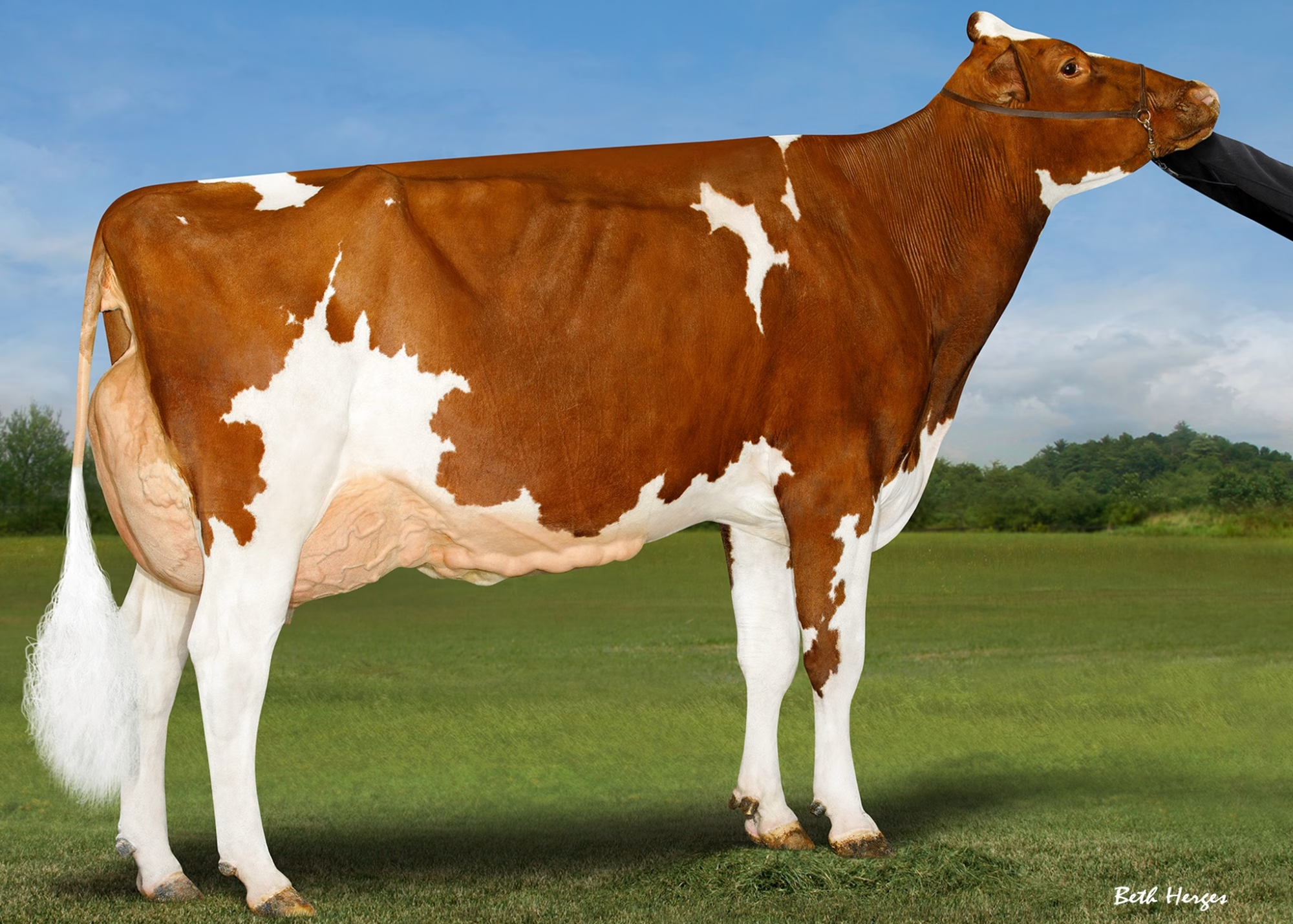
Milksource Boris Allura, a stunning Red & White Holstein bred and owned by Lauren and Brayden Breunig of Sauk City, Wisconsin. This exceptional dairy cow exemplifies the superior genetics and balanced breeding philosophy that has made the Breunig family's Mystic Valley Dairy a powerhouse in the industry. With her impressive frame, dairy strength, and striking red coat with crisp white markings, Allura represents the next generation of the breeding program that emphasizes longevity, components, and conformation. The Breunig family's commitment to "doing 100 little things right" extends from their record-breaking production herd to developing champion-caliber individuals like this remarkable Red & White. Photo by Beth Herges.
Milksource Boris Allura, a stunning Red & White Holstein owned by Lauren and Brayden Breunig of Sauk City, Wisconsin. This exceptional dairy cow exemplifies the superior genetics and balanced breeding philosophy that has made the Breunig family’s Mystic Valley Dairy a powerhouse in the industry. With her impressive frame, dairy strength, and striking red coat with crisp white markings, Allura represents the next generation of the breeding program that emphasizes longevity, components, and conformation. The Breunig family’s commitment to “doing 100 little things right” extends from their record-breaking production herd to developing champion-caliber individuals like this remarkable Red & White. Photo by Beth Herges.

A Day in the Life: Routine Is King at Mystic Valley

So, what does a typical day look like when you’re producing these kinds of numbers? Consistency, consistency, consistency.

The herd is milked three times daily, and Mitch is militant about minimizing time away from the pen and keeping lock-up periods short. “I am a big believer in time away from the pen being limited as well as lock-up time being very short,” he emphasized. It makes sense—every minute a cow spends standing in a holding area is a minute she’s not resting, ruminating, or eating.

They use the TAP feed system, which delivers a consistent diet daily. One thing I appreciated was how they handle refusals—instead of being wasted, they’re fed to dry cows and heifers. That kind of resource efficiency is an innovative dairy business.

Throughout the day, the team monitors key performance indicators using activity and rumination sensors. It’s not about replacing human observation but enhancing it with technology that can spot subtle changes before they become problems.

Contented Holsteins rest in spacious, well-bedded freestalls at Mystic Valley Dairy, showcasing how cow comfort and thoughtful barn design drive record-setting milk production and longevity
Contented Holsteins rest in spacious, well-bedded freestalls at Mystic Valley Dairy, showcasing how cow comfort and thoughtful barn design drive record-setting milk production and longevity.

Breeding for Balance: How Mystic Valley Built 115 Lifetime Production Stars

Many farms chase extremes in their breeding programs, but Mitch takes a different approach: “We breed for balance. Conformation is still important, especially when you have older cows.”

While they want high combined fat and protein (CFP) bulls, they insist on balanced fat and protein contribution. As Mitch put it, “The ebbs and flows of milk pricing are too hard to predict, so we want to be strong in both.” They also prioritize mastitis resistance, fertility, and livability.

Check out the daughter groups they’ve built:

Bull NameNumber of Daughters in HerdNotable Characteristics
Parfect65
Conway40
Sheepster (Trooper son)40Renegade grandson
Gameday30
RenegadeSignificant influence as foundation sire

The farm primarily uses NxGen bulls from Select Sires, focusing on high TPI sires that excel across multiple indexes.

“A key partner in this genetic success is Kevin Jorgensen from Select Sires,” Mitch notes. “Kevin has been instrumental in guiding our sire selections for years. We co-own several cows, which deepened our collaborative approach to breeding decisions. His expertise has been invaluable in building the genetic foundation we rely on today.”

Their commitment to building daughter groups, even in the genomic era, stood out to me. “Before genomics, we tried to use bulls we liked and made 50 daughters of them. It is a lot harder to do that using genomic sires, but with a bull like Parfect, we were able to have 65 daughters and Conway 40 daughters, which has us excited for the future,” Mitch shared.

The results speak for themselves—115 cows in the herd have surpassed 150,000 pounds of lifetime production. To put that in perspective, a cow typically needs at least five lactations to hit that mark, well beyond the industry average of less than 3. Now that’s longevity!

Fresh Cow Magic: The 7-Step System That Sets Up Success

If you ask me, transition cow management might be the most underrated aspect of dairy success. At Mystic Valley, they’ve turned it into a science:

TimingProtocol/Intervention
Pre-calvingAnion-cation balance with urine pH monitoring
At calvingJust-in-time movement to calving area
Immediately post-calving5 gallons warm water calcium drink
Morning after calvingBovicalc bolus
Throughout transitionCa-vital bolus for rumination
MonitoringActivity sensors for early intervention
Intervention if neededBHBA checks, alfalfa meal mix, rumastart boluses

What I found particularly interesting was their switch to a newer bolus. “Recently, we are using a different bolus called ca-vital, which is less expensive and effective at getting rumination to take off,” Mitch explained. That’s the kind of continuous improvement that keeps top herds at the summit—they’re never satisfied with “good enough.”

The system works remarkably well, with third-lactation and older cows averaging 152 pounds at peak milk. That’s about 50% higher than what you’d see in an average herd. Impressive stuff.

A Team Approach: The People Behind the Production

You might think technology drives operations like Mystic Valley, but at the end of the day, it’s all about people. The farm employs eight full-time staff members, including Mitch, plus one part-time feeder.

One thing that resonated with me was Mitch’s leadership style: “I believe in training how we want it done and then letting people do their job. You must also show what we value as the most important things and consistently coach people to do them better.”

Mystic Valley has created stability through respect and clear expectations in an industry plagued by labor shortages and high turnover. As Mitch put it, “I like to work alongside my employees to show them I am not asking for something I am not willing to do myself.” No wonder they’ve maintained consistent staffing when many farms struggle.

S-S-I Loyola-P Mazgof stands proudly showcasing the exceptional dairy type and mammary system that have made her a production powerhouse. This outstanding Holstein recently shattered <a href='https://www.thebullvine.com/news/farm-crisis-looms-record-low-bankruptcies-mask-looming-financial-disaster/' data-lazy-src=

Marketing Elite Genetics: How Mystic Valley Sells 140 High-Quality Cows Annually

The farm’s genetic excellence creates another revenue stream through the annual sale of approximately 140 young milking cows. These animals, primarily first and second-lactation cows fresh between 15-60 days, are sold a trailer load at a time.

“The marketing side of our operation wouldn’t be nearly as successful without Kevin Jorgensen’s involvement,” Mitch explains. “Beyond his role in our breeding program, Kevin helps market our cows to potential buyers. His industry connections and understanding of what makes our genetics valuable in the marketplace have been crucial to developing this additional revenue stream.”

Mitch’s approach to marketing reflects his overall philosophy of quality: “I try to sell cows I would want to milk myself, so it is important to calve in the best animals we can because we end up keeping the ones others don’t want to buy.”

The marketing strategy employs a selective approach that respects the buyer’s interests and fair market value. “Currently, I will give a choice of a group of 35 or so to pick 15 at a predetermined price,” Mitch explained. “It is important to know the market and price accordingly.”

The recent trend of beef-on-dairy breeding has significantly impacted the market in ways that benefit operations like Mystic Valley Dairy. “The influence of beef on dairy has been huge for us as the shrinking heifer population has increased demand and prices,” Mitch notes. This market dynamic has created additional revenue opportunities that help offset periods of tight margins in milk production.

Precision and consistency in action: Cows at Mystic Valley Dairy’s parlor deliver industry-leading milk yields, thanks to a focus on comfort, nutrition, and meticulous management.

Navigating Challenges: How Mystic Valley Handles Industry Headwinds

Let’s be honest—dairy farming isn’t all sunshine and record production. Mitch identifies labor and inflation as two significant hurdles facing elite operations like his.

His approach? “As the cost of production goes up, you can either spend less or improve margin through better output.” Rather than slashing costs, which can backfire by reducing productivity, they focus on improving efficiency to maintain margins even when expenses climb.

One fascinating strategy they’ve developed is using cattle sales as a financial safety net. “The ability to market cattle has been a game changer for us; when margins get tight, we can find additional revenue,” Mitch explained. They sell about 140 young milking cows annually, primarily first—and second-lactation animals fresh for 15-60 days.

I appreciated his candor about succession planning, which he admits is “our biggest weakness.” He’s focused on encouraging outside experience with relatively young children: “I think it’s important to get experience outside of our farm to bring back a different perspective than how Dad and Grandpa have always done it.” He doesn’t want them to feel obligated to return—the passion has to be genuine.

Setting the Bar Higher: Mystic Valley’s Future Goals

Even with their current stellar performance, Mitch isn’t sitting still. “Our next goal is 9 pounds of CFP per cow daily,” he told me, with an energy-corrected milk target of 130 pounds.

They focus on energy-corrected milk (ECM) rather than straight milk production. “We look at ECM of each cow more than straight milk production as it tends to rerank the cows considerably,” he explained. Their current components of 4.5% fat and 3.4% protein already demonstrate their commitment to high-value milk production rather than just volume.

Mitch acknowledges the biggest hurdle is the sheer energy demand of that production level, particularly in first-lactation animals where exceeding 7 pounds of CFP is challenging. But if there’s a farm that can crack that code, my money’s on Mystic Valley.

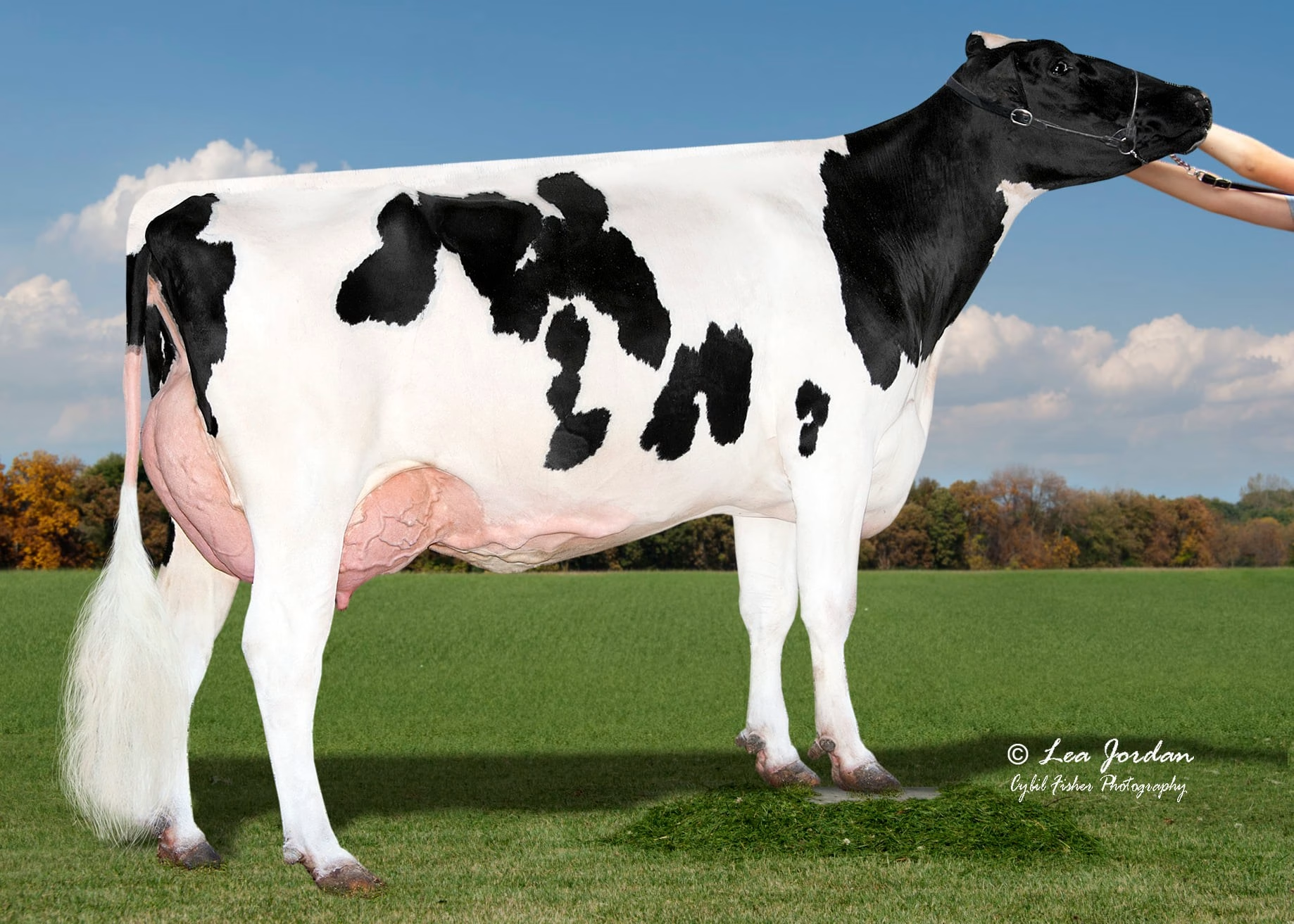
Jenny-Lou Wiggins 4515 EX-90 3Y displays the balanced conformation and dairy strength that exemplifies Mystic Valley Dairy's breeding philosophy. This impressive Holstein achieved her Excellent classification score at just three years of age, showcasing the superior genetics that have made the Jenny-Lou prefix world-renowned. Her strong frame, well-attached udder, and overall dairy character represent the type of cow that contributes to the operation's remarkable 125-pound energy-corrected milk average with 4.5% fat and 3.4% protein. As Mitch Breunig states in the article, their success comes from "doing 100 little things right" - including selecting for balanced type and production traits evident in exemplary animals like Wiggins. Photo credit: Lea Jordan/Cybil Fisher Photography.
Jenny-Lou Wiggins 4515 EX-90 3Y. This impressive Holstein achieved her Excellent classification score at just three years of age, showcasing the superior genetics that have made the Jenny-Lou prefix world-renowned. Her strong frame, well-attached udder, and overall dairy character represent the type of cow that contributes to the operation’s remarkable 125-pound energy-corrected milk average with 4.5% fat and 3.4% protein. Photo credit: Lea Jordan/Cybil Fisher Photography.

The Mystic Valley Philosophy: 100 Little Things Done Right

After understanding Mystic Valley’s approach, I realized there isn’t any single practice or innovation. It’s their comprehensive system where science-based management meets attentive animal husbandry. Mitch says, “We just want to do things well.”

That straightforward philosophy has created something remarkable—not just 125 pounds of energy-corrected milk (with an impressive 4.5% fat and 3.4% protein) and 8.4 pounds of fat and protein per cow daily with a 20% turnover rate, but a sustainable operation that’s influencing the industry while staying rooted in Wisconsin’s rich dairy tradition.

What Mitch and his team have built at Mystic Valley Dairy isn’t just impressive—it’s inspirational. They’ve shown that elite production can go hand in hand with cow longevity, that innovative practices can complement traditional values, and that doing “100 little things right” can add up to world-class results.

And isn’t that the essence of excellent dairy farming? The daily commitment to excellence, the constant refinement of practices, and the balance of science with animal husbandry. Mystic Valley isn’t just producing exceptional milk—they’re creating a blueprint for dairy success that others would be wise to follow.

Key Takeaways

  • Mystic Valley’s production excellence (125 lb ECM, 4.5% fat, 3.4% protein) comes from prioritizing cow comfort, including properly sized stalls for older cows and minimizing time away from pens.
  • Their nutrition program features a strategic 70-30 mix of corn silage (using a 3-way blend of BMR and conventional hybrids) and low lignin alfalfa, achieving 1.90 pounds of ECM per pound of dry matter.
  • The breeding philosophy emphasizes balance rather than extremes, focusing on combined fat and protein while maintaining strong conformation, mastitis resistance, and fertility.
  • A comprehensive 7-step fresh cow protocol, including specialized calcium supplementation and monitoring, helps third-lactation and older cows achieve peak milk of 152 pounds.
  • The farm’s success demonstrates that elite production can coexist with exceptional cow longevity when management focuses on consistent execution of fundamentals rather than seeking a single “magic bullet.”

Executive Summary

Mystic Valley Dairy, operated by Mitch Breunig near Sauk City, Wisconsin, has achieved remarkable production metrics with their 450 registered Holsteins producing 125 pounds of energy-corrected milk daily with impressive 4.5% fat and 3.4% protein components. Their success stems from a comprehensive approach focusing on cow comfort, balanced nutrition using a 70-30 forage mix, strategic breeding for balanced traits, and meticulous fresh cow management. Rather than relying on a single “magic bullet,” Breunig attributes their extraordinary results to “doing 100 little things right,” creating a sustainable operation with exceptional longevity (115 cows exceeding 150,000 pounds lifetime production) and a low 20% turnover rate. This philosophy extends to their team management, marketing strategy for selling 140 high-quality cows annually, and ambitious future goals of reaching 9 pounds of combined fat and protein daily.

Join the Revolution!

Join over 30,000 successful dairy professionals who rely on Bullvine Daily for their competitive edge. Delivered directly to your inbox each week, our exclusive industry insights help you make smarter decisions while saving precious hours every week. Never miss critical updates on milk production trends, breakthrough technologies, and profit-boosting strategies that top producers are already implementing. Subscribe now to transform your dairy operation’s efficiency and profitability—your future success is just one click away.
NewsSubscribe
First
Last
Consent
Send this to a friend