



Archive for H5N1 dairy outbreak

$950 Per Cow Is Only the Start: Bird Flu’s True Cost to Your Dairy

$4.4M in federal aid—still not enough. The $950/cow figure? It doesn’t count the high-genomic 2-year-old you had to cull because her quarter dried off.

Executive Summary: Cornell’s research puts H5N1 losses at $950 per clinically affected cow. Farmers who’ve lived through outbreaks say that’s just the starting point. The study tracked direct losses over 67 days but explicitly excluded breeding setbacks, lost premiums, and the genetic value of high-genomic animals you’re forced to cull—costs that compound long after the acute phase ends. One California dairyman received $4.4 million in federal aid and says his actual losses exceeded it. With 1,790 herds confirmed across 18 states and vaccine approval stalled by trade politics, the outbreak keeps growing, while biosecurity alone can’t stop a virus that spreads through workers traveling between farms. The playbook for producers: document every cost obsessively, fortify your financial reserves, and push your representatives hard—because we have the tools to fight this, and every month of delay is money out of your pocket.

You’ve probably heard the official estimate—about $950 per clinically affected cow. But farmers who’ve actually lived through H5N1 outbreaks are finding the true cost runs considerably higher. Here’s what the research shows, why it matters for your operation, and where things are headed.

Jonathan Cockroft didn’t need anyone to explain the math to him. When H5N1 swept through his Channel Islands Dairy Farms operation in California earlier this year, the federal indemnity payment came to about $4.4 million. His actual losses? They exceeded that figure—and kept climbing as the ripple effects moved through his breeding program and production cycle.

“The check helps,” Cockroft told the Los Angeles Times this past July. “But it doesn’t cover what we actually lost.”
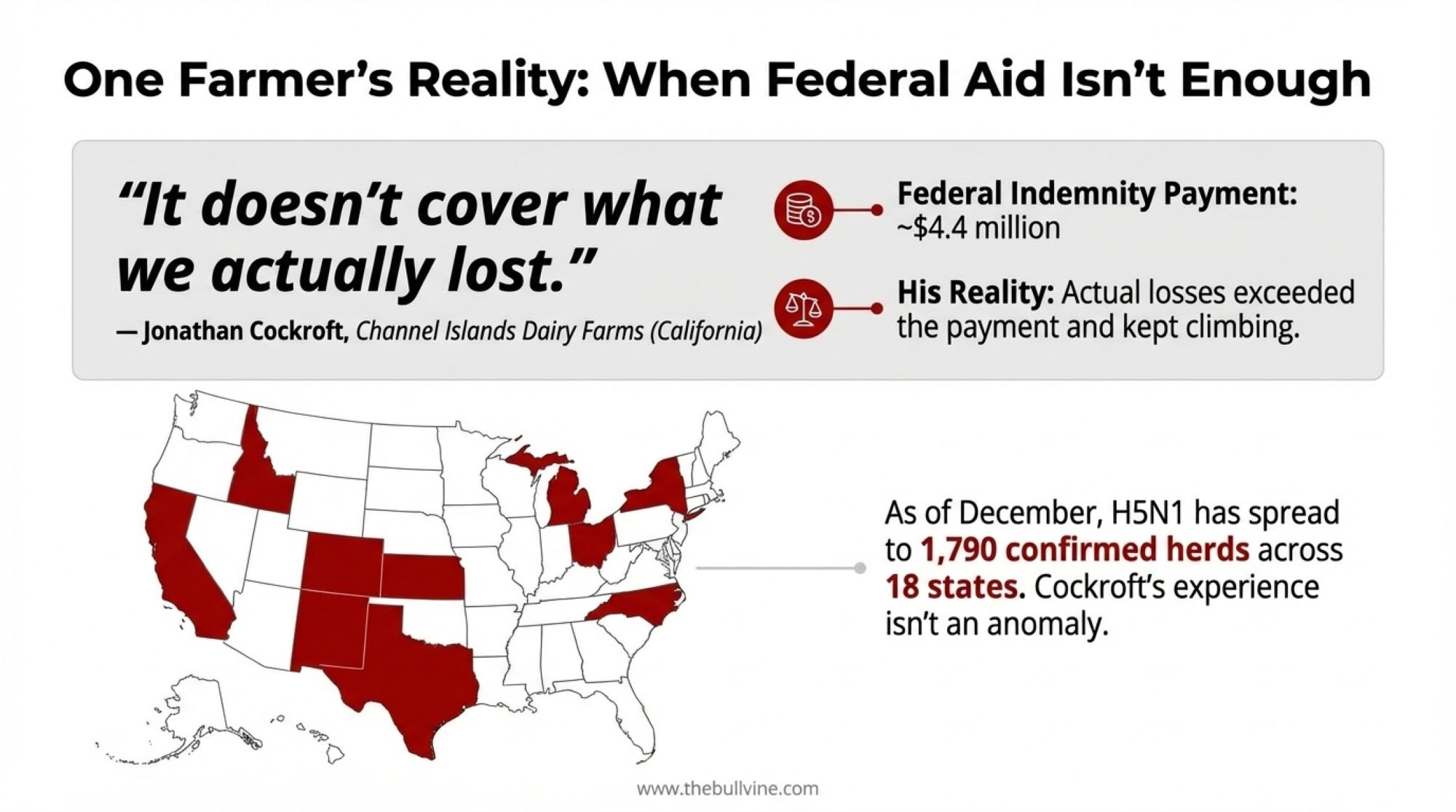
And you know, his experience isn’t unusual. As of early December, USDA APHIS data shows H5N1 has spread to roughly 1,790 confirmed herds across 18 states. That’s a significant jump from where we were even six months ago. Dairy producers from California’s Central Valley to Wisconsin’s dairy heartland are getting a hard education in the gap between official loss estimates and what actually shows up on the balance sheet.
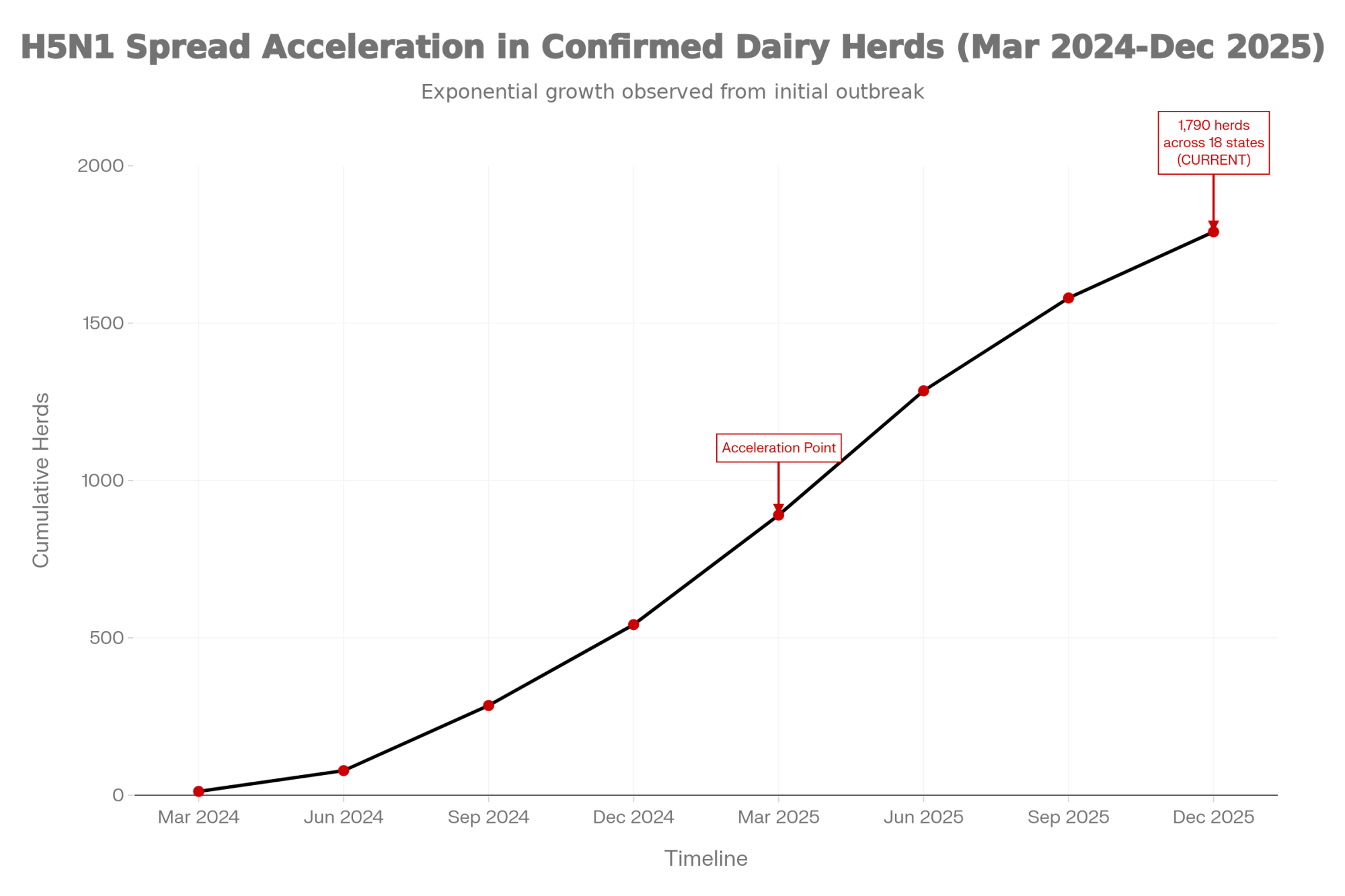
Understanding that gap isn’t about pointing fingers at anyone. It’s about helping you make informed decisions—about biosecurity investments, about financial planning, about the policy conversations happening right now in Washington.

The Economic Gap: What Research Measures vs. What Farms Experience

MetricOfficial Research (Cornell)On-Farm Reality
Loss Per Cow~$950 in direct, quantifiable lossesDirect losses + premiums, genetics, labor surge
Recovery Timeline67-day acute observation periodMonths before production normalizes
What’s CapturedMilk loss, mortality, and early cullingBreeding setbacks, SCC penalties, overtime costs
Key GapMeasures the acute phaseHidden costs compound across seasons

Source: Cornell University, Nature Communications, July 2025. On-farm observations from producer reports and USDA epidemiological summaries.

What the Official $950 Figure Actually Measures

Let’s start with what that number represents, because here’s the thing—it’s not wrong. It’s just measuring something specific.

That $950 figure comes from Cornell University research published in Nature Communications this past July. The researchers followed an Ohio dairy operation through a full H5N1 outbreak and documented direct economic losses per clinically affected cow, including decreased milk production, mortality, and early removal from the herd.

The study was thorough. They tracked a herd with 776 clinically affected lactating cows over a 67-day observation period and found total production losses averaging around 945 kilograms—that’s over 2,000 pounds, or nearly a ton of milk—per clinically affected cow. For that group, total documented losses came to approximately $737,500.

Fair enough. But what farmers on the ground are discovering is that the acute phase is really just the beginning of the story.

The Hidden Costs That Keep Adding Up

Recovery takes longer than the paperwork suggests. The Cornell team documented production impacts lasting at least two months in clinically affected cows, and many veterinarians and producers report that getting a herd back to its pre-outbreak groove can take considerably longer—especially when older cows or stressed transition cows are hit hard. Production doesn’t just snap back to baseline when clinical signs resolve. Some animals never fully recover their previous peak.

Reproductive impacts hit breeding programs hard. This is where operations with strong genetic programs really feel it. Abortion rates spike during outbreaks. Conception rates drop. Breeding cycles get disrupted in ways that take a full lactation cycle to sort out. I’ve spoken with producers who say they’re setting their breeding programs back a year or more.

For a Bullvine reader, this is the heartbreak. When you cull a high-genomic 2-year-old because her quarter dried off from H5N1, you aren’t just losing a cow—you’re losing the dam of your next sire analyst contract.

When you’ve invested years in genomic selection and careful mating decisions, watching that progress unravel is devastating—and none of that shows up in the per-cow calculation.

Quality premiums disappear. For operations built around butterfat performance or somatic cell count bonuses—and that’s a lot of farms in Wisconsin and the Northeast, especially—H5N1 is particularly brutal. SCC spikes during and after infection can disqualify milk from premium markets. A farm earning an extra dollar-fifty to two dollars per hundredweight on quality bonuses can watch that revenue stream vanish overnight. And rebuilding those numbers takes months of careful fresh cow management and culturing.

The labor-management surge is real. Farmers who’ve been through it describe round-the-clock monitoring during acute phases, increased veterinary visits, enhanced biosecurity protocols, and staff overtime. These costs don’t appear anywhere in the official calculations—they just get absorbed into that season’s operating expenses.

Genetic losses compound over the years. This one’s harder to put a number on, but it matters enormously if you’ve invested in your breeding program. When high-value animals are culled due to permanent udder damage or reproductive failure, decades of selection work can be undone. Anyone who’s built a herd over generations understands exactly what I’m talking about.

What This Means for Your Planning

So what does the true picture look like? Well, that depends on your operation. The Cornell research gives us a solid baseline of about $950 per clinically affected cow for direct, quantifiable losses. But—and here’s the key part—the researchers specifically note that their estimate doesn’t capture longer-term reproductive impacts or changes in herd structure.

Because of that gap, economists and producers expect the true long-run cost per affected cow to be higher than $950 once those additional factors are accounted for. How much higher depends on your genetics program, your premium market position, and how hard the outbreak hits your best animals.

For a 500-cow dairy experiencing a typical outbreak affecting 15-20% of the herd, even using just the verified $950 figure, you’re looking at direct losses of roughly $70,000-$95,000. Add in those hidden costs—the extended recovery period, the breeding setbacks, the lost premiums—and the true impact grows from there.


Cost Category
Cornell Study Captured?Cost Per Cow (USD)Timeline/Notes
Milk production loss (acute phase)Yes$62067-day observation period; ~945 kg lost per cow
Mortality & immediate cullingYes$230Direct animal replacement costs during outbreak
Acute veterinary & treatmentYes$100Medications, diagnostics, emergency care
Extended production depressionNo$1402-4 months post-clinical recovery; partial production
Breeding setbacks & abortionsNo$2806-12 months; delayed conception, lost calves
Quality premium losses (SCC/BF)No$1803-6 months to rebuild; varies by market
High-genomic animal genetic valueNo$100Permanent; irreplaceable selection progress
Labor surge & biosecurity operationsNo$85Outbreak duration + 30 days; overtime, PPE, monitoring
TOTAL VERIFIED (Cornell)$950What indemnity calculations use
TOTAL TRUE COST (full cycle)$1,735What your balance sheet actually shows

That’s a different planning conversation than the official numbers alone might suggest. And it helps explain why farmers like Cockroft find indemnity payments—helpful as they are—falling short of actual economic damage.

The Biosecurity Investment Question

Given those numbers, one of the most practical questions on everyone’s mind is straightforward: How much should I invest in enhanced biosecurity, and will it actually protect my operation?

What we’re seeing in the data is more nuanced than any of us would prefer.

The cost picture is clearer than the effectiveness picture. USDA’s current support program offers up to $28,000 per premises for biosecurity improvements, covering a significant portion of equipment and infrastructure costs. That’s genuinely helpful. But when you work through what comprehensive implementation actually requires—enhanced disinfection systems, dedicated PPE facilities, separate equipment for different areas of operation—the investment adds up quickly. And then there are ongoing operational costs for uniform laundering, PPE supplies, and additional labor that continue month after month.

Now for the harder question: does it work?

USDA’s epidemiological audits of affected dairy operations revealed something that complicates this conversation. Even farms with enhanced biosecurity protocols in place experienced continued transmission in a meaningful percentage of cases.

The reason isn’t that farmers are doing something wrong—and I want to be really clear about that. It’s that the primary transmission pathway operates at a level that individual farm protocols can’t fully address.

The Network Problem Worth Understanding

Here’s what I’ve found most eye-opening in reviewing the outbreak investigations: the role of worker mobility.

According to USDA APHIS epidemiological summaries reported by CIDRAP, about 20% of dairy workers on affected farms also work on other dairy operations. About 7% of workers on affected dairy farms also worked on poultry farms. And roughly 62% of farms shared vehicles for transporting cattle, with only about 12% cleaning them before use.

Think about what that means from a practical standpoint. The virus can travel on boots, clothing, and equipment between operations. It’s not that anyone is being careless—it’s the structural reality of how dairy labor markets function, especially in regions where farms are smaller and can’t always offer forty hours a week year-round. Workers need income from multiple sources. The resulting movement creates transmission pathways that no individual operation can fully control, no matter how good their on-farm protocols are.

The takeaway for most of us is this: biosecurity investments remain valuable. They reduce risk, demonstrate due diligence, and protect against multiple disease threats beyond just H5N1. But under current conditions, even excellent protocols provide only risk reduction, not elimination. Any farmer evaluating biosecurity spending should factor that reality into their calculations—and into their financial planning for potential outbreak scenarios.


Biosecurity Measure
Typical InvestmentRisk Reduction PotentialLimitation/Gap
Enhanced disinfection stations$8,500-$12,000Moderate (30-40% reduction in surface contamination)Doesn’t address worker clothing/vehicle transfer between farms
Dedicated PPE & laundering systems$6,000-$9,500 + $400/month ongoingModerate-High (50-60% reduction in barn-to-barn spread)Limited if workers commute from other dairy operations
Visitor/vendor protocols & separate entry$3,500-$7,000Low-Moderate (20-35% reduction in external introduction)Feed trucks, milk haulers, and AI technicians still cross farms daily
Cattle movement quarantine protocols$2,000 + $150/head quarantine costHigh (60-70% reduction from purchased cattle)62% of farms share cattle transport vehicles; 12% clean between use
Worker health monitoring & education$1,500-$3,000 + staff timeModerate (35-45% reduction in symptomatic transmission)20% of dairy workers work multiple operations; 7% also work poultry farms
TOTAL comprehensive implementation$21,500-$35,000 upfront + ~$600/monthCumulative: 40-55% risk reductionEven farms with “enhanced protocols” experienced continued transmission in USDA audits
USDA biosecurity cost-share availableUp to $28,000 per premisesCovers 65-80% of upfront investmentDoesn’t eliminate the transmission network problem

Where Things Stand on Vaccines

No topic generates more questions in dairy right now than vaccination. Let me walk you through what we actually know versus what’s still developing, because there’s a lot of incomplete information floating around out there.

On the product side, Medgene Labs has developed an H5N1 vaccine for cattle, and they’re working with Elanco for commercial distribution. According to Hoard’s Dairyman reporting from March, the vaccine has met all requirements of USDA’s platform technology guidelines and is in the final stages of review for conditional license approval.

Alan Young, Medgene’s Chief Technical Officer, told Agri-Pulse earlier this year that they’re confident the data meets expectations for conditional licensure. So the product exists and appears to work. The holdup is elsewhere.

What’s slowing things down? Several factors are at play, and I want to present them fairly because reasonable people disagree about the tradeoffs involved.

Trade concerns from the poultry sector have been significant. The National Chicken Council and related organizations have expressed worry that vaccination—even limited to dairy—could trigger trading partner restrictions affecting poultry exports. Their concern is that any U.S. vaccination program signals endemic infection to foreign markets, potentially closing doors for chicken and turkey products. Given that U.S. chicken exports alone totaled about $5 billion in 2024, according to industry data, that’s a substantial consideration. We shouldn’t dismiss it out of hand, even if we might weigh the tradeoffs differently.

USDA leadership has also cited a desire for additional field data. Secretary Brooke Rollins told Agri-Pulse in March that there’s “a tremendous amount of work to do before we would even consider that as a potential solution” and that vaccination remains “at least a year or more away.” Whether you agree with that timeline or not, it’s worth noting that regulatory agencies tend to be cautious, especially when trade implications are involved.

What dairy industry leaders are saying is a bit different. The National Milk Producers Federation, International Dairy Foods Association, and multiple state dairy organizations have called for accelerated vaccine deployment. IDFA President Michael Dykes stated in February that the industry continues to “urge USDA and its federal partners to act quickly to develop and approve the use of safe, effective bovine vaccines.” There’s genuine frustration in the dairy community about the pace of progress.

Here’s what I find particularly noteworthy about the trade concern: restrictions are arriving regardless of vaccination status. The Canadian Food Inspection Agency has implemented testing requirements for dairy cattle imports. EU food safety and animal health agencies have raised concerns about H5N1 in U.S. dairy in their risk assessments. Australia and several other markets have enhanced their protocols.

That reality suggests the original calculus around vaccination and trade may need updating. If restrictions are emerging based on infection presence rather than vaccination policy, the argument for delaying vaccines to protect trade relationships becomes less compelling. But these are genuinely complex tradeoffs, and I don’t think anyone has a monopoly on the right answer here.

The Viral Evolution Picture

For farmers trying to assess longer-term risk, let me explain what researchers are watching on the scientific side—because it matters for understanding the urgency of this issue.

The concern among virologists is that continued circulation in mammalian populations increases the likelihood that the virus will acquire mutations that enhance transmission. Each additional month of cattle-to-cattle spread means more viral replication cycles, and with more replication comes more chances for random mutations—most of which are neutral, but some of which could matter.

A newer variant designated D1.1 has been detected in dairy cattle. According to WeCAHN tracking data, it was first confirmed in Nevada on January 31, 2025, and then identified in Arizona on February 11. Some field reports suggest that D1.1-positive herds are seeing more noticeable respiratory signs alongside mastitis, though researchers are still working to define that pattern.

The third major concern—full adaptation for efficient human-to-human transmission—hasn’t been observed. Current human cases remain sporadic with no sustained person-to-person spread documented. But the scientific consensus is that the longer this virus circulates in mammalian populations, the more opportunity it has to evolve in concerning directions. That’s not cause for panic. But it does underscore why public health officials, veterinary researchers, and dairy industry leaders are pushing for faster action.

What Proactive Herds Are Doing Right Now

Across the country, dairy producers aren’t waiting for Washington to reach consensus. Here’s what the smartest operators are doing:

Building Documentation Systems: Smart operators are logging every dime—not just for taxes, but for the inevitable indemnity fights. Production impacts, recovery timelines, breeding disruptions, veterinary costs, overtime hours. If you ever need to show a Congressional office what this actually costs, specific numbers from your own operation are far more compelling than industry averages.

Restructuring Labor: Where possible, larger herds are stopping the “shared worker” loop to cut transmission lines. That’s not feasible for everyone—labor economics are what they are, especially for smaller operations—but farms that can offer consistent full-time hours to keep workers on single operations are reducing one key pathway.

Investing in Early Detection: Daily milk tracking by string is catching drops before clinical signs explode. Farms with strong veterinary relationships are developing monitoring protocols that identify problems early. Close observation of fresh cows—who seem particularly susceptible—and rapid veterinary consultation at the first sign of trouble can reduce outbreak severity even if they can’t prevent infection entirely.

Strengthening Financial Reserves: Producers who’ve watched neighboring operations go through outbreaks are reviewing credit lines, cash positions, and insurance coverage. The farms that weather this best will be those that planned for the possibility before it arrived. That’s not pessimism—it’s the kind of practical risk management that successful dairy operations have always practiced.

Engaging the Policy Conversation: Producer organizations at the state and national levels are amplifying messages to USDA. Individual farmers are contacting Congressional offices. That kind of sustained engagement matters—it reflects dairy constituents making clear that the current pace isn’t acceptable.

Looking Ahead: What to Watch For

Looking ahead, here’s how this might unfold depending on decisions made in the coming months:

If vaccine deployment accelerates and USDA moves forward with conditional approval, transmission could be substantially reduced within six to nine months of deployment. Trade negotiations would need to happen in parallel, but early engagement with trading partners could establish protocols maintaining market access for vaccinated herds. This is the path dairy industry organizations are advocating for.

If the current approach continues with the primary focus on biosecurity and surveillance rather than vaccination, the outbreak will likely continue to expand. Economic losses would keep accumulating. Trade relationships would probably deteriorate further regardless. And the virus would keep circulating—and potentially evolving—in the dairy cattle population.

Regional variation might emerge as a third possibility. Some states might pursue their own approaches more aggressively, creating a patchwork of policies. California’s substantial investments in outbreak response suggest a willingness to act independently. That could accelerate action in some areas while complicating interstate commerce for operations that regularly move cattle across state lines.

Which scenario we end up with depends substantially on decisions made in the next several months. USDA’s next quarterly assessment and any movement on the Medgene conditional license application will be key indicators to watch heading into early 2026.


Scenario
Timeline to DeploymentAdditional Herds Affected (Projected)Cumulative Industry LossKey Tradeoff/Note
Accelerated approval & deployment3-6 months (by June 2026)+450-650 herds$1.8-2.4 billionRequires immediate conditional license; trade protocols negotiated in parallel
Current pace (“at least a year”)12-18 months (by June 2027)+1,800-2,400 herds$4.2-5.8 billionContinues Sec. Rollins timeline; mounting trade restrictions regardless
Extended delay (trade-focused)18-24+ months (late 2027+)+2,800-3,600 herds$6.5-8.9 billionTrade restrictions emerging anyway; poultry export rationale weakens as spread continues
Regional/state-led patchwork6-12 months (varies by state)+900-1,400 herds$2.8-3.9 billionCalifornia and other high-density states act independently; creates interstate commerce complications
Current baseline (no vaccination)1,790 herds as of Dec 2025$2.1-3.1 billion to dateUsing $950-$1,735 per affected cow range × avg herd size ~150 lactating cows × clinical rate ~18%

Note: Loss estimates use Cornell’s verified $950/cow minimum and true cost range up to $1,735/cow, applied to average affected herd clinical rates of 15-20% with 150-200 lactating cows per operation. Projections assume continued monthly growth rates of 200-350 new herds based on Q3-Q4 2025 trends.

What This Means for Your Operation

Let me pull this together into practical considerations.

On understanding the economics: The verified research shows direct losses of about $950 per clinically affected cow—that’s from the Cornell study published this summer. But because that estimate doesn’t include longer-term reproductive impacts or herd-structure changes, the true cost is likely higher once those factors play out. Budget accordingly.

On biosecurity investments: Enhanced biosecurity reduces risk but can’t eliminate it given current transmission dynamics—and that’s not a criticism of biosecurity, just a realistic assessment of what it can accomplish given the network transmission problem. USDA support helps with upfront costs. Just go in with realistic expectations about what any individual farm can control.

On the vaccine conversation: Products are in advanced regulatory review. Industry organizations are pushing hard for acceleration while trade concerns create cross-pressures. Importantly, trade restrictions are emerging regardless of vaccination policy, which changes the calculus somewhat. Stay engaged with producer organizations tracking this situation, because developments could come quickly once decisions are made.

On protecting your operation now: Document everything with specifics. Maintain strong veterinary relationships focused on early detection. Review your financial reserves and credit availability against realistic outbreak scenarios. And engage your representatives with your own farm’s story—specific examples matter enormously in policy discussions.

The Bottom Line

The H5N1 situation represents one of the most significant challenges American dairy has faced in decades. What’s frustrating for many of us is the sense that solutions exist—vaccines are in development, regulatory pathways are established, the science is reasonably clear—but the gap between what’s possible and what’s actually happening remains wide.

Understanding the full economic picture, the transmission dynamics, and the policy landscape helps you make informed decisions and advocate effectively for practical solutions. That’s what this comes down to: having the information you need to protect your operation and push for the responses this situation demands.

We’ve actually got most of the tools we need. The real question is whether we’ll use them in time. And that’s a question dairy farmers shouldn’t have to answer on their own.

Key Takeaways

  • $950/cow is just the beginning. Cornell tracked direct losses over 67 days—breeding setbacks, lost premiums, and genetic value weren’t counted.
  • The hidden costs are brutal. Months of depressed production. Quality bonuses gone. High-genomic animals were culled because their quarters dried off. It compounds.
  • Biosecurity helps, but can’t solve this. 20% of dairy workers work across multiple farms, creating transmission pathways that no single operation can control.
  • Vaccines exist. Approval doesn’t. Medgene’s product is stuck in regulatory review while 1,790 herds across 18 states keep absorbing losses.
  • Your playbook: Document every dollar. Build reserves now. Push your reps hard. The tools to fight this exist—demand they get used.

Complete references and supporting documentation are available upon request by contacting the editorial team at editor@thebullvine.com.

Learn More:

Join the Revolution!

Join over 30,000 successful dairy professionals who rely on Bullvine Weekly for their competitive edge. Delivered directly to your inbox each week, our exclusive industry insights help you make smarter decisions while saving precious hours every week. Never miss critical updates on milk production trends, breakthrough technologies, and profit-boosting strategies that top producers are already implementing. Subscribe now to transform your dairy operation’s efficiency and profitability—your future success is just one click away.

NewsSubscribe
First
Last
Consent

H5N1 Dairy Crisis Enters Critical Phase as Economic Losses Exceed $950 Per Infected Cow

H5N1 devastates milk yield with 900kg losses per cow while 90% spread silently. Your milking parlor = ground zero. Are you prepared?

EXECUTIVE SUMMARY: The dairy industry’s traditional biosecurity playbook just became obsolete—H5N1 has rewritten the rules by turning your milking parlor into the primary disease transmission vector, not wild birds. Cornell University’s groundbreaking research reveals that infected operations face catastrophic losses averaging $950 per clinically affected cow, with total herd impacts reaching $737,500 for large-scale operations[1][2]. Mathematical modeling confirms current industry interventions have prevented only 175.2 additional outbreaks, proving our response strategies are barely scratching the surface of this evolving threat. While Europe congratulates itself on zero confirmed cases, research shows European cattle breeds possess identical susceptibility patterns to U.S. herds, with the virus’s inevitable arrival being a matter of “when,” not “if”[1]. The virus spreads with alarming stealth—90% herd exposure despite only 20% showing clinical symptoms—making traditional visual monitoring completely inadequate for early detection[3]. Canada’s proActive program has successfully prevented H5N1 entry through mandatory biosecurity integration, proving that proactive preparation works infinitely better than reactive crisis management[1]. Forward-thinking producers must immediately abandon outdated poultry-focused biosecurity models and implement “Fortress Farm” protocols before this industry-defining threat reaches their operation.

KEY TAKEAWAYS

  • Eliminate raw waste milk feeding immediately to prevent 50%+ mortality in farm cats and potential viral amplification—switch to pasteurized alternatives or milk replacer to break the deadliest transmission pathway that most operations ignore. This single change can prevent catastrophic spillover events that transform your farm into a multi-species disease reservoir.
  • Implement dedicated milking parlor biosecurity with N95 respirators, dedicated gloves per cow, and complete equipment disinfection cycles after every session—the mammary gland-centered pathogenesis means your milking equipment has become the primary cow-to-cow transmission vector, not respiratory droplets. Operations ignoring this shift face inevitable herd-wide contamination within days of introduction.
  • Adopt Canadian-style “closed herd” philosophy with mandatory 30-day quarantine and pre/post-movement testing for all animal introductions—mathematical models show this approach prevents the interstate spread patterns that have devastated over 959 U.S. dairy herds across 16 states. The $28,000 USDA biosecurity support per farm proves prevention costs far less than outbreak response.
  • Install precision monitoring systems that detect rumination and milk production declines 5-7 days before clinical diagnosis—Cornell research confirms behavioral changes precede visual symptoms, enabling isolation protocols that could prevent the 90% herd exposure rates documented in infected operations. Early detection transforms potential $737,500 losses into manageable, isolated cases.
  • Prioritize genetic resilience in breeding decisions as H5N1 targets your highest-producing, most genetically valuable multiparous cows disproportionately—the virus’s mammary gland tropism means superior TPI scores amplify economic vulnerability, requiring breeding programs to balance production traits with disease resistance markers. This genetic shift protects decades of genetic investment from permanent productivity compromises.
dairy biosecurity protocols, H5N1 dairy outbreak, farm profitability protection, dairy production losses, dairy risk management

Let’s be honest – while you’ve been focused on optimizing genetics and precision agriculture, a biosecurity disaster has been quietly devastating the industry’s foundation. Comprehensive research now reveals H5N1’s catastrophic economic impact has reached $950 per infected cow, with total herd losses exceeding $737,500 for large operations. As the outbreak enters its second year, are you prepared for the harsh reality that your operation could be next?

The numbers don’t lie, and they’re brutal. The latest research from Cornell University and other academic institutions confirms that H5N1’s emergence in dairy cattle represents more than just another disease challenge – it’s a fundamental threat to everything progressive dairy producers have built through decades of genetic advancement and technological investment.

Here’s what the industry doesn’t want to admit: this outbreak has already changed the game permanently.

How Bad Is “Bad” Really?

The U.S. Department of Agriculture confirms H5N1 has now devastated over 959 dairy herds across 16 states, making this the largest mammalian influenza outbreak in modern agricultural history. However, here’s the kicker: mathematical modeling published in Nature Communications reveals that current interventions have prevented only 175.2 reported outbreaks.

Translation? We’re barely making a dent in this thing.

What This Means for You: The outbreak’s geographic spread proves no dairy region remains immune. The virus has established itself as a permanent feature of the North American disease landscape, with spillover events documented in multiple mammalian species, including red foxes, sea lions, and bears.

Think your state’s doing better? Think again. Current CDC surveillance data indicate that the outbreak began in March 2024, when HPAI H5N1 was first confirmed in Texas dairy cattle. The virus has maintained relentless spread patterns despite everything we’ve thrown at it, with genetic sequencing revealing the emergence of genotype B3.13 through multiple reassortment events.

Production Disasters That’ll Keep You Up at Night

Remember all those efficiency gains you’ve worked years to achieve? H5N1 can destroy them in weeks. Cornell University’s devastating analysis of a 3,900-cow Ohio operation reveals the brutal truth: the total economic loss for the herd reached $737,500 over the observation period.

Here’s the reality check: individual cow losses average $950 per clinically affected animal. However, it gets worse – studies show that milk production can plummet by 10-20% for periods of 7-10 days during acute infections. A Michigan dairy study demonstrates the virus’s devastating efficiency, with a cumulative incidence of 32% among herds during outbreaks.

Real-World Impact: The primary site of viral replication isn’t the lungs, but rather the mammary gland. Post-mortem examinations reveal severe necrotizing and suppurative mastitis, with viral loads in raw milk measuring between 10⁴ and 10⁸ plaque-forming units per milliliter.

But wait – it gets worse. Research confirms that a significant drop in milk production can persist for at least 60 days following an outbreak. These aren’t just sick cows anymore – they’re “zombie cows” that survive but never regain economic viability.

Are you starting to see why this isn’t just another case of mastitis?

The Genetic Nightmare You Haven’t Considered

Here’s something the genetics companies aren’t advertising: this virus targets your most productive animals explicitly. The high concentration of virus in milk, combined with the physical milking process, creates perfect conditions for transmission. Contaminated milking equipment—specifically clusters, liners, and milk lines—serves as the primary vector for mechanically transmitting viruses from infected udders to healthy ones.

Your milking parlor has become a biocontainment hot zone. The process involves pressure changes and potential aerosolization of milk droplets, transforming what should be your most efficient operation into a high-risk environment for both animals and workers.

How much genetic progress are you willing to lose to preventable biosecurity failures?

The European Wake-Up Call

While Europe congratulates itself on zero confirmed cases, the reality is sobering. Research conducted at Wageningen Bioveterinary Research confirms that European H5N1 isolates can efficiently replicate in cultured bovine airway epithelial cells. European cattle breeds exhibit identical susceptibility patterns to those of U.S. herds.

European Food Safety Authority risk assessments identify two primary pathways for virus introduction: migratory birds using transatlantic flyways and contaminated trade products. Key stopover sites, such as the Wadden Sea region, are designated as critical surveillance zones.

The threat isn’t theoretical – it’s inevitable. The only question is whether European operations will learn from America’s disaster or repeat it.

Technology Failures When You Need Them Most

Think your precision agriculture investments will save you? Think again. The outbreak highlights how modern dairy technology can become a liability without proper biosecurity integration. The milking parlor has emerged as the epicenter of cow-to-cow spread, transforming your automated systems into disease amplification vectors.

Farm-to-farm spread occurs through the movement of infected but often asymptomatic lactating cows, which is definitively linked to the transmission of the virus across state lines. Secondary vectors include shared personnel, vehicles, and farm equipment.

Your technology is only as good as your biosecurity protocols. Currently, most operations are failing in both areas.

The Amplification Pathway Nobody Talks About

Here’s a particularly dangerous discovery: the common practice of feeding raw, unpasteurized waste milk to other farm animals creates a deadly amplification pathway. Research documents mortality rates exceeding 50% in farm cats that consumed raw milk from infected cows, starkly illustrating the virulence of bovine-passaged virus.

This finding transforms waste milk management from a routine operation into a critical biosecurity control point. The high viral loads in raw milk make it the single most high-risk material on infected farms.

European Vulnerability: The Policy Gap

The European Union has sophisticated animal health frameworks in place, as outlined in the Animal Health Law, which grants authorities the power to implement rapid, harmonized control measures. However, the EU framework is overwhelmingly poultry-centric, currently lacking specific, mandated HPAI biosecurity protocols for dairy farms.

This creates a significant policy gap. While Europe maintains robust general biosecurity principles, these are insufficient to counter the unique udder-to-udder transmission pathway of HPAI in dairy herds.

What’s next when this virus inevitably reaches European shores?

The Immunity Breakthrough That Changes Everything

Finally, some good news. Groundbreaking research from the Vaccine and Infectious Disease Organization provides the first evidence that dairy cattle can develop natural immunity following H5N1 exposure. Studies conducted in containment Level 3 Agriculture facilities demonstrate that cows re-exposed to the virus showed no signs of disease and maintained steady milk production.

“Our findings demonstrate that natural infection can induce immunity that protects against reinfection in other parts of the udder,” confirms research from VIDO. This discovery suggests vaccine development could prove highly effective for herd protection.

But here’s the question: how many more operations will we lose before effective vaccines reach the market?

Financial Reality Check: The True Cost of Complacency

The U.S. response demonstrates the massive public cost of reactive biosecurity. The USDA has allocated $824 million in new funding, with up to $28,000 per farm in biosecurity support. Financial assistance programs offer up to $10,000 for veterinary costs and $8,000 for milk disposal per premises.

But prevention costs far less than response. The economic devastation stems from morbidity, not mortality, with principal financial damage from sustained milk production losses and premature culling of “recovered” animals.

Think about the math: individual farm losses of $737,500 for a 3,900-cow operation translate to approximately $950 per clinically affected cow. How does that compare to your annual biosecurity budget?

The Canadian Model: What Success Looks Like

Want to see what proactive biosecurity actually accomplishes? Look north. Canada’s approach centers on the national proAction program, an industry-led quality assurance framework mandatory for all Canadian dairy producers. This program integrates biosecurity as a core component of farm management, requiring regular risk assessments and documented protocols.

The Canadian model promotes a “closed herd” philosophy as the gold standard, with rigorous testing and quarantine protocols. This comprehensive system has prevented HPAI from entering Canadian dairy herds, demonstrating that preparation is more effective than response.

Critical Biosecurity Failures: Learning from Disaster

The U.S. experience identifies specific failure points that every operation must address immediately. Detection of HPAI in asymptomatic cattle complicates surveillance and control, suggesting the virus may be more widespread than clinical signs indicate.

The phenomenon of “recovered” but permanently less productive cows represent a hidden, long-term economic drain not captured in initial loss estimates. These “zombie cows” become capital liabilities, challenging traditional economic models of disease impact.

Mandatory Action Items:

  • Immediate cessation of raw waste milk feeding to any farm animals
  • Implementation of dedicated glove policies for milking personnel
  • Establishment of physical separation protocols for equipment and personnel
  • Adoption of closed herd management philosophy

The Latest: Where We Stand Now

Here’s the bottom line: H5N1 has permanently altered the dairy industry landscape. The virus’s unique pathogenesis centered on mammary gland tissue fundamentally challenges existing biosecurity paradigms focused on respiratory transmission routes.

Mathematical modeling confirms that current interventions have prevented only a fraction of potential outbreaks, highlighting both the virus’s efficient adaptation to dairy environments and the critical importance of implementing comprehensive biosecurity.

The harsh reality: This isn’t a crisis you can wait out. Research confirms the virus has established itself as a permanent feature of the disease landscape, with spillover events continuing to occur across multiple mammalian species.

The difference between survival and devastation comes down to one fundamental choice: Will you implement fortress-level biosecurity now, or become another casualty statistic?

Your immediate action checklist:

  • Stop feeding raw waste milk today – switch to pasteurized alternatives or milk replacer
  • Implement dedicated PPE protocols – N95 respirators and eye protection for all milking personnel
  • Establish quarantine procedures – 30-day isolation for all new animals with pre- and post-movement testing
  • Create equipment sanitation cycles – complete disinfection after every milking session
  • Adopt closed herd management – minimize animal movements and maintain detailed visitor logs

As this outbreak enters its second year, operations that refuse to prioritize biosecurity will face elimination through preventable economic losses. The choice is stark: adapt immediately or join the growing list of casualties in agriculture’s most devastating disease outbreak.

The virus isn’t going away. The question is whether you’ll be prepared when it arrives at your farm gate.

Complete references and supporting documentation are available upon request by contacting the editorial team at editor@thebullvine.com.

Learn More:

Join the Revolution!

Join over 30,000 successful dairy professionals who rely on Bullvine Weekly for their competitive edge. Delivered directly to your inbox each week, our exclusive industry insights help you make smarter decisions while saving precious hours every week. Never miss critical updates on milk production trends, breakthrough technologies, and profit-boosting strategies that top producers are already implementing. Subscribe now to transform your dairy operation’s efficiency and profitability—your future success is just one click away.

NewsSubscribe
First
Last
Consent

Idaho at the Epicenter: The Evolving H5N1 Outbreak in U.S. Dairy Cattle

Idaho’s H5N1 crisis hits 86 herds-milk production plummets. Learn how dairy giants are battling this viral threat.

EXECUTIVE SUMMARY: Idaho’s dairy industry faces an unprecedented H5N1 avian influenza outbreak, with 86 herds infected since March 2024. The virus, concentrated in the state’s south-central dairy belt, spreads via contaminated equipment, cow-to-cow contact, and farmworker movement, slashing milk yields by up to 40% in affected herds. While pasteurized milk remains safe, raw milk poses serious risks, and infected farms face losses averaging 0 per cow. Federal and state agencies are deploying quarantines, biosecurity mandates, and financial aid, but asymptomatic transmission and lax PPE adoption threaten long-term containment.

KEY TAKEAWAYS:

  • Idaho’s Hotspot Status: 86 herds quarantined in 4 counties, driven by dense farm networks and shared equipment.
  • Transmission Triggers: Milking parlors are ground zero-virus survives 1+ hours on surfaces, with 25% of farms reusing manure/feed tools.
  • Economic Blow: $950/cow losses over 60 days; state milk production dropped 3% initially.
  • Safety Split: Pasteurization neutralizes H5N1, but raw milk risks zoonotic spread-linked to cat deaths on 50% of farms.
  • Response Gaps: Voluntary testing and optional PPE in Idaho vs. proactive measures in states like Washington.
H5N1 dairy outbreak, Idaho dairy farms, avian influenza cattle, milk production loss, dairy biosecurity

Idaho’s dairy farmers are battling a perfect storm as H5N1 avian influenza rips through the state’s herds, with 86 confirmed cases since March 2024, making it ground zero in the nationwide outbreak. The virus has targeted Idaho’s powerhouse dairy region, where officials quarantined 59 herds across Gooding, Jerome, Twin Falls, and Cassia counties. For the nation’s third-largest milk-producing state with over 350 family-owned operations, this outbreak isn’t just threatening milk checks – it’s forcing a fundamental rethink of how we protect our herds, workers, and milk supply.

This isn’t your granddaddy’s cattle disease. H5N1 spreads like gossip at the county fair – through contaminated milking equipment, cow-to-cow contact, workers moving between farms, and cattle shipments. Research confirms this virus clings to milking units like a tick to a hound dog, surviving on surfaces for over an hour.

When this bug hits your herd, it leaves a calling card you can’t miss milk production drops faster than feed prices during a drought, while the milk itself turns thick as molasses – yellowish-brown and colostrum-like. Cows lose their appetite, manure consistency changes, and sometimes spike a low-grade fever.

Idaho’s Dairy Empire Takes a Punch

The financial bruising hits producers where it hurts most – right in the bulk tank. While early estimates from the American Association of Bovine Practitioners suggested costs of $100-200 per infected cow, real-world studies paint a much bleaker picture. A detailed Cornell study documented losses reaching $950 per clinically affected cow over 60 days, translating to potential losses of up to $200,000 for a 1,000-cow operation.

“We lost 40% of our tank overnight,” says Jerome County dairyman J.D. Holt. “Now I eye every milk filter like it’s a biohazard. Even with production bouncing back, this virus has changed how we think about basic operations we’ve done the same way for decades.”

Idaho briefly saw milk production dip about 3% during the early outbreak months, though it’s since recovered. Don’t let those numbers fool you, though – individual farms took devastating hits while the state’s massive production volume absorbed the shock.

The cruel irony? The factors that powered Idaho’s dairy boom – concentrated production regions, mega-operations, and integrated supply chains – created perfect highways for spreading this virus. Have you noticed how Gooding and Jerome counties became ground zero? When your neighbors are just down the road, and you’re all using the same milk trucks, veterinarians, and feed suppliers, one farm’s problem becomes everyone’s nightmare faster than you can say “biosecurity breach.”

Transmission Highways Need New Traffic Cops

The milking parlor has emerged as viral ground zero – where this disease hitchhikes from cow to cow. With virus-packed milk flowing through equipment that touches multiple cows, you might as well be running a disease distribution system alongside your milk harvesting operation. Isn’t it time we rethink basic milking protocols?

The biosecurity holes on affected farms would make Swiss cheese jealous. Over half the operations using shared livestock transport admitted they barely clean between loads. Workers bounce between farms like pinballs, tracking who-knows-what on their boots and clothes. Even worse, more than 25% of affected dairies used the same manure and feed-handling equipment. That’s like using your dinner fork to clean the toilet – then eating without washing it.

Farm cats became unexpected sentinels, with over 50% of farms reporting cats falling sick or dying after drinking contaminated raw milk. These feline forecasters often sounded the alarm before cow symptoms appeared. But how many of us watch our mousers as carefully as we monitor our milk components?

Idaho’s Response: Ready or Reactive?

The Idaho State Department of Agriculture (ISDA) leads the charge, slapping immediate quarantine on infected operations to prevent animal movement. Within these locked-down facilities, officials require separating sick cows from the healthy herd – a common-sense approach that’s easier ordered than implemented on busy commercial dairies.

ISDA isn’t just suggesting better biosecurity – they’re practically begging for it. Their recommendations include watching your herd like a hawk, isolating new arrivals for 3-4 weeks, and being pickier than a banker at loan renewal time when purchasing new stock. They’ve even rolled out an online “H5N1 Livestock Screen” tool for suspected cases. But are enough producers using these resources?

Idaho’s approach works within federal guidelines, including April 2024’s Federal Order requiring negative H5N1 testing before interstate movement and December’s National Milk Testing Strategy. Here’s the catch, though – testing asymptomatic cattle within Idaho remains voluntary mainly. Doesn’t this create a massive blind spot when we know these silent carriers exist?

Your Milk Is Safe – Unless You’re Drinking It Raw

Public health officials keep hammering home that pasteurized milk remains perfectly safe. This protection rests on two shields: producers divert milk from visibly sick cows away from the food supply, and pasteurization neutralizes any H5N1 virus faster than a calf bucket empties on a cold morning.

FDA testing backs this up – they found zero live viruses in hundreds of pasteurized retail dairy products despite detecting viral fragments in about 20% of samples from outbreak areas. This confirms what we’ve known since Pasteur’s day – proper heat treatment kills pathogens.

Raw milk consumers face an entirely different story. Health authorities warn against consuming unpasteurized milk during this outbreak with unusual urgency. High concentrations of infectious H5N1 lurk in raw milk from infected cows – an invisible threat demonstrated by cats dying after drinking the same milk. With researchers documenting that pH adjustments alone don’t reliably neutralize this virus, why gamble with your family’s health when the stakes include a deadly zoonotic pathogen?

Workers Face Frontline Risks

The CDC rates the risk to the public as low, but if you’re working hands-on with dairy cows, you’re playing a different game. Since April 2024, officials confirmed 70 human cases of influenza A(H5) virus infection nationwide, with 41 directly tied to dairy exposure.

The silver lining? Human cases from dairy exposure have generally been mild – mostly pink eye or minor respiratory symptoms. No human-to-human transmission has emerged yet. But isn’t that exactly how every pandemic thriller starts – with “mild” symptoms before the virus adapts?

Health agencies recommend workers suit up with gloves, eye protection, respirators, coveralls, and disinfectable boots. Interestingly, Idaho treats PPE use as optional and “available upon request,” while states like Washington and Colorado push it aggressively. Shouldn’t worker protection be non-negotiable when handling milk that can sicken humans?

Financial Lifelines You Need to Know About

USDA throws struggling producers a critical lifeline through the Emergency Assistance for Livestock, Honeybees, and Farm-raised Fish Program (ELAP), paying for milk production losses due to H5N1. They calculate payments based on your estimated period of production shortfall.

“The ELAP program saved our operation,” confirms Lisa Martin, whose Twin Falls dairy lost 22% of production during their outbreak. “Nobody tells you how the paperwork feels like a second job – start documenting everything the minute you suspect something’s wrong.”

Money’s also available for 120 days of enhanced biosecurity costs after confirmation – covering PPE, disinfectants, barriers, vet consultation, cleaning equipment, waste milk treatment, and sample shipping. Have you explored these programs, or are you leaving federal dollars on the table?

Free diagnostic testing comes through the National Animal Health Laboratory Network and National Veterinary Services Laboratories, covering samples for investigating clinical signs, mandatory pre-movement testing, voluntary monitoring, and testing potentially exposed animals. When was the last time Uncle Sam offered this much free testing to dairy farmers?

Building Your Dairy’s Defense System

Long-term industry survival demands more than just reactive measures. We need standardized protocols for personnel movement that work in the real world, not just biosecurity fantasies written by people who’ve never milked cows during a blizzard. We need practical equipment cleaning systems (especially for those milking systems) and realistic plans for handling contaminated materials.

Researchers aim to understand better transmission pathways, viral, environmental persistence, and potential vaccines. Meanwhile, genomic surveillance teams track viral evolution to catch new variants jumping from wild birds – because this disease keeps throwing new curveballs.

The bottom line: Idaho’s dairy industry faces a watershed moment that demands an evolution in how we approach disease control. While H5N1 hasn’t created a cow mortality crisis, the economic sucker punch from lost production and the looming threat of future outbreaks means adaptation isn’t optional – it’s survival. By implementing enhanced biosecurity, tapping available support resources, and staying vigilant, Idaho’s dairy producers can weather this storm and build stronger defenses for whatever comes next. After all, isn’t adapting to challenges what separates successful dairies from those auction flyers you see stapled to the feed store bulletin board?

Learn more:

Join the Revolution!

Join over 30,000 successful dairy professionals who rely on Bullvine Weekly for their competitive edge. Delivered directly to your inbox each week, our exclusive industry insights help you make smarter decisions while saving precious hours every week. Never miss critical updates on milk production trends, breakthrough technologies, and profit-boosting strategies that top producers are already implementing. Subscribe now to transform your dairy operation’s efficiency and profitability—your future success is just one click away.

NewsSubscribe
First
Last
Consent

H5N1 Rages Through U.S. Dairy Industry While Canadian Farms Remain Virus-Free

H5N1 ravages 1,000+ U.S. dairy herds as Canada stays virus-free. Raw milk risks, $400M losses, and why biosecurity gaps are fueling the crisis.

EXECUTIVE SUMMARY: The H5N1 avian flu has infected over 1,000 U.S. dairy herds across 18 states since March 2024, with California losing 9.2% of milk production ($400M) in 2024 alone. The virus spreads via contaminated raw milk, equipment, and personnel, with 41 human cases linked to dairy exposure. Despite aggressive testing and movement restrictions, biosecurity failures-like shared vehicles and lax sanitation-drive transmission. Canada’s rigorous surveillance and protocols have kept its dairy herds virus-free, highlighting preventable gaps. Federal agencies confirm pasteurized dairy and cooked beef remain safe, but the outbreak underscores the urgent need for industry-wide biosecurity reforms.

KEY TAKEAWAYS:

  • Milk = main transmitter: Infected cows shed high viral loads in raw milk, driving herd-to-herd spread.
  • Biosecurity breakdowns: 62% of Michigan farms shared uncleaned vehicles; movement of sick cattle worsened outbreaks.
  • $400M milk loss: California’s production plummeted to 20-year lows, with national costs still rising.
  • Human risk: 41 mild dairy worker cases (mostly eye infections) but no human-to-human spread.
  • Canada’s clean slate: 2,954 negative tests prove proactive surveillance works-zero cases despite U.S. chaos.

The highly pathogenic avian influenza (HPAI) H5N1 virus has now infected 1,034 U.S. livestock premises across 18 states, primarily devastating dairy operations while making concerning jumps to swine and alpacas. As of April 28, 2025, the virus continues its relentless spread through America’s dairy sector, with California bearing the brunt of a staggering 765 affected herds. Meanwhile, Canadian dairy cattle remain virus-free despite extensive surveillance, starkly contrasting North American animal health status just one year after the outbreak began.

The unprecedented mammalian outbreak, which first emerged in Texas dairy cattle in March 2024, has transformed from isolated cases into a full-blown crisis threatening the economic viability of affected operations. Federal authorities have implemented aggressive testing and movement restrictions, but biosecurity failures continue driving transmission through contaminated milk, shared equipment, and personnel movement between farms.

For dairy producers, the key message is clear. This virus isn’t going away anytime soon, and protecting your operation requires rigorous, consistent biosecurity practices that many farms have failed to implement correctly.

California Dairy Crisis Goes from Bad to Worse

California’s massive dairy industry has been devastated by this outbreak, with nearly 70% of the state’s dairy operations affected. Other heavily impacted states include Idaho (65 infected herds), Colorado (64), Michigan (31), and Texas (27).

The virus responsible is primarily H5N1 clade 2.3.4.4b, genotype B3.13, which originated in wild birds before making the unprecedented jump to cattle. A second viral genotype (D1.1) was detected in Nevada and Arizona herds in early 2025, indicating the virus continues to evolve within its new mammalian hosts.

What started as a mystery illness in Texas dairy herds quickly morphed into a national crisis. The first official H5N1 detection came on March 25, 2024, when USDA confirmed cases in Texas. By early April 2024, the virus had leaped to 12 operations across five states.

The Evolving Federal Response

The regulatory response has evolved as the situation deteriorated:

  • April 29, 2024: First Federal Order implemented mandatory testing for interstate movement of lactating dairy cattle
  • October 2024: First H5N1 detection in swine confirmed in an Oregon backyard farm
  • November 2024: USDA expanded to bulk tank testing to contain the spread
  • December 2024: A new federal order required mandatory nationwide raw milk testing
  • January 2025: A second viral genotype (D1.1) detected alongside the original strain

The National Milk Testing Strategy (NMTS) now provides systematic surveillance through bulk tank sampling, helping detect new cases early and track the outbreak’s evolution. Since April 2024, U.S. laboratories have performed over 204,300 PCR tests for H5N1 in livestock samples from all 48 contiguous states.

What Infected Cows Look Like

Unlike in poultry, where H5N1 is often fatal, infected dairy cows typically show milder symptoms. The most obvious sign is a sudden drop in milk production, with affected cows producing thick, discolored, or colostrum-like milk or stopping lactation completely.

Other symptoms include reduced feed consumption, lethargy, dehydration, fever, and abnormal feces described as tacky or loose. Respiratory signs may occur but aren’t usually prominent.

Most infected cows recover with supportive care. Mortality and culling rates directly attributed to H5N1 infection have remained relatively low, averaging 2% or less in affected herds, but the economic damage from production losses can be substantial.

The Milk Connection: Primary Transmission Route

The most critical finding is that infected cows shed extremely high virus concentrations in their milk. This makes raw milk the primary vehicle for transmission within and between farms.

Any object, person, or animal coming into contact with contaminated raw milk can spread the virus. The practice of feeding untreated waste milk to calves or farm cats has been directly linked to infections in these animals, cats often suffering severe neurological symptoms and death.

Indirect transmission via fomites (contaminated objects) and personnel represents another significant risk. The virus spreads through shared equipment like milk trucks, feed vehicles, and manure handling equipment, especially when not adequately cleaned between farm visits.

Biosecurity Failures Drive Continued Spread

Investigations on affected farms have revealed alarming gaps between recommended biosecurity practices and actual implementation. Approximately 62% of affected Michigan farms reported sharing vehicles between operations without proper cleaning.

Personnel frequently moved between locations without changing clothing or disinfecting footwear. Some farms continued moving cattle even after clinical signs appeared, helping the virus jump state lines.

Environmental contamination also plays a role. Infected cattle shed the virus in feces, leading to contamination of manure slurry and wastewater that can spread the virus if not properly treated before land application.

Breaking Transmission: What Works

Enhanced biosecurity remains the most effective tool for preventing H5N1 introduction and spread. USDA offers financial assistance for implementing improved measures, but compliance has been inconsistent.

Critical biosecurity steps include:

  • Limiting farm access to essential personnel only
  • Requiring clean, dedicated clothing and footwear for anyone entering animal areas
  • Never feeding raw milk or colostrum to calves or other animals
  • Treating all waste milk through pasteurization or acidification before disposal
  • Minimizing cattle movements and isolating new arrivals for 30 days
  • Thoroughly cleaning and disinfecting shared equipment

Farms that have successfully implemented these measures have demonstrated significantly lower risk of infection, even when located in heavily affected regions.

Movement Restrictions and Testing Requirements

Under federal orders, lactating dairy cows must test negative for H5N1 via PCR on individual milk samples within 7 days before crossing state lines.

Animals that test positive for H5N1 cannot move interstate for 30 days following the positive test date. Affected premises are placed under state quarantine until they complete disease response protocols.

The USDA also strongly recommends minimizing non-essential movements of cattle whenever possible. Specific guidance for livestock exhibitions includes documenting farm origins, isolation protocols for sick animals, and post-event quarantine for returning animals.

Human Health: Farm Worker Infections Climbing

The CDC has confirmed 70 human cases of H5 influenza since the broader outbreaks began, with 41 explicitly linked to dairy cow exposure. Most cases in farm workers have been mild, often involving conjunctivitis (eye infection), though severe illness has occurred rarely.

The first case of likely cow-to-human transmission occurred in a Texas dairy worker in late March 2024. Most dairy-related human cases were reported from California (36), Michigan (2), Colorado (1), Nevada (1), and Texas (1).

No human-to-human transmission has been detected, and CDC assesses the risk to the general public as low. However, farm workers, veterinarians, and others with direct animal contact face moderate-to-high risk and should use appropriate PPE, including eye protection and N95 respirators.

What About My Food?

Pasteurization effectively inactivates the H5N1 virus. Extensive FDA testing of 464 retail pasteurized dairy products found no viable virus in any sample, confirming that properly processed dairy products remain safe.

While sensitive PCR testing detected fragments of viral RNA in some pasteurized samples, additional testing confirmed no infectious virus was present. This distinction between detecting viral fragments and actual live virus required careful public communication.

USDA expresses confidence in the safety of the meat supply. Their inspection process removes visibly sick animals from the food chain, and cooking effectively kills the virus. Testing of retail ground beef found no viral particles.

The Canadian Contrast: Zero Cases

In stark contrast to the American situation, no cases of HPAI H5N1 have been detected in Canadian dairy cattle as of late April 2025, despite active monitoring by Animal Health Canada and its partners.

As of April 2, 2025, Canadian Food Inspection Agency laboratories tested 2,954 samples of raw milk from processing plants across all Canadian provinces, with every sample testing negative.

This difference highlights how wild bird migration patterns, cross-border controls, industry structures, and biosecurity practices influence disease emergence and spread. Canadian authorities continue surveillance efforts despite having no confirmed cases.

The Bottom Line

The H5N1 outbreak represents an unprecedented challenge for the U.S. dairy industry. Controlling it requires a multi-pronged approach: implementing strict biosecurity, maintaining robust surveillance, researching transmission dynamics, and developing effective vaccines.

Field trials for candidate H5N1 vaccines were underway in early 2025, potentially adding another tool to the control arsenal and understanding the whole picture- including subclinical infections and environmental persistence- which requires further investigation.

For U.S. dairy producers, this crisis demands uncompromising attention to biosecurity protocols that many farms have failed to implement correctly. For Canadian producers, maintaining protection means staying vigilant despite the current absence of cases. This virus has fundamentally changed dairy farm management across North America, with consequences that will likely be felt for years.

Learn more:

Join the Revolution!

Join over 30,000 successful dairy professionals who rely on Bullvine Daily for their competitive edge. Delivered directly to your inbox each week, our exclusive industry insights help you make smarter decisions while saving precious hours every week. Never miss critical updates on milk production trends, breakthrough technologies, and profit-boosting strategies that top producers are already implementing. Subscribe now to transform your dairy operation’s efficiency and profitability—your future success is just one click away.

NewsSubscribe
First
Last
Consent

Send this to a friend



