



Archive for farm income

Who Speaks for Your Milk Check? The Push to Reform Dairy’s Voting Power

Not every deduction on a milk check is math—some are politics. Here’s how U.S. farmers lost $337 million without casting a single vote

Executive Summary: In 2025, U.S. dairy farmers lost $337 million in just three months following FMMO reforms that increased processor make allowances using voluntary, unverified cost data. The change exposed a fundamental flaw: most producers never voted on the rule that reduced their pay. The American Farm Bureau Federation is now leading a campaign for modified bloc voting, restoring producers’ right to vote independently rather than through cooperative boards. At the same time, pressure is growing for USDA audits of processor costs and itemized cooperative milk checks, ensuring transparency and accountability from plant to producer. A similar structure in Canada illustrates the power of individual voice—where direct farmer ownership and votes drive protective policy outcomes. Together, these reforms mark a turning point toward verified data, fair pay, and representation that aligns with the farmers doing the milking.

Milk Check Transparency

You know that feeling when the milk check comes and something doesn’t line up. The herd’s healthy, butterfat performance is steady, feed costs haven’t spiked—but the final number is off. That’s been a common story across farms this year.

Earlier this fall, both the U.S. Department of Agriculture’s Agricultural Marketing Service (AMS) and the American Farm Bureau Federation (AFBF) confirmed what many suspected. The most recent Federal Milk Marketing Order (FMMO) pricing reforms shifted about $337 million from farmers to processors in just three months.

What’s striking isn’t just the number—it’s how the decision happened. Most producers never saw a ballot. And that missing vote might be the most expensive one they never got to cast.

How a Technical Rule Became a Real Pay Cut
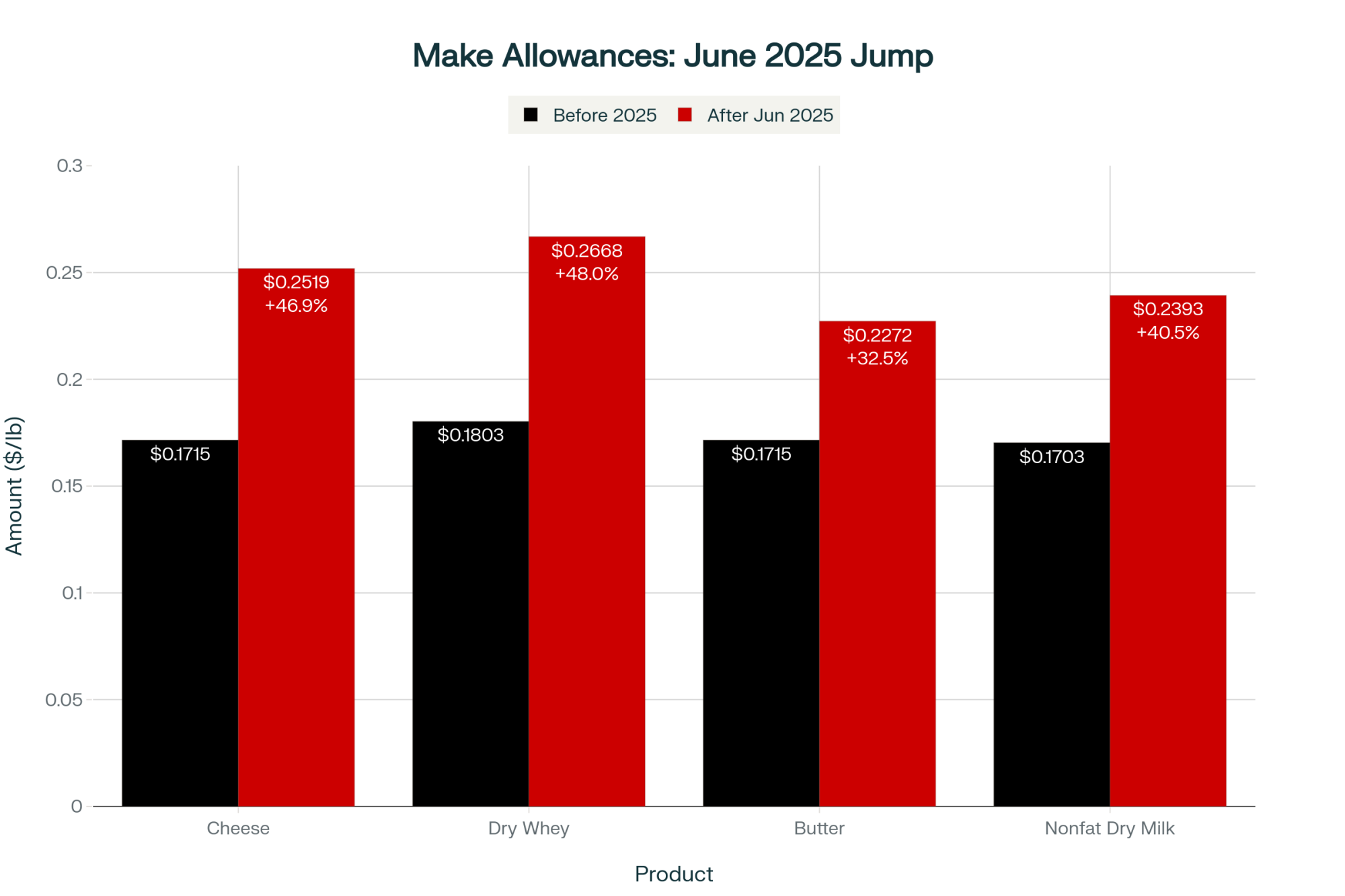
Make allowances surged 32-48% in June 2025 based on unverified processor data—the highest jumps in dry whey and cheese directly slashed what farmers received per hundredweight

Here’s what set this off. In June, USDA raised make allowances—the assumed cost of processing milk into dairy products—by 25 to 43 percent. The reasoning was simple enough: labor, packaging, and energy costs have risen since the last review in 2008.

Here’s the part that farmers are still talking about. Those numbers came from voluntary processor surveys and not from audited financials. By law, USDA still lacks the authority to require processors to open their books under the Agricultural Marketing Agreement Act of 1937.

As AFBF dairy economist Danny Munch explained during the organization’s fall dairy policy update,

“We’re basing a national pay system on unverified numbers, and the only side that benefits is the one submitting the data.”

USDA’s Pool Settlement Reports show how fast that imbalance added up: $64 million in the Upper Midwest, $62 million in the Northeast, and $55 million in California.

For a 150-cow herd shipping about 24,000 hundredweight a year, that’s about $18,000 to $20,000 gone—roughly equivalent to this year’s surge in energy costs, or a major herd health outlay.

Regional distribution of the $337 million in FMMO losses reveals that smaller regions collectively bore nearly half the burden, intensifying the impact on individual farms

Regional Impact Summary (June–September 2025)

  • Upper Midwest: –$64 million
  • Northeast: –$62 million
  • California: –$55 million
    (Source: USDA AMS, Q3 2025 Pool Data)

Who Cast the Vote That Changed It?

AspectCurrent Bloc VotingModified Bloc Voting (AFBF Proposal)
Who Controls Your Vote?Cooperative board decides for all membersYOU decide—opt in or vote independently
Member ChoiceNone—vote cast automaticallyFull choice: authorize co-op or vote direct
Transparency LevelLow: No individual vote trackingHigh: Individual votes counted
Conflict of InterestHIGH: Co-ops process AND voteLOW: Direct farmer control
Individual AccountabilityNone—members never see ballotFull—every producer has voice

That question gets to the heart of a deeper issue. When FMMO proposals go out for a referendum, producers are supposed to decide. But under the current system, most never touch a ballot.

That’s because cooperatives cast bloc votes representing all their members. The idea was originally intended to save administrative time in the 1940s, when local co-ops marketed milk from small family dairies.

Fast forward 80 years. Dairy Farmers of America, Land O’ Lakes, and California Dairies Inc. now handle more than 60 percent of the nation’s milk, according to the USDA’s Economic Research Service (2024). Those organizations don’t just market milk—they process it. When processing margins rise, they gain on one side while the member pay price shrinks on the other.

That’s why AFBF, joined by several state-level farm bureaus, is pressing for modified bloc voting.

Under this approach, co-ops could still submit bloc votes, but only for members who authorize them. Others could opt out and cast their own ballots directly. It’s a small procedural shift with big implications for fairness.

As Munch told producers in Wisconsin, “If your paycheck depends on it, you should get to decide how it’s structured.”

Why Voting Reform Comes First

Some producers have asked why start with voting rights rather than mandatory audits or cost-verification reforms? It’s a logical question—but one with a simple answer.

Every major FMMO change still requires a producer vote to pass. If co-ops continue controlling those votes, the same imbalances in representation will persist—even with better data. Modified voting gives individuals a voice before the next cost survey or order amendment lands on the table.

Think of it this way: fair data means knowing the numbers are right; fair voting means knowing your opinion counts before the next decimal gets moved.

The Transparency Gap That Shows Up Every Month

For most of us, the problem isn’t hidden in Washington—it’s sitting right on the milk check.

Private processors are required to list detail on component prices, deductions, and the Producer Price Differential (PPD). Cooperatives, though, are exempt. Since they’re considered farmer-owned, they aren’t required to disclose the same payment details.

That might sound routine, but it creates an information gap. A University of Wisconsin Extension report (2024) found that 70 percent of cooperative pay statements lacked full explanations for deductions over $0.25 per hundredweight. Terms like “market adjustment” or “balancing charge” were often used without further specification.

As Mark Stevenson, emeritus policy specialist at UW–Madison, put it, “You can’t manage what you can’t measure.”

Plenty of producers can relate. Even herds with solid butterfat and protein trends are seeing unexplained adjustments that chip away at gross pay. That lack of clarity feeds the same frustration driving the broader voting reform effort: farmers want transparency, not theory.

Looking North: What Canadian Quotas Tell Us About Voice
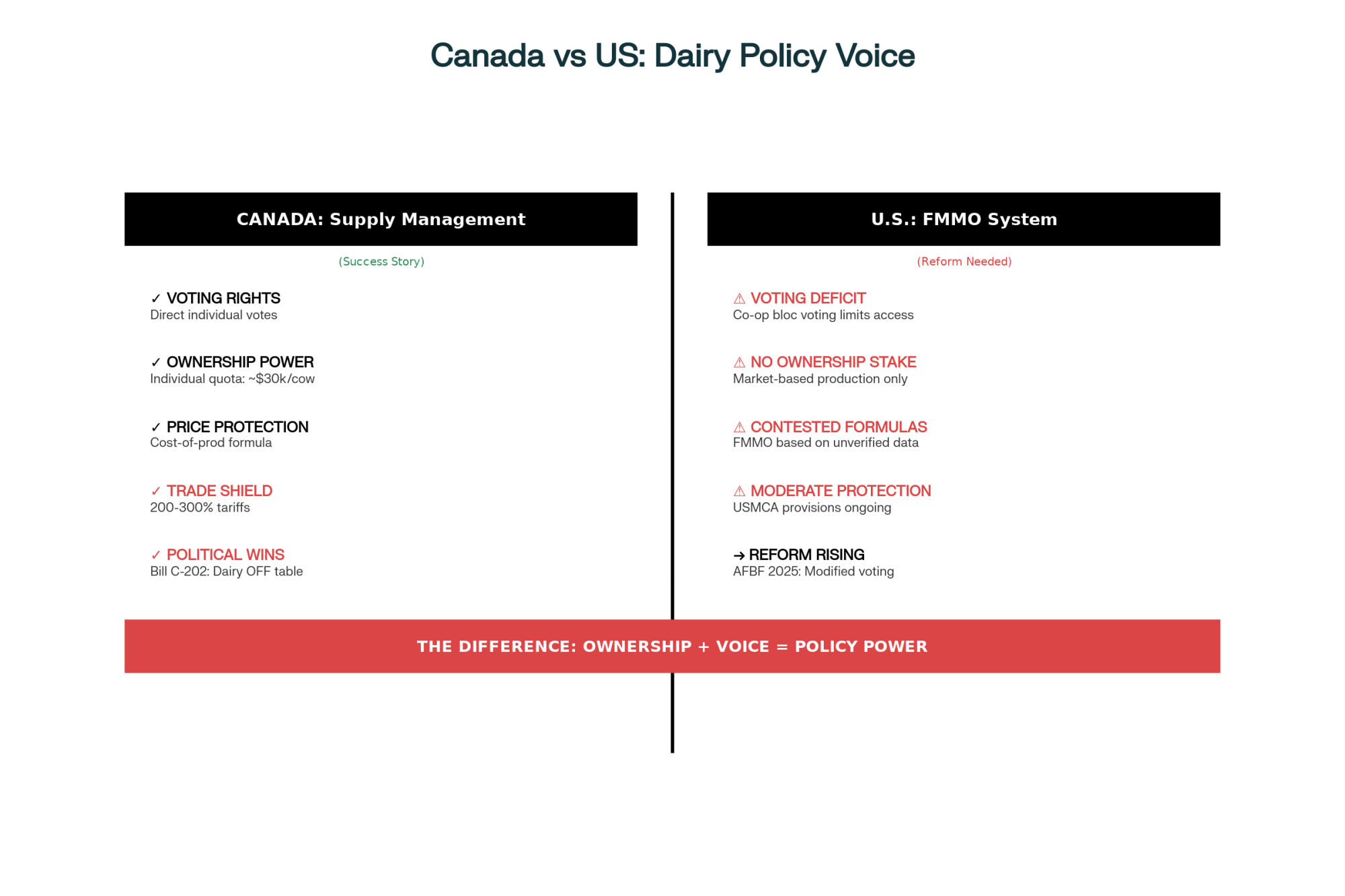
Canada’s dairy producers own individual quotas and cast direct votes that shape trade policy; U.S. farmers are fighting to regain that same power through modified bloc voting and mandatory processor audits

It’s worth pausing to look north for perspective. Canada operates under a supply management system that balances domestic production and demand through quotas. Each farmer owns a quota, currently worth about CA $30,000 per cow (Agriculture and Agri-Food Canada, 2025), and that ownership translates directly into control.

In 2017, Canadian dairy farmers organized a significant voter push within the Conservative Party, ultimately flipping a leadership contest by less than 1%. This year, the Canadian Parliament passed Bill C‑202, which makes it illegal for ministers to negotiate away dairy protections in trade deals.

The U.S. doesn’t have a quota system, and few producers would want one. But here’s the takeaway: when farmers hold direct, non-negotiable voting authority, policy outcomes tend to protect producers instead of eroding them.

Where These Reforms Stand Now

For the first time in years, the groundwork for reform is visible.

A provision in the 2025 Farm Appropriations Act now gives USDA AMS the authority to conduct audited processor cost surveys. The agency plans to begin that process in 2027, replacing voluntary surveys with verifiable data collection.

Meanwhile, new proposals are emerging to standardize cooperative milk-payment statements so co-op members receive the same level of itemized transparency as proprietary producers.

And finally, AFBF’s modified bloc voting proposal continues building bipartisan traction, with several state delegations already urging USDA to schedule a hearing for 2026.

These are all incremental steps—but together, they form the backbone of a more accountable system.

What It Means for Different Dairies

Whether you milk 80 cows in New York’s Finger Lakes or 8,000 in a California dry lot, clarity is good business. Verified cost surveys stabilize Class III and IV price forecasts. Transparency builds trust and simplifies planning.

Cornell University’s Dairy Markets Research Program (2024) notes that “information symmetry improves efficiency and stability at every scale.” In simpler terms, fair data and fair governance don’t pick winners—they lift the whole market.

Co-ops That Are Already Leading

Some cooperatives aren’t waiting for regulation to catch up. Rolling Hills Dairy Cooperative in Wisconsin already provides members with detailed monthly pool and freight summaries through an online portal. Select Milk Producersin Texas publishes audited hauling and balancing charges so members can see exactly what the deductions mean.

Rolling Hills general manager Tom Larkin says the results were immediate: “Once members could see where their money went, trust followed. Transparency lined us up on the same side again.”

That kind of leadership shows reform doesn’t have to start in Washington—it can begin wherever farmers demand a clearer deal.

Five Things Producers Can Do Now

  1. Compare your check. Match component prices to your federal order’s monthly reports; the differences may surprise you.
  2. Ask for documentation. Request written breakdowns for deductions labeled “market adjustment” or “balancing.”
  3. Collaborate. Compare notes with neighboring farms—shared data reveals patterns.
  4. Engage early. Follow your state Farm Bureau updates and dairy policy hearings.
  5. Exercise your vote. Whether under current co-op structures or future modified voting, make sure your ballot represents your voice.

The Bottom Line

After covering dairy policy for years—and spending plenty of time around farmers who live it—I’ve noticed that most producers can handle market volatility and feed swings. What they can’t handle is opacity.

The call for reform isn’t rebellion; it’s about modernizing a system that no longer reflects how milk is marketed or how producers define ownership.

If democracy belongs anywhere, it’s in the milk check. Because when producers see the numbers, cast their own votes, and know where their dollars go, trust stops being a slogan—it becomes part of doing business.

Key Takeaways:

  • $337 million disappeared from producers’ milk checks in three months following FMMO reforms based on voluntary processor cost data that USDA could not verify.
  • Most farmers never voted on the rules that reduced their income, because cooperatives cast bloc votes on behalf of all members—often blending farmer and processor interests.
  • AFBF’s proposed modified bloc voting system would restore the right for every producer to cast an individual ballot, bringing direct democracy back into milk pricing.
  • Mandatory processor cost audits and itemized co-op pay statements are now gaining traction, opening the door to verified data, clear deductions, and accountable pay.
  • Transparency isn’t anti-cooperative—it’s pro-farmer. As seen in Canada’s producer-driven system, ownership and voice together equal stability and fair value for milk.

Complete references and supporting documentation are available upon request by contacting the editorial team at editor@thebullvine.com.

Learn More

Join the Revolution!

Join over 30,000 successful dairy professionals who rely on Bullvine Weekly for their competitive edge. Delivered directly to your inbox each week, our exclusive industry insights help you make smarter decisions while saving precious hours every week. Never miss critical updates on milk production trends, breakthrough technologies, and profit-boosting strategies that top producers are already implementing. Subscribe now to transform your dairy operation’s efficiency and profitability—your future success is just one click away.
NewsSubscribe
First
Last
Consent

Avian Influenza Outbreak: How US Dairy Cows Are Suffering

Explore the devastating effects of the avian flu outbreak on U.S. dairy cattle, recognizing the surge in mortality rates and culling practices among farmers. What implications does this hold for the future landscape of dairy farming?

The U.S. dairy industry is grappling with an unprecedented crisis as the avian flu, a disease typically associated with poultry, has now infiltrated dairy cows across multiple states. This alarming development has resulted in significant cattle losses, with infected cows either succumbing to the virus or being culled by farmers due to the lack of recovery prospects. These measures are dealing a severe blow to the sector, given the higher cost of raising dairy cows compared to poultry. 

Bird flu in cows could take a more significant economic toll than initially thought. 

For farmers, the avian flu outbreak is not just a health crisis but also an economic disaster. The need to prioritize containment efforts is adding to the financial pressures on struggling producers. The situation is further complicated by secondary infections, which are causing higher mortality rates and management challenges, thereby exacerbating the economic implications. 

  • Increased culling of infected dairy cows
  • Secondary infections elevating mortality rates
  • Long-term impact on milk production and market prices

As the virus spreads, the agricultural sector’s resilience is being tested, but it’s also a testament to the industry’s ability to adapt and overcome. This makes long-term adaptations critical for survival, but it also instills a sense of hope that the sector can weather this storm.

Avian Flu Strikes Dairy Industry: A Significant Economic Threat

StateInfected CowsCulled CowsSecondary Infections
South Dakota1,7002412
Michigan2002010
ColoradoUnavailableReportedReported
OhioUnavailableReportedReported
TexasUnavailableReportedReported
New MexicoUnavailableReportedDecreased
North CarolinaNoneNoneNone
KansasNoneNoneNone
IdahoUnavailableNo ResponseNo Response

Reuters’ Leah Douglas and Tom Polansek highlighted a critical issue in the agricultural sector: dairy cows in five U.S. states have died or been culled due to the avian flu. State officials and academics confirmed that the affected cattle either died from the virus or were euthanized by farmers after failing to recover. This development could have significant economic implications, considering the higher costs of raising dairy cows than poultry.

The Financial Fallout: Avian Flu’s Deep Economic Impact on Dairy Farms 

The economic ramifications of the avian flu outbreak in dairy cattle are severe, straining farmers already on thin margins. Dairy cows represent a much more significant investment in cost and maintenance than poultry. Raising a cow involves substantial feed, healthcare, housing, and labor expenses over several years, making the financial stakes high. 

As dairy operations confront this crisis, culling infected cows adds economic pressure. Each lost cow means a direct financial hit and disrupts milk production cycles, affecting farm income. The smaller herd size reduces milk output, lowering sales and profits. The costs of rebuilding herds and replacing culled cows add further stress. These impacts can be devastating for small to mid-sized farms and may lead to closures. 

The impact of the avian flu outbreak extends far beyond individual dairy farms, affecting the entire agricultural sector. The ripple effects of the outbreak are felt by feed suppliers, veterinary services, and dairy product distributors, all of whom experience a drop in demand due to the reduced number of cows. This highlights the need for robust disease management and support systems to mitigate future outbreaks and protect the livelihoods of those dependent on the agricultural sector.

Secondary Infections: The Underestimated Threat to Dairy Cattle Health 

Secondary infections significantly contribute to the mortality of dairy cattle affected by avian flu. As the virus weakens their immune systems, cows become vulnerable to other infections they would usually resist. 

Russ Daly from South Dakota State University explains, “Some animals died not from avian flu, but from secondary infections that thrived in their weakened state.” 

Olga Robak from the Colorado Department of Agriculture adds, “Infected cows often didn’t recover their health because secondary infections took hold after their immune systems were compromised.” 

Phil Durst of Michigan State University Extension notes, “In Michigan, secondary infections are notably high among infected cattle, further depleting herds struggling to recover.” 

Ohio Department of Agriculture spokesperson Meghan Harshbarger confirms, “Most deaths in Ohio are due to secondary infections, rather than the avian flu virus itself.” 

Therefore, while the initial avian flu infection is severe, the subsequent secondary infections are proving fatal for many dairy cows, complicating herd management during an outbreak.

Case Studies: Devastating Impact of Avian Flu on Dairy Farms

In South Dakota, a dairy farm had to cull 24 cows—12 that did not recover from the virus and another 12 that succumbed to secondary infections. This illustrates the drastic measures needed to maintain farm health

In Michigan, about 10% of a farm’s 200 infected cows were culled due to their inability to recover from avian flu, highlighting the severe impact on large-scale dairy operations. 

Colorado dairies also culled cows that failed to return to milk production, showing how the virus can significantly disrupt milk output and economic stability.

State Responses: A Patchwork of Impact and Strategies Amid Avian Flu Crisis

State responses to avian flu in dairy cows vary significantly. In Ohio and Texas, officials reported that most cow deaths resulted from secondary infections. Similarly, New Mexico’s state veterinarian indicated that early culling due to reduced milk production has diminished as recovery rates improved. Conversely, North Carolina and Kansas officials reported few to no cow deaths, suggesting a more contained situation.

Expanding Crisis: Avian Flu’s Relentless Spread Across U.S. Dairy Herds

The situation continues to worsen, with avian flu affecting dairy herds in Minnesota and Iowa. This brings the total infected dairies to 86 across 11 states. Since May 30, 18 new herds have tested positive. Recent USDA data shows new cases in three Texas dairies and another in Idaho. Increased voluntary testing by the USDA suggests more cases may emerge as the virus spreads.

USDA’s Pilot Program: A Crucial Weapon in the Fight Against Avian Flu in Dairy Herds

The USDA’s pilot program is a critical strategy in tackling the avian flu outbreak in dairy herds. By urging producers to test their herds voluntarily, it aims to identify H5N1 cases and quickly limit the virus’s spread. Farms must test negative for three consecutive weeks using ‘on-farm bulk milk’ or similar samples to be designated as ‘negative status,’ ensuring herd health and industry integrity.

Achieving a ‘negative status’ is crucial. It provides a framework for disease monitoring and control, preventing outbreaks from becoming more significant crises. Rigorous testing protocols help identify infected animals early, reducing economic losses from culling and secondary infections. Additionally, it restores consumer confidence in the safety of dairy products, which is essential for market stability. Such measures are vital in safeguarding public health and the dairy industry’s future.

Ensuring Food Safety Amid Avian Flu: USDA’s Assurance in the Integrity of Meat and Milk Supplies

As avian flu affects dairy cattle, food safety remains a top concern. The USDA assures that both meat and milk supplies are safe. Rigorous inspections by Food Safety and Inspection Service (FSIS) veterinarians at federal slaughter facilities ensure that only healthy cattle enter the human food supply. Any cattle that do not pass these inspections are excluded. 

Additionally, the USDA confirms that milk from healthy animals is safe for consumption, highlighting ongoing efforts to protect public health. These measures not only reassure consumers but also maintain the integrity of the U.S. food supply chain, instilling confidence in the safety of dairy products.

The Bottom Line

The avian flu’s penetration into the U.S. dairy industry is causing significant economic fallout. Dairy cows are dying or being culled due to the virus and secondary infections. Robust responses from state and federal agencies are now more critical than ever. Case studies from states like South Dakota, Michigan, and Texas highlight the dire impact. The USDA’s pilot program and testing efforts are essential for crisis management, food safety, and public trust. While current meat and milk supplies are safe, continuous monitoring and effective strategies are paramount to protect the agricultural economy and public health.

Key Takeaways:

  • Economic Impact: The culling and deaths of infected dairy cows are creating substantial financial strain on farmers, as cows are significantly more costly to raise compared to poultry.
  • Secondary Infections: Many cows are dying not directly from avian flu, but due to secondary infections that take advantage of their weakened immune systems.
  • State Reports: Multiple states, including South Dakota, Michigan, and Colorado, have reported significant losses, with differing responses and outcomes based on local conditions and strategies.
  • Rising Infections: The spread of avian flu continues to escalate, with new cases recently confirmed in Minnesota and Iowa, bringing the total number of affected states to 11.
  • Testing Initiatives: The USDA has initiated a pilot program encouraging dairy farms to test herds more frequently, aiming to identify negative status herds and curtail the spread of the virus.
  • Food Safety Assurance: Despite the outbreak, the USDA maintains that the U.S. meat supply remains safe due to stringent inspection processes ensuring only healthy animals enter the food supply.
  • State Variations: Impact and response strategies vary across states, reflecting a patchwork approach in managing the outbreak and its aftermath.

Summary: The U.S. dairy industry is facing an unprecedented crisis as the avian flu infiltrates dairy cows across multiple states. This has resulted in significant cattle losses, with infected cows either succumbing to the virus or being culled by farmers due to the lack of recovery prospects. The outbreak is not just a health crisis but also an economic disaster for farmers, with prioritizing containment efforts adding financial pressures on struggling producers. Secondary infections, causing higher mortality rates and management challenges, further complicate the situation. The agricultural sector’s resilience is being tested, but it is also a testament to the industry’s ability to adapt and overcome. Long-term adaptations are critical for survival, but it also instills hope that the sector can weather this storm. State responses to the avian flu in dairy cows vary significantly, with most cow deaths resulting from secondary infections. The USDA’s pilot program is a critical strategy in tackling the avian flu outbreak in dairy herds by urging producers to test their herds voluntarily.

Major Updates in the 2024 House Farm Bill: What Farmers Need to Know

Discover the key changes in the 2024 House Farm Bill. How will updates to reference prices, base acres, and federal programs impact your farming operations? Find out now.

The House Agriculture Committee recently approved the 2024 Farm Bill, bringing significant changes to production agriculture. This bill covers important areas such as reference prices, base acres, and federal programs, aiming to meet the evolving needs of farmers. In this article, we’ll break down these changes and explain how they could impact your farming operations, giving you the insights you need to stay ahead.

Significant Boost in Reference Prices Brings Both Opportunity and Cost 

CropProposed Increase (%)
Legumes~19%
Peanuts17.8%
Cotton14.4%
Wheat15.5%
Soybeans18.5%

The proposed increases in reference prices for various crops are significant. Legumes will see a 19% rise, and peanutswill get a 17.8% bump. Cotton follows with a 14.4% increase, while wheat and soybeans will jump by 15.5% and 18.5%, respectively. Though these changes promise better financial security for farmers, they also bring a hefty cost. It’s estimated this could increase the farm bill’s cost by $15 to $20 billion over a decade. Adjustments might be made to balance the budget if needed.

A Golden Opportunity to Adjust Your Base Acres

The base acres update is particularly beneficial. If you’ve planted more acres than your base acres from 2019 to 2023, you can now permanently increase your base acres to match that excess. This is a one-time opportunity. 

For instance, if you usually grow corn and soybeans but only planted corn in the last five years, you can now increase your base acres for corn. This could lead to higher subsidies or benefits for your corn production. 

Another advantage is the inclusion of non-covered commodities like potatoes or onions. You can now use up to 15% of your farm acres for these crops, adding more flexibility to your operations. 

Importantly, the House proposal does not restrict who qualifies for this program, making it accessible to more farmers without extra hurdles.

Enhanced Safety Net: Agricultural Risk Coverage (ARC) Program Receives Key Updates 

The Agriculture Risk Coverage (ARC) program has some noteworthy updates that could affect your farm. The benchmark revenue guarantee jumps from 86% to 90%, and the maximum payment cap rises from 10% to 12.5%.  

This means you’ll have a broader and deeper safety net. If your revenue falls short, the increased coverage and higher payment rate can offer better financial protection during tough years. 

Keep in mind, while these changes enhance ARC’s benefits, they might also come with increased federal program costs. It’s essential to weigh these enhanced benefits against your farm’s financial plans and risk management strategies.

Marketing Loans: A Double-Edged Sword for Farmers

Marketing loans are set to increase by about 10% in the new bill. This offers both pros and cons. On the positive side, getting a loan becomes easier, providing more financial flexibility. You can borrow more against your crops, which can be a big help in tough times. 

However, there’s a catch. The higher loan rate could lower your Price Loss Coverage (PLC) payments. PLC payments hinge on the gap between the effective reference price and the market year average (MYA) price. Since the MYA price can’t drop below the loan rate, this change might reduce the financial benefits you expect from PLC payments.

Boosted Support for Livestock Programs: Enhanced Dairy Margin and Indemnity Payments

The 2024 Farm Bill introduces significant updates for livestock programs, crucially affecting both the dairy margin program and livestock indemnity payments

In the dairy margin program, the subsidy for tier one coverage now extends from 5 million pounds to 6 million pounds, a 20% increase. This boost provides extra financial relief for dairy farmers, helping them manage milk prices and feed costs. 

For livestock indemnity payments, the compensation rate has increased to up to 100% for animals killed by federally protected species, like wolves. Additionally, if a pregnant animal is harmed, the owner can receive up to 85% of the value of the unborn animal’s lowest weight class. 

These changes underscore the Farm Bill’s commitment to supporting farmers and ranchers in managing the risks of agricultural production.

Major Shift for Farm Partnerships: Proposed Rule Change Could Unlock Multiple Payment Opportunities

Under the new House farm bill, partnerships like LLCs and S corporations could see big changes. Traditionally, these entities were limited to one payment. The new proposal aims to remove this cap for qualified pass-through entities. This means many farming operations structured as LLCs, S corporations, general partnerships, or joint ventures could benefit from multiple payments. 

However, C corporations would still be subject to the one-payment limit. Because of this, some agricultural entities might consider restructuring to maximize their benefits. While the final decision is pending, this change could offer significant financial and strategic advantages for many farming operations.

Expanded Farm Income Definition: Embracing Diversification and Innovation

The House proposal expands the definition of farm income, making it more inclusive and adaptable for today’s farmers. Now, gains from trading farm equipment, such as old tractors and machinery, are recognized as farm income. 

Plus, if you offer agritourism activities like hayrides, farm tours, or pumpkin patches, the income from these will be counted as farm income too. This is great news for those who have diversified their revenue streams

The new definition also includes direct-to-consumer sales. So, if you’re selling produce, meats, or other products directly through farmers’ markets, roadside stands, or online, this income is also now classified as farm income. 

These changes provide a more accurate picture of your farm’s total income and encourage innovation and diversification. It’s a boost that supports your financial stability and resilience. 

In sum, this updated definition helps you better manage and report your income, leading to a stronger, more flexible agricultural sector.

Substantial CRP Payment Increase: A Win-Win for Farmers and the Environment

The 2024 Farm Bill draft proposes a significant hike in the maximum Conservation Reserve Program (CRP) payment, boosting it from $50,000 to $125,000. This increase offers greater financial incentives for farmers with less suitable land for cultivation. 

Higher payment limits mean more acres can join conservation efforts, benefiting both the environment and farmers. With this boost, making decisions about reallocating underproductive land becomes easier. Whether enhancing wildlife habitats or reducing soil erosion, the increase makes land preservation financially appealing. 

For those with less productive land, this change is an economic win. It allows income from land that may not be yield-worthy through traditional farming, balancing economic viability with environmental responsibility.

Significant Updates in Supplemental Crop Insurance Policies: A Game-Changer for Farmers 

The latest Farm Bill brings noteworthy updates to supplemental crop insurance, promising significant advantages for your farming operations. The cap on revenue protection policies is now increased, allowing up to 90% coverage for individual yield or revenue. This higher cap spans multiple commodities, giving you more comprehensive protection. 

In addition, the Supplemental Coverage Option (SCO) jumps from 86% to 90%. This is especially beneficial for states like North Dakota, Texas, Oklahoma, and southern Missouri, where crop insurance costs are high. The increased subsidy can ease your financial load and improve risk management. 

There’s also good news for beginning or veteran farmers: a 10-percentage point subsidy increase now extends from five to ten years, giving you more time to stabilize and grow your farm. 

Overall, these changes offer a better safety net against unpredictable market and environmental conditions, helping you secure your farming future.

The Bottom Line

The proposed changes in the 2024 House Farm Bill could significantly impact production agriculture. While increased reference prices might boost farmers’ income security, they come with potential budgetary constraints. Updating base acres and broader program qualifications aim to make farming more flexible and inclusive. 

Enhanced protections through the Agricultural Risk Coverage program and marketing loans offer a stronger safety net but come with trade-offs. Livestock programs receive substantial support adjustments, and the expanded definition of farm income and shifts for partnerships open new financial avenues. Conservation efforts benefit from increased CRP payments, and supplemental crop insurance updates provide relief for high-cost areas. 

In essence, these changes aim to create a more resilient and adaptable agricultural sector. By enhancing financial safety nets, improving flexibility in farm management, and increasing support across various aspects of farming, these updates present both opportunities and challenges. Staying informed and proactive will help farmers navigate and leverage these advancements.

Key Takeaways:

  • Proposed increase in reference prices for various crops could lead to higher farm bill costs, potentially between $15 billion to $20 billion over a decade.
  • Farmers can adjust base acres based on average plantings from 2019 to 2023, benefiting those who have planted more acres than they currently have as base acres.
  • ARC program guarantees and maximum payments are set to increase, enhancing the safety net for farmers.
  • Marketing loans are projected to rise by about 10%, although this may reduce PLC payments due to higher market loan rates.
  • Livestock programs, including the dairy margin program and livestock indemnity payments, are receiving increased support and subsidies.
  • New rule changes for farm partnerships may allow multiple payments, benefiting pass-through entities like LLCs and S corporations.
  • The definition of farm income is expanded to include trading gains on farm equipment, agritourism, and direct-to-consumer marketing.
  • CRP payment caps are more than doubled, encouraging enrollment of acres that should not be farmed.
  • Supplemental crop insurance policies receive significant updates, including increased caps on revenue protection and expanded subsidy periods for beginning and veteran farmers.

Summary: The House Agriculture Committee has approved the 2024 Farm Bill, which includes changes to production agriculture, reference prices, base acres, and federal programs. The bill aims to meet farmers’ evolving needs by increasing reference prices for crops like legumes, peanuts, cotton, wheat, and soybeans. It also introduces updates for livestock programs, such as a 20% increase in the dairy margin program and a compensation rate for animals killed by federally protected species. The bill also expands the definition of farm income, increases the cap on revenue protection policies, and extends the subsidy period. These changes aim to create a more resilient and adaptable agricultural sector.

Send this to a friend





