When the Comps’ parlor burned, nobody asked about herd average or sire stack. They asked: ‘How many cows can we take?’ That’s dairy’s real safety net.
Executive Summary: This article looks at four real dairy stories—a 1,100‑cow Ohio fire, a New Brunswick barn loss, a 100‑cow Wisconsin family dairy, and a South Dakota robot‑plus‑creamery farm—to show that your strongest risk‑management tool might actually be your neighbors, not your next piece of steel. When Comp Dairy’s parlor burned in 2024, more than 1,100 cows were rehomed to 14 farms overnight, protecting milk flow, genetics, and processor relationships that could easily have vanished. The Titus family saw a similar pattern after their New Brunswick barn fire, as nine fire departments and multiple local dairies stepped in to keep surviving cows milking and a family operation alive after major losses. On the proactive side, the Daluges’ 100‑cow “four incomes” model and Stenslands’ robot‑and‑creamery setup show how building tours, camps, and on‑farm retail into the business can create both margin and community without adding cows. Backed by current research on farm stress, depression, and suicide risk, the piece argues that the “tough, silent farmer” image is a liability, and that asking for help is a leadership move, not a weakness. It closes with a five‑step playbook—who’s on your 2 a.m. list, one regular touchpoint, one kid brought in on purpose, visible mental‑health contacts, and community baked into your risk plan—so owners and managers can start strengthening their own safety net right now.
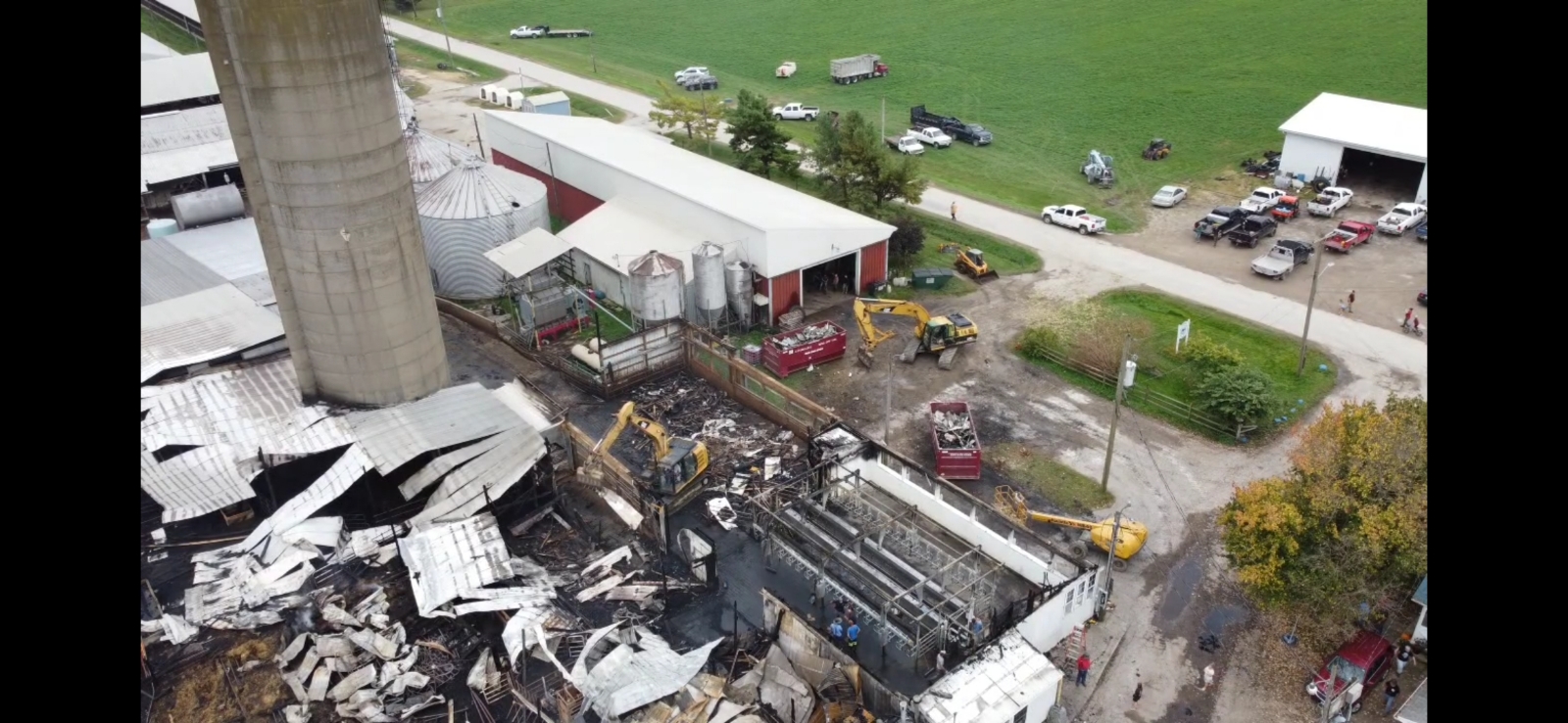
On a Sunday night in late September 2024, the sky over northeast Ohio glowed the kind of orange every dairy farmer dreads. The Comp family’s parlor was on fire. Flames were rolling through the building while more than 1,100 cows stood in pens that suddenly didn’t feel safe anymore.
Somebody grabbed a phone. Then another.
Very quickly, trucks and stock trailers started coming down the lanes in the dark as neighbors from counties away dropped everything to come help. By the time the sun came up, cows were walking down ramps onto new farms across Ohio and Pennsylvania. Before the end of Monday, every animal had a place to go—spread across about 14 dairies that opened gates, made room in pens, and simply said, “We’ll take some.”
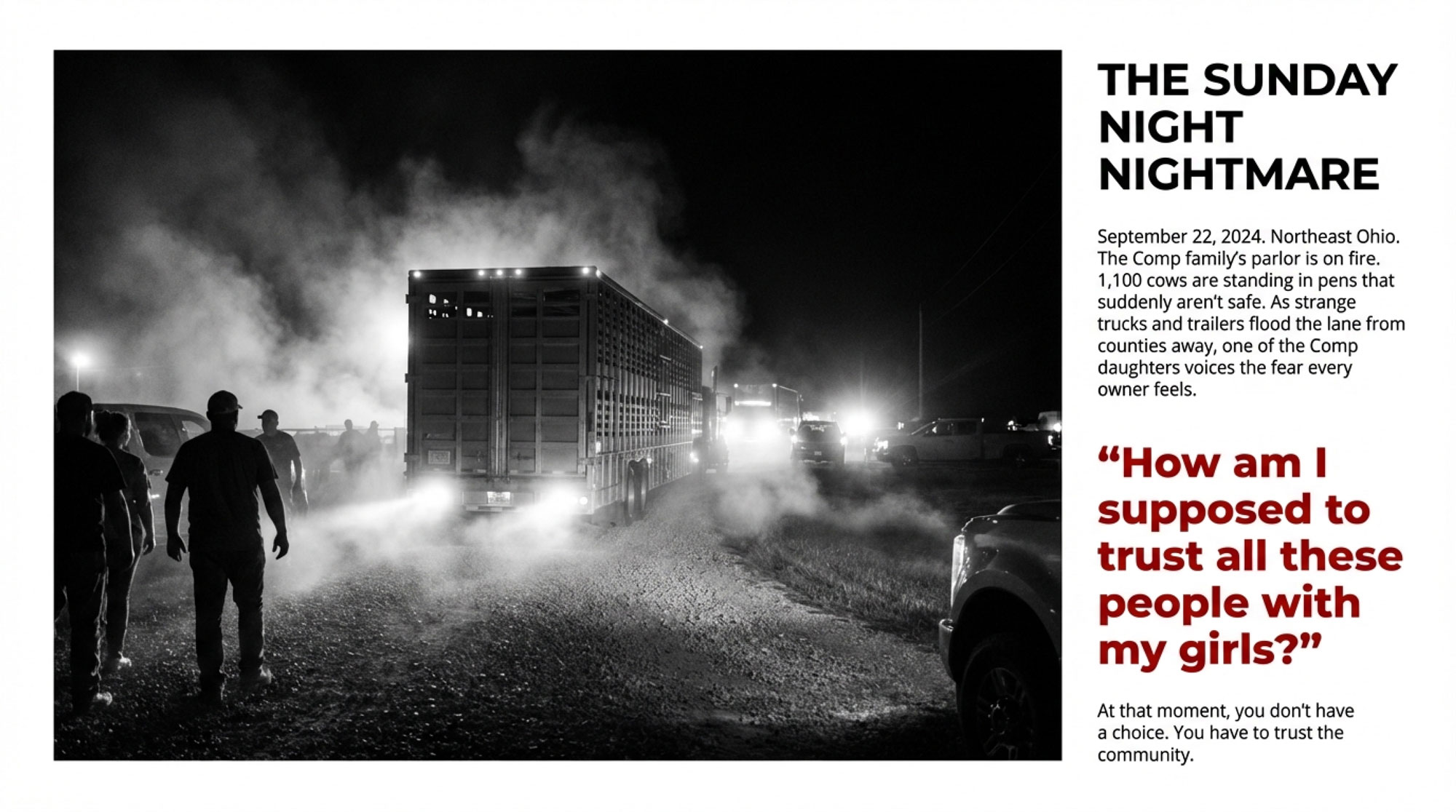
Ohio Farm Bureau’s Mandy Orahood remembers the look on one of the Comp daughters’ faces as strange trucks loaded up their best cows. “She said, ‘How am I supposed to trust all these people with my girls?’” Mandy told Brownfield. “At that moment, you have no choice. You trust that the community’s going to do the right thing.”
They did.
Strip away the smoke and sirens, and that night in Ohio is a harsh reminder of something we all know but don’t always plan around: when your world tilts in a single phone call, the difference between surviving and folding isn’t your last proof sheet or your robot capacity. It’s who shows up in your yard.
When Neighbors Become Your Survival Plan
Here’s what’s really going on in nights like that.
Brownfield Ag News reports that more than 1,100 milking cows in northeast Ohio needed new temporary homes overnight after the Comp Dairy parlor caught fire late on a Sunday in September 2024. Farm & Dairy adds that the fire started around 7 p.m. on September 22, that more than 70 firefighters from multiple counties showed up, and that the milking parlor was a total loss for the nearly 1,100‑cow, 3x herd that had been running 24 hours a day.
There was no grant program, no government coordinator. Orahood told Brownfield that after she put out calls through the farm community and on Facebook, hundreds of supporters from “Canada to Texas and Missouri to Vermont” reached out to help. By the end of Monday, all cows were accounted for and placed on about 14 farms across Ohio and Pennsylvania, with those partner herds using their own feed initially and sending photos and texts so the Comps could see how their cows were doing.
Same story, different postal code. In early 2022, on the Kingston Peninsula in New Brunswick, the Titus family’s dairy barn in the Gorham’s Bluff area caught fire before the evening milking. CBC reports that the January 23 fire destroyed a major section of the barn, killed 43 cows and 10 barn cats, and left surviving animals needing immediate care. Atlantic Farm Focus details how nine volunteer fire departments tankered water through the afternoon and night, and how a logging winch was used late in the rescue to pull cows from the smoke‑filled tie‑stall section when they refused to leave on their own.
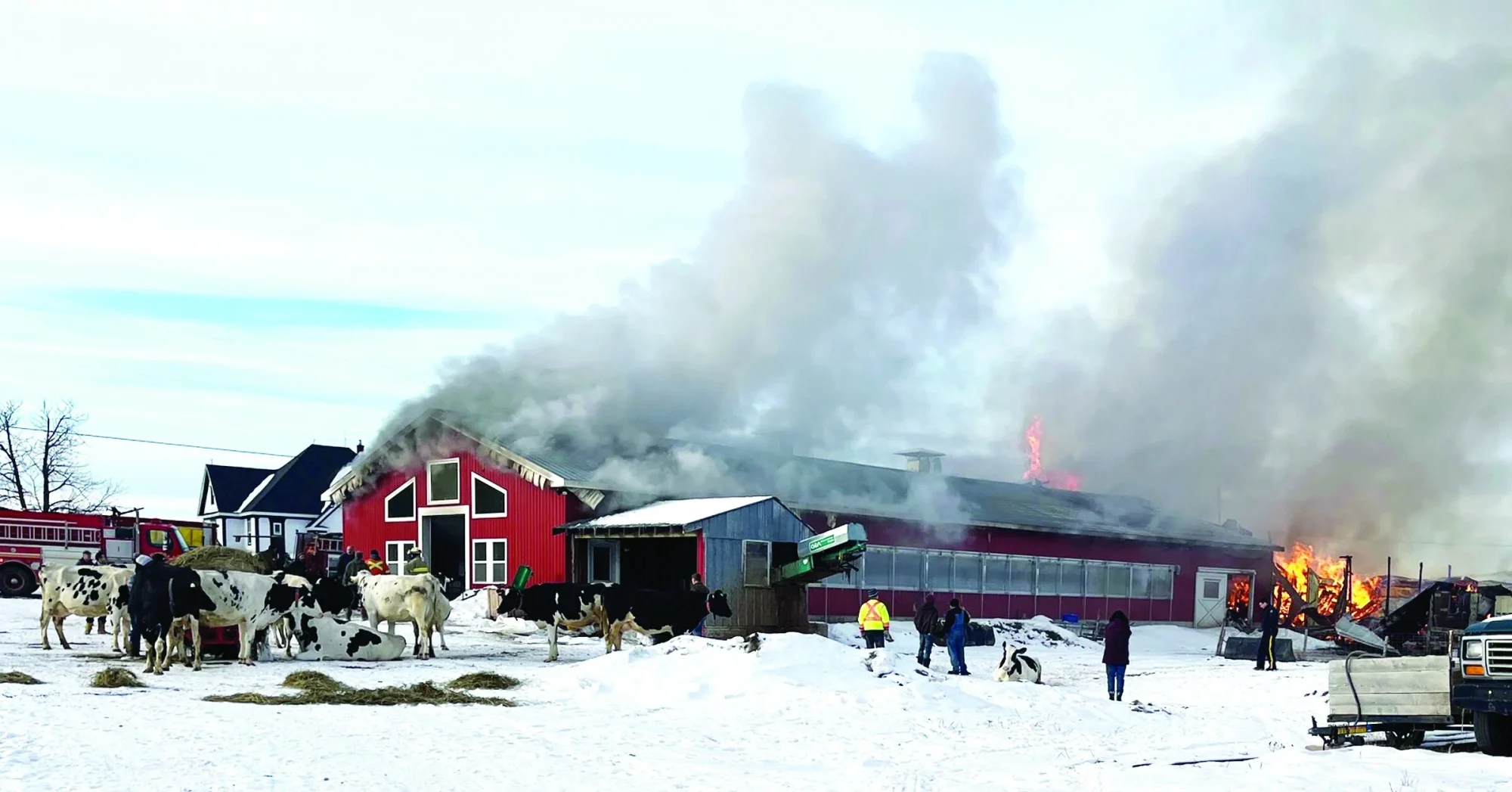
By the time the smoke cleared:
- About 38 lactating cows that survived the fire were hauled to four different area farms where they could be milked, including operations run by the Frazee, Sharp, Wesselius, and other local families.
- A local contractor dug up and repaired the waterline to the Titus home, restoring running water to the family.
- Neighbors kept arriving for days with food, labour, equipment, and offers to keep cows until a new barn could be built.
That isn’t a “program.” That’s culture. It’s the quiet kind of neighbourliness a lot of us grew up with—people aren’t keeping a ledger, they’re just making sure one family’s disaster doesn’t turn into a generational write‑off.
If you zoom out and think like an owner instead of just a survivor, it’s also a brutal but clear lesson in risk management:
- Cows placed quickly keep milking instead of being culled or standing dry because there’s nowhere to go—that’s milk cheques, not just animal welfare.
- Genetics you’ve spent 15–20 years building don’t disappear in one night because nobody had room for them.
- You protect your processor relationship and future shipping volume, which matters the next time contracts or plant capacity are on the table.
On paper, consultants will call this “business continuity” or “disaster‑risk mitigation.” On your yard, it’s just your neighbors making sure one bad night isn’t the last chapter for your herd or your family.
Raising Cows, Raising Kids, Raising a Customer Base
Not every turning point is a fire call. A lot of them happen at the kitchen table when the next generation says, “I want to come back—but not like this.”
Take the Daluge family in Wisconsin. On paper, they’re “just” a 100‑cow Holstein dairy near Janesville. In reality, they’re running one of the most creative 100‑cow business models in North America. Media coverage lays it out: fifth‑generation family, 100 cows, and four adults now making full‑time incomes off that platform.
The catch? They built it during a period when more than 500 other Wisconsin dairies disappeared, many of them much larger operations. Doubling cow numbers wasn’t their survival plan. Community was.
According to published feature articles:
- They opened their farm to tours, school field trips, and summer camps, where kids bottle‑feed calves, learn where milk actually comes from, and see cows up close instead of on a carton.
- They created “Milkin’ Mamas,” a brand aimed at rural women that started as a way to “restore the voice and label of milk” by sharing real, unfiltered farm life—including the not‑so‑pretty parts.
- Between the dairy, camps, tours, and Milkin’ Mamas social channels, they’ve built an audience of more than 45,000 followers and turned that attention into multiple revenue streams, including an online boutique.
- Today, four family members are drawing income from about 100 cows by stacking milk, experiences, and retail, instead of just pushing more cows through the parlor.
Megan Daluge sums it up in one line: “There’s not freedom financially, but there is freedom with time.” That’s not a fluffy Instagram quote. That’s a real management choice. Time flexibility lets you coach 4‑H, attend a school concert, or sit still long enough to make deliberate decisions about genetics, facilities, and loans instead of bouncing from crisis to crisis.
Different state, similar mindset. Stensland Family Farms in South Dakota traces its dairy roots back to around 1915. For a long time, it operated as a fairly standard commodity dairy. In the last decade, the younger generation has added robotic milking, grown to roughly 250 cows, and built an on‑farm creamery plus retail stores to sell ice cream and dairy products directly to consumers in Sioux Falls and on the farm.
In Family Business Magazine, Doug Stensland talks about the pride of seeing his sons run both the robot barn and the creamery, and why having the family name on the store sign matters. The land isn’t just turning out litres and cwt anymore; it’s producing a place where neighbors, city families, and tourists show up, buy ice cream, see cows, and connect the dots between the tank and the cone.
From a business standpoint, both the Daluges and the Stenslands are doing the same three things:
- Diversifying margin off the same cows—adding high‑margin products and experiences instead of only chasing volume.
- Building brand and goodwill with the people who ultimately decide whether dairy has a social license in their region.
- Making it attractive for the next generation to come back to a business that feels modern, connected, and flexible, not just like a treadmill of chores.
From a community‑resilience perspective, they’re also creating literal places where people bump into each other and talk. That matters a lot more than we like to admit when the crises aren’t on fire.
The Quiet Crises You Can’t Photograph
We’re great at rallying around smoke and sirens. The tougher challenge is rallying around the stuff that never makes it to Facebook.
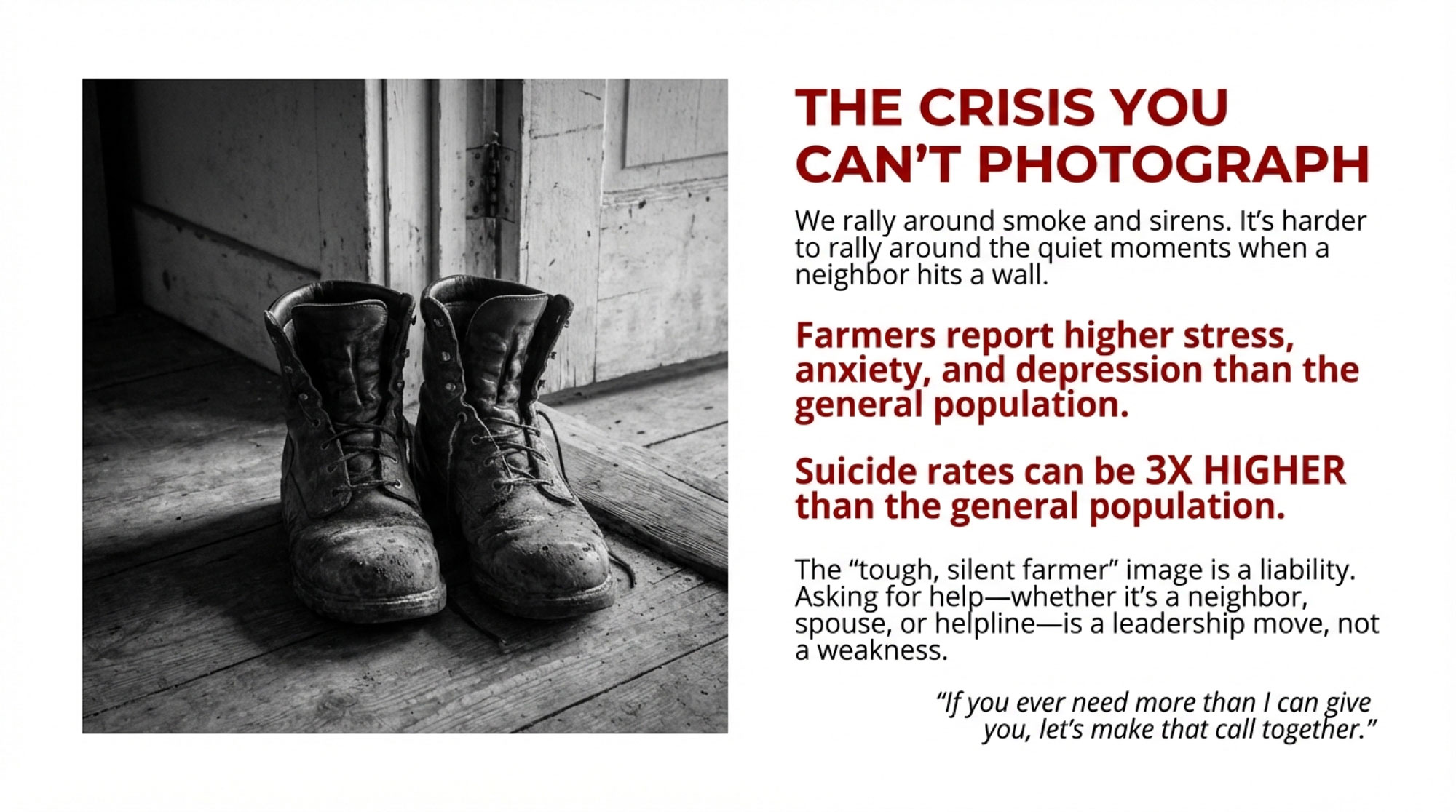
Let’s be honest: the mental load on farm families right now is heavier than most people want to admit, but it’s not a lost cause. Recent research on farm and ranch families has found very high rates of at least mild depressive and anxiety symptoms among both adults and adolescents, and links between farm stress and mental‑health strain. Other work from Canada and the U.S. shows farmers report higher stress, anxiety, depression, and emotional exhaustion than the general population, and that suicidal thoughts can be roughly twice as common in farm populations as in non‑farm groups. One analysis highlighted that suicide rates among farmers and ranchers may be more than three times higher than in the general population, which is a hard number to ignore.
The good news is there’s movement in the right direction. A 2024 feasibility trial of remote mental‑health tools for farmers found that tailored cognitive‑behavioural support delivered at a distance was both acceptable and showed promising improvements in participants’ wellbeing. Studies of farmer‑specific mental‑health programs and provider perspectives also point out that when support is made farm‑friendly—delivered through trusted ag organisations, by people who understand agriculture, and in ways that respect time pressure and privacy—farmers are far more likely to use it.
What providers and farm‑family advocates keep coming back to is this: the old picture of the “tough, silent farmer who never needs help” is actually a risk factor, not a badge of honour. In interviews, farmers’ spouses and advisers consistently say that being willing to talk, to listen, and to pick up the phone early is what keeps families and businesses on their feet. In that sense, asking for help—whether it’s a neighbour, a spouse, a trusted advisor, or a helpline—isn’t weakness; it’s a leadership move that protects your cows, your people, and your future.
The catch is you can’t always see when the person across the lane is hitting a wall. We don’t post a selfie when the bank calls, when a kid says, “I’m not sure I want this,” or when you’re doing math in your head and wondering if the next generation should take this on. But those quiet moments have just as much power to knock out a herd as a barn fire.
This is where the same instincts that move 1,100 cows in a night need to get pointed at the things you can’t photograph. It’s still community work—and it’s smart management—when you sit in the buddy seat and say, “How are you really doing?” and then follow it up with, “If you ever need more than I can give you, let’s make that call together.”
How Strong Dairy Communities Actually Work
If you layer the Comp and Titus fires over what’s happening at farms like Daluge and Stensland, and then stack the mental‑health data on top, a few patterns start to stand out.
They’re not complicated. But they’re easy to ignore until you need them.
- They make “I need help” part of the management playbook.
On the healthiest farms, asking for help stopped being a last‑ditch confession and became a normal tool—same category as calling your nutritionist or hoof trimmer early. You see it in simple things: a text that says “short a milker, can you spare someone?” or “I’m not sleeping, can we talk?” That mindset is usually in place before the fire, not invented after. - They build places where people bump into each other.
Livestock auctions, co‑op meetings, farm bureau events, 4‑H clubs, creamery stores, and farm camps are not just “nice extras.” They’re where people notice who’s missing, who looks worn down, and who’s suddenly quiet. The Daluges’ farm camps and the Stenslands’ creamery are as much mental‑health and community infrastructure as they are business units, whether anyone calls them that or not. - They give every generation a real role.
On a lot of strong farms, Grandma may not throw square bales anymore, but she still knows every fresh cow by name. Younger kids might not run the mixer, but they can halter calves, greet visitors, make TikToks about feeding calves, or help Grandma with calf records. That sense of “I matter here” carries weight if you’re 70 and wondering who you are without the barn, or 15 and trying to decide if you want to be the sixth generation or not. - They think beyond their own lane.
Some of the most robust support networks run through co‑ops, milk boards, and producer organizations that take mental wellbeing seriously. In Canada, for example, producer mental‑health resource hubs promoted by Dairy Farmers of Canada and provincial organizations are putting farmer‑specific tools in places where producers already go. When farms actually use those resources, it doesn’t make them look weak—it makes them look like they’re planning to be here in 10–20 years. - They understand resilience is a profit strategy.
A community that can move cows overnight is the same community that can:- Help you source feed when there’s a local feed shortage.
- Share labour when you’re down a milker.
- Partner on equipment or trucking to drop the cost per cow and spread risk.
That doesn’t show up as a neat line on your cost‑of‑production sheet, but it shows up in who’s still shipping milk after a drought, a price crash, a barn failure, or a health crisis.
What This Means for Your Farm and Your Town
You don’t have to wait for a fire, a flood, or a mental‑health crisis to find out how strong your circle is. Here are moves you can make in the next month that will pay off in ways your banker, your processor, and your family will feel—even if they never show up in your milk cheque line items.
1. Decide who’s on your 2 a.m. list
Grab a pen and be brutally honest.
Write down three people you’d call if:
- Your barn roof gave way under snow or wind.
- Your parlor or robot room went down for more than a day.
- You hit a mental wall and needed someone who actually understands your world.
Then flip it: who would put you on their list? If you can’t name anyone, that’s your first project. If you can, tell them: “You’re on my 2 a.m. list. If you ever need me, call—day or night.”
It feels awkward until the night you actually need it. After that, it’ll feel like one of the smartest risk‑management tools you’ve built.
2. Build one small, regular touchpoint
We all say we don’t have time. Fair. But most of us still find time to scroll. Carve out a sliver of that time and put it back into real‑life contact.
Pick one:
- Monthly coffee at the sale barn with two or three neighbors.
- A rotating “barn talk” night where two or three of you walk someone’s facility and then sit in the shop for an hour.
- A simple potluck that moves between farms every month or two.
No agendas. No pressure. Just a reason to walk off your own yard and a chance to notice if somebody’s eyes look a little more tired than last month. That hour might be the difference between a neighbor quietly spiralling on their own and feeling like they’ve got someone in their corner—and sometimes, that really does change the outcome.
3. Bring at least one kid in on purpose
If you want dairy to exist in your area 20 years from now, somebody’s kid needs a good first experience with it. That doesn’t happen by accident.
Options:
- Host a 4‑H clipping, showmanship, or calf‑care clinic on your farm so kids get hands‑on with cattle and learn real skills.
- Invite a neighbor’s kid to help with calves every Saturday for a month and pay them like it matters.
- Offer your place as a tour stop or camp partner the way the Daluges did, even if you start small with one class or one club.
From a purely selfish standpoint, that kid could be your future employee, your next‑gen partner, your nutritionist, your vet, or the only family member who ever seriously considers running the place. You’re not just giving them a memory; you’re investing in your own labour and succession pipeline.
4. Put mental‑health resources where people will see them
Don’t make it weird. Just normalize it.
Post a simple list of key contacts:
- 988 or your country’s crisis line.
- Any farm‑specific helplines available in your state or province—many producer groups and departments of agriculture list them on their sites.
- Local counselor or support programs you trust, plus a couple of online options designed for farmers and rural residents.
Put that list where people stand still: in the parlor, by the robot screen, on the office fridge, near the medicine cupboard. You don’t need a speech. The paper itself says, “We know this matters, and it’s okay to use this.”
5. Treat the community as part of your risk‑management plan
Your lender and your processor might not write it into the contract, but if you talk to people who assess farm risk every day, you’ll often hear the same observation: farms with strong community connections usually have more options when things go sideways than those that try to operate completely on their own.
When you can point to people who will help you move cows, chop silage, share a tanker, or talk through a hard decision, you’re showing that you’ve thought about what happens when things don’t go to plan. That makes the next conversation about financing, facility upgrades, or passing the farm on a lot easier to have with a straight face.
What This Really Means for All of Us
Looking at where dairy sits right now—tight margins, consolidation, and tech decisions that can easily run into seven figures—it’s easy to think the winners will just be the ones with the sharpest Net Merit list, the fanciest PTAT, the lowest feed cost per cwt, or the smoothest robot fetch curve. All of that matters, and The Bullvine will keep beating that drum. But when the barn burns, when the milk price drops below your breakeven, or when your brain says “I’m done,” none of that is what saves you first.
When the Comp family’s parlor lit up the sky in Ohio, nobody paused to ask what their herd average was or which sires they were using. They asked, “How many cows can we take?”
When the Titus family’s tie‑stall burned on the Kingston Peninsula, nobody checked how many kilos of butterfat they’d shipped that month before they hooked onto a trailer or fired up a logging winch. They dragged cows out of the smoke, hauled water, dug up a buried line, and came back the next day with skid steers and shovels.
When the Daluge sisters decided to build a future on 100 cows, they didn’t just chase more stalls—they built more community and more revenue streams around the same cow numbers. When the Stenslands added robots and a creamery, they didn’t just chase more litres—they built a place where neighbors could show up, sit down, and see exactly who they were buying from.
Those choices don’t show up on a proof sheet. But they absolutely show up in who survives the next round of market shocks, policy changes, disease scares, or personal crises.
So ask yourself—honestly:
- Who would you call at 2 a.m. if your barn was on fire?
- Who would call you if they were in the same spot?
- What are you doing in the next 30 days to make those answers stronger?
You’re not going to control Class III futures or interest rates from your kitchen table. You are 100% in control of how strong your circle is before the next storm hits.
And if there’s one thing the last few years have proven—from more than 1,100 cows rehomed in the wake of a single Ohio fire, to barn disasters in Atlantic Canada, to a 100‑cow Wisconsin dairy and a South Dakota creamery turning farms into community hubs—it’s this: we’re a lot more resilient, and a lot more profitable over the long haul, when we stop pretending we’re in this on our own.
Key Takeaways
- Community is risk management. When Comp Dairy’s parlor burned in 2024, neighbors moved 1,100+ cows to 14 farms overnight—saving milk flow, genetics, and processor relationships that insurance alone couldn’t replace.
- The pattern holds across borders. After a barn fire killed 43 cows at a New Brunswick dairy, nine fire departments and four neighboring farms kept the surviving herd milking and the family in business.
- You don’t need more cows to build a future. The Daluges run a 100-cow Wisconsin dairy that now pays four adults full-time by adding tours, camps, and retail, rather than chasing herd size.
- The “tough, silent farmer” myth is a liability. Research shows farmers face significantly higher rates of stress, depression, and suicide risk—and asking for help early is a leadership move, not a sign of weakness.
- Start this month. Define your 2 a.m. list, build one regular neighbor touchpoint, bring a kid onto the farm on purpose, post mental-health contacts visibly, and treat the community as part of your written risk plan.
Complete references and supporting documentation are available upon request by contacting the editorial team at editor@thebullvine.com.
Continue the Story
- Rising From the Ashes: The Unbreakable Spirit of the Dairy Family – This narrative walks a similar path to the Comp family, proving that when disaster strikes, our community doesn’t just offer sympathy—they bring trailers, open gates, and ensure no farmer ever has to face the fire alone.
- Mental Health in Agriculture: Breaking the Silence – This piece wrestles with the same questions of survival and stress, pulling back the curtain on the industry forces shaping our mental wellbeing and explaining why vulnerability is finally becoming a vital management tool on the farm.
- The Next Generation of Dairy Leaders: Building a Sustainable Future – Proving the point that the future is built on more than just genetics, this article explores how the next generation carries forward a legacy of resilience by turning their farms into literal hubs of community and connection.
 The Sunday Read Dairy Professionals Don’t Skip.
 The Sunday Read Dairy Professionals Don’t Skip.
Every week, thousands of producers, breeders, and industry insiders open Bullvine Weekly for genetics insights, market shifts, and profit strategies they won’t find anywhere else. One email. Five minutes. Smarter decisions all week.