Archive for Dairy Cattle Showing

The Charming Nomad: How Alberto Medina Became the Most Beloved Man in Global Dairy Shows

Traveling 12+ countries yearly with less than 100 nights at home, Alberto Medina has turned cattle fitting into a global art form built on charm and excellence.

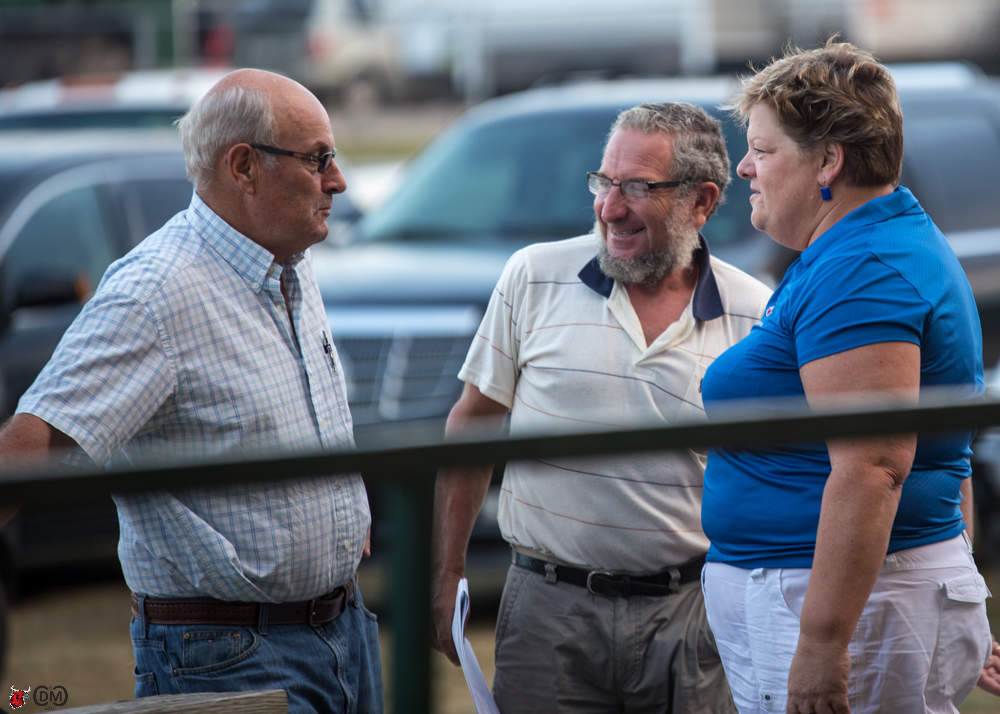
A master in his element. This candid shot captures Alberto Medina’s calm, observant focus amidst the bustling pre-ring at the 2014 Royal Agricultural Winter Fair, completely at home in the organized chaos. (Photo by Carl Saucier)

You know that rare person who walks into any room and somehow makes everyone feel like they’ve just met their new best friend? Alberto Medina is that guy—except his “rooms” happen to be cattle barns scattered across five continents, and his magnetic presence has turned him into something of a legend in the dairy world.

Less than 100 nights a year—that’s how often this Spanish-born cattle fitter actually sleeps in his own bed. The rest of the time? He’s somewhere between customs lines and show rings, navigating airports with the confidence of a seasoned diplomat and somehow managing to be the most genuinely admired professional in an industry not exactly known for its abundance of humble superstars.

Here’s what strikes everyone about Alberto—in a business where success can breed contempt and competition often gets ugly, Alberto has managed to achieve unprecedented global recognition while earning genuine respect from virtually everyone he encounters.

The Boy Who Never Lost His Wonder

The story begins at Argomota Holsteins, where young Alberto absorbed something special from his parents—not just their passion for showing cattle, but their fundamental approach to treating people well. “My parents always loved the shows, so I started showing at a very early age,” he tells me, and you can hear decades of genuine enthusiasm still bubbling under those words.

A pivotal moment: Alberto Medina (left) and Santiago Llera celebrate their first National Grand Champion title with Llera Goldwyn Gala, a testament to Alberto’s early eye for exceptional cattle and a foreshadowing of his global success

What’s remarkable about Alberto’s journey is how organically it unfolded. While others fought their way up through regional politics and industry hierarchies, Alberto simply continued to excel at his craft, maintaining the same authentic enthusiasm that had first drawn people to him as a teenager, when he would clip cattle for friends.

After a decade with Semex Spain providing customer support and fitting services, he made the leap that changed everything: he went full-time as an independent fitter. “After that, I became a full-time fitter, and that’s how the traveling started. I was looking to fulfill my working days,” he explains with characteristic modesty, as if describing a weekend hobby rather than embarking on what would become an unprecedented global career.

A young Alberto Medina (second from the right) with the CIAQ/Semex daughter display team, showcasing his early commitment to the dairy genetics industry.

Living the Impossible Dream

Picture this: You land in Madrid after two weeks in Canada, rush home to change suitcases, maybe catch four hours of sleep, then hop on a 6 AM flight to New Zealand. Most people would be staggering zombies. Alberto steps off that plane looking refreshed and ready to tackle whatever challenges await.

“Sometimes I have to go home for a day, change luggage, sharpen my blades… and fly again the next day,” he says matter-of-factly. The logistics alone would break most people—navigating different electrical systems, language barriers, and cultural expectations that shift with every border crossing. But Alberto has mastered it all with an ease that borders on the supernatural.

Twelve to fifteen different countries annually. Thirty-plus shows a year. Only five of those shows are in his native Spain. That’s not just a career—that’s a lifestyle that would terrify most of us, yet Alberto has turned it into an art form.

Precision under pressure—Alberto’s ring-ready finish is the quiet edge behind champion results.

The Stories That Reveal Character

Every conversation with Alberto eventually becomes storytelling time, and his tales reveal layers of humor and grace under pressure. Take the great goat invasion: “A goat running in the ring full of cows was priceless,” he recalls with obvious delight. You can picture the whole scene—some prestigious European show, everything formal and serious, then suddenly chaos as a goat careens through a ring full of Holstein cows.

Or the highway cow chase during a trip from Spain to Italy: “We stopped for milking, one of the cows escaped and was so close to jumping onto the highway.” The way he tells it, you can feel the adrenaline spike, the frantic teamwork, the collective relief when disaster was averted. These aren’t just amusing anecdotes—they’re windows into someone who finds adventure and humor even in moments that would traumatize others.

But perhaps the story that best captures Alberto’s character involves a cow whose breeder wanted to milk her out before the show because, “in their opinion, she didn’t look any good.” Alberto saw something others missed—and she ended up Supreme Champion. That’s not just professional expertise; that’s someone who believes in potential when others have given up hope. This moment perfectly illustrates his ability to see beyond surface appearances and trust his instincts, even when others doubt him.
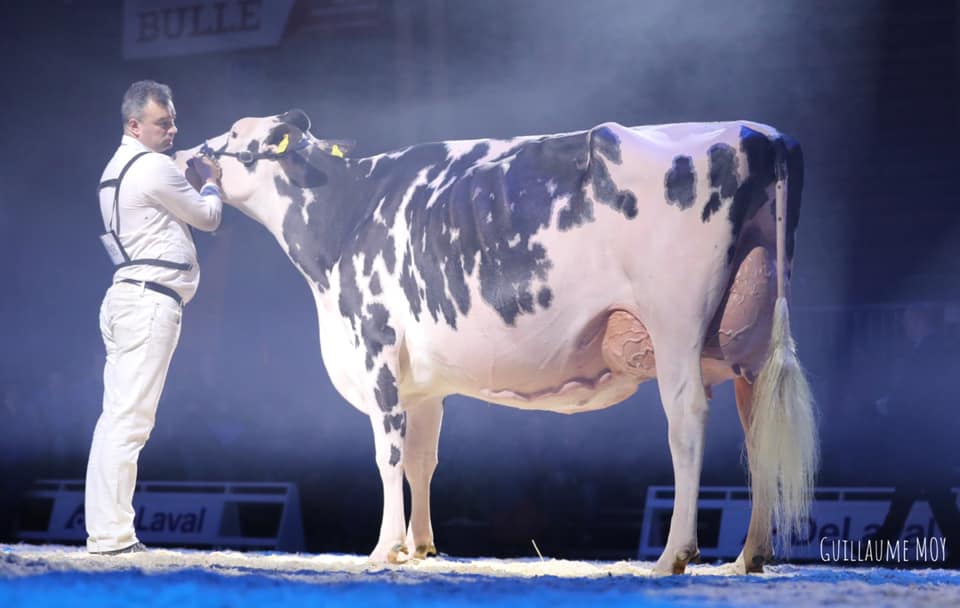
Mastering the moment. Alberto Medina guides Au Parchy Doorman Jolie in the spotlight at the 2019 Expo Bulle, where their flawless presentation led to a stunning upset victory for Grand Champion

The Professional Who Elevates Everyone

What distinguishes Alberto from other elite professionals is his collaborative philosophy. “Make a good team at every show because showing animals is not a one-person thing. Success is about teamwork,” he explains, and this isn’t just strategic thinking—it’s how he approaches every aspect of his career.

Rather than hoarding trade secrets or maintaining a competitive advantage through secrecy, Alberto freely shares knowledge and actively builds others up in the industry. When he talks about buying a cow with friends back in 2006 that became Grand Champion at the European Dairy Show in Italy in both 2008 and 2009, then Junior Champion at the Swiss Expo in 2020, you hear the joy of shared achievement. These weren’t solo victories—they were friendship triumphs that created lasting bonds across continents. His willingness to invest in partnerships and celebrate collective success has earned him respect that transcends mere professional accomplishment.

Teamwork makes the dream work at IDW 2020. Alberto Medina (standing) with the talented Blue Chip crew including Sheila Sundborg (kneeling, center left) and Katie Kearns (kneeling, center right) and Kelvin Cochrane (Queensland), embodying the collaborative spirit that defines his approach to the global show circuit.

The Master Who Wears Success Lightly

Alberto’s technical mastery is undeniable—he’s adapted to feeding systems ranging from TMR to pasture to full hay programs, stayed current with equipment that’s “changed completely in the past 30 years,” and somehow manages mental transitions between regional showing standards that would challenge seasoned diplomats.

Llinde Ariel Jordan—Grand Champion and Best Udder at Cremona, the matriarch Alberto has believed in for a decade.

Take his relationship with Llinde Ariel Jordan, a cow he first encountered as a “small, narrow, straight-legged, soft-pastured” two-year-old. Most professionals would have written her off as unpromising. Alberto saw potential and patiently watched her develop “into one of the best show cows in the world.” At 14 years old, she continues to compete and improve her skills. The pride in his voice when discussing her isn’t just professional satisfaction—it’s genuine affection for watching someone (even four-legged someones) exceed expectations.

Even challenging animals earn his respect. Kingboy Birdy is “one of the hardest cows I ever walked into the ring with,” yet he speaks of her with bemused fondness rather than frustration. He appreciates strong personalities even when they complicate his job.

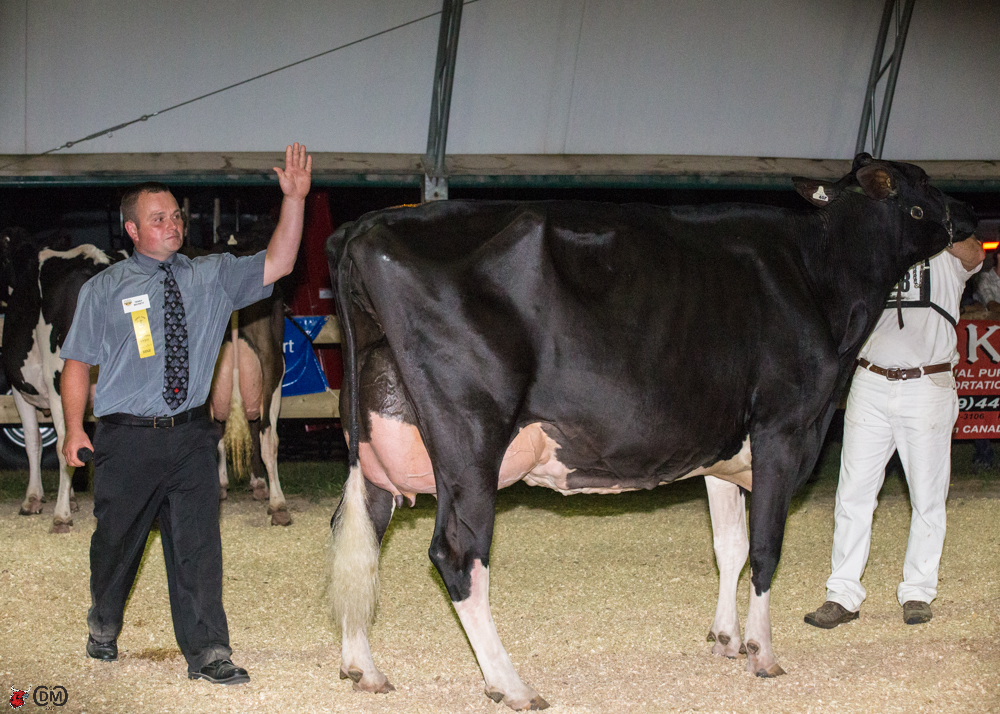
A challenging partnership, a dream fulfilled. Alberto Medina presents Vinbert Kingboy Birdy in the final lineup at the 2022 Royal Agricultural Winter Fair, an event he called the realization of a lifelong dream after a rewarding year with “one of the hardest cows I ever walked into the ring with.

The Gentle Revolutionary

Here’s something most people don’t realize about operating at Alberto’s level—sometimes excellence itself becomes controversial. “People tried to ban me from going to do my job at a show because they think I’m too good at it. Yes, this happened,” he admits with characteristic understatement.

Praise from peers often means the most. Alberto shared his pride in this post from industry veteran Carl Saucier, which places him in the direct lineage of show ring legends like Donald Dubois—a testament to the deep respect he has earned at the highest level.

Think about that scenario: being so consistently successful that competitors attempt to exclude you from events. It’s the kind of situation that could make anyone defensive or bitter. Alberto tells the story with the same bemused calm he brings to everything else, seemingly genuinely puzzled by such reactions to professional excellence. His grace under this kind of pressure reveals the depth of his character and professional maturity.

The Philosophy of Authentic Excellence

Alberto’s approach to both life and work reveals someone who’s found genuine fulfillment in an unconventional path. His downtime activities perfectly capture his character: ‘Hanging out with friends, good restaurants, more traveling, and getting my heifers ready for the next show.’ Even relaxation centers on the things he values most—relationships, experiences, and continued engagement with his passion

Alberto’s approach to both life and work reveals someone who’s found genuine fulfillment in an unconventional path. His downtime activities perfectly capture his character: “Hanging out with friends, good restaurants, more traveling, and getting my heifers ready for the next show.” Even relaxation centers on the things he values most—relationships, experiences, and continued engagement with his passion.

When I ask about maintaining personal connections with such an intense travel schedule, he’s refreshingly honest: “It’s truly difficult.” But there’s no self-pity, just acceptance of choices made in pursuit of something he genuinely loves. That emotional honesty extends to his professional relationships as well.
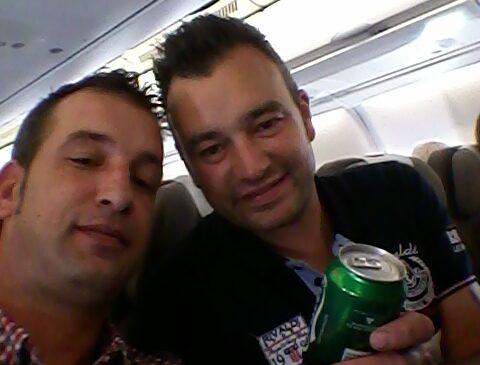
The life of a nomad is better with family. Alberto and his brother, Jose Medina, share a moment while en route to the World Dairy Expo in 2015, a rare bit of downtime in a schedule packed with international travel.

The Visionary with Feet on the Ground

Alberto’s insights about the industry come from an unmatched global perspective. His philosophy about cattle evaluation challenges conventional wisdom: “Wideness is the true type of cow. Modern cows have to have a wide chest, wide open rib, wide rumps, much more than being long and tall.” But he presents these views as contributions to ongoing conversation rather than final pronouncements, inviting discussion rather than demanding agreement.

The technical challenges of transitioning between different regional standards reveal the complexity of his work. “Still hard to adapt when you have 2 months in North America and go back straight to a show in Italy. Not so easy to change your mind that quick on… getting the udders too full,” he notes. This kind of cultural and technical switching demonstrates the mental agility required to succeed at his level.

The focus of a master craftsman. Alberto Medina demonstrates the precision and skill that make him sought-after worldwide, here fitting a show cow for Blue Chip at Australia’s International Dairy Week (IDW) in 2020.

His advice for aspiring professionals reflects both extensive experience and fundamental optimism: “Travel and see other ways of showing because every country is different and there are so many ways to do the same thing.” It’s counsel about embracing the world with curiosity and openness—life philosophy disguised as career guidance.

The Honest Realist

When I ask about his reputation for being universally liked, Alberto cuts through diplomatic nonsense with refreshing candor: “I don’t think so! Some people love me, but also many on the other side.”

That honesty is quintessentially Alberto. He’s not trying to convince anyone he’s perfect—just being genuine about the realities of high-level success. Yes, most people genuinely enjoy working with him. Yes, his consistent achievements have created some resentment. Both things can be true, and Alberto’s comfortable with that complexity in ways that reveal deep emotional maturity.

Dreams Still Dancing

Dreams realized across borders. Alberto proudly leads Marsella to Grand Champion honors at Agro Expo Bogota, Colombia, a testament to his ongoing pursuit of excellence and the global impact of his expertise.

Even after achieving global recognition that most professionals can only imagine, Alberto maintains specific ambitions that keep him energized. “I’ve been in the middle of the ring at the end of the day at almost every show I’ve been in the world but Expo,” he admits with a smile. World Dairy Expo—the crown jewel of North American dairy shows—remains unconquered territory.

This perspective—always having meaningful goals ahead—might explain how someone maintains enthusiasm across decades of demanding travel and competition. The moment you think you’ve achieved everything is probably when excellence starts to fade. Alberto’s far too fascinated by what’s around the next corner to let that happen.

The passion that fuels the dream. Alberto shares a heartfelt embrace with the Grand Champion at a recent show in Ecuador. Victories like these, filled with joy and genuine affection, are the moments that power his pursuit of a World Dairy Expo title

The Living Proof

What strikes me most about Alberto Medina isn’t his unprecedented travel statistics or technical expertise, though both are extraordinary. It’s how he’s demonstrated that success and kindness aren’t mutually exclusive—that you can achieve global recognition while maintaining the values that make you genuinely likable.

In an industry that sometimes rewards sharp elbows over generous spirits, Alberto has built an international reputation on competence paired with character. Every airport conversation, every patient explanation of a technique, and every shared celebration of others’ achievements contribute to a legacy that transcends mere professional accomplishment.

Those fewer than 100 nights at home annually represent something profound: a commitment to relationships and excellence that has literally transformed an entire industry. Every clipping session becomes an opportunity to mentor. Every show becomes a chance to help someone else achieve dreams they might not have believed possible.

As young professionals watch Alberto work—whether in Auckland or Amsterdam—they see living proof that excellence doesn’t require ego. His patient teaching, infectious enthusiasm, and genuine investment in others’ success have redefined what global leadership can look like.

The next time you encounter perfectly prepared cattle in any show ring around the world, remember the man who’s probably logged more miles in service of our industry than anyone else, while somehow making the whole impossible journey look like the most natural thing in the world.

Alberto Medina’s greatest achievement isn’t any single championship or distance record. It’s proving that the most effective way to conquer the world is to help it succeed, one genuine relationship at a time. For aspiring professionals in any field, his example provides both inspiration and practical guidance: master your craft, treat everyone with respect, find joy in the journey, and remember that the best victories are always shared.

And somewhere tonight, Alberto is probably planning his next adventure, sharpening his clippers, and reminding everyone lucky enough to be around him that work stops being work when you love what you do and genuinely care about the people you do it with. That might be the most beautiful lesson of all.

Key Takeaways:

  • Embrace adaptability: Master working across diverse cultures, climates, and management systems rather than limiting yourself to one approach
  • Build strong, collaborative teams: Success depends on teamwork—”showing animals is not a one-person thing”
  • Practice genuine humility and kindness: Authentic relationships and respect open more doors than technical skill alone
  • Commit to continuous learning: Stay current with evolving techniques and technology throughout your entire career
  • Trust your professional intuition: Learn to identify potential that others might miss, even when conventional wisdom disagrees
  • Develop resilience for challenges: Accept that pursuing excellence involves logistical difficulties and personal sacrifices
  • Balance passion with realistic expectations: Understand the trade-offs required for global success, including limited time at home
  • Prioritize long-term preparation: Focus on consistent, year-round excellence rather than relying on last-minute efforts

Executive Summary

Alberto Medina, the most traveled cattle fitter in the dairy industry, embodies a unique blend of technical mastery, humility, and genuine charm that has made him a beloved figure across five continents. Born at Argomota Holsteins in Spain, Alberto’s career spans over three decades, with annual travels to 12-15 countries and participation in more than 30 shows worldwide—sleeping fewer than 100 nights at home each year. Renowned for his ability to adapt effortlessly to diverse cultures, feeding systems, and show standards, he builds lasting relationships through authentic kindness and collaborative spirit, all while maintaining top-tier performance that has led to multiple championship wins, including his work with Llinde Ariel Jordan, who successfully competed at 14 years old. What sets Alberto apart isn’t just his unmatched global experience or technical expertise, but his rare combination of professional excellence and personal warmth—proving that in an industry where egos often clash, success and genuine likability can coexist beautifully, making him not just the most traveled fitter in the business, but quite possibly the most respected.

Learn More:

  • 7 Things You Must Do To Win In The Show Ring – This article provides a tactical checklist for aspiring showmen. It breaks down the key preparations and mindset, offering practical strategies to translate the professional excellence demonstrated by Alberto Medina into your own repeatable success in the ring.
  • The 21st Century Guide to Marketing Your Genetics – Moving from individual skill to business strategy, this piece explores how to build a powerful brand around your herd’s genetics. It reveals modern methods for capitalizing on show ring success to create long-term value and market influence.
  • Is It Time To Rethink The Perfect Dairy Cow? – This forward-looking analysis challenges breeders to consider the future of dairy type. It complements Alberto’s story by examining the evolving standards and economic realities that will shape the champion cows of tomorrow, prompting readers to innovate their breeding strategies.

Join the Revolution!

Join over 30,000 successful dairy professionals who rely on Bullvine Weekly for their competitive edge. Delivered directly to your inbox each week, our exclusive industry insights help you make smarter decisions while saving precious hours every week. Never miss critical updates on milk production trends, breakthrough technologies, and profit-boosting strategies that top producers are already implementing. Subscribe now to transform your dairy operation’s efficiency and profitability—your future success is just one click away.

NewsSubscribe
First
Last
Consent

Has Social Media Infected the Tanbark Trail?

For years, there has been considerable debate about how the person who leads or owns a cow influences a judge’s opinion and how the judge places the class.  With the introduction of Facebook and other social media platforms, this debate has been amplified.  Which leads to the question “Have Facebook and other social media platforms infected the show ring?”

There is no doubt that Facebook is the most powerful social tool in the history of mankind.  The ability for Facebook to connect people with similar interests from around the world is unmatched.  Previously, when you wanted to know the results of a cattle show or how a particular cow looked at a show, you had to call someone you knew who was there or wait at least a month to see the results and a few posed pictures in a print magazine.  Now, in the age of social media, pictures are placed on Facebook even before the class has exited the ring. Larger shows now offer live streaming of the show and those at the show and/or watching the show online post their comments in real time.

How the World has changed

All this has significantly changed both the method and the speed that show oriented breeders communicate with one another.  However, has this changed how animals are placed in the show ring? Ten years ago, most often the first time a judge would have seen most cows would have been in the show ring on show day. But today  judges have more than likely seen pictures and heard comments on animals long before they ever enter the show ring.

One of the great things about social media is that it has enabled members of a small, remotely located community, such as the Tanbark Trail, to connect and share their thoughts very easily.  Many top judges are active on social media and they see how certain animals are doing at shows and how popular certain animals are, long before they enter the show ring to judge a show.

Everyone has an opinion

In the past, when members of the Tanbark Trail disagreed with a judge’s placing, their comments would only be heard by a select few.  Now in the age of social media, their opinion can reach thousands in a matter of minutes.  While I have not seen many negative comments about a judge, I have indeed seen comments made about how certain cows where “gifted” due to certain circumstances.  This touches on the question of the integrity of the show ring and those who are selected to judge it.

It’s a question of integrity

The question of integrity is not a new one.  It has been around for as long as there has been subjective cattle judging.  In the age of social media the need for integrity has been amplified.  One of the interesting challenges with selecting dairy cattle judges is the fact that the best ones are often very involved in the show scene.  This means that they have developed friendships, preferences and opinions over the years. The best judges have always been those that are able to let their judging performance not be influenced by these factors.  In the age of social media, a whole new level of integrity is required.  No longer is it just the opinion of a select few, but rather the opinion of thousands that can significantly influence a judge’s decision.  Those who are of the highest integrity are able to tune out all the traditional influences as well as the new ones that social media brings to the table.

There are some who would comment that judges should not be active on social media.  I argue the exact opposite.  I want a judge who is involved in the dairy community.  All aspects of the dairy industry.  In today’s day and age, that means social media as well.  There are many judges that are very active on social media and whom I trust to have the integrity  to tune out what they read on Facebook or see online when, they are making their final decision in the ring.

Does social success influence show ring results?

There are some that would say that how popular a cow is on social media greatly influences her placing at a major show.  I would argue that the reason that most of these cows have become so popular is because they have been able to demonstrate again and again their superior conformation and hence have developed a loyal following.  There is no question that many cows’ show ring pictures have been able to go viral on social media.  However, there is a very sound reason why these cows have great pictures….they are of superior conformation.

One of the great things about show ring pictures is that they are 100% honest.  Since these photos are being posted online usually within minutes of being taken, there is no opportunity for them to be doctored or altered in anyway.  Hence, when a cow looks great in her show ring picture, it is because she looked great in the show ring.

One of the greatest pleasures I get from taking pictures in the show ring at the major shows is that I am able to get the same view of the animals in the ring that the judges of the shows see when they make their decisions.  Often I receive comments from people outside the ring about how one cow placed higher than another when from their view it did not look correct.  Very seldom have I ever had a case where these questions proved accurate. When you see the pictures afterwards, you often see that particular cows looked better from a distance than they did up close.  So while many will let their personal preference or influences affect the questioner’s own opinion, I have seldom found a case where it was not at least a tossup or where one judge’s decision on the day may be slightly different than another’s.  However, never have I seen a blatant error on the judge’s part.

The Bullvine Bottom Line

Judging a dairy cattle show is never easy. Since the introduction of social media and the growth of dairy show coverage, the job of judging has only gotten harder.  Probably the most important trait a judge has always needed is that of Integrity.  In today’s social media age, the necessity of integrity is greater than ever.  Now instead of hundreds of eyes watching you there are thousands, all with their own opinions.  Facebook and other social media platforms have done wonders for growing the popularity of the Tanbark Trail, but it has also led to the potential infection by the influences they bring.  It takes judges of the utmost integrity to tune all that out and place the animals based on how they appear on show day and only that day.  And that’s exactly what the best judges have been doing for years.


Get original “Bullvine” content sent straight to your email inbox for free.


[related-posts-thumbnails]


Passion – From the Olympics in Sochi to the Show Ring in Toronto

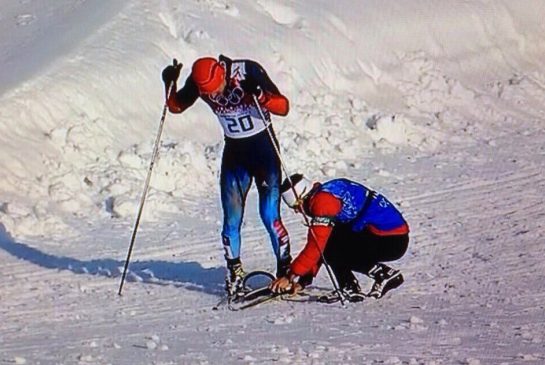
Twitter image of Canadian coach Justin Wadsworth fixing Russian Anton Gafarovski.

Twitter image of Canadian coach Justin Wadsworth fixing Russian Anton Gafarovski.

As I was watching the Olympics today from Sochi Russia, I saw the Canadian cross-country ski coach, Justin Wadsworth, do something amazing.  You see from all accounts Justin was having a terrible day.  His team had not performed as well as they had hoped they would and he was depressed.  As he was watching the final of a race he had hoped that one of his team members would have been competing in, he spotted Russian Anton Gafarov coming over a rise.  Gafarov, an early medal favorite, was struggling miserably.  He’d crashed on a quick downhill corner and broke a ski.  Then he crashed again.  A long, thin layer of P-Tex had been skinned off his ski.  It was now wrapped around his foot like a snare.  Gafarov was not ‘skiing’ to the finish.  In a race typically decided by tenths-of-a-second, Gafarov was three minutes behind the pack.  He was trying to make it the last couple of hundred metres down the 1.7 km course. Wadsworth grabbed a spare ski he’d brought for Canadian racer Alex Harvey and ran onto the track.  Gafarov stopped.  Wadsworth kneeled beside him.  No words passed between them.  Gafarov only nodded.  Wadsworth pulled off the broken equipment and replaced it.  Gafarov set off again.  “I wanted him to have dignity as he crossed the finish line,” Wadsworth, a three-time Olympian, said. That unselfish act defines what the Olympics is all about.

This story also reminded me of an incident that occurred at the Royal this year.

During one of the most anticipated classes in history, one of the cows came into the ring very uncomfortably.  She was not walking with her usual stroll because the teat glue, something that is  legal in the North American show ring, had come partly unglued and was causing the cow discomfort and had her kicking at her teat.  While many just watched the cow and the showman struggle, one person didn’t.  The next showman behind this animal knew that the thrill and passion that drives us all to love the show ring is not about beating someone else, but rather demonstrating the passion for great cattle.  No one wants to win on a technicality or because of the misfortune of others.  They want to win because they showed the best cow on that day.  So that showman took it upon himself to relieve the cow of the discomfort by adjusting and regluing the teat.  A simple act of kindness but, in reality, a much larger gesture.

Like Justin Wadsworth at the Olympics, what drives the show ring, or a sport like cross country skiing is not only the prize money or the fame or fortune.

It’s passion for that higher level of training, commitment and dedication.  Let’s face it, for the majority of the athletes who compete at the Olympics they do so not to get rich or famous, as there just is not that kind of money in the sports they compete in (outside of  men’s Hockey).  The same is true for the majority of the people who show cows.  If you penciled it all out, the show ring for many is not a big money maker, it’s a passion.  (Read more: RF Goldwyn Hailey: Cash Cow or Cash Hog?) A passion that typically costs them far more money than they will ever make.  It’s that pure passion that drives them.

 Sometimes we are accused here at the Bullvine of forecasting doom and gloom and not looking at the positive.

And while yes I do tell it like I see it, there are parts of this industry that I know will remain for generations to come.  (Read more: The Dairy Industry – Past, Present and the Future, Casualties of the Genomic Wars – The End of Seed Stock Producers and Supermodels, Show Cows and the Future of Dairy Cattle Breeding) One such part is those who love to breed show cattle.  That is because they do so, not to get rich, or be famous.  It’s because they just love great cattle.  They love competing at the top shows.  Their passion is what drives them not profits. While I certainly see many changes to those who are breeding high index cattle, also typically those ones are trying to “get rich quick.”  They do so often times for the dream of big bucks instead of the passion for cattle.  (Read more: Richard Caverly A Passion for Perfection – Winner Gives All!, FRANCISCO RODRIGUEZ: Passion with a Purpose and Do We Speak the Same Language?)

The Bullvine Bottom Line

No matter how often we compete against each other, it’s the passion that joins together the men and woman who compete at all the local shows, regional shows, and even World Dairy Expo and The Royal.  Not high paid or well-known except during those moments of intense competition. .  I cannot tell you the number of times I have seen exhibitors help their fellow breeder, often their biggest competitor. However, they rise above the rivalry and share their mutual dedication to the craft they have spent countless hours working on.  That is what makes the show ring great.  For over 30 years I have had the pleasure of being moved by great moments inside and outside the show ring.  The medals and ribbons add up to winning histories but moments of unselfishness show us the true winners.  For me, those who do it for the passion last.  Those who do it to get rich don’t.


Get original “Bullvine” content sent straight to your email inbox for free.


[related-posts-thumbnails]


For Love of the Ring!

Last night I had the opportunity to go back to the county show that I had exhibited at for over 20 years.  It has been a few years since I was last at the Brant Wentworth County Show held at Paris Fairgrounds, but man did many memories come rushing back to me.

IMG_1390

Sometimes it’s too easy to get caught up in all the big names and issues like show ethics, that you forget what it really means to show dairy cattle.  Watching the 19 pre 4-H show people in the ring brought back many memories for me.  While the faces have changed, many of the names have not.  I guess it’s a sign of getting older, but all the same kids that I used to compete against when I was young, now have children of their own in the pre 4-H class.  There is something so pure about watching these young people compete.  These kids are not doing it for the money.  They are not doing it for the glory.  They are doing it for the love of dairy cattle and the show ring.

IMG_1473

This is when   you remember what makes county shows so great.  It’s not the money you are going to make by breeding or selling a class winner.  After all, let’s face it there is none.  It’s not the fame that will come from it because, in most cases, no one will ever really know about the results.  It’s about community experience and love of dairy cattle.  For me last night was   the purest confirmation of why we love dairy farming that I have seen in a long time.  These kids put on a show second to none for enthusiasm, tension and crowd appeal.  I loved it!  I grew with much the same experience as many of these kids:  working each day on the farm, helping my parents and learning to appreciate being a dairy farmer.  There is something about being a dairy farmer that is very special.  It is hard to describe to someone who has not had the experience.  Ingrained in every child raised on a dairy farm is a set of values and sense of accomplishment, that can’t ever be taken away, even though many of these youth eventually end up off the farm.

IMG_1447

Getting the opportunity to talk to many of the dairy community members that I have known for over thirty years was great.  It was also super to meet so many new faces that will be the next generation leading the dairy industry into the future.

IMG_1530

L-R John Innes, David Loewith, Anne Louise Carson

As much as it seems like the world is changing every day, events like this remind me how deep the roots of the dairy industry remain.  At this local show we had many generations of dairy producers as well as several different types of producers.  We are fortunate in our county to rub shoulders with  some of the most progressive milk producers in the industry, such as David  Loewith (seen here with Holstein Canada Secretary Manager  Ann Louise Carson), as well as one of the top index herds in Canada, Mapelwood Holsteins.  By the way, Mapelwood also took home Grand Champion honours with Willsey Jasper Rockette.

IMG_1839

Grand Champion – Willsey Jasper Rockette
Exhibited by Mapelwood Farms.

In talking with Clarence Markus about his recent barn fire and how they are already starting to build again. (Read more: Your Barn Is On Fire!)  Clarence commented about how the dairy community from around the world has been great in supporting him through this tough time.  He also said the thing that surprised him most was how, even though you don’t realize it, everyone is watching you and that the great things that you do to support others, don’t go unnoticed.

The Bullvine Bottom Line

Sometimes I wonder what the future of the dairy industry holds.  At one time, Wentworth County that I grew up in had over one hundred   dairy producers and its own show.  Now there are less than thirty and it can be hard for two counties, Wentworth and Brant, to get enough cattle out.  At times I wonder if there is much future.  Then I have moments like last night, when these 19 future dairy leaders showed the world exactly what it means to fall in love with dairy cattle and the show ring and I think to myself, “Man the future is looking bright!”

For more pictures click here and for show pictures click here.

Get original “Bullvine” content sent straight to your email inbox for free.


[related-posts-thumbnails]

Does The Dairy Genetics Industry Have A Drug Problem?

Just like Alex Rodriguez and Major League Baseball, the dairy genetics industry has a drug problem.

You cannot go very far without reading something about the latest drug scandal involving a pro athlete.  This week it`s 13 major league baseball players headlined by Alex Rodriguez the league’s highest paid player.  Experts in sports doping believe that the problems in baseball — and cycling, track and field and other sports — remain widespread and that policing sports is proving to be nearly impossible.  With recent events at a few of the dairy cattle shows, has me asking whether the dairy industry also has a drug problem.

There are many similarities between the professional sports world and the dairy cattle show scene.  (Read more:  Is the Show Ring the Center of the Dairy World? and Dairy Cattle Showing: For Ego or Profit?) However, for me this is not just a show ring issue.  The problem of people wanting to test the limits and sometimes go over the line is not a new one to the dairy industry.  There have been breeders whose ethics have had a greater effect on the industry than that of those in the show ring.  (Read more:  Has Genomics Knocked out the Hot House Herds?  And The Hot House Effect on Sire Sampling).  While a cow that wins  the show may catch the attention of many breeders, it’s the 2yr year old who is getting illegal drugs (such as rBST in Canada) to help inflate their production, or their pictures enhanced or udders juiced for picture day that causes a bigger issue for the industry (Read more: No Cow Is Perfect – Not Even in Pictures and Introducing the Dairy Marketing Code of Conduct).

Why do we test in the first place?

According to major league baseball, the point of the testing is to keep the sports-entertainment industry functioning, to maintain its loyal public and to stay in business.  For these very same reasons, wouldn`t it be a good idea to set up some form of rules around the use of performance enhancing drugs in the dairy industry?

Yes I am well aware that there is the use of ultrasounds at the Royal and World Dairy Expo.  However, they can only catch so much and it means that some exhibitors just switch to a different drug of choice.  For some that means the use of dextrose to get that cow alert and veins popping while she is in the show ring.  Though many have admitted that dextrose is not that effective, it still could be viewed as a performance-enhancing drug.  The big issue is that, whenever there is testing, there will always be those who are one-step ahead of the tests.

However, as I said earlier, the bigger issue is not with the show ring but rather with the fact that some of the genetic index stars are getting that extra edge on classification day, or on the day they are pictured or they are even getting the day-to-day production boost they need in order to get ahead of the rest.  These animals have absolutely no testing to prove whether they are simply living up to their genetic potential or why they are far exceeding it.

In talking with many average producers, and especially in talking with many commercial producers – both groups who represent the largest purchasers of semen, I have heard a consistent theme, about how they have lost trust in the seed stock industry, especially certain high index cattle.  They feel that generation after generation have shown that they are unable to cut it in the working day-to-day environments.

Do we really want to clean it up?

The dairy industry is guilty of ignoring the drug issue, just like the NFL. Just because you don’t have positive tests, does not mean there is not an issue.

Even with all the talk about what needs to change, there has been very little done over the years to actually bring about change.  It’s kind of like the way the NFL does not want to admit it has an issue with drugs.  Do you really believe a 300-pound lineman can run 40 yards in 4.4 seconds?  The National Football League generates millions and millions in revenue, clobbers everything in the television ratings and is a national obsession.  The NFL brags about its drug-testing program and, while they catch a few players from time to time, the inference is that the majority of the players are clean.  Yep, that’s probably true.  Those offensive linemen are bulking up to 335 pounds on good diet and weight lifting.  Sure they are.  Instead of dealing with the issue, they would rather look the other way.

The same is true in the dairy genetics marketplace.  Instead of addressing this issue, many in the industry would rather sweep it under the carpet and not discuss it.  Here at The Bullvine we have written many articles on marketing ethics (Read more:  Dairy Cattle Marketing Ethics – Do they exist?  and Business Ethics and Marketing Dairy Cattle Genetics), and for the most part the A.I. companies, those who make the most money from these practices, have decided to bury their heads in the sand, not wanting to buck the system.  That is because they are the ones making the most money from this and yet not the ones actually committing the crime.  Similar to how the owners of the baseball, hockey, soccer, and football teams are trying to pin the issue of drugs in professional sports solely on the athletes.  If they really wanted to clean up the game, they could do so, since they are the ones controlling the most important part in this equation.  The money.

Are we doing enough?

One of the big knocks on sports like Hockey and Football is that you never hear about any players actually being caught for the use of illegal drugs.  The same is true for the show ring.  You never hear about a cow failing a test, as we recently did in the beef industry (Read more: Stampede steer champion disqualified after drug test).  While some would tell you that is because there are none, those in the ring and the barns know that is not the case.  At least the shows are doing something.  What are the photography and seed stock industries doing?

The Bullvine Bottom Line

While certainly everyone loves to talk about what show cows are fixed and which ones are not, the bigger issue for me is that of the seed stock industry.  Yes genomics has helped eliminate some of the hothouse cattle but it certainly has not changed the way many of these top cattle are cared for (Read more: Preferential Treatment – The Bull Proof Killer) and how they are marketed.  So the answer to the drug question boils down to this. Until changes are made in these areas the dairy genetics industry will continue to have a problem!!!

Get original “Bullvine” content sent straight to your email inbox for free.


[related-posts-thumbnails]

Is the Show Ring the Center of the Dairy World?

Now there is a question that you will get many different answers to.  From your die hard show supporters that believe the earth revolves around the show ring, to your commercial producers that would tell you there could be nothing further from what really matters.  Everyone has an opinion.  The question becomes, ”Who is right?”  For me personally this question comes up as I prepare to head out to the Ontario Summer Show and then on to the International Intrigue Sale at Ferme Blondin on Saturday.  On the one hand,   I am questioning if this is really that important to 99% of the breeders out there?  And beyond that, how much will the results of this show and the sale affect the dairy industry?

I wonder will the Grand Champion of the show really have any genetic effect on the rest of the industry?

Probably not.  For example, take a look at last year’s World Dairy Expo and Royal Winter Fair Grand Champion, RF Goldwyn Hailey.  Are her genetics setting the breed on fire?  NO.

RF GOLDWYN HAILEY EX-97-2E-CAN  GRAND ROYAL 2012 GRAND MADISON 2012

RF GOLDWYN HAILEY EX-97-2E-CAN
GRAND ROYAL 2012
GRAND MADISON 2012

So then if it’s not from the genetic advancement standpoint, what is it that’s important about dairy cattle shows?

Will the standard from the show ring become the new standard for type classification?  No.  In many cases type classification and show ring evaluation could not be farther apart (Read more: Over-Scored and Over-Rated).  Therefore, it’s not the show ring that is setting the standard for which all other cows will be measured.

So then what is it that has so many breeders excited about showing?

Could it be the thrill of competition?  There is no doubt that as a society we put our great athletes on pedestals and maybe the show cows are just like the great athletes, whom we idolize so much.  Just as in every day society, the vast majority of us could not name the top executives at the world’s Fortune 100 companies, many breeders could not tell you the top ten gTPI or gLPI females in the breed.  HOWEVER … we all can tell you our favorite show cow.  And just like we have Green Bay Packer, Montreal Canadians or Toronto Blue Jays fans who would die for their team, there are fans of the many great show cows that would scorn anyone who says anything negative about them.

I think another great thing about shows is the way   they bring everyone together.  Whether you love showing cows or not, pretty much all breeders are passionate about dairy cattle.  Anytime you can get this number of people together who are passionate about the same thing, you are sure to have a good time.  There is no question that dairy breeders are very passionate about what they do.  You certainly cannot say you got into dairy farming for the money, because there are much greater opportunities to make money in other industries.  However, you certainly will be hard pressed to find a greater community where everyone shares the same passion as they do in the dairy industry.

The Bullvine Bottom Line

Is the show ring the center of the dairy world?  Probably not.  But is it the perfect opportunity to see amazing cattle and talk with fellow breeders about what is great about this industry?  Yes.  I love to show…I love going to shows…..I love looking at great show cows…..most importantly I love talking with dairy breeders about cows. All of these things happen at a show.  So for me, the answer is “Yes!” For that day, that show is definitely the center of the dairy industry!


Get original “Bullvine” content sent straight to your email inbox for free.


[related-posts-thumbnails]

KIDS, CALVES and COMPETITION: Safety in the Dairy Ring

dairy cattle showing youthOne of the outstanding benefits of living on a dairy farm is that it provides the opportunity to learn how to compete in the dairy ring. Working with dairy animals improves physical fitness, coordination, self-discipline and teamwork, but these beneficial activities can also put participants at risk for injury.



Show-related injuries are preventable.  It is a matter of protecting bodies, while they are still growing and just beginning to understand the skills involved in working with animals. Unlike sports such as baseball or hockey where flying objects can cause injuries to the face, the danger in the show ring  most often lies in the child’s awareness of the living, and sometimes unpredictable, animal at the end of the lead.

Training of both the child and the animal is the key to avoiding injuries to both participants.  Of course, it is up to the adults in charge to make sure that youth participating in the events are safe from foreseeable harm.

Dairy Show Injury Prevention Tips

  • Dress participants in appropriate protective equipment. Most sports teams require participants to have specific equipment that is the proper size and adjusted to each athlete. We should do the same for young cattle show persons. Footwear that can withstand tromping on and that is safe from slipping in wet, muddy or messy conditions. Steel toed work boots are the safest choice. Flip flops, clogs and bare feet are strictly unacceptable when working with cattle.  If proper protective equipment isn’t available, it is NOT alright to go ahead.  It teaches two incorrect things: a- the rules don`t count  b- rules can be broken.
  • Proper halter size. A halter that is too big is dangerous as it can be easily pulled off. The halter should not cause discomfort to the calf. As well, make sure the lead shank is neither too long nor too short. This is where experience will be the best teacher but don`t let the handling of the halter or lead become a bigger job than moving easily with the calf.
  • Maintain safe show ring conditions. Wherever, cattle are being shown, basic safety precautions should be in place. Clear the area of debris. Beware of broken glass, rusty nails, used syringes, rocks and other items that would increase injury if a child fell or slid on them. If this will be an outdoor event, watch weather forecasts; have a set of guidelines for postponing the event, if necessary.
  • Have an emergency plan for injuries during shows. If at all possible have an adult trained in first aid techniques on hand. At least have an adult with a charged mobile phone. Provide the adult supervisor with a notebook of emergency phone numbers for parents or guardians of all participants. Carry a well-stocked first aid kit.
  • Enforce basic sportsmanship rules. This is the beginning of learning how to care for animals, prepare them for showing and putting forth their best feet forward in the ring. By all means, prevent bullying of competitors by adults or children. Young show persons need to focus on showing, not on their shame, embarrassment or humiliation.
  • Ensure children drink plenty of liquids. In the excitement of participating in this highlight of dairy cattle this may be overlooked and could result in dehydration. This is especially important in high heat, high humidity or high altitudes or with children who are novices and may not have experience in maintaining control of their animal for an extended time.
  • Provide proper training and skills building for young show people. Select a calf that will be a suitable size for the child to work with and show. Begin training as soon as possible. Training is not something that can be done in a couple of days! As the child builds fundamental skills, they will gain confidence in handling the calf and in presenting it for the judge`s consideration.
  • NEVER wrap the lead rope around the hand, arm, wrist or any body part. If they are bound like this and the heifer moves away quickly, the child could be seriously hurt.

THE BULLVINE BOTTOM LINE

When children are properly prepared to show dairy cattle, the skills they learn and mentors they meet will last them a lifetime. Safety first.  Memories forever.

[related-posts-thumbnails]

Send this to a friend