Archive for dairy carbon credits

Carbon Credits: $150,000 for Large Dairies, $3,000 for Family Farms – Here’s Why

Two dairies. Same carbon practices. One makes $150K, the other makes $3K. The difference isn’t what you think.

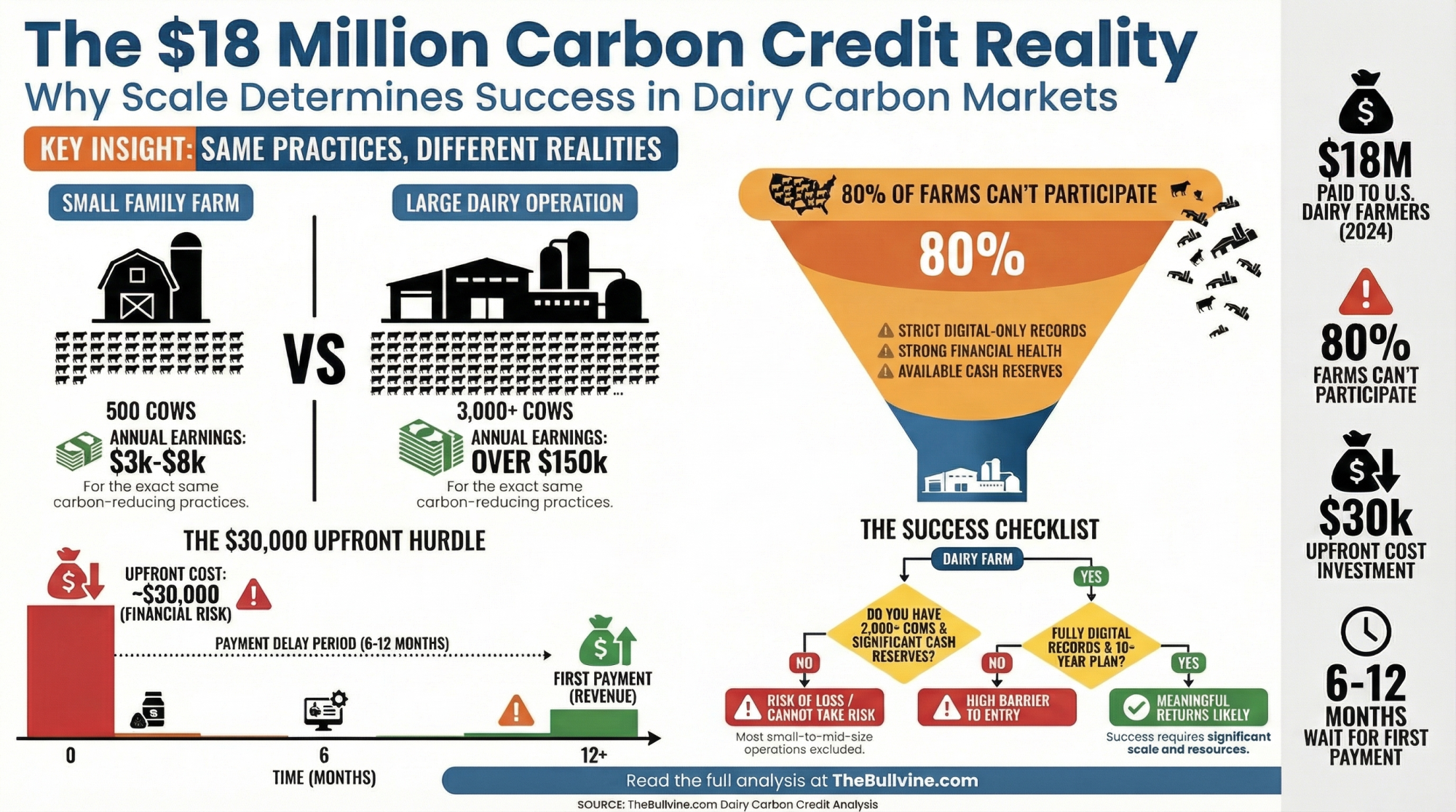
EXECUTIVE SUMMARY: Athian paid dairy farmers $18 million for carbon reductions in 2024, but the money isn’t flowing where you’d expect—large farms pocket $150,000 yearly while small operations get just $3,000 for identical practices. The math explains why: although per-cow profits are similar at $40-56, only operations with 2,000+ cows can justify the $28,000-37,000 upfront investment and 6-12 month payment delays. Add requirements for digital records and working capital above 1.25, and 80% of U.S. dairy farms simply can’t participate. Yet for qualified operations, carbon credits offer genuine value—transforming feed additives you’re already considering into profit centers. This article delivers real economics, explains why scale wins again, and provides a practical framework for determining whether carbon credits make sense for your specific operation.

So I was reviewing Athian’s latest announcement the other day, and here’s what caught my eye—they’ve actually distributed million to dairy farmers for emissions reductions since early 2024. Not promises, not projections. Real checks hitting real farm accounts. And what’s interesting is, these are for practices many of us have been considering anyway for operational efficiency. You know how it is—in our industry, sustainability initiatives usually mean spending more money for the privilege of doing the right thing. This development, though, it deserves our careful attention.

I’ve been talking with producers from Vermont to New Mexico who’ve navigated these dairy carbon credit programs, and I’ve noticed a fascinating pattern emerging. Success varies dramatically across operations, and here’s what might surprise you—it’s not about environmental commitment or willingness to adapt. What I’ve found is it’s primarily about operational scale, cash flow position, and whether you’ve already got your data management systems dialed in.

Understanding the Market Forces at Play

Let’s talk about what’s really driving these payments. As many of us have seen, major food companies—Nestlé and Mars among them—have committed to reducing supply chain emissions by 30% before 2030, according to their recent sustainability reports. And here’s the thing: since most of their carbon footprint originates at the farm level rather than in processing facilities, they’re actively seeking verified reductions from us dairy suppliers.

This has led to something called “insetting”—basically, these companies are investing in emissions reductions within their own supply chains rather than buying random offset credits from who knows where. DFA pioneered this approach in January 2024, becoming the first U.S. cooperative to purchase verified livestock emissions reductions through Athian’s platform. Their initial transaction involved a Texas dairy using Elanco’s Experior technology, and they documented 1,150 metric tons of CO2 equivalent reduction. That’s not theoretical—it’s verified, third-party audited through SustainCERT standards, and most importantly, paid for.

What distinguishes this from all those previous carbon initiatives we’ve seen come and go? The verification rigor. These dairy carbon credit programs require comprehensive documentation—you’re matching feed invoices with ration records, integrating milk production data, running everything through standardized calculation models, and having independent auditors verify it all. This level of verification means buyers can confidently report these reductions to their stakeholders.

Current Practices Generating Returns

Looking at current market activity, four practice categories are demonstrating consistent value for dairy farm profitability, and each has distinct operational requirements and economics worth understanding.

Feed additives for enteric methane reduction have really emerged as the primary pathway. Bovaer—that’s the 3-nitrooxypropanol compound from DSM-Firmenich—got regulatory approval in Canada and the UK in January, and the FDA completed their review in May. What’s encouraging is the research consistency: across 56 peer-reviewed studies, we’re seeing approximately a 30% reduction in enteric methane when administered at recommended doses. According to the Journal of Dairy Science’s comprehensive analysis, this translates to a 10-15% reduction in overall GHG intensity per unit of milk production.

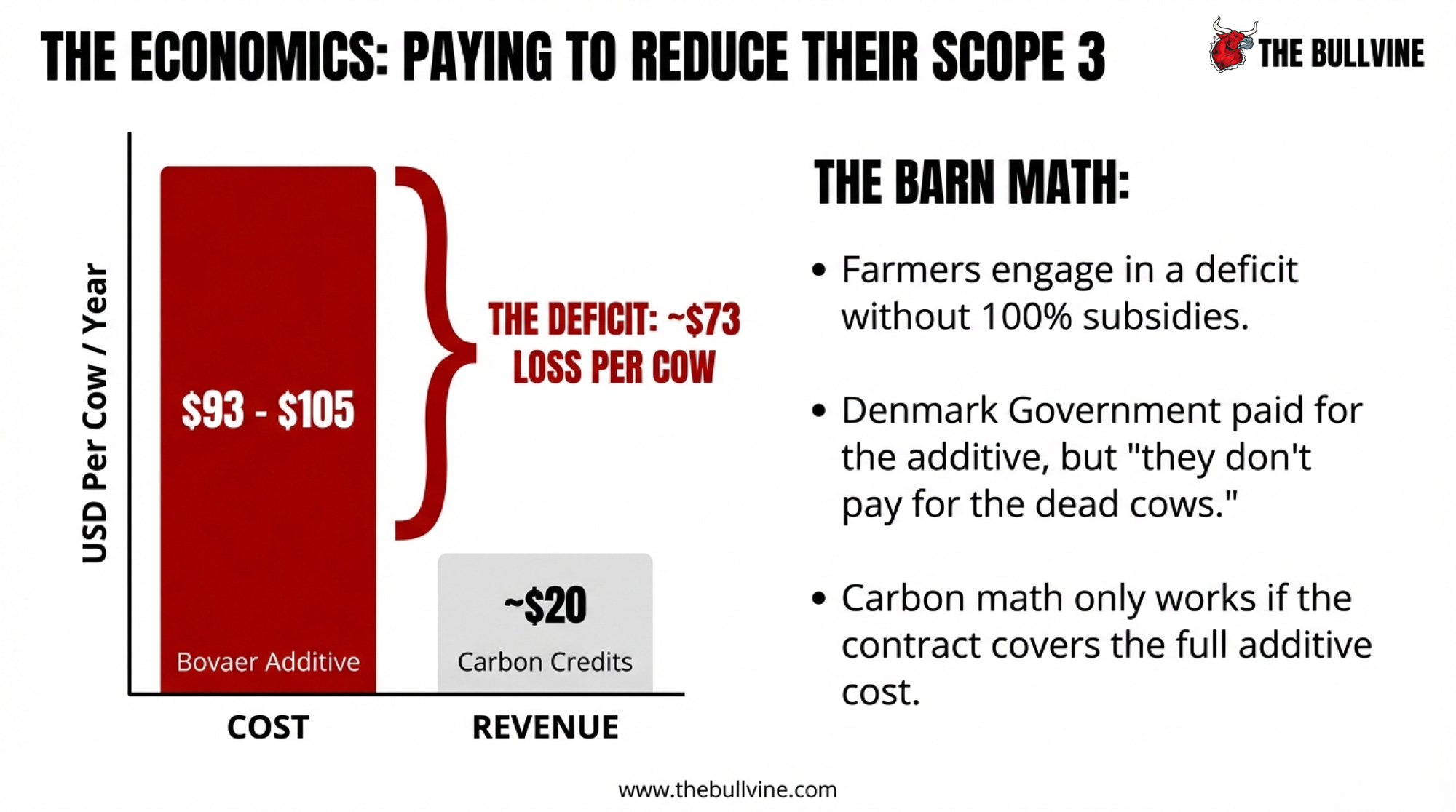
Now, pricing varies considerably by region and purchase volume—you probably know this already. Industry data suggests Bovaer costs range from $0.30 to $0.50 per cow daily, while Rumensin (that’s monensin from Elanco) typically runs $0.13 to $0.15 per cow per day. Rumensin provides modest emission reductions, but it also delivers about a 3% improvement in feed efficiency, according to Elanco’s published data. That’s nothing to sneeze at when you’re looking at overall dairy milk check revenue.

Precision nutrition approaches, particularly those low-protein, amino acid-balanced rations, offer another pathway without requiring infrastructure investment. These strategies reduce nitrogen excretion and associated nitrous oxide emissions while potentially improving your feed cost efficiency. Ajinomoto’s AjiPro-L protocol, which Athian approved in April, exemplifies this approach. University of Wisconsin Extension trials indicate potential for both ration cost savings and carbon credit generation, though—as you’d expect—results vary by operation.

Anaerobic digester systems continue to provide opportunities for larger operations. You can stack RNG revenue, RIN credits, nutrient products, and now carbon insets. But let’s be realistic about the economics here—USDA NRCS data and Cornell’s agricultural economics research show you need at least $1,800 per cow in capital investment. Even with RCPP cost-share programs covering 50-75% of installation costs, that’s a serious commitment that really only pencils out at significant scale.

What I’m particularly interested in are these whole-farm carbon intensity protocols. Rather than requiring specific expensive interventions, they measure your overall emissions per unit of milk production. California’s CDFA has been developing this methodology, while the Innovation Center for U.S. Dairy has been creating parallel frameworks. If you’re already efficient—getting more milk from fewer cows with less waste through better genetics and reproduction—you should theoretically qualify even without fancy additives. And looking ahead, emerging technologies such as seaweed-based additives and genetic selection for lower-emission cows could further expand options, though they are still in development.

Economic Realities Across Different Scales

Here’s where things get really interesting for dairy farm profitability, and the implications vary dramatically by operation size. Let me share what I’ve learned from producers at different scales, including those Southeast operations dealing with heat stress and different housing systems.

A Wisconsin producer I know with 450 cows spent three months getting all his documentation together, and when the first payment came through, it was $4,200. As he told me, “It’s certainly welcome income, but when you consider the time investment and upfront costs, it doesn’t fundamentally change our operation.”

For a typical 500-cow dairy in Wisconsin or Pennsylvania—and I’ve run these numbers with several folks—participating in carbon credits for dairy farms looks something like this: Initial investment in feed additives runs $25,000 to $30,000 annually, assuming you’re using a combination of products. Data system upgrades, if you need them, add $2,000 to $5,000. Nutritionist consultation and protocol documentation typically cost another $1,000 to $2,000.

So you’re looking at a total upfront investment of $28,000 to $37,000.

And here’s the kicker—you pay these costs immediately, but receive carbon credit payments after 6 to 12 months of verification, per Athian’s current terms. That means you need that cash sitting available, not borrowed.

Current carbon pricing at $60 per ton represents a historical high—the Ecosystem Marketplace reports voluntary carbon markets averaged just $6.37 per ton in 2024. At these prices, a 500-cow operation might generate $5,000 to $8,000 in annual carbon revenue. Combined with potential feed efficiency gains of $15,000 to $20,000, net benefits could reach $20,000 to $28,000 annually. But that’s assuming stable carbon prices, smooth verification, and favorable baseline calculations…

The economics shift significantly at larger scales. An Idaho dairy manager I spoke with, who’s running 3,200 cows, explained: “We’re generating about $47 per cow from carbon credits, plus the feed efficiency improvements. At our scale, that translates to over $150,000 annually—meaningful revenue that justifies the administrative investment.”

This reveals something important for dairy milk check revenue: while per-cow returns are similar ($40-56 for smaller operations versus $43-57 for larger ones), the absolute dollar amounts make participation worthwhile for larger operations while remaining marginal for smaller ones.

Operations That Should Consider Alternatives

Based on extensive discussions with producers and financial advisors from Michigan to Arizona, certain operations face structural barriers that make successful participation in current dairy carbon credit programs challenging for overall dairy farm profitability.

If your working capital ratio is below 1.25, you don’t have the financial flexibility to manage that 6 to 12-month payment delay. The Farm Financial Standards Council identifies this as a critical threshold for operational stability, and I’ve seen this play out firsthand. One producer near Viroqua, Wisconsin, with 380 cows, carefully analyzed his situation. He told me, “Borrowing to cover upfront costs at 8% interest would essentially eliminate any carbon revenue benefit. The mathematics simply didn’t support participation.”

If you’re still using paper-based or basic spreadsheet record-keeping, the documentation burden will probably eat you alive. These carbon programs for dairy farms require integrating feed invoices, ration records, and milk production data in formats that support third-party verification. It’s not impossible with manual systems, but honestly, the administrative burden often becomes prohibitive.

“The transition from paper to carbon credits simply doesn’t occur—it’s from digital systems to carbon credits.”

Pasture-based operations encounter technical limitations with current protocols. Both Bovaer and Rumensin require consistent daily dosing through total mixed rations. DSM’s product development pipeline includes slow-release bolus systems for grazing operations, but they aren’t yet commercially available. These producers may find better opportunities in whole-farm intensity protocols that recognize the inherent efficiency of well-managed grazing systems. This is particularly relevant for Southeast producers, where year-round grazing is more common.

And if you’re approaching retirement within 5 to 7 years, you should carefully evaluate participation. These programs typically achieve optimal returns over 10 to 15-year horizons, allowing carbon revenues to compound and infrastructure investments to fully amortize.

Industry Structure Implications

Something we need to consider thoughtfully is how these programs might affect industry structure and long-term patterns of dairy farm profitability. Large-scale operations in Texas, Idaho, and California that implement comprehensive carbon programs might generate $200,000 or more annually. That creates meaningful cash flow advantages and balance sheet improvements that can influence expansion decisions and market dynamics.

Meanwhile, a 400-cow operation might generate $3,000 in carbon credits—barely covering administrative costs. When milk prices cycle from $20 to $16 per hundredweight, as they periodically do, operations with substantial carbon revenue cushions have clear advantages in weathering these downturns.

Current USDA Census of Agriculture data show we’re losing 2,100 to 2,800 dairy farms annually, with exits concentrated in the 150- to 1,500-cow range. While dairy carbon credit programs don’t cause this consolidation, they may influence its pace by providing additional advantages to operations already benefiting from economies of scale.

This raises important questions about program design and accessibility that we as an industry continue to grapple with.

Common Success Factors

Producers successfully participating in these programs—whether they’re in the Northeast, Midwest, or Western regions—share several characteristics worth noting for those seeking to enhance dairy milk check revenue.

Cooperative participation proves crucial. Working through established programs at DFA, Land O’Lakes, or similar organizations significantly reduces administrative complexity. The co-ops handle documentation aggregation, facilitate buyer connections, and provide technical support that individual producers would struggle to replicate on their own.

Financial strength matters—a lot. Successful participants typically maintain working capital ratios above 1.5, giving them the flexibility to manage payment timing without incurring debt. As one Wisconsin producer with 1,100 cows near Fond du Lac observed, “If carbon payments are necessary for cash flow, the operation probably isn’t ready for program participation.”

These successful producers view carbon credits as complementary to operational improvements rather than primary drivers of dairy farm profitability. A Pennsylvania dairyman with 750 cows explained their perspective: “We were evaluating Rumensin for efficiency gains regardless. The carbon credits transformed a good decision into an obvious one.”

And digital infrastructure proves essential. Not necessarily sophisticated systems, but at least DHIA participation, computerized ration management, and organized record-keeping. The transition from paper to carbon credits simply doesn’t occur—it’s from digital systems to carbon credits.

Verification Processes and Practical Considerations

Understanding verification helps set realistic expectations for dairy carbon credit programs. Programs begin by establishing baseline emissions using models with acknowledged uncertainty ranges of 15-25%, in accordance with IPCC methodology and UC Davis CLEAR Center analysis. Your baseline could vary substantially in either direction—something to keep in mind.

Implementation requires comprehensive documentation—feed invoices, ration formulations, production records, and health events. Verification bodies, including SustainCERT and other ISO 14064-accredited auditors working with Athian, review this documentation through varying combinations of remote review and farm visits.

One Wisconsin producer with 650 cows near Bloomer experienced the complexity of verification firsthand. Initial approval was questioned 6 months later when butterfat levels changed, potentially indicating variation in the feed additive. Three additional months of documentation were required to verify consistent feeding practices. The final payment arrived 11 months late, rather than the anticipated 6.

Credit registration on Athian’s blockchain ledger prevents double-selling within their system. But as the Institute for Agriculture and Trade Policy noted in their recent analysis of insetting risks, enforcement mechanisms across different platforms remain underdeveloped. Something to be aware of.

Looking Ahead: Realistic Expectations for 2030

If current trajectories continue, what might we reasonably expect for dairy farm profitability by decade’s end?

Industry-wide emissions intensity could decrease 20 to 30% through combined adoption of feed additives, ration optimization, and efficiency improvements. California Air Resources Board data already show a 20% reduction in methane intensity from early adopter programs, suggesting this target is achievable.

Mid-size farm participation could expand through cooperative-led programs that aggregate verification costs and streamline administration. Replicating DFA’s model across major cooperatives could make participation as routine as DHIA testing for appropriately positioned operations.

Carbon price stabilization through corporate commitments seems plausible. Companies might guarantee minimum prices of $40 to $50 per ton for verified reductions from their supply chains, providing investment confidence for participating producers.

Policy mechanisms could amplify market-based approaches. Implementation of the 45Z tax credit under the Inflation Reduction Act could establish price floors. State programs, like California’s $25 million methane-reduction initiative through its Climate Smart Agriculture program, demonstrate potential for complementary support.

Realistically, I anticipate 2,000 to 3,000 larger farms generating $150 to $300 million in cumulative payments by 2030—meaningful for those operations but unlikely to transform industry-wide economics or substantially alter consolidation patterns affecting dairy milk check revenue across all farm sizes.

A Practical Decision Framework

For producers considering participation to enhance dairy farm profitability, here’s a systematic evaluation approach based on actual participant experiences:

Step 1: Assess your working capital ratio. Below 1.25 indicates you need operational stabilization before adding program complexity.

Step 2: Calculate your true break-even costs, including all expenses. If you’re exceeding $20 per hundredweight in current markets, carbon credits won’t address fundamental profitability challenges.

Step 3: Evaluate available cash reserves. Can you deploy $25,000 to $35,000 for 6 to 12 months without borrowing? Interest costs often eliminate carbon revenue benefits.

Step 4: Engage your cooperative. Established programs with clear protocols and payment histories indicate readiness. “Exploring options” suggests patience might be warranted.

Step 5: Review your documentation capabilities. Digital ration management, DHIA participation, and nutritionist relationships all contribute to readiness.

Step 6: Consider your time horizon. Ten-plus year operational plans align well with program economics. Five-year exit strategies likely don’t.

This framework probably excludes 70 to 80% of U.S. dairy farms, which itself reveals important characteristics about current market design and its impact on dairy farm profitability.

Broader Industry Implications

The emergence of functional dairy carbon markets represents genuine progress. It demonstrates corporate willingness to invest in verified emissions reductions, validates market mechanisms for environmental progress, and rewards efficiency improvements that many of us pursue regardless.

Yet it also illuminates the limitations of the agricultural market. These mechanisms naturally favor scale, sophistication, and capital access—characteristics already driving industry evolution. Programs generating $150,000 annually for large operations while offering $3,000 to smaller farms reflect market dynamics rather than program design flaws.

This isn’t attributable to any particular organization or conspiracy. It’s simply how markets function when transaction costs are substantial and economies of scale are significant. The relevant question isn’t fairness but rather our collective comfort with carbon markets as another factor influencing industry structure and dairy milk check revenue distribution.

My assessment? These represent useful tools rather than transformative solutions for dairy farm profitability. Well-capitalized operations already pursuing efficiency improvements will find carbon revenues provide a welcome acceleration. Marginal operations won’t find salvation here. For the broader industry, it’s another advantage accruing to scale in an already scale-advantaged system.

Evaluate these opportunities based on your specific situation. But maintain realistic expectations about carbon credits as supplemental revenue rather than foundational income, especially given agriculture’s historical pattern of commodity price volatility.

Athian’s $18 million in payments is real. The practices deliver results. The verification systems function. But whether this matters for your particular operation depends entirely on where you sit within dairy’s increasingly differentiated structure. And that’s the conversation we need to continue having—not just whether carbon markets work, but how they work within our evolving industry landscape and their real impact on dairy farm profitability.

Editor’s Note: Producer experiences shared in this article are based on interviews conducted in November 2025.

KEY TAKEAWAYS

  • The $18M reality: Carbon credits paid dairy farmers real money in 2024, but large operations (3,000+ cows) capture $150,000 annually while family farms (500 cows) get just $3,000-8,000 for identical practices
  • Why scale always wins: Per-cow profits are virtually the same at $40-56, but you need 2,000+ cows to cover the $30,000 upfront investment and 6-12 month cash flow gap
  • Your qualification checklist: Must have a working capital ratio >1.25, digital record systems already running, and participate through established co-op programs—miss any one and you should pass
  • Bottom line decision: Carbon credits work for well-capitalized operations planning 10+ year horizons, but won’t save struggling farms—they amplify existing advantages rather than leveling playing fields

Complete references and supporting documentation are available upon request by contacting the editorial team at editor@thebullvine.com.

Learn More:

Join the Revolution!

Join over 30,000 successful dairy professionals who rely on Bullvine Weekly for their competitive edge. Delivered directly to your inbox each week, our exclusive industry insights help you make smarter decisions while saving precious hours every week. Never miss critical updates on milk production trends, breakthrough technologies, and profit-boosting strategies that top producers are already implementing. Subscribe now to transform your dairy operation’s efficiency and profitability—your future success is just one click away.

NewsSubscribe
First
Last
Consent

The Carbon Credit Programs Every Dairy Should Join Before 2026

While you track milk prices, smart dairies bank $400+ per cow from carbon credits. Here’s the enrollment window closing fast.

Here’s a statistic that should wake up every dairy operator: anaerobic digestion systems are generating up to $450 per cow annually in carbon revenue, with documented cases showing realistic annual revenue figures in the range of $400 to $450 per cow for high-value projects producing Renewable Natural Gas (RNG). That’s equivalent to $1.50 per hundredweight in additional income, and it’s happening right now while most producers focus solely on traditional revenue streams.

The problem? Most dairy operations are missing this opportunity because they assume carbon credits are too complex, too risky, or “not for farms like theirs.” The bigger problem? With carbon credit markets experiencing a documented “flight to quality” favoring permanent, verifiable reductions over questionable soil claims, early adopters are locking in the most favorable terms before capacity limits are reached.

Here’s what the industry doesn’t want you to know: Three legitimate programs are currently accepting new enrollments, government funding covers up to 85% of implementation costs through programs like OFCAF, and documented case studies prove this isn’t theoretical—it’s transforming dairy economics across North America.

Challenging the “Environmental Compliance as Cost Burden” Myth

Let’s confront one of the dairy industry’s most expensive misconceptions: that environmental initiatives are purely cost centers that drain profitability without generating returns. This conventional wisdom isn’t just wrong—it’s costing you six figures annually.

The Evidence Against Conventional Thinking:

The comprehensive analysis reveals that capital-intensive methane abatement technologies, particularly anaerobic digesters producing RNG, represent a high-reward pathway with documented earnings reaching $400-$450 per cow annually, driven by high-value compliance markets like California’s Low Carbon Fuel Standard. One documented case study of a large 5,500-cow Western U.S. dairy reported generating $1.4 million in annual carbon credit revenue after expenses, equating to roughly $255 per cow—revenue that exceeded the farm’s profit from milk production in a good year.

Why the Old Mindset Persists:

The dairy industry’s resistance stems from decades of viewing environmental programs through a regulatory compliance lens. But here’s where conventional wisdom fails catastrophically: carbon markets represent a fundamental shift from regulatory compliance to market-based incentives. Instead of paying penalties for emissions, farms now get paid for reductions.

The New Reality Creating Millionaires:

Research shows that feed additive programs alone have generated substantial returns. Across three carbon projects initiated in 2021 and 2022, U.S. dairy farmers using the feed additive Agolin Ruminant received nearly $3 million in carbon-asset payments. The profitability hinges on carbon credit prices being high enough to offset the daily cost of the additive, estimated at $0.15 to $0.30 per cow per day.

The Three-Tier Carbon Revenue Strategy (Verified by Real Farm Data)

Technology/PracticeFarm Size (Cows)Capital Cost RangeAnnual Revenue per Cow (Low)Annual Revenue per Cow (High)Implementation TimelineGovernment Support Available
Anaerobic Digester + RNG (Large)2,500+$5M – $10M+40045018-36 monthsYes (ACT, OFCAF)
Anaerobic Digester + RNG (Medium)1,000-2,500$2M – $5M25035012-24 monthsYes (ACT, OFCAF)
Feed Additive (Bovaer)300-1,000Minimal3516030 daysNo
Feed Additive (Agolin)300-1,000Minimal3510030 daysNo
Cover Cropping<300Low2101 seasonYes (OFCAF)
No-Till Farming<300Low281 seasonYes (OFCAF)
Rotational Grazing100-500Low-Medium5256 monthsYes (OFCAF)
Manure Management500+Medium15406-12 monthsYes (OFCAF)

Tier 1: The RNG Gold Rush (Large Operations)

For operations with 2,500+ cows, anaerobic digestion systems represent the “gold standard” technology for maximizing carbon revenue. The captured biogas can be used in two main ways: electricity generation for on-farm use or grid sale, or upgraded to pipeline-quality RNG for injection into natural gas grids as low-carbon transportation fuel.

The Financial Reality: With capital costs running from $3 million to over $10 million, this opportunity is largely accessible only to the largest dairy operations or those able to secure significant grant funding. However, the returns justify the investment—documented payback periods range from 3 to 7 years under favorable market conditions.

An aerial view of a dairy farm's anaerobic digestion and biogas facility, featuring large green domes and processing equipment
An aerial view of a dairy farm’s anaerobic digestion and biogas facility, featuring large green domes and processing equipment.

Tier 2: The Feed Additive Sweet Spot (Medium Operations)

Feed additives that reduce enteric methane represent a rapidly developing area with significant potential. Specific, scientifically validated feed additives can be incorporated into a cow’s diet to inhibit the microbes that produce methane.

Proven Technologies:

  • Agolin Ruminant: This proprietary blend of essential oils has been certified by The Carbon Trust for methane reduction and is the foundation for carbon inset projects that have resulted in nearly $3 million in payments to U.S. dairy farmers
  • 3-Nitrooxypropanol (3-NOP/Bovaer): Scientifically shown to consistently reduce enteric methane emissions in dairy cattle

The Implementation Reality: The first verified transaction through Athian’s livestock carbon insetting marketplace involved Texas dairy farmer Jasper DeVos generating nearly 1,150 metric tons of CO2e reduction, which was purchased by Dairy Farmers of America.

This chart shows the annual revenue potential per cow for different carbon credit technologies available to dairy farms, ranging from high-investment anaerobic digesters to low-cost management practices

Tier 3: The Soil Carbon Foundation (Small Operations)

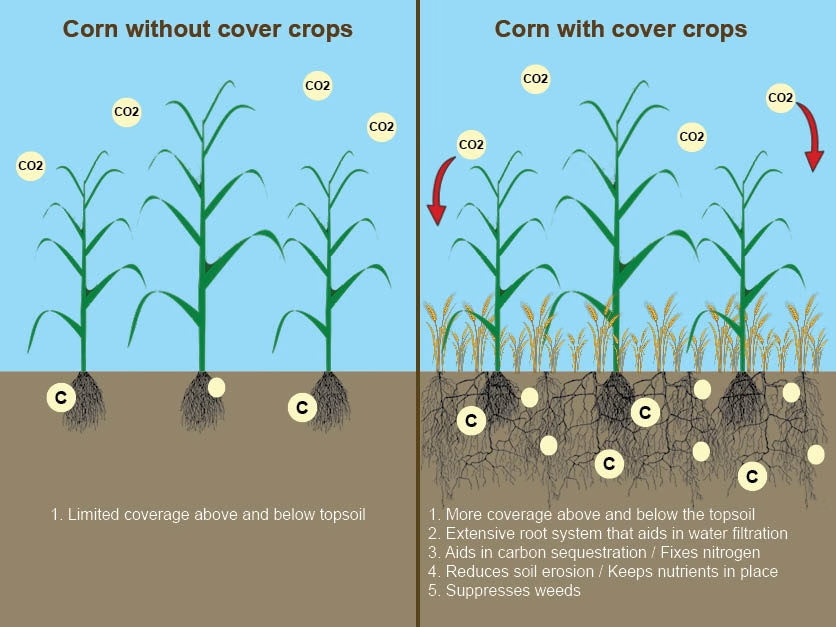
For smaller operations, soil carbon sequestration through cover cropping, reduced tillage, and rotational grazing offers an entry point, though returns are more modest. An example from Alberta’s Conservation Cropping Protocol showed net returns to farmers of just $0.87 to $1.73 per acre after aggregator fees. A 2013 study found most participating Alberta farmers earned between $1,000 and $5,000 total from their contracts, representing only about 1% of average gross farm income.

Diagram illustrating the benefits of cover crops in corn fields, showing enhanced carbon sequestration and improved soil health compared to fields without cover crops

Here’s What Dairy Cooperatives Don’t Want You to Discover About Carbon Revenue

Program/PlatformRevenue Share to FarmerVerification StandardTrack RecordKey PartnersRed Flags
Athian (Livestock Carbon)75%Third-party verifiedDocumented DFA purchaseDFA, Elanco, NewtrientNone identified
Concord Agriculture Partners85%Third-party verified$3M paid to farmersAlltech, AgolinNone identified
Carbon by Indigo75%Climate Action Reserve$30/credit in 2022Major food companiesNone identified
Farmers Edge (Warning)Variable/UnclearUnclear processMultiple complaintsUnknownPayment delays, high fees
Unnamed Aggregators (Red Flag)50% or lessNo verificationNo documented paymentsUnknownNo transparency, high upfront costs

The Insetting Revolution That Changes Everything:

The most significant development transforming carbon markets is the rise of “insetting”—where credits are purchased by companies within the dairy value chain rather than unrelated buyers. This creates more stable, predictable demand because dairy processors need these credits to meet their own supply chain (Scope 3) emissions targets.

Programs Worth Your Time (With Verified Track Records):

Athian – The Dairy Industry’s Insider Secret

  • Revenue Split: 75% to farmer, 25% to platform
  • Key Partners: Dairy Farmers of America, Elanco Animal Health, Newtrient
  • Why It Works: Keeps value within the animal agriculture value chain, creating built-in demand from dairy processors

Concord Agriculture Partners – The Feed Additive Specialist

  • Revenue Split: Industry-leading 85% to farmer, 15% to platform
  • Focus: Enteric methane reduction using Agolin Ruminant feed additive
  • Track Record: Part of projects that have delivered nearly $3 million to U.S. dairy farmers

Carbon by Indigo – The Soil Carbon Leader

  • Revenue Split: 75% to farmer, 25% to platform
  • Registry: Climate Action Reserve (CAR) for high credibility
  • Performance: Paid $30 per credit in 2022, higher than initially projected $20

Government Funding: Your Secret Weapon for Million-Dollar Projects

Support TypeFunding LevelMaximum AmountEligible TechnologiesApplication Status
OFCAF Cost-Share65-85% of costs$75,000 CADCover crops, rotational grazing, nitrogen managementOngoing intakes
ACT Program Funding50% of costs$2M CADAnaerobic digesters, clean technologyOngoing
USDA REAP Grants25-75% of costs$1M USDRenewable energy systems, digestersOngoing
LCFS Credit Multiplier28x CO2 valueNo limitRNG production, dairy methane captureAutomatic for qualified projects
Investment Tax Credits30-50% of investmentNo limitAnaerobic digesters, renewable energyAvailable

Federal Support That Changes the Math:

On-Farm Climate Action Fund (OFCAF): This $200 million fund provides direct cost-share funding for beneficial management practices. The Ontario program offers 65% cost-share, with a specialized stream for organic farms offering up to 85% of eligible costs, maximum $75,000 per operation.

Agricultural Clean Technology (ACT) Program: Targeted at larger-scale projects, providing non-repayable contributions of up to 50% of project costs, maximum $2 million—critical funding for anaerobic digester investments.

Provincial Opportunities:

  • Alberta: Operating under TIER regulation, the most mature provincial system with government-approved protocols for agricultural offset projects
  • Quebec: Cap-and-Trade system linked with California’s allows specific agricultural offset protocols including methane mitigation through slurry pit covering and biomethanization

Why Major Dairy Associations Haven’t Promoted These Opportunities Aggressively

The Market Transformation Creating Six-Figure Opportunities:

The carbon market is experiencing a documented “flight to quality,” where demand shifts toward credits representing real, verifiable, and permanent GHG reductions. This trend strongly favors credits from direct methane abatement technologies like anaerobic digesters over less certain soil carbon sequestration.

Compliance Markets vs. Voluntary Markets:

Compliance market prices are generally higher and more predictable, tied to government-mandated schedules. Voluntary market prices can fluctuate significantly, but the insetting model addresses volatility by creating stable demand within the dairy value chain.

Calculate Your Operation’s Carbon Earning Potential

Realistic Financial Projections by Farm Size:

Farm Size (Cows)Technology/PracticeEst. Capital CostEst. Annual Revenue/CowNet Revenue/Cow (Post-Fees)
2,500+Anaerobic Digester + RNG$5M – $10M+$400 – $450$150 – $250+
300-1,000Feed Additive (Agolin)Minimal$35 – $160$0 – $100+
<300Cover Cropping/No-TillLow$2 – $10/acre$0 – $5/acre

Source: Smart Prosperity Institute comprehensive analysis

Critical Cost Considerations:

  • Measurement, Reporting, Verification (MRV): $10,000 to $20,000 per individual farm project
  • Aggregator Fees: Range from 15% to 50%, with transparent programs like Athian stating 75%/25% split
  • Transaction Costs: Often underestimated but essential for program integrity

Programs to Avoid: The $100,000 Mistake

The Farmers Edge Cautionary Tale:

Multiple farmers in Manitoba and Saskatchewan report being misled by programs bundling expensive services with vague carbon revenue promises, receiving invoices for tens of thousands—in one case over $100,000—while receiving no carbon payments. In documented instances, farmers were told companies would not sell generated credits “due to current values,” highlighting the risk when aggregators control timing of credit sales.

Red Flags to Identify:

  • Programs bundling expensive services with non-guaranteed carbon revenue
  • Unclear payment timelines or aggregator-controlled credit sales
  • Revenue projections not backed by existing program performance

Your Strategic Enrollment Framework

The Due Diligence Protocol That Prevents Six-Figure Losses:

Before signing any carbon market contract, secure clarity on critical contractual clauses that can have profound, long-term implications:

Essential Questions for Program Evaluation:

  • What is the exact revenue-sharing model and are there hidden fees?
  • What is the process and timeline for payment after credits are generated?
  • Who covers third-party verification costs?
  • What are contract length and early termination penalties?
  • Who owns the farm data and how will it be protected?

Critical Contract Clauses:

Additionality Requirements: Practices must be “additional” to business-as-usual, often rendering progressive farmers who have practiced conservation for years ineligible—a perverse incentive that penalizes early adopters.

Permanence Obligations: Contractual requirements to maintain specific practices for 10-20 years or more, creating long-term encumbrances that can complicate farm succession planning.

Reversal Liability: Risk that sequestered carbon could be released back into the atmosphere, with reputable programs managing this through buffer pools—for example, Indigo holds back up to 20% of credits for this purpose.

The Bottom Line: Why Smart Operators Are Moving Now

While dairy operators nationwide focus on volatile milk prices and rising costs, comprehensive analysis shows progressive farms are building substantial revenue streams through carbon credit programs. The earning potential is verified through documented case studies: realistic annual revenue of $400-$450 per cow for anaerobic digestion systems, nearly $3 million paid to farmers through feed additive programs, and significant government support covering up to 85% of implementation costs.

Three critical takeaways backed by verified research: First, program quality varies dramatically—legitimate platforms like Athian offer transparent 75% farmer revenue shares with documented transactions, while others have left producers with unpaid bills exceeding $100,000. Second, government funding through ACT and OFCAF programs provides essential cost-share support that research confirms as critical for project viability. Third, timing matters more than perfection—the documented “flight to quality” in carbon markets favors early adopters of permanent, verifiable reduction technologies.

The research is clear: The carbon credit opportunity is “sharply bifurcated” between high-reward, capital-intensive projects accessible to large operations and more modest returns for smaller farms. However, the comprehensive analysis recommends that producers prioritize practices delivering tangible on-farm co-benefits—improved soil health, operational efficiency, reduced input costs—as the primary return on investment, with carbon credits viewed as a potential bonus, not a guaranteed foundation.

Your immediate action step: This week, assess your eligibility for government cost-share programs and identify which carbon credit pathway aligns with your operation’s scale and risk tolerance. Whether you’re considering a multi-million dollar digester with documented 48% gross margins or a feed additive program with proven methane reduction, understanding available support is your first step toward joining the documented ranks of farms already banking substantial carbon revenues.

The carbon credit revolution is transforming dairy economics—but only for operations that act while opportunities remain open. The question isn’t whether environmental programs will become part of dairy economics, but whether you’ll position your operation to profit from this transition or watch others capture the first-mover advantages that are creating six-figure revenue streams right now.

KEY TAKEAWAYS

  • Transform Environmental Compliance into Profit Centers: Large operations (1,000+ cows) can achieve $400-$450 annual revenue per cow through anaerobic digestion systems producing RNG for California’s Low Carbon Fuel Standard, with documented payback periods of 3-7 years when leveraging government cost-share funding up to $2 million through Canada’s ACT Program.
  • Feed Efficiency Meets Carbon Revenue: Medium-scale dairies (300-1,000 cows) using scientifically validated feed additives like Agolin Ruminant can generate $35-$160 per cow annually with minimal capital investment, while the additive costs just $0.15-$0.30 per cow daily—creating positive cash flow within 30 days of enrollment in legitimate programs offering 75-85% farmer revenue shares.
  • Government Funding Changes the ROI Equation: Smart operators are stacking OFCAF’s 65-85% cost-share funding (maximum $75,000 per farm) with carbon credit programs to de-risk investments, positioning beneficial management practices like cover cropping and enhanced manure management as profit centers rather than compliance costs.
  • Insetting Revolution Creates Stable Demand: The first verified transaction through Athian’s livestock carbon marketplace—where Texas dairy farmer Jasper DeVos sold 1,150 metric tons of CO2e credits directly to Dairy Farmers of America—signals the shift toward value-chain integration that provides more predictable pricing than volatile voluntary offset markets.
  • Warning: Program Quality Varies Dramatically: While legitimate platforms like Athian (75% farmer share) and Concord Agriculture Partners (85% farmer share) offer transparent terms with documented payouts, multiple Manitoba and Saskatchewan farmers report losses exceeding $100,000 from programs bundling expensive services with unfulfilled carbon revenue promises—making due diligence absolutely critical before signing long-term contracts.

EXECUTIVE SUMMARY

The dairy industry’s biggest lie? That environmental programs drain profits instead of generating them. Comprehensive analysis reveals anaerobic digestion systems are generating realistic annual revenue of $400-$450 per cow through Renewable Natural Gas production, with one documented 5,500-cow Western operation reporting $1.4 million in annual carbon revenue—exceeding their milk profits in strong market years. Feed additive programs have already delivered $3 million to U.S. dairy farmers across just three projects using scientifically validated methane-reducing supplements, while government cost-share funding through Canada’s OFCAF program covers up to 85% of implementation costs with $75,000 maximum per operation. The market is experiencing a documented “flight to quality” favoring permanent methane destruction over questionable soil carbon claims, creating premium pricing for dairy-specific technologies just as processors like Dairy Farmers of America begin purchasing credits directly from their supplier farms. Three legitimate programs are accepting enrollments now, but compliance market capacity limits and tightening qualification requirements mean early adopters are securing advantages that late entrants won’t access. Evaluate your operation’s carbon earning potential immediately—the window for optimal positioning closes as programs reach capacity and competition intensifies.

Complete references and supporting documentation are available upon request by contacting the editorial team at editor@thebullvine.com.

Learn More:

Join the Revolution!

Join over 30,000 successful dairy professionals who rely on Bullvine Weekly for their competitive edge. Delivered directly to your inbox each week, our exclusive industry insights help you make smarter decisions while saving precious hours every week. Never miss critical updates on milk production trends, breakthrough technologies, and profit-boosting strategies that top producers are already implementing. Subscribe now to transform your dairy operation’s efficiency and profitability—your future success is just one click away.

NewsSubscribe
First
Last
Consent

Generate $15,000+ Annual Carbon Revenue: The Dairy Producer’s Guide to Getting Paid for Going Green

While you’re chasing milk yield gains, smart producers are banking $15,000+ annually from practices that boost feed efficiency AND reduce emissions

EXECUTIVE SUMMARY: The dairy industry’s biggest lie: treating methane reduction as a compliance cost rather than a profit center is the single biggest strategic mistake most producers are making. While the agricultural carbon market exploded from $2 billion in 2021 to a projected $40 billion by 2030, dairy-specific programs now generate $20-$80 per metric ton for verified emission reductions—yet 90% of producers remain completely unaware. Research consistently shows feed additives like 3-NOP can simultaneously reduce methane emissions by 22-35% while improving feed efficiency by 4-5%, creating dual revenue streams that industry nutritionists have historically ignored. Corporate giants like Microsoft have contracted for nearly 30 million metric tons of carbon removal, while early adopters are locking in premium contract terms before the market matures. Canadian farmers are already earning $30-45 per acre annually through established carbon programs, proving the financial viability for North American operations. Government cost-share programs can cover 50-75% of implementation costs, dramatically reducing financial risk during the transition period. Stop viewing environmental practices as expenses—start evaluating carbon farming as your next major profit opportunity.

KEY TAKEAWAYS

  • Revenue Stacking Opportunity: Feed additives like 3-NOP generate $14,000-$25,000 annually for 1,000-cow operations through 20-30% methane reduction PLUS 4-5% feed efficiency improvements—turning environmental compliance into a dual profit center
  • Market Timing Advantage: Early adopters are securing 75% revenue-sharing contracts with registry-verified programs while the agricultural carbon market experiences 28.9% annual growth, positioning operations for long-term premium pricing
  • Government De-Risking Strategy: USDA cost-share programs (EQIP/CSP) cover 50-75% of practice implementation costs, allowing producers to stack government payments with private carbon credits from the same practices—dramatically reducing transition risk
  • Technology Integration Reality: Modern carbon verification systems integrate seamlessly with existing dairy management software, eliminating the “paperwork burden” myth while creating comprehensive data streams that unlock multiple value opportunities beyond carbon credits
  • 45Z Policy Revolution: Section 45Z tax credits create parallel markets for low-carbon-intensity dairy feedstocks potentially worth $130+ per acre annually—eclipsing traditional carbon credit revenue while requiring identical management practices

The industry’s biggest lie: Treating methane reduction as a compliance cost rather than a profit center is most dairy producers’ single biggest strategic mistake. While the agricultural carbon market exploded from $2 billion in 2021 to a projected $40 billion by 2030, dairy-specific programs now generate $20-$80 per metric ton for verified emission reductions—yet 90% of producers remain completely unaware of these opportunities.

Your nutritionist isn’t telling you that feed additives like 3-NOP can simultaneously reduce methane emissions by 22-35% while improving feed efficiency, creating dual revenue streams from carbon credits and operational savings that industry consultants have historically ignored in their singular focus on milk production metrics.

The policy revolution nobody’s discussing: Section 45Z of the Inflation Reduction Act creates a parallel market for low-carbon-intensity dairy feedstocks that could generate over $130 per acre annually, eclipsing traditional carbon credit revenue while requiring the same practices most carbon programs incentivize.

What if the biggest profit opportunity in dairy isn’t from higher milk prices, better genetics, or even precision feeding, but from getting paid for practices that improve your operation’s efficiency and resilience?

While most dairy producers are laser-focused on squeezing another dollar from their Income Over Feed Cost (IOFC), which currently averages just $8-12 per cow per day, a parallel market has exploded, creating entirely new revenue streams. Corporate giants like Microsoft, which has contracted for nearly 30 million metric tons of carbon removal, and Amazon are writing premium checks to dairy producers who can demonstrate measurable greenhouse gas reductions.

Challenging the Industry’s Sacred Cow: Why Traditional Methane Management Is Backwards

Here’s the industry sacred cow that needs slaughtering: the assumption that methane reduction is just a compliance cost rather than a profit opportunity.

The American Dairy Science Association, National Milk Producers Federation, and major dairy nutritionists have framed emission reduction through the lens of regulatory compliance for decades. This approach isn’t just financially shortsighted—it’s strategically wrong and ignores the massive financial opportunities now available to forward-thinking producers.

The evidence-based alternative transforms emission reduction from a cost center to a profit center. Research consistently shows that feed additives can reduce methane emissions by 20-30% while maintaining or improving milk production efficiency, yet most industry advisors continue presenting these technologies as environmental expenses rather than profit-generating investments.

Why most industry advisors give you incomplete information: The traditional focus on milk production optimization ignores the financial value of emission reductions. A feed additive program that costs $75 per cow annually but generates $120 in carbon credits while improving feed efficiency isn’t an expense—it’s a profit opportunity with environmental co-benefits.

Your Dairy’s Multiple Revenue Goldmines

Think of carbon farming like implementing genomic testing—you’re not changing what you do fundamentally, but rather adopting proven technologies that deliver measurable, profitable improvements. Just as genomic testing revolutionized breeding decisions through data-driven selection, carbon programs reward you for data-driven management decisions that reduce emissions while improving operational performance.

Feed Additive Implementation: The Scientifically-Proven Revenue Stream

The feed additive 3-nitrooxypropanol (3-NOP) represents dairy’s equivalent of artificial insemination—a scientifically proven technology that delivers both immediate operational benefits and long-term value creation. University research demonstrates consistent methane reduction while often delivering measurable improvements in feed efficiency.

Current market pricing reality for agricultural carbon credits:

  • Basic emission reduction credits: $20-$60 per metric ton CO2e
  • High-integrity, registry-verified credits: $40-$80 per metric ton CO2e
  • Premium corporate buyer contracts: $80-$120+ per metric ton CO2e

Revenue calculation for a 1,000-cow operation using verified market data:

  • Methane reduction with feed additives: 20-30% (established research range)
  • Credits generated: 400-500 metric tons annually
  • Revenue at $60/ton: $24,000-$30,000
  • Feed efficiency improvement: Additional operational savings
  • Net annual benefit: $14,000-$25,000

Program Analysis: Who’s Actually Paying and What They’re Demanding

The Market Leader Under Scrutiny: Indigo Ag’s Business Model

Indigo Ag operates an outcome-based program where farmers receive 75% of the verified credits’ weighted average sale price. The program requires 5-year contracts that auto-renew annually and uses Climate Action Reserve and Verra registry verification to ensure credit integrity.

Corporate Demand Reality Check:

Microsoft has established a corporation’s most aggressive climate goal: carbon negative by 2030 and removal of all historical emissions since 1975 by 2050. The company’s “Criteria for High-Quality Carbon Dioxide Removal” emphasizes robust scientific validation and long-term permanence—standards that directly influence program development across the industry.

Amazon is pursuing net-zero by 2040 and has launched its own “Sustainability Exchange” platform, stating that less than 5% of credits on the global market meet its quality standards. This quality differentiation is creating distinct pricing tiers that reward high-integrity program participation.

Risk Management: Learning from Industry Failures

The Cautionary Tale Everyone’s Ignoring: Nori’s Collapse

Nori, a high-profile venture-backed startup that operated a carbon removal marketplace using blockchain technology, abruptly shut down in September 2024 despite raising over $17 million in funding. The company cited the “stagnant Voluntary Carbon Market and tough funding environment” as primary reasons for the collapse.

Critical Risk Factors:

Contract lengths vary dramatically, with some programs requiring 40-year commitments, longer than most dairy facility depreciation schedules. For operations with significant leased acreage, these terms create unmanageable risk.

The “additionality” requirement means programs require proof that practices are new implementations rather than existing management. Progressive producers who have already implemented sustainable practices face eligibility challenges.

Government Program Stacking: De-Risking Your Investment

Strategic Financial Integration That Most Producers Miss

The $3.1 billion USDA Partnerships for Climate-Smart Commodities initiative funds 141 large-scale pilot projects providing direct financial and technical assistance to farmers adopting climate-smart practices. Participants can receive up to 75% cost-share for eligible practices while maintaining eligibility for private carbon programs.

The Stacking Opportunity Nobody’s Talking About:

Multiple programs explicitly allow farmers to receive payments from government programs like EQIP and CSP for the same practices that generate carbon credits. This powerful financial strategy enables producers to use cost-share payments to cover significant implementation costs while maintaining private program eligibility.

Regional Implementation Strategy: Timing and Seasonal Considerations

Upper Midwest Implementation Timeline (Wisconsin, Minnesota, Michigan):

  • March-April: Cover crop species selection and NRCS application submission
  • May-June: Equipment evaluation and carbon program enrollment
  • July-August: Baseline soil sampling and data collection training
  • September-October: Cover crop establishment and first verification
  • November-February: Data analysis and first-year revenue projection refinement

Southwest Operations (California, Arizona, New Mexico):

  • Year-round opportunities: Focus on feed additive programs and manure management
  • Fall implementation: Optimal timing for practice changes to align with verification cycles
  • Water management integration: Coordinate carbon practices with water conservation requirements

Implementation Checklist: Research-Backed Action Steps

Phase 1: Operational Assessment (Week 1-2)

Baseline Data Collection: Document current feed management protocols using farm management software
Methane Reduction Potential Assessment: Calculate potential emission reductions using established 20-30% ranges for feed additives
Financial Modeling: Use verified market pricing ($40-$80/ton for high-integrity credits) to project revenue potential
Technology Infrastructure Review: Assess data collection capabilities for verification requirements

Phase 2: Program Evaluation (Week 3-4)

High-Integrity Program Identification: Focus on registry-verified programs using Climate Action Reserve or Verra standards
Contract Analysis: Evaluate payment models (practice-based vs. outcome-based) against risk tolerance
Legal Review: Engage an agricultural attorney for contract evaluation, particularly regarding 40-year commitment requirements

Phase 3: Implementation Preparation (Month 2)

Government Cost-Share Applications: Apply for NRCS programs (EQIP/CSP) to finance implementation
Feed Additive Supplier Evaluation: Research commercial suppliers with proven track records
Data Management System Upgrade: Implement software capable of tracking detailed operational data for verification
Baseline Establishment: Complete soil sampling and emission baseline measurements

Phase 4: Revenue Optimization (Month 3-6)

45Z Market Investigation: Contact local ethanol facilities about low-carbon-intensity grain premiums potentially exceeding $130 per acre
Multi-Program Stacking: Explore combining carbon credits with government payments and 45Z premiums
Performance Monitoring: Track emission reductions and feed efficiency improvements
Financial Performance Analysis: Monitor actual returns against projections

Industry Event Integration and Market Intelligence

Connecting Carbon Opportunities to the Industry Calendar:

Major dairy conferences increasingly feature carbon market sessions, yet most attendees leave without actionable implementation strategies. The American Dairy Science Association’s 2025 annual meeting will include specific technical sessions on methane reduction technologies and carbon verification protocols.

International Benchmarking:

Canadian farmers earn $30-45 per acre annually through carbon credit programs, with established markets providing proven templates for U.S. dairy operations. European programs demonstrate even higher premiums for dairy-specific applications.

The Bottom Line: Three Strategic Implementation Imperatives

First Strategic Imperative: Start with government cost-share to finance the transition. Use NRCS programs to cover 50-75% of practice implementation costs before committing to private carbon contracts. This approach reduces financial risk during the 12-24-month adaptation period that most carbon practices require for optimal performance.

Second Strategic Imperative: Focus on registry-verified programs with transparent pricing. Partner with established programs using Climate Action Reserve or Verra standards. These represent the “high-integrity” tier that sophisticated corporate buyers demand, ensuring long-term credit marketability as quality differentiation increases.

Third Strategic Imperative: Integrate carbon practices with existing operational improvements. Feed additives that reduce methane often improve feed efficiency. Cover crops on feed crop acres improve soil health while generating credits. The most successful dairy carbon programs enhance rather than complicate existing management systems.

The agricultural carbon market represents more than additional revenue—it’s a research-backed pathway to building resilient, efficient operations positioned for multiple emerging value streams. Your operation’s competitive advantage in 2026 depends on your current decisions. The market is expanding at nearly 30% annually, major corporations are paying premium prices for verified dairy carbon reductions, and early adopters are securing the most favorable contract terms.

Take action this week: Document your current practices, contact three carbon program providers, and schedule NRCS consultation for cost-share opportunities. The carbon revolution is happening with or without you—make sure you’re generating revenue from it rather than reading about others who are.

Complete references and supporting documentation are available upon request by contacting the editorial team at editor@thebullvine.com.

Learn More:

Join the Revolution!

Join over 30,000 successful dairy professionals who rely on Bullvine Weekly for their competitive edge. Delivered directly to your inbox each week, our exclusive industry insights help you make smarter decisions while saving precious hours every week. Never miss critical updates on milk production trends, breakthrough technologies, and profit-boosting strategies that top producers are already implementing. Subscribe now to transform your dairy operation’s efficiency and profitability—your future success is just one click away.

NewsSubscribe
First
Last
Consent

Amazon’s Methane Microbes Promise 85% Emission Cuts – But Will They Deliver for Dairy Farmers?

Amazon’s 85% methane cut sounds great—but at $308/cow break-even, is Big Tech overselling dairy sustainability solutions?

EXECUTIVE SUMMARY: The dairy industry’s been sold a false narrative that methane reduction automatically destroys profitability—but Journal of Dairy Science research reveals the brutal economic reality behind the hype. Amazon-backed Windfall Bio just proved 85% methane reduction is possible, while Bovaer delivers 30.6% cuts in commercial trials, but here’s what no one’s telling you: break-even requires $308 per cow annually from carbon markets or processor premiums. Meta-analysis of 119 peer-reviewed studies confirms that feed efficiency optimization can reduce methane by 15-25% while actually boosting income over feed costs—meaning the best solutions might already be in your barn. With EU regulations creating trade barriers for high-emission dairy products by August 2030 and major processors like Danone achieving 25% supply chain reductions, early adopters are gaining competitive advantages through strategic implementation rather than waiting for Silicon Valley promises. California operations using proven digesters are hitting 82% methane reductions with positive ROI, while 500-cow operations face $154,000 annual costs for Bovaer compared to $616,000 for 2,000-cow herds. Stop waiting for Amazon’s methane miracle—calculate your operation’s baseline, implement proven feed efficiency strategies, and position yourself for the regulatory reality that’s already reshaping global dairy markets.

KEY TAKEAWAYS

  • Feed Efficiency Trumps Feed Additives: Optimize nutrition strategies to achieve 15-25% methane reduction while improving milk yield and feed conversion ratios—delivering immediate ROI without external technology dependence or regulatory approval delays.
  • Size-Specific Economic Reality: 500-cow operations need $308/cow annually in carbon credits to break even on Bovaer, while 2,000-cow herds face $616,000 total costs—making farm-scale economic modeling critical before adopting methane reduction technologies.
  • EU Trade Barrier Timeline: Maximum methane intensity values for dairy imports take effect August 2030, creating competitive advantages for operations demonstrating verified reductions through processor partnerships and premium pricing opportunities.
  • Proven Technology vs. Promise: California digesters deliver 82% methane reduction with positive ROI, while Amazon’s 85% microbe results remain limited to single-location pilots—focus on commercially available solutions while monitoring emerging technologies.
  • Strategic Implementation Roadmap: Start with baseline measurement and feed optimization (0-12 months), evaluate proven technologies like digesters or Bovaer based on processor partnerships (12-24 months), then integrate emerging solutions when economically viable (24+ months).

What if the biggest breakthrough in dairy sustainability isn’t coming from traditional agricultural research, but from a tech giant’s bet on biology? Amazon-backed methane solutions just proved they can slash emissions by over 85% in real-world trials—but every dairy operator should ask whether these innovations will actually pencil out on your farm.

The stakes have never been higher. With California dairy farms ahead of schedule to meet 40% methane reduction targets and major processors like Danone hitting 25% supply chain reductions since 2020, methane reduction isn’t a future concern—it’s a competitive reality happening right now.

The Methane Reality Check: Why Amazon Is Betting Big on Dairy Biology

Let’s cut through the hype and examine what’s actually working. Windfall Bio’s pilot with Straus Family Creamery demonstrated over 85% methane reduction from manure biogas, with their methane-eating microbes consuming raw biogas continuously for more than a month without requiring pre-treatment or external energy sources.

Here’s what makes this revolutionary: these microbes don’t just eliminate methane—they convert it into nitrogen-enriched organic fertilizer. A 1,000-cow operation producing roughly 80 tons of manure daily transforms waste management from a cost center into a potential revenue stream.

The Science Behind Farm-Level Emissions

Research published in Rabobank’s comprehensive dairy emissions analysis shows that farm-level methane from enteric fermentation and manure management accounts for 75% to 85% of direct on-farm emissions. The remainder consists largely of nitrous oxide from soil management and manure application, meaning methane reduction strategies can address the majority of your operation’s climate impact.

The Global Investment Reality

Amazon isn’t the only player recognizing this opportunity. The Bezos Earth Fund committed €9 million to methane vaccine research at the Pirbright Institute and Royal Veterinary College, targeting 30%+ methane reduction through immune system responses that inhibit rumen methanogens.

Meanwhile, Windfall Bio secured $28 million in Series A funding from Amazon’s Climate Pledge Fund, positioning them for commercial scale deployment by 2025.

Amazon’s Two-Pronged Strategy: Microbes vs. Vaccines

Strategy #1: Methane-Eating Microbes (Windfall Bio)

Windfall Bio’s technology deploys specialized microbes that consume methane and convert it to organic fertilizer. The microbes are grown in fermentation vats, dried, packed like yeast, and deployed near manure lagoons where they consume biogas without electricity or high-temperature processing.

In their pilot project, the bioreactor consumed raw manure biogas without disruption and removed hydrogen sulfide from the manure gas, potentially reducing odors and improving local air quality.

Strategy #2: Methane Vaccines (Research Phase)

The Pirbright Institute research focuses on developing antibodies that target methane-producing microbes in cattle digestive systems. Early trials by startup Arkebio showed 12.9% methane reduction over 105 days with no adverse side effects.

Scientists involved in the Pirbright research expect that an effective vaccine will reduce methane production by more than 30%, while New Zealand has invested approximately $40 million in methane vaccine development by establishing Lucidome Bio.

How Amazon’s Solutions Stack Against Proven Alternatives

Smart producers evaluate new technologies against existing options. A comprehensive meta-analysis published in MDPI analyzing 119 peer-reviewed studies establishes the definitive efficacy hierarchy for methane reduction interventions:

SolutionMethane ReductionCommercial StatusImplementation
Macroalgae51.0% (peer-reviewed)Limited supply chainsFeasibility challenges
Windfall Bio Microbes85% (pilot results)Commercial scale 2025Requires manure lagoon infrastructure
3-NOP (Bovaer)30.6% (meta-analysis)FDA approved May 2024Daily feeding requirement
Nitrate16.0% (peer-reviewed)Available but with limited adoptionPotential toxicity concerns
Oils and Fats14.7% (peer-reviewed)Widely availableVariable results

The Reality Check: While Amazon solutions show promise, University of Cattolica trials confirmed that Bovaer reduces methane emissions by 44-50% when fed to dairy cows at 60ppm while maintaining milk composition and production levels.

Economic Reality: Will These Solutions Actually Pencil Out?

Here’s where theory meets your milk check. Research published in the Journal of Dairy Science shows that dietary interventions can reduce methane per unit of milk while maintaining or improving production efficiency, but economic viability varies significantly by farm size and implementation approach.

Real Farm Economics: The Numbers That Matter

Let me walk you through what this looks like on actual operations, because that’s where the rubber meets the road.

Bovaer Cost Analysis by Operation Size

Based on verified Journal of Dairy Science research, 3-NOP (Bovaer) costs approximately $0.495 per head per day but creates a net reduction in income over feed costs of $0.35 per cow daily. Here’s how this breaks down for different farm sizes:

500-Cow Operation:

  • Annual Bovaer cost: $90,000 (based on $0.495/cow/day)
  • Annual productivity loss: $64,000 (based on $0.35/cow/day net reduction)
  • Total yearly cost: $154,000
  • Break-even requirement: $308 per cow annually from carbon credits or processor premiums

2,000-Cow Operation:

  • Annual Bovaer cost: $360,000
  • Annual productivity loss: $256,000
  • Total yearly cost: $616,000
  • Break-even requirement: $308 per cow annually from carbon credits or processor premiums

Bruce Knight, former USDA undersecretary for marketing and regulatory affairs, notes that federal approval of methane-reducing additives positions the dairy industry well for carbon market participation, especially because these technologies are “size neutral”. But let’s be honest—that break-even math is steep without significant external support.

Real-World Implementation: Midwest Case Study

Consider a practical example from Feed and Additive’s economic analysis: a farm with 1,000 cows weighing 1,500 pounds each, consuming 60 pounds of dry matter daily. If management improvements could boost milk production from 80 to 90 pounds per day while maintaining the same methane yield:

  • Methane intensity reduction: From 0.004375 to 0.00389 kg CH₄ per pound of milk
  • Daily savings per cow: $0.0073 based on the social cost of methane
  • Annual herd-level savings: $2,665 for emission reduction value alone

While that might sound small, it’s just the beginning. The real value comes from the milk production increase—an extra 10 pounds daily per cow generates $20 additional revenue at current prices, or $7.3 million annually for the herd.

Implementation Barriers: The Real Obstacles You’re Thinking About

Let’s address the elephant in the room—your concerns about adopting these technologies. Because if we’re gonna talk implementation, we need to tackle the real barriers head-on.

Economic Reality Check

The biggest barrier? That break-even math we just showed you. At current implementation costs of $0.30 to $0.50 per cow per day for Bovaer, you’re looking at $110-$180 annually per cow just for the additive. Add in the productivity impact; you need serious external revenue to make this pencil out.

But here’s what’s changing: Elanco reports that carbon markets, federal conservation programs, and processor incentives could generate $20 or more per lactating cow annually. That’s not enough to cover full costs yet, but it’s moving in the right direction.

Consumer Acceptance Concerns

You’re probably wondering about consumer reaction to feeding additives. Fair question. The reality is that consumer acceptance of feed additives for environmental benefits has been mixed, with some resistance based on concerns about “artificial” interventions in food production.

However, major processors like Danone achieving 25% methane reductions suggest that market acceptance is growing, especially when positioned as environmental stewardship rather than just another feed additive.

Technology Integration Challenges

For Amazon’s microbe solutions, the infrastructure requirements are significant. You’ll need:

  • Compatible manure management systems
  • Consistent biogas generation
  • Monitoring and maintenance protocols
  • Staff training for new technology management

Windfall Bio’s successful pilot demonstrated continuous operation for over a month, but scaling across diverse farm conditions remains to be proven.

Regulatory Uncertainty

Here’s something most articles won’t tell you: regulatory uncertainty is actually decreasing, not increasing. With FDA approval of Bovaer for dairy cattle and the USDA developing standards for carbon programs, the regulatory pathway is becoming clearer.

Global Implementation: Learning from International Leaders

California’s Success Model

UC Riverside research confirmed that properly managed dairy digesters achieve 82% methane emission reductions, with over 130 such systems currently operating statewide. But here’s the key insight: these systems require significant investment and are primarily viable for operations with sufficient scale.

European Union Regulatory Timeline

The EU isn’t messing around with methane regulations. Here’s what’s coming:

  • Methane emission reporting requirements effective August 2025
  • Prohibition on routine methane venting begins in February 2026
  • Maximum methane intensity values for imports effective August 2030

These regulations will create trade barriers for high-emission dairy products, potentially providing market advantages for operations demonstrating verified methane reductions.

International Innovation Examples

Research from Russia’s Volga Research Medical University developed a wood waste feed additive that delivers 30% methane reduction plus 12% milk yield increases, proving that sustainability and productivity can work together when approached strategically.

Real Farm Implementation: Different Strategies for Different Operations

Why This Matters for Your Operation: Different farm sizes require different approaches to methane reduction. Annual Reviews research on net-zero dairy production indicates that achieving substantial emission reductions requires combining multiple strategies rather than relying on single technologies.

Large Operations (2,000+ cows): Can justify capital-intensive solutions like digesters or comprehensive feed additive programs. Research shows these operations benefit from economies of scale that make substantial infrastructure investments viable.

Medium Operations (500-2,000 cows): Focus on feed additives, alternative manure management, and efficiency improvements. Studies indicate that feed-based interventions often provide better cost-effectiveness at this scale.

Small Operations (<500 cows) 50% enteric methane reduction combined with comprehensive farm efficiency improvements

Your Strategic Advantage:

The dairy industry is at a critical inflection point. Major processors are achieving significant reductions, EU regulations are creating trade implications, and FDA approval is opening new market opportunities. Operations implementing comprehensive methane reduction strategies now—using available technologies while monitoring emerging solutions—will gain competitive advantages far beyond environmental compliance.

Your Action Plan:

  1. Calculate your baseline: Use validated measurement protocols to establish the current methane intensity
  2. Optimize current operations: Implement feed efficiency improvements proven in peer-reviewed research
  3. Evaluate economic viability: Calculate break-even requirements using Journal of Dairy Science cost data
  4. Engage with carbon markets: Explore opportunities through USDA conservation programs and voluntary markets
  5. Monitor emerging technologies: Track Amazon-backed solutions for future integration opportunities

The question isn’t whether Amazon’s methane microbes will revolutionize dairy farming—it’s whether you’ll be positioned to capitalize on the methane reduction opportunity using whatever technologies prove most effective for your operation. Start reducing methane emissions today with proven methods backed by peer-reviewed research, and you’ll be ready to integrate breakthrough technologies when they become commercially viable and economically justified.

With processors achieving 25% supply chain reductions and EU regulations creating international market implications, early action on methane reduction isn’t just environmental stewardship—it’s strategic business positioning for the dairy industry’s sustainable future.

Complete references and supporting documentation are available upon request by contacting the editorial team at editor@thebullvine.com.

Learn More:

Join the Revolution!

Join over 30,000 successful dairy professionals who rely on Bullvine Weekly for their competitive edge. Delivered directly to your inbox each week, our exclusive industry insights help you make smarter decisions while saving precious hours every week. Never miss critical updates on milk production trends, breakthrough technologies, and profit-boosting strategies that top producers are already implementing. Subscribe now to transform your dairy operation’s efficiency and profitability—your future success is just one click away.

NewsSubscribe
First
Last
Consent

The Carbon Credit Goldmine: How Forward-Thinking Dairy Producers Are Turning Methane Reduction into Cash Flow

Forget emissions-dairy’s new cash cow is methane. Early adopters are cashing in while others lag. Your move.

While most dairy producers still treat environmental compliance like another cost burden alongside SCC penalties and FARM program requirements, a savvy group of innovative farmers is quietly banking profits that make component premiums look like pennies on the parlor floor. The inconvenient truth? Your operation is either positioned to profit from methane reduction, or you’re leaving serious money on the table.

Dairy farmers have mastered transforming forage and grain into milk solids for generations. An elite group is now learning something potentially more valuable: turning methane into money. As global pressure mounts to address agriculture’s carbon footprint, the question isn’t whether you’ll need to reduce emissions- it’s whether you’ll turn that challenge into a revenue stream or watch others in while you play catch-up.

But let’s cut through the manure, shall we? Is the “carbon goldmine” real, or just another consultant’s fantasy like those $30 cwt milk price projections we’ve all stared at? As some claim, can average producers generate $800-1,200 per cow annually from environmental programs? How can your operation profit from this emerging opportunity before the window closes faster than a milk house door in January?

The Carbon Market Reality Check: Opportunity vs. Hype

Let’s start with some straight talk: The widely circulated claim that dairy farms can generate $800-$1,200 per cow annually through carbon credits represents an optimistic best-case scenario rather than a typical outcome. It’s like saying every heifer will conceive on first service and every cow will peak at 150 pounds-theoretically possible, but not what you’d bank the mortgage on.

The reality is more nuanced. Recent analyses of anaerobic digester (AD) projects producing renewable natural gas (RNG) place typical annual revenue closer to $400-$450 per cow when combining California’s Low Carbon Fuel Standard (LCFS) and federal Renewable Fuel Standard (RFS) credits. Still, it is substantial- about $1.25-$1.50 per hundredweight equivalent- but hardly the goldmine some consultants promise.

This doesn’t mean the opportunity isn’t real- it is. But why are so many dairy producers sitting on their hands while early adopters are already cashing in? Is it fear of the unknown? Skepticism of “green” initiatives? Or is it simply the industry’s notorious resistance to change that keeps us a step behind?

Why Dairy Methane is Carbon Market Gold

What makes dairy operations uniquely positioned in carbon markets? It comes down to methane’s potency and the accounting methods used in carbon crediting.

Methane has been approximately 28 times more potent than carbon dioxide as a greenhouse gas for over 100 years. This means reducing one ton of methane is equivalent to reducing 28 tons of CO2-instantly multiplying the potential credit value. It’s like the difference between shipping whole milk versus protein concentrate- the same truck, exponentially more value.

For dairy operations, methane comes from two primary sources:

  1. Enteric fermentation – The natural digestive process in a cow’s rumen that produces methane, released primarily through eructation (belching). Your best 35,000-pound Holsteins can produce over 500 liters of methane daily, while your Jerseys might produce somewhat less per head but with higher intensity per pound of milk solids.
  2. Manure management – Methane is released when manure decomposes anaerobically in lagoons or pits. That 5,000-cow free-stall operation with a 3.5-acre lagoon can generate enough methane to power 1,000 homes.

Under California’s LCFS, dairy RNG receives exceptionally favorable treatment through a methodology that assigns negative carbon intensity scores by crediting “avoided methane emissions.” This accounting approach creates extraordinary value for dairy RNG projects that can access this market.

Let’s be blunt: The dairy industry has been handed a gift in this accounting methodology, and we’d be fools not to capitalize on it. How long do you think regulators will maintain this generous approach if we don’t demonstrate meaningful adoption?

The Methane Reduction Toolkit: What’s Working Now

Anaerobic Digesters: The High-Value Pathway

Anaerobic digestion remains the gold standard for generating maximum carbon revenue, particularly when manufacturing RNG for transportation fuel markets.

The economics are heavily scale-dependent operations (typically over 2,000 cows) benefit from economies of scale that make the substantial capital investment (often $3-10 million) more feasible. For medium-sized farms, viability usually depends on grant funding, co-digestion of food waste, or participation in cooperative “hub-and-spoke” models.

Beyond carbon credits, digesters generate valuable co-products: renewable energy, separated solids used as bedding (saving $80-100 per cow annually on sand or sawdust), and nutrient-rich digestate that can reduce commercial fertilizer costs for your corn silage ground.

The practical challenges are significant. Sand bedding- the gold standard for cow comfort and mastitis prevention- can wreak havoc on digester systems, requiring sophisticated separation equipment. Farms with flush systems must carefully consider dilution rates, as too-watery manure (under 3% DM) reduces biogas potential, while thicker scrape manure (8-12% DM) may require different digester designs.

The dairy industry’s current approach to AD adoption is fundamentally flawed. We’ve created a system where only the most significant operations can realistically access the highest-value pathways. Why aren’t we seeing more cooperative models where multiple mid-sized farms combine resources to build shared facilities? The answer lies in our stubbornly independent mindset- the same one that’s held back progress in other areas like genetic improvement, equipment sharing, and marketing innovation.

Feed Additives: The Accessible Option

For farms unable to justify the massive capital investment of digesters, feed additives targeting enteric methane represent a more accessible entry point to carbon markets.

Two leading options are making headway in North American dairy:

3-Nitrooxypropanol (3-NOP/Bovaer®): Developed by DSM-Firmenich and marketed in the U.S. by Elanco, this compound inhibits the enzyme that catalyzes methane production in the rumen. Studies consistently show 25-30% enteric methane reductions in dairy cattle.

The economics are complex. The additive costs approximately $0.15-0.30 per cow daily, and economic analyses suggest performance benefits alone may not offset this cost. Carbon credit revenue becomes essential for adoption, with breakeven estimates ranging from $0.10 to $0.45 per cow daily, depending on carbon price and performance assumptions.

Think of it like rBST back in the day: additive with a proven effect but requiring careful economic calculation. Just as you’d calculate the return on each $40 dose of a reproductive hormone, you need to calculate the return on methane reduction additives with the same precision.

Agolin® Ruminant: This blend of essential oils certified by The Carbon Trust shows more modest methane reductions (around 10-11%) but may offer better economics through improved feed efficiency and milk production. Some analysts suggest benefit-to-cost ratios exceeding 12:1 from performance improvements alone, with carbon credits providing additional upside.

Implementation can be straightforward for operations already using computerized feed management systems like Feed Watch, EZ Feed, or TMR Tracker, as these platforms can document additive inclusion rates and dry matter intake-critical data points for verification.

Here’s a hard truth: Most nutritionists aren’t discussing methane reduction options with their clients because they’re stuck in the mindset that their only job is maximizing milk output. Is your feed advisor bringing these opportunities to your attention, or are they still pushing the same old ration software outputs they’ve used for decades? It’s time to demand more from your nutrition team.

Show Me the Money: How Credits Work

The path from methane reduction to bankable revenue involves several critical steps many producers underestimate. It’s not unlike qualifying for your cooperative’s highest quality premiums- the potential payoff is there, but only if you’re willing to do the work.

Step 1: Project Identification & Feasibility Assessment

Before diving in, you must clearly define your methane reduction strategy and conduct a thorough feasibility assessment. This involves evaluating technical suitability for your specific farm, estimating potential methane reduction, projecting costs, and exploring revenue streams.

Just as you wouldn’t build a new parlor without calculating potential throughput and return on investment, you shouldn’t jump into carbon markets without understanding the numbers. If your BouMatic dealer or DeLaval rep proposed a new system based on best-case scenarios with no downside analysis, you’d show them the door. Apply the same skepticism to carbon project developers.

Step 2: Select Carbon Standard & Methodology

Next, you’ll need to choose a recognized carbon crediting program such as Verra, Climate Action Reserve (CAR), or American Carbon Registry (ACR) and select the specific methodology for your chosen activity.

This is like choosing between organic certification, conventional production, or specialized programs like A2 milk or grass-fed-each, which have specific requirements that dictate your management practices and verification needs.

Step 3: Establish Baseline & Demonstrate Additionality

This is where many projects stumble. You must determine your “business-as-usual” emissions scenario and prove that your reductions wouldn’t happen without carbon market incentives.

It’s somewhat like proving to your lender that you need that operating line to make it through to milk checks-if you’ve got a million in the bank, you won’t qualify for emergency financing.

Step 4: Implement Rigorous Measurement, Reporting & Verification (MRV)

Carbon markets demand meticulous documentation. For digesters, this means continuously measuring biogas flow rates, periodically testing methane concentration, and maintaining precise records of animal populations and manure inputs.

You’ll need to track inclusion rates, measure feed intake, and maintain detailed herd records for feed additives.

If you’ve ever been through a whole-herd DHIA verification for genetic evaluations or maintained records for a Certified Organic audit, you understand the level of detail required. The good news is that farms with existing management software like DairyComp 305, PCDart, or Dairy Management Systems already have many data structures needed for verification.

But many dairy farms still operate with record-keeping systems one step above a pencil and notepad. How can you possibly compete in carbon markets when you can’t even tell me your somatic cell count by string or your pregnancy rate by lactation group? The farms that will capitalize on carbon opportunities are the same ones already using data to drive decisions.

Step 5: Monetize Your Reductions

After verification confirms your emission reductions, you’ll receive carbon credits that can be sold through brokers, direct contracts, or partnerships with project developers.

As milk can be sold as fluid, cheese, powder, or components, carbon credits can be marketed with different value propositions and pricing structures.

The Implementation Roadmap: Different Paths for Different Farms

The optimal carbon strategy varies dramatically based on farm size and circumstances. Here’s how to approach it based on your operation:

For Large Operations (>1,000 cows)

You’re best positioned to consider capital-intensive technologies like anaerobic digesters, particularly those producing RNG for compliance markets. Your scale allows you to achieve the necessary economies to make AD financially viable, especially when leveraging LCFS/RIN credits.

A Western dairy friend with 5,500 Holsteins recently shared that his digester is now generating more annual profit than his milk production, $1.4 million in carbon credit revenue after expenses, while his milk margin hovers around $1.2 million in a good year. It’s become the tail wagging the cow, so to speak.

For Medium Farms (300-1,000 cows)

The economics of standalone AD systems are more challenging at your scale. Viability might be achieved through:

  • Significant grant funding
  • Co-digestion of off-farm organic waste (generating tipping fees)
  • Participation in cooperative “hub-and-spoke” models

Feed additives represent a more financially accessible option for direct methane reduction. Also, the focus should be on improving overall farm efficiency and implementing sustainable cropping practices.

Think of it like buying your combine versus using custom harvesters for your corn silage. The per-ton cost might be higher, but without the capital expenditure and maintenance headaches, it often makes more financial sense at your scale.

For Small Farms (<300 cows)

Individual AD projects are typically uneconomical at your scale unless exceptional subsidies or co-digestion opportunities exist.

Focus instead on:

  • Evaluating feed additives (if cost-benefit analysis is favorable with incentives)
  • Optimizing manure handling and storage to minimize emissions
  • Maximizing production efficiency
  • Adopting sustainable cropping and grazing management

Accessing carbon markets requires partnering with an aggregator who can bundle credits from multiple small farms to achieve marketable volumes.

Small farms are getting a raw deal in the carbon economy, but it’s partly our fault. While farmers excel at complaining about processors, cooperatives, and government, we’ve been painfully slow to form the collaborative structures needed to compete in these new markets. When will we learn that sometimes, the only way to maintain independence is through strategic collaboration?

The Early Mover Advantage: Why Timing Matters

The carbon opportunity isn’t static-it’s evolving rapidly, and early adopters stand to gain significant advantages:

  1. Securing favorable contracts: Early participants can negotiate better terms with developers or credit buyers before the market becomes more crowded.
  2. Operational experience: Gaining valuable experience in implementing reduction technologies and navigating MRV requirements leads to efficiency gains over time.
  3. Brand differentiation: Demonstrating proactive environmental leadership enhances your position with processors, consumers, and the community.
  4. Regulatory positioning: Establishing projects early positions your farm favorably should future regulations mandate emissions reductions.

However, early adoption also carries risks. Carbon markets are subject to significant price volatility, and policies underpinning compliance programs like LCFS and RFS can change, potentially altering eligibility rules or credit values.

It’s not unlike transitioning to robotic milking. Pioneers faced higher costs and steeper learning curves, but many now enjoy labor savings and operational advantages that latecomers are scrambling to match.

Ask yourself this: Are you typically an early adopter, or do you wait until technologies are proven before implementing them? And more importantly, how has that approach worked for your bottom line over the past decade? The dairy industry’s most profitable operators are rarely the first to adopt every innovation, but they’re never the last.

Avoiding the Pitfalls: Common Mistakes That Kill Carbon Projects

Many promising carbon projects falter due to avoidable mistakes:

1. Insufficient Due Diligence

Rushing into projects without a comprehensive understanding of the technology’s suitability, realistic costs and revenues, market risks, and contractual obligations.

Solution: Conduct thorough, independent feasibility studies and seek expert review.

It’s like buying a herd of cattle without seeing them or their DHIA records- the results rarely match the sales pitch.

2. Poor Partner Selection

Engaging with inexperienced or disreputable project developers, brokers, or verifiers.

Solution: Check credentials, demand references for similar completed projects, and verify adherence to industry codes of conduct.

As you carefully select your A.I. company, feed supplier, or equipment dealer, vet your carbon partners thoroughly. The wrong supplier can cost you far more than a few points of conception rate or a slight component drop.

3. Inadequate Record Keeping

Failing to establish robust systems for collecting, managing, and reporting monitoring data accurately and consistently.

Solution: Implement clear MRV protocols, use calibrated equipment, and maintain meticulous records.

Think of MRV as antibiotic residue prevention: The testing will happen, and if your records aren’t in order, the consequences will be severe.

4. Misunderstanding Complex Rules

Failing to fully grasp the nuances of additionality criteria, permanence obligations, or specific methodology requirements.

Solution: Work with knowledgeable advisors and carefully study the relevant protocols.

Carbon markets make the federal milk marketing order look simple by comparison. When hiring a milk marketing consultant for hedging strategies, bring carbon market expertise before committing.

5. Unrealistic Financial Expectations

Overestimating potential carbon credit prices or co-product values while underestimating capital or operational costs.

Solution: Use conservative assumptions and conduct sensitivity analyses.

We’ve all seen those enticing projections where everything goes perfectly- 100% conception rates, no transition cow issues, $25 milk-and reality never measures up. The same applies here.

The Bottom Line: Is Carbon Farming Right for Your Operation?

The dairy industry faces both challenges and opportunities as it addresses methane emissions. While the often-cited revenue potential of $800-$1,200 per cow per year represents an optimistic scenario rather than a guaranteed outcome, real financial opportunities exist.

Forward-thinking dairy producers who undertake thorough feasibility studies, select appropriate technologies and partners, implement robust MRV systems, and manage risk effectively can potentially transform environmental compliance from a cost center into a profit opportunity.

The most frustrating aspect of the dairy carbon discussion is watching farms drag their feet while consultants and developers with no skin in the game make all the decisions. It’s time for dairy producers to seize control of this narrative and develop carbon reduction strategies that benefit farms first and foremost, not just the middlemen.

As one innovative Wisconsin producer put it: “Carbon isn’t just about compliance anymore-it’s becoming as much a part of our business model as milk production itself. On our 1,200-cow operation, the methane we capture offsets the carbon footprint of our entire milk supply chain, and the processor premium we get for that is worth nearly a dollar per hundredweight. Between that and the bedding savings from separated solids, we’ve turned what used to be a waste management headache into a solid profit center.”

Your Call to Action

It’s time to stop viewing environmental practices as merely a cost of doing business and start recognizing them as potential profit centers. Here’s what you need to do today:

  1. Assess your farm’s carbon potential by requesting a baseline emissions assessment from a qualified consultant
  2. Explore multiple technology options, not just what the first salesperson tries to sell you
  3. Talk to producers who have already implemented these systems rather than relying solely on developer claims
  4. Demand more from your industry organizations in creating collaborative models that make carbon markets accessible to farms of all sizes
  5. Start improving your record-keeping systems now, even if you’re not ready to implement a carbon project immediately

The carbon opportunity won’t wait for those who drag their feet. Are you ready to mine the carbon goldmine on your farm, or will you watch from the sidelines as your competitors cash in?

Key Takeaways:

  • Methane isn’t just emissions-it’s a revenue stream via carbon credits, with compliance markets (LCFS/RFS) offering the highest payouts.
  • Anaerobic digesters dominate profitability but demand heavy upfront costs; feed additives (e.g., 3-NOP, Agolin) provide low-barrier entry.
  • The $800-$1,200/cow claim is aspirational-realistic returns hover near $400-$450/cow for RNG projects.
  • Early adoption matters: First movers lock in contracts, build expertise, and position as sustainability leaders.
  • Success requires feasibility analysis, risk mitigation, and leveraging USDA/EQIP grants or aggregator partnerships.

Executive Summary:

Forward-thinking dairy producers are transforming methane reduction from a regulatory burden into a lucrative revenue stream. By leveraging carbon markets, technologies like anaerobic digesters (generating $400-$450/cow annually via compliance credits) and methane-inhibiting feed additives are turning environmental compliance into profit. While the widely touted $800-$1,200/cow claim reflects peak market optimism, real opportunities exist for farms willing to navigate complex verification processes and volatile credit prices. Success hinges on strategic partnerships, rigorous feasibility studies, and aligning practices with compliance or voluntary markets. Early adopters gain competitive advantages as corporate sustainability demand grows, but scalability and policy risks require careful management.

Join the Revolution!

Join over 30,000 successful dairy professionals who rely on Bullvine Weekly for their competitive edge. Delivered directly to your inbox each week, our exclusive industry insights help you make smarter decisions while saving precious hours every week. Never miss critical updates on milk production trends, breakthrough technologies, and profit-boosting strategies that top producers are already implementing. Subscribe now to transform your dairy operation’s efficiency and profitability—your future success is just one click away.

NewsSubscribe
First
Last
Consent
Send this to a friend