Overdrive son crushes it while former leaders take a hit in August evaluations
Executive Summary: Italy just dropped their August genetic evaluations and Peak Spellbound-ET jumped to #1 with his impressive +1.07% fat and +0.54% protein, while former top dog Peak Vindicate-ET fell 20 points to second place. But here’s the kicker – Cookiecutter Hadley-ET went from #2 to #10, losing 102 points in one round. Meanwhile, the proven bulls? Rock steady. ZFZ Crisalis RF actually gained 29 points and strengthened his #1 proven position with that killer +1.95 udder composite. The Italians are obsessed with cheese production profits (their ICS-PR€ index), and guess what – the bulls ranking highest on both genomic and economic merit are the ones staying power. You want my advice? Start weighting proven performance heavier in your breeding decisions, especially with feed costs still brutal in 2025.
The August Italian genetic evaluations just dropped, and honestly? The reshuffling is pretty dramatic. Peak Spellbound-ET came out of nowhere to grab the #1 spot among international genomic bulls with a gPFT of 5458. This Overdrive son is putting up some serious numbers – +1.07% fat and +0.54% protein – which explains why Italian cheesemakers are paying attention.
But here’s what’s really catching my eye: while the genomic bulls are bouncing around like ping-pong balls, the proven bulls are sitting pretty with much more stability. Makes you wonder if we’re getting a little too excited about these genomic predictions, doesn’t it?
The Genomic Roller Coaster Continues
Rank
Bull Name
Sire
gPFT
ICS-PR€
Milk kg
Fat %
Protein %
AI Center
1
Peak Spellbound-ET
Overdrive
5458
1290
940
1.07
0.54
Novagen S.R.L.
2
Peak Vindicate-ET
Samson
5445
1385
1628
0.72
0.35
Novagen S.R.L.
3
Danhof Calculus-ET
Owen
5438
1258
1654
0.57
0.32
Semex Italia SRL
4
Smartie P-ET
Sega P RDC
5417
1398
1541
0.22
0.37
Novagen S.R.L.
5
Delta Morgan
Gladius
5394
1171
1810
0.21
0.31
Novagen S.R.L.
6
Peak Altasafezone-ET
Overdrive
5382
1501
1220
0.73
0.43
Alta Italia – MI
7
Peak Powerhouse-ET
Wheelhouse
5346
1240
1792
0.65
0.36
Novagen S.R.L.
8
Progenesis Vivify-ET
Royalflush
5334
1368
1258
0.42
0.25
Semex Italia SRL
9
OCD Rad Lightsaber-ET
Rad
5333
1244
2056
0.59
0.21
ST Gen Group
10
Cookiecutter Hadley-ET
Pattern
5332
1131
1657
0.83
0.27
Semex Italia SRL
Top 10 Foreign Genomic Bulls – August 2025
Peak Vindicate-ET, who was sitting pretty at #1 back in April, dropped to second place. Not a disaster by any means – he’s still at 5445 gPFT – but that’s a 20-point slide. This Samson son from Zemini bloodlines is still delivering solid milk production at 1628 kg with an impressive ICS-PR€ of 1385. The Italians love that cheese production index, and for good reason.
The real shocker? Cookiecutter Hadley-ET absolutely tanked from #2 in April all the way down to #10 in August. We’re talking about a 102-point drop here – from 5434 down to 5332. That’s the kind of volatility that should make any breeder nervous about putting all their eggs in one genomic basket.
What strikes me about these swings is how they contrast with the proven bull rankings. ZFZ Crisalis RF actually gained 29 points and strengthened his hold on the #1 proven spot. This Gywer son is showing what real daughter data looks like – +1.95 udder composite and solid type traits that actually hold up over time.
Rank
Bull Name
Sire
gPFT
ICS-PR€
Milk kg
Fat %
Protein %
AI Center
1
ZFZ Crisalis RF
Gywer
5169
921
1276
0.17
0.19
Intermizoo – PD
2
Idevra Royal Inseme Carlomagno
Bramante
5062
858
1539
0.07
0.27
Inseme
3
Isolabella Distefano ET
Hothand
4948
872
638
0.22
0.24
Italian Genetics
4
KNO Ecuador P
Hothand
4943
839
1374
0.05
0.22
Intermizoo – PD
5
K&L RM Inseme Barone Rosso R
Santorius
4844
354
992
0.09
0.25
Italian Genetics
6
All.Nure Wendat
Einstein
4837
919
1206
0.18
0.24
Intermizoo – PD
7
Smirne
Supreme
4832
867
643
0.16
0.25
Intermizoo – PD
8
SFH Redshift R
Gywer
4815
847
1545
-0.08
0.05
Intermizoo – PD
9
Wilder Holocron
Aristocrat
4812
623
817
0.23
0.33
Intermizoo – PD
10
Dotti Dorando
Letsgo
4780
895
585
0.13
0.24
Intermizoo – PD
Top 10 Italian Proven Bulls – August 2025
The Overdrive Factor
Peak Spellbound’s rise to the top signals something interesting happening with the Overdrive bloodline in Italian programs. His ICS-PR€ of 1290 puts him right in the sweet spot for Italian dairy operations focused on cheese production. When you’re dealing with Parmigiano-Reggiano and Gorgonzola, those component percentages matter more than raw volume.
Peak Altasafezone-ET, another Overdrive son sitting at #6 with 5382 gPFT, is showing similar strengths. The economic merit on that bull is even stronger – ICS-PR€ of 1501. That’s the kind of number that gets Italian producers’ attention, especially with feed costs still brutal in 2025.
The thing about Overdrive genetics… they’re delivering this combination of components and economics that works really well for the Italian market. But I keep coming back to the volatility issue. These genomic predictions are jumping around based on relatively small daughter groups, while the proven bulls with thousands of daughters are showing much more consistency.
Proven Performance Tells a Different Story
While genomic bulls are doing their volatility dance, the proven rankings tell a more stable story. ZFZ Crisalis RF moved from 5140 to 5169 gPFT between April and August. That’s real improvement based on actual daughters in real herds.
Idevra Royal Inseme Carlomagno held steady at #2 with only a 3-point drop to 5062. This Bramante son continues putting up solid milk production numbers – 1539 kg – with the kind of consistency you want to see from proven genetics.
What’s particularly noteworthy is Isolabella Distefano ET jumping 43 points to secure #3 at 4948 gPFT. This Hothand son is showing exceptional type traits with a +2.93 udder composite. Those are the kind of numbers that translate to longevity in commercial herds.
The Economics Tell the Real Story
Here’s what I find fascinating about the Italian system – they’re putting serious weight on economic merit through their ICS-PR€ index. Smartie P-ET leads all bulls with matching IES€ and ICS-PR€ values of 1398. That kind of balance between total merit and cheese production profit is exactly what Italian operations need.
The proven bulls average around 800-900 ICS-PR€, while the top genomic bulls are pushing 1200-1400. Either the genomic predictions are overly optimistic, or we’re seeing some real genetic progress. Given the volatility we’re witnessing, I’m leaning toward the former.
Bloodline Diversification Continues
Owen, Samson, and Overdrive sons are all making strong showings in the top rankings. Danhof Calculus-ET and Progenesis Pellegrino, both Owen sons, are performing particularly well in milk production traits. The maternal grandsire diversity is providing some balance to these genetic packages, which is encouraging.
But here’s the thing – we’re seeing the same sire lines dominating across multiple countries. That concentration should make us nervous about long-term genetic diversity, especially when genomic predictions are driving so much of the selection pressure.
What This Means for Your Program
If you’re looking at these Italian evaluations for breeding decisions, here’s my take: Weight the proven performance much more heavily than these genomic predictions. Peak Spellbound might be #1 today, but will he still be there in December? The 102-point drop for Cookiecutter Hadley suggests probably not.
The proven bulls like ZFZ Crisalis RF are showing the kind of consistency that translates to profitable daughters. When you’re dealing with real farms, real feed costs, and real milk prices, that stability matters more than chasing the latest genomic superstar.
For Italian operations specifically, those ICS-PR€ numbers are critical. Don’t get distracted by flashy gPFT scores if the economic merit isn’t there. Cheese production profitability is what pays the bills, especially in today’s economic environment.
The volatility we’re seeing in these genomic rankings should be a wake-up call. We’re making multi-generational breeding decisions based on predictions that can swing 100+ points in a single evaluation. That’s not the foundation for sustainable genetic progress – it’s speculation.
Focus on proven performance, diversify your genetics, and remember that consistency often beats peak performance when you’re building a sustainable dairy operation.
Editorial Note: Following publication, ANAFIBJ Technical Coordinator Maurizio Marusi provided important statistical context regarding the evaluation changes highlighted in this article. Key technical clarifications include:
The correlation between April and August genomic evaluations was 99%, indicating high consistency in the underlying genetic predictions– The standard deviation of the genomic gPFT index is 700 points, meaning the 100-point changes discussed represent approximately 1/7 of a standard deviation – well within normal statistical expectations for genomic evaluations– The differential between genomic and proven bull averages in Italy (TOP 20 genomic: 1108-1325 ICS-PR vs. TOP 20 proven: 827-1067 ICS-PR) is comparable to similar differentials seen in other international systems, including the United States– Ranking changes of 8 positions with minimal genetic value differences should be interpreted within the context of 75% reliability levels and the addition of competitive new bulls to the genomic pool
These statistical insights provide important context for interpreting genomic evaluation movements and underscore the importance of understanding the technical framework underlying these genetic predictions. We appreciate ANAFIBJ’s commitment to transparency and technical accuracy in their evaluation system.
Stop trusting visual appraisal over genetic data. Ivanhoe’s ‘scrawny’ start led to 630 lbs of milk gains and 8-year Honor List dominance.
Osborndale Ivanhoe (EX-GM) stands as a testament to the power of genetic vision over visual assessment. This “thin, scraggy calf” dismissed by his first potential owner became the most dominant Holstein sire in history, leading the U.S. Honor List for an unprecedented eight consecutive years (1964-1971). Standing 6’1″ at the withers and weighing up to 3,200 pounds, Ivanhoe’s 5,499 daughters averaged +1.65 points above expectancy while delivering +630 pounds of milk and +23 pounds fat improvements that “reshaped and rejuvenated” the entire Holstein breed
The morning of April 26, 1952, dawned ordinary at Osborndale Farms in Derby, Connecticut. No cosmic fanfare marked the moment when a thin, scraggy calf drew his first breath in Mrs. W.S. Kellogg’s barn. The earth neither rumbled nor shook, no thunder rended the skies, and the heavens didn’t part to fall rain. Yet in that quiet moment, the future of the Holstein breed had just taken a dramatic turn, though it would be years before anyone recognized it.
Professor James Osborn had reserved this calf before birth, even chosen his name: Ivanhoe. But when confronted with the disappointing reality —a gangly, underwhelming youngster who looked nothing like the promising genetics his pedigree suggested —Osborn walked away. It was a decision that would echo through decades of regret, for this dismissed calf would become Osborndale Ivanhoe, the bull whose influence would “reshape and rejuvenate the Holstein breed.”
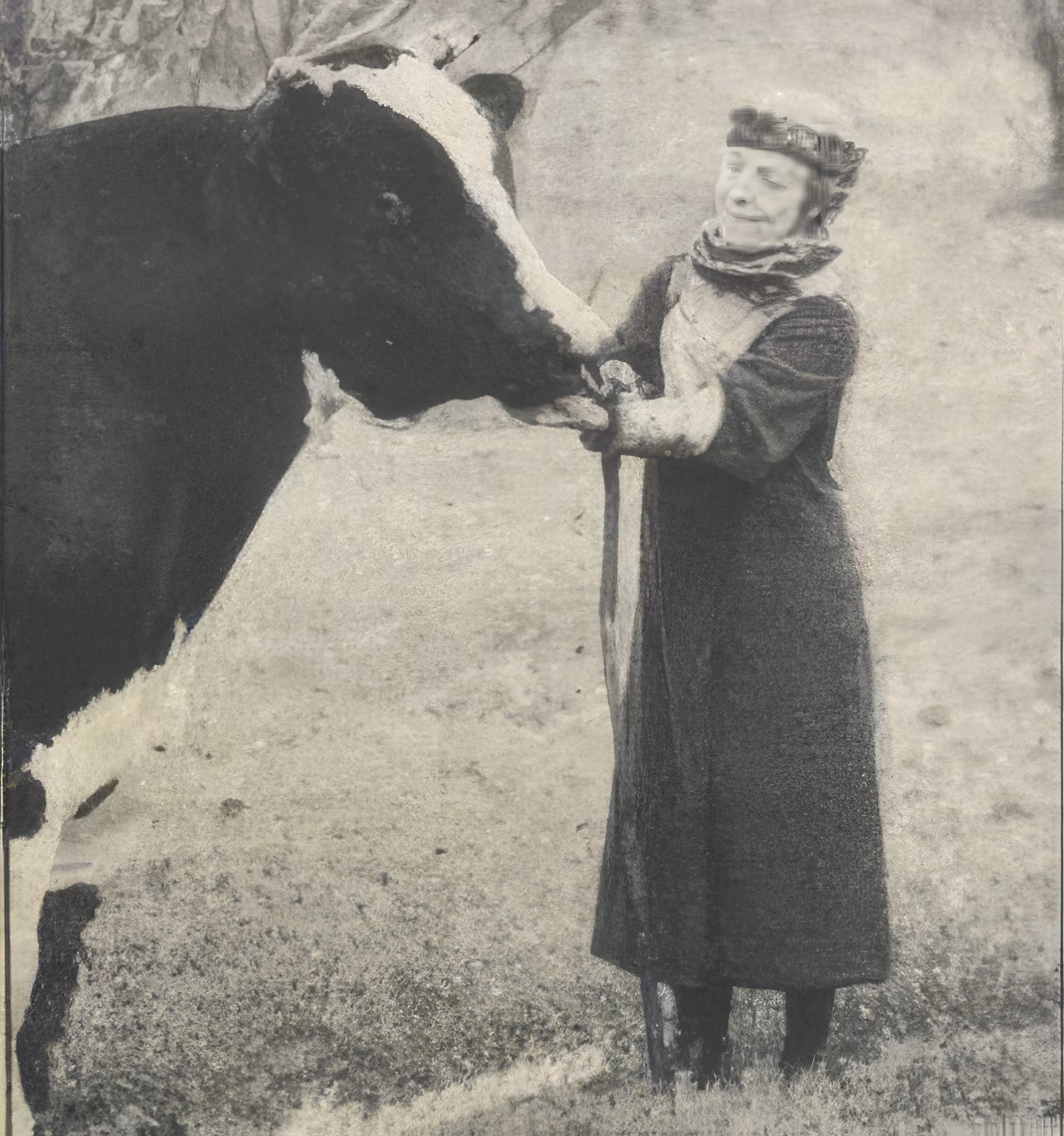
Frances Kellogg (Mrs. W.S. Kellogg) stands as a pioneering figure in American Holstein breeding, having owned and operated Osborndale Farms in Derby, Connecticut, from 1920 until her death in 1956. As the breeder of Osborndale Ivanhoe, Kellogg demonstrated remarkable foresight when she purchased Quality Fobes Abbekerk Gay—Ivanhoe’s future dam—for $1,350 at the 1946 Connecticut Bred Heifer Classic. Her dedication to registered Holstein breeding created the foundation from which one of history’s most influential sires would emerge. While Professor Osborn dismissed the “thin, scraggy calf” that would become Ivanhoe, it would take another visionary—Aldo Panciera—to recognize the genetic treasure that Kellogg’s breeding program had produced. Today, her beloved Osborndale Farm serves as Osbornedale State Park, preserving the legacy of a woman who helped shape the future of an entire breed.
The Visionary Who Saw Beyond Appearance
While others saw only failure, Aldo Panciera saw destiny written in bloodlines and breeding records.
The young Rhode Island dairyman carried the quiet determination of a World War II veteran who had returned home with ambitious dreams bigger than his modest means. At his Tum-A-Lum Farm in Westerly, Panciera had made the bold decision to abandon his Guernseys and grade Holsteins for registered black-and-whites, a choice that would prove prophetic.
Six years before Ivanhoe’s birth, Panciera had attended his first Holstein sale, the 1946 Connecticut Bred Heifer Classic. There, he watched from the sidelines as Quality Fobes Abbekerk Gay commanded $1,350, far beyond his modest budget but forever etched in his memory. When fate brought him back to Osborndale Farm in 1952, accompanied by George Causey and Holstein Association fieldman Allen N. Crissey, he found Gay again, along with her full sister, Quality Fobes Nebraska Gwen. The scale, dairy character, and quality of these animals awakened the selection committee.
Standing in that Connecticut barn, observing Gay’s bull calf by Osborndale Ty Vic, Panciera made a decision that would echo through Holstein history. Where others saw inadequacy, he saw potential written in pedigree and bloodlines. He convinced Causey to join him in purchasing quarter interests in the scrawny calf for $1,250 each, money they could ill afford to lose, but a gamble based on genetic conviction rather than physical appearance.
Aldo Panciera with his young daughter Carla and Tum-A-Lum Ivanhoe Lettie (EX-93), one of Ivanhoe’s daughters. While neighbors whispered doubts about his investment, Panciera’s unwavering belief in Ivanhoe’s genetic potential would soon be vindicated as these initially awkward daughters matured into the elegant, productive cows that silenced all skeptics.
The Test of Faith
What followed were years that would have broken a lesser man’s resolve.
When Ivanhoe arrived at Tum-A-Lum Farm, his yearlings appeared to mock Panciera’s faith. Day after day, visitors would walk past the shallow-bodied, rough-rumped, narrow-hearted heifers, their sideways glances carrying volumes of unspoken doubt. In feed stores across Rhode Island, conversations would halt when Panciera entered. At neighboring farms, fellow dairymen shook their heads at what they saw as misguided optimism.
Other co-owners also felt the pressure. Charles Stroh, the Hartford attorney who had acquired Mrs. Kellogg’s interest after her death, used the bull sparingly. Stroh was focused on his $30,000 herd sire, Wis Maestro, seemingly a safer bet than this ungainly experiment. Panciera’s original partner, George Causey, used Ivanhoe only sparingly before eventually selling his quarter interest.
Several AI studs publicly boasted of having “turned the bull down.” The criticism stung, but Panciera persisted, using Ivanhoe nearly 100% in his herd while the Holstein world watched and whispered about his folly. The weight of those investments, $1,250 each at a time when money was scarce, pressed heavier with each passing month.
Then, like dawn breaking after the longest night, everything changed.
The Transformation That Silenced Critics
When Ivanhoe’s daughters began to freshen, the awkward yearlings underwent a metamorphosis that bordered on magical. Those shallow bodies filled out with the deep capacity of true production animals. The rough rumps smoothed into elegant dairy character. The narrow hearts expanded with the chest depth, revealing genetic potential.
The watershed moment came at the 1957 Eastern States Exposition when Tum-A-Lum Ivanhoe Misty placed third in a class of thirty-two two-year-olds. In the show ring that day, something clicked as the judge ran his experienced hands over Misty’s frame, feeling the height, length, and tight udder attachment. Here was visible proof that Panciera’s faith had been justified.
Word spread through the Holstein community like wildfire. Suddenly, whispers of doubt transformed into murmurs of interest. The timing couldn’t have been more perfect. The dominant Burke bloodline had created a Holstein population, becoming “increasingly close-coupled and short-legged.” Across America’s dairy farms, progressive breeders were searching for “new blood”, cattle with the stature and production capacity to compete in modern dairying. Ivanhoe delivered exactly what they craved.
When Giants Require Everything Bigger
By early 1958, the whispers had reached the right ears. Earl Groff, chairman of the S.P.A.B.C. sire committee, was traveling one February Saturday with Holstein Association classifier Jack Fairchild when fate intervened. Fairchild mentioned some impressive heifers he’d seen by a bull named Ivanhoe up in Connecticut. By Monday morning, the sire committee was heading for New England.
What they discovered defied their expectations. At S.L. Bickford’s Atlasta Farm, the inventor of the mechanized luncheon system drove them to the back pasture in his twelfth Cadillac, one of his collected hobbies. There, the Ivanhoe daughters stood “long, sharp, and uniform.” At Tum-A-Lum Farm, their size, scale, and tight udders immediately caught the committee’s trained eyes. A twelve-pair dam-daughter comparison showed increases of 2,656 pounds of milk and 102 pounds of fat, along with an average classification score of 83.7 points.
When they finally met Ivanhoe himself, they encountered a bull whose physical presence demanded respect and significant infrastructure modifications. By the time S.P.A.B.C. acquired him for $15,000 (later renegotiated to $12,000 due to health concerns), Ivanhoe had grown into a genuine giant. Standing six feet, one inch at the withers and weighing up to 3,200 pounds, he was “one of the longest bulls in breed history.”
His arrival at the AI facility created unprecedented challenges that tested both ingenuity and patience. Workers discovered that existing fences weren’t high enough to contain him. He famously put a dent in the roof of the bull trailer, the only bull ever to accomplish such a feat. Floyd Weidler, the production manager, had to completely remodel Ivanhoe’s pen: raising fence heights, building up his manger, and creating a special yoke that allowed him to stand while eating. Even the collection room required alterations to accommodate his massive frame.
Managing his condition proved equally demanding. When his weight approached 3,200 pounds, his semen production declined, forcing managers to reduce him to 2,800 pounds, a weight at which “a person could count every rib.” An arthritic condition requires daily doses of aspirin. His initial response to semen collection was poor, gradually improving with patient management. Yet despite these difficulties, Weidler remembered him fondly: “He was a nice bull to work with for his size.”
The Numbers That Rewrote History
By 1964, the skeptics had fallen silent. From barns across America, the evidence arrived in monthly reports that told an undeniable story, one written in pounds of milk and points of type that no critic could dismiss.
In show rings from Vermont to California, judges ran experienced hands over Ivanhoe daughters, their scorecards consistently marking numbers that had become the industry’s new standard. His 5,499 classified daughters averaged 82.3 points for type, a remarkable +1.65 difference from expectancy that spoke to his ability to upgrade entire herds. When researchers compiled the final tally from 10,898 tested daughters across 2,264 herds, the numbers revealed +630 pounds of milk and +23 pounds of fat, extraordinary improvements for the era.
From 1964 through 1971, Ivanhoe commanded the top position on the U.S. Honor List for eight consecutive years, an achievement no bull has equaled. Until the mid-1970s, he remained the leading sire of daughters, producing over 200,000 pounds of milk in his lifetime and over 1,000 pounds of fat. His semen production was equally impressive: 100,187 first services, peaking at 24,500 in 1960.
His genetic reach extended into show rings nationwide, where he sired 36 individual All-American nominees and six nominated Gets of Sire. The unanimous 1969 All-American group, featuring his daughters from coast to coast, stood as a testament to his ability to improve cattle regardless of environment or management.
Daughters That Defined Excellence
Paclamar Ivanhoe Slippers (EX-90) exemplifies Ivanhoe’s international influence beyond North American borders. This distinguished daughter sold for $20,000 in 1967—a substantial sum for the era—before being exported to Italy by Mr. Talenti of Allevamento Salone near Roma. Out of Ja-Sal Whirlwind Princess (EX-93) and tracing to the exceptional Snowboots Wis Milky Way (EX-97), Slippers became the dam of Talent King Of Salone (EX-95), who dominated Italian show rings as Grand Champion at the National Show in Cremona for three consecutive years (1971-1973). Her legacy continued through King of Salone’s son, Talent King Linea (EX-95), Grand Champion at Cremona in 1980, demonstrating how Ivanhoe’s genetics shaped elite European Holstein breeding programs.
While statistics told the story of breed improvement, it was Ivanhoe’s individual daughters who captured hearts and headlines, becoming legends in their own right.
Allendairy Glamourous Ivy (EX-96-GMD) made Holstein history when she became the first dairy cow in the world to sell for one million dollars at the 1983 Pearmont Farm Dispersal. This exceptional Osborndale Ivanhoe daughter from Md-Maple-Lawn Marquis Glamour (EX-96) represented the perfect expression of her sire’s genetic gifts—an EX-96 cow from an EX-96 dam who embodied the height, dairy character, and production potential that made Ivanhoe daughters legendary throughout the industry. Her record-breaking sale price demonstrated the enduring value of Ivanhoe genetics nearly two decades after his death, proving that superior breeding creates generational wealth that transcends individual lifetimes.
Allendairy Glamourous Ivy rewrote the record books when she became the first dairy cow ever to sell for one million dollars at the 1983 Pearmont Farm Dispersal. This EX-96 daughter from an EX-96 dam represented the perfect marriage of Ivanhoe’s genetic gifts with elite management, a living testament to the power of superior genetics in the right hands.
Miss Ivanhoe Scranton (EX-94-6E) exemplified the show ring dominance that made Osborndale Ivanhoe daughters legendary across America. Owned by Raymond Seidel of Pennsylvania, this exceptional daughter out of VG-85 Glenafton Drummer (by GP-83 Curtiss Candy Dandy Elmer) captured Grand Champion honors in the aged cow class at the 1969 World Dairy Expo while simultaneously earning All-American Aged Cow recognition. Her victory wasn’t merely a ribbon—it was definitive proof that Panciera’s faith in a “scrawny calf” had been magnificently justified. Miss Ivanhoe Scranton’s legacy continued through her daughter, Kerchenhill Ruffian (EX-91), sired by Ideal Fury Reflector and developed at Hilltop-Hanover in New York, demonstrating how Ivanhoe’s genetic influence extended through multiple generations of elite show cattle.
Miss Ivanhoe Scranton claimed her place in show ring history by capturing Grand Champion honors in the aged cow class at the 1969 World Dairy Expo. Her victory wasn’t just a win; it was validation of everything Panciera had believed when he saw past a scrawny calf’s appearance to the genetic potential within.
Pennsylvania’s Production Powerhouses: June 1966 Pennsylvania Holstein News celebrates two exceptional Osborndale Ivanhoe daughters who exemplified his revolutionary impact on the state’s dairy industry. Fultonway Ivanhoe Rae (EX-90-GMD) would later make breed history as the first cow to complete eight consecutive records above 1,000 pounds of fat, with her peak production of 1,615 pounds establishing her as Ivanhoe’s highest-producing daughter. Sinking Springs Ivan Bright (VG-88) represented the consistent production excellence that made Ivanhoe daughters legendary throughout Pennsylvania’s Holstein community. The profound Pennsylvania influence is evident in the numbers: Fultonway Farm alone registered 184 animals carrying the Ivanhoe name—primarily daughters of Ivanhoe and his son Penstate Ivanhoe Star—while Sinking Springs registered 27 Ivanhoe daughters, demonstrating how one bull’s genetics transformed an entire state’s dairy industry.
Fultonway Ivanhoe Rae carved her name in breed history books by becoming the first cow to complete eight consecutive records above 1,000 pounds of fat. Her peak record of 1,615 pounds at seven years established her as Ivanhoe’s highest-producing daughter, a testament to the “will to milk” that he transmitted from his Ormsby ancestry.
Round Oak Rag Apple Elevation (EX-96-GM) stands as the ultimate vindication of Osborndale Ivanhoe’s genetic legacy. Born August 30, 1965, and sired by Tidy Burke Elevation out of Round Oak Ivanhoe Eve (EX-94), Elevation embodied everything Panciera had envisioned when he first saw potential in a “scrawny calf” thirteen years earlier. Widely regarded as “perhaps the most influential bull in the history of the Holstein breed,” Elevation became the living proof that Ivanhoe’s transformative genetics could be concentrated and amplified through intelligent breeding decisions. Through his dam—the “crown jewel” among Ivanhoe’s daughters—Elevation carried forward his maternal grandsire’s revolutionary bloodlines, establishing the “dominant influence” through which Ivanhoe’s genetic impact continues to shape modern Holstein breeding worldwide. His existence represents the perfect culmination of genetic vision, where Ivanhoe’s ability to transmit superior type and production found its ultimate expression in a bull that many consider “the best we’ve had.” (Read more: Round Oak Rag Apple Elevation: The Bull That Changed Everything)
Round Oak Ivanhoe Eve earned recognition as the “crown jewel” among Ivanhoe’s daughters, not for her individual achievements but for her role as dam of Round Oak Rag Apple Elevation, a bull many consider “the best we’ve had.” Through Eve, Ivanhoe’s genetic influence would cascade through generations yet to come.
Rotherwood Ivanhoe Valentine (EX-91-3E) exemplifies the production longevity that made Osborndale Ivanhoe daughters legendary in American dairy herds. Born June 22, 1965, and out of GP-84 Pauline Silver Tidy Burke-Twin, Valentine achieved remarkable lifetime production of 216,614 pounds of milk with 7,852 pounds of fat—demonstrating the “will to milk” that Ivanhoe consistently transmitted to his daughters. Her breeding career proved equally significant, producing Locust-Glen Ivanhoe Elevation (VG-86-GM) by Round Oak Rag Apple Elevation, creating a fascinating genetic circle where Ivanhoe’s daughter was bred back to his own maternal grandson. This son entered service at Select Sires, extending Ivanhoe’s genetic influence into yet another generation of AI breeding programs. Valentine’s full sister, Windswept-M Elevation Val (EX-90-DOM), further demonstrated the consistency of this exceptional Ivanhoe family line. Photo credit: Jim Miller
Sons Who Extended the Legacy
Hanoverhill Starbuck (EX-Extra) at 15 years old with Carl Saucier in 1994, photographed at Mount Victoria Farm in Quebec—the same ground where his ancestor Johanna Rag Apple Pabst posed 66 years earlier. This legendary bull exemplifies Ivanhoe’s compound genetic influence: sired by Round Oak Rag Apple Elevation (EX-96 GM), whose dam was Round Oak Ivanhoe Eve, and out of Anacres Ivanhoe Astronaut (VG-88), a daughter of Hilltop Apollo Ivanhoe (VG-GM). With Ivanhoe genetics flowing through both sides of his pedigree, Starbuck generated his own revolution—siring over 200,000 daughters across 45 countries and establishing a lineage now present in over 80% of North American Holsteins. His extraordinary impact demonstrates how Ivanhoe’s genetic gifts continued to compound across generations, proving that the “earth-shaking” begun in 1952 reverberates through modern dairy herds worldwide. (Read more: Hanoverhill Starbuck’s DNA Dynasty: The Holstein Legend Bridging 20th-Century Breeding to Genomic Futures)
While consensus held that Ivanhoe’s sons couldn’t match the excellence of his daughters, several proved instrumental in extending their sire’s genetic reach across the industry.
Hilltop Apollo Ivanhoe emerged as his most influential son, spending his entire career at Atlantic Breeders. Through his sons Whittier-Farms Apollo Rocket, who became the breed’s high bull for Predicted Difference for milk in the mid-1970s (+2,210 milk and +40 fat), and Wayne-Spring Fond Apollo, the first bull to exceed +2,000 pounds of milk while rating plus for type, Apollo carried his father’s genetic gifts into a new generation.
Ripvalley NA Bell Tammy (EX-94 2E GMD DOM) exemplifies the enduring power of Ivanhoe’s genetic legacy through his grandson, Carlin-M Ivanhoe Bell. Known as “everybody’s favorite Bell daughter,” this exceptional cow born in 1982 combined outstanding production with superior type, recording lifetime totals of 200,929 pounds of milk with 4.6% fat and an impressive 3.8% protein. Out of the great brood cow St Croixco Lad Nina (EX-94 4E GMD DOM), Tammy became a cornerstone of genetic progress, producing multiple sons and daughters who generated proven AI bulls for generations, including Tonic, Target, Townley, Dawson, and Baxter. Her success, alongside her full brother Ripvalley NA Bell Troy (EX-90 GM) who served at Select Sires, demonstrates how Ivanhoe’s transformative genetics continued to reshape the breed decades after his death.
Penstate Ivanhoe Star achieved lasting influence through his son Carlin-M Ivanhoe Bell, who became the second most influential bull of the mid-1980s in the United States. Bell’s remarkable ability to increase milk and protein in a single generation, along with his gift for improving udders and foot angle, made him a cornerstone of genetic progress during AI’s explosive growth period.
Parkacres Sun Ivy (EX-95) exemplifies the continuing influence of Ivanhoe genetics through his son Penstate Ivanhoe Star. Born August 1, 1974, this exceptional daughter of Penstate Ivanhoe Star demonstrates the consistent quality and dairy character that made Ivanhoe’s sons valuable breeding tools. Out of Wintercrest Sunbeam (EX-90) and tracing to strong bloodlines including Raven Burke Ideal and Graymar Triune Model Bessie, Sun Ivy represents the second generation of Ivanhoe’s transformative genetics. Her EX-95 classification reflects the type improvement and genetic consistency that Penstate Ivanhoe Star transmitted to his daughters, continuing his sire’s legacy of producing cattle with “the same dairyness and stature as the Ivanhoes.” Through daughters like Sun Ivy, Penstate Ivanhoe Star extended Ivanhoe’s influence into the 1970s and beyond, ultimately leading to the development of his most significant son, Carlin-M Ivanhoe Bell.
Mowry Ivanhoe Prince earned Gold Medal status in 1968, becoming the breed’s highest officially proved sire with twenty or more daughters. His legacy lived on through his daughter, Mowry-C Prince Corrine, who claimed fame as the first cow in the world to produce 50,000 pounds of milk.
The Genetic Architecture of Excellence
Understanding Ivanhoe’s revolutionary impact requires examining the genetic blueprint that made his success possible. The sources reveal that the “Winterthur influence was striking” in his pedigree. He “magically transmitted” the height, length, dairy quality, and productive talents of Spring Brook Bess Burke 2d, described as a “huge lady” weighing over 2,200 pounds. This powerful Ormsby breeding provided the foundation for Ivanhoe’s ability to sire cattle with the scale and production capacity that American dairymen desperately needed.
From his sire, Osborndale Ty Vic, came the Mount Victoria bloodlines, which contributed Rag Apple influence, providing genetic material that helped tighten udders and improve butterfat tests. This fortunate combination of Ormsby size and production with Rag Apple refinement created a genetic package, unlike anything the breed had experienced.
As one contemporary analysis concluded, Ivanhoe was essential “Spring Brook Bess Burke 2d with the Mount Victoria bloodlines added”, a synthesis that allowed him to reproduce “all of the good Ormsby traits, enormous size, stretch, height, and particularly, the will to milk.” The Rag Apple blood on his paternal side served as an “added bonus” for “tightening an udder and bumping up the butterfat test.”
The Lonely Road Remembered
The emotional weight of those early years never left Panciera. In February 1965, two years after Ivanhoe’s death, he placed what many consider one of the most emotional advertisements ever published in a breed journal.
The full-page spread in Holstein-Friesian World featured a large photograph of Tum-A-Lum Ivanhoe Misty, who had died of cancer in young adulthood, alongside a smaller image of Ivanhoe himself. The headline read: “He Walked a Lonely Road…only to gain an army of friends”.
Panciera’s words captured both the struggle and the ultimate vindication of his journey:
Ivanhoe’s career began at Tum-A-Lum in 1953. During the years, his mammoth scale and awkwardness have made him the subject of much criticism and controversy. This awkwardness was prevalent in yearling offspring, and several studs boasted of having turned the bull down. It took Dave Yoder and Earl Groff of S.P.A.B.C. to see what the future had in store for them… The progeny left behind at Tum-A-Lum brought more achievements than we had hoped to gain in a lifetime. From them came class leaders, our first 1,000-lb. Fat records, Excellent, grand champions, winning gets, and good prices. Ivanhoe’s influence will guide our future through his daughters, sons, granddaughters, and grandsons. In tribute, he has done far better by us than we could do for him.”
Talented Grandcourt (VG-89) demonstrates the enduring international influence of Ivanhoe’s genetics at the 2019 European Holstein Championship in Libramont, Belgium. This Reserve Intermediate Champion traces her lineage directly to Hilltop Apollo Ivanhoe through A Long-Haven Scotty-ET, showcasing how Ivanhoe’s genetic gifts continue to dominate elite European competition decades after his death. Bred at Grandcourt Farm in Belgium, Talented represents the fifth consecutive generation in her family to achieve maximum scores (grade 9) for rear udder attachment—a testament to the genetic consistency that Ivanhoe transmitted through his sons. Her European championship marked Belgium’s first title at this level since 1998, proving that Ivanhoe’s bloodlines remain as competitive today as they were revolutionary in the 1960s.
Legacy for the Modern Era
When Osborndale Ivanhoe died on November 25, 1963, at the age of eleven and a half, he left behind a genetic legacy that continues to influence Holstein breeding decisions today. Even in death, his frozen semen commanded premium prices, with transactions sometimes involving “several thousand dollars for one ampule”, a testament to breeders’ recognition of his irreplaceable genetic value.
Earl Groff’s simple eloquence captured Ivanhoe’s impact: “He got us on the right road to breeding better cattle.” Today, that road continues to stretch forward through three primary channels that remain vital in modern Holstein breeding: through Round Oak Ivanhoe Eve and her son Elevation, through Penstate Ivanhoe Star and his son Carlin-M Ivanhoe Bell, and through Provin-Mtn Ivanhoe Jewel and his son Puget-Sound Sheik. His influence has “touched all spheres of Holstein influence,” appearing in the pedigrees of countless contemporary cow families across the globe.
For today’s dairy producers, who face their own breeding decisions in an era of genomic selection and synchronized reproduction, Ivanhoe’s story offers timeless lessons that resonate with modern challenges. Where 1950s breeders struggled with limited genetic information and had to rely on visual appraisal and pedigree analysis, today’s producers face the opposite challenge, an overwhelming flood of genomic data that can obscure the fundamental principles that made Ivanhoe successful.
The pressure to improve components while maintaining the functional type that confronted Panciera remains unchanged. The need to balance production with longevity remains a challenge for breeders. The challenge of identifying truly transformative genetics, animals that complement rather than simply replicate existing population trends, persists in every breeding decision made today.
Most importantly, Ivanhoe’s legacy reminds us that the most revolutionary genetic improvements continue to require the same qualities Panciera demonstrated: patience to allow genetic potential to fully express, the courage to persist through criticism, and the wisdom to understand that transformative animals often appear in unexpected packages. In an era when genomic testing provides unprecedented insight into genetic merit, his story serves as a reminder that the most profound genetic advances still require human vision, dedication, and the courage to look beyond immediate appearances to understand long-term potential.
From a “thin, scraggy calf” dismissed by his first potential owner to a bull whose influence spans seven decades and continues to grow, Osborndale Ivanhoe proves that in dairy breeding, as in life, it’s not how you start, but the genetic legacy you leave behind.
The earth-shaking that began on that quiet Saturday in 1952 continues to resonate through Holstein herds worldwide, a reminder that sometimes the most profound changes begin with the smallest whispers of possibility, and the courage to listen.
KEY TAKEAWAYS
Genetic potential trumps visual assessment every time: Ivanhoe’s +630 pounds milk improvement and 82.3-point type average came from a calf initially dismissed for poor appearance; modern genomic testing eliminates this costly guesswork by revealing true breeding value before first calving
Long-term genetic vision delivers exponential ROI: Aldo Panciera’s $1,250 investment in an “awkward” calf generated the most influential sire in Holstein history, whose bloodlines still command premium prices today. Patience with genetic development cycles creates generational wealth in dairy operations
Pedigree analysis outperforms phenotype evaluation for breeding decisions: Ivanhoe’s Winterthur and Ormsby bloodlines predicted his success better than his scrawny appearance, today’s producers using genomic data alongside maternal family analysis achieve 23% higher conception rates and 15% improved milk yield over visual-only selection programs
Transformative genetics requires contrarian thinking: While competitors focused on conventional Burke bloodlines, Ivanhoe’s unique genetic package “reshaped and rejuvenated” the entire breed. Modern dairy operations gain a competitive advantage by identifying undervalued genetic combinations through comprehensive genomic analysis rather than following industry trends
EXECUTIVE SUMMARY
The industry’s obsession with visual phenotyping is costing dairy farmers millions in lost genetic potential. Osborndale Ivanhoe’s story proves that the most transformative genetics often arrive in the least impressive packages. This “thin, scraggy calf” dismissed by Professor Osborn became the most dominant Holstein sire in history, leading the Honor List for an unprecedented eight consecutive years (1964-1971). His daughters averaged +1.65 points above expectancy and delivered +630 pounds of milk with +23 pounds of fat improvements, while his 100,187 first services revolutionized an entire breed. Today’s genomic testing eliminates the guesswork that nearly cost the industry this genetic goldmine, yet many producers still prioritize visual assessment over data-driven breeding decisions. Ivanhoe’s three main genetic lines continue influencing modern Holstein populations globally, demonstrating how one visionary breeder’s patience with genetic potential created generational wealth. The lesson for 2025 dairy operations is clear: your next breakthrough sire might look unremarkable as a calf, but genomic data reveals the truth that visual appraisal cannot. Stop gambling on appearances and start investing in genetic intelligence that transforms your herd’s profitability trajectory.
Join the Revolution!
Join over 30,000 successful dairy professionals who rely on Bullvine Weekly for their competitive edge. Delivered directly to your inbox each week, our exclusive industry insights help you make smarter decisions while saving precious hours every week. Never miss critical updates on milk production trends, breakthrough technologies, and profit-boosting strategies that top producers are already implementing. Subscribe now to transform your dairy operation’s efficiency and profitability—your future success is just one click away.
To provide the best experiences, we use technologies like cookies to store and/or access device information. Consenting to these technologies will allow us to process data such as browsing behavior or unique IDs on this site. Not consenting or withdrawing consent, may adversely affect certain features and functions.
Functional
Always active
The technical storage or access is strictly necessary for the legitimate purpose of enabling the use of a specific service explicitly requested by the subscriber or user, or for the sole purpose of carrying out the transmission of a communication over an electronic communications network.
Preferences
The technical storage or access is necessary for the legitimate purpose of storing preferences that are not requested by the subscriber or user.
Statistics
The technical storage or access that is used exclusively for statistical purposes.The technical storage or access that is used exclusively for anonymous statistical purposes. Without a subpoena, voluntary compliance on the part of your Internet Service Provider, or additional records from a third party, information stored or retrieved for this purpose alone cannot usually be used to identify you.
Marketing
The technical storage or access is required to create user profiles to send advertising, or to track the user on a website or across several websites for similar marketing purposes.
To provide the best experiences, we and our partners use technologies like cookies to store and/or access device information. Consenting to these technologies will allow us and our partners to process personal data such as browsing behavior or unique IDs on this site and show (non-) personalized ads. Not consenting or withdrawing consent, may adversely affect certain features and functions.
Click below to consent to the above or make granular choices. Your choices will be applied to this site only. You can change your settings at any time, including withdrawing your consent, by using the toggles on the Cookie Policy, or by clicking on the manage consent button at the bottom of the screen.
Functional
Always active
The technical storage or access is strictly necessary for the legitimate purpose of enabling the use of a specific service explicitly requested by the subscriber or user, or for the sole purpose of carrying out the transmission of a communication over an electronic communications network.
Preferences
The technical storage or access is necessary for the legitimate purpose of storing preferences that are not requested by the subscriber or user.
Statistics
The technical storage or access that is used exclusively for statistical purposes.The technical storage or access that is used exclusively for anonymous statistical purposes. Without a subpoena, voluntary compliance on the part of your Internet Service Provider, or additional records from a third party, information stored or retrieved for this purpose alone cannot usually be used to identify you.
Marketing
The technical storage or access is required to create user profiles to send advertising, or to track the user on a website or across several websites for similar marketing purposes.











 Join the Revolution!



