Archive for carbon credits

Your State’s Next: How Smart Dairies Turn Methane Compliance into $200K+ Annual Revenue

California lost farms while others made millions—the difference wasn’t technology, it was timing and scale

EXECUTIVE SUMMARY: What California’s methane compliance journey reveals isn’t just about environmental regulations—it’s a roadmap showing how dairy economics fundamentally shift when compliance costs hit different sized operations. The patterns emerging from California show operations over 3,000 cows can generate substantial revenue through digesters and carbon credits, while dairies between 500-1,000 cows face increasingly marginal economics that challenge long-term viability. Feed additives that achieve dramatic reductions in laboratory settings deliver substantially lower performance in commercial applications, highlighting the gap between promises and farm reality. Early movers who position infrastructure before regulatory deadlines consistently capture better financial terms, while those forced to react face compliance costs without offsetting revenue streams. The consolidation accelerating across the industry isn’t simply about farm size—it reflects fundamental economic thresholds where compliance costs create dramatically different outcomes based on scale. States developing their own approaches are learning from California’s experience, creating opportunities for prepared operations to capture value through strategic positioning. The message for dairy farmers is clear: understanding where your operation falls on the scale spectrum and making strategic decisions aligned with your resources determines whether environmental regulations become profit centers or existential challenges.

You know, if you’d told me five years ago that California dairies would be making serious money from methane reduction, I’d have thought you were pulling my leg. But here we are at the crossroads of environmental necessity and economic opportunity—and what’s happening out West is reshaping how we all need to think about the future of dairy, whether we’re managing herds in Wisconsin’s rolling hills, Pennsylvania’s river valleys, or anywhere in between.

I should mention upfront—I’m not here to tell anyone what to do with their operation. We all know our own farms best, our own soil, our own markets. But sharing what’s happening and what others are learning? That has always been valuable, especially when we face industry-wide changes that affect us all.

The Technology Reality: Lab Versus Farm

What’s particularly noteworthy is the gap between laboratory promises and on-farm reality with these methane reduction technologies. You’ve probably seen the headlines about seaweed additives—those impressive reduction numbers from controlled trials that make it sound like we’ve found the silver bullet.

University feeding trials have demonstrated significant reductions in methane emissions with the use of Asparagopsis seaweed under controlled conditions. But here’s the thing—commercial applications generally achieve substantially lower reductions than laboratory conditions. And there’s a fascinating reason for this disconnect.

The 57% lie: Seaweed additives promise 82% methane reduction in labs but deliver just 25% on actual farms. Before investing $50K in ‘miracle’ solutions, know the difference between university press releases and feed bunk reality.

The active compounds in seaweed break down faster than anyone expected once they leave controlled conditions. What works beautifully in a university feeding trial—with fresh product, immediate feeding, controlled temperatures—doesn’t always translate to the reality of your feed bunk. Especially after the product has been shipped across the country and stored in your commodity shed through a hot summer, that’s just the reality of moving from lab to farm.

This builds on what we’ve seen with other feed technologies over the years, doesn’t it? Remember when bypass protein was going to revolutionize everything? Great concept, variable field results. The same story with numerous “game-changing” innovations.

And those synthetic options like 3-NOP? Research suggests they can reduce methane emissions in total mixed ration systems, delivering more consistent results than seaweed. But effectiveness varies significantly in high-forage feeding systems, particularly in grazing-based operations common in the Northeast. The compound requires precise mixing and doesn’t distribute well in pasture situations.

Understanding the Real Economics: Scale Matters More Than Ever

What I find most instructive is examining how the economics actually play out across different-sized operations. The patterns emerging from California show clear economic thresholds that determine viability.

Scale Dictates Profitability. This is the hard math of methane compliance. Larger dairies can see payback on digester investments up to twice as fast as mid-sized operations, turning regulation into a revenue stream. For dairies under 500 cows, the economics rarely work, forcing them to find entirely different strategies to survive.

For those running larger operations—let’s say over 3,000 cows—digesters can actually generate substantial revenue through carbon credits and renewable energy programs. Larger California operations report favorable payback periods when carbon credit programs are available.

Now, for operations between 1,000 and 3,000 cows—and that’s a significant portion of our industry—the economics require patient capital. Payback periods typically extend longer for medium-sized operations, and your financing structure matters enormously.

Those 500 to 1,000 cow dairies face the toughest economics. Too large for niche markets but too small for economies of scale. Economics becomes increasingly challenging at this scale, testing even the most patient and financially capable individuals.
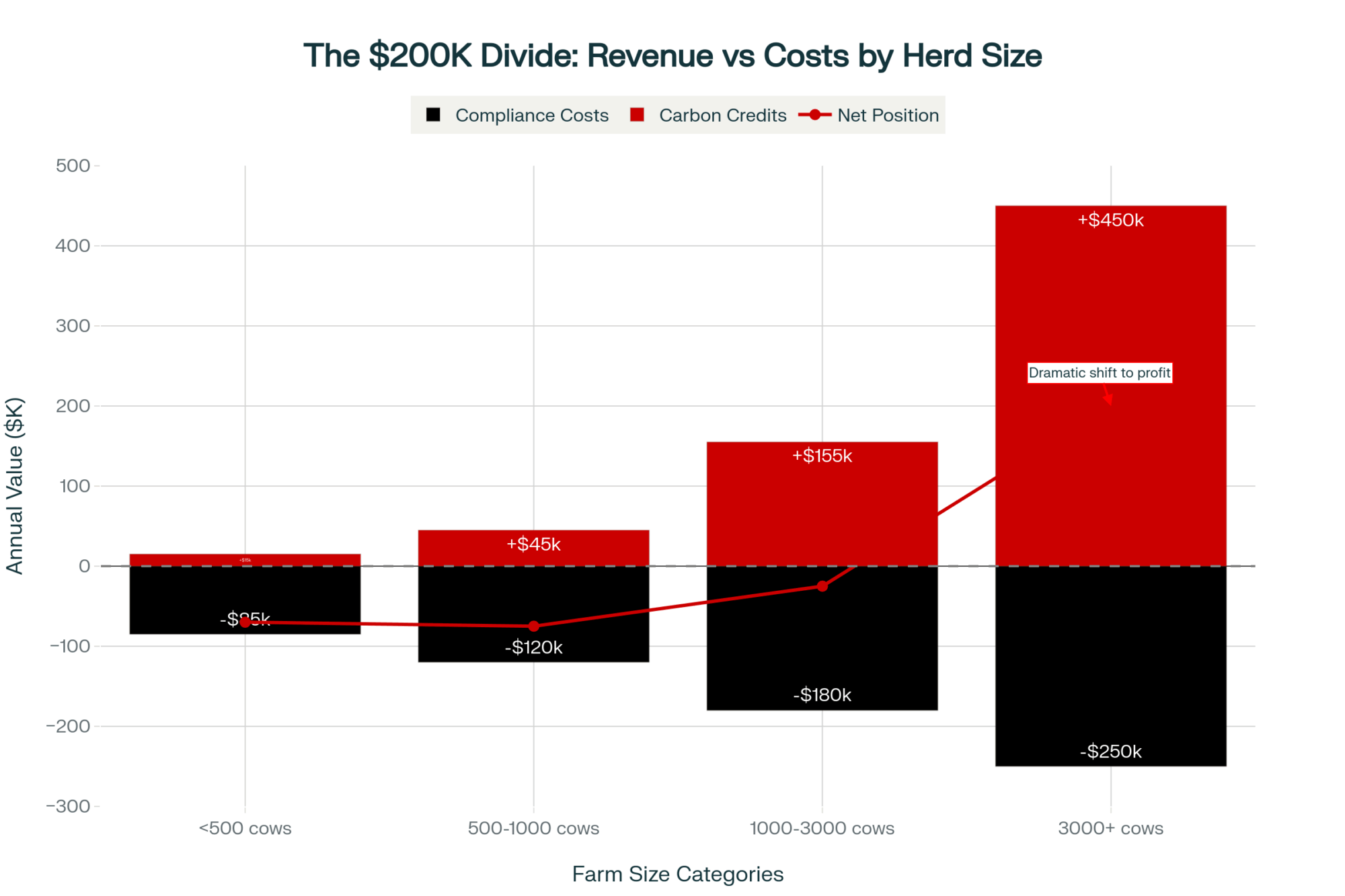
The $200K reality check: While mega-dairies turn compliance into profit centers, mid-size family farms face an existential squeeze. This isn’t just about technology—it’s about survival thresholds that reshape American dairy.

And for dairies under 500 cows? Large-scale technologies rarely pencil out. However, creative alternatives are emerging—shared composting facilities, cooperative manure management systems, and simplified solid waste separation. These approaches require different thinking, but they can be effective.

What’s crucial to understand is how dependent these economics are on local carbon credit values and renewable energy incentives. Voluntary carbon markets typically offer lower credit values than California’s specialized programs, creating dramatically different economics depending on your location.

I’m curious to see how this plays out in states with strong traditions of grazing. Will they develop crediting systems that recognize carbon sequestration in well-managed pastures alongside methane reduction?

The Portfolio Approach: Diversification Beyond the Milk Check

Strategy<500 cows500-1,000 cows1,000-3,000 cows3,000+ cows
DigestersNot viableMarginalOften justifiedStrong ROI
Composting/Manure MgmtViableViableViableViable
Feed AdditivesRarely economicalEconomic only in confinedMore effectiveBest fit
Direct Marketing/Value AddedHigh potentialPossible nicheSupplementaryAuxiliary

The most successful operations aren’t betting everything on any single technology. They’re building diversified strategies that create resilience when individual components underperform.

Production efficiency forms the foundation. Increasing production per cow significantly reduces methane intensity per unit of milk produced—without any new technology. Better heat abatement, tighter fresh cow protocols, optimizing starch levels and fiber digestibility—these improvements compound over time.

This aligns with what progressive nutritionists emphasize: good management is environmental management. Better feed efficiency, improved reproduction, lower SCC—these traditional metrics reduce environmental footprint while improving profitability.

Alternative manure management provides middle-ground solutions. Composting, separation systems, and mechanical scraping—these technologies work at various scales. New research on biochar-enhanced composting shows promise, though commercial viability remains uncertain.

Some traditional practices deserve renewed attention. Rotational grazing, well-managed pastures, and focus on cow longevity—these approaches sequester carbon while reducing emissions intensity.

Digesters work effectively when you have the right conditions: a liquid manure system, consistent feedstock, technical expertise, and sufficient scale to spread capital costs. Success depends heavily on the quality of management and local market conditions.

Feed additives continue evolving. Current products work best in confined feeding situations with precise ration control. Costs should decrease as production scales up, but these remain supplementary tools rather than complete solutions.

The Timeline Pressure: First-Mover Advantages and Late-Adopter Penalties

Various states are establishing different incentive structures and compliance timelines. Early movers consistently capture the best opportunities.

California’s experience proves instructive. Their programs lock in favorable terms for early infrastructure development. Miss those windows, and you face compliance costs without offsetting revenue.

Agricultural lenders see this bifurcation clearly. Early strategic movers maintain financing options. Those forced to act later find limited and expensive choices.

The pattern remains consistent: capture value by moving early, face costs by waiting. Each year of delay in regulated markets potentially sacrifices a significant portion of the lifetime project value.
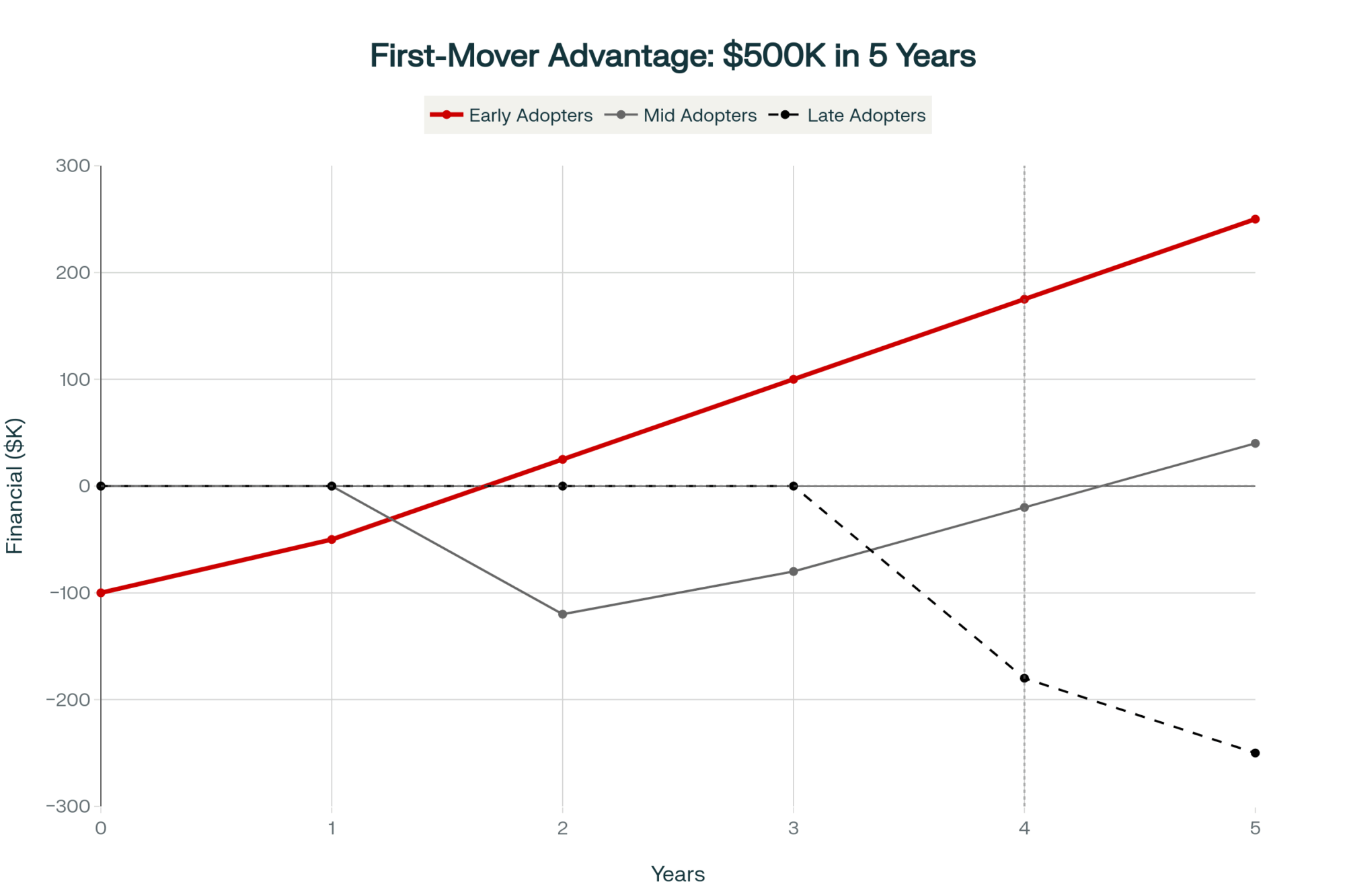
The half-million-dollar procrastination penalty: Early movers capture $250K in credits while late adopters lose $250K to compliance costs. Every month you wait, someone else locks in your potential revenue stream.

Processors are increasingly factoring environmental performance into their supply relationships. Some develop sustainability programs, although the value of meaningful premiums remains uncertain.

Industry Consolidation: The Structural Reality

USDA data confirms accelerating consolidation in dairy farming, with environmental regulations adding pressure in certain regions.

Mid-sized operations (500-1,000 cows) face existential challenges. They can’t easily access niche markets or achieve the scale for technology economics. Multi-generational family farms confront difficult succession decisions under this pressure.

These operations remain profitable today, but face uncertainty about the regulatory landscape of tomorrow. This uncertainty complicates planning, financing, and family transitions.

Smaller operations encounter different challenges. Per-unit compliance costs run higher without scale advantages. However, some thrive through direct marketing, value-added processing, or agritourism—creating businesses that sidestep the pressures of the commodity market.

Custom operators navigate unique complexities working across multiple farms with varying capabilities and requirements. Standardizing practices while maintaining flexibility poses a challenge for these essential service providers.

Regional Adaptation Strategies

RegionAvg Herd SizePrimary StrategyIncentive $/cowCompliance TimelineSuccess Rate
California1,850Digesters + Credits$285Active Now65%
Northeast85Grazing Credits$452027 Start82%
Upper Midwest195Co-op Models$752028 Start78%
Southwest2,200Water + Methane$1952026 Start71%
Southeast450Voluntary Programs$352029+ StartTBD

States are learning from California while developing approaches suited to their conditions and farming systems.

Northeast states initially emphasize voluntary programs, recognizing their smaller average herd sizes and pasture-based systems. They’re exploring how to credit both methane reduction and soil carbon sequestration.

The Upper Midwest investigates incentive structures that value well-managed grazing systems. Some states explore digesters for medium-sized farms through cooperative models. Others examine manure-to-energy opportunities linked with existing utility infrastructure.

The Southwest links water conservation with methane reduction, recognizing their interconnected resource challenges. Different regions focus on integrating energy infrastructure or enhancing drought resilience alongside emissions reduction.

Some states are exploring how to credit both methane reduction and soil carbon sequestration—potentially game-changing for grazing operations. Others develop programs recognizing diverse farm scales and production systems.

Implementation Realities: What the Planning Documents Don’t Tell You

Field experience yields critical insights that extend beyond theoretical planning.

Infrastructure costs typically exceed initial estimates, often by a substantial amount. Beyond primary technology, you need storage modifications, handling equipment, monitoring systems, and team training. Budget extra for contingencies—you’ll need it.

Seasonal operations create challenges vendors rarely acknowledge. Winter functionality at sub-zero temperatures differs dramatically from summer operations. Heat stress impacts both cows and technology performance. Spring mud season complicates manure handling. These realities affect system design and operating costs.

Supply chains for newer technologies remain immature. Quality varies between suppliers, availability fluctuates, and prices reflect market volatility. Multiple supplier relationships provide essential backup.

You must document everything. Carbon credit verification, regulatory compliance, and management decisions all require baseline data. Start measuring before implementing changes—retroactive documentation doesn’t work.

Emerging Opportunities: Beyond Compliance

Strategic positioning creates opportunities beyond mere compliance.

Carbon credit markets evolve rapidly with significant regional variation. Some areas generate meaningful revenue streams; others offer minimal returns. Understanding your local market conditions drives decision-making.

Milk processors and food companies develop sustainability programs with potential premiums for verified low-emission milk. Whether these deliver meaningful value or just create requirements remains uncertain.

Technology continues advancing rapidly. Today’s impractical solution might become viable within a few years. Stay informed without chasing every innovation.

Taking Action: Your Next Steps

Here’s your practical roadmap:

Assess your position honestly. Evaluate your scale, resources, and timeline for major decisions. Consider retirement, succession, and expansion plans realistically.

Gather region-specific information. Attend extension meetings, engage with neighbors, and explore NRCS programs. Local knowledge is often more valuable than general advice.

Start documenting now. Begin baseline measurements even before making changes. This data becomes invaluable later.

Think strategically, not reactively. Success comes from thoughtful decisions aligned with your specific circumstances, not from following prescriptive solutions.

The Strategic Bottom Line

After observing nationwide developments across different regions and scales, success requires making thoughtful strategic decisions with available information, building adaptable systems, and maintaining flexibility.

The shifts in emissions thinking, environmental impact assessment, and value creation aren’t future considerations—they’re current realities in some regions and near-term probabilities everywhere else.

Learn from others’ experiences while recognizing your unique situation. A large New Mexico operation differs fundamentally from a smaller Vermont farm. Someone with returning children faces different decisions than someone approaching retirement.

Stay informed, think strategically about your specific operation, and make decisions aligned with your long-term goals and values. The dairy industry will look different five years from now—that’s certain.

Is change concerning? Perhaps. But it also creates opportunities for those prepared to adapt thoughtfully. The question isn’t whether change arrives—it’s how we position our operations to thrive.

Consider this as you head into another season managing the operations you’ve built. The future of dairy isn’t distant—it’s being shaped now by decisions each of us makes on our farms, in our communities, within our circumstances.

The conversation continues, and we’re all part of it.

KEY TAKEAWAYS:

  • Digesters generate positive returns for 3,000+ cow operations with favorable payback periods when carbon credit programs are available, but economics become marginal below 1,000 cows and typically unviable under 500 cows
  • Production efficiency improvements offer universal benefits—increasing milk per cow through better management reduces methane intensity without requiring permits, infrastructure investment, or regulatory approval
  • Early strategic positioning captures value while delayed action faces costs—agricultural lenders report producers who move before regulatory deadlines maintain better financing options and terms
  • Portfolio approaches outperform single technologies—combining production efficiency, manure management alternatives, and selective technology adoption creates resilience when individual solutions underperform
  • Documentation starting now strengthens your position—baseline measurements before implementing changes become invaluable for carbon credit verification, regulatory compliance, and informed decision-making regardless of operation size

Complete references and supporting documentation are available upon request by contacting the editorial team at editor@thebullvine.com.

Learn More:

Join the Revolution!

Join over 30,000 successful dairy professionals who rely on Bullvine Weekly for their competitive edge. Delivered directly to your inbox each week, our exclusive industry insights help you make smarter decisions while saving precious hours every week. Never miss critical updates on milk production trends, breakthrough technologies, and profit-boosting strategies that top producers are already implementing. Subscribe now to transform your dairy operation’s efficiency and profitability—your future success is just one click away.

NewsSubscribe
First
Last
Consent

The Carbon Credit Conversation: What’s Really Happening on Dairy Farms Today

Could your dairy benefit from $130/acre tax credits starting 2025? New programs are changing the carbon conversation.

EXECUTIVE SUMMARY: What farmers are discovering across the Northeast and Midwest is that carbon reduction strategies are delivering real cash flow benefits, not just environmental compliance. Recent data from Vermont’s Ben & Jerry’s Low Carbon Dairy program shows participating farms achieving 16% greenhouse gas reductions without sacrificing production, while generating measurable revenue improvements. Feed additives like 3-NOP are proving their worth at $93-$105 per cow annually, delivering 22-35% methane reductions and up to 5% feed efficiency gains that translate to potential savings of $14,000-$25,000 per 1,000-cow operation. Australian dairy operations demonstrate solar’s impact with 70% electricity bill reductions and two-year payback periods, while California digesters—despite $8.6 million investments for 2,500-cow operations—generate returns through $60 per metric ton carbon credits plus renewable gas sales. Government support is substantial, with USDA programs covering up to 75% of implementation costs and the new 45Z tax credit offering over $130 per acre starting in 2025. The key insight emerging from successful operations is that a phased approach works best—starting with operational improvements and feed additives, then adding solar and eventually digesters—allowing farms to build cash flow while positioning for an evolving market that increasingly rewards measurable carbon reduction.

KEY TAKEAWAYS

  • Proven returns from feed efficiency: 3-NOP additives reduce methane emissions 22-35% and improve feed efficiency up to 5%, potentially saving $14,000-$25,000 annually per 1,000 cows, with Ohio State Extension confirming costs at $93-$105 per cow yearly.
  • Solar delivers quick payback: Australian dairy operations report 70% electricity bill reductions with systems paying for themselves in two years, making the $140,000-$200,000 investment for 70kW systems increasingly attractive with federal incentives through 2032.
  • Government programs provide substantial support: USDA’s EQIP and CSP programs cover up to 75% of implementation costs, while the 2025 launch of the 45Z tax credit offers over $130 per acre for carbon intensity reduction without complex contract requirements.
  • Regional strategies matter: European mandatory carbon pricing creates different dynamics than North American voluntary markets, requiring tailored approaches whether you’re in California (with LCFS credits), the Midwest (with ethanol partnerships), or the Northeast (with compliance advantages).
  • Phased implementation maximizes success: Start with operational improvements and feed additives for immediate returns, add solar when ready, then consider digesters for long-term revenue—allowing farms to build cash flow progressively while adapting to evolving carbon markets.
dairy farm sustainability, carbon credits, dairy profitability, methane reduction, farm efficiency

You know, there’s been a ton of chatter about going carbon neutral in dairy—with so many folks thinking you need huge investments, like $50,000 or more—but here’s what I’ve found from chatting with friends across the Northeast and Midwest: it’s a pretty different story. And honestly, it’s encouraging.

I talked with a dairy farmer in Vermont who’s part of the Ben & Jerry’s Low Carbon Dairy program. Across seven farms, they manage to cut greenhouse gases by around 16%, without dropping production.

What’s really interesting is they’re seeing actual cash flow benefits too—that was featured in Dairy Herd Management last year. Funny how what we hear in the milkhouse doesn’t always match the cold, hard numbers coming out of the barns.

What Does It Really Cost?

Feed additive investments of $93-$105 per cow annually can generate $14,000-$25,000 in feed savings for 1,000-cow operations, demonstrating compelling return potential.

Let’s get down to numbers. Take feed additives—like 3-NOP, commercially called Bovaer. According to Ohio State Extension’s 2024 research, they’ve got a price tag of about $93 to $105 per cow per year. At first glance, that might seem like a lot. But with methane reductions averaging between 22 and 35%, and feed efficiency improvements up to 5% (though these vary based on your transition period management and your ration), it starts to make sense.

I ran these numbers by some nutritionists in Wisconsin and Ohio. They said potential feed savings could come in between $14,000 and $25,000 annually on a 1,000-cow farm, though your results will definitely depend on your baseline efficiency and management style.

Speaking of Wisconsin operations, I recently heard from a farm that was able to boost butterfat performance and overall feed conversion by tightening rations and cutting refusals—all with additives and some smart fresh cow management. What’s worth noting is how much your existing setup affects these results… a producer running an already efficient program might see more modest gains than someone with room for improvement.

Down under in Australia, dairies have been slashing their electric bills by as much as 70%. Those solar systems, typically around 70kW and costing $140,000 to $200,000 before incentives, can save between $45,000 and $100,000 per year. One dairy in Victoria got their initial investment back in just two years, according to Dairy Global.

For the Big Players

Let’s not forget digesters. EPA AgSTAR data puts the cost of setting one up on a 2,500-cow farm at about $8.6 million. But here’s where it gets interesting—California’s Low Carbon Fuel Standard currently values methane reduction credits closer to $60 per metric ton. That’s a far cry from some of the historic highs we heard about, but when you toss in renewable gas sales and RIN credits, the payback tends to be between seven and ten years.

From what I hear, many farms take a phased approach here. Get started with feed additives for earlier returns, add solar systems when the timing feels right, and think about digesters as a longer-term play.

Don’t Overlook Government Help

One thing worth noting is the scale of support out there. USDA programs like EQIP and Conservation Stewardship Program can cover up to 75% of your implementation costs, which is serious help, per NRCS documentation. And last year, the Regional Conservation Partnership Program set aside $25 million for projects focused on emissions near ethanol plants.

Big news for 2025—the 45Z tax credit is rolling out, expected to pay upwards of $130 an acre to farms lowering their carbon intensity. And it doesn’t come with the same red tape or exclusive contracts that carbon markets often require.

That said, watch out: these programs tend to get oversubscribed. A lot of farms are lining up, sometimes three for every dollar available. Your local NRCS office can walk you through applications—I’d suggest calling them sooner rather than later.

What’s Going on in Carbon Markets?

: The carbon credit market divides between commodity credits ($20-$60/ton) and premium credits ($80-$120+/ton), with premium opportunities becoming increasingly limited.

Carbon credits break down into two tiers. The commodity credits typically trade in the $20 to $60 range per ton, while premium credits fetch $80 to $120 or more.

Ben & Jerry’s participants often secure those premium prices and keep around 75% of their revenue, though exact cuts vary with each contract. But the program’s mostly closed now to newcomers.

If you’re outside that circle, there are secondary markets, often through groups like Truterra—they’ve paid farmers over $21 million for carbon sequestration in recent years—but they’re paying less attractive rates while still providing value.

Small Yet Mighty Steps

Here’s what I find most encouraging—the biggest wins often come from simple changes. Better ration balancing, consistent TMR management, and cutting refusals can boost overall feed conversion and milk components, though the degree varies quite a bit based on your starting point and facility setup.

These improvements don’t cost much, usually a few thousand dollars. But the return? Often solid when you get the management details right.

I recently spoke with a 300-cow operation in Pennsylvania where they focused on reducing feed waste and improving their dry lot management. Their investment was under $5,000, but they’re seeing measurable improvements in both feed efficiency and butterfat levels.

Solar’s still a strong pick. Federal incentives through 2032 make the decision easier, and newer methane capture tech is promising—we’re watching those closely as they develop.

Regional Realities

Critical dates for dairy carbon programs include the 45Z tax credit launch in January 2025, extended federal solar incentives through 2032, and Europe’s carbon pricing escalation starting in 2030.

Europe, including Denmark, is preparing for mandatory carbon pricing, with a target of €40 per ton in 2030, rising to €100 by 2035. That creates certainty but also unavoidable costs.

Here in North America, voluntary markets dominate, but corporate buyers are tightening requirements. Farmers in Pennsylvania and New York, facing stricter environmental requirements, are finding these programs help them get ahead of compliance while improving margins. Wisconsin producers often have better access to ethanol plant partnerships. And California farmers are capitalizing on the Low Carbon Fuel Standard—a unique state-level program with real financial teeth.

Let’s Talk Challenges

Cash flow timing challenges are real. Additives show returns fast—often within months—but solar installations and carbon credit revenue take longer to materialize.

Supply chains are tight, too. I’ve heard producers waiting months for additive supplies or solar installation slots. The documentation requirements for carbon programs can be more intensive than expected.

And paperwork—don’t underestimate it. One Pennsylvania farmer told me, “You’ve got to have your records in order or the whole effort stalls.”

Results vary hugely, too. One Ohio operator shared that adjusting his ration made all the difference in maximizing additive benefits. It’s those fresh cow protocols and transition period tweaks that often tip the scales.

What’s Working

If you want real success stories, California’s digesters are becoming cash engines, supported by both public funds and market credits to create predictable income streams.

Natural Prairie Dairy’s comprehensive approach achieves a 96% reduction in CO2 while generating substantial operational savings, a notable achievement for a large-scale operation with significant capital investment.

Vermont’s Ben & Jerry’s farms have done a remarkable job balancing profitability while cutting emissions across different operation sizes.

What’s Next?

Thinking about jumping in? Here’s what I’d suggest based on what I’m seeing work:

  • Keep an eye on the 45Z tax credit rolling out in 2025—could be significant for many operations
  • Act early on government cost-share programs—they fill fast, but the support is real
  • Consider proven feed additives as a practical first step with documented returns
  • Explore solar options while federal incentives and utility rebates are available
  • Stay tuned to emerging methane capture technologies as they develop

Timing matters. Early adopters often find they’re best positioned for whatever regulatory changes come next.

The Bottom Line

Carbon neutrality isn’t some far-off ideal anymore. It’s becoming a practical business strategy for operations that approach it thoughtfully.

The farms I know that are making the greatest headway start small, sharpen their management, and then add technology in phases that fit their cash flow and operational style.

The producers generating returns from carbon reduction aren’t necessarily running the largest operations or using the most expensive technology. They’re the ones who balanced learning with action, adapted strategies to their specific circumstances, and didn’t wait for perfect information.

Waiting for perfect data or the perfect check book usually costs more than moving on with what you know today.

The biggest winners are those who learn quickly, monitor their results, and act decisively based on what works for their operation.

And that, just might be the best advice I can share over a cup of coffee.

What’s the one small step you could take this week to get the carbon conversation started on your farm?

For grant help, check your local NRCS office or visit farmers.gov. To explore carbon credits, look to Truterra and other platforms. Remember, every farm’s different—so work with your nutritionist, extension agent, or trusted advisors before making big changes. Individual results will vary based on management, facilities, and local conditions.

Complete references and supporting documentation are available upon request by contacting the editorial team at editor@thebullvine.com.

Learn More:

Join the Revolution!

Join over 30,000 successful dairy professionals who rely on Bullvine Weekly for their competitive edge. Delivered directly to your inbox each week, our exclusive industry insights help you make smarter decisions while saving precious hours every week. Never miss critical updates on milk production trends, breakthrough technologies, and profit-boosting strategies that top producers are already implementing. Subscribe now to transform your dairy operation’s efficiency and profitability—your future success is just one click away.

NewsSubscribe
First
Last
Consent

The Methane Money Grab You’re Not Seeing – And Why You Need to Pay Attention

What if waiting on methane additives means losing $100K+ to your neighbors?

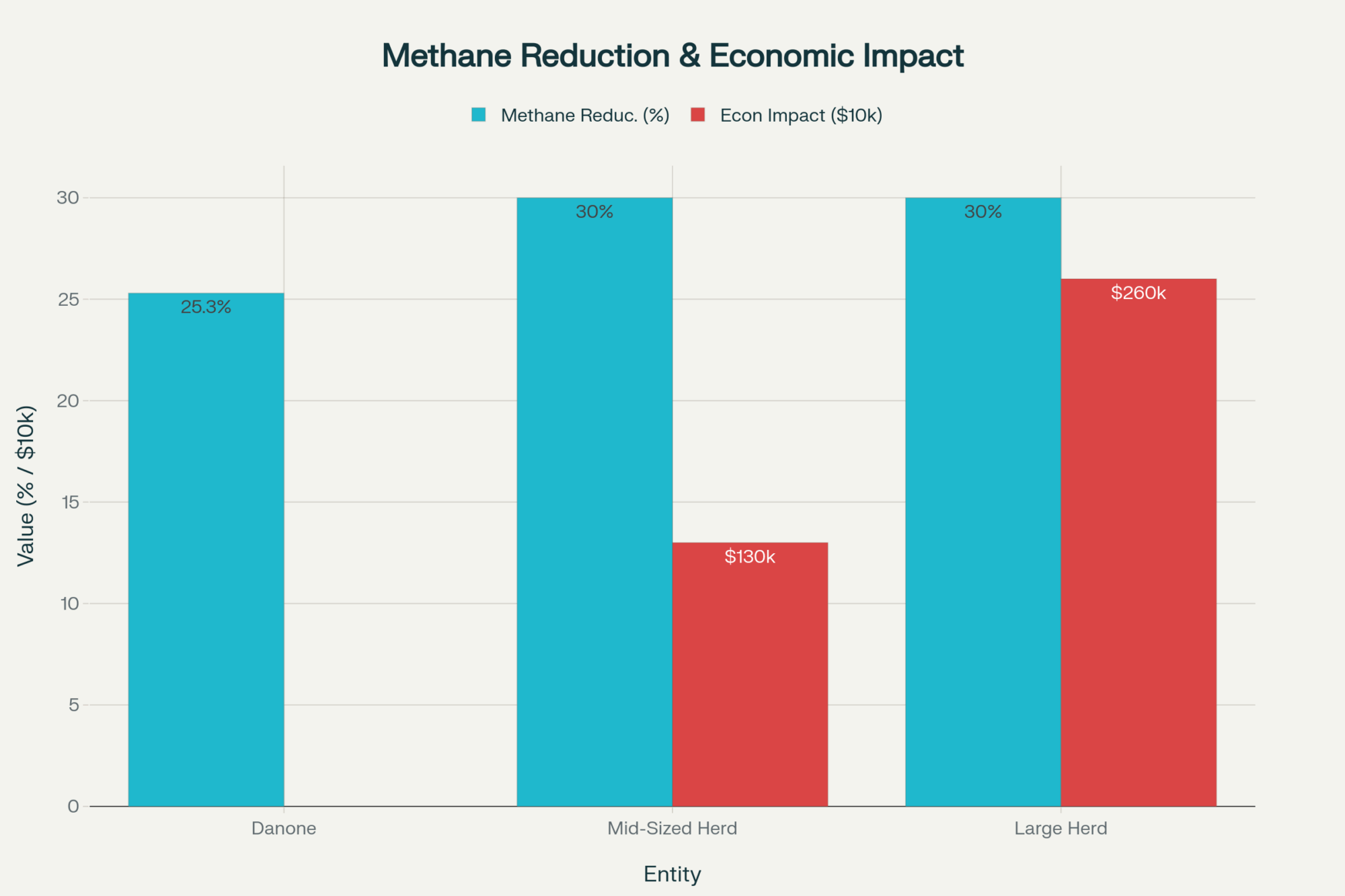
EXECUTIVE SUMMARY: Here’s what we’ve uncovered, and it’s gonna challenge everything you think you know about methane reduction: These feed additives aren’t just an environmental feel-good story—they’re a legitimate profit play.Sure, you’re looking at 30-50 cents per cow daily in costs, but early data suggests returns could hit 70 cents per cow per day. Do the math on a 500-cow herd… that’s potentially $130,000 in additional annual revenue (though we’ll be straight with you—these are preliminary estimates that’ll vary by operation). Meanwhile, global giants like Danone are already 25% of the way to their 30% methane reduction targets by 2030, signaling this isn’t going away.But here’s the kicker we don’t hear enough about—the premium pricing window likely shuts between 2027 and 2030. Miss it, and you’re back to commodity pricing while your neighbors collect the bonuses. The science shows cow responses vary wildly based on genetics and feed management, so this isn’t plug-and-play. But producers who test their herds, work with sharp nutritionists, and pilot smart protocols? They’re positioning for advantages that could last years. Time to stop debating and start testing—because your competition sure isn’t waiting.

KEY TAKEAWAYS

  • Cut methane 30% without sacrificing production – FDA-approved additives maintain milk yield and butterfat while meeting regulatory targets (MDPI, 2024). Your move: Schedule a sit-down with your nutritionist this month to evaluate your herd’s suitability.
  • Potential returns of 70 cents per cow daily translate to roughly $130K annually on 500 cows, though results vary by genetics and management (Industry analysis, 2025). Smart approach: Pilot with 50-100 of your best cows before committing the whole herd.
  • Documentation is everything for carbon credits – rigorous baseline measurements and continuous monitoring are mandatory, no shortcuts (US DOE, 2025). Get ahead: Connect with your local extension office now for compliance guidance tailored to your region.
  • Feed management makes or breaks success – unbalanced rations can kill your ROI before you start (Cornell Cooperative Extension, 2025). Critical step: Work with feed advisors who understand additive interactions, not just someone pushing products.
  • Regional regulations are all over the map – California’s SB 1383 mandates differ drastically from Wisconsin’s cooperative approach and New York’s Climate Act timelines. Bottom line: Know your state’s rules because 2025 regulatory reality varies wildly depending on where you milk.
dairy profitability, methane reduction, feed additives, dairy farm management, carbon credits

You know what’s been bugging me lately? There’s this massive shift happening with methane feed additives in dairy, and half the producers I talk to at the local co-op are still treating it like some far-off science experiment. Meanwhile, the smart operators—they’re already positioning themselves while the rest of us debate whether it’s worth the hassle.

Here’s the thing, though… if you’re not moving on this soon, you won’t just miss out on the opportunity. You might end up helping pay for your neighbor’s success.

Let’s Talk Real Numbers (Because That’s What Actually Matters)

The FDA finally gave Bovaer the green light back in May—that’s 3-nitrooxypropanol for those keeping score—and the results coming out of peer-reviewed research are pretty solid. Multiple studies, including recent work published by MDPI, show these additives consistently knock down methane emissions by about 30%, and here’s the kicker: your butterfat numbers and milk volume stay put (MDPI, 2024).

But it ain’t cheap. We’re talking 30 to 50 cents per cow, every single day, according to FDA documentation and manufacturer pricing (FDA, 2024). Now, if you’re milking 500 head, that’s $54,750 to $91,250 annually just in additive costs. Real money.

The economic projections—and I want to be straight with you here—suggest you might see returns around 70 cents daily per cow. That’s potentially $127,750 in additional revenue for that same 500-cow operation. But these are preliminary estimates based on economic modeling, and your actual results will depend on everything from your cows’ genetics to your feed management and local market conditions (Industry economic analysis, 2025).

What strikes me about this whole thing is how the big players are already positioning themselves. Danone’s not messing around—they committed to slash methane by 30% by 2030, and according to their latest sustainability report, they’re already at 25.3% (Danone, 2023). DSM-Firmenich is ramping up production like crazy, getting ready for what they see as inevitable demand.

The Window’s Closing Faster Than You Think

Here’s what’s keeping me up at night: the premium pricing window for methane-reduced milk isn’t going to stay open forever. Market analysts are pointing to somewhere between 2027 and 2030 as when this opportunity likely diminishes, depending on how fast adoption rates climb and regulations kick in. But that’s an estimate—regulatory changes and market forces could shift this timeline significantly (Market analysis, 2025).

Miss that window, and you’re back to commodity pricing while the early movers keep their premium contracts. Supply chains are already tightening—I’m hearing from feed dealers that those who got in early secured better pricing and delivery slots.

Why Aren’t More Producers Jumping In?

The honest answer? It’s complicated, and that scares people.

The breakthrough research from UC Davis really opened my eyes on this—individual cow responses to these additives vary like crazy, mostly because of rumen microbiome differences and genetics. You might have half your herd responding great while the other half barely budges (UC Davis Veterinary Research, 2025). That’s a tough pill to swallow when you’re looking at the daily costs.

And let’s be real about the feed side of this equation. If your ration’s heavy on grain or you’ve got mineral imbalances, you might as well flush that additive money down the drain. The nutritional management piece is absolutely critical, according to Cornell’s extension work (Cornell Cooperative Extension, 2025).

Storage is another headache most people don’t think about. These aren’t your standard mineral tubs—heat, humidity, and light exposure will kill the potency faster than you’d believe. The feed industry safety standards are pretty clear on this (Feed Industry Standards, 2025).

The Compliance Game Nobody Talks About

Want to get into carbon credits? Better get comfortable with paperwork. Serious paperwork.

We’re talking verified baseline measurements, continuous monitoring, third-party audits—the whole nine yards, according to US Department of Energy requirements (DOE, 2025). Miss a detail, skip a report, and you’re out. No exceptions.

The monitoring equipment that actually meets verification standards? You’re looking at $35,000 to $50,000 just to get started properly. Not the cheap stuff some companies are pushing.

Consumer Reactions Are All Over the Map

This is fascinating to watch unfold. When Arla announced their Bovaer trials in the UK, consumers went absolutely nuclear—boycotts, milk dumping, viral videos, the whole social media meltdown. The BBC covered it extensively back in December (BBC News, 2024).

But here’s what’s interesting… at the exact same time, Danone was quietly expanding their premium programs across continental Europe for the same technology. No backlash, just steady premium payments.

The difference? Marketing and messaging. Research shows that framing methane reduction as “natural farm efficiency” rather than “chemical intervention” makes all the difference in consumer acceptance (Marketing Research, 2024).

The Split-Herd Strategy Some Are Testing

Some of the bigger operations—we’re talking 1,000+ cows—are getting clever with a dual-herd approach. They feed additives to their top producers and market that milk separately to premium buyers, while the rest of the herd stays on conventional feed for local markets.

Now, industry modeling suggests that infrastructure investments of $170,000 to $275,000 are required for proper segregation systems, with potential annual returns of $15,000 to $25,000. However, these are preliminary figures from an economic analysis, and actual results may vary considerably by operation (Dairy Systems Analysis, 2025).

This development is fascinating because it’s creating a two-tier milk market that most producers are not even aware of yet.

Small Operations Aren’t Left Out

Don’t think you need to be huge to play this game. A lot of state cooperatives are setting up group purchasing programs for feed additives, plus they handle the compliance documentation, according to cooperative reports (State Cooperative Programs, 2025).

Minnesota’s got a particularly good program running—smaller producers can get group pricing and shared technical support without the big upfront commitments.

Your Regional Reality Check

The regulatory landscape is… well, it’s a patchwork, frankly.

California’s SB 1383 means business—mandatory methane reductions with some serious incentive money behind it (California Air Resources Board, 2025). If you’re in the Central Valley, this isn’t optional anymore.

Wisconsin’s taking a softer approach, but the cooperative support is growing fast, according to their Department of Agriculture updates (Wisconsin DATCP, 2025). The DFA facilities there are starting to offer preferred pricing for verified low-emission milk.

New York’s Climate Leadership Act is picking up steam, and the North Country producers I know are starting to feel the pressure (NY Department of Environmental Conservation, 2025).

What This Means for Your Next Move

Look, I get it. Change is hard, especially when you’re dealing with your livelihood. But here’s my take after watching this unfold…

Start with microbiome testing on your herd. Find out which cows are most likely to respond before you commit serious money.

Work with a nutritionist who actually understands this stuff—not just someone pushing products.

Pilot with 50-100 of your best cows. Test the waters before you dive in completely.

Get your documentation systems right from day one. Don’t try to retrofit later.

And for crying out loud, keep an eye on what’s happening in your state. These regulations are moving faster than most people realize.

The Bottom Line Truth

This industry transformation is happening whether we participate or not. The early adopters are positioning themselves for advantages that could last for years. The late adopters… well, they might find themselves at a permanent disadvantage.

Your decision timeline isn’t measured in years anymore. It’s months. The competition is already making their moves.

The question is: what’s yours going to be?

Complete references and supporting documentation are available upon request by contacting the editorial team at editor@thebullvine.com.

Learn More:

Join the Revolution!

Join over 30,000 successful dairy professionals who rely on Bullvine Weekly for their competitive edge. Delivered directly to your inbox each week, our exclusive industry insights help you make smarter decisions while saving precious hours every week. Never miss critical updates on milk production trends, breakthrough technologies, and profit-boosting strategies that top producers are already implementing. Subscribe now to transform your dairy operation’s efficiency and profitability—your future success is just one click away.

NewsSubscribe
First
Last
Consent

How Canadian Dairy Farmers Can Cash In on Carbon Markets

Learn how Canadian dairy farmers can profit from carbon markets. Ready to turn eco-friendly efforts into financial gains?

Summary: Canada’s dairy farmers are increasingly adopting greener practices and selling their carbon credits to reduce their environmental impact. Carbon markets are marketplaces for buying and selling carbon credits, which turn carbon emission reductions into cash incentives. By participating in these markets, dairy producers can significantly reduce their carbon emissions and increase their profitability. Carbon credits and offsets are crucial for dairy producers, as they indicate a one-metric-ton decrease in carbon dioxide emissions. Companies buy carbon offsets to compensate for their emissions, supporting programs that absorb or decrease carbon emissions. These credits are sold in compliance markets, governed by government rules, and voluntary markets, where firms may purchase credits to satisfy corporate sustainability objectives. Various practices can help generate carbon credits, such as cover cropping, no-till or reduced-till farming, rotational grazing, manure management, and agroforestry. Participating in carbon markets can balance the ecological footprint while increasing profitability, contributing to environmental sustainability and economic benefits. To transform a dairy farm with carbon credits, assess your current carbon footprint, identify reduction opportunities, implement sustainable practices, document and monitor improvements, engage with certification programs, generate carbon credits, and list and sell certified carbon credits in carbon markets.

  • Carbon credits offer a lucrative revenue stream by incentivizing eco-friendly farming practices.
  • Implementing sustainable farming techniques not only mitigates climate change but also enhances soil health and productivity.
  • Dairy farmers can capitalize on government incentives aimed at reducing carbon footprints, further boosting profitability.
  • Certification and partnerships with reputable organizations ensure maximum returns and credibility in carbon markets.
  • Staying abreast of market trends and regulatory changes is crucial for long-term success in the carbon economy.

Consider converting an invisible consequence of your dairy farming activities into a profitable cash stream. Intrigued? You should be. As more businesses commit to decreasing their carbon footprints, carbon markets allow dairy farmers in Canada to embrace greener techniques and sell their carbon credits. This isn’t only excellent for the environment; it may be a hidden treasure for individuals navigating these marketplaces successfully. Canadian dairy farmers play an essential role in environmental sustainability, and by understanding and proactively participating in carbon markets, you may help dramatically reduce carbon emissions. More importantly, this can lead to a significant increase in your profitability. This essay will walk you through the complexity of these marketplaces, providing insights into the methods necessary to join, ideas for increasing your financial returns, and strategies for integrating these techniques into your present agricultural operations.

Deciphering Carbon Markets: A Primer for Dairy Farmers 

Understanding carbon markets is not just a step; it’s a crucial journey that dairy producers must navigate successfully. Carbon markets are marketplaces for buying and selling carbon credits. These markets work by turning carbon emission reductions into cash incentives. When a farm lowers its carbon footprint, it creates carbon credits, which may be sold to other businesses that need to offset their emissions. Understanding the nuances of these marketplaces is critical to being well-informed and prepared to engage successfully, ensuring that you take full advantage of this opportunity.

Understanding carbon credits and offsets is critical for dairy producers. A carbon credit indicates a one-metric-ton decrease in carbon dioxide emissions, which may be achieved via various ecologically beneficial agricultural methods. Companies, on the other hand, buy carbon offsets to compensate for their emissions. They support programs that absorb or decrease carbon emissions, such as reforestation or soil carbon sequestration. This more comprehensive awareness of the carbon market may help farmers make more educated choices about participating.

These credits are sold in two markets: compliance markets, governed by government rules, and voluntary markets, where firms may purchase credits to satisfy corporate sustainability objectives. Participating in these marketplaces may help dairy producers reduce their environmental impact while providing an extra money source.

Unlocking Wealth While Saving the Planet: How Carbon Credits Revolutionize Dairy Farming 

Carbon credits are a novel tool for reconciling environmental stewardship and economic incentives. A carbon credit is one ton of carbon dioxide (CO2) or its equivalent in other greenhouse gases that have been avoided or removed from the environment. Understanding the complexities of carbon credits, especially the science of carbon sequestration, may help dairy producers contribute to a more sustainable future while increasing their profits.

Carbon sequestration is how agricultural operations collect and store atmospheric CO2 in the soil or biomass. This natural method is mainly achieved by photosynthesis, in which plants take CO2 and transform it into organic matter. When done correctly, agricultural techniques may significantly increase the amount of carbon stored in the soil, transforming farms into carbon sinks.

Several specific practices can aid in generating carbon credits: 

  • Cover Cropping: Planting cover crops in the off-season may help farmers increase soil organic matter and decrease CO2 emissions. These crops also benefit soil health, reduce erosion, and boost biodiversity.
  • No-Till or Reduced-Till Farming: Minimizing soil disturbance contributes to preserving soil carbon reserves. Traditional plowing may release stored carbon into the atmosphere, while no-till practices keep it sequestered.
  • Rotational Grazing: This entails moving animals between pastures to allow for vegetation regeneration. Healthy pastures trap more carbon, which adds to the total carbon offset.
  • Manure Management: Handling and using manure may minimize methane emissions (a potent greenhouse gas) while increasing soil fertility. Anaerobic digestion is one technique for capturing and using methane as a sustainable energy source.
  • Agroforestry: Integrating trees and shrubs into agricultural systems increases carbon sequestration. Trees store carbon in their biomass and roots, contributing considerably to long-term carbon sequestration.

By implementing these techniques, dairy producers help to reduce global greenhouse gas emissions and create valuable carbon credits that may be exchanged in carbon markets. These credits provide an additional source of revenue, bolstering the farm’s financial stability while emphasizing its dedication to environmental sustainability.

Balancing the Ecological Footprint While Enhancing Profitability 

Balancing the ecological impact while increasing profitability may seem complicated, but the twin advantages of participating in carbon markets make this objective attainable. Dairy producers like yourself have the potential to contribute to environmental sustainability while also reaping economic benefits. By implementing methods that minimize greenhouse gas emissions, such as methane collection for energy generation, you may reduce your farm’s carbon footprint while possibly increasing profitability.

Furthermore, several governments and corporations provide carbon credits as a financial incentive for proven emission reductions. Participating in these carbon markets or establishing Scope 3 reduction programs ensures that your environmental efforts provide immediate economic benefits. In addition to directly selling carbon credits, energy savings and improved soil health from methods such as carbon sequestration may result in significant long-term cost savings, giving financial stability. So, by tackling climate change, you protect the environment for future generations while unlocking a profitable cash stream that strengthens your farm’s economic status.

From Environmental Stewardship to Profit: Why Canadian Dairy Farmers Should Dive Into Carbon Markets Now!

Aside from the obvious environmental benefits, carbon markets provide other advantages to Canadian dairy producers. The prospect of generating additional income sources is one of the most enticing motivators. Farmers may create extra cash by selling carbon credits, which can be reinvested in more sustainable projects or used to improve agricultural operations. This improves the farm’s financial health and promotes a more cyclical and regenerative agrarian model.

Agronomically, these projects promote measures that improve soil health, increase water usage efficiency, and minimize dependency on synthetic inputs, all contributing to farm sustainability. Rotational grazing, cover cropping, and optimal manure management are ecologically friendly practices that help to build more resilient agricultural ecosystems. Enhanced soil fertility and biodiversity ultimately lead to higher crop yields and animal output, resulting in a win-win situation for the farm and the environment.

Furthermore, carbon market participation improves Canadian dairy farmers’ public perception. Consumers nowadays are more concerned about how their dietary choices affect the environment. Dairy producers may attract more conscious customers by proving their commitment to lowering greenhouse gas emissions and adopting sustainable practices. This boosts consumer loyalty and increases the total brand value of Canadian dairy products in a highly competitive industry.

Incorporating carbon markets into dairy farming operations is a strategic step that boosts economic resilience, environmental stewardship, and public image, thus cementing the dairy sector’s position as a pioneer in sustainable agriculture.

Unlock Hidden Wealth: Transform Your Dairy Farm with Carbon Credits! 

  1. Assess Current Carbon Footprints: The first step for Canadian dairy farmers interested in carbon markets is thoroughly assessing their current carbon footprint. This involves measuring the greenhouse gas emissions (GHGs) generated by their farming operations, including carbon dioxide (CO2), methane (CH4), and nitrous oxide (N2).
  2. Identify Reduction Opportunities: Once the carbon footprint is assessed, the next step is identifying opportunities for reduction. Standard practices include optimizing feed efficiency to reduce methane emissions, adopting manure management systems that capture or reduce methane, and implementing soil management techniques that enhance carbon sequestration.
  3. Implement Sustainable Practices: Begin integrating the identified reduction practices into daily operations. For instance, consider investing in anaerobic digesters for manure management to produce biogas or transitioning to no-till farming to improve soil carbon storage.
  4. Document and Monitor Improvements: Meticulously document all changes and monitor the results over time. Accurate record-keeping is crucial for verifying emission reductions and is required to earn carbon credits.
  5. Engage with Certification Programs: Farmers must engage with authorized certification programs to enter the carbon market. Organizations such as VCS (Verified Carbon Standard) or Gold Standard can verify and certify the emission reductions, ensuring they meet market standards.
  6. Generate Carbon Credits: The verified emission reductions can be turned into carbon credits upon certification. Each credit represents one metric ton of CO2 reduced or sequestered.
  7. Sell Carbon Credits: Finally, list and sell your certified carbon credits in carbon markets. Platforms such as the Chicago Climate Exchange or through private brokerages can facilitate the sale. Engaging with buyers looking to offset their carbon footprints can yield competitive prices, contributing to environmental sustainability and farm profitability.

Government Incentives: Your Ticket to Eco-Friendly and Economically Vibrant Dairy Farming 

The Canadian government has implemented various initiatives and incentives to assist dairy farmers in minimizing carbon emissions and actively engaging in carbon markets. For example, the Agricultural Clean Technology (ACT) Program supports farmers who invest in technology that decreases greenhouse gas emissions and promotes energy efficiency. The Canadian Agricultural Partnership (CAP) offers subsidies for programs promoting environmental sustainability, such as carbon capture and soil storage. Furthermore, the Canadian Dairy Commission (CDC) has been implementing programs such as the Dairy Farmers of Canada’s “Net Zero by 2050” target, which seeks to dramatically reduce dairy farming’s carbon footprint by providing different assistance and tools for measuring and validating carbon credits. On a provincial level, Ontario and British Columbia have specialized programs to reduce greenhouse gas emissions in agriculture, providing financial assistance and technical advice to farmers engaging in carbon offset schemes. These extensive initiatives encourage dairy producers to adopt environmentally friendly methods and open the basis for significant economic benefits via carbon trading markets.

Maximize Your Carbon Potential: Tools, Certifications, and Partnerships for Dairy Farmers 

Maximizing your carbon potential entails more than simply implementing eco-friendly practices; it also entails using the correct tools and building strategic alliances to assist you in meeting environmental and economic objectives.

  • Carbon Footprint Calculators: Utilize tools like the Cool Farm Tool to estimate your farm’s emissions and potential carbon sequestration.
  • Certification Bodies: Partner with organizations such as Verra and Gold Standard to certify your carbon credits and ensure they meet market standards.
  • Industry Groups: Get involved with groups like the Dairy Farmers of Canada and the International Dairy Federation to stay informed on best practices and policy developments.
  • Government Resources: Leverage federal and provincial resources available through websites like the Government of Canada Carbon Pollution Pricing platform.
  • Consulting Services: Engage consulting firms such as CIBO Technologies for expert advice and personalized strategies tailored to your farm’s unique needs.

Triumph Over Trials: Navigating the Complexities of Carbon Markets in Dairy Farming 

Although lucrative, incorporating carbon markets into the dairy farming environment has various hurdles that dairy producers must negotiate carefully. Market volatility is a crucial barrier since shifting carbon credit values may cause financial instability. Farmers may find themselves in a scenario where the expected return from carbon credits does not cover the investment, creating financial distress.

Another major topic is the certification procedure. Establishing eligibility to trade carbon credits requires adherence to tight and frequently complex rules. The certification landscape includes a variety of standards and techniques, each requiring thorough documentation and third-party verification. This takes time and requires knowledge that may go beyond typical agricultural procedures.

The early expenses of adopting carbon-reduction initiatives exacerbate the issues. Transitioning to more sustainable practices sometimes requires a considerable initial investment in technology, equipment, and training. For example, implementing precision agricultural methods or changing manure management systems incurs significant upfront costs. While these investments provide long-term benefits, the immediate cost burden may dissuade many farmers.

Despite these hurdles, dairy farmers’ efforts to engage in carbon markets offer great potential for altering their economic and environmental impact. Farmers may successfully negotiate the obstacles and realize the many rewards by carefully assessing these challenges and getting appropriate help.

The Promising Future of Carbon Markets: A Golden Opportunity for Canadian Dairy Farmers 

As we look forward, the trajectory of carbon markets represents both a developing opportunity and a problem for Canadian dairy producers. Current trends point to the continuous spread of carbon pricing systems, with more nations and subnational jurisdictions projected to implement or improve their carbon pricing policies. This increase creates a profitable opportunity for dairy producers to monetize their carbon reductions more than ever.

With the price of government offset credits expected to grow by $15 per tCO2e by 2030, the financial repercussions for dairy producers might be significant. This growth reflects a rising realization of the worth of carbon credits, which drives up demand. Farmers that use carbon management strategies will increase their profitability and market competitiveness.

However, it is essential to anticipate harsh regulatory changes. As governments tighten environmental rules, compliance with stringent sustainability criteria will become unavoidable. However, this regulatory environment has a silver lining, with several government incentives ready to smooth the economic shift to eco-friendly companies.

Furthermore, the growing market for carbon insets has unexplored potential. While less well-known than offsets, insets allow direct investment in on-farm initiatives that absorb carbon and improve sustainability. This might result in considerable cost reductions and income increases for forward-thinking dairy producers.

Finally, combining developing legislation with the rising demand for carbon credits predicts a dynamic future. Canadian dairy farmers who successfully navigate these changes will contribute to global environmental objectives while identifying lucrative avenues and converting their farms into models of sustainability and economic resilience.

The Bottom Line

Carbon markets provide a revolutionary opportunity for dairy producers to align their operations with sustainability objectives while generating new income streams, balancing ecological footprints, and considerably increasing profit margins. Understanding how carbon credits operate, utilizing government incentives, gaining the necessary tools and certifications, and navigating market difficulties may help you establish yourself as a sustainability leader. The hidden gains are there for the taking—join the sustainable revolution and enjoy the benefits of being an early adopter in the carbon market arena. The future of dairy farming is linked to environmental stewardship and economic resilience, creating an excellent opportunity for those willing to innovate and adapt.

Learn more: 

Unlocking Carbon Accounting: New Revenue Streams for Small and Large Farms Alike

Unlock new revenue streams for farms of all sizes through carbon accounting. How can your farm benefit from carbon credits and sustainable practices? Discover more.

Historically, carbon credits have been an advantage reserved for larger farms with the capital and resources to invest in projects like anaerobic digestion for methane capture. Smaller farms were sidelined due to prohibitive costs and complex requirements. 

Changing regulatory frameworks and a push for supply chain sustainability are creating new opportunities. California’s Voluntary Carbon Market Disclosure Act, a game-changer, makes the carbon market more transparent and accessible for smaller operations. This regulatory shift not only offers feasible pathways for smaller farms to participate in carbon markets but also underscores their crucial role in contributing to environmental sustainability

Companies are not just looking to reduce emissions along their supply chains through on-farm reductions and removals—known as Scope 3 reductions or insets. They are also offering economic benefits. Smaller farms can now influence their carbon footprint, cooperatives, and the broader market. This new landscape not only allows farms of all sizes to adopt sustainable practices but also opens doors to economic benefits, sparking hope and motivation in the agriculturalcommunity.

Leveling the Playing Field: California’s Voluntary Carbon Market Disclosure Act Unveils New Opportunities for Farms of All Sizes 

California’s Voluntary Carbon Market Disclosure Act is a pivotal regulation injecting essential transparency into carbon offset markets. This legislation mandates that entities provide clear and comprehensive information about the offsets they sell, thus enhancing the credibility and reliability of carbon credits. Detailed disclosures about each carbon credit’s origin, type, and confirmation create a transparent marketplace for buyers and sellers. 

This shift presents new opportunities for farms of all sizes to engage in carbon accounting and benefit from carbon credit initiatives. Smaller farms, traditionally excluded due to market complexities, can now participate confidently by standardizing information and reducing ambiguity. This transparency allows small to medium-sized farms to verify their carbon credits and access potential buyers, unlocking avenues for additional revenue streams

The act provides the assurance needed to invest in and partner with smaller agricultural operations for larger corporate buyers, facilitating Scope 3 emission reductions across supply chains. This regulation not only democratizes the carbon credit market but also inspires comprehensive participation and collaboration across farm sizes. By embracing these changes, farms not only enhance sustainability and gain economically but also contribute meaningfully to global emission reduction targets, making them feel part of a larger mission.

Driving Sustainability with Scope 3 Reductions and On-Farm Insets 

Scope 3 reductions target the indirect emissions in a company’s value chain, covering production, transportation, and logistics activities. In agriculture, these emissions are linked to getting products from farm to consumer. Insets are on-farm projects designed to cut these Scope 3 emissions within the supply chain instead of using external offsets. 

Organizations are investing more in on-farm reductions to meet emission targets. Companies foster sustainability and innovation in agriculture by supporting projects that lower enteric methane emissions, streamline feed production, and improve manure management. This approach helps them meet corporate social responsibility goals and promotes efficient and eco-friendly farming methods. 

Farms can significantly benefit from these projects through improved sustainability, lower carbon footprints, and new revenue from carbon credits. Cooperatives can offer better value to members, advocate for collective sustainability, and gain more market power. Consumer brands can boost their reputation and trust by showing a real commitment to environmental impact reduction. This holistic approach ensures that the entire supply chain works towards a sustainable and resilient agricultural industry.

Comprehensive Emission Sources and Mitigation Strategies in Dairy Farming

Dairy operations face significant on-farm emissions from enteric methane, manure management, and feed production. Enteric methane, produced during ruminant digestion, is an important issue but can be mitigated with innovative feed additives. Manure management requires infrastructure but is essential for reducing emissions. Sustainable feed production practices are crucial, such as reducing nitrogen fertilizer, cover cropping, and better grazing techniques. 

Other emissions stem from energy use, both direct and from purchased electricity. There’s also great potential for carbon removals through soil carbon sequestration, afforestation, and silvopasture, which can offset emissions and improve the ecological footprint of dairy farming.

Revolutionizing Methane Reduction: Harnessing Feed Supplements and Seaweed Additives in Dairy Farming 

Enteric methane emissions projects offer innovative solutions for reducing methane output from dairy operations. By using feed supplements and seaweed additives, these projects aim to decrease the methane produced during digestion. Various supplements, including seaweed, have been shown to cut emissions effectively. With many already in different approval stages, the regulatory landscape is evolving to accommodate these alternatives. 

One key advantage of these projects is their simplicity, requiring minimal record-keeping. This makes them an appealing, practical choice for dairy farms of all sizes. 

Organizations often help offset the cost of these supplements, thanks to their interest in the carbon benefits. Financial incentives reduce the initial investment and provide ongoing economic benefits, allowing dairy farmers to integrate these methane-reducing interventions easily.

Innovative Approaches to Methane Reduction in Dairy: Leveraging Feed Supplements and Seaweed Additives

Enteric methane emissions projects offer practical solutions to cut methane output from dairy operations using feed supplements and seaweed additives. These dietary changes can significantly reduce methane produced during digestion. Many of these supplements are progressing through regulatory approval stages. 

These projects are easy to implement and require minimal record-keeping, making them an attractive option for dairy farms of all sizes. 

Financially, organizations often cover the cost of these supplements in exchange for carbon benefits, reducing initial investment for farmers and offering ongoing economic advantages.

Unlocking the Dual Benefits of Carbon Sequestration: Ecological Stewardship and Economic Gain on Farms

Carbon sequestration involves capturing and storing atmospheric carbon dioxide, reducing greenhouse gases. This can be achieved on farms through soil carbon sequestration and forestry initiatives. Practices like cover cropping, reduced tillage, and organic matter additions enhance soil’s carbon storage ability while planting trees and integrating silvopasture systems increase carbon storage above ground. 

These efforts require long-term monitoring to ensure permanence, as disruptions can release stored carbon into the atmosphere. Rigorous measurement and verification are essential to validate carbon credits. 

Participating in carbon sequestration projects is not just about environmental stewardship. It’s also a smart financial move for farmers. These projects create additional revenue streams through the sale of verified carbon credits, providing a tangible return on their sustainability efforts. This blend of ecological stewardship and economic gain underscores the potential of carbon sequestration for farms of all sizes.

The Bottom Line

Participating in carbon accounting projects offers numerous advantages beyond environmental benefits. These initiatives can improve farm sustainability, aligning practices with ecological and community resilience. They help reduce the farm’s carbon footprint through precise emission tracking and targeted mitigation strategies. Financially, they provide opportunities for additional revenue through efficiencies and selling carbon credits, turning environmental efforts into profitable ventures. Farmers are encouraged to explore these opportunities and understand project requirements to maximize benefits and lead in sustainable agriculture.

Key Takeaways:

  • Larger farms have historically dominated the carbon credit market, but new regulations and project types are leveling the playing field for smaller farms.
  • California’s Voluntary Carbon Market Disclosure Act mandates transparency for entities selling carbon offsets, fostering greater understanding and involvement across all farm sizes.
  • Organizations are investing in on-farm reductions and removals to meet Scope 3 emissions targets, impacting the entire supply chain, including cooperatives, brands, and retailers.
  • Dairy farms primarily emit carbon through enteric methane, manure management, and feed production, with additional emissions from energy use.
  • Enteric methane reduction projects involving feed supplements and seaweed additives are emerging but require minimal record keeping and come with financial incentives.
  • Feed production enhancements like nitrogen fertilizer reduction, cover crops, reduced tillage, and improved grazing practices offer viable pathways for both carbon offsets and insets.
  • Carbon sequestration projects involving soil, forestry or silvopasture require long-term monitoring but provide substantial ecological and economic benefits.
  • Participating in these projects not only promotes sustainability and reduces the carbon footprint of farms but also potentially increases revenue through efficiencies and the sale of carbon credits.

Summary: 

California’s Voluntary Carbon Market Disclosure Act is a significant step in making the carbon market more transparent and accessible for smaller operations. The act mandates entities to provide clear information about offsets they sell, enhancing the credibility and reliability of carbon credits. This transparency allows small to medium-sized farms to verify their carbon credits and access potential buyers, unlocking avenues for additional revenue streams. The act also provides assurance needed to invest in and partner with smaller agricultural operations for larger corporate buyers, facilitating Scope 3 emission reductions across supply chains. Scope 3 reductions target indirect emissions in a company’s value chain, covering production, transportation, and logistics activities. Companies are investing more in on-farm reductions to meet emission targets and foster sustainability and innovation in agriculture. Dairy operations face significant on-farm emissions from enteric methane, manure management, and feed production. Innovative feed additives, sustainable practices, and financial incentives can help mitigate emissions. Farmers are encouraged to explore opportunities and understand project requirements to lead in sustainable agriculture.

Learn more:

To delve deeper into the emerging opportunities and sustainability practices in dairy farming, consider exploring these related articles: 

Send this to a friend