Archive for butterfat trends

Global Dairy Markets Kick Off 2026 With A Surprise Rally – But Don’t Get Too Comfortable Yet

The first 2026 GDT rally is real—but the farms that win from it will be the ones already managing margin, not chasing price.

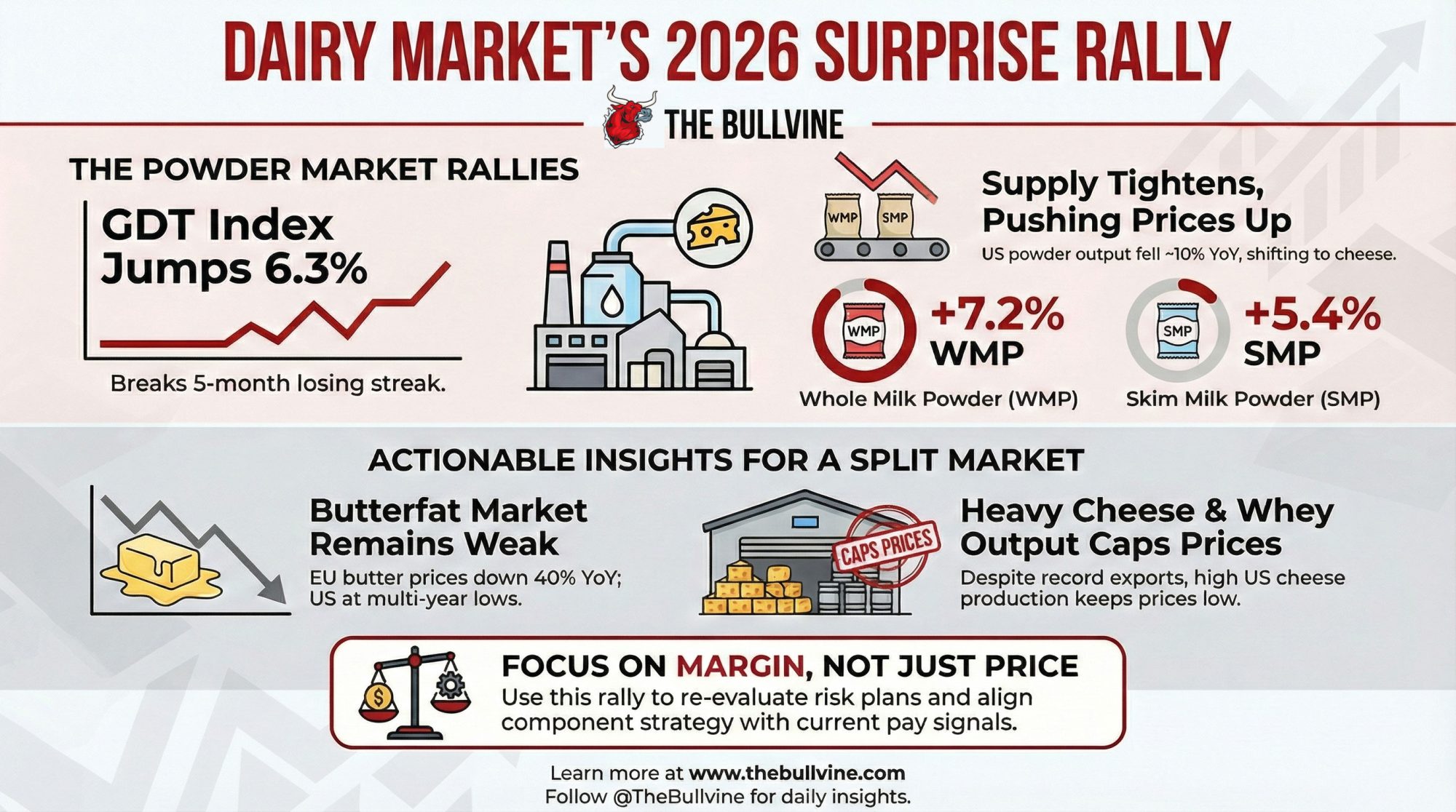
Executive Summary: Global dairy got a welcome jolt to start 2026 when the first GDT auction pushed the index up 6.3%, led by stronger whole and skim milk powder prices, after a long stretch of weaker events. Behind that headline, the shift is being driven less by a demand boom and more by tighter powder supply: New Zealand offered less product, and US plants have cut powder output by roughly 10% year‑on‑year as milk moves into cheese and high‑protein ingredients instead. At the same time, EU butter prices around €4,400 per tonne, sizeable EU butter stocks, US butter stuck in the mid‑$1.30s, and heavy cheese and whey production all remind us that the world is still working through a “wall of milk,” even if it looks different in Europe, North America, Oceania, and China. Futures markets in Europe and Singapore are quietly confirming this firmer tone, but most official outlooks still point to only modest milk price gains against relatively high input and finance costs. For farmers, this combination means the rally is useful but not a rescue: the biggest wins will come from tightening margin‑management plans, rechecking butterfat versus protein strategy against current pay programs, and using tools like dairy‑beef where local buyers can genuinely support it. In short, this is a moment to use better prices to strengthen your position, not a signal that the hard part of this cycle is behind us.
Global Dairy Market Trends

You know those weeks when the market finally gives you something other than bad news? The first Global Dairy Trade auction of 2026 was one of those weeks. The January 6 event pushed the GDT Index up 6.3 percent, according to official GDT results and confirmed by NZX Dairy Insights. That broke a five-month slide that had been wearing on everyone’s nerves.
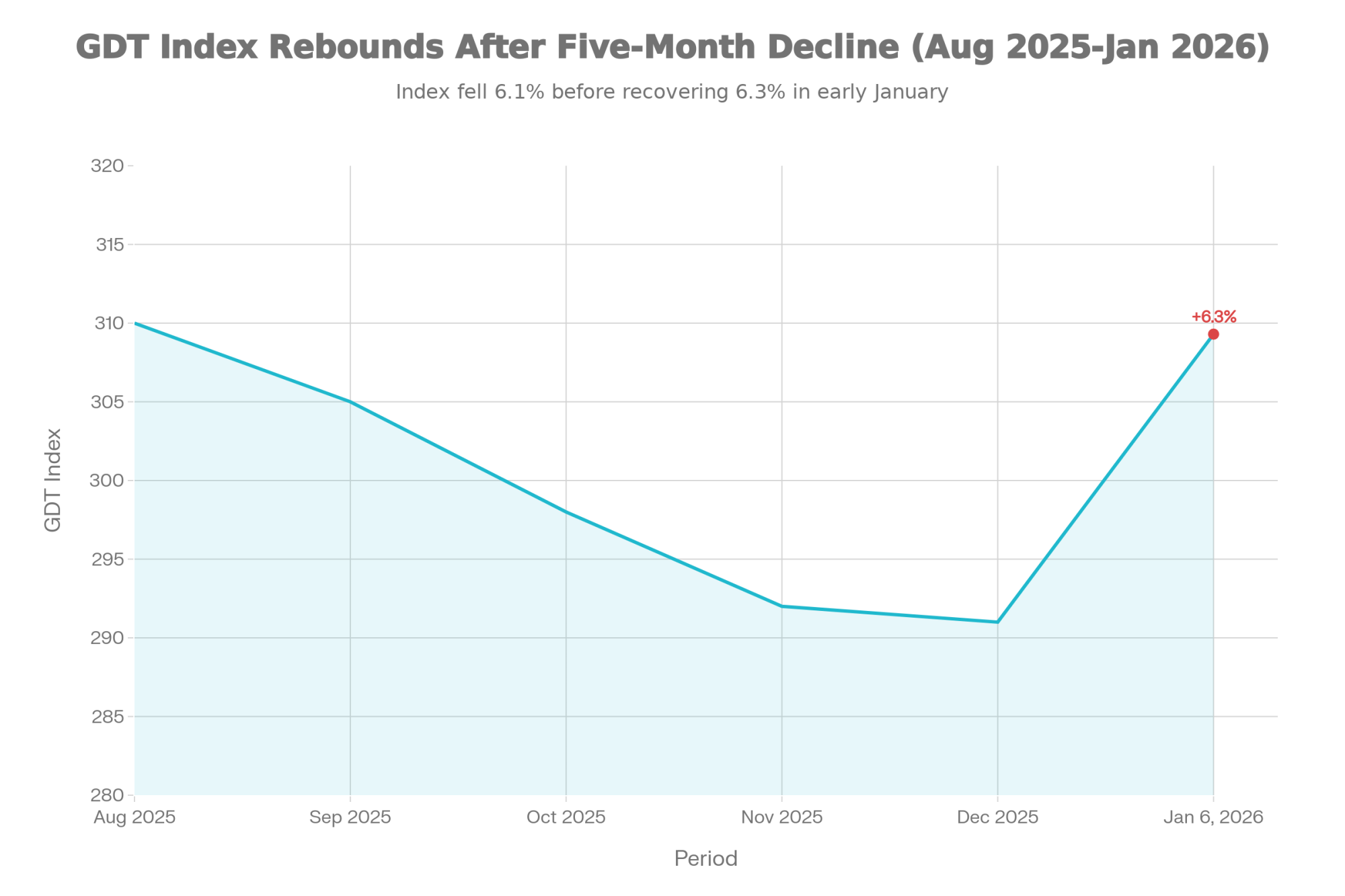
GDT Index Snaps Five-Month Slide—But Don’t Mistake a Rally for a Recovery 

Before we dig into what’s driving all this, here are the numbers that matter most right now:

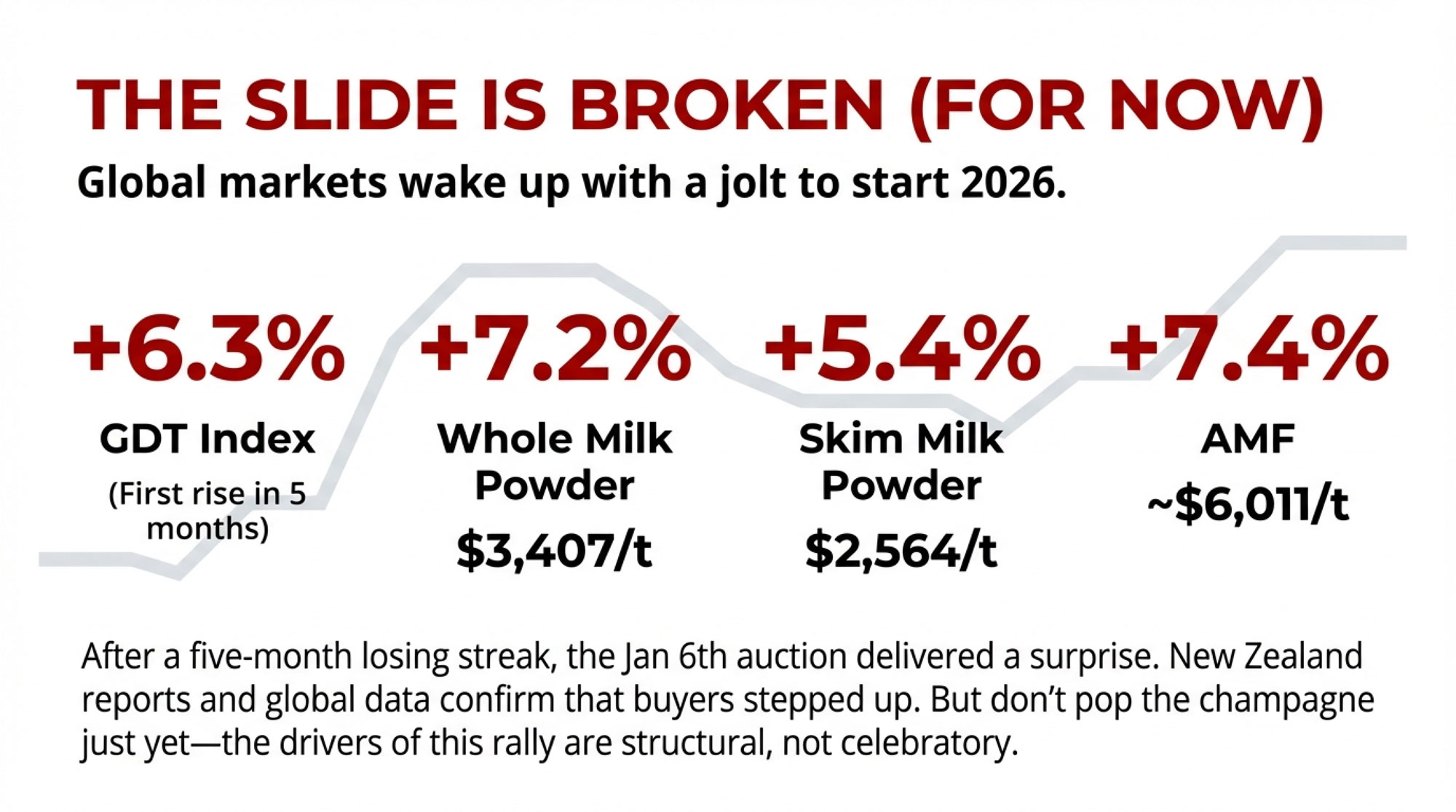
  • GDT Price Index: Up 6.3% at Event 395, the first increase since August 2025
  • Whole Milk Powder: Up 7.2% to roughly $3,407 per tonne
  • Skim Milk Powder: Up 5.4% to about $2,564 per tonne
  • Anhydrous Milkfat: Up 7.4% to around $6,011 per tonne
  • US Spot NDM: Reached $1.265 per pound for the week ending January 9
  • EU Butter Reference: Around €4,408 per tonne, down roughly 40% year-on-year
  • CME Spot Butter: Trading in the mid-$1.30s per pound, near multi-year lows
  • CME Dry Whey: Slipped into the low-70-cent range per pound

New Zealand and global dairy reports told the same story: less product on offer from Oceania and stronger demand from Asia and the Middle East combined to move the needle. Average winning prices at GDT moved into the mid-$3,500-per-tonne range, which was a welcome change from the drift we’d been seeing.

What’s encouraging is that this is the first time in a while we’ve seen both fat and powder move up together in a meaningful way. It doesn’t mean the year is saved. But it does tell us the market still responds when supply tightens, and buyers step forward.
Powder’s Quiet Turn: Less Balancing, More Bite

Looking at the powder side of this rally, you start to see some interesting structural changes at work. In early January, US spot nonfat dry milk climbed into the mid-$1.20s per pound. The T.C. Jacoby Weekly Market Report, which draws heavily on CME and USDA data, pegged the weekly average at $1.265 per pound for the week ending January 9. That’s a real improvement from where we sat late last year.

At the same time, USDA’s Livestock, Dairy, and Poultry Outlook still points to modest US milk growth for 2026. The October projections have national production rising from around 231 billion pounds in 2025 to 234 billion pounds in 2026, driven by a slightly larger herd averaging just under 9.5 million cows and higher yield per cow. On the surface, you’d expect “more milk” to mean softer powder prices, not firmer.

So what changed? On the production side, you see, we’re simply not making as much powder as we used to. That same Jacoby report highlighted October US nonfat/skim production at just under 150 million pounds, about 10 percent below the same month a year earlier. The analysts described it as one of the lighter October figures they’ve seen in recent years based on USDA’s monthly time series.

MetricOctober 2025October 2024ChangeYoY %
Total US Milk Production19.25B lbs18.98B lbs+270M+1.4%
Nonfat Dry Milk (NDM) Output148.5M lbs165.0M lbs-16.5M-10.0%
US Cheese Production286M lbs271M lbs+15M+5.5%
Whey Protein Streams42M lbs38M lbs+4M+10.5%

On the ground, plants are using their dryers less as a balancing tool. With all the new cheese vats and high-protein lines that have come online across the Midwest and West over the past few years, extra milk that would have gone to powder a decade ago is now more often going into cheese or specialty proteins. A plant manager in the Central Plains told me recently, “If I can put a load into cheese or a protein stream, I’ll do it before I even think about the dryer.” That attitude is becoming pretty common.

Now put that together with the GDT story. Ahead of the first 2026 auction, New Zealand sellers cut back their offered volumes of whole and skim milk powder compared with earlier events, according to NZX Dairy Insights. Milk collections there aren’t running away, and co-ops are managing volume more tightly. Buyers still came to the table, and between that and tighter US production, the whole powder market suddenly looked a lot less heavy than it did in the fall.

So the data suggests this powder rally isn’t just a random bounce. It’s built on less supply meeting stable-to-better demand. The open question is how long that balance holds.

What The Futures Are Whispering

If you sit down with anyone who lives in the risk-management world, they’ll tell you the futures curves matter. And right now, they’re quietly backing up what we’re seeing in spot markets.

On the European Energy Exchange, skim milk powder futures for the early-to-mid-2026 months moved into the low € 2,200-per-tonne range right after the GDT lift. That’s a few percent higher than where they sat in late December. Whey futures edged higher, too, though not by as much.

Over in Singapore, which has become a key hub for hedging Oceania-linked product, whole milk powder futures for the January–August window climbed into the upper-$3,300s per tonne, with skim in the high-$2,600s to low-$2,700s. Anhydrous milkfat and butter futures there saw even stronger percentage gains after the auction.

Why does any of this matter at the farm level? Because these are the curves your co-op or processor looks at when they’re deciding whether to lock in export deals. On Wisconsin farms that ship into export-focused co-ops, and in California plants that rely heavily on overseas powder sales, marketers are much more willing to write business when EEX and SGX curves are firm and active. Those deals, in turn, show up in premiums, base prices, and risk-sharing programs.

You might never place a futures order yourself, but it’s worth knowing that the people pricing your milk are watching those screens every day.

Butterfat: Valuable In Theory, Awkward In Practice

Now, let’s talk butterfat, because this is where many of us feel a disconnect between the “fat is back” headlines and the actual pay stub.

In Europe, the composite butter price, based on Dutch, German, and French quotations, has been around €4,408 per tonne in early January. That’s a bit better than December, but still about 40 percent below where it was a year ago. Vesper’s late-2025 analysis estimated EU butter surpluses at roughly 93,700 tonnes across the first three quarters of 2025, with production up more than 86,000 tonnes year-on-year. That’s a lot of butter to work through, and Vesper expects prices to slip below €4,000 per tonne in the first quarter of 2026.
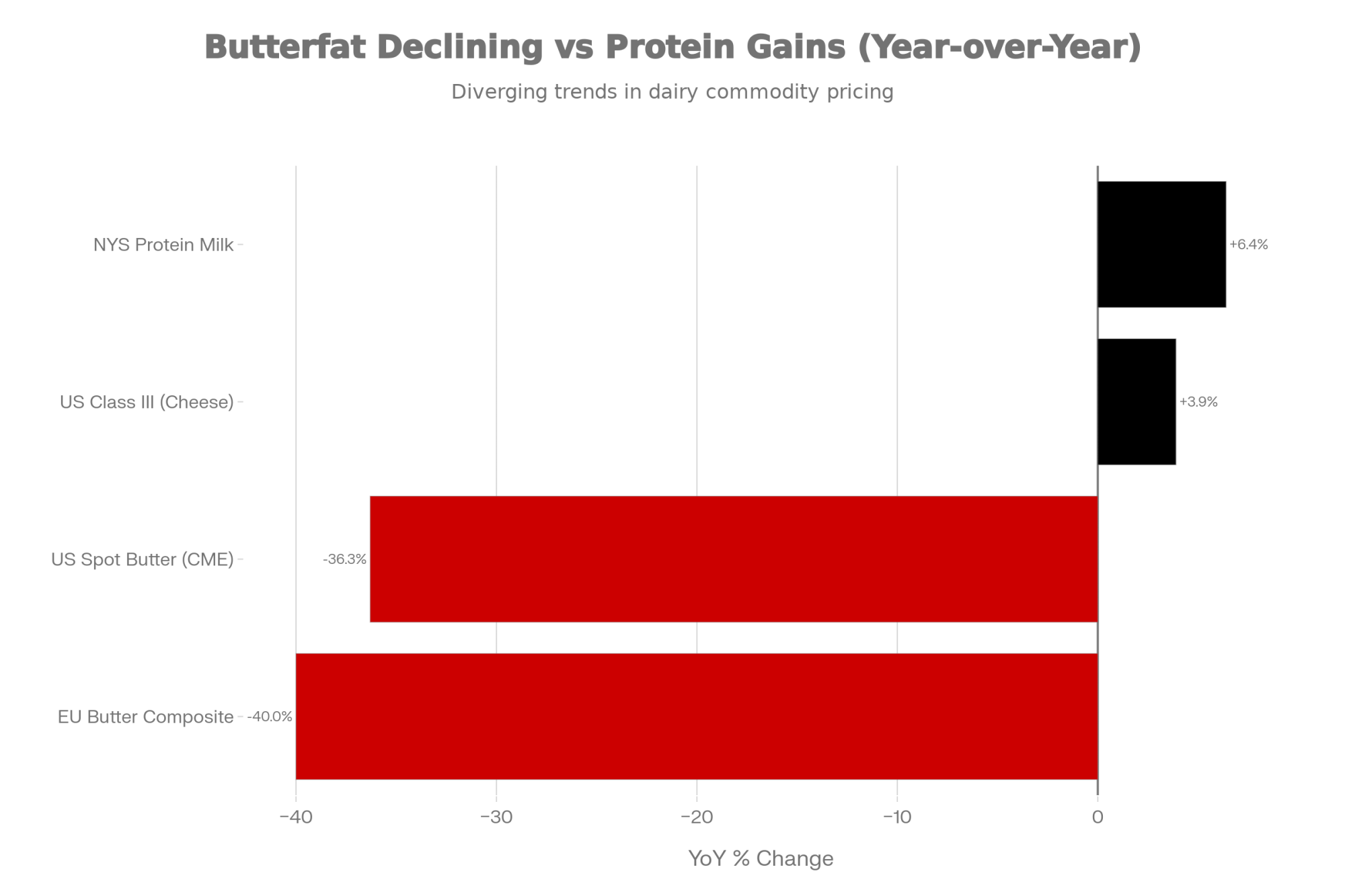
Product / RegionPrice (Current)Price (Year Ago)YoY ChangeStatus
EU Butter Composite€4,408/tonne€7,347/tonne-€2,939⚠️ -40.0%
US Spot Butter (CME)$1.37/lb$2.15/lb-$0.78⚠️ -36.3%
US Class III (Cheese)~$18.50/cwt~$17.80/cwt+$0.70↑ +3.9%
NYS Protein Milk Price~$19.25/cwt~$18.10/cwt+$1.15↑ +6.4%

In the US, it’s a different flavour of the same challenge. Spot butter at the Chicago Mercantile Exchange has started 2026 in the mid-$1.30s per pound. Butter at $1.3750 on January 1, and Ever.Ag’s early-January “Margin Matters” commentary described it as testing multi-year lows. USDA data show butter production in late 2025 still running ahead of year-ago levels, even after accounting for strong cream usage elsewhere in the system.

Exports, interestingly, have improved. Late-2025 export summaries from USDA and dairy trade coverage show US butter shipments several times larger than the year before and strong growth in anhydrous milkfat exports as well. International buyers are clearly taking advantage of the discount on US fat relative to European and New Zealand product.

Domestically, the picture is nuanced. Consumers haven’t gone back to low-fat diets. USDA production reports show yogurt and cottage cheese output growing in recent years, while ice cream and sour cream have been flat to slightly down. So people are still comfortable with fat, but they seem to prefer it when it’s paired with protein or cultures.

What does that mean for butterfat levels on your farm? Over the last decade, many herds have pushed fat up through better fresh cow management, strong transition programs, and careful ration work. On Northeast and Upper Midwest farms, it’s not unusual now to see rolling herd averages north of 4.0 percent fat. But with butter this cheap, the extra dollars you spend chasing an extra few points of fat may not pay back like they did when butter was at $2.50 or more.

That doesn’t mean you stop caring about fat. It does mean it’s worth sitting down with your nutritionist and milk statement to see whether your current component strategy still lines up with how your buyer is paying today. On some Ontario and New York farms, for instance, processors are quietly putting more emphasis on protein because of where their products – yogurt, cheese, high-protein drinks – are headed. That shifts the economics.

Cheese And Whey: Strong Demand, Full Vats

Cheese has been the main growth engine for the US dairy industry in recent years, as many of us have seen. USDA’s 2025 production data shows total cheese output running several percentage points ahead of the previous year, with some months close to 6% growth. New plants in places like Michigan, Texas, and Idaho are very visible examples of that expansion.
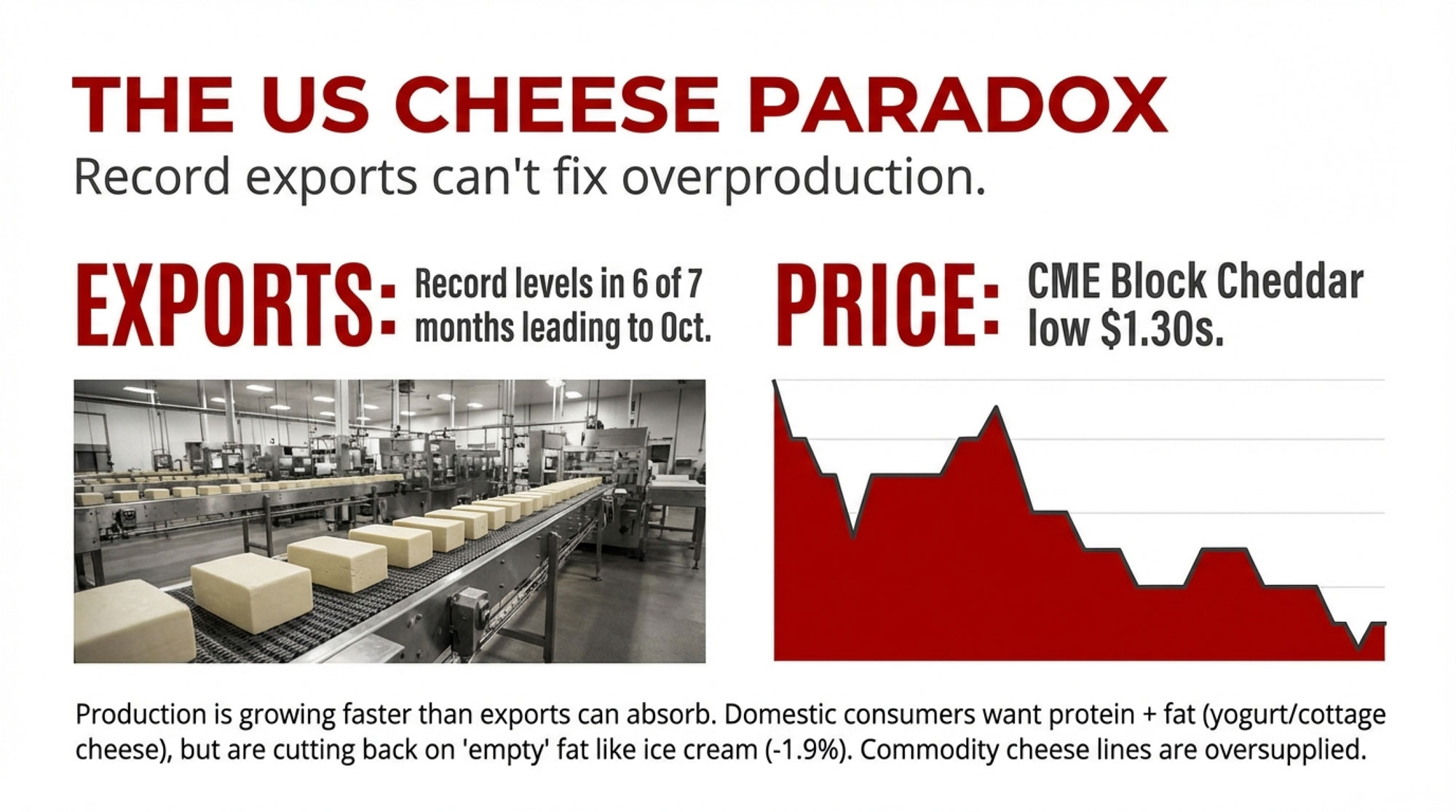
On the price side, CME block Cheddar has been trading in the low-$1.30s per pound to start 2026, down from the $1.60–$1.80 range that held for much of last spring and summer. During that higher-price period, US cheese exports set record or near-record volumes in several months, especially into Mexico and parts of Asia, according to USDA export statistics.

MetricCurrent StatusYear AgoChangeImplication
US Total Cheese Production+6.0% YoYBaselineHigher volumeSupply exceeds domestic + export growth
US Cheese ExportsRecord+ to Mexico & AsiaYear-ago baselineRecord volumesDemand is real, but can’t absorb all new production
Domestic Cheese ConsumptionRelatively flatFlatNo growthMore product chasing same home market
Dry Whey (CME Spot)$0.70–$0.73/lb$0.88–$0.92/lb-20% to -22%Substantial pressure; excess supply; downside drag
Whey Protein Concentrates (WPC)Firm (specialty)StrongStable to slightly higherValue-added fractions holding; commodity pressure below

So why are prices back down? It comes back to volume. Even when exports are “record,” they still only take a slice of total output. The rest has to be eaten domestically or stored. When production grows faster than both domestic use and exports, prices simply don’t have much room to move higher.

Whey is part of this story. Protein demand hasn’t gone away. In fact, consumer research and nutrition studies from the last few years show continued growth in demand for high-protein foods and supplements. Dairy proteins remain a central ingredient in many sports and wellness products.

But every pound of cheese brings whey with it. Processors tend to strip out the higher-value fractions – whey protein concentrates, and isolates – and those markets remain fairly tight. The commodity dry whey that’s left, though, has been under pressure. To start 2026, CME dry whey has slipped into the low-70-cent range per pound, lower than it was in early autumn. Industry analyses point to several months where dry whey output has run ahead of the previous year, adding to stocks.

So, as with butterfat, the headline (“protein is hot”) doesn’t always tell you what’s happening at the commodity end. The details of how your milk is used – commodity cheese, specialty cheese, high-value protein ingredients – matter a lot when it comes back to your mailbox.
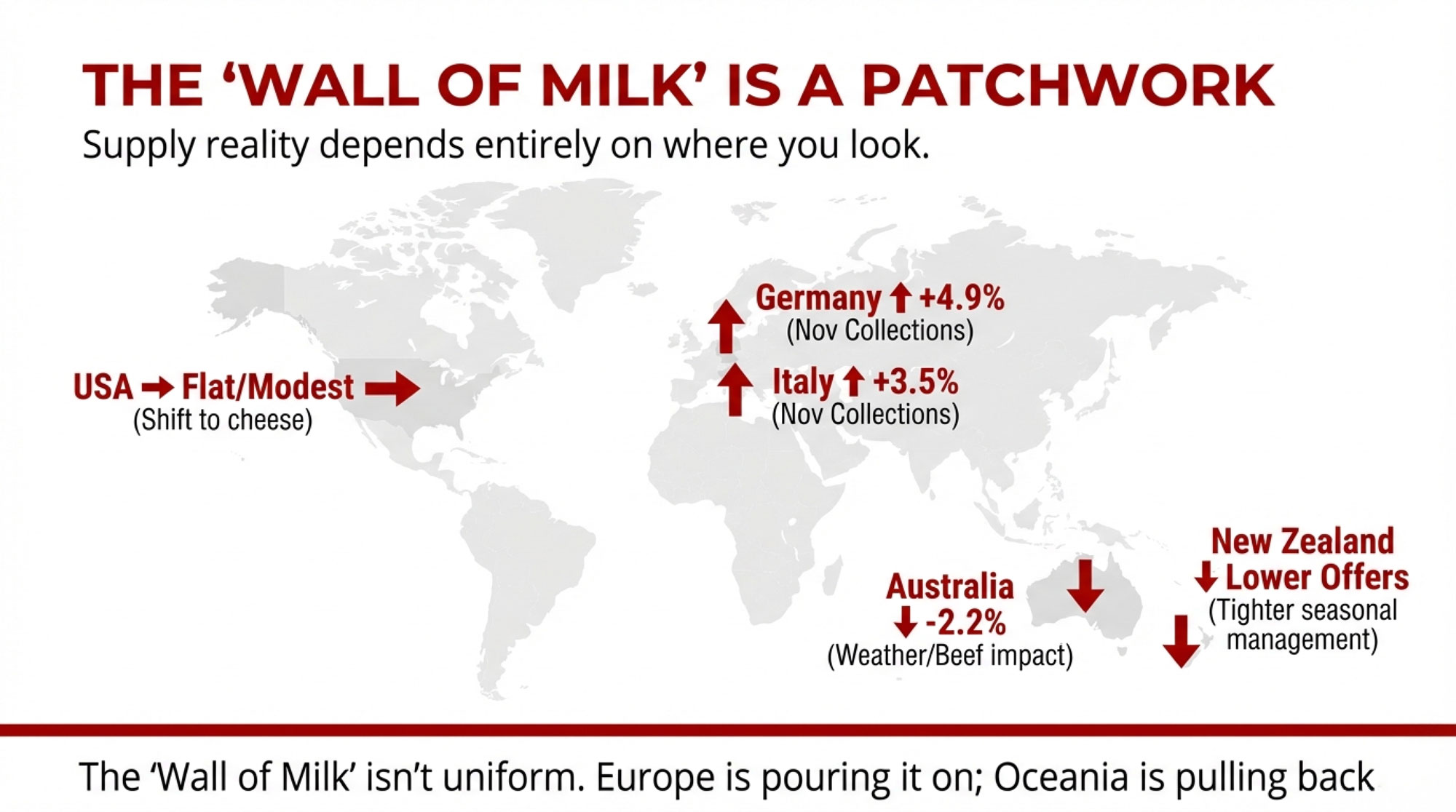
The Wall Of Milk: It Doesn’t Look The Same Everywhere

RegionNov Collection (Local Unit)YoY % ChangeYTD TrendKey Driver
Germany+5.0%Slightly behind 2024 YTDHigher milksolids (4.1% fat, 3.5% protein)
Italy+3.5%Positive YTDSolid seasonal strength
Spain-2.0%Positive YTDLower volume, but higher solids
Ireland-2.1%Strong YTD leadSpring flush strength carrying year
Australia-2.2%Behind 2024 YTDBeef prices, weather, cow numbers under pressure
New Zealand~FlatN/A (seasonal producers)Tight GDT offerings, managed supply
China+3.2%Above 2024 (cautious)Farmgate prices linked to global powder; selective demand

We all hear about the “wall of milk,” but when you look region by region, it doesn’t look uniform at all. Here’s what the latest data show:

  • Germany: November milk collections came in close to 5 percent higher than a year earlier, with milksolids up even more, thanks to butterfat around 4.1 percent and protein near 3.5 percent. But year-to-date, Germany is still slightly behind 2024 because the early months were weaker.
  • Italy: November collections were roughly 3.5 percent higher year-on-year, with milksolids up about 4 percent.
  • Spain: November volumes were down a couple of percent, yet cumulative milk solids ticked higher as fat and protein percentages improved.
  • Ireland: November milk was down just over 2 percent while still holding a solid lead in year-to-date milk and solids thanks to a strong spring flush.
  • Australia: November production was around 875,000 tonnes, more than 2 percent lower than a year earlier, and season-to-date volumes are also behind. Dairy Australia and analysts like Bendigo Bank have been open about the drivers: strong beef prices, weather challenges, and structural issues are all making it harder to rebuild cow numbers.
  • New Zealand: Ahead of the January auction, local analysts talked about lower milk collection forecasts and reduced whole and skim milk powder offerings compared with previous events, per NZX Dairy Insights. When those smaller catalogs arrived at GDT, and buyers still wanted volume, prices responded quickly.
  • China: Official data put December farmgate milk prices in major producing provinces around 3.03 Yuan per kilogram, slightly higher than in November and a few percent above the year before. Academic studies have shown that Chinese raw milk prices have become more tightly linked to international powder prices as imports have grown. When global powder is weak, Chinese farmers feel it quickly; when international prices firm, Chinese buyers become more active, but step by step.

So the global “wall of milk” is really a patchwork. Some bricks are growing, some are shrinking, some are fairly static.

A Practical Playbook For The Year Ahead

Let’s bring this back to the farm office and the kitchen table. What do we do with all this?

1. Use The Powder And Fat Lift To Recheck Your Risk Plan

With powder and fat both stronger than they were in the fall, this is a reasonable time to revisit your risk-management approach. You don’t need to swing for the fences.

You might:

  • Talk with your co-op or buyer about locking in a portion of your spring or early-summer milk if Class IV or powder-linked prices offer margins that work for your cost structure.
  • In the US, review Dairy Revenue Protection and Dairy Margin Coverage again. University of Wisconsin dairy economists have repeatedly noted that these tools can provide a useful safety net when both milk and feed are volatile.

Mark Stephenson, director of dairy policy analysis at the University of Wisconsin, has been emphasizing for years that producers shouldn’t wait for the “perfect” price. “If you can lock in a margin that covers your costs and leaves something reasonable, that’s worth serious consideration,” he’s noted in recent extension presentations. That kind of thinking – focusing on acceptable margins instead of a perfect price – often serves farms better over the whole cycle.

2. Make Sure Components Match Today’s Pay Signals

Over the past decade, a lot of energy has gone into improving butterfat levels through fresh cow management, solid transition programs, and refined rations. Many herds have made impressive gains. But with butter pricing where it is right now, it’s worth asking whether every extra pound of butterfat is paying back the way it did a few years ago.

Take a recent milk cheque and ask yourself:

  • How is each unit of butterfat valued compared to protein?
  • Has your processor or co-op changed those relative values in light of current market conditions?

On some Wisconsin and Northeast farms, nutritionists are still prioritizing high-fat content but also placing greater emphasis on protein yield and overall cow health, especially as processors lean into higher-protein products like yogurt, cottage cheese, and protein-enriched milks. The point isn’t to back off on fat, but to ensure your component strategy aligns with today’s economics, not yesterday’s.

3. Lean Into Dairy-Beef Only Where The Market Can Absorb It

Beef-on-dairy has grown very quickly. Farm Bureau Market Intel analyses and USDA data show that many herds are using beef semen strategically on lower-genetic dairy cows. That’s generating a lot more crossbred calves than we had ten years ago.

When everything is lined up – sire choice, health programs, and marketing channels – those calves often bring a clear premium over straight Holstein bull calves. Feedlot operators in the US and Canada have said publicly that well-bred dairy-beef crosses can perform better on growth and carcass traits than traditional Holstein steers. University research from institutions like Penn State and Kansas State supports that.

But not every region is set up the same way. On parts of the Northeast and some more remote Western areas, producers still report challenges finding reliable buyers willing to pay a premium for crosses. So it’s important to match your breeding strategies to your local marketing reality.

Before expanding beef-on-dairy, it’s worth a very practical conversation with your calf buyer or local feedlot:

  • What specific genetics are they looking for?
  • What health standards and documentation do they require?
  • What kind of premium can they realistically sustain over time?

Those answers will tell you whether dairy-beef is a valuable outlet or a potential headache in your area.

4. Think In Margins, Not Just In Class Prices

We all look at the headline Class III and IV prices. They’re a quick barometer. But as recent years have reminded us, margin per hundredweight is what keeps the lights on.

Recent USDA projections suggest that while milk prices may stay under pressure, feed costs are off the extreme highs we saw not long ago. Corn and soybean meal are still volatile, but not at the peaks that squeezed margins so brutally in 2022. That changes the math.

PeriodClass III Milk Price ($/cwt)Corn Price ($/bu)SBM Price ($/ton)Estimated Margin ($/cwt)
Q3 2024$17.50$3.45$315+$2.10
Q4 2024$17.20$3.65$325+$1.85
Jan 2026 (Est. post-GDT)$18.25$3.55$318+$2.45
2-Year Historical Average$18.80$3.20$290+$3.10
Peak (2022)$23.50$6.85$480-$0.50

This season, it’s useful to:

  • Update your cost of production with your adviser, including interest, labor, and repairs.
  • Talk with your lender about how much downside you can realistically handle before major changes would be needed.
  • Decide ahead of time what actions you’ll take if milk or feed prices cross certain thresholds, rather than waiting until stress is high.

Farms that understand their true margin – not just the milk price – tend to make steadier decisions when things get choppy.

5. Keep An Eye On Global Signals, Without Letting Them Drive Every Move

Global benchmarks like GDT, EU wholesale prices, and futures on EEX and SGX have become regular reference points for processors. That doesn’t mean you need to live in the data, but it does help to have a basic feel for where those numbers are.

A practical approach might be:

  • Glancing at a simple GDT summary after each event to see if WMP, SMP, butter, and AMF are rising or falling.
  • Following one or two reliable sources for EU butter and SMP price trends.
  • Asking your co-op rep once or twice a year how closely your local prices track these global indicators.

That way, when you hear “GDT was up six percent this week,” you already have some sense of what that might mean for export-linked values and, eventually, for your own milk cheque.

The Bottom Line

Stepping back, this early-January rally has given the industry something it’s been lacking: a little bit of positive momentum. Powder and fat have come off their lows. Futures markets in Europe and Asia have acknowledged that shift. And we’ve seen that when supply tightens, and buyers stay active, prices can still move.

At the same time, we’re not out of the woods. Milk production across key exporting regions is still ample. Cheese and whey output remains heavy. Butter stocks in Europe are comfortable. Chinese demand looks better than it did, but it’s still cautious rather than aggressive. And on many farms – from smaller family dairies in the Northeast to large dry lot systems in the Southwest – the milk cheque still feels tight for the amount of capital and effort involved.

While the rest of 2026 is far from written, early indications suggest this may be a year where small, smart moves matter: a slightly better hedge, a ration that protects components without overspending, a breeding plan that matches local markets, a stronger relationship with your buyer. None of these alone will transform a balance sheet, but together they can make a meaningful difference.

What’s particularly noteworthy is that we’re starting this year from a place of pressure, but not panic. The supply side will adjust over time. Some regions will scale back faster than others. As that plays out, the operations that keep a clear eye on margins, stay flexible, and base decisions on solid information will be the ones best positioned to benefit when the market finally swings more decisively back in favour of producers.

And that’s why conversations like this – whether at the kitchen table, in the barn office, or over coffee at a conference – still matter. We’re all trying to read the same signals and make the best decisions we can for our herds, our families, and our businesses in a very interconnected dairy world.

Key Takeaways :

  • The slide is broken—for now. GDT kicked off 2026 with a 6.3% rally, whole milk powder up 7.2%, skim up 5.4%. First increase in five months.
  • Supply, not demand, is driving it. US powder output fell ~10% year-over-year in October as milk shifts to cheese and protein streams. New Zealand also trimmed GDT offerings.
  • Fat markets aren’t following. EU butter stocks near 94,000 tonnes, US butter in the mid-$1.30s—don’t expect butterfat to carry your cheque like it did in 2022.
  • Futures confirm the turn. EEX and SGX dairy curves have firmed, giving processors more confidence to lock in export deals that eventually flow back to farm prices.
  • Act now, not later. Use this window to tighten margin plans, recheck your component strategy against current pay signals, and push dairy-beef only where local buyers genuinely support it.

Complete references and supporting documentation are available upon request by contacting the editorial team at editor@thebullvine.com.

Learn More

The Sunday Read Dairy Professionals Don’t Skip.

Every week, thousands of producers, breeders, and industry insiders open Bullvine Weekly for genetics insights, market shifts, and profit strategies they won’t find anywhere else. One email. Five minutes. Smarter decisions all week.
NewsSubscribe
First
Last
Consent

4.23% Butterfat, $187,000 Gone: The Margin Math That Broke 2025 – And Shapes Your 2028

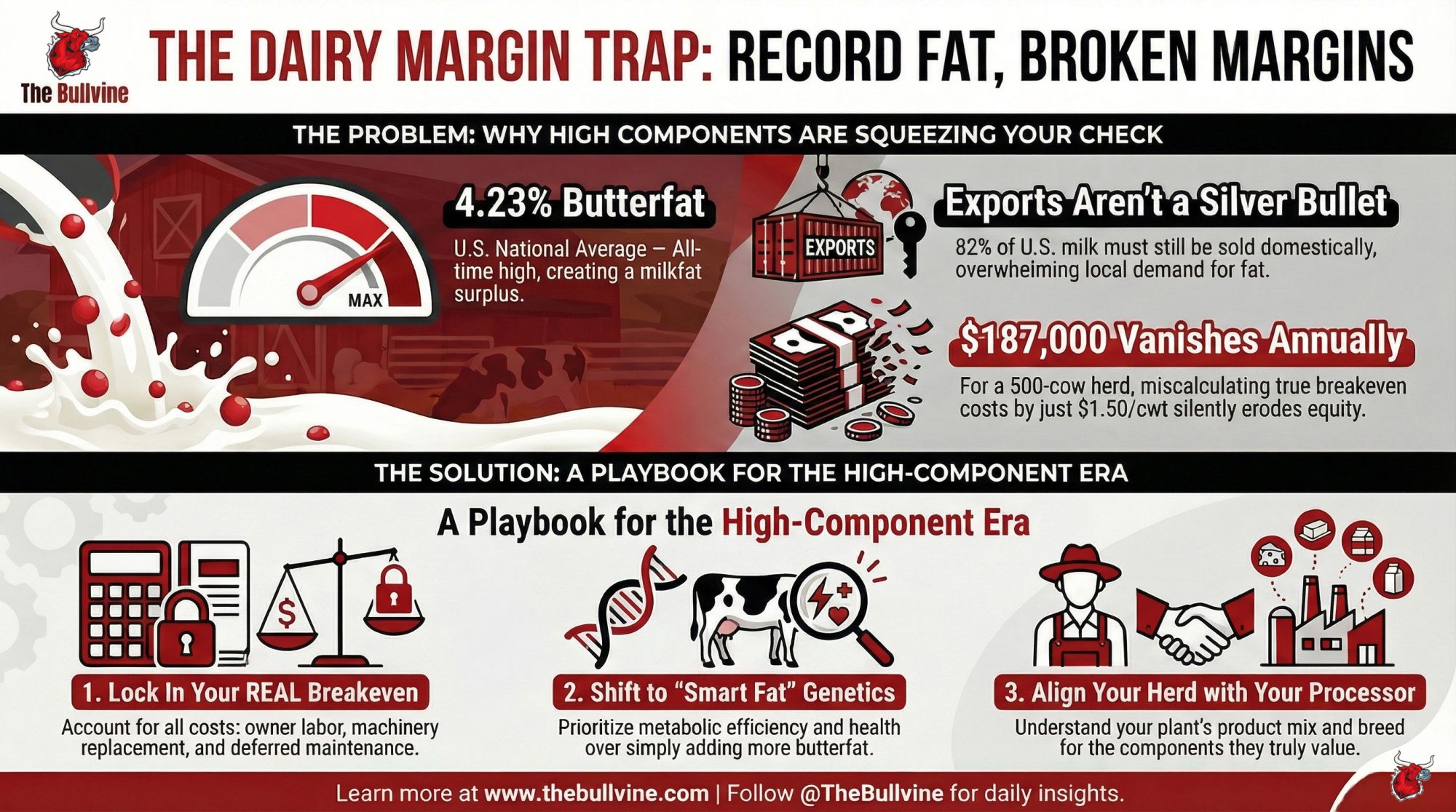
4.23% butterfat—an all-time record. $187,000 gone from a 500-cow herd—silently. That’s not bad luck. It’s the margin math that broke 2025 and shapes who wins by 2028.

Executive Summary: U.S. butterfat hit 4.23% in 2024—an all-time record. Exports topped $8.2 billion. Margins still collapsed. For a 500-cow herd underestimating true breakeven by just $1.50/cwt, that translates to roughly $187,000 in equity vanishing annually—often invisibly, until the lender starts asking hard questions. This isn’t cyclical bad luck; genomic selection has locked the national herd into high-component production through at least 2028, while 82% of U.S. milk still clears domestically, no matter how strong exports run. Regional pain points vary sharply: eroding Class I premiums in the Northeast, punishing cost structures in California, and processor-dependent fortunes across the Southwest. What follows is the margin math that explains 2025’s wreckage—and a 2026-2028 checkpoint framework for aligning genetics, breakeven reality, and processor fit before options narrow further.

Dairy Margin Math

You know that feeling when you look at the milk check and think, “This isn’t what the markets promised me a year ago”? A lot of dairy folks were right there in 2025.

What I’ve found, digging through the numbers and talking with economists, lenders, and producers across the country, is that 2025 wasn’t just “one bad year.” It was the point where years of genetic progress in butterfat performance, record-high component tests, and massive processing investments finally collided with the hard limits of demand and pricing. And that’s the math we need to walk through together.

The 2025 Reality: Less About Volume, More About Butterfat

Looking at this trend, one of the first surprises is that the U.S. didn’t suddenly drown in extra milk. Industry analysis based on 2024 and 2025 statistics indicates that total U.S. milk production has been relatively flat compared with earlier decades of growth. So the story isn’t just “too many cows.”

What really changed was what was in the tank.

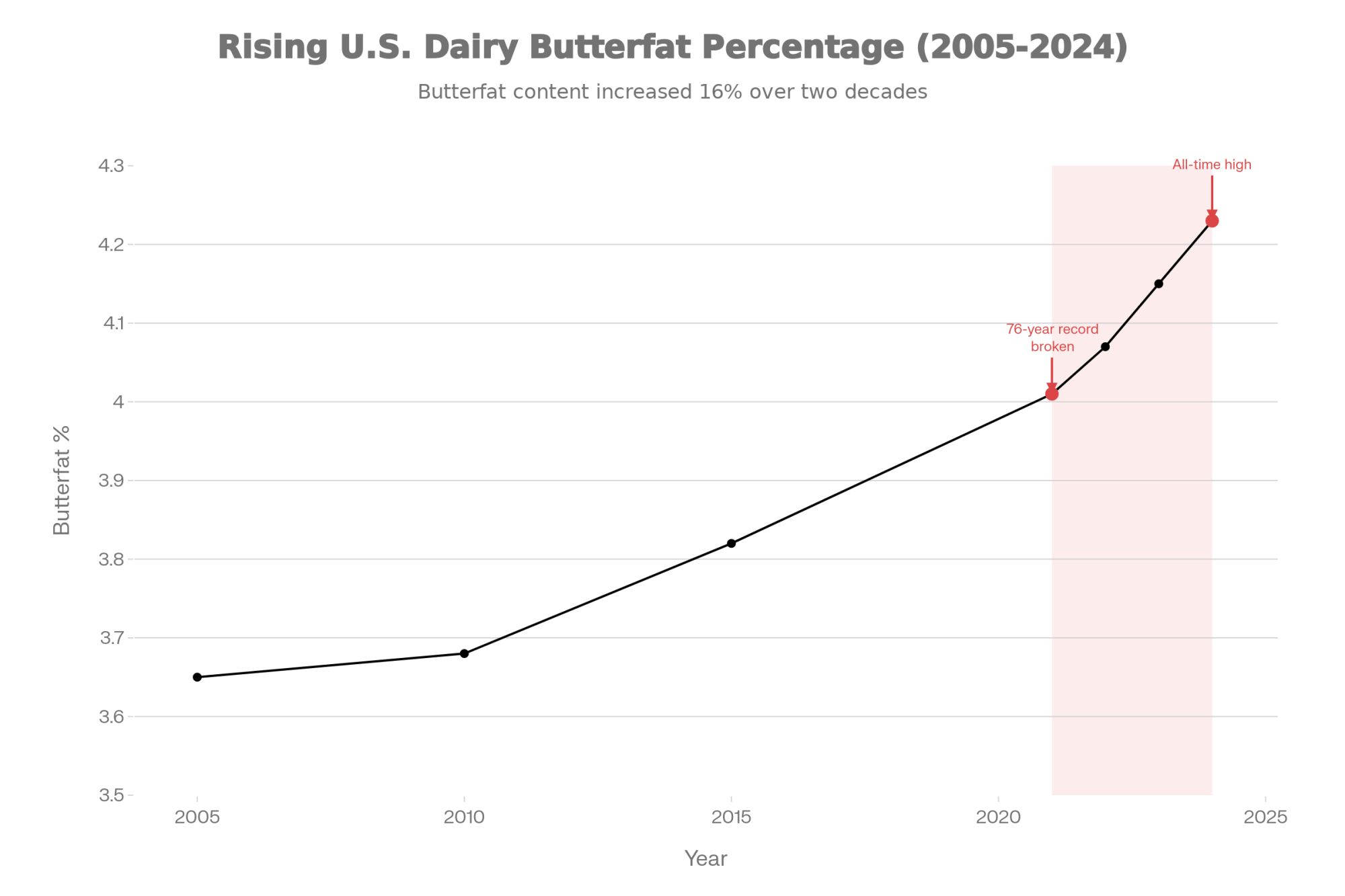
Here’s what’s interesting. Industry reports traced national milkfat trends going back decades, and for a long stretch—from the mid-1960s up to about 2010—average U.S. butterfat hovered in a remarkably tight band, around 3.65–3.69 percent. Then things started to climb. By 2021, we hit a national average of about 4.01 percent milkfat for the first time in recorded history—breaking a record that had stood since 1944 and 1945.

That moved to roughly 4.06–4.08 percent in 2022 and 4.14–4.15 percent in 2023, depending on the calculation method, with each year setting a new record. By 2024, calculated national averages around 4.23 percent butterfat and 3.29 percent protein using monthly USDA National Agricultural Statistics Service data. That lines up with what many of you are probably seeing on DHI sheets—cows that were once 3.6–3.7 percent now sitting comfortably over 4.0.

It’s worth noting that because total milk volume hasn’t grown nearly as fast as butterfat tests, the total pounds of milkfat have jumped faster than the pounds of milk. From 2022 to 2023 alone, U.S. milkfat production increased by about 136.2 million pounds—a 1.5 percent gain—despite modest growth in total milk.

At the same time, price reports and commentary from CME, USDA, and the Farm Bureau, along with our own analysis here at The Bullvine, showed butter and cheese markets under pressure in 2024 and 2025 as stocks built and global competition intensified. So the 2025 reality wasn’t just “more milk.” It was a lot more fat in roughly the same milk pool, with fewer places to sell that fat at the premiums we’d gotten used to.

The Long Component Shift, in One Glance

To put the component story in perspective, here’s a simple snapshot using ranges and figures drawn from USDA statistics and industry analysis.

Table 1. The Component Shift (National Picture)

YearApprox. Avg. Milkfat %Primary Market FocusPhase
2005mid-3.6% rangeFluid milk / volumeOld baseline
20214.01%Fat premiums are gaining tractionThe “pivot”
20234.14–4.15%Fat clearly leading the checkThe “boom”
2024~4.23% (estimated)High-component “new normal.”The “overload”

Industry reports confirm that milkfat set a new annual record four years in a row, leading into 2024. And when you combine that with industry genetics coverage and what we’ve been tracking here, the component gains have been fueled by coordinated genetic selection, nutrition programs, and management improvements. Put together, the message is clear: we’re not drifting back to 3.6–3.7 percent as a national norm anytime soon.

Why Exports Didn’t “Save” 2025

What farmers are finding—and you probably know this already if you’ve been watching the trade reports—is that the export story is a bit of a double-edged sword.

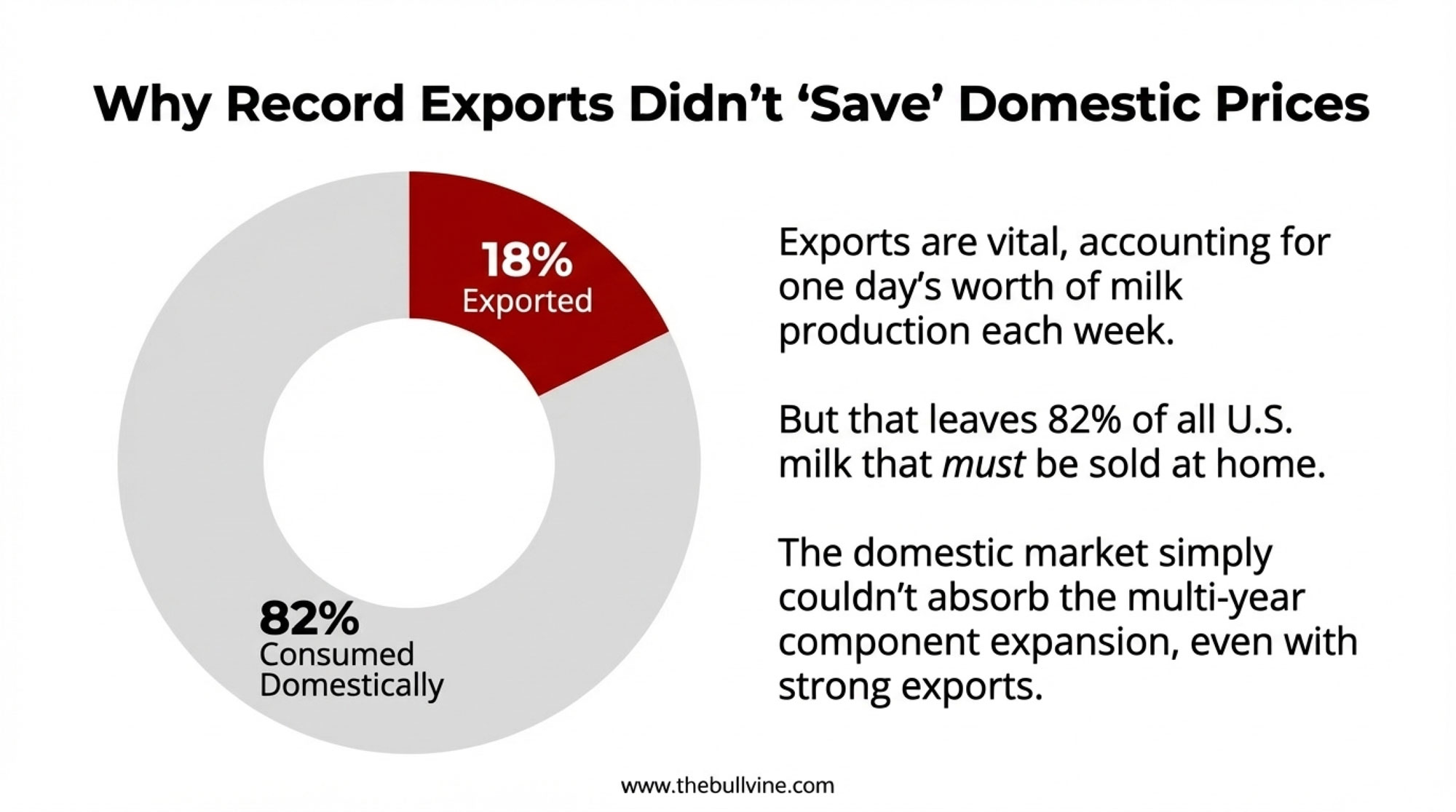
USDA’s Foreign Agricultural Service and industry groups like USDEC and IDFA have all highlighted that U.S. dairy exports hit record or near-record levels in recent years. Dairy Foods reported that U.S. dairy exports topped $8.2 billion in 2024—the second-highest total export value ever—with strong cheese and powder shipments to key buyers such as Mexico and Southeast Asia. And here’s the figure that really matters: according to IDFA, roughly 18 percent of U.S. milk production, on a solids basis, is now exported. That’s about one day’s worth of milk produced on America’s dairy farms each week going overseas. A huge change from 20 years ago.

So it’s fair to ask: if exports were that strong, why did domestic prices still slump?

The scale math is pretty unforgiving. If about 18 percent of U.S. milk production goes out as exports, that still leaves roughly 82 percent that has to be consumed domestically. At the same time, the national butterfat average went from roughly 4.01 to 4.08 to 4.15 to over 4.2 percent in just a few years. So even if total milk volume is nearly flat, the pounds of fat looking for a home are not.

Market Destination% of U.S. Milk (Solids Basis)Key Vulnerability2024–2025 Reality
Domestic consumption82%Hard ceiling on fat absorptionButter stocks built despite record components; Class I utilization down to 30% in Northeast
Export markets18%Price competition with EU/Oceania$8.2B record exports in 2024, but often at discounted prices to move volume
Processing capacity100%Processor product mix locked in$11B in new plant investments (2025), but most designed for specific component profiles

On top of that, USDEC and Farm Bureau’s dairy trade analysis have emphasized that keeping those export channels open often means being competitive on price. In multiple periods, U.S. butter and skim milk powder have had to trade at a discount to European and Oceania products to move volume.

Industry reports have described that dynamic as a mix of record exports and tight margins, as a defining feature of the last couple of years. We covered the implications of this in our piece on 2025’s dairy dilemma.

What’s encouraging is that in some regions, especially in the West and Southwest, export-oriented plants have been a lifeline. Industry coverage of new powder and cheese facilities in Texas, New Mexico, and Kansas shows how those plants have created strong localized demand and a better basis for dairies in those draw areas, many of them large freestall or dry lot systems. In those cases, exports aren’t an abstraction; they’re the reason the local processor can keep taking milk.

But zooming out, the data from USDEC, IDFA, Farm Bureau, and industry analysts suggests exports did about as much as they reasonably could—and still couldn’t completely mop up the extra butterfat coming out of U.S. herds. When 80-plus percent of your product still has to clear domestically, multi-year component expansion will eventually show up in the price.

Genetic Momentum: The Part You Can’t Undo Next Breeding Season

Here’s where the genetics piece comes in, and it’s one of the most important parts of this whole story.

Coverage has spelled out how dairy cattle in the U.S. have essentially entered a “high-component era” thanks to genomics and selection for fat and protein. Genomic selection, shorter generation intervals, and focused breeding goals have stacked more fat and protein into the national herd over the last decade.

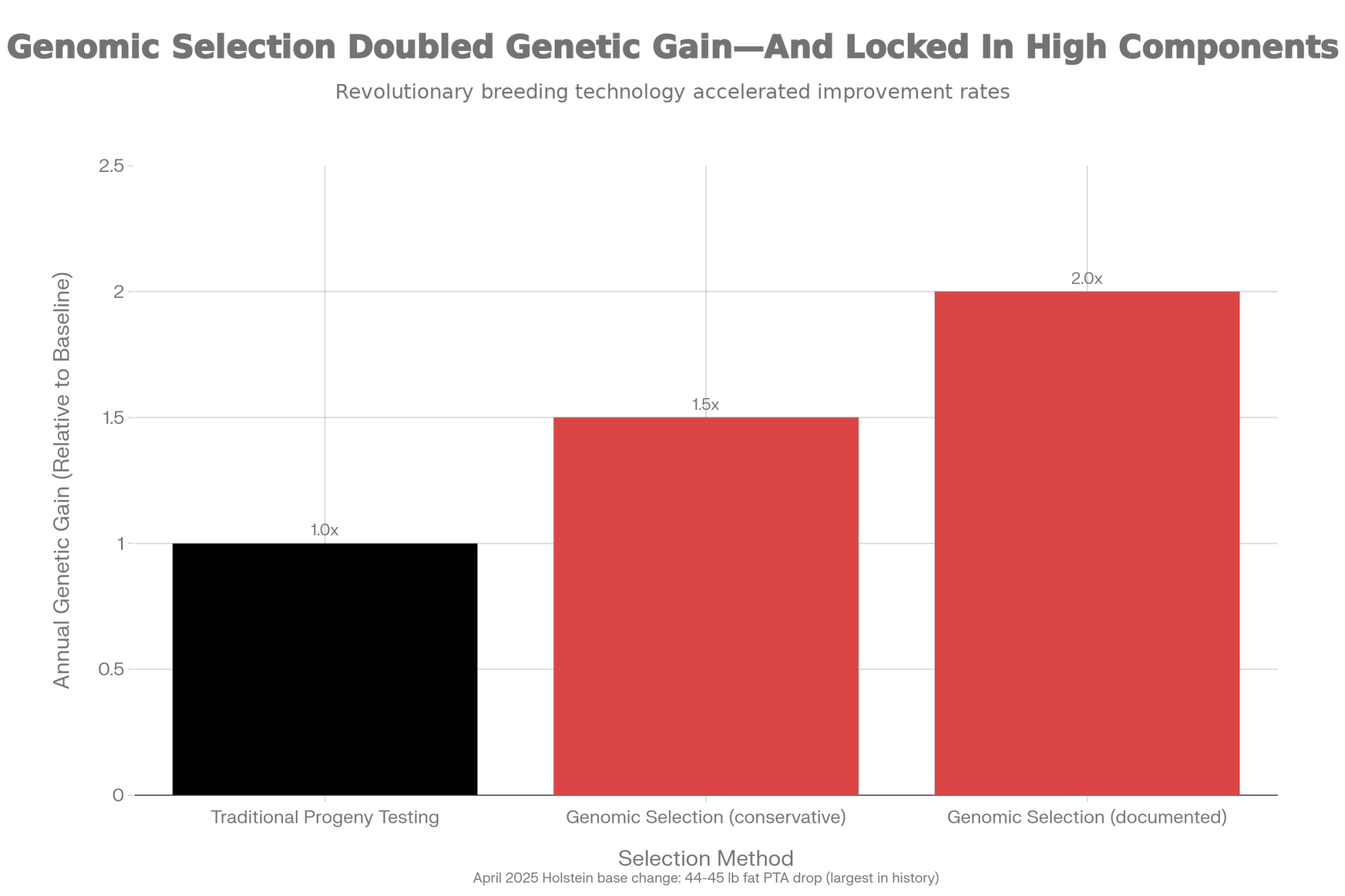
And the research backs this up. Peer-reviewed genetics papers published in journals such as Genetics, Selection Evolution, and PNAS have documented that genomic selection has increased genetic gain rates for production and component traits by 50% or more compared with traditional progeny-testing systems. Some studies show even larger gains—the Frontiers in Genetics review on U.S. dairy cattle genomic selection noted that the program has essentially doubled the rate of genetic gain.

The April 2025 Holstein base change really drove this home. According to documentation from NAAB and Select Sires, this was one of the largest base changes in history—resetting values to 2020-born cows with PTAs for fat dropping by about 44-45 pounds in the adjustment. That tells you just how much the genetic level has climbed. We covered the implications in our April 2025 US Holstein Evaluations analysis.

Here’s what that means in the parlor. A heifer you bred in 2021 or 2022 to a high-component genomic bull freshened in 2023 or 2024. Her daughters—already on the grow—will be milking through 2028–2030. So while you can start adjusting your sire lineup today—maybe shifting a bit more emphasis toward protein, feed efficiency, and health—you can’t un-breed the decisions from five years ago.

Land-grant university extension programs have been pretty clear in their 2024–2025 outlook discussions: the industry is genetically “pre-loaded” for high butterfat and strong solids for at least the next several years. The cows in the pipeline and the base-change data both point in that direction.

If current component and utilization trends continue, it’s hard to see a world in the late-2020s where butterfat returns to scarcity. Much more likely is a reality where high butterfat is the baseline, and the true differentiators are metabolic efficiency, health, and how closely your herd’s profile matches your plant’s needs.

Regional Pain Points: Same Storm, Different Boats

What farmers are finding is that the same national trends play out very differently depending on where you are and who you ship to.

Table 2. Regional Pain Points (2025–2026 Snapshot)

RegionPrimary Market StructureBiggest Margin Killer (2025)Est. Breakeven Range ($/cwt)Strategic Position
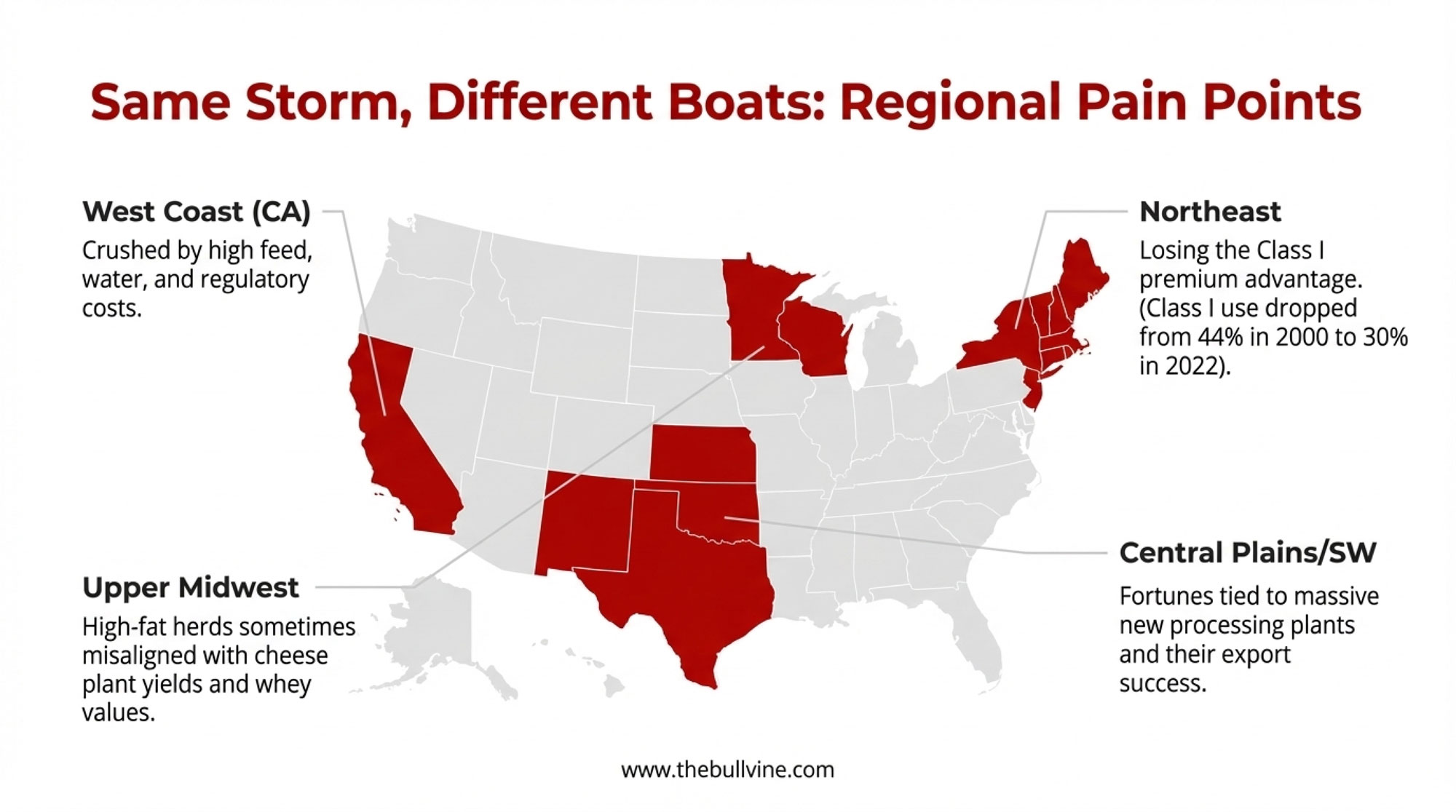
Northeast (FMMO 1)Fluid-to-manufacturing shiftLoss of Class I premiums (44% → 30% utilization)$21–$24High-cost structure meets manufacturing pricing; margin squeeze acute
California & West CoastMixed fluid/manufacturing/exportFeed + regulatory costs + co-op loss pass-throughs$20–$23Punishing input costs; basis often below U.S. average
Upper Midwest (WI/MI)Cheese-focused, high componentsComponent mismatch with some plants; 4.2%+ fat not always rewarded$17–$20Strong processing diversity, but not all plants optimize ultra-high butterfat
Central Plains / Southwest (TX/NM/KS)New cheese & ingredient plants, export-linkedProcessor-dependent; need consistent volume to justify $11B buildout$16–$19Best positioned if tied to new plants; vulnerable if outside draw areas

In the Northeast, FMMO 1 data and Cornell/Penn State extension work indicate that Class I (fluid) utilization has declined significantly. Analysis has documented that in the Northeast, Class I milk utilization fell from 44 percent in 2000 to 30 percent by 2022. That’s a dramatic shift, and it means more milk is being priced in manufacturing classes. Coverage of FMMO reform and Order 1 discussions has highlighted how that erodes the fluid premium that used to support many smaller and mid-size herds. Producers there are now being judged much more directly on components and the all-in cost structure.

In California and other Western states, the cost picture is especially tight. Feed, water, and regulatory burdens are already higher than in many other regions.

On top of that, reports have documented co-ops passing losses through to members during tough stretches, leaving some producers with net milk prices materially below the national all-milk price. Stack those together, and you have a very narrow margin for error.

In the Central Plains and Southwest, there’s been massive investment in new processing capacity. IDFA reported in October 2025 that more than $11 billion is flowing into 53 new or expanded dairy manufacturing facilities across 19 states, with Texas alone receiving about $1.5 billion. We examined these dynamics in our piece on the $11 billion wave of processor investments. Industry coverage has documented specific projects including Cacique Foods in Amarillo, Great Lakes Cheese in Abilene, H-E-B in San Antonio, and Leprino Foods in Lubbock. Many of those plants are designed around large freestall and drylot systems that supply consistent volume. Producers in those regions often report strong local demand and aggressive base allocations, even in weaker price windows, but they’re also tied tightly to the success of those new plants and their export programs.

In Wisconsin and other Upper Midwest states, statistics and extension data show a mix of strong production, high butterfat, and diversified processing: cheese, butter, whey, specialty products. But even there, when state and national butterfat levels pushed firmly into the 4.0+ range, not every product mix could reward unlimited fat—especially plants focused heavily on cheese yield and whey solids.

A Note for Canadian Producers: The specifics differ north of the border—quota systems buffer volume swings and provide different price dynamics. But the underlying component and cost pressures are real in Canada too, and conversations about efficiency, genetics, and processor fit are just as relevant. The genetic momentum we’re describing is continental, not just American, and many of the strategic questions around breeding emphasis and cost structure apply regardless of which side of the border you’re milking on.

So while the national numbers are the same for everyone, the pain points—and the opportunities—vary a lot by region and processor.

The Breakeven Trap: Where “Almost Okay” Eats Equity

Here’s the part that’s easy to overlook when you’re just trying to get through another month: the breakeven math.

Farm financial analysts, including those at American Farm Bureau and in land-grant university farm management programs, have flagged a significant uptick in Chapter 12 bankruptcies. Chapter 12 filings were up 56 percent in June 2025 compared to the prior year. Farm Policy News documented that family farm bankruptcies increased 55 percent in 2024 compared to 2023. And University of Arkansas Extension noted that Q1 2025 saw 88 Chapter 12 filings compared to just 45 in Q1 2024.

What’s striking is that these filings often don’t coincide with the absolute lowest milk prices we’ve ever seen—they show up after a few years of “thin but not terrible” margins. We explored this pattern in depth in our analysis of the 55% surge in strategic bankruptcies.

Our own “$200K Dairy Margin Trap” analysis here at The Bullvine walked through an example of how a relatively modest $1.25–$1.75/cwt squeeze between expected and actual margins can quietly drain $150,000–$200,000 a year out of a 500-cow operation. You don’t always feel that in any one month, but the balance sheet sure feels it in three to five years.

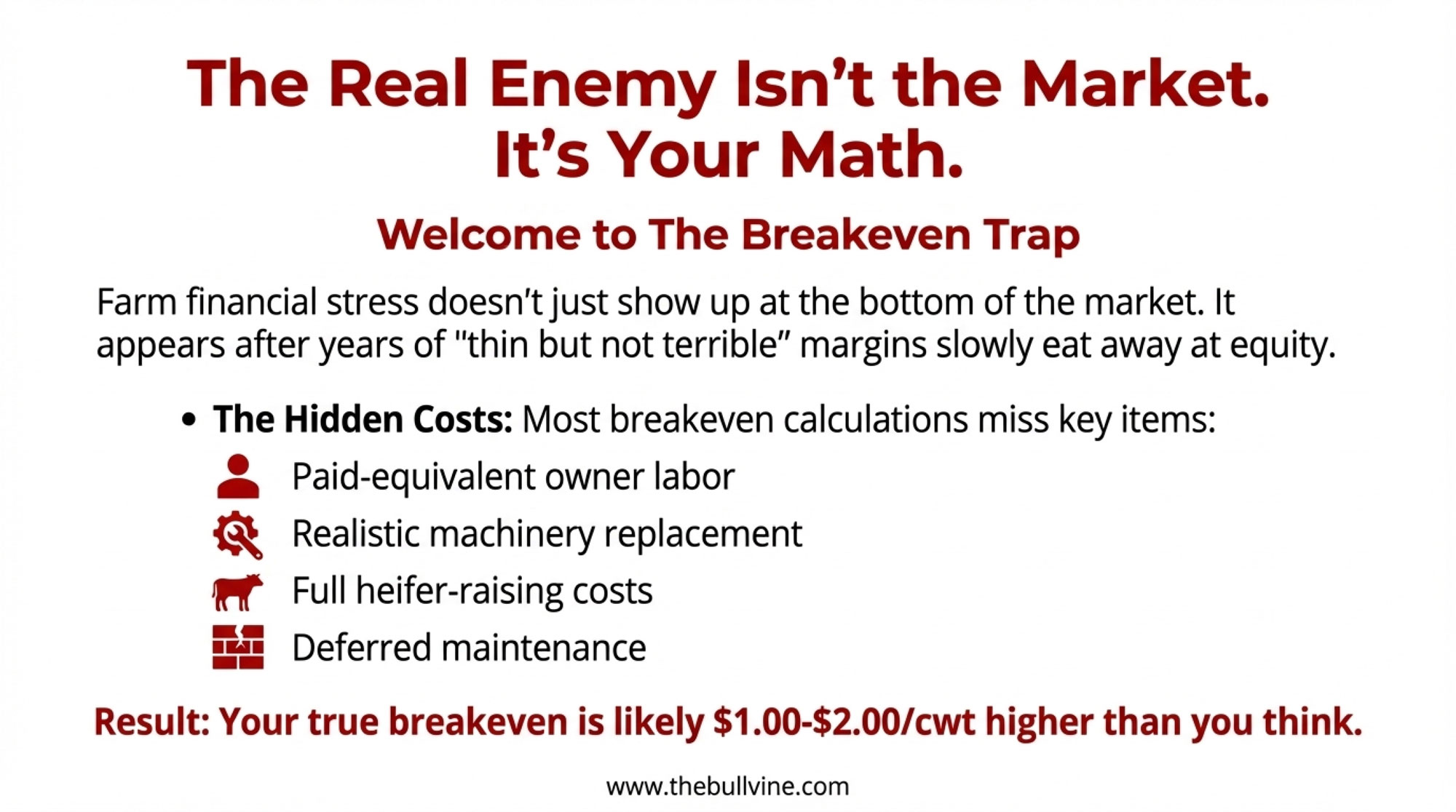
Extension bulletins from universities like Wisconsin and Penn State have stressed that many farms underestimate their true cost of production by omitting paid-equivalent owner labor, reasonable machinery replacement, heifer-raising costs, and deferred maintenance. When those are fully accounted for, breakeven often ends up $1–$2 per hundredweight higher than the “mental” number many producers are using.

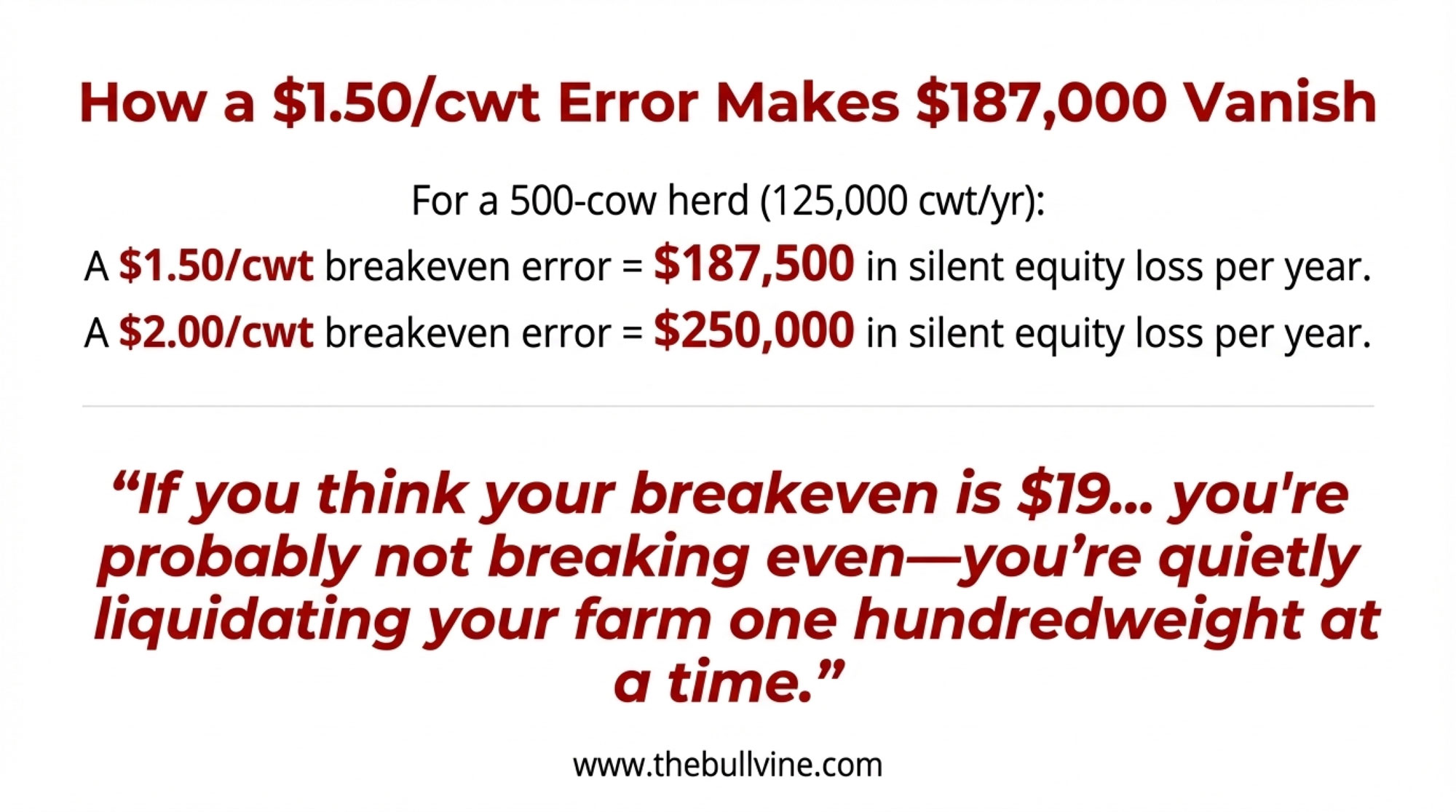
To put some real numbers on it: a 500-cow herd averaging about 25,000 pounds per cow per year ships roughly 12.5 million pounds—125,000 hundredweight. If your real breakeven is $1.50/cwt higher than you think, that’s around $187,500 a year in unrecognized loss. At $2.00/cwt, it’s roughly $250,000. On a 150-cow herd producing around 37,500 hundredweight, the same $1.50–$2.00 error still adds up to roughly $56,000–$75,000 per year—enough to decide whether you can replace a tractor or re-roof a barn.

“If you think your breakeven is $19 but you haven’t fully counted owner labor, capital replacement, heifer costs, and deferred maintenance, you’re probably not breaking even—you’re quietly liquidating your farm one hundredweight at a time.”

Across three lean years, that’s hundreds of thousands of dollars of equity quietly eroded. It’s no wonder some producers feel blindsided when the bank suddenly looks nervous; the erosion happened slowly, while everyone hoped “next year” would fix it.

That’s why you’re seeing more talk from lenders and extension teams about detailed cost tracking, FINBIN-style benchmarking, and honest breakeven exercises. The goal isn’t to beat anyone up; it’s to make sure the math behind the milk check is as clear as the test sheet for butterfat.

Rethinking “Winning” in a High-Component Era

So, what farmers are finding is that the definition of “winning” has shifted.

Most serious market outlooks—including USDA’s Livestock, Dairy, and Poultry Outlook, CoBank’s Knowledge Exchange dairy briefs, Farm Bureau’s dairy market overviews, and multiple land-grant university outlook meetings—converge on a similar picture: a high-component milk supply, robust processing capacity, strong but not unlimited export growth, and ongoing Class I decline. They don’t pretend to know the exact Class III price in 2027, but they do suggest the structural pressures we’re seeing now aren’t going away.

Against that backdrop, three themes keep emerging in industry coverage and in our analysis here at The Bullvine.

1. Genetics: From “More Fat” to “Smart Fat.”

Industry analysts have shown we can absolutely keep breaking component records with the tools we have. The question isn’t “Can we add more fat?” anymore; it’s “Is more fat the best use of the next unit of genetic progress on this farm, with this processor?”

Reviews on milk quality and economic sustainability in journals such as Animals, and systematic reviews on performance indicators, point to a growing emphasis on metrics such as feed efficiency, health, and fertility. These align with what extension geneticists say: we now have the genomic tools to select for cows that convert feed into milk solids more efficiently, stay healthier through the transition period, and last longer in the herd.

For herds shipping mainly to cheese plants with strong whey and lactose streams, it can make sense to lean a little harder into protein, casein, and efficiency traits, while maintaining solid butterfat performance. For plants more dependent on butter and cream, maintaining high butterfat is still logical—but even there, balancing it with health and feed efficiency can keep production sustainable.

2. Efficiency and Health: Durable Competitive Edge

Our margin analysis and university farm business summaries both highlight that in tight times, the herds that stay profitable are the ones that consistently produce higher income over feed cost per stall, not just more pounds per cow. We explored the feed cost dynamics in our recent piece on why smart dairies are spending more on feed.

Research on seasonal milk composition, transition cow health, and fresh cow management shows that better control of the transition period—reducing displaced abomasum, ketosis, retained placenta, and metritis—pays off in both milk components and lower vet bills. The National Mastitis Council’s “Best of the Best” roundtable and industry coverage of quality award winners show that herds with strong udder health and milking routines capture more premiums and generally have more stable production.

In practical terms, as many of us have seen and extension case studies generally support, herds that clean up transition management and tighten ration consistency often see substantial improvements in income over feed cost—sometimes more than a dollar per cow per day—without adding new technology. That’s the kind of advantage that holds up whether butter is $1.80 or $3.00.

3. Market Alignment: Matching Cows to Plants

Industry coverage and our market pieces here keeps coming back to one simple idea: the same hundredweight of milk can be worth very different amounts, depending on what your plant does with it.

Cheese plants with advanced whey and ingredient streams can usually capture more value from both protein and fat than butter-powder plants with no side-streams. Plants that sell a lot of branded consumer products may be less exposed to global commodity swings than plants that sell mostly unbranded bulk product. Co-ops that spent heavily on certain commodity investments have more riding on specific market segments.

In Wisconsin operations, for example, producers shipping to specialty cheese plants with strong whey programs often report different checks than neighbors shipping to a more traditional commodity mix, even with similar butterfat performance and protein levels. In Texas and Kansas, dairies tied to new cheese/ingredient plants have reported strong demand and competitive pricing, while those just outside certain draw areas don’t see the same benefits.

The farms that seem to be navigating this best aren’t always the biggest, but they usually have a clear grasp of three things:

  • How their buyer makes money
  • How their butterfat and protein profile fits that product mix
  • How their cost of production stacks up against the risk profile of that market

2026–2028: Checkpoints Instead of Crystal Balls

So, where does that leave you when you sit down with your family, your lender, or your advisory team?

Nobody can tell you exactly where prices will be in June 2027. But the combination of USDA data, component trends, USDEC/IDFA trade reports, CoBank outlook briefs, and farm financial analysis provides enough structure to use checkpoints rather than crystal balls.

2026: Get Honest and Get Oriented

  • Lock in a real breakeven. Work with a farm business specialist or your lender to build a fully loaded cost of production that includes owner labor, realistic machinery replacement, heifer raising, and deferred maintenance.
  • Map your buyer. Identify your processor’s main products—cheese, powder, butter, fluid, ingredients, branded retail—and how they price butterfat and protein. Ask them directly how your component profile helps or hurts their system.
  • Audit your herd plan. With your genetic advisor, review whether your current sire choices and culling strategy still make sense for where you expect your milk to go in 2029–2031, not just where it went in 2022.

2027: Test Your Plan Against Reality

  • Compare plan vs. actual. Take your 2026 plan and match it against your actual margins, cull rates, heifer inventory, and debt service. Did the quiet equity erosion show up despite your adjustments?
  • Reassess market fit. If your plant is clearly long on cream and struggling with butter, but you’re chasing ever-higher butterfat performance, it might be time to rebalance breeding goals and rations slightly toward protein, efficiency, and health.
  • Decide whether to fix or pivot. If you’re still below true breakeven after making reasonable operational changes, 2027 is the year to have honest conversations about restructuring, resizing, or exploring different income strategies before equity erosion gets out of hand.

2028: Choose Your Long-Term Role

If current genetic and utilization trends continue, by 2028, we’re likely still in a world of high component prices, strong processing capacity, and export markets that are vital but not omnipotent. At that point, it’s less about hoping for a return to “normal” and more about choosing who you want to be in this system.

  • Are you positioned as a lean, efficient, component-savvy herd aligned with a processor that can pay for what you produce?
  • Is your breeding program clearly set up for metabolic efficiency, health, and the component balance your market values, not the one it valued five years ago?
  • Does your balance sheet give you room to keep investing in fresh cow management, transition cow care, and facilities that support cow comfort, instead of just plugging leaks?

Those aren’t easy questions, but the sooner they’re asked, the more options you tend to have.

Editor’s Note on Data and Methods

The numbers in this article come primarily from USDA National Agricultural Statistics Service milk production and composition data; U.S. dairy statistics; USDEC/IDFA and Dairy Foods export summaries; Farm Bureau, Farm Policy News, and University of Arkansas Extension analysis of dairy financial stress and bankruptcy trends; CoBank Knowledge Exchange dairy briefs; IDFA manufacturing investment data; and The Bullvine’s own breakeven and margin modeling. Genetic trends and efficiency themes reflect published reviews on milk composition and economic sustainability in peer-reviewed journals, including Genetics, Selection, Evolution, PNAS, and Frontiers in Genetics, as well as NAAB/Select Sires base change documentation. These are national or regional averages and may not mirror your exact situation; that’s why we encourage you to run your own numbers and share your experience.

The Bottom Line

What’s interesting is how consistently the data and the on-farm stories line up when you step back. USDA analysis shows a steady march to higher butterfat; industry genetics coverage shows record components driven by genomics; USDEC, IDFA, and Farm Bureau show exports doing well but still capped around that 18-percent share; and farm financial analysis points to slow, quiet equity erosion when breakeven is misjudged.

What’s encouraging is that producers have more tools than ever—genomic testing, better transition period nutrition research, fresh cow management protocols, quality benchmarking, and robust financial tools—to respond thoughtfully rather than just react.

If current trends continue, the late-2020s likely won’t be about “getting back” to some old version of the milk check. They’re going to be about thriving in a world where high butterfat is common, where efficiency and health are as valuable as raw output, and where being matched to the right plant matters more than ever.

The 2025 downturn wasn’t a random fluke; it was a feature of a system that finally caught up to its own success in components and capacity. The big question going forward isn’t when the market will fix itself. It’s whether our cows, our costs, and our contracts are lined up with the market we actually have.

So let me leave you with the same question I’ve been asking in winter meetings:

Are you still breeding and budgeting for the 2022 milk check—or are you starting to design your herd and your business for the 2028 reality the data keeps pointing toward?

KEY TAKEAWAYS:

  • Record butterfat broke the margin math: 4.23% components and $8.2 billion in exports still left producers struggling—82% of milk clears domestically, and American fat demand has hard limits
  • $187,000 vanishes without warning: A 500-cow herd underestimating true breakeven by just $1.50/cwt bleeds that much equity every year—often invisibly, until the lender starts asking hard questions
  • Genetics locked this in through 2028: Genomic selection doubled the rate of component gain; the high-fat cows freshening now were bred years ago, and their replacements are already growing out
  • Same storm, very different boats: Northeast herds face eroding Class I premiums, California operations fight punishing cost structures, and Southwest dairies have bet heavily on new processing capacity
  • Decide by 2027 or drift into trouble: Lock in your real breakeven, understand what your processor actually pays for, and audit your breeding direction—the window for strategic repositioning shrinks every season

Complete references and supporting documentation are available upon request by contacting the editorial team at editor@thebullvine.com.

Learn More

The Sunday Read Dairy Professionals Don’t Skip.

Every week, thousands of producers, breeders, and industry insiders open Bullvine Weekly for genetics insights, market shifts, and profit strategies they won’t find anywhere else. One email. Five minutes. Smarter decisions all week.

NewsSubscribe
First
Last
Consent
Send this to a friend