Archive for butterfat performance

Protein Will Drive Your 2026 Milk Check: Are Your Components Still Built for the Butterfat Era?

Is your herd’s protein‑to‑fat ratio making your processor money—or quietly costing you on every 2026 milk check?

Executive Summary: Looking at 2026, what’s really moving the needle on dairy profitability isn’t just how many hundredweights you ship—it’s how much protein and butterfat are in each one. CoBank’s recent component analysis points out that U.S. herds excelled at boosting butterfat, but processors and cheese plants now need more protein, and that’s starting to change which components lead the milk check. USDA outlooks add another layer of pressure, with softer butter prices and tighter margins, meaning component value and processor fit will matter more than ever. This feature unpacks that “component economy” in plain language, explains why your herd’s protein‑to‑fat ratio matters to plant yield and standardization costs, and shows how nutrition, fresh cow management, and genetics can be tuned to support stronger protein without sacrificing fat. It also walks through how this plays out differently in Upper Midwest cheese country, Western dry lot systems, Northeast fluid markets, and under Canadian quota, so you can see your own reality in the numbers. By the end, you’ll have a clear set of questions to ask at your own kitchen table—about your milk check, your processor contracts, and your breeding and feeding strategy—so you can decide if you’re still built for the butterfat era or ready for protein to do more of the heavy lifting.

You know, after watching milk checks and component trends for a lot of years now, I’m more convinced than ever that we’re in one of those quiet turning points you only really see clearly in hindsight. In October 2025, USDA’s National Agricultural Statistics Service reported that the 24 major dairy states shipped about 18.7 billion pounds of milk, up 3.9% from the previous October, with total U.S. production up 3.7% year‑over‑year. That’s real growth on top of an already big base. What’s interesting here is that when you look under the hood, the story isn’t just about more milk—it’s about what’s in that milk, especially in terms of butterfat performance and protein yield. 

The herds that read this shift right are going to hang on to more dollars per cow in 2026. The ones that don’t may find money quietly slipping away, even if the tank looks full.

Looking at This Trend From the Plant Side

Looking at this trend from the plant side, you start to see a different layer of the story. A 2025 analysis from CoBank’s Knowledge Exchange group, led by Corey Geiger—lead dairy economist at CoBank—dug into how milk components have changed over the last decade. They found that butterfat levels in U.S. milk climbed about 13.1% over 10 years, while butterfat levels in the European Union and New Zealand rose only about 2.4–2.5%. Geiger’s team linked that jump to strong domestic demand for butter and full‑fat dairy products, plus component‑based pricing in many Federal Orders that paid generously for fat. Other market coverage has pointed out that U.S. cows are shipping more total fat and protein per hundredweight today than they did a decade ago, thanks to genetics and feeding. 

YearButterfat Growth (%)Protein Growth (%)Protein-to-Fat Ratio
20150.00.00.82
20173.51.20.81
20197.22.10.79
20219.83.00.78
202312.13.80.77
202513.13.90.77

On paper, that sounds great—and to be fair, it has been. Many Midwest producers will tell you there were years when butterfat premiums essentially “saved the year” on cheese‑market milk. But as butterfat kept rising, something else began to appear in the data. CoBank’s follow‑up commentary and articles in dairy media have begun asking whether the U.S. might actually have more butterfat than some processors really need, especially cheese plants that also depend heavily on protein to make both cheese and whey efficiently. 

If you look at late‑2025 market coverage, you see that tension showing up in prices. News outlets reported butter falling sharply from the record territory seen in 2022, with analysts warning that lower butter values and larger supplies were helping pull down milk prices and setting up weaker milk checks moving into 2026 as production stayed strong. USDA’s own outlook work around the same time projected continued growth in milk production and lower average butter, cheese, and all‑milk prices compared with those earlier highs. 

Now, here’s where components and ratios come into play. Cheesemaking research and USDA work on predicting cheese yield have shown for years that cheese and whey yields are highly sensitive to the balance of protein and fat in the vat. Plants can standardize milk, of course, but they run most efficiently when the incoming milk is already in a workable range. Industry guidance and component tables suggest that, for many common U.S. cheeses, milk somewhere just over 3% true protein and in the upper‑3s to around 4% butterfat—often yielding a protein‑to‑fat ratio near 0.80—makes life a lot easier in the plant. 

It’s worth noting that this isn’t about chasing a single magic target to two decimal places. What CoBank’s report points out is the trend: for much of the 2000s and early 2010s, the U.S. protein‑to‑fat ratio hovered around 0.82–0.84, then drifted down toward roughly 0.77 as butterfat grew faster than protein. When that ratio drops, cheesemakers are forced to do more standardizing—adding protein or skimming off fat—to hit the composition they need. That extra work is routine, but it isn’t free. 

In an article on “reading the signs” from milk components, Mike Hutjens—Emeritus Professor of Animal Sciences at the University of Illinois—suggests using the protein‑to‑fat ratio as a simple “dashboard light.” He notes that when herd averages sit below about 0.75, cows are often “missing milk protein,” and when they’re above about 0.90, milkfat may be depressed. That rule of thumb aligns with what cheesemakers and plant managers have been telling CoBank and others: they don’t just want high butterfat levels; they want balanced components that fit their vats and product mix. 

Herd Size (cows)Protein-to-Fat RatioHerd TypeRegion
800.88Tie-stallNortheast
1250.85OrganicNortheast
1500.76FreestallWisconsin
2200.82OrganicMidwest
3000.78FreestallWisconsin
4000.81FreestallCalifornia
7000.74DrylotCalifornia
12000.79FreestallMidwest
20000.75DrylotCalifornia

So the big takeaway from the plant side is this: butterfat is still valuable, but now that we’ve pushed fat so hard, protein is starting to carry more weight in cheese and ingredient markets. And more plants are watching that protein‑to‑fat ratio than a lot of farms realize.

Looking at This Trend in Consumer Behavior and GLP‑1

You’ve probably heard plenty of noise about GLP‑1 medications like Ozempic and Wegovy and what they might do to food demand. Some general media stories make it sound like these drugs are going to hollow out the whole snack aisle and maybe dairy with it. When you dig into the food‑industry analysis that actually looks at what these consumers buy, the picture is more measured.

Analysts following GLP‑1 users’ eating habits report that, as use of these medications grows, many people do change how they eat: they generally cut overall calories, but they also tend to gravitate toward foods that deliver more protein and nutrition per bite. Several large food and dairy companies, in their own product briefings and category outlooks, have pointed to high‑protein Greek yogurts, strained yogurt drinks, cottage cheese, and cheese‑based snacks as growth areas for health‑conscious consumers. A theme that keeps coming up is grams of protein per serving and satiety in a smaller portion. 

For plants making concentrated or high‑protein dairy products, that puts a premium on milk that brings strong protein content right through the door. Filtration and concentration technology can boost solids, but starting with milk that already has good protein levels makes the whole system more efficient. So instead of seeing GLP‑1 as “anti‑dairy,” it’s probably more accurate to say it nudges part of the market further toward higher‑protein, nutrient‑dense dairy products—a direction that was already building. 

The Bigger Protein Story That’s Been Building for Years

Stepping back from GLP‑1 for a moment, the bigger story is that consumers have been chasing protein for quite a while. Surveys from the International Food Information Council over the last several years, including a 2025 spotlight on protein, have found that roughly seven in ten Americans say they’re actively trying to increase their protein intake. Trade coverage summarizes this as a kind of “protein obsession”—you’ve likely noticed how often “high protein” shows up on packaging now, from snack bars to coffee creamers. 

Dairy naturally sits in the middle of that trend. Peer‑reviewed nutrition research has repeatedly described dairy proteins as high‑quality, with complete amino acid profiles and good digestibility. Phillip Tong, Professor Emeritus of Dairy Science at California Polytechnic State University and former director of the Dairy Products Technology Center, has emphasized in his work that milk proteins provide not just nutrition but also functional properties—gelling, foaming, water‑binding, emulsifying—that make them valuable to food manufacturers. Those properties are a big reason why whey protein concentrates, isolates, and milk protein ingredients have grown steadily in sports nutrition, medical nutrition, products for older adults, and a whole list of “better‑for‑you” foods. 

So when you line these things up—consumer protein interest, functional advantages of milk protein, and CoBank’s finding that butterfat has outpaced protein growth and pulled the national protein‑to‑fat ratio downward—the pattern is pretty clear. We’re not just living in a “butterfat era” anymore. We’re operating in a component economy where protein is moving closer to center stage, especially in processing‑heavy, cheese‑oriented regions. 

What Farmers Are Finding at the Feed Bunk

All right, enough big‑picture talk. Let’s bring this back to decisions you can make at the feed bunk and in fresh cow management.

Land‑grant university nutrition work—from Nebraska, Illinois, and others—has reinforced for years that butterfat and protein both respond to the basics: forage quality and chop length, effective fiber, starch fermentability, physically effective NDF, and overall energy balance. They also stress that the transition period and early fresh cow management are critical. Poor intakes, subclinical ketosis, and cow comfort problems in the first weeks after calving often manifest later in milk volume and components. 

You probably know this from your own records: when energy gets tight, or rumen health slides, protein is often the first to sag while fat hangs on a bit longer. That’s a signal.

Over the last decade, a lot of herds leaned on palmitic‑rich rumen‑protected fat supplements to push butterfat performance. Research and field experience have shown that, in well‑balanced rations with healthy rumens, these products can bump milkfat percentage and, in some cases, fat yield. Combined with genetics and management, that helped drive regional butterfat averages upward. Some herds in the Upper Midwest increased their components toward 7 pounds of fat and protein per cow per day by focusing on both nutrition and genetics. 

ScenarioComponentAnnual Cost/ValueResult
2022 Butter PeakSupplement Cost-$54,000Baseline
2022 Butter PeakButterfat Value @ $2.20/lb+$43,362Net: +$10,638
2026 OutlookSupplement Cost-$54,000Baseline
2026 OutlookButterfat Value @ $1.35/lb+$26,608Net: –$27,392
Protein-Focused AlternativeNutrition + Genomics Cost-$30,000Baseline
Protein-Focused AlternativeProtein Value @ $1.80/lb+$31,200Net: +$1,200

But as butter prices have come off their highs and more processors are paying attention to protein, it’s worth sharpening the pencil on those investments. The exact cost per cow per day and the exact response in butterfat for any one product will depend on your ration and conditions. Rather than relying on a canned example, the best move is to sit down with your own numbers:

  • What are you actually paying per cow per day for any fat supplement?
  • What change in butterfat test and fat pounds shipped have you documented when using it versus not using it?
  • What’s your current value per pound of butterfat on your milk check?

If, after that exercise, the extra butterfat dollars comfortably outrun the cost—and you’re not harming rumen health or protein—then that tool may still have a solid place in the ration. If the margin has narrowed or turned negative under today’s component prices, it might be time to consider shifting some of that budget into strategies that help both protein and overall efficiency, like higher‑quality forages, more precise starch and fiber balance, or amino acid balancing.

On the protein side, extension and research consistently highlight a few themes in diets that support higher true protein:

  • Forages harvested at the right stage and moisture, with consistent quality across the year.
  • A solid balance of rumen‑degradable and rumen‑undegradable protein, so microbes and the cow both get what they need.
  • Enough fermentable starch to fuel microbial protein production without driving subacute ruminal acidosis.
  • Targeted methionine and lysine supplementation when diets are limited in those key amino acids.
  • Strong transition and fresh cow programs that keep intakes up and cows out of deep negative energy balance. 

Hutjens’ component “dashboard” fits nicely with this. When the protein‑to‑fat ratio averages below about 0.75 across a herd, there’s usually room to improve protein yield. When the ratio climbs above about 0.90, milkfat may be compromised. That gives you a simple, herd‑level way to keep an eye on how well your feeding program, fresh cow management, and genetics are working together. 

So here’s a practical check that’s worth doing: pull your last 12 months of test results and calculate the average protein‑to‑fat ratio. If most of your milk goes to cheese and that ratio is consistently down in the low‑to‑mid 0.70s, it’s probably time to sit down with your nutritionist—and maybe your plant field rep—and ask whether your feeding program and your plant’s needs are still aligned. 

Genetics: The Quiet Lever Behind Tomorrow’s Components

Once you’ve taken a hard look at the feed bunk, the next quiet lever is genetics.

Genetic evaluations in Holsteins and Jerseys show that fat and protein yields are positively correlated—selecting for more milk and better components generally moves both traits upward, though not always at the same rate. Economic indexes like Net Merit (NM$) put explicit economic weights on fat and protein, and USDA’s 2021 revision documented changes to those values based on updated milk and component prices. For much of the last decade, strong butterfat pricing helped push index emphasis toward fat, and that made sense in the markets at the time. 

As plants and markets begin to value protein more heavily—particularly in cheese, whey, and protein ingredients—that weighting becomes worth a second look. Some recent commentary and genetic updates have already noted that bulls with strong protein proofs and overall solids are climbing in rankings as the economics shift. 

Genomic testing has made it much more practical for commercial herds to act on this. Many herds now test heifers genomically, at costs typically ranging from the mid‑teens to around $50 per head, depending on the panel and country, and use those results to:

  • Rank replacement heifers by projected lifetime profit, including fat and protein yields.
  • Identify families that consistently underperform on components.
  • Tune sire selection so that the component profile—fat and protein percentages and pounds—matches where their milk actually goes. 

Breed mix also plays a role. Typical Holstein herd averages often sit around 3.7% butterfat and just over 3.1% true protein, giving a protein‑to‑fat ratio in the mid‑0.80s. Jerseys commonly run up in the high‑4s for fat and around 3.8% protein, with a ratio just under 0.80. Crossbred herds land in between, depending on the breeds and selection emphasis. None of these profiles is “right” or “wrong” on its own. The key is whether your genetics give you a component profile that fits your market. 

What I’ve noticed, looking at sire lists in a lot of herds, is that there’s still a tendency to default to a single index number and only later ask, “Does this bull actually fit my processor’s needs?” In a world where cheese plants and ingredient makers are increasingly vocal about wanting more protein to catch up with butterfat, it’s worth pulling out those proofs and asking a slightly different question: “Is my sire selection moving my herd toward a better protein‑to‑fat balance for where my milk is going?”

RegionPrimary MarketIdeal ButterfatIdeal True ProteinTarget P:F RatioPayment Emphasis
Upper Midwest (WI, MN, MI)Cheddar, mozzarella, whey concentrate3.8–4.0%3.2–3.4%0.80–0.85Ratio-sensitive; protein gaining
Western States (CA, ID, NV)Mixed (cheese, powder, fluid, ingredients)3.6–3.9%3.0–3.2%0.77–0.82Volume + flexibility; less ratio-rigid
Northeast & Atlantic CanadaFluid, yogurt, regional cheese, specialty3.4–3.7%3.1–3.3%0.85–0.95Quality premium + components vary
Canadian Quota MarketsButter, cheese, powder (supply-managed)3.9–4.1%3.1–3.3%0.78–0.82Factors adjusted annually; quota limits output
Organic ProcessorsPremium fluid, specialty cheese, yogurt3.5–3.8%3.0–3.2%0.80–0.88Organic premium overshadows fine diffs

Regional Realities: One Trend, Many Local Versions

As many of us have seen, these trends don’t play out exactly the same way everywhere, and it’s important to respect that.

In Wisconsin and other Upper Midwest cheese states, the fit between components and plant needs is front and center. A large share of the milk in these regions is used to make Cheddar, mozzarella, and other cheeses, thanks to modern whey recovery systems. CoBank and regional market coverage have emphasized that cheesemakers there are especially sensitive to the protein‑to‑fat ratio and total solids because both cheese and whey yields depend heavily on those numbers. Education pieces walking through new pricing rules have shown examples where herds with modestly lower fat but stronger protein outperform very high‑fat, low‑protein herds at the same cheese plant, purely on yield and component value. That’s the kind of quiet math that makes protein more than just a “nice to have” in those markets. 

In Western states like California, the picture gets more layered. Many herds are large, often in dry lot systems, and ship into a mix of cheese, powders, fluid milk, and value‑added products. At the same time, they’re operating under high feed costs, water limitations, and some of the toughest environmental regulations in the business. Market analysis and sustainability work from that region make it clear that components still matter, but they’re just one lever among many—alongside stocking density, water use, regulatory risk, and plant capacity. 

In the Northeast and across Atlantic Canada, much of the milk ends up in fluid markets, regional brands, yogurt plants, and specialty cheeses. Some cooperatives and proprietary processors in these areas have moved more aggressively toward component‑based payments, including protein, while others still lean heavily on volume and quality premiums. In Canada, national supply management and quota limit total output, but planning documents from the Canadian Dairy Commission emphasize the need to manage components to meet butter and cheese requirements; component allowances and factors are adjusted accordingly. 

Organic herds see yet another twist. Many have a base premium for organic milk that can overshadow fine‑grained component differentials, but processors and organic brand programs still pay attention to components because they affect product yield and cost. Some organic buyers include composition and quality benchmarks as part of their sourcing criteria, even if the pay formula is simpler. 

So while the big pattern says protein is gaining importance, the way it shows up in your milk can be quite different in Wisconsin, California, New York, or Ontario. That’s why those local conversations with your nutritionist, field rep, and lender matter just as much as the national reports.

What the Outlook for 2026 Is Really Saying

When you bring together USDA’s outlooks, CoBank’s component analysis shared that the picture for 2026 is pretty consistent: it’s likely to be another tight‑margin year for many dairies. USDA projections anticipate continued growth in milk production, driven mainly by higher milk per cow, while average prices for butter, cheese, and the all‑milk price are expected to stay below the highs we saw a few years ago. Analysts have already noted that rising supply and strong component levels are weighing on prices, and that “weaker milk checks” are a real possibility if production doesn’t moderate. 

At the same time, more and more people in the industry are using that “component economy” language to describe where we are. Fat and protein are being priced, managed, and in some cases hedged more independently. New or revised pay formulas are paying closer attention to how each component contributes to product yield and plant margins. 

For your farm, the message is pretty straightforward: when base prices soften, the share of your milk check that comes from components, quality, and program premiums becomes more important. If protein is gradually gaining ground in your pay structure and your herd’s protein‑to‑fat ratio is drifting in the wrong direction, you can end up working just as hard for a less competitive milk check.

YearBase MilkButterfat PremiumProtein PremiumQuality/OtherTotal
202218.503.421.860.9224.70
202418.202.642.070.8923.80
2026E17.902.102.420.8823.30

Practical Questions to Ask at Your Own Kitchen Table

So, with all that in mind, if we were sitting together at your kitchen table with a stack of milk checks and test reports between us, here are the questions I’d want to walk through:

  • Over the past 12 months, what’s your average protein‑to‑fat ratio—not just on one test, but across the year? Are you closer to 0.72, 0.78, or 0.85? How does that compare to the 0.75–0.90 “healthy range” Hutjens and others talk about? 
  • Looking at your milk checks, how many dollars per hundredweight in the last year came from butterfat, and how many from protein? Has that mix shifted as butter prices eased and protein held or strengthened?
  • When was the last time you asked your processor or cooperative, “If you could design the ideal butterfat and protein tests for your plant today, what would they be—and how would you pay for that?” Some plants and contracts are quietly adjusting to encourage the component balance they need. 
  • Are you still spending money on fat supplements mostly to chase higher butterfat levels, and have you re‑run that ROI using your current butterfat value, actual response in your herd, and today’s feed costs?
  • Are you using genomic testing—or at least looking closely at sire proofs—to nudge your herd toward a component profile that matches where your milk actually ends up: cheese, yogurt, fluid, or export ingredients? Are protein traits getting the weight they deserve on your bull list? 
  • When you look at your top sires, how many are genuinely strong on protein, not just fat and total yield?

The answers will look different for a 120‑cow tie‑stall herd in the Northeast, a 400‑cow freestall in Wisconsin, a 2,500‑cow dry lot in California, or a quota‑managed herd in Ontario. And that’s okay. The goal isn’t to chase every trend or copy the neighbor. It’s to be intentional about which trends actually matter to your milk check and which don’t.

A Balanced Way to Look at the Future

When you line up the current numbers—from USDA’s production and price outlooks, from CoBank’s component growth analysis, from IFIC’s consumer protein surveys, and from cheesemaking research and extension work—the pattern is pretty clear: protein is becoming a bigger part of how milk is valued, especially in cheese and ingredient markets. That doesn’t mean butterfat suddenly stops mattering. Butter, cream, and full‑fat dairy products still resonate with consumers, and strong butterfat performance will remain a point of pride on many farms. 

What’s encouraging is that a lot of the practices that help protein also help build durable, resilient dairies in general: good forages, thoughtful starch and fiber balance, strong fresh cow and transition management, attention to cow comfort, and smart use of genetics and genomics. You’re not being asked to tear your operation down to the studs. You’re being invited to fine‑tune a few dials based on where the money seems to be heading instead of where it used to be. 

For some herds, that might mean easing off an “all‑in on fat” mindset and giving protein a bit more focus in both rations and sire selection. For others, especially those already shipping to plants that pay well for protein and running healthy protein‑to‑fat ratios, it might simply confirm that the path you’re on lines up well with your market.

Either way, as you look ahead to the next few seasons, it’s probably worth pouring another coffee, spreading out those milk checks and test reports, and asking yourself a simple question: Is your herd set up for the protein pivot that’s shaping 2026 milk checks—or mainly for the butterfat boom we were cashing in a few years ago?

Key Takeaways:

  • Butterfat won the decade—protein didn’t keep pace: U.S. fat jumped ~13% in ten years while protein lagged, pulling the national ratio from ~0.82 to ~0.77. Cheese plants are pushing back.
  • Your plant needs balance, not just fat: Cheese and whey yields hinge on a ~0.80 protein-to-fat ratio. Fat-heavy milk means extra standardization—and that cost comes back to you.
  • Protein is about to do more heavy lifting on your milk check: Butter prices are off their highs, USDA sees tighter 2026 margins, and component formulas are shifting toward protein.
  • Know your number and act on it: Pull your 12-month protein-to-fat ratio. Below 0.75? Protein opportunity. Above 0.90? Possible fat depression. Tune rations, transition protocols, and your bull lineup.
  • One trend, many local versions: Upper Midwest cheese plants are ratio-obsessed; Western herds weigh components against water and regulations; Canadian quota adjusts factors to hit national targets.

Complete references and supporting documentation are available upon request by contacting the editorial team at editor@thebullvine.com.

Learn More

The Sunday Read Dairy Professionals Don’t Skip.

Every week, thousands of producers, breeders, and industry insiders open Bullvine Weekly for genetics insights, market shifts, and profit strategies they won’t find anywhere else. One email. Five minutes. Smarter decisions all week.

NewsSubscribe
First
Last
Consent

39% of U.S. Dairies Are Gone: Big-Herd Reality and the 3 Survival Lanes That Still Protect Your Margin

39% of U.S. dairies gone in 5 years. Milk production? Still up. The survivors picked a lane. Have you?

Executive Summary: Over the last census period, nearly 40% of U.S. dairies with milk sales disappeared, even as national cow numbers and total milk production held steady – a clear sign that milk has consolidated into fewer, larger herds. The numbers now show that roughly 2,000 farms milking 1,000 cows or more produce close to two‑thirds of U.S. milk and often enjoy cost advantages of up to about $10/cwt over 100‑ to 199‑cow herds, while many smaller herds stay profitable by squeezing more milk solids, labour efficiency, and cow longevity out of every stall. Against that backdrop, the article lays out three realistic “survival lanes” – scale with discipline, an efficiency sweet spot for 150‑ to 800‑cow herds, and niche/value‑added models – and illustrates each with concrete examples from a New York tie‑stall, a Wisconsin freestall, and a New Mexico dry lot. It then dives into genetics and technology as profit levers, showing how DWP$‑driven selection can add $1,000–$1,500 lifetime income over feed cost per top‑quartile cow, and how AMS, collars, sort gates, and feed pushers can either strengthen or weaken margins depending on milk lift, labour changes, and interest costs. Labour and sustainability pressures are treated as hard economics rather than buzzwords, tying turnover, welfare metrics, and Net Zero goals back to cost per cwt and processor relationships. The piece finishes with five direct questions owners can use at the kitchen table to decide which lane they’re really in, which investments to prioritize, and where “doing nothing” might actually be the riskiest move of all.

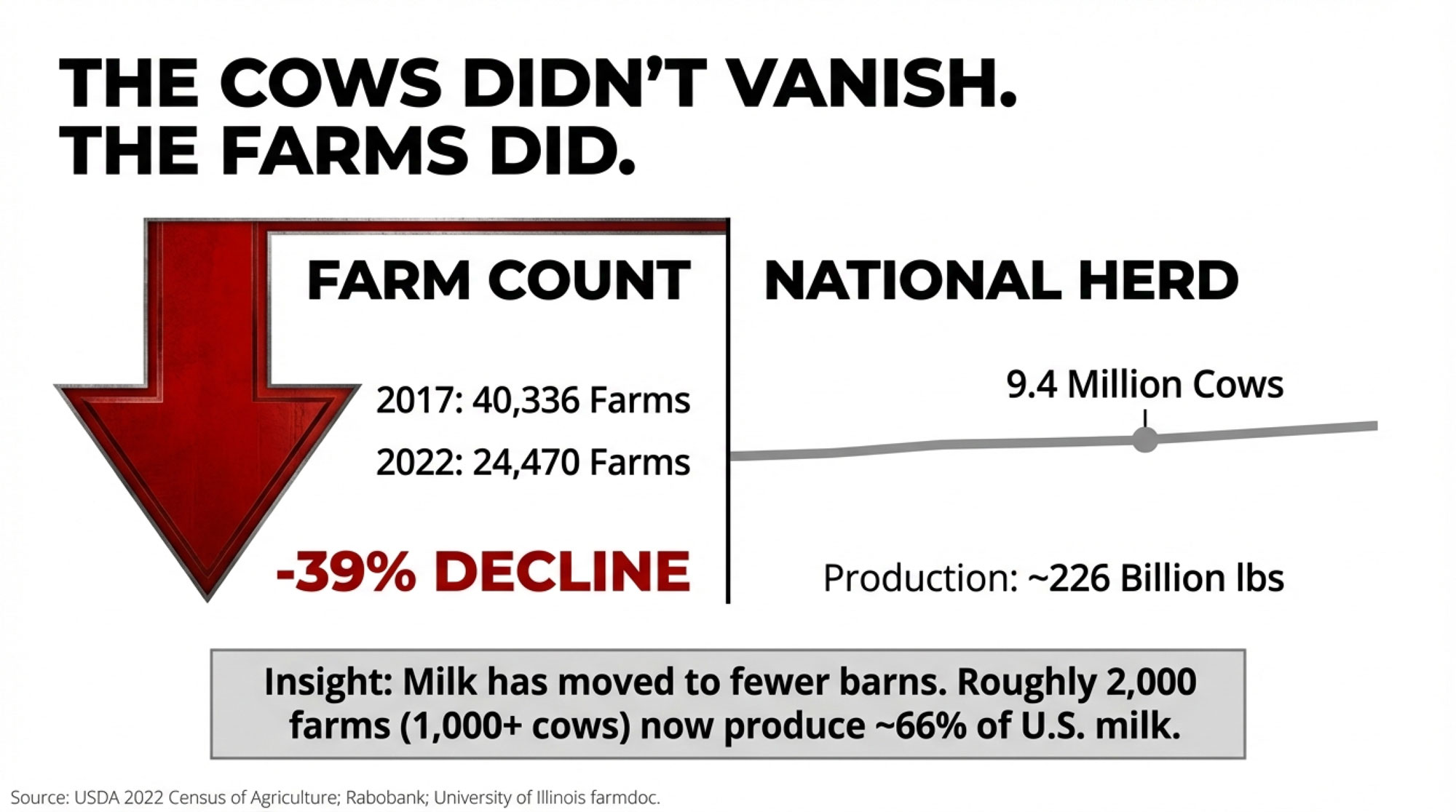
You know, in the time it took you to raise your current group of two‑year‑olds, almost four out of ten U.S. dairy farms disappeared. That’s not just coffee‑shop talk. USDA’s 2022 Census of Agriculture shows that farms with sales of milk from cows dropped from 40,336 in 2017 to 24,470 in 2022 – a 39% decline – while the national milking herd stayed close to 9.4 million cows and total milk production held in the mid‑220‑billion‑pound range in USDA and industry summaries. 

So the cows didn’t vanish. The milk didn’t vanish. It just moved to fewer barns.

Metric20172022% Change
Dairy Farms (000s)40.324.5−39%
Milking Cows (millions)9.49.40%
Milk Production (bn lbs)215220+2.3%

Looking at this trend, farmers are finding that the industry’s structure has quietly shifted under their feet. USDA economists, Rabobank analysts, and a detailed 2024 review from the University of Illinois farmdoc team all point out that a relatively small group of large herds – those with 1,000 cows or more – now produce roughly two‑thirds of U.S. milk by value.  That farmdoc piece breaks it down very clearly: only about 2,013 farms in the 1,000‑plus‑cow category accounted for around 66% of U.S. milk sales in 2022.  Dairy industry coverage of the same data has gone further, noting that roughly 65% of the nation’s dairy cows now live on farms with 1,000 cows or more. 

Herd SizeFarm Count% of Farms% of MilkVisualization
1,000+ cows2,013~8.2%66%Large, red-bordered segment
500–999 cows~1,800~7.4%~18%Medium grey segment
250–499 cows~3,500~14.3%~10%Smaller segment
50–249 cows~16,000~65%~6%Remaining sliver

Here’s what’s interesting: while farm numbers are falling, consumer demand for dairy hasn’t collapsed. USDA per‑capita use data, summarized by industry outlets, show Americans now drink roughly 120‑plus pounds of fluid milk per person per year – that part’s been sliding for decades – but cheese consumption has climbed into the low‑40‑pound range per person, and butter use has pushed above six pounds per person, around modern‑era record levels.  People haven’t walked away from dairy; they’ve just walked over to cheese, butter, and ingredients. 

When you dig into profitability work from groups like the Kansas Farm Management Association and international dairy efficiency studies, a pattern pops out. High‑profit and low‑profit herds in the same region often receive very similar milk prices. The spread shows up in feed efficiency, butterfat performance, labour cost per hundredweight, fresh cow management in the transition period, and how effectively barns, parlours, robots, and people are actually used. 

And over the last couple of years, with interest rates higher and feed and fertilizer bouncing around, those efficiency gaps have hurt. Coverage in 2023–2024 margins has highlighted how many herds – especially in higher‑cost western regions – have seen their total cost per cwt push toward or above the milk price, with some large western herds facing total costs in the $20–$21/cwt band while milk prices weren’t far above that.  The room for error has gotten pretty thin. 

Taken together, this development suggests something many of us already feel: the system today rewards margin per cwt and solids, not just volume, and certainly not just the fact that we’re milking cows.

That’s where this idea of “survival lanes” actually helps make sense of things.

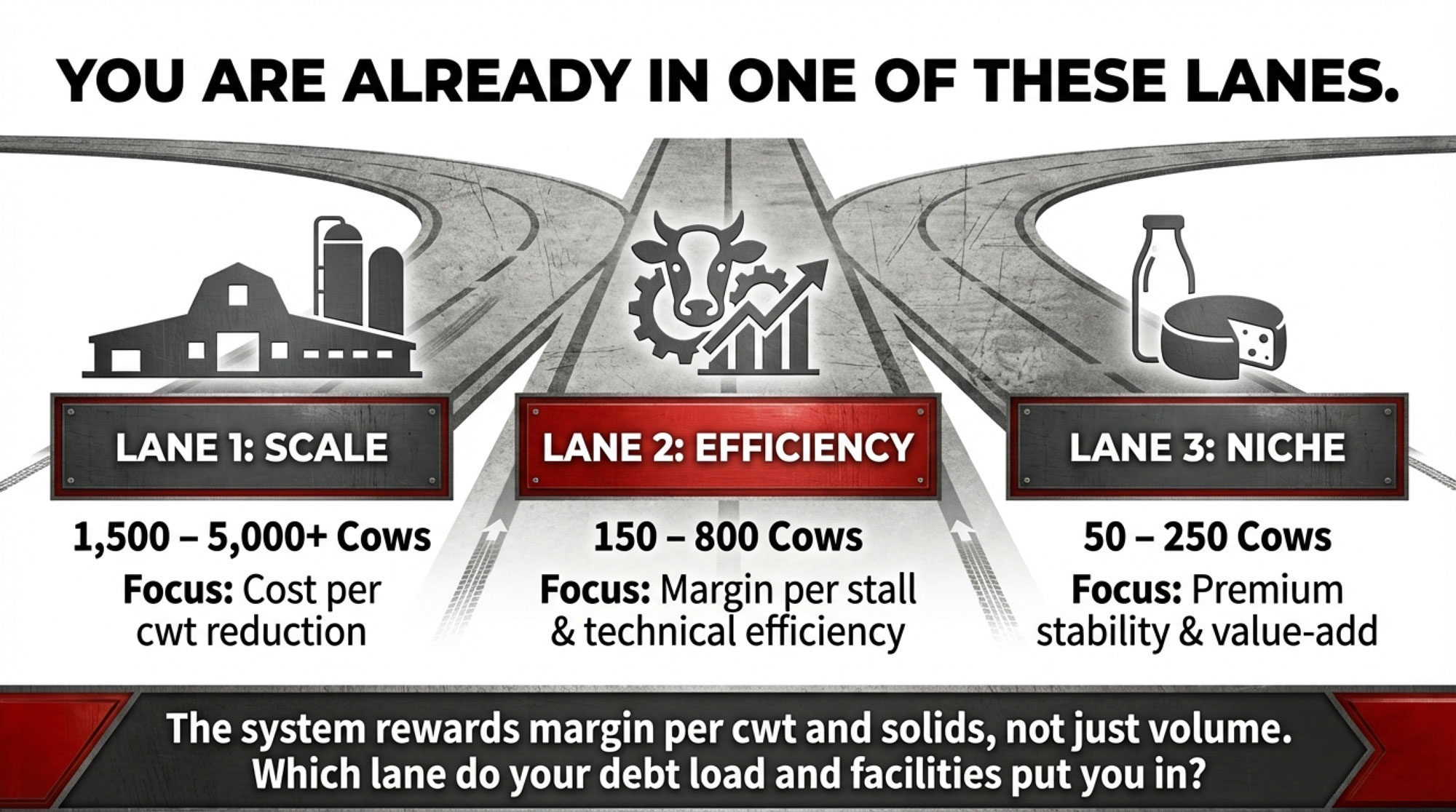
Looking at This Trend: Three Survival Lanes Most Farms Are Already In

What I’ve found, looking at the Census numbers, USDA reports, Rabobank, and farmdoc analysis – and honestly, just talking with producers from California to New York – is that most viable dairies today are already drifting into one of three lanes:

  • Lane 1: Scale with discipline – big herds, high throughput, a relentless cost‑per‑cwt focus.
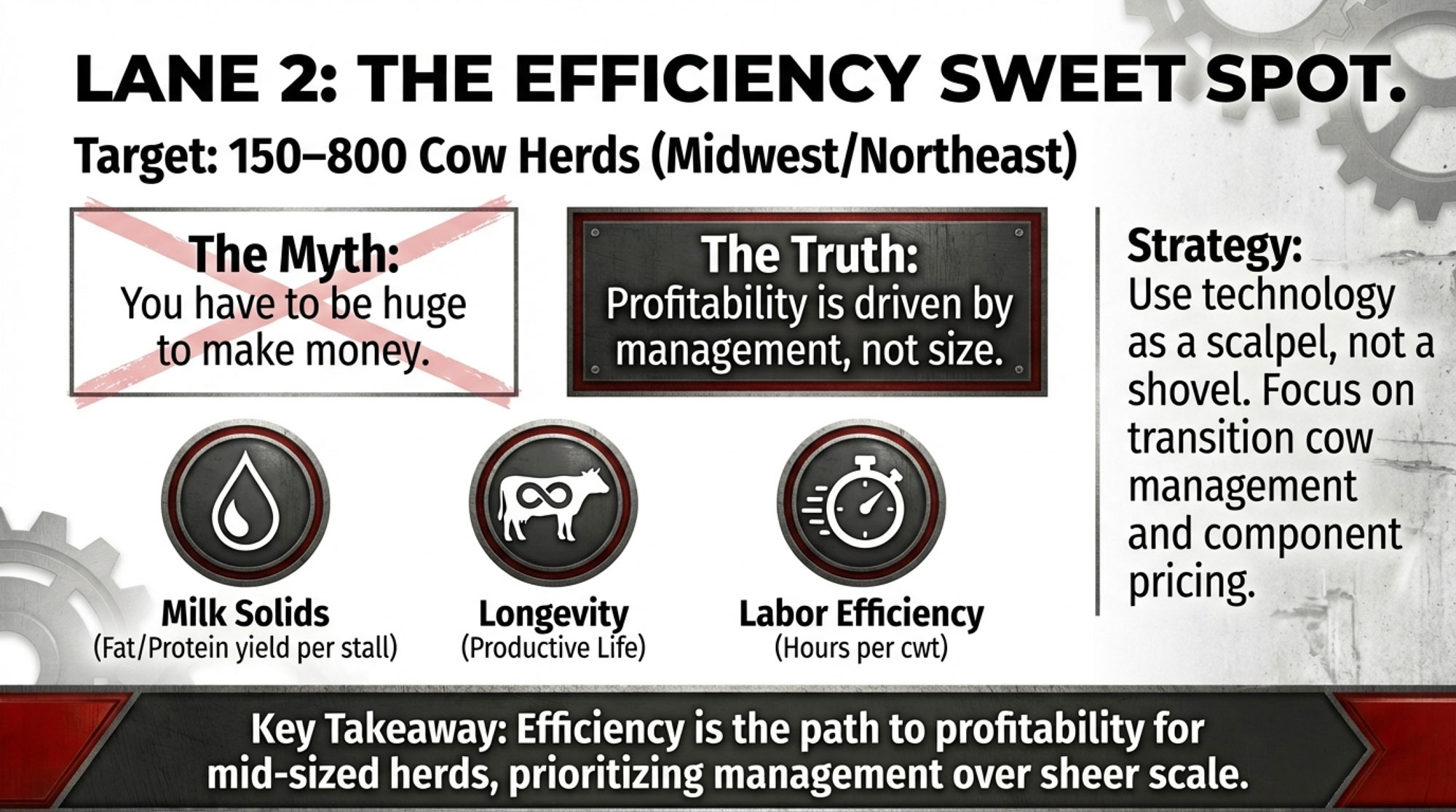
  • Lane 2: The efficiency sweet spot – mid‑size herds, sharp management, targeted tech.
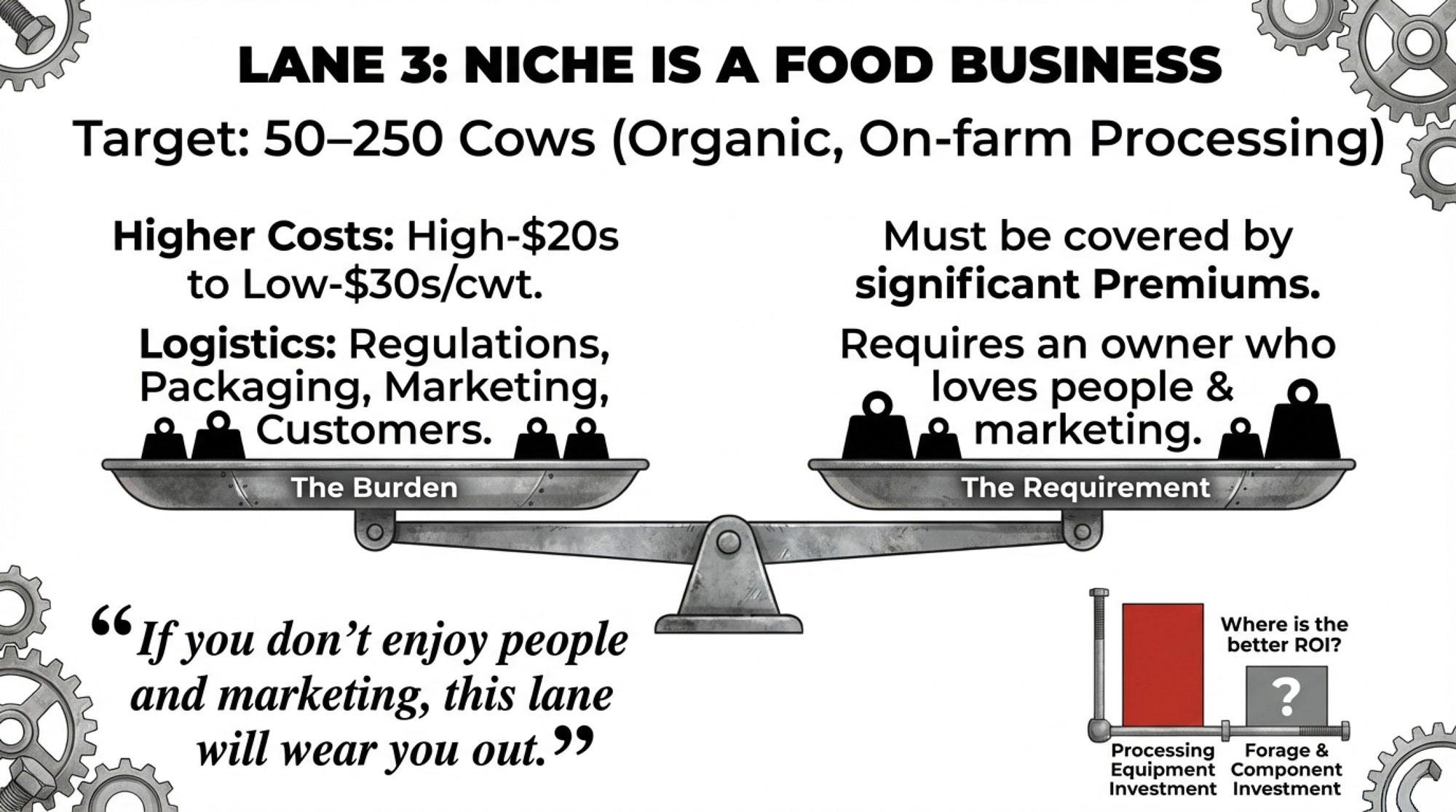
  • Lane 3: Niche and integrated – smaller herds leaning on premiums and value‑added strategies.

You don’t have to love those labels. But if you look around your neighbourhood and across the U.S., they’re pretty much what the numbers and the barns are telling us.

Here’s a simple way to picture the lanes while we’re topping up the coffee.

How the Three Lanes Tend to Look

FeatureLane 1: ScaleLane 2: EfficiencyLane 3: Niche/Integrated
Typical Herd Size1,500+ cows150–800 cows50–250 cows
Main FocusCost per cwtMargin per cow & per stallPremium stability
Labour SetupLarger hired teams, formal structureMixed family/staff, targeted techMostly owner/family, a few key hires
Main RiskPolicy, interest, feed & water“Stuck in the middle,” capital creepMarket volatility, buyer dependence

So the real question isn’t “which lane sounds nicest?” It’s “which lane do our barns, our contracts, and our debt load already put us in – whether we’ve said it out loud or not?”

Lane 1: Scale With Discipline

Let’s start with the herds that get most of the headlines. This is the lane of the 2,000‑ to 5,000‑cow operations you see in California’s Central Valley, Idaho’s Magic Valley, the Texas Panhandle, those big New Mexico dry lot systems, and along I‑29.

The 2022 Census, and the way farmdoc and Rabobank have unpacked it, show that the 2,500‑plus‑cow class was the only herd‑size group that actually grew in number between 2017 and 2022. Most smaller herd‑size categories shrank.  Rabobank economists, leaning on USDA cost data, have highlighted that herds milking more than 2,000 cows can operate at total costs around $23/cwt and roughly $10/cwt cheaper than 100‑ to 199‑cow herds in 2022 when you look at all‑in cost per cwt.  That lines up with USDA ERS work documenting that average costs tend to drop sharply as you move into the 1,000‑plus‑cow range. 

Cost‑of‑production benchmarking from large western herds has shown total costs often in the low‑20s per cwt in recent years, with some examples in that $20–$21 range when feed was expensive.  When milk prices were higher and costs were under control, those herds had decent margins. When milk softened, and feed stayed high, there wasn’t much cushion. 

What’s interesting here is that scale really can work, but only if it’s paired with discipline and a clear view of risk. On a 2,500‑cow dry lot in eastern New Mexico or west Texas, a $2/cwt swing in margin can mean hundreds of thousands of dollars a month. Heat stress, water rights, feed price spikes, and regulatory changes all magnify at that scale. Producers in those regions consistently talk about cooling systems, water security, and manure and nutrient plans because they don’t have the luxury of ignoring those things. 

In a lot of western dry lot systems, the focus tends to be on:

  • Reproduction and days open, because milk per stall is everything.
  • Heat abatement – fans, soakers, shades – to keep feed intake and rumination from breaking down during long, hot spells.
  • Feed efficiency and shrink control, given the volume of commodities moving through the yard.
  • Manure and water systems that keep regulators, neighbours, and processors onside.

So if you’re in this lane – or seriously thinking about stepping into it – the question shifts from “should we add more cows?” to “does this next big capital decision lower our cost per cwt or take a major risk off the table over the next 10 or 15 years?” New rotary? Digester? More housing? At that scale, the lens really has to be long‑term margin and resilience, not just filling an empty pad.

Lane 2: The Efficiency Sweet Spot

Now, let’s talk about where a lot of well‑run Midwest and Northeast herds actually live: somewhere between 150 and 800 cows. Solid freestall barns, a mix of family and hired help, and a lot of pride in butterfat performance and cow comfort.

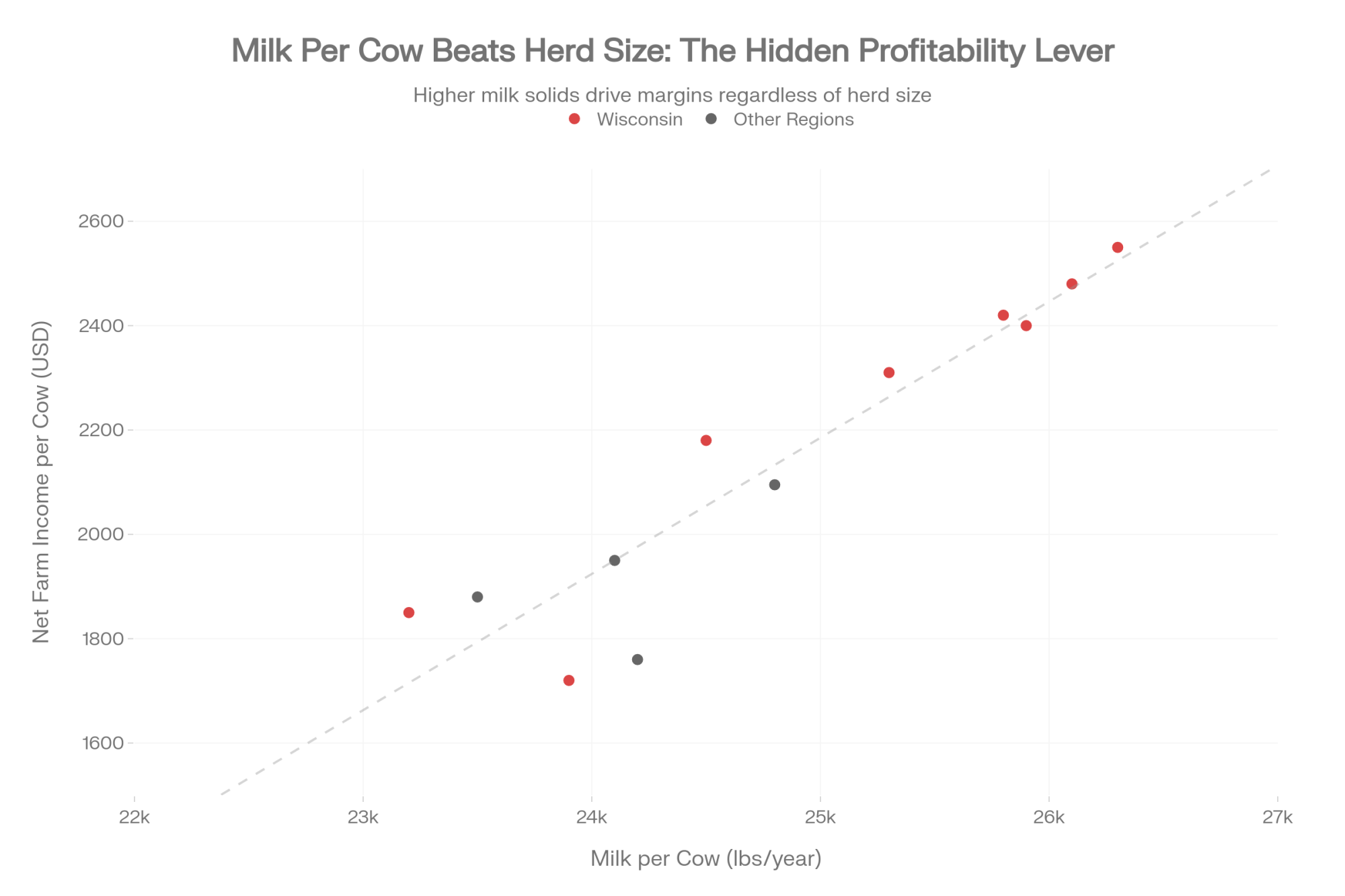
Kansas Farm Management Association comparisons of high‑, medium‑, and low‑profit dairies have shown that the most profitable herds aren’t always the biggest. They’re the ones with higher milk sold per cow, better feed conversion, fewer labour hours per cow, and controlled overhead.  An international study looking at dairy farm performance across countries reached a similar conclusion: technical efficiency – things like milk per cow, feed use, and labour use – plus management decisions explain profitability differences much more than milk price alone. 

Farm IDHerd SizeMilk per Cow (lbs/yr)Net Farm Income per Cow (USD)Region
A28024,500$2,180Wisconsin
B32023,200$1,850Wisconsin
C45025,300$2,310Wisconsin
D52024,800$2,095Iowa
E38026,100$2,480Wisconsin
F65023,900$1,720Wisconsin
G52024,100$1,950Minnesota
H42025,800$2,420Illinois
I48023,500$1,880Iowa
J58026,300$2,550Wisconsin
K39025,900$2,400Wisconsin
L61024,200$1,760Minnesota

In Wisconsin, herds shipping to cheese plants, the paycheque is built on components. Producers are getting paid for butterfat and protein, not just pounds of skim, so milk solids per cow and per stall become the key levers. Hoard’s Dairyman benchmarking and Dairy Herd coverage of component pricing have underlined that top‑profit herds in these markets tend to combine strong fat and protein yields with good herd health and reproduction. 

In many Northeast operations – think 80–150‑cow tie‑stalls or smaller freestalls in New York or Pennsylvania – the economics look surprisingly similar, even if the barns are older. Butterfat performance, SCC, and reproduction determine whether to stay in business or set a dispersal date. The facilities differ; the margin math stays the same. 

What farmers are finding in this lane – especially in those 300‑ to 600‑cow freestalls – is that they don’t need to chase 3,000 cows to be successful. They do need to be absolutely clear about:

  • Butterfat and protein yield per cow and per stall, not just tank weight.
  • Fresh cow management through the transition period – calcium, energy balance, rumen health, and calm, clean calvings.
  • Involuntary cull rates and how long cows stay productive in the herd.
  • Labour per cwt and whether there are too many hands doing too many half‑defined jobs.

Many of the stand‑out herds in this lane use technology as a scalpel, not a shovel. You’ll see activity and rumination collars, some well‑designed sort gates, herd management software that someone actually uses, maybe a feed pusher. But the filter isn’t “is this new and shiny?” It’s “does this clearly move margin per stall and labour per cwt on our farm?” 

Lane 3: Niche and Integrated Models

Then there’s the lane a lot of smaller herds either already operate in or quietly eye: organic, grassfed, A2A2, farmstead cheese, on‑farm bottling, or tight specialty contracts.

A Vermont study of organic dairies, using about ten years of farm‑level data, found that profitable organic farms tended to have strong forage management, controlled purchased feed costs, and organic milk prices that more than covered their higher expenses.  Another paper looking at organic and grassfed dairy farms reported that higher‑producing grass‑based herds typically had better forage quality and more grazing management experience, which reinforces that “grassfed” doesn’t automatically mean low output. 

Economic work on organic and value‑added dairy suggests something else important: these farms often generate more local economic activity per dollar of milk sold because more processing, marketing, and labour occur in the local community.  That matches what many small organic and farmstead operations in Vermont, New York, and the Upper Midwest describe – more local jobs and spend, but also more work per unit of milk. 

So yes, a 100‑cow organic herd in Vermont or a 70‑cow farmstead cheese operation in New York can outperform a 300‑cow conventional herd in terms of income per cwt when premiums, volume, and costs are well managed.  The trade‑off is that you’re not just running a dairy – you’re running a food business with capital‑heavy equipment, regulations, labels, shipping, and customers attached. 

Here’s the honest part about this lane that doesn’t always make it into the glossy stories: it’s not a magic profit button. The farmers who thrive here genuinely enjoy the marketing and relationship side – tastings, farmers’ markets, social media, restaurant accounts – not just the idea of a higher pay price. If you don’t enjoy people, paperwork, and problem‑solving beyond the farm gate, this lane can wear you out fast.

FeatureLane 1: Scale with DisciplineLane 2: Efficiency Sweet SpotLane 3: Niche / Integrated
Typical Herd Size1,500–5,000+ cows150–800 cows50–250 cows
Primary FocusCost per cwt (volume + relentless efficiency)Margin per cow & per stall (quality + management)Premium stability & value-added processing
Labour ModelLarge hired teams, formal shift structureMixed family + staff, targeted technology useMostly owner/family + 2–4 key hires
Tech EmphasisCooling, feed efficiency, herd logistics, data systems at scaleActivity collars, sort gates, feed pushers, parlour automationDirect marketing, on-farm processing, customer relationships
Revenue LeverVolume + operational disciplineComponents (fat/protein) + reproductive health + longevityOrganic/grassfed/A2A2 premiums + direct sales markup
Main Economic RiskPolicy, interest rates, feed/water volatility → margin shrinks fast at scaleStuck in the middle: not big enough for economies of scale, not focused enough on nicheMarket volatility, buyer dependence, capital intensity of processing equipment
Typical Cost per cwt$20–$23 (with discipline)$24–$27 (depending on efficiency)$26–$32 (offset by premiums)

The Economics Behind the Lanes

If we step back from individual barns and look at the bigger picture, USDA’s cost‑of‑production work and ERS research on consolidation are pretty consistent: on average, total cost per cwt falls as herd size increases, at least up into the 1,000‑plus‑cow bracket. Fixed costs and specialized labour get spread over more cows.  That’s a big part of why those large herds have grown their share of the milk. 

At the same time, when you look inside any given size category – this shows up clearly in the Kansas data and the international comparisons – the herds at the top of the profit pile aren’t automatically the biggest ones. They’re the ones with more milk sold per cow, better feed efficiency, and leaner labour use. The laggards often have similar milk prices but higher costs per cwt due to lower yields, poor reproduction, health problems, or poorly organized labour. 

On the organic and value‑added side, the Vermont research and similar studies report that total costs per cwt are usually higher – often in the high‑20s or low‑30s – but strong organic or specialty premiums can still leave attractive margins when stocking rates, forage programs, and processing capacity fit together. 

And in the real‑world conditions of 2023–2025, with feed, fuel, and fertilizer on a roller coaster and interest costs higher, that margin for error has shrunk for almost everyone. Industry analysis has shown how quickly margins swung negative for many herds when feed stayed expensive, and Class III and IV prices dropped back. 

So the old “get big or get out” line is too blunt. The more accurate version is probably closer to: get crystal clear on which economic lane you’re in and manage aggressively for that lane’s realities.

Genetics: Turning Genomic Numbers Into Real Barn Dollars

Let’s shift to genetics for a bit, because this is one of those levers that doesn’t shout at you day‑to‑day but quietly adds up over time.

Since genomic testing really took off around 2009, geneticists and AI organizations have documented significantly faster genetic progress for traits like production, fertility, and health compared with the old, slower progeny‑test system. Peer‑reviewed work in the Journal of Dairy Science has confirmed that when you select on genomic lifetime merit indexes consistently, you see real differences in lifetime performance show up in the parlour and on the cull list. 

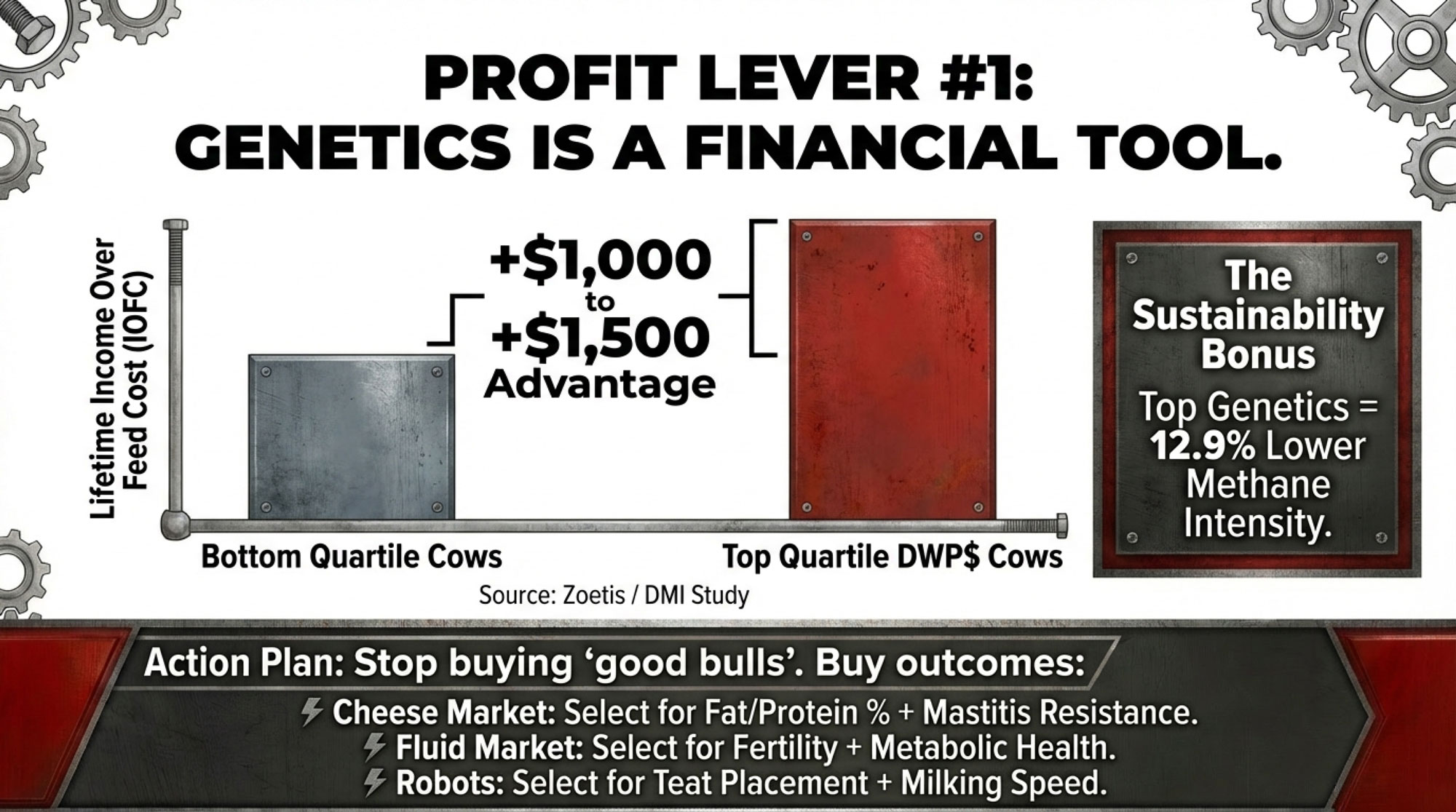
Zoetis and Dairy Management Inc. analyzed barn‑level data using the Dairy Wellness Profit Index (DWP$) and found that cows in the top 25% generated roughly £1,300 more lifetime income over feed cost than those in the bottom quartile in a UK study, and about US$1,474 more in comparable U.S. herds.

A more recent study published in the Journal of Dairy Science and summarized by Zoetis looked at 11 U.S. herds and found something that really grabs attention in 2025: cows in the top DWP$ quartile weren’t just more profitable – they also produced milk with about 12.9% lower methane intensity and roughly 9.5% lower manure nitrogen intensity per unit of milk compared with bottom‑quartile cows. 

MetricTop QuartileBottom QuartileDifference% Advantage
Lifetime Income Over Feed Cost (USD)$3,474$2,000+$1,474+74%
Lactations in Herd4.22.8+1.4+50%
Milk Solids per Lactation (lbs)3,2402,580+660+26%
Methane Intensity (kg CO₂e per lb milk)0.921.05−0.13−12.9%
Manure N Intensity (g N per lb milk)4.85.3−0.5−9.5%

So, when you put those pieces together, it’s reasonable – and supported by the field data – to say that in herds using DWP$ as intended, top‑quartile cows can be expected to generate somewhere on the order of $1,000 to $1,500 more lifetime income over feed cost than bottom‑quartile cows.  It’s a range, not a promise, but it lines up across both UK and U.S. studies. 

Now picture a 400‑cow freestall in Wisconsin turning over about 30% of its cows each year – roughly 120 heifers entering the parlour. If genomic testing and DWP$‑based selection mean 80 of those animals land in your top genetic quartile instead of being a random mix, and each of those cows brings in just $1,000 more lifetime income over feed cost, that’s about $80,000 in extra lifetime margin from that one group of replacements.  That doesn’t even count the peace of mind from having fewer train‑wreck cows. 

What I’ve noticed in herds that really make genetics pay is that they do three things clearly:

  • Cheese‑market herds emphasize fat and protein yield, fertility, mastitis resistance, and good feet and legs because those traits show up directly in the milk cheque and cull bill. 
  • Fluid‑market herds in the Northeast and Upper Midwest still value volume, but they’ve learned that better fertility, lower mastitis, and fewer metabolic problems often save more money than chasing a little extra milk. 
  • Robot herds pay close attention to udder structure, teat placement, milking speed, and temperament because they’ve seen, the hard way, how box visits, refusals, and nervous cows turn into lost milk and burned‑out staff. 

Genetics tends to work best when the herd has a simple, written plan that answers three questions:

  1. Which economic index—DWP$, Net Merit, Pro$, or a custom mix—actually reflects how we get paid and why we cull cows?
  2. Who gets sexed semen, who gets conventional dairy, and who gets beef‑on‑dairy, and how does that match our replacement needs and calf market? 
  3. Where does genomic testing clearly earn its keep, and where are we comfortable making decisions without it? 

When you revisit those answers once a year with your vet, nutritionist, and breeding advisor, genetic decisions stop being “we buy good bulls” and start being another tool in your profitability plan.

Robots, Parlours, and Tech That Actually Pays

Now to the topic that comes up at almost every winter meeting: robots versus parlours, and which technology actually pays.

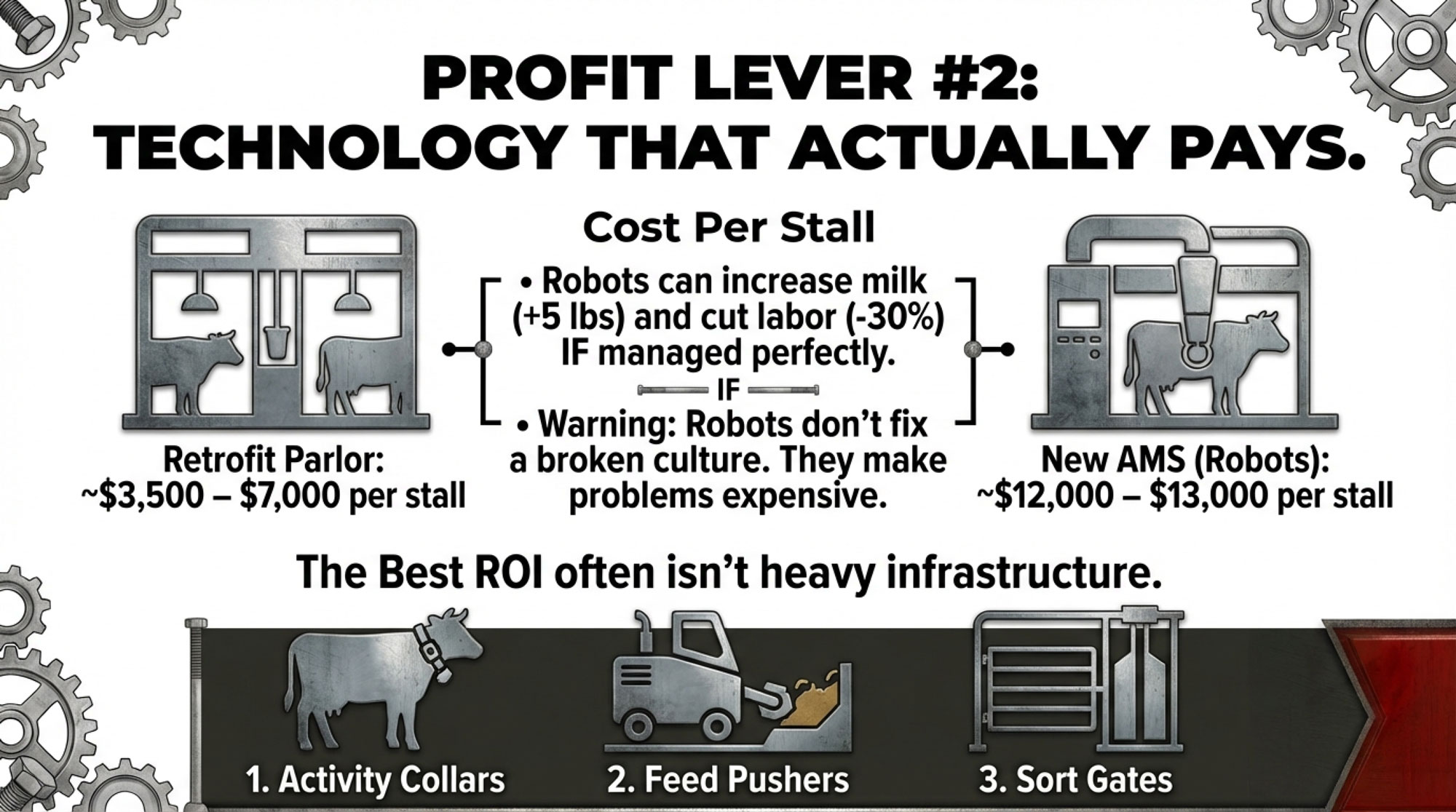
A 2022 feature pulled together several automatic milking system studies and reported that AMS can increase milk production by up to about 12% and reduce milking labour needs by as much as 30% in well‑managed herds. One of the highlighted studies showed robot‑milked cows producing roughly 2.4 kilograms – about 5.3 pounds – more milk per day than parlour‑milked cows, thanks mainly to more frequent milking and tighter routines.  Other research in peer‑reviewed journals and extension materials echoes those possibilities, while repeatedly stressing that results depend heavily on barn design and management. 

On the cost side, Wisconsin Extension’s 2022 “Building Cost Estimates – Ag Facilities” gives some solid ballpark figures that many lenders and consultants are using:

  • Retrofitting an existing parlour typically costs $3,500 to $7,000 per milking stall.
  • Building a new parlour with its own structure, concrete, utilities, and support spaces can cost $28,000 to $36,000 per stall.
  • A complete AMS setup – robots, barns or major renovations, manure systems, and cow‑flow infrastructure – commonly comes in around $12,000 to $13,000 per stall when you add everything together. 

Case studies presented at the Precision Dairy Conference and shared by consultants in North America often cluster AMS projects in the $11,000 to $14,000 per cow range once all related infrastructure is factored in. 

So let’s walk through a realistic example. Take a 240‑cow freestall in Wisconsin or Pennsylvania, considering four robots:

  • Capital outlay: It’s not hard, once you add robots, stall work, some concrete, building adjustments, and basic manure and cow‑flow changes, to end up near $2.5 million in total capital. 
  • Milk lift assumption: Say an extra 5 lb per cow per day. That’s on the optimistic side but consistent with upper‑end AMS study results when barn layout and management are dialled in. 
  • Labour savings: If milking labour is genuinely reorganized, many case farms have reported trimming the equivalent of roughly 1.5 full‑time positions from milking chores. 
  • Annual benefit: With those assumptions and typical milk and wage levels, it’s reasonable to see more than $150,000 per year in combined extra income over feed cost and labour savings. 

In that kind of scenario, the payback math can look pretty decent.

But here’s where a lot of producers quietly nod: in plenty of real‑world AMS installs, the milk lift ends up closer to 2–3 lb per cow, and labour doesn’t truly drop because the farm is short‑staffed elsewhere or the daily schedule never really gets redesigned. Industry case reports and extension consultants have been honest about that.  In those herds, the payback stretches out and sometimes never really hits what the original spreadsheet promised. 

Robots don’t fix a broken schedule or a toxic work culture. They just make those problems more expensive.

That’s why a lot of very profitable 400‑ to 600‑cow herds in the Midwest and Northeast still see their best returns coming from:

  • A well‑designed, efficient parlour that cows move through calmly and quickly.
  • Strong fresh cow management and transition pens that keep problems small and short.
  • High‑quality forage systems and consistent feeding routines that support components.
  • A handful of “workhorse” tech tools that support those systems rather than distract from them. 

Those workhorse tools often include:

  • Activity and rumination collars that improve heat detection and flag health issues early, which multiple studies and field reports have tied to better reproductive performance and lower disease‑related losses. 
  • Feed pushers that keep TMR in front of cows and frequently bump milk a couple of pounds per cow per day in both research and on‑farm results. 
  • Sort gates, in‑line milk meters, and mastitis sensors that make grouping, fresh cow checks, and mastitis detection more systematic and less dependent on one person’s memory. 

For most U.S. herds, the filter that seems to work best is simple: at conservative milk prices and realistic interest rates, can we honestly say this technology will improve dollars of margin per stall and labour per cwt on our farm? If the math only works when everything goes perfectly, it probably belongs on the “someday” list.

Labour: The Bottleneck Behind Everything Else

If there’s one theme that keeps coming up from New York freestalls to Idaho dry lot systems, it’s labour – finding people, keeping people, and getting consistent work from people.

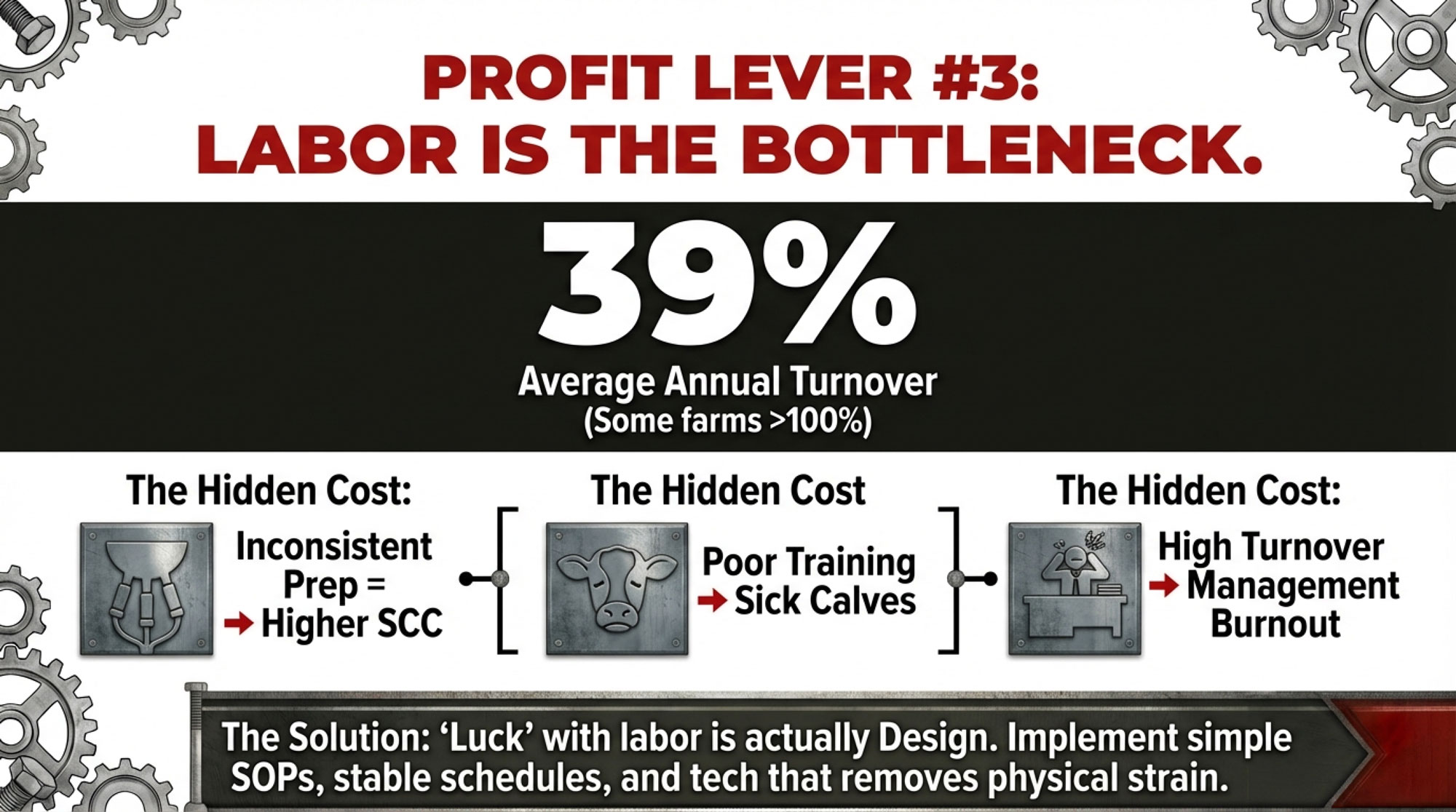
A national survey done under the National Dairy FARM Program’s Workforce Development initiative, with Texas A&M leading the analysis, surveyed more than 600 dairies and found average annual employee turnover around 38.8% on U.S. dairies.  Dairy Herd’s coverage of that work noted that while this isn’t wildly different from some other private‑sector averages, it’s a major challenge for farms that struggle to find and train reliable employees. 

A 2018 paper in the Journal of Dairy Science that examined employee management practices on large U.S. dairies found annual employee turnover ranging from 8% to 144%, meaning some operations were turning over more than their entire workforce in a year.  That level of churn doesn’t just hurt morale. It hits milking consistency, fresh cow monitoring, calf care, and training costs in ways you feel in both the tank and the cheque. 

Extension programs through Cornell PRO‑DAIRY and universities in Michigan and Wisconsin have also highlighted how heavily many dairies rely on immigrant labour, and how housing, immigration uncertainty, language support, and basic management practices influence whether good employees stay.  Producers in those programs often report that high turnover shows up as: 

  • Inconsistent parlour prep and higher bulk tank SCC.
  • Missed early signs in transition cows that later turn into expensive problems.
  • Shortcuts in calf protocols and higher calf morbidity.
  • Lower average milk yield and more stress for owners and managers.
Annual Turnover RateBulk Tank SCC (cells/mL)Fresh-Cow Disease Rate (%)Calf Morbidity (%)Milk Loss per Cow (lbs/yr)Est. Monthly Cost per 300-Cow Herd (USD)
<15% (Low)150K–180K8–12%5–8%200–400$2,500–$4,000
15–30% (Moderate)220K–280K15–18%10–12%600–800$6,500–$9,500
30–50% (High)320K–420K22–28%15–18%1,000–1,400$12,000–$18,000
>50% (Severe)500K+35%+22%+1,800–2,200$22,000–$35,000

What I’ve noticed in operations that seem “lucky” with labour is that luck usually looks a lot like design:

  • Barns and work routines are set up so that on a bad day – when someone is off or quits suddenly – the system still functions safely and adequately, even if it’s not perfect.
  • Core tasks like milking prep, colostrum handling, sick cow checks, and pre‑fresh monitoring have simple written SOPs, and someone actually takes time to train people on them.
  • Technologies like sort gates, collars, and feed pushers are chosen not just for their ROI on paper, but because they remove repetitive or physically punishing tasks that burn people out. 

So the real question for a lot of herds is this: if you put a realistic dollar value on lost milk, extra treatments, extra culls, and your own stress when turnover is high, what would it actually be worth to have a more stable, better‑trained crew? Sometimes the answer looks a lot like higher wages, better housing, more structure – and only then more gadgets.

Environment, Consumers, and Where Policy Is Pointed

Whether we like it or not, environmental and consumer expectations are part of the lane conversation now.

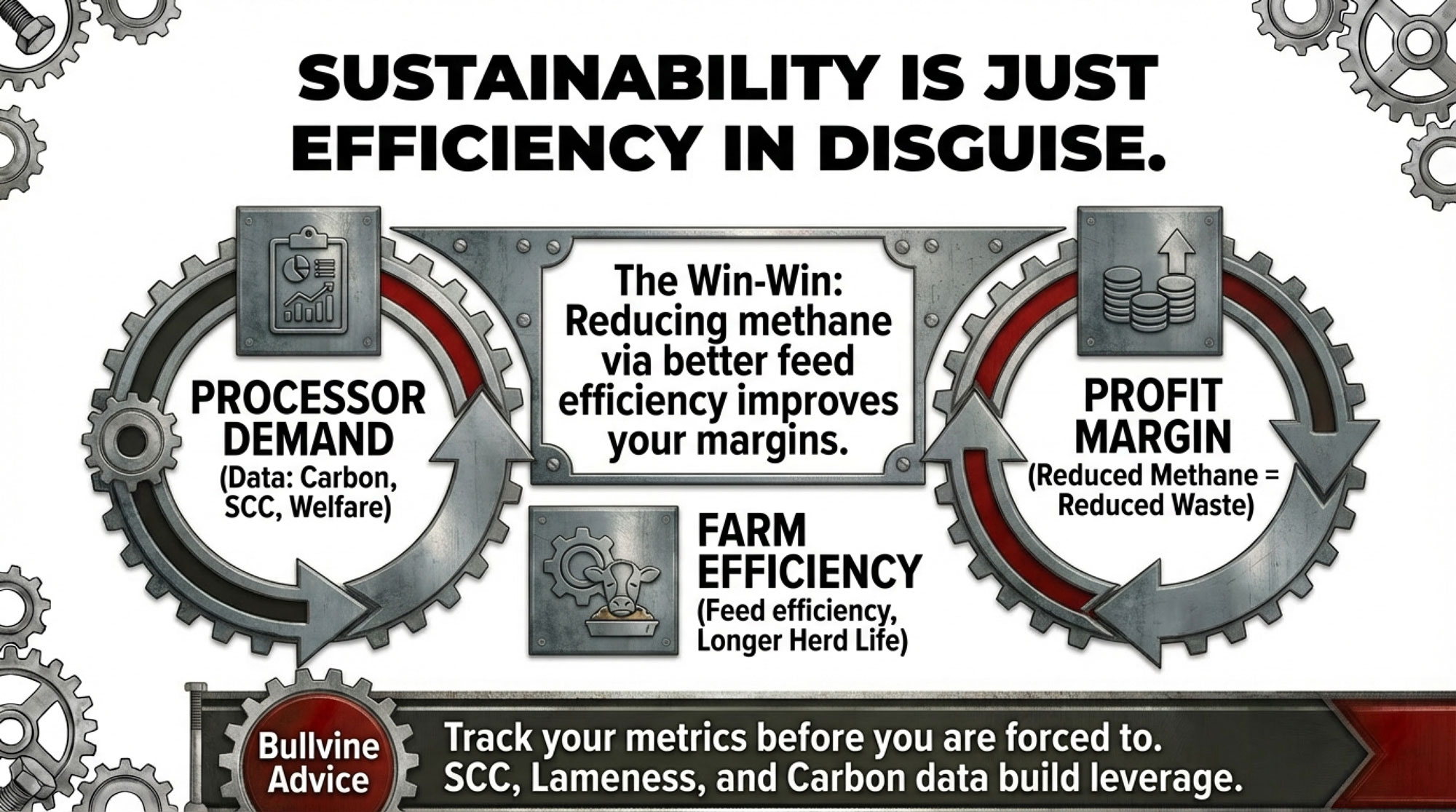
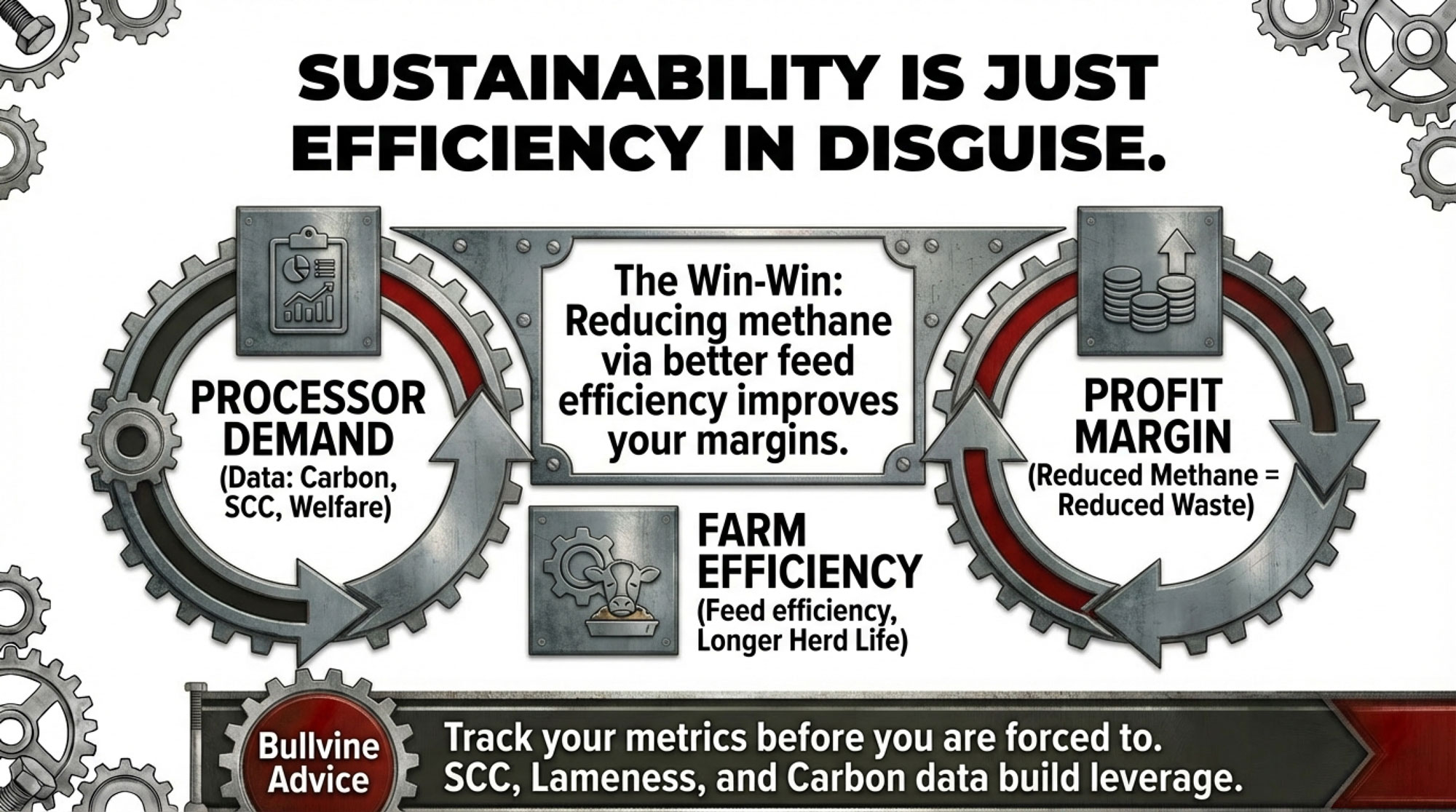
The Innovation Center for U.S. Dairy has laid out a sector‑wide goal for greenhouse‑gas neutrality by 2050 through the Net Zero Initiative, and this goal is supported by life‑cycle assessment work from universities such as Texas A&M. Those LCAs consistently show that most of dairy’s greenhouse‑gas footprint comes from feed production, enteric methane, and manure management. 

What’s encouraging is that many of the steps that shrink that footprint – better feed efficiency, stronger fresh cow management, longer productive lives, fewer involuntary culls – also tend to improve cost per cwt and margins. That DWP$ study is a good example: cows selected for higher DWP$ were more profitable and produced milk with lower methane and manure nutrient intensity per unit of milk. 

On the market side, the shift toward cheese, butter, and other ingredients is prompting more questions from processors and retailers about animal welfare, environmental impact, and traceability. In practice, that’s showing up as programs that ask farms to document things like:

  • Bulk tank SCC and mastitis treatment rates.
  • Lameness levels and reasons cows leave the herd.
  • Transition‑cow performance, stillbirths, and overall cow mortality.
  • Manure-handling practices and, in some programs, basic carbon or nutrient values. 

In Wisconsin and Northeastern plants supplying branded retail milk and yogurt, this is already happening through sustainability questionnaires, on‑farm audits, and sometimes through price incentives or program bonuses for certain performance levels. 

It’s easy to see all of that as “one more thing.” But the flip side is that the metrics processors want to see often align with what already matters for profitability and labour sanity. Getting a handle on your SCC trends, cull reasons, lameness, and transition‑cow outcomes isn’t just for paperwork; it’s also good business.

On‑Farm Processing and Branding: Romantic and Real

For a 90‑cow tie‑stall in upstate New York or a 150‑cow herd in Pennsylvania, it’s natural to look at a successful farmstead cheese maker or local milk brand and wonder if that’s the way through.

University of Vermont and other land‑grant work has followed organic and value‑added farms that improved their financial position by adding on‑farm processing or direct marketing. When there’s strong local demand, and the owners have both the interest and the skill set, on‑farm processing can absolutely lift income per cwt. 

But those same studies are pretty blunt about what it takes:

  • Capital for plant renovations, pasteurizers, vats, coolers, and packaging can easily be in the hundreds of thousands of dollars, even on a modest scale. 
  • Owners suddenly need to learn food safety regulations, distribution logistics, branding, marketing, and customer service – on top of managing cows, crops, and people. 
  • Cash flow in the first few years can be tight, and success depends heavily on the local market and whether someone on the farm truly enjoys the business side. 

So if you’re thinking about going down that road, it really helps to compare two honest scenarios side by side:

  1. Putting that capital and management energy into your own processing and marketing.
  2. Putting the same resources into better forage, higher butterfat performance, stronger fresh cow and calf programs, and labour and tech improvements inside your current marketing channel.

In a lot of case studies, both paths can work. The winner usually comes down to your people and your local market, not just what the spreadsheet says.

Three U.S. Farm Types, Three Practical Paths

To make this less theoretical, let’s walk through three common U.S. farm profiles and talk about where they likely sit and what that suggests.

1. A 100‑Cow Tie‑Stall in Upstate New York

  • Likely lane: efficiency, with a bit of niche potential.
  • Reality: smaller tie‑stall herds in the Northeast are often shipping into competitive fluid and cheese markets, where butterfat levels, SCC, and day‑to‑day consistency can make the difference between staying afloat and calling an auctioneer. 

Practical focus might look like:

  • Pushing butterfat performance and overall component yield through better forage quality, balanced rations, and tight fresh cow management in the weeks around calving.
  • Keeping SCC low and reproduction steady to protect days in milk and minimize involuntary culls.
  • If there’s strong local demand – and someone on the farm genuinely wants to deal with customers – exploring a small, manageable value‑added product like seasonal cream or limited cheese runs, with extension support on food safety and realistic capital budgets. 

2. A 450‑Cow Freestall in Wisconsin

  • Likely lane: efficiency sweet spot.
  • Reality: shipping to a cheese plant under multiple‑component pricing, with a mix of family and hired staff and a typical Upper Midwest forage base. 

Practical focus might include:

  • Using a custom genetic index that emphasizes fat and protein yield, fertility, and health – potentially blending DWP$ or other health‑focused indexes with your pay price and culling patterns. 
  • Running a conservative AMS‑versus‑parlour comparison using Wisconsin cost benchmarks, realistic milk‑lift assumptions, and local wage and labour availability, rather than best‑case numbers from brochures. 
  • Prioritizing tech that clearly improves transition‑cow outcomes, labour per cwt, and data visibility – activity collars, sort gates, feeding tools – before committing to bigger, more complex systems. 

3. A 2,500‑Cow Dry Lot System in New Mexico

  • Likely lane: scale with discipline.
  • Reality: exposed to feed cost swings, water and environmental rules, and a competitive labour market in a hot, dry climate. 

Practical focus could be:

  • Leaning into genetics for fertility, mastitis resistance, and moderate mature size to support longevity and milk per stall under heat stress. 
  • Using beef‑on‑dairy strategically to monetize lower‑end genetics, improve calf value, and avoid raising more replacements than you really need. 
  • Prioritizing capital for cooling, water infrastructure, feed efficiency, and manure management first – the things that hit both cost per cwt and environmental risk – before simply adding more cows. 
  • Building a basic set of sustainability and welfare metrics (SCC trends, cull reasons, lameness levels, manure handling) so you’re ready when processors and lenders start asking tougher questions. 

None of these paths are easy. But each one looks more manageable when you’re honest about which lane you’re really in and what your main constraints actually are.

Five Kitchen‑Table Questions to Print Out

If you’re still here, you’re already thinking harder about this than most. Here are five questions you might want to print and stick on the fridge, office wall, or milkhouse door:

  1. Which lane are we actually in – scale, efficiency, or niche – and do our barns, labour setup, contracts, and debt load truly match that lane?
  2. Do our genetic goals – and how we use sexed, conventional, and beef‑on‑dairy semen – really line up with our milk cheque, our barn design, and our culling reasons, or are we just following the latest sire list?
  3. Which technologies on our wish list can we honestly say will improve dollars of margin per stall and labour per cwt at conservative milk prices and realistic interest rates?
  4. What is high staff turnover actually costing us in lost milk, health problems, training time, and stress – and what would it be worth to have a more stable, better‑trained crew?
  5. If our processor, lender, or a key customer asked tomorrow, what welfare, health, and environmental numbers could we share confidently – and where are the easiest improvements that would cut both costs and emissions?

In a world where nearly 40% of U.S. dairy farms disappeared in just five years, and where roughly two‑thirds of American milk now comes from 1,000‑cow‑and‑up herds, staying “as we’ve always done it” is its own kind of decision. 

What’s encouraging is that the tools to make smarter decisions – good data, solid research, better genetics, and thoughtfully chosen technology – are more available than they’ve ever been. The hard part, as many of us have seen around kitchen tables, shop benches, and barn alleys, is being brutally honest about which lane we’re in, and then steering into it on purpose, with our eyes open, instead of getting dragged there by default.

And if you’re still reading at this point, you’re already acting more like an owner than a passenger. That’s a pretty good place to start.

Key Takeaways

  • The shakeout is real: Nearly 40% of U.S. dairy farms vanished in five years – but the cows didn’t. They moved to fewer, bigger barns while total milk production held steady.
  • Scale helps, but it’s not the only way to win: Herds milking 2,000+ cows can operate about $10/cwt cheaper than small herds, yet mid-size and niche operations stay profitable by pushing components, labour efficiency, and cow longevity harder.
  • Profit separates on efficiency, not milk price: Top-profit herds at any size win on feed conversion, butterfat and protein yield, fresh cow management, and labour per cwt – the milk cheque is usually similar; the cost side isn’t.
  • Genetics and tech pay only when they fit: DWP$-driven selection can add $1,000–$1,500 lifetime IOFC per top-quartile cow; AMS, collars, and sort gates strengthen margins only when milk lift, labour changes, and interest costs actually pencil.
  • Inaction is a decision: Five closing questions help owners identify which survival lane they’re really in – and where standing still may be the riskiest move of all.

Complete references and supporting documentation are available upon request by contacting the editorial team at editor@thebullvine.com.

Learn More

The Sunday Read Dairy Professionals Don’t Skip.

Every week, thousands of producers, breeders, and industry insiders open Bullvine Weekly for genetics insights, market shifts, and profit strategies they won’t find anywhere else. One email. Five minutes. Smarter decisions all week.
NewsSubscribe
First
Last
Consent

H5N1 and Raw Milk Cheese: What the Science Actually Shows About Risk, Testing, and Your Operation

New research reveals surprising gaps between laboratory findings and real-world data, offering practical insights for navigating regulatory requirements while managing actual contamination risks

Executive Summary: The disconnect between H5N1 lab research and marketplace reality is costing cheese producers millions in unnecessary recalls. While Cornell’s October study found the virus can survive 120 days in experimental cheese, the same researchers discovered ferrets eating that cheese didn’t get infected—and FDA surveillance detected zero viable virus in 110+ retail cheese samples nationwide. The culprit? PCR testing that can’t distinguish between infectious virus and harmless RNA fragments, yet triggers $10+ million recall costs when it finds genetic debris. Wisconsin’s 19,000 milk samples with zero detections prove systematic surveillance works, but California’s 233 affected herds show real risk exists regionally. Smart risk management means sourcing from tested negative herds, considering pH optimization for natural protection, and avoiding voluntary testing that creates massive liability for what marketplace data suggests is minimal actual risk.

dairy profitability

You know how sometimes the headlines tell one story, but when you dig into the actual numbers, you find something entirely different? That’s exactly what’s been happening with H5N1 in cheese.

I was talking with a group of producers the other day, and one of them said something that really stuck with me: “The lab research had us all worried, but our test results keep coming back clean. What’s going on here?” It’s a fair question—and as it turns out, there’s a fascinating answer emerging from the data.

Here’s what’s interesting: We’re now at 442 affected dairy herds nationwide, according to USDA’s latest October count, with California bearing the brunt at 233 farms. Those are real numbers. But for those of us in the cheese business—especially raw milk cheese—the story gets more complex when you compare what laboratory experiments suggest could happen versus what’s actually showing up in marketplace testing.

What Cornell’s Research Really Found

So the Cornell team got this $1.15 million FDA grant last July to figure out if H5N1 could survive cheese aging. Makes sense, right? Their work, which appeared in Nature Medicine this October, involved making these tiny experimental cheeses—about 5 grams each—using milk deliberately spiked with a lab-grown virus.

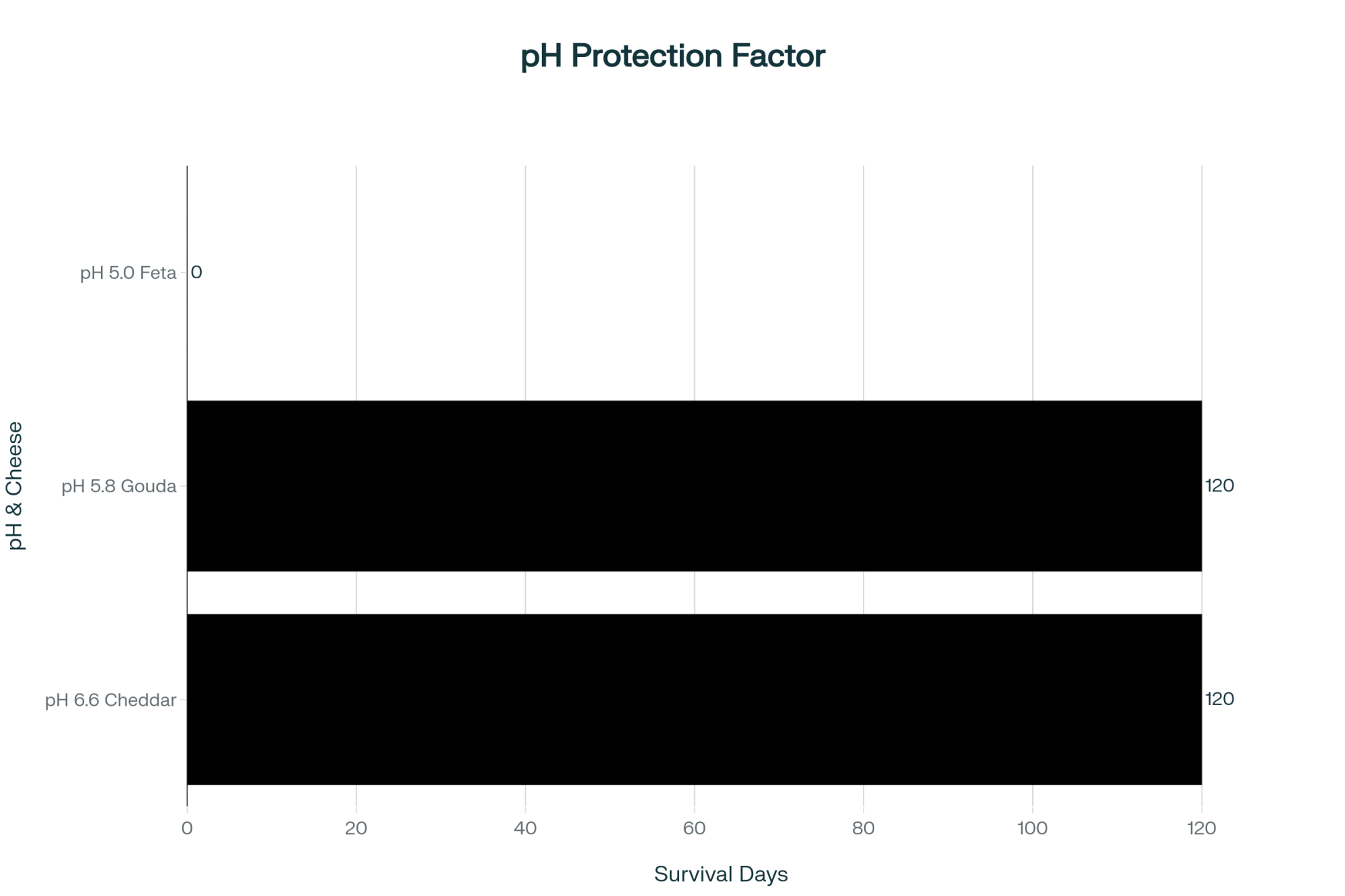
Cornell’s research reveals a game-changing insight: acidification to pH 5.0 eliminates viable virus entirely. Your feta, chèvre, and fresh cheeses naturally provide protection through their production process—no additional intervention needed. Smart producers are already shifting product mix toward naturally protective varieties

Here’s where it gets interesting, though. They tested three different pH levels, and the results were pretty clear-cut. At pH 6.6 and 5.8—that’s your typical aged cheddar or gouda range—the virus did persist through 120 days of aging. But at pH 5.0? Nothing. No viable virus at all. And you know what runs at pH 5.0? Your feta, your chèvre, most of your fresh cheeses.

But wait, it gets better. When the full paper came out (not just the preprint), it revealed something crucial: they fed this contaminated cheese to ferrets. Now, if you don’t know, ferrets are basically the canary in the coal mine for flu research—they’re incredibly susceptible. And guess what? Not a single ferret got infected from eating the cheese. Not one.

Meanwhile, some ferrets drinking contaminated raw milk did get sick. The researchers think—and this makes sense when you think about it—that the solid structure of cheese might trap the virus differently than liquid milk, where it’s just floating around freely. In cheese, you’ve got this protein matrix, salt everywhere, enzymes breaking things down… it’s actually a pretty hostile environment, even if the virus technically survives.

Understanding the Testing Game: PCR vs. Viability

What I’ve found is that most producers don’t really understand the difference between PCR testing and viability testing—and honestly, why would you? But it matters enormously.

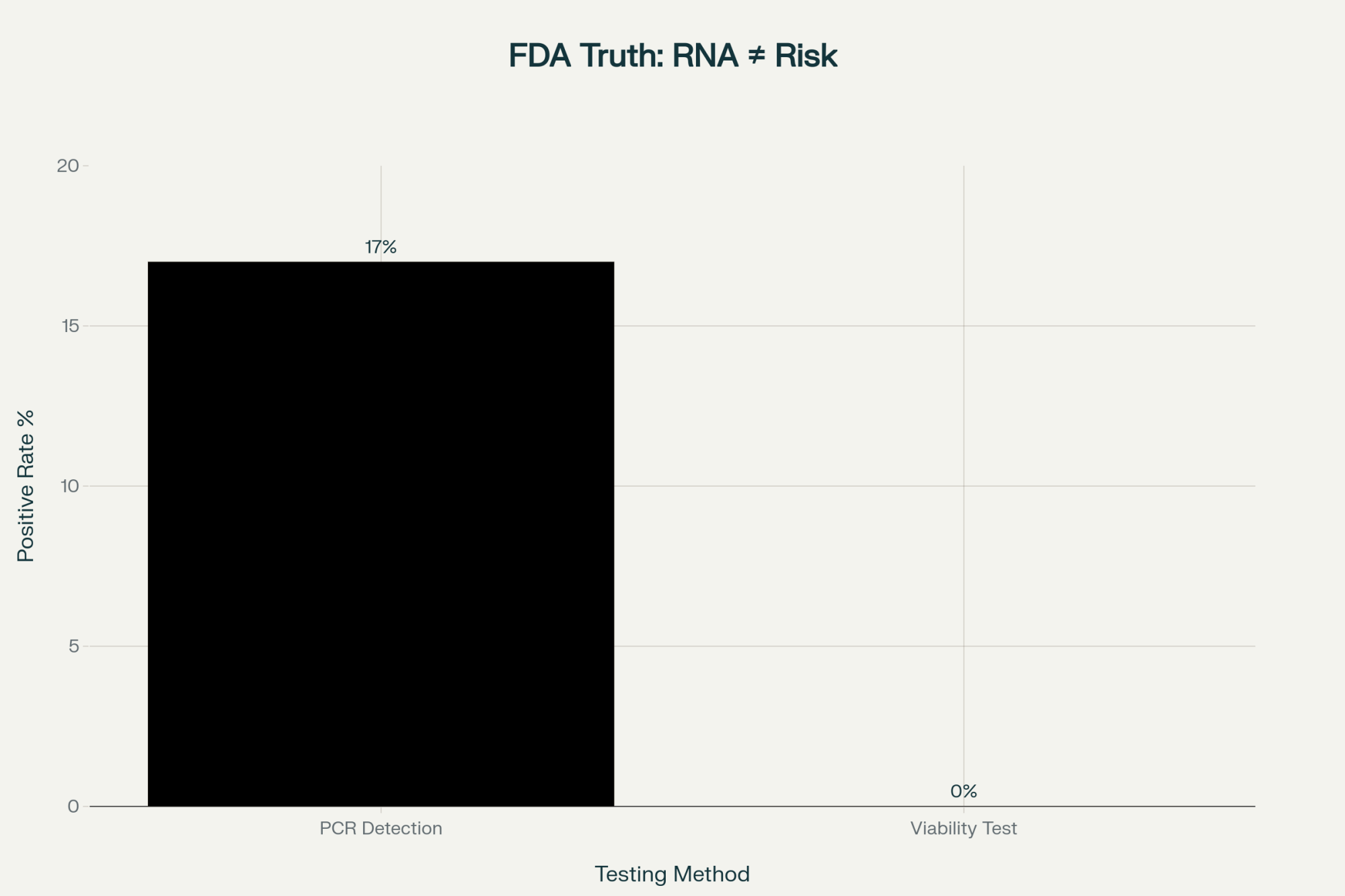
FDA’s own data exposes the PCR paradox: 17% of samples test positive for viral RNA, but viability testing reveals zero infectious virus in 110+ retail cheese samples. This gap between detection and actual risk is costing producers millions in unnecessary recalls

Quick Reference: Testing Types and What They Mean

PCR Testing:

  • Detects as few as 5-10 viral RNA copies per microliter
  • Results in 3-7 days
  • Can’t distinguish between live and dead virus
  • Like finding footprints—proves something was there, not that it’s still dangerous

Viability Testing:

  • Uses egg inoculation to grow the virus
  • Takes up to 30 days for results
  • Confirms if the virus can actually cause infection
  • The only way to know if there’s a real risk

PCR is incredibly sensitive. According to research published in the Journal of Virological Methods this September, we’re talking about detecting as few as 5 to 10 copies of viral RNA per microliter. That’s… well, that’s basically nothing. It’s like being able to find a single grain of salt in a swimming pool.

But here’s the thing—and this is crucial—PCR can’t tell you if what it’s finding is alive or dead. It’s just finding genetic material. Think of it like finding footprints in your barn. Those footprints tell you something was there, but they don’t tell you when, or if it’s still around, or if it was even a threat to begin with.

Now, the FDA has been running this massive surveillance program, and its March update revealed something really eye-opening. They found viral RNA fragments in about 17% of some dairy products they tested. Sounds scary, right? But then they took those same positive samples and did viability testing—that’s where you actually try to grow the virus in chicken eggs to see if it’s infectious—and every single sample came back negative. Every one. No viable virus.

Why does this matter? Well, Food Safety Magazine’s analysis puts the average food recall at over $10 million in direct costs alone. So if you’re destroying product based on PCR positives that turn out to be just RNA fragments… you can see the problem.

State Strategies: From Wisconsin’s Testing Blitz to California’s Realities

California’s dairy outbreak concentration reveals why risk management strategies must be regional, not national. While California battles 233 affected herds, Wisconsin’s 19,000 tested samples show zero detections—proving surveillance works and geography matters more than headlines suggest

What’s fascinating to me is how differently states are handling this. Wisconsin—and you’ve got to hand it to them—they’ve gone all-in on testing. They’re processing over 5,000 milk samples every month through their state lab. The result? As of October, they’ve tested more than 19,000 samples with zero H5N1 detections. Zero. That’s not luck, that’s systematic surveillance working.

Pennsylvania took a more measured approach. Their State Veterinarian, Dr. Hamberg, caught some flak back in March when he basically said, “Let’s wait for the full peer-reviewed study before we panic.” Looking back now? Smart move. Pennsylvania has maintained what USDA calls Stage 4 status—that is, no H5N1 present—with over 100 dairy herds. They’re actually the only state with that many herds to achieve that status.

Then there’s California. Different story entirely. With 233 of the 442 affected herds nationally—we’re talking over half the outbreak—they’re dealing with real contamination. I was talking with a Central Valley producer recently who put it this way: “We’re not worried about theoretical risk here. We’ve got affected herds all around us. Our testing is about survival, not compliance.”

And what about operations in the Southeast or Mountain West? They’re watching all this unfold, implementing practical measures based on their regional risk. A Georgia operation I heard about is focusing testing at their processing facility rather than individual farms—makes sense given their smaller dairy sector and limited resources.

The Raw Farm Story: A Cautionary Tale

The Raw Farm situation from last November and December really shows how this all plays out in real time. Santa Clara County found influenza A virus through routine PCR testing on November 24th, right before Thanksgiving—couldn’t be worse timing. This triggered recalls of everything produced after November 9th.

Now here’s what’s important: Despite multiple PCR-positive results across different products, California’s health department confirmed on December 3rd that not a single person got sick. Not one. But the damage was done—holiday sales season shot, product destroyed, consumer confidence shaken.

While Raw Farm hasn’t released exact figures, industry standards indicate that recalls of this scope typically exceed $10 million in direct costs alone. That’s before you factor in lost sales, brand damage, all of that. And remember, this happened during the peak holiday season when specialty cheese sales traditionally surge.

The Economics Nobody Talks About

Let’s get real about the numbers here. Research from the Journal of Dairy Science shows that aging facility costs range from $0.25 to $0.27 per pound for the entire aging period. So if you’ve got 10,000 pounds aging for 120 days—pretty standard for a mid-sized operation—you’re looking at $90,000 to $130,000 in product value, plus another $10,000 or so in aging costs you’ve already paid.

Key Financial Considerations for Producers

  • Aging costs: $0.25-0.27 per pound for the entire aging period
  • Product Contamination Insurance: $1,000-$20,000 annually (varies by size)
  • Voluntary testing: $50-$150 per sample
  • Average recall cost: $10+ million in direct expenses
  • Viability testing wait: Up to 30 days (during which the product is quarantined)

And insurance? Don’t get me started. Agricultural insurance data shows that Product Contamination Insurance ranges from $1,000 to $20,000 a year, depending on your size. But—and this is the kicker—standard policies usually exclude most recall costs. You need special coverage, and good luck affording it after any claims.

What’s really tough is how this hits different sized operations. If you’re running 500 cows and making commodity cheese, you can spread these costs across volume. But if you’re a 50-cow farmstead operation? These compliance costs can wipe out your entire margin.

I’ve been hearing from a lot of smaller producers who are rethinking voluntary testing. University labs charge $50 to $150 per sample—seems reasonable, right? But if you test voluntarily and get a PCR-positive result —even if it’s just dead virus fragments —you’re often required to report it. That can trigger recalls before anyone even checks whether there’s an actual infectious virus. And that viability testing? Takes up to 30 days. By then, you’re already destroyed.

Some cooperatives are starting to pool resources for testing—spreading costs across multiple small operations. It’s one way smaller producers are adapting, though it’s not yet available everywhere. The Wisconsin Cheese Makers Association has been particularly active in helping members navigate these challenges—they’re a good resource if you’re looking for guidance.

What’s Actually Working Out There

So what approaches are proving effective? From what I’m seeing across the industry, a few things stand out.

First, source control is absolutely critical now. With the USDA’s National Milk Testing Strategy mandatory since December 6th, systematic bulk tank surveillance is underway. If you’re working exclusively with tested, negative herds, you’ve got documentation and significantly lower risk.

pH management is proving to be another practical tool. The Cornell findings that pH 5.0 is protective align with what many of us have long known about acidification. I know several Vermont operations that have shifted toward more acidic varieties—their chèvre naturally hits pH 4.6, which, according to this research, provides inherent protection through normal production.

But here’s something that might surprise you: voluntary finished product testing might actually increase your risk rather than reduce it. Legal guidance emerging in trade publications suggests really thinking twice before implementing voluntary testing unless customers demand it. The liability exposure from triggering costly recalls due to RNA fragments… it’s just not worth it for many operations.

The Market Reality

Here’s what’s encouraging: Grand View Research projects that the specialty cheese market will reach $81.44 billion by 2034. Consumer demand isn’t going away. University of Vermont research from this August shows buyers will still pay good premiums for local, artisanal, traditional methods.

But—and this is important—H5N1 testing as a marketing point doesn’t work. Trade publications have been reporting that producers who try advertising their H5N1 testing actually see sales drop. It introduces a concern customers hadn’t even considered. It’s like putting “arsenic-free” on bottled water—suddenly everyone’s worried about arsenic.

Despite H5N1 headlines, specialty cheese market projections remain bullish with $81.44 billion expected by 2034. Smart producers who master risk management today position themselves for tomorrow’s premium-paying consumers who still value traditional, artisanal methods

What Europe’s Doing Differently

The European approach is worth noting. Their Food Safety Authority concluded in June that H5N1 trade risks are, quote, “a lesser concern” compared to migratory birds. They require demonstrating that actual risk exceeds thresholds before restricting traditional products.

The UK’s surveillance data backs this up. Food Standards Agency testing of 629 raw milk cheese samples found that 82% met satisfactory standards, and zero human infections were reported in their 2024 summary. They’re monitoring, not prohibiting. Different philosophy entirely.

Where This Leaves Us

After looking at all this—the research, the surveillance data, what producers are experiencing—a few things become clear.

The science suggests aged cheese poses minimal real-world risk. Cornell’s ferrets stayed healthy eating contaminated cheese. The FDA found zero viable virus in over 110 retail cheese samples. Wisconsin’s 19,000 tests came back clean. At some point, you have to acknowledge what that’s telling us.

But regulatory frameworks don’t pivot quickly. FDA’s March guidance still says aging “may not be effective,” despite their own surveillance data. That’s just how these systems work—once precautionary measures are in place, they rarely get walked back.

For those of us actually making cheese, this means developing strategies based on real risk assessment, not just regulatory compliance. Source from tested herds—that’s foundational now. Consider pH optimization where it makes sense for your products. Carry adequate insurance, but understand what it actually covers. And think very carefully about voluntary testing that could trigger massive recalls for what might be harmless RNA fragments.

Your geographic location matters enormously here. Operating in Wisconsin or Pennsylvania with comprehensive surveillance and zero detections is fundamentally different from operating in California, where outbreaks are ongoing. Know your state’s status and plan accordingly.

And if you’re a smaller operation—under 50 cows—the economics are completely different. You might need to explore cooperative testing approaches to reduce testing costs, focus on direct sales where relationships matter more than paperwork, and maintain product diversity to spread risk.

The Bottom Line

You know, the specialty cheese market’s going to keep growing. Consumer demand for quality, artisanal products isn’t disappearing. What we’re learning is that producers who understand both the science and the regulatory landscape—who can implement practical risk management based on actual rather than theoretical threats—they’re finding ways forward.

Understanding the difference between finding viral RNA and finding infectious virus, knowing what your state’s surveillance shows, making informed decisions for your specific operation—that’s what gets you through this.

The gap between laboratory worst-case scenarios and what we’re actually seeing in the field tells us something important. While it’s appropriate to be cautious with new threats, there’s a point where precaution becomes… well, maybe overcautious.

This situation’s going to keep evolving. What we know today builds on yesterday, and tomorrow will probably bring new insights. But armed with good science, awareness of regional differences, and practical approaches, we can navigate this while protecting both public health and our operations.

Every producer meeting I attend, every conversation at the co-op, we’re all trying to figure this out together. And that’s actually encouraging—we’re not just reacting anymore, we’re understanding. That’s real progress.

Key Takeaways

  • PCR’s $10 million problem: Testing detects harmless RNA fragments but can’t identify actual infection risk—triggering massive recalls for dead virus that FDA surveillance shows doesn’t exist in retail cheese
  • The data is reassuring: Cornell’s infected ferrets stayed healthy eating contaminated cheese, Wisconsin tested 19,000 samples with zero detections, and the FDA found zero viable virus in 110+ retail samples nationwide
  • Geography drives strategy: California’s 233 affected herds require aggressive risk management, while Wisconsin and Pennsylvania’s comprehensive surveillance with zero detections means regulatory compliance matters more than contamination risk
  • Your three-point action plan: Source exclusively from tested negative herds (non-negotiable), optimize toward pH 5.0 or below for natural viral inactivation, and avoid voluntary finished product testing unless customer-mandated—it creates $10M liability exposure for detecting fragments that pose no risk

Complete references and supporting documentation are available upon request by contacting the editorial team at editor@thebullvine.com.

Information current as of October 28, 2025. Regulations and surveillance data continue evolving. Always consult current USDA and FDA guidance, along with your state regulations, for the most up-to-date requirements. For more information on navigating these challenges, the Wisconsin Cheese Makers Association (www.wischeesemakers.org) and your state dairy associations can provide valuable resources and support.

Learn More:

The Sunday Read Dairy Professionals Don’t Skip.

Every week, thousands of producers, breeders, and industry insiders open Bullvine Weekly for genetics insights, market shifts, and profit strategies they won’t find anywhere else. One email. Five minutes. Smarter decisions all week.

NewsSubscribe
First
Last
Consent
Send this to a friend