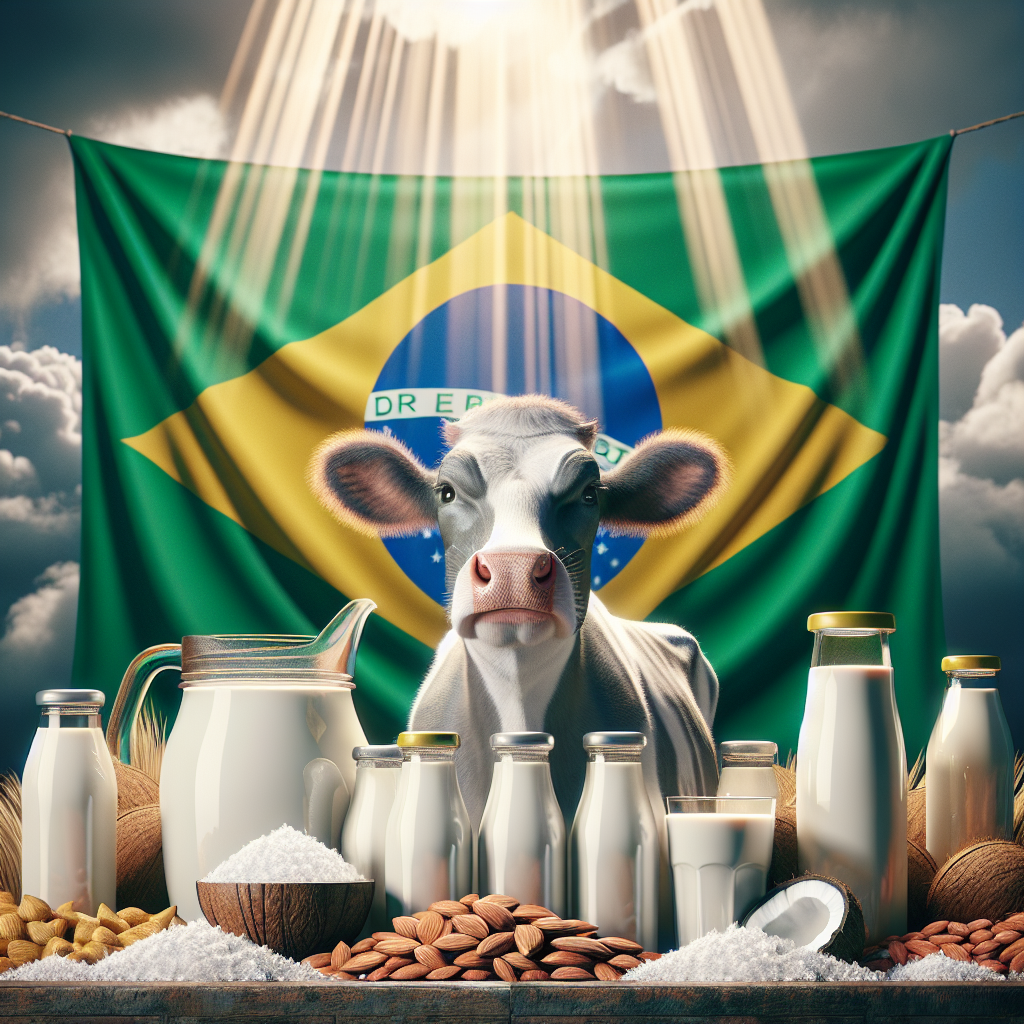
Labs just cracked making real casein — could boost your milk protein yields 5% while slashing feed costs.
EXECUTIVE SUMMARY: Just heard from some contacts in Europe — researchers finally cracked the code on making real milk protein in labs, complete with all the phosphate tags that actually make casein work for cheese and yogurt. We’re talking bio-identical stuff, not some plant knockoff. With Class III sitting around $18.80 per hundredweight and feed costs still crushing margins, this could be huge. The global milk protein market’s set to jump from $12.2 billion to $17 billion by 2035, and smart money like Perfect Day’s $350 million raise tells me this isn’t just lab talk anymore. Look, if you’re already pushing genomic testing and tracking feed efficiency… this tech could tip your whole operation. Time to start watching these developments and maybe testing some of these proteins in your nutritional program.
KEY TAKEAWAYS:
- Bump milk protein consistency by 4-6% while improving butterfat recovery — Start running genomic profiles focused on protein yield potential, especially with 2025’s volatile pricing making every percentage point count for your milk check.
- Cut feed costs up to $45 per cow monthly through better protein utilization — Implement precision feeding protocols that integrate lab-produced proteins with your current ration analysis, crucial when corn and soy prices won’t budge.
- Increase reproductive efficiency by 3-4% with optimized protein metabolism — Use metabolic profiling alongside your genomic data to fine-tune breeding decisions, because better fertility means more calves hitting the market when prices recover.
- Position for the $17 billion protein boom by 2035 — Partner with co-ops exploring precision fermentation deals now, before the big processors lock up supply chains and pricing advantages.
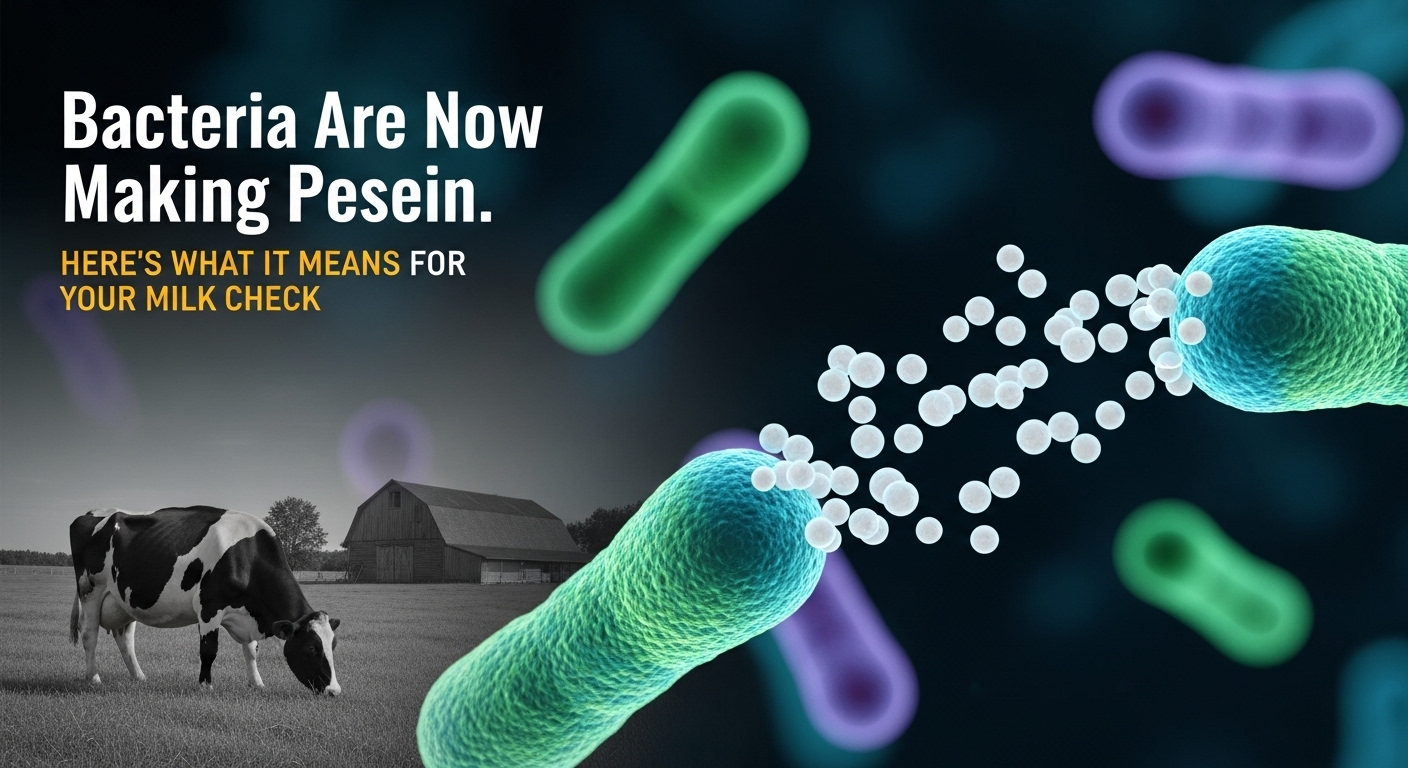
You know, the dairy industry doesn’t see breakthroughs like this every Day — at least, not without some serious debate about what it means for our farms and futures. Recently, researchers at the Technical University of Denmark, collaborating with their counterparts at Sweden’s Chalmers, discovered how to instruct E. coli bacteria to produce actual casein. Not a plant-based approximation, but bio-identical casein — complete with all the phosphate groups that make milk protein work the way it should.
Here’s the thing, though… this isn’t just another lab curiosity. We’re talking about a potential game-changer that could impact everything from your milk check to how we feed the world.
The Science That Actually Matters
Most folks don’t realize how complex milk proteins really are. Casein isn’t just a simple protein chain — it requires specific modifications after it’s formed to function properly. The key is phosphorylation, where phosphate groups get attached at precise spots. Without this step, casein can’t bind calcium or form those microscopic structures that give milk its unique properties.
This has been the stumbling block for every biotech company trying to make “dairy-identical” proteins in fermentation tanks instead of cows. Think about it — companies like Perfect Day have been working on this for years, burning through hundreds of millions in funding, all stuck on this one technical hurdle.
The Danish team cracked it two ways. First approach: they borrowed some molecular tools from Bacillus subtilis — basically giving E. coli the ability to add phosphates correctly. Second approach: They engineered a clever workaround by swapping in different amino acids that mimic the effects of phosphorylation.
Both methods worked. In head-to-head testing, their lab-made casein demonstrated identical calcium-binding and digestibility properties to those found in bulk tank milk. The implications of this breakthrough are remarkable.
Why This Hits Different in 2025
Let’s talk business reality. Class III futures have been hovering around $18.82 per hundredweight for June contracts — not terrible, but when you’re dealing with feed costs that won’t budge (especially if you’re sourcing corn from drought-stressed regions), those margins feel tight.
Meanwhile, global demand for milk proteins continues to rise. According to recent market analysis, we anticipate growth from $12.2 billion this year to nearly $17 billion by 2035. That’s driven by everything from premium infant formulas to the protein bar craze that shows no signs of slowing.
What’s particularly noteworthy is the investment momentum. Perfect Day — probably the most visible player in this space — raised $350 million in their Series D back in 2021, part of $750 million they’ve pulled in total. They’re reportedly hitting cost reduction targets ahead of schedule, though exact manufacturing expenses remain somewhat opaque to the broader market.
Big Dairy Makes Its Move
Rather than fighting this technology, some major players are embracing it. Danone — yeah, the Activia folks — invested in Israeli startup Imagindairy through their venture arm. They’re also committing €16 million toward a precision fermentation production line in France, scheduled to come online next year.
Then there’s Bel Group’s partnership with Climax Foods, using AI to develop plant-based versions of Babybel, Laughing Cow, and Boursin that actually taste like cheese. They’re targeting launches in the U.S. and Europe by Q4 2024, though you know how these timelines can shift with regulatory approvals.
The regulatory landscape is evolving, too. The FDA currently handles these proteins through its GRAS (Generally Recognized as Safe) pathway, though Secretary Kennedy’s pushing reforms to close what he calls the “self-affirmation loophole.” European authorities remain more cautious, but that’s changing as the technology matures.
What About Those Environmental Claims?
Perfect Day’s life cycle assessment — third-party validated by WSP — claims some dramatic numbers: up to 99% less water use, 97% lower greenhouse gas emissions, and 60% less energy consumption compared to conventional dairy protein production.
Now, having seen enough sustainability studies to be cautious about company-commissioned research, I am still drawn to these numbers, which are gaining attention from operations looking to reduce their carbon footprint. Mars used Perfect Day proteins in a limited chocolate release, and Unilever’s testing them in Breyers ice cream.
The question isn’t whether these environmental benefits are real — the LCA methodology seems solid. It’s whether the technology can scale to meaningful volumes while maintaining those efficiency gains.
Ground Truth from the Heartland
Here’s what I’m seeing on farms. Wisconsin’s dairy landscape continues to evolve — we now have 5,348 operations, with each averaging 237 cows and producing record volumes per animal.
A mid-sized Wisconsin operation I know well — around 400 head, modern parlor, solid genetics — isn’t losing sleep over lab-grown proteins. Their butterfat tests are strong; they have long-term contracts with a regional processor, and their cost per hundredweight continues to improve through better feed efficiency and cow comfort.
But the larger operations? Different story. Some cooperatives are quietly exploring partnerships, trying to understand how precision fermentation might complement traditional production rather than compete with it.
The Practical Question Every Producer’s Asking
So, what should you actually do with this information?
For most farms: Keep doing what you’re doing well. Focus on cow comfort, optimize your ration, and maintain milk quality. These fundamentals pay off regardless of what’s happening in biotech labs.
For larger operations and co-ops: Consider these strategic moves:
- Explore pilot partnerships with fermentation companies
- Join industry working groups discussing technology integration
- Monitor regulatory developments in your key markets
- Evaluate how alternative proteins might complement your product portfolio
The feed industry’s already adapting. Some nutrition companies are exploring how to incorporate precision-fermented proteins into starter feeds or specialty applications. There’s probably opportunity there for forward-thinking operations.
Don’t forget — we’ve been using biotechnology in dairy for decades. Most cheese already relies on fermentation-produced chymosin instead of calf rennet. This casein breakthrough feels like the next logical step.
Looking Down the Road
What strikes me most about this development is how it represents evolution rather than revolution. The timeline for meaningful commercial impact? Probably longer than the startups hope but shorter than skeptics think.
These things have a way of accelerating once the technical hurdles get cleared — which appears to be happening. What’s certain is that dairy’s future will likely involve both cows and microbes, working different parts of an expanding protein market.
The operators who understand both sides of that equation will have options that others don’t. And in an industry where margins matter and consumer preferences keep shifting, having options is never a bad thing.
Keep watching this space. I’ll be tracking the development of this technology and its implications for real farms facing real challenges. Meanwhile, focus on excellence in your daily operations — that’s where the foundations of any successful future get built.
Stay curious. Keep adapting. The future’s coming whether we’re ready or not.
Key sources: Technical University of Denmark biotechnology research (2025), USDA Class III market data, Perfect Day funding announcements, Danone Manifesto Ventures investments, FDA GRAS program updates, Perfect Day environmental LCA by WSP, Wisconsin state agricultural statistics
Complete references and supporting documentation are available upon request by contacting the editorial team at editor@thebullvine.com.
Learn More:
- Maximizing Milk Components: The Key to Higher Milk Checks – While the main article covers external threats, this piece delivers actionable tactics you control. It details practical nutritional and management strategies for boosting butterfat and protein, directly increasing the value of every hundredweight you ship.
- Dairy’s Crossroads: Are We Marketing a Product or a Priceless Story? – This strategic analysis provides the perfect counter-narrative to new technology. It reveals how to compete by marketing trust, tradition, and transparency—brand assets that fermentation tanks and biotech startups simply cannot replicate in a lab.
- Genomics: The #1 Tool for Fast-Tracking Your Herd’s Genetic Progress – This article demonstrates how dairy producers are already using advanced biotechnology to their advantage. It highlights how genomics builds more efficient, healthy, and profitable herds, proving that on-farm innovation remains our most powerful competitive tool.
 Join the Revolution!
 Join the Revolution!
Join over 30,000 successful dairy professionals who rely on Bullvine Weekly for their competitive edge. Delivered directly to your inbox each week, our exclusive industry insights help you make smarter decisions while saving precious hours every week. Never miss critical updates on milk production trends, breakthrough technologies, and profit-boosting strategies that top producers are already implementing. Subscribe now to transform your dairy operation’s efficiency and profitability—your future success is just one click away.