Archive for 2025 dairy market outlook

Weekly Global Dairy Market Recap Dec 15th, 2025: The “Wall of Milk” vs. The Heifer Shortage (Why 2025 is Different)

Every major dairy region is producing more milk—at the exact same time. That almost never happens. And prices are showing it.

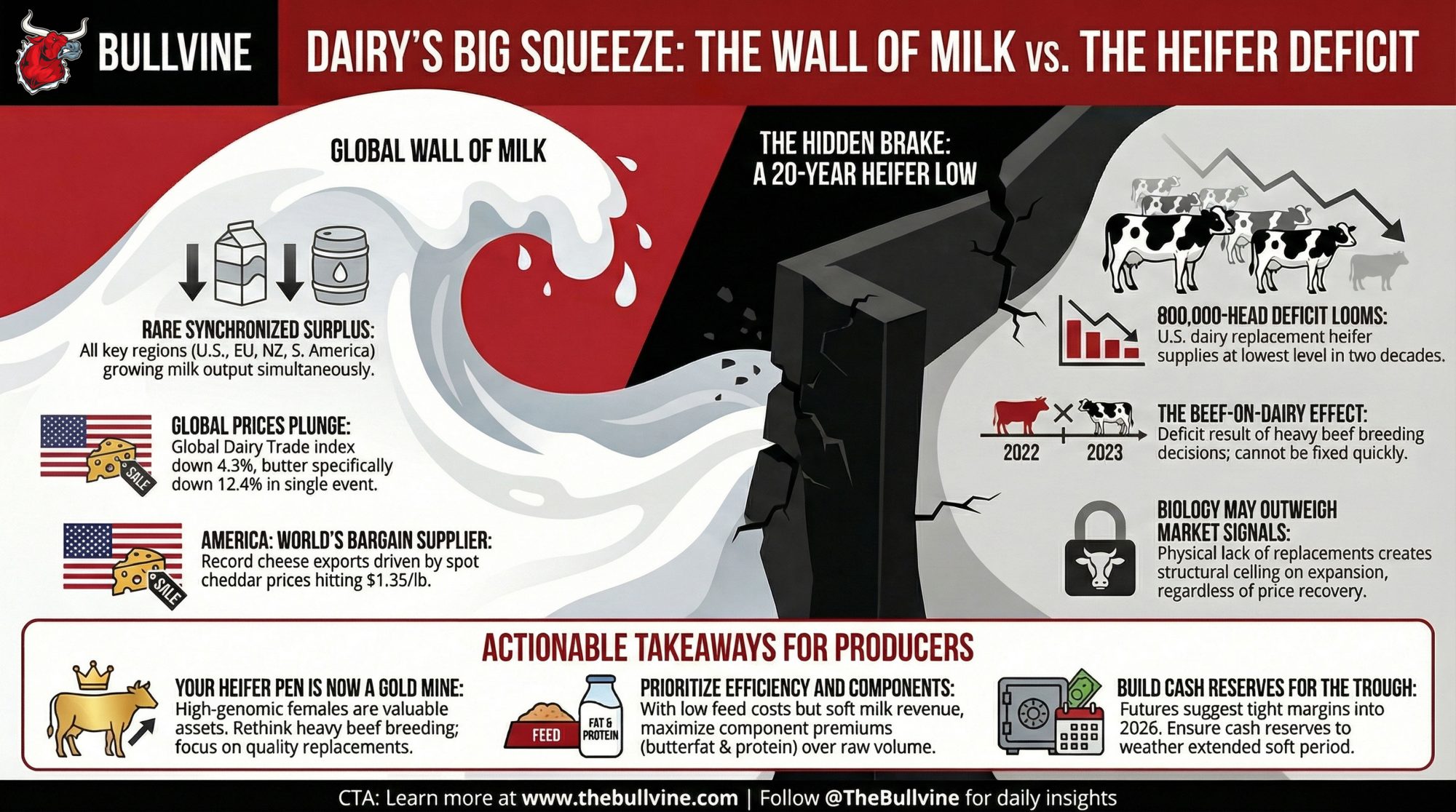
Executive Summary: The world is awash in milk. The U.S., Europe, New Zealand, and South America are all growing production simultaneously—a rare alignment that almost never occurs and has crushed the Global Dairy Trade index by 4.3%, with butter plunging 12.4% in a single auction. U.S. cheese exports are setting records, yet spot cheddar sits at just $1.35/lb; America has become the world’s bargain supplier. RaboResearch analysts don’t see meaningful price recovery through 2026, given relentless production growth. But here’s the structural twist worth watching: CoBank reports dairy heifer inventories at 20-year lows, with an 800,000-head deficit baked into the system from beef-on-dairy breeding decisions made in 2022-2023. Biology may ultimately accomplish what price signals haven’t. For farmers navigating this extended trough, the priorities are clear: cost control, component premiums, and cash reserves.
2025 Dairy Market Outlook

Something unusual is happening across the global dairy landscape right now—every major milk-producing region on earth is growing production at the same time. That almost never happens. And it’s reshaping price expectations heading into 2026.

Typically, when American parlors are running full, New Zealand deals with drought. When Europe expands, South American margins collapse. But as we close out 2025, that natural counterbalancing act has broken down entirely—and the market is feeling it.

“Milk output is growing in all key exporting regions, which is not common,” explained Lucas Fuess, senior dairy analyst at RaboResearch, in a December 2025 analysis. “Typically, at least one part of the world is dealing with a limiting factor that is reducing milk growth—either weather, disease, margins, or something else. Now, the U.S., EU, New Zealand, and South America are all seeing growth—simultaneously.” 

What this means practically is that the usual relief valves aren’t working. When everyone’s producing, someone has to buy—and right now, demand simply isn’t keeping pace.
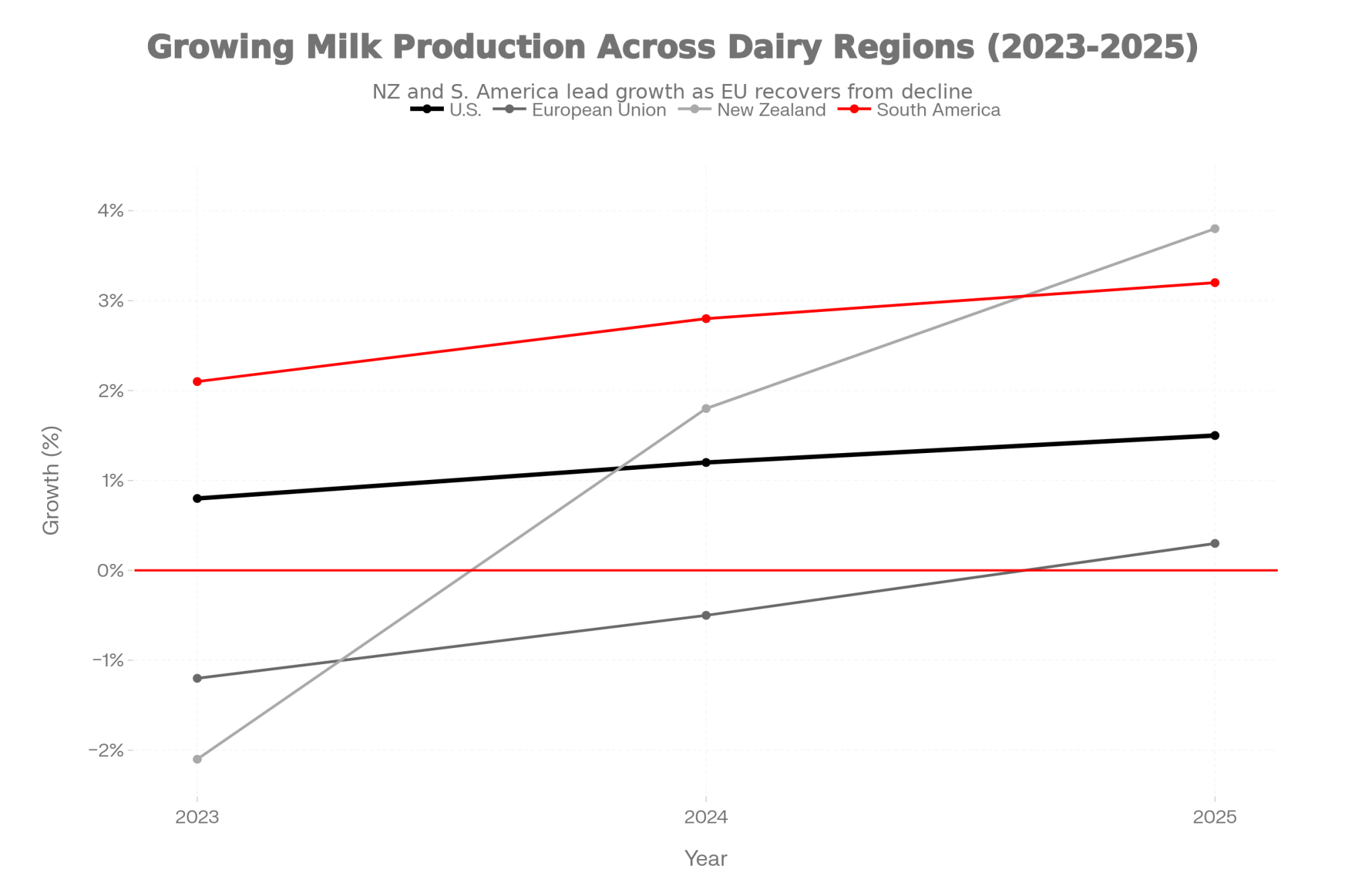
For the first time since 2018, all four major exporting regions are growing production simultaneously. Historically, drought in New Zealand or margin collapse in South America provided natural relief valves. Not this time. South America’s relentless 3.2% growth (red line) combined with New Zealand’s seasonal surge is flooding global markets—and that’s before we factor in the U.S. becoming the world’s discount cheese supplier. 

Global Dairy Trade: What the December Numbers Show

The Global Dairy Trade price index fell 4.3% at the most recent auction, with most product categories posting declines. Butter took the hardest hit—down 12.4% in a single event. Only cheddar (+7.2%), lactose (+4.2%), and buttermilk powder (+1.8%) managed gains. 
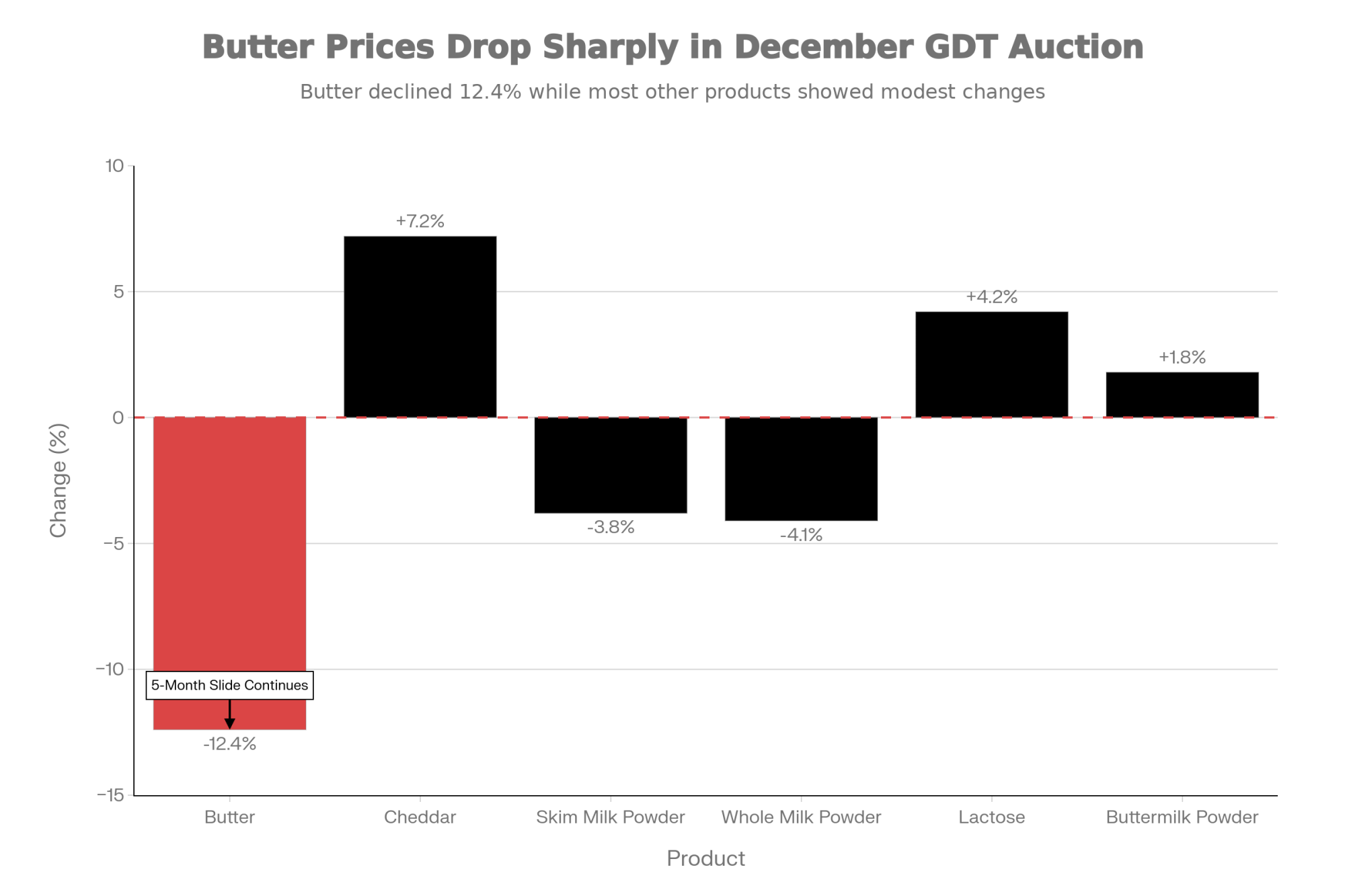
While the headline GDT index dropped 4.3%, the December auction revealed massive divergence: butter collapsed 12.4% in a single event, extending a five-month slide from May highs, while cheddar actually firmed +7.2%. This matters because it signals where global buyers see value—and where they don’t.

What strikes me about these numbers is the divergence between commodities. Butter has been sliding since May, when it reached five-year highs. Meanwhile, cheddar actually firmed at the latest auction. That kind of split tells you something important about how global buyers are thinking—they’re not avoiding dairy, they’re just getting selective about where they source it and what they’re buying.

Why U.S. Butter Became the World’s Bargain in 2025

Here’s something that deserves more attention: U.S. butter prices have sat well below European and New Zealand prices throughout all of 2025. That gap created an opportunity that global buyers noticed—and acted on.

“The US butter price has been well below the EU and NZ price throughout all of 2025,” Fuess noted. “This has driven global buyers to procure product from the US instead of other regions to recognize the value in US product.” 

John Hallo, procurement business partner at Maxum Foods, offered additional context on the New Zealand correction: “New Zealand pricing had been running at a premium from the USA/EU for four months, so I could argue their price was overinflated. Along with peak season supply of NZ fat, we have inevitably seen the correction.” 

The practical implication? That American price advantage is narrowing as global prices converge downward. Farmers who’ve been benefiting indirectly from strong export demand should watch these spreads closely heading into 2026.

U.S. Dairy Exports 2025: Record Cheese Volumes Meet Softening Spot Prices

The American export picture presents an interesting paradox. CME spot cheddar blocks closed the week of December 8-12 at $1.35 per pound, with butter averaging $1.4785/lb. Class III futures for December settled around $15.88/cwt, with Class IV hovering in the mid-$13s—hardly inspiring numbers for the milk check. (Daily Dairy Report, December 12, 2025)

And yet, U.S. cheese exports are having a record year. September shipments jumped 35% year-over-year, putting year-to-date volume at 453,076 metric tonnes. That’s already more cheese shipped abroad in nine months than in any full calendar year except 2024. The U.S. Dairy Export Council projects we’ll likely top 600,000 MT for the full year. (USDEC, December 11, 2025)

What I find telling is that we’re moving record cheese volumes at the exact moment spot prices are hitting 18-month lows. That disconnect reveals how global buyers think—they’re responding to relative value, not absolute price levels. When an American product is cheap compared to alternatives, they buy American. Simple as that.
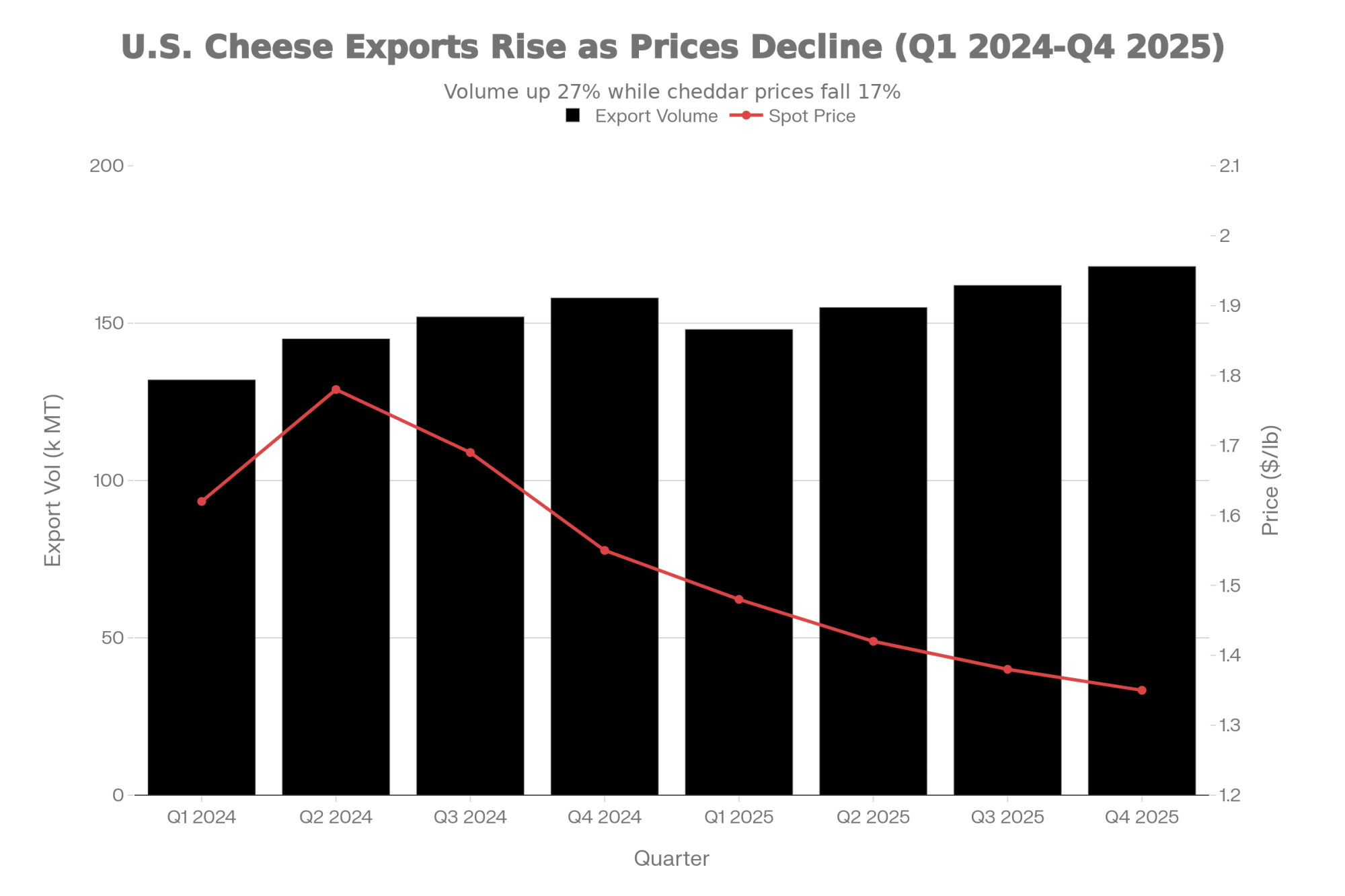
U.S. cheese exports are on track to exceed 600,000 MT in 2025—a record—while spot cheddar sits at $1.35/lb, down nearly 30% from mid-2024 peaks. This isn’t competitive excellence; it’s competitive desperation. Global buyers are choosing American cheese because we’re cheap, not because we’re better. 

Katie Burgess, dairy market advising director with Ever.Ag raised an important concern at the Oregon Dairy Farmers Convention earlier this year: “If we can’t get the cheese exported, and we’re making a lot of it, it means we’re going to need to eat a lot more cheese.” 

What University Research Is Showing About Milk Solids

Leonard Polzin, dairy markets and policy outreach specialist at the University of Wisconsin-Madison, has been tracking something important: production efficiency gains are outpacing headline milk volume. Despite modest total production growth, calculated milk solids production has increased more substantially because butterfat and protein tests keep climbing. (UW Extension Farms, 2025 Dairy Situation and Outlook)

For context, back in 2020, the average butterfat test was 3.95% and the protein test was 3.181%. Today’s tests are running notably higher than usual. This matters because it means the industry can meet demand for milk solids more quickly than raw production numbers suggest—processors get more usable product per hundredweight than they did five years ago. 

Additionally, UW-Madison research highlights that Federal Milk Marketing Order reforms taking effect are expected to decrease the All Milk Price by approximately $0.30/cwt, with a more pronounced impact on Class III prices. (UW Extension Farms, February 2025) That’s not a dramatic hit, but it’s another headwind for margins already under pressure.

The Heifer Constraint Nobody’s Talking About Enough

Here’s what makes the current situation genuinely unusual: despite soft milk prices, there’s a structural ceiling on how fast production can actually grow. Talk to producers across the Upper Midwest, and you hear the same story—replacement heifers are scarce and expensive.

According to CoBank’s August 2025 sector analysis, U.S. dairy replacement heifer supplies have fallen to their lowest levels in twenty years. The research projects heifer inventories will shrink by approximately 800,000 head over the next two years before beginning to recover in 2027. (CoBank/Wisconsin Ag Connection, August 2025)
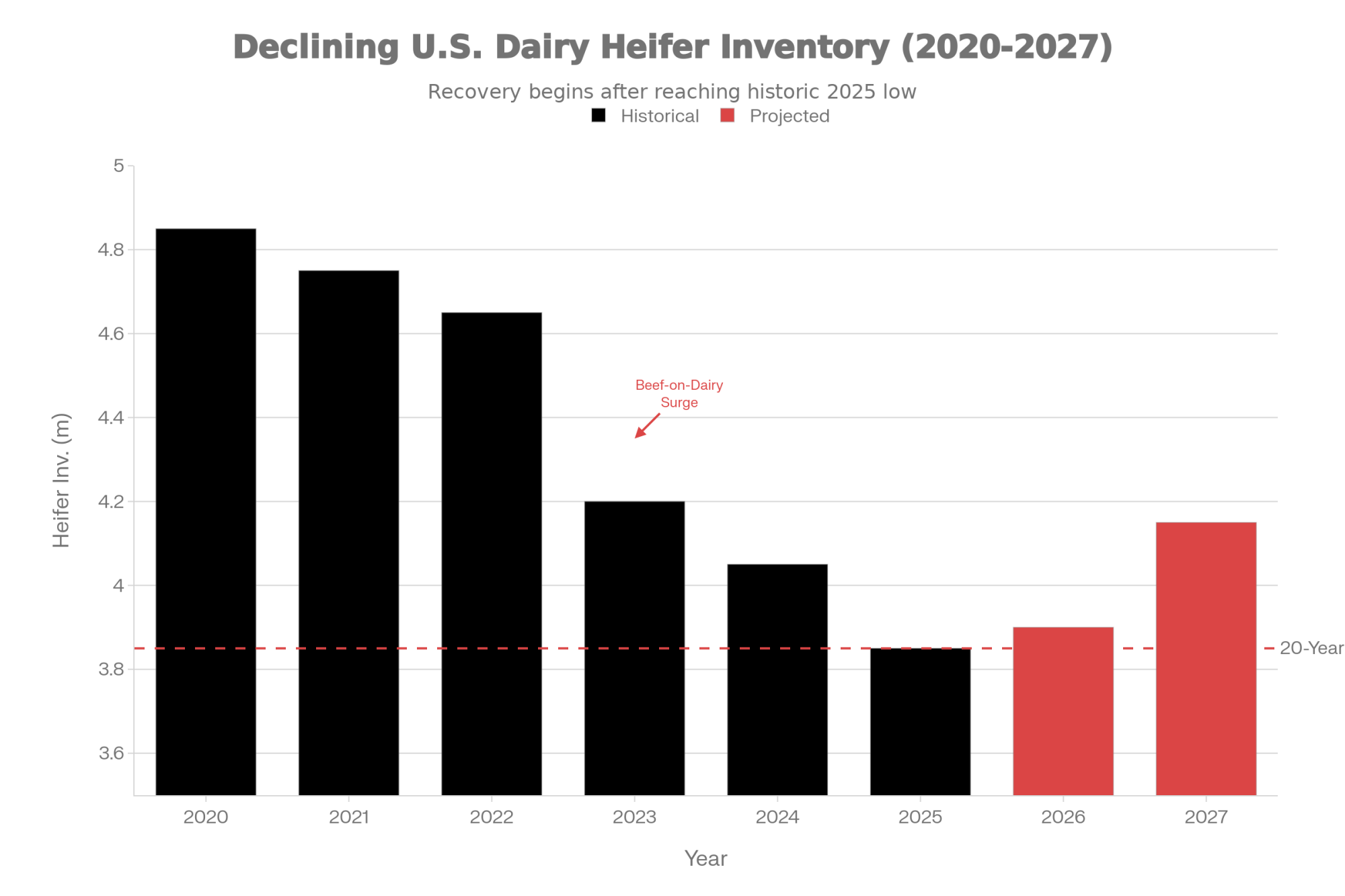
CoBank’s research reveals an 800,000-head deficit already baked into the system—the direct result of beef-on-dairy breeding decisions made during 2022-2023’s high beef prices. Here’s what makes this genuinely different: even if milk prices doubled tomorrow, you can’t breed your way out of a heifer shortage when the calves weren’t born three years ago. 

That 800,000-head deficit is already baked into the system based on breeding decisions made during 2022 and 2023 when beef-on-dairy crossbreeding surged. Biology dictates timing here—you can’t simply buy your way out of a heifer shortage when the calves weren’t born.

What this means practically: even if milk prices rose tomorrow and every producer wanted to expand, the replacement animals aren’t there to support rapid growth. It’s one reason why the supply response to current low prices may be slower than historical patterns would suggest—and why some analysts see eventual price support emerging from the supply side rather than demand.

The Bullvine Breeder’s Takeaway

The 800,000-head heifer deficit changes the math on your genetic inventory. Here’s what that means for breeding decisions:

  • Your heifer pen is now a gold mine. Verified high-genomic females will likely command premium prices through 2026 as processors compete for milk to fill new capacity.
  • Stop culling lightly. With replacements at 20-year lows, that “marginal” cow might be worth keeping for one more lactation.
  • Inventory as asset class. Heifers are no longer just a cost center—they’re increasingly liquid assets in a supply-constrained market.
  • Rethink beef-on-dairy. If you swung 70%+ to beef semen in 2023, review your genetic strategy immediately. The market is signaling a need for replacement purity, and premiums for verified dairy replacements are likely within 12 months.

European Dairy 2025: Less Milk, More Cheese

The EU situation offers its own set of complexities. USDA GAIN reports forecast milk deliveries at 149.4 million metric tonnes in 2025—down 0.2% from 2024. Low farmer margins, environmental regulations, and disease outbreaks continue pushing smaller producers out. 

But here’s the nuance that matters: European processors are deliberately prioritizing cheese over butter and powder. EU cheese production is forecast to rise 0.6% to 10.8 million metric tonnes, even with less total milk available. They’re making a strategic choice about where to allocate their milk supply—and cheese is winning. 

For American producers competing in export markets, this means European cheese will remain a competitive threat even as their overall milk production contracts.

New Zealand and Fonterra: Strong Collections, Cautious Outlook

New Zealand’s dairy sector continues performing well, though Fonterra’s latest forecast signals caution about where prices are heading. The cooperative narrowed its 2025/26 farmgate milk price range from NZ$9.00-$11.00 per kgMS down to NZ$9.00-$10.00 per kgMS in late November, with the midpoint dropping from NZ$10.00 to NZ$9.50. (Fonterra, November 25, 2025)

At the same time, Fonterra increased its milk collection forecast for the 2025/26 season from 1,525 million kgMS to 1,545 million kgMS—reflecting strong on-farm production conditions. Season-to-date collections through October were running 3.8% above last season. (Fonterra Global Dairy Update, November 2025)

CEO Miles Hurrell noted the cooperative has seen strong milk flows this season, “both in New Zealand and other milk-producing nations,” resulting in seven consecutive price drops at recent Global Dairy Trade events. Fonterra’s cooperative structure provides some insulation from spot-market volatility that investor-owned processors don’t enjoy, but its price guidance suggests it’s not expecting quick relief from current conditions.

China: Modest Import Recovery on the Horizon

After a brutal 17% decline in dairy imports through the first eight months of 2024, Rabobank forecasts Chinese dairy imports will improve by 2% year-on-year in 2025. Chinese farmgate milk prices have fallen to near 10-year lows, forcing herd reductions and farm exits that are constraining domestic supply. (Tridge/Rabobank, November 2024)

That said, a 2% increase helps at the margins but won’t fully absorb the global surplus on its own. The AHDB notes that most import growth is expected in the latter half of 2025 as domestic stocks weaken. (AHDB, February 2025) It’s a positive signal, not a rescue.

Feed Costs 2025: The One Clear Bright Spot

There’s genuinely good news on the cost side. March corn futures settled around $4.405/bu in mid-December, while January soybean meal closed near $302/ton. These represent meaningful relief for ration costs heading into 2026.

The catch—and there’s always a catch—is that feed savings don’t help if milk revenue falls faster. Margins are being compressed from the revenue side right now, not the cost side. Strong feed conversion efficiency and component production matter more than ever when the milk check is lean.

Cost/Revenue ComponentMid-2024 AverageDec 2025 AverageChange per Cow/Year
Corn ($/bu)$4.85$4.41-$96 (savings)
Soybean Meal ($/ton)$365$302-$142 (savings)
Total Feed Cost per Cow/Year$3,420$3,182-$238 (savings)
Milk Price per Cwt (Class III avg)$18.20$15.88-$522 (loss)
Annual Milk Revenue per Cow$4,368$3,811-$557 (loss)
Net Margin Impact (Revenue – Feed)-$319 per cow

The Price Signal That Hasn’t Triggered Supply Response

What farmers are finding, according to Fuess, is that milk prices simply haven’t dropped far enough to trigger the supply response markets typically need.

“Milk prices have declined in the US, but total dairy farmer income likely remains higher than the cost of production for most farmers, meaning there has not yet been a strong enough price signal to tell farmers to cull cows or cut production.” 

This creates a frustrating dynamic. Prices are low enough to hurt, but not low enough to force the contraction that would eventually support recovery. We may be stuck in this uncomfortable middle ground for a while—though the heifer shortage could ultimately do what price signals haven’t.

2026 Dairy Price Outlook: What Analysts Are Watching

Both Rabobank and Maxum Foods expect Europe to slip into a meaningful contraction next year, which should help ease the current oversupply.

“For the EU, there is a lag in falling farmgate price and reduction in milk production,” Hallo explained. “Coming off the back of good market conditions for farmers, the farms still produce good quantities despite falling commodity prices. This may look to correct itself mid-2026.” 

For U.S. producers, Fuess offered a more sobering assessment: “While volatility is never gone from the market, it is unlikely that US milk prices will see significant growth in 2026 due to the continually growing production.” 

Practical Considerations for Your Operation

Every farm faces different circumstances, but several themes emerge from the current market environment:

  • Cost management becomes your primary lever. With corn affordable and milk prices soft, feed efficiency and labor productivity matter enormously. Every dollar saved drops directly to the bottom line. This isn’t the time for sloppy ration management or deferred maintenance.
  • Component premiums over raw volume. High-protein, high-butterfat milk commands better prices at most plants. The Pennsylvania Dairy Producer Survey found that “increasing milk components” ranked among the highest-rated priorities across the state’s dairies in 2025. (Center for Dairy Excellence/Penn State Extension, 2025 Survey Results)Chasing volume into a surplus market amplifies the problem for everyone.
  • Beef-on-dairy revenue remains strong. With beef prices at historic highs, strategic terminal breeding can supplement dairy income while managing replacement inventory. The sustained strength in beef has made this supplementary income stream increasingly important to overall farm profitability—though it’s worth remembering that heavy beef breeding during 2022-2023 contributed to the heifer shortage now constraining expansion. 
  • Build cash reserves for an extended trough. Futures markets suggest sub-$16 Class III and sub-$14 Class IV through early 2026. That’s not a dip—that’s a prolonged soft period. Make sure your balance sheet can absorb six more months of tight margins, because the market isn’t signaling quick relief.

One important caveat: margin pressures vary significantly by region and operation size. Upper Midwest operations face different feed cost structures than Western dry-lot dairies, and component premiums differ by processor. What works for a 150-cow grazing operation in Vermont won’t necessarily apply to a 3,000-cow confinement dairy in Texas. Consult your nutritionist, your lender, and your local extension economist about your specific situation.

The Bottom Line

The global dairy market is sending a clear message: there’s more milk than buyers need right now, and sustained low prices will likely be required to rebalance supply and demand. Some analysts believe we’re approaching a floor. History suggests inflection points are notoriously difficult to call.

What’s interesting is that biology may ultimately accomplish what price signals haven’t—the 800,000-head heifer deficit documented by CoBank creates a hard ceiling on expansion that capital alone can’t override. By 2027, when $10 billion in new processing capacity needs filling, the cows to supply it may simply not exist.

Operations focused on efficiency, component quality, and cost discipline will be best positioned to weather this period—and to capitalize when conditions eventually turn.

Margin StrategyEstimated Impact per Cow/YearImplementation DifficultyWorks Best ForWhat this means
Component premium focus+$180-$320MediumAll herd sizes“Non-negotiable. Volume into a surplus is suicide.”
Feed efficiency optimization+$140-$220Low-MediumHerds >100 cows“Low-hanging fruit. Audit your ration immediately.”
Strategic beef-on-dairy+$250-$400LowHerds with replacement flexibility“Beef prices won’t save you, but they’ll soften the blow.”
Heifer inventory as asset+$150-$500HighHerds with genomic programs“Your heifer pen is now a gold mine. Stop culling verified genetics.”
Cash reserve buildingN/A (protects survival)MediumAll farms“Six months operating capital. Non-negotiable for 2026.”
Cull rate discipline+$80-$180LowHerds facing heifer shortage“That ‘marginal’ cow is worth one more lactation.”

Editor’s Note: Market data in this analysis comes from CME Group, Global Dairy Trade platform, USDA FAS reports, University of Wisconsin-Madison Extension, Penn State Extension, CoBank sector research, and industry analyst commentary from RaboResearch, Maxum Foods, and Ever.Ag (December 2025). National and regional averages may not reflect your specific operation’s circumstances. Feed and milk prices vary significantly by region, management practices, and market access.

Key Takeaways

  • Rare synchronized surplus: U.S., Europe, New Zealand, and South America are all growing milk production simultaneously—a phenomenon that almost never occurs and is crushing prices globally
  • December market snapshot: GDT index down 4.3%, butter plunged 12.4% in one auction, spot cheddar at $1.35/lb, Class III futures hovering near $15.88/cwt
  • America’s export paradox: U.S. cheese exports are setting records precisely because we’ve become the world’s cheapest supplier—though that advantage narrows as global prices converge
  • The 800,000-head constraint: Dairy heifer inventories have hit 20-year lows; this structural deficit from beef-on-dairy breeding may eventually limit supply when price signals alone haven’t
  • 2026 outlook and action items: RaboResearch sees no meaningful recovery until European contraction mid-year; prioritize cost control, component premiums, and cash reserves to weather an extended trough

Complete references and supporting documentation are available upon request by contacting the editorial team at editor@thebullvine.com.

Learn More:

Join the Revolution!

Join over 30,000 successful dairy professionals who rely on Bullvine Weekly for their competitive edge. Delivered directly to your inbox each week, our exclusive industry insights help you make smarter decisions while saving precious hours every week. Never miss critical updates on milk production trends, breakthrough technologies, and profit-boosting strategies that top producers are already implementing. Subscribe now to transform your dairy operation’s efficiency and profitability—your future success is just one click away.

NewsSubscribe
First
Last
Consent

Butterfat Crashed. Beef Calves Hit $1,400. Now What?

$3.71 butterfat in 2023. $1.70 today. Same cows. Different math. Different future.

Executive Summary: Butterfat crashed 54%—from a record $3.71/lb in October 2023 to $1.70 today. Beef-on-dairy calves now bring $1,400; dairy bulls, maybe $800. This isn’t a down cycle. It’s the year global oversupply, China’s growing self-sufficiency, and processor consolidation collided—and the old playbook stopped working. For 300-800 cow operations, the math is forcing real choices: scale hard, capture niche premiums, or use beef-on-dairy as a planned exit over 3-5 years. This analysis delivers the diagnostic tools—breakeven thresholds, debt ratios, the five questions to ask your lender—alongside an honest look at the mental health stakes when “just hang on” becomes dangerous advice. Waiting isn’t a strategy. It’s a decision by default.

You know, looking at 2025, a lot of producers are saying the same thing over a cup of coffee: “On paper this shouldn’t be a disaster year… so why does it feel like one?” Class III futures are hovering around $17/cwt according to the latest CME data. Butterfat premiums have been cut nearly in half from their 2022–2023 peaks—USDA component pricing shows we’ve gone from above $3.00/lb down to $1.70. And here’s the kicker: beef-cross calves are commanding $1,400 a head in organized sales while the milk check shrinks.

Milk is still moving. Dairy demand hasn’t fallen off a cliff. Some export numbers even look decent based on what Rabobank’s been reporting. Yet plenty of 300–800 cow herds are staring at negative cash flow, higher debt from 2024 expansions, and kids who aren’t sure they want in.

The sentiment among multi-generation producers is a familiar one these days. They followed the signals. They invested when they were supposed to. And now many are questioning whether the playbook has fundamentally changed.

What farmers are finding is that 2025 isn’t just another low-price year. It’s the year a lot of long-standing assumptions got stress-tested all at once—about global demand, butterfat premiums, beef-on-dairy, and how much processing steel the system can really keep full. So let’s walk through what the data and real-world stories are showing us, and what that means for the mid-sized commodity herds feeling the squeeze the most.

“2025 isn’t just another low-price year. It’s the year a lot of long-standing assumptions got stress-tested all at once.”

The Year Everyone Hit the Gas at the Same Time

If you step back and look at global numbers, the first big lesson is simple: we managed to grow milk almost everywhere at once.

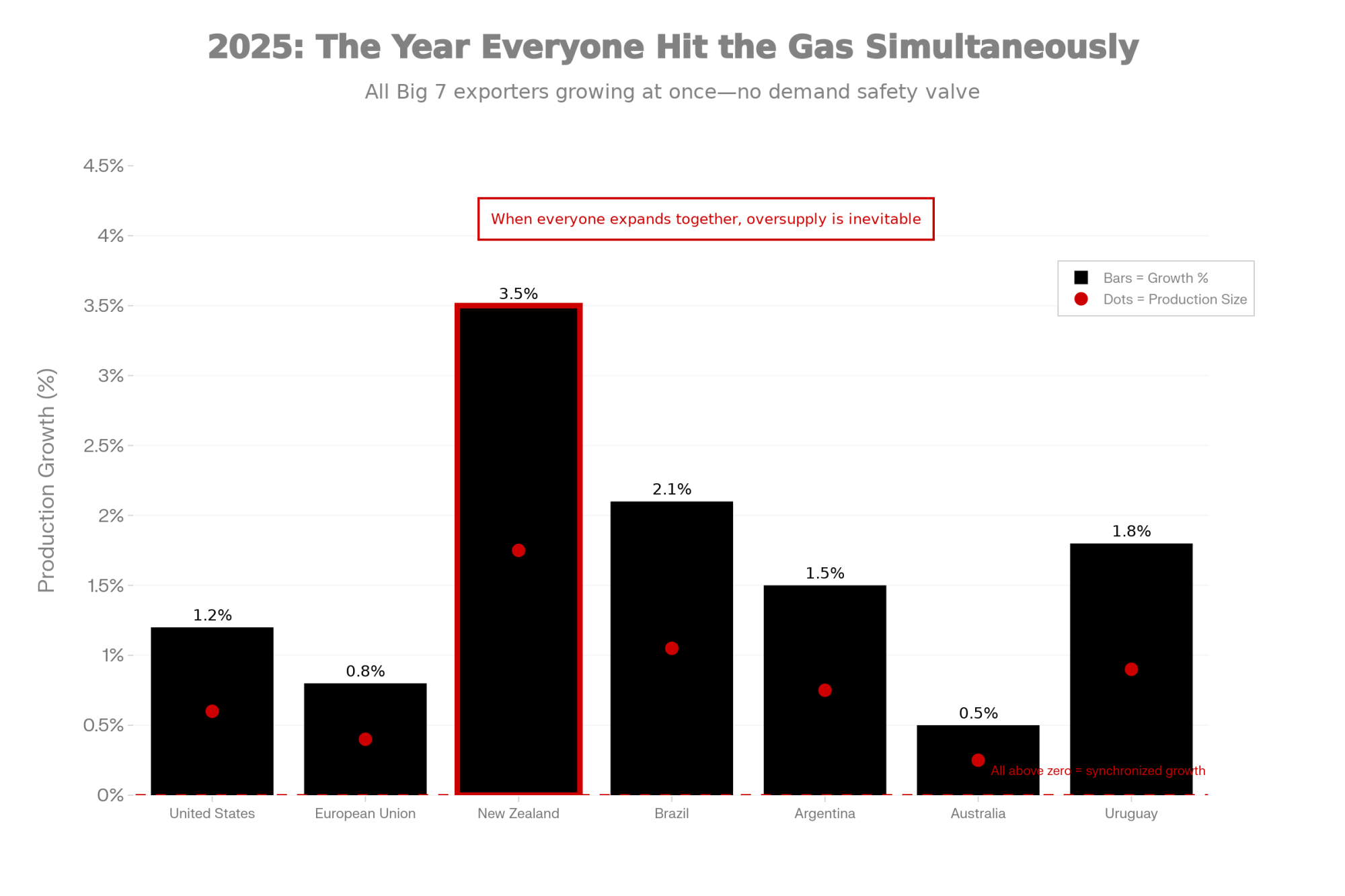
Rabobank’s late-2024 and 2025 global outlooks flagged something that probably should have gotten more attention. After several years of very modest growth, combined milk output from the major exporting regions—the “Big 7” of the US, EU, New Zealand, Australia, Brazil, Argentina, and Uruguay—was back in positive territory. On an annualized basis, Rabobank forecasts 2025 milk production from the Big 7 at 326.7 million metric tons—approximately 1–1.6% higher year-on-year, depending on the quarter measured—the highest annual volume gain since 2020.

Here’s why 2025 feels different: every major dairy exporter is growing production simultaneously—US, EU, New Zealand, Brazil, all in positive territory. That hasn’t happened since 2020. When the whole world expands at once and China stops absorbing the surplus, you get structural oversupply. This isn’t a down cycle. It’s a fundamental reset of the global dairy balance

United States: Volume on Top of Volume

USDA data shows the US dairy herd creeping back up toward 9.4–9.5 million cows by mid-2025, after earlier contraction. States like Texas, Kansas, and South Dakota led the way—in some periods, Texas was up by over 10% and Kansas by nearly 19%, according to USDA livestock reports. Monthly production in the first half of 2025 was regularly running several tenths of a percent to a few percent above the year before.

Here’s what’s interesting about where that growth landed. A lot of it didn’t go back into small parlor barns in traditional dairy counties. It went into dry-lot systems and large freestall complexes, specifically designed to handle high volumes of standardized milk for specific plants.

This creates a split reality we don’t talk about enough. In Texas and Kansas, expansion is still penciling out for operations built around $16 milk and economies of scale. Meanwhile, traditional dairy states like Wisconsin, New York, and Pennsylvania face a different equation entirely—higher land costs, older facilities, tighter environmental rules, and processors who may be more interested in sourcing from the new mega-plants out west.

California sits in its own category. Still a production giant, but increasingly constrained by water policy under SGMA and labor costs that have pushed some herds to relocate or downsize. Same industry, very different local math.

Europe and Oceania: Back in Expansion Mode

On the other side of the Atlantic, 2024 forecasts projected stable-to-slightly higher EU milk deliveries as margins improved from earlier lows. Ireland, Poland, and some German regions have all contributed to that uptick, offsetting declines in more constrained zones.

In New Zealand, Fonterra’s updates through late 2024 and 2025 pointed to milk collections running 2–4% ahead of the prior season in some periods. Reasonable pasture growth and a farmgate price forecast that—while trimmed at times—still kept most herds milking hard. Add in recovering output in Brazil and Argentina, and global trade reports going into 2025 were pretty consistent: exportable milk supply was growing again across the big players at the same time.

That’s our backdrop. Now layer on demand.

When the “China Safety Valve” Stopped Working the Way It Used To

For close to a decade, a lot of quiet boardroom confidence in export expansion could be summed up in one thought: “If we’re a little long on powder or whey, China will take it.” That was never entirely true, but it was true enough to guide a lot of investments.

Recent Chinese dairy outlooks from the USDA’s Foreign Agricultural Service tell a different story. Over the last several years, Chinese raw milk production has risen steadily, backed by large-scale commercial dairies and improved fresh cow management. At the same time, Chinese imports of some dairy commodities have flattened or declined—particularly whole milk powder—as domestic supply fills more of the pipeline.

Rabobank Research highlighted that net dairy product import volumes in 2024 fell by 12% from a year earlier, with skim milk powder imports dropping by nearly 37% according to their December 2024 analysis. Chinese buying is still important, but it’s no longer the automatic “pressure release” it once seemed to be.

So in 2025, we have more exportable milk from the US, EU, New Zealand, and South America… and a key customer that’s now partly replacing imports with its own production. The world is less forgiving of synchronized overproduction than it was ten years ago.

How the Component Story Flipped on High-Butterfat Herds

Now let’s zoom back into the bulk tank.

Here’s the supply crisis nobody’s talking about: butterfat production is exploding at 5.3% while milk volume crawls at 0.5%. That 10x divergence explains why cream buyers have the upper hand and why your high-fat breeding strategy from 2020 is now crushing your margins. Volume numbers lie—component pounds tell the truth

For most of the last decade, breeding and feeding for top-end butterfat performance was one of the clearest, most rational strategies available. Butter prices were strong. Fat-based milk pricing rewarded high tests. Nutrition and genetics teams encouraged ration tweaks and sire selection that reliably bumped herd butterfat 0.2–0.4 points over time.

And you know what? It worked beautifully. According to Federal Milk Marketing Order data reported by USDA, butterfat saw five consecutive months of record-breaking prices in 2022, from June to October, with prices ranging from $3.33 to $3.66 per pound. Then in October 2023, butterfat hit a new summit of $3.7144 per pound—an all-time record.

The Great Butterfat Crash reveals the brutal math facing dairy producers: a 54% price collapse from $3.71 to $1.70 per pound while protein stayed steady. This isn’t a cycle—it’s a structural reset that makes every breeding and feeding decision from the last decade suddenly obsolete

Not surprisingly, farmers responded. By late 2023, commentaries from US economists and industry consultants noted that national butterfat production had grown faster than protein output as herds and rations adjusted to these incentives. We did exactly what the market told us to do.

2025: Butterfat Comes Back to Earth

By late 2025, that story had changed dramatically. USDA’s November 2025 component price announcement shows butterfat at $1.7061 per pound—down more than 54% from that October 2023 peak. November butterfat fell almost 12 cents from October and was $1.20 less than the $2.91 per pound value from one year ago. Protein, meanwhile, has held steadier at $3.01 per pound according to USDA Dairy Market News.

One ag economist told Brownfield in October 2025 that US producers should pay more attention to protein going forward, because relative protein value was expected to play a larger role in milk checks than in recent years.

For herds that had pushed bulk tank fat to 4.3–4.5% and beyond, this doesn’t mean they were “wrong.” But it does mean the payback period on those genetic and ration decisions suddenly got longer.

What’s important to understand—and I think this gets missed sometimes—is that you can’t “un-breed” a cow in a year. It takes two or three calf crops, plus solid fresh cow and transition management, to materially shift the herd’s component profile. That lag is exactly why many producers started looking for a faster-acting lever to help the milk check in 2025: the beef-on-dairy calf.

Beef-on-Dairy: From Extra Cash to Core Margin Tool

If you want to see how quickly economics can reshape breeding philosophy, just look at the 2025 calf markets. According to Laurence Williams, dairy-beef cross development lead at Purina Animal Nutrition, beef-on-dairy calf prices averaged about $650 three years ago, compared to today’s average of $1,400 for day-old beef-on-dairy calves. A 2025 report puts current prices at $1,000 to $1,500 per head, driven by strong demand for high-quality beef and tight supplies.

Beef-on-dairy calves exploded from $650 to $1,400—a 115% gain that’s rewriting the dairy business model. Meanwhile, replacement heifers jumped 58% to $2,850, creating a profitability squeeze that forces every producer to recalculate their breeding strategy. The question isn’t whether to use beef semen anymore—it’s how much
YearBeef on Dairy Calf PriceHolstein Bull Calf PriceReplacement Heifer Price
2022650501800
20239001501990
202412006002400
202514008002850

Meanwhile, even Holstein dairy bull calves—once nearly worthless—can today fetch as much as $10 per pound at auction because of historically high beef prices, according to Christoph Wand, livestock sustainability specialist with Ontario’s Ministry of Agriculture, Food and Rural Affairs. But a dairy-beef crossbred animal commands about 50% more.

Academic and extension work backs up the economic case. A 2021 analysis in JDS Communications found that when beef calves sell at a strong premium, using beef semen on lower genetic merit cows can significantly improve whole-farm profitability—especially when sexed dairy semen is used strategically on replacements. A 2023 paper in Animals, which modeled beef-on-dairy strategies at herd and sector levels, reached similar conclusions.

As many producers have been sharing at industry meetings lately, the beef calf check in some months now rivals or exceeds net milk margin. That’s not a side hustle anymore. That’s starting to look like a business model.

What we’re all figuring out is there’s a tipping point where this shifts from “nice emergency cash” to “core business model.”

  • At 20–30% of breedings to beef, beef calves feel like a smart way to trim replacement heifer numbers and pick up needed cash. Milk remains the clear focus.
  • Somewhere around 40–60%, the beef calf check can rival or even exceed net milk income in tough years, especially for mid-sized herds.
  • Above 70% beef usage, the operation starts to resemble a confinement cow-calf system that happens to have a milk parlor attached.

That’s not a moral judgment—the cow is perfectly capable of playing both roles. The key is that this shift has downstream consequences, especially for processors and milk sheds built on the assumption of a steady dairy-only supply.

Processors, Plants, and the Risk of Empty Steel

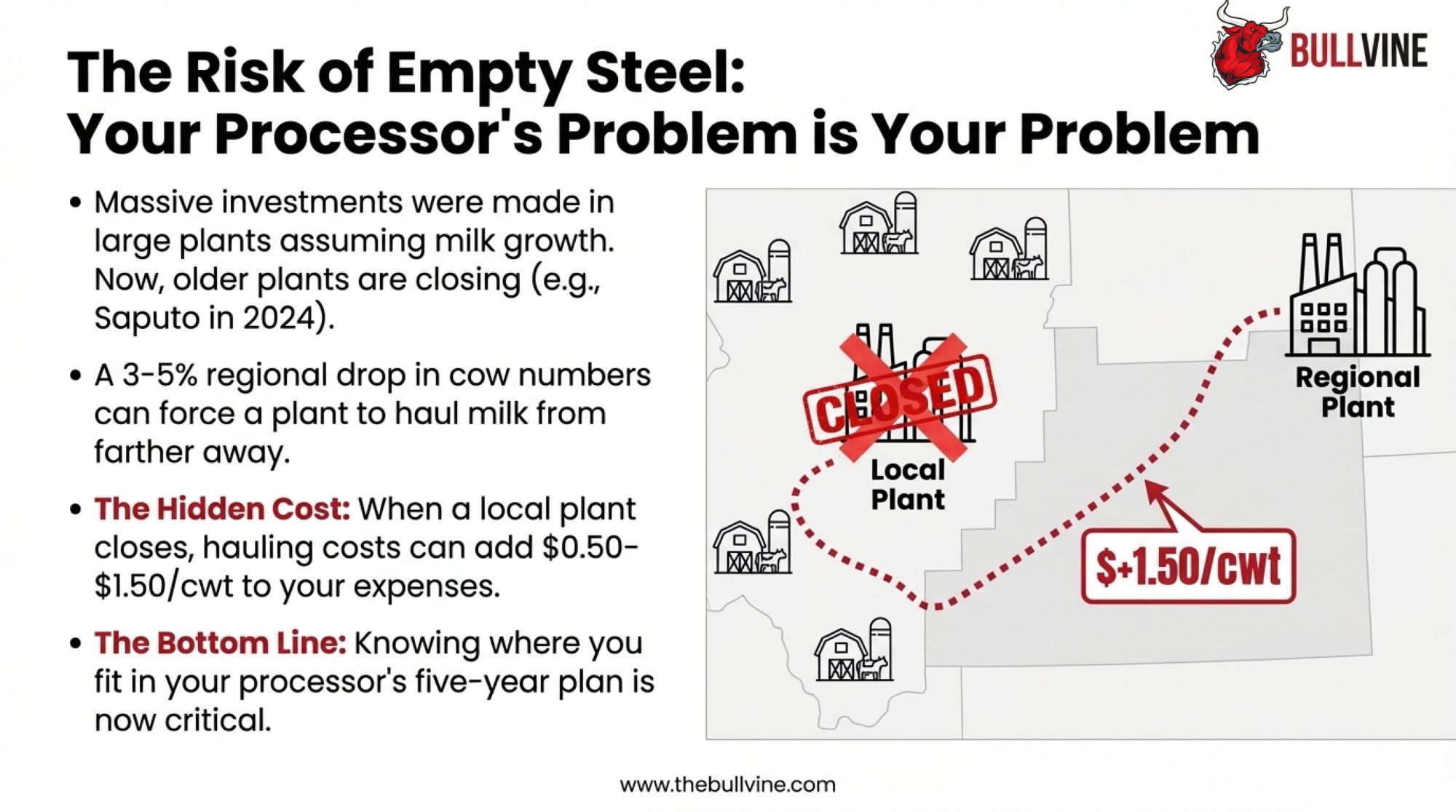
While all of this is happening on the farm, processors are juggling their own challenges. Over the past decade, North America saw massive investment in large, efficient processing plants designed to handle millions of pounds daily. Those decisions assumed long-run milk growth and strong export markets.

At the same time, older, smaller plants keep closing. In 2024, Saputo announced closures of several US facilities as part of a network optimization plan. Regional media in 2025 highlighted more closures in the Northeast and parts of Canada.

Here’s why this matters to you: keeping plants viable depends on high utilization and dense, local milk supplies. Even a 3–5% regional reduction in cow numbers can force a plant to haul milk from farther away or cut shifts. And hauling costs have climbed—milk transport expenses now run $0.50–$1.50/cwt more when a nearby plant closes, and milk has to travel an extra 100–150 miles round-trip.

The remaining dedicated dairies—folks who want to stay 100% in milk—can end up paying part of the bill for regional consolidation, even if they themselves haven’t downsized. That’s one more reason to know where your buyer sees you fitting in their long-term supply plans.

The Quiet Load: Mental Health and Identity in a Restructuring Industry

Up to this point, we’ve mostly talked numbers. But the other part of the 2025 story—the part that doesn’t show up in USDA reports—is the mental and emotional toll of trying to navigate all this change while the bills are due every month.

Multiple studies and policy briefs over the past few years have documented that farmers, including dairy farmers, face significantly higher suicide risk than the general population. CDC data and rural health research put it at often around three-and-a-half times higher, depending on the dataset. A 2024 paper in FACETS reviewing Canadian data linked poor mental health directly to stressors such as financial pressure, weather extremes, and the feeling of being trapped between tradition and economics.

Qualitative work focused on agricultural communities has found similar themes. Farmers talk about isolation, stigma around seeking help, and the unique pain of feeling like “the generation that lost the farm.” A 2021 systematic review of farmer mental health interventions highlighted both the scale of the issue and the need for supports that actually fit farm culture and schedules.

Dairy-specific stories in 2024–2025 from farm mental health organizations describe producers who came very close to suicide during prolonged downturns, often when they felt powerless to change course or communicate with family and lenders. Many of these farmers eventually decided on a concrete plan—scaling back, changing enterprises, or exiting—that gave them what one producer called “permission to breathe again.”

“I think a lot of us tie our self-worth to the operation,” one Upper Midwest producer told a farm stress counselor in a 2025. “When the numbers say you’re failing, it feels like you’re failing—not just the business.”

From a purely business perspective, it can be tempting to say “hang on for better prices.” From a human perspective, there’s a point where “tough it out” becomes dangerous advice—especially when a farm is burning equity simply to keep operating with no clear path back to profitability.

The point isn’t that everyone should sell out. It’s that mental health and business planning are now inseparable topics. Decisions about scaling, shifting to beef-on-dairy, taking on new debt, or stepping away all have real emotional weight. And that weight deserves as much open, factual discussion as the milk-to-feed ratio.

A Simple Diagnostic for 300–800 Cow Commodity Herds

Most Bullvine readers aren’t running 30,000-cow dry lots or tiny direct-market dairies. You’re probably in that 300–800 cow band—big enough to be a full-time enterprise, small enough to feel exposed when margins shrink.

Based on extension work, lender guidance, and whole-farm modeling from land-grant universities, three numbers can really sharpen the conversation about next steps.

1. Your True All-in Breakeven

This isn’t just feed and vet. It’s everything:

All-in breakeven = (Total farm expenses + principal & interest + family living) ÷ cwt sold. Using USDA’s Dairy Margin Coverage calculations, the average dairy producer spent $9.38/cwt on feed alone in August 2025—down from $9.86/cwt in July.  August feed costs were the lowest for any month since October 2020. 2024 Northeast Dairy Farm Summary showed a net cost of production at $21.49/cwt, down $1.15 from 2023.

Studies suggest efficient herds can still produce milk in the high teens per cwt all-in, while others sit in the low 20s once all costs are honestly accounted for.

As a rough rule of thumb…

  • If your honest all-in breakeven is under $18.50/cwt, you’re positioned to consider careful growth if demand justifies it.
  • If you’re between $18.50 and $20.50, you’re in the “tight but workable” zone, where beef-on-dairy, better component focus, or cost control can make the difference.
  • If your all-in breakeven is consistently above $20.50, and local mailbox prices are expected to average well below that, then every tanker load you ship deepens the hole unless you have strong non-milk income.
The uncomfortable truth: 75% of mid-sized herds are in the squeeze zone or worse. If your breakeven is above $20.50/cwt and milk prices average $17-$18, every tanker load deepens the hole. This isn’t a chart—it’s a mirror. Which tier are you really in when you count EVERYTHING, including family living and debt service?

2. Debt-to-Asset and Working Capital

Look at your debt-to-asset ratio—using realistic values for land, cows, and facilities. Not peak boom prices. Farm financial work from universities and ag lenders generally marks 35–40% D/A as a comfortable zone, and anything over 50–60% as a caution area where new borrowing becomes riskier.

Similarly, working capital (current assets minus current liabilities) should be at least 15–20% of gross farm revenue to handle volatility safely. If you’ve slipped below 10%, even small shocks can force fire-drill decisions.

3. Matching Numbers to a Path

Once you’ve run those numbers, three broad paths look clearer.

Path 1: Scale Aggressively makes sense when costs are already competitive (breakeven in the high-teens), debt-to-asset is modest, working capital is healthy, and a processor explicitly wants additional volume. Some 2024–2025 appraisals have documented distressed facilities selling at 40–60 cents on the dollar.

Path 2: Capture Premium or Niche Value looks promising when you’re near urban markets or specialty processors for organic, A2, grass-based, or farmstead products. You need contracted premiums that justify the extra work.

Path 3: Strategic Exit or “Milk-Out” with Beef-on-Dairy deserves attention when all-in breakeven is consistently above realistic price expectations, debt-to-asset is high, and there’s no next generation eager to step in. Some herds are using beef-on-dairy as a 3–5 year glide path—selling high-value calves and older cows while avoiding the cost of raising many replacements.

Five Questions to Discuss with Your Lender in 2026

  1. “If milk prices stayed where they are for the next two years, what would our cash flow and equity position look like?”
  2. “What’s our true all-in breakeven right now—not our best year, but our honest trailing twelve months?”
  3. “Where does our processor see us in their five-year supply plan? Are we core, or are we on the margin?”
  4. “If we shifted 50% of breedings to beef and stopped raising most replacements, what does that do to our debt service capacity over 36 months?”
  5. “At what point would you advise us to exit with equity intact rather than continue operating at a loss?”

These aren’t comfortable questions. But they’re the ones that can turn a vague sense of pressure into a concrete plan—one way or another.

How This Looks in Your Region

National averages hide a lot of variation. The 2025 squeeze doesn’t hit every geography the same way.

High Plains (Texas, Kansas, New Mexico): Expansion is still happening, driven by new processing capacity and relatively low costs. If you’re already here with scale, the game is volume and efficiency. Heat stress management becomes a year-round conversation.

Upper Midwest (Wisconsin, Minnesota, Michigan): Traditional dairy country is caught in the middle. Strong infrastructure, but older facilities, tighter environmental rules, and a wave of 50–200 cow retirements. Many Midwest producers report running the beef-on-dairy numbers very seriously for the first time.

Northeast (New York, Pennsylvania, Vermont): Proximity to population centers creates niche opportunities—fluid, organic, farmstead. But commodity margins are brutal, given land and labor costs. Northeast producers often note they’re not competing with Kansas—they’re competing with the farm down the road for the same premium slot.

California: Still a powerhouse, but increasingly constrained by water policy under SGMA, labor costs, and air quality rules. Some herds are relocating; others are doubling down on efficiency or specialty markets.

Canada: Supply management provides price stability but limits growth. The pressure shows up differently—less about survival, more about succession and quota value as the next generation weighs options.

No single playbook fits everywhere. The key is understanding which forces are strongest in your specific situation.

Key Takeaways: How to Use 2025 as a Turning Point

2025 is a structural stress test, not just a price dip. Synchronized production growth, China’s partial self-sufficiency, component pricing shifts, and processing consolidation all lined up this year. Those forces are likely to return.

Beef-on-dairy has become a core margin tool. With beef-cross calves worth several times a straight dairy bull, and good research backing the economics, it’s a strategy every herd should run the numbers on. The key is deciding how far up that scale you want to go.

Component focus needs a reset, not a reversal. Butterfat had a great decade. Protein and overall solids will deserve more attention going forward. Flexibility and balance matter more than chasing a single number.

Processing relationships matter more than ever. With plant closures reshaping where milk can go, knowing your buyer’s long-term plans is as important as any ration change.

Mental health isn’t separate from business planning. High suicide rates remind us that “just toughing it out” can be far costlier than a few bad years on a tax return. Sometimes the bravest decision is to change course in time.

Policy tools exist, but face real barriers. Supply management, environmental caps, and coordinated export agreements could, in theory, dampen boom-bust cycles. In practice, structural volatility is likely to persist. Betting on policy rescue probably isn’t a sound business plan for 2026.

If there’s one encouraging thread through all of this, it’s that information and tools are better than ever. We have more transparent market data, more refined economic models, and more breeding and management options than our predecessors did. The hard part is being willing to look those numbers in the eye and let them inform decisions, even when the answers aren’t what we hoped for.

What 2025 offers, if we let it, is a chance to re-align our operations with the new reality—whether that means becoming a lean, scalable commodity producer, a differentiated value creator, or a family that chooses to step away with its equity and relationships intact.

That’s not an easy conversation. But it’s one worth having now, while there are still options on the table.

Complete references and supporting documentation are available upon request by contacting the editorial team at editor@thebullvine.com.

Learn More:

Join the Revolution!

Join over 30,000 successful dairy professionals who rely on Bullvine Weekly for their competitive edge. Delivered directly to your inbox each week, our exclusive industry insights help you make smarter decisions while saving precious hours every week. Never miss critical updates on milk production trends, breakthrough technologies, and profit-boosting strategies that top producers are already implementing. Subscribe now to transform your dairy operation’s efficiency and profitability—your future success is just one click away.

NewsSubscribe
First
Last
Consent

2025 Dairy Market Reality Check: Why Everything You Think You Know About This Year’s Outlook is Wrong

Stop chasing milk volume. Component revolution delivers 1.65% production gains while volume drops 0.35%. Smart farmers capture $8B opportunity.

 2025 dairy market outlook, milk component optimization, dairy profitability strategies, FMMO reforms impact, dairy export opportunities

Here’s the brutal truth: While industry cheerleaders point to modest growth forecasts, they’re missing a seismic shift that’s rewriting the rules of dairy profitability. The component revolution creates winners and losers overnight, policy chaos reshapes margins, and most farmers are still making decisions based on yesterday’s playbook.

The Numbers Game Everyone’s Getting Wrong

Let’s cut through the feel-good industry reports and look at what’s really happening. The U.S. dairy sector is projected to produce 226.9 billion pounds of milk in 2025—a modest 0.5% increase that sounds like business as usual. But here’s what those vanilla forecasts don’t tell you: we’re witnessing the death of volume-based thinking.

While total milk production crawls forward, butterfat production exploded 3.4% year-over-year in the first quarter of 2025. Think about that for a second. Your cows aren’t just making more milk—they’re making fundamentally different milk. The average U.S. butterfat test hit 4.36% in March 2025, up nearly nine basis points from last year. Protein tests climbed to 3.38%.

These aren’t just statistics—they’re profit opportunities most farmers haven’t figured out how to capture.

Despite a 0.35% decline in total milk production year-to-date through March, calculated milk solids production increased 1.65%. Your operation is becoming a component factory, and the old milk check calculations no longer reflect true value.

The Price Forecasting Disaster

Here’s where it gets interesting—and concerning. USDA’s all-milk price forecasts have been all over the map. February projections started at $22.60 per hundredweight and dropped to $21.60 in March, with some analysts citing figures as high as $22.75.

That level of volatility in official forecasts within months? That’s not market analysis—that’s educated guessing in a fundamentally changed environment.

Class III Price Comparison: USDA Forecast Revisions

MonthClass III Forecast ($/cwt)Revision Direction
February 2025$19.10Baseline
March 2025$17.95Down $1.15
April 2025$17.60Down $1.50 from Feb

Source: University of Wisconsin Extension, USDA reports

The problem? These forecasts assume traditional milk composition and processing patterns. What happens when the underlying milk supply has fundamentally different economics? The models break down.

The Policy Earthquake Nobody Prepared For

While farmers debate whether milk will hit $22 or $23, Federal Milk Marketing Order reforms taking effect June 1st are reshaping the entire game.

The return to “higher-of” Class I pricing will put more money in the pool, but updated make allowances for cheese ($0.2519/lb), butter ($0.2272/lb), and nonfat dry milk ($0.2393/lb) will initially lower Class III and IV prices.

Here’s the kicker: These changes create regional winners and losers overnight. Farmers in high Class I utilization areas win. Those in manufacturing regions? You’re about to subsidize everyone else.

But the real earthquake is trade policy uncertainty. Research from the University of Wisconsin shows that 25% retaliatory tariffs could:

  • Reduce all-milk prices by $1.90 per hundredweight
  • Decrease U.S. dairy export values by $22 billion over four years
  • Drop Class III prices by $2.86 per hundredweight

With Mexico, Canada, and China accounting for 40% of U.S. dairy export value, those aren’t just statistics—they’re survival numbers.

The $8 Billion Processing Revolution

Here’s a fact that should change how you think about 2025: The U.S. dairy industry has more than $8 billion in processing infrastructure investment happening right now.

Major Processing Investments Creating Demand

CompanyInvestmentLocationCapacity Impact
Walmart$350 millionTexasNew distribution hub
Fairlife$650 millionNew YorkFluid milk expansion
Chobani$1.2 billionNew YorkYogurt/processing

Source: University of Wisconsin Extension analysis

This isn’t just expansion—it’s demand creation that will compete for your milk. Much of this new capacity focuses on cheese production, increasing Class III utilization and eventually pressuring prices as more products hit the market.

Smart farmers are already positioning themselves as strategic suppliers rather than replaceable inputs.

The Component Revolution Most Are Missing

Forget everything you think you know about milk pricing. Despite overall production declining 0.35% year-to-date, milk solids production jumped 1.65% through March 2025.

The updated FMMO composition factors taking effect December 1st will reward farmers producing milk with 3.3% protein and 6.0% other solids. If you’ve been investing in genetics and nutrition to boost components, you will get paid for it. If you haven’t? You’re financing those who have.

Component Performance Reality Check:

  • 2020 average butterfat: 3.95%
  • 2025 average butterfat: 4.36% (+0.41 percentage points)
  • 2020 average protein: 3.181%
  • 2025 average protein: 3.38% (+0.199 percentage points)

This isn’t a gradual change—it’s a fundamental shift in what your cows produce and how you get paid for it.

Export Markets: The Hidden Opportunity

While everyone worries about domestic policies, U.S. cheese exports are crushing it. January 2025 dairy export values surged 20% year-over-year to a record $714 million, driven by butterfat exports up 41%.

Key Export Performance Indicators:

Product CategoryJanuary 2025 PerformanceDriver
Butter exports+41% year-over-yearPrice competitiveness
Anhydrous milkfat+525% year-over-yearGlobal demand
Total export value$714 million (record)Component focus

Source: University of Wisconsin Extension, USDA trade data

U.S. butter prices in May 2025 were $2.33 per pound compared to EU prices of $3.75 and Oceania at $3.54. That’s not a small edge—it’s a massive competitive advantage.

But here’s the catch: exports of nonfat dry milk dropped 20% in January and 28% in February. The winners are those aligned with component-rich products. The losers are stuck in commodity thinking.

Risk Management in the New Reality

Traditional risk management is failing because it’s built on assumptions that no longer exist. Historical models become dangerous when trade policies can slash prices overnight and component premiums reshape milk values.

What Actually Works:

Dairy Margin Coverage Performance: From 2018-2024, DMC issued payments in 66.7% of months, averaging $1.35/cwt after premiums. That’s solid catastrophic protection, but it won’t capture upside opportunities.

Component-Based Strategy: Instead of hedging milk prices, hedge component values. Lock in fat and protein premiums when markets favor them.

Processor Relationship Management: Your biggest risk isn’t market volatility—it’s being replaceable. Processors with expanding capacity need reliable suppliers who deliver consistent quality and components.

Labor Crisis: The Hidden Threat

Labor accounts for 25% of total dairy farm operating costs, and proposed immigration policies that reduce non-U.S. worker availability could increase wage costs by 20% and cause a 10% productivity decline.

Do the math: For operations with $2 million in annual costs, that’s a $100,000 yearly increase plus productivity losses. Research shows this could reduce net farm operating income by $64,482 annually—a 30.9% reduction.

Smart operations already invest in automation, employee retention programs, and cross-training systems.

The Global Chess Game

While U.S. farmers focus domestically, global moves are setting up 2025 opportunities. China’s domestic milk production is forecast to decline 2.6% year-over-year—the second consecutive year of reduced output.

EU cheese prices are up 19% year-over-year in early 2025 as processors prioritize high-value products amid constrained milk supplies. New Zealand production is expected to increase by 1.2%, but U.S. geographic advantages for North American markets remain strong.

The strategic question isn’t whether global markets will grow—it’s whether you’re positioned to capture that growth through the right processor relationships and component optimization.

Why 2025 Separates Winners from Survivors

The conventional wisdom is wrong. 2025 isn’t a stable, moderately profitable year. It’s a pivot point that will separate strategic operators from reactive farmers.

Winners will:

  • Understand milk as a portfolio of components, not a commodity
  • Build processor relationships based on strategic value delivery
  • Invest in genetics and nutrition for component optimization
  • Implement risk management accounting for policy volatility
  • View sustainability as a competitive positioning

Survivors will:

  • Focus on volume over components
  • Compete primarily on cost
  • Rely on outdated risk management tools
  • View policy changes as external threats

The Bottom Line

The dairy industry is transforming faster than most farmers realize. Component economics is replacing volume thinking. Processor relationships are becoming strategic partnerships. Policy volatility is the new normal.

The opportunities are massive for farmers willing to challenge conventional wisdom and implement strategic changes:

Immediate Actions (Next 30 Days):

  • Audit current component production against new FMMO factors
  • Evaluate processor relationships for component premium potential
  • Enroll in appropriate risk management considering policy risks

Strategic Positioning (3-12 Months):

  • Develop component-focused breeding and nutrition programs
  • Build relationships with processors investing in new capacity
  • Implement sustainability practices with immediate ROI

The question isn’t whether the dairy industry will change—it’s whether you’ll lead that change or be forced to follow it.

Your move.

KEY TAKEAWAYS

  • Component Production Surge Creates Profit Opportunities: Milk solids production increased 1.65% while total volume dropped 0.35%, with average butterfat tests reaching 4.36% and protein hitting 3.38%—farmers optimizing genetics and nutrition for components position for FMMO reform premiums starting December 1st
  • $8+ Billion Processing Investment Wave Rewards Strategic Suppliers: Major facilities from Walmart ($350M), Fairlife ($650M), and Chobani ($1.2B) create 55 million pounds daily capacity through 2026, with cheese-focused plants offering component premiums to reliable, high-quality milk producers
  • Export Market Competitive Advantage Through Component Focus: U.S. butter exports jumped 41% and cheese hit record levels in early 2025 due to price competitiveness (U.S. butter $2.33/lb vs. EU $3.75/lb), while nonfat dry milk exports dropped 20-28%—proving component-rich products drive profitable export growth
  • Policy Shock Protection Requires Multi-Layered Risk Management: Potential trade retaliation could slash all-milk prices $1.90/cwt while FMMO reforms initially reduce Class III prices—smart operations combine Dairy Margin Coverage (66.7% payout history), component-based contracting, and processor relationship management beyond traditional hedging
  • Labor Crisis Demands Technology Investment: With labor representing 25% of operating costs and potential 20% wage increases from immigration policy changes, operations investing in automation, cross-training, and retention programs gain sustainable competitive advantages worth $64,482 annually in preserved profitability

EXECUTIVE SUMMARY

The dairy industry’s obsession with milk volume is costing farmers millions while the component revolution reshapes profitability overnight. Despite total milk production declining 0.35% year-to-date, calculated milk solids production surged 1.65% through March 2025, with butterfat tests hitting 4.36%—up nearly nine basis points from last year[1]. While industry cheerleaders point to USDA’s .75/cwt forecasts, they’re missing the + billion processing investment tsunami creating demand for component-rich milk and regional winners overnight[1]. Federal Milk Marketing Order reforms taking effect June 1st will reward farmers producing 3.3% protein and 6.0% other solids, while penalizing volume-focused operations who’ll subsidize those capturing component premiums. Trade policy uncertainty threatens $1.90/cwt price reductions if retaliatory tariffs hit the 40% of U.S. dairy exports going to Mexico, Canada, and China. Progressive farmers who shift from volume thinking to component optimization, build strategic processor relationships, and implement policy-shock risk management will separate themselves from reactive competitors in 2025’s transformed dairy economy.

Learn More:

Join the Revolution!

Join over 30,000 successful dairy professionals who rely on Bullvine Weekly for their competitive edge. Delivered directly to your inbox each week, our exclusive industry insights help you make smarter decisions while saving precious hours every week. Never miss critical updates on milk production trends, breakthrough technologies, and profit-boosting strategies that top producers are already implementing. Subscribe now to transform your dairy operation’s efficiency and profitability—your future success is just one click away.

NewsSubscribe
First
Last
Consent
Send this to a friend