








500-cow Panhandle herd, 35% beef through 2023–24. At a $3,010 replacement and a $500 calf, every beef service on a viable dairy dam now costs $583. Pipeline Index: 43.5. Yellow Zone.
Executive Summary: A 500-cow Panhandle dairy that ran 35% beef-on-dairy through 2023 and 2024 is staring at a $117,000-a-year expected-value gap on its 2026 breeding sheet, with every beef service on a viable dairy dam now costing $583 against a $3,010 national replacement heifer (USDA NASS, July 2025) and a $500 crossbred calf. The Bullvine Replacement Pipeline Index just printed 43.5 — Yellow Zone, 4.5 points from Red — carried almost entirely by semen-mix momentum, not biology on the ground. The math is blunt: sexed dairy delivers $854 per service in expected value, beef-on-dairy delivers $271, and crossbred calves don’t pencil against sexed dairy until they clear $1,660/head at a $3,010 heifer. Settlement date is Q1 2027, when a 27%-turnover herd projects 87 heifers to first calving against 135 needed — 48 head short at spot prices that already ran ,110 in October 2025. The October 2025 correction (/cwt off CME December live cattle in twelve business days, calves from ~,400 to ,239) proved calf revenue and Class III aren’t independent streams — same operation, overlapping signals, correlated downside. Lenders are starting to model this; producer balance sheets generally haven’t caught up. If you ran 30%+ beef the last two cycles, the 30/90/365 playbook inside (plus the LRP Unborn Calves window and the $1,660/$1,931/$2,262 crossover prices) is the math before the heifer pen comes up short.
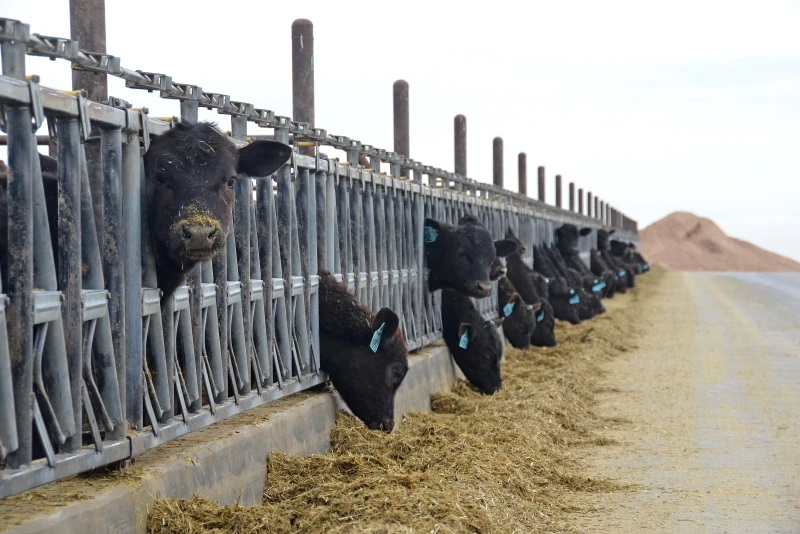
An archetypal 500-cow Panhandle dairy that ran 35% beef-on-dairy through 2023 and 2024 is looking at a 7,000-a-year expected-value gap on its 2026 beef-on-dairy breeding sheet — math anchored on a late-October 2025 crossbred calf trough near ,239/head reported across regional auction channels and USDA NASS’s July 2025 national replacement milk-cow price of ,010/head. Brad Kooima of KKV Trading has characterized beef-on-dairy, in effect, as a packer’s dream in recent industry commentary: known genetics, predictable gain, a schedulable 341-day pipeline from calf to kill. The Bullvine Replacement Pipeline Index just named the other side of that trade.
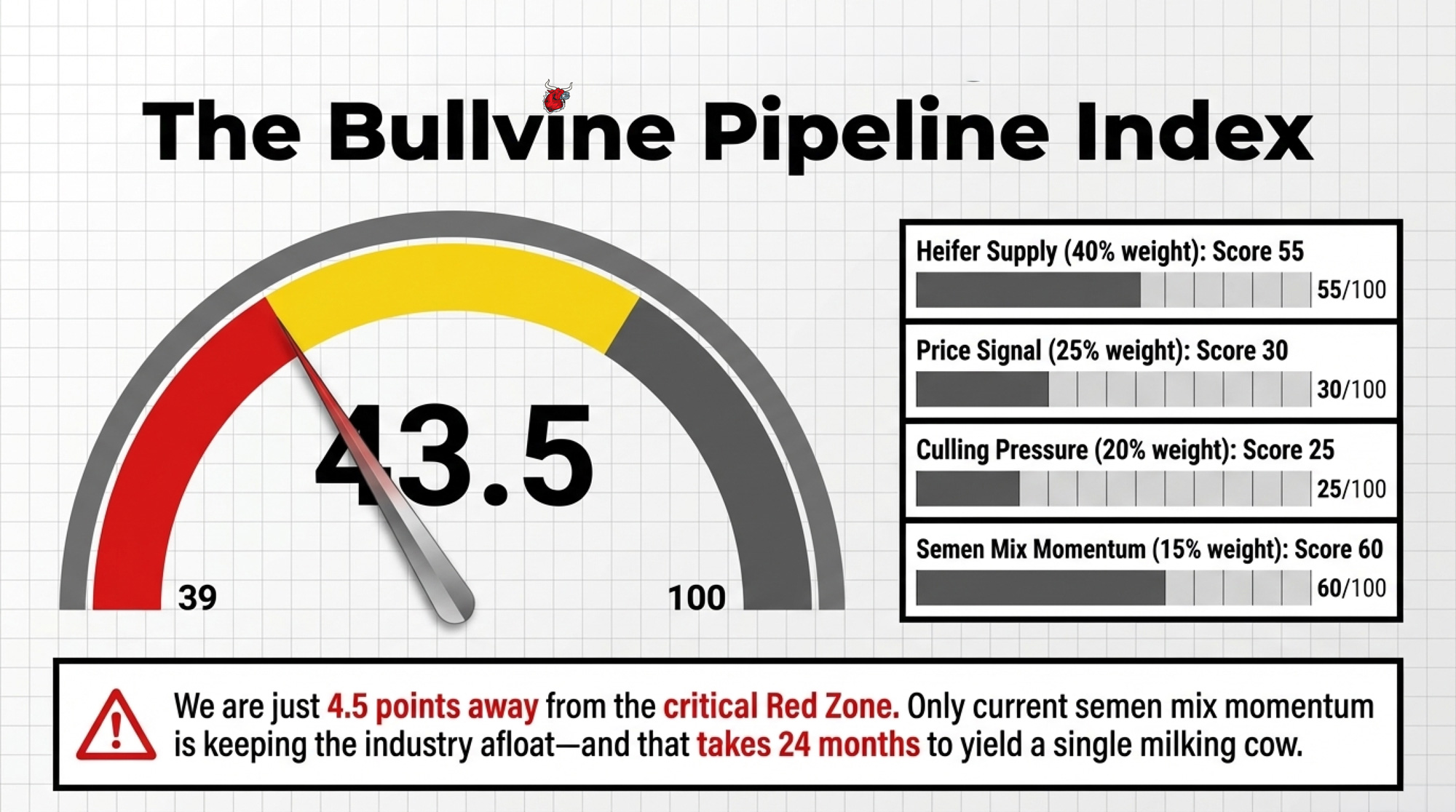
43.5 on the Index as of April 2026. Yellow Zone, 4.5 points from Red. Roughly 4.29 million dairy heifers projected by Bullvine’s model to enter the 2027 milking string from 2025 breedings, against a U.S. dairy cow herd near 9.35 millionhead per USDA’s January 1, 2025 Cattle Inventory, and more than billion in new processing steel rising across 19 states per industry build-out tracking.
Both reads are true. For herds that ran 35%+ beef the last two years, leg two of that trade hasn’t settled.
This is a beef-on-dairy 2026 breeding story. It reads like a credit memo.
Why the Packer’s Dream Is Only Half the Trade
Kooima’s framing points at a real structural gain. Known genetics. Predictable gain. A 341-day pipeline is something native beef never offered the packer-feeder complex at this volume.
CoBank Knowledge Exchange analysis of USDA AMS slaughter-cattle auction data covering March 2024 through February 2025 pegged beef-on-dairy animals at $2,485 at slaughter, native beef at $2,385, and pure dairy at $2,210. Feeder-to-fat value retention ran 81.3% for beef-on-dairy on a $/cwt basis, 72.1% for pure dairy, 69.6% for native beef. Ohio State and Michigan State feedlot trials have documented lower cost of gain on beef-on-dairy steers versus Holsteins, with the spread varying by ration and finishing system.
That efficiency is real. It’s not a packer profit story either. Drovers’ Sterling Marketing Beef Cutout and Packer Margin Tracker has shown deeply negative packer margins through most of 2025 and into spring 2026. Tyson Foods has disclosed materially elevated cattle procurement costs across fiscal 2025 in public filings and announced the closure of its Lexington, Nebraska beef plant.
So where did the supply-chain value come from? NAAB’s 2025 Year-End Report, released March 2026, puts domestic beef-on-dairy semen at 8.1 million units, on top of 10.6 million sexed dairy and 6.0 million conventional. Every beef service on a cow that could carry a viable dairy pregnancy is a dairy heifer that won’t walk into a milking string in 2027.
Related: Bullvine’s April 22 Panhandle Springer Tax feature.
What Does a $3,010 Replacement Heifer Mean for a 500-Cow Panhandle Herd in 2026?
National numbers turn into a breeding sheet fast. An archetypal 500-cow Panhandle dairy shipping to one of the new plants outside Amarillo needs about 135 replacement heifers a year at a 27% turnover rate. At USDA NASS’s July 2025 Agricultural Prices national average of $3,010/head, that’s a $406,350 annual replacement line. In Texas and California premium bands where springers cleared $4,000–$4,500 in late 2025 per regional auction reporting, the number climbs toward $500,000. USDA NASS’s October 2025 reading was already $3,110 — up $100 in three months, up $510 year-over-year.
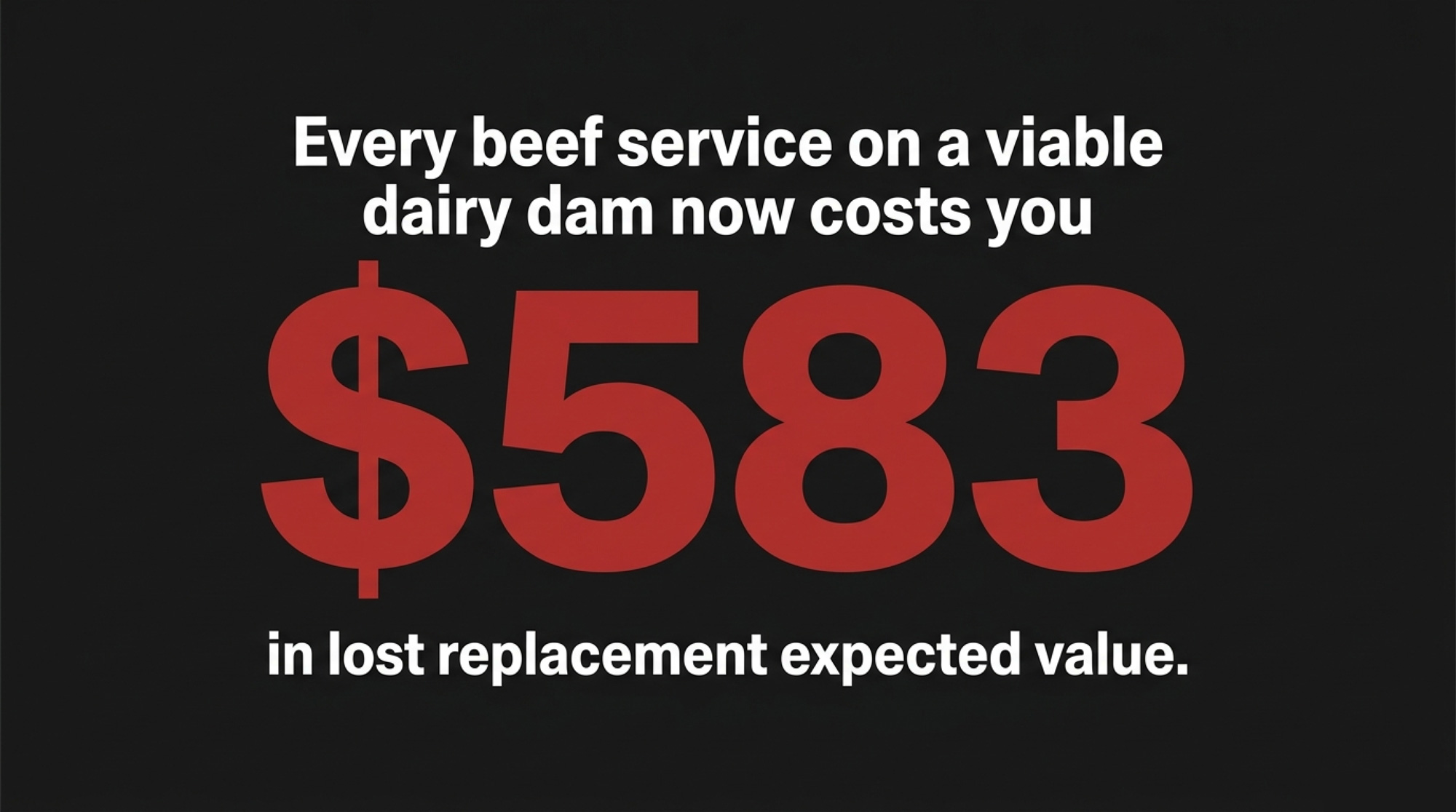
Run 35% beef on that herd and you’re putting roughly 200 beef services a year on cows that could carry a viable dairy pregnancy. Using Dr. Michael Overton’s Zoetis field dataset from 85 commercial Holstein herds — 42% sexed conception, 57% conventional, 90% and 50% heifer ratios, 95% pregnancy survival, 79% born-to-first-calving — every one of those 200 services trades away roughly $583 in expected replacement value at a $3,010 heifer and a $500 pre-weaned beef calf.
Running the Numbers — The Spread at a Glance
Based on $3,010 national heifer average vs. $500 crossbred calf. Sources: USDA NASS July 2025 Agricultural Prices; Overton Zoetis 85-herd dataset.
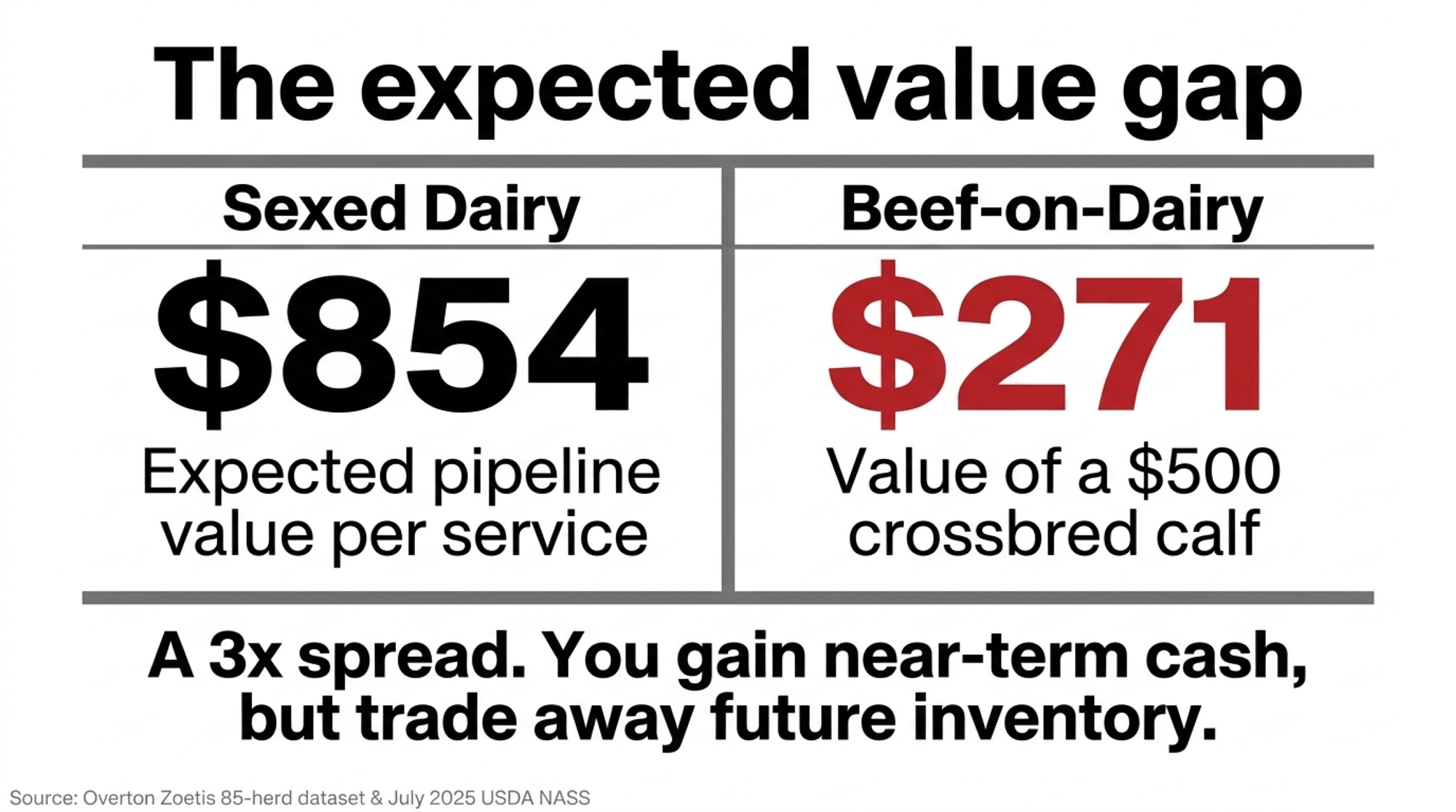
| Breeding Choice | Expected Value per Service | Why |
| Sexed Dairy | $854 | (0.42 conception × 0.95 preg survival × 0.90 heifer ratio × 0.79 born-to-first-calving) × $3,010 |
| Beef-on-Dairy | $271 | $500 calf × 0.57 conception × 0.95 pregnancy survival; no replacement value |
| The Gap | ($583) | Cost of every beef service used on a viable dairy dam |
200 × $583 ≈ $117,000 a year in expected pipeline value, gone.
Scaling the Gap to Your Herd
Annual EV traded away at three beef ratios across three herd sizes. Linear scaling of the $583 per-service gap.
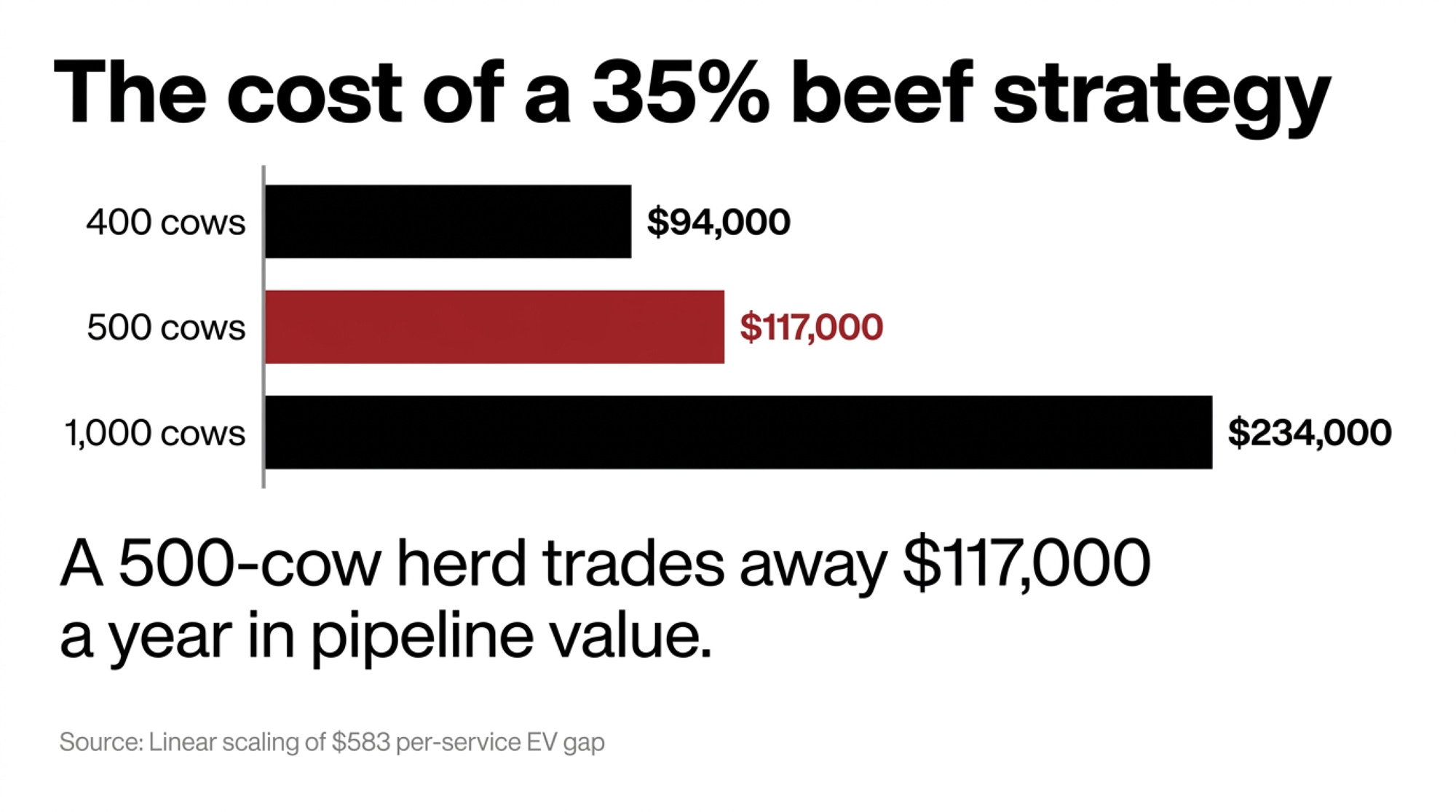
| Herd Size | 25% Beef | 35% Beef | 50% Beef |
| 400 cows | ~$67,000/yr | ~$94,000/yr | ~$134,000/yr |
| 500 cows | ~$83,400/yr | ~$117,000/yr | ~$167,000/yr |
| 1,000 cows | ~$167,000/yr | ~$234,000/yr | ~$334,000/yr |
The Crossover — Where Beef-Cross Calves Match Sexed Dairy on EV
Solving beef calf × (0.57 × 0.95) = heifer × (0.42 × 0.95 × 0.90 × 0.79). Crossover calf price ≈ heifer cost × 0.5516.
| Local Heifer Cost | Crossover Calf Price | Late-Oct 2025 Trough | Status vs Trough |
| $3,010 (USDA NASS, Jul 2025) | $1,660/head | $1,239/head | Below — beef pencils only above $1,660 |
| $3,500 (regional avg) | $1,931/head | $1,239/head | Below — pipeline drawdown |
| $4,100 (TX/CA premium) | $2,262/head | $1,239/head | Far below — every beef service trades EV away |
| $3,110 (USDA NASS, Oct 2025) | $1,716/head | $1,239/head | Below — gap widening with heifer price |
Units note: The October 2025 CME December live cattle move is $/cwt on fat cattle. The ~$1,400 → $1,239 per-head calf move is a different instrument. Both tracked the same signal down.
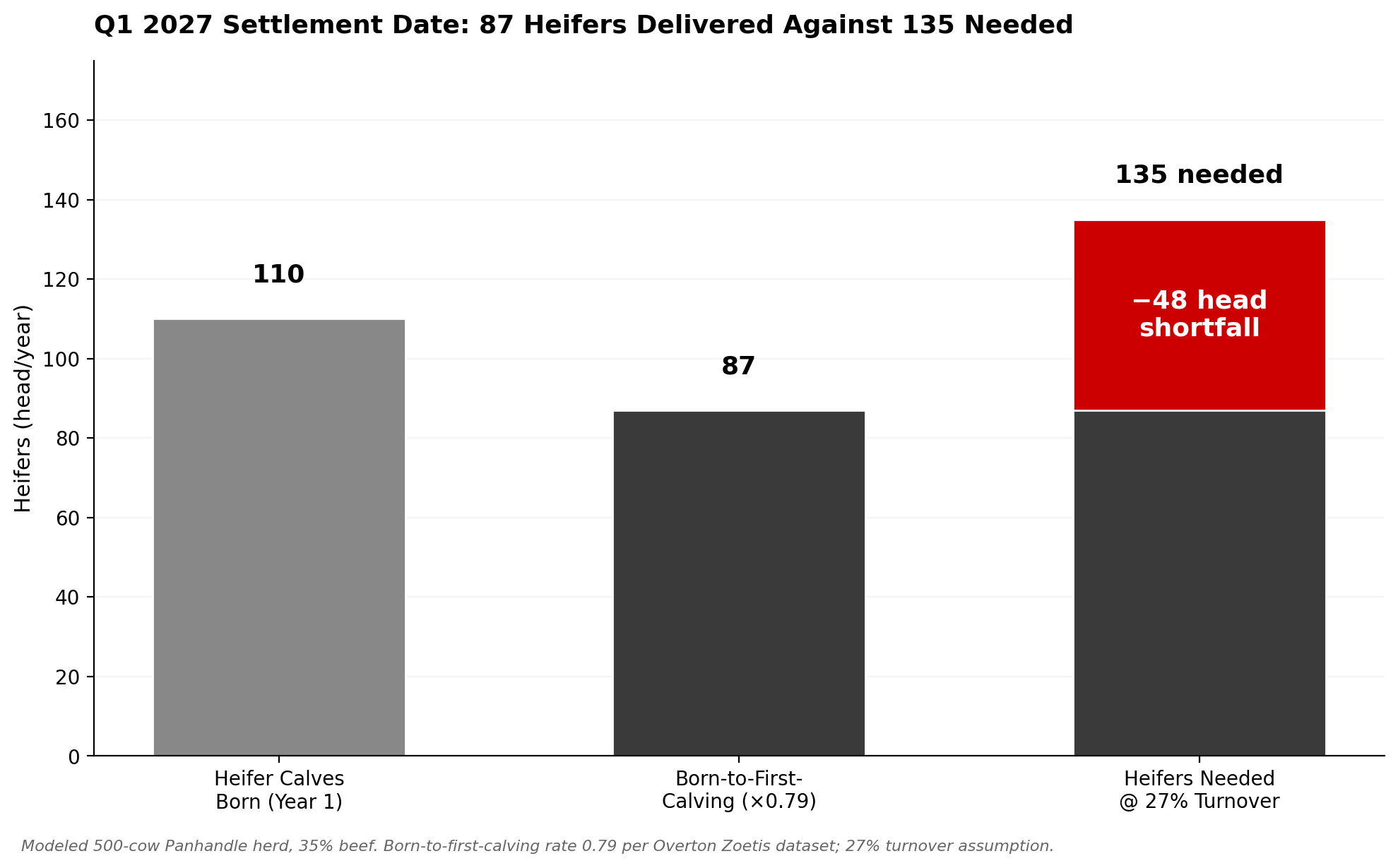
Heifer-calf baseline: At 35% beef on a 500-cow herd, about 65% of pregnancies are dairy. Against Overton’s conception and heifer-ratio rates, that produces roughly 110 heifer calves/yr. Multiply by 0.79 born-to-first-calving and the herd delivers ~87 heifers to first lactation against 135 needed. That’s the 48-head shortfall the 2027 pipeline has to cover at spot prices.
“$854 per sexed-dairy service. $271 per beef-on-dairy service at today’s $500 calf. The spread is 3x — and the settlement date is 2027.”
What Does the October Correction Actually Say About Calf Price Risk?
Most of the industry filed October 2025 as a blip. It wasn’t.
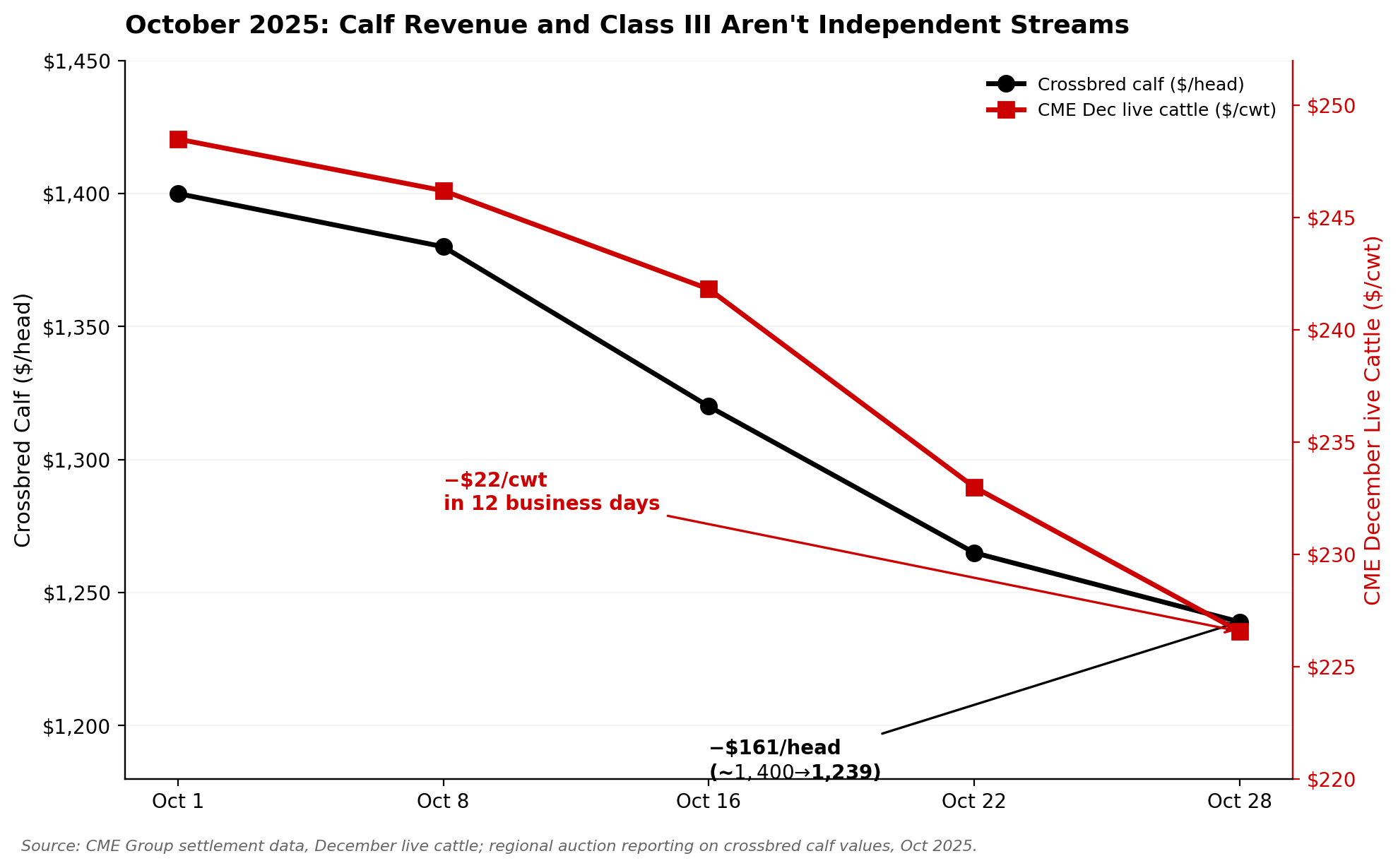
Per CME Group settlement data, December live cattle futures fell from the mid-$248 range in early October to $241.82on October 16 — a single-session $6.05/cwt drop — and bled to $226.57 by October 28. Roughly $22/cwt in twelve business days. Market analysts linked the move to public presidential commentary that week pressing ranchers on beef prices, and crossbred calf values fell with the futures from roughly $1,400 to near $1,239. Bullvine’s prior modeling on a 1,000-cow / 40%-beef archetype put the annualized revenue impact near $196,000.
The assumption most coverage leaned on: beef-on-dairy is diversification against milk-price weakness. The data says otherwise. USDA AMS Class III printed $14.59/cwt in January 2026 — the lowest since July 2023 — and recovered to $16.16 in March 2026. Thin milk margins, volatile calf revenue, same operation. Both streams moved on overlapping signals, not independent fundamentals.
That’s correlation, not diversification. A different risk structure than the one the 2023 breeding decision was made against.
Related: Bullvine’s prior Tier 3 on McCarty’s 341-Day Pipeline and the DSCR Trap.
The Bullvine Pipeline Index — April 2026 Reading
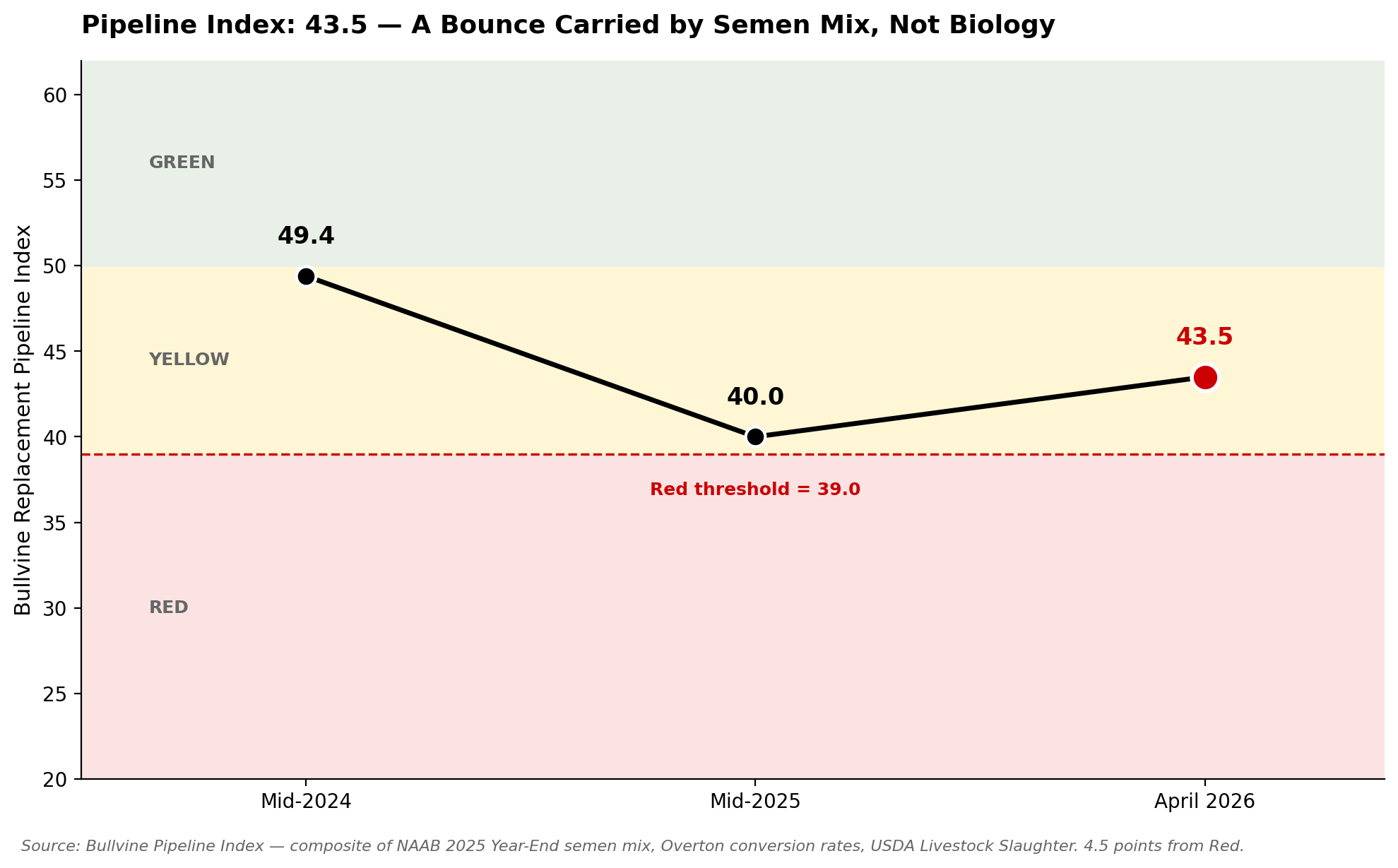
🟡 Pipeline Index: 43.5 — Yellow Zone
Red threshold: 39.0 · Distance from Red: 4.5 points
What it is: Bullvine’s proprietary replacement-pipeline health score. It combines NAAB’s domestic semen-sales mix, Overton’s biological conversion rates, and USDA’s weekly Livestock Slaughter data into a single weighted reading (Heifer Supply 40%, Price Signal 25%, Culling Pressure 20%, Semen Mix Momentum 15%). Refreshes quarterly as USDA and NAAB data update.
Trajectory: Mid-2024 → 49.4 · Mid-2025 → 40.0 · April 2026 → 43.5
Read: Fragile recovery. The bounce is carried almost entirely by semen-mix shift, not by biology on the ground. Settlement-date risk for 2027–2028 replacements remains elevated.
The Four Components
- Heifer Supply — 55 (weight: 40%). Marginal. Replacement ratio runs near 27 per 100 cows. Why it matters:direct line from current inventory to 2027 milking cows.
- Price Signal — 30 (weight: 25%). Red-Zone range, driven by the $3,010 national heifer price. Why it matters:price is the market’s vote on scarcity, and the vote is already in.
- Culling Pressure — 25 (weight: 20%). Red-Zone range; retained-cow overhang is keeping today’s milk on. Why it matters: retained cows mask supply tightness now and widen the 2028 gap.
- Semen Mix Momentum — 60 (weight: 15%). The one component propping the score up. Sexed dairy climbed to 64% of domestic dairy units used in 2025 per NAAB’s 2025 Year-End Report. Why it matters: the pipeline’s only tailwind — and it won’t produce a milking cow for 24 months.
USDA’s January 2025 Cattle Inventory counted just 3.91 million dairy replacement heifers on U.S. farms — the smallest reading in 47 years, down 16% from 4.61 million on January 1, 2020. Iowa State Extension’s NW Iowa Dairy Outlook (Lee Schulz) has tracked weekly dairy cow slaughter running behind year-earlier across most of the period since September 2023. Bullvine’s modeling pegs cumulative “extra cows kept” at 600,000–611,600 head versus normal culling pace — an extrapolation from the ISU weekly deficit, not a USDA number.
Those retained cows carry milk volume today. They won’t carry a new plant in 2028. The $11 billion in new processing capacity was sized against herd-growth assumptions from 2022–23 that no longer hold.
Related: Bullvine’s Beef-on-Dairy’s $500,000 Swing, January 5.
Why the Operator Who Got the Calf Market Right Got the Settlement Date Wrong
The Panhandle operator who made good money on beef calves through 2023 and 2024 didn’t miscalculate. They executed leg one of a two-leg trade well. What most haven’t done is look up leg two’s price.
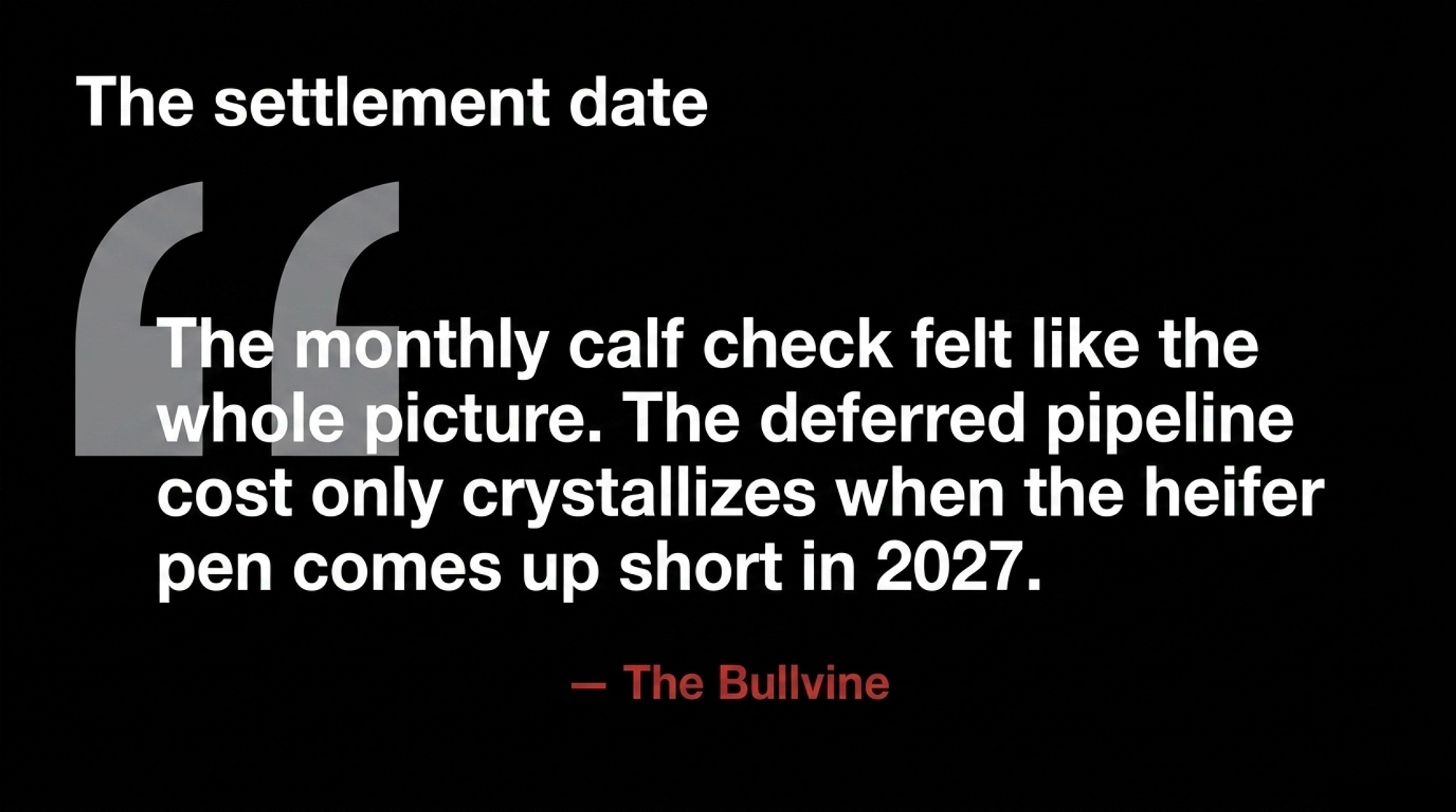
That’s not on the operator. It’s on how the trade got sold. One leg at a time. The $900–$1,400 calf checks landed every month through that run. The pipeline cost was deferred, off balance sheet, and only crystallizes when the heifer pen comes up short in Q1 2027.
Some operators ran the full math and took the trade eyes-open. For others, the settlement-date cost didn’t get modeled because the monthly calf check felt like the whole picture. Both positions exist in the data. What’s changed is the spread at the service level: sexed dairy at $854 against beef-on-dairy at $271. More than three times. The crossover doesn’t arrive until beef-cross calves clear $1,660 at a $3,010 heifer. Most markets aren’t in the same zip code.
Will Babler of Atten Babler Risk Management has publicly argued that premium U.S. beef will increasingly be held by dairy producers because of the extra benefits these animals bring to market. He’s right about the premium. The question is whether your animals qualify — traced genetics, breed-society enrollment, direct feedyard relationship — or whether they’re anonymous crossbreds moving through the sale barn at $200–$500 and carrying all the pipeline risk for a fraction of the revenue.
Gregg Doud has framed the reclassification plainly in recent NMPF communications, telling dairy audiences they may be in the beef business more than the dairy business. Lenders have started modeling it that way. Producer balance sheets generally haven’t caught up.
Related: Bullvine’s $585-Per-Service Beef-on-Dairy Trap.
Where Does This Leave Ontario and Supply-Managed Herds?
Different mechanism, same breeding-sheet question. Supply management protects the Canadian milk check in a way the U.S. spot market does not, which blunts the milk-price-weakness argument for riding beef-on-dairy hard. Quota carrying costs and genetic replacement economics still drive the service-by-service EV decision. Beef-cross calves from Ontario herds still move into a North American feedyard market that cleared near $1,239 at the October 2025 trough. The crossover math above holds; the variables that change are your local heifer cost and your calf-sale channel.
The 30/90/365-Day Playbook for Herds That Ran 35%+ Beef in 2023 and 2024
30-Day Actions — Before Your Next Breeding Round
- Run your pipeline math. Pull 12 months of heifer-calf births. Multiply by 0.79 for completion to first calving. Compare to herd size × your replacement rate. A 500-cow operation needing 135 heifers/yr but projecting 110 heifer calves × 0.79 ≈ 87 to first calving is roughly 48 head short for 2027–2028. Threshold: any shortfall above 10% of annual demand is a planning problem, not a shopping problem. Where it backfires: if your actual born-to-first-calving rate runs below 79%, the shortfall is bigger than your spreadsheet shows.
- Audit beef-on-dairy EV at your own calf price and local heifer cost. EV_beef = your calf price × 0.57 × 0.95. EV_dairy = your heifer cost × 0.42 × 0.95 × 0.90 × 0.79. If the dairy advantage lands near $583/service, decide how many beef services you keep on viable dairy dams. You gain near-term cash. You give up future replacement inventory.
- Call your heifer suppliers this week. Ask how far they’re booked and whether they’ll lock numbers 12–18 months forward. If “I’ll just buy later” is the plan, find out whether the supply actually supports that.
💡 Pro Tip — The LRP Window Opens Before the Calf Is Born
Per Farm Credit East’s October 2025 guidance, the USDA RMA’s LRP Unborn Calves program (launched July 1, 2025) lets you floor the price on beef-on-dairy crossbred calves before they hit the ground. Farm Credit East’s worked example shows coverage up to roughly $1,200/head at a post-subsidy premium near $26.20/head, based on a 95-lb target weight and a 395% price adjustment factor. Parameters vary by endorsement length, coverage level, and sale date — confirm current rates with your crop insurance agent.
Most producers miss the window because they don’t realize the coverage is available at breeding-decision time, not at weaning. If you’re making the beef-service call this month, the LRP decision is the same conversation — not a separate one six months later.
Red-flag trigger: If beef revenue runs above 10–12% of gross income (thresholds vary by lender; confirm with yours) and you aren’t carrying LRP on unborn calves, this moves to the top of the 30-day list. LRP is a U.S. RMA program; Canadian producers should consult provincial risk-management options separately. Where it backfires: LRP floors price risk, not local basis risk.
90-Day Actions — Structural Adjustments
- Tier your herd and write it into SOPs. Top genetics on sexed dairy. Middle tier mixed. True terminal cows only get beef. Requires: current genomic evaluation, AI technician cooperation, a small conception-rate give-back on sexed services. Where it backfires: aggressive sexed use on a herd running below 20% 21-day preg rate can widen, not close, your pipeline gap.
- Forward-book 30–40 springers for Q1 2027 delivery. Heifer developers contacted by Bullvine report contracting 12–18 months forward at typical premiums of $100–$200/head over spot, with 10–20% deposits. Converts a forced peak-market purchase into a known commitment. Where it backfires: if heifer markets soften faster than calf markets, you’re carrying an above-market forward against tighter cash flow.
- Cull on profit, not habit. Keep productive older cows if SCC and repro allow. Ship chronic mastitis, repeat breeders, and low-index animals. A retained cow buys you time. She doesn’t buy you margin.
365-Day Moves — Positioning for the Next Cycle
- Align your herd plan to your plant. If you’re shipping to new processing steel, decide whether you’re growing, holding, or shrinking. Pipeline, beef percentage, and culling strategy need to match that call — and the processor’s volume expectation. Opportunity signal: if your genetics and repro numbers support program qualification and your local heifer basis is tracking the $3,010 national average rather than the $4,100 peak, 30–40% beef inside a direct-feedyard program can still pencil.
- Set hard floors and ceilings. Floor: the minimum beef-calf price where beef services still pencil. Ceiling: the maximum percentage of breedings you’ll put to beef on viable dairy dams. $1,660 at a $3,010 heifer is your north star; $1,931 at $3,500; $2,262 at $4,100.
- Recalculate quarterly, not annually. Sexed semen, beef semen, replacement heifers, and calf markets have all moved enough in 24 months that a 2024 analysis won’t hold up in a 2026 credit file. The Pipeline Index refreshes quarterly.
The Trade-Off, Stated Plainly
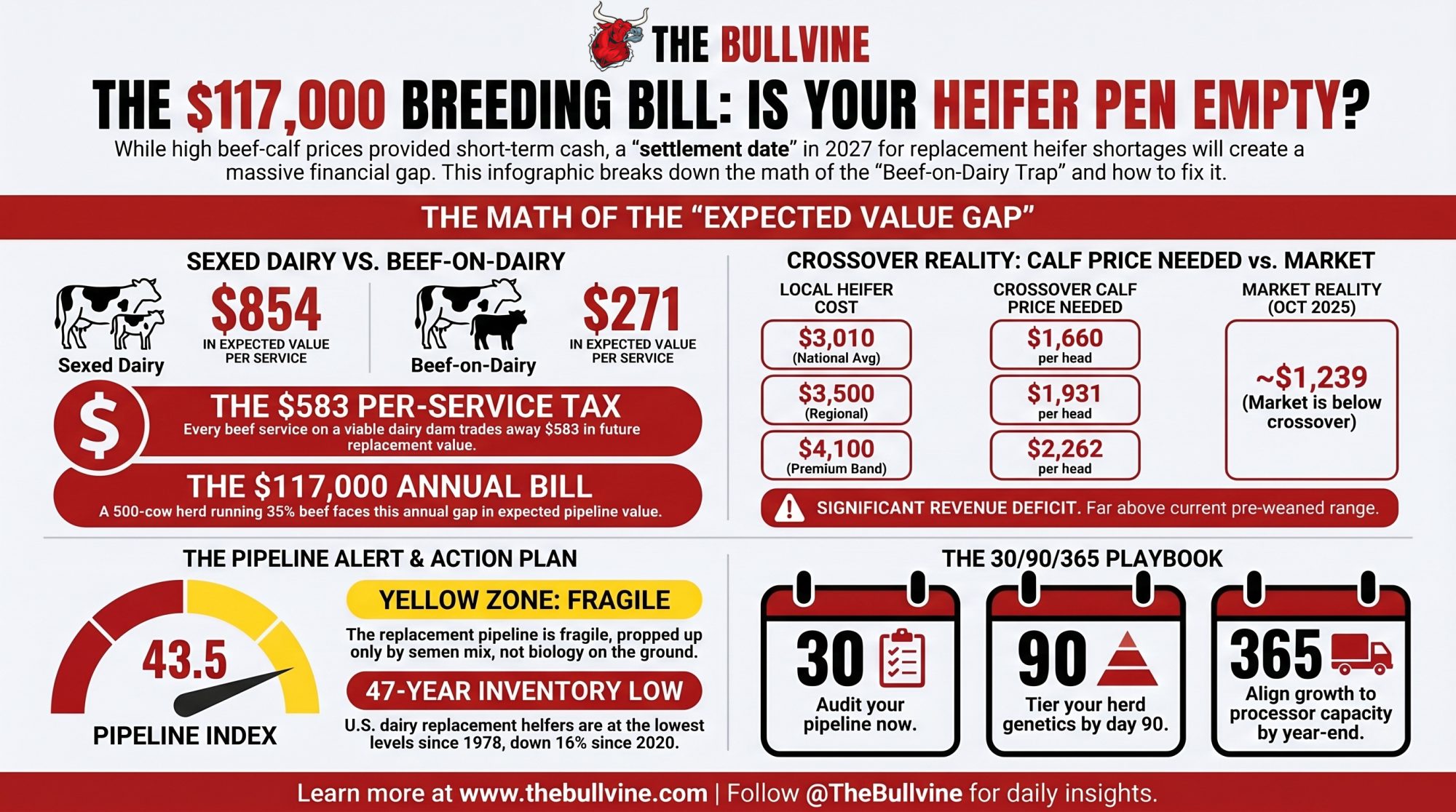
Every beef service on a viable dairy dam is a near-term calf check bought with a 24-month pipeline drawdown. At a $3,010 heifer and a $500 beef calf, that trade costs roughly $583 in expected replacement value per service. At 200 services on a modeled 500-cow Panhandle herd, it’s $117,000 a year. At 4.29 million projected pipeline entries against a 9.35 million U.S. dairy cow herd and billion in new plants, it’s a national structural question. Neither number moves itself. Both settle on a specific date — when the heifer pen is supposed to be full and isn’t.
The crossover prices are the line in the dirt: $1,660 at a $3,010 heifer, $1,931 at $3,500, $2,262 at $4,100. Everything below those prices is a pipeline drawdown with a monthly calf check attached.
The 500-cow Panhandle dairy referenced throughout is an illustrative archetype, not a specific operation. The Bullvine Pipeline Index just put beef calves and replacement heifers on the same invoice — 43.5, Yellow Zone, 4.5 points from Red.
The $117,000 bill is already in the mail. The only question is whether you have the heifers to pay it in 2027, or whether you’ll be writing that check to a neighbor who saw the Yellow Zone coming.
What does your last 12 months of heifer-calf births × 0.79 actually produce — and at what beef-calf price does your own breeding sheet stop building revenue and start building a 2027 liability?
Complete references and supporting documentation are available upon request by contacting the editorial team at editor@thebullvine.com.
Learn More
- Beef-on-Dairy’s $500,000 Swing: What 72% of Farms Know That’s Costing You $1,000/Cow Every Year — Arms you with a Monday-morning blueprint to capture $1,450 beef-cross premiums. Following this three-tier breeding strategy separates $340,000 annual earners from those leaving $1,000 per cow on the table for competitors to grab.
- Beef-on-Dairy’s $3,000 Trap: 800,000 Missing Heifers and Who Pays the Bill — Exposes the 800,000-head replacement hole already baked into the 2027 dairy calendar. Mastering this market intelligence allows you to navigate $4,100 price tags and secure elusive processor partnerships before the supply-chain window slams shut.
- The Missing Piece in Genomic Selection: Why the Best Herds Still Walk the Pens — Dismantles the “spreadsheet-only” approach to breeding by layering physical structural checks over genomic proofs. Leveraging this hybrid method keeps cows producing into their fourth lactation, effectively slashing your annual heifer replacement draw by 15 percent.
 The Sunday Read Dairy Professionals Don’t Skip.
 The Sunday Read Dairy Professionals Don’t Skip.
Every week, thousands of producers, breeders, and industry insiders open Bullvine Weekly for genetics insights, market shifts, and profit strategies they won’t find anywhere else. One email. Five minutes. Smarter decisions all week.




