Archive for News – Page 119

Wisconsin Milk Production Up From 2017

Wisconsin dairy cows produced more milk during the month of February than they did a year earlier. According to the USDA’s monthly milk production report, state output totaled 2.33 billion pounds last month, up 1.0 percent from February 2017, but less than January’s 2.54 billion pounds (which had more days on the calendar).

Nationally, 15.9 billion pounds of milk was produced in the 23 major dairy states, which was 1.8 percent more than in 2017, and greater than the 17.3 billion pounds made this past January.

California continues to have the highest total production with about 3.2 billion pounds. Colorado had the greatest increase in year-to-year output as that state produced 337 million pounds of milk in February, up 7.7 percent from the same month last year.

Meanwhile, the number of milk cows on farms in the 23 major states was 8.75 million head, 49,000 head more than February 2017, and 1,000 head more than January 2018. The average number of milk cows on Wisconsin farms for the month was 1.28 million head, about the same as last month, but 5,000 fewer than than last year. Monthly production per cow averaged 1,830 pounds, up 10 pounds from last year’s figures.


Source: Wisconsin Ag Connection

USDA Decides Not to Impose Additional Regulatory Requirements for Organic Producers and Handlers

The U.S. Department of Agriculture (USDA) today announced the decision to withdraw the Organic Livestock and Poultry Practices (OLPP) final rule published on January 19, 2017. The rule would have increased federal regulation of livestock and poultry for certified organic producers and handlers. The withdrawal becomes effective May 13, 2018.

Significant policy and legal issues were identified after the rule published in January 2017. After careful review and two rounds of public comment, USDA has determined that the rule exceeds the Department’s statutory authority, and that the changes to the existing organic regulations could have a negative effect on voluntary participation in the National Organic Program, including real costs for producers and consumers.

“The existing robust organic livestock and poultry regulations are effective,” said USDA Marketing and Regulatory Program Undersecretary Greg Ibach. “The organic industry’s continued growth domestically and globally shows that consumers trust the current approach that balances consumer expectations and the needs of organic producers and handlers.”

According to USDA reports for 2017, the number of certified organic operations increased domestically by seven percent and globally by 11 percent. Industry estimates show that organic sales in the United States reached almost $47 billion in 2016, reflecting an increase of almost $3.7 billion since 2015.

The Department carefully considered public comments and the relative costs and benefits for both producers and consumers of imposing the proposed additional regulations.

More information on the OLPP final rule is available in the March 12, 2018, Federal Register, and on the USDA National Organic Program web page.


Source: USDA

Despair for devastated farmers facing grim task of shooting burned animals

Newlywed Rebecca Jones searching through the ashes of her recently-renovated home near Cobden yesterday. Picture: David Caird.

Victorian farmers are counting the cost of devastating grassfires that swept across large parts of the state’s southwest at the weekend, destroying 18 farmhouses, dozens of shearing sheds, haystacks and outbuildings, and killing hundreds of cattle and sheep.

More than 200 firefighters, ­assisted by cooler weather and light rain, spent yesterday containing the last of the four firefronts around Cobden, Terang, Wools­thorpe and Simpson, clearing fallen trees and powerlines from roads and mopping up spot fires on the 15,000ha of burnt farmland.

Attention is now focused on the 211 mainly dairy farms directly ­affected by the fires, where many cattle have already died and hundreds more are expected to be shot over the next two days.

Victorian Agriculture Minister Jaala Pulford said teams of vets and agriculture officers were starting to visit farms to identify cattle and sheep that needed to be put down because of burnt hoofs and damaged lungs and airways.

Local councils were yesterday digging pits where dead livestock could be buried and the army has supplied dozens of diesel generators so dairy farmers can milk cows on properties still without power and keep the milk cool until trucks can collect it.

Ms Pulford said areas such as Terang, Cobden and Simpson were the heartland — and highest producing region — of Australia’s dairy industry, where green grass and frequent rain was much more common than grassfires.

But nearly six weeks without rain had turned Victoria’s southwest extremely dry, creating a horror night last Saturday when strong hot winds combined with lightning strikes to cause what Premier Daniel Andrews called an “unprecedented fire event” for the normally lush region.

Surveying the damage around Cobden yesterday, Mr Andrews said it was remarkable there had been no deaths or serious injuries from the fast-moving fires.

“Talking to a 40-year veteran, he made a point he had never seen a fire like it,” Mr Andrews said, thanking Country Fire Authority volunteers from around the state for their service. “It was the hardest work he had ever done; to have a fire running all night …”

Mr Andrews announced hardship payments of up $540 an adult and $270 per child for those ­directly affected by the fires and up to $40,700 for families who have lost their homes, but pointed out the fires could have been worse.

“The losses could be much more significant and ultimately, there are no funerals to go to,” the Premier said.

“That is the most important thing when it comes to a fire like this.”

Beef farmer Brad Gilmour came home on Saturday night to see his 1000ha family farm southeast of Terang already ablaze. But remarkably the homestead was still standing with just singed veranda posts.

But almost every fence on the farm was destroyed, more than half the property’s paddocks were burnt to ash, the woolshed and 300 bales of hay were gone and some of his 700 cattle were dead.

Mr Gilmour feared more of his angus beef cattle and young dairy heifers would have to be shot in the next few days, once he could ­rebuild enough fencing around his surviving set of steel yards to enable a veterinary inspection.

But he was grateful for donations of hay and grain for his surviving cattle.

His family was safe and, unlike three of his neighbours, the house where they have lived for 30 years survived the fire.

“I’m tired and it is emotional; once you stop working and take time to look around, you can’t help thinking what a massive undertaking it will be to get back to where we were,” Mr Gilmour said.

“I know we will lose more cattle but then I’m hearing about some who have lost their entire herds.”

Source: The Australian

Oregon settles suit, won’t shut down mega-dairy accused of pollution

The state alleges in a lawsuit that the dairy repeatedly endangered nearby drinking water by violating environmental laws.

Oregon has settled a lawsuit it brought against a new mega-dairy accused of endangering nearby municipal and private wells by mismanaging manure and wastewater.

The settlement, filed in court Wednesday, will allow Lost Valley Farm in Boardman to operate in a limited capacity until it can prove that its wastewater treatment system is fully functional.

Since it opened a year ago, the dairy has failed numerous inspections, has been cited four times, and has been fined $10,640 for environmental violations, the Oregon Department of Agriculture said in the lawsuit, filed Feb. 23.

Owner Greg te Velde failed to comply with multiple directions to stop liquid manure and wastewater from overflowing storage lagoons and seeping into soil, the state said.

The lawsuit sought an injunction to stop the dairy from producing any more wastewater, effectively shutting it down.

Under the terms of the agreement, the dairy must:

  • Within 20 days, remove 38 acre feet of manure and wastewater from settling cells and lagoons that are too full. That’s approximately 12.4 million gallons.
  • By June 1, remove an additional 37 acre feet of manure and wastewater from the settling cells and lagoons.
  • Produce no more than 65,000 gallons of wastewater per day, until it can prove that its treatment system is fully functional. Its regular permit allows 187 million gallons per year, or about a half-million gallons per day for 30,000 animals.
  • Report any discharges resulting from system failure, as required by law.

If the dairy complies with the terms of the settlement for a year, it will be allowed to resume operations under its regular wastewater permit.

The Oregon Department of Agriculture will inspect the dairy weekly, spokeswoman Andrea Cantu-Schomus said. 

“The court now has oversight of this facility for a year. Lost Valley Farm will have to respond to the court if there is a violation,” she said. 

Dairy owner te Velde declined to comment Wednesday afternoon.

In a written response to the lawsuit filed Feb. 26, te Velde and dairy manager Travis Love said the dairy already was meeting all permit requirements.

The dairy said the injunction would put them out of business, forcing them to lay off 70 workers, euthanize their cows, lose $4 million per month on milk sales and default on local creditors. And they said the state should cut them some slack while they were getting up and running.

The dairy is in the Lower Umatilla Basin Groundwater Management Area, designated because groundwater already is high in contaminants.

Groundwater flows from the site to a large part of the area, so pollutants could impact a broad area of the shallow aquifer, the agriculture department said, threatening 81 public water systems and many private drinking water wells.

A dozen health and environmental groups issued a joint statement Wednesday criticizing the settlement. 

“Governor Brown’s weak settlement with Lost Valley is a missed opportunity,” said Kendra Kimbirauskas, CEO of  Salem-based Socially Responsible Agricultural Project. “Shutting down this disastrous operation would have sent a clear message that Oregon will not compromise its environment or rural communities for corporate benefits. This settlement sends the opposite message.”  

Permit violations reported in the state’s court filings included one for allowing the storage area for dead cows to overflow and leak, indicating the operation has high mortalities despite being in operation for only months.

“The state’s settlement barely requires more than compliance with the permit already in place – it’s a status quo deal that lets Lost Valley off the hook,” said Tarah Heinzen, staff attorney with Food & Water Watch.

The other groups opposing the settlement are Friends of Family Farmers, Columbia Riverkeepers, Humane Oregon, WaterWatch of Oregon, The Humane Society of the United States, Center for Food Safety, Center for Biological Diversity and Animal Legal Defense Fund.

Lost Valley Farm opened in April 2017 as a supplier to the Tillamook County Creamery Association, which makes Tillamook Cheese.

Tillamook spokeswoman Tori Harms said the association has terminated its contract with the dairy because of its problems. However, it is temporarily continuing to buy milk from the dairy, with additional testing to ensure the milk is safe.

“We are mindful of the animal welfare and environmental risk of abruptly shutting down a dairy farm,” Harms said.

Source: statesmanjournal.com

Fire causes $2M in damages to Saskatoon dairy farm

It’s a total loss. That’s what firefighters say of a large quonset containing semi trailers that caught fire at a dairy farm in the Osler area on Monday night.

The family who owns the farm is safe but there were approximately $2 million in damages to the six-bay building, which housed most of the farm’s equipment. 

Firefighters at Osler diary farm fire

Several dozen firefighters were involved in battling the Osler-area fire. (@WarmanFire/Twitter)

Warman Fire Chief Russ Austin is one of more than 24 from Osler, Warman, Dalmeny, and Martensville who battled the fire for more than four hours after a call came in around 9:10 p.m. CST Monday. 

He said the building was totally engulfed in flames when they arrived, and the roof had already started caving in.

“You try to protect what you can,” he said. 

“In that particular yard, there’s everything from bale stacks to other, it’s a dairy farm so they have lots of barns with animals in them.”

Firefighters contained the damages to only the original building. The cause of the fire is under investigation.

Neighbours pitch in to get cattle fed

Austin extended his sympathies to the family who lives on the farm.

“It’s a very unfortunate incident, unfortunate for the family and we’re sorry for their loss,” he said.

Osler area dairy farm fire

The quonset fire is said to have caused about $1.8 million in damages. (Ryan Fletcher/YouTube)

The fire incinerated feeding equipment for the farm’s dairy cattle, but Osler-area neighbours didn’t miss a beat in helping out as they came over to help them feed the animals on Tuesday morning, said Jason Pauls, Fire Chief of the Osler Fire Department.

“They’re very lucky they have good neighbours,” he said.

Firefighters at Osler dairy farm fire

Firefighters say the roof of the building had caved in before they arrived. (@WarmanFire/Twitter)

Source: CBC

When the Death of a Family Dairy Farm Leads to Suicide

Fred Morgan was already deep in debt from rebuilding his milking barn after a fire when milk prices plunged in 2015, setting off an economic drought that is now entering its fourth year — the worst in recent memory for dairy farmers in New York State.

Mr. Morgan, 50, saw no way to save the dairy farm in central New York State that he took over as a teenager from his ailing father and ran with his wife, Judy, and their son, Cody.

With the farm operating at a loss and facing foreclosure, Mr. Morgan believed his only solution was his $150,000 life insurance policy. He said he planned on killing himself so his family could receive the payout.

“I’d sacrifice my life so my family could keep the farm,” Mr. Morgan said. His wife persuaded him otherwise.

Mr. Morgan was hardly alone in his suicide plan. There has been a spate of suicides in the state as the dairy industry has nose-dived, resulting in the closing of hundreds of small farms. While the dairy industry nationwide is in the grip of an economic crisis — fueled by decreasing demand as customers turn to milk alternatives — the picture is particularly bleak in New York where dairy sales represent about half of total farm sales every year.

“I’d sacrifice my life so my family could keep the farm,” Mr. Morgan said of his suicidal thoughts.

New York is the third largest milk-producing state in the country and low milk prices have not only devastated farmers financially — most are selling milk for less than it costs to produce — but also emotionally.

The situation has become so grim that NY FarmNet, a leading farm support group, has started running suicide prevention training for local agricultural service providers and lenders who deal with dairy farmers.

After a local dairy farmer took his life in January, Agri-Mark, a large cooperative that bought milk from the farmer, sent its 550 members in the state a list of suicide and mental health hotlines — along with the news that milk prices would drop even lower this year.

In providing the information, the co-op wanted “to get ahead of the curve” in offering vital services to its member farmers, said Doug DiMento, a spokesman for Agri-Mark, which owns Cabot and McCadam cheese.

It was one of at least three suicides of its member farmers in recent years, Mr. DiMento said.

Hal McCabe, the outreach director for FarmNet, believes the number of suicides is higher on the roughly 4,500 dairy farms across the state during this downturn, but the issue is hard to quantify, he said, because many have been reported as farming or hunting accidents.

There have been 81 work-related deaths on dairy farms reported from 2006 to 2016, with most of the victims the owners of smaller farms, according the state Department of Health.

Whatever the prevalence of suicides, there is no doubt about the widespread hopelessness afflicting the industry.

FarmNet’s 24-hour hotline has been fielding an increased rate of calls from distressed farmers, Mr. McCabe said, and the agency has begun offering stress-management training for its team of financial and other consultants who assist farmers.

“It’s not unusual to get woken up in the middle of the night by a farmer who is potentially suicidal,” Mr. McCabe said.

Farming overall is a stressful occupation and farmers have higher suicide rates than almost any other occupation. Those working in farming, fishing and forestry were 3.4 times more likely than other American workers to commit suicide on the job, according to a 2016 study by the federal Centers for Disease Control and Prevention.

Fred and Cody Morgan at their farm in Eaton, N.Y., which Fred Morgan had taken over from his ailing father.

In Mr. Morgan’s case, his wife was able to dissuade him from taking such a final step and instead seek the counsel of two FarmNet consultants — Judy Flint, a social worker, and Dewey Hakes, a financial consultant and former dairy farmer.

The Morgans, unable to repay six bank loans and debts to neighbors and suppliers, declared bankruptcy, restructured their finances to help pay off debts and have been seeing increased revenue after switching to producing organic milk, which they can sell at $43 per 100 pounds, or hundredweight.

That is about three times the going price for conventional milk, which has dropped below $15 per hundredweight from its peak of over $25 in 2014.

Milk prices are calculated under federal guidelines and have been driven down by a combination of strong milk production and weak demand in both global and United States markets with many Americans turning to alternatives such as soy and almond drinks, said Dr. Andrew Novaković, who teaches agricultural economics at Cornell University.

In New York State, many smaller farms, facing financial hardship or run by aging owners, are closing at a rate of over 100 per year. Many of them become part of much larger operations.

Though about 550 dairy farms closed in the state from 2012 to 2017, the number of dairy cows has increased to 625,000, up from 610,000, in that same period, and milk production has risen steadily in recent years, according to the state’s Department of Agriculture and Markets, which helps fund FarmNet.

With prices depressed, farmers who are looking to sell are having a hard time finding buyers.

“A lot of dairy farmers are thinking about closing, but with the prices down, nobody else has the money to buy their equipment and cattle. So you’re between a rock and hard place,” said Bill Kiernan, 75, a dairy farmer in Copake, N.Y., who runs Walt’s Dairy, which has 400 Holstein cows on 768 acres.

Mr. Kiernan’s two sons have helped the farm survive by taking construction jobs. When he received the suicide outreach information from Agri-Mark, Mr. Kiernan said he “threw it in the garbage.”

“Everyone was kind of upset about it — you’d think there would be more optimism,” said Mr. Kiernan, who has seen the dark side of dairy farming.

In 2010, his neighbor, Dean Pierson, 59, a dairy farmer, shot all 51 of his milking cows and then turned the weapon on himself, leaving suicide notes on cow tag cards stating that he was “overwhelmed” by personal and financial issues.

Mr. Pierson, whose body was discovered by an Agri-Mark driver, had grown increasingly isolated and “had a lot of things to sort out,” said Mr. Kiernan, who buried his neighbor’s cows and now rents Mr. Pierson’s farmland.

Mr. Pierson’s isolation is common to dairy farmers, said Paul Fouts, 45, whose farm in Cortland, N.Y., is also struggling.

“You go into that barn and you’re in your own little world,” said Mr. Fouts, who wakes up at 2 a.m. every day to milk 410 Holsteins. “There may be days on end you don’t go into town. It’s easy to get consumed in your own problems.”

Mr. Fouts said he would like to see his farm, which his grandfather started in 1937, taken over someday by his two teenage children. But he has exhausted his credit with his lender.

Tucker Bailey napping at the Morgan family’s dairy farm.

“This is my gamble,” he said, pointing out recent improvements to his 750-foot-long barn, made to try to increase his cows’ productivity by making them more comfortable. Still, if his financial trajectory persists, he could operate at a $300,000 loss this year and be forced to fold.

“I’m not at the end of my rope, but the rope’s getting short,” he said.

Like Mr. Fouts, many dairy farmers run farms that have been in their family for generations and the shame of failing financially can be emotionally overwhelming, said Kate Downes, the program coordinator at NY FarmNet, which is based in Ithaca.

But admitting they need help is not always easy. Many farmers would never want their vehicles to be spotted outside mental health offices, said Ms. Downes, whose uncle took his life several years ago at his third-generation dairy farm in Jefferson County.

Farmers tend to work long hours with few breaks from the farm — or each other, if they are a family-run farm. And they often own guns, Mr. McCabe said.

Smaller problems can seem outsized, he said, before describing a recent call from a farmer who said he was suicidal over $27,000 worth of debt.

“You’re not just losing your job and your house,” he said. “You’re losing your entire family history and legacy, through no fault of your own.”

After declaring bankruptcy, the Morgans have seen their revenues increase after switching to producing organic milk.

Source: nytimes.com

Celebrating 45 years of National Agriculture Day

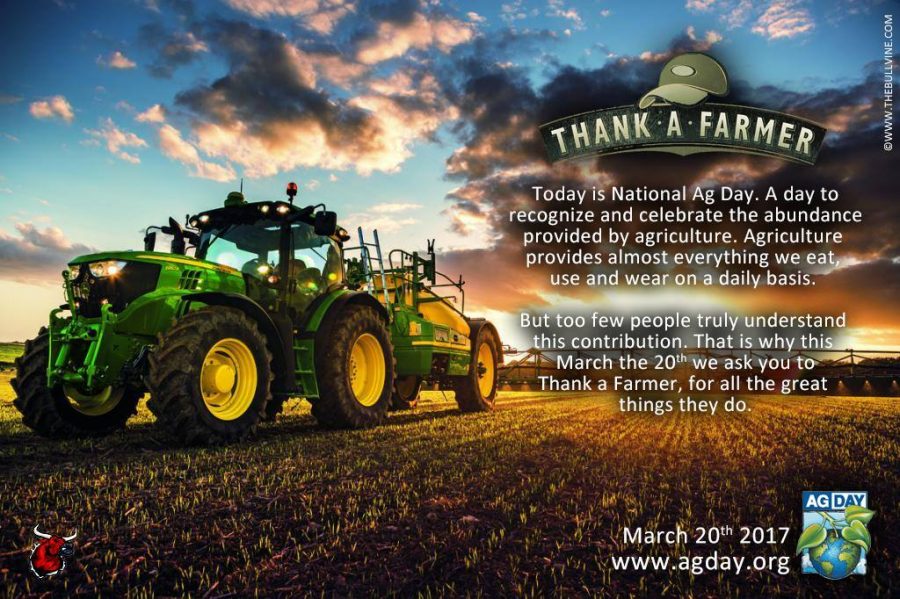
Tuesday, March 20th is National Ag Day. And this year mark’s the 45th Anniversary in which Ag Day is celebrated in communities and classrooms across the country. The theme for this year’s event: Agriculture: Food For Life.

Events all around This Land of Ours, including the nation’s capital, will help tell the true story of American agriculture and remind citizens that agriculture is a part of all of us. A number of producers, agricultural associations, corporations, students, and government organizations, involved in agriculture are expected to participate.

National Ag Day is organized by the Agriculture Council of America. ACA is a nonprofit organization composed of leaders in the agricultural, food and fiber community, dedicating its efforts to increasing the public’s awareness of agriculture’s role in modern society.

For more information visit agday.org.

Reese Burdette overcomes severe burns and kidney failure to settle in to normal life

After spending about 100 days in isolation following a kidney transplant, 10-year-old Mercersburg girl Reese Burdette is back in the swing of things. 

Reese Burdette, pictured at Mercersurg Elementary School on Thursday, March 15, returned to class on March 2 following a 100-day quarantine that began after a kidney transplant in November. Reese survived a house in 2014 and has had medical issues along the way.

Reese Burdette, pictured at Mercersurg Elementary School on Thursday, March 15, returned to class on March 2 following a 100-day quarantine that began after a kidney transplant in November. Reese survived a house in 2014 and has had medical issues along the way. (Photo: Markell DeLoatch, Public Opinion)

For the first time in about three months, the Mercersburg Elementary fifth-grader was able to trade places with the iPad-and-robot combination that allowed her to attend class virtually, and join her classmates back at school on Friday, March 2. 

Reese’s mother, Claire Burdette, said it was just like any other day for her daughter, who added she was excited to be able to attend classes in person.  

“She’s a lot easier to get up in the mornings,” she said. 

Reese had spent two years at Johns Hopkins Children’s Hospital’s Pediatric Intensive Care Unit in Baltimore, recovering from severe burns and other injuries she received in a fire at her grandparents’ house over Memorial Day weekend in 2014. This Sunday will be the two-year anniversary of her homecoming; it was a huge event, with people decked out in Reese’s favorite color purple lining the Mercersburg streets to see her arrive. 

Last September, Reese found out she was in the final stages of renal failure and would need a kidney transplant. 

For the past few months, the 10-year-old has been recovering from the kidney transplant kidney she received in the middle of November. Despite a period in the beginning where doctors worried she might be rejecting the new organ, Claire said overall the recovery “was fantastic.” 

Reese is still visiting Johns Hopkins about every other week to get regular bloodwork and to monitor her health, but “her quality of life is so much better,” according to her mother. Since the surgery, she is no longer reliant on machines to keep her healthy, her dialysis port was removed and she has no diet limitations, which means she can eat whatever she wants. 

“She enjoys everything just like a kid would, and you see her getting stronger all the time,” Claire said. 

However, Reese still has to drink 3 1/2 liters of water every day as part of her recovery, which can be a struggle, Claire added. The average person drinks about four cups a day, according to U.S. National Health Nutrition Examination Survey. 

Reese will also need to take daily medications every 12 hours for the rest of her life. 

But none of this stops the young girl from living her life. The daughter of dairy farmers – her father’s side of the family runs Windy Knoll View Holsteins and her mother’s side runs Waverley Jerseys in Virginia, both well-known among dairy breeders – is spending time practicing in dance class and is working with her calf, which she hopes to show in a few weeks, in addition to going to school. She will also celebrate her 11th birthday on Tuesday, March 20. 

“She’s almost a normal 11-year-old,” Claire said. 

The Mercersburg mom said because a family friend was willing to give a piece of herself  – her kidney – to Reese to help improve and save her life, she has a new appreciation for the kindness of others. 

“As a parent you want your child to be healthy and strong, and just to see her getting back to that is just so rewarding for us all,” she said. 

Now that Reese is back to school, Claire said the next step is getting her trach – a device in her neck to help her breathe – removed, and just continuing to help her get stronger. 

And with summer just around the corner, days by the pool and visits to waterparks are also in Reese’s future. 

“That’s our next vision,” Claire said. 

Source: publicopiniononline.com

Fires southwest Victoria: Dairy cows succumb as blazes rage

MILKING herds have been lost in the Terang and Cobden areas, as fires continue to rage in southwest Victoria.

Scotts Creek dairy farmer Matt Grant says fellow farmers in the Cobden and Terang region have “lost their entire herds”.

He spent all night fighting fires and said conditions were “pretty hair-raising”.

“I haven’t seen the damage in the daylight, but there has been a lot lost,” he said.

“We got the call out at 9.30pm last night and I got home at 8am. Thankfully my farm is 10km from latest flare-up and we’re OK here.”

With electricity down across much of the Cobden and Terang area, many farmers are scrambling to find generators, or walking their cows to their neighbour’s farms so they can milk their cows.

“Our cows haven’t been milked for 24 hours. We’ve had to call in a few favours and got some generators so we can get going with milking,” Mr Grant said.

The Weekly Times understands several milking herds in the Terang area have been entirely or partially lost in the fires.

At other fires further north, Angus breeders, the Moyle family, Pathfinder at Gazette near Penshurst, has also been hit. One home was lost on the property.

Meanwhile, crews hold grave concerns that the two large out-of-control fires in southwest Victoria could merge to form a super blaze as conditions worsen.

Senior station officer Peter Lowe said strong winds shifted early this morning putting them on a collision course.

“Conditions are making the effort difficult where we now have to fight the fires on multiple fronts,” he said.

The towns of Camperdown, Cobden and Timboon remain under fire threat.

Winds are pushing the fires in a south-easterly direction, but a strong westerly wind change is expected to impact the blazes soon.

Already four properties have been lost from the fire which originated in Terang, but authorities fear there will be many more.

Deputy Premier James Merlino said it was the biggest fire event of the season.

“This has been a difficult weekend,” Mr Merlino said.

“The wind will remain all day and it is quite a big fire front.”

At this stage he said 10 to 12 homes had been impacted by the fire.

The fires are believed to have been caused by lightning strikes but the Victoria Police arson and explosives squad is investigating to rule out foul play.

Not all of the properties were occupied and there have been no deaths or serious injuries.

However, lots of beef and dairy cattle have been lost.

A total of 29 firefighting aircraft have been used to tackle the fires with 280 firefighters working on the ground to battle the blazes in the state’s west.

Around 800 people have reported to relief centres for information and assistance.

Craig Lapsley, Emergency Management Commissioner of Victoria, said seven “push messages” were sent out to phones and devices throughout the night. The messages reached 70,000 devices.

Mr Lapsley said: “We acknowledge it was very challenging to get information out in the early stages.”

As the fire was at night, and aircraft were not being used, it was difficult for emergency services to accurately tell the locations of the fires in the early stages.

Peter Otto, acting state manager of the Victorian Bureau of Meterology, said this afternoon that the fire warning remained for southwest and central parts of the state.

“We are still expecting some severe fire dangers through this afternoon, that will ease tonight,” Mr Otto said.

“We also have this potential for damaging wind gusts over the southern and eastern parts of the state.”

Paramedics assessed about 12 people at relief centres for minor injuries including cuts, abrasions, sprains and mild asthma.

None required transport to hospital.

A community meeting has been scheduled in Cobden for 5.30pm at Cobden Civic Hall on Victoria St.

Mr Lapsley said thousands of homes are without power in the southwest.

There are a number of emergency warnings still in place for towns including Cobden, Timboon, Simpson and Camperdown.

Residents in those communities have been told it is too late to leave.

The fires began last night and are causing significant challenges for fire crews.

“In western Victoria significant fires all started after dark and therefore has been a very difficult night for crews on the ground to endeavour to pull those fires up,” CFA deputy officer Gary Cook said.

“Those fire are still running, they are still running under significant wind.”

Mr Laspley warned the fire danger will continue throughout the day,” he said.

“We will see potentially more fire in the landscape today.

“The wind will be very strong all morning and reaching into the afternoon.

“Victorians need to be very careful this Sunday.”

A CFA spokesman said last night Hawkesdale is “extremely dry” and is being lashed with “extreme winds”.

“If you are located in Hawkesdale, it is strongly recommended that you evacuate now and seek shelter at The Arc Gymnasium Stadium located on the Caramut Road in Warrnambool,” read a CFA warning.

Authorities have grave fears multiple fires could come together, creating an enormous front about 45kms north east of Warrnambool.

Homes are under serious threat, with residents fleeing the quick-spreading fires affecting up to 20 towns.


Source: The Weekly Times

Suicidal Dairy Farmers Should Consider Marijuana Industry

Dairy farmers all across the United States have been committing suicide at an alarming rate because their respective industry can no longer support them in the same way that it has for generations. For the fourth year in a row, diminishing milk prices has brought about dark times for this major farming sector.

Sadly, these doomsday conditions have forced many of those associated with the trade to take drastic measures. Some have sold their family farms just to dig themselves out of debt. Others, feeling as though there is nowhere left to turn, have opted to take their own lives.

In northeastern states, like Massachusetts, the self-inflicted trapdoor out of the poor house is the most devilish. Agri-Mark Inc., a dairy cooperative consisting of around 1,000 members, buried three of its own over the past few years, according to a report from NPR.

This year is no exception.

The risk of dairy farmer suicides has become so severe in recent months that the co-op actually included a list of suicide prevention contacts with its 2018 milk price predictions. The overall message is the situation for dairy farmers is not about to improve anytime soon.

“Farm families are incredibly resilient, but some members may want to take advantage of helpful programs where they can talk with experts about work and financial stress, depression and anxiety, grief counseling, substance abuse and family relationship issues,” the letter from Agri-Mark reads.

It is sad to watch a classic industry drive hard working Americans into early graves. Not only that, but it is completely unnecessary. There is a wealth of opportunity opening up in the cannabis industry that could provide this farming sector with a second chance for survival.

Some of the latest statistics from New Frontier shows the business of growing and selling marijuana is on the path to becoming a $24 billion industry by 2025. A significant portion of these earnings will be generated through the sale of edible marijuana products.


Source: Forbes


Fonterra’s finances: Why it’s facing a triple whammy

Fonterra’s problematic 18.8 percent holding in China’s Beingmate Baby & Child Food, a big legal settlement with France’s Danone, and generally higher milk prices are expected to weigh on the co-operative’s first-half result, due on Wednesday.

Beingmate, which develops and sells children’s food and infant milk formula in China, in January, downgraded its earnings for 2017 to a loss of NZ$171–NZ$214m.

The Hangzhou-based company’s share price has slumped to 5.37 yuan from Fonterra’s purchase price of 18 yuan a share, for a total of $756 million, in 2015.

Since January, the price of Fonterra’s units – which give investors access to the co-operative’s dividends – has slumped from $6.66 to $5.89, largely reflecting the uncertainty around Beingmate.

Analysts expect to see a substantial write-down of the Beingmate investment to reflect the share price slump at this week’s result.

Adding to Fonterra’s woes was last December’s announcement that an arbitration tribunal had ruled it must pay $183m to Danone in the wake of 2013’s whey protein product recall.

At the time, Fonterra revised its earnings per share range for the 2017/18 financial year to 35 to 45 cents from 45c to 55c to reflect the settlement.

The good news for farmers is that a significant change in the current 2017/18 milk price forecast of $6.40 per kg of milk solids looks unlikely, thanks to a recovery in whole milk powder prices since December.

However, with milk prices being Fonterra’s biggest input cost, elevated prices will make their presence felt on the co-operative’s earnings.

Devon Funds Management’s managing director Slade Robertson said that given Beingmate’s soft share price, the potential write-down for Fonterra could be as much as $380m.

“This together with $183m of Danone damages …. means that Fonterra could report charges of up to $563m in this result,” Robertson said.

“Combined with tough stream returns, a European market seemingly awash with skim milk powder, and weak collection volumes, leaves little room for optimism,” Robertson said.

Harbour Asset Management senior research analyst Oyvinn Rimer said the result was likely to contain more “negatives than positives”.

In the big picture, Rimer said Fonterra faced the challenge of achieving a reasonable rate of return from its considerable assets.

“There are challenges with this business in terms of its fixed asset base, which they need to earn a good return on,” he said.

“That’s always been hard and I don’t see that changing in the short term,” he said.

Aside from its issues with Beingmate, Rimer said Fonterra had made incremental improvements in its business, and there had been a substantial turnaround in its Australian operation.

Fonterra has a lot riding on China, the country last year accounting for $3.4 billion of its sales revenue.

Forsyth Barr analyst James Bascand expects Beingmate and the Danone settlement to weighing heavily on the outcome.

He expected growth on Fonterra’s value-added volume to be offset by the higher cost of milk it pays its farmers.

“The combination of damages payments due to Danone and a likely Beingmate write-down will weigh on the actual profitability and balance sheet,” he said.

“In summary, we expect a soft result to justify recent share price weakness,” Bascand said in a research note.

“Fonterra has historically ignored market valuations when determining the value of its holdings in Beingmate,” he said.

“The combination of a disconnect between directors and management as well as sustained operating losses suggests Fonterra needs to write down its holdings to a more realistic level – potentially by $370m,” he said.

Bascand estimates Fonterra’s the first half’s underlying earnings before interest and tax will come to $619m, broadly flat on the previous comparable period.

This excludes $183m in damages to Danone and any impact from a write-down of Beingmate.

Meanwhile, Fonterra’s high court injunction is in force to a weekly rural publication publishing or using any “confidential” information it received from former director Leonie Guiney.

The injunction also prevents other unnamed media, including the New Zealand Herald, from disseminating any information it may have received from Guiney.


Source: Newstalk ZB

‘There’s a big difference between 30c/L and €1/L’ – Farmer on selling his milk direct to the marketplace

His working day can stretch from dawn to 10 at night but Nicky Doyle has no regrets about opting to sell his milk direct to the marketplace

Five years ago Nicky Doyle got fed up with milk price volatility and decided to branch out on his own and sell the 1,800 litres of milk which he was producing daily at his 70-acre farm directly to local shops.

It was a decision based on simple mathematics: “I came to the conclusion that I would make more money selling directly in the market on a sale and return basis. There’s a big difference between getting 30c/l from Glanbia and a euro a litre from selling directly to the supermarkets and artisan shops,” the 54-year-old says of his decision to go independent.

And thus began the Fairfield Farm milk brand which is available in shops along the east coast from Wicklow down to Waterford.

Nicky runs a herd of 50 Holsteins and British Friesian crosses. Having decided to go solo, he got up to speed with the art of pasteurising milk by completing food safety and management courses. He also “swotted up” on the business by consulting other independent milk producers in Valentia Island and Mitchelstown and then secured Department of Agriculture approval for his venture.

The next steps were to build a €70,000 pasteurising plant and refrigeration facilities, source a milk carton producer for his own brand product and buy a refrigerated van to transport Fairfield Farm milk to market under his logo: “Milk as it used to be”.

Then came the knocking on the doors and selling the milk. His first customer was the Ardkeen Quality Foodstore in Waterford and this breakthrough was quickly followed by orders from the Petit supermarket chain in the south east. Other artisan stores followed along with SuperValu shops along the east coast.

Nicky’s unique selling point is the traditional taste of his milk.

“There is a difference in my milk in that it is only pasteurised and not homogenised. It has a completely different taste. And non-homogenised milk is better for the heart according to the studies.

“I was talking to an old lad recently who is on a strict low fat diet who told me he buys the milk to put in his porridge as a total treat to himself and he says he loves it. He knows the difference!”

The economics and logistics of the venture are simple enough. Nicky receives €2 for his two litre cartons of milk which retail at €2.50.

Along with the day-to-day costs of running a dairy herd, other costs include 20c for the milk containers and 10c per litre for transport.

Nicky does most of the 800kms a week transportation himself which is no bother to him as he drove the farm’s cattle lorry for his father Nicholas Snr (85) until he took over running the family farm some 20 years ago.

But it is no easy job.

“It’s 7 am to 10 pm, milking in the morning and evening and travelling every second day to get the milk to market. You can’t afford to get sick with this job,” says Nicky, quickly adding that he gets sterling help from his wife Anne Marie.

Despite the long hours, Nicky is already in expansion mode. He has added a goats’ milk brand to the Fairfield Farm stock list.

He buys a 250 litres of milk from a local goat farmer every week and using the same pasteurising process, markets the product to the same retail outlets as the cows’ milk.

Nicky is also looking at increasing milk production in Enniscorthy. If he does, he will have to employ extra staff, but that’s a decision for the future.

In any case, Nicky believes we are heading for another round of milk price volatility this year which, he says, will be caused in no short measure by the current over-production of milk in Ireland and elsewhere.

Meanwhile, his business received another unexpected fillip during the recent storms when he was able to get his milk into the shops come hail, snow or blizzard.

“The snow was bad down here but I am in a valley and I was able to make my deliveries by jeep on time. New customers and shops were on the phone throughout the snows looking for Fairfield Farm milk and the upside is that I now have new customers and more shops on board.”

The €600 bargain filly that landed a €110,000 windfall

The Doyles have been dairy farming in Enniscorthy for three generations and also keep a few mares for breeding purposes.

This is not unusual for farmers in Wexford where hunting is part of the rural landscape.

Nicky takes an interest in local point to points and breeds some hunters.

“We’ve about 10 horses on the farm and two mares. We breed and sell — we are talking about sales in the €7,000 to €17,000 region and I breed from the cheapest sires I can get,” he says. But occasionally the sideline can land a substantial windfall.

Two years his “horse mad” dad Nicholas Snr had an extraordinary stroke of luck. He bought a Westerner filly from a friend for a mere €600.

The bay filly, who already had two points to points in the bag, was sent to the St Patrick’s Day sale at Cheltenham where the gavel came down at €110,000. Bingo.

The filly, Three Swallowsnick, was bought by Michael O’Leary’s Gigginstown operation and is currently in training with Gordon Elliot.

Nicky says that his father “still makes the annual pilgrimage to Galway and is totally taken up with the horses.

“That’s why we still have a few horses on the farm.”

Nicky and Anne Marie have five children: MJ (25) who is in Spain working as an English teacher; Helena (22) who works with a local yoghurt manufacturing firm; Nick (20) who is studying agriculture at Carlow IT; Patricia (19) a student nurse in Waterford and Sarah  (18) who is currently facing into her Leaving Certificate.

And all help out on the farm when time allows.

It will be interesting to see how the next generation carry on the horsey tradition, but for now their main sporting interest centres on the GAA fields of Wexford, especially Nick who is making his mark this year with the Wexford  senior football team.


Source: Farm Ireland

Holstein Canada Offers International Work Opportunity to Canadian Young Leaders

Holstein Canada is proud to offer a new international opportunity for Canadian Young Leaders (Age 19-25) looking to further their international networking skills, dairy industry knowledge and personal skills. The Denmark Farm Work Opportunity gives two Canadian youth the opportunity to travel to Denmark and work on dairy farms.

Under the Danish and Canadian Holstein Associations’ supervision, two Danish youth and two Canadian youth are offered the possibility to travel and work on a foreign farm. We are currently looking for two passionate Canadian Young Leaders who are interested in participating in this program. The chosen delegates must be prepared to travel to Denmark for a minimum of 3 months, to work on a Danish Dairy Farm. Holstein Canada is not responsible for covering the cost of this trip, but will actively help support the chosen delegates in completing the necessary paperwork and establishing the connection.

It is important to note that in order to obtain a travel visa, there is a Biometric Recording procedure of application that is only available in Ottawa, Toronto or Vancouver. Selected delegates must be able to physically go to one of these offices. These cities are the only ones in Canada with official Danish Visa offices.

Interested in applying to be one of the two delegates who will be travelling to Denmark in 2018? Follow these steps:
Step 1:
Fill out the application form.

Step 2:
Write a 500 word essay on why you would be an ideal candidate for this Denmark Farm Opportunity and what you hope to learn from this trip.

OR

Submit a 1-3 minute video on what you hope to take away from this trip and why you would be a good candidate. Please upload your video to Dropbox, YouTube or Vimeo, and provide the link along with you application.

Submit your application and video or text to afrance@holstein.ca by Friday, March 24th, 2018.

China dairy consumption trending towards cheese, yogurt and added protein

The Chinese Nutrition Society issued updated dietary guidelines for Chinese consumers in 2016, recommending that each adult should consume 300 grams (10.6 ounces) of dairy products per day – current consumption is 100 grams (3.5 ounces).

“There is still opportunity for growth of dairy consumption in China, especially from lower tier markets, as a result of consumers’ growing awareness of nutrition intake, increasing household income levels, and the accelerated urbanization process,” Loris Li, food and drink analyst at Mintel, told DairyReporter.

Cheese, yogurt, protein lead consumer interest

Mintel predicts that cheese, yogurt, and protein-fortified dairy products will be the next big trends to hit the subcontinent of 1.4bn people offering export opportunities for other international markets.

In fact, a record amount of US cheese was sold to China last year representing a volume increase of 44% between 2016 and 2017, according to USDEC.

“The next potential dairy subcategory in China could be cheese as cheese consumption per capita in China is very low,” Li said.

Amrbosial yogurt drink
Yili’s ambient drinkable yogurt brand, Ambrosial

“In other regions, brands are making cheese more snack-like to encourage consumption. The awareness of cheese for children’s and toddlers’ consumption has been rising because parents believe the nutritional benefits of cheese, such as protein and calcium, are good for their children.”

Yogurt has also been on an upward trend lately, particularly Greek and drinkable varieties such as Bright Dairy’s recently-launched yoGreek and with Inner Mongolia Yili expanding its ambient drinking yogurt operations to accommodate for the growth of its Ambrosial brand.

Lastly, dairy manufacturers are seeing an increasing consumer demand for products with higher-protein content, Li added.

“For China’s market, both the white milk and yogurt categories are focusing on increasing protein levels as a high level of protein has become a feature of premium products. Brands like Mengniu Deluxe communicate with consumers about the protein levels of its products in TV commercials and state the protein level clearly on the packaging.”

A dairy innovation unique to China is the development of goat infant formula by brands such as Oli6 and Bubs, Li says. “Some parents believe that goat infant milk formula is easier for babies to absorb nutrients and does not cause allergies,” she said. However, the product remains controversial in China because it is unknown whether consuming too much would cause digestive issues for babies, Li added.

Preference for imported dairy products

Imported dairy products are still in high demand due to the some food safety concerns surrounding China’s domestic dairy products leading to a consumer perception that international dairy products are of higher quality, according to Mintel.

“Companies have begun including the source of their milk, such as that it is imported from Australia or New Zealand, to prove that the milk is of high quality,” Li said.

However, this perception of Chinese dairy manufacturers shows signs of changing as the Chinese Food and Drug Administration recently conducted a monthly inspection dairy products, of which 99.5% of the samples passed the screening, according to Hong Kong data and business intelligence firm CCM.

In addition, a survey of Chinese consumers conducted by CCM found that confidence in domestic milk products increased from 50% in 2008 to 75% last year.

Australia and New Zealand will continue to be the largest exporters of milk to China as the preference for foreign milk products is still strong among Chinese consumers, CCM added.

Source:dairyreporter.com

A dairy expands near polluted lakes, putting regulators to the test

Pleasant Valley Farms built one of the state’s largest farming operations last year, in one of Vermont’s most polluted watersheds, without a permit, according to documents obtained by VTDigger.

The only action taken thus far by the state’s Agency of Agriculture, which is responsible for regulating Vermont farms and has the enforcement authority to address the state’s worsening problem of water pollution resulting from farming, has been to request that the owners apply for the permit retroactively.

Pleasant Valley Farms is now in the process of obtaining the permit it should have obtained prior to last year’s expansion project, on a plot of land the state is calling the Lumbra Farm.

Agency of Agriculture officials say they first learned of the illegal operation in October 2017. They won’t say whether they plan to penalize Pleasant Valley Farms, which is owned by the St. Pierre family, which includes Amanda St. Pierre, executive director of the Vermont Dairy Producers Alliance, a dairy lobby.

The agency confirmed it does not know whether the new farm operation is involved in producing or selling milk, which would be illegal without a license. The agency says it also doesn’t know how many cows are currently housed in the facility, which is large enough to hold more than 700.

Agency inspectors have not used their authority to inspect the building, relying instead on information from the owners.

Pleasant Valley Farms is itself one of the state’s largest dairy operations. The Richford-based farm has more than 5,000 cows, calves and heifers in six confinement structures at several locations across Franklin County, all within the Missisquoi River Basin, which drains into heavily polluted Missisquoi Bay.

The bay, according to the Environmental Protection Agency, is one of the most heavily polluted sections of Lake Champlain. Lake Champlain is under a federal order requiring the state to dramatically cut farm pollution, at an estimated cost of billions of dollars over the next 20 years.

As a result of last year’s expansion, the Lumbra Farm portion of Pleasant Valley Farms is now considered a large farming operation, which is one large enough to hold more than 700 cattle, according to Agency of Agriculture records. Agency officials said there are fewer than three dozen farms of that size in the state.

Also at some point last year, Pleasant Valley Farms built a new pit to hold liquid manure. The manure pit, which has a capacity of millions of gallons, and the expanded Lumbra Farm facility, are located four miles from Lake Carmi.

An operation on the scale of the Lumbra Farm requires a Large Farm Operation permit, in which owners must demonstrate that they have taken necessary steps to prevent water pollution, among other requirements.

This permit, and the “nutrient management plan” (a farm-pollution control plan) required in the permit, are among the key tools in the Agency of Agriculture’s effort to cut farm pollution. All but the very smallest farms in Vermont are required by law to obtain these permits before operating.

Secretary of Agriculture Anson Tebbetts has the authority to take a wide range of actions to ensure that farmers obtain these permits, and meet certain conditions before moving forward with their plans. The agency can issue cease and desist orders against farms, require corrective action, take violators to court, assess administrative fines, revoke other permits or certifications held by the owners, or turn the matter over to the Agency of Natural Resources for enforcement.

In the case of Pleasant Valley Farms, the Agency of Agriculture has done none of the above. Instead, agency officials said Friday that they’ve given Pleasant Valley Farms until next month to retroactively submit an application for the Lumbra Farm’s new Large Farm Operation permit.

Amanda St. Pierre declined to be interviewed by telephone because, she said, farmers are misrepresented in the media. She asked for questions via email, but did not respond to emailed questions. The Vermont Dairy Producers Alliance, of which she is executive director, celebrated one year of existence last August.

Asked about his agency’s oversight of the St. Pierre family operation, Tebbetts said there are too many farms in the state for him to keep tabs on each individually, and referred specific questions to agency employees.

Agency records show that Tebbetts wrote Agency of Natural Resources Secretary Julie Moore a detailed three-page letter in January to update her on technical and legal details of the permit status of Pleasant Valley Farms.

Laura DiPietro, deputy director of the agency’s Agricultural Resource Management division, said agency representatives have visited the site but have not been inside the animal-confinement structure.

The Agency of Agriculture has authority to inspect the building’s interior, even if that requires a search warrant, according to a November 2017 letter Thea Schwartz, of the Attorney General’s Office, sent to Pleasant Valley Farms’ attorney.

Because Lumbra Farm has not been inspected, producing milk there would illegal, according to another letter from Schwartz dated Dec. 21, 2017. Dipietro said agency officials don’t know whether milk is being produced at Lumbra Farm. She said the agency is not investigating to determine whether milk has been illegally produced at the Lumbra Farm.

Agency of Agriculture officials said in correspondence obtained by VTDigger that they didn’t know the facility was expanded until being informed in October by Michael Colby, president of farming-advocacy group Regeneration Vermont. Colby shared the documents he obtained about the farm with VTDigger.

Those records, which include email exchanges between attorneys for the farm and attorneys for the agency, show that after the expansion the Pleasant Valley Farms attorney told the Agency of Agriculture that Lumbra Farm was a “small farm,” meaning it held no more than 199 cows.

DiPetrio confirmed that a permit should have been obtained prior to its expansion, but was not. Asked what the agency would do about the failure of the St. Pierres to obtain a permit, DiPetrio said there was a “penalty matrix” for farming offenses. She did not say whether any of those penalties would be applied to Pleasant Valley Farms.

Tebbetts has testified at the Statehouse in recent weeks about the work being done by his agency, and whether new legislation could strengthen state oversight of farms. The secretary has said that his agency’s regulation of almost 800 dairies under its oversight is “working”. Asked if there were additional measures the agency could take to rein in farm pollution, the secretary said nothing came to mind.

“It’s very difficult to answer, because all the things we have thought about are under regulation already,” Tebbetts told lawmakers.

Tebbetts said Friday that he meant these statements in the general sense, and not in reference to any specific farming operation.

This is not the first time Pleasant Valley Farms has come under state, or federal, scrutiny.

It was fined $14,000 by the Vermont Attorney General’s Office late last year for a separate infraction in which the farm illegally discharged agricultural waste into Godin Brook, which drains into Missisquoi Bay.

That incident turned Godin Brook red with the volume of waste, according to documents filed by Assistant Attorneys General Laura Murphy and Robert McDougall. Tebbetts referred to this infraction in his January letter to Moore about Pleasant Valley Farms.

The farm also has run afoul of the U.S. Food and Drug Administration. In a warning letter sent in 2015, the FDA said investigations had found “that you hold animals under conditions that are so inadequate that medicated animals bearing potentially harmful drug residues are likely to enter the food supply.”

The farm was warned for its failure to “maintain complete treatment records” for failing “to systematically review existing treatment records prior to offering a treated animal for slaughter as human food.”

“As a producer of animals offered for use as food, you are responsible for ensuring that your overall operation and the food you distribute is in compliance with the law,” the letter said.

Pleasant Valley Farms received a similar warning from the state in 2011, regarding drug residues found in its milk.

Lumbra Farm is located in a watershed that drains into the Missisquoi Bay, which is the second-most polluted portion of Lake Champlain, according to the Environmental Protection Agency. The farm also is four miles from Lake Carmi, regarded as the most polluted lake in the state.

Farms are the single greatest contributors of pollution into both of those lakes, and both Lake Carmi and Lake Champlain are under federal orders requiring the state to dramatically reduce the rate at which farmers pollute them. Lake Carmi is the impetus for a proposed bill that would declare it “in crisis” and require state agencies to take urgent action to clean it up.

Both the Agency of Agriculture and the Agency of Natural Resources have enforcement authority over farm-related pollution. An agreement between the two agencies gives ANR responsibility for evaluating the Agency of Agriculture’s effectiveness in regulating farm pollution.

“ANR shall retain responsibility for evaluating the effectiveness of agricultural pollution-control programs in attaining water-quality standards,” the agreement says.

When asked last month about the effectiveness of the Agency of Agriculture’s work controlling pollution, ANR Secretary Julie Moore said it’s “incorrect” to say that her agency is responsible for evaluating the effectiveness of agricultural pollution-control programs.

Legislators are seeking to take enforcement authority away from the Agency of Agriculture and put it entirely in the hands of the Agency of Natural Resources, out of concern that the Agency of Agriculture isn’t effectively enforcing the state’s laws against farm pollution.

Farming advocates, too, say Tebbetts is not doing his job.

“Anson Tebbetts needs to stop working for the 30 [large farming operations] that are polluting Vermont, and start working for all of Vermont,” Colby said.

Colby said part of the problem was that the agriculture secretary is also called on by statute to promote and encourage farming, while simultaneously regulating the industry. He said Tebbetts, who previously worked in television, was focusing too much on the promotion side of his job.

“He’s no longer producing puff pieces for the local news, he’s a regulator and an enforcer, and the people of Vermont are looking for him to step up and do his job,” Colby said.


Source: VTDIGGER

New DeLaval dealership in Colorado to lead automated milking in region

High Plains Robotics becomes first VMS-exclusive DeLaval dealership.

DeLaval announced this week that it has a new dealer in Colorado, the first of which will exclusively sell and support DeLaval robotic solutions. High Plains Robotics is a collaborative venture of Colorado businessmen Kevin Fiske and John de Jonge and will serve dairy producers in Colorado, Wyoming and Western Nebraska.

The owners and staff of High Plains Robotics are longtime Colorado dairy producers. Fiske, of Fiske Electric, has his own 700-cow family dairy, and his colleague, Randy Checketts, was raised in the dairy industry and brings multiple years of experience with DeLaval solutions. De Jonge is passionate about cow comfort and the success of farmers.

Knowing that the largest robotic dairy in the world is home to 64 DeLaval VMS, High Plains Robotics saw a match between the large herd expertise of DeLaval and the needs of western states dairies.

“High Plains Robotics has identified the need and is prepared to meet the demand for VMS in these large, western dairies,” Checketts said. “By pairing all of our industry expertise with DeLaval robotics, we’re confident we can bring the best solutions and support to dairies in Colorado.”

Checketts and his team were also drawn to the only robot that can preg-check cows: the VMS Supra+. He stated, “The capabilities for preg-checking and monitoring mastitis and ketosis are going to be a great asset to the dairies out here.”

Checketts added, “We’re the same people you’ve known in your community for over 41 years. We’re really excited about this new opportunity for service to our dairies in the West.”

Clyde Olmstead, DeLaval district manager, was instrumental in starting up the dealership.

“Having a robotics-exclusive dealership, especially while robotics are starting to take off in this part of the country, is going to be the ticket to these producers’ success,” Olmstead said. “A whole new set of management practices comes with robots, and High Plains Robotics will really be able to hone in on that with their customers.”


Dairy farm to pay £19,000 after bull attacked worker

A Shropshire dairy farm must pay more than £19,000 after a worker was seriously injured by a charging bull.
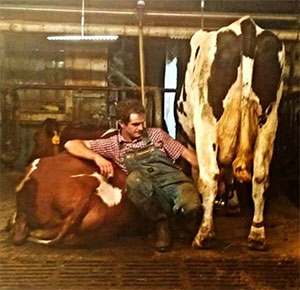
The farmworker entered a cow shed at Moreton Hall Farm, near Market Drayton, to clear it out when he was struck by a dairy bull.

The 28-year-old employee, who had been working on the farm for one year, suffered a serious leg injury which required an operation.

Kidderminster Magistrates’ Court heard the incident happened on 23 August 2016.

An investigation by the Health and Safety Executive (HSE) found the mature dairy bull was housed with cows in a cubicle shed, which farmworkers had to enter three times a day to clear out, while the bull was loose in the same enclosure.

Inspectors found a suitable bull pen with means of restraint was not provided on the farm to ensure workers did not have to enter an area occupied by the bull.

The farm’s risk assessment identified potential danger from the unrestrained bull, but failed to identify adequate controls, even though there were clear signs that the bull was getting more difficult to handle, the court heard.

Guilty plea

Farm owners TN Beeston and Son pleaded guilty to breaching health and safety at work regulations. A judge fined the company £16,000 and ordered it to pay £3,079 court costs.

Speaking after the hearing, HSE inspector Wendy Campbell said: “Farmers have a responsibility to assess risks from their cattle and provide suitable housing and handling facilities to ensure that bulls are excluded from areas where they or their employees work.

“Farmworkers should never enter an enclosure when a bull is loose.”


Source: Farmers Weekly

The Cows Were Sold, the Hay Was Gone

One of the saddest pictures I have ever seen was posted on the Internet recently. It was an empty milking parlor that marked the end of a multi-generational family dairy farm. The cows were sold, the hay was gone, the equipment put away. The children would not have the legacy of this farm. Only echoes and concrete remained in the barn.

Sadly, this predicament is all too real for the modern dairy owner. Lately, letters have been sent to farmers from Dean Foods, giving a 90-day notice for producers to find a new milk buyer. Dean Foods is the contractor for Walmart’s Great Value milk. While not blaming Walmart for this tragedy, the regions where contracts were lost encompasses the location of Walmart’s new bottling plant. Processors are also shipping milk in from other states to take advantage of low prices. After surviving two years of extremely low prices, over one hundred farms have lost contracts in the past few weeks. Companies blame a surplus of milk, but individual producers say this is more than a swing of the market. 

Many processors have felt the impact. Some combat this by increasing hauling fees, taking away quality premiums, and charging for milk tests that help farmers with feed efficiency. Many farmers won’t protest this for fear of their contracts being dropped. 
My friend Tristan is one of these steadfast producers, moving to Wisconsin when the dairies dried up in his home state of Missouri. He met his wife, Meg, and they literally combined dairy herds, from getting married in a livestock auction barn to spending honeymoon money on cows and a combine. Tristan and Meg milk 60 cows, farm 500 acres and rely on other ag endeavors to make ends meet. 

Both Tristan and Meg start each day by cleaning stalls, milking and feeding each cow a specific diet for her individual needs. At the evening milking, they groom the cows, scratch their backs for them, and clean hooves. They each have their favorite cows, too. Tristan says, “Every cow is named and Meg and I can name them all off by heart. It’s a very fulfilling life, yet very sad at the same time. We bring these girls into the world by delivering them ourselves. We spend each and every day of our lives together twice a day. We give them help when they are sick. I know Meg and I are going to be in tears when we see two of them go through the sale barn tonight.” These two have seen a 60% decrease in their dairy income. 

These issues affect every aspect of a dairy family’s life. Milk checks are cut and divided between multiple organizations that advertise and market for the dairy company. But even that comes to a halt when a contract is dropped. Without a buyer for their milk, most dairymen won’t be able to get loans for seed and other farm necessities What many consumers don’t know is that termination letters and final milk payments often come with suicide hotline numbers. 

But what can we do? Many encourage buying extra dairy products. Milk, buttermilk and cheese can all be frozen. Trying to buy from smaller dairies also helps producers. You can find out where your milk is from by entering in the bottle code at www.whereismymilkfrom.com. The website also includes a map to find your local dairies. Producers also ask that you call your congressmen and let them know how important family dairy farms are. 

I asked Tristan what he wanted consumers to know. He says, “We do the best we can for our livestock, not because it is the most profitable, but because it is the right thing to do. We are stewards of God’s creation and that’s something we hold sacred. The next time people complain about the price of food, remember the people who put food on their tables often don’t have enough on their own. Please support your local family farmer.” 

So please, let’s do our part to make sure the family dairy doesn’t disappear into idealistic storybooks. Let’s give these hardworking producers a future. Let’s make sure their farms stay in the family and their children will have calves to bottle-feed. Let’s do what we can, whether we raise livestock, tend orchards, or farm row crops. We are in this together. As Tristan says, “I’m a fourth-generation dairyman and I pray I’m not the last.”

Source: Growing Wisconsin

Vieuxsaule Allen Dragonfly 6th cow in Canada with 40 stars

VIEUXSAULE ALLEN DRAGONFLY EX-94-2E-CAN 40*

For just the 6th time, a Canadian cow has achieved the amazing accomplishment of 40 stars. Vieuxsaule Allen Dragonfly EX-94 now gradually comes within reach of Stepido Super Mega (47 stars), Sher-Est Rudolph Stress (49) and Brabantdale Triumphant Spooky (54). La Presentation Daurel (64) and Gillette Blitz 2nd Wind (72) apparently remain beyond reach.

Canadian government invests in modernizing Quebec dairy farm

Speaking today at Ferme Élégante, Marie-Claude Bibeau (Compton—Stanstead), Minister of International Development and La Francophonie, on behalf of Agriculture and Agri-Food Minister Lawrence MacAulay, highlighted the investments made to modernize Ferme Élégante, a 120-cow farm. Pierre-Paul Boulet and Chantal Fortier are fourth generation dairy farmers, continuing a family farm that has been in operation since 1908. The dairy producers recently upgraded their barn to install a new milking robot, increasing productivity and efficiency, with support from the Dairy Farm Investment Program.

Quotes

Pierre-Paul Boulet and Chantal Fortier are great examples of forward-looking dairy farmers focused on improving their farm’s productivity and driving down costs. I’m glad the Government of Canada has contributed to keep Ferme Élégante’s operations innovative and competitive. This is just one of the many ways the Government continues to support the dairy sector to ensure it remains strong.”
–          Marie-Claude Bibeau (Compton—Stanstead), Minister of International Development and La Francophonie

“It’s a significant investment and it will allow us to modernize our business. With this third generation milking robot, we’ll have more reliable data regarding our herd’s health and productivity. Our herd management will be more efficient and we will be able to provide higher milk quality.”
–          Pierre-Paul Boulet and Chantal Fortier

Quick Facts

  • The Ferme Élégante modernization project was supported by the Dairy Farm Investment Program with an investment of over $194,000.
  • The Dairy Farm Investment Program is a $250 million, five-year federal investment, providing targeted contributions to help Canadian dairy farmers update farm technologies and systems and improve productivity through upgrades to their equipment.
  • To date, over 750 dairy producers have been approved for funding support valued at over $36 million, in a wide array of projects from small investments in cow comfort equipment to large ones for automated milking systems.

Associated Links

Holstein Association USA Announces New Production Records Program for Producers with Robotic Milking Systems

Holstein Association USA is excited to announce a new program for producers with robotic milking systems who no longer are participating in traditional milk recording programs but still wish to have their production information published on Official Holstein PedigreesTM. Known as TriStarSM AMR, the goal of the program is to allow producers with robotic milking systems that are recording both milk weights and component data to have the information collected by those systems flow into the Holstein herdbook database. This program is an extension of HAUSA’s TriStar program, a longstanding service for administering production records, cow and herd genetic performance reports, and recognition.

“We’re pleased to be able to offer a new service to dairies with robotic milking systems, so they can streamline their milk weights and component information to help them manage their herds,” said Holstein Association USA CEO John M. Meyer. “More cows are being milked with robotic milking systems every day, and our AMR program is just what their owners have been looking for, and we are happy to provide it. This program represents a new evolution in the dairy industry.”

TriStar AMR is only for herds who are no longer participating in DHIA milk recording programs; herds testing with DHIA are eligible for the traditional TriStar production records program options. Once enrolled, HAUSA and AgriTech Analytics (ATA) will coordinate with producers to receive data from their on-farm system, have it processed at ATA, and sent on to HAUSA for loading into the herdbook database.

Herds will have 305-day production records added to their Official Holstein Pedigrees as soon as the record is processed. Production records coming from these on-farm systems will be clearly labeled on Official Holstein Pedigrees with “AMR” printed in front of the record, in the area where TriStar level designations are typically printed.

The fees to participate in TriStar AMR are a $17 per month herd fee, plus $2 per completed 305-day lactation recorded that is loaded for Registered Holstein® cows, which covers data collection and processing by ATA, and loading into the HAUSA herdbook system. TriStar AMR is not included in Holstein COMPLETE®, and at this time, AMR records are not eligible for recognition programs.

To enroll in TriStar AMR or get more information about this new program, call Holstein Association USA customer service at 800.952.5200.


Organic ‘grassmilk’ may help beat heart disease, study suggests

If you’re like most Americans, you probably grew up hearing that milk is an important part of a healthy diet. But research suggests health benefits such as lowering heart disease risk may ultimately depend on a cow’s diet.

Cows consuming an essentially 100 percent organic grass and legume forage-based diet produce milk rich in nutrients that slash the risk of heart disease, diabetes and other illnesses, according to a recent study published in “Food Science & Nutrition.

Researchers from the University of Minnesota, Johns Hopkins University, Newcastle University in England, Southern Cross University in Australia, and the Aarhus University Hospital in Denmark collaborated to analyze over 1,160 samples of whole “grassmilk” over three years, taken from on-farm bulk tanks before processing.

Their results showed that grassmilk cows produce milk with elevated levels of omega-3 and CLA, which provides a significantly healthier balance of fatty acids.

“The improved fatty acid profile in grass-fed organic milk and dairy products (also known as grassmilk) brings the omega-6/omega-3 ratio to a near 1 to 1, compared to 5.7 to 1 in conventional whole milk,” according to a press release from the University of Minnesota. “Omega-6 and omega-3 fatty acids are essential human nutrients, yet consuming too much omega-6 and too little omega-3 can increase the risk of cardiovascular disease, obesity, and diabetes.”

The data has led some of the researchers to suggest milk suppliers could increase their margins by turning to pasture fed cows.

“With growing consumer demand for organic dairy products, producers may be able to expand their profitability and market share by converting to grass-based pasture and forage-feeding systems,” study co-author Dr. Bradley Heins and associate professor of dairy science at the University of Minnesota’s West Central Research and Outreach Center, said, according to Express.

For the study, researchers divided cows into three groups based on what they were fed: “grassmilk” cows, “organic” cows and “conventional” cows.

Grassmilk cows consumed an essentially 100 percent organic grass and legume forage-based diet, via pasture and stored feeds like hay and silage. The organic cows ate about 80 percent of their daily Dry Matter Intake (DMI) from forage-based feeds, and 20 percent from grain and concentrates. In contrast, conventional cows consumed rations in which forage-based feeds account for only about 53 percent of daily DMI. The other 47 percent comes from grains and concentrates.

The research showed that grassmilk provided the highest level of omega-3s (0.05 grams per 100 grams of milk), compared to 0.02 grams per 100 grams in conventional milk. This demonstrated an increase of 147 percent in omega-3s when cows are primarily grass fed.

Additionally, grassmilk contains 52 percent less omega-6 than conventional milk, and 36 percent less omega-6 than normal organic milk. The research team also found that the grassmilk had the highest average level of CLA (0.043 grams per 100 grams of milk). In comparison, the conventional milk contained just 0.019 grams per 100 grams, and the organic milk contained 0.023 grams per 100 grams.

Despite the significantly healthier balance of fatty acids in grassmilk, conventional feeding of cows accounts for the vast majority, or more than 90 percent, of the milk cows on U.S. farms.

However, consumers concerned about their health should definitely consider avoiding conventional milk, according to the researchers.

“The near-perfect balance of omega-6 and omega-3 fatty acids in grassmilk dairy products will help consumers looking for simple lifestyle options to reduce the risk of cardiovascular and other metabolic diseases,” Dr. Charles Benbrook, from Johns Hopkins University, said, according to NDTV.


Source: AJC

Dairy Farmers of America, Sprint announce 2018 start-up accelerator cohort

US cooperative Dairy Farmers of America (DFA) and communications company Sprint have revealed the nine start-up businesses that take part in their accelerator programme this year.

They include start-ups focused on “ag tech” and dairy food products.

The Accelerator is a 90-day programme that continues until June. Start-ups will work directly with leaders from Sprint, DFA and programme backer CoBank as well as other industry experts and mentors.

Sprint launched its accelerator in 2014. DFA first teamed up with Sprint to develop an accelerator looking at agricultural technology and dairy food last year.

Kevin Strathman, senior vice president of finance at DFA, said: “We’ve found tremendous value in this programme and leveraging innovation that’s happening with start-up companies in the ag tech space.

“For year two, we’re focused not only on building partnerships that can help solve problems and benefit our members on their farms, but it’s also exciting to add dairy food start-ups into the mix. We’re looking forward to working with these companies to help grow their businesses and ultimately drive consumer demand for dairy.”

Doug Dresslaer, managing director of the Sprint Accelerator, said: “We have a diverse and exciting group of companies joining our programme this year,

“For Sprint, we’ve recruited companies that align with our IoT [internet of things] team’s core business strategies and for DFA, we’ve not only brought in cutting-edge agricultural technology companies, but we also have three dairy food product companies in this year’s cohort.”

The ag tech and dairy food product companies selected for the 2018 Accelerator are:

Pharm Robotics from San Jacinto, California, which is developing robotic systems to automate the administration of animal health products in dairy cows.

Ripe Technologies from San Francisco, California, which is transforming the food supply chain using blockchain technology to enable data transparency.

SomaDetect from Fredericton, Canada, which is a precision-dairy company that is creating an in-line system for measuring every compound of interest in raw milk.

Cheddies from San Antonio, Texas, which provides consumers with a cheese cracker that has added nutritional benefits.

MoPro Nutrition from Birmingham, Michigan, which claims to be the first Greek yogurt infused with CFM whey protein isolate.

Too Cool Chix from New York, which creates ice cream sandwiches free of artificial ingredients and stabilising gums.

The internet of things participants are:

Keybot from St. Louis, Missouri, which helps automate rental access with proprietary keypad lock and app through self-showings and renter and maintenance access.

Luxe Concierge from Kansas City, Missouri, which has developed a mobile app which allows apartment residents to book and manage services such as housekeeping, dog walking and dry cleaning pick up.

Sofihub from Melbourne, Australia, which is a digital assisted living solution using artificial intelligence and sensor technology to support seniors to live independently.

As a sponsor for the accelerator, DFA will provide mentorship, connections and resources to help accelerate the growth of the ag tech and dairy food product start-ups selected.

Workspace facilities will be provided at Sprint Accelerator in Kansas City.


Help grow the next generation of dairy leaders

The “Plant a Seed. Inspire a Dream” campaign is looking to raise $25,000 to grow the next generation of dairy leaders. Help us to cultivate a legacy of learning.

Donations can also be made at the PDPW Business Conference March 14th-15th or mailed to the Professional Dairy Producers Foundation, 820 North Main Street, Suite D, Juneau, WI 53039.

World Dairy Expo® Honors 2018 Outstanding Dairy Leaders

World Dairy Expo is pleased to announce the recipients of the 2018 Expo Recognition Awards to be formally presented at the 52nd annual event in October. The honorees were nominated and selected by their peers for their contributions and excellence in the dairy industry and their community.

The 2018 honorees are as follows:

Dairy Woman of the Year
Jeannette Sheehan, Sheeknoll Farms, Rochester, Minn. 

Dairyman of the Year
Pete Kappelman, Meadow Brook Dairy Farms, LLC, Two Rivers, Wis. 

Industry Person of the Year
Dr. Dan Hornickel and Dr. Chris Keim, Sunshine Genetics, Inc., Whitewater, Wis. 

International Person of the Year
Alastair Pearson, World Wide Sires China Co. Ltd, Beijing, China

These dairy leaders will be recognized at World Dairy Expo’s Dinner with the Stars, October 3, 2018, in the Exhibition Hall at the Alliant Energy Center. Banquet tickets are available by contacting the WDE office at 608-224-6455 or wde@wdexpo.com. Prior to the banquet, the WDE Welcome Reception returns to give all Expo stakeholders and attendees the opportunity to celebrate and interact with these honorees while enjoying complimentary hors d’oeuvres.

Serving as the meeting place of the global dairy industry, World Dairy Expo brings together the latest in dairy innovation and the best cattle in North America. Crowds of nearly 70,000 people, from 100 countries, will return to Madison, Wisconsin for the 52nd annual event, October 2-6, 2018, when the world’s largest dairy-focused trade show, dairy and forage seminars, a world-class dairy cattle show and more will be on display.


A new king cheese has been crowned world champion

A new king cheese has been crowned in Wisconsin.

The winner of the 2018 World Championship Cheese Contest is a hard sheep’s milk cheese called Esquirrou. The announcement was made Thursday night in Madison.

Esquirrou is made in France at Mauleon Fromagerie by Michel Touyarou and imported by Savencia Cheese USA of New Holland, Pennsylvania.

Twenty cheeses out of a record 3,402 entries were finalists for the top prize. The Wisconsin Cheese Makers Association, which hosts the contest , said five of those cheeses were from Wisconsin.

The contest began Tuesday. Judges had to sniff, taste and inspect 121 classes of dairy products, with entries from 26 nations.

Source: nypost.com

Dr. Pearse Lyons, Alltech President and Founder, Passes Away at 73

Alltech president and founder Dr. Pearse Lyons has passed away after battling an illness, the company said Thursday.

The company says he died Thursday morning.

Lyons immigrated to the United States from Ireland in the 1970s, and built the agricultural company from a home operation to employing more than 5,000 people internationally.

“The thoughts of our entire Alltech family around the world are with Dr. Lyons’ family, specifically his wife Deirdre, daughter Aoife, son Mark and Mark’s wife Holly,” CEO and treasurer of Alltech Alric Blake said, “Dr. Lyons was a visionary entrepreneur who transformed the agriculture industry beginning with his innovative application of yeast technology in animal nutrition. From farm to field, from market to family dinner table, our world is immeasurably better because he was a man who never saw problems, only a challenge that had not yet been solved.”

The company released additional details on his life story here.

Lyons’ funeral will be in Lexington Mar. 17 with a public visitation the day before.

University of Kentucky men’s basketball coach John Calipari was a close friend of Lyons, and he had mentioned that the entrepreneur’s health had been failing days ago.

“On a personal level, I’ve never met anyone as driven, as wired or as big-hearted as Dr. Lyons,” Calipari said, “His random acts of kindness know no boundaries. I would use the term legendary to describe them, but you would only know about them if you were touched by them or if you’re really close to him because most of it was done in a silent way.”

At his news conference in St. Louis, Calipari discussed his friendship with Dr. Lyons.

Lexington Urban County Council held a moment of silence at the beginning of their regular meeting on Thursday.

“He had compassion,” Mayor Jim Gray said afterward. “He had so much spirit for the city, for Lexington, for Kentucky. He was our ambassador.”

Sen. Majority Leader Mitch McConnell, R – Ky., also offered a statement following Lyons’ death.

“Elaine and I were deeply saddened to hear of the passing of our friend, Dr. Pearse Lyons,” McConnell said, “Pearse will be remembered for his many accomplishments – as a scientist and innovator, as a businessman and philanthropist, and as husband and father. In each of these, he excelled.”

Lexington-area business leaders are also taking time to remember Dr. Lyons.

“Dr. Lyons was not only a strong advocate for Kentucky and the Bluegrass, but through his visionary leadership, Alltech transcended business and industry to become a global leader in finding solutions to the world’s most pressing issues,” said Commerce Lexington president and CEO Bob Quick.

“The Kentucky Horse Park extends its deepest sympathy to the Lyons family upon the passing of our good friend, Dr. Pearse Lyons. The vision and support of Dr. Lyons and his wife, Deirdre, enabled the Kentucky Horse Park to host the 2010 Alltech FEI World Equestrian Games. The Alltech Arena, at the Kentucky Horse Park, is one of the nation’s premiere equine event facilities. Both are legacies of his support,” said Kentucky Horse Park chair Tandy Patrick, “Dr. Lyons’ energy, enthusiasm and belief that anything is possible will continue to be an inspiration to all of us.”

University of Kentucky president Eli Capilouto also released a statement.

“The University of Kentucky, our alumni, and our friends are saddened to hear of the passing of Dr. Pearse Lyons,” said UK President Eli Capilouto. “Dr. Lyons was a compassionate and committed community leader and global entrepreneur who founded Alltech and established it as a powerful brand and industry leader. He was a philanthropist, ardent supporter of the University, and deeply committed patron of the arts. Most notably, his support of UK Opera Theatre brought artistic expression and music performance to the community, and students supported by his generosity have shared their remarkable talent with audiences across the world. We are enriched by the legacy he leaves to our campus and community, and the UK family offers its condolences to Deirdre and the entire Lyons family at this time.”

State leaders are also mourning the loss of Dr. Lyons.

“Kentucky lost one of the great ones today with the passing of Pearse Lyons,” House Democratic Leader Rocky Adkins said, “I don’t know of anyone who was more innovative, who was more committed to excellence, or who was a better ambassador for the Commonwealth. He made a true difference in all of our lives, and the legacy he established through Alltech will be felt for generations. He will be deeply missed.”

Agriculture Commissioner Ryan Quarles talked about Dr. Lyons’ impact in a statement, as well.

“It is with great sadness I have learned of Dr. Pearse Lyons’ passing,” he said. “Dr. Lyons was, at root, a visionary and an ambassador for Kentucky. When he founded Alltech in 1980, Kentucky agriculture changed forever. The institution he built, the jobs he created, and his boundless zeal for our state lit a spark that spread into a wildfire of innovation for Kentucky agriculture, from animal feed to our beverage, fuel, and industrial alcohol industries. Dr. Lyons also gave generously to numerous philanthropic endeavors and launched a global conference that has become a staple of Kentucky’s spring calendar.
“A dear mentor of mine, he taught me the importance of continuous self-improvement and served as a role model and inspiration. My thoughts and prayers are with his wife, Deidre; his children, Mark and Aoife; and the entire Alltech family during this difficult time.”

Lyons’ family is asking for donations to the Alltech ACE Foundation, which provides services for schoolchildren in Haiti, in lieu of flowers.

Source: wkyt.com

Devastated dairy farmer ditches 75,000 litres of milk

A Scottish dairy farmer has been forced to dump 75,000 litres of raw milk after snow drifts blocked routes for collection tankers, Farmers Weekly can reveal.

As temperatures plunged as low as -9C paralysing road networks and cutting off farms the producer had no choice but to ditch milk worth £23,000. 

The dairy farmer said the experience had been devastating for everyone involved.

“It’s been very difficult for the farm and everyone here who work so hard to keep our herd in the best shape possible.

“To carry on milking three times daily in such adverse weather and ensure all the cows and calves are safe and dry and then to have to discard the milk has been very disheartening for our staff,” the producer told Farmers Weekly.

“Our processor did try and get through to us but were turned back by police on Thursday [1 March] as the conditions were too bad.”

The farmer added the farm would just have to keep going and work harder to shoulder the costs of the losses brought about by the adverse weather.

A milk tanker managed to get through to the farm on Friday (2 March), after the farmer plotted a new route and their team of staff cleared roads with their own plough.

What to consider when buying insurance for your milk

With many processors placing responsibility on producers to shoulder the cost of uncollected milk, Farmers and Mercantile branch manager Matt McWhirter estimates that only about 30% of producers would have insurance to cover the costs of wasted milk. He explains what to consider when looking at purchasing insurance for uncollectable milk:

  • Be aware of what cover you already have. There are two types of cover for milk losses, which are often sold separately. There is cover for milk lost through contamination, which is usually a separate package to coverage for uncollected milk due to things such as bad weather.
  • Producers should calculate how much cover they need. Policies can be bought to cover a number of days or litres, with most producers with cover opting to protect themselves against one to two days without collection.
  • Consider geographical factors. For some producers, coverage should be a no brainer – but if farmers aren’t in high-risk areas or somewhere that experiences the extreme cold often then insurance is likely not for them. We have not seen a weather event comparable to this for 20 years so producers should think whether this is a risk they want to carry themselves or not.
  • Many policies are renewed in the summer when bad weather seems a long way away – it is crucial to look ahead and plan for winter.
  • Bolt-ons to standard cover start from about £75 and increase depending on how many day’s milk is included and the size of your bulk tank.
  • Payouts are usually based on the day’s previous milk delivery and subject to an excess amount.
  • Most insurance companies use an exclusion period after the add-on is bought during which no claims can be made. The period can range from seven days to up to a month.

Source: fwi.co.uk

The milkman of Montreal isn’t ready to stop delivering

Arnaldo de Castris was supposed to retire from delivering milk in Montreal. He’s 82 and after 65 years on the job, time was catching up.
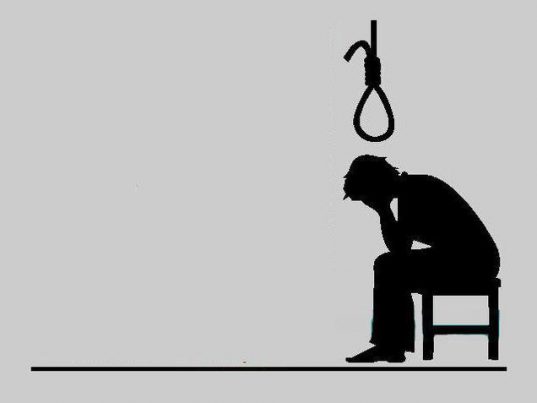
But retirement wasn’t really working out for him, so he’s back on the job, tagging along with his 69-year-old cousin Richard Di Monte who took over his route. It’s hard work – getting up before dawn, pushing around heavy milk, and navigating snowy streets and slippery driveways – but de Castris missed it too much.

“Well, I enjoy my job. I really enjoyed working, I still do. I miss it, I miss it unbelievable,” he said. “The whole thing, the customers, the area, the whole works.”

He’s delivered milk, eggs and butter in the neighbourhood of Notre-Dame-de-Grace for seven decades and his customers have become friends. De Castris is unfailingly cheerful and charming, greeting customers and their families and pets with a big smile and a “good morning” or “buongiorno.”

But his doctor said it was time to retire.

“He said, ‘You’re not 22 you’re 82.’ So he tells me to slow down.”

So de Castris reluctantly packed up his milk crates in the New Year. But now that he’s feeling better, staying home isn’t for him.

“I’m having a hard time. I just can’t do it, not yet. So I’m glad he’s taking me along with him. I’m happy,” he told CTV Montreal.

“It’s incredible. He has so much energy. It’s obvious he’s doing it for the love, not for the money. He loves to see his clients,” said one of de Castris’s customers.

“Arnie’s been really a pet,” said one woman, a long-time customer. “He’s been very helpful.”

De Castris’s uncle brought him into the business when he was 17. He was delivering from a truck when some were still using horses.

“There wasn’t much to learn. It’s only about milk. There’s only homogenized and pasteurized and skim milk and jersey milk. So that’s all gone but now we have a lot more.”

Many Canadian cities said farewell to milk delivery years ago and it is dwindling in Montreal, too. The city used to have 150 people delivering milk door to door but only about 30 remain.


Source: CTV News

Addressing suicide risk for dairy farmers

Accompanying the routine payments and price forecasts sent to some Northeast dairy farmers last month were a list of mental health services and the number of a suicide prevention hotline.

The Agri-Mark dairy cooperative got the resources out to its 1,000 farmers in New England and New York following the suicide of a member farmer in January, and one the year before.

“I know there’s a number of farmers out there that are under such tremendous stress that we’re worried about that same thing happening,” said Bob Wellington, an economist for Agri-Mar Inc., which owns Cabot Creamery.

Farmers are facing their fourth year of payments well below their cost of production, due in part to a national and global oversupply of milk, he said.

Prices paid to farmers hit an average of $24 per hundred pounds of milk in 2014, the highest price since at least 2000. They quickly dropped to an average of about $17 per hundred pounds of milk in 2015, $16 in 2016 and $17 last year.

“They’re really getting frustrated, getting concerned and in some cases they’re getting almost desperate about how they’re going to pay their bills, how they’re going to support their families,” Wellington said.

The farm prices have no direct correlation with what consumers pay for milk.

According to a 2016 Centers for Disease Control and Prevention report , people working in farming, fishing and forestry had the highest rate of suicide.

Agri-Mark is also creating its own assistance program for its members and isn’t alone in its concern.

“Financial duress magnifies some of the personal issues like depression, or anxiety, or something else that’s underlying can be triggered by a severe economic downturn in the dairy industry,” said Ed Staehr, executive director of NY FarmNet, a free confidential service for New York farmers that offers personal and financial consulting at their homes. Vermont has a similar program called Farm First.

Minnesota has set up a free, 24-hour confidential help line as stress, anxiety, depression, financial burdens, and other mental and emotional problems continue to affect farmers and other rural residents. It also provides workshops for people who work with and serve farmers, such as bankers and suppliers, to understand mental health.

Since the department started promoting the help line in early October through December, 39 calls came in including from a few suicidal farmers and others who called about fights with a spouse, anxiety or physical manifestations of stress, like not sleeping, said Meg Moynihan, a dairy farmer and adviser for the Minnesota Agriculture Department.

“At this time of year, people are doing their taxes and starting to go in for operating loans, and it’s kind of terrifying to say, ‘Am I going to be able to farm again for a year?’” she said.

Calls have poured in to FarmNet in New York since the end of December. The service is seeing more severe cases in recent months, with farmers realizing they’re stressed out. Some lenders are not letting certain farmers have a line of credit, so FarmNet is encouraging farmers to work with their suppliers.

Social worker Erica Lewbner’s load has jumped from one new case a month to at least one new case a week, she said.

“Farmers are very proud,” said Lewbner, of Marietta, New York. “They typically do not reach out for help.”

Beth Kennett, of Liberty Hill Farm in Rochester, Vermont, said she and her family make decisions every day to keep the farm going, something they want to do for future generations. In addition to dairy farming, they offer farm vacations to visitors.

“Faith and fortitude will get us through this difficult time,” she said.

Although gut-wrenching, the Agri-Mark letter sparked conversations among farmers and farm families and words of support from the community, she said.

“I think it really initiated conversations on multiple levels within the family individually, but within the farm community, as well,” she said, “recognizing that we all are family and we really have to reach out and care for each other.”

Source: NY Times

2018 Ontario Holstein Branch Board of Directors

At their February 28, 2018 Ontario Holstein Branch Board of Directors Meeting, David Johnston of Listowel was elected as the new Ontario Holstein Branch President for the upcoming year with Brad Lowry of Almonte as the new Vice-President. Johnston, Lowry, Past President Sandy O’Hara and Tara Bullock of Lakefield make up the Executive Committee.

2018 Ontario Holstein Board of Directors: front (l to r): Tara Bullock, Dave Johnston (President), Merina Johnston (Branch GM), Brad Lowry (Vice President), Sandy O’Hara (Past President). Back (l to r): Dennis Werry (National Director), James Cranston, Cole Verburg, Wilf Strenzke, Hans Pfister.

The 2018 Board of Directors includes the following members:

Eastern Ontario: Brad Lowry, Almonte, and Cole Verburg, Athens.

East-Central Ontario: Sandy O’Hara, Schomberg, and Tara Bullock, Lakefield.

West-Central Ontario: James Cranston, Ancaster, and Wilfred Strenzke, Breslau.

Western Ontario: David Johnston, Listowel, and Hans Pfister, Mitchell.

National Holstein Canada Director appointed to Board – Dennis Werry, Oshawa.

New Farm Advisory Group Launched in Canada – Proventus

Proventus is a comprehensive new agribusiness consultation network made up of a diverse group of independent, industry leading professionals that will operate independently from WestGen, the Abbotsford, B.C., based A.I. centre. This network brings the opportunity for producers to access unbiased expertise that encompasses everything from veterinary care to agribusiness management. Two pivotal like-minded partners included in the initiative are MNP and XLVets Canada. The MNP team offers a range of specialized business solutions, with a focus on agricultural expertise. The other pillar delivers expertise and knowledge from XLVets Canada; already 60 veterinarians strong from across Canada and drawing further knowledge from over 800 XL Vets globally. In addition, the XL Vets organization in Canada is expected to continue to grow as more clinics apply to become members.
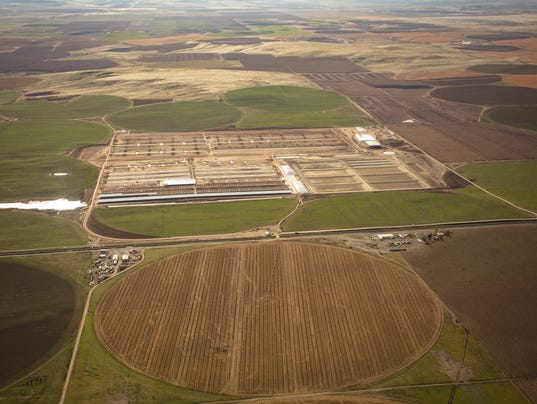
Proventus will launch with the initial service offerings including Farm Business Health Check, Business Plans, Cash Flow Projections, Family Farm Succession Planning, Quarterly Financial Updates and Reports, Monthly Financial Dashboards, Annual Financial Statements, Tax Planning, Farm Purchases & Sales, Financial Benchmarking, HR Support, Farm Worker Benefits Packages, Farm Labour Recruitment Services, Herd Health Performance Audit & Management, Lameness Assessment, Production Evaluation, proAction® Corrective Action Planning, Audit Planning & Assessment, IT Planning & Support, and Farm Employee Training.

Proventus experts will collaborate with a farm’s existing service providers, enabling producers to find the best solution while only making one call. XLVets Canada and MNP were chosen to be the initial consultant businesses representing the gold standard in their respective fields, and who are not engaged in significant commercialization beyond their advisory capacity. In the future, other consultant businesses who share these philosophies will be encouraged to join Proventus. Canadian Veterinary Clinics are encouraged to apply to become members of XLVets Canada. You can contact Proventus at 1-800-982-1674 or e-mail info@proventusgroup.com.

As farms grow, the need for information has also grown. WestGen recognizes this increased need for specialized information and as a farmer-owned company, decided to provide leadership for this initiative and bring together this specialized information through Proventus’ collaborative network.

“Providing our members access to North America’s most respected experts and encouraging the incubation benefits of cross-pollination that will naturally occur from their interactions through Proventus will undoubtedly help producers make well informed decisions as they continue to develop their businesses,” states WestGen CEO, Chris Parry.

Oregon sues to shut down new mega-dairy, citing repeated manure spills

Oregon’s newest mega-dairy has repeatedly endangered nearby drinking water by violating environmental laws and should be shut down immediately, the state alleges in a lawsuit.
Lost Valley Farm opened in April 2017 near Boardman along the Columbia River in north central Oregon to supply the Tillamook County Creamery Association, which makes Tillamook Cheese.

Its wastewater permit allows up to 30,000 animals and 187 million gallons of manure per year.

Regulators approved the dairy despite objections from about 4,000 people and a dozen state and national health and environment organizations raising concerns about air and water pollution, water use and health impacts on nearby communities.

Since then the dairy has failed numerous inspections, has been cited four times and has been fined $10,640.

Each citation included steps the dairy was required to take to remain in operation. Each time, the dairy failed to comply with most of those requirements, the Oregon Department of Agriculture said in the lawsuit filed last week.

As a result, liquid manure and wastewater has repeatedly overflowed storage lagoons and seeped into soil.

The lawsuit seeks an immediate and permanent injunction prohibiting the dairy from creating any more wastewater.

Dairy owner Greg te Velde, who lives in California, declined comment.

In a written response to the lawsuit, te Velde and dairy manager Travis Love said the injunction would put them out of business, forcing them to lay off 70 workers, euthanize their cows, lose a $4 million per month milk contract, and default on local creditors.

“The department’s order would have significant ramifications to the local community where the dairy is located,” te Velde wrote. “Many of our employees are Latino and rely on the dairy to support their family.”

Love and te Velde said they currently are meeting all the permit requirements.

“In my experience and discussion with other dairy farms, (the inspector’s) approach to inspections and ODA’s approach to notices and penalties against Lost Valley Farm is much more stringent than at other dairies in Oregon,” Love wrote. “The dairy is a new facility. ODA is aware of this but is approaching compliance with the permit as if it is an established dairy that has been in operation for some time.”

The dairy is in the Lower Umatilla Basin Groundwater Management Area, designated because groundwater already is high in contaminants.

Groundwater flows from the site to a large part of the area, so pollutants could potentially impact a broad area of the shallow aquifer, ODA said. That threatens 81 public water supply systems, including five within 10 miles of the farm. There also are many private drinking water systems within the area.

“Defendant’s repeated and gross violations of numerous permit conditions threaten human health, safety and the environment,” ODA told the court.

State officials don’t know how much wastewater has been improperly released, because the dairy did not file required forms notifying officials of the releases and estimating amounts. 

Last Friday, a judge issued a temporary restraining order requiring the dairy to operate in compliance with all permit requirements. Dairy owner te Velde will have a chance to argue against the state’s request for an injuction on March 16.

The Tillamook County Creamery Association declined an interview request. 

“Based on a number of recent factors that indicate deterioration of the Lost Valley operation, Tillamook has initiated the process to terminate our contract with Lost Valley Farm,” the cooperative said in an email. 

On Monday, Rabobank, a multinational agricultural lender, filed a separate lawsuit in Morrow County seeking to foreclose the dairy in connection with the foreclosure of two dairies te Velde owns in California.

According to the lawsuit, Rabobank is more than a year past-due on two of three commercial loans it made to te Velde. As of Jan. 2, 2018, te Velde owed $37.4 million on those two loans.

Lost Valley Farm is located on 7,000 acres near the 70,000-head Threemile Canyon Farms, which also supplies the Tillamook Dairy Cooperative.

Te Velde had operated a smaller dairy, with 8,000 animals, on land leased from Threemile Canyon Farms since 2002. He purchased land for the new dairy from the former Boardman Tree Farm in 2015.

“Thousands of Oregonians weighed in to object to this facility, but their voices were largely ignored by the state agencies and political leaders in charge of protecting our natural resources and water supplies,” Ivan Maluski, policy director for Salem-based Friends of Family Farmers, said Wednesday. 

Hannah Connor, an attorney for the Center for Biological Diversity, one of the groups that opposed the dairy, called the violations detailed in the lawsuit a preventable disaster.

“It’s exceedingly clear the agency made a huge mistake when it granted a permit to Lost Valley,” she said. “To stop any further harm to the state’s irreplaceable natural resources, Oregon must now take the appropriate steps to improve its oversight of this industry and fix the weaknesses in its permitting program.”


Source: Statesman Journal

Thousands Attend Dairy Farmers Pagel, Witcpalek Funeral

John Pagel

A steady stream of people filed into Kewaunee High School on Friday to honor, remember and celebrate the impact John Pagel and Steve Witcpalek had on the dairy industry and their community.

As many as 5,000 people were expected between Friday’s visitation and prayer service and Saturday’s funeral for the two men is almost twice the 2,900 residents of the city of Kewaunee.

Don Niles, a partner of Pagel’s for 32 years, when Niles was “a baby dairy vet” and Pagel was a “baby dairy farmer,” said the turnout shows the impact two farm boys from Kewaunee County can have on the world. 

“The world’s certainly turned upside down for a lot of people,” Niles, who cofounded Dairy Dreams with Pagel 17 years ago, said. “John and I grew our worlds together. We grew to be very close friends, also.”

The “baby dairy farmer” grew a small farm into Pagel’s Ponderosa Dairy, a dairy farm that today has more than 5,300 cows, 100 employees and 8,500 acres He also developed the Cannery Public Market, a farm-to-table restaurant in downtown Green Bay.

Pagel, 58, Witcpalek, 39, and their pilot, Nathan Saari, were killed Feb. 22 when their Cessna 441 Conquest II crashed in an Indiana farm field on a return trip to Green Bay.

Deacon Chuck Agnew of Holy Rosary Catholic Church in Kewaunee was to lead a prayer service at 8 p.m. Friday at the high school. Visitation will continue Saturday prior to a 1 p.m. funeral Mass at Holy Rosary. 

As they made their way to the school’s gymnasium, mourners on Friday walked the halls where Witcpalek as a high school student first met Pagel’s daughter, Jamie Pagel, who became his wife and mother of three children.

They looked across Third Street at the school’s agricultural sciences building that Pagel and the family’s farm, Pagel’s Ponderosa Dairy, were instrumental in helping to design and build.

Kewaunee School Board President Brian Vogeltanz said Pagel had architects out to his farm many times to get the equipment, animal lab, student lab, aquaponics setup, greenhouse and other details just right before the agriculture labs opened in January 2017.

Vogeltanz said the agriculture labs were only a fraction of the Pagel family’s involvement in the community.

“John was instrumental in building the ag center,” Vogeltanz said. “He also opened his farm up for different activities students could take part in. He hosted an ag boot camp for the last two years so students could work on a dairy farm and see the positions available. He sponsored a career day for sixth- and seventh-graders in Kewaunee and Door counties.”

Family members, friends, co-workers and community residents who entered the high school from the west passed a new inclusive playground that Witcpalek had been instrumental in planning and building with the help of the Pagel’s Ponderosa crew. The purple and gold playground is almost ready to welcome its first special needs children this spring.

“He worked hard on the farm and on community projects around Kewaunee,” said Al Paul, Witcpalek’s uncle. “Him and his sister, Jill, started the playground project for special needs children. He also helped with soccer fields in the community. … His mother and father taught him good ethics and giving to other people, just caring about other people. That’s what he was: A very generous and caring person.”

Al Paul talks about his nephew Steve Witcpalek who died in a February plane crash that also killed John Pagel, Witcpaleks father-in-law Jeff Bollier/USA TODAY NETWORK-Wisconsin

Shirley and Sheldon Prodell have been neighbors to the Pagel family for 51 years and still remember an energetic, 7-year-old John’s arrival at their house.   

“John liked our cookie jar,” Shirley Prodell said.

Sheldon Prodell said the couple welcomed the Witcpaleks to the neighborhood when they built a house nearby as well. The cookie jar Pagel loved so much as a boy might be gone, but Sheldon said the Pagel and Witcpalek kids still like coming over for treats.

Sheldon said it’s still impressive how John Pagel helped expand the family farm from its humble roots with 56 cows to its current count of more than 5,000.

“His parents would be very proud of what John has accomplished,” Sheldon Prodell said.

Niles said Pagel treated the farm, bought by John’s father in 1945 after he returned home from World War II, like a laboratory. He’d travel the world to find new methods of caring for cows wherever they were and implement them on the Ponderosa.

But what made Pagel truly unique, Niles said, was that Pagel would share what he learned with other dairy farmers.

“He was an innovator, always looking to improve life for his family, employees, his cows and the community around him,” Niles said. “He enjoyed nothing more than seeing other people have success with ideas he encouraged.”

Niles said he will remember Pagel’s smile and the joy he took in dairy farming.

“We’re all here, thousands of us, filled with grief, but John would want us to get past the grief, carry on and make the world a better place,” Niles said. “John always had fun doing that. It will just be a little less fun now without him and Steve.”

Source: greenbaypressgazette.com


No calf, no problem: P.E.I. dairy producer welcomes 4H members who don’t live on farms

As 4-H celebrates its centennial year on P.E.I., the group is facing an interesting challenge. More than half of the current members don’t live on farms.

Lydia Doyle pets Danni, her calf from last year. Danni now weighs more than 900 pounds. (Nancy Russell/CBC)

That has led to some creative solutions, including more and more Island farmers who have opened up their barns to 4-H members and “sharing” their animals.

‘At first they thought it was a little gross that I was working with cows but as soon as I started showing them pictures and videos, they loved it.’ — Lydia Doyle, 4-H member

“We have lots of animals here so when people ask us, do you have a calf we can borrow, and pet and train, we said sure,” said Amber Craswell of Crasdale Farms in Hunter River, P.E.I.

“It’s always interesting to hear the comments not even just from the kids but from the parents too like how much does a calf weigh, how old is a cow, all these things that we take for granted.”

Craswell grew up in 4H in Quebec and has been a dairy leader for the Cavendish club for 11 years.

Last summer, she was approached by another leader to see if the farm could help out some 4-H members who wanted to do a dairy project. The farm ended up hosting nine young Islanders, each with their own calf.

4-H PEI calf Lydia at show 3

Lydia Doyle and Danni competed at Old Home Week in Charlottetown. (Submitted by Karen Ford-Doyle)

Training a calf takes time and patience, Craswell said.

“Introducing them to the calf and getting that calf to follow them, basically like a dog, takes some training,” she said.

“The more you put into it, the more calf co-operates and it’s a good relationship.”

Craswell points out that the size of the calves can be daunting, which is why they usually suggest one under a year of age.

“A baby calf when it’s born is a hundred pounds and by the time it’s two months old, it’s double that if not more,” she said.

“These kids aren’t nearly that big.”

4-H PEI calf Lydia at show

Lydia Doyle placed at every show in confirmation and showmanship and even got a first-place ribbon. (Submitted by Karen Ford-Doyle)

Lydia Doyle,12, was one of the 4-H members who spent time at the Craswell farm last year, preparing a calf to take on the exhibition circuit. 

“I learned different breeds of cows, I learned how to train a cow, how to pull hundreds of pounds along with me,” said Lydia, a Grade 6 student at Sherwood Elementary.

Her calf was born in March and her official name is Crasdale Uppercut Danni, or Danni for short.

4-H PEI Lydia calf 2

Lydia Doyle says her friends thought it was a ‘little gross’ that she was working with cows until they saw the pictures and videos and loved it. (Submitted by Karen Ford-Doyle)

“I really loved her, she was so sweet. She really liked to lick you and she was great at the shows, she didn’t act up.”

Taking Danni to shows was a learning experience for the first time competitor.

“You have to wear crisp white clothes, which isn’t ideal for cows and you have to bathe her, gel her,” Lydia said.

“You have to put black stuff on her to make all her black stuff stand out and you have to put white on her white spots and it’s really fun.”

4-H PEI calf 1

Aleah Craswell checks out one of the newly born calves at her family’s farm. (Randy McAndrew/CBC)

Lydia did well in her first year of competition, placing at every show in confirmation and showmanship and even got a first-place ribbon.

It took a while but Lydia has even convinced her non-farm friends of what she likes about 4-H.

“At first they thought it was a little gross that I was working with cows but as soon as I started showing them pictures and videos, they loved it,” Lydia said.

“I even brought some of my friends out to meet Danni and they loved her.”

4-H PEI calf 4

Aleah Craswell wants to compete in the poultry category so her family is learning a lot about chickens. (Randy McAndrew/CBC)

Lydia said she appreciates the welcome the Craswells have given her.

“I think it was really nice of them, such lovely people to help us ’cause I don’t own a cow, I don’t live on a farm so in order to get one I had to come to a farm,” she said.

For Amber Craswell, the 4-H experience is taking a new turn as her daughter, Aleah, 9, has joined the youth group. However, Aleah’s first love is not dairy cows, but poultry.

“I like chickens a lot and I feel like they have a personality,” Aleah said.

“I just thought it would be a great learning experience because I can learn more about chickens and how to take care of them.”

Lydia is looking forward to her second year of doing a dairy project, even though she will be starting over with another calf because Danni is now over 900 pounds.

“I have more experience now than I did last year, coming in and not knowing anything,” she said.

“It’ll be really great because now I know all my dairy friends and I can work along side with them.”

Source: cbc.ca

Whole milk may be a healthier choice for kids than low-fat or skim

Study finds that kids who drink whole milk are three times less likely to be overweight and have higher vitamin D levels than kids who drink low-fat milk.

Young children who drink whole cow’s milk tend to be leaner and have higher vitamin D levels than those who consume low-fat or skim milk, researchers say.

In a study of more than 2,700 children aged one to six, Toronto researchers found that those who drank whole milk had a body mass index score almost a full unit lower than kids who drank one percent or two percent milk.

That’s comparable to the difference between having a healthy weight and being overweight, said Dr. Jonathon Maguire, a pediatrician at St. Michael’s Hospital who led the study.

Kids who consumed whole-fat milk were roughly three times less likely to be overweight or obese and two times less likely to have a vitamin D deficiency compared with children who were given one percent milk, he said.

Health Canada, the U.S. National Institutes of Health and the American Academy of Pediatrics recommend that children under two consume only whole milk, but parents are advised to switch to low-fat milk after a child turns two to reduce their risk of obesity. Yet children who drink lower-fat milk don’t necessarily have less body fat and they also don’t benefit from higher vitamin D levels they would get with whole milk, the study found.

“So it’s a double-negative with low-fat milk,” Maguire said.

While the study design doesn’t allow a direct cause-and-effect relationship between a child’s weight status and the type of milk consumed, Maguire speculated that children who down a glass of whole milk may feel more satiated, and therefore may end up eating less than kids who drink the same amount of milk with a lower fat content.

“If children aren’t receiving fat, for example from whole cow’s milk, they need to make up those calories in some other way,” he said Wednesday. “So they may be consuming foods that are higher in calories and are maybe not as good for them. And that may be why these children’s weight is a little higher.’”

Children who drank whole milk also had higher blood levels of vitamin D compared to kids given reduced-fat milk, the study found. All milk products in Canada are fortified with vitamin D to prevent the skeletal disease rickets and to promote strong, healthy bones and teeth.

“A child consuming whole milk had about the same vitamin D levels as another child consuming 2.9 cups of one per cent milk—which is actually a pretty big difference,” said Maguire.

Because vitamin D is fat-soluble, milk with a higher fat content may contain more vitamin D, so more of the so-called sunshine vitamin would be absorbed into the child’s bloodstream, he said.

To conduct the study, published Wednesday in the American Journal of Clinical Nutrition, researchers gathered data on 2,745 children who attended nine family medicine/pediatric clinics between September 2008 and August 2014. The clinics are associated with the research group TARGet Kids!, a collaboration between doctors and scientists at St. Michael’s Hospital and the Hospital for Sick Children.

Questionnaires filled out by parents showed 49 percent of the children drank whole milk; 35 percent consumed two per cent milk; 12 percent drank one percent; and four percent drank skim. Less than one per cent of children drank some combination of the four types of milk. Sixteen per cent of the children had BMIs that put them in the overweight category, while five percent were considered obese. However, the study didn’t examine whether kids were given milk with a particular fat content because of their weight profile.

Public health campaigns have long urged people of all ages to cut down on high-fat foods to prevent obesity, cardiovascular disease and several types of cancer. Yet even though consumption of whole-fat milk is about half what it was 30 years ago, childhood obesity has tripled over the same period, said Maguire, adding that recent research suggests fat may not be the health threat it was once thought to be.

“Almost all children in North America receive cow’s milk and parents make decisions every day about what kind of milk to provide their children,” he said. “And the reality is, we just don’t know what (is) the right kind of milk. So I think we need to look very carefully at the current guidelines and make sure that they are having the effect that we intended, because the question is really important to so many of us.”


Source: Today’s Parent

You can now go to prison in Canada for providing raw milk.

As Canada ambles along towards the day when its prisons will empty of people who did nothing more heinous than possess marijuana, the province of Ontario appears eager to fill its empty jail cells with individuals whose so-called crime was distributing raw milk.
On Jan. 5, 2018, Justice P. W. Sutherland of Ontario’s Superior Court of Justice imposed an injunction in a case called Downing v. ARC. Downing is the provincial Milk Act Director, while ARC is an incorporated farm co-op that allegedly was distributing raw milk, but has now closed down its milk operation. In essence, the decision transformed an action that was previously a provincial regulatory offence punishable only by fines — distributing raw milk — into a federal crime punishable by up to two years in prison.

As is often the case when raw milk makes headlines, the case involved farmer Michael Schmidt, who has campaigned for decades for the legal right to fill the niche market for unpasteurized milk and cheese. Schmidt originally owned the farm that was later transformed into the ARC co-op. However, the injunction granted by Sutherland affects not only Schmidt and the several family members and incorporated co-ops, including ARC, who were actually sued in the lawsuits, it also affects anyone who happens to have knowledge of the existence of this new injunction.

So if you’re reading this article, and you’re among the probably hundreds of Ontarians who distribute unpasteurized milk or milk products, then you should stop reading immediately, try to forget everything you’ve read so far, or at least never admit to having read it. Although ignorance of the law is generally not an excuse for people charged with an offence, Sutherland’s order has made it advantageous for purveyors of raw milk to be ill-informed.

But that won’t be the only unintended consequence of the order. Another likely outcome will be increased health risk to steadfast raw milk consumers. The sworn evidence before the court from some 80 co-op shareholders was that if their operation were shut down by injunction, they’d simply seek out raw milk from other sources.

Schmidt’s operation has a 25-year history of safety. Knowing that they were perpetually in the limelight and under scrutiny, the farmers focused on quality and sanitation. No one has ever been known to get sick from raw milk produced there. The fly-by-night guys who’ll be pedaling raw milk out of the backs of their pickup trucks — and there have certainly been cases like this — probably won’t be taking the same precautions. Buyers are therefore more likely to get food poisoning.

Ontario’s law requiring mandatory pasteurization was first enacted in the 1930s and has outlived its “best before” date by a few decades. Several milk-borne diseases prevalent 80 years ago have been virtually eradicated by now. Advances in technology and general increases in our standard of living have further reduced the risk. Bacterial testing is readily available, transportation is fast, and consumers can all afford refrigerators.

But Ontario stubbornly refuses to reconsider the legislation. Schmidt’s 37-day hunger strike in 2011 culminated in a meeting with then premier Dalton McGuinty, but nothing changed.

Meanwhile, over the 24 years that Ontario has been prosecuting Schmidt, the number of U.S. states that have enacted laws allowing consumers to access raw milk has risen from 26 to 42. Canada is the only G7 country that completely prohibits the distribution and sale of raw milk, through both federal and provincial laws. In many European countries, raw milk is sold in vending machines. Italy alone has about 1,300 such machines.

Do all these foreign governments care less about their people than Canadian governments do? Or do they simply recognize that raw milk really isn’t very risky compared to all kinds of stuff that people consume legally every day? Canadian kids make an alarming number of trips to the hospital emergency room every year (and occasionally die) due to choking on hard candies or balloons, but we don’t outlaw those. Deadly cigarettes and alcohol are still legal.

Sutherland’s injunction is being appealed. Simultaneously, lawyers have launched a constitutional challenge seeking to overrule the province’s outdated legislation. Fighting this through the courts (yet again) will just add to the millions of taxpayer dollars that Ontario has already squandered on “protecting” people who either don’t need or don’t want that protection.

Virtually everyone who learns about this issue has sympathy with the position of Schmidt and the consumers’ co-op. Even Sutherland acknowledged his own sympathy in his decision. It’s time for the federal and provincial legislatures to pay attention, just as they finally did with marijuana, and remove this thorn from everyone’s side.

Source: business.financialpost.com

The milkman is making a comeback as milk drinkers ditch plastic for vintage glass bottles

Cornwall has seen a huge upsurge in requests for doorstep milk deliveries

There used to be a time in Cornwall as in the rest of the country when milk would be delivered directly to customers’ door steps and exclusively in glass bottles.

Milkmen on their funny little electric floats would trundle around towns and villages making their deliveries and picking up empties.

Milk bottles resting outside a neighbour’s front door with their distinctive coloured foil caps for full fat or semi creamed, were as commonplace as ashtrays in pubs.

The plastic revolution and the rise of supermarket shopping swept all that away and milkmen delivering glass bottled milk disappeared from our streets almost altogether.

But now glass bottled milk delivered to people’s homes is making a huge resurgence.

Clare Lillie, from Falmouth family business Lillie Brothers, said the milkman never really went away, but there’s no doubt they’re growing now faster than they have done for years.

The Falmouth business, set up in 1974 by Ms Lillie’s father and uncle, has seen a massive surge in demand for door step deliveries of milk in vintage glass bottles.

In just three weeks, the business has grown from 300 door step deliveries a week in the Falmouth area to 1,000 bottles a week last week.

In addition, the business is now expanding and is seeing 2,000 bottles a week being delivered beyond the family business’s traditional territory to Truro or Newquay.

“We’ve kept door step delivery since my dad and uncle set up the business,” Ms Lillie said. “We never stopped. But we’re expanding the service once more. We’ve seen considerable growth over the last few weeks.

“There seems to be a greater awareness of the impact of plastic on the environment. Now it seems more people are going back to vintage glass milk bottles and we’re taking more calls from customers wondering if we’re still delivering glass bottles.”

Already glass bottled milk delivered to people’s doors steps represents 25% of all milk delivered by Lillie Brothers and that market share is growing fast.

Cornwall Live joined forces with Surfers Against Sewage earlier this year to launch Plastic Free Cornwall as a rallying cry to every town, business and individual in the duchy to help win the war against plastics.

The impact of marine litter on our beautiful coastlines has galvanised many people in Cornwall to take action to reduce our plastic footprint and help clean up the resulting tidal wave of waste.

SAS want to create 125 Plastic Free communities by 2020 and as part of the Plastic Free Cornwall campaign, and Cornwall Live wants to see every town in Cornwall working this status, by appointing a leader and working up an action plan.

Young businessman Jack Gould decided to join the fight against plastic by only delivering milk to his customers in glass bottles.

Jack runs The Veg Shed and Bakery based in Camelford which describes itself as “a good old fashioned bakery bringing you local, fresh products and a range of sweet treats”.

He said: “We’ve just opened and we deliver glass bottled milk, veg, bread and eggs.

“We opened because we feel the need for plastic to be reduced in our environment so we’ve gone back in time to deliver glass bottled milk.”

Jack’s milk round has already proved a hit selling 90 pints in its first two days and he has cut back on plastic for his other deliveries as well.

He said: “I do is reuse everything, even if the suppliers do send me plastic. All my crates are reused, they’re made from wood and are sturdy enough.

“Hopefully this is the start of something interesting. We’re trying to get all of our plastic stopped, we’re asking our suppliers not to give us plastic bags. We’d rather them be in paper like they used to be as it’s much better on the environment.”

It’s the same picture for Mark and Isobelle Delbridge, Cornwall Council farmer tenants at Plushayes Farm near Liskeard.

The young farmers bought the herd of 30 cows last summer and a customer base of around 500 people in South East Cornwall.

However while the couple used to receive a handful of inquiries a week about doorstep deliveries of glass bottled milk they now have a waiting list and their customer list has boomed to 750 people getting twice weekly deliveries.

Their company, Green Cow Dairy, is unique in the area as it is the only dairy farm producing, processing, bottling and delivering its own cows’ milk direct to customers.

Mrs Delbridge said that while the couple had no intention of growing to the size of bigger dairy businesses, such as Trewithen Dairy, they had seen a massive demand for glass bottled milk.

“There has been a massive surge in demand for it,” she said. “It’s a lot to do with publicity around plastic and also because there are still many people out there who don’t know that milk can be delivered in glass bottles straight to their doorstep.

“For us, it has boomed. We have a waiting list of people. It seems people concerned about plastic issues are not just talking about it but following through with it and wanting to take action.”

The change is taking its time to filter down to some of the bigger organisations though and there are challenge in getting larger companies to switch away from plastic.

The Royal Cornwall Hospital buy in 122litres of milk a day in plastic bottles as it is easier and safer to store in a medical environment than 480 glass bottles would be.

For small and large businesses, from Lillie Brothers and its 15 staff or Green Cow Dairy and its two full time equivalent staff to Milk & More, which was acquired by Muller from Dairy Crest two years ago, both doorstep delivery and glass bottles are not just a good thing for the environment, it’s also big business that’s only getting bigger.

Cost and convenience may remain an issue for some customers before they switch to glass bottle doorstep deliveries – Green Cow Dairy sells its milk in one-pint glass bottles for 65p while Lillie Brothers sell there for 75p a pint and 80p for organic, all of them believe the future for glass bottles is bright.

Fresh juice, flavoured milk and sauces are also selling well in glass bottles and demand is growing for such products.

A spokesman for Muller, which has owned Milk&More since December 2015, also confirmed the demand for glass bottled milk door step deliveries.

He said: “Since the start of the year, we have indeed seen a significant increase in both traffic to our website and customers interested in having their milk delivered by our doorstep delivery service.

“In particular, we are seeing an increase in both new and existing customers wanting milk in our iconic glass bottles. In Cornwall alone, we have attracted more than 200 new customers in the last month.

“Nationwide, 60% of Milk&More’s milk deliveries are in our iconic glass bottles – each of which can be reused up to 25 times.”

The firm has 7,500 customers in Cornwall and its milkmen deliver milk and lots more besides to them on an every-other-day basis not only to residents but to schools and community groups and small convenience shops.

The spokesman added: “People are becoming increasingly aware of their environmental footprint and they want to take whatever steps they can to minimise their impact on the environment.

“We believe also that the recent publicity has reignited people’s love affair with the great British milkman and their desire to have milk delivered to their doorstep. ”

The feeling is shared by both Green Cow Dairy and Lillie Brothers who feel the trend for glass is just the beginning and the milkman is back.

“It is not for everyone but there is definitely a lot of demand for milk in glass bottles out there,” said Mrs Delbridge. “I think it’s just the beginning.

“I would love to see supermarkets get in on it and offer a facility where people can just come on and refill their own container with fresh milk.”


Source: Cornwall Live

Holstein Association USA Launches Holstein Marketplace

Holstein Association USA is offering an opportunity for breeders to advertise Registered Holsteins® for sale via a page on the Holstein Association USA website. The development of the Holstein Marketplace comes at a time when Registered Holstein breeders are looking for quality genetics to help maximize their profitability. The new Holstein Marketplace provides easy, affordable advertising to help Registered Holstein breeders optimize their investment. 

Classified ads may be submitted by using the form found on the Holstein Marketplace website, www.holsteinusa.com/marketplace. Complete the form and email the information to marketplace@holstein.com

Ads are only accepted for Registered Holsteins. The advertisements are grouped into broad categories for Females, Breeding Bulls, Embryos and Sales/Dispersals. As a condition of advertising and potentially selling cattle through this service, sellers must agree to pay for the transfer of the animals, complete the transfer, and submit it upon completion. 

Advertisements of up to 100 words will cost $25 per month. If the text is 101 words or more, the cost is $25 plus an additional 10 cents per word. For added value, breeders have the option of linking their advertisements to a genomic prediction or pedigree for $5 per animal. Links to a website or Facebook page can also be included in the ad. Advertisements will be invoiced to your Holstein Association USA account. 

Requests to place advertisements will be accepted anytime. New ads will be placed on the Holstein Marketplace website the first business day of each month and all ads remain on the site until the last business day of that month. 

Partial month advertisements are offered at the same rate. These ads will be uploaded to the Holstein Marketplace within five business days. 

This new service helps further the popularity of the Holstein breed and provides another avenue to connect Registered Holstein breeders. 

Visit www.holsteinusa.com/marketplace to submit an ad today. With questions contact, marketplace@holstein.com or call us at 802.451.4128. 

Borderway UK Dairy Expo 2018 Attracts Huge Industry Support

Harrison & Hetherington’s premier dairy event, Borderway UK Dairy Expo, which will take place at the Borderway Exhibition Centre, in Carlisle, on 10 March 2018, has seen unprecedented support from the dairy sector.  This year it promises to offer dairy farmers a unique opportunity to see world class cattle and all the latest industry innovations and information all under one roof.



Now in its seventh year and sponsored by Holstein UK, Clydesdale Bank, Carrs Billington, Farmers Guardian and Norbrook, Borderway UK Dairy Expo, is a very firm fixture in the dairy industry’s calendar. It has grown to be both a major livestock showcase and a major business event for the industry attracting UK and International exhibitors representing all sectors.

Whether their business is technology, genetics, feeding, breeding or buildings, or if they are a professional organisation, they will be on hand to support and advise farmers, and to help them plan for the future. New exhibitors include, AG Products, Animax, Z Tags, Viking Genetics, Strohfelder, Natural Stockcare Direct, Habro Ltd, Natwest Agriculture, JK Genetics, Heatsafe and Germinal GB Ltd.

Many of those attending will be keen to see best practice highlighted through demonstrations and this year first-time exhibitor Fullwoodhead Dairy Supplies Ltd will do just that. Using their DP AGRI Crush which is designed to maximise cow comfort and give the user complete access to all four hooves, with minimum stress to the animal they will demonstrate safe foot trimming techniques.

Commenting in advance, Event Organiser and Operations Director at Harrison & Hetherington, David Pritchard said: “February is a key time for farmers to be reviewing the year ahead and deciding on their farm management plans and investments. This event offers a wealth of information and access to an array of experts, to enable them to make informed business decisions.

“We have demonstrations on hand this year and practical advice as well as accounting and management advisors – all there to promote best practice for each individual farm.

“We are always hugely encouraged that this event has proven to be  so popular with farmers, and all involved in the industry, with over 7000 visitors last year. We have built a reputation that promises practical and professional advice that offers farmers true benefits for their dairy enterprise.”


Source: Cumbria Crack

Send this to a friend