Archive for Dairy Margins

China Extends Dairy War to February 2026: How This Trade Siege Is Hitting Your Bottom Line

€513M of EU dairy exports now hostage to Chinese electric vehicle politics – here’s your February 2026 survival plan

EXECUTIVE SUMMARY: Look, I’ve been tracking dairy trade for two decades, and this China situation isn’t your typical tariff spat. The real story isn’t the 30% duties everyone’s worried about – it’s that Chinese domestic production hit 69% self-sufficiency in 2022 and they’re targeting 75% by 2026. That €1.7 billion in EU exports? Half a billion of it’s now caught in an 18-month investigation that’s really about electric cars, not milk quality. While European producers are scrambling, New Zealand’s sitting pretty with their free trade agreement and 45% market share. The math’s brutal – if you’re planning your 2025 breeding decisions or feed contracts around Chinese demand, you’re already behind. Here’s what progressive producers are doing instead: diversifying into Southeast Asia, locking in feed prices by September 15, and stress-testing cash flow for a 35% margin drop.

KEY TAKEAWAYS

  • Lock feed contracts by September 15 – With corn at $10.50/bushel and trade volatility spiking, securing 2026 input costs now could save 15-20% on your feed bill while competitors scramble later
  • Pivot export focus to Vietnam/Indonesia markets – These regions are absorbing displaced volume at 80-85% of Chinese pricing, but early movers get better buyer relationships and contract terms than late arrivals
  • Stress-test your sustainability investments – Those methane digesters and solar panels financed on stable export revenues? Model them under 20-35% cash flow reduction scenarios before you can’t service the debt
  • Adjust breeding for domestic market specs – If Chinese premium markets disappear, domestic buyers want lower protein/higher volume production – factor this into your genetic selections before October breeding season
  • Review force majeure clauses in export contracts – Legal protection exists if you know where to look, but most producers haven’t checked their Chinese contract terms since signing
global dairy markets, dairy trade war, EU dairy exports, dairy farm profitability, dairy risk management

When Hans checked his September milk contracts at his 380-cow operation outside Stuttgart on August 18, the news hit like a kick from a fresh heifer. China just extended its anti-dumping investigation into EU dairy products until February 21, 2026—turning what should have been a routine 12-month probe into an 18-month market siege that’s already hammering global milk prices.

“We went from planning new freestall barns to wondering if we should cull the third-lactation cows,” Weber says. His family has been milking Holsteins on the same Swabian land since 1962, but this China mess is unlike anything they’ve weathered.

Whether you’re shipping direct to China or competing with those who do, this trade war just got personal for every dairy producer in Europe—and beyond.

Electric Cars Just Torched Your Cheese Exports

Let’s be straight about what happened here. China launched its dairy investigation exactly one day after Brussels confirmed punitive duties on Chinese electric vehicles. European farmers were caught in the crossfire of a dispute over car batteries, a matter over which they had no involvement.

What that means for your milk check is brutal. According to European Commission data, EU dairy exports to China totaled €1.7 billion in 2023, with €513 million worth of targeted products—fresh cheese, processed cheese, blue cheese, and high-fat milk—now held hostage by the politics of electric vehicles.

Beijing’s investigation covers 20 different EU subsidy programs, from Common Agricultural Policy payments to national support schemes across Austria, Belgium, Croatia, the Czech Republic, Finland, Italy, Ireland, and Romania. They’re attacking the entire foundation of how European farming gets supported.

What These Trade Terms Actually Mean:

  • Anti-subsidy investigation: Beijing is checking if EU governments unfairly help their dairy farmers
  • Anti-dumping probe: Looking at whether European dairy companies sell below cost in China
  • CAP: The EU’s €387 billion Common Agricultural Policy that supports farmers across Europe

Who’s Winning and Losing in This Milk Market Shakeup

ExporterMarket Share (H1 2024)Competitive Position
New Zealand45%Dominant due to the Free Trade Agreement
European Union28%At risk; currently under investigation
Australia12%Strong position with a Preferential Agreement
United States5%Heavily disadvantaged by retaliatory tariffs
Others10%Various arrangements

Chinese dairy imports dropped 14.1% in the first half of 2024 to 1.19 million tonnes as domestic production surged. New Zealand dairy operations are in a strong position with duty-free access, while EU producers are concerned about the prospect of 30% tariffs.

Europe’s Dairy Giants Got Bull’s-Eyes Painted on Them

FrieslandCampina executives, who run a €13.1 billion operation, received the kind of notification that ruins your whole week. Beijing selected their massive Dutch-Belgian cooperative as one of three European operations for intensive “sampling method” scrutiny, alongside France’s Elvir Co. and Italy’s Sterilgarda Alimenti.

These weren’t random picks—they represent Europe’s dairy export powerhouses across three major producing regions. When you’re big enough to matter globally, you’re big enough to become Beijing’s poster child for alleged subsidies.

Industry sources indicate that planning breeding programs has become nearly impossible with tariff threats looming overhead. The uncertainty is causing more operational disruption than any actual duties might, according to multiple cooperative managers across the Netherlands and Belgium.

September Inspections: When Beijing Gets Down to Business

Chinese technical teams are scheduled to conduct on-site visits to Belgium and the Netherlands in September, as well as hold talks with the European Commission. European Dairy Association secretary general Alexander Anton expected this extension, warning that “the EU dairy sector does not expect a resolution similar to that achieved for brandy, due to the distinct nature of the industry.”

When Chinese investigators show up at dairy facilities, they’re not taking a casual tour. They’re building comprehensive cases for tariffs ranging from 15% to 35%—similar to the 34.9% duties they slapped on EU brandy producers last month.

China’s Self-Sufficiency Push Changes Everything for Your Markets

Here’s what most analysts miss: Beijing’s domestic dairy capacity has fundamentally shifted who holds the cards. Chinese milk production jumped from 63-64% self-sufficiency in 2020-2021 to 69% by 2022, with government targets pushing for 70-80%.

Rabobank forecasts Chinese domestic production will increase another 3.2% in 2024 to 43.3 million tonnes. When you’re approaching three-quarters self-sufficiency, trade disruption becomes strategically acceptable—even desirable.

Chinese domestic costs remain brutal, though. Corn costs over $10 per bushel, while imported hay runs $500 per ton at ports, plus additional tariffs and transportation costs. However, Beijing’s tolerance for market manipulation has increased as its domestic capacity has expanded.

How This Hits Different Regions and Products

This trade war doesn’t affect everyone equally. Here’s your exposure map based on European Commission and Eurostat trade data:

Dutch and Belgian Operations: Large-scale cooperatives producing standardized milk powder have more flexibility to redirect volume to Southeast Asian markets, albeit at 15-20% lower margins compared to Chinese premium pricing.

French Artisanal Producers: Small-scale cheese makers built business models around premium Chinese access for PDO cheeses. Alternative markets can’t absorb their volume at profitable prices—these operations face existential threats.

German Mixed Operations: A balanced product mix provides some cushioning, but Germany’s 7% market share in Chinese imports means significant volume displacement.

Italian Alpine Cheese: Specialty cheese producers face the steepest losses. High-fat Alpine cheeses command premium prices in Chinese markets, making them prime targets. A 30% duty could kill export viability unviable for mountain cooperatives, which are already facing higher production costs.

Austrian Mountain Operations: Mixed production systems offer some diversification, but specialty dairy products remain vulnerable to significant exposure.

European Farmers’ Fury Meets Cold Political Reality

Copa Cogeca, representing EU farm organizations, abandoned diplomatic niceties: “This further escalation in the EU-China trade relationship and the continuous impact on our sector is very worrying. Our dairy farmers and agri-coops produce and export in full respect of EU and WTO rules, but once again, our well-performing exports are the target due to other disputes.”

Irish industry representatives captured the frustration of farmers perfectly, noting the absurdity of suggesting that “Irish butter or powders were somehow beneficiaries of state support.” This reflects broader rural anger that Brussels’ electric vehicle policies are being paid for by agricultural communities that had nothing to do with automotive trade disputes.

Brussels Goes Nuclear: WTO Challenge Escalates

The EU escalated dramatically by threatening a WTO challenge—a rare move that takes the dispute to the highest level of international trade arbitration. Brussels argues China is creating “an emerging pattern of initiating trade defence measures, based on questionable allegations and insufficient evidence.”

But WTO dispute resolution takes 3-4 years. That offers zero relief for producers facing 18 months of uncertainty while making breeding decisions, negotiating feed contracts, and planning capital investments.

When Climate Investments Become Financial Liabilities

Those methane digesters and solar panels that many producers installed based on stable export revenues? They’re now potential liabilities if tariffs slash cash flows by 20-35%.

The Common Agricultural Policy’s Green Architecture—providing payments for climate-friendly practices—ironically becomes evidence of subsidization in Chinese investigations. Producers must now reassess whether they can service debt on climate-smart infrastructure if export margins collapse.

Three Scenarios: What Happens to Your Operation

Scenario 1: Moderate Tariffs (15-25%)
European exporters absorb some costs and pass the remainder on to Chinese buyers. Alternative Southeast Asian markets see modest volume increases. Global milk powder prices rise 8-12%. Most operations survive with tighter margins.

Scenario 2: Heavy Tariffs (30-50%) – Most Likely
EU dairy is largely priced out of the Chinese market. New Zealand and Australia capture additional market share. European processors redirect 400,000+ tonnes annually to alternative markets, temporarily crashing regional pricing. Some smaller operations face serious cash flow problems.

Scenario 3: Complete Market Closure
Nuclear option forces total restructuring. European production contracts 3-5% over 18 months. Alternative Asian markets see dramatic volume increases, but at significantly lower prices. Marginal operations face closure.

Your Survival Playbook: Action Steps by Farm Calendar

By September 15:

  • Lock feed contracts through spring 2026. Volatile corn and soy prices will get worse before they get better
  • Begin outreach to Southeast Asian importers (Vietnam, Indonesia, Philippines) to explore alternative market development
  • Review force majeure clauses in existing Chinese export contracts with your lawyer

October Planning:

  • Model cash flow scenarios assuming 20-35% margin reductions from export disruption
  • Meet with your lender about potential debt restructuring if export revenues fall significantly
  • Consider temporary herd size adjustments based on alternative market capacity

Before Breeding Season:

  • Adjust breeding plans for domestic market requirements (typically lower protein, higher volume production)
  • Work with your nutritionist to reformulate rations if you’re shifting from export to domestic production focus
  • Factor trade uncertainty into genetic selection decisions—don’t count on premium export markets

Financial Reality Check:

  • Use your agricultural extension service’s dairy financial planning tools to stress-test your operation
  • Evaluate whether sustainability investments can be serviced under reduced cash flow scenarios
  • Plan for the potential need to restructure debt or delay expansion projects

The Bottom Line for Your Operation

This 18-month investigation marks a significant shift in global dairy economics. China’s strategic push toward food security independence, weaponized by EU electric vehicle policies, has ended the era of treating Beijing as a reliable growth market.

European producers face potential duties similar to the 34.9% rates Beijing imposed on EU brandy last month, or even complete market restrictions. Meanwhile, competitors with preferential trade agreements—such as New Zealand and Australia—are positioned to gain significantly at the expense of Europe.

The clock is ticking toward February 2026. Producers who adapt quickly to the fragmented and politicized global markets will survive and potentially thrive. Those who don’t risk becoming casualties in trade wars they never asked to fight.

Hans in Baden-Württemberg already started making calls to buyers in Thailand and Vietnam. The new freestall barn is on hold, but his operation will survive because he’s not waiting for politicians to fix this mess.

Your feed bills won’t wait for diplomats to sort this out. Your breeding decisions can’t wait for politicians to make nice. The market rewards adaptation and punishes hesitation.

Bottom line? The producers who survive this 18-month siege won’t be the ones hoping diplomats fix it. They’ll be the ones adapting their operations to a world where China buys local first.

Start making those calls. Today.

Complete references and supporting documentation are available upon request by contacting the editorial team at editor@thebullvine.com.

Learn More:

  • 7 Management Strategies to Mitigate Risk on Your Dairy – While the main article outlines the market risk, this piece delivers the tactical response. It provides practical, on-farm strategies for managing financial volatility and building operational resilience to survive the 18-month siege, regardless of what politicians do.
  • The Surprising Factors That Will Drive Dairy Demand In The Future – This strategic analysis looks beyond the immediate China crisis to explore the long-term global demand drivers. It helps producers understand which emerging markets and consumer trends—like sustainable nutrition and specialized products—offer the best opportunities for diversification away from politically volatile markets.
  • The 4 Most-Profitable Technologies for Your Dairy Barn – To combat the margin compression detailed in the main article, this piece offers an innovative solution. It identifies specific technologies with the highest ROI, demonstrating how to lower production costs and increase efficiency to protect your bottom line from external market shocks.

Join the Revolution!

Join over 30,000 successful dairy professionals who rely on Bullvine Weekly for their competitive edge. Delivered directly to your inbox each week, our exclusive industry insights help you make smarter decisions while saving precious hours every week. Never miss critical updates on milk production trends, breakthrough technologies, and profit-boosting strategies that top producers are already implementing. Subscribe now to transform your dairy operation’s efficiency and profitability—your future success is just one click away.

NewsSubscribe
First
Last
Consent

Export Apocalypse: How Three Countries Control Your $8.4B Future (And What Smart Producers Are Doing About It)

China just killed $584M of our dairy exports in 4 months—but smart producers are already pivoting to Southeast Asia’s stable markets.

EXECUTIVE SUMMARY: Look, we’re all hearing about this record $8.4 billion in dairy exports, and yeah… the checks have been good. But here’s what’s keeping me up at night: nearly half of that money flows through just three politically unstable countries—Mexico, Canada, and China. When China slapped us with 125% tariffs earlier this year, we lost $584 million practically overnight. That’s the equivalent of our entire Indonesian market… gone. Wisconsin Extension ran the numbers, and if all three markets tank together? We’re looking at a $4 billion hit annually. The producers who are getting ahead of this mess aren’t waiting around—they’re diversifying into Southeast Asia’s 9.9 billion liter market and investing in robotic milking systems that deliver 12-15% consistency improvements. Indonesia just eliminated 99% of tariffs on our products, and their middle class is paying premium prices for quality. Bottom line: stop betting on politicians and start building export resilience that survives trade wars.

KEY TAKEAWAYS

  • Diversify or die: Southeast Asia imports 9.9 billion liters annually with minimal political drama—contact your co-op’s international division this week to explore Indonesian and Vietnamese opportunities that pay premiums for consistent quality.
  • Technology pays off fast: Robotic milking systems show 12-15% consistency improvements and 5-7 year payback periods for 500+ cow operations—exactly what export buyers demand for zero-residue guarantees and premium contracts.
  • Co-products are serious money: China used to buy 42% of our whey exports before the tariff war—start tracking your co-product income because it’s often 15-20% of your total milk value.
  • Sustainability opens doors: German buyers are already requiring carbon footprint documentation—get your environmental certifications now because companies like Nestlé won’t buy from uncertified suppliers.
  • The math is brutal: If 40% of your revenue depends on Mexico, Canada, and China, you’re overexposed—with feed costs up 19% and milk prices at $22/cwt, you can’t afford to lose export premiums overnight.
dairy exports, dairy farm profitability, robotic milking systems, dairy market diversification, dairy tariff risk

The $8.4 billion export celebration is masking a concentration crisis that could bankrupt leveraged operations overnight. With 48% of exports flowing through three politically volatile countries, savvy producers are already diversifying into Southeast Asia’s stable markets while building technological advantages that withstand trade wars.

You know what struck me about last week’s Wisconsin Milk Marketing Board meeting? Three guys bragging about their August milk checks… and not one of them knew their co-op had quietly canceled whey contracts with China.

Look, I get it. U.S. dairy exports hit $8.4 billion in 2025—that’s a $400 million bump from 2024, and everybody’s feeling good about those numbers. However, what’s keeping me up at night is that half of that money flows through just three countries. Mexico, Canada, and China. And China just hammered us with 125% tariffs that wiped out our entire Indonesian market worth—$584 million—practically overnight.

From the feed stores in California’s Central Valley to Wisconsin’s Fox River Valley, I’m hearing the same story everywhere. Producers expanded based on export projections while trade wars quietly demolished their foundation. This isn’t sustainable, folks.

The Three-Country Trap That’s Got Us All Cornered

Here’s the thing about export dependency that most producers don’t fully grasp—and I’ve been tracking this for months now. Take a typical Central Valley operation milking 850 Holsteins through DFA’s Western Division. Every hiccup in Mexico, Canada, or China hits their milk check directly. “When Mexico sneezes, my milk check feels it. Same with Canada and China,” is what I keep hearing at cooperative meetings.

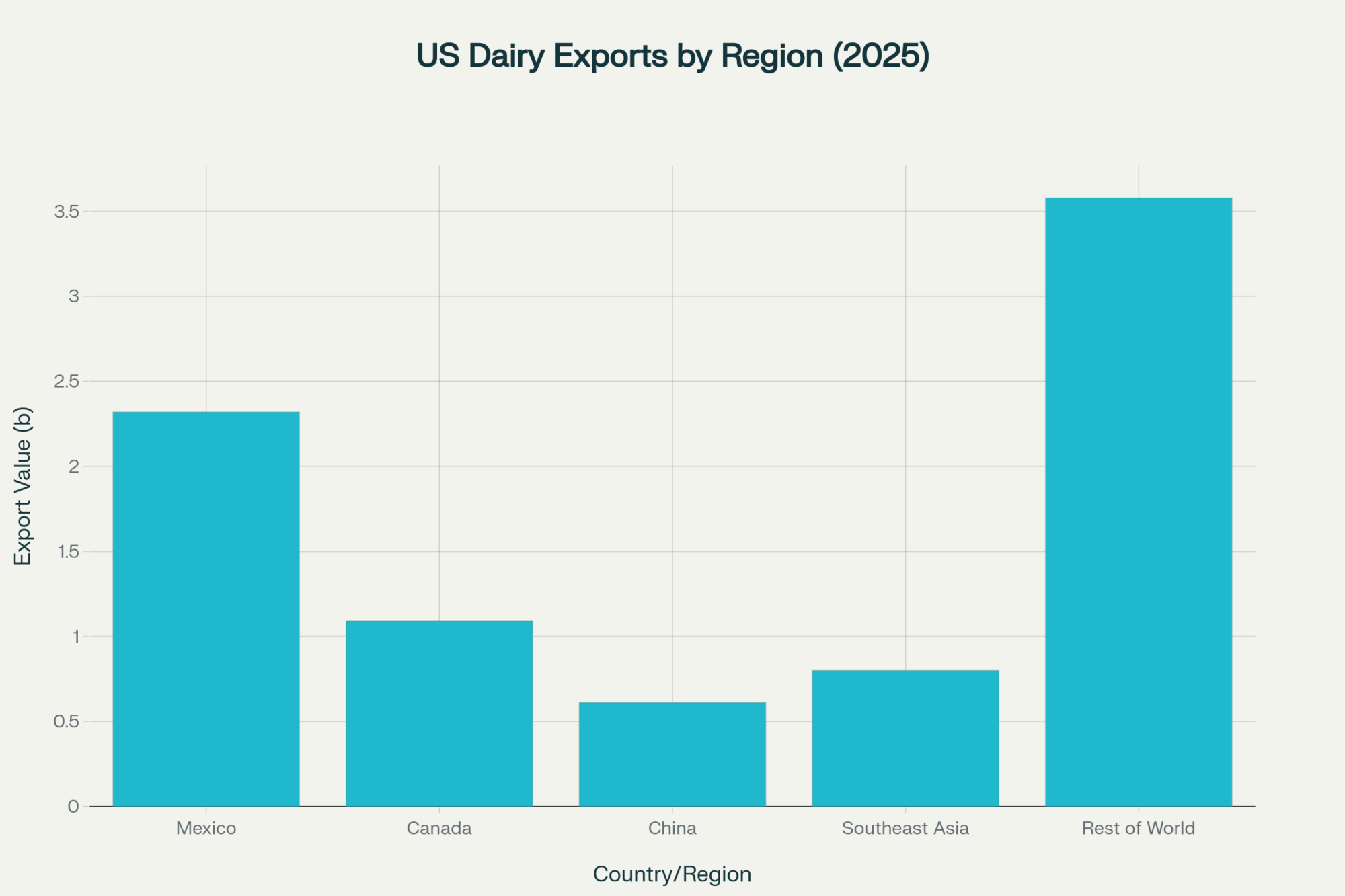
The numbers don’t lie, and they’re honestly more concentrated than I expected when I first started digging into this: Mexico buys $2.32 billion annually, Canada takes $1.09 billion, and China represents $610 million despite all the current hostilities. Those three countries control 48% of American dairy exports. Nearly half!

University of Wisconsin Extension economist Dr. Mark Stephenson doesn’t sugarcoat it: “The current conflict accelerates structural shifts that permanently reshape global dairy trade flows. Today’s tariff rates are exponentially higher than those in previous disputes.”

What strikes me about this concentration is how vulnerable it makes us:

MarketAnnual ValueSharePolitical Risk
Mexico$2.32 billion28%Border tensions escalating
Canada$1.09 billion13%USMCA disputes ongoing
China$610 million7%Trade war active
Southeast Asia$800 million10%Generally stable
Rest of the world$3.58 billion42%Mixed conditions

The Wisconsin Extension ran a nightmare scenario that honestly shocked me: simultaneous disruption in our top three markets would result in an annual loss of $4 billion. For operations that borrowed big on export projections? That’s not just a bad year—that’s bankruptcy math.

China’s Co-Product Massacre (And Why Most Producers Missed It)

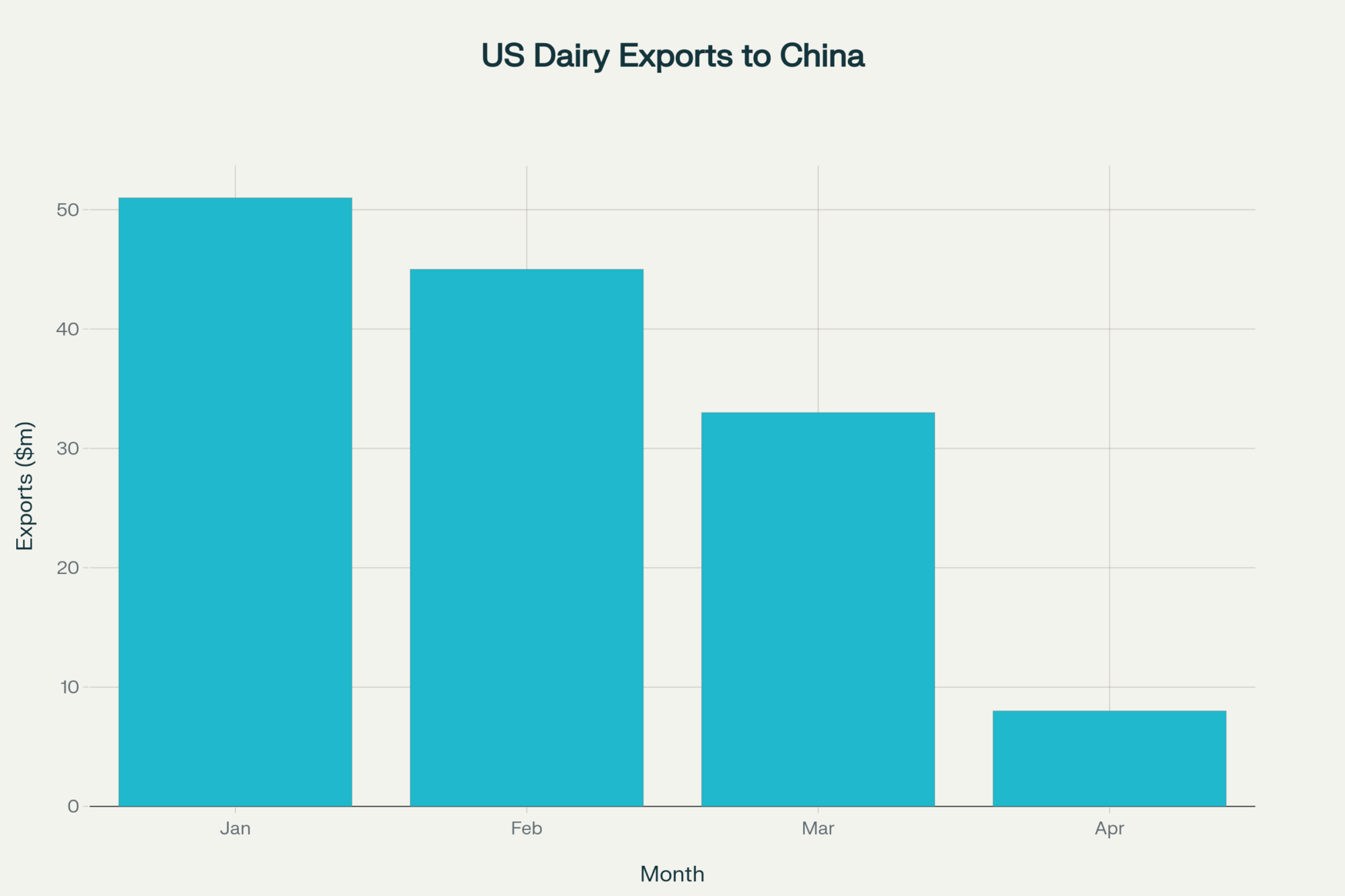
This is where it gets really concerning. I’ve been talking to Wisconsin operations that run 650 Jersey cows, and they’re watching their cooperative whey income just… evaporate. Chinese tariffs exploded from 10% in January to 125% by April 2025. Four months. That’s all it took.

Here’s what most producers don’t track—and this is a big mistake. When you’re making cheese, you create nine pounds of whey for every pound of cheese. Before this trade war, China bought 42% of our whey exports and 72% of our lactose sales. Those co-products… they’re not just byproducts anymore. They’re serious money.

Cornell calculated the damage, and it’s brutal: USDA slashed Class III milk forecasts by 35¢/cwt as these markets collapsed.

The timeline tells the whole story: Source: USDA export data and China’s Ministry of Commerce tariff schedules

PeriodTariff RateMonthly ExportsWisconsin Impact
January 202510%$51 millionManageable strain
March 202534%$33 millionPain begins
April 2025+125%$8 millionMarket death

A 92% collapse in monthly export value in four months. One Wisconsin producer put it perfectly at a dairy meeting: “Never count on a government that changes trade rules faster than Jersey cows change moods.”

Indonesia: Finally, Some Good News

Now here’s where things get interesting—and frankly, more hopeful than I expected. California Dairies Inc.’s operations, which include 1,200 Holsteins, are securing direct contracts with Indonesian processors, thanks to the U.S.-Indonesia agreement that eliminated tariffs on 99% of American dairy exports.

What I’m hearing from Central Valley producer meetings is encouraging: “Indonesia’s middle class wants our quality and pays premiums for consistency.” Indonesia represents our seventh-largest export market, with annual sales of $246 million, and this is just the beginning.

Krysta Harden from the U.S. Dairy Export Council gets it: “This deal gives U.S. dairy companies a fair shot at competing without governments tilting the playing field.”

The fact is, while Indonesia provides a clear win, progress elsewhere remains… complicated.

Europe’s Endless Framework Dance

The August 2025 U.S.-EU trade framework represents some progress toward addressing our $3 billion dairy trade deficit; however, specific tariff reductions and European Commission final approval are still under negotiation. We’ve been down this road before.

National Milk Producers Federation’s August brief captures the frustration perfectly: American producers are “done playing second fiddle in Europe’s rigged system.” I couldn’t agree more.

Asia’s Production Revolution (This Should Terrify Us)

While we’re debating tariffs, Asia has undergone a complete revolution in dairy production. And honestly? We missed it. Asia now makes half the world’s milk—458 million tonnes annually. Half!

China’s 4.8% production growth reached 45.5 million tonnes in 2025, while our growth rate is 0.3% annually. Meanwhile, New Zealand’s production contracted to its lowest level in 30 years. The landscape is shifting faster than most people realize.

Land O’Lakes operations near New Prague, Minnesota, are monitoring a 25% drop in premium powder prices as Chinese domestic production improves. “Used to be, they needed our quality. Now they’re building plants that make ours look dated,” one producer told me recently. That’s the reality we’re facing.

Tech: Your Secret Weapon in This Mess

Here’s where I get excited about our future, though. California Central Valley operations, which manage 1,400 cows using four DeLaval robotic milking systems, are reaping real benefits through export contracts that demand consistent quality specifications. This is happening right now.

The global milking robot market is projected to grow from $3.2 billion to $5.3 billion by 2029, driven by a 10.8% annual growth rate, primarily due to increasing demand for high-quality exports. That’s not just growth; that’s transformation.

University of Minnesota Extension research shows that robotic systems typically deliver payback periods of 5-7 years for operations with over 500 cows. The numbers work.

What’s particularly noteworthy about the tech investment reality: Based on University of Minnesota Extension studies and industry performance data

InvestmentCost RangeQuality BenefitExport Premium
Robotic milking$200-300K/unit12-15% consistency improvement$0.15-$0.20/cwt
Automated feeding$75-150K/system10% nutrition precision$0.08-$0.10/cwt
Sensor monitoring$25-75K/farm20% faster health detectionZero residue guarantee

Sustainability: The New Gatekeeper (Whether You Like It or Not)

Wisconsin operations milking 550 cows through Foremost Farms are losing lucrative German contracts for lacking carbon footprint documentation. “They wanted more paperwork than my banker,” is becoming a common frustration at sustainability meetings.

But here’s the thing—companies like Nestlé and McDonald’s fund sustainability research specifically for supply chain requirements. Premium export buyers want responsible production documentation, not just quality milk. This isn’t going away.

Southeast Asia: The Opportunity Hiding in Plain Sight

While everyone obsesses over Chinese losses, Southeast Asia quietly imports 9.9 billion litres annually with minimal political drama. Philippines, Malaysia, Thailand, Singapore, Vietnam—they offer middle-class growth without trade war risks.

What’s fascinating is that regional self-sufficiency rates stay low through 2030, creating sustained opportunities. This isn’t a flash in the pan.

Here’s how I’d rank export opportunities right now:

MarketSizeGrowthPolitical RiskEntry DifficultyMy Grade
Southeast AsiaLarge+5.2%LowModerateA-
Latin AmericaMedium+3.8%ModerateLowB+
MexicoVery Large+2.1%ModerateLowB
CanadaLarge+0.8%HighVery HighC-
EuropeMassive+1.2%ModerateVery HighC+
ChinaMassiveUnknownCriticalImpossibleF

Focus on A- and B+ markets. Don’t waste 25% of your budget chasing resistant markets—it’s not worth the headache.

What Your Milk Check Actually Shows

USDA forecasts 2025 all-milk prices at $22.00/cwt, up from earlier projections but still subject to trade volatility. The fact is, feed costs increased by 19% from 2019 to 2024 across major regions. Q2 2025 corn averaged $4.85/bushel, up from $4.12 last year. With 16% of U.S. milk exported, trade disruptions have a direct impact on farm profitability.

The export picture by product tells an interesting story:

ProductExport ChangeFarm ImpactCash Reality
Butter+87%Minimal direct benefitCo-ops capture gains
Nonfat dry milk-21%Component price hitLower protein premiums
Whey-19%Co-product income lossReduced milk checks
Specialty cheese+12%High potentialPremium processing needed

Your Action Plan (Don’t Wait on This)

This month, you need to:

  • Calculate export dependency using your cooperative statements
  • Contact your field rep about sustainability certification programs
  • Evaluate robotic milking ROI for your specific herd size
  • Research Southeast Asian opportunities through your co-op’s international division

Next six months:

  • Document environmental practices for premium export buyers
  • Diversify beyond those volatile top three markets
  • Invest in consistent technology that creates export advantages
  • Build relationships in stable, growing regions

The implementation timeline that makes sense:

ActionTimelineInvestmentKey Considerations
Southeast Asian relationships12-18 months$25-50K marketingNeeds cooperative support and cultural understanding
Value-added processing24-36 months$500K-2MMarket demand validation and regulatory compliance are required
Sustainability certification6-12 months$15-30KEssential for premium market access, relatively low risk
Technology upgrades18-24 months$200K-1MROI depends on herd size and management capability

The Bottom Line (And Why This Matters Right Now)

Winners capture premium pricing through documented quality, environmental credentials, and strategic diversification—not waiting for politicians to fix broken relationships.

The $8.4 billion export boom masks a significant vulnerability to concentration that can collapse in the face of political crises. China’s $584 million market loss proves trade relationships disintegrate overnight—faster than most of us anticipated.

However, here’s what gives me hope: Indonesia’s breakthrough and the opportunities in Southeast Asia reward producers who build technological advantages and sustainable practices over those who rely on political dependencies.

Your expansion depends on customers you can serve consistently, not governments you can’t control.

What you need to do this week:

  1. Check your dependency—if 40%+ revenue flows through three countries, you’re overexposed
  2. Document practices—environmental and quality certifications open premium access
  3. Evaluate technology—consistency creates competitive advantages, politics can’t eliminate
  4. Contact your cooperative—international marketing divisions have Southeast Asian contacts ready now

The choice is yours: keep betting on political promises or build export resilience that survives trade wars.

This isn’t doom and gloom, folks—it’s a wake-up call. The producers who act on this now will be the ones still standing when the next trade war hits.

Contact your cooperative’s international marketing division this week. Your future milk checks depend on decisions you make today… and honestly, tomorrow might be too late.

Complete references and supporting documentation are available upon request by contacting the editorial team at editor@thebullvine.com.

Learn More:

  • Robotic Milking Systems: A Game-Changer for Modern Dairy Farming – This article provides a tactical deep-dive into robotic milking, detailing how the technology directly improves herd health, milk quality, and labor efficiency—key factors for securing the premium-paying export contracts mentioned in the main piece.
  • The Genomic Secret: The Untapped Goldmine in Your Herd’s DNA – Shifting to a strategic perspective, this piece reveals how to leverage genomics to build a more profitable and resilient herd, creating the high-component, efficient cows that give you a competitive edge in demanding international markets.
  • Sustainable Dairy Farming: The Future is Green and Profitable – Looking to the future, this article breaks down the practical economics of sustainability. It offers innovative methods for reducing your environmental impact through feed efficiency and management, turning the “gatekeeper” issue into a significant market advantage.

Join the Revolution!

Join over 30,000 successful dairy professionals who rely on Bullvine Weekly for their competitive edge. Delivered directly to your inbox each week, our exclusive industry insights help you make smarter decisions while saving precious hours every week. Never miss critical updates on milk production trends, breakthrough technologies, and profit-boosting strategies that top producers are already implementing. Subscribe now to transform your dairy operation’s efficiency and profitability—your future success is just one click away.

NewsSubscribe
First
Last
Consent

Margin Squeeze: Dairy Farms Face Tightening Profits as Milk Prices Tumble

Milk prices plunge to 3-year lows as beef sales become dairy’s lifeline. Can producers weather the storm?

EXECUTIVE SUMMARY: Dairy margins are tightening in 2025 as milk prices collapse to $22/cwt (lowest since May 2024) while feed costs hold steady at $10.45/cwt. Class III and IV prices fell below $18/cwt for the first time since 2021, squeezing profits despite record beef income from $145/cwt cull cows. Trade wars with China and Canada threaten exports, but futures predict a late-2025 rebound to $12.94/cwt margins. Producers face a “difficult trifecta” of price volatility, disease risks, and policy uncertainty, requiring strategic culling, feed efficiency gains, and aggressive risk management to survive.

KEY TAKEAWAYS

  • Margin squeeze: Milk prices dropped $1.60/cwt since February 2025, while stable feed costs offer limited relief
  • Beef buffer: Record cull cow prices ($145/cwt) and beef-cross calves offset 20-30% of milk revenue losses
  • Trade turbulence: China’s 125% dairy tariffs and Canada’s retaliation threaten $3B+ in annual exports
Dairy margin coverage, milk price trends 2025, dairy trade wars, beef prices dairy income, dairy risk management

The numbers don’t lie – dairy farmers feel the pinch as milk margins continue downward into spring 2025. The USDA’s Dairy Margin Coverage (DMC) program registered an $11.55/cwt margin in March, plummeting $1.57 from February’s figures. While this remains above crisis territory, the rapid erosion of profitability demands attention from producers worldwide. Recent Class III and IV price announcements signal further pressure ahead, creating a complex financial landscape that requires strategic planning and risk management.

THE PERFECT STORM: MILK PRICES CRASH WHILE COSTS HOLD

The primary culprit behind shrinking margins is the dramatic decline in milk prices. The All-Milk price used in DMC calculations hit $22/cwt for March 2025, marking its lowest point since May 2024 and representing a staggering $1.60 drop from February alone. This isn’t just a minor market correction – it’s part of a concerning downward trajectory that began earlier this year.

April’s milk price announcements cast an even darker shadow over producer profits. Class III prices plummeted to $17.48/cwt (down $1.14 from March), while Class IV settled at $17.92/cwt (down $0.29). This marks the first time since October 2021 that both benchmark prices have fallen below the critical $18/cwt threshold simultaneously – a clear warning sign of challenging market conditions ahead.

“These aren’t just statistics – they’re your milk check,” says dairy market analyst Mark Stevens. “When both Class III and IV prices drop below $18 together, we’re looking at milk payments approaching or even below production costs for many operations.”

The USDA continues to revise its forecasts downward, with its March report slashing the 2025 all-milk price projection by a full dollar to $21.60/cwt. This represents a dramatic shift from earlier optimism and reflects growing concerns about market fundamentals throughout the year.

Production Growth Meets Export Challenges

Two forces collide to lower prices: expanding domestic production and weakening export demand. After declining year-over-year for 13 consecutive months, US milk production rebounded in late 2024, with the national dairy herd growing steadily. This increased supply, without corresponding demand growth, naturally pressures prices downward.

Meanwhile, international markets – critical outlets for absorbing US dairy products – face significant headwinds. The USDA has lowered its dairy export forecasts on a fat basis, primarily due to decreased cheese exports. The ongoing trade tensions with major partners, including China, Canada, and Mexico, create additional uncertainty for exporters trying to find homes for US dairy products.

FEED COSTS: SURPRISING STABILITY PROVIDES BUFFER

If there’s a silver lining in the current margin situation, it’s the remarkable stability of feed costs. The DMC feed cost calculation for March 2025 registered at $10.45/cwt, dropping just three cents from February. This stability provides a crucial buffer against falling milk revenues, preventing a dramatic squeeze on producer margins.

Current feed ingredient prices demonstrate unprecedented calm in a market usually characterized by volatility. The DMC calculation incorporates corn (around $4.58/bu), soybean meal (approximately $305/ton), and premium alfalfa hay (about $243/ton). These prices remain significantly below the peaks reached during previous feed cost crises.

Several factors could keep feed costs in check for the remainder of 2025:

  1. Faster-than-average planting progress (corn at 24% planted by late April, soybeans at 18%)
  2. Potential trade disruptions reducing export demand for US feed grains
  3. Generally favorable growing conditions in major production regions

However, dairy producers shouldn’t become complacent. Weather patterns remain unpredictable, and the “evolving trade war” could introduce unexpected volatility into feed markets. Strategic feed purchasing and inventory management remain essential components of margin protection strategies.

THE BEEF BONUS: RECORD PRICES PROVIDE CRUCIAL INCOME SUPPORT

While milk prices tumble, an unexpected hero has emerged to help dairy farmers weather the storm – the robust beef market. Cull cow prices in the Southern Plains jumped from $121 to $145 per cwt since January 2025, with auction prices consistently outpacing year-ago levels. This substantial premium for dairy culls provides crucial supplementary income when milk revenues are under pressure.

“Don’t underestimate how important these beef prices are right now,” says livestock market specialist Janet Rivera. “For a 1,400-pound dairy cow going to market, we’re talking about $2,000+ checks that significantly offset reduced milk income.”

The beef price surge stems from historically tight cattle supplies nationwide. Both beef and dairy cow slaughter have declined dramatically (down 20% and 6.6%, respectively). This supply constraint and strong consumer demand for ground beef have created a perfect storm for record prices.

Many forward-thinking dairy producers have amplified this income stream through strategic breeding decisions. Using beef semen on a portion of the dairy herd to produce higher-value beef-cross calves generates substantial supplementary revenue. With advanced sexed semen technology ensuring adequate dairy replacements, this approach represents a crucial profit center during margin challenges.

DMC PROGRAM: YOUR SAFETY NET DURING UNCERTAIN TIMES

The Dairy Margin Coverage program remains the cornerstone safety net for US dairy producers navigating volatile markets. The 2025 enrollment period, which ran from January 29 to March 31, offered producers the opportunity to secure protection against precisely the type of margin compression we’re now witnessing.

For just $0.15 per hundredweight at the $9.50 coverage level, DMC offers affordable peace of mind. The program protects dairy farmers when the calculated margin falls below their selected coverage level, with options ranging from to .50 per cwt in 50-cent increments.

While current margins remain above the $9.50 trigger level for maximum DMC coverage, the rapid erosion from February to March demonstrates how quickly conditions can change. Producers who opted for higher coverage levels during enrollment now have valuable protection should margins continue to deteriorate in the coming months.

The program’s value has been proven repeatedly. In 2023 alone, DMC payments were triggered in 11 months, including two months below the catastrophic $4 margin level, distributing more than $1.2 billion to participating farmers. This historical perspective underscores the importance of consistent participation in the program as a fundamental risk management strategy.

GLOBAL TRADE TENSIONS CAST SHADOW OVER MARKETS

International trade dynamics will significantly influence dairy prices and market access in 2025. The “evolving trade war” referenced in industry publications encompasses a complex web of tariffs and retaliatory measures between the United States and major trading partners, particularly China, Canada, and Mexico.

These trade disputes create dual pressures on dairy margins:

  1. Reduced export opportunities: Retaliatory tariffs limit access to critical markets for US dairy products, creating domestic oversupply that pressures prices downward. China – a significant US whey and lactose market – has effectively closed to US exporters through punitive tariffs.
  2. Potential feed cost impacts: While trade tensions may reduce export demand for US feed ingredients (potentially lowering costs), they also introduce market volatility and uncertainty.

USDA’s March report lowered dairy export forecasts on both fat and skim-solid bases, citing expectations for reduced cheese, dry skim milk products, and lactose shipments internationally. This reduced export capability directly contributes to the lower milk price forecasts troubling producers.

OUTLOOK: CAUTIOUS OPTIMISM FOR LATE 2025

Despite current challenges, futures markets provide some reason for optimism later in 2025. Market indicators suggest margins will remain compressed in the $11/cwt range for the next four months before improving in the year’s second half. Fourth-quarter margins are projected to average $12.94/cwt – still below last year’s exceptional levels but sufficient to support continued milk production for most operations.

The USDA’s most recent milk production forecast for 2025 stands at 226.2 billion pounds, reflecting a reduction of 700 million pounds from earlier projections. This adjustment, based on expectations for lower output per cow (despite slightly higher cow inventories), could help rebalance markets if it materializes.

Class III futures have shown resilience despite ample milk supplies, with May contracts trading well above the USDA’s annual forecast. This disconnect between futures markets and USDA projections creates additional uncertainty but suggests traders may anticipate stronger demand than currently forecast by government analysts.

STRATEGIC CONSIDERATIONS FOR DAIRY PRODUCERS

The current margin environment demands proactive management from dairy producers worldwide. Consider these key strategies:

Risk Management Is Non-Negotiable

Other risk management tools remain available while the 2025 DMC enrollment deadline has passed. Explore Dairy Revenue Protection (Dairy-RP) options, futures and options contracts, and forward contracting opportunities with your processor. The volatility in early 2025 underscores that relying solely on strong market prices is insufficient.

Maximize Beef Income Opportunities

With record-high beef prices providing crucial income support, optimize your culling and breeding strategies. Consider:

  • Strategic use of beef semen on lower-genetic-merit dairy animals
  • Developing relationships with cattle buyers to capture maximum cull value
  • Timing culling decisions to align with seasonal price patterns

Focus on Feed Efficiency

While feed costs remain stable, improving feed conversion efficiency directly enhances margins. Evaluate your current ration with your nutritionist, focusing on cost per ton and income over feed cost metrics. Small improvements in feed efficiency can yield significant margin benefits.

Monitor International Developments

Stay informed about evolving trade situations, particularly with China, Canada, and Mexico. Their impact on export opportunities and input costs will significantly influence dairy margins throughout 2025.

CONCLUSION: WEATHERING THE PROFIT SQUEEZE

The dairy industry has entered a challenging period of margin compression that demands attention but not panic. While significantly reduced from late 2024 peaks, current dairy margins remain historically adequate and well above levels that trigger government support payments.

The combination of falling milk prices, stable feed costs, and record beef values creates a complex economic landscape that rewards strategic management. The most successful operations will be those that actively manage both the revenue and cost sides of the equation while utilizing appropriate risk management tools.

For dairy producers worldwide, the message is clear: be proactive, not reactive. The current margin pressure appears likely to persist through mid-year before improving in late 2025. Positioning your operation to weather this challenging period while maintaining production capacity for the anticipated recovery will be the defining characteristic of successful dairy businesses in the year ahead.

Learn more:

Join the Revolution!

Join over 30,000 successful dairy professionals who rely on Bullvine Weekly for their competitive edge. Delivered directly to your inbox each week, our exclusive industry insights help you make smarter decisions while saving precious hours every week. Never miss critical updates on milk production trends, breakthrough technologies, and profit-boosting strategies that top producers are already implementing. Subscribe now to transform your dairy operation’s efficiency and profitability—your future success is just one click away.

NewsSubscribe
First
Last
Consent

Dairy Industry Faces Record Setbacks: Stable Margins Amid California’s Milk Production Plunge

Discover how bird flu in California affects dairy margins. Can stable prices balance out production drops? Explore challenges and strategies for farmers.

dairy margins, milk prices, feed costs, California bird flu outbreak, milk production drop, U.S. milk production, December dairy market, dairy industry trends, factors affecting dairy, dynamic dairy market

Ah, December—it always feels like a time of surprises. Even in the dairy world, just when you think you’ve got everything figured out, bam! Here comes the plot twist. For those deeply entrenched in the dairy industry, this December was one such month with its unique challenges and revelations. Yet, the resilience and adaptability of our industry professionals continue to amaze us, enabling them to navigate these twists with confidence and capability. 

Let’s examine the numbers over the past six months more closely. Understanding these trends is essential, as they provide insight into market conditions. 

MonthDairy MarginYear Over Year Change
July$11.50+2.5%
August$11.75+3.0%
September$11.60-1.5%
October$11.80+0.8%
November$11.90+1.2%
December$12.00+2.0%

These numbers underscore the challenges of navigating through an ever-changing market landscape.

Grasping the Dairy See-Saw: Supply, Demand, and Dairy Margins 

Understanding the delicate dance of supply and demand is crucial in the dairy industry. The industry involves more than cows producing milk or farmers waking up at dawn. It is an ever-evolving market ecosystem influenced by many factors, from weather patterns to consumer preferences and, importantly, the intricate balance of supply and demand. 

Let’s start with the basics of supply and demand. Milk prices? They’ve nudged up, which initially might sound like good news, right? But hold your horses because feed costs climbed in tandem, nullifying the potential gains from those higher milk prices. It’s a classic case of one step forward, two steps back in dairy margins. Talk about a balancing act! For many, this prompts the question: how do you strategically plan when the see-saw of costs and prices keeps swinging? Despite these challenges, there’s always room for strategic planning and optimism in the face of market volatility. For instance, dairy farmers in the Midwest implemented innovative cost-saving measures to counteract the impact of fluctuating milk prices. 

The Unexpected Heavyweight: California Facing a Dairy Dilemma 

StateMilk Production (November 2024, billion pounds)Year-Over-Year Change (%)
California3.0-9.2
Wisconsin2.51.5
Idaho1.32.0
New York1.2-0.5
Pennsylvania0.9-1.0

Now,  talk about that unexpected (and unfortunate) heavyweight—California. This pivotal state in the dairy sector has been grappling with an unexpected adversary—a severe bird flu outbreak. This isn’t just a minor glitch; this outbreak has slashed milk production by a staggering 9.2% year-over-year. Let’s pause here and think—this is the most significant annual decrease ever noted in the state’s milk production history. It’s like watching an Olympic record being broken but on a much grimmer note. 

Why does this matter so much to Californians and all involved in the dairy ecosystem? California is a powerhouse in milk production, and this considerable drop has rippling effects far beyond its borders, influencing dairy prices nationwide and even affecting international trade dynamics. Nationally, for instance, U.S. milk production chalked up to 17.875 billion pounds in November, reflecting a 1% decline compared to the previous year. Yes, that number is correct, and it’s a figure that encapsulates the complex dynamics at play. While some regions were basking in growth, the weight of California’s losses tipped the scales in the opposite direction. Think about it—had circumstances been different, there was chatter of a 0.2% increase on the horizon. Who would have predicted this downturn instead? This significant decrease in milk production in California affects the national supply. It has implications for the global dairy market, potentially leading to increased prices and changes in trade dynamics. 

The Intricate Dance of Data and Context in Dairy Management 

Still, numbers can paint only part of the picture without the context that makes them meaningful. For instance, the USDA was a little surprised by October’s figures. They revised their initial estimates, adding 35 million pounds to the national tally. But how did that happen?  There was an unexpected surge in cow numbers, with dairy farmers adding to their herds and squeezing out higher production per cow. By November, the milking cows numbered 9.365 million—5,000 less than in October but still a decent step up from last year by 20,000. It’s a game of strategic expansions and contractions, where dairy farmers carefully adjust herd sizes based on market conditions, highlighting the dynamic nature of cattle management. Isn’t it fascinating how these small shifts can make a massive difference overall? 

Exploring Dairy Treasures Beyond Milk: California’s Impact on Butter 

Let’s take a closer look at California’s impact on butter and powder production. California isn’t just any player in the dairy game; it’s the nation’s heavyweight champion, the undisputed leader in milk production. When a state of such magnitude faces a production hiccup — like the 9.2% year-over-year slump we’re seeing — it’s only natural that the effects will ripple far and wide. But how exactly does this slowdown shadow butter and powder supplies? 

It’s worth noting that in California, a substantial volume of the milk produced is directed towards creating Class 4 products — our butter and dry milk powder. So, when less milk flows through the pipelines, there’s automatically a squeeze on how much of these products can be churned out (pun intended). Butter stocks might seem stable, with a mere 0.4% increase over last year, but remember, this subtle rise is termed the smallest in the entire yearly tally for 2024. That’s no minor detail. 

It all boils down to supply and demand. While demand remains relatively steady — because, let’s face it, who doesn’t love a good pat of butter on their toast? — a drop in production can lead to tighter supply conditions. This could increase prices, making it more expensive for consumers and businesses relying on these dairy staples. Moreover, as one of the staunch suppliers, California’s reduced output means a potential shift in the supply chain dynamics, forcing other states or even countries to step up and fill the gap. These adjustments can lead to heightened volatility within the market, affecting overall margins and how the industry strategizes for future fluctuations. 

So, next time you butter your bread or indulge in a creamy latte, consider the broader narrative behind these seemingly small changes. They remind us of the interconnectedness and delicate balance that define the dairy industry.

For All the Cheese Enthusiasts: A Closer Look at the Numbers 

Now, for all the cheese enthusiasts, here’s a nugget for you. Total cheese inventories at the end of November stood at 1.335 billion pounds. That’s a decline of 1% month-over-month from October and a more pronounced 7.2% dip year-over-year. Quite the shift, wouldn’t you say? It suggests that cheese production, too, is feeling the pinch in this tightening market. 

The Whirlwind in Commodities: Brace for Unexpected Twists 

And what about the commodities market? It indeed wasn’t sitting idle. Corn and soybean meal markets showcased some exhilarating rallies, akin to a thrilling rollercoaster ride driven by fund shorts scrambling to cover positions alongside pivotal technical breakouts. Soybean meal notably spiked 11.6% from its recent low—a surge that caught many off-guard. Like skilled sailors navigating turbulent seas, dairy professionals must demonstrate nimbleness and adaptability to weather the storm. Navigating the dairy market is akin to conducting a symphony, where each strategic decision plays a crucial note in the harmony of profit margins, showcasing the intricacies of daily business operations. Dairy professionals can consider strategies such as forward contracting, risk management tools, and diversifying feed sources to navigate these market fluctuations. 

The Bottom Line

So where does that leave us? Maybe you’re wondering how these shifts will shape your operations’ future. Are there strategies you’re contemplating to shield your business from the unpredictable ebbs and flows? Or perhaps you’re thinking of innovative ways to harness the shifting tides to your benefit? As always, there’s much to consider in the ever-evolving landscape of dairy farming. The dairy industry faces challenges ranging from navigating supply and demand dynamics to addressing unexpected outbreaks and managing market volatility. However, with strategic planning, adaptability, and a keen understanding of the market, dairy professionals can overcome these hurdles and even find growth opportunities.

Key Takeaways:

  • Dairy margins remained relatively stable throughout December, with milk prices rising alongside feed costs.
  • California’s bird flu outbreaks led to a historic decrease in milk production, with a 9.2% decline from the previous year.
  • Overall U.S. milk production in November came in at 17.875 billion pounds, representing a 1% decrease compared to the previous year.
  • The declining milk production in California significantly impacted national production statistics despite gains elsewhere.
  • USDA slightly revised October milk production, adjusting for increased cow numbers and productivity.
  • Butter stocks saw considerable tightening in November, reflecting California’s production challenges, although stocks increased marginally year-over-year.
  • Cheese inventories decreased by 1% from October and 7.2% compared to the previous year, highlighting a more significant reduction.
  • Commodity markets witnessed sharp rallies, driven by fund activities, impacting corn and soybean meal prices.
  • Producers continue to navigate the markets with strategic, flexible approaches to safeguard margins in light of consistent market fluctuations.

Summary:

In December, dairy margins stayed stable because higher milk prices were balanced with rising feed costs. However, California’s bird flu outbreak led to a massive 9.2% drop in milk production, the largest recorded. This event influenced November’s overall U.S. milk production, which was 17.875 billion pounds, down 1% from last year. These numbers demonstrate how important it is to stay informed about all the factors in play, from diseases to changes in production, in the dynamic dairy market.

Learn more:

Join the Revolution!

Bullvine Daily is your essential e-zine for staying ahead in the dairy industry. With over 30,000 subscribers, we bring you the week’s top news, helping you manage tasks efficiently. Stay informed about milk production, tech adoption, and more, so you can concentrate on your dairy operations. 

NewsSubscribe
First
Last
Consent
Send this to a friend