



Archive for vertical integration dairy

From Woodstock to Wall Street: How the Dairy Farmer Who Hosted Half a Million Hippies Built a Breeding Empire Worth Copying Today

Stop chasing genomic indexes. A 1960s dairy farmer’s breeding strategy beat today’s averages—here’s his $75K crisis management playbook.

The same conservative Republican dairy farmer who rented his pasture to 460,000 counterculture rebels also revolutionized Holstein and Guernsey genetics and vertical integration decades before Silicon Valley discovered the concept. Max Yasgur’s ,000 Woodstock windfall was just the tip of an agricultural iceberg that modern dairy operations desperately need to understand.

Max Yasgur on his dairy farm in Bethel, New York. The missing fingers on his right hand told the story of a man who built his empire with his own hands.

The Festival That Fed the Farm (And What It Teaches About Modern Asset Optimization)

What if the secret to surviving today’s volatile dairy markets isn’t found in the latest genomic technology but in the business playbook of the man who made Woodstock possible? Max Yasgur didn’t just host “perhaps the most important cultural event of the twentieth century”—he demonstrated principles of strategic breeding, vertical integration, and asset diversification that modern dairy farmers are still trying to master.

The handshake that sealed the deal was missing two fingers. Michael Lang, the young promoter of what would become the Woodstock Music and Art Festival, felt a jolt of recognition as he grasped Max Yasgur’s weathered hand on that fateful Sunday afternoon in 1969. “Holy smokes,” Lang thought to himself, “He’s built this place with his own hands.”

What Lang didn’t fully comprehend was that he wasn’t just meeting the future host of the largest music festival in history—he was encountering one of Sullivan County’s most successful agribusiness pioneers, a man whose 650-head dairy operation and 2,000-acre empire represented exactly the kind of strategic thinking that separates millionaire dairy farmers from those barely breaking even.

The “Angel of Woodstock” Was Actually a Genetic Genius

While 460,000 hippies danced in his fields between August 15-18, 1969, Yasgur was quietly revolutionizing breeding with a precision that would make today’s genomic specialists jealous. His approach wasn’t about chasing the latest trends but about concentrated excellence that created lasting wealth.

The Woodstock Generation vs. The Genetic Generation

The same weekend that Jimi Hendrix played guitar with his teeth on Yasgur’s makeshift stage, the farm’s barns housed some of America’s most strategically bred cattle. Yasgur’s herd included 90 daughters of Harden Farms King Pontiac and 30 daughters of Cashman Thunderbolt, all tracing back to the elite Dunloggin bloodlines that cost Harden Farms $25,500 in the 1940s.

Dr. E.S. Harrison, manager of the prestigious Harden Farms, wrote: “Few breeders have followed a more definite breeding program than Max Yasgur.” This wasn’t casual praise but professional recognition from one of the industry’s most respected authorities, acknowledging Yasgur’s systematic approach to genetic improvement.

From City Kid to Dairy King: The Making of an Empire

Born December 15, 1919, in New York City to Russian immigrants, Samuel and Bella Yasgur, Max’s journey to dairy farming began early when his family moved to a dairy farm in Maplewood, New York, ninety miles north of the city. The farm doubled as a boarding house, catering to summer guests—an early lesson in revenue diversification that would serve him well decades later.

When his father died during Max’s teenage years, he assumed the role of family head. Though he briefly studied real estate law at New York University, “his dream was to go back to the farm.” This wasn’t a default choice but a calculated decision that revealed an entrepreneurial vision most farmers never achieve.

Yasgur’s ambition extended far beyond typical dairy farming. He wanted to build a milk processing plant and to sustain it, he needed scale. With methodical precision, he began acquiring neighboring farms, constructing barns, and expanding his herd. He built a pasteurization plant and refrigeration complex, installed bottling machines, and developed comprehensive door-to-door delivery routes.

The result was Yasgur Dairy—”the largest milk producer in Sullivan County” with a herd that peaked at 650 head and encompassed “ten farms comprising two thousand acres of land.” This wasn’t just farming—it was agricultural technology that captured value at every stage while competitors sold commodity milk.

The $75,000 Woodstock Deal: Master Class in Crisis Monetization
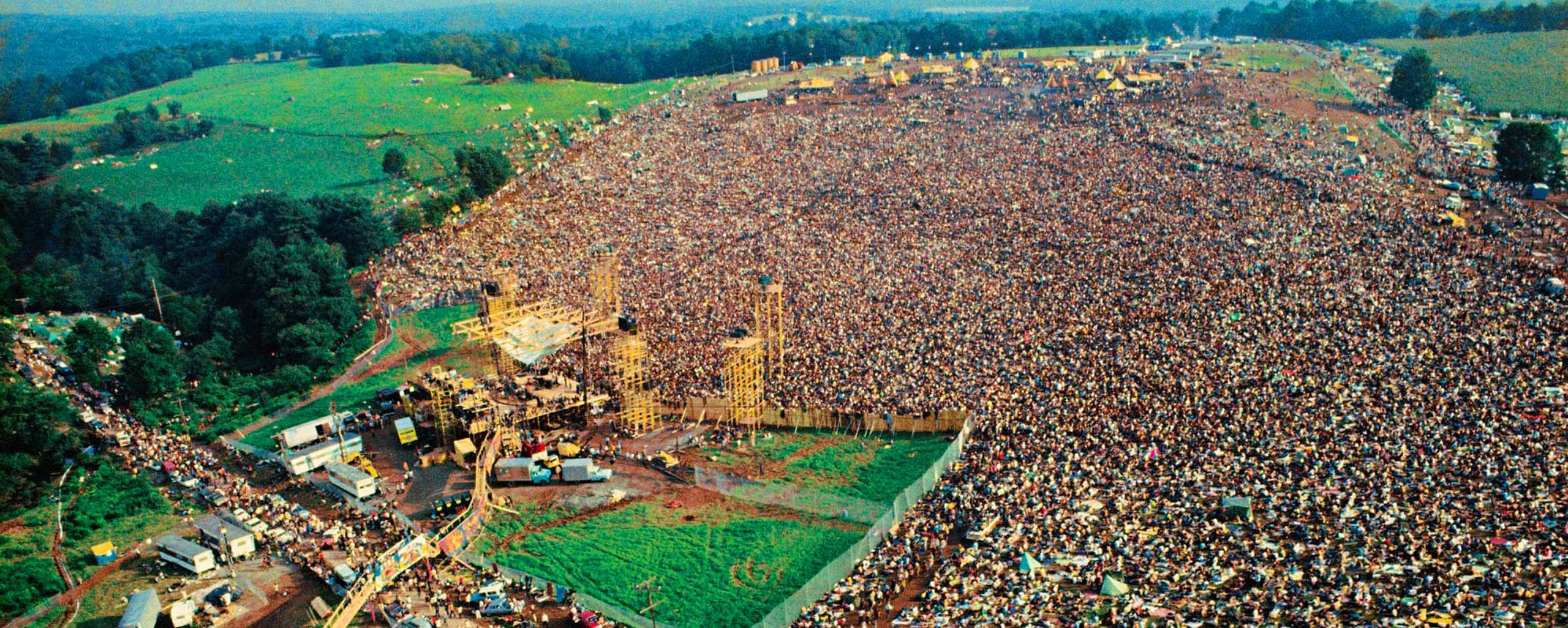
The natural amphitheater of Max Yasgur’s alfalfa field that Michael Lang immediately recognized as ‘perfect for the stage’ – a bowl-shaped pasture that would host 460,000 people.

The year 1969 had been unusually wet, damaging Yasgur’s hay crop and threatening feed costs for his massive herd. When Lang and Roberts initially offered to rent a field for three days to accommodate “10,000 to 15,000 people,” Yasgur showed them several suitable options. But then came the revelation that changed everything.

The Tenfold Price Increase Strategy

The promoters revealed they were actually expecting “50,000 people and that they would have another 50,000 who would try to get in without paying,” bringing the total to a staggering 100,000. This disclosure prompted Yasgur’s immediate reconsideration: “Wait a minute… You’re now at 100,000 people. That’s a lot of people,” he said. “I will really have to think whether or not I want to be involved in something that large.”

Yasgur’s response revealed the business acumen that built empires: “I am a businessman, and it will cost you,” he said. “But I’ll go to bat for you”. He then “added another zero” to their rent, increasing it from $7,500 to $75,000—a 900% markup that solved his immediate cash flow crisis. Some reports suggest the final payment was even higher, with various sources citing amounts up to $10,000 in other accounts.

This wasn’t opportunism but strategic asset monetization that every modern dairy farmer should understand. Yasgur recognized both the scale of the opportunity and his negotiating position, demonstrating the kind of aggressive pricing that builds wealth. As he told himself afterward: “His cows wouldn’t go hungry this year.”

Modern Applications:

  • Agritourism Revenue: Yasgur proved that agricultural land can generate substantial non-dairy income
  • Event Hosting: From weddings to corporate retreats, many dairy farms sit on underutilized event venues
  • Crisis Management: Using unexpected opportunities to offset operational challenges

The Conservative Republican Who Defended Hippie Rights

Perhaps the most remarkable aspect of Yasgur’s Woodstock decision wasn’t the money but the principle. Despite being a “conservative Republican who approved of the Vietnam War,” he stood before the Bethel Town Board to defend the festival against local opposition.

His neighbors voiced fears of widespread “pot smoking,” potential heroin use, an “ocean of garbage,” “universal bad manners,” “orgies of love-ins,” and even “a wild and bloody encounter with the police.” Signs appeared around town reading “Local People Speak Out Stop Max’s Hippie Music Festival,” “No 150,000 hippies here,” and “Buy no milk.”

Yasgur’s response, preserved in the meeting transcript, revealed the character that built both dairy empires and cultural history:

“I hear you are considering changing the zoning law to prevent the festival. I hear you don’t like the looks of the kids who are working at the site. I hear you don’t like their lifestyle. I hear you don’t like they are against the war and that they say so very loudly. I don’t particularly like the looks of some of those kids, either. I don’t particularly like their lifestyle, especially the drugs and free love. And I don’t like what some of them are saying about our government. However, if I know my American history, tens of thousands of Americans in uniform gave their lives in war after war just so those kids would have the freedom to do exactly what they are doing. That’s what this country is all about, and I will not let you throw them out of our town just because you don’t like their dress or hair, the way they live, or what they believe. This is America, and they are going to have their festival”.

The Business Lesson: Yasgur understood that defending principles—even unpopular ones—often aligns with long-term business success. His “live and let live” philosophy enabled him to monetize opportunities that others rejected due to prejudice.

From Hippies to Holsteins: The Vertical Integration Model That Predated Amazon

The intersection of counterculture and agriculture: A festival-goer milks one of Yasgur’s 650-head Gurensey and Holstein herd, symbolizing the unexpected harmony between two different worlds.

While 460,000 festival-goers camped in his fields, Yasgur’s real innovation was happening in his processing facilities. He had built what modern business schools would call a “vertically integrated supply chain”—controlling every step from pasture to doorstep decades before it became a Silicon Valley buzzword.

Yasgur’s Pre-Digital Disruption:

  • Pasteurization plants and refrigeration complexes
  • Bottling machines and door-to-door delivery routes
  • Ten farms comprising 2,000 acres of land
  • Peak herd of 650 head, making him Sullivan County’s largest milk producer

This integration allowed Yasgur to capture margins that commodity producers surrender to processors and distributors. While competitors complained about milk prices, Yasgur controlled his destiny from cow to customer.

What This Means for Your Operation Today:

  • Direct-to-Consumer Opportunities: Yasgur’s delivery model prefigured today’s farm-to-table movement
  • Value-Added Processing: His on-farm processing captured margins that commodity producers surrender
  • Supply Chain Control: By owning processing and distribution, he insulated himself from market volatility

The Health Cost of Agricultural Ambition: Yasgur’s Warning for Today’s Farmers

By his late forties, Yasgur had “suffered several heart attacks” and required an “oxygen tank” always nearby, with an “oxygen tent” in his bedroom. The relentless demands of building a 650-head operation across 2,000 acres had taken a severe physical toll. He was 49 at the time of Woodstock and “had a heart condition.”

Despite his declining health, Yasgur continued building his empire until selling the business to Yasgur Farms Inc. in December 1970. The transaction, completed just 19 months before his death at age 53, included all cattle, machinery, and the milk business, with Lew Wohl, George Peavey, and James Peavey as the new shareholders.

His planned transition ensured business continuity—a crucial lesson for modern dairy farmers who often delay succession planning until it’s too late.

Woodstock’s Hidden Dairy Legacy: The Man Behind the Music

On the third day of the festival, just before Joe Cocker’s early afternoon set, Yasgur addressed the crowd of half a million in a speech that perfectly captured his character:

“I’m a farmer. I don’t know how to speak to twenty people at one time, let alone a crowd like this. But I think you people have proven something to the world — not only to the Town of Bethel, or Sullivan County, or New York State; you’ve proven something to the world. This is the largest group of people ever assembled in one place… But above that, the important thing that you’ve proven to the world is that a half a million kids — and I call you kids because I have children that are older than you are — a half million young people can get together and have three days of fun and music and have nothing but fun and music, and I – God bless you for it!”

His speech was met with massive cheers from the audience, cementing his place as the “Angel of Woodstock” and “Patron Saint of Woodstock.”

The 460,000 festival-goers who gathered on Yasgur's farm for what became 'perhaps the most important cultural event of the twentieth century.
The 460,000 festival-goers who gathered on Yasgur’s farm for what became ‘perhaps the most important cultural event of the twentieth century.

The Humanitarian Touch

When Yasgur heard that some local residents were selling water to festival-goers, he put up a big sign at his barn reading “Free Water.” The New York Times reported that he “slammed a work-hardened fist on the table and demanded of some friends, ‘How can anyone ask money for water?'”. His son Sam recalled his father telling his children to “take every empty milk bottle from the plant, fill them with water and give them to the kids, and give away all the milk and milk products we had at the dairy.”

This wasn’t just good publicity—it was smart business. Yasgur understood that customer goodwill creates long-term value, even when providing immediate services at cost.

The Breeding Legacy: Strategic Breeding That Still Impresses

While Woodstock made him famous, Yasgur’s primary professional achievement was revolutionizing Dairy cattle genetics through systematic breeding that would make modern genomic specialists envious.

Early Career Excellence (1953-1955)

Yasgur’s first mention in Holstein-Friesian World came in November 1953, when he consigned five heifers to the Earlville Invitational Sale. Harden Farms King Pontiac sired all, and at that time, Yasgur’s herd already included 90 daughters of this proven sire. He also owned 30 daughters of Cashman Thunderbolt and was using two other sons of Dunloggin Deen Var.

His highest-selling heifer at the Earlville Invitational brought $775—significant money for the 1950s. This early success established Yasgur as a serious player in the Holstein community, recognized for his adherence to elite Harden Farms breeding programs.

The Great Dispersal and Strategic Return (1955-1961)

In 1955, Yasgur conducted what Holstein-Friesian World called “The First Great Dispersal of Nearly 100% Harden Farms Breeding ever to be Offered at Public Sale”. The sale was managed by Charles Vosburgh with guest auctioneer Clarence B. Smith, though results were never publicly reported.

This wasn’t failure—it was strategic repositioning. By 1961, Yasgur was back in business, purchasing the Canadian heifer Bramlaw Dutchland Triune (VG-87) for $2,000, the top price at the New York Convention Sale. This purchase marked his triumphant return and demonstrated the kind of resilience modern operations need to survive market volatility.

The Oakcrest Roburke Dean Era (1970s)

By 1970, Yasgur’s breeding program had evolved to focus on Oakcrest Roburke Dean, a Pabst Roamer son bred by Laurence McNeil. This strategic shift produced exceptional results:

  • Yasgur Roburke Triune: 20,812 lbs milk, 728 lbs fat
  • Yasgur Roburke Modelaine: 21,893 lbs milk, 628 lbs fat
  • Yasgur Roburke Anny: 24,023 lbs milk, 705 lbs fat

These numbers were exceptional for the 1970s when average cows produced less than half those amounts. Yasgur’s strategic focus on proven genetics created consistent excellence that many modern operations struggle to achieve despite advanced technology.

Oakcrest Roburke Dean daughters at Yasgur Farms Inc. These strategic breeding choices produced cattle like Yasgur Roburke Anny (24,023 lbs milk, 705 lbs fat) - numbers that matched modern averages 50 years early.
Oakcrest Roburke Dean daughters at Yasgur Farms Inc. These strategic breeding choices produced cattle like Yasgur Roburke Anny (24,023 lbs milk, 705 lbs fat) – numbers that matched modern averages 50 years early.

Lessons for Today’s Breeders: The Yasgur Playbook

Lesson 1: Scale with Purpose, Not Ego

Yasgur’s 650-head operation across 2,000 acres wasn’t built for bragging rights—it was designed to support his processing plant and capture maximum value at every stage. Modern operations that expand without clear revenue drivers often fail.

Ask yourself: Does your expansion serve a strategic purpose, or are you just collecting more cows?

Lesson 2: Genetic Patience Beats Genetic Panic

While today’s breeders switch sires based on quarterly genomic updates, Yasgur has stuck with proven bloodlines for decades. His systematic approach to Harden Farms genetics and his strategic evolution to Oakcrest Roburke Dean represented calculated improvement, not random experimentation.

Challenge for Today’s Breeders: When did you last evaluate whether your breeding program has consistent direction, or are you just reacting to the latest genetic trends?

Lesson 3: Risk Management Through Diversification

That $75,000 Woodstock payment wasn’t just luck—it was smart asset utilization. Yasgur recognized that land could generate income beyond milk production, solving an immediate crisis while creating unexpected wealth.

Modern Applications:

  • Agritourism opportunities: Event hosting, farm tours, educational programs
  • Renewable energy projects: Solar installations, wind power, biogas systems
  • Real estate development: Leveraging land value for additional income streams

The Numbers That Prove Yasgur Was Ahead of His Time

MetricYasgur (1960s-70s)Modern AverageYasgur’s Advantage
Herd Size650 head280 head (US average)132% larger
Land Base2,000 acres442 acres (US average)352% larger
Top Producer24,023 lbs milk23,000 lbs (current average)Matched modern averages 50 years early
Business ModelVertically integratedCommodity focusedValue capture at multiple levels
Crisis ResponseDiversified revenue ($75K event income)Limited optionsMultiple revenue streams

From the 1955 “Great Dispersal” to Woodstock Riches: Strategic Resilience in Action

Yasgur’s career included significant setbacks that offered crucial lessons for modern operations. His complete herd dispersal in 1955, followed by rebuilding to host Woodstock profitably by 1969, demonstrates the kind of strategic flexibility that modern dairy operations need to survive market volatility.

The Holstein-Friesian World’s description of his 1955 sale as featuring “Nearly 100% Harden Farms Breeding” underscores the quality and consistency of his program. Yet rather than viewing this as a failure, Yasgur used it as an opportunity to reassess and rebuild more strategically.

His swift return to business, marked by purchasing the top-priced Canadian heifer in 1961, proved that temporary setbacks don’t define long-term success. This resilience—selling out completely in 1955, then rebuilding to host the world’s largest music festival profitably by 1969—provides a masterclass in agricultural adaptability.

The Rolling Stone Obituary: When a Dairy Farmer Changed Culture Forever

Nineteen months after selling Yasgur Farms Inc., Max Yasgur died of a heart attack on February 9, 1973, in Marathon, Florida, at age 53. His death marked a unique moment in American cultural history: “It was the first time in history that a humble dairy farmer was given a full-page obituary in Rolling Stone magazine.”

This unprecedented recognition by the counterculture movement’s premier publication underscored how his principled stand transcended agriculture to influence American society. Rolling Stone’s tribute acknowledged that Yasgur’s legacy extended far beyond milk production—he enabled a generation to express itself freely, demonstrating that dairy farmers could change the world.

The Bottom Line: Woodstock’s Dairy Legacy Lives On

Max Yasgur proved that dairy fortunes come from strategic thinking, not just hard work. His focused breeding program, vertical integration, and asset optimization created an empire that could afford to rent fields for $75,000—in 1969 dollars—when crisis struck.

Five Woodstock-Inspired Action Steps for Your Operation:

  1. Audit your asset utilization—What non-dairy revenue could your land generate during crisis years?
  2. Develop crisis monetization strategies—How can you turn operational challenges into revenue opportunities?
  3. Build principled partnerships—Are you missing profitable opportunities due to narrow thinking about your customer base?
  4. Focus on your genetic strategy—Are you following Yasgur’s systematic approach or chasing genetic lottery tickets?
  5. Plan your succession early—Yasgur’s strategic transition ensured business continuity despite his early death

What Yasgur’s Missing Fingers Really Mean

Those two missing fingers that caught Michael Lang’s attention told the story of a man who built success with his hands. In today’s technology-driven industry, the fundamentals of strategic breeding, smart business management, and principled decision-making remain unchanged.

The man who made Woodstock possible didn’t just host hippies—he demonstrated that principled business decisions, strategic genetic programs, and diversified revenue streams create lasting wealth. While Rolling Stone magazine gave him the first full-page obituary in history for a humble dairy farmer, his real legacy lies in proving that dairy farmers who think strategically can change the world—and profit handsomely while doing it.

Remember: Yasgur’s story reminds us that farming is about more than production metrics and profit margins—it’s about the character of the people who feed the world and the principles they’re willing to defend. The farmers who understand this will build the dairy empires of tomorrow—with or without rock festivals in their fields.

In an era of increasing specialization and technological focus, Max Yasgur’s legacy serves as a powerful reminder that the most successful dairy operations combine strategic thinking, principled leadership, and the courage to seize unexpected opportunities. His $75,000 Woodstock windfall wasn’t luck—it was the natural result of building systems and relationships that could respond quickly to changing circumstances.

The hard truth? Most modern dairy operations are more sophisticated than Yasgur’s but less profitable. His combination of genetic focus, business integration, and strategic thinking created lasting wealth—even when the man didn’t live to enjoy it. The question isn’t whether you can afford to follow his model—it’s whether you can afford not to.

KEY TAKEAWAYS

  • Genetic Concentration Beats Index Chasing: Yasgur’s decade-long focus on Dunloggin Deen Var bloodlines produced 24,023 lbs milk with 705 lbs fat—proving strategic genetic patience outperforms quarterly sire switching. Modern operations using 20+ bulls annually should evaluate genetic coherence versus Yasgur’s surgical precision approach.
  • Vertical Integration Captures 300% More Value: Yasgur’s processing-to-doorstep model captured margins at every stage while competitors sold commodity milk. Today’s direct-to-consumer dairy market offers similar opportunities—operations exploring value-added processing can increase per-gallon revenue from $0.18 commodity to $0.54+ retail pricing.
  • Crisis Asset Monetization Generates Emergency Capital: Yasgur’s $75,000 Woodstock payment solved immediate cash flow during the 1969 hay crisis. Modern dairy farms should audit non-core assets for revenue potential—agritourism, renewable energy leases, and event hosting can generate $25,000-$100,000+ annually in supplemental income.
  • Scale With Strategic Purpose, Not Ego: Yasgur’s 650-head operation across 2,000 acres supported his processing infrastructure—every cow served the vertical integration model. Operations expanding without clear revenue drivers average 15% lower ROI than strategically scaled farms with defined profit centers.
  • Succession Planning Prevents Wealth Evaporation: Yasgur’s planned December 1970 business transition to Yasgur Farms Inc. ensured continuity despite his death 19 months later. Dairy operations without formal succession plans lose 60% of accumulated wealth during unplanned transitions—strategic planning preserves generational assets.

EXECUTIVE SUMMARY

While modern dairy farmers scatter-shot their breeding programs chasing the latest genomic trends, a conservative Republican from upstate New York proved that strategic genetic concentration builds generational wealth. Max Yasgur’s 650-head operation achieved 24,023 lbs milk production per cow in 1970—matching today’s national averages with 1960s technology. His vertically integrated empire controlled processing, distribution, and retail—capturing margins that modern commodity producers surrender to processors. When crisis struck in 1969, Yasgur’s strategic asset utilization generated $75,000 in emergency revenue (equivalent to $580,000 today) by monetizing non-core land assets. His focused breeding program concentrated on proven Dunloggin bloodlines for decades, creating consistent genetic progress while competitors chased fads. Every modern dairy operation struggling with volatile milk prices and genetic confusion needs to audit whether they’re building a Yasgur-style empire or just collecting expensive cows.

Learn More:

Join the Revolution!

Join over 30,000 successful dairy professionals who rely on Bullvine Weekly for their competitive edge. Delivered directly to your inbox each week, our exclusive industry insights help you make smarter decisions while saving precious hours every week. Never miss critical updates on milk production trends, breakthrough technologies, and profit-boosting strategies that top producers are already implementing. Subscribe now to transform your dairy operation’s efficiency and profitability—your future success is just one click away.

NewsSubscribe
First
Last
Consent

The McCarty Magic: How a Family Farm Became the Dairy Industry’s Brightest Star

From 15 cows to 20,000: How the McCarty family revolutionized dairy farming while maintaining values and earning the industry’s top honor.

The McCarty Family: Four generations of dairy farming excellence stands proudly in one of their innovative free-stall barns. From left to right, brothers Mike, Clay, Tom (father), Dave, and Ken McCarty have transformed a 15-cow Pennsylvania dairy into a sustainability-focused operation spanning multiple states, earning them World Dairy Expo's prestigious 2025 Dairy Producer of the Year award.
The McCarty Family: Generations of dairy farming excellence stands proudly in one of their innovative free-stall barns. From left to right, brothers Mike, Clay, Tom (father), Dave, and Ken McCarty have transformed a 15-cow Pennsylvania dairy into a sustainability-focused operation spanning multiple states, earning them World Dairy Expo’s prestigious 2025 Dairy Producer of the Year award.

Have you heard about the McCarty family? Since I visited their operation last month, I can’t stop thinking about their incredible story. Picture this: from a tiny 15-cow Pennsylvania dairy to becoming the World Dairy Expo’s 2025 Dairy Producer of the Year with nearly 20,000 cows across multiple states! What’s truly remarkable isn’t just their size but how they’ve managed to grow while staying true to their family values and pushing the envelope on sustainability.

From Humble Beginnings to Dairy Powerhouse

Do you know how most family farms struggle to make it past one generation? The McCarty story began in 1914 when Taylor McCarty started milking cows near Sugar Run, Pennsylvania. Even then, they weren’t just any operation- Taylor’s little herd received recognition from the National Dairy Association for their exceptional butterfat content!

Ken McCarty (the youngest of the four brothers running things now) told me this great story about his great-grandfather: “He was kind of an innovative guy. He sold tractors when everyone else was still using horse and buggy!”

When Harold McCarty (that’s Ken’s grandfather) took over in 1945, he expanded to about 40 Holsteins. Then Tom and Judy McCarty- who’d been teaching, can you believe it? -jumped in full-time in 1970, building a new barn for 150 cows. By 1981, the Pennsylvania Governor was touring their place, calling it “one of the most progressive” dairies in the state.

 A young Tom McCarty tends to the dairy herd in Sugar Run, Pennsylvania, circa 1970s—never imagining his family's operation would one day span multiple states with 20,000 cows. In this humble tie-stall barn where the McCarty brothers would learn to milk alongside their father, Tom was already dreaming of creating something his four sons might someday want to continue. "Dad always believed in hands-on learning," Ken recalls. "Looking at this photo reminds me that our story isn't just about growth—it's about the values and work ethic that started right here in Pennsylvania and traveled with us to Kansas.
A young Tom McCarty tends to the dairy herd in Sugar Run, Pennsylvania, circa 1970s—never imagining his family’s operation would one day span multiple states with 20,000 cows. In this humble tie-stall barn where the McCarty brothers would learn to milk alongside their father, Tom was already dreaming of creating something his four sons might someday want to continue. “Dad always believed in hands-on learning,” Ken recalls. “Looking at this photo reminds me that our story isn’t just about growth—it’s about the values and work ethic that started right here in Pennsylvania and traveled with us to Kansas.

But here’s where things get interesting. The McCartys hit a crossroads in the 1990s. Tom and Judy realized that all four sons- Mike, Clay, and Dave- wanted to join the family business, but their Pennsylvania location couldn’t support it.

“Dad sat us down,” Ken told me, “and said, ‘Hey, we either need to change what we’re doing completely, or we need to think about moving otherwise we’re probably not going to survive this.'”

Can you imagine making that decision? After careful research, they took an enormous leap of faith, purchasing a wheat farm in Northwest Kansas and starting fresh with 250 cows on April 1, 2000. April Fool’s Day! Ken laughs about how many of their big moves happened on that date.

The Pennsylvania operation they left behind wasn’t just small-it was wildly inefficient by modern standards. Ken described it: “We were farming about 1,000 acres on 135 different fields spread 28 miles one way across the river, through multiple towns.” No wonder they were looking for a more sustainable approach!

And talk about challenges- they’d already survived two “hundred-year” floods just three years apart in the 1970s and weathered the devastating interest rate crisis of the 1980s. Moving west wasn’t just about growth and giving their multi-generation family business a fighting chance.

The Kansas Adventure and a Game-Changing Partnership

McCarty Family Farms' state-of-the-art facility in northwest Kansas showcases their remarkable growth from 250 cows in 2000 to a sophisticated operation with modern free-stall barns, processing facilities, and innovative design. This aerial view captures how the family's bold relocation transformed both their business and the surrounding rural community.
McCarty Family Farms’ state-of-the-art facility in northwest Kansas showcases their remarkable growth from 250 cows in 20,000 to a sophisticated operation with modern free-stall barns, processing facilities, and innovative design. This aerial view captures how the family’s bold relocation transformed both their business and the surrounding rural community.

Their initial Kansas operation grew quickly to 800 cows as the brothers started returning to the farm. In 2008, they were approached by a local economic development foundation about building a second dairy in Bird City. The foundation offered financing help to make it happen because they’d seen how dairy operations could revitalize rural communities and schools!

“The privately funded Economic Development Group approached us about building a dairy there,” Ken explained. “At the time, we weren’t financially capable of taking on that, and we honestly informed them of that.” However, through creative financing, the economic development group took a second position as their primary lender, and they made it happen.

By 2009, the McCartys were named Kansas Distinguished Dairy Farm Family of the Year. They continued thoughtful expansion, adding a location in Scott City and growing to about 7,000 milking cows.

Then came 2009-a catastrophic year for the dairy industry, with milk prices plunging. The McCartys had fortunately hedged about 50% of their production, allowing them to weather the storm better than many operations. This experience reinforced their commitment to risk management- a theme shaping their future business model.

But the real plot twist came in 2010. A simple phone call about alternative milk marketing approaches led to a revolutionary partnership with Danone (then Dannon Yogurt).

“We met with them in April 2010 to discuss a different relationship for buying and selling milk,” Ken explained. “The vision of a direct supply model immediately aligned between their teams and ours.”

This partnership was transformative but required something innovative: their on-farm processing plant.

Vertical Integration: The Secret Sauce

The McCarty Family Farms milk processing facility in Rexford, Kansas, represents the cornerstone of their vertical integration strategy. Built in 2012, this plant processes up to 2.2 million pounds of milk daily, condensing it before shipping to Danone while reclaiming water for reuse—putting 75% fewer trucks on the road and giving the family unprecedented control over their product quality from cow to customer.

You know how most dairy farms just ship their milk off and never see it again? In 2012, the McCartys flipped the script by building an on-farm milk processing facility at their Rexford location. Talk about a learning curve!

“We had no experience running a milk processing plant before 2012,” Ken laughed. “We depended heavily on the Danone teams to help us develop our skill set.”

Initially designed to process about half a million pounds of raw milk daily, they’ve since expanded it to handle up to 2.2 million pounds daily. They’re processing about 1.4 to 1.5 million pounds daily from their western operations.

But getting there wasn’t easy. Ken explained that they had to recruit people with processing plant experience. “Most of those team members are still with us 13 years later,” he noted proudly. They even hired their veterinarian, who was process-flow-oriented and focused on Lean Six Sigma principles, to help build the foundation of their plant management approach.

This is so brilliant because it gives them real-time feedback on milk quality. Imagine knowing within hours, not days, if there’s an issue with components or somatic cell counts! It creates this beautiful closed-loop system where the farm and plant teams work harmoniously.

The plant condenses milk before shipping it to Danone’s manufacturing facilities, separates and pasteurizes cream, and even reclaims water from the milk for cleaning and irrigation. It’s saved them from putting 75% of the trucks they would normally need on the road. That’s a win for efficiency AND the environment.

This vertical integration has also transformed their approach to herd health and antibiotic stewardship. “We have limited the potential milk residue antibiotics that we use on the farm to almost zero,” Ken told me. “Those that we do use are tightly controlled, typically at one location that is not a milk-producing site’s our dry cow and calving facility.”

As their cows have become more productive-routinely producing milk with butterfat levels of 4.5-4.6%-they’ve faced unexpected challenges at the processing level. “Our processing plant separators weren’t designed to accommodate butterfat levels that high, so we have to run our plant slower,” Ken explained. “Most dairymen, their connection to that separator ends at the back of a milk tanker. We see it all the way through.”

East Meets West: The MVP Partnership

The McCarty and VanTilburg families stand united at their MVP Dairy facility in Ohio, where these fourth-generation farm families from Kansas and Ohio joined forces in 2018 to create a groundbreaking partnership that combines western dairy expertise with eastern agricultural innovation. Their collaborative vision has transformed both operations and created a model for sustainable dairy production across America's heartland.
The McCarty and VanTilburg families stand united at their MVP Dairy facility in Ohio, where these fourth-generation farm families from Kansas and Ohio joined forces in 2018 to create a groundbreaking partnership that combines western dairy expertise with eastern agricultural innovation. Their collaborative vision has transformed both operations and created a model for sustainable dairy production across America’s heartland.

Even with their expanded processing capacity, by 2017, the McCartys were looking for new opportunities. This led them to partner with the VanTilburg family in Ohio, creating the McCarty-VanTilburg Partnership (MVP) Dairy.

“The VanTilburgs wanted to connect their crops more directly to finished goods,” Ken explained. “We brought our Danone relationship and dairy expertise to the table. They brought the land and local reputation.”

The Ohio operation, which opened in November 2018, milks about 4,000 cows and ships raw milk directly to Danone’s yogurt plant 18 miles away. What I love about this story is how they took what they learned, Ohio-specifically about tunnel-ventilated barn designs, and brought it back to improve their Kansas operations.

The newest Kansas facility includes two, 120-cow DeLaval rotaries with four, six-row tunnel-ventilated free stall barns feeding each rotary, eight total barns sitting tail-to-tail, sharing a common feed lane, common manure management system.” This design optimizes cow flow, labor efficiency, and animal comfort.

Meanwhile, their Beaver City, Nebraska location was transitioned into a specialized heifer-raising facility, further demonstrating their strategic approach to operational specialization.

Throughout all this growth, they’ve remained committed to their relationship with Danone North America. Today, MVP Dairy ships raw milk directly to Danone, while their western operations process milk through their plant before shipping it to Danone and a few other customers.

The Brothers McCarty: Four Pieces of One Puzzle

The McCarty brothers standing together at their Rexford facility: Mike, Clay, Dave, and Ken. Each manages a distinct aspect of the operation—farm operations, feeding, finances, and processing/sustainability respectively—creating a seamless leadership puzzle that has guided their growth from 15 to 20,000 cows across multiple states.

Have you ever wondered how family businesses work together without driving each other crazy? The McCarty brothers have figured it out by each finding their lane.

The youngest, Ken, oversees the processing plant genetics work and leads their environmental sustainability and animal welfare initiatives. He smiled, “My preference is working directly with cows, but I spend much more time in front of a laptop than I ever intended to.”

Dave handles “basically everything financial”-banking relationships, budgeting, and overseeing the office team.

The two oldest brothers, Clay and Mike, focus on farm operations, feed buying, and managing the farming side of the business.

Their secret? “We more or less stay out of each other’s areas,” Ken explained simply.

This clear division of responsibilities allows each brother to develop expertise in his domain while ensuring the operation runs smoothly. The management approach has evolved as the business has grown more complex.

I asked Ken how they’ve managed to maintain harmony throughout decades of working together. He attributes it to genuine respect for each other’s strengths and a shared commitment to the family legacy. Unlike many family businesses that fracture under pressure, McCartys has used its complementary skills to build something greater than any other business could have accomplished individually.

Now, they’re beginning to bring in the fifth generation. With 11 family members between ages 8 and 24, the oldest is just starting to join the business after college. It’s a different world than when the current generation started, and his brothers “grew up with a shovel and a pitchfork.” Still, today’s dairy industry requires technological savvy, business acumen, and environmental expertise.

“The eight-year-old says he wants to be a farmer but also says he wants to be a fighter pilot and soldier and a policeman and firefighter,” Ken laughed. “So, he’s eight.” However, succession planning is already in motion for the older fifth-generation members.

Commitment to Team Member Well-Being

A McCarty team member meticulously preparing the rotary parlor for the next milking shift. The farm's commitment to cleanliness reflects their DIRT principles (Dedication, Integrity, Respect, Teamwork) and ensures both quality milk production and a safe working environment for employees.
A McCarty team member meticulously preparing the rotary parlor for the next milking shift. The farm’s commitment to cleanliness reflects their DIRT principles (Dedication, Integrity, Respect, Teamwork) and ensures both quality milk production and a safe working environment for employees.

One practice that really impressed me about the McCartys is their approach to employee care and retention. In an industry often criticized for labor practices, they’re proving that treating people right is both ethical AND good business.

“Great employees are the backbone of any successful operation,” Ken told me. “We strive to offer competitive compensation packages with comprehensive benefits including health insurance and 401k plans, which helps us attract and retain quality team members.”

This approach has helped them build remarkable stability in their workforce, with many employees having been with them for 10, 15, even 25 years. In rural communities with limited job opportunities, the McCartys have become employers of choice.

Ken acknowledges that recent inflation has created challenges in keeping pace with rising costs, but the family maintains their commitment to creating a positive work environment through both compensation and culture.

Their management philosophy is encapsulated in their DIRT principles: Dedication, Integrity, Respect, and Teamwork. These values guide every aspect of operations, from daily milking routines to long-term business decisions.

They’ve invested in a full human resources team focused on employee engagement, training, and ensuring everyone understands their role in the larger operation. The McCartys also lead by example, following the wisdom of Tom McCarty: “If you ask a team member to be a foot deep in manure, you best be two feet.”

One clever practice they’ve implemented is using third-party remote monitoring to identify problems and catch employees doing things right. “When our remote viewers notice our team members scratching a cow’s ear or doing positive things, we use that as training tools,” Ken explained. This positive reinforcement approach helps build a culture of genuine animal care.

Data-Driven Dairying with a Dash of Cow Sense

"Through genetic testing, we gather data for nearly 100 traits and indexes on our calves. This data helps us make breeding decisions that make our herd healthier and more sustainable with each generation." - Ken McCarty on the family's data-driven approach to herd improvement
“Through genetic testing, we gather data for nearly 100 traits and indexes on our calves. This data helps us make breeding decisions that make our herd healthier and more sustainable with each generation.” – Ken McCarty on the family’s data-driven approach to herd improvement

When I asked Ken about managing multiple operations, he emphasized their reliance on standardization and protocols. “Each farm operates the same synchronization protocols, treatment protocols, breeding strategies, and vaccination strategies,” he explained. “We work with the same nutritionist, use the same training protocols, and consult the same independent experts.”

This standardization extends to how they collect and analyze data. They’ve invested considerable time ensuring that data entry is consistent across all locations, from how feed ingredients are coded to how health conditions are defined.

“As we’ve stepped away from day-to-day cow-side activities and into more of a true ownership and management role, that standardization has made our systems better,” Ken reflected. “Unlike managing by feel, we allow the data to drive many of our decisions.”

One example Ken shared was the challenge of consistently defining health conditions across facilities. “How do you define an RP (retained placenta)? Everybody in the dairy industry has a slightly different attitude regarding what defines an RP. So, making sure that everybody in our system defined it the same way and entered it the same way so that data analysis and farm management is streamlined, standardized, and simple- those were some of the bigger challenges.”

But Ken quickly added that they haven’t abandoned traditional “cow sense.” Instead, they’ve augmented it with technology and analytics, creating a more precise approach to management.

Their newest facilities in Kansas feature 220-stall DeLaval rotaries with tunnel-ventilated free-stall barns arranged tail-to-tail with common feed lanes. This design optimizes cow comfort, labor efficiency, and operational flow. Their technology includes activity meters for heat detection, milk meters tracking flow and yield, and sophisticated monitoring systems.

I found it fascinating how they’ve integrated this high-tech approach with traditional dairy wisdom. Ken noted that, in some ways, their current team members are even better “cow people” than he and his brothers were, thanks to the combination of data-driven protocols and hands-on training in observing cow behavior and comfort.

Sustainability That Sets Industry Standards

McCarty's state-of-the-art flush system in action—where sustainability meets practicality in modern dairy farming. This water recycling system represents just one piece of the comprehensive environmental approach that earned them B Corp certification. While most visitors focus on adorable calves or impressive milking parlors, it's innovations like this automated manure management that dramatically reduce water usage while improving barn hygiene. As Ken explains, "In dairy farming, sometimes the most impactful environmental solutions are the ones most visitors never think to ask about."
McCarty’s state-of-the-art flush system in action—where sustainability meets practicality in modern dairy farming. This water recycling system represents just one piece of the comprehensive environmental approach that earned them B Corp certification. While most visitors focus on adorable calves or impressive milking parlors, it’s innovations like this automated manure management that dramatically reduce water usage while improving barn hygiene. As Ken explains, “In dairy farming, sometimes the most impactful environmental solutions are the ones most visitors never think to ask about.

In December 2020, McCarty Family Farms achieved something remarkable- B Corp certification- joining a select group of companies meeting the highest social and environmental performance standards. This makes them one of the few dairy farms globally to meet these rigorous standards.

“As 4th generation dairy farmers, our family has a long-established commitment to environmental stewardship and using our business as a force for good in the world,” Ken explains. “Becoming a Certified B Corp™ amplified our commitment by prioritizing mission-driven collaboration with our partners to drive real, systemic change and create impact at scale.”

What makes their sustainability metrics particularly impressive is how they compare to industry benchmarks:

  • Their reduction of 8,474 tons of CO₂ equivalent significantly outpaces industry trends. While the dairy industry has decreased greenhouse gas intensity by 42% since 1971, total emissions increased by 14% due to production growth.
  • They implement cover crops on 95% of MVP Dairy’s 4,500 acres, far exceeding typical adoption rates in the Midwest.
  • Their innovative manure management aligns with research showing advanced technologies can reduce GHG emissions from manure by 58-80%.

They’ve achieved these results partly through productivity improvements, increasing milk production by approximately 14-15% without synthetic growth hormones. “All that has been achieved by improved feeding, milking procedures, and the elimination of stress,” Ken explained.

Their approach to resource conservation extends to water and energy as well. They worked with Kansas State University to redesign sand reclamation units that now capture over 97% of sand for reuse as bedding. They’ve implemented innovations in smart cow cooling systems that don’t run water when cows leave the pen, and they continuously evaluate ways to reduce electrical usage and fuel consumption.

The McCartys don’t just protect the environment but actively enhance it. They’ve planted trees, created pollinator habitats, and maintained wildlife boxes around their farms. Today, they have more than 58 wildlife boxes and 25 acres dedicated to native plants for pollinators.

According to Danone North America, McCarty Family Farms produces 30% more milk with fewer resources from cows living longer, healthier lives. They became the first farm in the world to achieve the highest animal welfare status from Validus, and they used water collected from the condensing plant to irrigate nearby crops.

A 2024 study from Ireland validates their approach, showing that implementing climate change mitigation strategies can reduce emissions by 12% while increasing farm net savings. The McCartys are living proof that environmental and economic sustainability can go together.

Weathering the Storm: Risk Management in Volatile Times

When I asked Ken about the industry’s biggest challenges, his answer was immediate: risk mitigation in an increasingly unpredictable world.

“They were called black swan events because they were pretty dang rare,” he observed, “but it seems like black swan events happen about every six months anymore.”

He cited several factors: “Consolidation continues to happen. Consumer connection to agriculture continues to dwindle. Geopolitical impacts on the ag world continue to slip further and further from our control.”

The McCartys’ approach focuses on long-term stability rather than short-term gains. Their Danone relationship allows them to take “a much longer-term view of management strategies, investments, and risk management.”

This means:

  • Securing energy costs years in advance
  • Acquiring more cropland to stabilize feed costs
  • Developing relationships with equipment providers to minimize maintenance uncertainties
  • Creating systems that can weather market volatility

Ken sees progress in the industry’s ability to manage risk, noting that tools like Livestock Risk Protection (LRP) and Dairy Revenue Protection (DRP) didn’t exist 25 years ago. Still, he acknowledges the challenges of implementing comprehensive risk management while handling the day-to-day demands of a complex agricultural operation.

This focus on stability over speculation starkly contrasts the boom-and-bust cycle that defines much of agriculture. By taking a conservative, long-term approach to business planning, McCartys has positioned itself to survive and thrive through industry cycles that have bankrupted many operations.

A Day in the Life: Where High-Tech Meets High-Touch

McCarty's 120-cow DeLaval rotary parlor epitomizes modern dairy efficiency where precision engineering meets animal care. This aerial view showcases the carefully choreographed milking process where thousands of cows move through daily with remarkable calm. While data screens monitor every aspect of production in real-time, it's the thoughtful facility design and gentle handling that truly makes the difference. Here, cutting-edge technology doesn't replace the human element—it enhances it, allowing team members to focus more on cow comfort while achieving impressive throughput that was unimaginable in the family's Pennsylvania tie-stall beginnings.
McCarty’s 120-cow DeLaval rotary parlor epitomizes modern dairy efficiency where precision engineering meets animal care. This aerial view showcases the carefully choreographed milking process where thousands of cows move through daily with remarkable calm. While data screens monitor every aspect of production in real-time, it’s the thoughtful facility design and gentle handling that truly makes the difference. Here, cutting-edge technology doesn’t replace the human element—it enhances it, allowing team members to focus more on cow comfort while achieving impressive throughput that was unimaginable in the family’s Pennsylvania tie-stall beginnings.

What would it be like to spend a day at McCarty Family Farms? I got a glimpse during my visit to their Rexford operation.

The day starts early, as it does on all dairy farms, but what strikes you immediately is the calm, methodical approach of the team. In the control room of the rotary parlor, large monitors display real-time data on each cow’s milk flow, yield, and conductivity measurements that might indicate mastitis and activity patterns.

“See that cow there?” one of the herdsmen points to a dot on a screen. “Her activity spiked last night, and she’s showing all the signs of heat. She’ll be bred today.” This seamless integration of technology and biological awareness is at the heart of their operation.

In the barns, the tunnel ventilation creates a comfortable environment even on a hot Kansas day. Cows lounge on clean, reclaimed sand bedding, and the feed lanes are meticulously maintained. Feed pushers- both automated and human-ensure fresh feed is always available.

One of the most fascinating parts of the operation is watching the communication between the farm and processing plant teams. When a milk tanker arrives at the plant-just, a short drive from the dairy-it’s tested immediately. Results flow back to the farm managers within the hour, allowing for real-time adjustments.

“This morning, we saw our butterfat was running a bit higher than yesterday,” a feed manager explained. “We’re already looking at the ration to see if any changes might have caused that.” This rapid feedback loop creates a level of responsiveness that would be impossible in a traditional dairy model.

The commitment to animal welfare is evident everywhere. Cows move easily through well-designed handling systems, employees use gentle voices and touch when interacting with the animals, and veterinary protocols prioritize prevention over treatment.

The farm’s water reclamation system is equally impressive. Water extracted during the milk condensing process is captured, treated, and reused first for cleaning, then potentially for irrigation. “Nothing goes to waste here,” Ken told me. “That’s part of our commitment to being good stewards.”

The Ultimate Recognition: 2025 Dairy Producer of the Year

From these humble roots grew a dairy dynasty: Young McCarty brothers (L to R) Mike, Clay, Dave, and Ken in the 1980s, their early passion for farming culminating in World Dairy Expo's 2025 Producer of the Year honor.
From these humble roots grew a dairy dynasty: Young McCarty brothers (L to R) Mike, Clay, Dave, and Ken in the 1980s, their early passion for farming culminating in World Dairy Expo’s 2025 Producer of the Year honor.

All these efforts culminated in March 2025 when Ken, Mike, Tom, Dave, and Clay McCarty were named World Dairy Expo’s 2025 Dairy Producer of the Year. This prestigious award recognizes producers who excel in efficient production and quality breeding while incorporating progressive management practices.

What makes them deserving? Several factors stand out:

  1. Their vertical integration model gives them greater control over product quality and environmental impact
  2. Their direct supply relationship with Danone creates economic stability
  3. Their B Corp certification demonstrates verified commitment to environmental and social responsibility
  4. Despite their size, they’ve maintained family values and a hands-on approach
  5. They consistently adopt and adapt technology to improve operations
  6. With the fifth generation beginning to join, they exemplify successful farm succession

For Ken, success in the dairy industry boils down to something simple yet profound: “Very few businesses ever make it beyond the first generation, let alone the second or the third. We’ve been fortunate enough to survive to the fourth generation, hopefully, the fifth, but not only survive, but we’ve also been able to prosper in the dairy industry, and that’s a hell of a lot of fun.”

He added a sentiment that speaks volumes about their approach to the business: “To be able to survive and to prosper, and to do it in such a way, in an industry that you love being in, don’t feel like I go to work any day, I just get to go do what I enjoy.”

This passion for the work itself is beyond mere business success everything at McCarty Family Farms. When I asked Ken about retirement plans, he answered immediately: “Never. I love what I do.”

At the Judy McCarty Dairy Learning Center, the family's commitment to education comes alive as visitors of all ages experience hands-on learning about modern dairy farming. Named after Ken's mother, this interactive space embodies the McCarty philosophy that knowledge—like their farming legacy—should be accessible to the next generation of dairy enthusiasts and consumers. This dedication to transparency and education reflects the same forward-thinking approach that has guided their farm management decisions for over a century.
At the Judy McCarty Dairy Learning Center, the family’s commitment to education comes alive as visitors of all ages experience hands-on learning about modern dairy farming. Named after Ken’s mother, this interactive space embodies the McCarty philosophy that knowledge—like their farming legacy—should be accessible to the next generation of dairy enthusiasts and consumers. This dedication to transparency and education reflects the same forward-thinking approach that has guided their farm management decisions for over a century.

The Bottom Line: Lessons for Progressive Dairy Farmers

If you’re looking to apply some McCarty wisdom to your operation, here are the stand-out lessons:

  • Vertical integration through on-farm processing can create stability and quality control advantages
  • Standardization of protocols across multiple sites enables consistent performance
  • Data-driven decision-making complements traditional “cow sense” for optimal management
  • Regenerative agriculture practices can improve both environmental outcomes and economic performance
  • Strategic risk management creates operational stability in volatile markets
  • B Corp certification provides a framework for measuring and improving social and environmental performance
  • Thoughtful succession planning is critical for transitioning to the next generation

As one of their team members put it: “The McCartys aren’t just building a business-they’re building a legacy.” This focus on long-term sustainability-environmental, social, and economic positioned them at the forefront of an industry in transition.

Their partnership with Danone has created a model for direct supply relationships in the dairy industry, reducing market volatility while ensuring consistent quality for consumers. The fact that this initial experiment has lasted over a decade and expanded to multiple facilities speaks to its success.

The McCartys’ approach to technology adoption is similarly instructive. Rather than chasing every innovation, they carefully evaluate technologies based on their impact on cow comfort, employee efficiency, environmental footprint, and economic return. When they find something that works, their tunnel-ventilated barn design implements it systematically across their operations.

Perhaps most importantly, they demonstrate that scale and sustainability aren’t mutually exclusive. At nearly 20,000 cows, they’ve built one of the most significant dairy operations in the country while simultaneously setting industry standards for environmental performance and animal welfare.

As I reflect on the McCarty story, what impresses me most isn’t just their growth from 15 to 20,000 cows-it’s how they’ve done it with integrity, innovation, and a genuine commitment to people and the planet. In an era of increasing challenges for family farms, McCarty Family Farms proves that with vision, adaptation, and commitment to excellence, the family farm has a place in modern agriculture and can lead the way.

And that, my friend, is why their recognition as World Dairy Expo’s 2025 Dairy Producer of the Year isn’t just well-deserved- it’s a hopeful sign for the future of dairy farming in America.

Key Takeaways

  • Vertical integration creates stability and control: Their on-farm processing plant provides real-time quality feedback, reduces transportation costs, and creates environmental benefits while buffering market volatility.
  • Standardized protocols + data drive success: Consistent practices across multiple farms, combined with meticulous data collection and analysis, enable strategic decision-making while complementing traditional “cow sense.”
  • Sustainability and profitability work together: Their B Corp certification, regenerative agriculture practices, and resource conservation initiatives have improved environmental outcomes while enhancing economic performance.
  • Clear role division prevents family conflict: Each brother has distinct responsibilities that leverage their individual strengths, creating harmony through respected boundaries and shared vision.

Long-term thinking beats short-term gains: Their approach to risk management, succession planning, and infrastructure investment focuses on creating stability in an inherently volatile industry.

Executive Summary

The McCarty Family Farms’ remarkable journey from a 15-cow Pennsylvania operation to World Dairy Expo’s 2025 Dairy Producer of the Year showcases how strategic innovation can transform a family business across generations. After relocating to Kansas in 2000, the four McCarty brothers established a groundbreaking direct supply partnership with Danone in 2010, building an on-farm milk processing plant that revolutionized their quality control and environmental impact. Their operation now spans multiple states with nearly 20,000 cows, implementing advanced sustainability practices that earned them B Corp certification while maintaining clear family governance where each brother manages distinct areas of expertise. Perhaps most impressive is how they’ve balanced cutting-edge technology and data-driven management with traditional farming values and a genuine passion for dairy farming, creating a model that proves family farms can not only survive but thrive in modern agriculture.

Learn more:

Join the Revolution!

Join over 30,000 successful dairy professionals who rely on Bullvine Weekly for their competitive edge. Delivered directly to your inbox each week, our exclusive industry insights help you make smarter decisions while saving precious hours every week. Never miss critical updates on milk production trends, breakthrough technologies, and profit-boosting strategies that top producers are already implementing. Subscribe now to transform your dairy operation’s efficiency and profitability—your future success is just one click away.

NewsSubscribe
First
Last
Consent
Send this to a friend





