



Archive for USDA dairy programs

USDA’s Massive Shakeup: What Every Dairy Producer Needs to Know Right Now

While USDA moves 6,500 staff, genomic testing just boosted milk component accuracy 3%—here’s why your breeding decisions matter more than ever.

EXECUTIVE SUMMARY: Look, I get it—you’re probably tired of hearing about another government shakeup. But here’s the thing most folks are missing about this USDA reorganization: while everyone’s panicking about delayed conservation payments and staff cuts, the producers who are leveraging genomic testing and precision breeding are actually positioning themselves to thrive. Recent research in the Journal of Dairy Science shows that herds using advanced mating strategies with genomic testing are generating $671 more net merit per heifer compared to operations still relying on basic breeding approaches. With feed costs exceeding $280 per ton and margins tighter than ever, producers who’ve invested in genomic evaluations are seeing feed efficiency improvements worth $470 per cow annually. Meanwhile, those 6-8-month EQIP payment delays? They’re hitting hardest on farms that haven’t embraced technology-driven profitability strategies. The global trend is clear—U.S. butterfat levels just hit a record 4.23% thanks to genomic selection, and that’s translating to real money when processors are paying a premium for components. Bottom line: stop worrying about what Washington’s doing and start focusing on what your herd’s genetics can do for your bottom line.

KEY TAKEAWAYS:

  • Genomic Testing ROI: 13% Retention Boost – When a genotyped heifer’s net merit increases by just one standard deviation, her odds of staying through first lactation jump 13%, saving you $1,400-$2,000 in replacement costs while USDA delays make finding quality heifers even tougher
  • Feed Efficiency = $470 Annual Savings Per Cow – With USDA conservation programs facing 6-8 month delays, producers improving feed efficiency from 1.55 to 1.75 are banking $470 per cow per year—that’s $1.2 million for a 2,500-cow operation while others wait for government support
  • Component Focus Beats Volume Strategy – U.S. butterfat production jumped 30.2% since 2011 while milk volume only grew 15.9%—herds using genomic selection for components are capturing premium pricing as processors value fat at $3.20/lb in today’s 2025 market reality
  • Advanced Mating = $671 Net Merit Advantage – Herds combining genomic testing with sexed semen and beef-on-dairy strategies are producing heifers worth $1,203 net merit versus $532 for basic programs—a massive profitability gap that’s only widening as USDA support becomes less reliable
  • Early Genomic Testing Pays Off by 6 Months – U.S. dairy females get genotyped at 6 months on average, giving you breeding decisions based on 65-80% accuracy versus 20-25% from parent averages alone—critical when feed costs and regulatory uncertainty demand precision management

Now, whether you’re running a classic dairy operation in Wisconsin’s Driftless Area or working the dry lot system in California’s Central Valley, this reorganization is going to impact how you engage with USDA every single day—from inspections and marketing orders to loan servicing and conservation programs.

The Timing? It’s Brutal

Here’s what strikes me: this comes hot on the heels of the Federal Milk Marketing Order changes that took effect on June 1, which have already sliced 85 to 90 cents off your Class III and IV milk checks. Those adjustments, confirmed by the Farm Bureau’s recent analysis, shook up price formulas—so with the folks who handle those formulas packing up and moving around, how steady can prices really be right now?
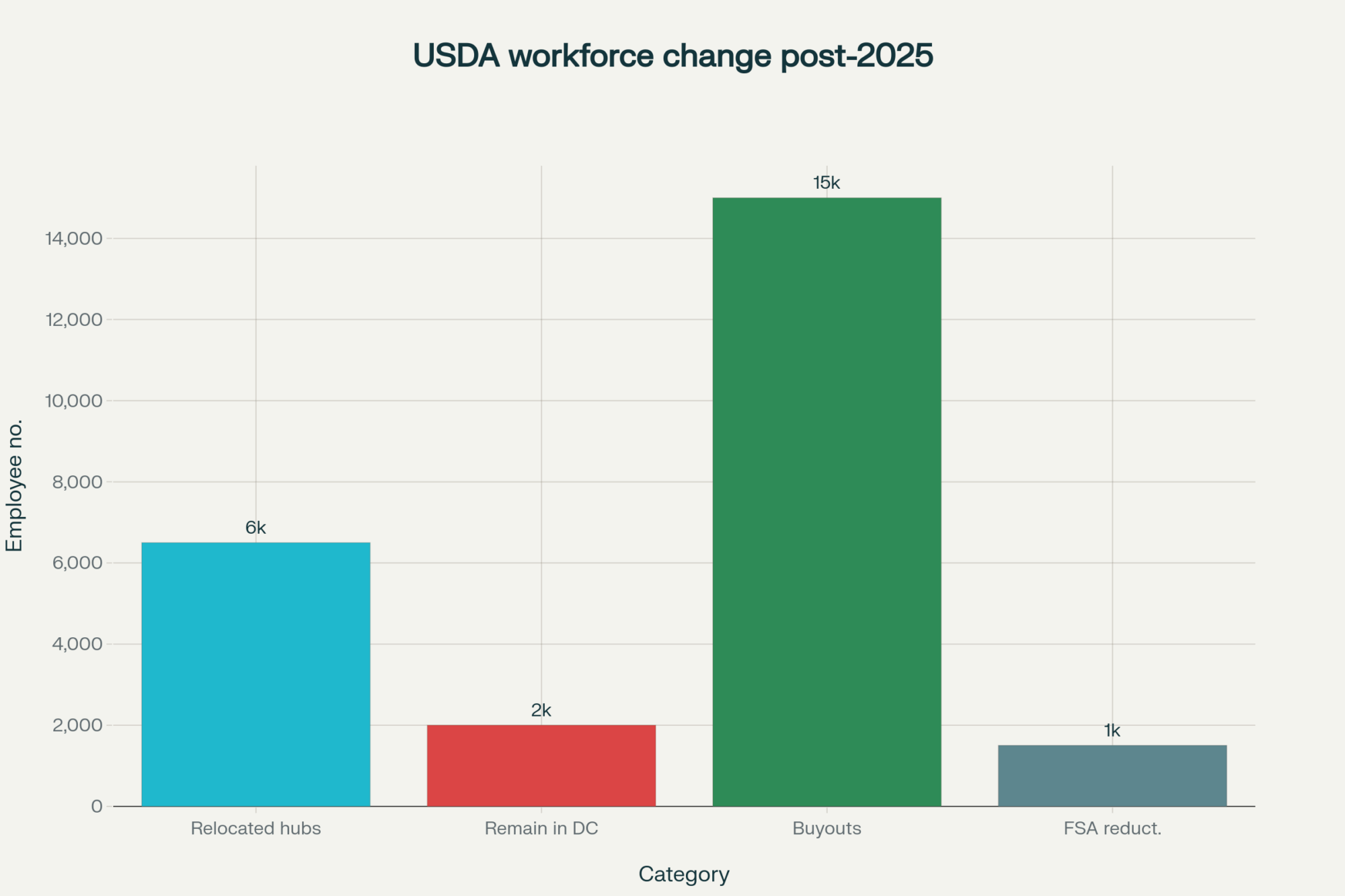
USDA workforce changes impacting dairy operations after 2025 reorganization

And then there’s the staffing crunch that has been ongoing—more than 15,000 USDA employees, roughly 15 percent of the workforce, have taken buyouts since early this year, with the Farm Service Agency alone shrinking by a whopping 35 percent, according to Brownfield Ag News. For producers waiting on loans or conservation payments, this slowdown translates directly to lost days—and dollars—on the farm.

I like how Rob Larew from the National Farmers Union puts it: “If meat plants don’t have inspectors, they don’t run.” The knock-on effect? Cull cow prices can dip by 10 to 12 percent when processing bottlenecks arise—a ripple effect that echoes all the way to your bottom line.

DateEventImpact on Dairy Farms
June 1, 2025Federal Milk Marketing Order changes85-90¢ reduction per cwt
July 2025USDA reorganization announcedService disruptions begin
Sept-Nov 2025Critical feed budgeting periodHigher costs, delayed support
Jan-Feb 2026EQIP payment delays peak6-8 month lag in conservation funding
April 2026Estimated hub operations stableServices potentially normalized

Where Everything’s Moving

So, what about these hubs? They’re strategically placed:

Kansas City, Missouri: The heart of feed pricing and logistics
Indianapolis, Indiana: A central hub for dairy processing
Fort Collins, Colorado: A key center for agricultural research
Raleigh, North Carolina: The dairy industry’s eastern expansion
Salt Lake City, Utah: Managing the vast western operations

The Agricultural Research Service is relocating key dairy administrative functions to these hubs, managing research funds aimed at boosting genetics and feed efficiency—the kind of work that can save producers substantial amounts each year.

The National Agricultural Statistics Service is consolidating its twelve regions down to five, aligned with these hubs. That means delays in those all-important milk production reports you rely on—potentially leading to price swings in the 15 to 20-cent range. That’s a headache if you’re hedging futures or managing cash flow.

MetricTraditional BreedingGenomic TestingAdvantage
Breeding Accuracy20-25% (parent averages)65-80% (DNA-based)3x more accurate
Heifer Retention RateBaseline+13% improvement$1,400-$2,000 savings
Net Merit per Heifer$532 (basic programs)$1,203 (advanced)$671 advantage
Feed Efficiency ROIStandard$470/cow annually$1.2M per 2,500 cows
Testing TimelineYears for proof6 months for resultsFaster decisions

The Conservation Crunch

Meanwhile, the Natural Resources Conservation Service is also facing delays. We’re looking at a six- to eight-month lag in delivering EQIP payments, and that has me thinking about producers in the Midwest trying to wrap up projects before winter sets in.

I keep a wary eye on the Beltsville Agricultural Research Center—this sprawling campus has been the backbone of dairy health research, particularly in the area of mastitis control, which is a significant factor in controlling treatment costs.

We’ve Seen This Movie Before

And history, as they say, rhymes. When the Economic Research Service and the National Institute of Food and Agriculture were relocated out of D.C. in 2019, about three-quarters of the staff refused to move. That led to a brain drain and a tangible drop in productivity, as documented by the Government Accountability Office.

Current trends suggest milk prices remain under pressure compared to earlier 2025 forecasts, while feed costs have pushed above $280 per ton—the kind of squeeze that tightens margins across the dairy belt.

The National Sustainable Agriculture Coalition highlights a significant decline in USDA staff, with tens of thousands lost since the start of the year, amid mounting concerns over shrinking conservation budgets.

The Political Reality

Politically, all eyes are on this. Senator Amy Klobuchar called the plan “completely unacceptable,” warning it risks undermining critical USDA capabilities. That’s from her official statement. Meanwhile, Senator Roger Marshall of Kansas sees opportunity, pointing to the value of embedding USDA staff near major land-grant universities to spark innovation and regional relevance, as noted in his press release.

But, on your farm, what does this mean? County USDA offices are often operating on skeleton crews—some only open two or three days per week, according to industry reports. The National Farmers Union recommends that producers establish multiple contacts and solidify relationships with cooperatives to navigate this changing landscape.

Your Game Plan Right Now

You might ask, “What’s the smart move for me?” Here’s my take:

Lock your loans in early — don’t bet on better terms later
File your conservation paperwork sooner rather than later
Keep a close watch on milk pricing to catch any market gyrations
Build a network of USDA contacts — don’t rely on a single line of communication

Remember, Secretary Rollins assures us that core operations will keep running—but previous reorganizations hint at inevitable bumps ahead. Preparing now could save you from costly operational headaches down the road.

Looking Ahead

Given the regulatory environment and tight margins you’re navigating, even small delays in data or service can cascade into tough decisions on nutrition and breeding strategies.

On a hopeful note, decentralizing services might actually speed up responses and make support more tailored to your specific region—provided that seasoned USDA experts stick around to share their knowledge.

What’s fascinating is how this all unfolds just as dairy operations are juggling production constraints, labor shortages, and price volatility. The challenges keep piling up, but dairy farmers are nothing if not resilient.

The question is, as all this unfolds, will your operation be among those that adapt and thrive? It’s a storm, but with a clear plan and solid connections, you can chart your course through it.

So, what do you think? Are you ready to steer through this new era?

Complete references and supporting documentation are available upon request by contacting the editorial team at editor@thebullvine.com.

Learn More:

  • Dairy Farm Financial Ratios: The Key Numbers You Need to Know – With USDA services in flux, mastering your financials is critical. This guide offers strategic guidance on key ratios for tracking profitability and liquidity, enabling you to make informed, data-driven decisions that navigate economic uncertainty and protect your margins.
  • Navigating the Dairy Crossroads: Key Trends Shaping the Next Decade – Look beyond the immediate USDA disruption to understand the larger market forces at play. This strategic analysis examines key consumer, economic, and policy trends, providing insights into how to position your dairy for long-term growth and resilience in a rapidly changing world.
  • The Robotic Revolution: How Automated Milking Systems Are Reshaping Dairy Operations – As institutional support shifts, on-farm efficiency is paramount. This piece examines how automated milking systems directly address labor shortages and enhance herd management, providing a practical approach to boosting productivity and future-proofing your operation against external shocks.

Join the Revolution!

Join over 30,000 successful dairy professionals who rely on Bullvine Weekly for their competitive edge. Delivered directly to your inbox each week, our exclusive industry insights help you make smarter decisions while saving precious hours every week. Never miss critical updates on milk production trends, breakthrough technologies, and profit-boosting strategies that top producers are already implementing. Subscribe now to transform your dairy operation’s efficiency and profitability—your future success is just one click away.

NewsSubscribe
First
Last
Consent

Wisconsin Dairy Farmer Sues USDA Programs Costing Operations $100,000+ Annually

Stop believing government programs are “fair game.” Wisconsin lawsuit exposes $15,000+ EQIP disparities threatening your operation’s constitutional rights.

EXECUTIVE SUMMARY: The dairy industry’s comfortable reliance on USDA programs is about to face its biggest constitutional challenge since the New Deal, potentially costing operations thousands in lost competitive advantages. Wisconsin Holstein producer Adam Faust’s federal lawsuit against USDA Secretary Brooke Rollins targets three cornerstone programs—Dairy Margin Coverage, Loan Guarantees, and EQIP—alleging they violate equal protection by offering preferential treatment worth up to $15,000 per project based solely on race and gender classifications . With DMC enrollment closing March 31, 2025, and margins averaging $11.61/cwt through 2024’s first ten months, producers face an uncomfortable reality: programs they depend on may be constitutionally vulnerable. The lawsuit builds on Faust’s successful 2021 challenge that eliminated $4 billion in race-based loan forgiveness, creating powerful legal precedent that could dismantle “up to two dozen other discriminatory programs” across USDA . While global dairy production grows 0.5% in 2025 and competitors pursue race-neutral support systems, American producers must grapple with whether demographic classifications distract from performance-based assistance that drives real operational improvements [4]. Every progressive dairy operation should immediately audit their government program dependencies and prepare contingency plans before judicial decisions reshape federal agricultural policy.

KEY TAKEAWAYS

  • DMC Administrative Fee Disparities Create $100 Annual Advantage: While standard producers pay $100 for identical margin protection at $0.15/cwt for $9.50 coverage, “socially disadvantaged” farmers receive the same catastrophic coverage free, multiplying across thousands of operations nationwide
  • EQIP Cost-Share Gaps Deliver $15,000 Project Advantages: Standard participants receive 75% cost-sharing for conservation practices like manure storage systems, while preferred classifications qualify for 90% reimbursement—creating a $15,000 disparity on typical $100,000 environmental compliance projects
  • Loan Guarantee Rates Affect Borrowing Power by 5%: USDA guarantees reach 95% for minority and female farmers versus 90% for others, directly impacting interest rates and lending terms on major refinancing like Faust’s $890,000 dairy operation loan
  • Constitutional Precedent Threatens Program Stability: The 2021 Faust v. Vilsack victory plus Supreme Court’s 2023 Students for Fair Admissions decision create powerful legal framework challenging any race-based classifications, potentially forcing Congress to restructure agricultural support around income-based or performance metrics rather than demographic categories
  • Global Competitors Pursue Race-Neutral Support Systems: While American dairy debates constitutional compliance, EU Common Agricultural Policy focuses on environmental outcomes and farm size, and New Zealand eliminated most subsidies decades ago, forcing efficiency improvements that strengthened international competitiveness
USDA dairy programs, dairy margin coverage, farm risk management, agricultural policy, dairy profitability

Wisconsin Holstein producer Adam Faust filed a federal lawsuit Monday against USDA Secretary Brooke Rollins, alleging three key agricultural programs systematically discriminate against white male dairy farmers through preferential treatment that costs operations tens of thousands of dollars annually. The case targets the Dairy Margin Coverage (DMC) program, USDA Loan Guarantee program, and Environmental Quality Incentives Program (EQIP), claiming these initiatives violate constitutional equal protection principles while creating significant financial disparities across dairy operations nationwide.

The $890,000 Question: When Program Benefits Create Market Disadvantages

Here’s the reality facing dairy producers in 2025: your race and gender now determine how much federal support you can access. Faust, who operates a 70-head Registered Holstein operation near Chilton, Wisconsin, discovered this firsthand when he refinanced his dairy farm in August 2024.

While Faust qualified for a 90% USDA loan guarantee on his $890,000 refinancing, minority and female farmers in identical situations receive 95% guarantees. That 5-percentage-point difference translates directly into borrowing power, interest rates, and your operation’s financial flexibility.

Let’s face it – in today’s capital-intensive dairy industry, every basis point matters. When feed costs remain elevated and milk prices stay volatile, access to favorable financing can determine whether you expand, maintain, or exit the business.

The $100 Administrative Fee: A Constitutional Violation in Plain Sight?

The Dairy Margin Coverage program, which protects producers when the difference between the all-milk price and the average feed price falls below a certain dollar amount selected by the producer, charges most participants a $100 annual administrative fee. However, this fee disappears entirely for farmers classified as “limited resource, beginning, socially disadvantaged, or a military veteran .”

With DMC enrollment running from January 29 to March 31, 2025, and coverage levels ranging from $4 to $9.50 per hundredweight in 50-cent increments, this isn’t pocket change we’re discussing. The program’s effectiveness has been demonstrated repeatedly – research from HighGround Dairy shows that Tier I coverage at the $9.50 margin would have triggered payments in 65% of the months over the past decade.

“Our safety-net programs provide critical financial protections against commodity market volatilities for many American farmers, so don’t delay enrollment,” said USDA Farm Service Agency (FSA) Administrator Zach Ducheneaux. “And at $0.15 per hundredweight for $9.50 coverage, risk protection through Dairy Margin Coverage is a relatively inexpensive investment in a true sense of security and peace of mind .”

But here’s what’s really concerning: Faust paid his $100 DMC administrative fee on March 25, 2025, while farmers in other demographic categories received identical coverage for free. Multiply this across thousands of dairy operations, and you’re looking at millions in differential treatment.

EQIP Conservation: When 90% vs 75% Cost-Share Creates Competitive Gaps

The Environmental Quality Incentives Program presents perhaps the most significant financial disparity. Standard EQIP participants receive up to 75% cost-sharing for conservation practices, while “socially disadvantaged, limited-resource, beginning, and veteran farmer and ranchers are eligible for cost-share rates of up to 90 percent .”

Consider the math on a typical manure storage system – exactly what Faust plans for his operation. On a $100,000 project, that 15-percentage-point difference means $15,000 more out-of-pocket expenses for some farmers compared to others. When margins are tight and environmental compliance costs continue rising, this disparity affects operational competitiveness.

The National Sustainable Agriculture Coalition confirms that these enhanced benefits extend beyond just cost-sharing rates. This same population of producers is also eligible for up to 50 percent advance payment for costs associated with planning, design, materials, equipment, installation, labor, management, maintenance, or training.

The Uncomfortable Constitutional Question: Have We Forgotten Equal Protection?

Here’s the question nobody wants to ask: When did American dairy farmers become so dependent on federal subsidies that we’ll accept constitutional violations for a $100 fee waiver?

This lawsuit exposes an uncomfortable reality about our industry’s relationship with government programs. We’ve built entire business models around accessing preferential treatment, loan guarantees, and conservation cost-shares that may fundamentally violate the principle of equal protection under the law.

Table 1: Financial Disparities in Challenged USDA Programs

ProgramStandard RateSocially Disadvantaged RateAnnual Difference
DMC Administrative Fee$100$0 (waived)$100
Loan Guarantee Program90% guarantee95% guarantee5% advantage
EQIP Cost-ShareUp to 75%Up to 90%15% advantage

Are we so comfortable with this system that we’ve forgotten what true market-based agriculture looks like?

Legal Precedent: The 2021 Victory That Changed Everything

Faust isn’t entering this battle unprepared. His successful 2021 lawsuit against the Biden administration halted a COVID-19 loan forgiveness program that excluded white farmers, establishing legal precedent that race-based agricultural programs violate constitutional equal protection principles.

That earlier victory, combined with the Supreme Court’s 2023 Students for Fair Admissions decision limiting race-conscious policies, creates a powerful legal foundation. The Wisconsin Institute for Law & Liberty, representing Faust, has already secured seven significant court victories challenging similar programs across 25 states.

What This Constitutional Challenge Means for Your Operation

Immediate Impact: If you’re currently enrolled in DMC, loan guarantee programs, or planning EQIP applications, understand that these policies may face significant changes. The Trump administration finds itself in the awkward position of defending programs that contradict its anti-DEI platform.

Financial Planning: Operations relying on the enhanced benefits available through “socially disadvantaged” classifications should prepare contingency plans. A successful lawsuit could eliminate preferential treatment across multiple USDA programs simultaneously.

Risk Management: With DMC proving its value through consistent performance and coverage at just $0.15 per hundredweight for $9.50 protection, the core program remains solid regardless of administrative fee structures. Don’t let policy uncertainty derail your risk management strategy.

Industry-Wide Ramifications: Beyond Individual Operations

This lawsuit targets more than three programs. The Wisconsin Institute for Law & Liberty has identified “up to two dozen other discriminatory programs” across USDA that use similar classification systems. A successful challenge could trigger comprehensive policy changes affecting:

  • Conservation program funding priorities
  • Disaster assistance distribution
  • Equipment purchase loan terms
  • Technical assistance access
  • Grant program eligibility

The Global Context: How Other Dairy Nations Handle Farmer Support

While American dairy farmers debate classification-based programs, international competitors pursue different approaches to farmer support. The European Union’s Common Agricultural Policy focuses on environmental outcomes and farm size rather than demographic characteristics. New Zealand eliminated most production subsidies decades ago, forcing efficiency improvements that strengthened their global competitiveness.

This raises uncomfortable questions: Are we creating the most effective support systems for American dairy farmers, or are demographic classifications distracting from performance-based assistance that drives real operational improvements?

The Constitutional vs. Practical Debate

Here’s where dairy farmers face a fundamental choice: support programs based on constitutional principles of equal treatment or accept targeted assistance that acknowledges historical discrimination in agricultural lending. The USDA’s own data shows that minority farmers historically faced higher loan rejection rates and less favorable terms.

But does addressing past discrimination through current preferential treatment create new inequities? When a Wisconsin Holstein producer pays $100 for DMC coverage while his neighbor receives it free, the constitutional argument becomes personally relevant.

Bottom Line: Preparing for Policy Uncertainty

Smart dairy managers prepare for multiple scenarios. Whether you benefit from current preferential programs or feel disadvantaged by them, policy stability remains uncertain. Here’s your action plan:

  1. Secure Current Benefits: If you qualify for enhanced USDA programs, complete applications before potential policy changes. The DMC enrollment deadline is March 31, 2025.
  2. Diversify Risk Management: Don’t rely solely on government programs for financial protection. While valuable at $0.15 per hundredweight for $9.50 coverage, the DMC program shouldn’t be your only margin protection strategy.
  3. Document Everything: Whether you’re affected positively or negatively by current policies, maintain detailed records of program interactions. Policy changes may trigger retroactive adjustments.
  4. Stay Informed: This lawsuit represents broader political movements challenging race-conscious policies across all government agencies. Monitor developments beyond agriculture that may signal wider policy shifts.

The dairy industry thrives on consistent, predictable policies that support operational efficiency and long-term planning. Whether you agree with or oppose current USDA classification systems, uncertainty helps nobody. The sooner these constitutional questions get resolved, the sooner we can focus on what really matters: producing safe, affordable milk for American families while maintaining profitable, sustainable operations.

The lawsuit’s outcome will determine whether America’s dairy support programs emphasize equal treatment or targeted assistance – a choice with implications far beyond Adam Faust’s 70-cow Holstein operation in Wisconsin.

Learn More:

Join the Revolution!

Join over 30,000 successful dairy professionals who rely on Bullvine Weekly for their competitive edge. Delivered directly to your inbox each week, our exclusive industry insights help you make smarter decisions while saving precious hours every week. Never miss critical updates on milk production trends, breakthrough technologies, and profit-boosting strategies that top producers are already implementing. Subscribe now to transform your dairy operation’s efficiency and profitability—your future success is just one click away.

NewsSubscribe
First
Last
Consent
Send this to a friend





