






Slippery barn floors cost $300+/cow in lameness. Discover how traction milling and smart flooring fixes can save your dairy operation six figures.
Executive Summary: Dairy barn floors are a hidden profit killer, with lameness costing $300+ per cow due to lost milk, fertility issues, and premature culling. Modern free-stall designs and larger cows amplify risks from slippery floors caused by mineral buildup, sand abrasion, and poor installation. Solutions like Agritra’s traction milling (80% traction improvement) outperform traditional grooving and rubber mats by eliminating “slip-and-catch” injuries while reducing bacterial traps. Proactive floor maintenance and objective assessments combat “barn blindness,” while proper concrete specs and post-cure texturing prevent long-term failures. Investing in optimized flooring isn’t optional-it’s a $100K+/year ROI opportunity for 1,000-cow herds.
Key Takeaways:
- Lameness = profit drain: Costs $300+/case via milk loss, culling, and treatment.
- Floor failures are preventable: Mineral buildup (not wear) often causes slipperiness-test with water.
- Traction milling dominates: 80% traction vs. 30% for grooving; avoids injuries and lasts 6-15 years.
- Sand beds backfire: Accelerate floor wear despite cow comfort benefits.
- Holistic approach wins: Pair flooring fixes with stall comfort, hygiene, and locomotion scoring.
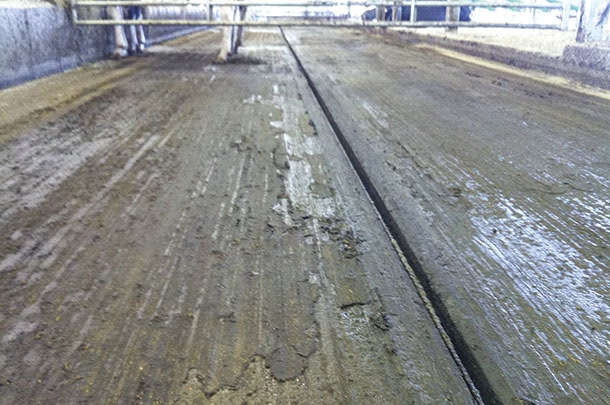
While you’re meticulously dialing in that TMR mix to the gram and scrutinizing DHIA test results to the decimal point, your cows are sliding toward financial disaster on what might be the most neglected investment in your dairy. The floor beneath their hooves is bleeding profits faster than a displaced abomasum that goes untreated for a week. It’s time to stop accepting lame cows as “just another cost of doing business” and start seeing your slippery floors for what they truly are – a fixable profit drain costing you six figures annually.
The Financial Hemorrhage You’re Ignoring
Let’s cut straight to your milk check: lameness is drying your operation like subclinical mastitis flying below the SCC radar. Each case costs over $300 per cow, and with prevalence rates between 20-50% in typical herds, we’re talking about $100,000 to $200,000 in annual losses for a 1,000-cow dairy.
“But my herd doesn’t have a lameness problem,” you might insist. Really? When was the last time you measured it? Research consistently show’s producers underestimate lameness prevalence by half or more. This phenomenon, “barn blindness” (normalization of hazards through daily exposure)-happens when you see the same gradual deterioration daily until it becomes your new normal. You don’t notice your cows’ subtle gait changes and arched backs until you’ve got Holstein tripods hobbling through the return alley.
Here’s the breakdown of where that $300+ per case is vanishing:
- Milk production losses: 700-950 pounds per lactation (that’s like dumping a full bulk tank from a 100-cow dairy every year)
- Premature culling: Those second and third-lactation cows never reach genetic potential (31% of total cost)
- Reduced fertility: More days open than a 24-hour convenience store (30-39% of total cost)
- Treatment costs and labor: The tip of the iceberg that most producers focus on
Here’s what should make you reach for the antacids: milk production often begins decreasing months before you notice any clinical lameness. Your transition cows are suffering in silence, and your bulk tank is taking the hit harder than a first-cutting alfalfa field in a hailstorm.
Has Your Floor Design Been Stuck in the 1980s?
The dairy industry has revolutionized everything from genetics to milking technology, yet most barns still feature the same concrete flooring systems farmers installed decades ago. This disconnect is costing you dearly.
Today’s 6-row free-stall facilities provide behavioral freedom but fundamentally change the physical demands on your cows. Instead of delivering food and water, such as room service, they must walk approximately half a mile daily between feeding areas, water troughs, and milking facilities.
Meanwhile, decades of selection for production have resulted in 1,600-pound powerhouses with frames that would make a Peterbilt jealous. This increased body mass places greater pressure on hooves and joints when walking on hard surfaces.
The math is simple: larger cows + more walking = unprecedented demands on your barn flooring. Yet most producers are still treating their concrete the same way they did 30 years ago, despite these dramatic changes. That’s like using your grandfather’s bull selection criteria in the genomic era dangerously outdated.
Why should you care? Your grandfather’s cows survived on poorly maintained floors because they barely walked. Today’s high-producing animals need surfaces that provide confident footing without causing excessive wear balance that most traditional approaches fail to achieve.
The Real Reasons Your Floors Get Slippery (And It’s Not What You Think)
Do you think your floors are slippery because they’re simply worn down? Think again. Many floors don’t lose traction because the concrete is degraded- they become dangerous because of what’s building up on them.
The most overlooked culprit is mineralization. Hydrated lime from free stall bedding chemically bonds with concrete immediately upon contact, gradually filling micro-textures that provide traction. This builds up like milk stone in your pipeline when your wash cycles aren’t correctly calibrated.
Want a simple test to know whether your floor is worn or just coated with minerals? Wash a section with water. If polished aggregate stones are visible, you’ve got genuine wear. You deal with mineral buildup if the original surface remains but has lost its texture.
Other major factors making your floors into skating rinks:
Sand Bedding: The Double-Edged Sword While excellent for cow comfort and SCC reduction, sand acts like 100-grit sandpaper under hooves and scraper blades. If you’re using sand, your floors will degrade significantly faster than with organic bedding. Has your bedding consultants ever mentioned this trade-off, or were they only focused on selling you on comfort metrics?
Over-Sloped Surfaces: The Counterproductive “Solution” Many barns incorporate excessive slopes with the intention of improving drainage. The irony? This often causes manure solids to smear into a slippery film rather than drain effectively. More slopes don’t equal better drainage- it equals more falls, like how pushing your vacuum pump beyond 14 CFM doesn’t improve milking but does increase teat-end damage.
The Imprinting Disaster That Engineers Keep Selling Perhaps the worst flooring mistake ever widely embraced was imprinting patterns into wet concrete. This displacement technique inevitably creates an uneven surface like an upside-down muffin tin. These uncomfortable “domes” between pattern impressions can increase lameness rates to 50-60%. Why are we still letting concrete contractors talk us into this approach when the data clearly shows it’s a welfare and financial disaster?
The Flooring Showdown: What Works?
When addressing slippery barn floors, you have several potential solutions. But which one delivers results? Let’s cut through the marketing hype faster than a Lely laser cuts through quarter milking:
Traditional Grooving: The Outdated Standard Concrete grooving has been standard practice since the 1960s, showing its age like a tie-stall barn with wooden stanchions. While providing approximately 30% improvement in traction, it relies on a dangerous “slip and catch” mechanism (where the hoof slips on a flat surface, then catches on the groove edge) that creates traumatic forces, causing white line separation and interdigital strain.
Even worse, those grooves become bacterial reservoirs like stagnant footbaths. They trap approximately 2 gallons of manure per 10 square feet even after scraping, creating perfect breeding grounds for digital dermatitis pathogens.
Rubber Flooring: The Comfortable Compromise Rubber has gained popularity for its comfort benefits, with cows taking longer strides and walking faster than concrete. But before you cover your entire barn in rubber-like artificial turf on a football field, ask yourself if the economics work.
The primary disadvantage is that cost-installing rubber throughout an entire facility requires substantial investment. Durability concerns also exist, with some operations reporting replacement needed after only five years, resulting in costs of around $2 per square foot annually.
Most importantly, rubber flooring doesn’t address underlying concrete issues; when it wears out or is removed, your original floor problems remain. Are you solving your problem or just putting an expensive band-aid on it?
Traction Milling: The Modern Alternative Traction milling (grinding a fine, ribbed texture directly into concrete surfaces) takes a fundamentally different approach to flooring, such as the shift from conventional parlors to rotaries or robots. This process provides “360-degree traction with every step” rather than the reactive “slip and catch” of grooving.
The process covers approximately 95% of the floor surface (versus only 10-20% with grooving) and claims to provide about 80% of the traction found on pasture- the difference between wearing cleats or dress shoes on wet grass.
A key advantage is its versatility across different existing surfaces. It can be applied over previously grooved floors, ungrooved surfaces, slats, and even problematic imprinted floors. Why aren’t more producers considering this option instead of defaulting to what their neighbors did twenty years ago?
Getting It Right from the Ground Up: If You’re Pouring New Concrete
If you’re pouring new concrete, you can avoid future problems or create a disaster that will plague your herd, like persistent BTSCC problems that never respond to treatment.
The Foundation Matters Before the first concrete truck arrives, ensure proper excavation, fill material, and compaction. Your concrete should have a minimum 25 MPa (3,500 PSI) compressive strength and 6% air entrainment for durability and acid resistance, which are higher standards than your bulk tank pad but essential for cow traffic areas.
The Critical Timing Window For broom finishing, timing is everything. Done too early, it pulls stones to the surface, creating painful pressure points. Done too late, it leaves little texture. Even properly executed, broom finishes typically provide traction for only 6-12 months in high-traffic scrape alleys-about as lasting as temporary hoof blocks on chronic lame cows.
The Deadly Imprinting Mistake Here’s a critical warning: never imprint patterns by displacing wet concrete. When concrete is pushed down in one area, it rises elsewhere, forming uncomfortable “domes” that increase lameness risk. Why are we still allowing contractors to sell us on this outdated practice when it creates predictable lameness problems?
What About New Floors? Consider arranging for post-cure texturing like traction milling for new installations rather than relying solely on initial brooming. This provides a more uniform, durable surface, implementing a comprehensive transition cow program instead of treating ketosis cases after they occur.
The Bottom Line: Stop Accepting Lameness as a “Normal” Cost of Doing Business
The floor beneath your cows’ feet isn’t just concrete- it’s the foundation of your dairy’s profitability, as critical as your nutrition program or reproduction protocol. Yet, while you track milk components to the hundredth of a point and reproductive performance to the day, you’re likely ignoring a problem staring you in the face.
With each lameness case costing over $300 and affecting up to half your herd, addressing flooring issues represents one of the highest-return investments available to modern dairy operations. This isn’t just maintenance- it’s capturing new profit in an industry where margins can be thinner than a Jersey’s tail on a fly day.
Take Action Now:
- Conduct a locomotion scoring assessment by June 1st – Don’t trust your daily observation alone. Schedule an objective evaluation using a standardized 1-5 scale scoring system for your floors and your cows’ locomotion. When was the last time someone besides you scored your cows for lameness?
- Calculate your specific lameness costs this week – Multiply your herd size by 35% (a conservative estimate based on research), then multiply that number by $336.91 (the average cost per case according to the 2023 Journal of Dairy Science research). That’s what lameness might be costing annually likely more than your annual breeding costs.
- Develop a floor maintenance schedule by July 1st – If you’re using sand, recognize your floor maintenance needs will be substantially higher. Create a calendar for regular floor assessment and maintenance, just as you do for your milking system.
- Request quotes from multiple flooring solution providers within 30 days – Don’t just call the same groover you’ve always used—research newer technologies like traction milling and targeted rubber application. Compare costs, expected lifespan, and ROI calculations.
- Implement a prevention-focused flooring strategy before fall – When was the last time you had someone evaluate your floors with the same diligence as your milking system analysis? Schedule a comprehensive assessment that includes traction testing and identification of problem areas.
The question isn’t whether you can afford to address your floor issues-it’s whether you can afford not to. Every day you delay is another day your cows struggle on slippery surfaces, another day of reduced performance, and another day of watching potential profits slide away on sore hooves faster than milk prices after a bearish USDA report.
Your cows walk half a mile daily on your floors. Isn’t it time you walked a mile in their hooves?
Complete references and supporting documentation are available upon request by contacting the editorial team at editor@thebullvine.com.
Learn more:
- Designing Durable Concrete Floors for Dairy Facilities to Minimize Lameness in Cows
Discover best practices for sub-base prep, concrete mix, and finishing techniques that create long-lasting, cow-friendly barn floors and reduce lameness. - Lameness in Dairy Cattle: Uncovering Why Hoof Health Issues Persist Despite Interventions
Explore the complex causes of lameness, from facility design to management, and learn why persistent hoof health challenges require comprehensive strategies. - Maximizing Cow Comfort: Preventing Lameness in Robotic Milking Facilities with Smart Design and Maintenance
See how proactive barn design, proper flooring, and regular maintenance are essential for cow comfort and lameness prevention in high-tech milking environments.
 Join the Revolution!
 Join the Revolution!
Join over 30,000 successful dairy professionals who rely on Bullvine Weekly for their competitive edge. Delivered directly to your inbox each week, our exclusive industry insights help you make smarter decisions while saving precious hours every week. Never miss critical updates on milk production trends, breakthrough technologies, and profit-boosting strategies that top producers are already implementing. Subscribe now to transform your dairy operation’s efficiency and profitability—your future success is just one click away.




