






Custom drone rates dropped from $22 to $16/acre in 2 years—here’s what that means for your spray decisions
EXECUTIVE SUMMARY: What farmers are discovering about spray drones challenges everything equipment dealers have been pushing—the real value isn’t in replacing your ground rig, it’s in solving specific problems conventional equipment can’t handle. Recent field data shows custom application rates have dropped from $22-25 per acre to $15-18 across the Midwest as more operators enter the market, fundamentally changing the ownership economics. Extension research confirms that while large operations (2,000+ acres) can achieve costs as low as $7-9 per acre, smaller dairies face $18-20 per acre when factoring in battery replacement, insurance, and time value. The producers finding success aren’t chasing technology for its own sake—they’re targeting chronically wet fields, odd-shaped parcels aerial applicators avoid, and emergency applications when timing trumps cost. With regulatory requirements varying wildly by state and Ontario producers essentially locked out of pesticide applications, the adoption pattern is becoming clear: scouting drones make sense for nearly everyone at $1,500, but spray drones require careful analysis of your specific operational challenges. Here’s what this means for your operation: document when conventional spraying actually fails you, test with custom services before buying, and understand that this technology works best as a specialized tool, not a revolutionary replacement.

You know those June mornings when you’re standing at the field edge, watching water pool between the corn rows? That’s when the conversation about spray drones becomes real for most of us. Not the trade show pitch about revolutionary technology, but the practical question: could this actually work on my operation?
I’ve been comparing notes with producers from Rock County, Wisconsin, to Lancaster County, Pennsylvania, and what’s interesting is how the conversation has shifted. The FAA now tracks agricultural drone registrations as a distinct category—they’re seeing steady growth, though exact numbers depend on classification. We’re past the hype stage. Now we’re seeing real patterns emerge about what works… and honestly, what doesn’t.
Looking across the I-94 corridor from Eau Claire to Madison, down through Illinois dairy country, the producers making drones work aren’t using them to replace their John Deere R4038s or Case Patriots. They’re using them for those specific situations where nothing else makes sense. And that distinction? Worth exploring, I think.
The Economics Are… Complicated (But Getting Clearer)
So let’s talk money, because that’s where every equipment decision starts and ends, right? I’ve been comparing notes with farm management specialists at various land-grants, and what’s fascinating is how differently the economics play out depending on your situation.
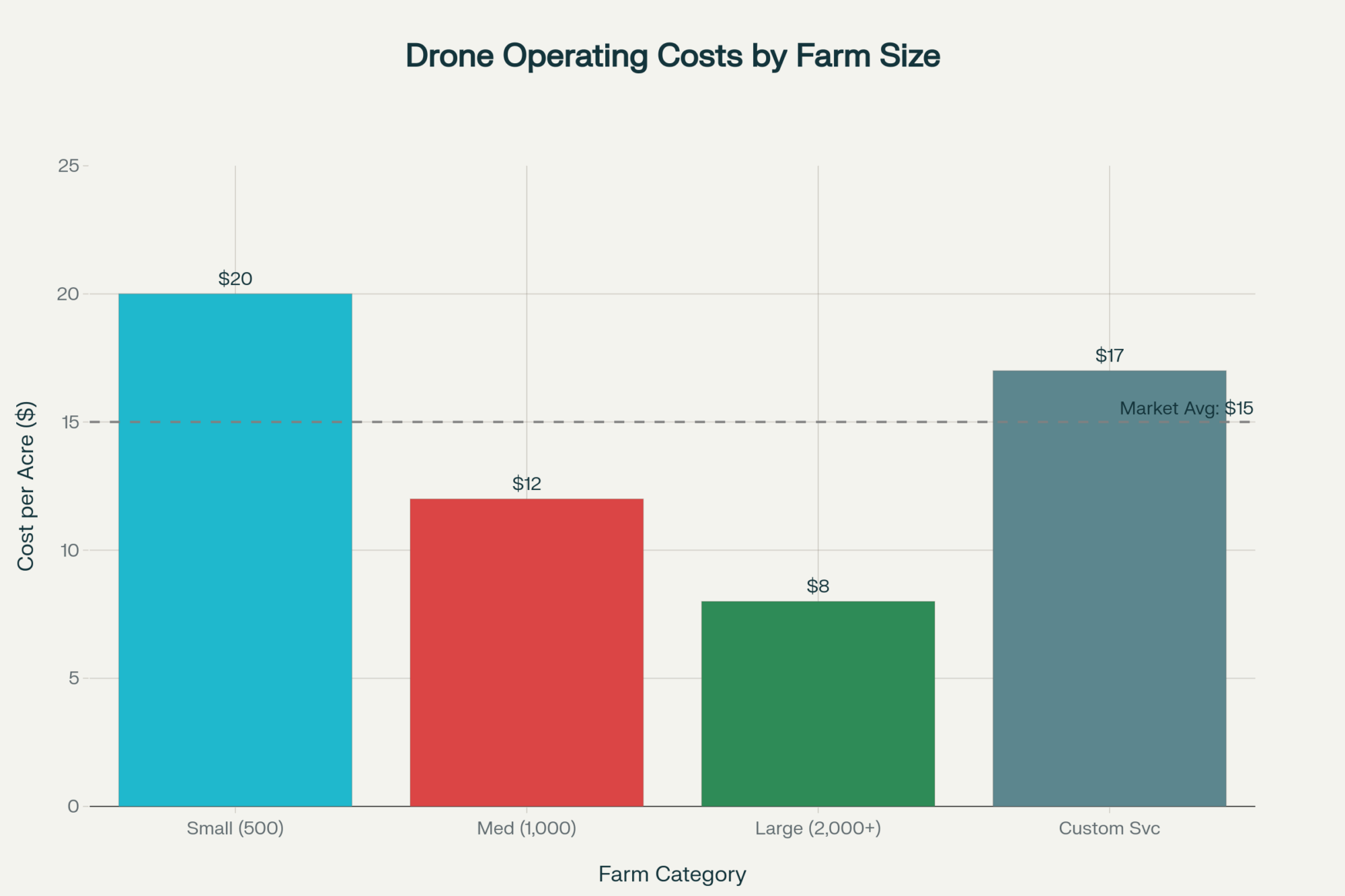
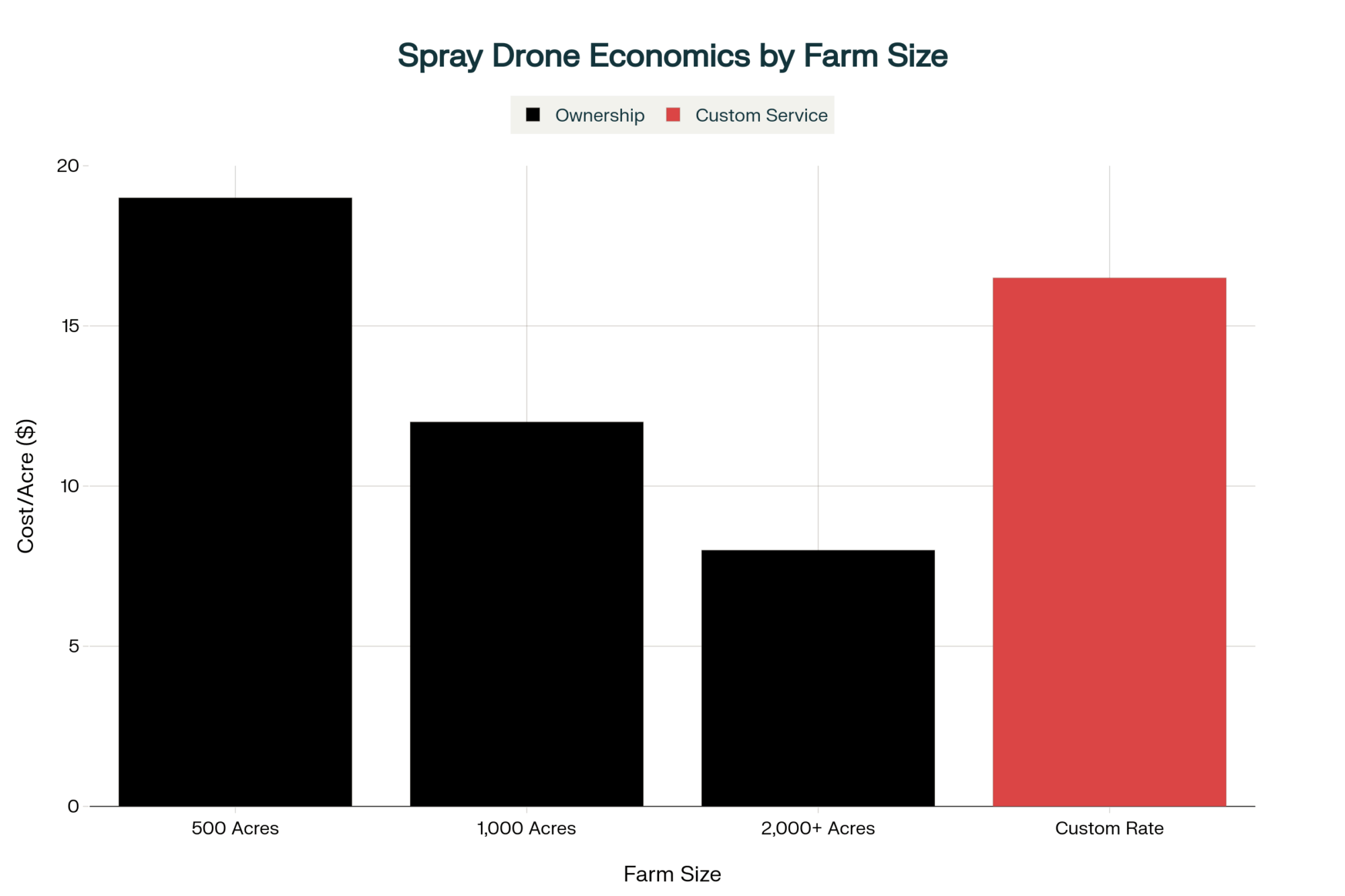
Some research from Midwest Extension programs suggests operating costs as low as $7-$ 8 per acre for high-volume custom operators running 4,000 acres or more annually. But then you talk to smaller operations—say, 500-800 acres—and they’re seeing costs approaching $20 per acre when you factor in depreciation, batteries, insurance, and the value of their time. That’s a huge spread.
But here’s something a producer in Lafayette County, Wisconsin, told me that really stuck: “The per-acre cost becomes irrelevant when it’s the difference between spraying and not spraying at all.”
We’ve all seen it—those compacted wheel tracks where corn just doesn’t perform the same. University research continues to confirm yield losses from compaction, sometimes as high as 8-15% in wet conditions. When managing premium silage ground where every ton is needed for your TMR, the drone economics suddenly become more than just application cost.
This past spring really drove the point home across the Great Lakes dairy region. NOAA data shows we had significantly more precipitation than normal during critical application windows. A Rock County producer I know gladly paid $18 per acre for a drone application on 300 acres when his fields were too wet. “Sure, it costs more than doing it myself,” he said, “but waterhemp doesn’t wait for fields to dry out.”
Now, I should mention—I’ve also talked with producers who ran the numbers and decided custom services made more sense for their situation. One veteran applicator near Sheboygan made a good point: “Why complicate things with new technology when my ground rig handles 95% of situations just fine?” There’s wisdom in both approaches.
Where Drones Actually Make Sense (And Where They Don’t)

What’s becoming clear from both university trials and farmer experience is that the most valuable drone applications on dairy farms often aren’t what the marketing brochures highlight.
Start with scouting. A quality agricultural drone with thermal and multispectral cameras runs about the same as a decent set of flotation tires. Extension specialists tracking adoption patterns report that farmers using drones for regular field scouting are catching problems 5-7 days earlier on average. For something like armyworm moving through your second-cut alfalfa, that timing difference matters.
But here’s where it gets interesting—and where some healthy skepticism is warranted.
Pasture management is showing real promise. Several land-grant universities have published trials on spot-spraying pastures, and the results are encouraging if you’ve got the right situation. One study found treating just problem areas—typically 15-20% of total pasture—delivered equivalent weed control while using 70% less herbicide. Makes sense for those of us working to maintain soil biology and forage density.
Though I should note, a pasture specialist in Vermont raised a fair point: “Sometimes the simplest solution is better grazing management, not more technology.” Worth considering.
Late-season applications in tall corn present another opportunity. When you have premium alfalfa heading into its third cutting with a 7-ton yield potential, or tall corn where your ground rig would snap stalks, aerial application starts looking attractive. Several seed companies report positive results from drone-based fungicide trials, although the response naturally varies by disease pressure and timing.
Some experienced custom applicators I respect aren’t convinced, though. One fellow who’s been spraying for 30 years told me, “I’ve seen every new technology promise to change everything. Most of them just complicate what already works.”
The Market Reality Nobody Wants to Discuss

From what I’m hearing at winter meetings and talking with equipment dealers, agricultural drone services are expanding rapidly. Every major ag retailer seems to be adding or exploring drone programs. Equipment dealerships are pushing them hard. And yes, plenty of producers are eyeing custom work to offset their investment.
But here’s what’s got me curious: can this market support all these operators?
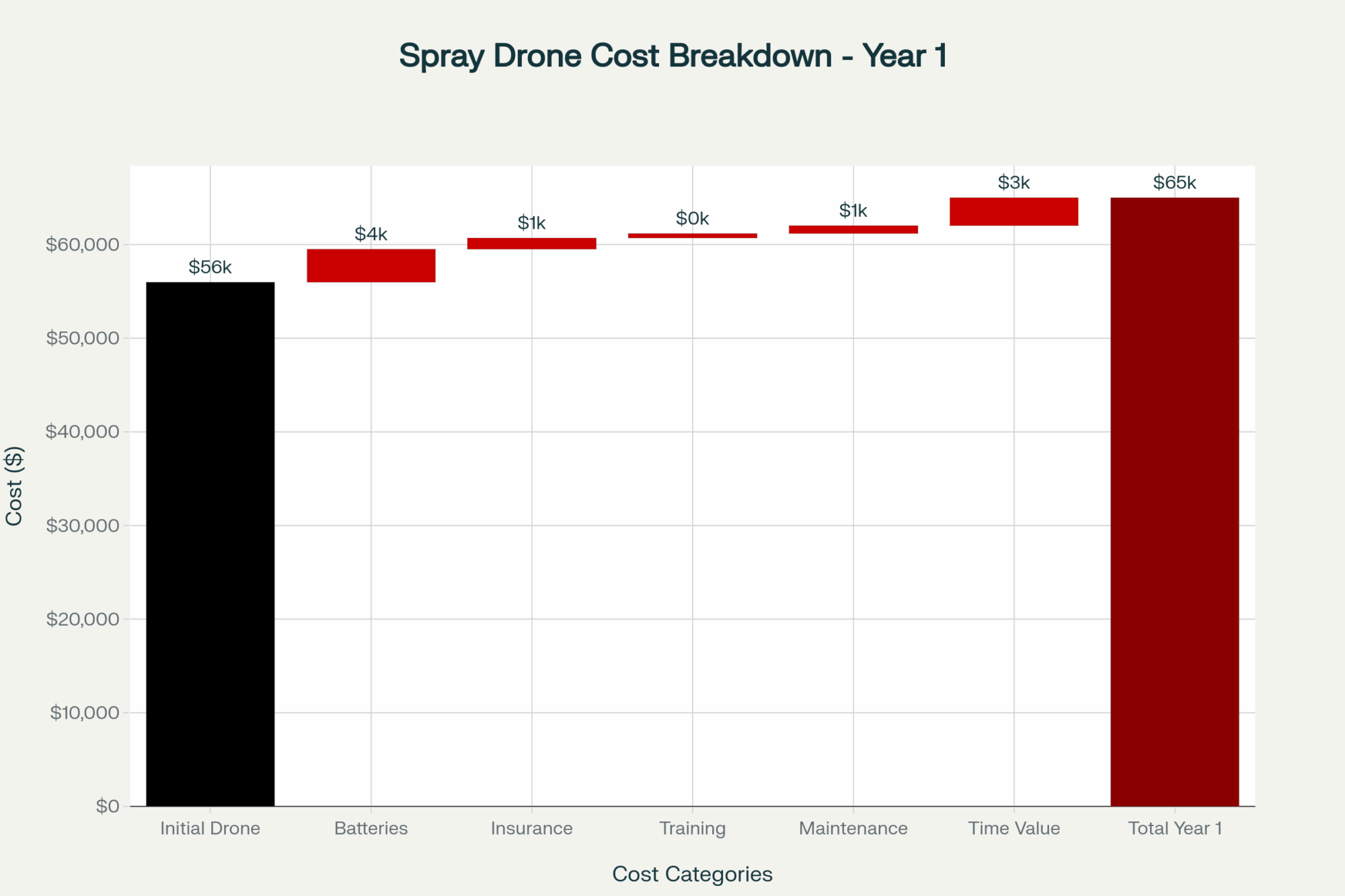
In areas like eastern Iowa and central Illinois, where adoption began early, custom rates have already moderated from $22 to $ 25 per acre two years ago to $15 to $ 18 today. Natural market evolution, sure—but challenging if you were counting on premium custom rates to justify a $56,000 spray drone setup.
| Feature | Scouting Drone | Spray Drone |
|---|---|---|
| Initial Investment | $1,500 | $56,000 |
| Regulatory Burden | Basic Part 107 | Part 107 + State Licenses |
| Training Time | 25-30 hours | 100+ hours |
| Annual Operating Cost | $300-500 | $3,000-8,000 |
| Break-even Timeline | 6-12 months | 3-5 years |
| Problem-solving Value | High (early detection) | High (emergency applications) |
Agricultural economists modeling these markets suggest there’s probably a sustainable ratio—maybe one service provider per 10,000-12,000 suitable acres, varying by region and crop mix. We may already be approaching that density in some areas.
The Regulatory Maze (And It Really Is One)
And here’s where it gets messy—every state seems to have its own take on how drones fit into pesticide regulations.
The FAA requires a Part 107 Remote Pilot Certificate for commercial operations, including use on your own farm. The test costs $175, and according to Wisconsin Farm Bureau’s training program reports, most farmers require 25-30 hours of focused study. Many community colleges now offer preparatory courses, which provide considerable help.
Want to spray pesticides? Now you’re in state-specific territory. Illinois treats drone operators like aerial applicators—requiring commercial licenses and continuing education. Wisconsin has different requirements. Minnesota is different still. Don’t assume—verify with your state department of agriculture.
Ontario producers face even more restrictions. From what I’m hearing at cross-border meetings, Health Canada’s approval process for drone-applied pesticides remains extremely limited. Several Ontario dairymen have told me they’re currently limited to foliar nutrients and biologicals.
Learning from Early Adopters (And Those Who Stepped Back)
Let me share what I’m hearing from producers who’ve actually been through this decision process.
A Holstein breeder near Eau Claire started with a $1,500 mapping drone in 2022. “Learned the rules, figured out what information actually helped,” he told me. Then, in 2023, he hired custom drone spraying for fungicide—wanted to see real results before investing serious money.
By 2024, he bought a 30-liter spray drone. But here’s the key: he had specific uses in mind. Four hundred acres of river bottom that floods regularly. Another 300 acres in odd corners and strips the co-op plane won’t touch. Running about 1,100 acres annually, including some custom work, he estimates his all-inclusive cost at $11-$ 12 per acre. The custom rate in his area is $17.
However, I’ve also spoken with a New Jersey operation in Crawford County that purchased a spray drone in 2023 and sold it this spring. “Too much hassle for the acres we could actually use it on,” the owner explained. “Between weather windows, battery management, and regulatory paperwork, we spent more time fiddling than flying.”
There’s probably wisdom in both experiences.
Technology Is Advancing—But Is That What We Need?
The precision capabilities developing now are genuinely impressive. John Deere’s See & Spray technology can identify individual weeds. University research programs are testing autonomous swarm operations. Variable-rate application based on real-time plant health sensing is commercially available.
However, when discussing dairy producers who juggle fresh cow protocols, TMR consistency, breeding programs, and commodity markets, complex drone operations often fall pretty far down the priority list.
A producer I respect put it well: “I don’t need my drone to do everything the salesman promises. I need it to spray that 40-acre bottom that’s underwater half of May, and check my furthest pastures without burning diesel.”
Some veteran applicators think we might be overengineering solutions. “Good drainage, proper rotation, and timely application with conventional equipment works 90% of the time,” one told me. “Are we solving real problems or creating new ones?”
Practical Thoughts for Different Operations
After tracking this technology and talking with dozens of producers across the dairy belt, here’s how I see it playing out:
For smaller operations (under 1,000 acres), the economics of spray drone ownership are tough to justify in most cases. But a basic scouting drone? That’s different. The information value and time savings can justify that investment pretty quickly, especially if you’re managing multiple scattered parcels.
For mid-sized operations (1,000-2,000 acres), especially those with challenging topography or chronic wet spots, ownership may be a viable option. But run real numbers. Include battery replacement ($3,000-4,000 annually for active use), insurance, training time, and the opportunity cost of your time.
For larger operations or those considering custom work, the economics improve, but competition is increasing. If you’re planning to offset costs with neighbor acres, have a genuine business plan, not just optimism. And understand you’re entering an evolving market.
Everyone should test with custom services first if available. Document results carefully. Compare against your conventional methods. Some producers find that drones solve critical problems; others realize their current system works fine.
QuickReference: Real-World Economics
| Operation Type | Annual Acres | Drone Cost/Acre | Custom Cost/Acre | Annual Savings | Payback Period |
| Small Dairy (500 acres) | 500 | $20 | $17 | -$1,500 | Never |
| Medium Dairy (1,000 acres) | 1,000 | $12 | $17 | $5,000 | 13 years |
| Large Dairy (2,000 acres) | 2,000 | $8 | $17 | $18,000 | 3.6 years |
| Custom Op (4,000 acres) | 4,000 | $7 | $17 | $40,000 | 1.6 years |
Based on producer reports and extension calculations:
- Small operations (500 acres): $18-20/acre ownership costs are typical
- Medium operations (1,000 acres): $11-13/acre achievable
- Large operations (2,000+ acres): $7-9/acre with good utilization
- Current custom rates: $15-18/acre most markets (down from $20-25 in 2023)
- Battery replacement: Budget $3,000-4,000 annually for regular use
Looking Forward: Your Decision Framework
What’s become clear is that this isn’t a simple yes-or-no technology decision. Start by honestly documenting your actual challenges. When has a conventional application actually failed you—not theoretically, but actually? Track it for a season.
Because this technology demonstrably works for certain applications. University trials confirm it. Successful operators prove it daily. However, it works best when matched to real problems you actually have, rather than hypothetical benefits from a trade show presentation.
Something a retired extension specialist told me keeps coming back: “Every new technology has its place. The trick is figuring out if that place is on your farm.”
In dairy, where we manage incredibly complex biological and economic systems—from transition cow management through the critical first 100 days to achieving optimal harvest moisture for corn silage—adding technology for technology’s sake rarely makes sense.
One thing seems certain: this technology will continue evolving. Whether through individual ownership, custom services, or cooperative arrangements we haven’t yet imagined, drones will likely become more common. The question isn’t if they’ll fit into dairy farming—it’s how they’ll fit into your specific operation.
Your operation, your challenges, your financial situation, your comfort with technology—these factors matter more than any general recommendation. But at least now you’ve got a framework for thinking it through, based on what’s actually happening in the field rather than what’s promised in brochures.
Next time you’re standing at that field edge, watching it stay too wet while your weeds keep growing—that’s when this conversation shifts from interesting to urgent. It’s better to develop your strategy now, while you have time to evaluate it properly.
Because if these past few wet springs have taught us anything, it’s that having options matters. Sometimes those options come with propellers. Sometimes they don’t. The key is knowing which makes sense for you.
KEY TAKEAWAYS:
- The economics shift dramatically by scale: Operations under 1,000 acres face $18-20/acre costs versus $7-9 for 2,000+ acre operations, with battery replacement adding $3,000-4,000 annually—run real numbers based on your actual sprayable acres, not wishful thinking
- Start with $1,500 scouting drones, not $56,000 spray equipment: Producers report catching pest and disease issues 5-7 days earlier with regular drone scouting, delivering immediate ROI through better timing decisions before committing to spray technology
- Test emergency applications through custom services first: Wisconsin producers paid $18/acre for drone application during wet conditions this spring—expensive, yes, but waterhemp control timing matters more than per-acre cost when fields won’t support ground rigs
- Pasture spot-spraying shows genuine promise: University trials confirm 70% herbicide reduction with equivalent control when treating just problem areas (typically 15-20% of pastures), preserving soil biology while managing thistles and multiflora rose
- Regulatory complexity demands homework: Part 107 certification takes 25-30 hours of study plus $175, while pesticide application requirements vary from Wisconsin’s ground equipment rules to Illinois treating drones like aerial applicators—verify your state’s specific requirements before investing
Complete references and supporting documentation are available upon request by contacting the editorial team at editor@thebullvine.com.
Learn More:
- AI and Precision Tech: What’s Actually Changing the Game for Dairy Farms in 2025? – This article provides a broader strategic look at technology adoption beyond just drones. It details the ROI and payback periods for systems like robotic milking, precision feeding, and automated health monitoring, helping producers prioritize which technology investments will deliver the fastest returns in a tight market.
- How Large Dairies Are Leading in Precision Tech Adoption – This piece complements the main article’s discussion of scale economics by explaining the specific tools large operations are using, such as autosteering systems and detailed soil mapping. It reveals how these technologies reduce costs and improve sustainability, offering a different perspective from the drone-focused article.
- The Digital Dairy Revolution: How IoT and Analytics Are Transforming Farms in 2025 – This article moves beyond specific equipment to the underlying data and analytics. It provides a strategic framework for understanding how IoT sensors and AI work together to provide a holistic view of a dairy operation, helping producers leverage data to make smarter decisions about everything from cow health to feeding.
 Join the Revolution!
 Join the Revolution!
Join over 30,000 successful dairy professionals who rely on Bullvine Weekly for their competitive edge. Delivered directly to your inbox each week, our exclusive industry insights help you make smarter decisions while saving precious hours every week. Never miss critical updates on milk production trends, breakthrough technologies, and profit-boosting strategies that top producers are already implementing. Subscribe now to transform your dairy operation’s efficiency and profitability—your future success is just one click away.




