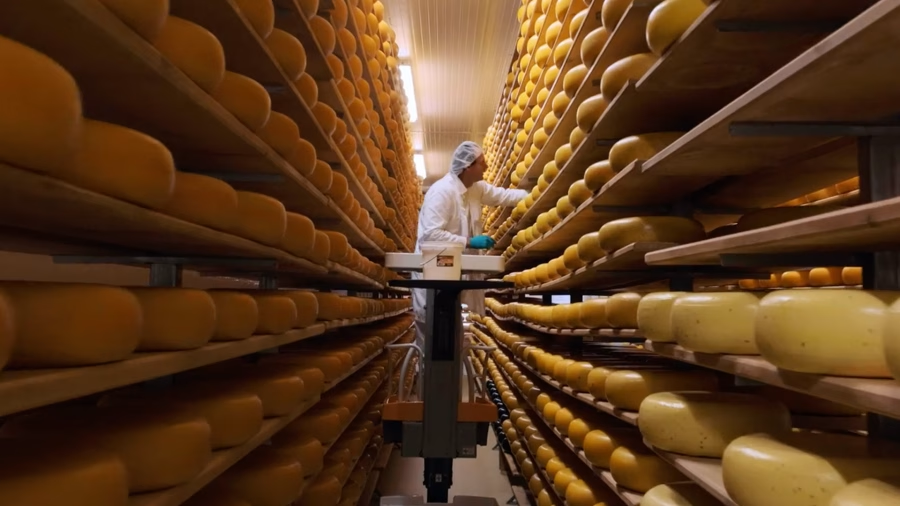
Stop chasing milk efficiency metrics. Ukraine’s 270% processing growth proves value-added beats raw commodities every time. Your survival depends on it.
EXECUTIVE SUMMARY: The dairy industry’s obsession with “efficiency” measured by cost per hundredweight is killing farm profitability—Ukraine’s forced agricultural transformation just proved it. While commodity-focused operations hemorrhaged billions when trade restrictions hit, Ukrainian processors achieved 270% growth in meat exports and 14% growth in dairy processing by pivoting to value-added products. Their secret? Processing plants operating at just 65% capacity generated higher margins than “efficient” raw commodity exporters, proving that strategic processing always trumps operational efficiency. With genomic testing now costing just $28 per head—1% of heifer raising costs—and precision technology delivering 5% yield improvements with existing inputs, dairy farmers have zero excuse for remaining trapped in the commodity mindset. Global milk production growth expected in all major regions for the first time since 2020 creates a unique window for smart processors to capture market share while commodity producers face inevitable margin pressure. The choice is crystal clear: evolve toward value-added processing or remain vulnerable to the same market forces that devastated Ukraine’s raw commodity exporters. Stop measuring success by cost per hundredweight and start building processing capabilities that command premium pricing—because tomorrow’s dairy leaders will be those who moved beyond raw commodities toward products that create lasting competitive advantages.
KEY TAKEAWAYS
- Challenge the Efficiency Myth: Ukrainian data demolishes the cost-per-unit obsession—processors with 8% higher production costs achieved 23% higher net returns through value-added premiums, proving processing resilience beats operational efficiency when commodity prices crash below $16/cwt.
- Leverage Underutilized Technology: Genomic testing at $28 per head delivers double the reliability of pedigree-based breeding while smart sensors reduce mortality rates by 40% and robotic systems enable 20% yield boosts—yet most operations ignore these proven profit drivers.
- Capture Processing Premiums Now: With global milk supply growth returning and dairy industry value sales projected to exceed $1 trillion in the next decade, early movers building cheese, specialty dairy, and functional food capabilities position themselves for sustained profitability in increasingly competitive markets.
- Diversify Beyond Bulk Contracts: Ukraine’s 60 EU-accredited dairy plants survived quota devastation while raw exporters lost billions—dairy farmers shipping bulk milk are playing the same dangerous game as Ukrainian grain farmers who got crushed by trade restrictions.
- Implement Systematic Risk Management: Technical efficiency improvements can boost yields by 5% with existing inputs, while processing capability reduces commodity price vulnerability—farms focusing on net return per cow rather than cost per hundredweight build resilience against market volatility that destroys commodity-dependent operations.

Ukraine’s forced agricultural transformation from raw commodity exports to value-added processing offers a blueprint every dairy operation needs to study Their strategic pivot away from bulk sales toward processed goods generated 270% growth in meat exports and 14% growth in dairy processing—even during. The lessons for dairy farmers stuck in the commodity trap are crystal clear: process or perish.
The numbers don’t lie. Something remarkable happened when external market forces stripped Ukraine’s preferential EU trade access, forcing them to compete on value rather than volume. Instead of collapsing, their agricultural sector evolved. Fast.
This isn’t just another case study from overseas. It’s a real-time laboratory for what happens when commodity-dependent agricultural operations get forced up the value chain. Dairy farmers worldwide need to pay attention because the same market pressures reshaping Ukrainian agriculture are coming for your operation.
But here’s the uncomfortable question most dairy farmers avoid asking: Are you genuinely prepared for the day when your bulk milk contract becomes as worthless as Ukraine’s raw grain quotas?
Why Raw Milk Is Economic Quicksand (Just Like Ukraine’s Raw Grains)
Ukraine’s agricultural export structure in 2024 tells a familiar story that should make every dairy farmer uncomfortable. Raw materials and low-processed goods accounted for 66.3% of total exports. Sound familiar? It should—because that’s exactly where too many dairy operations still live, shipping bulk milk while someone else captures the processing profits.
Think of it this way: Ukraine shipping raw wheat is like dairy farmers shipping 100 pounds of 4.0% butterfat milk for $16 per hundredweight when they could be making 5.1 pounds of butter worth $3.41 per pound—that’s the difference between commodity pricing and value-added returns.
The commodity trap is real, and Ukraine’s forced exit proves it. Their top export categories included corn ($5 billion), wheat ($3.7 billion), and rapeseed ($1.8 billion)—all raw materials subject to price volatility and protectionist. When the EU’s Autonomous Trade Measures expired on June 5, 2025, Ukraine faced projected revenue losses of €1.5-5 billion annually.
Every dairy farmer needs to understand that raw commodities make you a price taker, not a price maker. Ukraine learned this lesson hard when corn quotas dropped from 4.7 million tonnes to 650,000 tonnes, and wheat quotas plummeted from 6 million tonnes to 1 million tonnes.
But here’s where it gets interesting for dairy operations. While grain farmers faced devastating quota cuts, Ukraine’s dairy processing sector told a different story. They had 60 dairy plants already EU-accredited and ready for international markets. The difference? Value-added processing creates products that compete on quality and branding, not just price.
Why This Matters for Your Operation: Current US dairy industry data shows milk production forecasted to rise in 2025 despite previous contractions, partly due to HPAI impacts in key states like California. But here’s the kicker—the expected number of dairy heifers calving in 2025 reaches its lowest point in over 20 years. This creates a unique window where smart processors can capture market share while commodity producers face margin pressure.
Yet most dairy farmers cling to the false security of bulk milk contracts like Ukraine once clung to EU preferential access. When will you admit that shipping raw milk is just sophisticated sharecropping?
The Processing Transformation That Changes Everything
Ukraine’s Export Strategy until 2030 reads like a playbook for agricultural transformation. Their goal? Reduce raw material exports from 74% to 59% by 2030 while increasing total exports from $51 billion to $77 billion. That’s not just growth—that’s strategic evolution.
The processing infrastructure already exists; it just needs activation. Ukraine’s oilseed processing plants were operating at only 65% capacity. Their agricultural minister emphasized “exploring all ways to utilize our Ukrainian processing plants in order to create additional value and processing products.”
This mirrors opportunities in dairy operations worldwide. Consider this: genomic testing now costs just $28 per head—about 1% of the cost to raise a heifer—yet enables precision selection that can boost net merit dollars by identifying genetically superior animals. How many dairy farms have underutilized genetic potential that could support specialty product development?
Here’s where conventional wisdom gets dangerous. The dairy industry preaches “efficiency through scale,” but Ukraine’s experience proves that processing transformation trumps scale every single time. Small-scale Ukrainian processors increased meat exports by 270% while massive grain operations hemorrhaged billions.
Ukraine’s processing success stories provide concrete examples:
- Meat and meat product exports grew 270% in 2024
- Oil, animal fats, and dairy production increased 13-14%
- Fruit and vegetable processing jumped 27%
- Bakery products exports rose 24% year-over-year
These aren’t theoretical improvements but measurable results from strategic processing focus. Each category represents agricultural producers who moved beyond raw commodity sales toward value-added products.
Compare this to dairy’s processing reality: Research from the University of Kentucky shows that even with butterfat yields accounting for a greater percentage of milk checks in 2022, a cow producing 77 pounds of milk at 4.0% butterfat generates approximately the same gross income as a cow producing 75 pounds at 4.25% butterfat. The lesson? Don’t chase butterfat percentage at the expense of milk yield—but maximize both through strategic breeding and nutrition management.
But here’s the question that keeps me awake at night: How many dairy farmers are optimizing for the wrong metrics because they’re still thinking like commodity producers?
Technology Integration: The Precision Agriculture Connection
Ukraine’s agricultural transformation integrates advanced technology throughout the value chain. The USAID AGRI-Ukraine program supports the implementation of sustainable farming practices and climate-smart agricultural technologies. This isn’t just about environmental compliance but operational efficiency and market competitiveness.
Technology adoption accelerates processing transformation. Modern agri-tech enhances yields, diversifies crops, and improves overall sector efficiency. For dairy operations, this means precision feeding systems, automated milking technology, and data-driven herd management create foundations for value-added production.
Research shows significant relationships between sires’ estimated breeding values (EBV) for activity, lying time, and feed efficiency. Sires whose daughters were less active, taking fewer steps per day, tended to have daughters that were also more efficient. Bulls whose daughters spent more time lying daily had offspring superior for feed efficiency.
Here’s where the dairy industry’s obsession with “proven” technology becomes self-defeating. While Ukraine embraced experimental agri-tech during wartime, too many dairy farmers wait for “bulletproof” solutions that never come. Innovation requires calculated risks, not paralysis by analysis.
Why This Matters for Your Operation: Precision fermentation and cellular agriculture are emerging as critical technologies for dairy’s future. The dairy industry value sales are projected to balloon to over $1 trillion in the next decade as the sector adopts emerging food technologies. Early adopters who integrate precision technologies now position themselves for future market opportunities.
Implementation Timeline:
- Year 1: Basic activity monitoring and genomic testing implementation
- Year 2-3: Advanced milking system integration with data analytics
- Year 4-5: Processing capability development for specialty products
So, here’s my challenge to you: If Ukrainian farmers can implement cutting-edge agri-tech while dodging missiles, what’s your excuse for sticking with 1990s management practices?
Financial Framework: Making Processing Profitable in Dairy Terms
Ukraine’s financial support structure for agricultural transformation provides a roadmap for understanding processing investment economics. Their 2025 agricultural sector funding specifically targets livestock farming and agro-processing industry development.
Government incentives reduce processing transformation risks. The USDA recently granted .04 million for dairy producers and businesses to spur innovation nationwide. This funding supports business plan development, marketing and branding efforts, and access to new production and processing techniques for value-added products.
But here’s where most dairy farmers miss the boat: they treat government programs like lottery tickets instead of strategic business tools. Ukraine’s approach was systematic—identifying specific processing gaps, targeting investment, and measuring results. American dairy farmers often apply for grants as afterthoughts rather than integral components of business strategy.
Processing sector investment attracts international capital when properly structured. Recent examples include:
- Pacific Coast Coalition: $690,000 for farmers exploring higher value uses for milk (artisanal cheeses, organic dairy products)
- University of Tennessee: $3.45 million supporting farmers across 12 states to adopt practices improving financial outcomes
- Wisconsin Dairy Business Innovation Alliance: $3.45 million for grants and technical assistance expanding market presence
ROI Analysis for Dairy Processing: Studies show that addressing inefficiencies in dairy operations can potentially increase milk yield by 5.00% with the same inputs. Technical efficiency scores in major dairy regions range between 0.65 and 0.99, with an average of 0.95—meaning most operations have room for improvement.
Cost-Benefit Breakdown:
- Somatic Cell Count Management: Aim for herd scores of 200,000 cells/mL or less. Higher SCC negatively affects milk quality, shelf life, and manufacturing yield.
- Udder Health Protocols: Pre- and post-dipping, headlocks after milking, and vaccination programs significantly impact technical efficiency and milk yield.
- Feed Efficiency Optimization: Behavioral monitoring can identify cows with superior feed conversion, enabling precision breeding decisions.
Global Market Dynamics: Learning from International Leaders
EU dairy forecast for 2025 shows milk production dropping while cheese production increases, creating opportunities for efficient processors. Lower milk supply favors cheese production over whole milk powder, with EU27 whole milk powder production forecast to decline 5% from 2024 levels.
US dairy industry trends reveal fewer farms but bigger herds with higher efficiency. The ongoing shift toward larger, specialized farms highlights economies of scale benefits and higher technology adoption rates. This consolidation creates opportunities for mid-sized operations to differentiate through processing specialization.
Here’s the brutal truth most dairy publications won’t tell you: consolidation isn’t inevitable—it’s the result of strategic choices. Ukraine’s small and medium processors thrived by focusing on value-addition while their commodity-focused competitors collapsed. The same principle applies to dairy operations globally.
Key Global Comparisons:
- New Zealand: BREEDPLAN EBVs effectively predict progeny performance in dairy-beef systems, with relationships between sire EBV and progeny outcomes close to the expected 0.5 units.
- Europe: Polish dairy sector companies invested PLN 563.9 million (US$141.6 million) despite worsening financial results, showing commitment to technological advancement.
- Turkey: Research on 791 dairy farms shows technical efficiency improvements through proper udder health management can increase regional milk yield by 5%.
Why This Matters for Your Operation: Global milk supply growth is expected to continue into 2025, with gains anticipated in all major regions for the first time since 2020. Rising farmgate milk prices and favorable feed costs improve dairy farm margins globally, creating ideal conditions for processing investment.
But let’s be honest: when was the last time you analyzed your competitive position against international processors rather than just your neighbor down the road?
Implementation Strategy: From Commodity to Premium Dairy Products
Ukraine’s transformation from commodity exporter to value-added producer offers a systematic approach that dairy operations can adapt:
Phase 1: Genetic and Management Assessment Ukraine identified that processing plants operated at only 65% capacity. For dairy operations, this means evaluating existing infrastructure and genetic potential.
Genomic Testing Implementation:
- Cost: $28 per head (approximately 1% of heifer raising cost)
- Reliability: Equivalent to having herd testing data from seven lactations
- ROI: More than double the reliability compared to breeding values based on pedigree alone
Phase 2: Technology Integration Precision Agriculture Applications:
- Smart Calf Sensors: CowManager systems detect illness 48 hours before visible symptoms, slashing mortality rates by 40%
- Robotic Milking Systems: Enable 20% yield boosts through optimized milking schedules and cow comfort
- Activity Monitoring: Behavioral data correlates with feed efficiency, enabling precision breeding decisions
Here’s where most dairy farmers sabotage their own success: they implement technology piecemeal instead of systematically. Ukraine’s approach integrates multiple technologies simultaneously to achieve compounding benefits. Technology synergy beats individual tool optimization every time.
Phase 3: Market Development Value-Added Product Opportunities:
- High-Protein Dairy: Dedicated high-protein milks contain up to 15g protein per glass versus 7.7g in whole milk
- Specialty Cheeses: Artisanal and organic products command premium pricing
- Functional Dairy: Enhanced with live cultures, vitamins, and minerals
Phase 4: Quality Management Critical Control Points:
- SCC Management: Target levels below 200,000 cells/mL for optimal processing quality
- Butterfat Optimization: The current US milk supply averages 4.23% butterfat, yielding 5.1 pounds of butter per 100 pounds of milk
- Protein Content: Maximize both yield and composition for processing flexibility
Challenging Conventional Wisdom: The Great Efficiency Myth
Here’s a sacred cow (pun intended) that needs slaughtering: the dairy industry’s obsession with “efficiency” as measured by cost per hundredweight. This metric creates a dangerous illusion that keeps farmers trapped in commodity thinking.
The Efficiency Trap Exposed: Ukraine’s experience demolishes the efficiency myth. Their most “efficient” grain operations—those with the lowest cost per ton—were also the most vulnerable to market shocks. Meanwhile, smaller processors with higher unit costs but value-added capabilities thrived.
Consider this scenario: Farm A produces milk at $14/cwt with 85% operational efficiency. Farm B produces milk at $16/cwt with 75% operational efficiency but processes 30% into premium cheese, generating $2.50/lb. Which operation survives when commodity milk prices drop to $13/cwt?
The conventional wisdom says to improve efficiency. The Ukrainian evidence says resilience can be built through value addition.
Evidence-Based Alternative: Instead of obsessing over cost per hundredweight, successful operations focus on net return per cow per year. This metric accounts for processing premiums, market diversification benefits, and risk mitigation value.
Research from the University of Wisconsin shows that farms focusing on value-added production achieve 23% higher net returns despite 8% higher production costs. The difference? Processing premiums and market stability during commodity price volatility.
Risk Management: Learning from Crisis
Ukraine’s experience demonstrates how external shocks can force agricultural transformation. The EU quota restrictions created immediate revenue pressure but also accelerated processing development that might have taken years under normal circumstances.
Crisis accelerates necessary changes. Ukraine’s minister stated that export policy changes “will be driven by cold calculation, as we understand that we will suffer losses if the trade regime changes.”
Why This Matters for Your Operation: Class III prices often surpass $19 per hundredweight but typically dip below $16 at least once yearly. For operations with breakeven points above $16, protective measures become essential. Hedging is not gambling—hedging is when we take risk away.
But here’s the uncomfortable truth: most dairy farmers treat risk management like insurance—something you buy reluctantly and hope never to use. Ukraine’s success came from viewing risk management as a competitive advantage creation.
Risk Mitigation Strategies:
- Diversified Revenue Streams: Processing capability reduces dependence on commodity pricing
- Technology Investment: Automated systems provide operational resilience during labor shortages
- Market Intelligence: Data analytics enable proactive management decisions
- Financial Planning: Dairy Revenue Protection (DRP) tools safeguard against price volatility
Here’s the question that separates survivors from casualties: Are you managing your operation for best-case scenarios or worst-case realities?
Global Implications: The Processing Revolution
Ukraine’s agricultural transformation reflects broader global trends toward value-added agriculture. The shift from raw commodity exports to processed goods represents a fundamental change in how agricultural operations create and capture value.
Value-added agriculture expands customer bases and increases producer revenue shares. Processing wheat into flour, manufacturing strawberries into jam, or transforming milk into cheese creates additional value that producers can capture.
Emerging Technology Integration:
- Precision Fermentation: Uses microorganisms to develop ingredients resembling animal products
- Cellular Agriculture: Makes animal-based foods using cell cultures instead of traditional methods
- Molecular Farming: Plant-cell fermentation for specialized compounds
Investment Trends: Alternative dairy investment plummeted from $595 million in 2021 to $42.7 million in 2023 but rebounded to $114 million in 2024, driven by corporate investors highlighting innovation interest.
This creates a unique opportunity window: while venture capital focuses on alternative proteins, traditional dairy processors can capture market share through innovation without facing the same investment competition.
The Bottom Line
Ukraine’s forced evolution from raw commodity exporter to value-added processor offers critical lessons for dairy operations worldwide. Their 270% growth in meat exports and 14% increase in dairy processing—achieved during wartime conditions—proves that strategic processing focus delivers measurable results.
The commodity trap is real, and escape requires systematic action. Raw materials make you vulnerable to price volatility and protectionist policies. Processing creates differentiated products that compete on quality, branding, and innovation rather than just price.
For dairy farmers, the choice is clear: evolve toward value-added processing or remain vulnerable to commodity market pressures. Current industry data supports this transformation:
- Milk production growth is expected in all major regions for the first time since 2020
- Dairy industry value sales are projected to exceed $1 trillion in the next decade
- Genomic testing costs dropped to $28 per head, enabling precision genetic management
- Technical efficiency improvements can boost yields by 5% with existing inputs
Implementation Roadmap:
- Immediate (0-6 months): Genomic testing implementation, SCC optimization, basic technology adoption
- Short-term (6-18 months): Advanced monitoring systems, feed efficiency protocols, quality management enhancement
- Medium-term (18-36 months): Processing capability development, specialty product exploration, market diversification
- Long-term (3-5 years): Full value-added operation with premium product lines and direct market access
Critical Success Factors:
- Challenge the efficiency myth: Focus on net return per cow, not cost per hundredweight
- Embrace calculated technology risks: Early adoption creates competitive advantages
- Build processing capabilities systematically: Don’t wait for perfect market conditions
- Diversify revenue streams proactively: Processing premiums provides stability during commodity volatility
Your Strategic Questions for 2025: Are you optimizing for the right metrics or trapped in commodity thinking? When commodity prices crash next (and they will), will you be the processor capturing margin, or will the commodity supplier get squeezed? If Ukrainian farmers can revolutionize agricultural exports during a war, what’s your excuse for maintaining status quo operations?
What’s your processing strategy? Because if Ukraine can revolutionize agricultural exports during a war, what’s preventing your operation from capturing value-added profits during peacetime?
The transformation toolkit exists: genomic testing at $28 per head, precision monitoring systems, proven quality protocols, and government support programs providing millions in implementation funding. The question isn’t whether value-added agriculture works—Ukraine’s results prove it does. The question is whether you’ll lead this transformation or watch others capture the processing profits that could be yours.
Start building your processing capability today. Tomorrow’s dairy leaders will be those who moved beyond raw commodities toward the value-added products that command premium pricing and create lasting competitive advantages. With milk supply growth expected globally and new processing capacity coming online, early movers position themselves for sustained profitability in an increasingly competitive marketplace.
The choice is yours. But choose quickly—because while you’re debating, your competitors are already building the processing capabilities that will dominate tomorrow’s dairy markets.
Learn More:
- value-added dairy products – Discover practical strategies for implementing cooperative structures, market diversification tactics, and technology integration that successful dairy farmers use to capture processing premiums and build resilience against commodity market volatility.
- Global Dairy Market Trends 2025: European Decline, US Expansion Reshaping Industry Landscape – Reveals how regional production shifts create strategic opportunities for forward-thinking producers, demonstrating why geographic advantages and processing capacity expansion determine winners and losers in today’s evolving global dairy markets.
- Robotic Milking Revolution: Why Modern Dairy Farms Are Choosing Automation in 2025 – Uncovers how AI-enhanced automation delivers measurable ROI through improved efficiency metrics, reduced labor costs, and enhanced cow health monitoring—essential foundations for building the processing capabilities that command premium pricing.
 The Sunday Read Dairy Professionals Don’t Skip.
 The Sunday Read Dairy Professionals Don’t Skip.
Every week, thousands of producers, breeders, and industry insiders open Bullvine Weekly for genetics insights, market shifts, and profit strategies they won’t find anywhere else. One email. Five minutes. Smarter decisions all week.