



Archive for nitrogen management

The Irish Dairy Meltdown: What Every Farmer Needs to Know

1.5 billion wipeout looming — Ireland’s dairy crisis signals what’s coming for all of us

EXECUTIVE SUMMARY: The dairy world’s shifting under our feet, and we’ve got the inside story. Ireland’s facing a €1.5 billion hit with 22% herd cuts and 1.5 billion fewer litres — that’s not just Cork’s problem, that’s a preview of what environmental regulations can do to any of us. Here’s what really gets us fired up: while Irish farmers scramble, smart producers worldwide are positioning for the biggest market shuffle since quotas ended. Our research shows this stems from EU nitrates policy tightening and Ireland’s derogation ending December 2025 — but here’s the kicker, this creates massive opportunities if you’re ready to pivot. We’re seeing New Zealand ramp up capacity, Dutch processors expand, and US operations eyeing those 140+ export markets Ireland might lose. The future belongs to producers who adapt their nitrogen management, diversify markets, and treat environmental compliance as a competitive advantage. Don’t just survive this wave — ride it to profitability.

KEY TAKEAWAYS

  • Slash regulatory risk by 22% through proactive nitrogen management — Start mapping your current N usage against tightening limits now, before you’re forced into emergency herd cuts like Irish producers (Teagasc economic modeling shows this prevents €10,000+ annual income hits)
  • Capture €6.3 billion in shifting export opportunities — Engage with processors planning 2025-26 capacity expansions while Irish supply contracts; New Zealand’s already positioning with new plants (Dairy Reporter analysis confirms first-movers get premium contracts)
  • Turn environmental compliance into profit centers — Invest in precision grazing and fertilization tech that cuts nitrogen waste while boosting efficiency; 55% emissions targets by 2030 aren’t going away, so get ahead of the curve (EPA data shows compliant operations avoid penalty costs AND capture sustainable premiums)
  • Build market diversification before you need it — Ireland’s 94% export dependency made them vulnerable; don’t make the same mistake when regulations can change overnight (Bord Bia export data proves diversified operations weather policy shocks better)
  • Monitor spring production patterns like your income depends on it — Ireland’s seasonal flush system amplifies regulatory impacts; understand your own production cycles and processing capacity vulnerabilities before they bite you (AHDB seasonal analysis shows timing matters more than total volume)

I was chatting with a dairy farmer from Cork who runs about 180 cows. Smart as they come — knows his genetics, his feed, and all the quirks of grazing grass. But when I asked about the looming nitrates debacle, he dropped the hammer: “I’m out at least 40 cows if Brussels pulls the plug.”

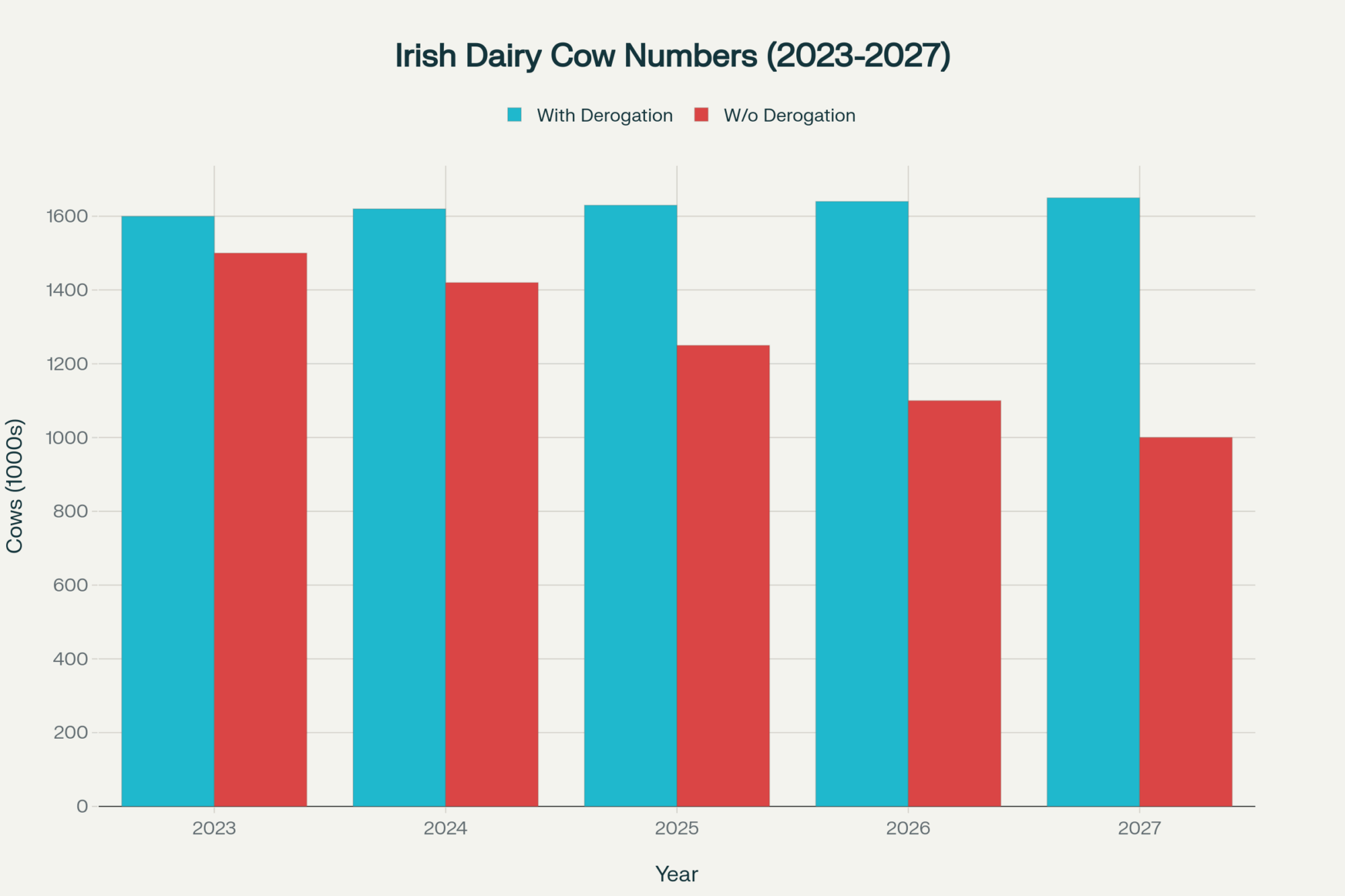
That’s the brutal reality creeping up on Irish dairy. They face a potential €1.5 billion hit (Bord Bia, 2024), with up to 22% fewer cows and a drop of around 1.5 billion liters in milk production (Teagasc, 2025). With Irish dairy shipped to over 140 countries, this will send shockwaves far beyond Ireland’s shores.
Some might shrug, but trust me, this is a big deal for all of us.

What’s this nitrates stuff all about?

Ireland’s had a bit more breathing room — farms can run up to 250 kg nitrogen per hectare, higher than the EU’s 170 kg limit (Department of Agriculture, 2025). That flexibility has powered their big leap since quotas ended.

But it’s changing fast. Some spots will drop to 220 kg this year, and the whole derogation ends at the close of 2025 (Irish Farmers Journal; Department of Agriculture, 2025).

In farming hubs like Cork and Kerry, many face serious cuts. For example, a farm with 180 cows on 90 hectares pulling 520,000 liters will likely need to reduce to around 140 cows just to stay legal.

The spring rush and the crunch
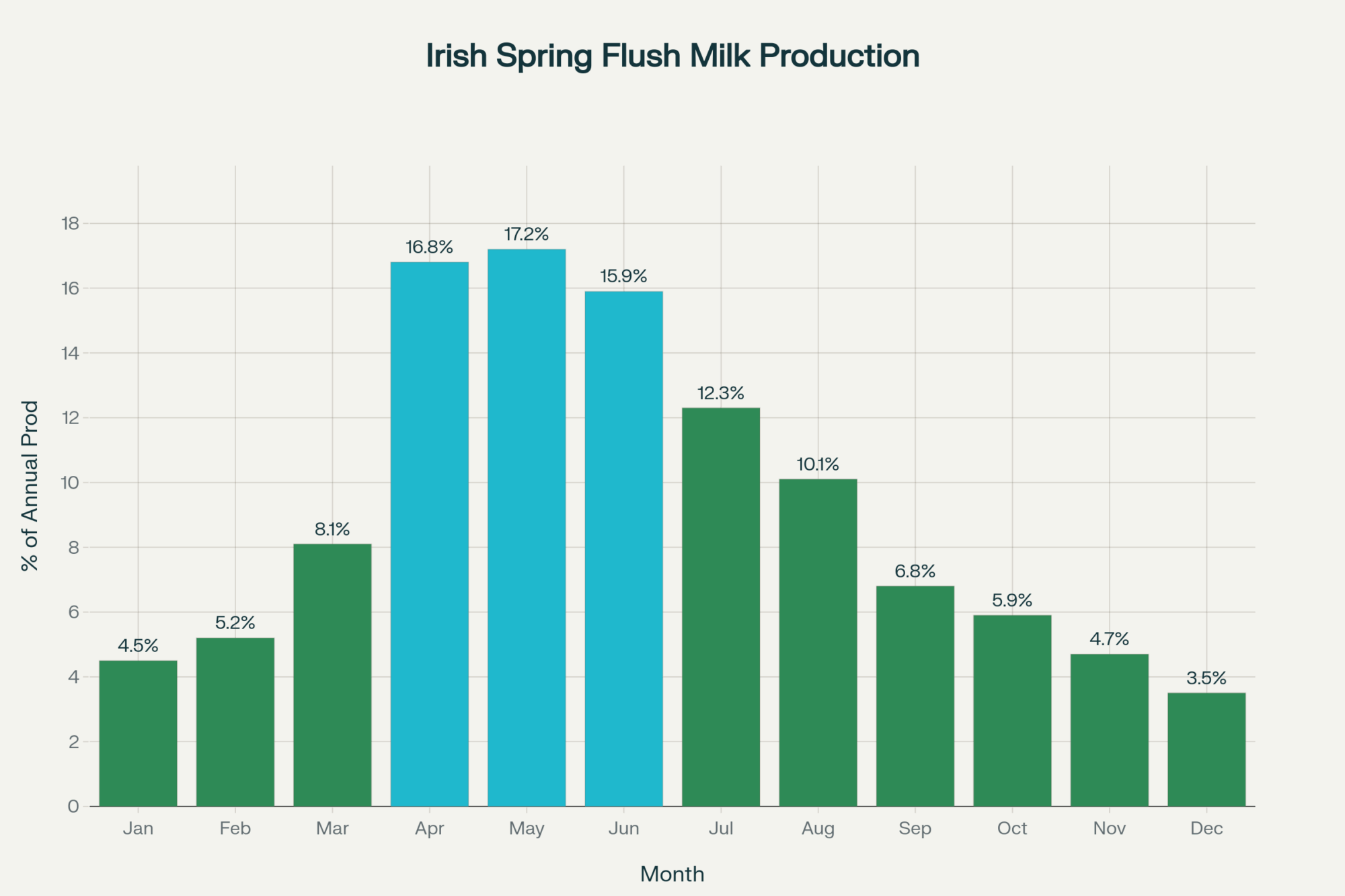
Milk’s far from steady — half the output floods in during April to June, the famous “spring flush” (AHDB, 2025). This seasonal surge is what makes Ireland’s grass-based system work, but it also creates massive vulnerability.

Processors like those in Mitchellstown and Charleville work around the clock during these months. Industry experts note serious concerns about potential processing capacity underutilization during production declines, though specific utilization rates remain confidential to individual processors.

Talked to a feed guy near Macroom, and he told me — when you lose 40 cows, there’s more than just fewer udders. Feed plans, labor demands, and cash flows all get tangled up.

A shifty game with hungry players

That €6.3 billion export haul stretches across 140 countries (Bord Bia Export Performance Report, 2024). When Irish flows shrink, others are ready to swoop.

New Zealand’s gearing up with new processing capacity ready by 2026 (Dairy Reporter, 2025). Dutch processors are edging forward, careful but ready to capitalize on Ireland’s regulatory chaos.

Markets like China and the US won’t flip overnight — brand loyalty runs deep — but cracks will open when supply gaps appear.

The green challenge

Irish waters? Not exactly pristine — about 30% of monitoring sites exceed nitrate limits (EPA Ireland, 2024). That’s Brussels’ leverage in this whole mess.

Then add the EU’s Green Deal vision for a 55% greenhouse gas reduction by 2030 (European Commission, 2024), and you see why the tightrope keeps getting thinner.

Ireland’s challenge is balancing milk production with environmental compliance — a dance every progressive dairy operation worldwide is learning.

The rare unity

In September 2024, six heavy-hitters — including IFA, ICOS, and Macra na Feirme — banded together in a joint declaration to protect the derogation (IFA, 2024).

With 17,500 farms and 55,000 jobs on the line, that’s serious muscle when Irish farm organizations usually can’t agree on the weather.

What’s your next move?

Whether you’re milking 30 or 300, in Wexford or Donegal — it’s time to hustle and prepare.

Some Irish farmers are already adapting: trimming herds strategically, adjusting calving patterns, or investing in tech to lower nitrogen outputs (Teagasc, 2025). Others are outsourcing youngstock rearing and tightening up feed efficiency.

Processors are crunching worst-case scenarios, especially for spring flush volume declines.

Across the Atlantic, US and Canadian firms watch keenly, ready to capture market share if Irish supply contracts (Dairy Reporter, 2025).

How to stay ahead

  • Don’t put all your eggs in one market or policy basket — diversify your risk
  • Overachieve on compliance; meeting minimums isn’t enough anymore
  • Invest in genetics and nutrition programs that maximize efficiency
  • Keep your ear to the ground — policy changes directly affect your bottom line

Ignore this advice at your peril.

The Bottom Line

Ireland’s dairy saga is more than a local crisis. It’s a wake-up call for dairy producers worldwide.

Markets are reshuffling fast. Capital moves even faster. Environmental regulations are becoming competitive differentiators rather than universal burdens.

The early birds will capture the opportunities this creates.

So get chatting — with your neighbors, your vet, your feed advisor. Position your operation for what’s coming.

The shift’s already here.

Complete references and supporting documentation are available upon request by contacting the editorial team at editor@thebullvine.com.

Learn More:

Join the Revolution!

Join over 30,000 successful dairy professionals who rely on Bullvine Weekly for their competitive edge. Delivered directly to your inbox each week, our exclusive industry insights help you make smarter decisions while saving precious hours every week. Never miss critical updates on milk production trends, breakthrough technologies, and profit-boosting strategies that top producers are already implementing. Subscribe now to transform your dairy operation’s efficiency and profitability—your future success is just one click away.

NewsSubscribe
First
Last
Consent

How Milk Infrared Spectroscopy Can Help Improve Nitrogen Utilization

Boost your dairy farm‘s efficiency with milk infrared spectroscopy. Discover how this technology enhances nitrogen utilization and minimizes environmental impact. Curious? Keep reading.

Summary: Are you struggling with nitrogen management on your dairy farm? You’re not alone. Excess nitrogen impacts the environment and your bottom line. Understanding how efficiently your cows use nitrogen can be a game-changer. This article explores using milk mid-infrared (MIR) spectroscopy to estimate cow-level nitrogen efficiency metrics. Insights from the research highlight MIR’s potential to predict nitrogen use traits, offer tailored feeding strategies, and inform breeding programs. MIR spectroscopy can enhance nitrogen management, reduce environmental impact, and improve financial outcomes. The remarkable potential of MIR technology is supported by findings, with cross-validation R2 values of 0.61, 0.74, and 0.58 for nitrogen intake, nitrogen use efficiency (NUE), and nitrogen balance (Nbal)—underscoring its practical benefits for sustainable dairy production.

  • Improved Nitrogen Management: MIR spectroscopy can help dairy farmers manage nitrogen more effectively.
  • Sustainability and Efficiency: MIR technology offers a sustainable approach to boost efficiency and reduce environmental impact.
  • Research-Backed Accuracy: Findings show vital predictive accuracy for nitrogen intake, NUE, and Nbal with R2 values of 0.61, 0.74, and 0.58, respectively.
  • Tailored Feeding Strategies: Utilizing MIR data can help develop feeding strategies tailored to the needs of individual cows.
  • Enhanced Breeding Programs: MIR-derived nitrogen efficiency metrics can inform breeding decisions, aiding in selecting more efficient cows.
  • Financial Benefits: Better nitrogen management can improve financial outcomes by reducing waste and improving farm productivity.
sustainable dairy production, global food security, environmental sustainability, excess nitrogen excretion, dairy cows, water pollution, greenhouse gas emissions, financial losses, nitrogen management, milk mid-infrared spectroscopy

In today’s world, sustainable dairy production is more than a slogan; it is a need. Public interest in food production fuels worldwide need for better sustainability indicators in dairy production systems. Excess nitrogen excretion from dairy cows pollutes water. It increases greenhouse gas emissions, resulting in substantial financial losses for dairy producers. Less than 25% of the nitrogen consumed by grazing dairy cows is utilized for biological purposes, with the remainder excreted. Even with limited feeding systems, efficiency levels seldom approach 30%. Modern methods such as milk mid-infrared spectroscopy improve nitrogen management, reduce environmental effects, and lower operating expenses.

The Fundamental Role of Nitrogen Utilization in Dairy Farming 

To comprehend the relevance of nitrogen use in dairy cows, one must first understand what it includes. Nitrogen utilization refers to how well cows convert the nitrogen in their food into essential biological processes and outputs, such as milk production. Optimizing this process is critical not just for increasing farm profitability but also for addressing environmental issues. Inefficient nitrogen usage causes excessive nitrogen excretion, which may contribute to water contamination and increase greenhouse gas emissions.

Typically, dairy cows consume a large quantity of nitrogen via their diet. However, they use less than 30% of it for development, milk, and other biological processes. In comparison, the remaining 70% or more is expelled into the environment. This excretion happens predominantly via urine and feces, and its high nitrogen concentration may have negative environmental consequences, such as nutrient runoff and increased greenhouse gas emissions.

Measuring nitrogen intake reliably is a considerable difficulty, particularly in grazing systems. In contrast to enclosed feeding operations, where diets can be accurately managed and monitored, grazing systems include cows consuming grasses and additional feed—accurately measuring the amount of nitrogen cows consume. At the same time, grazing is complicated due to variations in fodder type and monitoring individual consumption. Because of this intricacy, different approaches, such as mid-infrared milk spectroscopy, are used to measure nitrogen efficiency indirectly.

Ever Wondered How to Estimate Your Cows’ Nitrogen Usage Efficiently? 

Have you ever wondered how to evaluate your cows’ nitrogen consumption more accurately without using expensive and labor-intensive methods? Enter milk mid-infrared (MIR) spectroscopy is a cutting-edge technology gaining popularity in the dairy sector for calculating nitrogen efficiency parameters.

Simply speaking, MIR spectroscopy entails transmitting infrared light through milk samples. Milk absorbs light at different wavelengths, and the resultant spectra provide information about its composition. Consider it a fingerprint for each milk sample, revealing specific chemical composition information, including nitrogen-related properties.

Why should you consider using MIR spectroscopy for regular monitoring on your farm? First, it is easy and fast to supply data, allowing prompt decision-making. Instead of analyzing daily feed intake and nitrogen production, a fast milk test may provide an accurate picture of nitrogen intake, nitrogen usage efficiency (NUE), and nitrogen balance. This translates to more efficient breeding, personalized feeding tactics, and a more sustainable enterprise. Imagine knowing exactly which cows are the greatest at nitrogen efficiency and being able to propagate this beneficial feature into future generations.

Case Study: Research Findings on Milk Infrared Spectroscopy 

Researchers used 3,497 test-day data to explore the ability of milk mid-infrared (MIR) spectroscopy to predict nitrogen efficiency features in dairy cows. The critical measures investigated were nitrogen intake, nitrogen utilization efficiency (NUE), and nitrogen balance (Nbal). Data from four farms over 11 years was analyzed using neural networks (NN) and partial least squares regression (PLSR). The results showed that neural networks predicted nitrogen intake, NUE, and Nbal the most accurately, especially when morning and evening milk spectra were combined with milk production, parity, and days in milk (DIM).

Accuracy of Predictions Using Neural Networks and Partial Least Squares Regression 

Neural networks surpassed partial least squares regression for most nitrogen-related variables, with cross-validation R2 values of 0.61, 0.74, and 0.58 for nitrogen intake, NUE, and Nbal. In contrast, PLSR produced lower prediction accuracies, particularly when validation was stratified by herd or year. While NN performed well in cross-validation circumstances, it had lower accuracy in form validation. This emphasizes the relevance of variability and data representation in calibration and validation datasets.

Practical Implications for Dairy Farmers

The results indicate that MIR spectroscopy, especially when paired with NN, is a potential approach for forecasting nitrogen efficiency measures on a wide scale. This entails frequently monitoring and controlling nitrogen consumption for dairy producers to improve economic efficiency and environmental sustainability. Farmers may utilize these findings to adapt feeding practices and make educated breeding choices, resulting in increased nitrogen usage efficiency, reduced nitrogen excretion, and related negative environmental implications.

Taking the First Steps Toward Implementing MIR on Your Dairy Farm 

Implementing milk infrared spectroscopy (MIR) on your dairy farm may seem complicated. Still, it is doable with a few innovative steps. Begin by cooperating with a lab that provides MIR analysis services. These facilities employ modern spectrometers to examine milk samples and provide thorough data on nitrogen use and other variables. Many milk recording organizations work with such laboratories, making the connection relatively straightforward.

The potential cost reductions are significant. By adequately calculating each cow’s nitrogen intake and efficiency, you may alter feed regimens to maximize nutrient absorption. This tailored feeding eliminates the waste of costly feed additives, saving thousands of dollars annually.

Furthermore, increasing nitrogen use efficiency will contribute to a healthier ecosystem. Reduced nitrogen excretion reduces runoff into nearby rivers, reducing the likelihood of eutrophication and toxic algal blooms. This benefits local ecosystems, improves community relations, and assures adherence to environmental standards.

For smooth integration into existing farm management practices, consider the following tips: 

  • Start Small: Begin with a trial project, employing MIR on a sample of your herd to collect early data and alter management tactics as needed.
  • Train Your Team: Ensure your employees understand how to collect and handle milk samples appropriately. Consider the training sessions offered by your MIR lab partner.
  • Analyze and Adapt: MIR analysis findings should regularly be compared with production results. Use this information to make sound judgments regarding feeding and other management methods.
  • Continuous Monitoring: Include MIR in your usual milk recording. This will allow you to monitor your progress and make appropriate modifications.

Following these procedures improves your farm’s efficiency and profitability and positively impacts the environment. MIR technology can significantly improve your farm’s sustainability and operating efficiency.

The Bottom Line

Improving nitrogen usage in dairy production is more than just a technical requirement; it represents a commitment to environmental stewardship and economic efficiency. Monitoring and optimizing nitrogen usage may significantly decrease pollution and improve the sustainability of your farming operations.

Using milk infrared spectroscopy (MIR) is a promising technique. MIR provides excellent information about individual cow nitrogen efficiency, leading to improved farm management and a favorable environmental effect.

So, while you evaluate these insights and ideas, think about how you might help the dairy business become more sustainable. Your decisions now will affect the future of farming for centuries.

Learn more:

Send this to a friend




