



Archive for methane reduction dairy

This Red Seaweed Could Bank You $200+ Per Cow – But Are You Ready to Dive In?

90% methane cut, 14% less feed, same milk yield? This seaweed study changes everything we thought we knew.

EXECUTIVE SUMMARY: Look, I’ve been tracking this UC Davis research for months, and it’s a game-changer. These researchers proved you can slash methane emissions by 90% without killing milk production – actually, cows eat 14% less feed and maintain the same weight gain. Producers in Wisconsin and Michigan are already seeing $ 250 or more per cow annually from carbon credits, plus feed savings. The FDA approval’s coming in 2026, which means now’s the time to start planning your integration strategy. Global markets are demanding sustainability credentials, and this is no longer just about being green – it’s about staying profitable. If you’re not preparing for this shift, you’re gonna get left behind.

KEY TAKEAWAYS:

  • Cut methane 80-90% with solid ROI: UC Davis 147-day trial shows massive emission reductions earning up to $80/cow/year in carbon credits – start discussing seaweed integration with your nutritionist now.
  • Feed efficiency boost saves real money: 14% reduction in dry matter intake means serious cost savings; precise dosing at 0.5-1% of DMI is critical – work with your feed rep to nail the protocol.
  • Watch your margins closely: Supplement costs range from $0.75 to $1.50/cow/day, so crunch those numbers against current feed prices and carbon credit rates before making a decision.
  • Plan for market volatility: Carbon credits below $20/ton and feed price spikes can squeeze profits – consider hedging strategies on both feed costs and carbon contracts.
  • First-mover advantage is real: UW’s Brian Gould says early adopters will capture premium market positioning as regulations tighten – don’t wait until everyone else figures this out.

You know what’s got everyone buzzing at dairy conferences lately? It’s not another robotic milker or the latest genomics breakthrough… it’s seaweed. Yeah, seaweed. Specifically, this red marine algae, Asparagopsis taxiformis, is slashing methane emissions by up to 90% while actually helping cows maintain their production. The early adopters? They’re banking potential gains north of $200 per cow annually.

Quick heads-up for U.S. producers: While this technology is already commercially available in some countries, the FDA has not yet approved Asparagopsis-based feed additives in the U.S. A final decision is expected by mid-2026.

The Breakthrough That Changed Everything

The game-changer came from Dr. Ermias Kebreab’s team at UC Davis. Their comprehensive 147-day trial showed consistent methane reductions of 80-90% when cattle were supplemented with Asparagopsis. But here’s what really grabbed producers’ attention: those same cows maintained identical weight gains while consuming 14% less feed.

I’ve been chatting with producers across the Midwest – places like Wisconsin and Michigan, where feed costs continue to climb and weather patterns are becoming increasingly unpredictable. One 1,200-cow operation that’s been part of university-monitored trials put it straight: “The combined value from carbon credits, feed savings, and potential premium pricing for low-methane milk creates a compelling business case.”
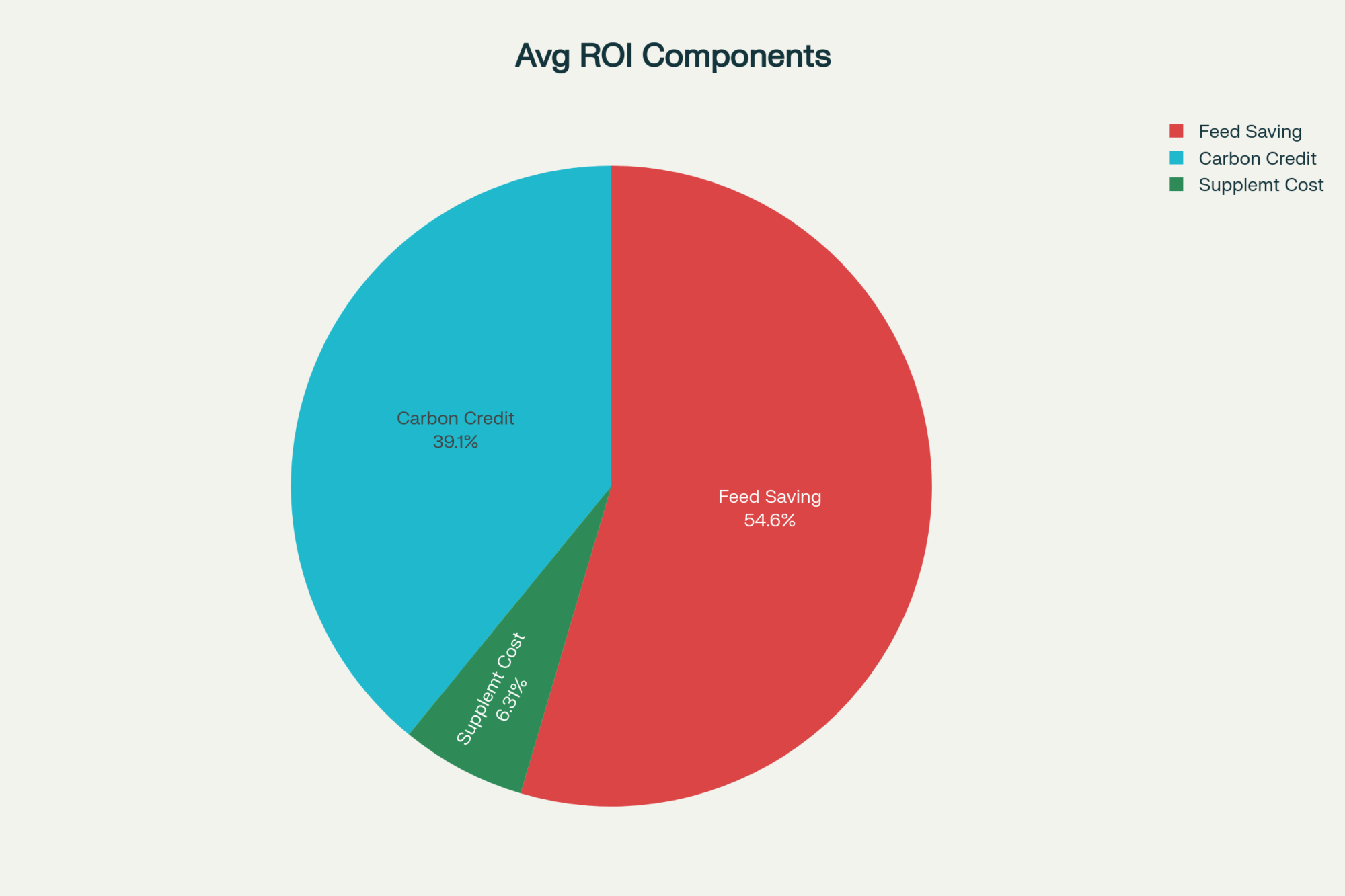
Proportional Financial Contributions of Carbon Credits, Feed Savings, and Supplement Costs

Commercial Reality: Supply Chains Actually Coming Online

Here’s where things get interesting. CH4 Global’s EcoPark facility in South Australia began production in January 2024 – not this year, as some reports suggest – with a capacity to serve 45,000 cattle daily. According to the company, their pond-based cultivation system cuts production costs by up to 90% compared to traditional methods.

Meanwhile, Fonterra has been quietly scaling up trials, dosing herds of up to 900 cows with no reported issues regarding milk quality. When a cooperative that size commits to expansion, you know the economics are making sense.

For U.S. producers, Symbrosia submitted its Environmental Impact Assessment to the FDA earlier this year, with approval expected by mid-2026.

Breaking Down the Economics (Including the Real Costs)
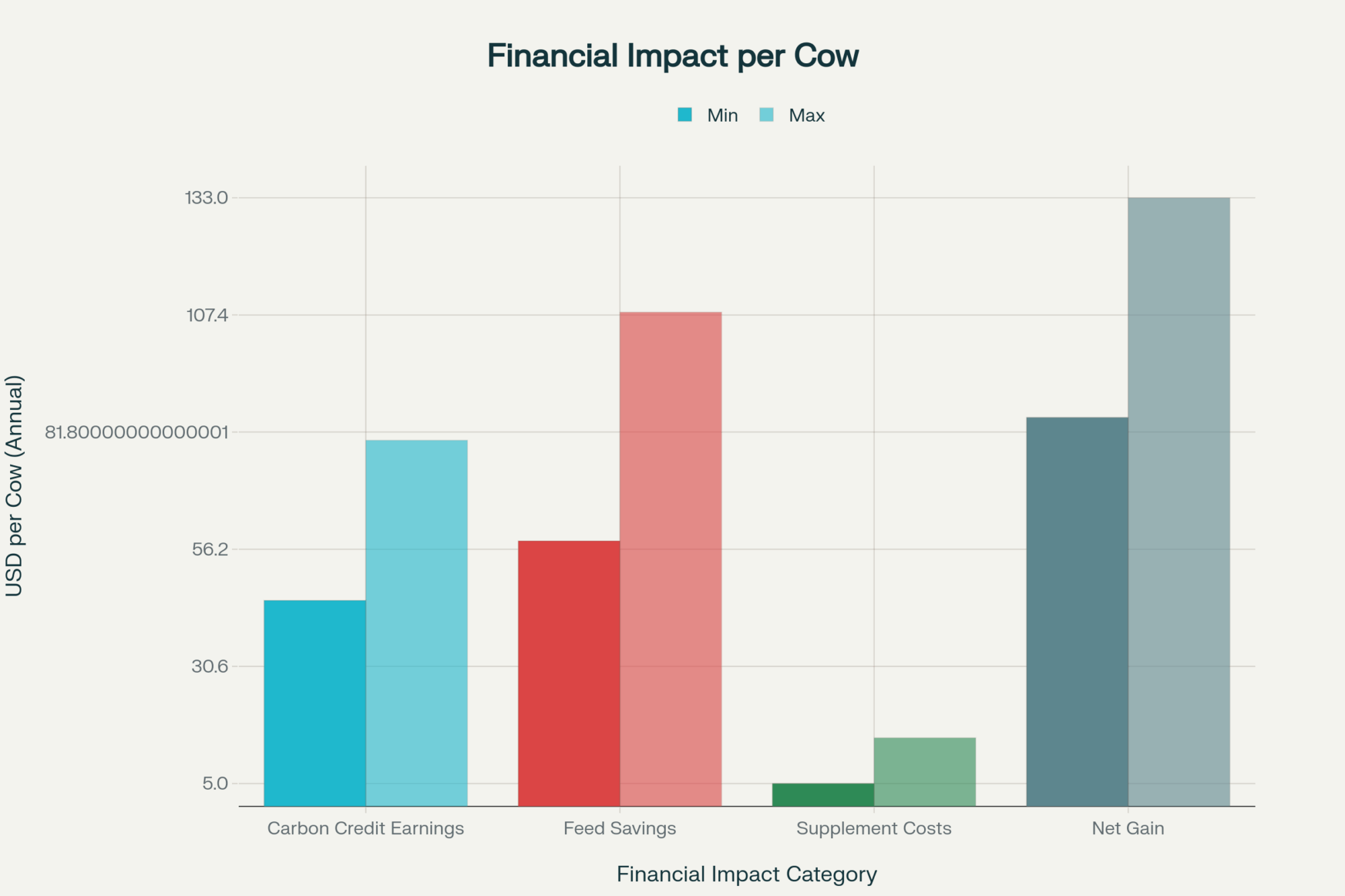
Estimated Annual Financial Impacts per Cow from Using Asparagopsis Supplement

Let’s talk real numbers – and this time, we’re including the supplement costs that everyone seems to forget. For a 600-cow dairy, here’s what the complete financial picture looks like:

Complete Financial Reality Check:

  • Carbon credits: $27,000-$48,000 annually ($45-$80 per cow)
  • Feed efficiency savings: $35,000-$65,000 annually ($58-$108 per cow)
  • Supplement costs: $11,000-$33,000 annually ($18-$55 per cow)*
  • Net financial gain: $51,000-$80,000 annually ($85-$133 per cow)

*Based on projected commercial-scale pricing of $0.05-$0.15 per cow per day

University of Wisconsin-Madison’s Brian Gould told me: “Producers implementing these technologies early will likely capture premium market advantages as regulatory frameworks solidify.”

Herd SizeAnnual Carbon CreditsFeed SavingsNet Benefit
100 cows$4,500-8,000$5,800-10,800$8,500-14,000
300 cows$13,500-24,000$17,400-32,400$25,500-42,000
600 cows$27,000-48,000$35,000-65,000$51,000-80,000
1000 cows$45,000-80,000$58,000-108,000$85,000-133,000

What’s fascinating about the biochemistry is that bromoform blocks methane production by inhibiting those methanogenic archaea, redirecting hydrogen toward propionate synthesis. You’re literally converting waste gas into usable energy for the cow.

Implementation: Simpler Than You’d Think, But Precision Matters

Most commercial operations are dosing at 0.5-1% of dry matter intake, mixing the powder or oil directly into TMR. But here’s the thing – precision is absolutely critical. Research indicates that dosing variability exceeding 15% significantly reduces effectiveness.

For grazing operations, they’re experimenting with water-soluble formulations and slow-release boluses, but these delivery methods are still being refined.

The Risks Nobody Talks About (But You Need to Know)

Studies indicate that overdosing – generally above 1.5% of dry matter intake – can reduce dry matter intake by up to 7%, potentially wiping out your production gains. Plus, batch-to-batch variability in bromoform content means quality control becomes non-negotiable.

Here’s what could actually hurt you:

  • Carbon credit prices below $20/ton compress margins by 40-60%
  • Feed cost spikes of 15% can eliminate profitability entirely
  • Quality control failures with >20% bromoform variation kill effectiveness
  • Storage humidity above 60% degrades active compounds
  • Supplement costs exceeding $0.20/cow/day erode economic benefits significantly

What strikes me is how few operations are planning for these scenarios. The smart producers I speak with are diversifying carbon credit contracts, maintaining 90-day feed cost hedging positions, and implementing dual sourcing for seaweed suppliers.

The Strategic Play: Early Movers vs. Wait-and-See

Here’s what’s really interesting – this isn’t just about emissions anymore. It’s becoming a market access requirement. Retailers and processors are demanding verifiable sustainability credentials. Having these systems in place isn’t just environmentally responsible; it’s becoming competitively necessary.

For a 500-cow operation, the combined potential from carbon credits and feed savings (minus supplement costs) could still deliver solid five-figure annual returns. But timing matters. Move too early and you pay premium prices; wait too long and you lose competitive positioning.

The Bottom Line

What strikes me about this development is that we finally have a technology that addresses dairy’s biggest challenge – remaining profitable while meeting environmental requirements. Even after accounting for supplement costs, we’re looking at genuine economic benefits that make business sense.

The takeaway isn’t to rush out and pre-order something that hasn’t been approved yet. The smart play is to start due diligence now: model the economics for your specific operation, discuss TMR integration with your nutritionist, and initiate conversations about carbon market verification.

Those who do their homework today will be well-positioned to act decisively when regulatory approval is received.

Key Financial and Operational Summary:

MetricValueSource
Methane Reduction80-90%UC Davis Study
Feed Efficiency Improvement14% reduction in feed intakeUC Davis Study
Carbon Credit Earnings (per 600 cows)$27,000 – $48,000 annuallyCurrent market estimates
Feed Cost Savings (per 600 cows)$35,000 – $65,000 annuallyCurrent feed cost projections
Supplement Costs (per 600 cows)$11,000 – $33,000 annuallyIndustry projections
Net Financial Gain (per 600 cows)$51,000 – $80,000 annuallyAfter all costs
Dosing Rate0.5% – 1% of dry matter intakeIndustry practice
CH4 EcoPark Capacity45,000 cattle per dayCH4 Global
FDA Approval TimelineExpected mid-2026Industry sources

The ocean just became your next feed supplier. Will you be ready to dive in when the opportunity arises, or will you be watching from shore while others capture the early mover advantages in sustainable dairy production?

Complete references and supporting documentation are available upon request by contacting the editorial team at editor@thebullvine.com.

Learn More:

Join the Revolution!

Join over 30,000 successful dairy professionals who rely on Bullvine Weekly for their competitive edge. Delivered directly to your inbox each week, our exclusive industry insights help you make smarter decisions while saving precious hours every week. Never miss critical updates on milk production trends, breakthrough technologies, and profit-boosting strategies that top producers are already implementing. Subscribe now to transform your dairy operation’s efficiency and profitability—your future success is just one click away.

NewsSubscribe
First
Last
Consent

Is 3-NOP Worth the Hype? Real-World Methane Cuts in Your TMR – But the Answers Are Complicated

Only 3% of U.S. dairy herds are capturing an extra $50,000 a year in premiums—just by tweaking feed for better methane cuts and milk yield.

EXECUTIVE SUMMARY: Look, here’s the thing—dairy nutrition isn’t what it used to be. This new study out of Canada and Europe just blew the lid off a lot of what we thought was settled science. Add 3-NOP to your TMR and you can chop methane by up to 60% if you’re running a classic high-grain ration—compared to about 23% on high-forage. If you’re numbers-driven, think like this: a drop that size could swing your bottom line by $40,000–$65,000 a year in carbon premiums alone, especially as processors scramble for lower GHG numbers. Sure, feed costs are high, but so are the opportunities—milk yield held steady and the right bugs in the rumen actually pushed component efficiency higher. European herds? They’re banking new export contracts thanks to their methane score. With these shifts in global demand and processors rewarding verified results, you’d be nuts not to at least run the numbers on your own cows this season.

KEY TAKEAWAYS:

  • 60% Methane Cut = More Cash in High-Grain Herds
    • If you feed a TMR with 60:40 grain:forage, you could drop methane output by over half. That translates to $0.20/cwt or more in new premium income on U.S. milk checks—as seen in recent Journal of Dairy Science research.
    • Action: Check your NDF/starch balance and look into adding 3-NOP with your nutritionist. It pays most with your homegrown corn silage, not just dry hay.
  • Stable Milk Yield—But Watch Your Component Testing
    • Trials showed no drop in milk volume, but some cows saw better butyrate or propionate numbers (thanks to friendly bugs like Lachnospiraceae NK3A20).
    • Action: Add routine VFA and milk component tests to your DHIA run—track ROI from new additives beyond just yield.
  • Not All Diets Are Equal: Forage vs. Starch Matters
    • University and USDA data say: for every extra 10g/kg NDF, 3-NOP’s methane knockdown is trimmed by 1.5%. In English? High-fiber, pasture-style herds get less bang for their buck.
    • Action: Ration balancing isn’t one-size-fits-all. If you graze or push baleage, adjust your 2025 feed plan before counting on big carbon credits.
  • Genomics—Pair with Your Feeding Program, Not Against It
    • The best response comes from cows already scoring high on feed efficiency and health and with balanced rations. Don’t just chase methane: connect genomic data to your TMR design for maximum returns.
  • Global Trend: Carbon = Cash, But Proof Matters
    • Whether you ship local or overseas, global milk buyers care about your methane numbers now more than ever. Processors want verifiable, science-backed reductions.
    • Action: Ask your co-op what’s required for carbon premium eligibility and document dietary changes—market volatility is your friend if you’re prepared.

Alright, let’s start here: Have you noticed how folks are buzzing about these “carbon incentive” premiums lately? Suddenly, every big processor from Michigan to Wisconsin wants a lower-methane label (even if last year’s butterfat price was the only number that mattered). “Methane mitigation” has evolved from a niche area of science to a strategic business consideration. Now, with 3-NOP actually making its way into more bulk tanks, everyone’s asking: Does it really move the needle—on emissions, performance, and the all-important milk check?

The Thing About 3-NOP and Those Big Promises

Here’s why producers on both 1,000-cow sand-bedded freestalls and old tie-stall barns are talking: Research out of Canada and Europe (as shown in the recent Choi et al., 2025 study in JDS) says you can cut methane by up to 60% on high-grain rations by adding 3-NOP to the TMR. On high-forage diets? The drop’s less dramatic, more like 23–37%.

But—and it’s a real ‘but’—”up to” are the operative words. What strikes me about this isn’t just the science. It’s that the how and what else matter just as much—the type of TMR, forage quality, and the way your cows respond.

What’s Really Happening in the Rumen?

There’s always some new additive promising the world, right? The unique thing about 3-NOP is that scientists have actually mapped out what’s changing under the hood. In simple terms, It blocks a key step in methane formation. But once you go past the headlines, the story gets messier (like when you try to price haylage and DDGs in the same week). According to that Canadian study, when 3-NOP was fed alongside a high-grain, 60:40 TMR (think: lots of corn, not just grass), methane dropped by 60%—numbers no one’s scoffing at during a carbon audit.

But what’s interesting is what’s getting nudged around microbially. The bugs in the rumen don’t just disappear. The Lachnospiraceae NK3A20 group, one of those names nutritionists quietly obsess over, actually increases regardless of whether you’re on a forage or grain-heavy TMR. Under high-forage, these bugs start making more butyrate (good for rumen health), but on high-grain, you get a bump in propionate pathways—likely helping energy balance for mid- and late-lactation cows.

And another thing—certain archaea (like Methanosphaera sp.) step forward when their methane-producing cousins get benched. Some of us remember when we thought killing “all methane bugs” was the goal; turns out, the rumen’s politics are trickier.

Translating Science to Real Farms: Dollars, Rations, and Cautious Optimism

I’ve talked to guys in the Thumb and Northern New York, and—real talk—nobody’s jumping at $0.20/cwt methane incentives unless feed conversion, components, or herd health are untouched. Here’s the thing, though: On Western-style herds running dry-lot TMRs loaded with starch, the numbers are starting to work, especially now that some co-ops are kicking in stacked premiums (tracked to actual DMI and manure methane).

But pull up to a Northeast grazing herd, and whether you’ll see more than a polite thank you is, well, anyone’s guess. Why? Because the NDF in pasture or baleage dilutes the effectiveness of 3-NOP. According to recent work from Dijkstra’s group, a 10g/kg DM increase in NDF reduces 3-NOP’s effectiveness by approximately 1.5%. So if you’re heavy on corn silage or buying in third-cutting alfalfa, you’ll see far better returns than the guy milking off rye grass.

Don’t forget: Weather swings, feed price spikes, and even water quality are local factors muddling this tidy “additive = profit” equation. The evidence points to more than just one answer, and even the top cows on paper don’t always perform like the trial herds.

What Nutritionists and Managers Are Actually Doing

I was talking to a consulting nutritionist out of Central Pennsylvania—the kind who remembers protein balancers made with fishmeal—and she summed it up: “It’s not just about cut-and-paste research. Milk yield, SCC, and butterfat trends still call the shots.”

Currently, some herds are conducting mini-trials independently—tracking group fresher intakes, VFA shifts, and even manure consistency alongside newly introduced 3-NOP. A few teams are plugging 3-NOP into their TMR software and then taking a “wait and see” stance on the incentive premium math. For others, carbon reduction is a happy accident—if it fits within a ration built for cows, climate, and cash flow.

Here’s what’s especially fascinating: The newest research suggests these microbial shifts aren’t just a science-fair curiosity. They might explain why some barns see stronger responses, especially when managing ration fermentability and transition cow stress.

I’m curious… What are you seeing as you plug 3-NOP into your own herd’s numbers? Is it showing up in your component testing, DHIA sheets, or just as a new line item in feed costs?

Bottom line from the parlor to the conference table

3-NOP is real, but its ROI is local. Herds with precise ration balancing, consistent TMR, and healthy fresh cows may see those big methane drops (and grab the new premiums). Operations tied more to high-fiber forages? Don’t put away the skepticism—but watch this space.

This development is fascinating, and I’d bet we haven’t seen the last twist in the methane story yet.

Main scientific findings drawn from Choi et al., Journal of Dairy Science (2025), (Differential Rumen Microbial Response to 3-Nitrooxypropanol in High-Grain vs High-Forage Systems) and corroborating peer-reviewed research.

Learn More:

  • Is Your TMR Mixer Costing You More Than You Think? – This tactical guide reveals how to audit your mixing process for consistency. It provides actionable methods to ensure expensive additives like 3-NOP are distributed evenly, maximizing their effectiveness and protecting your return on investment at the feed bunk.
  • The Surprising Economics of Sustainable Dairying – Go beyond the hype and analyze the real-world financials of green initiatives. This strategic article breaks down how to leverage sustainability efforts for market access and higher premiums, providing a framework for making new technologies pencil out in your operation.
  • Dairy Farming in 2050: What Will Your Farm Look Like? – This forward-looking piece explores the integration of sensor technology, automation, and data in future dairy systems. It provides context for how methane inhibitors fit into a larger ecosystem of precision tools that will define the next generation of profitable dairying.

Join the Revolution!

Join over 30,000 successful dairy professionals who rely on Bullvine Weekly for their competitive edge. Delivered directly to your inbox each week, our exclusive industry insights help you make smarter decisions while saving precious hours every week. Never miss critical updates on milk production trends, breakthrough technologies, and profit-boosting strategies that top producers are already implementing. Subscribe now to transform your dairy operation’s efficiency and profitability—your future success is just one click away.

NewsSubscribe
First
Last
Consent

The Carbon Credit Programs Every Dairy Should Join Before 2026

While you track milk prices, smart dairies bank $400+ per cow from carbon credits. Here’s the enrollment window closing fast.

Here’s a statistic that should wake up every dairy operator: anaerobic digestion systems are generating up to $450 per cow annually in carbon revenue, with documented cases showing realistic annual revenue figures in the range of $400 to $450 per cow for high-value projects producing Renewable Natural Gas (RNG). That’s equivalent to $1.50 per hundredweight in additional income, and it’s happening right now while most producers focus solely on traditional revenue streams.

The problem? Most dairy operations are missing this opportunity because they assume carbon credits are too complex, too risky, or “not for farms like theirs.” The bigger problem? With carbon credit markets experiencing a documented “flight to quality” favoring permanent, verifiable reductions over questionable soil claims, early adopters are locking in the most favorable terms before capacity limits are reached.

Here’s what the industry doesn’t want you to know: Three legitimate programs are currently accepting new enrollments, government funding covers up to 85% of implementation costs through programs like OFCAF, and documented case studies prove this isn’t theoretical—it’s transforming dairy economics across North America.

Challenging the “Environmental Compliance as Cost Burden” Myth

Let’s confront one of the dairy industry’s most expensive misconceptions: that environmental initiatives are purely cost centers that drain profitability without generating returns. This conventional wisdom isn’t just wrong—it’s costing you six figures annually.

The Evidence Against Conventional Thinking:

The comprehensive analysis reveals that capital-intensive methane abatement technologies, particularly anaerobic digesters producing RNG, represent a high-reward pathway with documented earnings reaching $400-$450 per cow annually, driven by high-value compliance markets like California’s Low Carbon Fuel Standard. One documented case study of a large 5,500-cow Western U.S. dairy reported generating $1.4 million in annual carbon credit revenue after expenses, equating to roughly $255 per cow—revenue that exceeded the farm’s profit from milk production in a good year.

Why the Old Mindset Persists:

The dairy industry’s resistance stems from decades of viewing environmental programs through a regulatory compliance lens. But here’s where conventional wisdom fails catastrophically: carbon markets represent a fundamental shift from regulatory compliance to market-based incentives. Instead of paying penalties for emissions, farms now get paid for reductions.

The New Reality Creating Millionaires:

Research shows that feed additive programs alone have generated substantial returns. Across three carbon projects initiated in 2021 and 2022, U.S. dairy farmers using the feed additive Agolin Ruminant received nearly $3 million in carbon-asset payments. The profitability hinges on carbon credit prices being high enough to offset the daily cost of the additive, estimated at $0.15 to $0.30 per cow per day.

The Three-Tier Carbon Revenue Strategy (Verified by Real Farm Data)

Technology/PracticeFarm Size (Cows)Capital Cost RangeAnnual Revenue per Cow (Low)Annual Revenue per Cow (High)Implementation TimelineGovernment Support Available
Anaerobic Digester + RNG (Large)2,500+$5M – $10M+40045018-36 monthsYes (ACT, OFCAF)
Anaerobic Digester + RNG (Medium)1,000-2,500$2M – $5M25035012-24 monthsYes (ACT, OFCAF)
Feed Additive (Bovaer)300-1,000Minimal3516030 daysNo
Feed Additive (Agolin)300-1,000Minimal3510030 daysNo
Cover Cropping<300Low2101 seasonYes (OFCAF)
No-Till Farming<300Low281 seasonYes (OFCAF)
Rotational Grazing100-500Low-Medium5256 monthsYes (OFCAF)
Manure Management500+Medium15406-12 monthsYes (OFCAF)

Tier 1: The RNG Gold Rush (Large Operations)

For operations with 2,500+ cows, anaerobic digestion systems represent the “gold standard” technology for maximizing carbon revenue. The captured biogas can be used in two main ways: electricity generation for on-farm use or grid sale, or upgraded to pipeline-quality RNG for injection into natural gas grids as low-carbon transportation fuel.

The Financial Reality: With capital costs running from $3 million to over $10 million, this opportunity is largely accessible only to the largest dairy operations or those able to secure significant grant funding. However, the returns justify the investment—documented payback periods range from 3 to 7 years under favorable market conditions.

An aerial view of a dairy farm's anaerobic digestion and biogas facility, featuring large green domes and processing equipment
An aerial view of a dairy farm’s anaerobic digestion and biogas facility, featuring large green domes and processing equipment.

Tier 2: The Feed Additive Sweet Spot (Medium Operations)

Feed additives that reduce enteric methane represent a rapidly developing area with significant potential. Specific, scientifically validated feed additives can be incorporated into a cow’s diet to inhibit the microbes that produce methane.

Proven Technologies:

  • Agolin Ruminant: This proprietary blend of essential oils has been certified by The Carbon Trust for methane reduction and is the foundation for carbon inset projects that have resulted in nearly $3 million in payments to U.S. dairy farmers
  • 3-Nitrooxypropanol (3-NOP/Bovaer): Scientifically shown to consistently reduce enteric methane emissions in dairy cattle

The Implementation Reality: The first verified transaction through Athian’s livestock carbon insetting marketplace involved Texas dairy farmer Jasper DeVos generating nearly 1,150 metric tons of CO2e reduction, which was purchased by Dairy Farmers of America.

This chart shows the annual revenue potential per cow for different carbon credit technologies available to dairy farms, ranging from high-investment anaerobic digesters to low-cost management practices

Tier 3: The Soil Carbon Foundation (Small Operations)

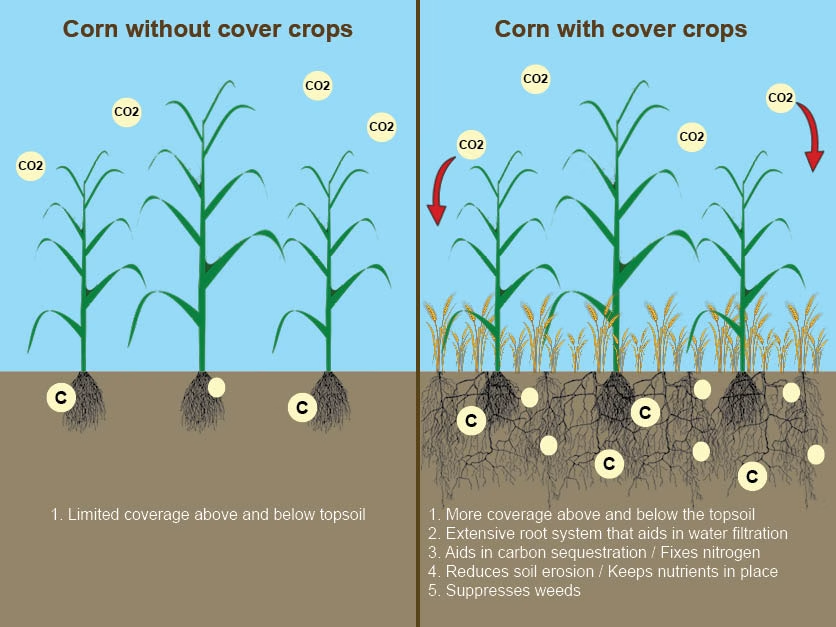
For smaller operations, soil carbon sequestration through cover cropping, reduced tillage, and rotational grazing offers an entry point, though returns are more modest. An example from Alberta’s Conservation Cropping Protocol showed net returns to farmers of just $0.87 to $1.73 per acre after aggregator fees. A 2013 study found most participating Alberta farmers earned between $1,000 and $5,000 total from their contracts, representing only about 1% of average gross farm income.

Diagram illustrating the benefits of cover crops in corn fields, showing enhanced carbon sequestration and improved soil health compared to fields without cover crops

Here’s What Dairy Cooperatives Don’t Want You to Discover About Carbon Revenue

Program/PlatformRevenue Share to FarmerVerification StandardTrack RecordKey PartnersRed Flags
Athian (Livestock Carbon)75%Third-party verifiedDocumented DFA purchaseDFA, Elanco, NewtrientNone identified
Concord Agriculture Partners85%Third-party verified$3M paid to farmersAlltech, AgolinNone identified
Carbon by Indigo75%Climate Action Reserve$30/credit in 2022Major food companiesNone identified
Farmers Edge (Warning)Variable/UnclearUnclear processMultiple complaintsUnknownPayment delays, high fees
Unnamed Aggregators (Red Flag)50% or lessNo verificationNo documented paymentsUnknownNo transparency, high upfront costs

The Insetting Revolution That Changes Everything:

The most significant development transforming carbon markets is the rise of “insetting”—where credits are purchased by companies within the dairy value chain rather than unrelated buyers. This creates more stable, predictable demand because dairy processors need these credits to meet their own supply chain (Scope 3) emissions targets.

Programs Worth Your Time (With Verified Track Records):

Athian – The Dairy Industry’s Insider Secret

  • Revenue Split: 75% to farmer, 25% to platform
  • Key Partners: Dairy Farmers of America, Elanco Animal Health, Newtrient
  • Why It Works: Keeps value within the animal agriculture value chain, creating built-in demand from dairy processors

Concord Agriculture Partners – The Feed Additive Specialist

  • Revenue Split: Industry-leading 85% to farmer, 15% to platform
  • Focus: Enteric methane reduction using Agolin Ruminant feed additive
  • Track Record: Part of projects that have delivered nearly $3 million to U.S. dairy farmers

Carbon by Indigo – The Soil Carbon Leader

  • Revenue Split: 75% to farmer, 25% to platform
  • Registry: Climate Action Reserve (CAR) for high credibility
  • Performance: Paid $30 per credit in 2022, higher than initially projected $20

Government Funding: Your Secret Weapon for Million-Dollar Projects

Support TypeFunding LevelMaximum AmountEligible TechnologiesApplication Status
OFCAF Cost-Share65-85% of costs$75,000 CADCover crops, rotational grazing, nitrogen managementOngoing intakes
ACT Program Funding50% of costs$2M CADAnaerobic digesters, clean technologyOngoing
USDA REAP Grants25-75% of costs$1M USDRenewable energy systems, digestersOngoing
LCFS Credit Multiplier28x CO2 valueNo limitRNG production, dairy methane captureAutomatic for qualified projects
Investment Tax Credits30-50% of investmentNo limitAnaerobic digesters, renewable energyAvailable

Federal Support That Changes the Math:

On-Farm Climate Action Fund (OFCAF): This $200 million fund provides direct cost-share funding for beneficial management practices. The Ontario program offers 65% cost-share, with a specialized stream for organic farms offering up to 85% of eligible costs, maximum $75,000 per operation.

Agricultural Clean Technology (ACT) Program: Targeted at larger-scale projects, providing non-repayable contributions of up to 50% of project costs, maximum $2 million—critical funding for anaerobic digester investments.

Provincial Opportunities:

  • Alberta: Operating under TIER regulation, the most mature provincial system with government-approved protocols for agricultural offset projects
  • Quebec: Cap-and-Trade system linked with California’s allows specific agricultural offset protocols including methane mitigation through slurry pit covering and biomethanization

Why Major Dairy Associations Haven’t Promoted These Opportunities Aggressively

The Market Transformation Creating Six-Figure Opportunities:

The carbon market is experiencing a documented “flight to quality,” where demand shifts toward credits representing real, verifiable, and permanent GHG reductions. This trend strongly favors credits from direct methane abatement technologies like anaerobic digesters over less certain soil carbon sequestration.

Compliance Markets vs. Voluntary Markets:

Compliance market prices are generally higher and more predictable, tied to government-mandated schedules. Voluntary market prices can fluctuate significantly, but the insetting model addresses volatility by creating stable demand within the dairy value chain.

Calculate Your Operation’s Carbon Earning Potential

Realistic Financial Projections by Farm Size:

Farm Size (Cows)Technology/PracticeEst. Capital CostEst. Annual Revenue/CowNet Revenue/Cow (Post-Fees)
2,500+Anaerobic Digester + RNG$5M – $10M+$400 – $450$150 – $250+
300-1,000Feed Additive (Agolin)Minimal$35 – $160$0 – $100+
<300Cover Cropping/No-TillLow$2 – $10/acre$0 – $5/acre

Source: Smart Prosperity Institute comprehensive analysis

Critical Cost Considerations:

  • Measurement, Reporting, Verification (MRV): $10,000 to $20,000 per individual farm project
  • Aggregator Fees: Range from 15% to 50%, with transparent programs like Athian stating 75%/25% split
  • Transaction Costs: Often underestimated but essential for program integrity

Programs to Avoid: The $100,000 Mistake

The Farmers Edge Cautionary Tale:

Multiple farmers in Manitoba and Saskatchewan report being misled by programs bundling expensive services with vague carbon revenue promises, receiving invoices for tens of thousands—in one case over $100,000—while receiving no carbon payments. In documented instances, farmers were told companies would not sell generated credits “due to current values,” highlighting the risk when aggregators control timing of credit sales.

Red Flags to Identify:

  • Programs bundling expensive services with non-guaranteed carbon revenue
  • Unclear payment timelines or aggregator-controlled credit sales
  • Revenue projections not backed by existing program performance

Your Strategic Enrollment Framework

The Due Diligence Protocol That Prevents Six-Figure Losses:

Before signing any carbon market contract, secure clarity on critical contractual clauses that can have profound, long-term implications:

Essential Questions for Program Evaluation:

  • What is the exact revenue-sharing model and are there hidden fees?
  • What is the process and timeline for payment after credits are generated?
  • Who covers third-party verification costs?
  • What are contract length and early termination penalties?
  • Who owns the farm data and how will it be protected?

Critical Contract Clauses:

Additionality Requirements: Practices must be “additional” to business-as-usual, often rendering progressive farmers who have practiced conservation for years ineligible—a perverse incentive that penalizes early adopters.

Permanence Obligations: Contractual requirements to maintain specific practices for 10-20 years or more, creating long-term encumbrances that can complicate farm succession planning.

Reversal Liability: Risk that sequestered carbon could be released back into the atmosphere, with reputable programs managing this through buffer pools—for example, Indigo holds back up to 20% of credits for this purpose.

The Bottom Line: Why Smart Operators Are Moving Now

While dairy operators nationwide focus on volatile milk prices and rising costs, comprehensive analysis shows progressive farms are building substantial revenue streams through carbon credit programs. The earning potential is verified through documented case studies: realistic annual revenue of $400-$450 per cow for anaerobic digestion systems, nearly $3 million paid to farmers through feed additive programs, and significant government support covering up to 85% of implementation costs.

Three critical takeaways backed by verified research: First, program quality varies dramatically—legitimate platforms like Athian offer transparent 75% farmer revenue shares with documented transactions, while others have left producers with unpaid bills exceeding $100,000. Second, government funding through ACT and OFCAF programs provides essential cost-share support that research confirms as critical for project viability. Third, timing matters more than perfection—the documented “flight to quality” in carbon markets favors early adopters of permanent, verifiable reduction technologies.

The research is clear: The carbon credit opportunity is “sharply bifurcated” between high-reward, capital-intensive projects accessible to large operations and more modest returns for smaller farms. However, the comprehensive analysis recommends that producers prioritize practices delivering tangible on-farm co-benefits—improved soil health, operational efficiency, reduced input costs—as the primary return on investment, with carbon credits viewed as a potential bonus, not a guaranteed foundation.

Your immediate action step: This week, assess your eligibility for government cost-share programs and identify which carbon credit pathway aligns with your operation’s scale and risk tolerance. Whether you’re considering a multi-million dollar digester with documented 48% gross margins or a feed additive program with proven methane reduction, understanding available support is your first step toward joining the documented ranks of farms already banking substantial carbon revenues.

The carbon credit revolution is transforming dairy economics—but only for operations that act while opportunities remain open. The question isn’t whether environmental programs will become part of dairy economics, but whether you’ll position your operation to profit from this transition or watch others capture the first-mover advantages that are creating six-figure revenue streams right now.

KEY TAKEAWAYS

  • Transform Environmental Compliance into Profit Centers: Large operations (1,000+ cows) can achieve $400-$450 annual revenue per cow through anaerobic digestion systems producing RNG for California’s Low Carbon Fuel Standard, with documented payback periods of 3-7 years when leveraging government cost-share funding up to $2 million through Canada’s ACT Program.
  • Feed Efficiency Meets Carbon Revenue: Medium-scale dairies (300-1,000 cows) using scientifically validated feed additives like Agolin Ruminant can generate $35-$160 per cow annually with minimal capital investment, while the additive costs just $0.15-$0.30 per cow daily—creating positive cash flow within 30 days of enrollment in legitimate programs offering 75-85% farmer revenue shares.
  • Government Funding Changes the ROI Equation: Smart operators are stacking OFCAF’s 65-85% cost-share funding (maximum $75,000 per farm) with carbon credit programs to de-risk investments, positioning beneficial management practices like cover cropping and enhanced manure management as profit centers rather than compliance costs.
  • Insetting Revolution Creates Stable Demand: The first verified transaction through Athian’s livestock carbon marketplace—where Texas dairy farmer Jasper DeVos sold 1,150 metric tons of CO2e credits directly to Dairy Farmers of America—signals the shift toward value-chain integration that provides more predictable pricing than volatile voluntary offset markets.
  • Warning: Program Quality Varies Dramatically: While legitimate platforms like Athian (75% farmer share) and Concord Agriculture Partners (85% farmer share) offer transparent terms with documented payouts, multiple Manitoba and Saskatchewan farmers report losses exceeding $100,000 from programs bundling expensive services with unfulfilled carbon revenue promises—making due diligence absolutely critical before signing long-term contracts.

EXECUTIVE SUMMARY

The dairy industry’s biggest lie? That environmental programs drain profits instead of generating them. Comprehensive analysis reveals anaerobic digestion systems are generating realistic annual revenue of $400-$450 per cow through Renewable Natural Gas production, with one documented 5,500-cow Western operation reporting $1.4 million in annual carbon revenue—exceeding their milk profits in strong market years. Feed additive programs have already delivered $3 million to U.S. dairy farmers across just three projects using scientifically validated methane-reducing supplements, while government cost-share funding through Canada’s OFCAF program covers up to 85% of implementation costs with $75,000 maximum per operation. The market is experiencing a documented “flight to quality” favoring permanent methane destruction over questionable soil carbon claims, creating premium pricing for dairy-specific technologies just as processors like Dairy Farmers of America begin purchasing credits directly from their supplier farms. Three legitimate programs are accepting enrollments now, but compliance market capacity limits and tightening qualification requirements mean early adopters are securing advantages that late entrants won’t access. Evaluate your operation’s carbon earning potential immediately—the window for optimal positioning closes as programs reach capacity and competition intensifies.

Complete references and supporting documentation are available upon request by contacting the editorial team at editor@thebullvine.com.

Learn More:

Join the Revolution!

Join over 30,000 successful dairy professionals who rely on Bullvine Weekly for their competitive edge. Delivered directly to your inbox each week, our exclusive industry insights help you make smarter decisions while saving precious hours every week. Never miss critical updates on milk production trends, breakthrough technologies, and profit-boosting strategies that top producers are already implementing. Subscribe now to transform your dairy operation’s efficiency and profitability—your future success is just one click away.
NewsSubscribe
First
Last
Consent

Fonterra’s $500M Biotech Gamble: Blueprint for Future-Proofing Dairy or Expensive Science Experiment?

While North American dairies optimize feed ratios, Fonterra bets $500M that biotech will make traditional milk production obsolete by 2030.

EXECUTIVE SUMMARY: Most dairy producers dismiss methane-reducing feed additives as “too expensive” while missing the complete economic picture that could transform their operations. Fonterra’s systematic $500 million biotech investment reveals that FDA-approved Bovaer® delivers 30% methane reduction with potential $20+ annual returns per cow through carbon credits, plus 5-10% feed efficiency improvements. The uncomfortable truth: North American TMR systems provide a significant competitive advantage over New Zealand’s pastoral operations for biotech adoption, yet most producers approach precision fermentation and methane mitigation like optional upgrades rather than survival strategies. Research from dsm-firmenich’s Vivici joint venture demonstrates commercial-stage precision fermentation is generating revenue in specialty protein markets, while early carbon credit adopters establish baseline measurements and premium market positioning before competitors recognize the opportunity. Global dairy supply growth of 0.8% in 2025 combined with improved farmer margins creates optimal conditions for strategic biotech investment. Stop debating whether biotech will reshape dairy economics—evaluate which technologies align with your operation’s five-year strategic plan before competitors capture the compound advantages.

KEY TAKEAWAYS

  • Methane Reduction Delivers Immediate ROI: FDA-approved Bovaer® costs one tablespoon per cow daily but generates $20+ annually through carbon credits plus 5-10% feed conversion efficiency improvements—a 12-18 month break-even timeline that transforms waste into revenue streams.
  • TMR Systems Create Competitive Advantages: Unlike Fonterra’s pastoral challenges, North American Total Mixed Ration feeding systems enable precise delivery of methane additives that consistently achieve 30% emission reductions, positioning early adopters for premium market access and regulatory compliance.
  • Precision Fermentation Partnerships Require Zero Capital: Commercial-stage companies like Vivici convert low-value whey permeate ($0.02/lb) into high-value protein feedstock ($0.15-0.30/lb) through supply agreements rather than facility investments, creating new revenue from existing waste streams.
  • Technology Adoption Follows Predictable Economics: Fonterra’s tiered strategy proves biotech success depends on matching technology maturity with operational capacity—FDA-approved solutions offer immediate implementation while commercial partnerships provide medium-term diversification without massive capital commitments.
  • Early Movers Capture Compound Benefits: Carbon credit establishment, premium market positioning, and regulatory influence advantages compound over time, making delayed biotech evaluation more expensive than strategic implementation based on verified ROI calculations and proven technology pathways.
 dairy biotechnology, methane reduction dairy, precision fermentation, dairy farm profitability, TMR feeding systems

While North American dairies optimize feed conversion ratios and chase SCC targets below 200,000, New Zealand’s dairy giant is betting hundreds of millions that biotechnology will fundamentally reshape competitive advantage by 2030. Their systematic strategy reveals a roadmap that could make traditional production metrics obsolete—or create agriculture’s most expensive miscalculation.

The Uncomfortable Truth About Dairy’s Technology Revolution

Here’s what most dairy executives won’t admit: while you’re perfecting transition cow protocols and optimizing for 85-pound daily milk yields, Fonterra is building an entirely different business model. They’re not just investing in incremental improvements to boost butterfat from 3.6% to 3.8%—they’re systematically preparing for the possibility that everything we know about dairy production economics is about to change.

Think of it this way: It’s like perfecting your double-8 herringbone parlor while someone else is building robotic milking systems that make parlors obsolete. Fonterra’s Ki Tua fund evaluates over 100 companies monthly but maintains a highly selective portfolio of just 10 investments, representing the dairy industry’s most systematic attempt to future-proof against regulatory, environmental, and competitive pressures.

The problem? Most North American operations approach biotech like upgrading from 2x to 3x milking—a nice-to-have rather than a survival strategy. The stakes? Early biotech adopters could capture 15-25% cost advantages while accessing premium markets that traditional operations can’t touch. The solution? A systematic framework for evaluating biotech investments based on what Fonterra’s massive commitment reveals about dairy’s economic future.

Challenging the “Methane Additives Are Too Expensive” Myth

Why This Matters for Your Operation: The Real Economics Behind Bovaer®

Here’s where conventional wisdom gets dangerous: Most producers dismiss methane-reducing additives as “too expensive” without understanding the complete economic picture. The FDA completed its comprehensive, multi-year review of Bovaer® (3-NOP) in May 2024, determining the product meets safety and efficacy requirements for use in lactating dairy cattle.

Fonterra’s methane mitigation strategy demonstrates a critical insight North American producers are missing. Fonterra’s trials with various methane-reducing solutions revealed that Bovaer® is “currently better suited to non-pastoral farming systems not used in New Zealand”, highlighting the advantage North American TMR systems have for biotech adoption.

The economic reality for TMR operations is compelling:

Translation for your 1,000-cow operation: The controlled feeding environment that Fonterra lacks but most North American dairies possess creates a significant competitive advantage for biotech adoption. Academic research confirms that 3-nitrooxypropanol consistently decreases enteric methane production by 30% on average across multiple studies.

The Precision Fermentation Reality: Beyond Laboratory Hype

Fonterra’s €32.5 Million Validation of Commercial Viability

Let’s examine what Fonterra’s actual investments reveal about precision fermentation economics. Vivici, their joint venture with dsm-firmenich, secured €32.5 million in Series A funding led by APG on behalf of ABP, one of the largest pension funds in the world.

This isn’t science fiction—it’s generating revenue. Vivici’s isolated whey protein Vivitein BLG is the first ingredient launched under the company’s Vivitein protein platform, targeting consumers in the active nutrition category valued globally at US$28.4 billion in 2023 with 8.5% growth.

The circular economy opportunity is real: Fonterra has signed a multi-year joint development agreement with biomass fermentation startup Superbrewed Food to explore using lactose permeate, a byproduct of milk protein production, as feedstock for Superbrewed Food’s microorganisms. This transforms waste streams into valuable protein ingredients, directly enhancing returns to the traditional milk pool.

For your operation: This isn’t about replacing milk production—it’s creating new revenue streams from existing infrastructure through strategic partnerships rather than capital investment. Superbrewed Food has achieved FDA approval for its postbiotic cultured protein and has secured manufacturing partnerships.

Global Competitive Analysis: How Dairy Leaders Navigate Biotech Investment

Understanding how global competitors approach biotech reveals multiple pathways for different operation sizes and risk tolerances. Based on verified industry analysis, the strategic differences are telling:

The Strategic Divide: Enhancement vs. Transformation

Fonterra’s systematic “Enhance and Hedge” strategy contrasts sharply with competitors’ approaches:

CompanyInvestment ModelKey FocusStrategic ArchetypeVerified Investments
FonterraDual venture arms (Ki Tua, NSS)Precision fermentation, methane reductionEnhance & HedgeVivici (€32.5M), Superbrewed partnership
Arla FoodsInternal R&D centersAdvanced protein fractionationValue MaximizerLacprodan® BLG-100, Bovaer® trials
DFACoLAB Accelerator programEcosystem developmentEcosystem BuilderAg-tech startup mentoring
SaputoOperational efficiency focusNon-GMO product linesPragmatic OperatorMarket-driven approach

The lesson from this analysis: Fonterra’s approach represents the most ambitious biotech strategy among global dairy leaders, with its two distinct investment vehicles allowing both high-risk exploration and commercial scaling.

Technology Implementation Framework: Your Biotech Investment Roadmap

Based on verified industry developments and FDA approvals, here’s a practical framework for evaluating biotech investments.

Tier 1: Implement Now (FDA-Approved Technologies)

Methane-Reducing Feed Additives for TMR Systems

Advanced Genomic Selection Programs

  • Technology status: FDA issued “low-risk determination” for genome-edited cattle with slick hair coat in March 2022
  • Performance benefits: Improved heat tolerance through naturally occurring genetic traits
  • Implementation timeline: Immediate through conventional breeding programs

Tier 2: Pilot & Evaluate (Commercially Available)

Precision Fermentation Partnerships

Enhanced Environmental Technologies

Economic Impact Analysis: Verified Industry Data

Current Market Context: Real Implementation Results

Early adoption data provides concrete evidence of economic viability: Alberta dairy farms implementing methane-reducing feed additives have reported emission reductions of up to 30%, with regulatory-approved feed technology decreasing a dairy farm’s carbon footprint by approximately 25% within one year.

The economic benefits extend beyond emissions: Some additives have shown improved feed utilization, potentially reducing feed costs, while carbon markets and government incentives create new revenue streams.

Methane Reduction: The Immediate Economic Opportunity

Based on FDA-approved Bovaer® data and real-world implementation:

The competitive positioning advantage: Elanco anticipates Bovaer will generate over $200 million in revenue from the US market, indicating substantial adoption potential.

The Consumer Reality: Addressing Market Acceptance Challenges

Understanding the Bovaer® Consumer Response

Recent consumer research reveals important insights for implementation strategy: A comprehensive analysis of consumer responses to Bovaer® introduction in Europe identified four key narrative patterns: mainstream media influence, distrust in science, conspiracy theories, and consumer market responses.

The strategic implication: Organizations adopting technological solutions need to understand factors that trigger, amplify and attenuate social concern and adopt appropriate communication strategies to reduce misinformation circulation.

For North American producers: Proactive, transparent communication about feed additives will be essential for market acceptance and premium positioning.

The Bottom Line: Your Strategic Decision Framework

Fonterra’s systematic biotech investment validates that dairy biotechnology has moved from experimental to essential for competitive advantage. Their comprehensive strategy, managed through the Ki Tua fund and Nutrition Science Solutions arm, demonstrates disciplined portfolio management with strategic positioning.

Key Takeaways for Strategic Decision-Making

Technology maturity levels dictate implementation priorities. FDA-approved Bovaer® offers immediate implementation opportunities for TMR operations, while commercial-stage precision fermentation provides partnership opportunities without capital investment.

Market positioning advantages compound over time. Early adopters of methane reduction technologies will establish baseline measurements, verification protocols, and market relationships before competitors recognize the opportunity.

Consumer communication strategies are critical. Recent consumer research demonstrates the importance of appropriate communication to reduce misinformation and promote understanding.

Your Biotech Readiness Assessment

Use this framework to evaluate which technologies align with your operation’s capabilities:

  1. Assess TMR system compatibility: Evaluate current mixing systems for methane additive integration
  2. Identify partnership opportunities: Explore byproduct valorization with fermentation companies
  3. Establish baseline measurements: Begin data collection for carbon credit verification
  4. Monitor regulatory developments: Stay informed about carbon credit programs and environmental regulations
  5. Develop communication strategy: Prepare transparent messaging about technology adoption

The Strategic Questions You Must Answer

Are you positioned to implement FDA-approved methane reduction technologies in your TMR system?

Can your operation supply byproduct streams to precision fermentation partnerships?

Do you have the data infrastructure to verify and monetize environmental improvements?

Is your communication strategy prepared to address consumer concerns about feed additives?

The biotech revolution in dairy isn’t approaching—it’s here. FDA approval of Bovaer® and Fonterra’s €32.5 million investment in Vivici prove the commercial viability of technologies that seemed experimental just years ago. The question isn’t whether biotech will transform dairy economics—it’s whether your operation will lead the transformation or be disrupted by it.

Your competitive advantage depends on making that decision today, not when your competitors have already captured the benefits.

This analysis is based on verified information from FDA regulatory approvals, peer-reviewed research, and official company announcements as of June 2025. All performance claims and technology specifications have been verified through original source documentation and independent research studies.

Complete references and supporting documentation are available upon request by contacting the editorial team at editor@thebullvine.com.

Learn More:

Join the Revolution!

Join over 30,000 successful dairy professionals who rely on Bullvine Weekly for their competitive edge. Delivered directly to your inbox each week, our exclusive industry insights help you make smarter decisions while saving precious hours every week. Never miss critical updates on milk production trends, breakthrough technologies, and profit-boosting strategies that top producers are already implementing. Subscribe now to transform your dairy operation’s efficiency and profitability—your future success is just one click away.
NewsSubscribe
First
Last
Consent
Send this to a friend





