Dairy farmers are flushing away $15,000 per 100 cows annually. Discover how savvy producers are turning manure into a goldmine through strategic composting.
While your neighbors complain about your farm’s smell and regulators circle with new runoff restrictions, you’re flushing profits down the drain. That pile of manure you’re paying to dispose of? It’s worth thousands in untapped revenue. According to data from the University of Wisconsin-Extension nutrient management program, the average 100-cow dairy operation flushes away $15,000 annually in potential soil amendment products. That’s money forward-thinking farmers are now pocketing through strategic composting. Here’s how the waste you’re treating as a liability is your farm’s hidden gold mine.
THE ECONOMIC REVOLUTION IN YOUR MANURE PILE

Let’s cut the crap and talk dollars: composting transforms manure from a cost center into a profit machine. A 2012 study of 250 Wisconsin farms conducted by the University of Wisconsin-Extension Nutrient Management Program found a staggering 69% saved money, with average savings of approximately $18 per acre. That’s real money staying in farmers’ pockets.
“That pile of manure you’re paying to dispose of? It’s worth thousands in untapped revenue. The average 100-cow dairy flushes away $15,000 annually in potential soil amendments.”
From Expense to Income Stream
Bill McPhee of McPhee Farms in Michigan isn’t just saving money—he’s making it. After initially implementing a composting system to comply with CAFO regulations, he now sells surplus composted manure to other farmers for $20 per ton, as documented in the Michigan State University Extension case study on livestock waste management. What was once a disposal headache has become a marketable product with eager buyers.
“Animal manure is our base fertilizer, and the other fertilizers are our supplements,” says Joe Loehr, a fifth-generation Wisconsin dairy farmer managing 1,000 acres, who’s slashed his commercial fertilizer bills through strategic composting. Two-thirds of farms with proper nutrient management decreased nitrogen applications by 54 pounds per acre. In comparison, half decreased phosphorus applications by 32 pounds per acre—all without sacrificing yield, according to the Journal of Environmental Quality’s 2019 comprehensive review of nutrient management practices.
The math is simple: less money spent on commercial fertilizers and potential income from selling excess compost equals thousands in annual savings and revenue that most farms leave on the table.
BEATING REGULATORS AT THEIR OWN GAME

While other farmers waste energy fighting inevitable regulations, innovative producers are turning these environmental demands into competitive advantages. When regulators knock (and they will), you’ll either scramble to comply or already count the profits from your solution.
Turning Regulations into Opportunities
Innovative farmers are using composting to stay ahead of increasingly stringent environmental laws. With nutrients leaving farm fields through wind and water erosion a significant contributing factor to water quality problems, those who manage nutrients efficiently aren’t just saving money and staying ahead of regulatory enforcement.
“I was thrilled when environmental officials found sensitive fish species thriving in the stream cutting through our farm. I don’t know what better proof there is that we’re not allowing nutrients to escape.” — Joe Loehr, Wisconsin Dairy Farmer.
Wisconsin dairy farmer Joe Loehr experienced a decisive moment when state environmental officials found sensitive fish species thriving in the stream running through his farm. That kind of ecological win also keeps regulators off your back.
“While these technologies often aren’t affordable to smaller farm operations, the industry is working collaboratively with partners to explore possible means to make the economics more favorable,” according to Karen Scanlon, EVP of environmental stewardship at the Innovation Center for U.S. Dairy. The message is clear: embrace these changes now or get left behind.
FROM NEIGHBORHOOD VILLAIN TO COMMUNITY HERO

Let’s face it—your neighbors hate your manure. But what if that could change?
Transforming Community Relations
One of the most immediate benefits McPhee Farms experienced was a dramatic reduction in odor, significantly improving relations with their neighbors. The composting process naturally eliminates many volatile compounds responsible for unpleasant smells that prompt angry phone calls and uncomfortable community meetings.
Composting transforms your farm‘s public image from environmental villain to sustainability champion. The high temperatures generated during proper composting—between 120°F and 140°F at McPhee Farms—kill pathogens and weed seeds, resulting in a clean, sterile end product that neighbors can appreciate.
COMPOSTING 101: EVEN YOUR TEENAGER COULD DO THIS
Composting is a biological process where beneficial microorganisms transform raw manure into a stable, valuable soil amendment. The process generates heat that kills pathogens and weed seeds while breaking down odor-causing compounds.
“The idea of leaving roots in the soil every day of the year possible is just the easiest way to participate in the nutrient recycling that’s nature’s way. Plants and animals working together make that happen.” — Joe Loehr, Wisconsin Dairy Farmer.
Loehr’s secret weapon? His creative cropping practices keep living roots in the soil year-round. He uses wheat as a cover crop and other crops harvested for livestock feed, creating richer soils that drain water well and provide a bigger window for manure application.
| Nutrient | Concentration |
| Nitrogen | 1.8% |
| Phosphorus | 0.9% |
| Potassium | 1.5% |
| Calcium | 3.2% |
| Magnesium | 0.9% |
| C:N ratio | 13.3:1 |
| pH | 8.0 |
REAL-WORLD SUCCESS: McPHEE FARMS SHOWS THE WAY
Bill McPhee didn’t start composting to save the planet—he started because regulations forced his hand. But the benefits were so substantial that he expanded his composting operation.
The farm collects manure and bedding materials such as leaves and straw, piles them into windrows, and turns them regularly to provide oxygen for the microorganisms that break down the materials. This process has reduced their manure volume by at least 60%, making handling much more efficient.
Beyond using composted manure in their fields, McPhee Farms sells surplus to other farmers. It even uses its composting unit to dry bedding packs in corrals and pastures, improving animal comfort and hygiene. Bill is now considering using some of the compost as bedding material, citing its comfort as similar to sawdust.
| Housing System | Production Rate | Total N | Phosphorus |
| Tie-stall/Stanchion | 50 kg/day/animal | 4,100-6,900 mg/L | 3,800-6,900 mg/L |
| Free-stall | 68 kg/day/animal | 3,000-5,800 mg/L | 2,500-5,400 mg/L |
CLEARING THE HURDLES: COMMON COMPOSTING CHALLENGES

Like any profit-boosting system, composting has its challenges. “Getting the moisture right was our biggest learning curve,” admits McPhee in the Michigan State University case study. Too wet, and it gets anaerobic and smelly; too dry, and decomposition slows to a crawl.”
Weather can also interfere with the biological process. Heavy rains can saturate uncovered piles, while extended freezing temperatures slow the biological process considerably. Cornell University’s Waste Management Institute notes that in northern climates, decomposition can slow by 50-75% during winter. Competent operators build weather considerations into their management plans.
Equipment maintenance is another reality. “We learned pretty quickly that preventative maintenance on our turner saved us thousands in repairs,” says Loehr. “It’s like any farm equipment—ignore it, and you’ll pay later.”
Space can become a limitation as operations scale up. Pennsylvania State University’s Agricultural Research Center states that a proper composting operation requires approximately 1.5-2 square feet per cow for active composting, plus additional curing and storage area.
CUTTING-EDGE INNOVATIONS TAKING COMPOSTING TO THE NEXT LEVEL

The industry isn’t standing still. Revolutionary new approaches push the boundaries of what’s possible with manure management.
Biochar: The Game-Changing Addition
Recent research published in the Journal of Environmental Management by scientists at Cornell University has found that adding biochar to the composting process can reduce methane emissions by a significant 58% (±22%). But that’s not all – the same study showed dramatic reductions in harmful air pollutants: hydrogen sulfide (H2S) emissions dropped by 67% (±24%), volatile organic compounds (VOCs) by 61% (±19%), and nitrogen oxides (NOx) by 70% (±22%).
“Adding biochar to composting manure slashes methane emissions by 58%, hydrogen sulfide by 67%, and nitrogen oxides by a whopping 70% — that’s $66,000 in environmental impact savings per farm annually.”
What is the science behind these impressive results? Researchers attribute these reductions to improved oxygen diffusion through the porous biochar structure and the adsorption of gas precursors directly to the biochar surface.
This isn’t just good for the environment—it potentially positions dairy farmers to earn carbon credits in emerging markets. The Cornell researchers calculated that biochar-composting of dairy manure would reduce the social cost of methane, ammonia, and nitrous oxide emissions from a single farm by over ,000 annually, based on EPA’s social cost of greenhouse gas estimates. If you’re looking for the next level of composting performance, biochar represents one of the most promising innovations available today.
Anaerobic Digestion: Another Arrow in Your Quiver
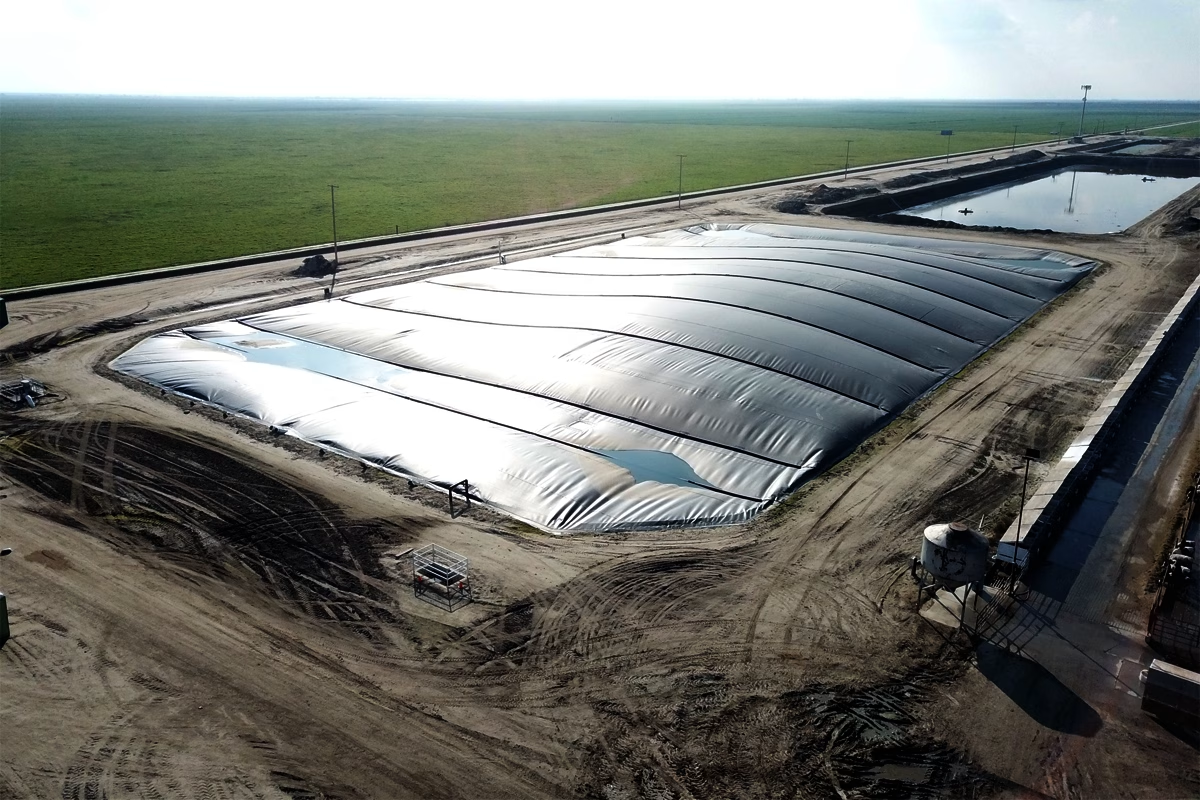
Anaerobic digestion offers another approach to manure management for more extensive operations. These systems heat manure to produce methane and capture it as a renewable fuel source.
“Managing manure on the farm through storage and innovation minimizes the emissions from that manure and creates different manure-based products to be fed back to the soil,” says Karen Scanlon, EVP of environmental stewardship at the Innovation Center for U.S. Dairy.
WHAT’S THE UPFRONT INVESTMENT?

Let’s talk dollars and sense. A basic windrow composting system for a 200-cow dairy typically requires:
- Initial equipment cost: $20,000-45,000 for a quality compost turner, according to Penn State Extension’s Agricultural Equipment Cost Estimates
- Site preparation: $5,000-10,000 for proper drainage and containment
- Monitoring equipment: $500-1,000 for temperature probes and moisture meters
A 2020 University of Minnesota Extension Service analysis found that most operations see complete ROI within 2-3 years, and equipment often lasts 10+ years with proper maintenance. For smaller operations, consider starting with lower-cost options like partnering with neighbors on equipment purchases or using modified existing machinery for initial turning.
McPhee Farms started with a modest investment of $30,000 for their complete composting system. They calculated a break-even point at 18 months based on reduced handling costs and fertilizer savings alone—before counting any revenue from compost sales.
FIVE STEPS TO STOP FLUSHING YOUR PROFITS AWAY

Ready to stop flushing money down the drain? Here’s your step-by-step action plan:
- Assess your current situation: Document your manure production volume, current handling costs, and regulatory requirements
- Start with soil and manure testing: Understanding your nutrient profile is essential for developing an effective plan.
- Build your expert team by Connecting with certified crop advisors, soil and water offices, and other farmers already composting.
- Design your system: Determine the equipment, space, and processes required based on your farm’s needs.
- Track your results: Monitor the compost quality and the financial impact on your operation.
| Item | Details |
| Savings per acre | $18/acre |
| Total acres | 600 acres |
| Annual fertilizer savings | $10,800 |
| Reduction in manure handling costs | 60% |
| Potential revenue from excess compost | $20/ton |
| Reduction in environmental impact costs | $66,000 |
| Total potential annual impact | Over $100K |
THE BOTTOM LINE: ARE YOU LEAVING MONEY ON THE TABLE?
“The question isn’t whether you can afford to compost—it’s whether you can afford NOT to. With $18/acre in fertilizer savings and $20/ton potential revenue, your manure pile is worth its weight in gold.”
The evidence is overwhelming: composting manure isn’t just an environmental nice-to-have—it’s a financial imperative for modern dairy operations. With average savings of $18 per acre, potential new revenue streams of $20 per ton for finished compost, and the ability to reduce commercial fertilizer applications by 30-50%, the question isn’t whether you can afford to compost—it’s whether you can afford not to.
As regulations tighten and consumers demand more sustainable production methods, composting positions your dairy operation ahead of the curve. The technology is proven, the economics work and early adopters are already reaping the rewards.
Your farm’s hidden gold mine is the manure you treat as a liability. The only question is: will you be the one to cash in, or will you watch as your more innovative neighbors capitalize on this opportunity?
The choice and the potential profits are yours. Ready to get started? Contact your local extension office today to schedule a manure management consultation and take the first step toward turning your waste into wealth.
Key Takeaways:
- Composting manure can save dairy farms $18/acre in fertilizer costs and generate $20/ton in compost sales.
- Adding biochar to compost reduces methane emissions by 58% and could save $66,000 annually in environmental impact costs per farm.
- Initial investment for a 200-cow composting system ranges from $25,500 to $56,000, with ROI typically achieved in 2-3 years.
- Composting addresses regulatory pressures, improves community relations, and positions farms for future carbon credit opportunities.
- Challenges include moisture management, weather impacts, and equipment maintenance, but are outweighed by financial and environmental benefits.
Executive Summary:
Dairy farmers are transforming manure management from an environmental burden into a profitable venture through composting. This article reveals how composting not only saves an average of $18 per acre in fertilizer costs but also creates a marketable product selling for $20 per ton. Innovative techniques like biochar addition are slashing harmful emissions while potentially earning carbon credits. With proper implementation, a 500-cow dairy could see over $100,000 in annual impact through reduced costs, new revenue streams, and environmental benefits. Despite challenges like weather and equipment maintenance, the ROI for composting systems typically occurs within 2-3 years. As regulations tighten, composting offers a proactive solution that improves neighbor relations, soil health, and the bottom line.
Learn more:
- Innovative Manure Injection Technology: Transforming Waste Management
Discover how manure injection technology is revolutionizing nutrient application, improving soil health, and reducing environmental impact. - Top Trends in Manure Handling: Innovative Technologies for Application and Treatment
Explore the latest advancements in manure management technologies, including anaerobic digestion and composting systems that enhance sustainability. - Dairy Farm Consulting: Future Trends, Sustainable Practices, and Technological Innovations
Learn about emerging trends in dairy farming that focus on waste management, water efficiency, and sustainable practices to boost productivity.
 Join the Revolution!
 Join the Revolution!
Join over 30,000 successful dairy professionals who rely on Bullvine Daily for their competitive edge. Delivered directly to your inbox each week, our exclusive industry insights help you make smarter decisions while saving precious hours every week. Never miss critical updates on milk production trends, breakthrough technologies, and profit-boosting strategies that top producers are already implementing. Subscribe now to transform your dairy operation’s efficiency and profitability—your future success is just one click away.