







Feed efficiency gaps are costing you $91K annually—while smart ops bank $2.50/cwt savings through conversion ratio tweaks.
Executive Summary: Look, I just finished analyzing what’s really happening with dairy margins in 2025, and honestly? Most producers are fighting the wrong battle. While everyone’s obsessing over that $21.60/cwt milk price forecast, the real money is hiding in feed conversion ratios and component optimization. University of Wisconsin data shows operations hitting 1.4 pounds milk per pound of dry matter are saving $2.50/cwt compared to farms stuck at 1.2 ratios—that’s potentially $91,250 annual savings for a 250-cow herd. Plus, every 0.1% butterfat increase adds $0.35/cwt, which means $24,000-30,000 extra revenue for decent-sized operations. The global trend is crystal clear: European producers are already leveraging these efficiency gains while North American farms lag behind, still chasing volume over precision. Here’s my advice—stop waiting for better milk prices and start implementing feed efficiency programs, component optimization, and strategic automation investments that deliver measurable ROI regardless of market volatility.
Key Takeaways
- Master your feed conversion ratios immediately — Target 1.4 lbs milk per lb dry matter to save $2.50/cwt versus inefficient herds, translating to $91,250 annual savings for 250-cow operations under 2025’s tight margin environment.
- Optimize milk components for instant payouts — Every 0.1% butterfat increase delivers $0.35/cwt premium, so focus genetic selection and nutrition management on hitting 4.5% fat and 3.5% protein targets for $24,000-30,000 additional annual revenue.
- Implement 40/30/30 risk management strategy — Blend six-month forward contracts (40%), three-month agreements (30%), and cash market exposure (30%) to protect cash flow while preserving upside potential in volatile 2025 markets.
- Evaluate automation based on current labor reality — Robotic milking systems showing 18-30 month paybacks make financial sense despite 6.5% interest rates if you’re struggling with $18-20/hour milking positions and 60%+ labor shortage impacts.
- Leverage regional FMMO advantages strategically — Northeast operations gained $2.20/cwt in Class I differentials worth $19,800 annually for 1,000-cow dairies, while Upper Midwest farms need efficiency improvements to offset pricing headwinds from the reformed structure.
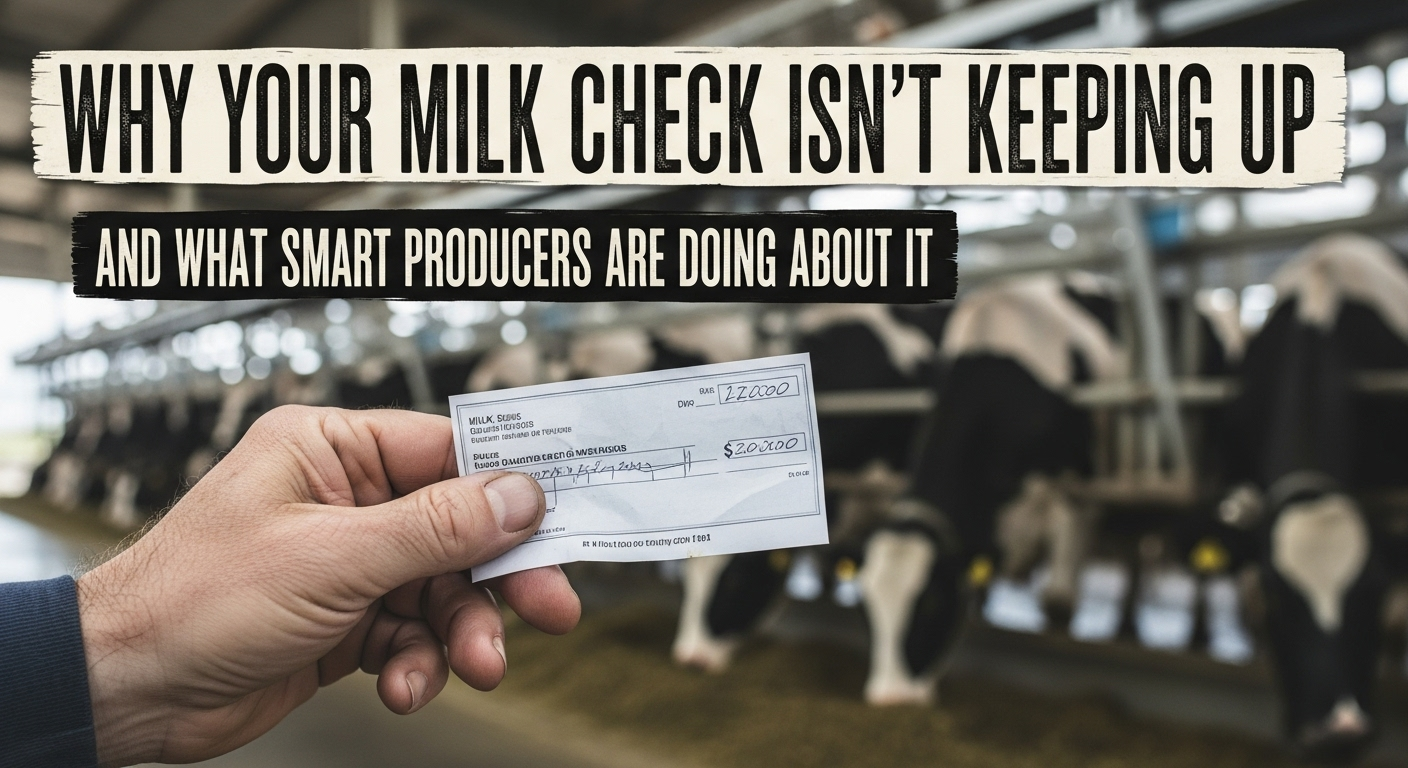
The current state of dairy economics isn’t pretty. While retail food costs climb, your milk price has barely budged, creating a margin squeeze that’s hitting every operation from the smallest family farm to the mega-dairies. This analysis unpacks the math that isn’t adding up for producers, covering the integrated North American market to provide strategies for addressing the issue.
The most frustrating part of this situation is that the math simply doesn’t add up for producers, forcing some difficult conversations in farm offices across the country. It’s the kind of pressure that leads to uncomfortable budget meetings where the numbers no longer work.
What’s Really Happening to Producer Returns
Let’s start with what we know for sure. USDA’s latest food price outlook shows food prices jumped 2.9% year-over-year through May 2025. Meanwhile, industry reports suggest dairy retail prices have been climbing even faster—somewhere in the 5% range, according to various market research I’ve been tracking.
But here’s the kicker… all-milk prices are forecast at $21.60 per hundredweight for 2025, and honestly, that’s where USDA’s latest revisions have been settling.
That disconnect should worry every producer reading this. Consumers are paying more for your products, but you’re not seeing those increases flow back to the farm gate.
Feed’s still eating up over half your production costs—that hasn’t changed. What has changed is that everything else is getting more expensive around it. Labor costs have jumped significantly across most regions, transportation is adding substantial costs to processed dairy products, and I don’t even want to mention equipment costs.
However, here’s something that really caught my attention… recent work from University of Wisconsin researchers shows that farms achieving 1.4 pounds of milk per pound of dry matter are spending $2.50 less per hundredweight than operations stuck at 1.2 ratios.
For a 250-cow herd, that’s potentially $91,250 in annual savings. Now that’s real money.
Are you tracking your feed conversion ratios this closely? Because if you’re not, you’re probably leaving serious money on the table.
Contradictory Signals in Manufacturing Capacity
This is where the situation becomes more complex… and frankly, a bit confusing. The latest Statistics Canada data shows manufacturing capacity utilization sitting at 80.1% in Q1 2025. That suggests there’s still room to run, right?
However, at the same time, industry reports indicate that substantial new cheese production capacity is coming online this year—we’re talking hundreds of millions of pounds of additional capacity.
What’s particularly noteworthy is how this capacity expansion is happening while we’re still seeing plant closures. Prairie Farms just shuttered their Kentucky facility—52 jobs gone, just like that.
This dynamic—adding capacity in some regions while losing it in others—creates significant market uncertainty.
Dr. Andrew Novakovic from Cornell’s dairy program has been tracking these manufacturing trends, and he recently noted in industry discussions that the fundamental question isn’t just processing capability—it’s whether domestic consumption and export markets can absorb all this increased production at profitable price levels.
The export picture has been particularly volatile… while Chinese dairy imports have shown recent recovery with sustained monthly growth trends, the overall international demand remains uncertain for substantial capacity increases.
Focus on Components: Your Most Controllable Revenue Stream
This is where smart producers are focusing their energy, and honestly, it’s probably the most immediate thing you can control. Current industry data shows butterfat tests averaging around 4.36% and protein at 3.38%, but here’s what that means in actual dollars…
Every 0.1% increase in butterfat is worth roughly $0.35 per hundredweight. Doesn’t sound like much? For a 2-million-pound annual production operation, achieving 4.5% butterfat and 3.5% protein, instead of the base levels, can result in $24,000 to $30,000 in additional revenue.
That’s a meaningful addition to the bottom line.
The genetics piece continues to fascinate me. Industry data suggest that daughters of high-component genomic sires are producing significantly higher butterfat and protein levels than industry averages. That lifetime value can be substantial per animal—and the connection between genetics and economics is compelling:
When you’re selecting bulls, are you just looking at milk production numbers, or are you calculating the actual economic impact of those component improvements? Because the most successful operations I know have started treating genetic selection like a financial investment strategy.
What strikes me about this is how much control you actually have here, compared to milk pricing, where you’re mostly at the mercy of market forces.
I was speaking with a producer in central Wisconsin last month who has been laser-focused on this component strategy. His butterfat numbers have climbed from 4.1% to 4.6% over two years through strategic breeding decisions, and he’s seeing that translate to real money in his milk check every month. “It’s like getting a raise without having to produce more milk,” he told me.
Technology Investments: The Labor Reality Check
Here’s the thing about labor shortages—they’re not going away. Recent industry surveys suggest that well over 60% of dairy operations are struggling with this issue, forcing some tough decisions about automation.
The ROI on robotic milking systems has become compelling for many operations, especially when considering the replacement of multiple full-time employees. Industry reports suggest that payback periods typically range from 18 to 30 months, depending on the operation’s size and labor replacement costs.
Automated feeding systems are showing similar promise. Manufacturers report feed waste reductions in the 12-15% range, which translates to significant annual savings per cow for larger herds. Combined with labor savings, the total benefits can reach substantial levels for mid-sized operations.
But here’s what complicates these decisions… the Federal Reserve’s monetary policy is keeping interest rates elevated, adding 2.5-3.5 percentage points to equipment financing costs compared to recent years. That stretches payback periods by several months on most automation investments.
Is it still worth it? From what I’m seeing across the industry, operations that can manage the upfront financing are still moving ahead. The labor situation is that challenging.
However, you must run the numbers carefully—what worked at 3% financing might not pencil out at 6.5%.
How Regional Price Reforms Impact Your Strategy
What’s happening isn’t uniform across dairy regions, and that matters for your planning. The impact of these reforms varies significantly by region, creating a distinct set of advantages and challenges across the country:
| Region | FMMO Impact | Key Advantage | Main Challenge |
| Northeast | Favorable | Improved Class I differentials | Higher operating costs |
| Upper Midwest | Challenging | Lower feed costs | Reformed pricing headwinds |
| California | Mixed | Strong regional pricing | Reduced efficiency from regulations |
| Southeast | Neutral | Stable fluid market | Limited growth opportunities |
Northeast producers are seeing the changes look more favorable in the short term, with improved Class I differentials providing some pricing support. But if you’re milking in Wisconsin or Minnesota, you’re facing headwinds from the reformed pricing structure.
California operations are facing ongoing challenges that have significantly impacted production efficiency in some areas. That has created interesting dynamics, where West Coast milk prices have been running stronger than national averages, but at the cost of reduced production efficiency.
Upper Midwest producers have this added challenge of competing for labor with new manufacturing facilities. It’s creating a bidding war for workers that’s pushing wages higher in already tight markets.
Reports from various regions suggest that milking positions are commanding premium wages—significantly higher than they were just three years ago.
Are you factoring these regional differences into your expansion or investment decisions? Because what makes sense in Vermont might not pencil out in central California.
What the Most Successful Operations Are Doing
So what are the smartest operators I know doing right now? A clear pattern is emerging, and it’s not waiting for markets to improve.
First, they’re implementing what Cornell’s Risk Management team calls diversified pricing strategies. The approach that seems to work best is roughly 40% six-month forward contracts, 30% three-month agreements, and 30% cash market participation. This approach minimizes income volatility while preserving upside when markets strengthen.
Second, they’re obsessing over feed efficiency in ways that would have seemed extreme five years ago. Every tenth of a point in conversion ratio matters now. Operations achieving improvements in the $0.75-$ 1.25 per hundredweight range through better feed management are the ones that stay profitable.
Third, they’re being strategic about debt management. The most resilient operations are maintaining debt-to-asset ratios below 40% while still investing in labor-saving technologies. It’s a delicate balance, but it’s working.
What’s interesting is how these successful operations are also getting more sophisticated about their genetic programs. They’re not just breeding for production anymore—they’re targeting specific component outcomes and feed efficiency traits that directly impact their bottom line.
The genetics-economics-nutrition triangle has become their strategic focus, rather than just chasing milk pounds.
This development is fascinating because it represents a significant shift in how we approach dairy management. Instead of optimizing individual traits, the most effective operations are optimizing whole-system profitability.
The Bottom Line
Here’s what you need to focus on right now to protect your operation:
Master feed efficiency first—target improvements of $0.75-1.25/cwt through better conversion ratios and reduced waste. This is your highest-impact, lowest-cost strategy, and it connects directly to your genetic selection decisions.
Optimize components immediately—every 0.1% increase in butterfat is worth $0.35/cwt. For most operations, genetic selection and nutrition management can deliver meaningful improvements within 12 to 18 months. Don’t just breed for pounds—breed for profit.
Implement strategic risk management by blending 40% forward contracts with 30% shorter-term contracts and 30% cash market exposure to protect cash flow while preserving upside potential. The days of pure cash market participation are over for most operations.
Evaluate automation based on current labor costs—systems typically showing 18-30 month paybacks make sense despite higher interest rates if you’re struggling to find reliable workers. But run the numbers at current financing costs, not historical rates.
Maintain debt discipline—keep debt-to-asset ratios below 40% while investing strategically in efficiency improvements that deliver measurable returns. This isn’t the time for growth just for the sake of growth.
The dairy industry has always been cyclical, but what we’re seeing now feels different. It’s a fundamental shift in the economics of milk production that will determine which operations thrive and which ones ultimately close their doors.
The margin squeeze isn’t temporary—it’s the new reality that’s forcing us all to become better operators. Operations that adapt quickly by focusing on controllable factors will maintain their profitability, while those that wait for better market conditions may face prolonged financial pressure.
The time to act is now. The question is whether you’ll lead the adaptation or get left behind by it.
Complete references and supporting documentation are available upon request by contacting the editorial team at editor@thebullvine.com.
Learn More:
- The Ultimate Guide to Maximizing Butterfat and Protein in Your Herd – Go beyond the ‘why’ and learn the ‘how’ of component optimization. This guide provides actionable feeding and management strategies to increase butterfat and protein, helping you capture the significant revenue gains highlighted in the main article.
- Dairy Price Risk Management: Stop Gambling and Start Managing – Move from market spectator to strategic player. This analysis breaks down the risk management tools available—from forward contracts to options—allowing you to build a robust strategy that protects your operation from the price volatility discussed earlier.
- Robotic Milking: Is It The Right Move For Your Dairy? – Before you invest, get the full picture on automation. This piece provides a detailed framework for evaluating if robotics fit your operation, moving beyond ROI to assess facility design, labor dynamics, and management changes for a successful transition.
 The Sunday Read Dairy Professionals Don’t Skip.
 The Sunday Read Dairy Professionals Don’t Skip.
Every week, thousands of producers, breeders, and industry insiders open Bullvine Weekly for genetics insights, market shifts, and profit strategies they won’t find anywhere else. One email. Five minutes. Smarter decisions all week.




