







The most profitable dairies aren’t milking harder—they’re walking smarter. The hoof holds the hidden margin.
Executive Summary: Hidden beneath every hoof is a profit story most producers never see. New data from the University of Nottingham and North American research show milk output and fertility start slipping weeks before obvious lameness appears—costing herds thousands in unseen loss. This Bullvine feature connects the biology to the balance sheet, showing how small timing changes in dry‑cow trimming, transition management, and housing comfort translate directly into stronger cash flow. It also explores how genetics, nutrition, and environment can turn hoof resilience into a permanent herd advantage. Examples from Wisconsin to Ontario prove one thing: the most profitable dairies aren’t just milking harder—they’re walking smarter.

Walk into any freestall barn, and you’ll hear that familiar rhythm—milkers humming, gates clanking, the easy shuffle of cows heading to the bunk. It’s a comforting sound of routine. But every so often, there’s a different note: a soft drag of a hoof, a pause in stride. For years, we’ve thought of that as a welfare concern. Important, yes—but separate from core profitability. The latest data suggest it’s time to reframe that thinking completely.
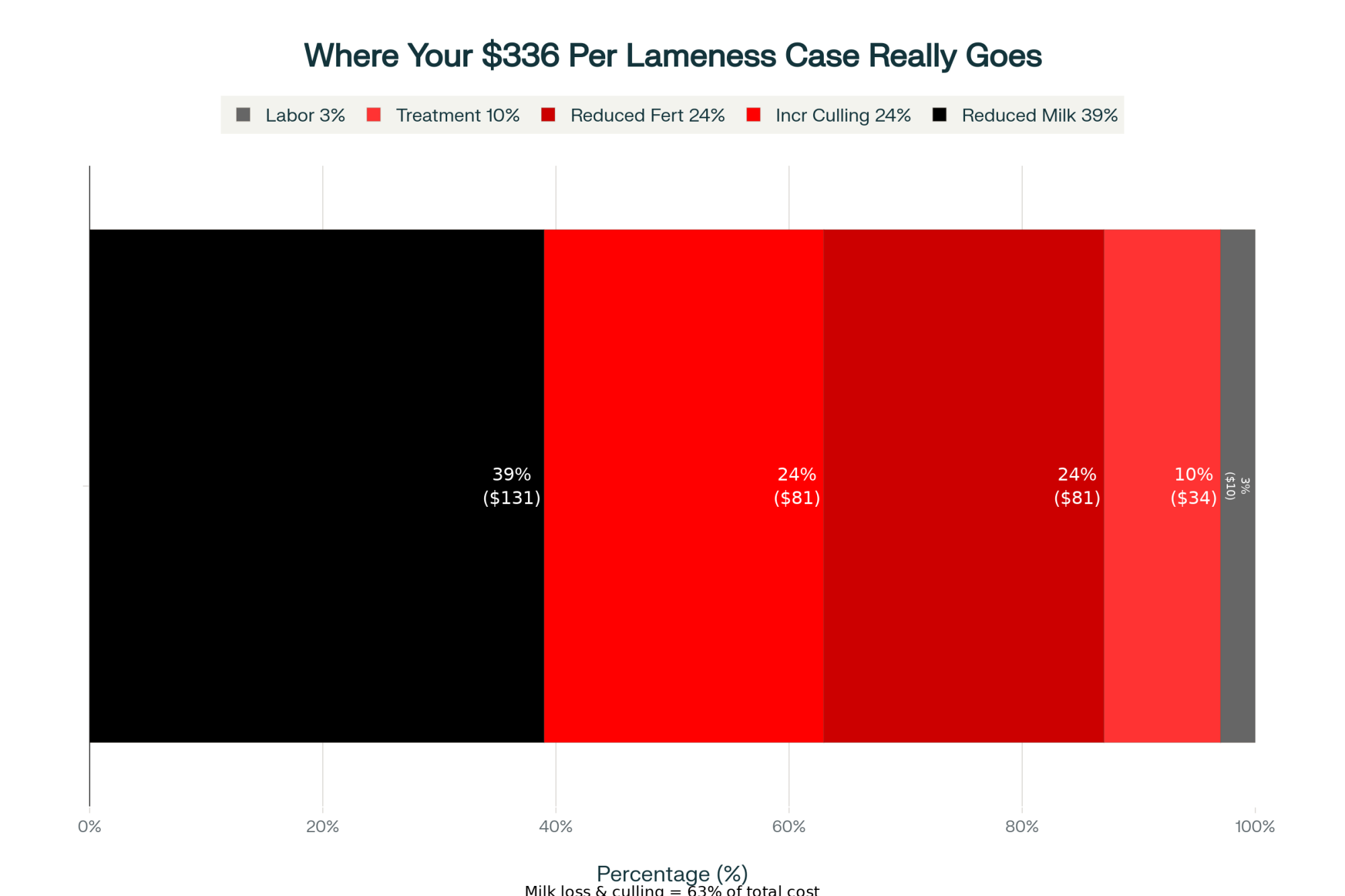
A groundbreaking study from the University of Nottingham tracked over 6,000 cows across 11 herds and analyzed more than 2 million milk records. The findings were striking—hoof problems cost an average of $336 per case, and could cut up to 17 percent of net farm profit. But what’s most interesting? Milk yield began dropping weeks before a limp appeared.
As Dr. Marcos Veira from the University of British Columbia recently put it, “The money starts leaving your tank long before the cow starts limping.” That line has stuck with many producers because it captures what science now proves: lameness isn’t just an animal welfare issue. It’s one of the most under‑recognized management costs in dairying.
The “Invisible Cow” That Costs You
Every herd has them—cows that look fine but quietly underperform. They milk, they eat, they breed back, but they never quite reach potential. Everything else in the herd may look solid—dry matter intake, conception rate, butterfat performance—yet something small keeps the herd average just below expectation.
The University of Wisconsin research team, led by Dr. Nigel Cook, found that cows showing subclinical inflammation in their hooves lose an average of 3.3 pounds of milk daily, even before lameness is visible. Across a 500‑cow freestall herd, assuming just 20% of cows are subclinically affected, that’s easily $30,000–$40,000 in milk revenue gone each year—without a single “lame cow” on the books.
What producers across North America are discovering is that the “invisible cow” problem doesn’t show up until it’s systemic—when the herd average drops, reproduction slows, and no one can pinpoint why. The solution lies not in more treatments but in catching every small signal before it compounds into loss.
What’s Actually Happening Inside the Hoof
Looking closer, the pathway from fresh cow to lameness begins well before any visual signs. During the transition period, a cow burns energy reserves to fuel milk production. That means not just backfat, but also fat from the digital cushion—the small pad beneath the coffin bone responsible for absorbing impact.
Work from Cornell University and the University College Dublin shows that when this cushion thins, the coffin bone (P3) begins pressing into the corium—the sensitive layer that forms the hoof wall. That pressure leads to micro‑bruising weeks before external changes appear. The immune system responds, redirecting nearly 40 percent of the liver’s protein synthesis away from milk components toward tissue repair.
What’s interesting here is that production losses begin long before clinical lesions do. In practical terms, that means a cow’s milk and butterfat test may be telling you about her feet weeks in advance.
Producers who have added hoof-scoring to transition audits—particularly in Wisconsin and Ontario—report lower fresh cow pullouts and steadier butterfat recovery. It’s a powerful reminder that hoof health isn’t an isolated variable. It’s baked into the biology of early lactation.
Why “Prevention” Often Misses the Mark
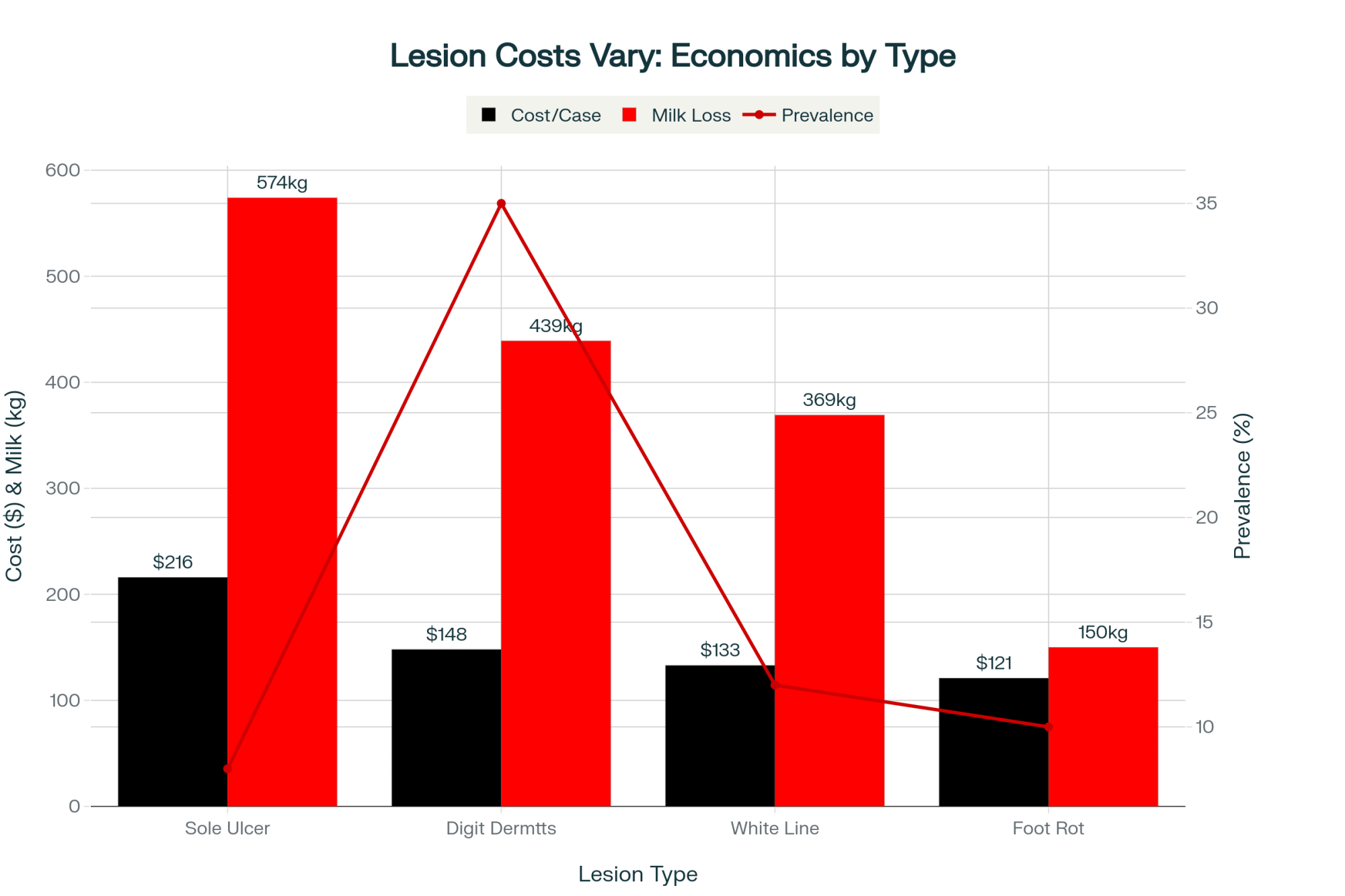
Most dairy operations already have some form of hoof care in place—scheduled trimming, routine footbaths, lesion recording, and even digital tracking. Yet despite those investments, the average herd still reports around 30 percent of cows experiencing hoof problems annually. The issue usually isn’t neglect—it’s timing.
Footbaths are indispensable for controlling digital dermatitis, but they do little to offset metabolic or mechanical strain. Likewise, blanket trimming during peak lactation can cause more harm than good.
Hoof-care pioneer Karl Burgi has spent decades talking to producers about timing and prevention. “If you’re trimming after she freshens, you’re already behind,” he says. Moving that routine to the dry period—before the hormonal wave and metabolic stress hit—gives horn tissue time to harden and dramatically reduces lesions.
I’ve noticed many herds adopting Burgi’s logic in recent years—not because it’s trendy, but because it simply pays. Prevention only works when it happens before damage begins.
The Transition Period: Management’s Sweet Spot

The transition window remains the most profitable period for hoof protection. Data from NAHMS 2023 and European dairy studies consistently show that cows losing > 0.5 BCS units between dry‑off and peak milk face exponentially higher lameness risk later in lactation.
Here are strategies that consistently yield returns:
- Trim 6–3 weeks before calving. Research from the University of Bristol showed that when trimming was moved to this window, hoof lesions dropped by 62 percent.
- Prioritize rest and comfort. A deeper bedding base and consistent cubicle space are critical. The University of Minnesota Extension found that each hour of lost rest correlates to 3 pounds of milk loss per cow, per day.
- Fortify claw health nutritionally. Supplement 20 mg biotin/head/day and 50–60 ppm zinc (half organic) to strengthen horn growth.
- Watch BCS swings closely. Logging condition scores at dry‑off, calving, and 21 days in milk creates a simple, herd‑level index of hoof risk.
One producer I spoke with near Green Bay summed it up well: “We didn’t change anything except timing, and the numbers told the story. Once we started trimming at dry‑off, it was like the cows got their footing back before calving even began.”
Closing the Freestall–Pasture Gap
It’s no secret that pasture systems show lower lameness rates—about 23 percent incidence versus 50 percent in conventional freestalls, according to data from the University of Guelph and University of Wisconsin. Still, it’s entirely possible to achieve similar comfort scores in high-producing freestall herds with fine-tuned management.
Across leading dairies, five consistent success points stand out:
- Rubber use in high-pressure zones. Installing mats in holding pens and return alleys reduces trauma by up to 40 percent.
- Modern stall design. According to the Dairyland Initiative, modern Holsteins perform best in 48‑inch stalls, 10‑foot lengths, neck rails 48–50 inches high, and 67 inches from the curb.
- Floor texture matters. Grooves, planted ¾ inch wide and 3¼ inches apart, ensure balance and minimize slips.
- Deep, dry bedding. Sand still wins on metrics of comfort and traction—reducing cases by 40 percent versus solid‑surface alternatives.
- Manage standing time. Research from Guelph suggests that keeping total standing time below 3½ hours daily minimizes the risk of sole ulcers.
Some Northeast producers have described how relatively inexpensive changes—re‑grooving lanes, adjusting neck‑rail height, or correcting parlor flow—reduced overall lameness nearly as much as large capital upgrades. What matters most is not the budget, but precision.
Genetics: The Silent Multiplier

Short-term changes can deliver immediate progress, but genetics create lasting impact. Genome mapping led by the Council on Dairy Cattle Breeding (CDCB) and Wageningen University has already linked 285 markers to hoof integrity, with heritabilities as high as 30 percent.
Producers no longer have to wait to select for sound feet. The Council on Dairy Cattle Breeding (CDCB) has already released a Hoof Health (HH$) index and direct PTAs for traits like Digital-Dermatitis-Free and Hoof-Ulcer-Free. We can even select for Digital Cushion Thickness (DCT), the very structure discussed earlier in this article. While we can still use proxies like Productive Life and Feet & Legs Composite, producers can now directly attack hoof health issues through genetic selection with far greater precision.
As Tom Lawlor, Research Director at CDCB, pointed out recently, “Every generation that overlooks hoof traits ends up paying the same bill twice.” Selecting for the right structure now locks in herd mobility—and profitability—for years to come.
A 90‑Day Plan That Delivers

For dairies looking to translate research into action, the University of Wisconsin’s 2025 Hoof Health Pilot condensed years of data into a working template. Participating herds reduced hoof treatments by 30–40 percent within six monthsand replacement rates by around 15 percent annually.
Here’s the quick version:
Weeks 1–4: Mobility‑score every cow; record one year of hoof treatments and case types.
Weeks 5–8: Standardize footbath systems (change solution every 200 passes), move trimming to dry cow groups, flag any fresh cow losing > 0.5 BCS.
Weeks 9–12: Re‑groove high‑traffic lanes if needed, fine‑tune stall design, and prioritize AI bulls in the top 25 percent for Net Merit and Feet & Legs Composite (≥ +2.0).
As one Minnesota dairyman told me, “We didn’t need an extra hoof trimmer—we just needed a plan that matched our rhythm.”
Seeing Hoof Health for What It Really Is
I remember an Ontario producer who told me, “We used to fix feet because it was the right thing to do. Now we fix them because it pays.” That statement says it all.
Hoof health has always been about welfare, but it’s also about efficiency, longevity, and sustained performance. The research, the genetics, and the management practices all tell the same story: when cows move comfortably, everything—from butterfat yield to pregnancy rate—stabilizes or improves.
What’s encouraging is that none of these solutions requires a drastic change. They’re layered, attainable, and already validated by producers who are seeing results.
Because when cows walk soundly, the entire operation gains stride—and every step becomes a step toward profit.
Key Takeaways:
- Profit leaves before the limp. Subclinical hoof pain steals milk and profits weeks before you notice.
- Start prevention early. Shifting trims, rations, and foot care to the dry period pays back fast.
- Comfort compounds. Small improvements in stalls, rubber, and cow flow can cut lameness by up to 40%.
- Breed soundness in. Bulls with positive Feet & Legs and Productive Life scores create durable cows built for longevity.
- Manage with intention. A clear 90-day plan of scoring, trimming, and tracking turns hoof health into herd stability and profit.
Complete references and supporting documentation are available upon request by contacting the editorial team at editor@thebullvine.com.
Learn More:
- Hoof Lesions in Dairy Cattle: The Hidden Profit Killer Costing Your Herd Thousands – This piece provides a tactical deep-dive into specific hoof lesions, revealing how to implement cost-effective monitoring and housing adjustments. It offers research-backed footbath protocols and trimming strategies that deliver a proven $4.20 ROI for every $1 invested in prevention.
- Understanding the Impact of Hoof Trimming on Cow Behavior and Milk Output: A Data-Driven Approach – Shifting to a strategic perspective, this article demonstrates how to use herd management data to optimize hoof care from a financial standpoint. It breaks down the economic necessity of proactive trimming, helping you build a business case for hoof health investments.
- AI Eyes on Your Herd: Why Automated Lameness Detection Is Revolutionizing Dairy Farming – Explore the next frontier of hoof health with this look at innovative technology. It explains how automated 2D imaging systems identify mobility changes up to 23 days before the human eye, empowering producers to intervene earlier and prevent profit loss.
 The Sunday Read Dairy Professionals Don’t Skip.
 The Sunday Read Dairy Professionals Don’t Skip.
Every week, thousands of producers, breeders, and industry insiders open Bullvine Weekly for genetics insights, market shifts, and profit strategies they won’t find anywhere else. One email. Five minutes. Smarter decisions all week.




