Archive for heat tolerant genetics

Why African Dairy’s $74B Boom Bypasses Local Farmers – And What It Means for Global Markets

African farmers: $21/cow/year. African dairy market: $74 billion. The money’s flowing—just not to farmers.

EXECUTIVE SUMMARY: Africa’s dairy market will reach $74 billion by 2035, yet local farmers capture just 2-3% while 80% flows to imports. The paradox: Africa owns 20% of global cattle but produces only 5% of milk, with farmers earning $21-200 per cow annually versus $1,800 breakeven in developed markets. Multinationals dominate through powder reconstitution rather than local sourcing—it’s cheaper to import at 5% tariffs than to collect from smallholders who produce 1-3 liters daily. East Africa proves transformation is possible, with Kenya and Rwanda becoming exporters through cooperatives and smart policy, while West Africa remains import-dependent. For global dairy professionals, success means abandoning Western models for adapted genetics, intermediate technologies, and hybrid strategies that match Africa’s unique reality—not replicating Wisconsin in Lagos.

African dairy market

At a recent dairy conference, I found myself in conversation with several producers interested in African opportunities. They’d all seen the same presentations—Africa’s dairy market reaching $74 billion by 2035, up from $61.7 billion today, according to IndexBox’s November 2024 analysis. “Last frontier for dairy,” one called it.

After spending the past few months examining the dynamics on the ground, I’ve come to realize we’re dealing with something far more complex than most investment presentations suggest. Africa isn’t developing a conventional dairy sector like we’ve seen elsewhere. Instead, it’s creating a unique hybrid system that challenges our traditional understanding of dairy market development.

The economic paradox of African dairy: A $74 billion market where local farmers earning $21 per cow annually capture just 2.5% of growth

The Market Growth Story: Real but Different

Understanding the Demographic Shift

The fundamentals driving growth are undeniably strong. McKinsey’s consumer research from June 2023 documented that Africa’s urban middle class is expanding from 300 million today to 500 million by 2035. That’s a demographic shift comparable to adding the entire U.S. population as potential dairy consumers.

What’s particularly noteworthy is how consumption patterns are evolving. Ethiopia’s Ministry of Agriculture reported in their 2024 sector review that urban dairy spending has accelerated dramatically, especially among middle-income households. Kenya’s Dairy Board projects 5.8% annual consumption growth through 2030—that’s faster than most Asian markets at a similar stage of development.

The Import Reality Check

Yet here’s where the story becomes more nuanced. The FAO’s November 2025 Africa Food Security Report reveals that approximately 80% of this consumption growth is met by imported dairy products and reconstituted powders, not by expanded local production.

Africa’s fundamental dairy paradox: controlling 20% of the world’s cattle but producing just 5% of global milk while importing 80% of consumption

“The continent currently produces just 5% of global milk while maintaining 20% of the world’s cattle.”

According to UN Comtrade data from 2024, Africa imports $7.5 billion in dairy products annually, with projections suggesting this could reach $15 billion by 2035. The European Milk Board’s October 2024 analysis shows traditional and fat-filled milk powder accounting for 76% of these imports—particularly dominant in West African urban centers.

KEY MARKET INDICATORS: The Scale of the Challenge

  • Current African production: 53.2 million tons (5% of global output)
  • Cattle population: 20% of the global herd
  • 2024 import value: $7.5 billion
  • Projected 2035 imports: $15+ billion
  • Powder products as a percentage of imports: 76%
  • Estimated local farmer share of market growth: 2-3%

Why Local Production Can’t Keep Pace

The Sobering Economics

I recently reviewed research from Mountaga Diop and colleagues at Senegal’s Institute of Agricultural Research, published in 2023. Their findings on smallholder economics were sobering:

“Average annual net returns of just $21.70 per cow”

Africa’s structural cost disadvantages: 70% feed costs, 40% infrastructure losses, and 53% heat-driven yield reductions make local production economically impossible against 5% tariff imports

In Kenya, often highlighted as a success story, the Kenya Institute for Public Policy Research’s 2024 analysis shows that farmers average $200 in annual profit per cow, with daily yields of 5-8 liters.

To put this in perspective, a Wisconsin producer recently told me their breakeven is around $1,800 per cow annually. The disparity illustrates fundamentally different economic realities.

Three Structural Challenges Blocking Progress

1. Feed Economics That Don’t Work

ILRI’s comprehensive study across eight African countries in 2024 found that feed accounted for 70% of production costs, compared to the 40-50% we typically see in North American operations. This difference alone changes everything about profitability calculations.

Ben Lukuyu, ILRI’s principal scientist for feed and forage development in Nairobi, shared with me that Kenya and Uganda face approximately 60% annual feed deficits. When the Russia-Ukraine conflict drove fertilizer prices up 81.9% and feed costs up 13.3%, many marginally viable operations simply couldn’t survive. And that’s in Kenya, which has better infrastructure than most.

2. Climate Stress Destroying Yields

The University of Melbourne’s research team, with support from the Gates Foundation, published compelling data in Animal Production Science this March. They documented Holstein yield reductions of 17-53% under African heat stress conditions—far exceeding what we see even in challenging U.S. environments like Arizona or Southern California.

“South Africa saw average yields decline from 21 liters to 16.1 liters per cow between 2018 and 2023—a 23% drop in the continent’s most developed dairy market”

This comes from the USDA Foreign Agricultural Service’s February 2025 report, and it’s particularly concerning because South Africa has the infrastructure we’d expect to mitigate these challenges.

3. Infrastructure That Can’t Support Growth

The World Bank’s 2024 Cold Chain Assessment estimates:

“Africa loses up to 40% of perishable food due to inadequate cold storage.”

CIRAD’s research indicates that only 1-7% of locally produced milk in West Africa enters formal trade channels. The investment required to fix this—estimated at $50-100 billion for comprehensive cold chain development—exceeds current funding commitments by roughly tenfold.

What Multinationals Are Actually Building

The Reconstitution Reality

The expansion strategies of major dairy companies offer important insights. Nestlé, Danone, and FrieslandCampina are indeed investing heavily across Africa, but their business models differ significantly from what many expect.

Okereke Ekumankama’s 2023 research at the University of Nigeria examined FrieslandCampina’s operations in detail. While the company controls 75% of Nigeria’s dairy market, they source virtually no local milk. Instead, they import powder from Europe for reconstitution in Nigerian facilities.

When “Development Programs” Don’t Develop

Their Dairy Development Programme, launched in 2010, aimed to integrate smallholder farmers. However, Ekumankama’s field research with 250 participating farmers revealed persistent challenges preventing meaningful integration.

The transaction costs of collecting from dispersed producers, averaging 1-3 liters daily, often in areas lacking roads, electricity, or cold storage, exceed the economics of importing powder at 5% tariff rates.

This pattern—building processing capacity for imported inputs rather than developing local supply chains—appears across much of the continent. It creates employment and provides affordable dairy products to urban consumers, which has value. But it doesn’t necessarily translate to local dairy sector development.

East Africa: A Different Story Emerges

The Success Stories

East Africa presents a notably different picture. The FAO’s October 2024 regional report shows the region accounting for 48% of Africa’s total milk production, with 26% growth between 2013 and 2023.

Rwanda’s Systematic Transformation

According to their Ministry of Agriculture’s presentation at September’s IDF Regional Conference:

  • Milk production tripled from 334,727 metric tons in 2010 to 1,092,430 metric tons in 2024
  • Per capita consumption doubled from 37.3 to 79.9 liters annually

The key? Mandatory quality testing at milk collection centers through Ministerial Order 001/11.30, strategic genetics programs with Heifer International, and sustained government investment spanning multiple administrations.

Kenya’s Cooperative Advantage

Kenya’s dairy success story: strategic policy and cooperative strength drove production from 4.2 to 5.7 billion kg while transforming from net importer to exporter by 2020

Kenya produces 5.7 billion kilograms annually, according to the Dairy Board’s 2025 outlook, with 80% originating from smallholder operations. The success factor isn’t individual farm productivity—yields remain at 5-8 liters per cow daily. Rather, it’s cooperative strength.

“Without the cooperative, I’d be selling to brokers at whatever price they offer. Now we negotiate as a group, and we get veterinary services I could never afford alone.”
— James Kibiru, dairy farmer in Nyeri County

Consider Meru Dairy Cooperative Union, which engages over 35,000 farmers through annual field days. They provide milk aggregation, veterinary support, quality-based payment systems rewarding butterfat performance, and collective bargaining power.

Uganda’s Export Achievement

IFPRI’s 2023 value chain analysis documents Uganda’s growth from a $2 million dairy industry in 2008 to $150 million by 2017. The country now exports $500 million worth of milk powder to Algeria, according to their Ministry of Trade’s 2024 data.

West Africa: Where Different Challenges Persist

I spoke with Kwame Asante, who manages a small dairy operation outside Accra, Ghana. “We can produce milk,” he told me, “but getting it to market before it spoils? That’s the real challenge. The processors prefer powder—it’s easier, cheaper, more reliable.”

His experience reflects broader West African dynamics. Ghana’s Fan Milk, now owned by Danone, built one of the region’s most successful distribution networks. Those yellow tricycles are everywhere in urban areas. Yet, as industry data shows, the operation relies primarily on imported powder, with local farmers supplying only about 2% of the processed volume.

The economics make sense from a processor perspective. A solar-powered cooling system for a single collection center runs about $15,000-20,000 according to equipment suppliers I’ve spoken with. When you’re collecting 50-100 liters daily from that center, the payback period stretches beyond what most investors will accept.

Policy Choices That Make or Break Markets

The fork in the road: policy choices and cooperative strength determine whether African dairy regions become self-sufficient exporters or import-dependent markets

The Tale of Two Approaches

Timothy Njagi at Kenya’s Tegemeo Institute documented how the country’s 2015 implementation of a 10% import levy plus 16% VAT on milk imports catalyzed transformation. Average daily yields from indigenous breeds increased by approximately 300% over the following decade, shifting Kenya from a net importer to an exporter.

By contrast, West African nations maintain just 5% tariffs through the ECOWAS Common External Tariff. Oxfam’s 2024 trade analysis shows the result: continued heavy import dependency, with fat-filled milk powder (a blend of skim milk and palm oil) dominating 70% of consumption in major cities.

Nigeria’s New Attempt

Nigeria’s National Dairy Policy Implementation Framework, validated in November 2025, offers:

  • Five-year tax holidays for processors
  • Low-interest credit for farmers
  • Guaranteed off-take schemes

Whether this succeeds where previous efforts struggled remains to be seen. The policy appears comprehensive on paper, but implementation has consistently been a challenge in Nigeria.

What This Means for Different Players

For Genetics Companies

Focus on adaptation, not maximum production. Raphael Mrode, who leads ILRI’s genetics program in Kenya, has been incorporating the “slick gene,” which confers heat tolerance through shorter, sleeker hair coats. These animals maintain reasonable productivity under conditions that would devastate conventional Holstein genetics.

The market opportunity exists for companies developing adaptation traits rather than pursuing maximum production designed for temperate conditions.

For Equipment Suppliers

Forget precision dairy technology designed for 1,000-cow operations. That’s not the market. Instead, think intermediate technologies: solar-powered cooling for collection centers (around $15,000-20,000 per unit), mobile apps for basic smartphones, robust milk testing equipment suitable for cooperative-level deployment.

Success requires matching technology to operational realities and economic constraints.

For Processors

Develop dual strategies: reconstitution capacity for urban markets while gradually building local collection infrastructure where economically viable. Don’t promise what you can’t deliver on local sourcing, but don’t ignore it either—governments are increasingly demanding local content.

The brutal reality: of the $74B African dairy market, local farmers capture just 2% ($1.5B) while European powder imports claim 58% ($43B)

The Bottom Line: Understanding the Real Opportunity

The $74 billion projection for the African dairy market from IndexBox appears realistic given demographic and income trends. However, understanding who captures this value—and how—requires nuanced analysis.

East African nations with strong cooperative structures and consistent policy support show genuine transformation potential. West Africa will likely remain import-dependent with selective local success stories. South Africa continues consolidating, potentially dropping below 500 commercial dairy operations by 2030.

What’s encouraging is seeing younger African dairy professionals returning from international training with fresh ideas. They understand both traditional systems and modern technology. They’re the ones who’ll ultimately bridge this gap between potential and reality.

For global dairy professionals, Africa represents opportunity—though not in ways that conform to conventional expectations. Success requires understanding the continent’s unique development trajectory, abandoning standard assumptions, and developing approaches appropriate to diverse regional contexts.

As we consider these opportunities, it’s worth noting that markets develop differently. Africa won’t follow the path of New Zealand or Wisconsin, or the Netherlands. It’s creating something new, and those who recognize and respect that difference will find the real opportunities.

This paradox—simultaneous consumption growth and production challenges—defines the current reality of African dairy. How the industry responds will shape both African food security and global dairy trade for decades to come.

What do you think? Are we looking at this opportunity the right way? I’d love to hear from producers who’ve worked in these markets or are considering investments there. The conversation continues.

KEY TAKEAWAYS:

  • Africa’s $74B dairy market is an import story, not a production opportunity—80% flows to European powder while farmers earning $21-200/cow yearly capture just 2-3% of value
  • Geography determines destiny—East Africa transforms through cooperatives and smart policy (Kenya exports after tripling yields), while West Africa stays import-dependent at 76% reconstituted powder
  • The economics simply don’t work at the current scale—African farmers face 70% feed costs (vs. 40% globally), 40% infrastructure losses, and compete against powder imports at just 5% tariffs
  • Success requires radical adaptation—heat-tolerant genetics (Holstein yields drop 17-53% in African heat), intermediate technology ($15K solar cooling, not $100K precision systems), and hybrid import-local business models
  • Multinationals aren’t villains, they’re rational—FrieslandCampina controls 75% of Nigeria’s dairy using zero local milk because collecting from smallholders costs more than importing

Complete references and supporting documentation are available upon request by contacting the editorial team at editor@thebullvine.com.

Learn More:

Join the Revolution!

Join over 30,000 successful dairy professionals who rely on Bullvine Weekly for their competitive edge. Delivered directly to your inbox each week, our exclusive industry insights help you make smarter decisions while saving precious hours every week. Never miss critical updates on milk production trends, breakthrough technologies, and profit-boosting strategies that top producers are already implementing. Subscribe now to transform your dairy operation’s efficiency and profitability—your future success is just one click away.

NewsSubscribe
First
Last
Consent

The Italian Warning: Why Your Cooling Fans Won’t Save You in 2030

$100K cooling system? Italian dairy families invested $50K in cheese vats instead—and DOUBLED profits.

EXECUTIVE SUMMARY: North American dairy faces an Italian preview: fourth-generation cheesemakers abandoning volume for value as cooling systems prove only 40% effective against extreme heat, exposing our industry’s dangerous bet on technology over adaptation. Wisconsin’s brutal arithmetic—7,000 farms vanished while production rose 5%—reveals that mid-sized operations carrying debt below the $18/cwt profitability threshold are mathematically doomed by 2030. Producers face three proven escape routes: scale to 2,000+ cows with $500K investment, pivot to seasonal/specialty for premium markets despite 30% volume cuts, or capture 10X commodity prices through on-farm processing. The clock is unforgiving—Q1 2026 marks the last moment to choose your path and begin the 3-4 year transition before market forces choose for you. Water scarcity, dependence on immigrant labor, and soil depletion compound the timeline, while genetic decisions force an uncomfortable trade-off: bulls whose daughters survive the August heat produce 500kg less milk annually. Italian farmers who accepted this reality doubled their profits; those who fought it with technology are gone. Your cooling fans won’t save you in 2030—but choosing the right business model today might.

Dairy Heat Stress Management

You know, I’ve been following what’s happening with dairy farmers in southern Italy, and it’s got me thinking about our own future here. These multi-generation families—some going back to their great-grandfathers—they’re not just adding bigger fans when the heat and drought hit. They’re completely rethinking how they farm.

Here’s what’s interesting: instead of fighting the climate with more technology, many are shifting to seasonal production with those beautiful heritage breeds like Podolica cattle. Moving from fresh mozzarella to aged cheeses that hold up better in both heat and volatile markets. Less milk, sure, but products that work with the reality they’re facing.

The European agricultural monitoring agencies have been tracking this, and the numbers tell a story. Summer milk production in Italy’s heat-affected regions has been declining by double digits over the past few years, and there’s been a steady increase in farms closing or transitioning. It’s not a crisis as much as it’s a transformation—and as I talk with producers from Vermont to California, I’m hearing remarkably similar questions bubbling up.

The insights I’m sharing here draw from extension research, industry data, and patterns I’ve observed across numerous dairy operations over recent years.

The Timeline We’re All Watching

Let me share what the research is telling us about the next decade, because this window for making strategic choices—it’s narrower than most of us realize.

The land-grant universities have been remarkably consistent. Cornell, Wisconsin, Minnesota—they’re all pointing to about a five-year period where we can still be proactive. After that? Well, the market and Mother Nature start making more of the decisions for us.

According to the U.S. Global Change Research Program’s latest work, by 2030, we’re looking at average temperature increases of 1.5 to 2.5 degrees Fahrenheit across dairy country. Now that might not sound like much sitting here, but translate that to your barn in July. We’re talking measurable production losses—maybe just over one percent nationally to start, but it won’t hit everyone equally. Some regions will feel it harder.

By 2040—and this is what really gets my attention—the modeling from multiple universities suggests heat stress days could double or even triple from what we see now. Instead of managing through 10 or 15 tough days, imagine 30 or 40 where even your best management can’t fully compensate.

Producers I’ve talked with in Wisconsin are already seeing this shift. What used to be a handful of brutal days has turned into weeks where the cows just can’t catch a break. And those power bills? Several operations tell me their cooling costs last summer ate up everything they’d saved for improvements.

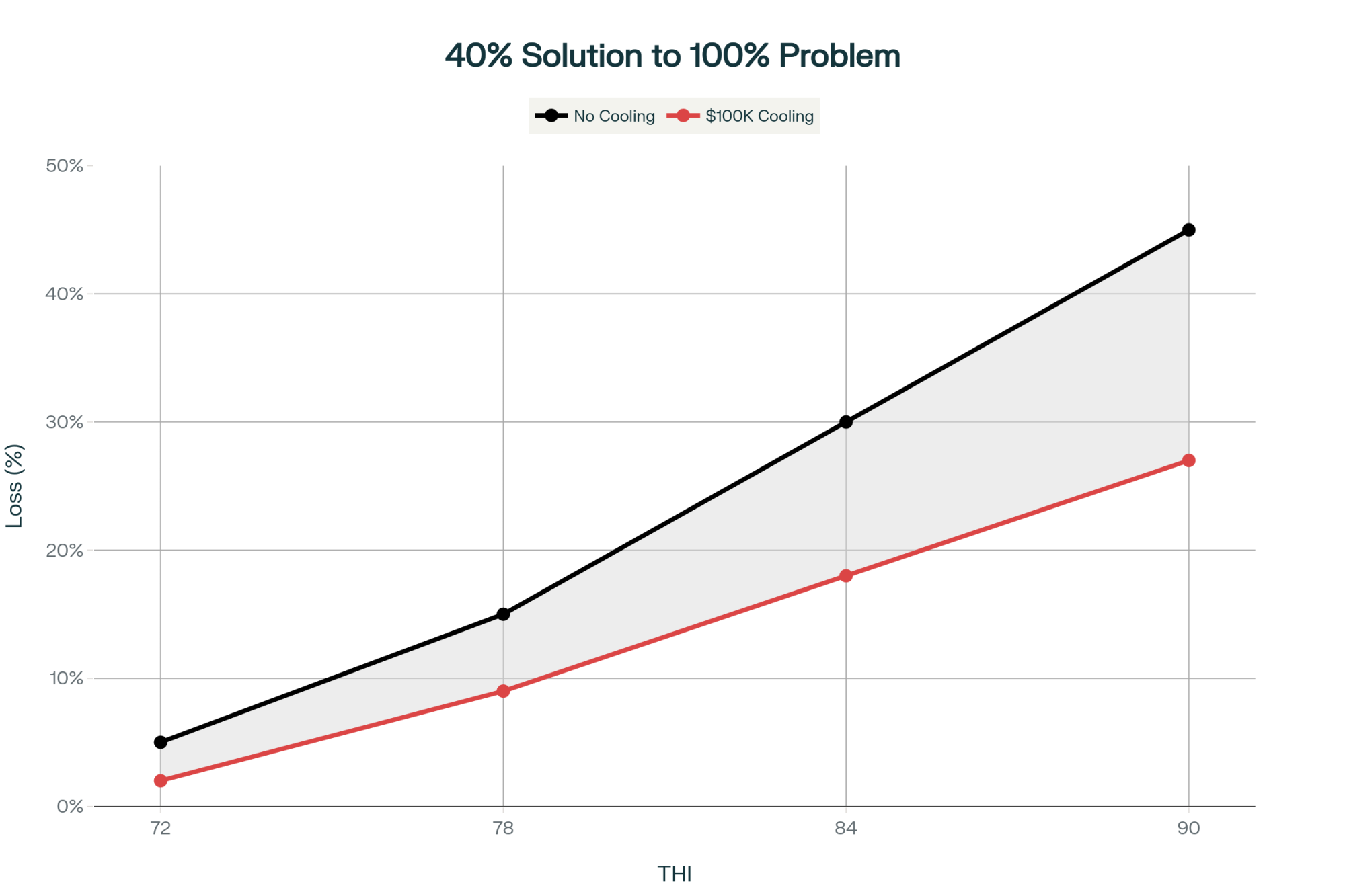
Here’s the sobering part: research from both U.S. institutions and international teams, including work from Israel’s Institute of Animal Science, published in recent years, shows that even effective cooling technology mitigates only about 40% of production losses during extreme heat events. That’s not the technology failing—that’s just the reality of what we’re up against.

That Six-Figure Cooling System Question

So let’s talk about what everyone’s pushing—these comprehensive cooling systems. I’ve been looking at the real numbers from extension programs, and honestly, the range is eye-opening.

For smaller operations, say 50 to 100 cows, Penn State Extension and others offer basic fans and sprinklers at about $10,000. That’s manageable for many. But for mid-sized farms? The backbone of many communities? You’re looking at $100,000 or more for a system that really makes a difference. Tunnel ventilation, sophisticated soakers, smart controls—it adds up fast.

Extension research from multiple land-grant universities reveals cooling systems only mitigate 40% of production losses during extreme heat events. That $100K investment still leaves you bleeding 18-27% production when it matters most—the dirty secret equipment dealers don’t advertise.

What’s particularly challenging is the cash flow math. Farm financial analyses from multiple universities suggest you need fifty to seventy-five thousand in annual free cash to justify that kind of investment. Looking at current milk checks versus input costs… that’s a pretty select group right now.

Many producers tell me the same thing: taking on massive debt for a system that only solves part of the problem feels more like gambling than adapting.

Though I should mention, for some larger operations, the investment does pencil out. Operations with 2,000-plus cows that have invested in comprehensive cooling report maintaining over 90% of their baseline production through heat waves. At that scale, with those milk volumes, the economics can work.

The Italian dairy farmers who invested $50K in cheese vats instead of $100K cooling systems doubled their profits. This chart shows why smaller, strategic investments often outperform mega-tech solutions—a reality North American producers need to face before Q1 2026.

Breeding for the Heat

Before we dive into alternatives, let’s talk genetics—because this is where the future really gets interesting.

Recent research from the USDA and multiple universities shows we’re at a crossroads in heat-tolerance breeding. The good news? Genetic variation for heat tolerance exists, and it’s heritable enough to make selection worthwhile. Studies from Florida show that 13-17% of the variation in rectal temperature during heat stress comes from genetics—that’s lower than milk yield heritability (around 30%), but it’s significant enough to work with.

What’s really eye-opening is how different bulls’ daughters perform under heat. The latest genomic evaluations show that the most heat-tolerant bulls have daughters with 2 months longer productive life and over 3% higher daughter pregnancy rates than the least heat-tolerant bulls. But here’s the trade-off—their predicted transmitting ability for milk is typically 300-600 kg lower, depending on the sire.

University research has identified a critical finding: genetic variance for fertility traits increases under heat stress. This means sire rankings change entirely depending on temperature conditions. A bull whose daughters excel for pregnancy rates in Wisconsin might tank in Texas heat, while another bull’s daughters maintain fertility specifically under stress conditions.

The industry is responding. Genomic evaluation companies now provide heat tolerance indices, with breeding values ranging approximately from minus one to plus one kilogram of milk per day per THI unit increase, according to the latest industry reports. That spread between the best and worst—it’s significant when you’re facing 40 heat stress days.

But here’s what nobody’s talking about openly: the relentless selection for production has made our cows increasingly heat sensitive. Selection indices now include longevity, fitness, and health traits, but we’re still playing catch-up. Progressive producers are prioritizing moderate frame sizes—those efficient 1,350- to 1,500-pound animals that maintain production while handling heat better than the larger frames that were historical breeding targets.

The question is: are you willing to trade some production potential for cows that actually survive and breed back in August? Because that’s the real decision genetics is putting in front of us.

USDA genomic evaluations reveal the genetic contradiction killing herds: bulls whose daughters produce 300-600 kg more milk have daughters that live 2+ months less and show 3% worse pregnancy rates under heat stress. You’re breeding cows that excel in Wisconsin winters but die in August—everywhere

Three Alternatives That Are Actually Working

This is where it gets interesting, because what I’m seeing isn’t theoretical—it’s happening right now on real farms.

Working With the Seasons

The seasonal production model adopted by some Italian producers seemed backward at first. Deliberately dry off cows during peak summer? Accept 25-30% less annual milk? But then you look at the complete picture.

Extension studies from Vermont, Wisconsin, and Michigan show feed costs dropping three to five dollars per cow per day during grazing seasons. Labor needs ease up considerably. And here’s what’s really interesting—market data from various cooperatives shows processors now paying 10-15% premiums for seasonal, grass-based milk. The market’s recognizing quality differences.

I’ve been tracking operations in Vermont and elsewhere that made this shift. Despite producing less milk than year-round neighbors, many report their net income actually increased—sometimes by 20% or more. As one producer put it to me, “When you stop fighting the weather every day, when the cows are comfortable in August, everything changes. The stress level drops for everyone.”

Value-Added on the Farm

Let’s talk about processing, because the economics here can be compelling for the right operation. We all know commodity milk prices—eighteen to twenty dollars per hundredweight when things are decent, less when they’re not. But producers who bottle and sell direct? Industry surveys from the American Cheese Society and extension case studies consistently show returns of $60 to $90 per hundredweight equivalent. That’s not marginal improvement—that’s a different business entirely.

The investment for basic processing ranges from 50 to 100 thousand, about what you’d spend on cooling. But here’s the difference—Penn State feasibility studies and Wisconsin DATCP analyses show that many processors recover that investment in 6 to 12 months when they’ve got their markets lined up.

Operations that have gone this route tell me the aged cheese they make during spring flush can bring ten times what they’d get from the co-op. Ten times. Now, it takes skill, the right permits, and consistent marketing, but for those who make it work, it’s transformative.

Going Direct to Consumers

What’s really changed—and this deserves attention—is the regulatory landscape. The Farm-to-Consumer Legal Defense Fund now tracks over 30 states that permit some form of direct dairy sales. That’s up from basically zero fifteen years ago.

The price differential almost seems unfair to discuss. Raw milk, when it’s legal and properly marketed, sells for $8 to $12 a gallon directly to consumers. Compare that to the $1.80 or $2 equivalent at the farm gate.

What’s encouraging is you don’t need to convert everything. Producers successfully moving just 20% of their milk to direct channels report that it completely changes their financial stability. It’s about diversification that actually means something.

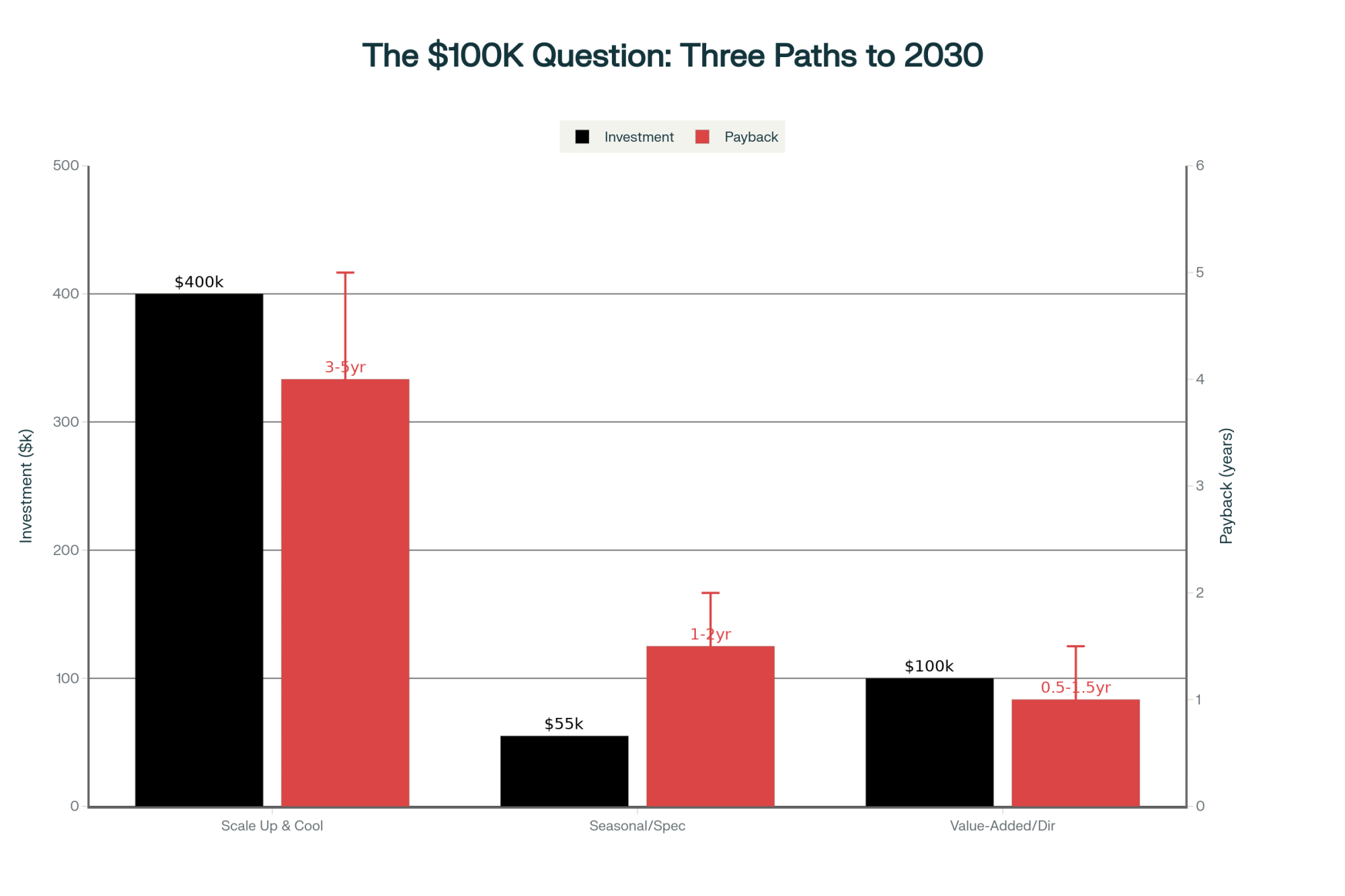
Your Three Pathways: A Quick Comparison

PathwayInvestment RequiredTypical PaybackVolume ChangeBest If You Have…
Scale Up & Cool$300k – $500k3-5 yearsMaintain/IncreaseStrong cash flow, <50% debt
Seasonal/Specialty$30k – $80k1-2 years-25% to -30%Pasture access, flexible mindset
Value-Added/Direct$50k – $150k6-18 months-20% to -30%Market access, marketing skills

The Math of Consolidation is Ruthless

Let’s stop dancing around this. If you’re mid-sized and carrying debt, the climate is coming for your margins—and the numbers don’t lie.

Research from Wisconsin and Cornell agricultural economists identifies the exact break points where your operation becomes a casualty. When your realized milk price consistently runs below eighteen dollars per hundredweight, you’re not adapting—you’re bleeding equity. When income over feed costs drops below seven or eight dollars per cow per day, you can’t service debt anymore. And when debt-to-asset ratios climb above 50%, banks won’t even return your calls for upgrade financing.

These thresholds aren’t suggestions—they’re mathematical realities derived from thousands of farm closures.

Wisconsin’s experience is the canary in the coal mine. USDA-NASS data shows the state hemorrhaged 7,000 dairy farms between 2015 and 2023, yet milk production hit records. Those weren’t random failures—they were mid-sized family operations caught in the consolidation vice. Meanwhile, according to the 2022 Census of Agriculture, operations with over 1,000 cows now control two-thirds of the nation’s milk supply, up from 57% just five years back.

The consolidation winners aren’t shy about it either. Producers who’ve successfully scaled tell me that at 2,000+ cows, they access technology and leverage that transforms the entire business model. As one mega-dairy owner put it bluntly, “Scale gave us options. Everyone else just has hope.”

If you’re sitting at 200 cows with 60% debt-to-asset and milk at $17.50, the math is already written. The question isn’t whether you’ll consolidate or exit—it’s how much equity you’ll have left when you do.

“Sometimes working with natural systems instead of against them might be the smartest strategy of all.”

Three Constraints We’re Not Discussing Enough

Beyond climate and economics, three pressures deserve more attention.

Water Is Everything

The situation with the Ogallala Aquifer has shifted from concerning to critical. U.S. Geological Survey data from 2024 shows that recoverable water continues to decline. Kansas reported drops exceeding a foot across wide areas last year. This directly affects irrigation for feed and long-term dairy viability.

In California, UC Davis research documents that Central Valley groundwater depletion is accelerating beyond sustainable levels. The San Joaquin Valley alone has lost over 14 million acre-feet of groundwater storage since 2019. We’re looking at maybe 15-20 years before water, not heat, determines who stays in business there.

Producers in those regions tell me water is now their first consideration every morning—something their grandfathers never worried about.

Labor Challenges Keep Growing

Industry analyses from the National Milk Producers Federation and Texas A&M converge on this: roughly half of dairy’s workforce consists of immigrant labor, and those workers produce the vast majority of our milk. When you overlay visa challenges and local labor shortages, smaller operations feel it first and hardest.

Rising labor costs—an extra two or two-fifty per cow per month in many areas—that’s often the difference between black and red ink when margins are already tight.

Soil Health Can’t Be Ignored

This might be our biggest long-term challenge. FAO data from 2024, backed by Iowa State research, shows soil organic carbon down by half in many agricultural regions. The fix—regenerative practices—takes three to five years and serious capital before you see results in forage quality.

The operations that most need soil improvement often lack the financial cushion to weather that transition. It’s a tough spot.

Making Your Own Decision

After countless conversations with producers and advisors, certain patterns have emerged to help frame decisions.

Suppose you’re consistently seeing milk prices above eighteen dollars, maintaining income over feed costs above seven or eight dollars per cow per day, keeping debt-to-asset ratios under 50%, and can access three to five hundred thousand in capital. In that case, scaling up with cooling infrastructure might work. But success still requires exceptional management and decent markets.

If those numbers don’t line up but you’re within reach of population centers, have some pasture, and can stomach lower volume for better margins, specialty production models offer real potential. Especially if you can develop that direct channel that provides price stability.

Timing matters. By year’s end, you need an honest assessment. First quarter 2026—decision time. Use 2026-27 for building infrastructure or markets. By 2028-29, you should be transitioning operationally. Come 2030, your model needs to be locked in, because the competitive landscape will be pretty well set by then.

Land-grant research from Cornell, Wisconsin, and Minnesota converges on one truth: you have 5-7 quarters to choose your survival path. Q1 2026 marks the last moment for proactive choice—after that, milk prices, heat waves, and bank covenants make the decision for you. Wisconsin’s 7,000 lost farms learned this the hard way

Regional Realities

RegionCurrent Heat Stress Days2035 Projected Heat DaysWater Crisis SeverityRunway to AdaptCompetitive Advantage
Upper Midwest (WI, MN, MI)12-1520-25StableLongest (~10 yrs)HIGH
Plains States (NE, KS)20-2535-45CRITICAL -1 ft/yrShort (~5 yrs)Declining
California & Southwest30-3545-55EXTREME 140 gal/cowIMMEDIATE (~2 yrs)Collapsing
Northeast (NY, VT)8-1215-20FavorableLong (~12 yrs)HIGHEST
Southeast (GA, FL)40-5060-70ModerateAlready Here (0 yrs)Experience Leader

Upper Midwest

Wisconsin, Minnesota, Michigan—you’ve got the longest runway. University of Minnesota Extension modeling suggests heat stress stays manageable through 2030, and water’s relatively stable. Focus on genetics, targeted cooling in holding areas, and protecting components during stress periods. Current operations average 12-15 heat stress days annually, expected to reach 20-25 by 2035.

Plains States

Nebraska and Kansas dairy operations face a double squeeze—the depletion of the Ogallala Aquifer threatening feed production while heat-stress days increase from the current 20-25 to projected 35-45 by 2040. Kansas State research shows producers here need water strategies yesterday, not tomorrow. Some are already transitioning to dryland-adapted forage systems or relocating operations entirely.

California and the Southwest

Water drives everything here. UC Davis reports show you’re already using 20-30% more water per cow than a decade ago just to maintain production. California dairy operations now consume an average of 140 gallons per cow daily during summer months, up from 95 gallons in 2014. If you haven’t developed a water strategy beyond hoping for wet years, you’re behind. The next five years will force hard choices about value-added production, relocation, or partnering with operations that have water rights.

Northeast

Cornell’s work shows you maintaining favorable conditions through 2035. That’s an opportunity—develop specialty markets now while you have the advantage. The artisan cheese growth in places like the Hudson Valley shows that real market appetite exists. New York State Department of Agriculture reports specialty dairy operations increased 35% between 2022-2024.

Southeast

You’re living tomorrow’s challenges today. Georgia and Florida operations already manage 40-50 heat stress days annually. Every smaller operation surviving your heat and humidity has developed strategies that the rest of us need to study. Your experience is our roadmap.

Resources for Moving Forward

Decision Support Tools:

  • Cornell’s IOFC Calculator (available through the PRO-DAIRY website)
  • Penn State’s Enterprise Budget Tool for processing feasibility
  • USDA Climate Hubs’ regional adaptation resources
  • National Young Farmers Coalition’s direct marketing guides

The Bottom Line

Climate change isn’t just forcing operational changes—it’s driving fundamental shifts in business models. The successful producers I see aren’t trying to preserve yesterday’s approach with tomorrow’s technology. They’re finding what works with emerging realities.

The choice isn’t simply to get bigger or get out. It’s about finding the model that fits your resources, market access, and what lets you sleep at night. For some, that’s scale and technology. For others, it’s lower volume with higher margins through differentiation.

What those Italian dairy farmers are teaching us isn’t that we should all make aged cheese or switch breeds. It’s that one-size-fits-all responses might be less adaptive than thoughtful, farm-specific strategies.

Your operation’s future depends on choosing a path, but mostly on choosing soon enough to control how you implement it. The changes are coming either way.

This is about preserving not just farms but farming as a viable way of life. Sometimes that means producing less to preserve more. Sometimes it means completely rethinking what success looks like.

And sometimes—just sometimes—it means recognizing that working with natural systems instead of against them might be the smartest strategy of all.

Key Takeaways:

  • Cooling = 40% solution to a 100% problem: That $100K system you’re considering? It only stops 40% of losses at extreme temps. Italian farmers who invested in $50K cheese vats doubled their income instead.
  • Three models survive 2030—pick one NOW: Mega-dairy (2,000+ cows), seasonal/specialty (30% less milk, 20% more profit), or value-added (10X commodity prices). Middle ground is extinction.
  • The $18/cwt line divides living from dying: Below it, with >50% debt, you’re already bleeding equity daily. Wisconsin lost 7,000 farms in this death zone while production rose 5%.
  • Genetics force a brutal trade: Accept 500kg less milk for cows that survive August, or chase maximum production with daughters that won’t breed in heat. There’s no middle option.
  • Water kills operations faster than heat: Ogallala Aquifer -1ft/year. California dairy: 140gal/cow/day. Your 2030 survival depends more on water rights than cooling technology.

Complete references and supporting documentation are available upon request by contacting the editorial team at editor@thebullvine.com.

Learn More:

Join the Revolution!

Join over 30,000 successful dairy professionals who rely on Bullvine Weekly for their competitive edge. Delivered directly to your inbox each week, our exclusive industry insights help you make smarter decisions while saving precious hours every week. Never miss critical updates on milk production trends, breakthrough technologies, and profit-boosting strategies that top producers are already implementing. Subscribe now to transform your dairy operation’s efficiency and profitability—your future success is just one click away.

NewsSubscribe
First
Last
Consent

The Million-Cow Gamble: What Indonesia’s Quiet Revolution Means for Your Bottom Line

Indonesia’s million-cow plan is rewriting global dairy trade—are we paying attention?

EXECUTIVE SUMMARY: Here’s what we discovered: Indonesia’s quiet revolution is slashing global dairy imports by up to 20%, with plans to import a million dairy cows by 2029—enough to flip the script on old export markets. Their fresh milk production hit 672,000 metric tons in 2023 despite recent disease setbacks, signaling rapid recovery with big implications for exporters worldwide. This shift is backed by strict local sourcing mandates in massive school nutrition programs serving over 80 million kids daily. Together with moves in Malaysia and Vietnam, it signals a tectonic shift in regional dairy supply chains. The data tells a different story than corporate PR: export premiums are at risk, margins are tightening, and family farms face real pressure. Progressive dairy producers need to rethink market assumptions, adjust genetics for heat tolerance, and diversify buyers now or risk being left behind. The time for complacency is over.

KEY TAKEAWAYS:

  • Indonesian policies could reduce dairy imports by up to 20%, impacting export revenues by hundreds of millions.
  • The importation of 1 million dairy cows by 2029 aims to boost domestic milk production, thereby pressuring foreign suppliers rapidly.
  • Local sourcing mandates in school nutrition programs create a massive, guaranteed demand that is inaccessible to imports.
  • Progressive producers should invest in heat-tolerant genetics, expand buyer diversification, and strengthen coop alliances.
  • 2025 market realities necessitate strategic agility to maintain profitability amid shifting global dairy trade dynamics.
 dairy farm profitability, global dairy markets, heat tolerant genetics, dairy trade disruption, farm business strategy
A worker feeds Holstein-Friesian cows from Australia at a dairy farm managed by Laras Ati milk cooperative in Kuningan, West Java province, Indonesia, Indonesia, June 25, 2025. REUTERS/Ajeng Dinar Ulfiana

You ever sit down over coffee with the guys on the farm and wondered if Asia really is this endless dairy goldmine we’ve been sold? I’ve been chewing on this myself, and Indonesia’s quietly changing the game in a way that’s hard to ignore.

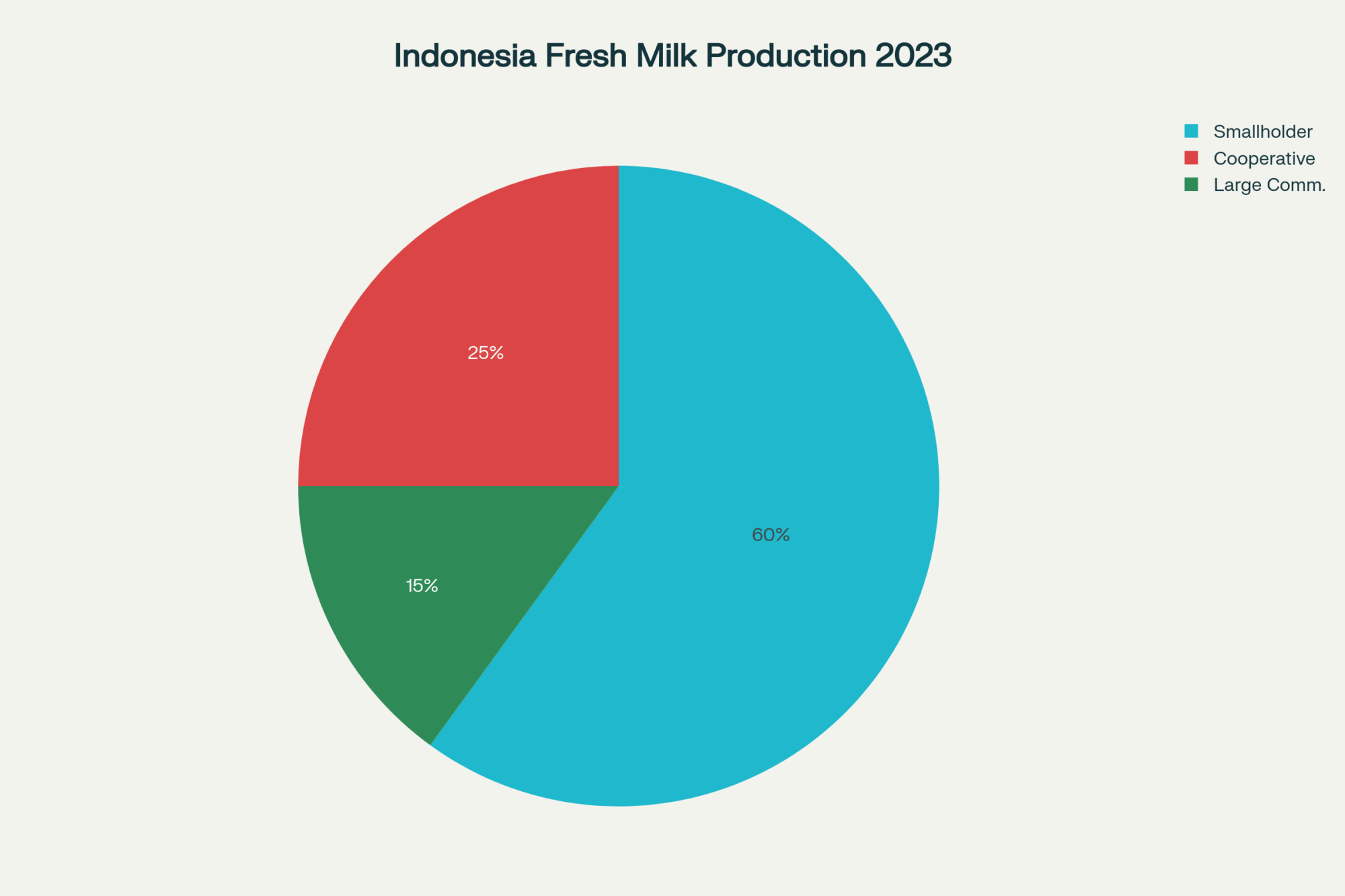
See, Indonesia pushed its fresh milk production up to about 672,000 metric tons last year, bouncing back fairly quickly after a heavy hit from that foot-and-mouth outbreak took out a good chunk of their herd (USDA GAIN Report ID2024-0038, 2023). But listen—their dairy imports dropped by 10 to 20 percent in 2023, not for lack of demand, but because the government cracked down hard on those import licenses and started backing their own dairy farmers (USDA GAIN Report ID2023-0033, DairyNews 2023).

When a Million Cows Change Everything

Now, here’s the kicker—these folks are planning to import a million dairy cows by 2029. Not just any cows, but mainly pregnant heifers ready to calve fast and get milk flowing (Reuters, September 2025; Indonesian Ministry of Agriculture).

These cows are mixed breeds—Holsteins crossed with Zebu—which those of us dealing with hotter summers can appreciate. They’re heat-tough and push out milk levels that small family farms see averaging 9 to 10 liters a day, while the bigger operations can hit 25 liters and up (USDA GAIN Reports; GKSI Cooperative Data).

The School Milk Shell Game

The government’s Free Nutritious Meals program is massive—serving over 80 million kids daily. And here’s the catch that should worry every export manager: every drop of milk for those kids has to come from local dairies. No imported powder slipping into those cartons (Indonesian Government releases; UN Nutrition Program, 2025).

That’s not just guaranteed demand. That’s a wall around billions of liters that used to flow from places like New Zealand and Australia.

The Ripple Effect Hits Home

Malaysia’s following suit, aiming to be 100% dairy self-sufficient by 2030, and they’ve got operations already positioning to cover demand (Malaysian Ministry of Agriculture, 2024). Vietnam’s boosting processing capacity like a barn raising, while the Philippines—reliant on nearly 99% imports—is working hard with Australian research backing to flip the script.

So here’s the deal—Indonesia’s moves have already hit export revenues hard. New Zealand and Australia have faced significant losses in the Indonesian market, and the U.S. has seen a decline of about 20 percent in exports to Southeast Asia recently (The Bullvine, USDA trade data, 2025).

Back home, you’re feeling this squeeze too. The processor plants from Ontario to Wisconsin and the Dakotas aren’t running full tilt anymore. And it’s the smaller operators who get hit first when export premiums shrink and contracts dry up.

Red Flags for Smart Operators

Now, if you hear about new dairy plants investing hundreds of millions across Asia, or government cattle import pushes targeting hundreds of thousands of head—that’s not just expansion. That’s systematic market capture.

Those Holstein-Zebu crosses that handle the heat? They’re no longer just a tropical curiosity. With climate change pushing temperatures up everywhere, those genetics are heading north whether we’re ready or not.

What This Means for Your Operation

The thing is, processing plants that built their growth plans around export markets are finding out those markets aren’t expanding—they’re shrinking. Family operations depending on export premiums to service debt are feeling the pinch first.

When your local co-op starts talking about “diversifying markets” or your processor mentions “adjusting contracts,” that’s code for export revenues getting squeezed.

The Bottom Line for Independent Producers

So here’s what I’m telling folks at every coffee shop and fence line: Get your genetics sorted—heat tolerance isn’t optional anymore. Spread your risk—don’t hang everything on one buyer if you can help it. Get tight with your co-op and understand their export exposure, because their pain becomes your pain real quick.

Most important? Stop believing fairy tales about endless growth markets. Start planning for a world where those markets supply themselves.

The Hard Truth About Market Shifts

The dairy industry you grew up in—where rich countries shipped to poor countries—is changing faster than a summer storm. Indonesia has demonstrated that developing nations can reduce their import dependency through coordinated policy and investment.

The question isn’t whether this transformation continues. The question is whether your operation adapts fast enough to survive what’s coming next.

That’s the straight story—no industry spin, no comfortable lies. Just the facts you need before your next equipment purchase, before your next expansion decision, before you bet your farm’s future on yesterday’s assumptions about tomorrow’s markets.

The dairy world we know? It’s changing fast. If you’re not ready to roll with it, you might get left chasing yesterday’s milk check.

Complete references and supporting documentation are available upon request by contacting the editorial team at editor@thebullvine.com.

Learn More:

Join the Revolution!

Join over 30,000 successful dairy professionals who rely on Bullvine Weekly for their competitive edge. Delivered directly to your inbox each week, our exclusive industry insights help you make smarter decisions while saving precious hours every week. Never miss critical updates on milk production trends, breakthrough technologies, and profit-boosting strategies that top producers are already implementing. Subscribe now to transform your dairy operation’s efficiency and profitability—your future success is just one click away.

NewsSubscribe
First
Last
Consent
Send this to a friend