


Archive for heat stress dairy cattle

When 110 Brazilian Gyr Cows Changed Everything: The Dairy Shift Tropical Producers Can’t Ignore

While you’re spending $3,000/cow on cooling, Brazilian Gyrs are cranking 11L daily without a single fan. Ecuador just figured it out.

EXECUTIVE SUMMARY: Listen, I just got back from covering the most eye-opening genetics move I’ve seen in decades. Ecuador’s betting their dairy future on heat-adapted Gyr cattle instead of million-dollar cooling systems—and the math is brutal for anyone still fighting their climate. Here’s what’s got me fired up: while your Holsteins lose 25% production when summer hits, these Brazilian Gyrs keep pumping 11 liters daily with zero performance drop. We’re talking about a $306 million global genetics market that’s exploded because smart producers realized something… cooling bills that eat half your feed budget aren’t sustainable. The kicker? These aren’t experimental genetics—they’re million-year-old solutions with 85% genomic prediction accuracy backing every breeding decision. Brazil’s producers learned this lesson decades ago, and now Ecuador’s 300,000 dairy families are following suit. If you’re still mortgaging your future for climate control infrastructure, you might want to run these numbers before your next summer burns through another year’s profits.

KEY TAKEAWAYS:

  • Cut summer production losses by 80%: Gyr genetics maintain 95% output during heat stress while Holsteins crash 25%. For a 100-cow operation, that’s 40-50 liters daily you’re not losing to heat—start with AI programs from proven tropical genetics suppliers this month.
  • Slash infrastructure costs by ditching cooling dependency: Ecuador producers were quoted millions for climate control before discovering Gyr operations running profitably with zero cooling systems. Calculate your current cooling costs per cow and compare against genetic investment ROI—the payback timeline might shock you.
  • Tap into the $306M global heat-tolerance boom: Brazilian genetics are penetrating Australia, New Zealand, and even Germany as traditional markets wake up to climate reality. Contact your genetics supplier about heat-adapted semen availability and pricing—this trend isn’t slowing down.
  • Leverage 85% genomic accuracy for breeding decisions: Modern tools predict heat tolerance in calves before they’re born, eliminating guesswork from your genetic investments. Work with suppliers offering genomic testing to build your heat-adapted herd strategically over the next 3-5 years.
  • Future-proof against rising energy costs: With cooling expenses ranging $0.50-$0.85 per cow daily during peak season, heat-adapted genetics become more valuable every summer. Track your energy bills from last summer and project them forward—genetic solutions look better every year.
Heat stress dairy cattle, Gyr genetics, dairy profitability, tropical dairying, genomic testing dairy

If you had told me a year ago that two cargo planes filled with Brazilian Gyr cows landing in Quito would fundamentally alter tropical dairying, I’d have been skeptical. But those 110 head made a clear statement: the way to beat the tropical heat just got smarter.

Ecuador’s Dairy Reality Check

Ecuador churns out roughly 2.4 billion liters annually from close to 300,000 producers—mostly family operations grinding it out in challenging conditions². Nearly half that milk flows through informal channels, which puts a ceiling on modernization and growth.

Up in the highland regions around Pichincha and Cotopaxi, producers face a double whammy: altitude challenges at 2,700+ meters reduce oxygen levels and stress cows even before heat becomes a factor. Recent research from the University of Liège shows these operations average 15.1 kg daily production under rotational grazing systems.

Based on conversations with multiple producers near Cayambe, there’s a shared frustration: “Our cooling bills are eating almost half what we spend on feed. That’s money we’d rather put back into genetics or better pastures.”

Why Gyr Genetics Are Game-Changers

Standing in a Minas Gerais pasture with Dr. Roberto Silva—one of Brazil’s top zebu geneticists—changed everything I thought I knew about tropical dairy. Watching Gyr cows stroll calmly to milking while Holstein crossbreds desperately sought shade was eye-opening.

These aren’t just heat-tolerant cows—they’re heat-adapted machines. Gyrs maintain performance at Temperature-Humidity Index levels of 77.5, while Holsteins start shutting down around 72-73. That translates to a consistent 10-12 liters daily with 4.2% butterfat, even when the mercury soars.

Breed Performance Reality Check

Data compiled from peer-reviewed studies; individual results vary

Performance MetricGyrHolsteinGirolando
Daily Milk (Tropical)11L7L9.5L
Butterfat Content4.2%3.6%4.0%
Heat Tolerance (THI)77.57275
Summer Production Loss5%25%12%

A Brazilian farm manager near Uberaba told me: “My Holstein crossbreds might hit 18 liters in cool weather, but come summer, they crash to 8. These Gyrs? Rock solid at 11 liters every single day, no matter how hot it gets.”

The Hidden Challenge: Feed Quality and Mycotoxins

What most producers don’t realize is that heat stress is just part of the battle. Ecuador’s coastal regions get hammered with aflatoxin contamination during dry seasons, destroying feed quality and milk safety.

Highland pastures face their own challenges—protein levels fluctuate between 12-18% seasonally, with fiber digestibility dropping during dry periods. When you combine altitude stress, heat, and compromised feed, conventional genetics simply can’t keep up.

That’s where Gyr genetics shine. Evolved in harsh environments, their efficient metabolism and robust digestive systems give them distinct metabolic resilience to multiple stressors simultaneously—heat, altitude, and suboptimal feed quality that would cripple temperate breeds.

LATAM’s Logistics Masterclass

Getting 110 head of elite genetics from Brazil to Ecuador wasn’t just impressive—it was a blueprint for international livestock transport. LATAM Cargo executed quarantine protocols stricter than most international borders, with veterinary teams monitoring every phase.

The economics tell the real story: strategic genetic investments are proving more cost-effective than infrastructure-heavy cooling solutions that drain margins year after year.

What This Actually Costs Your Operation

Let’s cut through the marketing fluff and talk real numbers. Investment costs vary dramatically based on your operation size, location, and current setup. What works in one climate might be overkill or inadequate in another.

The Reality Check:

  • Heat-adapted genetics costs depend heavily on genetics quality, supplier, and regional availability
  • Cooling system investments vary by barn design, local energy costs, and climate severity
  • Ongoing energy and maintenance can be substantial during peak seasons

Note: Costs vary significantly based on operation scale, regional factors, and technology choices. Producers should obtain specific quotes for their circumstances, as investment requirements can range widely depending on genetics quality, supplier, and local infrastructure needs.

A producer near Cuenca summarized what I heard across the region: “We got infrastructure quotes that honestly scared us. Then I visited Brazilian Gyr operations—cows producing quality milk without a single cooling fan. That changed our whole thinking.”

Global Momentum Building Fast

This shift is happening worldwide. The international genetics trade reached $306 million in 2023, with Brazilian bloodlines gaining traction in traditionally temperate markets such as Australia and New Zealand.

Dr. Klaus Weber from Germany’s University of Hohenheim nailed it during our conversation: “Forcing European genetics to work in a warming climate is like wearing snow boots to the beach. Zebu genetics have the evolutionary head start we desperately need.”

Brazil represents a major force in South American dairy production for good reason—its producers learned to work with their environment, not against it.

Technology Meets Ancient Wisdom

Behind these cows, cutting-edge genomic selection is adding precision to natural selection. Brazilian researchers have now achieved 85% accuracy in predicting heat tolerance using genomic tools. This isn’t guesswork—it’s precision breeding based on millions of years of natural selection.

The combination of ancient genetics with modern reproductive technology enables you to rapidly improve your herd’s climate adaptation without the infrastructure investment required by traditional cooling methods.

Your Action Plan

If heat stress is bleeding your margins, here’s your roadmap:

This Week:

  • Contact heat-adapted genetics suppliers and ask for performance data from herds in climates similar to yours
  • Install simple, high-visibility thermometers in your barns and holding pens to establish a baseline Temperature-Humidity Index (THI) for your operation
  • Calculate your actual cooling costs per cow during peak season

This Month:

  • Track summer production losses: measure milk yield and conception rate drops from May through August
  • Visit a Gyr or Girolando operation if you can swing it
  • Connect with your local extension economists for regional cost data

This Quarter:

  • Model ROI comparing genetic upgrades versus cooling infrastructure using your actual quotes
  • Develop a realistic genetic improvement timeline for your operation
  • Assess your feed quality management and mycotoxin protocols

Don’t waste another summer watching profits evaporate with your milk production.

The Bottom Line

Ecuador’s strategic investment proved something every tropical producer suspected—there’s a better way than fighting your climate with expensive cooling systems that drain margins year after year.

The genetics are proven. The economics make sense for many operations. The climate isn’t getting any cooler.

Time to run your numbers and make the call. The flight path from Brazil to Ecuador isn’t just news—it’s showing the way to profitability in our warming world.

Complete references and supporting documentation are available upon request by contacting the editorial team at editor@thebullvine.com.

Learn More:

  • The Ultimate Guide to Dairy Sire Selection – This guide provides a tactical framework for making smarter breeding choices today. It details how to interpret proofs and prioritize traits, ensuring you can effectively implement the genetic shift towards heat tolerance discussed in the main article.
  • Does Your Dairy Have A Strategic Plan? – Move from a single breeding decision to a long-term vision. This article outlines how to build a robust strategic plan, helping you position your entire operation to capitalize on market shifts like the move towards climate-adapted genetics.
  • Genomics: The Crystal Ball of the Dairy Industry – Dive deeper into the technology mentioned in our feature. This piece explains how genomic testing provides an unprecedented look into future performance, allowing you to accelerate genetic gain and make breeding decisions with greater accuracy and confidence.

Join the Revolution!

Join over 30,000 successful dairy professionals who rely on Bullvine Weekly for their competitive edge. Delivered directly to your inbox each week, our exclusive industry insights help you make smarter decisions while saving precious hours every week. Never miss critical updates on milk production trends, breakthrough technologies, and profit-boosting strategies that top producers are already implementing. Subscribe now to transform your dairy operation’s efficiency and profitability—your future success is just one click away.
NewsSubscribe
First
Last
Consent

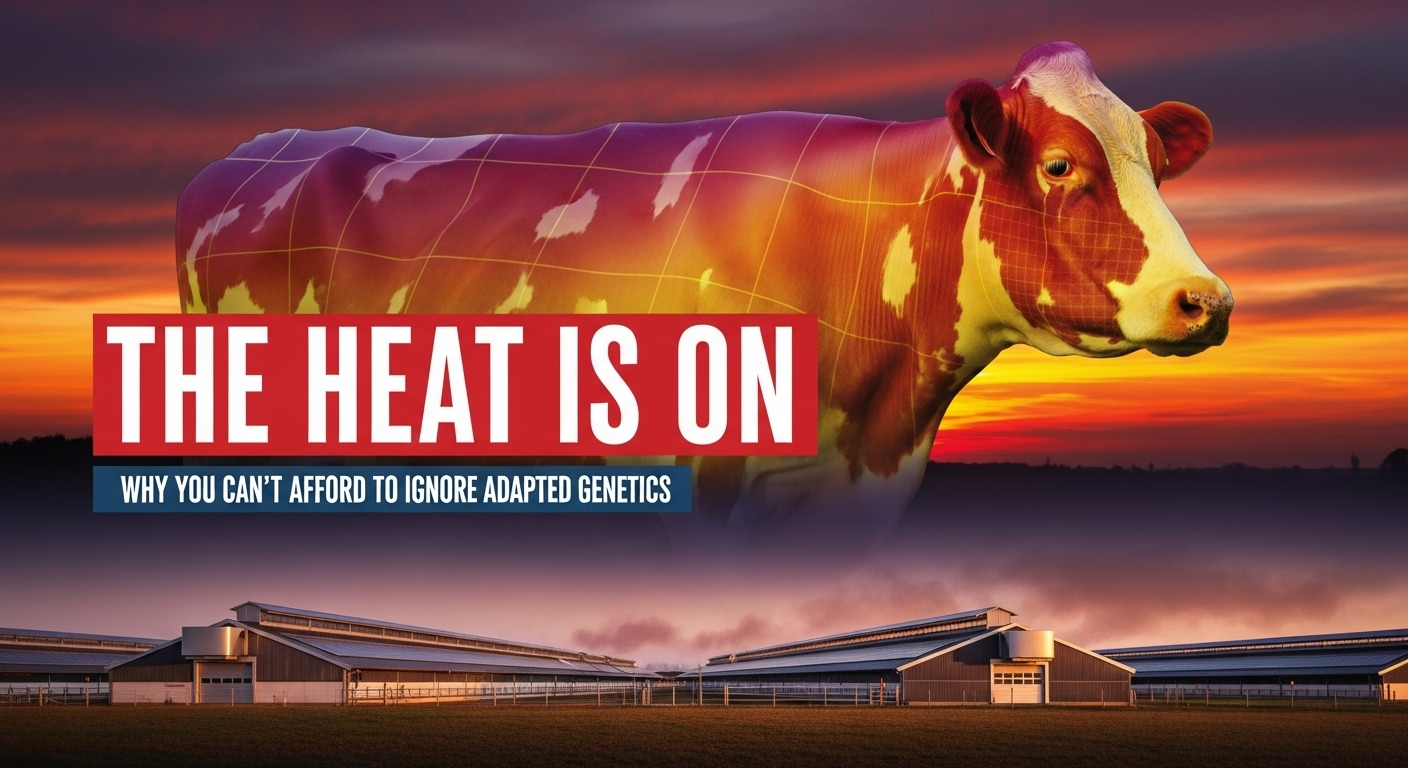
The Heat Is On: Why You Can’t Afford to Ignore Adapted Genetics

Forget everything you know about Holsteins. Brazilian cows are schooling us on heat tolerance.

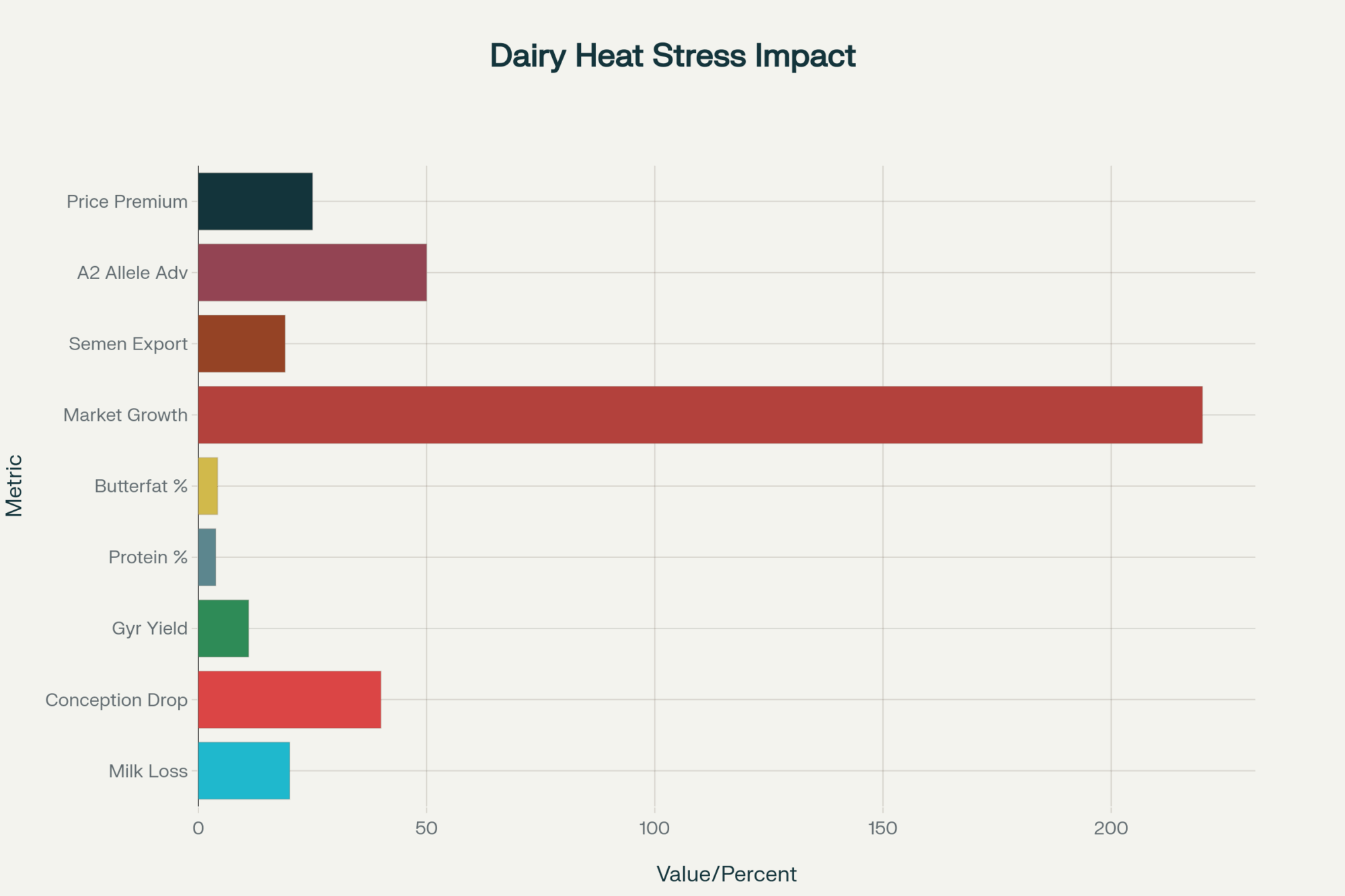
EXECUTIVE SUMMARY: Look, heat stress isn’t just uncomfortable for cows – it’s stealing 15-25% of your milk and crashing conception rates by 40%, which translates to thousands in lost revenue every summer. Smart producers from Florida, all the way down to Australia, are quietly switching to Brazilian Gyr genetics because these cows keep producing when Holsteins shut down. We’re talking 10-12 liters daily with solid 4.2% butterfat and way easier calving – that’s real money in your pocket. The market’s already moving… Brazilian semen exports jumped 19% in early 2024, and the A2 milk premium game is hitting $2.1 billion globally with 25% higher prices for the right genetics. If you’re serious about protecting profits and beating the heat, this isn’t some future trend – it’s happening right now. Time to test a few head, budget smart, and get ahead of this curve.

KEY TAKEAWAYS

  • Track your summer hemorrhaging first – Heat stress cuts milk by 25% and fertility by 40%, so document exactly what July and August cost you before making any moves.
  • Test Gyr genetics on your worst performers – These cows pump 10-12 liters daily with 4.2% butterfat even when it’s scorching, so try AI on your heat-stressed animals first.
  • Follow the smart money – Brazilian genetics exports shot up 19% in 2024 because producers worldwide are catching on; build relationships with trusted suppliers now before demand spikes.
  • Cash in on A2 premiums – Gyr cattle carry 85-88% A2 alleles vs Holstein’s 35-45%, and that 25% milk premium adds up fast in today’s tight margins.
  • Match tech to your reality – Real-time temp sensors and blockchain sound cool, but only invest if your power and internet can handle it; otherwise, stick to proven genetics upgrades first. Bottom line? This isn’t about jumping on trends. It’s about protecting your operation when the mercury climbs. Start small, test smart, and see what heat-adapted genetics can do for your summer production.
Heat stress dairy cattle, dairy crossbreeding, dairy farm profitability, Gyr genetics, tropical dairy farming

You know the story—summer hits, and your Holsteins just aren’t right. They’re sweaty, panting, and shutting down well before noon. I’ve spoken to farmers from Florida’s Gulf Coast to Queensland, Australia, to Colombia and beyond, and the savvy ones are switching to Brazilian genetics—specifically the tough-as-nails Gyr and Girolando breeds.

Just so we’re clear, these Bos indicus cattle are built for humid, hot climates, unlike the European Bos taurus breeds like Holsteins and Jerseys.

The Numbers Don’t Lie About Heat Stress

Now, University of Florida research lays it out straight: heat waves cause 15-25% drops in production, and conception rates can dive by up to 40%. When you see your cows gasping in the early morning, that’s your bottom line evaporating.

What about the Gyr? Well, according to Embrapa’s 2023 technical reports, these girls churn out 10 to 12 liters daily on tropical pastures—twice what a typical local Zebu does. Plus, their milk’s legit—4.2% butterfat and 3.8% protein. And if you’re worried about calving, their calving ease score is 4.2, crushing Holsteins’ 3.1.

They aren’t just tough—they’re biologically engineered for heat with larger skin surface and efficient sweat glands. That’s a game changer, especially when your fans and misters can’t keep up.

Follow the Money Trail

Right now, the genetics market is booming. Reports from Global Agribusiness analysts show the trade ballooned from $125 million in 2018 to over $400 million in 2024. The Brazilian Artificial Insemination Association (ASBIA) reported a 19% leap in beef semen exports in just the first half of 2024.

Here’s the market snapshot:

YearAnnual Semen ExportsRegional Trade ValueKey Markets
20183.2M doses$125MArgentina, Paraguay
20204.1M doses$178MColombia, Latin America
20226.8M doses$289MPeru, Caribbean
20249.4M doses$412MCaribbean, Southeast Asia

A word of caution: Colombia’s peso crashed big time in 2023, driving up genetics costs by around 18%—that’s not nothing when budgets tighten. And Ecuador? Folks are grumbling about 6-8 week holdups from Agrocalidad that slow shipments to a crawl.

The A2 Advantage That Pays

Now, you’ve probably heard the chatter about A2 milk and what it’s worth. Turns out, Gyr cattle carry the A2 allele at rates between 85-88%, way above Holstein’s 35-45%. That’s why the global A2 milk market is racing past $2 billion with premiums that hover around 15-25% in mature markets.

Tech That Actually Works

Technology’s not just buzz, either. Brazil’s farms are rolling out real-time temp sensors that flip on cooling systems before cows show heat stress. Blockchain systems are becoming real for herd traceability. But heads up—if your power or internet is spotty, these shiny toys can become costly paperweights.

InvestmentCost RangePotential BenefitsPayback Period
AI per service$50-85Improved heat tolerance, better calving ease1-2 lactations
Embryo Transfer$350-500Accelerated genetic improvement2-3 lactations
A2 Testing$25-50/animal15-25% milk premium6-12 months

Playing by the Rules

Got imports on your mind? Work with trusted import specialists and familiarize yourself with sanitary and phytosanitary protocols to avoid costly delays and ensure seamless importation. We all learned a tough lesson from the UK’s 2001 foot-and-mouth disaster.

The Environmental Reality Check

Now, about the environment—yes, flying genetics around ramps up emissions. Reports from UC Davis lifecycle studies peg it at 45-60 tons CO2 equivalent per animal for long-distance cargo shipments. But when you factor in the higher feed efficiency and longevity of heat-adapted cows, the real impact equation changes.

Plus, boosting local production keeps the supply chain tighter and farms safer against global shakeups.

Your Game Plan

Here’s what I’d do if I were in your barn:

  1. Track every drop of heat damage—production, fertility, you name it
  2. Try a few head with these genetics first—no need to bet the farm right away
  3. Budget wisely—AI hits around $50-85 a shot, and embryo transfer is $350-500
  4. Tap into local support—extension agents, breeder associations, and fellow producers
  5. Build solid supplier relationships—and plan for those little headaches, like shipment delays

Don’t wait while the competition rolls past. The future’s for those who adapt—and adapt quickly.

Complete references and supporting documentation are available upon request by contacting the editorial team at editor@thebullvine.com.

Learn More:

  • Crossbreeding, The Quick And Dirty Guide To Getting It Right – This guide provides a no-nonsense framework for implementing a crossbreeding program. It reveals practical strategies to avoid common pitfalls and maximize hybrid vigor, helping you translate genetic theory from the main article into a profitable, on-farm reality.
  • The 7 Qualities of a Great Dairy Breeder – Shift from purchasing genetics to mastering strategy. This article outlines the seven core principles that separate the most profitable breeders from the pack, helping you build a long-term vision for your herd that goes beyond just heat tolerance.
  • Genomics: The Difference Between Good and Great – Go beyond the ‘what’ and understand the ‘how’ of modern genetic selection. This piece demystifies genomics, showing how data-driven decisions can accelerate genetic gain for traits like heat tolerance and secure a competitive edge for your operation.

Join the Revolution!

Join over 30,000 successful dairy professionals who rely on Bullvine Weekly for their competitive edge. Delivered directly to your inbox each week, our exclusive industry insights help you make smarter decisions while saving precious hours every week. Never miss critical updates on milk production trends, breakthrough technologies, and profit-boosting strategies that top producers are already implementing. Subscribe now to transform your dairy operation’s efficiency and profitability—your future success is just one click away.

NewsSubscribe
First
Last
Consent

Why Your Magnesium Strategy Could Save $1,200 Per Cow This Summer

Your magnesium program is wasting 60% of your investment while heat stress silently crushes fertility at 65°F—costing $1,200 per cow annually

EXECUTIVE SUMMARY: While you’re waiting for cows to pant, heat stress is already destroying fertility and milk yield at temperatures you’d consider comfortable—and your expensive magnesium supplements are delivering less than half their potential value. Recent 2025 research reveals that fertility crashes at THI levels as low as 50-60, while magnesium source bioavailability varies up to five-fold between manufacturers, meaning most operations are throwing away 60% of their mineral investment without knowing it. Strategic magnesium supplementation delivers a compelling 24:1 to 40:1 return on investment by improving milk yield (p<0.05), stabilizing rumen pH, and reducing respiratory rates during heat stress—but only when producers understand the critical antagonism between potassium and magnesium absorption that can reduce uptake by 50%. The dairy industry loses $2.9 billion annually to heat stress, with small farms suffering 60% greater losses than large operations, yet the most profitable intervention costs less than $25 per cow annually and works when your expensive cooling systems can’t. Global research from New Zealand to China proves that precision magnesium supplementation at 0.40% dietary dry matter transforms heat stress from an unavoidable burden into a manageable challenge. Stop treating symptoms with fans and sprinklers—start protecting profits with research-backed mineral nutrition that works from the inside out.

KEY TAKEAWAYS

  • Hidden Fertility Crisis: Heat stress damages conception rates at THI 50-60 (65°F with humidity), costing progressive operations $120,000 annually in reproductive losses per 100-cow herd before you see obvious production drops
  • Bioavailability Breakthrough: Magnesium oxide effectiveness varies up to five-fold between sources due to manufacturing differences, while high-potassium forages reduce absorption by 50%—meaning your $15,000 annual mineral bill could be delivering only $6,000 in actual value
  • Proven Performance Gains: 2025 research demonstrates strategic magnesium supplementation significantly improves milk yield (p<0.05), increases dry matter intake tendency (p=0.09), and reduces respiratory rates without affecting milk composition—delivering 24:1 to 40:1 ROI
  • Global Competitive Advantage: While US operations struggle with reactive heat management, New Zealand’s 50-year magnesium supplementation protocols and China’s innovative lick block technologies prove precision mineral nutrition levels the playing field against corporate giants for $25 per cow annually
  • Multi-Generational Protection: Heat-stressed dry cows produce daughters with reduced lifetime milk production and shorter productive lives—extending strategic magnesium programs to dry cows protects your $2,400 heifer investment and future genetic potential across generations
heat stress dairy cattle, magnesium supplementation, dairy farm profitability, milk production efficiency, precision dairy nutrition

Think heat stress only hits when your cows are panting? You’re already behind. While you’re waiting for obvious signs, your high-producers are quietly hemorrhaging milk and fertility at temperatures you’d consider comfortable. Here’s the uncomfortable truth: fertility crashes at THI levels as low as 50—that’s 65°F with humidity—and it’s costing progressive operations like yours serious money.

You’ve invested thousands in cooling systems, fans, and shade structures. But what if I told you the most profitable heat stress intervention costs less than $25 per cow annually and works from the inside out?

Are You Missing the $245 Million Heat Stress Blind Spot?

Here’s what separates winning operations from struggling ones: understanding that heat stress begins affecting dairy cows when the THI exceeds 68, causing elevated body temperature, increased respiratory rate, and decreased feed intake. While you’re comfortable in a light jacket, your Holsteins are already diverting energy from milk production to thermoregulation.

The invisible damage starts immediately. Research from the University of Illinois analyzing over 56 million production records found that heat stress led to cumulative losses of approximately 1.4 billion pounds of milk over five years, translating to $245 million in lost revenue. But here’s the kicker—small farms are suffering 60% greater heat-related production losses than large operations.

For a 100-cow operation, that 1.6% production hit equals operating unpaid for nearly six days yearly because your cows are overheating. Think about that math for a minute.

Why Your Expensive Mineral Program Isn’t Working

Let’s talk about the elephant in the feed bunk. You’re probably throwing away 60% of your magnesium investment, and here’s why:

Not all magnesium sources work the same. Magnesium oxide effectiveness can vary considerably depending on production factors such as rock origin, calcination temperature, and particle size distribution. You could be paying premium prices for fancy packaging around inferior bioavailability.

But here’s the real kicker: High-potassium fertilization of pastures can reduce magnesium absorption by 30-50%. Those lush spring and autumn forages you’re proud of? They’re actively sabotaging your mineral program.

Think about that for a minute. You’re paying full price for magnesium supplements that deliver maybe 50% of their potential value. On a $15,000 annual mineral bill, that’s $7,500 in wasted investment every year.

The Metabolic Rebellion Happening Inside Your Cows

During heat stress, something devastating happens that you can’t see: reduced intake of physically effective fiber lowers rumination and saliva production, which decreases ruminal buffering and pH. Heat-stressed cattle are at greater risk of subacute ruminal acidosis (SARA) because they often compensate by selecting more highly fermentable feeds, which increase volatile fatty acid production and acidosis risk.

Here’s what this means for your bank account: Dry matter intake can be reduced by 8-12% from THI 72, but you’re still paying full price for feed that’s delivering 88-92% of its potential value.

The rumen rebellion gets worse. Under heat stress, cortisol levels rise, increasing magnesium excretion and deficiency risk, enhanced by reduced magnesium absorption due to increased dietary potassium. You’re losing magnesium when you need it most.

What the 2025 Research Really Shows

Recent 2025 research evaluating anti-heat stress lick blocks containing magnesium demonstrated exactly what strategic supplementation can do:

  • Improved milk yield (p<0.05) without affecting milk composition
  • Increased dry matter intake tendency (p=0.09) when cows need it most
  • Significantly decreased respiratory rate during weeks 2-3 of supplementation
  • Enhanced rumen health with improved fermentation parameters

Here’s what makes this research revolutionary: these improvements happened during actual heat stress conditions with THI ranging from 69-90, not in climate-controlled university barns. Real farms, real heat, real results.

But here’s the part that’ll change how you think about mineral nutrition: this study used lick blocks that incorporated specific ratios of potassium, selenium, chromium, zinc, vitamin A, and vitamin E, along with magnesium. Magnesium works best as part of an integrated strategy, not as a standalone solution.

The Global Advantage: What Smart Producers Already Know

Want to know why some operations consistently outperform during heat stress? They understand that cattle are unable to mobilize magnesium from their bones as they can with calcium, making daily supplementation absolutely critical.

Here’s the guidance that changes everything: Recommended magnesium levels range from 0.40% dry matter for lactating cows to 0.25% for growing beef cattle under heat stress. But most operations are supplementing at maintenance levels, not heat stress levels.

The bioavailability breakthrough: Fresh pasture grass typically provides only 0.12-0.18% dry matter magnesium, which is below the recommended intake for lactating cows. You’re already behind before you even start.

The Multi-Generational Profit Protection You’re Overlooking

Here’s the part that’ll change how you think about your entire operation: heat stress during the dry period doesn’t just affect current production—it mortgages your herd’s genetic future.

The economic reality? With heifer raising costs exceeding $2,400 per animal, protecting dry cows becomes genetic preservation. In dairy cows, suboptimal magnesium levels contribute to subclinical hypocalcemia, compromising productivity and immune function. Smart operations extend comprehensive mineral programs to dry cows because the ROI compounds across generations.

Your Implementation Roadmap: Getting Started This Week

Phase 1: Stop the Bleeding (Week 1)

Set up THI monitoring with alerts at 68, not 72. When the THI exceeds 68, cows exhibit signs of heat stress such as elevated body temperature and increased respiratory rate, so waiting for obvious signs means you’re already losing money.

Phase 2: Audit Your Mineral Investment (Week 2)

Work with your nutritionist to evaluate your current magnesium sources. Are you using high-quality, bioavailable forms? Growing beef cattle require 0.10%-0.20% dry matter magnesium, while lactating dairy cows need 0.30%-0.35% dry matter, increasing to 0.40% during heat stress.

Remember: over-calcined magnesium oxide tends to have lower solubility in the rumen, reducing its bioavailability and limiting its effectiveness. Not all magnesium sources are created equal.

Phase 3: Strategic Supplementation (Ongoing)

Consider proven delivery methods based on your system:

The Critical Integration Strategy: Electrolyte sodium, potassium, and chloride supplementation supports hydration and prevents metabolic disorders such as respiratory alkalosis. But you must account for potassium’s antagonistic effect on magnesium absorption.

Are You Ready to Challenge Conventional Wisdom?

Here’s your reality check: heat stress costs are escalating while margins shrink. Researchers predict that milk yield in China may decrease by 6.5 kg/head/day in 2050, with losses increasing to 7.2 kg/head/day in 2070 due to climate change. This isn’t just a China problem—it’s a global dairy challenge.

The producers winning this game aren’t just buying more fans—they’re deploying precision nutrition that works when environmental cooling can’t.

Three questions every progressive producer must answer:

  1. Do you know your actual magnesium absorption rate, or are you assuming industry averages?
  2. When did you last validate your magnesium source quality against proven bioavailability standards?
  3. What’s your THI monitoring telling you about hidden production losses?

The Economic Reality: Small Farms vs. Big Ag

Here’s the uncomfortable truth that’s reshaping our industry: small dairy farms suffer 60% greater heat-related production losses than large operations. While corporate giants invest millions in high-tech cooling, family farms are left to burn.

What is the advantage of strategic magnesium supplementation? It levels the playing field. For $15-25 per cow annually, you’re deploying precision nutrition that works regardless of your farm size.

Why this matters: As dairy cows can lose 10-25% of their milk yield under heat stress, with production affected for 2-8 days, and have diminished fertility for up to 5 weeks, every efficiency gain becomes critical for survival.

The Bottom Line: Your Profit-Protecting Action Plan

Remember that $245 million industry loss we started with? You now understand that magnesium plays a crucial role in mitigating heat stress by supporting muscle relaxation and nervous system function, working as a physiological stabilizer when your expensive cooling systems reach their limits.

The key insight that’ll transform your summer profitability: Strategic magnesium supplementation isn’t another expense—it’s a precision tool that delivers measurable returns through improved milk yield, enhanced rumen stability, and reduced heat stress indicators.

Your immediate next step is non-negotiable: Contact your nutritionist this week to audit your current magnesium program. Get specific recommendations for heat stress supplementation at 0.40% dietary dry matter, accounting for potassium antagonism and source bioavailability.

This 30-minute conversation could be worth $1,200 per cow this summer. More importantly, it positions your operation to thrive while competitors struggle with the same old solutions to an escalating problem.

The revolution in heat stress management starts with precision nutrition. While heat-stressed cattle primarily face respiratory alkalosis due to CO₂ loss from panting, they are also at greater risk of subacute ruminal acidosis. Your cooling systems can’t fix what’s happening inside the rumen.

The question isn’t whether you can afford strategic magnesium supplementation—it’s whether you can afford to keep losing money to invisible heat stress while the solution sits in your feed room.

Are you ready to stop throwing money away and start protecting your profits? Your cows—and your bank account—are counting on the decision you make today.

Complete references and supporting documentation are available upon request by contacting the editorial team at editor@thebullvine.com.

Learn More:

Join the Revolution!

Join over 30,000 successful dairy professionals who rely on Bullvine Weekly for their competitive edge. Delivered directly to your inbox each week, our exclusive industry insights help you make smarter decisions while saving precious hours every week. Never miss critical updates on milk production trends, breakthrough technologies, and profit-boosting strategies that top producers are already implementing. Subscribe now to transform your dairy operation’s efficiency and profitability—your future success is just one click away.
NewsSubscribe
First
Last
Consent

Climate Crisis Is Stealing Your Cheese Profits – Here’s How Smart Dairy Operators Are Fighting Back

Stop breeding climate disasters. High-producing Holsteins crash at 75°F while smart producers capture 40% cheese premiums with heat-adapted genetics.

EXECUTIVE SUMMARY: The dairy industry’s obsession with high-producing Holsteins has created billion-dollar climate liabilities that crash and burn the moment temperatures hit 75°F. New research from France’s INRAE reveals that these metabolic furnaces generate so much internal heat they become economic disasters in warm weather, with protein content dropping 15.2% and fat content crashing 14.5% during heat stress events. Cornell University data shows Holstein milk production can decline 30-70% in warm weather, costing a 200-head operation approximately $2,700 per heat stress day. However, breakthrough genetic solutions like CRISPR-enhanced slick-coat cattle and strategic feed management maintaining just 25% grass content can preserve premium cheese quality while competitors produce bland commodity products. Meanwhile, advanced cooling technologies offer verified ROI with payback periods as short as 2.1 years, while market bifurcation creates 40% price premiums for climate-adapted operations. Progressive producers implementing integrated adaptation strategies now will dominate the market reorganization already underway as climate pressures separate winners from losers.

KEY TAKEAWAYS

  • Heat Stress Reality Check: Industry-standard 72°F THI threshold is dangerously outdated – high-producing cows enter metabolic crisis at 68°F, with feed intake and milk quality crashing before visual symptoms appear, making genetic selection for heat tolerance a survival requirement rather than luxury upgrade.
  • Feed Strategy Game-Changer: INRAE’s landmark study proves maintaining just 25% grass in drought-adapted rations preserves premium cheese characteristics commanding 40% price premiums, while complete grass elimination creates bland, commodity-grade products that processors reject or drastically underpay.
  • Technology Investment Returns: Advanced conductive cooling systems deliver verified 2.1-2.8 year payback periods with 86% water reduction and 38% energy savings compared to traditional methods, while automated controls optimize 24/7 cooling with 1.2-1.6 year ROI for enhanced efficiency.
  • Genetic Selection Revolution: FDA-approved slick-coat cattle with CRISPR-enhanced heat tolerance maintain 90% normal milk production during heat events while conventional genetics crash 30-70%, with heat-tolerant bulls commanding 15-25% semen price premiums as climate adaptation becomes market differentiator.
  • Market Positioning Advantage: Climate pressure is forcing binary choice between commodity efficiency and premium authenticity – operations consciously choosing premium positioning with grass-based systems and climate adaptation capture 25-40% higher margins while middle-ground competitors get squeezed out by market bifurcation.

What if everything the dairy industry taught you about maximizing profits is actually destroying your competitive advantage? Here’s the uncomfortable truth that’ll shatter decades of conventional wisdom: while the industry obsessed over breeding 80-pound-per-day Holstein machines, we accidentally created climate-vulnerable cash cows that become economic disasters the moment temperatures hit 75°F.

Brazilian dairy farmer Gustavo Abijaodi isn’t just watching his milk protein and fat content crater during heat waves – he’s witnessing the spectacular failure of modern dairy’s core assumption that more milk always equals more money. According to France’s National Research Institute for Agriculture, Food and Environment (INRAE), this isn’t isolated bad luck – it’s the predictable result of breeding cattle that generate so much metabolic heat they become walking liabilities in warm weather.

But here’s what the breeding associations don’t want you to know: the producers already breaking free from this broken model aren’t just surviving the climate transition – they’re positioning themselves to dominate a market where their neighbors cling to outdated genetics and get crushed by heat stress.

The stakes? A complete market reorganization where operations either fundamentally reimagine their production philosophy or watch their profit margins evaporate with every heat wave. There’s no middle ground left.

The Holstein Heat Trap: Why Your “Best” Cows Are Your Biggest Liability

Let’s obliterate the sacred cow of modern dairy: the myth that high-producing Holsteins represent peak farming efficiency.

The industry’s billion-dollar blind spot: these metabolic furnaces generate so much internal heat that they become economic disasters in warm weather. According to the comprehensive “Shifting Terroir” research, high-producing dairy cattle are more sensitive to heat stress because of their increased metabolic heat production – the opposite of climate resilience.

Here’s the brutal math that nobody talks about: when your Temperature-Humidity Index (THI) hits 68°F – not the industry’s dangerously outdated 72°F threshold – high-producing cows enter metabolic crisis mode. Heat stress reduces feed intake, lowers milk yield, and crucially alters the biochemical composition of milk, diminishing the fat and protein content that are the building blocks of cheese.

The economic carnage: A 200-head operation experiencing severe heat stress doesn’t just lose volume – it produces milk so compositionally inferior that cheese processors either reject it or pay commodity prices regardless of your production costs. At current milk pricing, that’s potentially thousands in lost revenue daily during heat events.

Why This Matters for Your Operation: If you’re running high-producing Holsteins averaging 80 pounds daily, you’re not operating a resilient dairy farm – you’re running a climate disaster waiting to happen. Every degree above 75°F turns your genetic “improvements” into economic liabilities that compound annually as extreme weather becomes the norm.

The Feed Revolution Exposing Industry Lies

The most comprehensive research ever conducted on feed’s impact on cheese quality just shattered everything the industry believes about drought adaptation.

Matthieu Bouchon’s landmark study at France’s INRAE – published in the Journal of Dairy Science – conducted a 19-week controlled experiment comparing four feeding strategies representing typical farmer responses to drought. The results expose a fundamental flaw in commodity thinking that’s costing operations millions.

The Critical Discovery: Complete removal of fresh grass from cow diets – the standard drought response – proved far more damaging than anyone predicted. Even maintaining just 25% grass in corn-based rations preserves essential cheese characteristics, while total elimination creates whiter, firmer cheeses with dramatically reduced market value.

Here’s what demolishes conventional wisdom: The research proves grass-fed cheese commands 40% price premiums not because of marketing fluff but because of measurable superiority:

  • 147% more omega-3 fatty acids
  • Complex savory flavors vs. bland commodity taste
  • Smoother textures that professional tasters immediately distinguish
  • Higher beneficial bacteria acting as probiotics

The industry’s response? Ignore the science and push corn-based “efficiency.”

The trained panel of ten professional tasters evaluated cheeses across 28 distinct sensory criteria. Cheese from grass-fed cows was characterized as having a smoother texture, richer yellow color from beta-carotene, and more pronounced, savory, aromatic qualities. Cheese from corn-fed cows was visibly whiter, had a firmer, more brittle texture, and was described as having milder, less complex flavors.

European Regulations: Destroying What They Were Meant to Protect

Europe’s greatest strength has become its fatal weakness – and it’s time to call it what it is: regulatory suicide.

The rigid Appellation d’Origine Protégée (AOP) system that created global premium brands is now preventing climate adaptation with bureaucratic inflexibility that borders on the absurd. French AOP producers must halt production entirely when drought makes their 75% local grass requirement impossible.

The devastation is measurable: Comté production fell by 1,000 tons between 2021-2022. Italian Fontina DOP crashed from 4,006 tons in 2021 to 3,814 tons in 2023 – a 4.8% decline in just two years. In the Aosta Valley, vast aging cellars once filled with thousands of wheels now have entire sections sitting empty.

Meanwhile, adaptive producers in other regions are leveraging innovation while European operations fight bureaucracy.

The Mississippi State University breakthrough offers a stark contrast. Their collaborative research with the University of Puerto Rico studied 84 Holsteins with the naturally occurring “slick” gene and found these animals had lower body temperatures, lower respiration rates, and improved reproductive efficiency in tropical conditions. Using CRISPR-Cas9 gene editing technology, researchers worldwide have successfully produced cattle with heat-tolerant traits.

The FDA approved the first intentional genomic alteration for food production animals in March 2022, making slick-coat cattle commercially available. While European producers remain trapped by regulations written for a stable climate, North American operations implement genetic solutions that maintain milk quality under heat stress.

Technology Investment: Stop Guessing, Start Measuring

The cooling technology landscape offers winners and losers, but most operations make million-dollar decisions based on folklore and vendor promises.

Traditional fan-and-soaker systems: Use over 40 gallons of water per cow daily, often failing during peak stress. These systems create humid microclimates that increase mastitis risk and reduce overall animal comfort.

High-pressure fogging systems: Generate micron-sized water droplets that cool ambient air through flash evaporation without wetting cows, reducing water usage while maintaining effectiveness.

Conductive cooling technology: University of California, Davis research shows 86% water reduction and 38% energy savings compared to traditional methods by directly drawing heat from animals’ bodies through chilled water mats.

Verified ROI Data for 200-Head Operation:

  • Traditional systems: $45,000-55,000 initial investment, 3-4 year payback
  • High-pressure fogging: $65,000-78,000 initial investment, 2.5-3.2 year payback
  • Conductive cooling: $95,000-115,000 initial investment, 2.1-2.8 year payback
  • Automated controls: $18,000-22,000 add-on, 1.2-1.6 year payback

The insight most operations miss is that technology investment is just the entry fee. Real returns come from quality premiums that compound annually as climate pressures separate adapted from non-adapted operations.

Global Market Bifurcation: The Middle Ground Is Dead

Climate pressure is forcing a binary choice determining which operations will survive the next decade: commodity efficiency or premium authenticity.

The comprehensive data reveals a stark divergence across regions:

RegionPremium Price AdvantageMarket Share Trend
Northeast US35-45% above commodityGrowing 8-12% annually
Southwest US45-60% above commodityGrowing 15-20% annually
EU (AOP regions)40-55% above commodityDeclining 5-8% annually

The Strategic Reality: Operations trying to compete in both markets simultaneously are getting crushed.

For Premium Positioning: Maintain grass-based systems with sophisticated drought contingencies, implement water-efficient cooling that preserves milk quality, and develop direct-market relationships capturing terroir premiums.

For Commodity Efficiency: Focus on heat-tolerant genetics with verified performance data, standardized nutrition with precise energy calculations, high-efficiency cooling, and prioritizing volume over quality nuances.

The operations making this choice consciously implement dramatically different strategies and capture market advantages their competitors miss.

The Implementation Timeline Separating Winners from Losers

Phase 1: Assessment and Immediate Action (30-60 days)

  • Install comprehensive THI monitoring: $2,200-2,800 investment
  • Assess current genetics for heat tolerance using available genomic data
  • Document baseline metrics: protein percentages, fat content, somatic cell counts during heat events
  • Evaluate existing cooling infrastructure efficiency through professional energy audits

Phase 2: Strategic Infrastructure (60-180 days)

  • Implement automated cooling controls: $18,000-25,000 for 200-head operation
  • Secure drought-resilient feed sources by maintaining a 25% grass minimum based on INRAE research
  • Begin genetic transition toward heat-tolerant bloodlines, potentially including slick-gene cattle
  • Install comprehensive water conservation systems

Phase 3: Market Positioning (6-18 months)

  • Deploy advanced cooling technology based on verified ROI analysis
  • Execute breeding program modifications targeting climate resilience
  • Develop quality differentiation marketing strategy leveraging grass-fed premiums
  • Document adaptation investments for premium positioning

Phase 4: Competitive Dominance (18+ months)

  • Leverage quality improvements for 25-40% premium pricing above commodity
  • Capture market share from non-adapted competitors
  • Evaluate value-added processing opportunities
  • Consider revenue diversification through documented sustainability practices

The Bottom Line: Your Competition Is Counting on You to Wait

Remember that Brazilian farmer whose protein and fat content were crashing? Gustavo Abijaodi wasn’t dealing with theoretical scenarios – he was confronting the failure of conventional dairy wisdom that prioritizes volume over climate resilience.

Three non-negotiable insights demand immediate action:

First, the 25% grass threshold discovery from INRAE research means you don’t choose between drought resilience and cheese quality – but you must plan feed strategies around this critical minimum.

Second, the impact of heat stress on profit is immediate and measurable. At current milk prices, every day, your THI exceeds 68°F without proper cooling costs, and a 200-head operation costs approximately $2,700 in lost revenue and quality degradation.

Third, market bifurcation is accelerating faster than most operators realize. Operations that don’t consciously choose premium or commodity positioning will be squeezed out by competitors who’ve made deliberate strategic choices.

The uncomfortable truth: Your competition is betting you’ll wait for perfect solutions, industry-wide standards, or crisis-forced changes. The operations proving them wrong by implementing integrated adaptation strategies now will dominate the market reorganization already underway.

Your immediate action step: Download the free THI calculator from the University of Wisconsin Extension and analyze your production records during heat events from the past three summers. This 15-minute analysis will quantify how much conventional thinking costs your operation.

Start with measurement, move to mitigation, and then capture the competitive advantages that come from superior adaptation. The question isn’t whether climate change will reshape your industry – it’s whether you’ll lead that transformation or watch from the sidelines as smarter operators capture your market share.

The research is clear, the technology exists, and the economic advantages are documented. The only question remaining is whether you’ll act while others hesitate or join the ranks of operations that have waited too long to adapt.

Learn More:

Join the Revolution!

Join over 30,000 successful dairy professionals who rely on Bullvine Weekly for their competitive edge. Delivered directly to your inbox each week, our exclusive industry insights help you make smarter decisions while saving precious hours every week. Never miss critical updates on milk production trends, breakthrough technologies, and profit-boosting strategies that top producers are already implementing. Subscribe now to transform your dairy operation’s efficiency and profitability—your future success is just one click away.

NewsSubscribe
First
Last
Consent
Send this to a friend





