







How Holstein breeding flipped from show-ring beauty to farm profitability: The 16-year revolution that’s transforming dairy genetics forever.
Do you know what blows my mind? How completely different Holstein breeding looks today compared to just 16 years ago. Seriously. We’ve been digging through Holstein Canada registration data from 2008 to 2024, and wow—the transformation is nothing short of revolutionary. If you’ve been in the Holstein breeding industry for a while, you’ve lived through a significant rewriting of the breeding rulebook, whether you realized it or not.
“From a focus on high conformation or a two-lactation and culled cow to a four-plus lactation, healthy, fertile, self-sufficient, high fat yielding cow.”
Genetic Diversity: The Old “Super-Sire” Model Is Dead
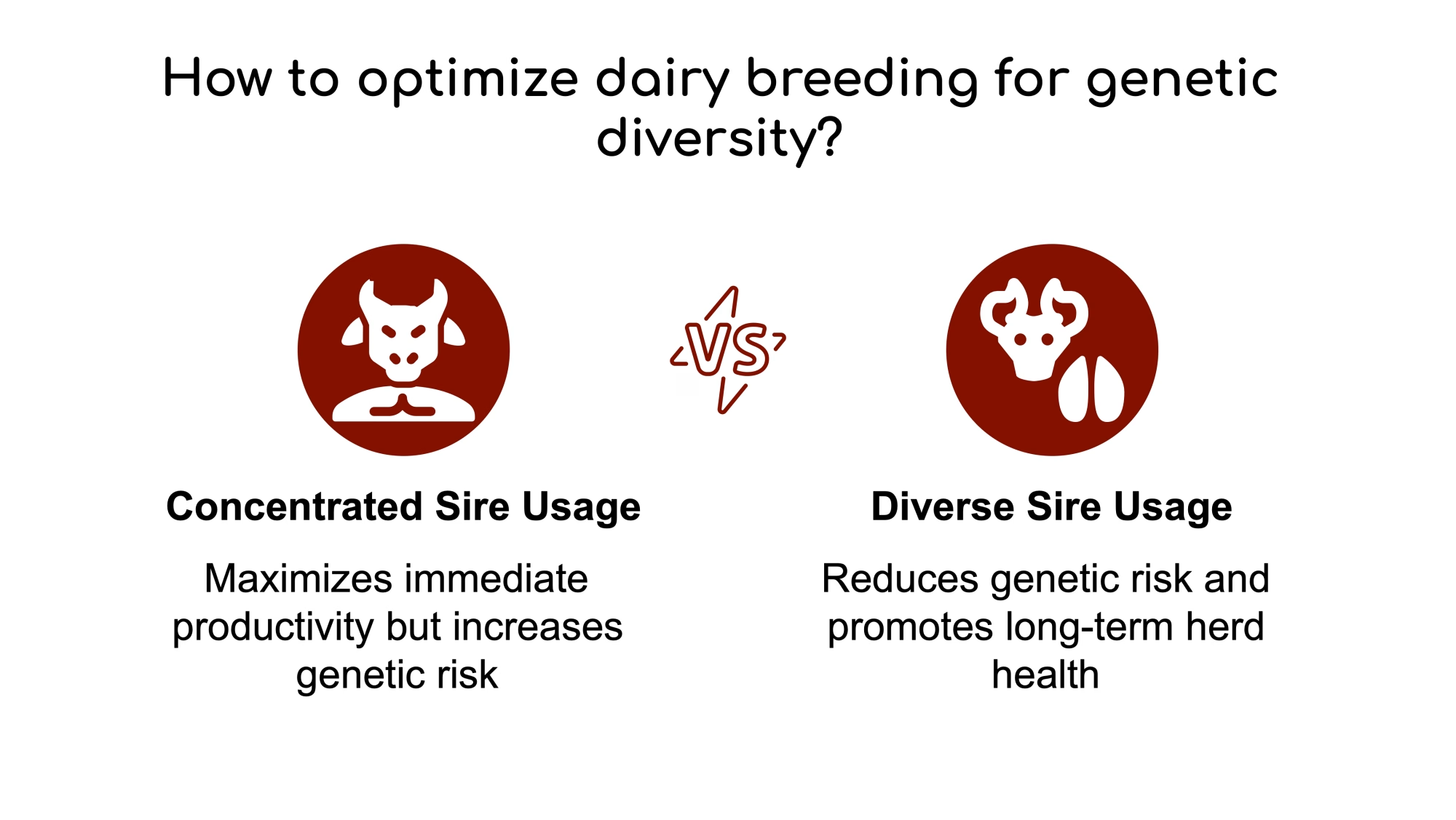
Remember when everyone and their brother used the same handful of bulls? Back in 2008, if you walked into any barn in Canada, practically every seventh heifer was sired by DOORMAN, GOLDWYN, or BUCKEYE. I’m not exaggerating—these three bulls alone accounted for nearly 12% of all registered females!
Fast forward to today, and that concentration has completely collapsed. Now, you’d need to see almost twenty-two calves before finding one from a top three sire. That’s not just a tiny shift—it’s a significant rejection of how we used to think about breeding.
“DOORMAN alone had 12,165 daughters registered in 2008. That was enough to fill about 120 average dairy barns back then!”
Think about this: DOORMAN alone had 12,165 daughters registered in 2008. That was enough to fill about 120 average dairy barns back then! Today’s top sire wouldn’t even fill 80 Canadian barns. Breeders have gotten a lot smarter about spreading genetic risk across more bloodlines. And honestly? It’s about time.
From Pretty Cows to Profitable Cows

Remember when everyone was chasing those gorgeous, deep-ribbed, less fertile, and often less robust show cows regardless of what they cost to maintain? Those days are gone, my friend. The Holstein world, everywhere, has flipped from worshipping pretty cows to demanding farm-level profitable ones.
“The Holstein world, everywhere, has flipped from worshipping pretty cows to demanding farm-level profitable ones.”
Early on (2008-2012), we were all obsessed with proven conformation sires. Look at the top bulls from that era—they were selected almost entirely for their daughters’ appearance. Today, the smart money is on bulls that deliver a complete package: health, production, fertility, AND decent conformation.
Here’s something nobody talks about enough: Despite all our sophisticated genetic tools and 16 years of so-called “improvement,” total Holstein registrations haven’t increased. It makes you wonder if we’ve been spinning our wheels, doesn’t it? The fact that bulls like WESTCOAST ALCOVE have shown up recently tells me breeders are still hunting for that perfect balance between genetic progress and sustainability.
Genomics: Game-Changer or Over-Hyped?

When genomics hit the scene in 2009, it didn’t just change how we select bulls—it completely rewrote who benefits from genetic advancement. Gone are the days when only the most significant operations with deep pockets could access elite genetics. With over 6.5 million Canadian dairy animals genetically evaluated now, we’re seeing a true democratization of genetics. Universally, dairy farmers have access to the top hundred Total Merit Indexed sires with no holes and will produce tomorrow’s complete cow.
But let’s be honest for a second. Are we selecting the right traits? The dramatic shifts in sire usage patterns suggest many breeders weren’t entirely sold on those early genomic promises. And rightfully so—the correlation between genomic predictions and actual performance isn’t perfect. Studies show genetic correlation coefficients of just 0.36 for milk yield, 0.29 for fat yield, and 0.19 for overall type with longevity. I’m not precisely sure. Are they bets?
The most mind-blowing impact of genomics has been on generation intervals. Check out these numbers:
| Selection Path | 1980 (Years) | 2009 (Years) | 2016 (Years) | % Reduction (1980-2016) |
| Sire to Bull (SB) | 10.4 | 6.1 | 2.5 | 76% |
| Dam to Bull (DB) | 8.8 | 5.3 | 2.9 | 67% |
| Sire to Cow (SC) | 7.3 | 5.8 | 4.5 | 38% |
| Dam to Cow (DC) | 5.5 | 4.3 | 4.2 | 23% |
| Total | 32.0 | 21.5 | 13.2 | 55% |
“In 1980, genetic improvement took over a decade to move from one bull generation to the next. Now it happens in just 2.5 years!”
Can you believe that? In 1980, genetic improvement took over a decade to move from one bull generation to the next. Now, it has happened in just 2.5 years! That’s like going from sending letters by Pony Express to instant messaging. No wonder we’re seeing such dramatic shifts in sire usage—we’re cycling through and benefiting from genetic options at warp speed.
I’ve watched breeders get much more knowledgeable about genomic indexing over time. Instead of unthinkingly chasing the highest numbers, they use genomics as just one tool in a more sophisticated strategy. That approach will be crucial with the significant genetic base change coming April 1, 2025—PTAs for USA Holsteins are about to drop by roughly 750 lbs for milk, 45 lbs for fat, 30 lbs for protein, and 0.6 for PTAT. That’s going to shake things up!
Beyond Milk: The New Traits Taking Over

You’ve probably noticed breeders talking a lot more about novel traits recently. This isn’t just trendy chatter—it’s a necessary evolution to survive in tomorrow’s industry. Between 2016 and 2024, we’ve seen a massive surge in interest for polled genetics, A2A2 milk, milk solids yield, and health and reproduction-related traits that directly impact a farm’s bottom line.
Ignore these trends at your peril. The upcoming Net Merit index revisions will emphasize butterfat yield, feed conversion efficiency, and cow livability. These aren’t just fancy buzzwords—they’re traits that directly address economic and environmental sustainability. In other words, they will help keep farms in business.
| Trait | Current NM$ | April 2025 NM$ |
| Protein | 19.6% | 13.0% |
| Fat | 28.6% | 31.8% |
| Feed Saved | 12.0% | 17.8% |
| Productive Life | 11.0% | 8.0% |
| Cow Livability | 7.0% | 8.0% |
| Udder Composite | 7.0% | 7.0% |
| Fertility | 6.8% | 6.8% |
| Heifer Livability | 1.3% | 2.0% |
As you can see from this table, the emphasis on butterfat production has increased significantly in the latest Net Merit index, while protein has decreased substantially. This reflects current market trends and the growing economic importance of butterfat. The shift toward feed efficiency (Feed Saved increasing from 12% to 17.8%) also shows how the industry adapts to address rising feed costs and sustainability concerns.
Want to see why fertility traits suddenly matter so much? Take a look at these real-world numbers:
| Trait | Mean Index | Standard Deviation | Records Analyzed |
| Conception Rate (CCR) | 0.43 | 0.49 | 837,655 |
| 56-day Non-Return Rate (NRR56) | 0.50 | 0.50 | 857,821 |
| Calving Ease (CE) | 1.06 | 0.27 | 259,042 |
| Stillbirth (SB) | 1.07 | 0.25 | 273,367 |
| Gestation Length (GL) | 278.36 days | 6.18 days | 258,611 |
A mean 0.43 sire cow conception rate? Yikes! That means the average Holstein needs multiple services to conceive. And that 56-day non-return index of 0.50. It tells us that too many cows are being bred to below-average sires and must be rebred within two months. No wonder fertility has become a hot selection priority—these numbers directly hit the pocketbook!
“Sire genetic merit for daughter fertility traits is improving rapidly in the dairy breeds, including the Holstein.”
Genetic selection is working. As Butler and others have shown, “Sire genetic merit for daughter fertility traits is improving rapidly in the dairy breeds, including the Holstein.” Thanks to genomics, we’re fixing fertility problems much faster than they initially declined when the priority traits in selection were milk yield and type. That’s something to celebrate over our morning coffees!
Power Shift: The End of Genetic Monopolies

The most fascinating change we’re seeing is the complete rebalancing of genetic influence across the Holstein population. In 2008, the top thirty sires used in Canada accounted for about 35% of all female registrations. By 2016, that dropped to just 22%, and the trend has continued.
This isn’t just a random statistic—it represents a fundamental power shift in dairy genetics. For decades, we rushed to use the “best” bulls, which narrowed genetic diversity and cranked up inbreeding rates. Finally, breeders are pushing back against that dangerous trend.
| Trait | Heritability Estimate |
| Lactation Yield | 0.46 ± 0.206 |
| Birthweight | 0.32 ± 0.181 |
| Age at First Calving | 0.19 ± 0.162 |
| Calving Interval | 0.14 ± 0.211 |
| Age at Maturity | 0.11 ± 0.136 |
| Dry Period | 0.11 ± 0.124 |
| Days Open | 0.09 ± 0.121 |
| Lactation Length | 0.04 ± 0.212 |
This table helps explain why milk production traits have historically dominated selection programs while fertility traits have been more challenging to improve. Traits with higher heritability, like lactation yield (0.46) and birthweight (0.32), respond more readily to selection pressure than low-heritability traits like days open (0.09) and lactation length (0.04). The introduction of genomic selection has been particularly valuable for these low-heritability traits, allowing for more accurate identification of genetically superior animals early in life.
Have you noticed more European bulls in AI catalogs lately? That’s no accident. While Canadian and American genetics dominated the early years of our analysis, we’re now seeing significant international representation. This global genetic exchange introduces fresh bloodlines to help fight inbreeding while delivering solid performance.
“We’re not just making small improvements—we’re correcting the whole course of the breed!”
What excites me is how selection based on genomics has rescued traits that were heading in the wrong direction. Research clearly shows that “genetic trends changed from negative or close to zero to positive or favorable” for traditionally difficult-to-evaluate traits like milking cow conception rate, productive life, and somatic cell score. We’re not just making small improvements—we’re correcting the whole course of the breed!
What’s Next? Innovative Breeding Strategies for Tomorrow

Based on everything we’ve seen over these 16 years, I’d bet my farm on several significant shifts in Holstein’s breeding strategies.
First, we’ll keep pivoting hard toward functional, health, and efficiency traits. The days of selecting primarily for production and type are over—sorry, not sorry! Modern breeding programs must balance these traditional traits with newer priorities impacting sustainability and profitability.
Second, A2A2 milk genetics will soon be the standard, not a specialty. Our data clearly show this trend, and industry forecasts agree, predicting “increased fat and protein yields, increased %Fat and a prevalence of A2A2” in the coming decade.
Third, new data and information resulting from new technologies and methodologies will continue to help accelerate genetic progress while addressing genetic diversity concerns. With 90% of Holstein registrations submitted electronically, our industry will have the infrastructure for sophisticated genetic management that balances progress and diversity.
Finally—and this one might ruffle some feathers—animal welfare traits like polled and healthy hoof genetics will increasingly drive selection decisions. Consumers care more about this stuff every year, and genetics that address welfare concerns will command market premiums paid by processors. Astute breeders are already positioning themselves for this shift.
The Bottom Line
What strikes me most about this 16-year journey is how dramatically the Holstein breeding philosophy has changed. We’ve collectively rejected the super-sire model in favor of genetic diversification, wholly transformed how we manage genetic resources and risk, and broadened our genetic focus beyond milk and type.
Canadian Holstein breeders, and I expect American breeders, have shown incredible adaptability through all this change. They’ve navigated the transition from traditional progeny-testing to genomic selection while embracing a more comprehensive view of what makes a profitable cow.
The data doesn’t lie—breeders use genetic information more strategically than ever. The winners in tomorrow’s dairy industry won’t be those unthinkingly chasing the highest numbers but those who skillfully balance genetics, economics, and consumer demands.
“The real question isn’t whether your breeding program will transform, but whether you’ll lead or participate in that transformation or be left to play catch-up or exit the industry.”
With genomic selection slashing generation intervals—from 10.4 years to just 2.5 years on the sire-to-bull path—genetic improvement will only accelerate from here. The real question isn’t whether your breeding program will transform but whether you’ll lead or participate in that transformation or be left to play catch-up or exit the industry.
What do you think? Are you ready for what comes next?
Key Takeaways
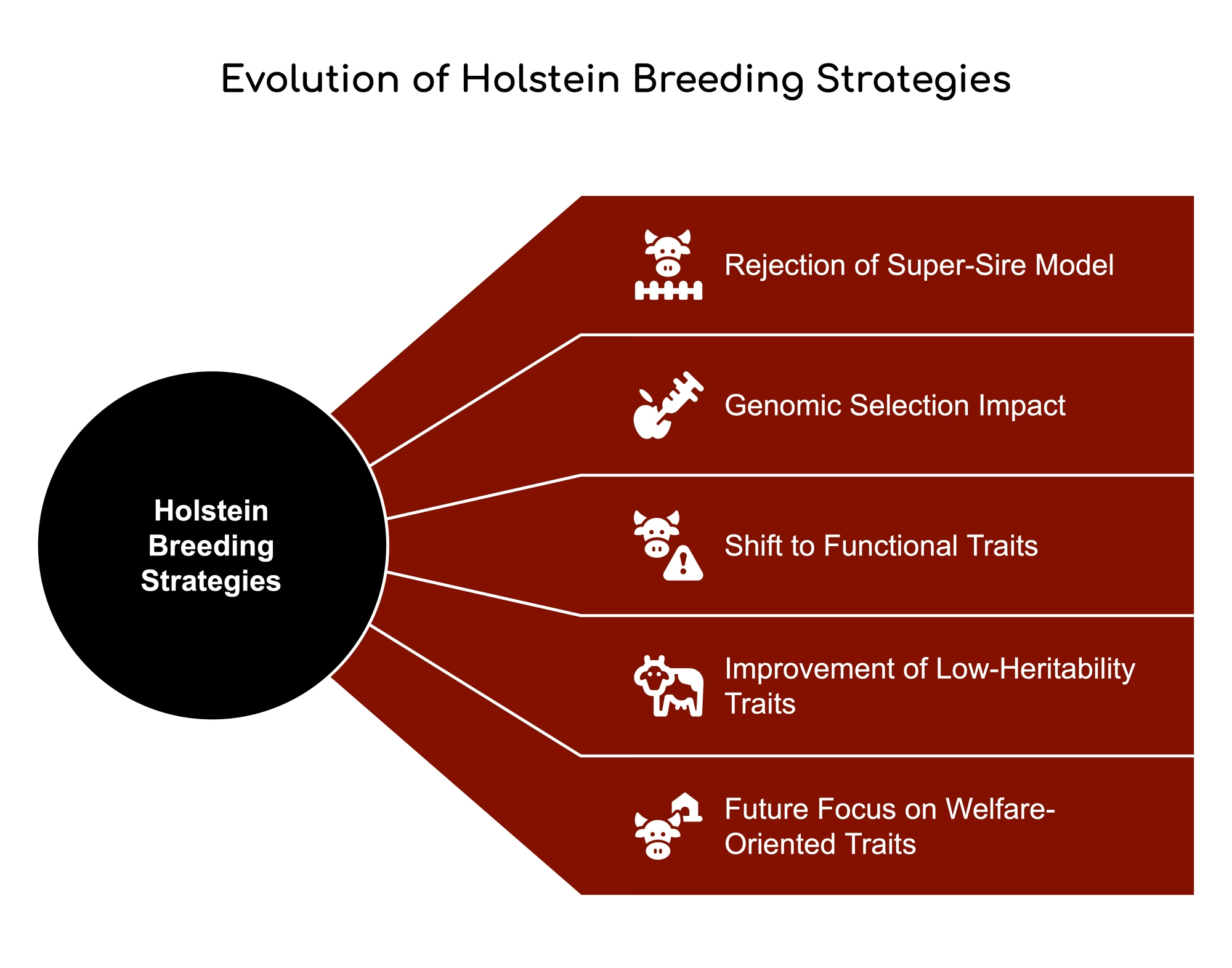
- The Holstein industry has decisively rejected the concentrated “super-sire” model, with top three sire representation dropping from 12% of registered females to requiring 22 calves to find one from a top sire.
- Genomic selection has revolutionized breeding by reducing generation intervals by 76% (from 10.4 to 2.5 years) on the sire-to-bull path, enabling faster genetic progress and trait improvement.
- Selection emphasis has dramatically shifted toward functional traits, with the 2025 Net Merit index increasing emphasis on fat (31.8%) and feed efficiency (17.8%) while decreasing protein emphasis (from 19.6% to 13.0%).
- Low-heritability traits like fertility are being improved much faster through genomic selection, addressing critical issues like the concerning 0.43 mean cow conception rate.
- Future breeding strategies will increasingly incorporate welfare-oriented traits (polled, hoof health) and A2A2 milk genetics as consumer preferences drive market premiums for these characteristics.
Executive Summary
The Holstein breeding industry has undergone a revolutionary transformation over the past 16 years, shifting focus from aesthetically pleasing show cows to functional, profitable animals that remain productive for four-plus lactations. This paradigm shift rejected the “super-sire” model that once concentrated genetics (with three bulls accounting for nearly 12% of all registered females in 2008) in favor of greater genetic diversity and reduced inbreeding. Genomic selection has dramatically accelerated genetic progress by slashing generation intervals from over 10 years to just 2.5 years on the sire-to-bull path, while simultaneously democratizing access to elite genetics. Increasingly, breeders are prioritizing health, fertility, and efficiency traits over pure production and conformation, with upcoming Net Merit index revisions placing even greater emphasis on butterfat yield, feed efficiency, and cow livability. The industry is now poised for further evolution toward welfare-focused traits like polled genetics and enhanced hoof health as consumer preferences continue to shape breeding decisions.
Learn more:
- Elite Holstein Genetics Shine in 2024 BAA Rankings!
- Advances in Genetic Technology Shaping the Future of Dairy Farming
- From Milk Machines to Component Champions: How Genomics and Sexed Semen Are Remaking the Dairy Cow
 Join the Revolution!
 Join the Revolution!
Join over 30,000 successful dairy professionals who rely on Bullvine Daily for their competitive edge. Delivered directly to your inbox each week, our exclusive industry insights help you make smarter decisions while saving precious hours every week. Never miss critical updates on milk production trends, breakthrough technologies, and profit-boosting strategies that top producers are already implementing. Subscribe now to transform your dairy operation’s efficiency and profitability—your future success is just one click away.




