Archive for FMMO modernization

Your Milk Check Just Got $337M Lighter – And Your Co-op Helped Plan It

$337M vanished from producer pools in 90 days, while cooperatives counted processing profits

EXECUTIVE SUMMARY: Here’s what we discovered: while cooperatives sold “technical modernization” to members, they orchestrated regulatory changes that transferred $337 million from producer pool values to processing advantages in just three months. Farm Bureau’s analysis reveals that make allowance increases of 26-60% across dairy commodities will slice 85-90 cents per hundredweight from milk prices—but here’s the kicker: cooperatives with processing operations capture these enhanced cost recovery mechanisms through their manufacturing divisions. Geographic warfare is surgical: California faces $94 million in annual losses, while the Mid-Atlantic regions gain $2.20/cwt through Class I differential increases, systematically advantaging politically connected fluid-milk territories over efficient manufacturing regions. December brings another redistribution wave as component assumptions jump to 3.3% protein, creating pool formulas that reward genetic and nutritional investments while penalizing volume-focused operations. This isn’t market evolution—it’s regulatory capture disguised as industry progress, and the data proves your cooperative helped design the very mechanisms now draining your milk checks.

 dairy pricing reform

Look, I’m gonna start with something that might sting a little.

Your cooperative just sold you out.

I know, I know… that’s harsh. But honestly? Sometimes the truth cuts deep, especially when it’s been buried under two years of “technical modernization” doublespeak and regulatory complexity designed—and I mean specifically designed—to hide what amounts to the largest wealth transfer from dairy producers to processors in modern history.

$337 million.

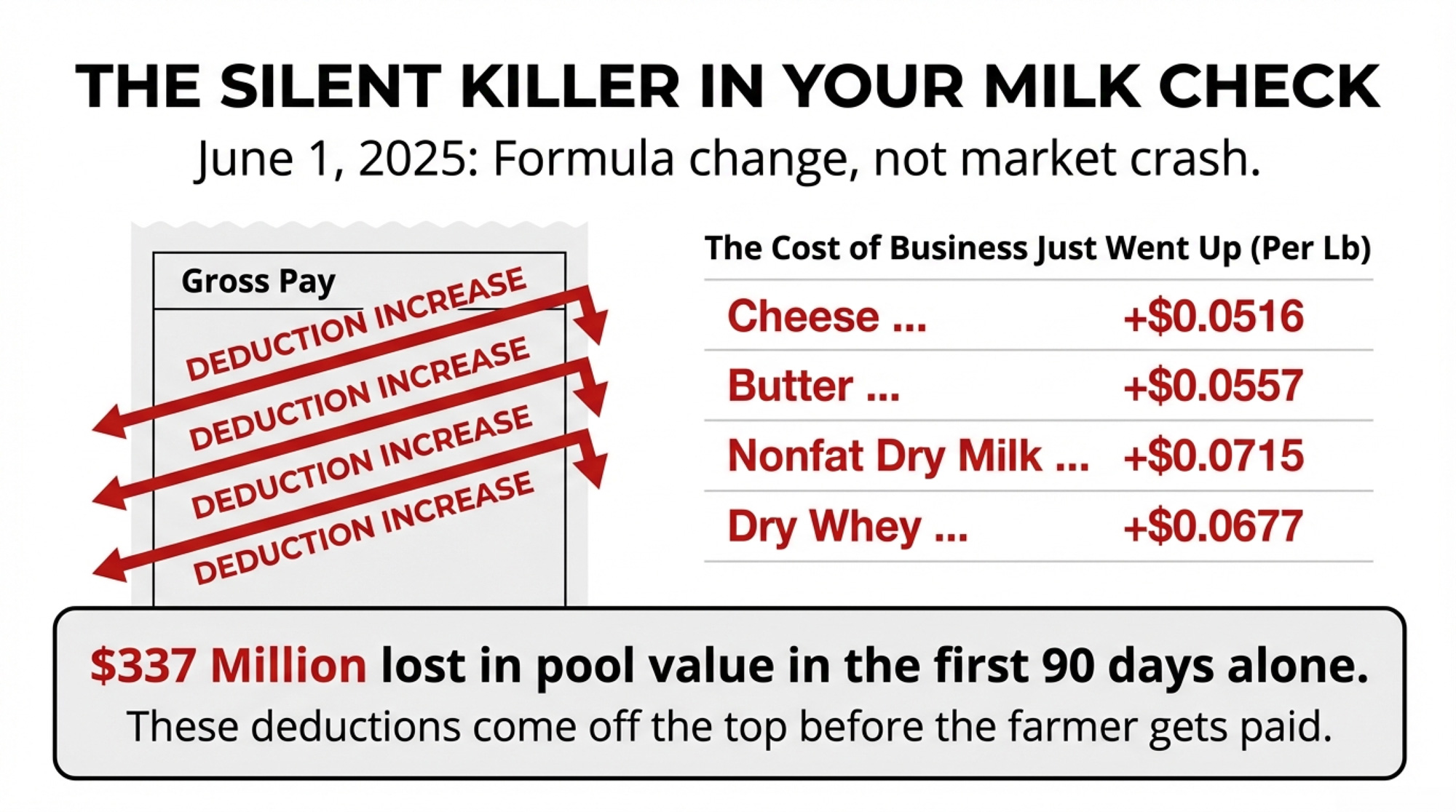
That’s how much money vanished from producer pool values between June 1st and August 31st this year. The American Farm Bureau Federation just released their quarterly analysis, and I’ve been poring over these numbers for weeks, trying to wrap my head around the scale of what just happened. Not because of feed costs going crazy. Not weather disasters. Hell, not even the usual corporate greed we’ve all grown accustomed to dealing with.

This is something way worse—systematic regulatory changes that, regardless of intent, redistributed massive wealth from the farm gate to processing margins.

While cooperatives were telling members about “updating outdated formulas” and “technical improvements”—you know, the same buzzwords they always use when major changes are coming—they were actually implementing reforms that drained $337 million from farmer milk checks to processor profit margins in just 90 days.

And here’s what really gets me: the National Milk Producers Federation—supposedly representing your interests as a farmer—spent over two years designing these proposals. Two years to figure out how to help farmers, and the end result is the biggest wealth transfer in dairy history.

Now, to be fair, NMPF and their supporters argue these changes were necessary to “modernize” pricing formulas and improve industry competitiveness. However, when you examine who actually benefits versus who pays, the math tells a different story than their press releases.

The Make Allowance Money Grab: When “Technical Updates” Create Winners and Losers

Alright, let me strip away all the regulatory jargon and show you exactly what happened to your money.

Make allowances… they sound innocent enough, right? Manufacturing cost deductions are processors’ claims against milk prices when they produce cheese, butter, or powder. These hadn’t been comprehensively updated for over a decade—which, by the way, gave everyone involved the perfect justification for what they successfully marketed as “technical modernization.”

Here’s where it gets interesting, though. USDA and NMPF argued these increases were based on actual cost increases in processing operations. They commissioned studies, held hearings, and gathered input from the industry. The whole regulatory process looked legitimate from the outside.

But here’s what really happened. Check out these numbers from the USDA’s final decision:

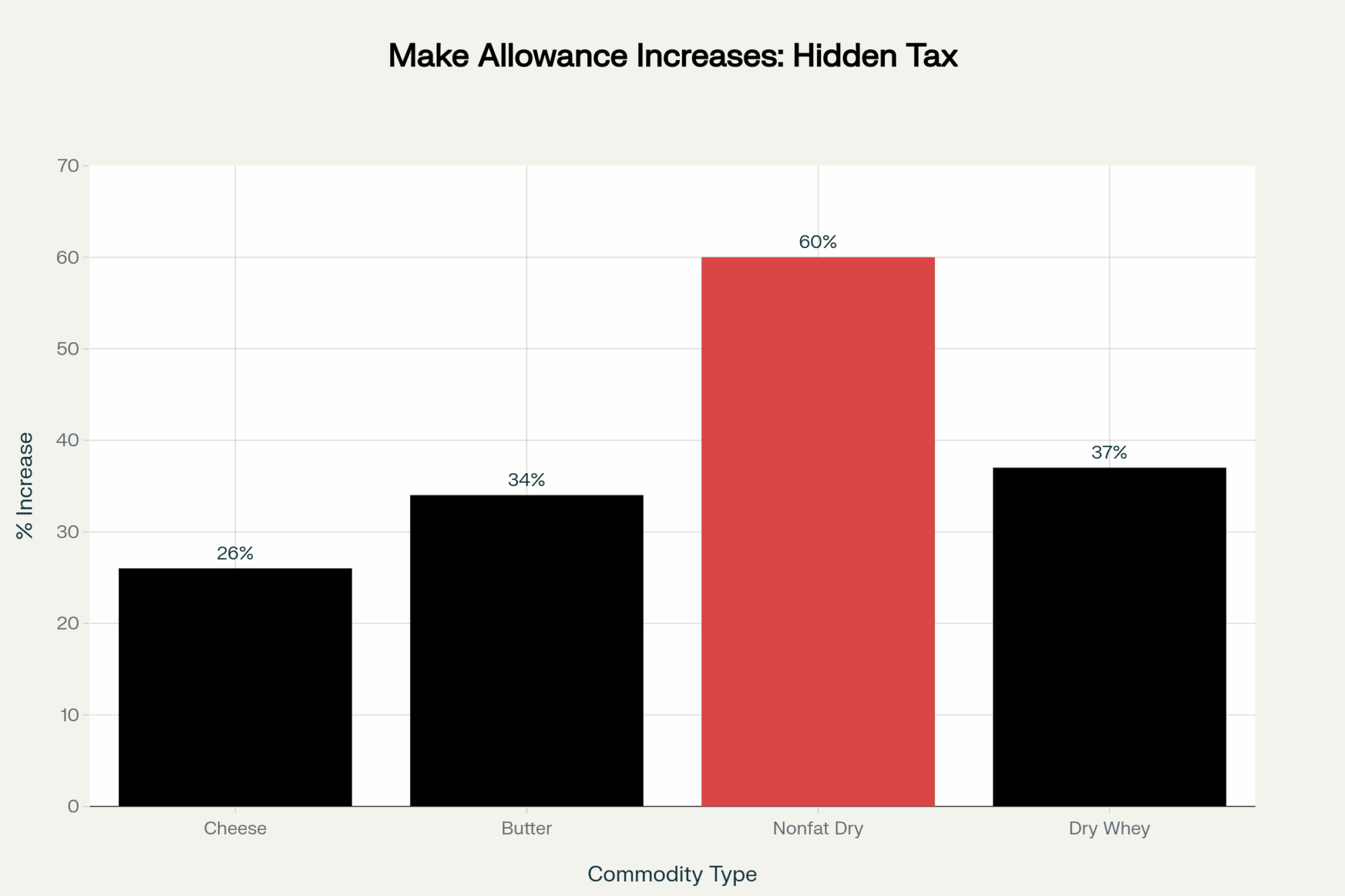
Cheese allowance: Jumped 26% from twenty cents to 25.19 cents per pound
Butter allowance: Spiked 34% from seventeen cents to 22.72 cents per pound
Nonfat dry milk: Get this—exploded 60% from fifteen cents to 23.93 cents per pound
Dry whey: Climbed 37% from 19.5 cents to 26.68 cents per pound

The Regulatory Heist in Numbers – While NMPF sold ‘technical updates,’ they engineered percentage increases that slice 85-90¢ from every hundredweight. That 60% nonfat dry milk spike? That’s your money flowing straight to processor profit margins.

Danny Munch—he’s the economist over at Farm Bureau who actually crunched these numbers instead of just accepting industry explanations—calculates these increases slice 85 to 90 cents per hundredweight from milk prices across all classes. Every single class.

Now, NMPF would tell you these increases reflect genuine cost inflation in processing operations since… well, since they were last comprehensively updated. Labor costs, energy costs, equipment costs—all legitimate concerns. And honestly? Some of that argument holds water.

However, what they don’t emphasize is that while these “cost adjustments” reduced producer pool values by $337 million in three months, cooperatives with processing operations receive enhanced make allowance cost recovery through their manufacturing facilities.

Think about the dynamic here. You ship milk to your “farmer-owned” cooperative. They process it into cheese. Those new make allowances let them claim extra cents per pound as “manufacturing costs” before calculating what they owe back to the pool. So your co-op’s processing division captures the benefit while your farm-gate price absorbs the cost.

Industry defenders would argue that this reflects economic reality—processing really does cost more than it did years ago. And they’re not entirely wrong. However, when cost increases are passed down to producers while the processing benefits flow to cooperative manufacturing divisions, that represents a fundamental shift in how value is distributed throughout the system.

What Your Cooperative’s Official Position Doesn’t Tell You

NMPF’s public justification emphasizes modernizing outdated formulas and improving competitiveness. Their white papers discuss aligning with current processing realities, supporting rural economies, and strengthening the industry’s global position.

And you know what? Some of those arguments aren’t completely without merit. Processing costs have increased significantly. Energy, labor, compliance costs—they’ve all gone up.

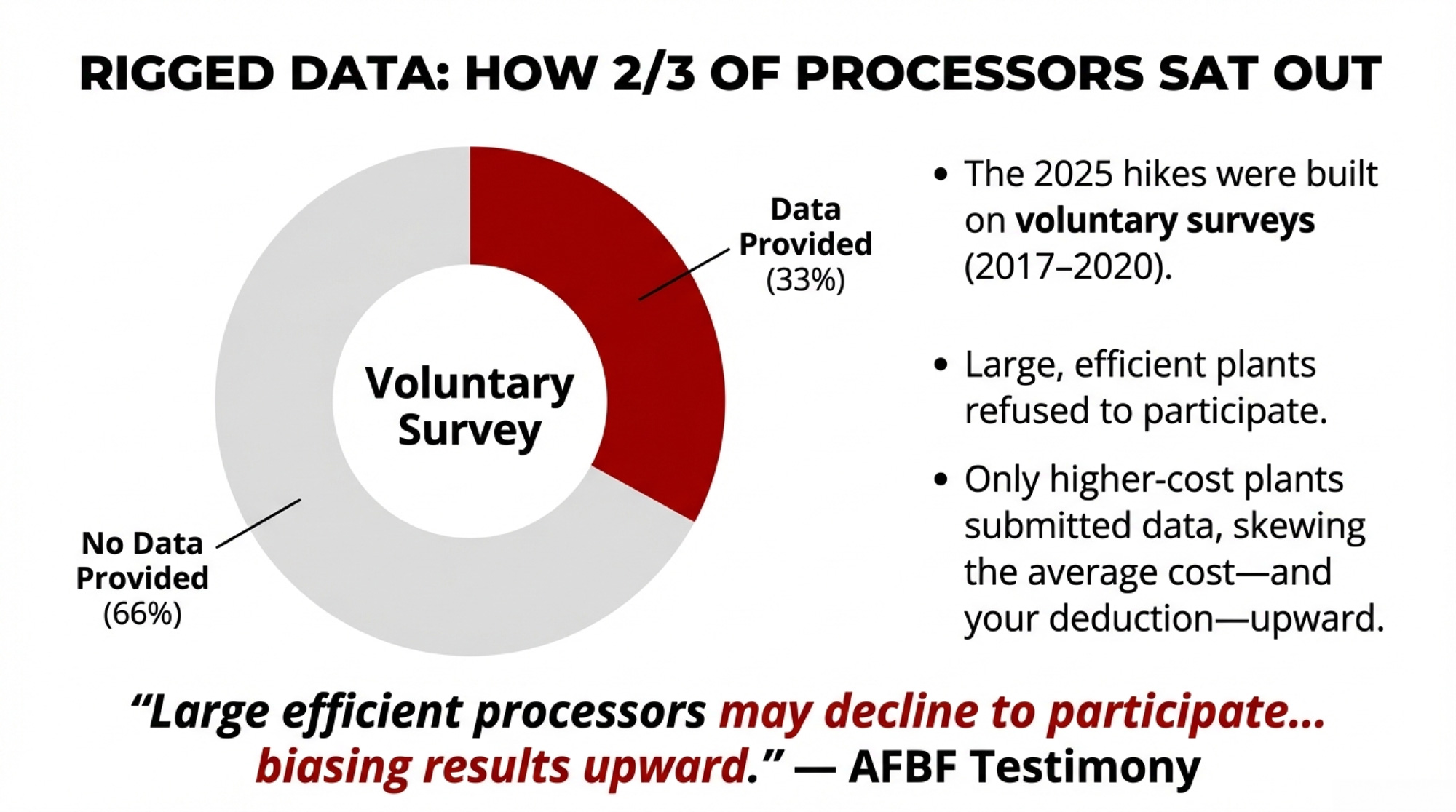
However, what their official positions overlook is that the industry cost studies justifying these increases primarily came from companies and cooperative processing divisions that benefit most from higher allowances. The processors provided the studies that justified their own enhanced cost recovery.

That’s not necessarily a case of fraud or conspiracy. It may simply be a matter of how regulatory processes work when complex industries are required to provide their own cost data. However, the conflict of interest becomes apparent when one steps back and examines it.

Industry trade groups framed these changes as an economic necessity rather than a move driven by advantage-seeking. And maybe they genuinely believe that. But notice what’s missing from all the official justifications? Any mechanism to ensure these “cost adjustments” flow back to producers through higher over-order premiums when processing operations benefit.

The Geographic Warfare: When Good Intentions Create Regional Winners and Losers

Here’s where the FMMO reforms get really complicated, and honestly, where some of the industry’s official reasoning starts to fall apart.

The changes didn’t just redistribute money between producers and processors—they systematically advantaged some regions while disadvantaging others. Now, USDA would argue this reflects legitimate differences in transportation costs and market dynamics. And again, that’s not entirely wrong.

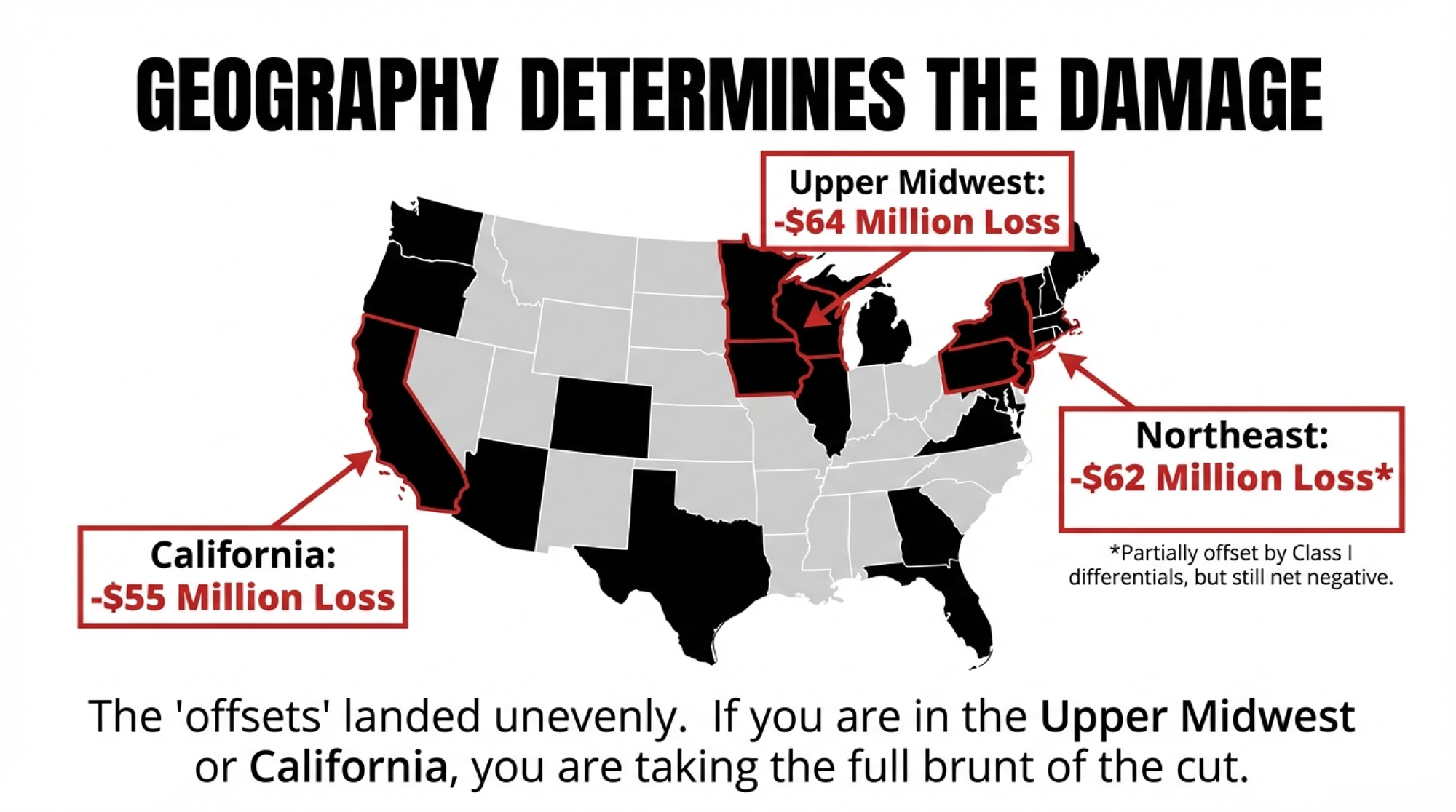
The Protected Class: Northeast and Mid-Atlantic operations got massive Class I differential increases that more than offset the make allowance hits. Federal Order 5, which covers the Mid-Atlantic region, saw differentials increase from $3.40 to $5.60 per hundredweight, according to USDA implementation data.

The official justification? Higher transportation costs, market premiums for fluid milk, and regional economic factors. All legitimate considerations that regulators weighed during the hearing process.

The Sacrifice Zones: California, the Upper Midwest, and Western orders—basically, the regions where most of the milk is actually processed for manufacturing—they absorb the full impact of milk allowance increases with zero offsetting benefits.

In California, they’re examining what Edge Dairy Farmer Cooperative calculated as a $94 million annual reduction in pool value. Southwest Order? They’re expecting $72 million in annual losses.

Now, USDA would argue these manufacturing-heavy regions benefit from lower transportation costs and established processing infrastructure. The regulations aren’t deliberately targeting anyone—they’re just reflecting economic realities.

However, here’s the problem with that reasoning: when regulatory changes systematically favor politically connected fluid-milk regions while disadvantaging efficient manufacturing areas, the practical effect appears to be deliberate economic engineering, regardless of the official intent.

Edge Dairy Farmer Cooperative released an analysis acknowledging that the reforms “would slightly decrease the minimum regulated price private milk buyers have to pay to pooled milk producers.” That’s cooperative-speak for “your margins just got systematically compressed through regulatory changes.”

The Complexity of Regulatory Intent vs. Practical Impact

What strikes me about the regional disparities is how they align so perfectly with political influence rather than economic efficiency. The regions that benefit most from Class I differential increases happen to be the areas with the strongest political representation in dairy policy discussions.

Is that deliberate favoritism? Or just how regulatory processes naturally work when different regions have different levels of political sophistication and influence?

The USDA would argue that they’re simply responding to economic data on transportation costs, market premiums, and regional factors. They’d point to studies showing legitimate cost differences between regions that justify differential adjustments.

But when the practical effect systematically advantages less efficient regions while penalizing more efficient ones, the intent becomes less important than the outcome.

You talk to any Pennsylvania or Maryland producer, and they’ll tell you those differential increases help cushion the blow from higher make allowances. Meanwhile, down in Wisconsin or California—the backbone of American cheese production—they’re getting hammered by make allowance increases with no relief.

The Cooperative Dilemma: Competing Loyalties and Conflicting Interests

And this is where it gets really complicated, because I don’t think most cooperative leadership deliberately set out to screw their members.

The National Milk Producers Federation spent over two years developing these proposals through extensive consultation with the industry. They held meetings, commissioned studies, and gathered member input. NMPF President Gregg Doud genuinely believes the final decision provides “a firmer footing and fairer milk pricing.”

From their perspective, these changes represent necessary modernization that will ultimately strengthen the entire industry in the long term. They’d argue that stronger processing margins benefit everyone by supporting infrastructure investment, improving competitiveness, and stabilizing markets.

And honestly? That’s not entirely a bogus argument. A strong processing infrastructure benefits producers by providing market outlets and value-added opportunities.

But here’s where the cooperative model creates inherent conflicts: when your “farmer-owned” organization also owns processing facilities that receive enhanced make allowances, which interest takes priority?

The Governance Challenge of Dual Roles

Modern cooperatives have evolved far beyond their origins as farmer-protection organizations, and this evolution creates genuine dilemmas rather than simple betrayals of their founding principles. They’ve become processor stakeholders through joint ventures, shared manufacturing facilities, and board governance that has to balance multiple interests.

Your co-op’s leadership may genuinely believe that stronger processing margins will ultimately benefit all members through improved services, a stronger market position, and enhanced competitiveness. That’s not necessarily wrong—it’s just a different theory of value creation than direct milk price maximization.

The problem lies in governance structures that concentrate decision-making power among the largest operations—exactly those most likely to benefit from processing partnerships and enhanced allowances. When delegates representing 5,000-cow operations with processing deals outvote representatives from 500-cow farms focused purely on milk prices, that’s not a conspiracy. That’s just how voting power works in cooperative governance.

But the practical effect is the same: systematic advantages for the largest, most diversified operations at the expense of smaller, milk-focused producers.

You’re running 500 or 800 cows in Ohio or Wisconsin? Your voice gets drowned out by delegates representing mega-operations with processing partnerships. Small and mid-scale producers… we lack the influence to counteract delegate votes that favor processing investments over farm-gate returns.

Industry position differences during the hearing process suggest that some cooperative leadership recognized these tensions. The question is whether they had realistic alternatives given the political dynamics of regulatory change.

The Price Discovery Changes: Technical Complexity vs. Market Impact

The removal of 500-pound barrel cheese from Class III pricing calculations represents another layer of regulatory change that official explanations struggle to justify convincingly.

USDA’s reasoning focused on streamlining price discovery and reducing complexity in commodity pricing formulas. They argued that barrel pricing created volatility and confusion in market signals.

From a technical regulatory perspective, that argument has some merit. Simpler pricing mechanisms can reduce administrative complexity and improve market transparency.

But the practical effect concentrates price-setting power among fewer market participants, which typically benefits buyers more than sellers. When you reduce the number of pricing points used to set commodity values for the entire industry, you typically reduce competitive pressure.

Block cheese producers lobbied for these pricing changes during the hearing process, and their arguments about market efficiency and price discovery weren’t entirely without merit. But they got exactly what they wanted: reduced competitive pressure from barrel pricing.

The Challenge of Technical vs. Political Justifications

What bothers me about pricing formula changes is how technical complexity provides cover for market advantages. When regulatory changes require specialized expertise to understand, most participants can’t effectively evaluate whether the changes serve broader industry interests or specific player advantages.

USDA’s technical justifications for barrel removal sound reasonable in isolation. However, when you combine these with allowance increases and regional differential changes, the overall pattern systematically favors certain players while disadvantaging others.

Is that deliberate market manipulation? Or just the inevitable result of complex regulatory processes where different players have different levels of technical expertise and political influence?

The answer probably depends on your position in the industry hierarchy. If you benefit from the changes, they represent necessary modernization. If you’re disadvantaged, they looks like regulatory capture.

What This Really Means Long-Term: Competing Visions of Industry Structure

The $337 million first-quarter transfer from Farm Bureau’s analysis represents more than just money moving between accounts. It reflects competing visions of how the dairy industry should be structured and who should capture value at different points in the supply chain.

NMPF and their supporters would argue that these regulatory changes strengthen the industry by improving processing margins, encouraging infrastructure investment, and enhancing global competitiveness. They’d point to expansion plans and processing investments as evidence that their approach is working.

From this perspective, temporary producer pain leads to long-term industry strength that eventually benefits everyone through stronger markets, better services, and enhanced competitiveness.

However, critics, such as Edge Dairy and the Farm Bureau, view a systematic wealth transfer from efficient producers to processing interests that may never be reflected in farm-gate prices. Their analysis suggests continued consolidation pressure in manufacturing-focused regions that could undermine the industry’s competitive foundation.

Industry analysts are already projecting different scenarios depending on whether these regulatory structures drive beneficial investment or simply redistribute wealth from producers to processors without creating genuine value.

The honest answer? We won’t know which vision proves correct for several years. However, the immediate impact is clear: $337 million was transferred from producer pool values to processing advantages in just three months.

Regional Implications and Competitive Dynamics

You’re going to see the Northeast and Mid-Atlantic regions positioned to benefit from permanent Class I premiums and processing investments that capture regulatory advantages. Whether that strengthens or weakens overall industry competitiveness depends on whether protected regions utilize their advantages for genuine improvement or merely engage in rent-seeking.

Meanwhile, California, the Upper Midwest, and Western operations face continued pressure from regulatory disadvantages that may force consolidation or exit. If those regions represent the industry’s most efficient production, it could undermine long-term competitiveness, regardless of short-term improvements in processing margins.

The global implications are murky. Enhanced make allowances might improve U.S. processing competitiveness by providing guaranteed cost recovery. Or they might create artificial advantages that reduce incentives for genuine efficiency improvements.

International buyers increasingly value supply chain consistency and reliable quality over marginal regulatory advantages. Whether FMMO changes enhance or undermine those qualities remains to be seen.

Component Factor Changes: Modernization or Redistribution?

Starting December 1st, the assumed protein content increases from 3.1% to 3.3%, while other solids rise from 5.9% to 6.0%, according to the USDA implementation schedule.

The USDA’s justification emphasizes the recognition of genuine improvements in milk quality and genetic progress over the past decade. And honestly? That argument has solid support. Average component levels have improved significantly through genetic selection and nutrition management.

From a technical perspective, updating component assumptions to reflect current reality makes perfect sense. If most producers are achieving higher components than the formulas assume, the assumptions should be updated.

However, here’s where technical accuracy creates practical consequences: these changes will benefit operations already achieving high efficiency while disadvantaging those still focused on volume production.

The December changes don’t create new value—they redistribute existing pool money based on component assumptions that favor certain production strategies over others.

The Question of Fair vs. Advantageous Updates

Smart operators are already adjusting their breeding programs and ration formulations to capitalize on these regulatory advantages. Whether that represents a necessary adaptation to industry evolution or regulatory changes in gaming depends on your perspective.

USDA would argue they’re simply updating formulas to reflect current industry reality. Producers achieving higher components deserve recognition for their genetic and management investments.

But producers focused on volume production—often smaller operations with older genetics or limited nutritional resources—will subsidize their higher-component competitors through pool redistribution formulas.

Is that fair recognition of superior management? Or systematic disadvantaging of producers who can’t afford the latest genetic and nutritional technologies?

The answer probably depends on whether you view dairy as a commodity industry where efficiency should be rewarded, or as a rural economic system where smaller operations deserve protection from technological displacement.

Down in Pennsylvania, I was speaking with a producer who has been pushing his nutritionist hard on component manipulation strategies. He’s targeting 3.8% butterfat and 3.3% protein specifically because of these December changes. He said he’s not going to subsidize his neighbors who haven’t yet figured out the new game.

And honestly? This is no longer about milk volume. It’s about maximizing value per pound in a system that’s been restructured to reward components over quantity.

You’re still focused on pounds per cow? You’re gonna get killed in this new regulatory environment.

Fighting Back: Navigating Complex Realities Rather Than Simple Villains

Look, the wealth transfer is happening whether the motivations were pure or calculated. Your milk checks already reflect these new realities, regardless of whether cooperative leadership intended to disadvantage smaller producers or genuinely believed they were modernizing industry structures.

Independent producers who refuse to accept systematic disadvantages must move aggressively, but the solutions are more complex than simply fighting “bad actors.”

Component Optimization: Adapting to Regulatory Realities

Target 3.8% butterfat and 3.3% protein through systematic genetic selection and precision nutrition management. Whether the December component changes represent fair modernization or regulatory favoritism, they’re happening.

Work with nutritionists who understand component manipulation strategies, rather than just focusing on volume maximization. Focus on rumen-degradable protein levels that support component synthesis while maintaining the health of the cow.

Utilize genomic services to identify high-genetic potential within your existing herd. Cull animals that can’t achieve competitive component levels regardless of management inputs.

The reality is that operations unable to compete on components will subsidize those that can, starting December 1st. Whether that’s fair or not doesn’t change the economics.

And honestly, if your fresh cows aren’t consistently meeting these component targets, you need to refine your transition cow management. Because starting December 1st, every cow below these assumptions is subsidizing your competitors.

Strategic Milk Marketing: Working Within Flawed Systems

Negotiate over-order premiums with processors who receive enhanced make allowance cost recovery. Document your component achievements and demand premiums that reflect true quality rather than just pool averages.

These processors are capturing regulatory advantages whether they deserve them or not. Demand your share through premium negotiations based on documented quality metrics.

What I’m seeing work in Ohio is producers forming marketing groups to negotiate collectively rather than accepting whatever pools provide. When you consistently achieve high component targets, you have leverage regardless of regulatory advantages.

Explore partnerships with regional processors willing to share value-added margins rather than just paying pool prices. Direct-to-market alternatives bypass FMMO redistribution entirely.

Coalition Building: Addressing Systemic Issues

Pool resources with other disadvantaged producers to challenge regulatory methodologies through formal petitions or legal action. Whether the original intent was benign or calculated, the practical effects are documentable and challengeable.

The power structure that created these advantageous changes can be influenced through organized pressure, but it requires coordination across regional and cooperative boundaries.

What strikes me about current producer responses is that most operations are adapting individually rather than organizing collectively to address systemic disadvantages. That approach might preserve individual operations, but it won’t change the underlying regulatory structures.

Political Engagement: Long-term Structural Reform

Launch campaigns targeting legislators in manufacturing-disadvantaged regions with specific evidence of regulatory impacts. Whether the original changes were intentional or accidental, the documented effects provide concrete evidence for advocacy.

Frame regulatory reform around fairness and competitive balance rather than conspiracy theories about deliberate theft. Focus on documented outcomes rather than speculated motivations.

Partner with consumer groups and rural development organizations to widen coalitions beyond agriculture. Position regulatory reform as supporting competitive markets and rural economic vitality.

The key is addressing the systemic issues that allow regulatory processes to systematically advantage certain players while disadvantaging others, regardless of whether that outcome was originally intended.

Down in Wisconsin, there’s already talk about organizing producer groups to pressure state legislators. The question is whether enough people realize they’re being systematically disadvantaged and actually do something about it.

The Bottom Line: Complex Problems Require Sophisticated Responses

The dairy industry has just experienced its largest wealth redistribution in decades, thanks to regulatory changes that may have been well-intentioned but have created systematic disadvantages for independent producers. $337 million transferred from farmer milk checks to processing advantages in three months, with more likely to follow.

Whether cooperative leadership deliberately betrayed producer interests or genuinely believed they were modernizing industry structures matters less than the documented outcomes. The regulatory process systematically advantaged certain players while disadvantaging others, regardless of original intent.

This isn’t simply about fairness versus unfairness—it’s about competing visions of industry structure and value distribution. The challenge is building sufficient political and economic pressure to rebalance regulatory outcomes without getting trapped in conspiracy theories about deliberate betrayal.

Strategic Response Framework

This month: Adapt to regulatory realities through component optimization while documenting the costs of regulatory disadvantages for advocacy purposes. Those December component changes are coming fast.

  • Audit your herd’s genetic potential for 3.8% butterfat and 3.3% protein targets
  • Begin processor premium negotiations based on documented quality metrics
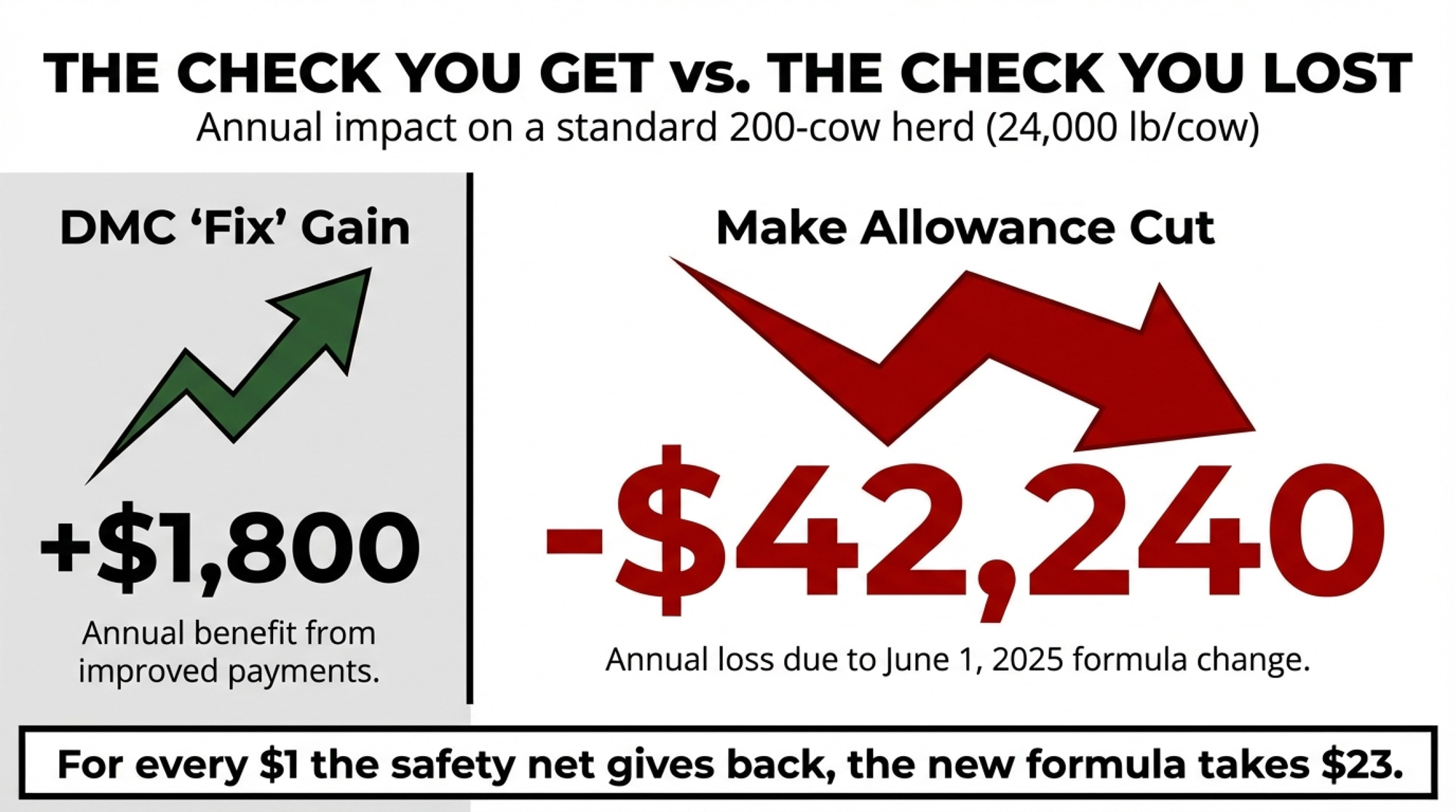
  • Calculate your operation’s specific losses from the 85-90¢/cwt make allowance impact

Next three months: Form coalitions with other disadvantaged producers to pool resources for legal challenges and political pressure targeting regulatory rebalancing. The Farm Bureau analysis gives you concrete numbers to work with.

  • Join regional producer alliances across cooperative boundaries
  • Pool resources for economic and legal expertise on regulatory challenges
  • Document specific financial impacts for legislative advocacy

Through 2025: Implement marketing strategies that capture value outside regulated pool formulas while supporting broader reform efforts. But honestly? Most of us lack the expertise for complex workarounds.

  • Explore direct-to-market partnerships bypassing FMMO pools
  • Negotiate over-order premiums, capturing regulatory advantages
  • Support cooperative governance reform requiring transparent processing profit disclosure

Strategic thinking: Support regulatory process reforms that require independent verification of industry cost claims and broader representation in policy development.

The $337 million wealth transfer already happened, according to Farm Bureau’s analysis. Whether it represents deliberate theft or unintended consequences, the practical effect is systematic disadvantaging of independent producers who lack processing partnerships and political influence.

Your response determines whether you adapt successfully to capture remaining value while building pressure for fairer regulatory processes… or watch your operation subsidize others’ advantages through government formulas that may never be rebalanced without sustained political pressure.

The regulatory game is complex, but the outcomes are clear. Understanding that complexity is essential for developing effective responses rather than just complaining about unfairness.

Your milk didn’t become less valuable. The formulas valuing your milk got restructured in ways that systematically favor certain players over others. The only question now is what you’re gonna do about it.

KEY TAKEAWAYS

  • Target 3.8% butterfat and 3.3% protein immediately—December component changes will redistribute pool money from operations below new assumptions to those hitting higher targets through systematic genetic selection and precision nutrition management
  • Negotiate over-order premiums with processors benefiting from enhanced make allowances—document your component quality and demand sliding-scale premiums that capture portions of the regulatory advantages flowing to processing margins
  • Form regional coalitions across cooperative boundaries to challenge regulatory methodologies—Farm Bureau’s $337 million documentation provides concrete evidence for legal petitions and political pressure targeting make allowance reversals
  • Calculate your operation’s specific losses from the 85-90¢/cwt make allowance impact—operations shipping 2,000 cwt monthly face $17,000-$18,000 annual reductions that cooperative processing divisions now capture as enhanced cost recovery
  • Explore direct-to-market alternatives, bypassing FMMO pool redistribution—regional partnerships with specialty processors willing to share value-added margins offer escape routes from regulatory formulas systematically favoring large-scale operations with processing partnerships

Complete references and supporting documentation are available upon request by contacting the editorial team at editor@thebullvine.com.

Learn More:

Join the Revolution!

Join over 30,000 successful dairy professionals who rely on Bullvine Weekly for their competitive edge. Delivered directly to your inbox each week, our exclusive industry insights help you make smarter decisions while saving precious hours every week. Never miss critical updates on milk production trends, breakthrough technologies, and profit-boosting strategies that top producers are already implementing. Subscribe now to transform your dairy operation’s efficiency and profitability—your future success is just one click away.

NewsSubscribe
First
Last
Consent

More Than Policy: For Jim Mulhern, Legacy is Measured One More Season at a Time

When times got tough, Jim Mulhern fought to keep dairy farmers afloat—his legacy is measured in seasons survived, not speeches made.

Jim Mulhern speaks on Capitol Hill: Leading with calm resolve and a producer’s perspective during his transformational tenure at NMPF.

What’s interesting about Jim Mulhern’s legacy—really, what stands out if you hang around barn meetings or share coffees after a long Expo day—isn’t just the policies on paper or the speeches under the lights. It’s how many dairy producers, across regions and generations, end up telling the same sort of story: when margins went south, when feed costs jumped, when times felt especially lean—somewhere in the background, or sometimes the foreground, Jim or his policy work was part of the survival toolkit. Sometimes it’s an NMPF Zoom, sometimes it’s a barn newsletter that started somewhere in DC, but at the end of the day, it’s about service, not a resume.

Ask producers from different regions and you hear variations of the same story: when margins got tight and options felt limited, Jim’s approach—listening first, speaking plainly—made challenging situations feel more manageable. Jim never had miracles—but if you picked up the phone, he’d listen, cut through the DC fog, and, true to form, drop that middle-child line: ‘You get good at compromise or you don’t eat!’ It made disaster feel… survivable.”

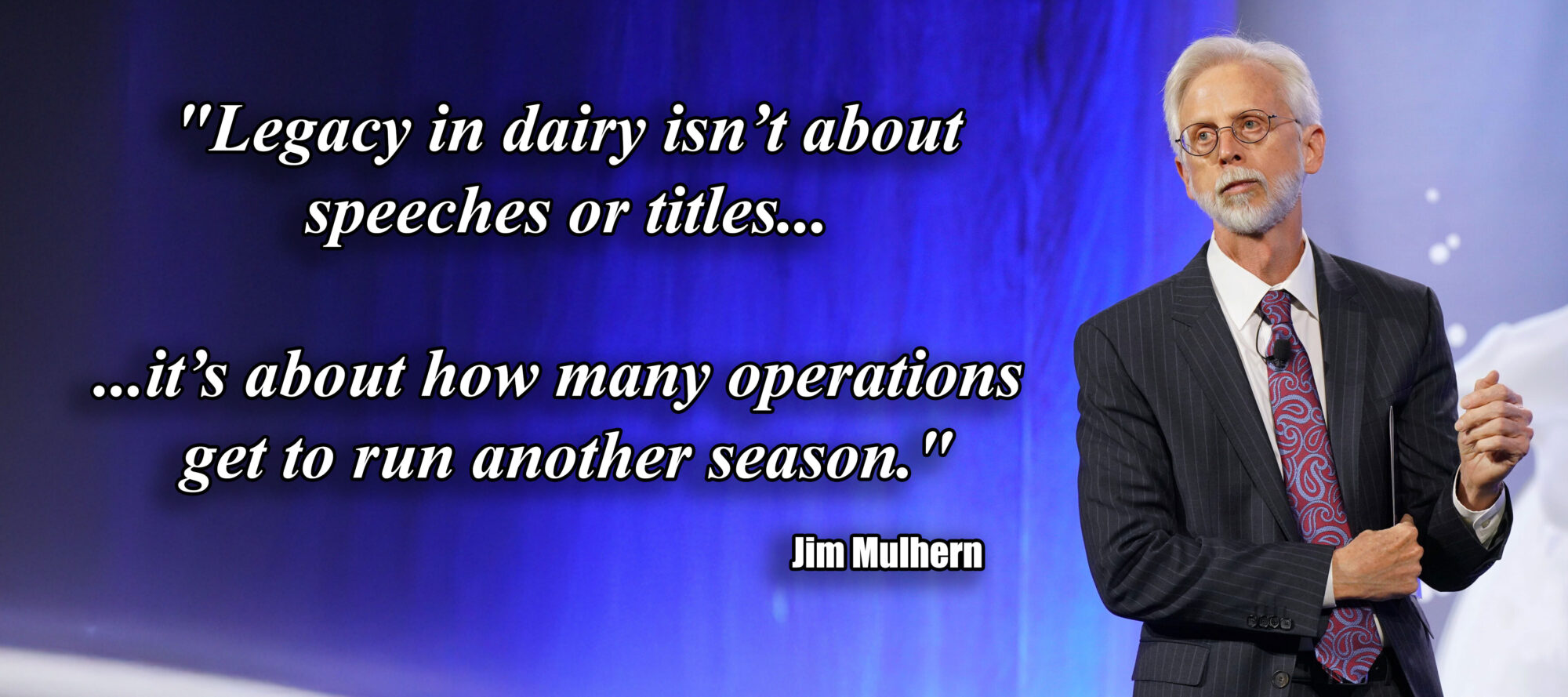
That earthy, honest support is the current running through his 45 years. Policy? It matters—but in dairy, legacy is how many operations get to run another season. So, let’s skip the official bio-paper and start where it hits hardest: with those farm stories that turn ‘legacy’ into something you can actually hold.

The Thing About Legacy in Dairy

It’s never been about reform tallies or titles. Ask anyone who’s watched drought suck the valley dry in Tulare, or a New Yorker calculating butterfat after a ration swap, or a Nevada dairyman wincing at the new heifer price sheet. Legacy’s about who keeps showing up—boots on, sleeves rolled—when everyone else is home.

Jim’s roots? Portage, Wisconsin—a big breakfast table, weekends on neighbors’ farms, one of those upbringings where you learned fast how problems got solved. Shuffled off to UW-Madison, he wasn’t in it for the hands-on milking; it was about using ag journalism to keep his hands in the land. That early DC internship with Bob Kastenmeier made it real: policy’s not a sideline, not if you steer it for the folks actually working the ground.

Compromise Isn’t a Dirty Word—It’s the Dairy Way

Here’s what the industry crowd knows: volume in a boardroom never means as much as listening on the ground. Jim, one of nine siblings, had the lessons of compromise engrained before he could drive. “The hardest part of co-op isn’t the milk check—it’s getting everyone on the same page.”

The road through FMMO reform? Nobody who was there would call it smooth. Those months would test anyone’s patience—herding Holsteins along a muddy path more than a couple of times. With all the regional priorities—Midwest cheese, Plains expansion, fluid markets in the West—compromise wasn’t an act, it was the job description. Jim pulled in trusted voices like Jim Sleper, and always circled back to what mattered: “Nobody walked away with everything, but everybody left knowing, ‘Yeah, my big worry was on the table.’” That’s why the results stuck when it mattered most.

Living Risk—Not Just Avoiding It

Let’s get down to it: bring up MILC, MPP, DMC (Dairy Margin Coverage program) at any coffee shop, and yeah, you’ll get some eye-rolls—until another dairy downturn reminds folks why it matters. Before the overhaul, many people figured their best shot was a prayer, insurance, and maybe a check if things got rough.

However, this is the new trend: with DMC, mid-sized to small operations have a real net. DMC’s pushed out over $2 billion when the pain hit hardest—money that kept for-sale signs out of the barn windows. You hear the same story everywhere—Michigan’s Thumb, a dry-lot outside Yuma, a late-night text from Idaho. When COVID hammered the sector, and the checks came, people said straight up, “That’s what kept cows fed and my kids in 4H.” That’s policy making a difference.

But managing risk wasn’t just about safety nets; it was also about fighting for a fair, predictable price in the first place—a battle that brought Jim straight to the messy heart of FMMO reform.

FMMO Reform—Messy, But Worth It

“Modernization” means one thing in Kansas, another in the Northwest—new barns going up in the plains, headaches with fluid class in the West. What’s striking, if you circle back with any co-op lead or new face from Montana to the Southeast, is that Jim didn’t duck the bumps. “Processors wanted unity for the Farm Bill, but the pandemic called the bluff—the formula needed rewriting. Still, we got folks back at the table and eventually hammered it out.” Grumbling’s still common (just call Vermont), but, as one co-op chair reminded me, “predictable beats chaos in my mailbox.”

Stewardship—Not Buzz, Just How You Farm

Sustainability’s trendy on the panel circuit, but “stewardship”—that’s been inside farming forever. Jim credits his convictions to watching families, his and others, do more with less, finding ways to turn waste into value, and always prepping for next year.

Ask the digester crew in Yakima. Or Florida operators who count every rainstorm and stretch a cover crop for two seasons. Policy eventually caught up: “We’ve cut emissions, improved yields, done more with less. Maybe, finally, that story is landing with customers and Congress.”

The Unfinished Battles: Immigration and Trade

You can measure most farm headaches by the grumble at Bullvine coffee hours, and nothing comes up more than labor and trade. Western herds, New York recalls, up into Quebec—if you don’t have crew, or if a new market wall goes up, everything halts. Jim’s honest about it: “Progress or not, it isn’t done until the guys in the parlor feel a difference.” Right now, Congress is stuck. And in ag, policy’s only as good as its impact before sunrise.

Labels, School Milk, and the Small Battles

Want to get Mulhern animated? Bring up almond “milk.” “Fake products using real dairy terms—FDA should’ve stepped in years ago.” And getting whole milk back in schools? If you’re not convinced, check in with a school nutrition lead in the Upper Midwest. “What we feed kids isn’t just a menu—it’s a message to the next generation.”

Passing the Torch—Not Just Polished Shoes on the Boardroom Floor

Ask Jim about wins, and he talks about his team, not tallies. “Building up smart, driven staff—beating paperwork by a mile,” he’ll say if you push. A real legacy isn’t a retirement countdown; it’s whether the next generation takes the lessons and actually runs with them.

Gregg Doud’s taking over, and from what Mulhern’s said publicly, the endorsement couldn’t be clearer: ‘Gregg is an established leader with a wealth of experience in ag policy. He knows the issues well, and he knows how to get things done.’ As more than one industry observer has noted, Jim’s legacy isn’t about grand gestures—it’s about leaving the field a little more level than he found it.

The Bottom Line—From the Parlor to the Boardroom

When you talk legacy around here, don’t glance at the plaque. Remember a neighbor scraping through a thin season thanks to a new rule, a check that cleared, or maybe just the right frank call at the right time. Sometimes it’s small, sometimes it makes the difference between getting the next shipment of feed or not.

You spot Jim Mulhern at Expo, maybe catching a sunrise before the barns get busy? You don’t need to make a speech. A nod—or a simple thank you—does the trick. The glue in this business has always been the unsung folks, steady at the wheel while the rest of us are milking before dawn.

Here at The Bullvine, that’s the vantage point we stand by: from the muddy middle, never giving up, proud of the next mile. Telling stories that help us all do it again, season after season.

Key Takeaways

  • Jim Mulhern’s legacy is defined by practical, producer-first leadership—he prioritized compromise, collaboration, and real-world policy solutions that mattered at the farm level.
  • His tenure saw major wins for dairy risk management (notably the DMC program), FMMO modernization, and timely COVID relief, helping stabilize milk checks and ensure producer survival through volatile markets.
  • Mulhern’s approach was always rooted in listening, unity, and finding common ground, even amid fierce regional and industry divides.
  • Ongoing challenges like labor, immigration, and global trade remain urgent—not “wrapped up” as he exits, but spotlighted as unfinished business for the next generation.
  • Beyond the boardroom, Mulhern is remembered for championing dairy’s true values—stewardship, authenticity, and resilience—leaving U.S. dairy better prepared for whatever comes next.

Executive Summary

Jim Mulhern’s legacy as retiring NMPF President isn’t written in speeches or boardroom victories—it’s measured season by season, in the everyday resilience of dairy producers his work helped sustain. Drawing on Midwestern roots and a knack for compromise forged as the middle child in a large family, Mulhern led policy moves like FMMO modernization and the Dairy Margin Coverage program that directly impacted milk checks in tough years. He was known for human-scale leadership: listening, cutting through politics, and prioritizing practical solutions that reached the parlor as much as the Capitol. The article spotlights Mulhern’s industry role in navigating regional divides, rallying co-ops, and meeting challenge after challenge—from market risk to labor and trade demands—with humility and relentless advocacy. Through anecdotes, peer insight, and grounded storytelling, it connects his legacy to themes of stewardship, collaboration, and the quiet determination that defines the dairy industry’s backbone. Even as he steps aside for a new generation, Mulhern’s mark endures in the unity he fostered and the real-world relief he delivered when it counted most.. This is the story of a leader whose true victories remain etched in seasons survived, not just awards won.

Learn More:

Join the Revolution!

Join over 30,000 successful dairy professionals who rely on Bullvine Weekly for their competitive edge. Delivered directly to your inbox each week, our exclusive industry insights help you make smarter decisions while saving precious hours every week. Never miss critical updates on milk production trends, breakthrough technologies, and profit-boosting strategies that top producers are already implementing. Subscribe now to transform your dairy operation’s efficiency and profitability—your future success is just one click away.

NewsSubscribe
First
Last
Consent

The Dairy Apocalypse of 2025: Why Your Milk Check Is Disappearing and Who’s Profiting from It

Milk prices crash 15% as trade wars erupt & new policies gut profits. Can dairy farmers survive 2025?

EXECUTIVE SUMMARY: US dairy faces a perfect storm in 2025: Plummeting milk prices (USDA slashes forecasts by $1.50/cwt), crippling tariffs locking exporters out of China/Mexico, and FMMO reforms reinstating $millions from producers to processors. HPAI outbreaks rage unchecked, while tight heifer supplies, and policy inertia expose farmers. Survival demands radical shifts-optimizing components over volume, aggressive risk management, and treating biosecurity as profit protection.

KEY TAKEAWAYS:

  • Milk checks nosedive: 2025 prices projected at $21.10/cwt (-15% from 2024), with Class IV hit hardest (-$2.55).
  • Trade wars backfired: 135% Chinese tariffs and Mexico/Canada retaliation threatened $1+/cwt price drops.
  • FMMO “modernization” = wealth transfer: Higher processors make allowances slash farm payouts, favoring fluid-heavy regions.
  • HPAI is the new normal: 1,000+ herds are infected, production losses are up to 15%, and no vaccine will be until 2026.
  • Adapt or collapse: Component-focused feeding, blended risk strategies, and biosecurity investments separate survivors from casualties.
dairy market outlook 2025, US milk prices, dairy trade tariffs, FMMO modernization, HPAI dairy cattle

The 2025 dairy industry faces a perfect storm that nobody wants to discuss. Milk prices are in free fall, with USDA slashing forecasts by $1.50/cwt in just 90 days. Meanwhile, bureaucrats are ramming through FMMO “reforms” that will drain millions from producers’ pockets through bloated make allowances, all while government-imposed trade wars lock us out of our most valuable export markets. And if that wasn’t enough, HPAI continues to ravage herds nationwide, with regulators pretending they’ve got it under control. The days of $23 milk and $4 corn are dead and buried.

The data doesn’t lie, folks. After riding high on record-breaking $16/cwt margins in late 2024, dairy producers are staring at a financial cliff in 2025. Let’s cut through the spin and get to the ugly truth about what’s happening to your milk check this year.

Your Disappearing Milk Price

Remember February, when USDA economists confidently projected a 2025 all-milk price of $22.60/cwt? That number has evaporated faster than dew on a summer morning in Texas. By March, it mysteriously dropped to $21.60. The latest May forecast? A pathetic $21.10/cwt.

That’s not a rounding error – it’s a $1.50/cwt heist in just 90 days. For a 500-cow dairy producing 25,000 pounds per cow annually, we’re talking about $187,500 in vanished income. When’s the last time an “adjustment” cost you nearly $200K?

Every month this year, USDA forecasters have slashed their milk price predictions while offering zero explanation for why they got it so wrong the month before. This isn’t meteorology, where predictions naturally become more accurate over time – it’s economics, and this pattern of consistent downward revisions reveals either incompetence or a deliberate attempt to mask how bad things are getting.

Look at what’s happening to your milk check:

Price Indicator2024 (Actual/Est.)2025 (Latest Forecast)Change
All-Milk Price$22.61/cwt$21.10/cwt-$1.51
Class III Price~$19.00/cwt$17.60/cwt-$1.40
Class IV Price$20.75/cwt$18.20/cwt-$2.55

The spotty good news? Feed costs remain relatively stable. But don’t celebrate yet – the projected declines in milk prices will still outpace any savings on your feed bill. It’s like finding a nickel in the parlor drain the same day your milk truck jackknifes on the highway.

The Trade War Nobody’s Talking About

While economists drone on about “shifting market fundamentals,” they’re tiptoeing around the elephant in the milking parlor: we’re in an unprecedented trade war systematically dismantling decades of market development.

In March, the administration unleashed a barrage of new tariffs – 25% on nearly all imports from Mexico and Canada and escalating rates on Chinese goods. Did anyone bother to ask dairy farmers if they wanted to sacrifice their export markets on the altar of immigration politics? The predictable result? Swift and severe retaliation targeting US dairy:

  • China slapped additional tariffs of 10-15% on US dairy products, pushing effective rates to an eye-watering 135%
  • Mexico announced its retaliatory measures against US goods
  • Canada immediately hit back with tariffs on approximately $21 billion of US products

The impact has been immediate and devastating. Nonfat dry milk/skim milk powder exports have collapsed 20% year-over-year, while lactose exports are down 14%. The critical dry whey market faces crippling tariffs of 84% to 150% in China.

Here’s what dairy economists won’t say publicly: this isn’t a typical trade dispute – it’s a full-scale market destruction that could take a decade to rebuild. When’s the last time you heard industry leaders acknowledge this reality instead of offering tepid statements about “hoping for resolution”?

The timing couldn’t be worse. New domestic cheese processing capacity is coming online just as international markets are slamming their doors in our faces. With no place for this additional production, the pressure on domestic prices will only intensify.

This is pure politics trumping economics. According to industry analysts, each posturing speech about “getting tough” on trade costs dairy farmers real money – about /cwt in Class III prices alone. That’s not theoretical – that’s your mortgage payment.

FMMO Reform: The Great Dairy Robbery

After years of debate and months of hearings, the Federal Milk Marketing Order modernization takes effect on June 1st. But before you celebrate this “achievement,” you might want to check which side of the dividing line you’re standing on – because this reform is nothing short of a massive wealth transfer.

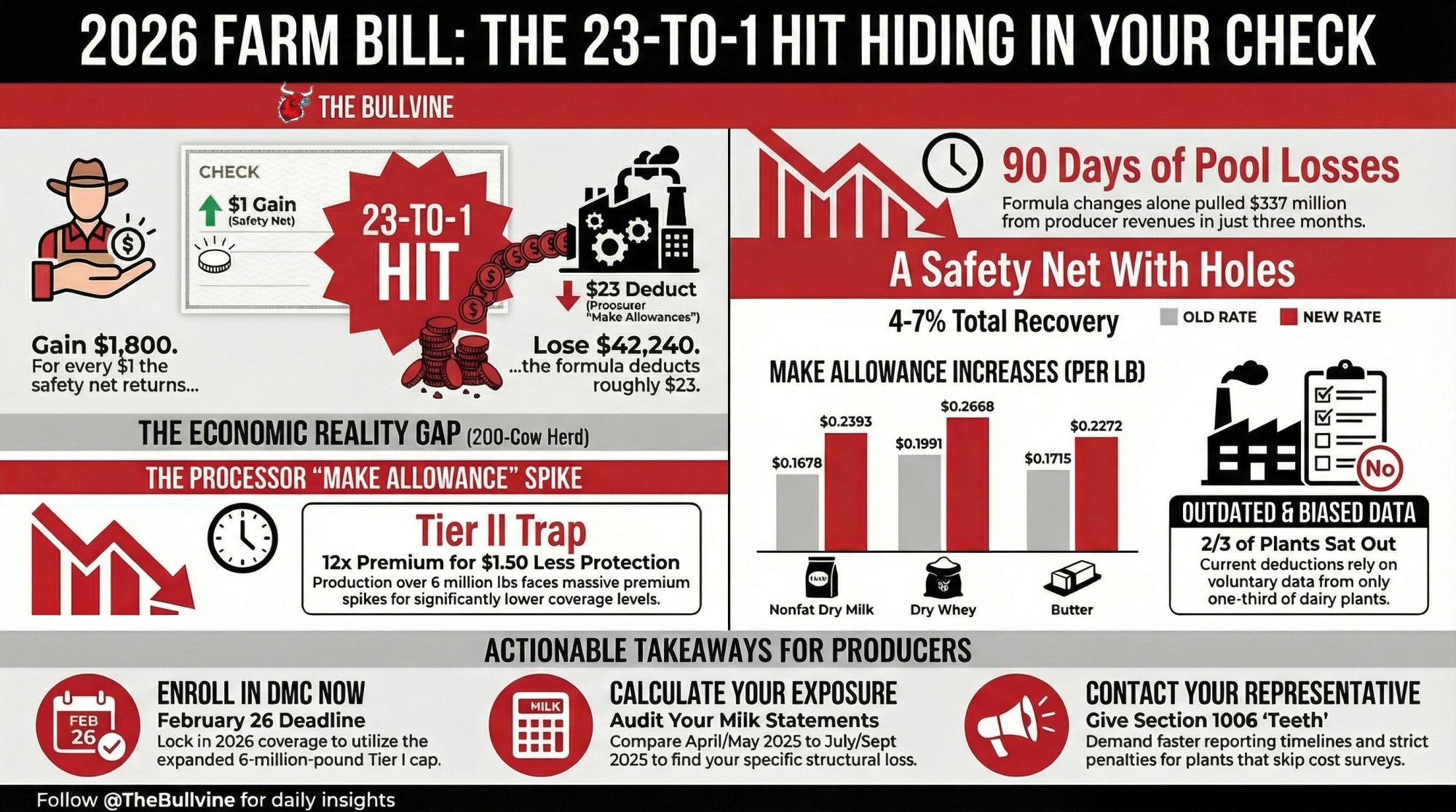
The most crucial change is getting the least attention: substantially higher make allowances for processors. These allowances are increasing to $0.2519/lb for cheese, $0.2272/lb for butter, $0.2393/lb for NDM, and $0.2668/lb for dry whey.

Let’s call this what it is: a direct transfer of money from farmers to processors. Higher make allowances mathematically reduce the milk price paid to farmers. Period. Industry representatives frame this as “necessary adjustments reflecting higher processing costs,” but the reality is simpler: processors get guaranteed margin relief while farmers bear all the market risk.

When processors face higher costs, they get an automatic adjustment. When your diesel or labor costs skyrocket, where’s your automatic adjustment? The hypocrisy is stunning, yet industry organizations dominated by processor interests have convinced farmers to vote for their financial disadvantage.

And here’s where it gets interesting. The net impact will vary dramatically by region:

  • If you’re producing milk in the Southeast, Florida, or Appalachia Orders where fluid utilization is high, congratulations – you’ll likely see a net benefit from these changes.
  • But are you in the Upper Midwest, Pacific Northwest, California, or Arizona? You’re about to get fleeced. The higher make allowances will hit you hard, while your region’s manufacturing-heavy utilization will dilute the benefits of Class I changes.

This regional disparity raises a fundamental question: Should dairy policy create winners and losers based on geography rather than efficiency? Does penalizing regions that have invested billions in creating efficient manufacturing infrastructure make sense? The data suggests that the FMMO changes reward location over innovation, potentially distorting signals for long-term industry development.

HPAI: The Disease They Can’t Control

While policymakers debate prices and tariffs, dairy farmers face a more immediate threat: the relentless spread of Highly Pathogenic Avian Influenza (HPAI) in cattle. Despite more than a year of intervention efforts, this crisis is accelerating, not receding.

As of April 2025, HPAI had been confirmed in dairy cattle on over 1,009 premises across 18 states – a dramatic increase from the 16 states reported in late 2024. The states with the highest number of affected herds include California (with approximately 765 affected herds), Idaho (65), Colorado (64), Michigan (31), and Texas (27).

The most alarming finding? Scientists have identified multiple viral strains, confirming at least two spillover events from wild birds into dairy herds. This means the threat isn’t just from cattle movement – even operations with strict biosecurity remain vulnerable to environmental exposure from wild bird populations.

Why isn’t this front-page news? If a virus affecting food production had infected over 1,000 operations in any other industry, it would be deemed a national emergency. Yet HPAI has been normalized, with USDA officials repeating reassurances while case numbers climb.

The impact on affected farms is significant: reduced appetite, decreased milk production (estimated at 10-15% in clinical cases), and changes in milk consistency. While mortality rates remain relatively low, production losses can devastate farm economics.

California’s experience illustrates the scale of impact. In October 2024, the state’s milk production was down a dramatic 3.8% year-over-year, partly attributed to HPAI infections. As the virus spreads through 2025, similar production declines could emerge in other major dairy regions.

The USDA’s response, including the National Milk Testing Strategy and enhanced biosecurity recommendations, has failed to contain the spread. Let’s be honest about where we stand: regulators have shifted from containment to management after over a year. The virus is here to stay.

Breaking With Conventional Wisdom

Let’s challenge some sacred cows in the dairy industry:

1. The “Produce More” Mentality Is Dead

For decades, the standard advice during low-price periods has been to maximize production to spread fixed costs. This outdated thinking is financial suicide in today’s market. While the industry mantra has been “produce more to spread fixed costs,” the economic reality has fundamentally changed.

Instead of chasing volume, leading producers are pivoting to component optimization. With cheese prices showing relative strength compared to other products, farms focusing intensely on butterfat and protein percentages rather than raw volume are capturing premium returns despite lower overall prices.

“We’ve shifted from a volume mindset to a component value mindset,” explains one Wisconsin producer whose operation has maintained profitability despite the market downturn. “Our nutritionist now formulates rations to maximize component yield rather than total production. It’s completely changed our approach to feeding.”

Would you rather ship 80 pounds of 3.8% fat, 3.3% protein milk or 90 pounds of 3.5% fat, 3.0% protein milk? Do the math – the lower volume, higher component milk is worth significantly more in today’s market, with lower hauling costs.

2. Risk Management Isn’t Optional – It’s Essential

Too many producers still treat risk management as something only big dairies need to worry about. That mentality is financial suicide in today’s volatile market. The most successful operations have abandoned the all-or-nothing approach to risk management.

Instead of either fully contracting or staying completely exposed to the market, they’re employing blended strategies that combine:

  • Targeted contracts for specific periods based on margin opportunities
  • Strategic use of put options to establish price floors while maintaining upside
  • Maintaining a portion of production unhedged to capture potential market improvements

Think of risk management like your breeding program – you’d never breed your entire herd to a single bull with extreme traits. You select a group of sires with complementary strengths to manage genetic risk. Your marketing approach should follow the same diversified strategy.

What Smart Producers Are Doing Differently

Faced with falling milk prices, export disasters, policy upheaval, and disease threats, smart dairy farmers aren’t waiting for conditions to improve – they’re taking decisive action now:

1. Biosecurity as a Profit Center, not a Cost

Forward-thinking operations have reconceptualized biosecurity from a regulatory burden to a profit-protection strategy. These farms aren’t just implementing basic HPAI prevention measures; they’re treating disease prevention as a core business function with dedicated staff, regular training, and rigorous protocols.

“We’ve stopped thinking about biosecurity as something we do to satisfy regulators,” notes a California producer who has kept HPAI at bay despite being surrounded by affected operations. “Now we treat it like we treat cow comfort or nutrition – as a direct driver of profitability that deserves significant time and investment.”

Consider the return on investment: spending $15,000 on enhanced bird deterrents, boot wash stations, and dedicated equipment between pens might seem excessive until you calculate the $85,000 lost milk revenue from even a moderate HPAI outbreak in your herd. The prevention math suddenly looks compelling.

2. Feed Efficiency: The New Production Frontier

With milk prices falling faster than feed costs, the margin between the two is compressing rapidly. In response, innovative producers are doubling on feed efficiency programs that reduce production costs by $0.75-1.25/cwt.

These initiatives go far beyond basic ration balancing, incorporating:

  • Intensive forage quality programs that maximize digestibility
  • Precision feed management systems that reduce shrink and waste
  • Genomic selection specifically targeting feed conversion efficiency

“We can’t control milk prices, but we absolutely can control how efficiently our cows convert feed to milk,” explains a New York producer who has reduced feed costs by over $1/cwt in the past year. “That’s where our focus needs to be in this market.”

Every pound of feed lost to shrinkage, sorting, or spoilage is pure profit leakage. Are you treating your silage face management with the same precision you apply to your synchronization protocols? Both directly impact your bottom line.

The Bottom Line

The 2025 dairy landscape presents unprecedented challenges: systematically lower milk prices, destructive trade policies, confusing order reforms, and a persistent disease threat. The combined impact creates a perfect storm that will test even the most efficient operations.

Here’s what you need to understand:

  1. Official forecasts have consistently underestimated the severity of price declines – expect continued downward pressure through 2025 as export markets remain constrained and domestic production increases.
  2. The trade war is not a temporary disruption but a fundamental reshaping of market access that could take years to resolve – plan accordingly rather than hoping for a quick fix.
  3. FMMO changes taking effect mid-year will create significant regional disparities – understand exactly how they’ll impact your operation’s specific milk check calculation.
  4. HPAI remains uncontained and will continue to spread despite official intervention – investing in rigorous biosecurity isn’t optional but essential for financial survival.
  5. Component optimization, strategic risk management, biosecurity investment, and feed efficiency programs aren’t just marginal improvements but essential strategies for navigating this challenging environment.

Are you still operating with a 2023 mindset in a 2025 market? The rules have fundamentally changed. Those waiting for markets to “return to normal” will be waiting for a train never arriving. Instead of hoping for better days, take control of what you can influence: your components, your risk management, your biosecurity, and your feed efficiency.

The question isn’t whether conditions will improve – it’s whether you’ll still be in business when they do. The dairy industry has weathered difficult periods, but 2025 presents complex challenges. Success will require abandoning outdated assumptions, embracing uncomfortable realities, and implementing bold strategies that challenge conventional wisdom.

What are you changing today to ensure you’re still milking cows in 2026?

Learn more:

Join the Revolution!

Join over 30,000 successful dairy professionals who rely on Bullvine Weekly for their competitive edge. Delivered directly to your inbox each week, our exclusive industry insights help you make smarter decisions while saving precious hours every week. Never miss critical updates on milk production trends, breakthrough technologies, and profit-boosting strategies that top producers are already implementing. Subscribe now to transform your dairy operation’s efficiency and profitability—your future success is just one click away.

NewsSubscribe
First
Last
Consent
Send this to a friend