



Archive for farm ROI

Concrete, Air, and Shade: The Real Drivers Behind Milk Yield

Your biggest ROI isn’t in feed—it’s in airflow, space, and shade. Comfort is still the cheapest form of nutrition.

You know, it’s easy to see why so many of us start with feed when we think about performance. Feed costs take up the biggest line in most of our budgets — and it’s the part of management we can see, mix, and adjust every day. But what I’ve found, after years of walking barns across Wisconsin and talking with producers from Ontario to Idaho, is that sometimes the problem isn’t in the ration. It’s in the roof, the floor, and the airflow.

You can’t fix nutrition in a broken barn. And once you understand the biology behind that statement, it changes everything about how you think about profitability.
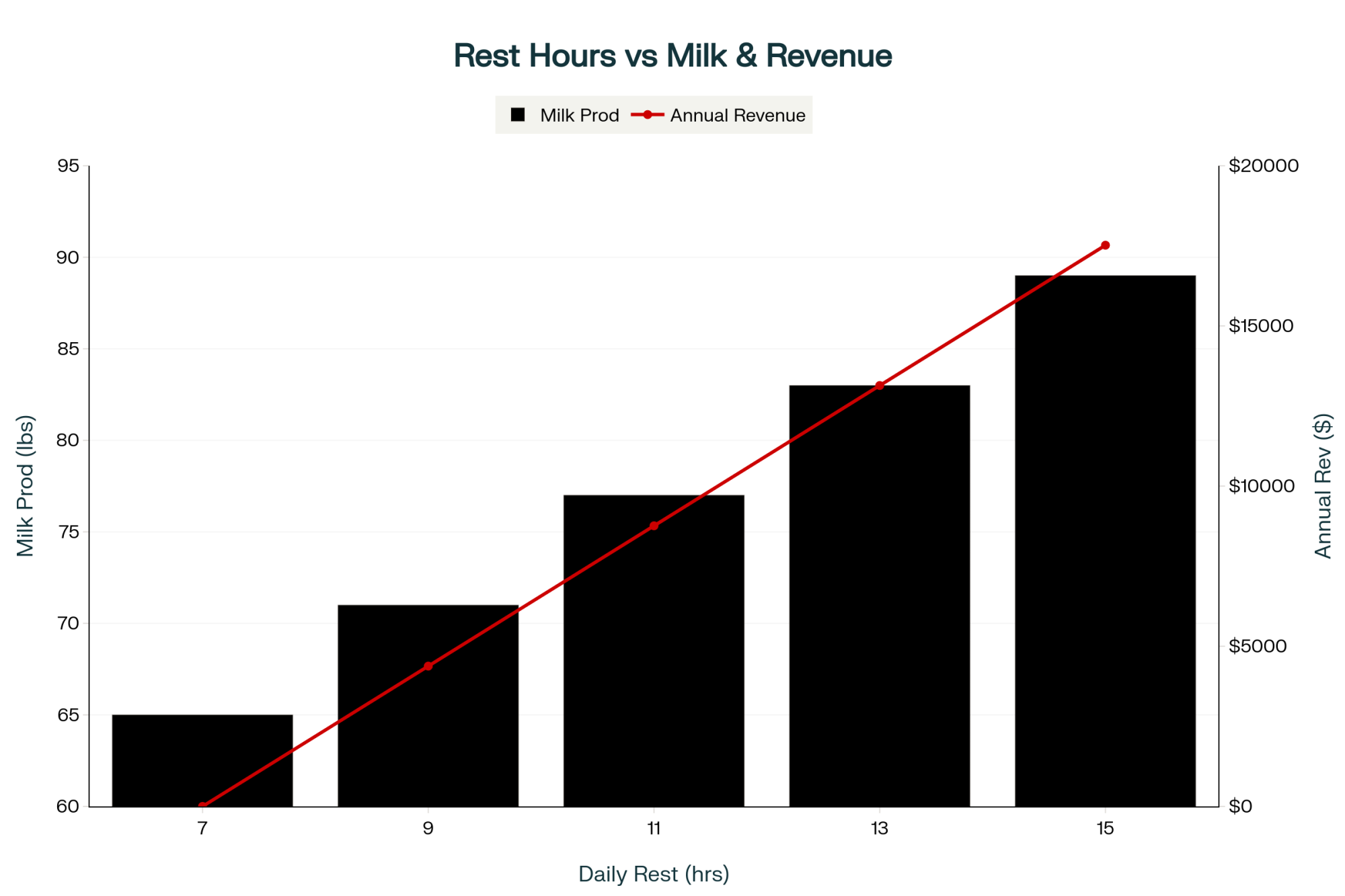
The Rest-Revenue Multiplier: Every additional hour of cow rest time generates 2-3 lbs more milk daily, translating to $4,380+ annual revenue per cow—making comfort your highest-ROI investment

The $50 Fix That Unlocks 3.5 Pounds of Milk

Research is clear on this one — comfort is milk in the tank. The University of Wisconsin’s Dairyland Initiative and William H. Miner Agricultural Research Institute have both documented that every additional hour a cow spends lying down yields 1.7 to 3.5 pounds more milk each day (UW Dairyland Initiative and Miner Institute Cow Comfort Resources).

Here’s what’s interesting: the fix for poor comfort isn’t always expensive. I visited a mid-sized herd near Ripon, Wisconsin, that simply raised neck rails by four inches and deepened bedding. The cows immediately started using the stalls properly, adding almost 2.5 hours of rest per day. “Same cows, same feed,” the producer told me. “We gained six pounds of milk just by fixing the structure.”

It makes sense when you look at history. Freestall dimensions built before 2010 were designed for smaller Holsteins, around 1,100–1,300 pounds. Modern cows average closer to 1,500–1,600 pounds, which means their natural movement is restricted in older stalls. Adjusting neck rails to 48–52 inches high and 68–70 inches from the curb better fits today’s herds.

Investment TypeCost Per StallPayback PeriodMilk Gain (lbs/day)Annual ROI
Neck Rail Adjustment$503 months2.0-3.5360%
Bedding Deepening$754 months1.7-3.0280%
Fan Repositioning$0-251-2 months2.5-4.0450%
Stall Width Increase$1506 months3.0-4.5320%

Cornell Pro‑Dairy economic modeling shows that small structural corrections like these deliver consistent three‑month paybacks with average returns of 360%. The investment? About $50 per stall, mostly in tools and labor (Cornell Stall Design & Economics Tools).

Heat Stress Isn’t Just a Southern Problem

Heat Stress Strikes at 68°F: Most producers think heat stress begins at 80°F, but research proves milk loss, fertility decline, and reduced feed intake start at just 68 THI—a game-changing revelation for northern dairies

A lot of northern producers still assume heat stress doesn’t affect them — but science and data say otherwise. Dr. Geoff Dahl, professor of animal sciences at the University of Florida, has shown that cows begin to decline in performance when the Temperature‑Humidity Index (THI) exceeds 68, roughly 70°F with 60% humidity (University of Florida – Heat Stress Research).

The Silent Inheritance: One summer without cooling dry cows costs $1,200-1,800 per animal across multiple generations—proving that heat stress during the dry period is the most expensive 46 days on your dairy

What’s really eye‑opening is that heat stress during the dry period doesn’t just affect current milk yield. It alters calf development in utero, setting those heifers up for life‑long performance losses. Dahl’s studies have shown that heifers born from heat‑stressed dry cows produce 5‑11 pounds less milk during their first lactation — a penalty that carries on through adulthood.

Even in the Upper Midwest and Ontario, weather-tracking from UW‑Extension shows that cows experience that threshold for 50–90 days per year, depending on ventilation and humidity. The solution doesn’t always mean a major retrofit — just adjusting fan direction or installation height to maintain 300‑400 feet per minute of airflow at cow levelcan significantly change outcomes.

At one Ontario farm, redirecting fans over feed alleys rather than back walls completely flattened milk yield swings. The owner laughed when he said, “We didn’t add fans — just turned them the right way.” That small shift eliminated bunching, improved feed intake, and kept butterfat performance steady all summer.

When Infrastructure Outperforms Feed

Investment CategoryTypical CostPayback TimeMilk ResponseWorks 24/7Risk Level
Stall Modification$50-150/stall3-6 months2-4 lbs/dayYesLow
Cooling System$200-500/cow6-12 months3-5 lbs/dayYesLow
Nutrition Additive$0.20-0.50/dayContinuous0.5-2 lbs/dayNoMedium
Premium Feed$50-100/tonContinuous1-3 lbs/dayNoMedium

Let’s talk numbers, because that’s where the case for infrastructure gets serious. Studies from Cornell Pro‑DairyUniversity of Wisconsin, and Kansas State University show the ROI on barn improvements consistently competes with — and often beats — nutrition investments.

One 450‑cow herd in western New York implemented these upgrades and dropped its cull rate by 10% while cutting hoof‑trimming costs by a quarter. Herd average climbed five pounds — all from removing the bottlenecks stalls created. The farm’s owner summed it up well: “I used to buy almost every nutrition additive out there. Now my barn does most of the work.”

Why Improvements Still Lag

If the data is so compelling, what holds farms back? Psychologists — and farm economists like Dr. Cameron King of the University of Guelph — believe it’s about visibility. As King puts it: “Producers invest where they can see results fast. Feed changes give immediate feedback. Infrastructure improvements return slower, even though the payoff is bigger.”

That rings true. With a slight tweak to the ration, you can check the milk weights the next morning. But it’s harder to measure peace, comfort, and stability — the quiet gains of removing friction from cow behavior. What’s encouraging is that the operations making these investments are often the same ones noticing calmer cows, fewer metabolic issues, and a stronger transition period before any milk data even comes in.

From Managing to Designing Systems

There’s a shift happening that’s worth watching. Instead of “managing stress,” many top herds are designing barns so that stress never builds in the first place. In a series of case studies, Cornell Pro‑Dairy and Kansas State Universityfound that herds that improved stall space, bedding, and airflow gained 2 hours of rest per cow daily, resulting in 8–9 pounds more milk per cow without changing feed.

Cows weren’t “pushed” to perform; their biology was finally allowed to express what the ration and genetics were already capable of. Transition cows handled fresh periods more smoothly, fertility improved, and energy balance stabilized.

One Minnesota dairy manager put it perfectly during a University of Minnesota Extension discussion: “We quit trying to ‘manage’ around cow comfort. Now, the management kind of takes care of itself.”

Five Quick Ways to Gauge Comfort

Your Monday Morning Diagnostic: This simple decision tree helps producers systematically identify barn comfort bottlenecks before spending another dollar on feed—potentially unlocking 2-3.5 lbs more milk per cow daily

If you want to know where your barn performance really stands, start with these simple checks:

  1. Monitor THI at the cow level. Anything above 68 calls for immediate cooling actions.
  2. Try the 25‑second knee test. Kneel in a stall for half a minute. If it’s painful or wet, it’s failing your cows.
  3. Look mid‑day. At least 80–85% of your cows should be lying down comfortably after feeding.
  4. Start small. Neck rails, fans, and bedding deliver immediate ROI—and can fund larger phases later.
  5. Recalibrate your ration. Once comfort improves, cows eat differently — work with your nutritionist to reflect that change.

The Foundation That Never Takes a Day Off

I remember something Dr. Mike Hutjens once told a group of producers: “Infrastructure never takes a day off.” And it stuck with me. A properly fitted stall or well‑placed fan doesn’t clock out when you do; it’s the one system on the farm that works 24/7 without supervision or overtime.

What’s important—and, frankly, encouraging —is that comfort strategies aren’t limited to freestall setups. Tie‑stall and dry lot systems achieve similar returns when cow biology drives design rather than human habit. Sand or dry bedding, airflow direction, and clean water space work for dairies of every scale and layout.

If there’s a single takeaway here, it’s this: foundation before feed. The barn sets the biological ceiling, and the feed fills the space below it. Get that order right, and suddenly everything else — the ration, the reproduction, the milk components — starts falling into place naturally.

Further Reading and Resources

Key Takeaways:

  • Every extra hour cows rest can earn roughly 3.5 lbs of milk—comfort converts directly into production.
  • Feed can’t fix a poorly built barn. Airflow, shade, and stall comfort determine how well the feed performs.
  • Simple $50 stall fixes often deliver a 300% ROI—before your next feed bill even prints.
  • Heat stress begins at a THI of 68 °F, not 80. Early cooling preserves milk yield and fertility.
  • Infrastructure pays you every day—it never takes a day off.

Executive Summary

Most producers focus on feed when milk performance stalls — but new research shows the real ceiling may be in the barn, not the bunk. Studies from Wisconsin, Florida, and Cornell link each extra hour of cow rest to 1.7–3.5 lbs of milk per day, with simple $50 comfort fixes delivering triple‑digit ROI. Heat stress starts earlier than we think — at just 68 °F THI — quietly costing milk, fertility, and even the next generation’s output. What’s encouraging is how quickly these investments pay back, often inside one season. Across freestalls, tie‑stalls, and dry lots, the takeaway is the same: infrastructure is the quiet partner that lets nutrition, genetics, and management finally show their full potential.

Complete references and supporting documentation are available upon request by contacting the editorial team at editor@thebullvine.com.

Learn More:

Join the Revolution!

Join over 30,000 successful dairy professionals who rely on Bullvine Weekly for their competitive edge. Delivered directly to your inbox each week, our exclusive industry insights help you make smarter decisions while saving precious hours every week. Never miss critical updates on milk production trends, breakthrough technologies, and profit-boosting strategies that top producers are already implementing. Subscribe now to transform your dairy operation’s efficiency and profitability—your future success is just one click away.


NewsSubscribe
First
Last
Consent

UK Dairy Revolution: How Smart Farmers Are Ditching Processors for 300% Profit Margins

UK dairy revolutionaries ditch processors, capture 300% profit margins through direct-sales vending. Your feed efficiency means nothing if processors own your margins.

Executive Summary: While you’re optimizing feed conversion ratios and chasing genomic gains, UK farmers are solving the real problem—processor dependency that’s stealing your profits. UK milk vending operations are delivering £1.20-£1.60 per litre while traditional wholesale contracts squeeze farmers at 43.69p per litre—a staggering 300% pricing premium that’s transforming farm economics. With 400 machines now operating nationwide and 12-month ROI periods on £30,000 investments, this isn’t diversification—it’s liberation from commodity pricing. While North American producers face regulatory barriers with 20 US states prohibiting raw milk sales and Canada’s supply management blocking direct sales entirely, UK farmers operate in a framework that enables direct-consumer innovation. The brutal truth? Your superior butterfat percentages and lower somatic cell counts won’t save you if processors capture all the value—time to evaluate whether you’re building your operation or subsidizing theirs.

Key Takeaways

  • Direct-Sales ROI Destroys Traditional Expansion Models: £30,000 vending setups deliver 12-month payback periods compared to decades for conventional capacity expansion, with farmers achieving 60-80 pence per litre margins versus single-digit pence through processor contracts
  • Value-Added Products Drive Exponential Returns: Flavoured milkshakes generate 40-50% higher per-litre revenues than base milk, with successful operations increasing average customer spend from £3.50 to £7.00 through comprehensive farm retail offerings that bypass traditional distribution entirely
  • Technology Integration Enables 24/7 Autonomous Revenue: Modern vending systems with IoT connectivity and contactless payments processing 85% of transactions create self-contained retail operations immune to processor capacity constraints and transport disruptions affecting conventional supply chains
  • Processor Disintermediation Transforms Farm Economics: Operations achieve sustainable 200-300% pricing premiums over wholesale rates while maintaining competitive positioning against premium supermarket brands, proving that controlling your supply chain beats optimizing for someone else’s profit margins
  • Global Regulatory Comparison Reveals UK’s Strategic Advantage: Unlike restrictive frameworks in Canada’s supply management system and fragmented US state regulations, UK’s permissive direct-sales environment enables farmer-led innovation that North American producers can only dream about
milk vending machines, dairy farm diversification, direct-to-consumer dairy, dairy profitability, farm ROI

Here’s the brutal truth your processor doesn’t want you to hear: UK farm-gate prices dropped to 43.69 pence per litre in April 2025—down 2.6% from March—while smart vending operators across the country are banking £1.20-£1.60 per litre. That’s not evolution, folks. That’s revolution.

Look at the numbers. Four hundred forty producers (5.8%) left the industry between April 2023 and 2024, reducing Great Britain’s producer count to approximately 7,130 operations. The survivors? They’re facing a stark choice: stay trapped as price-takers in a commodity squeeze, or break free and become price-setters through direct consumer engagement.

This isn’t just another diversification trend rolling through the countryside. This is the blueprint for breaking free from processor dependency—and it’s already delivering 12-month ROI periods for operators brave enough to challenge the status quo.

The Processor Disintermediation Wave You Can’t Ignore

Let’s cut through the industry noise for a minute. Sure, milk volumes hit 1,396 million litres in April 2025, but here’s what really matters—who’s controlling the margins? The global milk vending market, valued at $152 million in 2025, is projected to reach $265.1 million by 2033 with a 7.2% compound annual growth rate.

What This Actually Means for You: Every machine that goes up represents another farmer who looked at their processor contract and said, “enough.” They’ve claimed ownership of their product’s final value, rather than handing it over to middlemen.

Those 400 machines now operating nationwide? They’re not just dispensers sitting in farm yards. They’re declarations of independence from a supply chain that’s kept farmers as commodity producers for generations. When processor margins consistently exceed farmer margins, something’s fundamentally broken. Smart operators are fixing it.

Technology Investment Reality Check: £30,000 to Freedom

Here’s where traditional thinking gets dangerous. Yes, complete setup costs typically reach £30,000 for vending machine and pasteurization combinations. But here’s the question processors are praying you never ask: How many years of 43p per litre milk does it take to generate the cash flow that vending operators achieve in just 12 months?

The Math They Don’t Want You to See:

  • Traditional margin: Single-digit pence per litre
  • Vending margin: 60-80 pence per litre after costs
  • ROI timeline: 12 months for vending vs. decades for traditional capacity expansion

Now, The Milk Station Company supplies roughly 75% of UK vending machines, but honestly? The real innovation isn’t in the hardware—it’s in the mindset shift from commodity production to premium retail positioning.

Current Market Dynamics: Why Now Is Your Moment

The industry consolidation creating today’s crisis? That’s tomorrow’s opportunity for operators who see what’s coming. With butterfat at 4.29% and protein at 3.41% in April 2025, you’ve got quality metrics that support premium positioning strategies. Yet most farmers let processors train them to ignore this advantage.

Global Context Reality: The United States prohibits raw milk sales in 20 states, while Canada operates near-total prohibition on private raw milk sales. Meanwhile, UK farmers are operating in a regulatory environment that actually enables direct sales innovation. Most just stay chained to processor contracts anyway.

This isn’t a coincidence—it’s a competitive advantage hiding in plain sight.

Value Engineering Beyond the Commodity Trap

Here’s What Processors Fear Most: Farmers discovering that flavoured milkshakes generate 40-50% higher per-litre revenues than base milk. Think about this: a 500ml milkshake selling for £1.80 delivers £3.60 per litre equivalent—more than eight times current farm-gate prices.

Successful operations routinely see average customer spend jump from £3.50 to £7.00 after introducing comprehensive retail offerings. This isn’t just about milk anymore. It’s about transforming from commodity supplier to destination retailer.

The Cooperative Response: First Milk’s Strategic Pivot

Even traditional cooperatives see the writing on the wall. First Milk’s Golden Hooves brand, launched in 2022, now provides member farmers with branded vending machines and regenerative agriculture messaging.

The Strategic Implication: When cooperatives start competing with their own wholesale model, you know the game has changed. The question isn’t whether direct sales will grow—it’s whether you’ll be leading this charge or watching from the sidelines.

International Regulatory Comparison: UK’s Hidden Advantage

While only 124 farms in England are registered for raw milk sales, the UK’s framework enables innovation that’s impossible elsewhere. Georgia became the 31st state to allow raw milk sales in 2023, but 20 US states still prohibit raw milk sales entirely.

Your Competitive Reality: You’re operating in a jurisdiction that enables direct-sales innovation while most global producers face regulatory barriers. That’s not luck—that’s strategic positioning most farmers aren’t exploiting.

UK Regulatory Framework: Clear Pathways vs Global Restrictions

The UK’s approach gives you clear pathways for farm diversification through direct milk sales. Raw milk producers just need to register with the Food Standards Agency and implement solid food safety management plans. You can sell directly from farms, through farm-run delivery services, or at registered farmers’ markets.

Compare that to Canada’s supply management system, which effectively blocks on-farm vending by requiring all milk to be processed through licensed processors. The regulatory comparison reveals exactly why UK adoption is accelerating, while North American penetration remains stagnant.

The Distribution Disruption Accelerating

The vending model cuts right through the traditional supply chain—farmer-hauler-processor-packager-distributor-retailer becomes a simple cow-to-consumer transaction. This disintermediation transforms farmers from commodity producers into brand owners, manufacturers, and retailers, granting them total control over pricing and positioning.

Real-World Evidence: Look at Midtown Milkhouse’s expansion into Booths supermarkets. They’re scaling beyond farm-gate sales while maintaining premium pricing and sustainable packaging that processors simply can’t replicate.

Technology Specifications: 24/7 Autonomous Revenue

Modern vending systems pack IoT connectivity for remote monitoring and contactless payment systems, handling 85% of transactions. Advanced models, such as the MOD 400 and MOD 600, offer multiple 200-litre tanks with automatic changeover functions that minimize downtime.

Operational Reality: High-temperature, short-time pasteurization equipment costs £6,000-15,000 but delivers the food safety compliance that’s essential for premium positioning—the same compliance processors use to justify their massive margins.

Market Saturation vs. Market Development

With approximately 400 machines nationwide serving the UK’s retail milk market, penetration remains minimal. Global market projections indicate compound annual growth rates of 6.6-8.1%, suggesting significant expansion potential beyond the early adopter crowd.

Strategic Question: In a consolidating industry that loses 440 producers annually, will you continue to compete for processor table scraps or claim your share of the premium direct-sales market?

The Latest: Why Traditional Distribution Is Becoming Obsolete

Here’s what the data confirms: UK vending operations are achieving sustainable pricing premiums of 200-300% over wholesale rates, while farm-gate prices remain 14% higher than in April 2024, despite recent declines. Post-pandemic consumer behavior shows a lasting preference for local provenance and sustainable packaging solutions.

Industry Reality Check: Global market projections indicate compound annual growth rates of 7.2% through 2033, while traditional processor margins continue to squeeze primary producers. This technology trend represents fundamental shifts that empower farmers through precision agriculture integration, while challenging processor-dominated supply chains.

Bottom Line: This direct channel delivers instant cash flow and greater business resilience, with ROI frequently achieved within 12 months. The question isn’t whether direct-to-consumer dairy will grow—it’s whether you’ll build your operation around processor dependency or consumer engagement.

The revolution is happening. The only question left is which side of the disruption you’ll choose.

Complete references and supporting documentation are available upon request by contacting the editorial team at editor@thebullvine.com.

Learn More:

Join the Revolution!

Join over 30,000 successful dairy professionals who rely on Bullvine Weekly for their competitive edge. Delivered directly to your inbox each week, our exclusive industry insights help you make smarter decisions while saving precious hours every week. Never miss critical updates on milk production trends, breakthrough technologies, and profit-boosting strategies that top producers are already implementing. Subscribe now to transform your dairy operation’s efficiency and profitability—your future success is just one click away.

NewsSubscribe
First
Last
Consent
Send this to a friend



