



Archive for farm labor efficiency

Pair Housing’s Hidden Payoff: $50,000 More Milk Revenue and a 6-Year Head Start on 2031

Early adopters of pair housing are building a competitive advantage that latecomers won’t be able to match

Executive Summary: Here’s what most dairy producers don’t realize: the 2031 pair housing mandate isn’t a burden—it’s creating the industry’s biggest competitive opportunity in decades. Research shows pair-housed calves produce $50,000 more in annual revenue through superior brain development, yielding 850-1,113 kg extra milk in the first lactation alone. But here’s the catch: mastering group management takes 18-36 months, meaning producers who start now will have six years of operational excellence when their neighbors are still figuring out the basics. While 60% of farms stay paralyzed by solvable concerns about cross-sucking and capital costs, early adopters are quietly building advantages that compound annually—better disease detection, 9-hour labor savings per calf, and premium market positioning. The brutal truth? Producers waiting until 2030 won’t just be late to comply—they’ll be permanently behind, missing profits they can never recover. Every quarter you delay is another group of superior replacements your competition is raising while you’re still deciding.

Calf Pair Housing

You walk through dairy operations across North America today, and those familiar rows of individual calf hutches still dominate the landscape. They’ve been our standard for good reason—biosecurity, individual monitoring, controlled feeding. But here’s what I’m seeing: something significant is shifting in how progressive producers approach calf rearing, and honestly, the implications go way beyond what most of us initially thought.

The catalyst is Canada’s requirement for pair or group housing by 2031. That’s in the revised Code of Practice that Dairy Farmers of Canada released in March 2023. What’s really catching my attention, though, is how early adopters are discovering benefits that go far beyond just checking off a regulatory box.

I was digging through research from Dr. Marina von Keyserlingk’s team at the University of British Columbia—fascinating work they published in PLOS ONE back in 2014. They documented something many experienced calf managers have suspected for years: calves raised together demonstrate remarkably superior cognitive flexibility. Get this—pair-housed calves adapt to environmental changes 35% faster and ultimately produce between 850 and 1,113 kilograms more milk in their first lactation compared to individually housed counterparts.

“This isn’t theoretical yield potential, folks. This is actual milk production, documented across multiple commercial operations.”

Understanding the Cognitive Advantage

The UBC research used a Y-maze reversal learning test. Basically, they teach calves which path leads to their milk reward, then switch the rules to see how quickly they adapt. Pair-housed calves? They figured out the change in 13 trials. Individually housed calves needed 20 trials, and here’s the kicker—some never mastered the reversal at all.
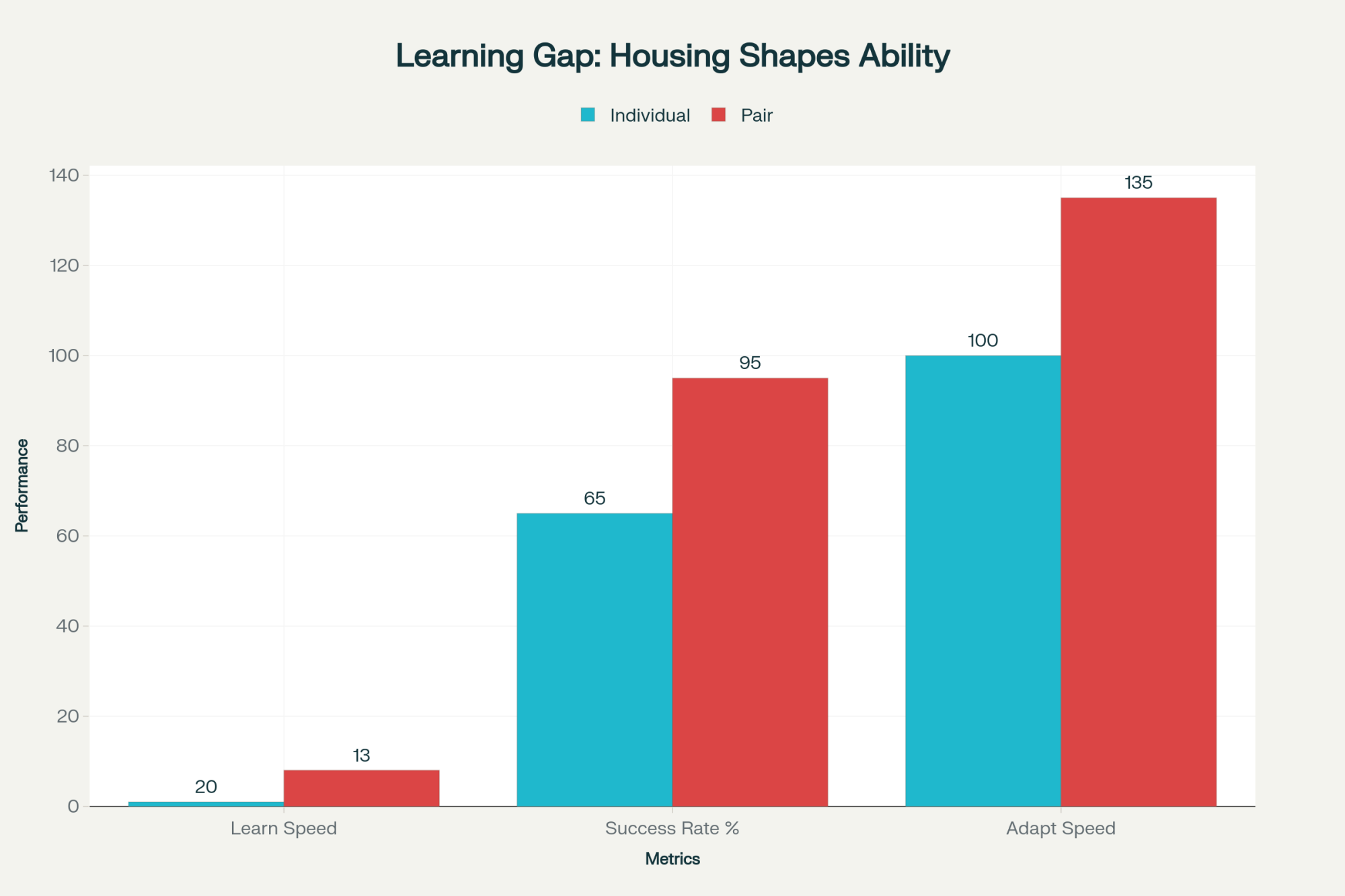
Pair-housed calves demonstrate 35% faster cognitive adaptation and 46% higher success rates in learning tests—brain development advantages that translate to lifetime performance in robotic milking systems, ration changes, and social dynamics on modern dairy operations.

Dr. Jennifer Van Os, who’s an Assistant Professor of Animal Welfare at the University of Wisconsin-Madison, puts it perfectly: “Modern dairy animals face constant learning challenges—new parlor routines, automated feeding systems, ration adjustments, social dynamics. If we’re not developing their capacity to learn from day one, we’re limiting their lifetime potential.”

What farmers are finding is that this resonates with real-world experience. Wisconsin Extension specialists have documented that operations transitioning to robotic milking systems consistently see younger animals adapting more readily than older cows. The difference? Many of those younger animals experienced social housing during their critical early development period. Food for thought, isn’t it?

The Economics Tell a Compelling Story

Looking at the numbers from Dr. Mike Van Amburgh’s comprehensive meta-analysis at Cornell University, which tracked 1,868 heifers across commercial operations, the production correlations are clear. Every kilogram increase in preweaning average daily gain translates to 850 to 1,113 kilograms of additional first-lactation milk production.

Let me break this down practically. Pair-housed calves, through what researchers call “social facilitation of feeding”plus reduced isolation stress, typically achieve 0.1 to 0.2 kilograms better daily gain during the preweaning period.

For a 500-cow operation raising 200 replacements annually:

  • Improving preweaning ADG from 0.6 to 0.8 kg/day
  • Generates approximately 124,200 kg of additional first-lactation milk
  • At current DFO pool prices (October 2025): roughly $0.41 per kilogram
  • That’s over $50,000 in additional revenue from a single cohort

And that’s just the first lactation.

What really gets interesting is research from Dr. Alex Bach’s team at IRTA in Spain. They published work in the Journal of Dairy Science showing these effects don’t diminish—they actually compound. Each kilogram of improved preweaning ADG correlates with 2,280 kilograms of additional lifetime production. The metabolic programming you establish in those first eight weeks? It sticks with them their entire productive life.

First lactation production comparison reveals that pair-housed calves generate 850-1,113 kg more milk, translating to over $50,000 in additional annual revenue for a 200-replacement operation—a competitive advantage that compounds across every cohort.

Labor Efficiency Surprises Everyone

Here’s an aspect that even experienced producers can get caught off guard by. Research from the University of Guelph and Wisconsin Extension field trials documents dramatic labor differences:

  • Individual hutch systems: 10.6 hours of labor per calf (birth to weaning)
  • Pair housing with automated feeding: 1.4 hours per calf
  • Labor reduction: 9.2 hours per calf

Minnesota Extension documented a 450-cow operation that reduced labor needs by two and a half positions after transitioning. But the manager told researchers the bigger win was performance—they went from one pound of daily gain to consistently achieving two pounds.

“Not hauling milk to hutches when it’s minus-30 doesn’t just save time—it helps them keep good employees who might otherwise look for easier work come February.”

Addressing the Adoption Gap

Despite all this compelling evidence, Lactanet’s 2024 dairy housing survey shows approximately 60% of Canadian dairy farms still use individual housing systems. We see similar patterns across the United States. So what’s holding folks back?

The Comfort of Familiar Systems

I understand the hesitation. Many producers with well-functioning individual housing face a tough decision. Their current approach delivers acceptable results—calves survive, reach target weights, and transition successfully to group housing post-weaning.

Quebec producers commonly express this in Extension workshops: “My individual system gives me certainty. I know each calf’s intake, health status, and growth rate. Group housing introduces variables I’m still learning to manage.”

This makes perfect sense. Change carries risk, especially when your current system meets baseline performance standards.

Cross-Sucking Remains a Primary Concern

Research published in 2025 by the University of Calgary identified fear of cross-sucking as the leading barrier to adoption. Every producer who’s dealt with a blind quarter on a fresh heifer remembers that frustration—I certainly do.

But here’s what’s encouraging: Dr. Cassandra Tucker’s work at UC Davis, done in collaboration with Penn State Extension, demonstrates that cross-sucking is entirely preventable through proper management:

  • Adequate milk allowance: minimum 7 liters daily for Holstein calves
  • Nipple feeding rather than buckets
  • Gradual weaning over 7 to 10 days

Follow these protocols, and cross-sucking essentially disappears.

Capital Investment Realities

Let’s talk dollars. Michigan State Extension’s 2024 calculations place infrastructure investment at approximately $127 per calf, with complete system implementation costing $15,000 to $25,000 for a 200-replacement operation.

Dr. Marcia Endres at the University of Minnesota documents returns of 269% to 312% on this investment, but what is that upfront capital requirement? It’s a real challenge when you’re managing tight margins.

What’s working for some producers is starting with pilot programs using temporary infrastructure. Prove the concept before making the major capital commitment.

Learning From Early Implementation

Extension specialists working with transitioning farms report remarkably consistent patterns through the first 90 days. Wisconsin Extension Bulletin A4154 clearly documents these phases.

Weeks 1-2: Resisting the Urge to Intervene

Ontario Extension case studies consistently show the biggest challenge is stepping back. Every instinct tells you to help calves find the nipple, guide them through feeding. But they need to learn independently and from each other. Too much intervention creates dependence rather than competence.

Successful protocols involve:

  • Backgrounding calves individually for 10-14 days before grouping
  • Establishing strong suckling reflexes
  • Health screening before mixing

Dr. Dave Renaud’s research at Guelph, published in Preventive Veterinary Medicine back in 2023, confirms this approach reduces health events by 40%.

Weeks 3-4: Managing Cross-Sucking Effectively

This critical period determines whether producers persist or revert. Extension field trials documented in the 2024 Wisconsin Dairy Management Guide show that increasing milk concentration while maintaining frequent feeding opportunities stops cross-sucking behavior cold.

The target remains consistent across all research: minimum 7 liters daily through nipples, with gradual 10-day weaning transitions. Get this right, and cross-sucking becomes a non-issue.

Weeks 5-8: Ventilation Becomes Critical

Dr. Ken Nordlund from Wisconsin’s School of Veterinary Medicine emphasizes in their 2024 facility design guidelines: “Poor health management in individual housing becomes amplified in group settings.”

Calves don’t generate enough body heat for natural convection ventilation to work. You need mechanical systems—positive pressure tubes or continuous airflow fans. Operations that underestimate ventilation requirements face respiratory challenges that can derail the entire transition.

Weeks 9-12: Systems Integration

Producers who navigate that initial learning curve consistently report dramatic improvements around month three. Multiple Extension case studies from 2024-2025 document this pattern:

  • Feed efficiency improves
  • Health events decline
  • Growth rates accelerate

Fraser Valley producers dealing with higher humidity than Prairie provinces really emphasize moisture management alongside ventilation. British Columbia Extension specialists report in their 2024 regional guide that once environmental controls are optimized, preweaning mortality typically drops from 7% to under 3%.

Data-Driven Management Revolutionizes Calf Rearing

Health IndicatorDays Early DetectionVisual Observation AccuracyAutomated System AccuracyImprovement
Milk Intake Drop (15-25%)540%78%+38%
Drinking Speed Reduction435%72%+37%
Unrewarded Feeder Visits ↑345%80%+35%
Combined Metric Analysis550%82%+32%

This transition from visual observation during feeding to continuous behavioral monitoring? It’s a fundamental shift in how we think about calf management.

Dr. David Renaud’s research, published back in November 2023 in the Journal of Dairy Science, reveals that automated systems detect illness indicators 3 to 5 days before you’d see visual symptoms.

Key metrics for early disease detection:

  • Milk intake declining 15-25% → 5 days before clinical illness
  • Drinking speed reduction → 4 days before visible symptoms
  • Unrewarded feeder visits tripling → Calf feels unwell but can’t finish meals
  • Meal duration increasing → While actual consumption decreases

Dr. Melissa Cantor at Penn State found—and published in the Journal of Dairy Science earlier this year—that combining these metrics achieves 75-80% disease-detection sensitivity, compared to just 40-50% with single indicators. This early detection capability? It transforms treatment outcomes and reduces both medication costs and production losses.

Building Competitive Advantage for 2031 and Beyond

The mandated transition creates an industry-wide baseline. Everyone has to comply. But here’s what I think many are missing: competitive advantage comes from operational excellence developed through early adoption.

By the 2031 mandate deadline, early adopters will have six annual cohorts of cognitively superior replacements producing 187-491 extra pounds of milk per lactation—while late adopters begin with zero such animals. The math is brutal: you can’t compress six years of competitive advantage into one year of panicked implementation.

“Producers transitioning in 2025 will have six annual cohorts of cognitively enhanced replacements by 2031. Late adopters starting in 2030? They begin with zero such animals.”

Consider the arithmetic:

  • 180 to 360 animals with cognitive advantages in your herd
  • 187 to 491 additional pounds of milk per lactation
  • Worth $34 to $88 per cow annually (Cornell longitudinal studies)

Dr. Jessica McArt’s research at Cornell’s College of Veterinary Medicine, published in Preventive Veterinary Medicine in 2024, demonstrates that disease prediction algorithms need 18 to 24 months of calibration to achieve optimal sensitivity. Early adopters will be preventing disease, while late adopters are still figuring out which buttons to push.

Market dynamics are shifting, too. Dr. Beth Ventura’s research at the University of Minnesota documents consumer willingness to pay 4-6% premiums for milk from enhanced welfare systems. Trade publications like Dairy Foods and Progressive Dairy suggest processors, including Agropur and Saputo, are exploring differentiated supply chains—though specific program details are still emerging. Early adopters with documented performance histories? They’re positioning themselves for opportunities that won’t be available to last-minute converts.

A Practical Implementation Framework

Based on Extension specialist experiences documented across multiple regions, here’s what consistently works:

Start with a 12-calf pilot program. Not to validate the science—that’s been done—but to develop expertise specific to your facility without risking your entire replacement program.

Foundation Phase (Months 1-3)

  • Get passive transfer rates above 90% (Dr. Sandra Godden at Minnesota recommends serum total protein >5.5 g/dL)
  • Establish 20% body weight milk feeding minimums
  • Develop cross-sucking prevention protocols for your specific setup

Skill Development (Months 4-6)

  • Learn to interpret behavioral data
  • Recognize that 20% intake drop that signals illness
  • Identify weaning readiness (Dr. Mike Steele at Alberta: look for 1.4 kg daily starter intake for three consecutive days)
  • Document equipment performance patterns

Protocol Optimization (Months 7-9)

  • Refine feeding algorithms for your genetics
  • Balance welfare with facility constraints
  • Align health protocols with actual disease pressure

Team Integration (Months 10-12)

  • Train every team member who touches calves
  • Ensure understanding of behavioral indicators
  • Establish report interpretation protocols
  • Define intervention thresholds

“This phase gets skipped too often, and it comes back to bite you.”

Practical Considerations for Your Operation

Looking at all the evidence, several principles stand out:

Early implementation with modest scale beats last-minute scrambling with your entire calf crop. That learning curve takes 18 to 36 months, no matter when you start.

Management excellence, not equipment sophistication, determines your outcomes. You can have the fanciest automated feeder on the market, but without skilled interpretation of its data, you’ve bought yourself an expensive milk dispenser.

Your foundation protocols have to be solid. If you’re running sub-90% passive transfer rates or marginal ventilation, group housing will amplify those problems rather than solve them.

Expect the learning curve. Embrace it, even. Those initial challenges? That’s education, not failure.

Document everything meticulously. This data validates your investment decisions and supports premium market positioning down the road.

Looking Forward

We’re witnessing one of those generational transitions that reshapes how we do things. Producers who view this 2031 requirement as an opportunity for systematic improvement? They’ll capture lasting competitive advantages. Those approaching it as just another compliance burden will perpetually lag behind early adopters who’ve already optimized their systems.

The parallel to previous industry evolutions is pretty clear. Consider free-stall adoption, TMR implementation, and genomic selection. Early, thoughtful adopters consistently emerged stronger.

What I’ve noticed across other major transitions is that success doesn’t come from the technology itself. It comes from the operational excellence you develop through implementation. Pair housing represents another one of those opportunities—it challenges our assumptions, rewards innovation, and ultimately advances both animal welfare and farm profitability.

The timeline is set. The science is clear. The economics are compelling. What remains is the decision each operation needs to make: lead this transition or follow those who do.

Six years gives you adequate time for thoughtful implementation. But it disappears quickly if you keep putting it off. The question isn’t whether to transition—that decision’s been made for us. The question is when to start capturing the advantages of early adoption.

Your move.

KEY TAKEAWAYS 

  • Start with 12 calves, not 200: Master the learning curve on a pilot scale where mistakes won’t sink you—but start NOW because the 18-month expertise gap between early and late adopters becomes permanent
  • $50,000 isn’t the ceiling, it’s the floor: First-lactation gains of 850-1,113 kg are just the beginning—these calves produce 2,280 kg more lifetime milk because early brain development programs permanent metabolic advantages
  • Stop fearing cross-sucking, start fearing the competition: While 60% of producers avoid pair housing over a completely preventable issue, early adopters are banking profits you’ll never catch up to
  • The 2031 deadline creates winners and losers: Producers with 6 years of experience will be preventing disease while you’re reading instruction manuals, capturing premium markets while you’re proving compliance

Complete references and supporting documentation are available upon request by contacting the editorial team at editor@thebullvine.com.

Learn More:

Join the Revolution!

Join over 30,000 successful dairy professionals who rely on Bullvine Weekly for their competitive edge. Delivered directly to your inbox each week, our exclusive industry insights help you make smarter decisions while saving precious hours every week. Never miss critical updates on milk production trends, breakthrough technologies, and profit-boosting strategies that top producers are already implementing. Subscribe now to transform your dairy operation’s efficiency and profitability—your future success is just one click away.

NewsSubscribe
First
Last
Consent

The Robotic Milker Hangover: The Hard Truths About Automation Your Dealer Won’t Tell You

70% of large US dairies building robots choose new construction—here’s why retrofitting your barn might cost you $37,800 annually

So, I was sitting in a diner last week, listening to two producers argue about robots. One swore they were the future of dairy farming. The other called them overpriced milking machines for people who forgot how to manage cows.

Both were right, and both were wrong.

Here’s the thing about automated milking systems—they’re not what most people think they are. They’re not magic productivity boosters, and they’re definitely not the answer to every dairy operation’s problems.

But they’re also not just expensive toys for farmers with more money than sense.

What strikes me about this whole automation discussion is how polarized it’s become. You’ve got the early adopters who act like conventional parlors are ancient history, and you’ve got the traditionalists who think robots are going to destroy everything good about dairy farming.

The truth? It’s somewhere in the middle, and it’s a lot more interesting than either side wants to admit.

The labor crisis everyone’s talking about (and some solutions nobody mentions)

Let’s start with the elephant in the barn—labor. According to the latest USDA figures, we’re looking at agricultural wages hitting $18.12 per hour on average, with some regions seeing $20+ for skilled milkers.

That’s not sustainable math for most operations, especially when you factor in the 3.6% annual increase we’ve been seeing.

But here’s what’s fascinating about the labor discussion… it’s not just about wages. I was talking to a 450-cow Holstein operation in Vermont’s Champlain Valley last month, who told me something that stuck with me:

“I can find workers. I just can’t find workers who want to work weekends, holidays, and who don’t mind getting kicked by a fresh cow at 4 AM.”

That’s the real labor crisis. It’s not just about money—it’s about lifestyle expectations that don’t mesh with the realities of dairy farming.

Recent work from the Journal of Dairy Science shows that labor costs have jumped from 13% of total dairy expenses in 2011-2012 to over 16% by 2017, and that trend’s only accelerating.

Now, here’s where it gets interesting… conventional operations aren’t sitting still. Some of the most efficient dairies I’ve visited are running modern double-24 parlors with two people milking 400+ cows in under four hours. They’ve invested in automatic takeoffs, automatic cluster flushers, and management systems that make the milking process incredibly efficient.

The difference? These operations typically have solid family labor, or they’re located in areas where agricultural workers are still relatively available. A 320-cow registered Holstein producer in Lancaster County, Pennsylvania, told me he’s had the same two milkers for eight years. They live within five miles of the farm, their kids go to local schools, and they’re part of a community that still values agricultural work.

So, when does conventional still make sense? More often than the automation advocates want to admit.

If you’re running under 150 cows, have solid family labor, and you’re not planning major expansion, a well-designed parlor can serve you for decades. The key is being honest about your situation.

Robotic milking systems reduce labor costs by $210 per cow annually compared to traditional parlors

The real cost of automation (and why the numbers don’t tell the whole story)

Robotic milking systems achieve payback in 3.2 years with continued financial benefits thereafter

Let’s talk money, because that’s where a lot of these conversations get muddy. Current market data shows automated milking systems running $150,000-$275,000 per robot. For a typical 120-cow operation, you’re looking at $3,200-$3,800 per cow when you factor in facility modifications.

But here’s what those numbers don’t capture—the operational transformation. I visited a 180-cow Jersey operation in Wisconsin’s Driftless Region that switched to robots three years ago. Their labor costs dropped from $375 per cow annually to $165 per cow. That’s $37,800 in annual savings for their herd size.

The payback math works.

Except… and this is important… it works if you can manage the system properly. The same operation told me they spent $22,000 on service calls and extra maintenance in year two because they hadn’t developed proper protocols for daily system checks.

This is where the industry conversation gets really interesting. Research from the University of Wisconsin shows that top-performing AMS operations get 42% more throughput from the same robotic hardware compared to poor performers.

That’s not a technology difference—that’s a management difference.

The international perspective we’re missing

European countries lead global adoption of robotic milking systems, with Scandinavian countries approaching 90% adoption

One thing that surprises me about the North American automation discussion is how little we talk about what’s happening globally. Europe’s been using robots for two decades. In the Netherlands, over 70% of dairy farms use automated milking systems. The Scandinavian countries are approaching 90% adoption.

But here’s what’s interesting—their approach is completely different from ours. European operations typically run smaller herds with higher per-cow productivity. They’re not necessarily more profitable than our conventional operations, but they’ve optimized for different constraints.

I had a conversation with a Danish producer last year who runs 150 cows through three robots. His milk price is about 30% higher than ours, his land costs are astronomical, and his labor regulations make hiring almost impossible.

For him, automation isn’t about productivity—it’s about survival.

That’s a critical distinction. In North America, we’re often trying to use automation to scale up and improve efficiency. In Europe, they’re using it to maintain viability under completely different economic pressures.

The nutritional complexity nobody talks about

Here’s where things get really technical, and honestly, where a lot of operations struggle. The nutrition program for an automated milking system is fundamentally different from a conventional TMR program.

You’re not just feeding cows—you’re programming behavior.

Recent research from the Journal of Dairy Science shows that the balance between your partial mixed ration (PMR) and robot concentrate is critical. Get it wrong, and you’ll either have cows camping at the feed bunk or you’ll be force-feeding concentrate through the robot to get them to visit.

What’s particularly noteworthy is how this varies by traffic system. Free-flow operations typically need 6-8 pounds of robot concentrate per cow daily to maintain adequate visit frequency. Guided-flow systems can often get by with 4-6 pounds.

That difference might seem small, but at $400-450 per ton for quality robot pellets, it adds up fast.

The complexity doesn’t end there. The timing of feed delivery, the palatability of your PMR, and even the ambient temperature affects voluntary milking behavior. I know a 240-cow Brown Swiss operation in northern Wisconsin that has had to completely reformulate their rations seasonally because heat stress changes how cows respond to the robot incentive.

The data revolution that’s changing everything (and overwhelming everyone)

The thing about automated milking systems is that they turn every cow into a data point. Your typical robot captures 50+ individual measurements per cow per milking.

That’s incredible… and incredibly overwhelming.

I was visiting a 280-cow operation in New York’s North Country that had been running robots for two years. The producer showed me his management computer with pride—milk yields, component data, conductivity readings, activity monitors, and rumination data.

Then he admitted something that I hear more often than you’d think:

“I’m drowning in data, but I’m not sure I’m making better decisions.”

That’s the dirty secret of the data revolution. Having information isn’t the same as having insights. The most successful AMS operations I’ve visited have figured out how to filter the noise and focus on actionable intelligence.

Operations using AI-powered analysis tools show 15% better performance than those trying to manage data manually.

The technology exists to help process all this information, but it requires additional investment and a learning curve that some operations aren’t prepared for.

The failure stories we don’t hear enough about

Here’s what makes me uncomfortable about a lot of the automation discussion—we don’t talk enough about the failures. I’ve visited operations where the robots are running, but the results are disappointing.

Usually, it comes down to one of several issues that nobody wants to discuss openly.

Poor facility design is probably the biggest culprit. I know of a 200-cow operation in Michigan’s thumb region that retrofitted robots into an existing freestall barn. The layout created permanent bottlenecks that limited cow flow.

Three years later, they’re still dealing with the consequences. Their robot utilization is about 70% of what it should be, and their fetch cow percentage is nearly twice the industry average.

Management complexity catches others off guard. The technology requires a different skill set, and not everyone adapts well to data-driven management. I’ve seen operations where the robots function perfectly from a technical standpoint, but the management team never fully embraced the systematic approach needed for success.

This is why the retrofit versus new construction decision is so critical. Recent industry surveys show that 70% of large US dairy farms adopting AMS choose to build new.

That’s not because producers enjoy spending extra money—it’s because the compromises inherent in retrofitting often create permanent inefficiencies.

The regional variations that matter more than anyone admits

What’s happening in dairy automation looks completely different depending on where you’re sitting. In the Upper Midwest, where labor is particularly scarce and winters are harsh, the automation decision often comes down to operational survival.

You simply can’t count on finding reliable help when you need it most.

I was talking to a 165-cow producer in northern Minnesota who told me his decision was made for him when his longtime milker moved to town and refused to drive the 20 miles to the farm during winter storms.

“I either automated or I milked cows myself for the next 15 years.”

For him, the $400,000 investment in robots was cheaper than the alternative.

Compare that to California’s Central Valley, where labor is more available but regulatory pressure is intense. The operations I’ve visited there are looking at automation as a way to improve consistency and reduce regulatory compliance risks.

Their labor costs might be manageable, but their environmental reporting requirements favor the precision data that automated systems provide.

The financing landscape is also regional. In areas with strong agricultural banking relationships, producers are finding creative solutions. Some operations are partnering with technology companies on lease arrangements that convert automation from a capital expense to an operating expense.

The quality of life question nobody quantifies

One aspect of automation that’s hard to measure but impossible to ignore is the lifestyle impact. I’ve interviewed dozens of producers who’ve made the switch, and the quality of life improvement is consistently mentioned as a major benefit.

A 210-cow producer in Iowa told me:

“I haven’t missed a single one of my daughter’s basketball games since we installed the robots. Before, I was chained to that parlor twice a day, every day. Now I check my phone for alerts, but I’m not physically tied to the milking schedule.”

But here’s the flip side—the stress doesn’t disappear, it just changes. The same producer admitted that he wakes up at 2 AM sometimes, worrying about robot alarms. The 24/7 nature of the system means problems can develop at any time, and system downtime can be costly.

From industry observations, the producers who adapt best to automation are those who embrace the shift from physical labor to systems management. They become comfortable with troubleshooting technology and using data to make decisions.

The ones who struggle are often those who miss the hands-on interaction with cows that conventional milking provides.

The environmental angle that’s gaining momentum

What’s interesting about the automation discussion is how environmental considerations are starting to influence decisions. Recent research from the Journal of Dairy Science shows that automated systems can reduce water usage by 15-20% compared to conventional parlors.

That’s becoming important in water-stressed regions.

The precision feeding capabilities of robots also offer environmental benefits. Because you can adjust concentrate allocation individually, there’s less waste and more efficient protein utilization. Some operations are reporting 5-10% improvements in feed efficiency, which translates to lower nitrogen excretion and reduced environmental impact.

But here’s where it gets complicated—the environmental benefits depend heavily on management. A poorly managed automated system can actually be worse for the environment than a well-run conventional operation.

The key is in the details: proper PMR formulation, accurate robot calibration, and consistent maintenance protocols.

The technology evolution that’s accelerating

The automation landscape is changing faster than most people realize. The robots being installed today are dramatically different from the systems available just five years ago.

AI integration, improved sensor technology, and better data analytics are making newer systems more capable and user-friendly.

What’s particularly noteworthy is the emergence of farm management platforms that integrate multiple systems. Instead of managing separate software for robots, feed mixers, and activity monitors, newer operations are working with unified platforms that provide holistic farm management.

This trend suggests that we’re moving beyond simple milking automation toward comprehensive farm automation. The early adopters are already experimenting with automated feed pushers, robotic manure scrapers, and AI-powered health monitoring systems.

The generational divide that’s real

One pattern I’ve noticed in my farm visits is that automation adoption often reflects generational differences. Younger producers, who grew up with technology, tend to embrace the data-driven approach more readily.

They’re comfortable with smartphone apps, cloud-based management systems, and troubleshooting electronic issues.

Older producers sometimes struggle with the transition from visual observation to data analysis. I’ve seen operations where the father installed robots, but the son actually manages the system because he’s more comfortable with the technology interface.

This generational aspect is important for succession planning. If your operation is planning to transition to the next generation, automation can be a tool for keeping young people engaged in dairy farming.

The technology aspect appeals to people who might otherwise be drawn to careers outside agriculture.

The financial reality that nobody wants to discuss

Let’s be completely honest about the financial picture. The initial investment for automated milking is substantial, and the payback period isn’t always as rosy as the sales literature suggests.

Recent analysis shows payback periods ranging from 5-10 years, with significant variation based on management quality.

The operations that achieve faster payback typically have three things in common: high production per robot (55+ cows per unit), excellent robot utilization (85%+ of capacity), and strong management protocols that minimize service calls and downtime.

But here’s what the financial analysis often misses—the risk mitigation value. Your robot payment is fixed and predictable. Your labor costs are variable and rising.

Dairy labor costs have risen from 13% to nearly 18% of total farm expenses, driving automation adoption

From a risk management perspective, automation converts your largest variable cost into a fixed cost.

The question isn’t whether you can afford to invest in automation. It’s whether you can afford not to invest while your competitors gain advantages that compound over time.

The decision framework that actually works

After visiting hundreds of dairy operations and watching the automation discussion evolve, I’ve developed a simple framework for evaluating whether automation makes sense for a specific operation.

First, assess your labor situation honestly. If you have stable, skilled labor that’s likely to continue for the next 10-15 years, conventional systems might serve you well. If you’re struggling to find help or your current team is aging toward retirement, automation becomes more attractive.

Second, evaluate your management style. Are you comfortable with technology? Do you enjoy analyzing data and optimizing systems? Can you troubleshoot equipment issues, or do you prefer hands-on problem-solving? Your answers should influence your decision.

Third, consider your facility constraints. If you’re planning to build new anyway, automation deserves serious consideration. If you’re retrofitting, be realistic about the compromises you’ll have to make and whether they’ll create permanent inefficiencies.

Finally, think about your long-term goals. Are you planning to expand? Do you want to improve work-life balance? Are you trying to keep the next generation engaged in the operation?

Automation can be a tool for achieving these goals, but it’s not the only tool.

The conversation that’s just beginning

The automation revolution in dairy farming isn’t a destination—it’s a journey. The technology will continue evolving, the economics will continue changing, and the management approaches will continue improving.

What’s exciting about this moment in dairy farming is that we’re not just talking about replacing labor with machines. We’re talking about fundamentally reimagining how dairy operations function.

The data, the precision, the 24/7 optimization—these capabilities are creating possibilities that didn’t exist before.

But here’s what I want every producer to understand: automation isn’t about the robots. It’s about the system. It’s about creating an integrated approach to dairy farming that leverages technology to achieve goals that were impossible with conventional methods.

The producers who thrive in this environment won’t be those who buy the newest technology. They’ll be those who understand how to integrate that technology into a comprehensive management system that serves their specific goals and constraints.

That conversation—about systems, integration, and strategic thinking—is just beginning. And it’s going to determine the future of dairy farming for the next generation.

Key statistics driving dairy automation adoption in 2025

KEY TAKEAWAYS

  • Labor Risk Hedge Worth $37,800 Annually – For a 200-cow operation, switching from $375/cow labor costs to $165/cow AMS costs saves real money while eliminating your biggest operational risk. With ag wages hitting $18+ per hour, this isn’t just cost savings—it’s insurance against labor market volatility.
  • Data-Driven Management Beats Gut Instinct – AMS captures 50+ data points per cow per milking versus 5-10 manual observations in parlors. Early mastitis detection through conductivity monitoring and activity-based heat detection dramatically improve your bottom line through proactive rather than reactive management.
  • Free-Flow Traffic Systems Deliver Premium Production – Research shows free-flow barns produce an extra 2 pounds of milk per cow daily compared to guided systems, but require stronger nutrition programs and accept higher fetch cow rates. Given 2025’s tight feed margins, this production boost often justifies the management trade-offs.
  • New Construction Beats Retrofit Economics – While retrofit projects seem cheaper upfront, 70% of large dairies choose new builds because retrofitting creates permanent bottlenecks. The “save now, pay later” mentality with narrow alleys and poor robot placement costs you efficiency for decades.
  • Management Skills Matter More Than Hardware – Top AMS managers extract 42% more throughput from identical robots through superior protocols and data interpretation. Invest in training your team for data-driven management—the technology is only as good as the people running it.

EXECUTIVE SUMMARY

Look, I’ve been watching this automation wave for years, and here’s what most producers don’t get about robotic milking systems. The biggest mistake isn’t buying robots—it’s treating them like expensive parlor replacements instead of complete system overhauls. We’re talking serious money here: labor savings of $175-250 per cow annually, with milk yield bumps of 2-12% when you get it right. But here’s the kicker… Canadian data shows robot farms dropped their labor costs from 8.44% of revenue down to just 4.39%—that’s real profit flowing straight to your bottom line. The Europeans figured this out decades ago (70% adoption in the Netherlands), and now progressive US operations are following suit with payback periods averaging just 5.2 years. The key? Stop thinking equipment upgrade and start thinking complete operational transformation. You should seriously consider whether your current setup is costing you more than you realize.

Complete references and supporting documentation are available upon request by contacting the editorial team at editor@thebullvine.com.

Learn More:

Join the Revolution!

Join over 30,000 successful dairy professionals who rely on Bullvine Weekly for their competitive edge. Delivered directly to your inbox each week, our exclusive industry insights help you make smarter decisions while saving precious hours every week. Never miss critical updates on milk production trends, breakthrough technologies, and profit-boosting strategies that top producers are already implementing. Subscribe now to transform your dairy operation’s efficiency and profitability—your future success is just one click away.

NewsSubscribe
First
Last
Consent
Send this to a friend





