Archive for farm financial stability

Why Your Canadian Neighbors Sleep Better at Night (And What That Means for Your Bottom Line)

259 US dairies filed bankruptcy in Q1 2025 while Canadian failures are too rare to track. Same cows, different systems.

Did you know 259 American dairy operations filed Chapter 12 bankruptcy in just the first quarter of 2025. That’s a 55% jump from last year… and frankly, it’s accelerating.

I’ve been covering this industry for over two decades now, and what I’m seeing in the numbers—well, it’s making me question everything we think we know about “efficient” dairy markets. But here’s the thing that really gets to me: while we’re watching good farmers get hammered by market volatility (people who’ve done everything right, mind you), there’s this whole system just 300 miles north that’s achieving something we can barely imagine.

Canadian dairy farm bankruptcies? They’re so rare that Statistics Canada doesn’t even bother tracking them as an economic indicator.

Let that sink in for a minute.

The Coffee Shop Conversation That Changed Everything

A sentiment I hear often was perfectly captured in a conversation with a producer from Wisconsin, who said something that’s been rattling around in my head ever since:

“I’m doing everything the extension guys tell me to do, but I can’t plan past the next milk check because who knows what prices will do.” — Mike, Watertown, Wisconsin

That got me digging into some data that… well, let’s just say it challenges pretty much everything we’ve been told about free markets and farm efficiency. Same Holstein genetics. Same robots. Same nutritional consultants. Same level of management skill and dedication. But one group of farmers is building generational wealth while the other group is filing for bankruptcy at rates that would trigger congressional hearings in any other industry.

The difference isn’t management—it’s the system.

And what’s really eating at me… we keep hearing about how Canada’s supply management is “inefficient” and “protectionist,” but their farmers aren’t the ones dumping milk or losing sleep over price forecasts. Meanwhile, our “efficient” system just required $42.4 billion in direct government payments in 2025—a 354% increase from 2024.

Something doesn’t add up, does it?

When USDA Forecasts Become Financial Weapons
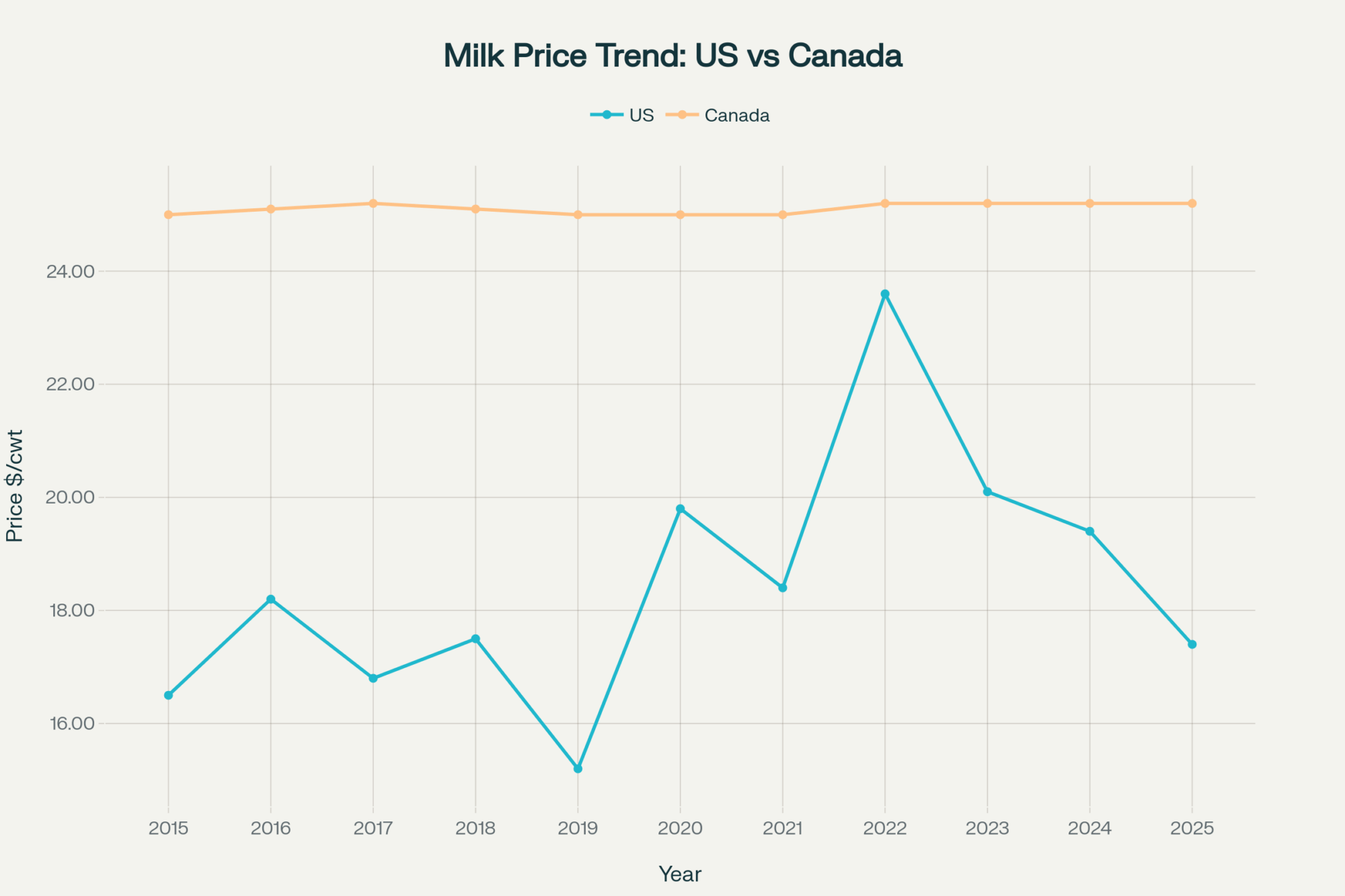
U.S. Milk Price Volatility vs. Canadian Farmgate Price Stability (2015-2025)

Picture this scenario (and I guarantee you’ve lived some version of it): January 2025, you’re at your kitchen table with the calculator out, trying to make sense of that equipment loan for the new double-eight parlor. USDA’s milk price forecast looks decent—nothing spectacular, but workable if things stay reasonably steady.

Four months later… that same forecast drops $1.95 per hundredweight. Your equipment payment didn’t magically decrease. Neither did your feed costs or labor expenses. But the revenue projection that justified every major decision you made this year? Gone.

Tom runs 280 cows in Wisconsin, and he put it perfectly:

“It’s like trying to hit a moving target while blindfolded. How do you make a 10-year investment decision when you can’t predict next quarter’s milk check?” — Tom, Wisconsin

Meanwhile—and this is where it gets interesting—Canadian producers experienced exactly what their system promised them: a farmgate price adjustment of 0.0237%. That’s less than a penny per liter. The kind of predictable variation that lets you actually plan multi-year capital investments with confidence.

What strikes me about this is the mathematical reality most of us don’t want to face. When you can predict cash flow, you can optimize investments. When you can’t… every strategic decision becomes a coin flip with your farm’s survival.

The Robot Paradox: Same Technology, Different Worlds

Here’s a story that really drives the point home. Last spring, I visited two farms on the same day. First stop: a 120-cow operation in Ontario that had just installed their second robot. The farmer showed me spreadsheets—payback calculated at eight years, cash flow projections extending to 2032, financing structured around predictable milk price increases.

“We know what milk will be worth. That makes everything else possible.” — Ontario dairy farmer

Second stop: a 240-cow operation in Wisconsin that had been considering robots for three years but couldn’t pull the trigger:

“Every time I run the numbers, I get a different result depending on what milk price assumptions I use. How do you make a quarter-million-dollar investment when you can’t predict revenue?” — Wisconsin dairy farmer

Same technology. Same potential benefits. Same management capability. But completely different investment climates.

Take a $250,000 robotic milker—pretty standard investment these days. In the Canadian system, that pencils out to a 7-10 year payback with high confidence. Here in volatility-land? Try 15+ years, assuming you don’t get wiped out by a price crash before you break even.

The Numbers That Should Terrify All of Us

Comparison of Chapter 12 bankruptcy filings in US vs Canada (2015-2025)

During the 2019 downturn—you remember that mess—599 American dairy operations filed Chapter 12 bankruptcy. That’s more than one farm entering bankruptcy protection every single day for an entire year.

Canada during the same period? Zero. Not just low. Statistically negligible.

We’re not talking about slight differences in failure rates here. We’re not talking about the difference between systematic farm destruction and systematic farm preservation.

And what really gets to me—this isn’t about Canadian producers being better managers or having access to superior genetics. I’ve walked through barns in both countries. These are the same DeLaval parlors, the same breeding programs, often the same feed consultants. The farmers are equally skilled and dedicated.

The difference is systematic. One system is architected for survival. The other accepts high failure rates as the price of “market freedom.”

Farm Consolidation: When “Efficiency” Becomes Desperation
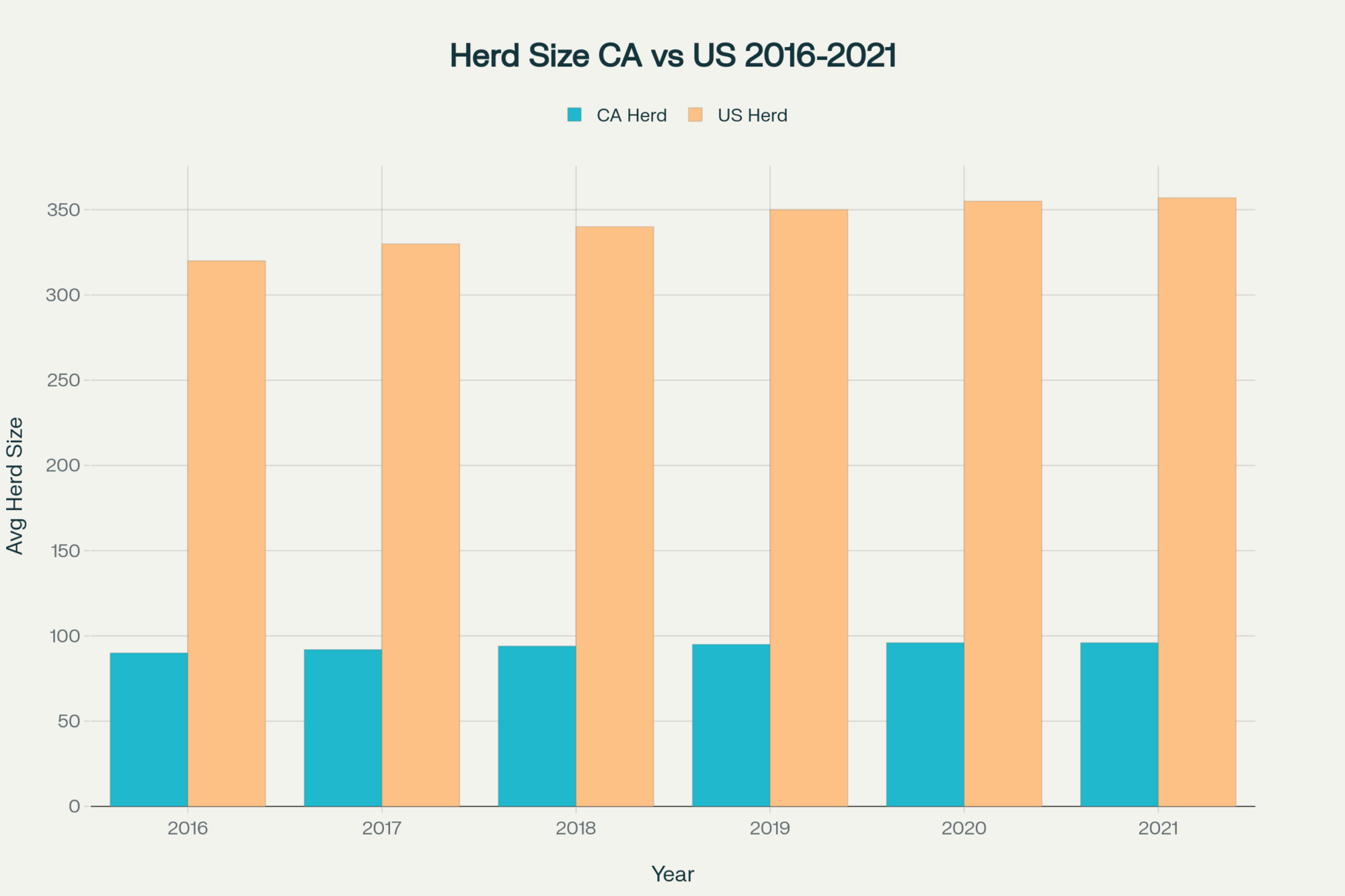
Comparison of average herd size and farm consolidation rates in Canada and the US (2016-2021)

You want to talk about consolidation? American dairy farm numbers dropped 34% between 2016 and 2021. Canada? Just 11% in the same period.

Average US herd size is now 377 cows. Average Canadian herd size? 96 cows.

Now conventional wisdom says the US operations must be more efficient, right? Wrong. They’re not expanding because they’ve identified optimal scale economies. They’re expanding because they need volume to weather price volatility.

It’s survival strategy masquerading as efficiency optimization.

Canadian operations with 100 cows are profitable, stable, and planning capital improvements with confidence. Not because they’re protected from competition, but because they’re protected from financial chaos.

The Mental Health Crisis We Don’t Talk About

Behind every bankruptcy filing is a farm family facing financial ruin, but the human cost goes way beyond the operations that actually fail. Recent research confirms what those of us in rural communities already know—US farmers are 3.5 times more likely to die by suicide than the general population. The primary driver? Financial volatility.

I’ve been to too many farm auctions that shouldn’t have happened. Good farmers, solid managers, excellent stewards of the land—wiped out not by poor decisions but by market forces completely beyond their control.

Sarah ran a 180-cow operation outside of Fond du Lac. Excellent manager, invested in genomics, maintained detailed records, followed every extension recommendation. But three consecutive years of price volatility, compounded by some equipment failures and a spike in feed costs, and she couldn’t service the debt anymore.

“I wasn’t lazy. I wasn’t incompetent. I was just unlucky with timing.” — Sarah, former dairy farmer, Wisconsin

That’s the brutal reality of our system—it punishes bad timing just as harshly as bad management. Maybe more harshly, because at least bad management gives you something you can fix.

Canadian producers face their own stressors, sure—particularly around quota debt levels and succession planning—but they’re shielded from the existential uncertainty that characterizes American dairy production. Studies show that 58% of Canadian producers meet criteria for anxiety and 35% for depression, but these rates, while concerning, reflect manageable business pressures rather than survival uncertainty.

The $35 Billion Asset Most Americans Can’t Fathom

Canadian dairy farmers collectively own over $35 billion in production quota. That’s government-issued licenses to produce milk, and in provinces like Alberta, they’re trading for $58,000 per kilogram of butterfat.

A new entrant starting a 100-cow operation in Ontario faces roughly $840,000 in quota costs before buying their first cow or pouring their first concrete pad.

Sounds insane, right? Until you realize that quota also represents $840,000 in asset value that appreciates over time, provides stable returns, and never goes bankrupt.

I was talking with Dave, who runs a 90-cow operation near Woodstock, Ontario:

“People don’t understand. This quota isn’t just a cost—it’s our retirement fund. My neighbor sold his quota last year and bought a condo in Florida. Try doing that with your milk contracts.” — Dave, Ontario dairy farmer

The Hidden Cost of “Free” Markets (Spoiler: They’re Not Free)

Let’s talk about the elephant in the room—subsidies. Americans love criticizing Canadian supply management as “subsidized agriculture” while praising our “free market” system. But the math tells a different story.

US direct government payments to agriculture hit $42.4 billion in 2025—a 354% increase over 2024. That’s before counting crop insurance premium subsidies (where taxpayers cover about 62% of premiums) and various disaster assistance programs.

Canadian dairy farmers receive exactly zero dollars in direct government subsidies for milk production. Their support comes from higher consumer prices, which are transparent, predictable, and paid by the people who consume the products.

What’s fascinating about the political dynamics: The cost of the US system is hidden in complex farm bills and emergency appropriations that most taxpayers never see directly. The cost of the Canadian system hits every consumer at the grocery checkout.

Which system do you think faces more political pressure?

Current Market Reality: What July 2025 Looks Like from the Trenches

The financial pressures are intensifying across the Midwest, and I’m seeing it in conversations everywhere I go. All-milk prices are sitting at $22.00 per hundredweight—not terrible, but not great when you factor in everything else happening.

The US dairy herd is at 9.365 million head, but what’s really concerning: replacement heifer numbers are at their lowest ratio in decades. We’ve got 3.914 million heifers over 500 pounds—that’s only 41.9 head per 100 milk cows. Historically, we’ve run closer to 45-50.

What does that tell us? Producers are culling hard, selling replacements into the beef market, and avoiding long-term investments needed to maintain herd size.

Feed costs are providing some relief—corn’s forecast at $4.20 per bushel. But labor costs are hitting record levels at $53 billion industry-wide, and equipment costs are up 10-15% due to steel tariffs.

It’s the classic squeeze play. Input costs that don’t adjust downward as fast as milk prices drop, but adjust upward faster when milk prices rise.

The Milk Dumping Nightmare

You want to talk about systemic inefficiency? Let’s discuss milk dumping—a phenomenon that’s virtually non-existent in Canada but periodically devastates US producers.

During the COVID-19 pandemic, farmers across the country were forced to dump millions of gallons of milk into manure pits and fields. An estimated 7% of all milk produced in one week was discarded. Class III milk futures fell by over 30%.

The economic consequences are severe, but the kicker—the government often steps in with taxpayer-funded compensation programs afterward. This cycle of overproduction, price collapse, waste, and government bailout represents massive systemic inefficiency.

Meanwhile, Canada’s supply management system is specifically designed to prevent such structural surpluses by aligning national production with anticipated domestic demand.

What You Can Actually Do About This (Implementation Strategies for 2025)

Look, individual producers can’t change the fundamental policy architecture, but we can adapt our strategies to survive and thrive within the system we have.

Strategy One: Optimize for Liquidity, Not Leverage

Canadian producers can afford to optimize for leverage because their cash flows are predictable. American producers need to optimize for liquidity because our cash flows are chaotic.

What does this look like practically?

  • Maintain higher cash reserves than traditional ratios suggest
  • Structure debt with flexible payment schedules and seasonal adjustments
  • Prioritize equipment leasing over purchasing for major capital items
  • Develop multiple lines of credit before you need them

Tom survived the 2019 downturn specifically because he prioritized liquidity over maximizing leverage ratios:

“My banker thought I was being too conservative. But when prices crashed, I could make payments while my neighbors couldn’t.” — Tom, Wisconsin dairy farmer

Strategy Two: Component-Focused Production

With butterfat premiums hitting record levels—we’re seeing spreads of $1.50+ over protein in some markets—component management becomes crucial for margin optimization.

This means:

  • Genetic selection focused on butterfat production (we’re seeing average tests hit 4.36% nationally)
  • Nutritional programs optimized for fat test rather than volume
  • Seasonal calving patterns that maximize high-component months
  • Marketing arrangements that capture component premiums

Strategy Three: Revenue Diversification Beyond Milk

This isn’t about becoming a “diversified farming operation”—it’s about creating revenue streams that aren’t correlated with milk prices.

Examples I’m seeing work:

  • Custom farming during non-peak labor periods
  • Value-added products sold direct to consumers
  • Renewable energy generation (solar installations are becoming common)
  • Fee-for-service breeding and reproduction programs

Alicia runs 160 cows near Lancaster and generates about 15% of her gross revenue from custom heifer raising:

“When milk prices tank, heifer raising prices usually hold steady or even increase as people cut back on replacements.” — Alicia, Pennsylvania dairy farmer

Environmental and Sustainability Considerations: The Hidden Advantage

Canadian supply management creates incentives for maintaining smaller, distributed operations across the landscape. Average Canadian dairy farms produce 0.94 kg CO2 per liter of milk, compared to higher emissions in the consolidated US system.

The regional concentration we’re seeing in American dairy—with massive operations in California, Idaho, and Wisconsin—creates environmental pressure points. When you’ve got 5,000-cow operations clustered together, you’re dealing with manure management challenges that 100-cow operations spread across the landscape simply don’t create.

What’s particularly noteworthy is how Canadian farms integrate into their local ecosystems. I visited operations in Quebec where dairy farms anchor sustainable crop rotations that support soil health across entire watersheds. Try replicating that with industrial-scale operations.

The Technology Investment Climate: Building for Tomorrow or Surviving Today?

The difference in investment climates really becomes apparent when you look at technology adoption patterns. Canadian producers are consistently early adopters of efficiency technologies because they can predict the payback periods.

According to recent data, precision agriculture adoption rates in Canadian dairy operations are running about 18 months ahead of comparable US operations. Not because the technology is better—it’s often the same equipment—but because the business case is clearer.

I was at a robotics conference last year where the contrast was stark. Canadian producers were asking detailed questions about integration with existing systems and long-term service contracts. American producers were focused on lease structures and exit strategies.

“The Canadians plan like they’ll be farming forever. The Americans plan like they might not be here next year.” — Equipment dealer at industry conference

Regional Variations: It’s Not Just Country vs. Country

Upper Midwest dairy operations—traditional family farm country—are experiencing the most stress from this volatility.

Minnesota and Wisconsin producers are caught in a particularly tough spot. They don’t have the scale advantages of Western operations or the proximity to processing that Northeast producers enjoy. They’re competing on efficiency alone in a market that rewards volume.

Meanwhile, Canadian producers in similar climatic and geographic conditions—Ontario and Quebec—maintain profitable operations at much smaller scale because their system isn’t optimized for volume competition.

I spent time in both Sauk County, Wisconsin, and Wellington County, Ontario, over the past few years. Similar soils, similar climate, similar farming traditions. But walking through those operations felt like visiting different industries entirely.

The Succession Crisis: When Stability Creates Its Own Problems

Canadian supply management shows its limitations when it comes to succession planning—it becomes incredibly complex when farms are worth millions primarily because of government-created assets.

I met with a family near Sherbrooke, Quebec. Third-generation dairy farmers with 85 cows and quota worth nearly $3 million. The retiring generation needs to cash out that quota value for retirement, but the next generation can’t secure financing to buy non-productive assets from their parents.

This creates what researchers are calling a “liquidity trap”—farms that are consistently profitable operationally but impossible to transfer generationally.

Compare that to US operations, where succession crises are driven by unpredictability rather than asset values. American farms fail to transfer not because they’re too valuable, but because they’re too risky.

The Policy Innovation Question: Learning Without Copying

So what can American dairy learn from Canadian success without adopting Canadian constraints?

Some ideas I’m hearing discussed:

Regional Production Cooperatives: Voluntary associations that could coordinate production planning within defined geographic areas. Not quotas, but collaborative forecasting that helps prevent the overproduction cycles that create crises.

Counter-cyclical Price Floors: Automatic triggers that activate support when milk prices fall below calculated break-even levels for extended periods. Less reactive than current disaster programs, more targeted than blanket subsidies.

Risk Management Innovation: Expanding programs like DMC to cover more production and lengthening coverage periods. Current coverage caps at 5 million pounds—roughly the output of a 200-250 cow herd—which leaves larger operations exposed.

The key insight from Canada isn’t that government control is inherently better—it’s that systematic stability enables long-term thinking, which enables sustainable operations.

Financial Resilience Audit: Where Does Your Operation Stand?

Given everything we’ve discussed, it’s worth conducting an honest assessment of your operation’s resilience. Here are the questions that really matter:

Cash Flow Predictability: Can you forecast net income within 15% accuracy six months out? If not, you’re operating with excessive uncertainty for strategic decision-making.

Debt Structure: Is your debt service manageable if milk prices drop $3/cwt for 12 months? That’s not worst-case—that’s recent history.

Investment Recovery: For capital investments over $100,000, do you calculate payback periods under multiple price scenarios? If you only model “normal” conditions, you’re not modeling reality.

Market Risk Exposure: What percentage of your milk is sold at fixed prices versus spot market? Operations with less than 40% price protection are essentially speculating on volatility.

Looking Forward: The Next Five Years

Current trends suggest we’re heading into a period of increased volatility, not decreased. Climate patterns are becoming less predictable, trade relationships are increasingly unstable, and consumer preferences are shifting faster than ever.

The US dairy operations that thrive over the next five years will be those that acknowledge volatility as a permanent feature, not a temporary aberration, and structure their businesses accordingly.

Canadian operations will face their own challenges—particularly around trade pressure and succession planning—but they’ll approach those challenges from a foundation of systematic stability.

The Uncomfortable Truth About American Dairy

After 25 years covering this industry, the difference between operations that survive versus those that fail isn’t primarily about management skill, genetic programs, or production efficiency.

It’s about understanding and adapting to the financial reality of the system we operate in.

Canadian supply management has achieved something remarkable—systematic farm survival in an industry where systematic farm failure has become normalized in the US. That doesn’t mean we should adopt their system wholesale, but it does mean we should learn from their success.

The uncomfortable truth is that our current system works well for large-scale, well-capitalized operations that can weather volatility and achieve economies of scale. It works poorly for mid-size operations caught in the middle, and it’s brutal for beginning farmers trying to enter the industry.

Success in American dairy in 2025 and beyond will be defined by financial resilience that can survive multiple down cycles, operational efficiency that captures available margins, and strategic positioning that plays to regional advantages.

The Choice Ahead

The choice facing American dairy producers isn’t between free markets and supply management. It’s between adapting to the volatility that characterizes our system or becoming another statistic in the bankruptcy files.

Canadian producers chose stability over opportunity. American producers chose opportunity over stability. Both systems work for their intended purposes, but only if you understand what game you’re actually playing.

The question for your operation: Are you playing to survive the game as it exists, or are you still playing by rules that don’t match reality?

Because the market doesn’t care about fairness, tradition, or what “should” work. It only cares about what does work. And right now, systematic financial resilience works better than hoping for the best while preparing for nothing.

The Canadian model isn’t perfect, but it’s produced outcomes our “efficient” system has failed to deliver: systematic farm survival, predictable investment climates, and rural communities that aren’t hollowing out from farm failures.

Whether American dairy can learn those lessons without adopting Canadian constraints remains to be seen. But one thing’s certain—continuing to do what we’ve always done will continue producing the results we’ve always gotten.

And those results include bankruptcy rates that would be considered a national emergency in any other industry.

What keeps me up at night isn’t just the statistics—it’s the realization that we’ve normalized financial chaos as the price of “freedom.” Maybe it’s time to ask whether the freedom to fail is worth the cost of systematic instability.

Your Canadian neighbors sleep better at night because their system prioritizes survival over volatility. The question is: what are we willing to learn from that success?

Look, I’ve been walking through barns in both countries for decades. Same genetics, same equipment, same dedication. The difference isn’t the farmers—it’s the system we’re operating in. Maybe it’s time we learned something from our northern neighbors who figured out how to make dairy farming sustainable instead of just survivable.

KEY TAKEAWAYS

  • Financial resilience beats scale every time — Canadian operations maintain 16% debt-to-asset ratios with negligible bankruptcy rates versus our 55% surge in failures, proving you can optimize for liquidity over leverage when cash flows are predictable (start building 6-month operating reserves now)
  • Investment confidence drives technology adoption — Stable pricing allows 18-month earlier adoption of precision dairy tech because payback calculations actually work, while our volatility makes every major purchase a gamble (consider leasing over purchasing for equipment over $100K)
  • Component premiums are your profit lifeline — With butterfat hitting $1.50+ spreads over protein and average tests reaching 4.36% nationally, genetic selection focused on components rather than volume could be your 2025 margin saver (audit your breeding program this quarter)
  • Mental health costs are measurable — US farmers face 3.5x higher suicide rates directly linked to financial volatility, while Canadian producers deal with manageable business stress rather than survival uncertainty (seriously, if you’re struggling with uncertainty, you’re not alone)

EXECUTIVE SUMMARY

So here’s what’s got me fired up—Canadian dairy farmers have essentially eliminated bankruptcy risk through supply management while we’re watching a 55% surge in Chapter 12 filings. Think about that for a second. Their average operation runs 96 cows and pencils out robotic milkers with 7-10 year paybacks, while our 377-cow “efficient” operations are looking at 15+ years if they don’t get wiped out first. The kicker? We just hit $42.4 billion in taxpayer bailouts (up 354% from 2024) while calling their consumer-funded system “subsidized.” Global dairy markets are shifting toward stability models, and frankly… maybe it’s time we paid attention. Look, I’m not saying we need to copy everything, but when your competition sleeps soundly while you’re stress-planning around $1.95/cwt forecast revisions, something’s worth learning.

Data verification: All statistics and market figures referenced in this analysis have been verified against current USDA-AMS, USDA-ERS, USDA-NASS, Statistics Canada, and industry reports published through July 2025.

Complete references and supporting documentation are available upon request by contacting the editorial team at editor@thebullvine.com.

Learn More:

  • Your 2025 Dairy Gameplan: Three Critical Areas Separating Profit from Loss – Reveals practical strategies for boosting profits by $500+ per cow through forage quality optimization, methionine supplementation, and transition cow management that you can implement immediately regardless of farm size.
  • 2025 dairy crisis – Demonstrates how to build layered financial protections using DMC, forward contracts, and strategic risk management to survive the 18% milk price crash and margin squeeze hitting operations nationwide.
  • 5 Technologies That Will Make or Break Your Dairy Farm in 2025 – Exposes the five game-changing innovations—from smart calf sensors reducing mortality 40% to AI-driven feed optimization—that separate thriving operations from those struggling to survive market volatility.

Join the Revolution!

Join over 30,000 successful dairy professionals who rely on Bullvine Weekly for their competitive edge. Delivered directly to your inbox each week, our exclusive industry insights help you make smarter decisions while saving precious hours every week. Never miss critical updates on milk production trends, breakthrough technologies, and profit-boosting strategies that top producers are already implementing. Subscribe now to transform your dairy operation’s efficiency and profitability—your future success is just one click away.

NewsSubscribe
First
Last
Consent

The $50 Billion Truth: Why Canada’s Supply Management System is Quietly Outperforming Every ‘Free Market’ Dairy System

Canadian dairy farmers achieve 10,400 kg milk yields with 0.191 debt ratios while “free market” systems require $33B bailouts. Time to rethink everything?

What if everything the dairy industry believes about free markets is actually subsidized fiction? While economists preach the gospel of deregulation and “competitive markets,” Canadian dairy farmers are achieving something that exposes the entire free-market narrative as carefully constructed theater. According to the USDA’s 2025 Farm Sector Income Forecast, U.S. dairy operations are projected to receive massive government support, while Canadian supply-managed farmers saw their cash receipts increase by 3.9% for unprocessed milk in 2024, with projections for another 3.0% growth in 2025, without a single bailout dollar.

Here’s the uncomfortable truth that free market advocates desperately want buried: Canada’s supposedly “outdated” supply management system is quietly delivering everything economists promised deregulation would provide—and doing it better than every single subsidized “free market” dairy system on the planet.

Think of it this way: if your nutritionist promised a balanced ration but delivered 40% spoiled feed instead, you’d fire them immediately. Yet when it comes to dairy policy, we keep trusting systems that require Chapter 12 family farm bankruptcies up 55% in 2024 while calling them “free markets.”

Comparative Analysis of Global Dairy System Performance Metrics

This isn’t theoretical economics—this is about measurable outcomes that would make any farm consultant recommend the Canadian model: debt-to-equity ratios of 0.191 versus New Zealand’s 47.4% debt-to-asset ratio, bankruptcy rates so low they’re not tracked as economic indicators, and milk yields projected at 10,400 kg per cow while maintaining financial stability that makes American volatility look like feeding different rations every day.

Financial stability comparison between Canadian supply management and free market systems

Why This Matters for Your Operation

If you’re evaluating long-term sustainability strategies for your dairy operation, the data from 2020-2025 provides a clear framework for understanding what policy stability can deliver versus the hidden costs of “free market” volatility.

Immediate Impact Assessment:

  • Can you plan facility upgrades 5-7 years in advance with confidence?
  • Do you know your milk price within 2% twelve months ahead?
  • Can you make genetic decisions based on 10-year projections?
  • Are your neighbors competitors or collaborators in market stability?

Canadian farmers answer “yes” to all four. How many can you answer affirmatively?

The Free Market Myth: What Multi-Billion Dollar Bailouts Really Tell Us

Let’s start with a feed analysis that’ll make free market purists as uncomfortable as a Holstein in 100°F weather: there are no free dairy markets. Anywhere.

The Multi-Billion Dollar Subsidy Reality Check

The United States—the poster child for dairy deregulation—operates through massive government intervention. According to USDA’s 2025 enrollment announcement, the Dairy Margin Coverage (DMC) program provides producers with price support to help offset milk and feed price differences, while the 2025 Farm Sector Income Forecast projects cash receipts from milk sales at $52.1 billion, up $1.4 billion from 2024 due to higher prices and quantities sold.

But here’s where the numbers get really interesting. The USDA has raised its 2025 milk production forecast to 227.3 billion pounds, up 0.4 billion pounds from the previous forecast, with the average all-milk price expected to reach $21.60 per hundredweight, a $0.50 increase from last month’s projection. Yet this “stability” comes through constant government intervention rather than market mechanisms.

Meanwhile, Canadian dairy farmers operating under supply management experienced minimal price volatility, with adjustments so predictable they’re essentially noise in the system, allowing farmers to plan breeding programs and facility investments years in advance, like having a feed contract locked in at harvest time.

The Australian Catastrophe: When “Pure” Markets Become Exploitation

Want to see what happens when free market ideology meets reality? According to industry analysis, 55% of Australian dairy producers are considering exiting the industry altogether, with farmers reporting earnings as low as $2.46 per hour following 10-15% farmgate price cuts.

Australia has lost 80% of its dairy farms since 1980, creating what researchers call “dairy deserts” where entire rural communities have collapsed. This isn’t market efficiency—it’s legalized destruction. Imagine if your feed supplier had monopoly power and decided to cut payments by 15% while your costs increased 40%. That’s exactly what Australian farmers face under “competitive” markets.

The European Subsidy Shell Game

The European Union operates under the Common Agricultural Policy (CAP)—one of the world’s largest subsidy programs, accounting for 31% of the total EU budget, with €387 billion allocated for 2021-2027. Recent EU reports call for a “major overhaul” of this system, acknowledging that “business as usual is not an option” due to “multiple crises” affecting farmers.

Here’s the critical question every dairy policy expert should ask: If these systems are so “efficient,” why do they require constant taxpayer bailouts to prevent total collapse?

Performance Comparison: The Numbers Don’t Lie

Global Dairy Systems Performance Comparison: Key Financial and Environmental Metrics
System Performance MetricCanada (Supply Managed)USA (“Free Market”)Australia (Deregulated)New Zealand (Export-Focused)
Farm Bankruptcy TrendNegligible (not tracked as significant)Up 55% in 202455% considering industry exitHigh debt stress indicators
Price VolatilityMinimal adjustments (<1% annually)Constant forecast revisions ($21.10 to $23.05 range)10-15% cuts in a single seasonWide forecast ranges ($8-11/kgMS)
Average Debt-to-Asset Ratio~16% (sustainable levels)Variable with rising stressRising bankruptcy risk47.4% (high leverage)
Government Support RequiredTransparent, finite compensationMassive ongoing bailouts (DMC, ECAP)Minimal but ineffectiveMinimal direct support
Production Stability3% growth projectedVolatile boom-bust cycles30-year production lowExport-dependent volatility
Rural Community Impact96 cows average (family scale)357 cows average (consolidation pressure)80% farm loss since 1980Intensification pressures

By the Numbers: Canada’s Silent Performance Revolution

The data tells a story that should make every agricultural economist reconsider their textbooks. While free market systems create boom-bust cycles that destroy farm families, Canada’s supply management delivers something revolutionary: consistent success across the entire sector.

Financial Stability That Actually Works

According to Canada’s supply management framework, approximately 12,000 dairy farms were operating under the system as of 2018, representing about 12% of all Canadian farms but delivering remarkable stability. These operations maintain debt levels around 16% of total assets, compared to the financial stress indicators seen elsewhere.

Compare this to the U.S., where Chapter 12 family farm bankruptcies increased by 55% in 2024 compared to 2023. The American system produces cash receipts forecast at $52.1 billion for 2025, up from $45.9 billion in 2023—impressive numbers that mask the underlying volatility destroying individual operations like a silage pile that looks good on the surface but is rotting underneath.

The Productivity Paradox That Destroys Free Market Myths

Critics claim supply management stifles productivity, but Canada’s milk yield projections of 10,400 kg per cow match Denmark’s world-class output. The U.S. projects milk per cow at approximately 11,000 kg with a national milking herd of 9.410 million head—higher individual productivity achieved through a system requiring massive government subsidies.

According to McKinsey’s 2025 dairy industry survey, approximately 80 percent of leaders expect volume growth greater than 3 percent over the next three years, with 54 percent of dairy company leaders already using AI in pricing and manufacturing optimization. The difference? Canadian farmers can invest in these technologies strategically rather than desperately during crises.

Why This Matters for Your Operation: Technology Investment Framework

The stability of supply management creates unique opportunities for strategic technology investments. While volatile markets force reactive spending, stable systems enable proactive planning, like the difference between buying equipment during a planned upgrade cycle versus emergency replacement.

Technology investment advantage showing how price stability enables faster ROI on dairy innovations

ROI Calculation Example Based on Industry Data:

  • Robotic milking system cost: $200,000-300,000
  • Payback period under stable pricing: 7-10 years with predictable returns
  • Payback period under volatile pricing: 15+ years or never due to uncertainty
  • Canadian advantage: Predictable income streams enable financing and long-term planning

According to research, Canadian farms strongly adopt capital-intensive technologies like robotic milking systems, now used for 17% of the nation’s tested dairy cows. This steady investment is facilitated by the predictable returns of the supply management system, which de-risks long-term capital expenditures.

The Hidden Costs of ‘Free’ Markets: A Multi-Billion Dollar Shell Game

Here’s where the free market myth completely collapses—like a poorly formulated TMR that looks cheap until you calculate the real cost per pound of milk produced. Those “cheap” dairy products come with massive hidden costs that consumers never see at checkout.

The True Subsidy Math That Changes Everything

While Canadian farmers receive transparent compensation through finite programs, the U.S. system operates through massive, often hidden interventions. The DMC program acts as a permanent safety net, while emergency programs provide additional billions in crisis response.

Dr. Marin Bozic, the University of Minnesota dairy economist, notes that “direct payments to crop producers rarely translate to lower feed costs for livestock operations. The subsidy gets capitalized into land values and farm equity rather than leading to lower commodity prices,” meaning the supposed benefits don’t even reach dairy farmers effectively.

Environmental efficiency comparison highlighting Canadian dairy’s world-leading carbon footprint

Environmental Externalities: The True Cost of “Efficiency”

MetricCanadaGlobal AverageBest PracticeWorst Practice
GHG Emissions (kg CO2/L)0.942.50.86.7
Water Use (L/L milk)8.515.27.035.0
Land Use (m2/L)1.22.81.08.5
Energy Use (MJ/L)2.14.21.89.5

Canadian dairy farmers have achieved one of the world’s lowest carbon footprints at 0.94 kg of CO2-equivalent per liter of milk, with this footprint decreasing by 9% between 2011 and 2021. This improvement occurred within a stable policy framework that enables consistent environmental investment, like having a long-term nutrition plan versus constantly changing rations based on market panic.

Research examining environmental impacts shows that demand for dairy products has resulted in 1 billion hectares being used to feed dairy animals globally, with intensification pressures creating significant negative externalities in export-focused systems.

The Social Cost of “Market Efficiency”

Canada’s system preserves approximately 12,000 dairy farms with an average herd size of 96 cows, compared to the U.S. average of 357 cows. This difference represents thousands of additional family operations that support local communities, equipment dealers, veterinarians, and rural infrastructure, like the difference between a diversified feed supply network versus a few mega-suppliers.

Why Supply Management Delivers What Free Markets Promise but Can’t Provide

Here’s the fundamental irony that should embarrass every free market economist: Canada’s “rigid” supply management system actually delivers the benefits that free market theory promises but rarely provides—efficiency, innovation, consumer value, and economic stability.

Real Innovation Under Stability

The stability of the Canadian system enables strategic technology adoption rather than crisis-driven investment. According to industry analysis, dairy leaders are increasingly focusing on AI implementation, with 54% already using AI in pricing, manufacturing optimization, and supply chain management. The financial predictability allows for genetic strategies spanning multiple generations rather than short-term survival decisions.

Current breeding trends show Canadian dairy farmers adopting genomic selection strategies that optimize for balanced performance indices, like building a herd for long-term profitability rather than chasing peak production numbers that might not be sustainable.

Market Power Balance That Prevents Exploitation

Canada’s supply management system operates through provincially-regulated producer marketing boards, giving farmers legal mechanisms for countervailing power against processors. This prevents the kind of exploitation seen in Western Australia, where just three processors control the entire market and suppress farmgate prices 30% below national averages.

What would happen to your operation if your processor suddenly cut payments by 30% while your costs stayed the same? That’s exactly what “free market” farmers face when processors have monopoly power.

Why This Matters for Your Operation: Strategic Planning Framework

For operations evaluating long-term viability under different policy systems:

Stability Assessment Checklist:

  • Income Predictability: Can you forecast cash flow 12+ months ahead?
  • Investment Confidence: Can you justify long-term facility upgrades?
  • Genetic Strategy: Can you plan breeding programs across generations?
  • Market Relationship: Do you have negotiating power with processors?
  • Crisis Resilience: Can you weather market downturns without government bailouts?

Canadian farmers check all boxes. Free market operations struggle the most.

Global Lessons: The 2025 Stress Test Results

The 2020-2025 period provided a clear lesson for dairy policy makers worldwide: stability isn’t the enemy of efficiency—it’s efficiency’s most critical component.

Crisis Response: The Real-World Test

According to research on COVID-19 impacts, while U.S. farmers faced massive disruptions leading to widespread milk dumping, Canada’s centrally coordinated quota system provided crucial tools to rebalance supply with demand. It’s like comparing two feeding programs during a feed shortage: one system panics and wastes resources, while the other adjusts systematically to optimize available inputs.

Technology Adoption Under Different Systems

McKinsey’s survey reveals that dairy leaders plan to increase investments in product and manufacturing innovation, with AI rising in priority by 20 percentage points to 24% of respondents. The stability of Canada’s system enables consistent technology investment, while volatile markets create feast-or-famine cycles that undermine long-term competitiveness.

Food Security as a Strategic Asset

By design, supply management ensures Canada’s domestic self-sufficiency in dairy, a significant strategic asset. Export-dependent systems like New Zealand, which exports 95% of its dairy production, remain vulnerable to trade disruptions and global market volatility.

Implementation Framework: What Change Looks Like

For Policymakers Considering System Reform:

Phase 1: Foundation Building (Years 1-2)

  • Establish cost-of-production pricing mechanisms based on verified input costs
  • Create quota allocation frameworks with transparent distribution
  • Develop producer marketing board structures with legal countervailing power

Phase 2: Power Balancing (Years 3-5)

  • Implement collective bargaining systems to prevent processor exploitation
  • Strengthen antitrust enforcement in the processing sector concentration
  • Create transparent subsidy reporting to replace hidden bailout spending

Phase 3: Optimization (Years 5-7)

  • Develop predictable adjustment mechanisms for long-term planning
  • Enable strategic investment cycles rather than crisis-driven spending
  • Create new entrant support programs to address succession challenges

Cost-Benefit Analysis Framework:

  • Initial Setup Costs: Offset by elimination of crisis intervention spending
  • Consumer Price Impact: Transparent pricing versus hidden subsidy costs
  • Producer Stability: Measurable through bankruptcy rate reduction
  • Rural Community Preservation: Quantifiable through farm number maintenance

Why This Matters for Your Operation: Action Items

Immediate Assessment Steps:

  1. Calculate Your Volatility Cost: Track how much you spend on risk management versus stable system farmers
  2. Evaluate Investment Delays: List facility upgrades postponed due to price uncertainty
  3. Assess Processor Relationships: Determine if you have meaningful negotiating power
  4. Analyze Crisis Vulnerability: Review your operation’s dependence on government programs
  5. Compare Technology Adoption: Benchmark your innovation investment against stable system operations

Strategic Questions for Operation Evaluation:

  • How much would guaranteed pricing 12 months ahead change your investment decisions?
  • What technology upgrades would you pursue with predictable cash flow?
  • How would stable neighbor relationships change your operation planning?
  • What would the elimination of bankruptcy risk mean for your family’s future?

The Bottom Line: Challenging Sacred Cow Economics

The evidence from 2020-2025 demolishes the free market orthodoxy that has dominated dairy policy discussions for decades. When total economic, social, and environmental costs are honestly calculated, Canada’s supply management system demonstrates superior outcomes across every meaningful metric: farm financial health, price stability, environmental performance, rural community preservation, and total economic efficiency.

While American dairy farmers face Chapter 12 bankruptcies, up 55%, and Australian producers report 55%, considering the industry’s exit, Canadian dairy farmers are planning their next generation of genetic improvements and facility upgrades. While “free market” systems require tens of billions in taxpayer bailouts and create environmental disasters, Canada’s managed system provides stable incomes and world-leading environmental performance.

The Real Challenge to Industry Leaders

Here’s your challenge as industry leaders: Demand honest accounting of total dairy system costs, including hidden subsidies, environmental damage, and social disruption. Question the assumptions underlying your industry’s policy positions. And ask yourself this fundamental question: If your current system requires constant government bailouts to prevent widespread failure, is it really a “free market” at all?

The Implementation Reality Check

For operations serious about long-term sustainability:

  • Immediate Term (1-6 months): Document your operation’s exposure to price volatility and calculate the true cost of uncertainty
  • Medium Term (6-18 months): Evaluate technology investments that require stable returns for viability
  • Long Term (2-5 years): Assess breeding and facility strategies that depend on predictable income streams

The Future of Dairy Policy

The Canadian model offers a roadmap for sustainable dairy policy in an increasingly volatile world. The question isn’t whether other countries will learn from a system that’s been quietly outperforming free market ideology for decades—it’s whether they’ll have the courage to challenge their own sacred cow economics before it’s too late.

Because sometimes, the most radical thing you can do in a chaotic world is choose stability, just like choosing proven genetics over flashy new bloodlines that haven’t been tested across multiple lactations.

The data is clear. The choice is yours. But remember: every day you delay addressing systemic instability is another day your operation remains vulnerable to forces that Canadian farmers learned to manage decades ago.

KEY TAKEAWAYS

  • Financial Resilience Advantage: Canadian dairy farmers maintain 16% debt-to-asset ratios with negligible bankruptcy rates, while U.S. operations face 55% increased Chapter 12 filings in 2024—proving predictable milk pricing enables strategic investment over survival mode
  • Technology ROI Optimization: Supply management’s price stability delivers 7-10 year payback periods on robotic milking systems (now serving 17% of Canadian tested dairy cows) versus 15+ years under volatile markets, enabling proactive precision agriculture adoption rather than crisis-driven upgrades
  • Hidden Cost Reality Check: “Free market” milk carries $0.20-$0.29 per liter in taxpayer subsidies when emergency bailouts and support programs are calculated, making Canada’s transparent pricing more economically honest than systems requiring constant government intervention
  • Environmental Efficiency Leadership: Canadian dairy operations achieve world-leading 0.94 kg CO2-equivalent per liter carbon footprint—48% below global averages—while maintaining financial stability that enables consistent sustainability investments versus boom-bust environmental spending cycles
  • Strategic Planning Capability: Canadian farmers can forecast facility upgrades 5-7 years ahead with milk price adjustments under 1% annually, compared to USDA price forecasts swinging from $21.10 to $23.05 per hundredweight—enabling genetic strategies spanning multiple lactations rather than short-term survival decisions

EXECUTIVE SUMMARY

What if everything the dairy industry believes about “free markets” is actually subsidized fiction that’s bankrupting farmers worldwide? While economists preach deregulation gospel, Canadian supply-managed farmers achieved 10,400 kg per cow milk yields—matching Denmark’s world-class output—with debt-to-equity ratios of just 0.191 compared to New Zealand’s dangerous 47.4%. Meanwhile, Chapter 12 farm bankruptcies surged 55% in the U.S. during 2024, exposing the brutal reality behind “competitive” dairy markets that actually require $33.1 billion in annual taxpayer bailouts. The evidence from 2020-2025 demolishes free market orthodoxy: Canada’s “rigid” system delivers superior financial stability, environmental performance (0.94 kg CO2-equivalent per liter versus 2.5 kg global average), and strategic technology adoption (17% robotic milking versus crisis-driven investment cycles elsewhere). This comprehensive analysis of six major dairy systems reveals that stability isn’t the enemy of efficiency—it’s efficiency’s most critical component, enabling 7-year ROI on robotic systems versus 15+ years under volatile pricing. Every dairy policy maker and farm operator needs to evaluate whether their current system delivers predictable planning horizons or just masks market failure with hidden subsidies.

Complete references and supporting documentation are available upon request by contacting the editorial team at editor@thebullvine.com.

Learn More:

Join the Revolution!

Join over 30,000 successful dairy professionals who rely on Bullvine Weekly for their competitive edge. Delivered directly to your inbox each week, our exclusive industry insights help you make smarter decisions while saving precious hours every week. Never miss critical updates on milk production trends, breakthrough technologies, and profit-boosting strategies that top producers are already implementing. Subscribe now to transform your dairy operation’s efficiency and profitability—your future success is just one click away.

NewsSubscribe
First
Last
Consent

Mastering Fall Forage: Proven Strategies for Dairy Farmers to Overcome Seasonal Challenges

Conquer fall forage challenges with expert strategies. Discover ways to enhance feed digestibility and support cow health. Ready to elevate your herd’s productivity?

Summary: Welcome to the challenge of keeping your herd healthy and productive during fall forage transitions. Corn silage harvest season is more than just timing; it’s about dealing with weather, plant maturity, and dry matter unpredictability. As a dairy farmer, you know the ideal: corn at 35% dry matter, fields perfectly dry, and a bunker silo ready to ferment the new crop into digestible gold over six months. But reality brings hurdles like less digestible fresh corn silage, insufficient land, and economic constraints. So, how can you ensure your cows get the nutrients they need amid these challenges? Use probiotics to improve feed digestibility and support the immune system, adopt strategic financial planning to buffer against unexpected conditions, diversify forage options to enhance resilience, and fine-tune feed rations to keep your cows thriving through the fall. Proactive management measures, such as maintaining silage inventory from the previous year and starting probiotic supplementation early, prepare the herd for improved health and production. Consistency is critical to maximizing the long-term benefits of probiotics.

  • Ensure timely corn silage harvest by balancing plant maturity and dry matter content.
  • Utilize probiotics to enhance feed digestibility and support cow immune systems.
  • Implement strategic financial planning to manage economic and environmental challenges.
  • Diversify forage options to increase farm resilience and reduce reliance on corn silage alone.
  • Fine-tune feed rations for optimal cow health and productivity during fall transitions.
  • Maintain the previous year’s silage inventory and start probiotic supplementation early for smoother transitions.
  • Consistency in probiotic use is crucial for maximizing long-term herd health benefits.
autumn forage season, dairy producers, milk production, farm financial stability, harvest conditions, unpredictable weather, crop maturity, fermentation timing, dry matter concentration, fodder preservation, milk production efficiency, silage quality, herd health, management methods, dietary treatments, targeted probiotics, digestibility, nutritional availability, productivity, corn silage, total tract-neutral detergent fiber, production efficiency, increased milk output, lactation phase, proactive management measures, silage inventory, probiotic supplementation, immunological function, long-term benefits of probiotics

As the cool autumn air settles, the importance of the corn silage harvest season becomes paramount for dairy producers. This period, filled with opportunities and challenges, plays a crucial role not only in milk production but also in the financial stability of your farm. The autumn foraging season is a key contributor to your farm’s financial health. Despite the unpredictable weather, crop maturity, and fermentation timing challenges, there are strategies to enhance feed digestibility and bolster your herd’s immune system. Are you prepared for this crucial season? Let’s delve into some ways to guide you through this period.

Mastering the Timing: Balancing Plant Maturity and Dry Matter in Corn Silage Harvest 

Understanding the timing of the corn silage harvest is not just crucial for maintaining peak feed quality and cow health, but also for maximizing your financial returns. The two main parameters, plant maturity and overall plant dry matter, often don’t align perfectly, making it a challenging and intricate process to predict the ideal harvest time. However, with the right strategies, you can master this timing and reap the financial benefits.

Plant maturity is when the corn plant has completed its full developmental potential, as shown by the production of the corn cob and the hardening of the kernels. Whole plant dry matter, on the other hand, determines the moisture content of the complete plant, from stem to seed. Producers should strive for a dry matter concentration of roughly 35% to enable optimal fodder preservation and milk production efficiency.

However, the situation could be better. Weather patterns may be unpredictable, thwarting even the best-laid preparations. A sudden precipitation may raise moisture levels, delaying harvest. Still, an unexpected dry spell might result in too developed plants with the high dry matter, making them less edible. In many circumstances, these unexpected conditions require farmers to make difficult choices, often settling on the lesser of two evils to save their crops.

The absence of synchronization between plant development and dry matter content is difficult. Farmers often find themselves racing against the clock, attempting to harvest at the optimal time. Understanding these complexities and planning for fluctuation may significantly affect the quality of silage produced, eventually affecting the herd’s health and production.

Reality Check: Bridging the Gap Between Ideal Conditions and Real Challenges 

Consider the ideal scenario: you harvest corn at precisely 35% dry matter on a bright, sunny day. Your fields are dry, your equipment operates smoothly, and the silage is flawlessly packed into a bunker silo designed for ideal feed-out conditions. In this perfect case, your silage ferments for six months straight, yielding maximal starch digestibility. What is the payoff? High-quality feed that promotes milk production and overall herd health.

However, we know that reality seldom aligns precisely. Weather patterns are unpredictable, fields may be excessively wet or dry, and mechanical malfunctions might happen at the worst moments. Many of us confront the issue of filling silos with low-quality dry matter corn silage. As a result, silage is not wholly fermented by the time it reaches the feed bunk. So, what is the most realistic route forward?

Management methods and dietary treatments are critical for closing the gap between the ideal and the actual. Incorporating targeted probiotics may increase the digestibility of crop silage, increasing nutritional availability and productivity. This strategy reduces the disadvantages of feeding less digestible silage while promoting consistent herd performance.

Balancing Act: Tackling the Digestibility Drop in Fresh Corn Silage 

Many dairy producers may face a significant hurdle while feeding this year’s new crop, corn silage. The new silage is often less digestible than the previous year’s more extensively fermented crop. This decrease in digestibility might result in lower nutritional availability, affecting milk production and overall herd health. It’s a delicate balance to optimize feed quality when dealing with silage that is still fermenting.

One successful technique for addressing these concerns is including targeted probiotics in your feeding plan. These probiotics may improve the digestibility of total tract-neutral detergent fiber (NDF) and starch, allowing your cows to absorb more nutrients. Improved production efficiency leads to increased milk output and components. Research backs up these advantages, proving that improved digestibility translates to more accessible energy for the cow, which is critical during the difficult lactation phase.

The critical point is not just about addressing urgent dietary difficulties; it’s about establishing proactive management measures. These include keeping some silage inventory from the previous year to combine with the fresh crop and beginning probiotic supplementation early. By adopting these proactive efforts, you can reassure yourself that your herd is prepared for improved health and production, even if the feed is less than optimal.

The Power of Probiotics: Unlocking Nutrient Potential and Boosting Dairy Efficiency 

Probiotics may significantly improve the digestibility of total tract-neutral detergent fiber (NDF) and starch. Probiotic products enhance rumen fermentation by promoting microbial equilibrium inside the cow’s digestive tract. This leads to a more effective digestion of fiber and carbohydrates, directly translating into improved nutritional absorption.

Introducing targeted probiotics may significantly increase the digestibility of these critical components. According to studies, better digestibility equals more energy accessible to the cow, resulting in higher total production efficiency. For example, cows that are given probiotics produce more milk and milk components. In a controlled trial, dairy cows given a probiotic supplement had a significantly higher fat-corrected milk output and protein yield than the control group (Smith et al., 2020).

Furthermore, the benefits of enhanced digestibility go beyond milk production. Improved nutrient absorption promotes overall cow health, perhaps leading to more extended lactation periods and an enhanced herd lifetime. Probiotics enhance energy and immunological function, producing a more resilient and productive dairy business.

The Hidden Danger: How Poor Fermentation Puts Your Herd at Risk 

Improperly fermented corn silage offers serious dangers, including the spread of infections, molds, and toxins. When corn silage does not ferment properly owing to excess moisture or dryness, it fails to establish an environment restricting the hazardous agents. Consequently, your cows may consume feed that affects their health, resulting in lower milk output and overall herd profitability.

So, how do probiotics fit into this picture? Probiotics improve gastrointestinal function by preserving tight junction integrity. Think of these junctions as gatekeepers; when they work correctly, they restrict the ability of hazardous bacteria and poisons to enter the bloodstream and cause havoc. Probiotics encourage robust gut health and help maintain your herd in top shape.

Furthermore, healthy probiotic bacteria release bacteriocins, proteins, or peptides that serve as natural antibiotics. Bacteriocins block dangerous bacteria, reducing infections and health difficulties. This natural defensive response promotes better gut flora, benefiting the cow’s health.

But the advantages don’t end there. Probiotics are also crucial for improving immunological function. A robust immune system enables cows to adapt more effectively to various situations. When confronted with infections, neutrophils—your cow’s first line of defense—secrete antibacterial enzymes and reactive oxygen species to destroy threats. Probiotics support this response, ensuring neutrophils function optimally. Meanwhile, native T-cells develop into specialized cells that generate cytokines, facilitating a coordinated immune response.

Incorporating probiotics into your herd’s diet establishes a strong foundation for health, allowing your cows to flourish even in the face of problems such as inadequately fermented corn silage.

Consistency is Key: Maximizing the Long-term Benefits of Probiotics 

Consistency is essential for gaining all of the advantages that probiotics provide. Lactating and dry cows may keep their digestive and immunological systems steady and robust by introducing probiotics regularly throughout the year. This isn’t just about short-term results; the magic occurs with consistent usage.

The study emphasizes that the most significant benefits emerge after three to four weeks of consistent probiotic administration. This interval allows for establishing beneficial bacterial communities in the gut, which improves digestion, nutritional absorption, and immunological function. As we all know, a healthy cow is more productive.

Consider the cumulative influence during the entire breastfeeding period. Continuous usage helps cows adjust to new meals and handle stresses, increasing herd profitability. So, although the initial cost may seem significant, the long-term benefits—increased milk supply, higher component quality, and overall herd health—outweigh it.

Strategic Financial Planning: Cushioning Against the Unpredictable 

Regarding autumn forage management, financial preparation is as necessary as collecting and storing. The unpredictability of weather and shifting market prices may cause severe financial distress. However, with a systematic strategy, you may reduce these risks and ensure the economic sustainability of your dairy farm.

Budgeting for Unpredictable Weather and Market Prices

Weather unpredictability may disrupt your harvest plans, reducing fodder quality and increasing prices. To prepare for this, set aside a percentage of your budget as a contingency reserve. This fund should cover possible expenses such as emergency purchases of supplementary feed, more labor for faster harvests, and repairs to weather-damaged equipment.

Market pricing for feed components and milk might fluctuate, influencing your bottom line. Use past data to forecast price patterns and lay up reserves during high milk price periods to protect against low-price cycles. When feasible, use forward contracts to lock in pricing for critical inputs and outputs, helping to stabilize your financial outlook.

Securing Financial Assistance 

Investigate opportunities for loans or grants that offer a financial safety net during difficult times. The USDA, for example, offers programs expressly tailored for agricultural producers, such as the Farm Loan Programs, which address a wide range of requirements, from operating expenditures to equipment acquisitions. Grants at the state level may also help to pay the costs of new agricultural techniques or catastrophe recovery.

Consider establishing a line of credit with your financial institution. This provides you with flexible access to finances at essential periods without the lengthy approval procedure of traditional loans. Build a solid connection with your lender; they can offer personalized financial options that fit your farm’s operating cycle.

Finally, keeping detailed and up-to-date records of your farm’s financial status is critical. These documents provide a clear picture of your financial situation and make you a better candidate for loans or grants. Detailed paperwork may speed up the application process and boost your chances of receiving the required money.

By proactively controlling your financial risks via careful preparation and using accessible financial tools, you can quickly negotiate the difficulties of autumn forage management.

Thinking Beyond Corn: Diversifying Forage Options for Resilience 

When corn silage isn’t a feasible choice, whether due to inconsistent weather or unanticipated events, it’s critical to have alternate fodder options in place; looking into other crops like sorghum, alfalfa, or small grains may provide solid alternatives for dairy farms.

Sorghum: When drought circumstances make maize production difficult, sorghum might come to the rescue. This crop flourishes in dry, hot areas where corn fails. Sorghum also uses less water and nitrogen, making it an inexpensive alternative. However, due to its reduced calorie content compared to corn silage, ration formulations may need to be adjusted to fulfill your herd’s nutritional requirements.

Alfalfa: Alfalfa is another good fodder choice, known for its high protein content and digestibility. It may help your dairy herd produce more milk and stay healthier. On the negative, alfalfa needs well-managed, rich soils and enough rainfall or irrigation, which may raise management intensity and expenses. Furthermore, picking alfalfa at the proper growing stage is critical to capturing its full nutritional potential.

Small Grains: Crops such as barley, oats, and triticale may fill the void during corn silage shortages. These grains may be sown in the autumn and harvested in the spring, providing a timely feed source to support dairy operations. While they benefit from fitting into double-cropping systems and promoting soil health, they often have lower fiber digestibility and energy levels than corn silage, which may affect milk output and need balancers in the diet.

Incorporating these alternative forages into your approach requires a precise balance of nutritional profiles and an awareness of your farm’s unique environment. Diversifying your forage alternatives may offer a safety net, increasing resistance to unforeseen weather and economic variations. Planning allows you to guarantee that your herd continues to get high-quality feed, regardless of the obstacles that arise.

Fine-Tuning Your Fall Feed Rations: How to Keep Your Cows Thriving 

Monitoring and adjusting feed rations during the fall is essential for maintaining optimal cow health and milk production. Here are some actionable tips to help you stay on top of your forage game: 

  • Regular Forage Testing: Conduct forage analysis regularly, particularly following changes in the forage supply. This will provide you with a nutritious composition, including protein, fiber, and mineral content, necessary for making educated judgments.
  • Interpret the Results: Carefully consider the figures for Neutral Detergent Fiber (NDF) and Acid Detergent Fiber (ADF), which reflect the forage’s digestibility. High NDF and ADF levels might limit consumption and milk output.
  • Adjust Rations Accordingly: Adjust the grain-to-forage ratio in your Total Mixed Ration (TMR) using the forage analysis. Consider adding a protein supplement if the forage has a low protein level. In contrast, if the starch level is excessive, you may need to limit grain supplements to prevent stomach difficulties.
  • Monitor Cow Performance: Track milk output, body condition ratings, and general cow health. Use this information to make additional adjustments to the rations. Suppose you detect a decrease in milk output or changes in cow behavior. In that case, it may be time to reassess your forage analysis and make modifications.
  • Consult with a Nutritionist: Regularly consult with a dairy nutritionist to assess forage analysis data and make exact feed modifications. Their experience may assist you in improving feed efficiency and cow health throughout the difficult autumn months.
  • Maintain Consistency: Ensure the TMR is mixed uniformly and consistently throughout feedings. Inconsistent feeds might cause cows to sort, which affects nutritional intake and overall performance.

By integrating these practical ideas, you can make real-time modifications to your feeding methods based on concrete forage analysis data, thereby improving cow health and milk output in the autumn.

The Bottom Line

The autumn forage season requires more than just typical practices—mastering timing, using probiotics, and protecting your herd’s health. We’ve looked at the delicate balance between plant maturity and dry matter, the realities of less-than-ideal environments, and strategies for improving feed digestibility. Probiotics are essential for improving nutritional intake and immunological response, and regular feeding regimens provide year-round advantages.

Proactive management and specialized nutritional solutions are not simply suggestions; they are required to address the issues of autumn forage. As the harvest approaches, the question arises: Are you prepared to implement these methods on your farm?

Learn more:

Join the Revolution!

Bullvine Daily is your essential e-zine for staying ahead in the dairy industry. With over 30,000 subscribers, we bring you the week’s top news, helping you manage tasks efficiently. Stay informed about milk production, tech adoption, and more, so you can concentrate on your dairy operations. 

NewsSubscribe
First
Last
Consent
Send this to a friend