European butter markets showed continuing volatility last month while some producers found ways to thrive—here’s what they’re doing differently and why it matters for your operation
EXECUTIVE SUMMARY: Farmers are discovering through current market volatility that the traditional commodity model isn’t just struggling—it’s fundamentally changing. European butter prices have decreased by 24% year-over-year, while GDT participation patterns indicate that buyers are losing trust in regular price signals. Yet certain operations are thriving: Delaware’s licensed raw milk producers command $16-20 per gallon (fourteen times the conventional price), Italian Parmigiano Reggiano makers maintain strong premiums despite market chaos, and strategic cooperatives like the Maryland-Virginia Milk Producers report 15-20% better returns than independent sellers. Recent data shows that scale increasingly determines survival options, with operations over 1,000 cows accessing credit in hours, while smaller farms wait weeks—a difference that matters when margins compress. Looking ahead, three proven strategies are emerging: premium differentiation requiring $10,000-50,000 investment for 20-40% price premiums, strategic cooperation providing immediate cost savings through shared resources, and processing integration demanding $250,000-3 million but delivering 2-3x commodity value. The path forward isn’t about waiting for markets to normalize—it’s about choosing which strategy fits your operation’s resources, goals, and regional opportunities while you still have options to act.
You know that unsettled feeling when you check the morning milk report and nothing quite adds up? That’s what I’ve been hearing at every co-op meeting lately. “Are these markets ever going back to normal?”
Looking at what’s happening—USDA’s International Dairy Market News indicating continuing volatility in European butter markets, while Trading Economics data from October showed prices off 24% year-over-year to around €5,575 per tonne—it’s a fair question. We’re not just seeing a correction here. This is something different.

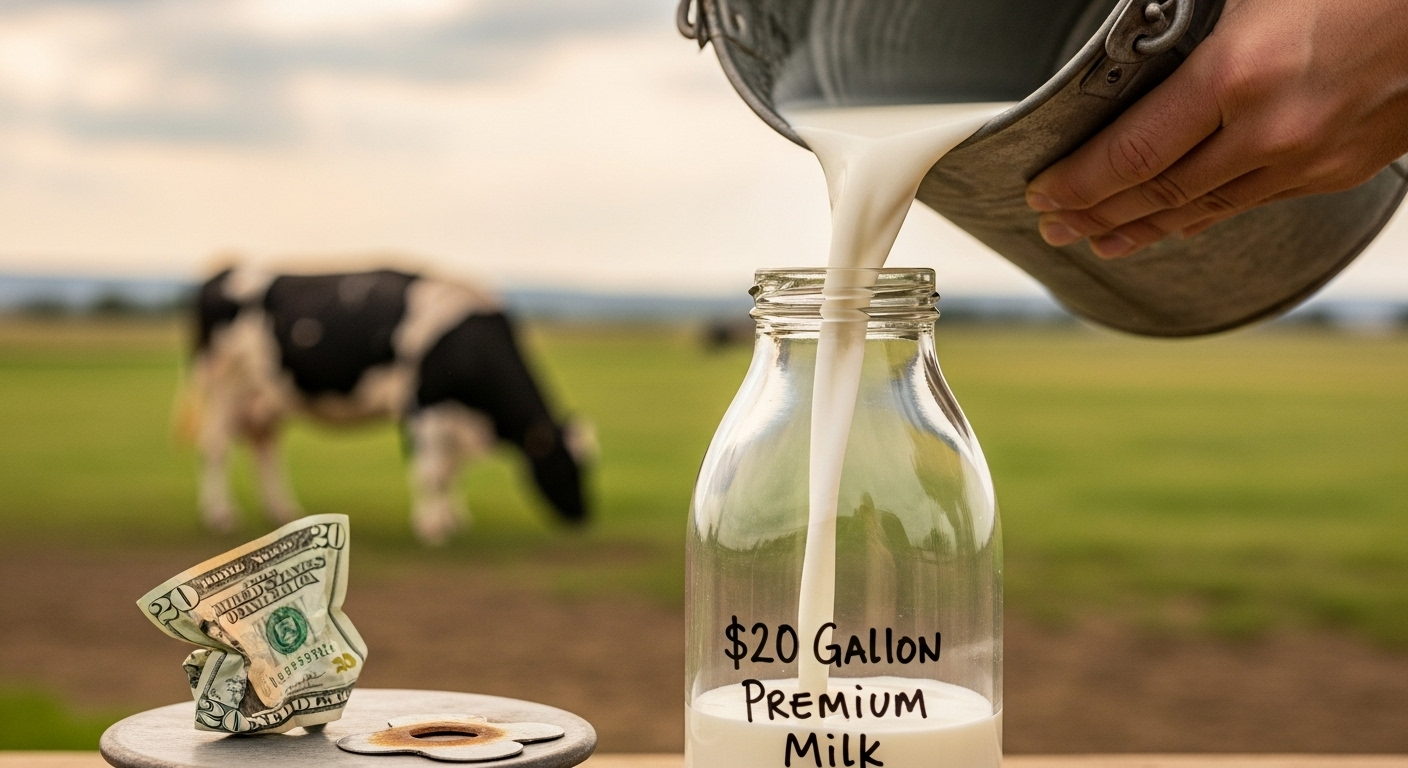
But what I find encouraging is that despite all this market pressure, certain producers are actually strengthening their position. Delaware’s raw milk producers, for instance, are getting $16-20 per gallon through direct sales since their new regulations took effect earlier this year, according to state Department of Agriculture filings. That’s about fourteen times what the rest of us get for conventional milk. And Italian cheesemakers supplying Parmigiano Reggiano? The Consorzio del Formaggio Parmigiano Reggiano reports they’re maintaining strong premiums even with everything else going sideways.
These aren’t lucky breaks, folks. They’re deliberate strategies based on understanding where markets are heading.
Quick Strategy Comparison
Before we dive in, here’s what we’re talking about:
Premium Differentiation: $10,000-50,000 initial investment → 20-40% price premiums → 12-36 month payback
Strategic Cooperation: Shared infrastructure/marketing → 15-20% better returns → Immediate cost savings
Processing Integration: $250,000-3 million investment → 2-3x commodity value → 3-5 year payback
How Price Discovery Is Breaking Down Across Regions

What I’ve found tracking these markets is that we’re seeing something beyond typical volatility. You may already be aware of this, but the Global Dairy Trade platform has been exhibiting some interesting patterns lately. Recent GDT results show varying outcomes across different product categories and auction timing—sometimes strong, sometimes lighter, depending on what’s being offered and when.
That variation tells us something important. When buyers become selective about their participation, they’re essentially saying they no longer trust regular price signals. They’re waiting for… something. Clarity, maybe.
The demand side remains pretty robust in certain areas, though. GDT’s recent summaries show continued strong interest from Chinese and Middle Eastern buyers, particularly for certain products. So it’s not that demand disappeared. It’s how markets function when the old structures start breaking down.
When you examine the developments in various regions, the patterns become clearer. California producers dealing with ongoing water restrictions from the Sustainable Groundwater Management Act are making different calculations than Wisconsin operations managing through another wet spring. Idaho’s large-scale operations have different leverage than Pennsylvania’s smaller family farms. Each region’s facing its own version of this market evolution.
How the Big Players Are Pivoting—And What We Can Learn
Fonterra’s moves over the past year provide some real lessons for the rest of us. Their deal with Lactalis—$3.85 billion, announced back in August 2024, where they sold consumer brands but kept long-term supply agreements—that wasn’t just portfolio shuffling.
As Miles Hurrell explained it in their earnings calls, they’re focusing on “what we do best—producing high-quality milk ingredients efficiently at scale.” But what that really means, if you ask me, is they’re letting someone else worry about convincing shoppers while they control the foundation of the whole supply chain.
This flexibility to shift between WMP, butter, cheese, and specialty ingredients based on what makes strategic sense, rather than just chasing today’s highest price, is a valuable approach. Even those of us running smaller operations can learn from it. Yes, it looks different at 200 cows versus 20,000, but the principle remains the same.
Speaking of different scales, DFA’s regional councils have been exploring similar strategies at the cooperative level. Their Mountain Area Council, covering Colorado, Wyoming, and parts of New Mexico, has been helping members navigate these changes through shared resources and collective negotiating power. Land O’Lakes member services report similar initiatives across the Upper Midwest.
Why Different Regions Take Completely Different Approaches
Recent data from various national dairy organizations paints an interesting picture. According to the European Commission’s milk market observatory, Italian production remains relatively stable. Dairy Australia’s latest situation and outlook report highlights ongoing challenges, with production levels down in recent periods. Spain’s Ministry of Agriculture data indicates fairly flat production. Meanwhile, the Dairy Companies Association of New Zealand reports modest growth in their milk collections.
These aren’t random variations. They reflect fundamentally different philosophies about dairy farming.
Take Italy’s approach. In regions like Lombardy, where they’re making Grana Padano, or around Reggio Emilia for Parmigiano Reggiano, those EU Protected Designation of Origin rules mean you can only make these cheeses in specific provinces using methods documented since medieval times. You’re not competing on efficiency at that point—you’re selling something that literally can’t be made anywhere else.
The Parmigiano Reggiano consortium’s published quality reports indicate that its members maintain strong premiums even when commodity markets are struggling. Geographic exclusivity, it turns out, has real value when broader markets face pressure.
Meanwhile, in Australia, Dairy Australia’s September 2024 situation report shows ongoing production challenges, with various factors, including climate and input costs, really affecting producers. However, here’s something interesting—I heard from a banker specializing in agricultural loans that farms and processing facilities in that area sometimes trade below historical values during these periods. Long-term investors from firms like Colliers International and CBRE are definitely watching.
Spain offers yet another model. Their focus on being a consistent and reliable supplier to European food manufacturers—not chasing premiums or competing on price—provides its own kind of stability. Spanish dairy cooperative COVAP’s annual reports emphasize that being the dependable middle option has value during chaos.
And then there’s the U.S. West. California dairies facing those Sustainable Groundwater Management Act restrictions are making completely different strategic choices than operations in water-rich regions. The Western United Dairyman’s recent member surveys show operations pivoting to higher-value products partly out of necessity—when water costs what it does in the Central Valley, you’d better be making more than commodity milk with it.
The Reality of What One Operation Learned the Hard Way
Let me share something that doesn’t make it into the success stories. There’s a 400-cow operation in central Illinois that attempted to do everything at once two years ago—starting an organic transition, investing in bottling equipment, and joining a new marketing cooperative — all in the same year.
By month 18, they were hemorrhaging cash. The organic transition meant three years without premium prices but immediate costs for new feed sources. The bottling line sat idle half the time because they hadn’t built their customer base first. The new cooperative required different hauling routes, which added $1,200 monthly in transportation costs.
They survived, barely, by selling the bottling equipment at a 40% loss and focusing solely on completing organic certification. Today they’re profitable again, but the owner told me, “I learned the hard way that one strategic change at a time is plenty.”
How Your Size Determines Your Options
The farm credit analysis released in July effectively highlights how the scale of your operation affects available options during volatile times. With current prime rates at 8.5% as of October 2025, according to Federal Reserve data, financing costs are more significant than ever.
For those 50-100 cow operations (and I know there are still plenty of you out there), the credit situation is particularly challenging. Most are working with smaller credit lines through their local bank or Farm Credit association. When you need to float a feed delivery at these interest rates, every relationship matters.
The 200-500 cow farms generally have moderate credit lines, based on Farm Credit data, with perhaps a bit more flexibility, but still typically depend on one primary lender. Farm Credit Services of America reports similar patterns across Iowa, Nebraska, South Dakota, and Wyoming. The difference? These operations can sometimes negotiate rate discounts of 0.5-1% based on their track record.
Then you have operations with over 1,000 cows, maintaining larger revolving facilities, often with multiple banking relationships. When margins compress, the difference between getting capital in hours versus weeks can determine who survives.
The derivatives situation tells a similar story. CME Group’s educational materials for dairy futures make it clear that maintaining an active hedging program requires substantial working capital. Most operations with fewer than 1,000 cows utilize their co-op’s risk management programs or hire advisors for forward contracts. Direct trading just doesn’t pencil out for smaller operations—and honestly, that’s probably for the best given the complexity.
Even something as basic as milk storage affects your leverage. Smaller operations with limited tank capacity face different pressures than someone with two weeks of storage. USDA’s Farm Storage Facility Loan program—they offer up to $500,000 with a 15% down payment according to FSA guidelines—but as Cornell Cooperative Extension’s PRO-DAIRY program points out, farms with storage flexibility can negotiate. Those without it take what’s offered.
Three Strategies That Are Actually Working—With Real Examples
Despite all these challenges, I’m seeing operations successfully pivot away from pure commodity dependence. And these aren’t pie-in-the-sky ideas—they’re happening right now.
Building Premium Value Through Differentiation
Delaware’s new raw milk regulations, which took effect earlier this year, have created some interesting opportunities. The testing requirements are intense, including monthly pathogen testing, enhanced facilities, and comprehensive insurance. Would crush a commodity operation. But according to Delaware Department of Agriculture licensing data, those approved producers are getting $16-20 per gallon, with customers driving in from Pennsylvania and Maryland.
What’s working elsewhere? In Vermont, the Northeast Organic Farming Association reports continued growth in the transition to grass-fed and organic farming. Initial certification involves a significant investment, ranging from $10,000 to $50,000, depending on your current setup, according to University of Vermont Extension estimates. However, certified organic milk typically commands premiums of $5-8 per hundredweight above conventional prices through cooperatives like Organic Valley or CROPP Cooperative.
Out in California, some producers are finding success with A2 milk. The A2 Milk Company’s supplier programs reveal that genetic testing and herd transition costs vary widely. However, retail price monitoring by the California Department of Food and Agriculture indicates that A2 milk commands premiums of 20-40% at stores like Whole Foods and regional chains.
Then there’s the somatic cell count premium game. The Michigan Milk Producers Association publishes its quality premium schedules, showing significant bonuses for consistently low SCC milk—we’re talking an extra $0.40-$ 0.60 per hundredweight for counts under 100,000. For a 500-cow dairy shipping 40,000 pounds daily, that’s real money.
Creating Leverage Through Cooperation
The Maryland and Virginia Milk Producers Cooperative shows what’s possible through smart aggregation. According to their annual report, by bringing together approximately 1,500 member farms that produce roughly 1.2 billion pounds annually, they’ve achieved negotiating positions that individual members could never reach.
In the Midwest, new forms of cooperation are emerging. Wisconsin’s FarmFirst Dairy Cooperative reports member groups sharing everything from equipment to marketing expertise. They’re coordinating hauling routes through services like Dairy Farmers of America’s transportation division, saving members thousands monthly. Some groups jointly invest in rapid testing equipment—a $45,000 unit that serves multiple farms when shared among them.
Out West, the Western Organic Dairy Producers Alliance brings together organic dairy producers across multiple states to share certification costs, coordinate marketing efforts, and negotiate more favorable terms with processors. Their member surveys show collective action providing 15-20% better returns than going solo.
Taking Control Through Processing
Now, adding processing isn’t for everyone—Wisconsin’s Center for Dairy Research makes that clear in their feasibility studies. Investment costs vary enormously. A basic pasteurizer and bottling line may cost around $250,000, according to equipment manufacturers such as Crepaco and Feldmeier. A small cheese operation? You’re looking at a minimum of $500,000 based on recent USDA Value-Added Producer Grant applications. Full creamery with ice cream capability? Now we’re talking $2-3 million according to dairy plant design firms.
But for those who make it work, the returns can be compelling. Penn State Extension’s dairy entrepreneurship program tracks on-farm processors, and its data show that farmstead cheese operations often capture $40-60 per hundredweight equivalent, versus the $20 commodity price. That’s after accounting for processing costs.
The regulatory piece is huge, though—something people often underestimate. Food safety modernization act compliance, state licensing, local health permits… the Pennsylvania Department of Agriculture’s guide to on-farm processing runs 87 pages. And that’s just one state. Don’t forget you’ll need workers, too—skilled cheese makers in Wisconsin are commanding $25-35 per hour if you can find them.
Your Practical Timeline for Making Strategic Changes
So, where does all this leave your operation? Let me break down a realistic timeline based on what’s actually working for producers making these transitions.
Next 30 Days:
- Schedule that credit review with your lender (seriously, with rates where they are, you need to know your options)
- Calculate exactly what percentage of your revenue depends on spot pricing
- Visit one operation already doing what you’re considering—most producers are surprisingly willing to share experiences
Next 60-90 Days:
- Premium path: Start certification paperwork (organic transition takes three years per USDA National Organic Program rules, but grass-fed can be faster)
- Cooperation path: Connect with neighboring producers—your extension agent can often facilitate introductions
- Processing path: Get a feasibility study done (many land-grant universities offer these through their food science departments)
6-12 Month Targets:
- Premium: Complete initial certification phases, identify your first customers through farmers markets or local food hubs
- Cooperation: Formalize agreements (get a good ag lawyer—handshake deals don’t survive market stress)
- Processing: Secure financing, order equipment (current lead times from manufacturers are running 6-9 months for dairy equipment)
Where This Leaves Us—And Why There’s Still Opportunity
What we’re experiencing isn’t some temporary blip that’ll fix itself next quarter. The evidence—from changing GDT auction patterns to structural shifts in how major players, such as Fonterra, position themselves—suggests that we’re seeing a fundamental market evolution. The commodity model that worked for our parents and grandparents… it’s struggling to generate returns that justify today’s capital requirements and risks.
However—and this is crucial—evolution creates opportunities alongside challenges. Those Delaware raw milk producers didn’t stumble into premium prices. They recognized where consumer preferences were heading and positioned accordingly. Italian PDO cheesemakers leverage centuries of tradition while continually investing in quality and modern food safety practices. Farms adding processing accept complexity in exchange for control.
Markets continue evolving. They may never return to patterns we once considered normal. However, by examining how producers find success through differentiation, cooperation, and integration, we can build something resilient. Something that actually rewards the work we do and the food we produce.
Your path depends entirely on your situation—land base, family labor, capital access, market proximity, and personal goals. However, whatever direction you choose, starting now, while you have options, beats waiting until markets force your hand.
Because if recent volatility has taught us anything, it’s that standing still while markets evolve around you? That’s the riskiest strategy of all.
KEY TAKEAWAYS:
- Premium differentiation delivers 20-40% price premiums with manageable investment ($10-50K for organic/grass-fed transition, $75K for A2 conversion) and 12-36 month payback—Michigan Milk Producers Association reports $0.40-0.60/cwt bonuses just for SCC under 100,000, adding $8,760 annually for a 500-cow dairy shipping 40,000 lbs daily
- Strategic cooperation cuts costs immediately through shared infrastructure (bulk tanks save $60K each when split three ways), coordinated hauling (FarmFirst members save thousands monthly), and collective bargaining—Western Organic Dairy Producers Alliance members report 15-20% better returns than going solo
- Processing integration captures 2-3x commodity value but requires serious commitment: $250K for basic bottling, $500K minimum for cheese, $2-3M for full creamery, plus navigating 87-page regulatory guides and finding skilled workers ($25-35/hour for experienced cheese makers)—Penn State Extension data shows farmstead cheese operations capturing $40-60/cwt versus $20 commodity
- Your financing options depend entirely on scale: With prime at 8.5% (October 2025), operations under 100 cows face limited credit access, while 1,000+ cow dairies maintain multiple banking relationships—that speed difference in accessing capital during volatility determines who survives
- Start with one strategy and perfect it: That Illinois operation, which was trying to transition to organic, bottling, and a new cooperative simultaneously, nearly failed—they survived by focusing solely on organic certification. Pick your path based on resources, execute well, then consider expansion
Complete references and supporting documentation are available upon request by contacting the editorial team at editor@thebullvine.com.
Learn More:
- June Milk Numbers Tell a Story Markets Don’t Want to Hear – This article expands on the market forces driving volatility, revealing why explosive production growth actually triggered a sharp sell-off. It provides tactical advice on shifting your strategy from volume to components, a proven profit center for operations looking to make “smarter milk” in a tough market.
- Taiwan Deal Requires 100,000 Pounds Monthly – Here’s What That Really Means for Your Farm – This piece offers a deep dive into the economics of export opportunities, revealing why most farms are automatically shut out. It presents actionable alternatives like targeting institutional buyers or forming collaborative ventures, providing a clear path to higher returns without the complexity and risk of international trade.
- The Tech Reality Check: Why Smart Dairy Operations Are Winning While Others Struggle – This article provides a crucial reality check on technology adoption, moving beyond sales pitches to reveal the true ROI of investments like robotic milking and automated monitoring. It helps producers avoid common pitfalls and strategically implement tech to slash labor costs and boost herd efficiency.
 Join the Revolution!
 Join the Revolution!
Join over 30,000 successful dairy professionals who rely on Bullvine Weekly for their competitive edge. Delivered directly to your inbox each week, our exclusive industry insights help you make smarter decisions while saving precious hours every week. Never miss critical updates on milk production trends, breakthrough technologies, and profit-boosting strategies that top producers are already implementing. Subscribe now to transform your dairy operation’s efficiency and profitability—your future success is just one click away.