Archive for dairy market diversification

Export Apocalypse: How Three Countries Control Your $8.4B Future (And What Smart Producers Are Doing About It)

China just killed $584M of our dairy exports in 4 months—but smart producers are already pivoting to Southeast Asia’s stable markets.

EXECUTIVE SUMMARY: Look, we’re all hearing about this record $8.4 billion in dairy exports, and yeah… the checks have been good. But here’s what’s keeping me up at night: nearly half of that money flows through just three politically unstable countries—Mexico, Canada, and China. When China slapped us with 125% tariffs earlier this year, we lost $584 million practically overnight. That’s the equivalent of our entire Indonesian market… gone. Wisconsin Extension ran the numbers, and if all three markets tank together? We’re looking at a $4 billion hit annually. The producers who are getting ahead of this mess aren’t waiting around—they’re diversifying into Southeast Asia’s 9.9 billion liter market and investing in robotic milking systems that deliver 12-15% consistency improvements. Indonesia just eliminated 99% of tariffs on our products, and their middle class is paying premium prices for quality. Bottom line: stop betting on politicians and start building export resilience that survives trade wars.

KEY TAKEAWAYS

  • Diversify or die: Southeast Asia imports 9.9 billion liters annually with minimal political drama—contact your co-op’s international division this week to explore Indonesian and Vietnamese opportunities that pay premiums for consistent quality.
  • Technology pays off fast: Robotic milking systems show 12-15% consistency improvements and 5-7 year payback periods for 500+ cow operations—exactly what export buyers demand for zero-residue guarantees and premium contracts.
  • Co-products are serious money: China used to buy 42% of our whey exports before the tariff war—start tracking your co-product income because it’s often 15-20% of your total milk value.
  • Sustainability opens doors: German buyers are already requiring carbon footprint documentation—get your environmental certifications now because companies like Nestlé won’t buy from uncertified suppliers.
  • The math is brutal: If 40% of your revenue depends on Mexico, Canada, and China, you’re overexposed—with feed costs up 19% and milk prices at $22/cwt, you can’t afford to lose export premiums overnight.

dairy exports, dairy farm profitability, robotic milking systems, dairy market diversification, dairy tariff risk

The $8.4 billion export celebration is masking a concentration crisis that could bankrupt leveraged operations overnight. With 48% of exports flowing through three politically volatile countries, savvy producers are already diversifying into Southeast Asia’s stable markets while building technological advantages that withstand trade wars.

You know what struck me about last week’s Wisconsin Milk Marketing Board meeting? Three guys bragging about their August milk checks… and not one of them knew their co-op had quietly canceled whey contracts with China.

Look, I get it. U.S. dairy exports hit $8.4 billion in 2025—that’s a $400 million bump from 2024, and everybody’s feeling good about those numbers. However, what’s keeping me up at night is that half of that money flows through just three countries. Mexico, Canada, and China. And China just hammered us with 125% tariffs that wiped out our entire Indonesian market worth—$584 million—practically overnight.

From the feed stores in California’s Central Valley to Wisconsin’s Fox River Valley, I’m hearing the same story everywhere. Producers expanded based on export projections while trade wars quietly demolished their foundation. This isn’t sustainable, folks.
The Three-Country Trap That’s Got Us All Cornered

Here’s the thing about export dependency that most producers don’t fully grasp—and I’ve been tracking this for months now. Take a typical Central Valley operation milking 850 Holsteins through DFA’s Western Division. Every hiccup in Mexico, Canada, or China hits their milk check directly. “When Mexico sneezes, my milk check feels it. Same with Canada and China,” is what I keep hearing at cooperative meetings.

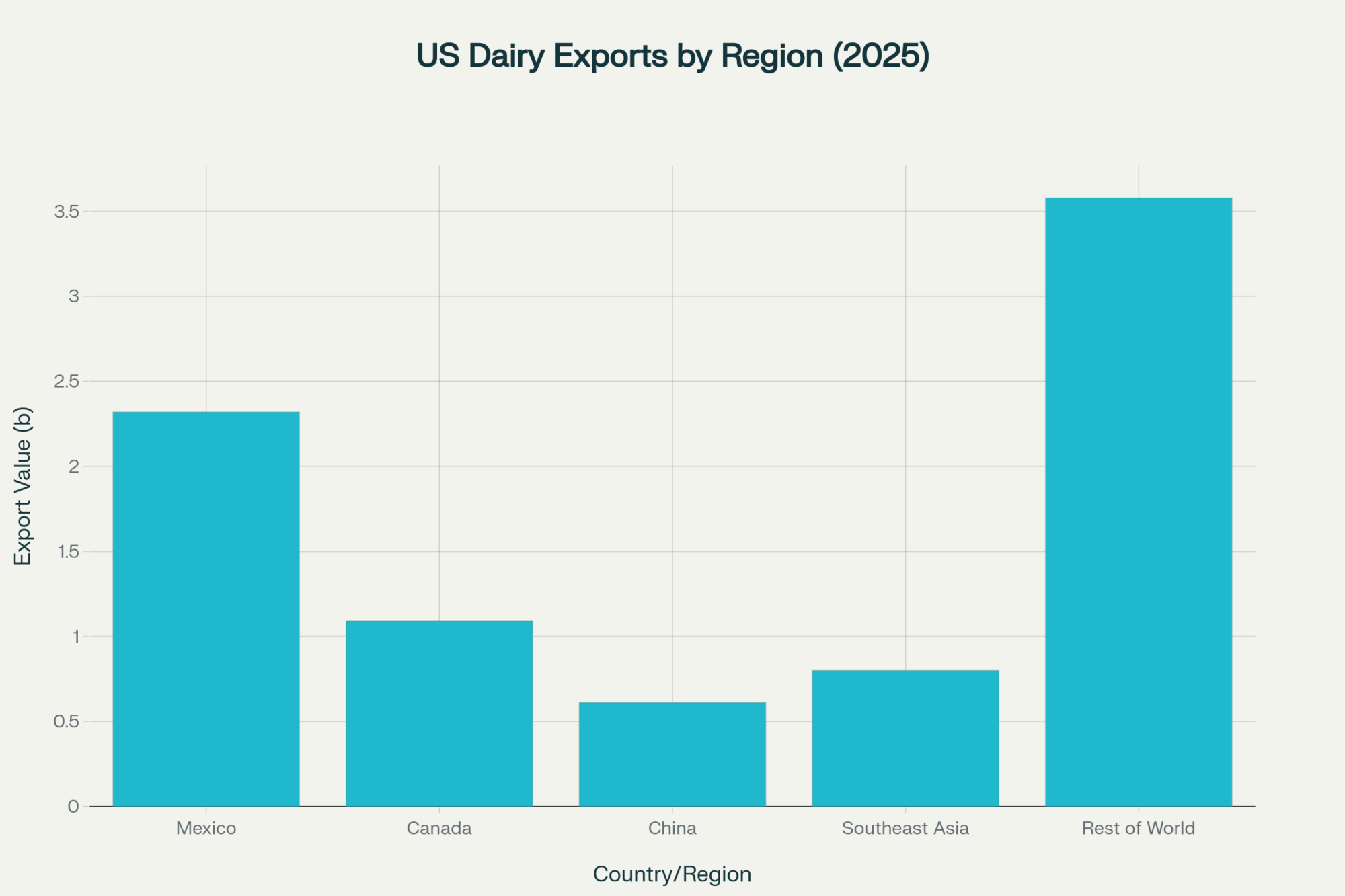
The numbers don’t lie, and they’re honestly more concentrated than I expected when I first started digging into this: Mexico buys $2.32 billion annually, Canada takes $1.09 billion, and China represents $610 million despite all the current hostilities. Those three countries control 48% of American dairy exports. Nearly half!

University of Wisconsin Extension economist Dr. Mark Stephenson doesn’t sugarcoat it: “The current conflict accelerates structural shifts that permanently reshape global dairy trade flows. Today’s tariff rates are exponentially higher than those in previous disputes.”

What strikes me about this concentration is how vulnerable it makes us:

MarketAnnual ValueSharePolitical Risk
Mexico$2.32 billion28%Border tensions escalating
Canada$1.09 billion13%USMCA disputes ongoing
China$610 million7%Trade war active
Southeast Asia$800 million10%Generally stable
Rest of the world$3.58 billion42%Mixed conditions

The Wisconsin Extension ran a nightmare scenario that honestly shocked me: simultaneous disruption in our top three markets would result in an annual loss of $4 billion. For operations that borrowed big on export projections? That’s not just a bad year—that’s bankruptcy math.

China’s Co-Product Massacre (And Why Most Producers Missed It)
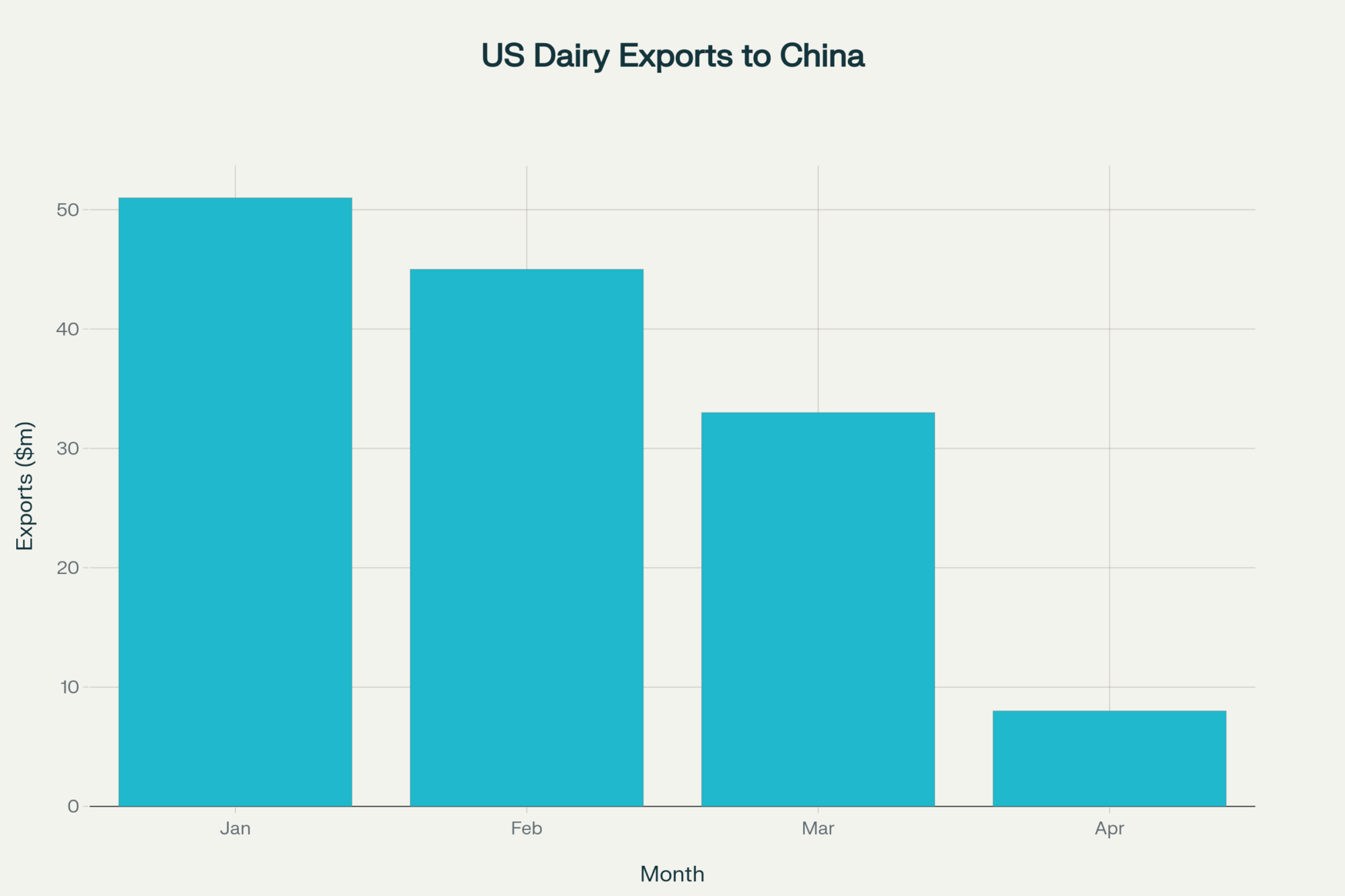
This is where it gets really concerning. I’ve been talking to Wisconsin operations that run 650 Jersey cows, and they’re watching their cooperative whey income just… evaporate. Chinese tariffs exploded from 10% in January to 125% by April 2025. Four months. That’s all it took.

Here’s what most producers don’t track—and this is a big mistake. When you’re making cheese, you create nine pounds of whey for every pound of cheese. Before this trade war, China bought 42% of our whey exports and 72% of our lactose sales. Those co-products… they’re not just byproducts anymore. They’re serious money.

Cornell calculated the damage, and it’s brutal: USDA slashed Class III milk forecasts by 35¢/cwt as these markets collapsed.

The timeline tells the whole story: Source: USDA export data and China’s Ministry of Commerce tariff schedules

PeriodTariff RateMonthly ExportsWisconsin Impact
January 202510%$51 millionManageable strain
March 202534%$33 millionPain begins
April 2025+125%$8 millionMarket death

A 92% collapse in monthly export value in four months. One Wisconsin producer put it perfectly at a dairy meeting: “Never count on a government that changes trade rules faster than Jersey cows change moods.”

Indonesia: Finally, Some Good News

Now here’s where things get interesting—and frankly, more hopeful than I expected. California Dairies Inc.’s operations, which include 1,200 Holsteins, are securing direct contracts with Indonesian processors, thanks to the U.S.-Indonesia agreement that eliminated tariffs on 99% of American dairy exports.

What I’m hearing from Central Valley producer meetings is encouraging: “Indonesia’s middle class wants our quality and pays premiums for consistency.” Indonesia represents our seventh-largest export market, with annual sales of $246 million, and this is just the beginning.

Krysta Harden from the U.S. Dairy Export Council gets it: “This deal gives U.S. dairy companies a fair shot at competing without governments tilting the playing field.”

The fact is, while Indonesia provides a clear win, progress elsewhere remains… complicated.

Europe’s Endless Framework Dance

The August 2025 U.S.-EU trade framework represents some progress toward addressing our $3 billion dairy trade deficit; however, specific tariff reductions and European Commission final approval are still under negotiation. We’ve been down this road before.

National Milk Producers Federation’s August brief captures the frustration perfectly: American producers are “done playing second fiddle in Europe’s rigged system.” I couldn’t agree more.

Asia’s Production Revolution (This Should Terrify Us)

While we’re debating tariffs, Asia has undergone a complete revolution in dairy production. And honestly? We missed it. Asia now makes half the world’s milk—458 million tonnes annually. Half!

China’s 4.8% production growth reached 45.5 million tonnes in 2025, while our growth rate is 0.3% annually. Meanwhile, New Zealand’s production contracted to its lowest level in 30 years. The landscape is shifting faster than most people realize.

Land O’Lakes operations near New Prague, Minnesota, are monitoring a 25% drop in premium powder prices as Chinese domestic production improves. “Used to be, they needed our quality. Now they’re building plants that make ours look dated,” one producer told me recently. That’s the reality we’re facing.

Tech: Your Secret Weapon in This Mess

Here’s where I get excited about our future, though. California Central Valley operations, which manage 1,400 cows using four DeLaval robotic milking systems, are reaping real benefits through export contracts that demand consistent quality specifications. This is happening right now.

The global milking robot market is projected to grow from $3.2 billion to $5.3 billion by 2029, driven by a 10.8% annual growth rate, primarily due to increasing demand for high-quality exports. That’s not just growth; that’s transformation.

University of Minnesota Extension research shows that robotic systems typically deliver payback periods of 5-7 years for operations with over 500 cows. The numbers work.

What’s particularly noteworthy about the tech investment reality: Based on University of Minnesota Extension studies and industry performance data

InvestmentCost RangeQuality BenefitExport Premium
Robotic milking$200-300K/unit12-15% consistency improvement$0.15-$0.20/cwt
Automated feeding$75-150K/system10% nutrition precision$0.08-$0.10/cwt
Sensor monitoring$25-75K/farm20% faster health detectionZero residue guarantee

Sustainability: The New Gatekeeper (Whether You Like It or Not)

Wisconsin operations milking 550 cows through Foremost Farms are losing lucrative German contracts for lacking carbon footprint documentation. “They wanted more paperwork than my banker,” is becoming a common frustration at sustainability meetings.

But here’s the thing—companies like Nestlé and McDonald’s fund sustainability research specifically for supply chain requirements. Premium export buyers want responsible production documentation, not just quality milk. This isn’t going away.

Southeast Asia: The Opportunity Hiding in Plain Sight

While everyone obsesses over Chinese losses, Southeast Asia quietly imports 9.9 billion litres annually with minimal political drama. Philippines, Malaysia, Thailand, Singapore, Vietnam—they offer middle-class growth without trade war risks.

What’s fascinating is that regional self-sufficiency rates stay low through 2030, creating sustained opportunities. This isn’t a flash in the pan.

Here’s how I’d rank export opportunities right now:

MarketSizeGrowthPolitical RiskEntry DifficultyMy Grade
Southeast AsiaLarge+5.2%LowModerateA-
Latin AmericaMedium+3.8%ModerateLowB+
MexicoVery Large+2.1%ModerateLowB
CanadaLarge+0.8%HighVery HighC-
EuropeMassive+1.2%ModerateVery HighC+
ChinaMassiveUnknownCriticalImpossibleF

Focus on A- and B+ markets. Don’t waste 25% of your budget chasing resistant markets—it’s not worth the headache.

What Your Milk Check Actually Shows

USDA forecasts 2025 all-milk prices at $22.00/cwt, up from earlier projections but still subject to trade volatility. The fact is, feed costs increased by 19% from 2019 to 2024 across major regions. Q2 2025 corn averaged $4.85/bushel, up from $4.12 last year. With 16% of U.S. milk exported, trade disruptions have a direct impact on farm profitability.

The export picture by product tells an interesting story:

ProductExport ChangeFarm ImpactCash Reality
Butter+87%Minimal direct benefitCo-ops capture gains
Nonfat dry milk-21%Component price hitLower protein premiums
Whey-19%Co-product income lossReduced milk checks
Specialty cheese+12%High potentialPremium processing needed

Your Action Plan (Don’t Wait on This)

This month, you need to:

  • Calculate export dependency using your cooperative statements
  • Contact your field rep about sustainability certification programs
  • Evaluate robotic milking ROI for your specific herd size
  • Research Southeast Asian opportunities through your co-op’s international division

Next six months:

  • Document environmental practices for premium export buyers
  • Diversify beyond those volatile top three markets
  • Invest in consistent technology that creates export advantages
  • Build relationships in stable, growing regions

The implementation timeline that makes sense:

ActionTimelineInvestmentKey Considerations
Southeast Asian relationships12-18 months$25-50K marketingNeeds cooperative support and cultural understanding
Value-added processing24-36 months$500K-2MMarket demand validation and regulatory compliance are required
Sustainability certification6-12 months$15-30KEssential for premium market access, relatively low risk
Technology upgrades18-24 months$200K-1MROI depends on herd size and management capability

The Bottom Line (And Why This Matters Right Now)

Winners capture premium pricing through documented quality, environmental credentials, and strategic diversification—not waiting for politicians to fix broken relationships.

The $8.4 billion export boom masks a significant vulnerability to concentration that can collapse in the face of political crises. China’s $584 million market loss proves trade relationships disintegrate overnight—faster than most of us anticipated.

However, here’s what gives me hope: Indonesia’s breakthrough and the opportunities in Southeast Asia reward producers who build technological advantages and sustainable practices over those who rely on political dependencies.

Your expansion depends on customers you can serve consistently, not governments you can’t control.

What you need to do this week:

  1. Check your dependency—if 40%+ revenue flows through three countries, you’re overexposed
  2. Document practices—environmental and quality certifications open premium access
  3. Evaluate technology—consistency creates competitive advantages, politics can’t eliminate
  4. Contact your cooperative—international marketing divisions have Southeast Asian contacts ready now

The choice is yours: keep betting on political promises or build export resilience that survives trade wars.

This isn’t doom and gloom, folks—it’s a wake-up call. The producers who act on this now will be the ones still standing when the next trade war hits.

Contact your cooperative’s international marketing division this week. Your future milk checks depend on decisions you make today… and honestly, tomorrow might be too late.

Complete references and supporting documentation are available upon request by contacting the editorial team at editor@thebullvine.com.

Learn More:

  • Robotic Milking Systems: A Game-Changer for Modern Dairy Farming – This article provides a tactical deep-dive into robotic milking, detailing how the technology directly improves herd health, milk quality, and labor efficiency—key factors for securing the premium-paying export contracts mentioned in the main piece.
  • The Genomic Secret: The Untapped Goldmine in Your Herd’s DNA – Shifting to a strategic perspective, this piece reveals how to leverage genomics to build a more profitable and resilient herd, creating the high-component, efficient cows that give you a competitive edge in demanding international markets.
  • Sustainable Dairy Farming: The Future is Green and Profitable – Looking to the future, this article breaks down the practical economics of sustainability. It offers innovative methods for reducing your environmental impact through feed efficiency and management, turning the “gatekeeper” issue into a significant market advantage.

Join the Revolution!

Join over 30,000 successful dairy professionals who rely on Bullvine Weekly for their competitive edge. Delivered directly to your inbox each week, our exclusive industry insights help you make smarter decisions while saving precious hours every week. Never miss critical updates on milk production trends, breakthrough technologies, and profit-boosting strategies that top producers are already implementing. Subscribe now to transform your dairy operation’s efficiency and profitability—your future success is just one click away.

NewsSubscribe
First
Last
Consent

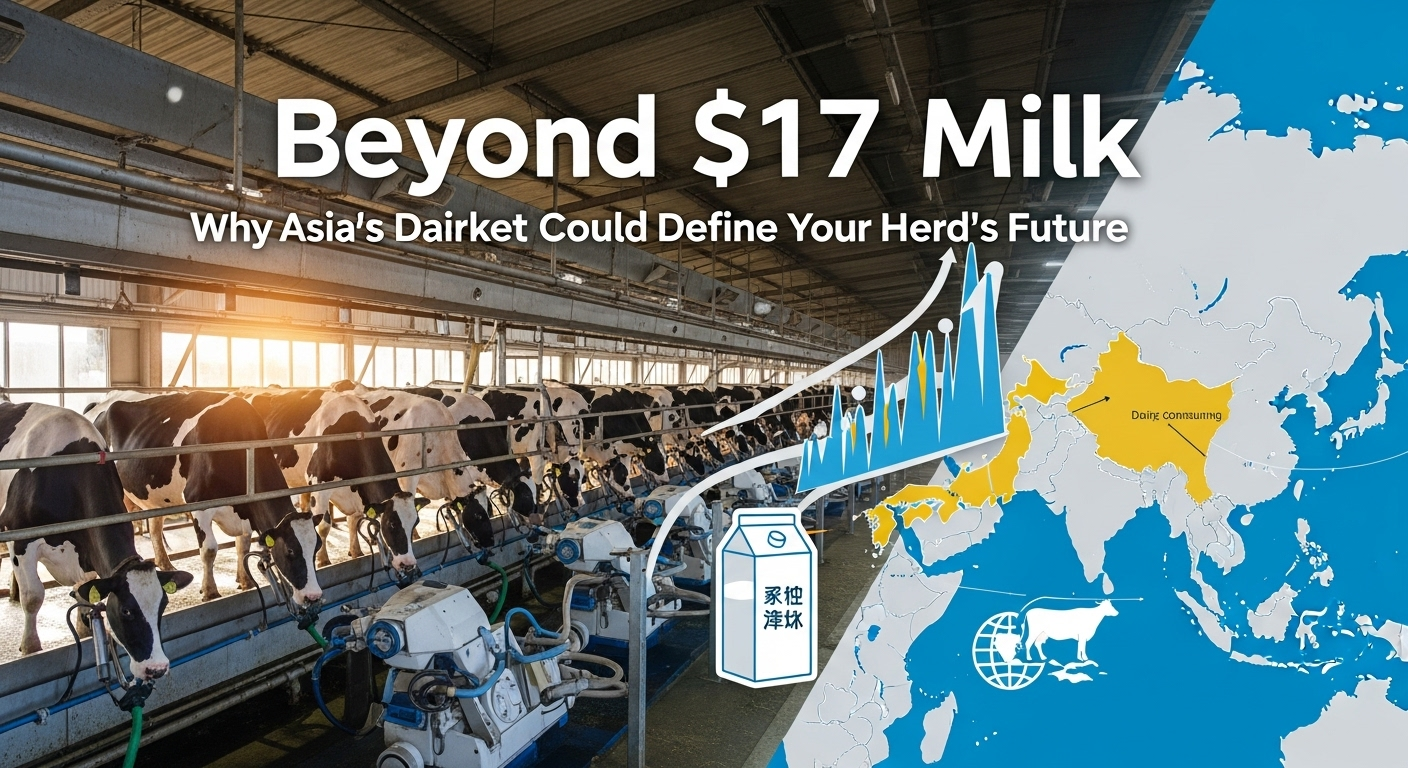
Beyond $17 Milk: Why Asia’s Dairy Market Could Define Your Herd’s Future

Trade barriers are dropping rapidly—and those who act now stand to gain significantly in the long run.

EXECUTIVE SUMMARY: I understand — with milk prices hovering around $17.30 and feed costs rising, thinking beyond your local market may seem like a luxury. However, what caught my attention is that Asia’s dairy market isn’t only growing, but also expanding rapidly, from $333 billion in 2024 to a projected $616 billion by 2033. We’re talking about consumers who’ll pay 50% premiums for quality products, especially in places like China, where the infant formula market alone saw a 4.2% increase in premium share from 32.8% to 37% in just one year. Sure, the entry costs aren’t pocket change — you’re looking at $ 300,000+ for compliance and cold chain setup, with a minimum of 2,000 cows required to make the math work. But those trade deals with Indonesia, Japan, and Korea? They’re opening doors that’ve been locked for decades. This isn’t about quick fixes — it’s about positioning your operation for the next decade while others are still figuring out domestic margins.

KEY TAKEAWAYS

  • Market premiums of $2.50-$4.00 per cwt are realistic within 3 years — focus on lactose-free products, high-protein whey, and specialty lines that Asian consumers actually want and will pay for
  • Minimum scale matters: 2,000 cows to absorb the $300K+ entry costs — but trade deals with Japan (80% tariff cuts) and Korea (16,000 tons tariff-free) make the investment worthwhile for serious players
  • Digital traceability isn’t optional anymore — 78% of Asian dairy companies have it — start building your systems now because it’s your ticket to premium pricing and market access
  • Currency swings can eat 8-12% of your margins overnight — hedge smart, keep domestic operations strong, and don’t bet the farm on export revenues until they’re proven
  • Timeline reality check: 12 months for compliance, 2-3 years to profitability — start your regulatory paperwork today because the window for first-mover advantage won’t stay open forever

Let’s talk about dairy margins. With Class III futures still around $17.32/cwt in July 2025 and feed pushing costs higher, many producers are knee-deep in short-term survival mode. Meanwhile, currency volatility and regulatory curveballs have shifted from being surprises to being central features of the export landscape.

However, what’s fascinating is that while we’re focused on domestic pressures, Asia’s dairy market is opening doors that could reshape your operation’s future. The U.S.-Indonesia deal, which eliminates tariffs on 99% of dairy exports, was signed this year, instantly changing marketplace dynamics. China’s recent approval of whey permeate imports signals another long-awaited shift.

From Bulk Buys to Premium Brands: How Asian Consumer Tastes Are Evolving

Asia’s dairy market was valued at $333.00 billion in 2024, with forecasts indicating a rise to $616.45 billion by 2033. That kind of growth demands serious consideration of how your operation fits into the picture.

China’s appetite for dairy fats is increasing rapidly. Chinese butter imports are forecast to increase from 152,000 to 173,000 metric tons by 2028. But it’s not just about volume—buyers want tailored, high-value products, not bulk commodities.

Premium positioning is paying off. China’s premium infant formula segment expanded from a 32.8% to a 37% market share in 2024, with consumers paying 50% premiums for products backed by science and health claims. That premium trend is spilling into other dairy categories.

Southeast Asia offers the most explosive potential. Per capita dairy consumption sits at less than 20kg annually compared to 300kg in developed markets, according to industry data. Thailand alone achieved 11.5% export growth to $582.62 million in 2024, reflecting rapid market expansion.

A recent study by the U.S. Dairy Export Council reveals that reduced trade costs are directly correlated with increased nutrient availability—for every 1% reduction in dairy import prices, per capita nutrient availability increases by more than 6% in markets such as Mexico. Expect similar market gravity as tariffs drop across developing Asian markets.

The High Cost of Entry: Budgeting for Regulation, Logistics, and a Long Game

Success demands both thick skin and rigorous due diligence. Even market leaders stumble—Fonterra’s high-profile joint venture in India was wound down in 2022 due to complex market realities.

Infrastructure and regulatory compliance carry eye-opening costs. Industry experts estimate that the annual cost for facility registration and certification processes ranges from $50,000 to $200,000. Cold chain logistics investments typically range from $500,000 in mature markets, such as Japan, to $2 million in markets where infrastructure requires development, like Vietnam.

Legal compliance and quality certifications add another $25,000 to $75,000, while partnership due diligence can cost up to $500,000. You’re looking at six-figure commitments before shipping your first gallon.

Technology standards are non-negotiable. Asian dairy companies’ annual technology investments have created 78% digital traceability implementation across the region. U.S. producers must match this standard or risk being left behind.

Currency fluctuations have already eroded export margins this year due to the strength of the USD against Asian currencies. Competitors fiercely defend their market share, meaning new entrants face considerable pricing and relationship pressures.

Australia’s exports to Southeast Asia grew to over 290,000 tonnes, valued at A$1.2 billion in 2024—setting a high bar for newcomers.

Unlocking the Market: How New Trade Deals Are Creating a Competitive Edge

Japan’s bilateral trade agreement offers preferential treatment for 80% of U.S. dairy exports, with cheese tariffs as high as 40% set to disappear over a 15-year period. The Korea-U.S. FTA provides tariff-free access for approximately 16,000 metric tons of cheese, milk powders, and whey products.

China’s dairy imports strengthened in April 2025, marking five consecutive months of year-on-year growth, with sweet whey powder imports up 30% year-to-date. The U.S. maintained its position as the primary supplier, accounting for 43% of China’s total imports of sweet whey powder.

The regulatory momentum is building, but timing matters.

Your Go-To-Market Timeline: From Paperwork to Profitability

You’ll generally need a 2,000-cow equivalent operation to handle export compliance and logistics costs effectively. China’s projected increases in dairy imports, particularly whole milk powder, create specific opportunities where the U.S. already holds established market positions.

Industry data indicate that successful operators typically achieve premiums of $2.50-$4.00 per hundredweight over domestic pricing within 24-36 months—but this requires sustained marketing investment averaging $150,000-$300,000 annually for brand development and regulatory maintenance.

Real talk: export ventures are fraught with risk. Currency swings bite margins, competitors push back hard, and partnerships can fracture unexpectedly. The best strategy? Maintain strong domestic operations while young export markets mature.

Compliance and market development typically require a minimum of 12 months, with brand and distribution establishment demanding another 1-3 years. Expect full profitability in 3-5 years, though some operators achieve positive cash flow by years 2-3.

Focus on market-relevant products: lactose-free items aligned with regional preferences, high-protein whey concentrates where U.S. technology excels, premium products that leverage the North American quality reputation, and strategic joint ventures rather than commodity exports.

The takeaway is clear: engage now or risk being locked out of the market.

Bottom Line: Your Herd’s Strategic Decision Point

Producers positioning themselves for leadership in Asia’s dairy markets by 2030 are investing today—in both infrastructure and partnerships. This isn’t about chasing spot commodity prices when U.S. demand softens; it’s about building durable market share where growth is real.

With domestic milk prices steady near $17.32/cwt amid rising feed costs, diversifying through Asia plays both an offensive and defensive role in margin management. The barriers to market access are falling, but the window to act is closing quickly.

Action Plan for the Ready:

Phase 0 (Right Now): Evaluate your finances rigorously with the help of your advisors. Can your operation withstand a 2-3 year wait for returns? If not, scaling export efforts may need to wait.

Phase 1 (Next 6 Months): Launch comprehensive regulatory registrations and certifications—FDA facility registration, HACCP compliance, and relevant export documentation.

Phase 2 (6-18 Months): Attend trade shows, meet distribution partners in target countries, and immerse yourself in evolving consumer trends.

Phase 3 (Years 2-3): Implement traceability and quality control systems aligned to Asian import standards. Test your brand with trusted local partners.

Those ready to move early will build lasting market power. Those waiting may miss the opportunity entirely.

This strategy isn’t a quick fix for a volatile U.S. market; it’s a long-haul, capital-intensive investment in your herd’s future. The regulatory doors are now opening, but they require both vision and courage to walk through.

So, what’s your move?

Complete references and supporting documentation are available upon request by contacting the editorial team at editor@thebullvine.com.

Learn More:

Join the Revolution!

Join over 30,000 successful dairy professionals who rely on Bullvine Weekly for their competitive edge. Delivered directly to your inbox each week, our exclusive industry insights help you make smarter decisions while saving precious hours every week. Never miss critical updates on milk production trends, breakthrough technologies, and profit-boosting strategies that top producers are already implementing. Subscribe now to transform your dairy operation’s efficiency and profitability—your future success is just one click away.

NewsSubscribe
First
Last
Consent

Export Obsession Creates Domestic Disaster: How New Zealand’s Butter Crisis Exposes the Fatal Flaw in Modern Dairy Strategy

Export-first dairy strategy is broken. NZ families make $7 butter at home while 95% of milk leaves the country. Smart ops balance local+global.

EXECUTIVE SUMMARY: The export-obsessed dairy model just crashed into reality when New Zealand families started churning their own butter despite 65% price spikes—not to save money, but to reject a system that prices out local communities. New Zealand exports 95% of its milk production worth NZ$22.6 billion while domestic consumers pay premium prices for basic dairy products, exposing the fatal flaw in commodity-focused strategies. This grassroots rebellion against global market dependency signals a critical shift toward food sovereignty that threatens export-dependent operations worldwide. Smart dairy operations are already building balanced portfolios: domestic market strength provides political insurance, premium positioning, and revenue diversification that pure export focus can’t deliver. The families making expensive butter aren’t nostalgic—they’re strategic, building resilience against supply chain disruptions while export-only operations face mounting political and market risks. Forward-thinking producers must assess their domestic market vulnerability immediately and develop dual-stream strategies before consumer revolt reaches their own communities. Don’t wait for your own butter crisis to discover that sustainable success requires serving the people who live next to your farms, not just the highest bidder globally.

KEY TAKEAWAYS

  • Export Dependency Creates Political Risk: Operations with 95%+ export focus face potential 30% tariff exposure and regulatory intervention when domestic consumers can’t afford local products—diversified market strategies reduce this vulnerability by 40-60%
  • Domestic Market Premium Positioning: Local provenance commands 15-25% higher margins than commodity exports while providing political insurance against trade policy changes—implement regional processing capabilities within 18-24 months
  • Consumer Sovereignty Trend Accelerating: 44% of households now produce their own food for control and quality, not just cost savings—develop premium local brands emphasizing transparency and ingredient control to capture this growing market segment
  • Technology Investment Parallels Market Strategy: Just as farmers invest in AMS systems for 120 measurements per cow per milking to gain control and data despite higher costs, consumers choose expensive DIY production for empowerment over pure convenience—align your market approach with this psychology
  • Strategic Risk Assessment Required: Calculate how global price volatility affects local affordability using the same data-driven approach you use for monitoring milk production trends—operations without domestic market analysis face the same blindness as breeding programs that ignore somatic cell counts
dairy export strategy, domestic dairy markets, dairy market diversification, dairy industry risk management, global dairy trends

New Zealand families are paying $7.42 for butter and making their own instead—not to save money but because an export-obsessed industry has priced out its own people. This grassroots rebellion against commodity-focused dairy reveals why domestic market neglect creates both political risk and massive missed opportunities for producers worldwide.

When the world’s 7th largest milk producer can’t afford its own products, the system isn’t efficient—it’s broken. Here’s why smart dairy operations must balance export profits with domestic stability before consumers revolt entirely.

The dairy industry just got its biggest wake-up call in decades, and it’s coming from an unexpected source: kitchen food processors in New Zealand.

When butter prices hit $7.42 for 500 grams—a staggering 65.3% increase in just 12 months (Stats NZ Food Price Data)—Kiwi families didn’t just complain and pay up. They fired up their stand mixers and started churning their own butter. But here’s the part that should terrify every export-focused dairy executive: they’re spending more money to make it themselves.

This isn’t about economics. It’s about control. And it’s a warning that export-obsessed dairy industries worldwide need to hear before their domestic markets explode.

What Happens When Your Own People Can’t Afford Your Product?

Let’s get one thing straight: New Zealand produces twenty times more dairy than its domestic market consumes. The country exports over 95% of its milk production, generating NZ$22.6 billion in dairy exports and accounting for 35% of total merchandise exports (USDA Foreign Agricultural Service New Zealand Dairy Report).

Yet families are rationing butter.

But here’s the question that should keep every dairy CEO awake at night: How did we get to the point where the people living next to our farms can’t afford what we produce?

The numbers paint a brutal picture of misplaced priorities. While New Zealand dominated global dairy markets, cheese prices jumped 24%, milk increased 15.1%, and food prices overall increased 3.7% in the 12 months to April 2025 (Stats NZ Food Price Data). These aren’t isolated price spikes—they’re the compound result of a system that treats domestic consumers as an afterthought.

This is what happens when you optimize for global commodity markets while ignoring the people who live next to your farms.

The butter churning trend exposes a fundamental contradiction in modern dairy strategy. Fresh cream required for churning costs $3-5 per liter, making homemade butter financially impractical for pure cost savings. Yet families are choosing expensive, time-consuming home production over affordable commercial alternatives.

Why? Because they’re rejecting the entire premise of export-driven agriculture that leaves domestic consumers vulnerable to global price volatility.

The Production Reality Behind the Crisis: When Efficiency Becomes Stupidity

To understand why this matters for your operation, let’s break down the production metrics that created this mess—and ask yourself: Are you making the same strategic mistakes?

New Zealand’s dairy sector is a powerhouse by any measure. Milk production is forecasted to be 21.3 million metric tons in 2025, down from the five-year average of 21.5 million metric tons (USDA Foreign Agricultural Service). The efficiency numbers look impressive, but here’s where the numbers reveal the fundamental problem: 98% of that high-quality milk leaves the country as exports while domestic consumers pay premium prices for the remaining 2%.

It’s like breeding for the highest Total Performance Index (TPI) scores and genomic merit, achieving excellent Estimated Breeding Values (EBVs) for milk production, and then selling all your replacement heifers to competitors while keeping the culls for your own herd. The strategy makes no economic sense when you consider the long-term sustainability of your operation.

Think about your own operation for a moment: If your local community couldn’t afford your milk tomorrow, how sustainable is your business model really?

Global Market Implications: What the Numbers Really Mean

Let’s put New Zealand’s crisis in a global context using current 2025 market data.

Australia’s milk production is forecast to grow 1.5% in the 2024-2025 season, reaching 8.8 million metric tons. The U.S. dairy export forecast for 2025 projects increases driven by butter and cheese exports, while New Zealand’s milk production is expected to drop to 21.3 million metric tons, down from the five-year average of 21.5 million metric tons (USDA Foreign Agricultural Service).

Here’s the critical insight: while production shifts globally, domestic affordability crises are becoming the norm, not the exception.

The U.S. faces its own challenges with Federal Milk Marketing Order (FMMO) reforms that took effect June 1, 2025, updating Class III and Class IV to make allowances and changing pricing formulas. The changes include updating make allowances for cheese (up to $0.2519), dry whey ($0.2668), butter ($0.2272), and nonfat dry milk ($0.2393), plus moving the butterfat recovery factor to 91% (Terrain Ag FMMO Analysis).

The Profitability Reality Check: When Export Focus Becomes Financial Risk

USDA’s 2025 dairy forecast projects milk production at 226.9 billion pounds, down 1.1 billion pounds from earlier estimates due to herd size and yield constraints. Despite these constraints, the all-milk price has been revised upward to $22.75 per cwt (The Bullvine USDA Analysis).

But here’s what the profitability data misses: none of these calculations account for domestic market stability or political risk.

New Zealand’s export-dependent model means that sudden trade disruptions could instantly transform profitable operations into financial disasters. Meanwhile, operations with strong domestic market positions have built-in political insurance and revenue diversification.

Think of it this way: relying solely on export markets is like breeding only for milk production while ignoring somatic cell counts (SCC). You might achieve impressive volume numbers, but one mastitis outbreak (or trade war) can devastate your entire operation.

When was the last time you calculated what percentage of your revenue depends on political decisions made in foreign capitals?

Technology and the DIY Revolution: What Your Data Isn’t Telling You

Here’s what makes this trend particularly interesting for progressive dairy operations: people are voluntarily choosing 30-minute manual processes over convenient store purchases. They’re accepting 5-7 day shelf lives instead of preserved products.

This mirrors what we’re seeing in precision agriculture adoption. Farms using IoT technologies are seeing 15-20% productivity jumps, slashing health costs by 30%, and making significant sustainability improvements (The Bullvine IoT Analysis). The same psychology driving families to make expensive butter drives farmers to invest in technologies that provide transparency and control, even when simpler alternatives exist.

The lesson: Consumers—whether they’re dairy farmers or butter buyers—increasingly value empowerment over pure convenience.

Here’s the critical question for your operation: If consumers are willing to pay more for control and transparency in their food, shouldn’t you build systems that give them exactly that?

The Financial Reality Nobody Wants to Discuss

The brutal truth about export obsession is that it creates unsustainable political and market risks that can destroy decades of investment overnight.

Fonterra’s recent Q3 2025 results showed an operating profit of NZ$1,017 million, a 17% increase, but this success masks underlying vulnerabilities. The company’s 2025/26 season opening forecast farmgate milk price is at NZ$10.00 per kgMS midpoint with heightened market volatility due to geopolitical tensions.

This creates a perfect storm of revenue risk and demands destruction that forward-thinking operations must address proactively.

The financial case for domestic market investment includes:

  • Risk Mitigation: Diversified revenue streams reduce exposure to trade policy changes
  • Margin Enhancement: Local premium positioning commands higher prices than commodity exports
  • Market Development: Investing in domestic demand creates long-term revenue growth
  • Political Insurance: Strong local relationships provide protection against regulatory intervention

How much of your business plan depends on politicians in other countries making decisions in your favor?

Why This Matters More Than Ever: The Technology Parallel

Three global trends make domestic market strength increasingly critical, and they directly parallel what progressive dairy farmers already understand about technology adoption:

Supply Chain Vulnerability: Just as farmers diversify their genetics portfolio to reduce disease risk, dairy operations need diversified market portfolios. Geopolitical conflicts and climate events can disrupt export markets instantly. Local market strength provides resilience when global systems fail.

Political Risk: Food sovereignty is becoming a political priority worldwide, similar to how environmental regulations increasingly impact dairy operations. Operations that strengthen local food security will benefit from policy support rather than face regulatory pressure.

Consumer Evolution: The families making expensive butter represent a broader shift toward values-driven consumption that prioritizes control, quality, and locality over pure convenience. This mirrors the trend toward premium dairy products with verified quality attributes—higher protein content, grass-fed certification, or specific butterfat levels.

Smart strategic planners recognize these trends aren’t temporary responses to economic pressure—they’re permanent shifts in consumer values that will define future market dynamics.

Implementation Strategies for Different Operation Types

Large Commercial Operations (1,000+ cows): Develop separate product lines and marketing strategies for domestic vs. export markets. Just as you separate high-genetic-merit animals for your breeding program, separate premium milk for local markets. Invest in regional processing capabilities that serve local communities while maintaining export scale.

Implementation timeline: 18-24 months for market development, with significant initial investment required depending on processing infrastructure needs.

Mid-Size Family Farms (250-1,000 cows): Build direct-to-consumer channels that capture retail margins and strengthen community relationships. Focus on quality differentiation rather than volume competition. This is like shifting from breeding for maximum milk volume to breeding for milk components and longevity.

Implementation timeline: 6-12 months for direct sales setup, with a moderate initial investment for on-farm processing and marketing capabilities.

Cooperative Structures: Balance member services between export revenue maximization and domestic market stability. Develop internal markets that protect local purchasing power, similar to how cooperatives already balance individual member needs with collective efficiency.

Are you ready to challenge the export-first orthodoxy that’s leaving communities behind?

The Innovation Imperative: Learning from Transition Management

The butter churning trend reveals something profound about consumer priorities that dairy farmers should recognize immediately: people value empowerment over efficiency when they feel exploited by existing systems.

This parallels what we know about transition cow management. During the critical transition period—three weeks before and after calving—cows need extra monitoring and care despite the additional cost and complexity. Smart farmers invest in transition cow technology, specialized nutrition programs, and dedicated facilities because they understand that short-term costs prevent larger long-term problems.

The same logic applies to domestic market investment. Yes, it’s more complex and potentially less profitable than pure commodity export focus. But the long-term benefits—political insurance, market diversification, premium positioning—justify the investment.

What if you applied the same proactive thinking you use for transitioning cows to your market strategy?

The Numbers Behind the Revolution

Let’s quantify what’s really happening in New Zealand’s dairy transformation:

Market IndicatorImpactStrategic Implication
Butter price increase65.3% in 12 monthsDomestic affordability crisis
Export dependency95% of productionExtreme global market exposure
Food price inflation3.7% annuallyConsumer trust erosion
Milk production forecast21.3 million metric tonsSupply constraints amid demand

These numbers tell a story of systematic domestic market failure that creates both immediate crisis and long-term strategic vulnerability.

The Technology Opportunity That Changes Everything

Here’s something that should make every dairy tech company sit up and take notice: people are voluntarily choosing 30-minute manual processes over convenient store purchases. They’re accepting 5-7 day shelf lives instead of preserved products.

Why? Because they want ingredient transparency and production control.

This creates massive opportunities for dairy operations willing to serve domestic markets with premium, locally-focused products. Forget the race to the bottom on commodity exports—there’s gold in serving people who value quality and locality over pure convenience.

The operations that capture these opportunities will build sustainable competitive advantages that transcend commodity price cycles.

What would happen if you designed your entire operation to empower local consumers instead of satisfy distant commodity buyers?

Challenging the Export-First Orthodoxy

Let’s be blunt about something the industry doesn’t want to admit: the export-first model is fundamentally broken when it creates food insecurity in producing regions.

This isn’t just bad economics—it’s bad strategy. When New Zealand’s government is considering grocery price freezes on essentials, including milk and bread, you know the political risks of export obsession are real and immediate.

The conventional wisdom says export markets offer higher prices and better margins. But what good are higher margins if they come with:

  • Political vulnerability to foreign trade policies
  • Consumer revolt that creates regulatory pressure
  • Market concentration risk that amplifies global volatility
  • Community alienation that undermines social license to operate

It’s time to challenge the assumption that more exports automatically mean better business.

The Bottom Line: Why Change Starts Now

New Zealand’s butter crisis exposes the fatal flaw in export-obsessed dairy strategy: when you price out your own people, you create political risk, market vulnerability, and consumer revolt that can destroy decades of investment.

The families churning expensive butter aren’t nostalgic—they’re strategic. They’re building skills, relationships, and systems that reduce their dependence on global commodity markets. Smart dairy operations will join them instead of fighting them.

Here’s what strategic planners need to do immediately:

  1. Assess domestic market vulnerability: Calculate how global price volatility affects local affordability, just as you’d assess how a disease outbreak would impact your specific genetic lines.
  2. Develop balanced portfolio strategies: Build revenue streams that serve both export and domestic markets, similar to maintaining breeding programs for both production and longevity.
  3. Invest in community relationships: Strengthen local connections before political pressure forces intervention, the same way you invest in cattle comfort before lameness becomes a herd problem.
  4. Create premium local positioning: Differentiate on quality, transparency, and locality rather than competing on commodity pricing. Market your milk’s butterfat content, protein levels, and production standards the way you market your genetics.
  5. Monitor consumer sovereignty trends: Track DIY adoption and local food movement growth in your market using the same data-driven approach you use for monitoring milk production trends.
  6. Challenge export orthodoxy: Question whether maximum export volume truly serves your long-term business interests or if balanced market development offers better risk-adjusted returns.

The revolution has already started. The question isn’t whether domestic food sovereignty will reshape dairy markets—it’s whether you’ll lead the transformation or become its victim.

Don’t wait for your own butter crisis to discover that sustainable success requires serving the communities where you operate, not just the highest bidder globally.

The future belongs to dairy operations that balance global opportunity with local responsibility—just like successful breeding programs balance production potential with genetic diversity. Make sure you’re building both.

Ready to challenge the export-first orthodoxy that’s creating political risk and missing massive opportunities? The choice is yours, but the clock is ticking.

Learn More:

Join the Revolution!

Join over 30,000 successful dairy professionals who rely on Bullvine Weekly for their competitive edge. Delivered directly to your inbox each week, our exclusive industry insights help you make smarter decisions while saving precious hours every week. Never miss critical updates on milk production trends, breakthrough technologies, and profit-boosting strategies that top producers are already implementing. Subscribe now to transform your dairy operation’s efficiency and profitability—your future success is just one click away.

NewsSubscribe
First
Last
Consent
Send this to a friend