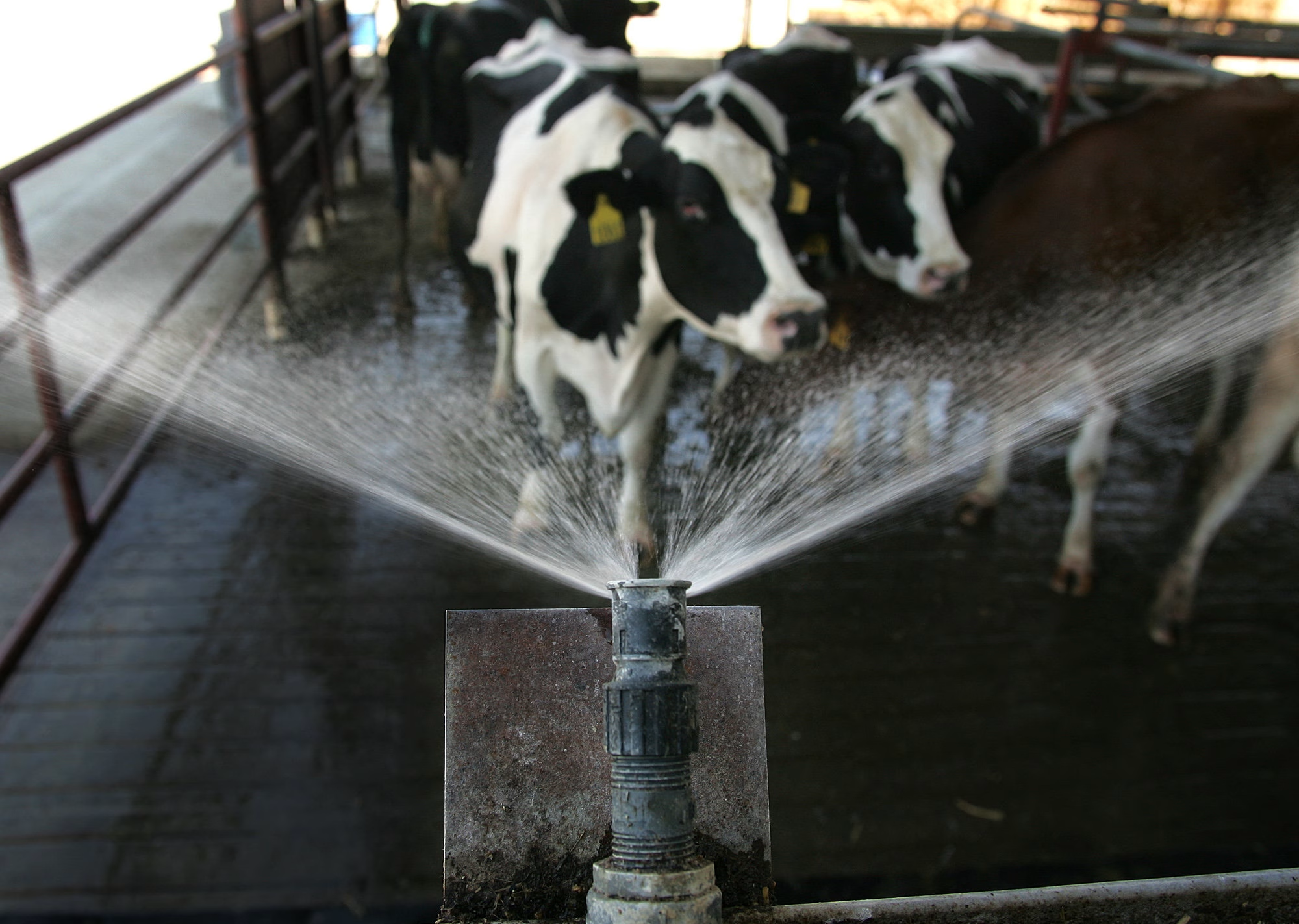
Archive for dairy heat stress management

The Italian Warning: Why Your Cooling Fans Won’t Save You in 2030

$100K cooling system? Italian dairy families invested $50K in cheese vats instead—and DOUBLED profits.

EXECUTIVE SUMMARY: North American dairy faces an Italian preview: fourth-generation cheesemakers abandoning volume for value as cooling systems prove only 40% effective against extreme heat, exposing our industry’s dangerous bet on technology over adaptation. Wisconsin’s brutal arithmetic—7,000 farms vanished while production rose 5%—reveals that mid-sized operations carrying debt below the $18/cwt profitability threshold are mathematically doomed by 2030. Producers face three proven escape routes: scale to 2,000+ cows with $500K investment, pivot to seasonal/specialty for premium markets despite 30% volume cuts, or capture 10X commodity prices through on-farm processing. The clock is unforgiving—Q1 2026 marks the last moment to choose your path and begin the 3-4 year transition before market forces choose for you. Water scarcity, dependence on immigrant labor, and soil depletion compound the timeline, while genetic decisions force an uncomfortable trade-off: bulls whose daughters survive the August heat produce 500kg less milk annually. Italian farmers who accepted this reality doubled their profits; those who fought it with technology are gone. Your cooling fans won’t save you in 2030—but choosing the right business model today might.

Dairy Heat Stress Management

You know, I’ve been following what’s happening with dairy farmers in southern Italy, and it’s got me thinking about our own future here. These multi-generation families—some going back to their great-grandfathers—they’re not just adding bigger fans when the heat and drought hit. They’re completely rethinking how they farm.

Here’s what’s interesting: instead of fighting the climate with more technology, many are shifting to seasonal production with those beautiful heritage breeds like Podolica cattle. Moving from fresh mozzarella to aged cheeses that hold up better in both heat and volatile markets. Less milk, sure, but products that work with the reality they’re facing.

The European agricultural monitoring agencies have been tracking this, and the numbers tell a story. Summer milk production in Italy’s heat-affected regions has been declining by double digits over the past few years, and there’s been a steady increase in farms closing or transitioning. It’s not a crisis as much as it’s a transformation—and as I talk with producers from Vermont to California, I’m hearing remarkably similar questions bubbling up.

The insights I’m sharing here draw from extension research, industry data, and patterns I’ve observed across numerous dairy operations over recent years.

The Timeline We’re All Watching

Let me share what the research is telling us about the next decade, because this window for making strategic choices—it’s narrower than most of us realize.

The land-grant universities have been remarkably consistent. Cornell, Wisconsin, Minnesota—they’re all pointing to about a five-year period where we can still be proactive. After that? Well, the market and Mother Nature start making more of the decisions for us.

According to the U.S. Global Change Research Program’s latest work, by 2030, we’re looking at average temperature increases of 1.5 to 2.5 degrees Fahrenheit across dairy country. Now that might not sound like much sitting here, but translate that to your barn in July. We’re talking measurable production losses—maybe just over one percent nationally to start, but it won’t hit everyone equally. Some regions will feel it harder.

By 2040—and this is what really gets my attention—the modeling from multiple universities suggests heat stress days could double or even triple from what we see now. Instead of managing through 10 or 15 tough days, imagine 30 or 40 where even your best management can’t fully compensate.

Producers I’ve talked with in Wisconsin are already seeing this shift. What used to be a handful of brutal days has turned into weeks where the cows just can’t catch a break. And those power bills? Several operations tell me their cooling costs last summer ate up everything they’d saved for improvements.

Here’s the sobering part: research from both U.S. institutions and international teams, including work from Israel’s Institute of Animal Science, published in recent years, shows that even effective cooling technology mitigates only about 40% of production losses during extreme heat events. That’s not the technology failing—that’s just the reality of what we’re up against.

That Six-Figure Cooling System Question

So let’s talk about what everyone’s pushing—these comprehensive cooling systems. I’ve been looking at the real numbers from extension programs, and honestly, the range is eye-opening.

For smaller operations, say 50 to 100 cows, Penn State Extension and others offer basic fans and sprinklers at about $10,000. That’s manageable for many. But for mid-sized farms? The backbone of many communities? You’re looking at $100,000 or more for a system that really makes a difference. Tunnel ventilation, sophisticated soakers, smart controls—it adds up fast.
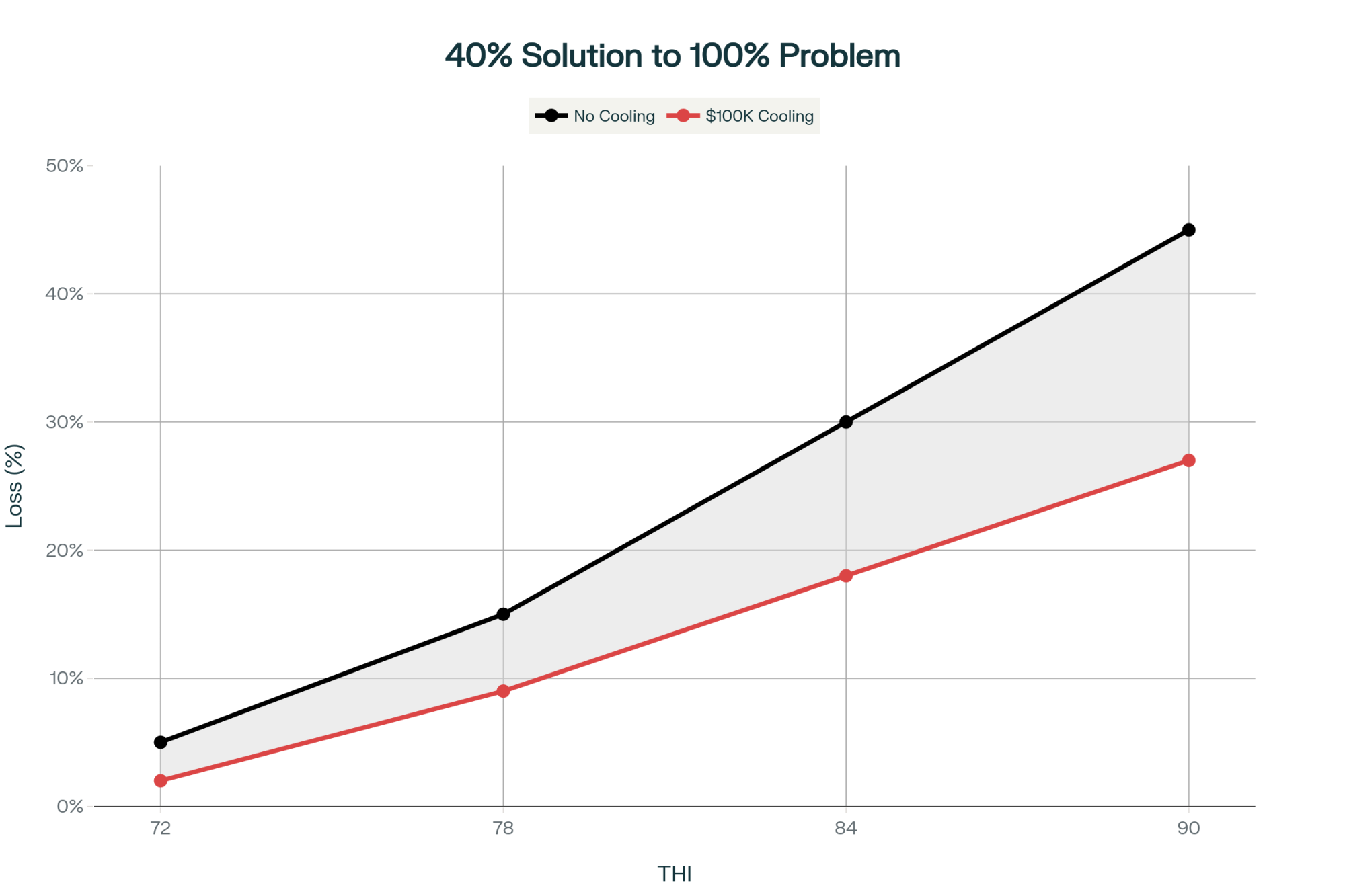
Extension research from multiple land-grant universities reveals cooling systems only mitigate 40% of production losses during extreme heat events. That $100K investment still leaves you bleeding 18-27% production when it matters most—the dirty secret equipment dealers don’t advertise.

What’s particularly challenging is the cash flow math. Farm financial analyses from multiple universities suggest you need fifty to seventy-five thousand in annual free cash to justify that kind of investment. Looking at current milk checks versus input costs… that’s a pretty select group right now.

Many producers tell me the same thing: taking on massive debt for a system that only solves part of the problem feels more like gambling than adapting.

Though I should mention, for some larger operations, the investment does pencil out. Operations with 2,000-plus cows that have invested in comprehensive cooling report maintaining over 90% of their baseline production through heat waves. At that scale, with those milk volumes, the economics can work.
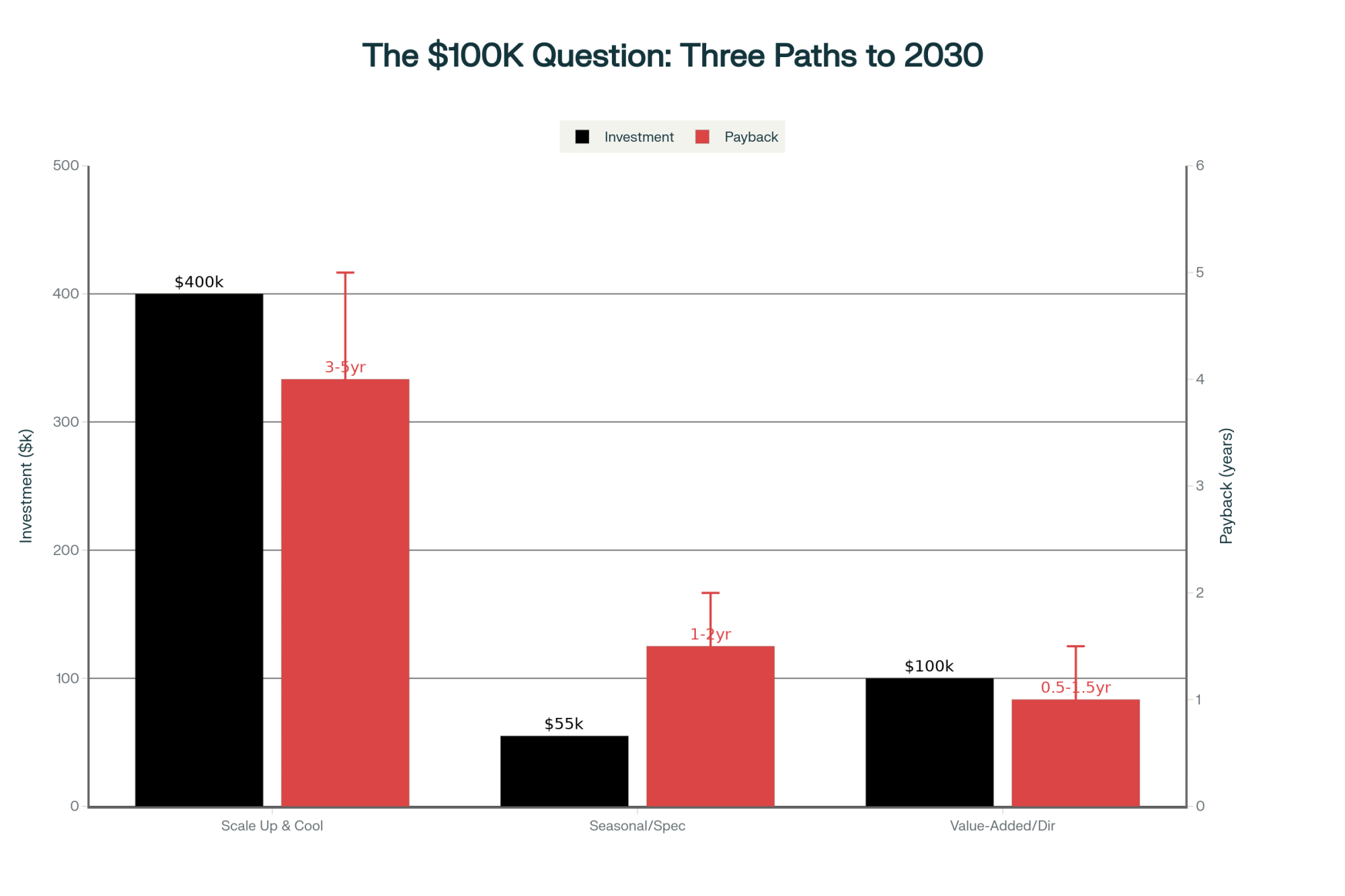
The Italian dairy farmers who invested $50K in cheese vats instead of $100K cooling systems doubled their profits. This chart shows why smaller, strategic investments often outperform mega-tech solutions—a reality North American producers need to face before Q1 2026.

Breeding for the Heat

Before we dive into alternatives, let’s talk genetics—because this is where the future really gets interesting.

Recent research from the USDA and multiple universities shows we’re at a crossroads in heat-tolerance breeding. The good news? Genetic variation for heat tolerance exists, and it’s heritable enough to make selection worthwhile. Studies from Florida show that 13-17% of the variation in rectal temperature during heat stress comes from genetics—that’s lower than milk yield heritability (around 30%), but it’s significant enough to work with.

What’s really eye-opening is how different bulls’ daughters perform under heat. The latest genomic evaluations show that the most heat-tolerant bulls have daughters with 2 months longer productive life and over 3% higher daughter pregnancy rates than the least heat-tolerant bulls. But here’s the trade-off—their predicted transmitting ability for milk is typically 300-600 kg lower, depending on the sire.

University research has identified a critical finding: genetic variance for fertility traits increases under heat stress. This means sire rankings change entirely depending on temperature conditions. A bull whose daughters excel for pregnancy rates in Wisconsin might tank in Texas heat, while another bull’s daughters maintain fertility specifically under stress conditions.

The industry is responding. Genomic evaluation companies now provide heat tolerance indices, with breeding values ranging approximately from minus one to plus one kilogram of milk per day per THI unit increase, according to the latest industry reports. That spread between the best and worst—it’s significant when you’re facing 40 heat stress days.

But here’s what nobody’s talking about openly: the relentless selection for production has made our cows increasingly heat sensitive. Selection indices now include longevity, fitness, and health traits, but we’re still playing catch-up. Progressive producers are prioritizing moderate frame sizes—those efficient 1,350- to 1,500-pound animals that maintain production while handling heat better than the larger frames that were historical breeding targets.

The question is: are you willing to trade some production potential for cows that actually survive and breed back in August? Because that’s the real decision genetics is putting in front of us.

USDA genomic evaluations reveal the genetic contradiction killing herds: bulls whose daughters produce 300-600 kg more milk have daughters that live 2+ months less and show 3% worse pregnancy rates under heat stress. You’re breeding cows that excel in Wisconsin winters but die in August—everywhere

Three Alternatives That Are Actually Working

This is where it gets interesting, because what I’m seeing isn’t theoretical—it’s happening right now on real farms.

Working With the Seasons

The seasonal production model adopted by some Italian producers seemed backward at first. Deliberately dry off cows during peak summer? Accept 25-30% less annual milk? But then you look at the complete picture.

Extension studies from Vermont, Wisconsin, and Michigan show feed costs dropping three to five dollars per cow per day during grazing seasons. Labor needs ease up considerably. And here’s what’s really interesting—market data from various cooperatives shows processors now paying 10-15% premiums for seasonal, grass-based milk. The market’s recognizing quality differences.

I’ve been tracking operations in Vermont and elsewhere that made this shift. Despite producing less milk than year-round neighbors, many report their net income actually increased—sometimes by 20% or more. As one producer put it to me, “When you stop fighting the weather every day, when the cows are comfortable in August, everything changes. The stress level drops for everyone.”

Value-Added on the Farm

Let’s talk about processing, because the economics here can be compelling for the right operation. We all know commodity milk prices—eighteen to twenty dollars per hundredweight when things are decent, less when they’re not. But producers who bottle and sell direct? Industry surveys from the American Cheese Society and extension case studies consistently show returns of $60 to $90 per hundredweight equivalent. That’s not marginal improvement—that’s a different business entirely.

The investment for basic processing ranges from 50 to 100 thousand, about what you’d spend on cooling. But here’s the difference—Penn State feasibility studies and Wisconsin DATCP analyses show that many processors recover that investment in 6 to 12 months when they’ve got their markets lined up.

Operations that have gone this route tell me the aged cheese they make during spring flush can bring ten times what they’d get from the co-op. Ten times. Now, it takes skill, the right permits, and consistent marketing, but for those who make it work, it’s transformative.

Going Direct to Consumers

What’s really changed—and this deserves attention—is the regulatory landscape. The Farm-to-Consumer Legal Defense Fund now tracks over 30 states that permit some form of direct dairy sales. That’s up from basically zero fifteen years ago.

The price differential almost seems unfair to discuss. Raw milk, when it’s legal and properly marketed, sells for $8 to $12 a gallon directly to consumers. Compare that to the $1.80 or $2 equivalent at the farm gate.

What’s encouraging is you don’t need to convert everything. Producers successfully moving just 20% of their milk to direct channels report that it completely changes their financial stability. It’s about diversification that actually means something.

Your Three Pathways: A Quick Comparison

PathwayInvestment RequiredTypical PaybackVolume ChangeBest If You Have…
Scale Up & Cool$300k – $500k3-5 yearsMaintain/IncreaseStrong cash flow, <50% debt
Seasonal/Specialty$30k – $80k1-2 years-25% to -30%Pasture access, flexible mindset
Value-Added/Direct$50k – $150k6-18 months-20% to -30%Market access, marketing skills

The Math of Consolidation is Ruthless

Let’s stop dancing around this. If you’re mid-sized and carrying debt, the climate is coming for your margins—and the numbers don’t lie.

Research from Wisconsin and Cornell agricultural economists identifies the exact break points where your operation becomes a casualty. When your realized milk price consistently runs below eighteen dollars per hundredweight, you’re not adapting—you’re bleeding equity. When income over feed costs drops below seven or eight dollars per cow per day, you can’t service debt anymore. And when debt-to-asset ratios climb above 50%, banks won’t even return your calls for upgrade financing.

These thresholds aren’t suggestions—they’re mathematical realities derived from thousands of farm closures.

Wisconsin’s experience is the canary in the coal mine. USDA-NASS data shows the state hemorrhaged 7,000 dairy farms between 2015 and 2023, yet milk production hit records. Those weren’t random failures—they were mid-sized family operations caught in the consolidation vice. Meanwhile, according to the 2022 Census of Agriculture, operations with over 1,000 cows now control two-thirds of the nation’s milk supply, up from 57% just five years back.

The consolidation winners aren’t shy about it either. Producers who’ve successfully scaled tell me that at 2,000+ cows, they access technology and leverage that transforms the entire business model. As one mega-dairy owner put it bluntly, “Scale gave us options. Everyone else just has hope.”

If you’re sitting at 200 cows with 60% debt-to-asset and milk at $17.50, the math is already written. The question isn’t whether you’ll consolidate or exit—it’s how much equity you’ll have left when you do.

“Sometimes working with natural systems instead of against them might be the smartest strategy of all.”

Three Constraints We’re Not Discussing Enough

Beyond climate and economics, three pressures deserve more attention.

Water Is Everything

The situation with the Ogallala Aquifer has shifted from concerning to critical. U.S. Geological Survey data from 2024 shows that recoverable water continues to decline. Kansas reported drops exceeding a foot across wide areas last year. This directly affects irrigation for feed and long-term dairy viability.

In California, UC Davis research documents that Central Valley groundwater depletion is accelerating beyond sustainable levels. The San Joaquin Valley alone has lost over 14 million acre-feet of groundwater storage since 2019. We’re looking at maybe 15-20 years before water, not heat, determines who stays in business there.

Producers in those regions tell me water is now their first consideration every morning—something their grandfathers never worried about.

Labor Challenges Keep Growing

Industry analyses from the National Milk Producers Federation and Texas A&M converge on this: roughly half of dairy’s workforce consists of immigrant labor, and those workers produce the vast majority of our milk. When you overlay visa challenges and local labor shortages, smaller operations feel it first and hardest.

Rising labor costs—an extra two or two-fifty per cow per month in many areas—that’s often the difference between black and red ink when margins are already tight.

Soil Health Can’t Be Ignored

This might be our biggest long-term challenge. FAO data from 2024, backed by Iowa State research, shows soil organic carbon down by half in many agricultural regions. The fix—regenerative practices—takes three to five years and serious capital before you see results in forage quality.

The operations that most need soil improvement often lack the financial cushion to weather that transition. It’s a tough spot.

Making Your Own Decision

After countless conversations with producers and advisors, certain patterns have emerged to help frame decisions.

Suppose you’re consistently seeing milk prices above eighteen dollars, maintaining income over feed costs above seven or eight dollars per cow per day, keeping debt-to-asset ratios under 50%, and can access three to five hundred thousand in capital. In that case, scaling up with cooling infrastructure might work. But success still requires exceptional management and decent markets.

If those numbers don’t line up but you’re within reach of population centers, have some pasture, and can stomach lower volume for better margins, specialty production models offer real potential. Especially if you can develop that direct channel that provides price stability.

Timing matters. By year’s end, you need an honest assessment. First quarter 2026—decision time. Use 2026-27 for building infrastructure or markets. By 2028-29, you should be transitioning operationally. Come 2030, your model needs to be locked in, because the competitive landscape will be pretty well set by then.

Land-grant research from Cornell, Wisconsin, and Minnesota converges on one truth: you have 5-7 quarters to choose your survival path. Q1 2026 marks the last moment for proactive choice—after that, milk prices, heat waves, and bank covenants make the decision for you. Wisconsin’s 7,000 lost farms learned this the hard way

Regional Realities

RegionCurrent Heat Stress Days2035 Projected Heat DaysWater Crisis SeverityRunway to AdaptCompetitive Advantage
Upper Midwest (WI, MN, MI)12-1520-25StableLongest (~10 yrs)HIGH
Plains States (NE, KS)20-2535-45CRITICAL -1 ft/yrShort (~5 yrs)Declining
California & Southwest30-3545-55EXTREME 140 gal/cowIMMEDIATE (~2 yrs)Collapsing
Northeast (NY, VT)8-1215-20FavorableLong (~12 yrs)HIGHEST
Southeast (GA, FL)40-5060-70ModerateAlready Here (0 yrs)Experience Leader

Upper Midwest

Wisconsin, Minnesota, Michigan—you’ve got the longest runway. University of Minnesota Extension modeling suggests heat stress stays manageable through 2030, and water’s relatively stable. Focus on genetics, targeted cooling in holding areas, and protecting components during stress periods. Current operations average 12-15 heat stress days annually, expected to reach 20-25 by 2035.

Plains States

Nebraska and Kansas dairy operations face a double squeeze—the depletion of the Ogallala Aquifer threatening feed production while heat-stress days increase from the current 20-25 to projected 35-45 by 2040. Kansas State research shows producers here need water strategies yesterday, not tomorrow. Some are already transitioning to dryland-adapted forage systems or relocating operations entirely.

California and the Southwest

Water drives everything here. UC Davis reports show you’re already using 20-30% more water per cow than a decade ago just to maintain production. California dairy operations now consume an average of 140 gallons per cow daily during summer months, up from 95 gallons in 2014. If you haven’t developed a water strategy beyond hoping for wet years, you’re behind. The next five years will force hard choices about value-added production, relocation, or partnering with operations that have water rights.

Northeast

Cornell’s work shows you maintaining favorable conditions through 2035. That’s an opportunity—develop specialty markets now while you have the advantage. The artisan cheese growth in places like the Hudson Valley shows that real market appetite exists. New York State Department of Agriculture reports specialty dairy operations increased 35% between 2022-2024.

Southeast

You’re living tomorrow’s challenges today. Georgia and Florida operations already manage 40-50 heat stress days annually. Every smaller operation surviving your heat and humidity has developed strategies that the rest of us need to study. Your experience is our roadmap.

Resources for Moving Forward

Decision Support Tools:

  • Cornell’s IOFC Calculator (available through the PRO-DAIRY website)
  • Penn State’s Enterprise Budget Tool for processing feasibility
  • USDA Climate Hubs’ regional adaptation resources
  • National Young Farmers Coalition’s direct marketing guides

The Bottom Line

Climate change isn’t just forcing operational changes—it’s driving fundamental shifts in business models. The successful producers I see aren’t trying to preserve yesterday’s approach with tomorrow’s technology. They’re finding what works with emerging realities.

The choice isn’t simply to get bigger or get out. It’s about finding the model that fits your resources, market access, and what lets you sleep at night. For some, that’s scale and technology. For others, it’s lower volume with higher margins through differentiation.

What those Italian dairy farmers are teaching us isn’t that we should all make aged cheese or switch breeds. It’s that one-size-fits-all responses might be less adaptive than thoughtful, farm-specific strategies.

Your operation’s future depends on choosing a path, but mostly on choosing soon enough to control how you implement it. The changes are coming either way.

This is about preserving not just farms but farming as a viable way of life. Sometimes that means producing less to preserve more. Sometimes it means completely rethinking what success looks like.

And sometimes—just sometimes—it means recognizing that working with natural systems instead of against them might be the smartest strategy of all.

Key Takeaways:

  • Cooling = 40% solution to a 100% problem: That $100K system you’re considering? It only stops 40% of losses at extreme temps. Italian farmers who invested in $50K cheese vats doubled their income instead.
  • Three models survive 2030—pick one NOW: Mega-dairy (2,000+ cows), seasonal/specialty (30% less milk, 20% more profit), or value-added (10X commodity prices). Middle ground is extinction.
  • The $18/cwt line divides living from dying: Below it, with >50% debt, you’re already bleeding equity daily. Wisconsin lost 7,000 farms in this death zone while production rose 5%.
  • Genetics force a brutal trade: Accept 500kg less milk for cows that survive August, or chase maximum production with daughters that won’t breed in heat. There’s no middle option.
  • Water kills operations faster than heat: Ogallala Aquifer -1ft/year. California dairy: 140gal/cow/day. Your 2030 survival depends more on water rights than cooling technology.

Complete references and supporting documentation are available upon request by contacting the editorial team at editor@thebullvine.com.

Learn More:

Join the Revolution!

Join over 30,000 successful dairy professionals who rely on Bullvine Weekly for their competitive edge. Delivered directly to your inbox each week, our exclusive industry insights help you make smarter decisions while saving precious hours every week. Never miss critical updates on milk production trends, breakthrough technologies, and profit-boosting strategies that top producers are already implementing. Subscribe now to transform your dairy operation’s efficiency and profitability—your future success is just one click away.

NewsSubscribe
First
Last
Consent

Heat Stress 2.0: Why Your Current Cooling Strategy Is Costing You Big Money

Old cooling methods are costing you $$$. Discover 2025’s advanced heat stress fixes: smart tech, genetics, and nutrition that protect profits & cows.

The old playbook for dairy heat stress management is officially obsolete. With climate projections showing hotter, longer summers ahead and the 2024 heat stress losses hitting record highs across North America, continuing with basic fans and sprinklers is like trying to cool your high-producing Holsteins with a household box fan. The most progressive producers are implementing integrated, advanced strategies that preserve milk checks and protect cow health and longevity in ways basic cooling never could.

As we approach the summer of 2025, it’s time to have a frank conversation about heat stress. The half-measures and band-aid solutions that might have sufficed a decade ago won’t cut it anymore. The economic reality is stark: the U.S. dairy industry loses approximately $1.5 billion annually due to heat stress in lactating cows, with individual farm losses ranging from $72 per cow per year in milder regions like Wisconsin to a staggering $700 per cow in hotter states such as Florida and Texas.

Let’s be even clearer about what’s at stake. When discussing heat stress losses, we’re not just talking about the immediate milk check impact. We’re talking about the hidden costs that quietly drain your profitability: reduced conception rates, increased metabolic disorders, compromised immune function, and perhaps most insidious, the “legacy effect” where heat-stressed dry cows produce offspring with permanently reduced productive potential. Much like a poor heifer raising program can handicap your herd for years, inadequate heat abatement today will affect your herd’s performance for generations.

Here’s the uncomfortable truth: While you’re meticulously fine-tuning your genetic selection program and debating the merits of the latest feed additive, your cows might be suffering from heat stress, negating all those investments. How many AI dollars have you wasted on failed breedings during the summer months? How much of that fancy TMR is going uneaten because your cows are too hot?

This article won’t waste your time. It provides basic advice about providing shade and water. Instead, we’ll dive into the cutting-edge strategies that forward-thinking producers are implementing – advanced cooling technologies with solid ROI numbers, breakthrough nutritional interventions that deliver, genetic selection tools that are commercially available today, and smart monitoring systems that can detect problems before they cost you money. Most importantly, we’ll show you how to integrate these approaches into a comprehensive system that works for your specific operation.

The science is clear. The economics are compelling. The question isn’t whether you can afford to implement advanced heat stress management – it’s whether you can afford not to.

Beyond Basic Fans: The Revolution in Cooling Technology

Let’s be honest – those 36-inch panel fans you installed fifteen years ago aren’t cutting it anymore. Modern dairy genetics have created cows that produce more milk than ever and generate more metabolic heat. Meanwhile, your cooling technology may be stuck in the early 2000s – about as effective as cooling your milking parlor with an open freezer door.

What’s Wrong with Your Current Cooling Approach

If you’re still relying on basic cooling methods, you’re likely facing these problems:

  • Inconsistent airflow creates “dead zones” where cows congregate and overheat
  • Wasteful water usage from outdated sprinkler systems
  • Skyrocketing energy costs from inefficient fans
  • Missed opportunities in critical areas like holding pens

The good news? Recent technological advances have transformed what’s possible in dairy cooling, with solid ROI numbers to back up the investment.

Next-Gen Cooling Systems That Pay for Themselves

Intelligent Soaking Systems: Forget timer-based sprinklers that waste water. Systems like the VES-Artex Intelligent Soaker 2.0 use sensor technology to activate only when cows are present and when temperature thresholds are met. These systems can reduce water usage by 50-70% compared to traditional setups while providing more effective cooling.

Smart soaking is all about precision cycling – short, effective soaking periods (30-45 seconds) followed by longer fan-only drying periods (4-5 minutes). This approach maximizes evaporative cooling while minimizing water waste, preventing wet bedding and increased mastitis risk. Much like the precision of robotic milking compared to batch milking, these systems deliver cooling exactly when and where it’s needed.

Advanced Ventilation Redesigned: Your ventilation strategy might be fundamentally outdated. Modern approaches include:

  • Tunnel Ventilation: Creating high-speed airflow (1.0-2.5 m/s) that can lower the perceived temperature by approximately 3.7°C through the wind chill effect. At an airspeed of 400 ft/min, cows experience significant relief even when ambient temperatures remain high.
  • Cross-Ventilation: Directing airflow perpendicular to the feed lane and parallel to the stalls provides more effective cooling where cows rest. Studies from the University of Wisconsin show respiratory illnesses in cross-ventilated barns can be about half those seen in naturally ventilated barns.

Smart Controllers Are No Longer Optional: The days of simple thermostat-controlled fans are over. Today’s controllers use:

  • Variable Frequency Drives (VFDs) that allow gradual adjustments to fan speed based on temperature
  • Environmental data from multiple sensors
  • Precision control algorithms that optimize cooling while minimizing resource use

A 2024 California Department of Food and Agriculture study showed optimized controllers reduced electricity consumption by 28% annually compared to thermostat-based systems. The difference is like comparing a modern TMR mixer with precise ingredient inclusion to an old-fashioned grain shovel approach.

The Numbers Don’t Lie: ROI Analysis That Will Convince Your Banker

Still wondering if advanced cooling technology is worth the investment? Here’s the uncomfortable truth: You’re probably spending more on genomic testing with less ROI than you’d get from proper cooling. Consider these numbers:

  • Cooling Dry Cows: Shows consistently favorable economics with a 5.67-year payback and a benefit-cost ratio 1.45. Even at milk prices as low as $13.50/cwt, cooling dry cows remains profitable in operations with over 100 heat stress days annually.
  • Tunnel Ventilation: Can justify an additional investment of up to $332 per cow space compared to basic fan and sprinkler systems due to its effectiveness in reducing milk losses.

The economics become even more compelling when considering maintenance costs and energy efficiency. Selecting a fan with low energy efficiency can nearly double the operating cost of any ventilation system. This makes fan choice pivotal for your operation’s bottom line, as critical as choosing the right genetics for your breeding program.

Small Farm vs. Large Farm: Tailoring Your Approach

The right cooling technology depends partly on your operation’s size:

Small Farms (including Tie-Stalls):

  • Focus on targeted, cost-effective solutions
  • Individual fans over stalls
  • Feed line soakers
  • Positive pressure tube systems for improved air exchange

Medium Freestall Farms:

  • More comprehensive fan and soaker systems
  • Consider upgrading to well-designed natural ventilation with fan assistance
  • Prioritize dry cow cooling for high ROI

Large Freestall Farms:

  • Advanced mechanical ventilation systems (tunnel or cross-ventilation with VFDs)
  • Comprehensive smart monitoring and control systems
  • Evaporative pads were climate-appropriate

The Industry’s Dirty Secret: Your Holding Pen Is Killing Your Cows

If there’s one area where the dairy industry collectively sticks its head in the sand, it’s the holding pen. This is consistently the hottest place on most dairies yet receives the least cooling investment. Without aggressive cooling, a cow’s body temperature can rise by 3°F in just 20 minutes of standing in the holding pen.

Think about that for a moment. You’ve invested in cooling your freestall barn, you’ve got fans over the feed bunk, but three times a day, you’re essentially putting your cows in a sauna before milking. How much sense does that make?

What’s truly baffling is that holding pen cooling often delivers the fastest and highest ROI of any heat abatement strategy. Yet farm after farm continues to underinvest in this critical area. Are you one of them?

The solution isn’t complicated:

  • High-capacity fans delivering at least 1,000 cfm per cow
  • Soaker systems with large water droplets in an overlapping spray pattern
  • Open sidewalls (at least 60%)
  • Proper cow flow to minimize time spent in this area

If you take nothing else from this article, upgrade your holding pen cooling before summer 2025. Your cows- and your milk check- will thank you.

Nutrition That Works: Beyond Snake Oil and Magic Potions

Your feed rep probably has a drawer full of heat stress additives they’re eager to sell you. But which ones deliver results? Let’s cut through the marketing hype and focus on nutritional interventions with solid science behind them.

Heat stress fundamentally alters a cow’s physiology, reducing DMI, impairing rumen function, and increasing maintenance energy requirements. Strategic nutritional adjustments can help counteract these changes, but not all approaches are created equal.

Feed Additives That Deliver

Osmolytes (Osmoprotectants): These compounds help cells maintain fluid balance, which becomes critical during heat stress.

  • Betaine (Trimethylglycine): Not just another feed sales pitch. A 2024 Journal of Dairy Science meta-analysis confirmed betaine’s positive impact on milk yield and DMI in heat-stressed ruminants. The research shows supplementing with 15 grams per day can improve milk yield by helping cows retain water and partition more energy toward milk synthesis.

Yeast Cultures with Proven Impact: Specific strains of Saccharomyces cerevisiae do more than just sound impressive on a feed tag:

  • They stabilize rumen pH, counteracting the tendency toward subacute ruminal acidosis (SARA) during heat stress
  • Promote the growth of fiber-digesting bacteria, improving feed efficiency when intake is reduced
  • Support immune function at a time when heat-stressed cows are more vulnerable

A 2025 Journal of Animal Science study demonstrated that S. cerevisiae supplementation decreased rectal temperature and respiratory rate in heat-stressed animals while improving physiological performance by favorably modifying energy metabolism.

Electrolytes That Matter: Heat stress increases sweating and panting, leading to significant losses of key electrolytes, particularly potassium (K) and sodium (Na).

  • Increase dietary K to 1.5-1.8% of DM and Na to 0.45-0.50% of DM during hot weather
  • Focus on DCAD (Dietary Cation-Anion Difference) management. A more positive DCAD (the balance of positive and negative ions in the diet) helps counteract metabolic acidosis and improves DMI and milk yield for lactating cows under heat stress. Think of DCAD as the pH balancer for your cows’ entire system.

Strategic Fat Supplementation: During heat stress, reduced DMI makes it challenging for cows to meet energy requirements. Adding fat to the diet increases energy density without generating as much metabolic heat as carbohydrates or protein.

  • Use rumen-protected fats to avoid negative effects on rumen fermentation
  • Target 3-5% protected fat without negatively impacting rumen microflora

What Your Nutritionist Should Be Telling You but Isn’t

The effectiveness of nutritional interventions depends on implementing them before severe heat stress hits. Waiting until cows are panting, and milk production has dropped means you’re already losing money. This is like waiting until your corn is drought-stressed before installing irrigation – the damage is already done.

When was the last time your nutritionist presented a comprehensive summer heat stress feeding program in February? If they haven’t, you might need to discuss proactive planning rather than reactive adjustments.

Additionally, nutritional strategies work best when combined with effective cooling. If your cows are severely heat-stressed, even the best-formulated ration won’t fully compensate for inadequate environmental management. This isn’t an either/or proposition – you need both, just like you need good genetics and management to achieve top milk production.

The Genetic Frontier: Breeding for a Cooler Future

While most producers focus exclusively on milk production traits in their genetic selection programs, forward-thinking dairies incorporate heat tolerance into their breeding strategies. Climate projections indicate heat stress will become more frequent and severe – shouldn’t your genetics evolve accordingly?

The “Slick” Revolution You Can’t Ignore

The most well-known gene influencing heat tolerance is the “Slick” gene – a dominant mutation in the prolactin receptor gene that results in cattle having a very short, sleek hair coat. This isn’t theoretical – it’s commercially available today:

  • Cattle carrying the Slick gene maintain body temperatures about 1.1°F lower during the hottest parts of the day
  • University of Florida research shows Slick-coated cows produce approximately 10 pounds more milk per day during hot months
  • Select Sires began offering Holstein sires heterozygous for the slick allele as early as April 2021

What’s most impressive is the real-world impact. Rafael López-López, a dairy producer in Puerto Rico, has been breeding SLICK Holsteins for decades and reports an additional 1,800 pounds of milk per lactation and improved reproductive efficiency. Farmers in southern U.S. states like Kentucky and Florida report SLICK cows appearing more comfortable in the heat and maintaining good milk production. This is like discovering polled genetics that boost production in the genetics world.

Beyond Slick: The Broader Genetic Approach

While the SLICK gene offers a distinct advantage, broader genomic selection for heat tolerance is also advancing:

  • Australia has had genomic breeding values (BVs) for heat tolerance since 2017
  • These BVs capture genetic variability in how an animal’s milk production declines as temperatures increase
  • The heritability of direct indicators of heat stress (measured at 0.13-0.17) is sufficient for making genetic progress through selection

Interestingly, fertility traits show increased genetic variance and heritability under higher temperatures. This suggests that selecting for fertility during hot weather could be particularly effective – essentially breeding cows that remain reproductively efficient despite heat challenges.

Implementing Heat-Tolerant Genetics in Your Herd

Incorporating genetic selection for heat tolerance doesn’t mean abandoning your focus on production. The key is balanced selection that considers:

  • Current climate conditions in your region
  • Climate projections for the next 10-20 years
  • Your current cooling infrastructure
  • The economic value of heat tolerance in your specific operation

Ask your genetics provider specifically about heat tolerance traits and SLICK carriers. If they can’t provide concrete information, it might be time to explore other options. After all, you wouldn’t base your herd’s health program on outdated advice from the 1980s – why would you ignore climate adaptation in your breeding program?

Smart Monitoring: Detecting Problems Before They Cost You Money

The most progressive dairies are leveraging technology to detect heat stress in its earliest stages – before it leads to significant production losses or health problems. These smart monitoring systems provide real-time animal physiology and behavior data, allowing for proactive rather than reactive management.

Beyond the Eyeball Test: Why Visual Observation Isn’t Enough

You’re already losing money when you notice cows panting heavily or see a drop in bulk tank average. Smart monitoring systems can detect subtle changes days before visual symptoms appear:

Rumen Boluses: These continuously measure core body temperature, a critical indicator of heat stress.

  • Detect increases in core temperature before visible signs appear
  • Monitor rumination activity, which often declines during heat stress
  • Some advanced systems can track water intake, rumen pH, and even heart rate

A 2024 study in the Journal of Dairy Science found decreases in milk productivity when rumen temperatures exceeded 39.15°C (102.47°F) – information you could know in real-time with the right monitoring system.

Wearable Sensors: Collars, ear tags, and leg bands track behavioral changes that signal heat stress:

  • Reduced rumination time
  • Decreased lying time (heat-stressed cows often stand more to increase body surface exposure)
  • Changes in activity patterns
  • In some cases, skin temperature

Automated Milk Data Analysis: While often a lagging indicator, milk data can provide valuable insights:

  • Decreased milk yield
  • Altered milk composition (particularly milk fat depression)
  • Increased conductivity or SCC during heat stress

Translating Alerts into Action

The true value of smart monitoring is in the response it enables. An effective system should trigger specific protocols:

Early Warning (Mild Heat Stress):

  • Verify barn conditions
  • Ensure maximum cooling system readiness
  • Prepare for dietary adjustments

Moderate Heat Stress:

  • Activate all cooling systems at optimal settings
  • Implement feed bunk management strategies to encourage DMI
  • Minimize activities that add additional stress

Severe Heat Stress:

  • Operate the cooling at maximum capacity
  • Prioritize cooling for vulnerable groups (fresh cows, high producers)
  • Implement emergency nutritional interventions

Think of these monitoring systems like the warning lights on your milking system – they alert you to problems before they become disasters, allowing for preventive rather than emergency action.

Integration: Why Your Piecemeal Approach Is Failing

Most dairies’ biggest mistake in heat stress management is addressing individual components without considering how they work together. A holistic, integrated approach is essential for maximizing effectiveness and ROI, as reproductive management requires coordination between nutrition, health, and breeding programs rather than isolated interventions.

Would you be satisfied with a reproductive program that got your cows pregnant but burned through 5 straws per conception? Or a mastitis treatment that cleared infections but crashed milk production? Then why accept cooling systems that run your water bill through the roof or bedding that looks clean but causes heat stress?

Success Stories: Integrated Approaches That Deliver Results

Real-world examples demonstrate the power of integration:

Kansas Dairy Case Study: A farm significantly improved heat abatement by upgrading fans in the freestall barn (from 48-inch fans to larger 72-inch models) and enhancing cooling in the holding pen and parlor with additional fans and a high-pressure fogging system. After these improvements, vaginal temperatures became comparable to a neighboring dairy with better existing cooling, and fertility metrics showed consistent improvement.

Oostdam Dairy Economic Impact: Establishing integrated cooling systems (soakers and fans) on feed lines and in wash pens projected an extra monthly income of over $10,000 from increased milk production and improved reproductive fertility.

The 2025 Heat Stress Action Plan: What You Need to Do Now

With summer approaching rapidly, here’s your concrete action plan for implementing advanced heat stress management:

Step 1: Complete Your Heat Vulnerability Audit

Start by identifying your operation’s specific vulnerabilities:

  • Climate Zone Analysis: Humid climates require different approaches than arid regions
  • Farm Type Assessment: Tie-stall, small freestall, or large freestall each needs tailored strategies
  • Infrastructure Evaluation: Identify your weakest links (shade, ventilation, water access, holding pen)

Step 2: Implement This Tiered Approach

Phase 1: Foundational Elements (Implement Immediately)

  • Ensure universal shade access for all animal groups (40-50 sq ft/cow)
  • Provide abundant clean water (1.5-2 linear inches of trough space per cow)
  • Maximize basic ventilation (clear obstructions, maintain fans, optimize natural ventilation)

Phase 2: Enhanced Cooling (Before Peak Summer Heat)

  • Target cooling in high-risk areas (especially the holding pen – have I mentioned that enough yet?)
  • Implement or improve dry cow cooling
  • Explore water/energy efficiency upgrades like intelligent soaker systems and VFDs

Phase 3: Advanced Integration (Long-term Strategy)

  • Formulate heat-specific nutritional programs with your nutritionist
  • Incorporate heat tolerance into your genetic selection strategy
  • Consider smart monitoring technology for early detection
  • Adjust management practices (timing of stressful activities, handling protocols)

Step 3: Calculate Your Heat Stress Economics

Do you know what heat stress is costing your operation? Most producers don’t, and it’s likely 2-3 times what you think. To justify investments, quantify your current heat stress losses:

  1. Compare milk production during cool months vs. hot months
  2. Calculate reproductive impacts (services per conception, days open)
  3. Estimate health costs related to heat stress
  4. Project the benefits of your planned interventions
  5. Calculate payback period: Total Investment Cost / Annual Net Benefit

The Bottom Line: Stop Making Excuses and Start Making Changes

Heat stress management is no longer just about getting through the summer with minimal milk loss. It’s about long-term sustainability in a warming climate. The economic calculations are clear – comprehensive heat stress management delivers compelling returns through:

  • Preserved milk production during hot weather
  • Improved reproduction and reduced days open
  • Better transition cow health and reduced metabolic disorders
  • Enhanced longevity and reduced involuntary culling
  • Improved calf health and future production potential

The most profitable dairies of the future won’t be those who invest in heat stress management when it gets hot – they’ll be the ones who make it an integral part of their year-round management strategy, with continuous improvements and adaptations. Much like preventive herd health protocols have replaced reactive treatment approaches, proactive heat stress management is becoming the new standard of excellence.

So, here’s my challenge: Stop accepting summer production drops as inevitable. Stop waiting until June to think about cooling. Stop putting band-aids on your heat stress problems.

Instead, commit to a comprehensive approach integrating facilities, nutrition, and genetics. Talk to your consultants about surviving this summer and building true heat resilience for the decades to come. Run the numbers on what heat stress truly costs your operation – I guarantee it will justify more investment than you currently make.

The question isn’t whether you’ll address heat stress this summer – it’s whether you’ll do it reactively, after the losses have already occurred, or proactively with the advanced tools and strategies now available. Your decision will impact not just this summer’s milk check, but your dairy’s profitability and sustainability for years.

Are you ready to move beyond basic cooling and implement Heat Stress Management 2.0? Your cows – and your bottom line – will thank you.

Key Takeaways:

  • Upgrade cooling tech: Tunnel ventilation and smart soakers cut losses, with dry cow cooling paying back in 5.7 years.
  • Feed strategically: Betaine, yeast cultures, and DCAD-balanced rations combat heat’s metabolic toll.
  • Breed for resilience: SLICK gene carriers maintain milk yield +10 lbs/day in heat.
  • Monitor early: Rumen boluses alert to stress 24hrs before visible symptoms.
  • Integrate systems: Combine facilities, nutrition, and genetics for compounding ROI.

Executive Summary:

Heat stress costs U.S. dairy farms up to $1.5B annually, but basic cooling strategies are no longer enough. This article reveals advanced solutions: intelligent soaking systems that slash water use by 70%, genomic breeding for heat-tolerant “SLICK gene” cows, and targeted nutrition with osmolytes like betaine. Smart sensors detect stress before milk drops, while integrated facility designs optimize airflow and cow flow. With ROI analysis showing paybacks as quick as 3 years, producers must combine these strategies to combat rising temperatures, protect $700/cow losses in hot states, and future-proof their operations against climate change.

Learn more:

Join the Revolution!

Join over 30,000 successful dairy professionals who rely on Bullvine Weekly for their competitive edge. Delivered directly to your inbox each week, our exclusive industry insights help you make smarter decisions while saving precious hours every week. Never miss critical updates on milk production trends, breakthrough technologies, and profit-boosting strategies that top producers are already implementing. Subscribe now to transform your dairy operation’s efficiency and profitability—your future success is just one click away.

NewsSubscribe
First
Last
Consent

Heat Stress Isn’t Coming – It’s Already Robbing Your Milk Check. Here’s How Elite Dairies Are Fighting Back

Heat stress costs dairy farms $1.5B annually, but elite operations turn summer into profit. Your 68°F threshold could be bankrupting you.

EXECUTIVE SUMMARY: The dairy industry loses $1.5 billion annually to heat stress, yet most farmers still operate under outdated assumptions that are costing them thousands per cow each summer. Modern high-producing genetics hit their thermal breaking point at just 68 THI – not the traditional 80°F threshold – meaning your best cows are suffering while you’re still comfortable. Elite operations have discovered that precision cooling infrastructure delivers a 3-to-1 ROI through strategic fan placement, timed sprinkler cycles, and comprehensive thermal management protocols. The economic impact extends beyond immediate milk losses to generational damage, with heat-stressed cows producing daughters that yield 8-10 pounds less milk daily for their entire productive lives. Forward-thinking dairies are weaponizing heat stress management into competitive advantage through genomics, smart technology, and systematic protocols that protect both cow productivity and worker safety. Climate modeling predicts 100-300 annual heat stress days in many regions by 2050, making thermal resilience essential for long-term profitability rather than seasonal comfort.

KEY TAKEAWAYS

  • Heat stress threshold is 68 THI, not 80°F – Your top producers are already suffering at temperatures that feel comfortable to humans, costing $4.16-$14.42 per cow daily in lost production
  • Precision beats brute force in cooling – Strategic 36-inch fan placement every 30 feet delivering 200 FPM airspeed, combined with 1-3 minute sprinkler cycles, outperforms random fan installation by 24%
  • Generational wealth destruction is real – Heat-stressed dry cows produce daughters with permanently reduced milk production (8-10 lbs/day less), creating multi-generational economic losses
  • Cooling infrastructure delivers 3:1 ROI – Every dollar invested in comprehensive heat stress management returns $3.20 in avoided production, reproductive, and health losses
  • Worker safety directly impacts milk quality – Heat-stressed employees make 40% more errors in protocols, potentially costing more in dumped milk than monthly cooling bills
dairy heat stress management, cow cooling systems, summer dairy preparation, THI dairy cattle, heat stress milk production

Summer heat doesn’t ask permission to crash your party – it kicks down the barn door and starts stealing milk straight from your tank. While you’re debating whether 75°F “feels hot,” your top producers are already gasping like fresh heifers in their first lactation. The game-changing dairies aren’t just surviving heat waves anymore – they’re turning thermal chaos into a competitive advantage.

The THI Reality Check: Why Your Grandfather’s Heat Rules Are Bankrupting You

Here’s a question that should keep you awake at night: What if everything you “know” about heat stress thresholds costs you thousands of dollars every summer?

That dusty old “wait until 80°F” mentality? Toss it faster than week-old silage. Research completed at the University of Arizona in 2009 recognized that developments in genetics, nutrition, and other improvements in milk production had lowered the heat stress threshold to 68 THI. Think about it: these metabolic blast furnaces generate heat like a TMR mixer running full throttle. They’re not your grandfather’s 60-pound Holsteins that could tough out anything.

Here’s the math that should terrify every dairy owner: In the US, heat stress creates a substantial economic challenge for the dairy industry, costing around $1 to $2.5 billion annually. The cost of unmitigated heat stress to the global dairy industry could reach $30 billion (USD) by 2050. Multiply that across your milking string during a week-long heat wave, and you’re looking at losses that could fund a brand-new parlor upgrade.

But here’s where conventional wisdom becomes financial suicide: Heat damage sticks around like mycotoxins in bad corn. Recent research has confirmed that heat stress compromises gastrointestinal barrier function, allowing harmful bacterial products such as endotoxin to translocate into the bloodstream. Documented evidence shows that milk production of heat-stressed daughters averaged 4.9 lb/d lower than that of cooled daughters during 35 weeks in milk, and the peak milk production was 8.6 pounds lower.

And that dry cow panting under the shade cloth? Her genetic potential is getting torched for the next generation. This deficit continued into the second lactation, resulting in a 5.1 lb/d reduction for the heat stressed group. That’s like breeding backward for three decades. How’s that for a generational wealth transfer you didn’t plan for?

Infrastructure Secrets the Top 5% Won’t Tell You

Fan Placement That Actually Moves Money, Not Just Air

Here’s what separates the winners from the wannabes: They stopped believing the “more fans equals better cooling” fairy tale decades ago.

Smart operators know it’s about precision, not brute force. According to industry standards, 36-inch fans should be spaced no greater than 30 feet apart, and 48-inch fans should be spaced within 40 feet. Fans should be installed above the stalls (7.5 to 8 feet) to keep the cows out of reach and angled so that the air from one fan reaches the location of the next fan to create a continuum of airflow.

The dirty secret nobody talks about? Dirt accumulation on fans can reduce the effectiveness of their ability to move air by 24%. That’s like running your milking system with a quarter of your vacuum pump offline. University of Wisconsin research shows farms that calibrated fans to deliver at least 200 feet per minute of air speed in every freestall saw fans reduce cows’ signs of heat stress by keeping their respiration rates and body temperatures in the normal range.

Pro move from the thermal management playbook: Test your airspeed at cow level with a $25 anemometer. You need 200 feet per minute hitting their skin, not 50 FPM swirling around the rafters where you can feel it standing in the alley. How many of you are actually measuring this? Be honest.

Sprinkler Science That Separates Winners from Whiners

Stop drowning your cows and start cooling them strategically. The magic isn’t in more water – it’s in smarter cycles.

Low pressure coarse droplet sprinklers (1.8-2.8l per minute, 1.25l per cow) are preferred, as the less the air moves, the more times the cow needs to be soaked. An 11.6% improvement in milk yield was obtained when cows were sprayed for 1.5 minutes every 15 minutes. Here’s where most operations screw up: They treat sprinklers like insurance – install them and forget them.

Smart farms understand that sprinklers should be operated in cycles, for example, 1 to 3 minutes on, followed by a 10 to 15-minute off-period to allow the cows’ skin to dry with the aid of fans. This cycling prevents excessive water use and minimizes issues with wet bedding or muddy conditions.

The holding pen game-changer: Time your sprinkler cycles to peak rumination periods. Research shows effective evaporative cooling when water application syncs with natural cow behavior patterns. Your cows are already telling you when they need cooling most – are you listening or just assuming you know better?

Shade Strategy That Actually Works Year-Round

Question: If conventional shade strategies were effective, why are elite operations investing in dynamic systems that cost significantly more?

Answer: Because traditional approaches don’t deliver maximum ROI when you factor in year-round benefits.

Elite operations understand that artificial shade structures should be designed to maximize protection from direct sunlight while allowing for optimal airflow. The effectiveness of shade can reduce heat load by as much as 30% or more. But here’s the kicker – height matters more than area. Shaded areas should be designed and managed to prevent the accumulation of mud and manure, which can create unhygienic conditions and attract flies.

Strategic insight: Shades over resting spaces should run north to south to allow the cows to follow the sun and maintain shade protection. The feeding area shades should run east to west to allow for maximum coverage over the bunk space. When you’re penciling out shade costs, remember you’re not just buying comfort – you’re purchasing production insurance.

The Multi-Billion Dollar Wake-Up Call That Changes Everything

Let’s have an uncomfortable conversation about money. The dairy industry faces staggering economic losses from heat stress. According to industry data, heat stress results in total economic losses of approximately $1.5 billion annually, driven by production and reproductive losses and increased morbidity and mortality of lactating cows.

But here’s what should really make you lose sleep – the impact of heat stress on lactation can result in an average reduction of 10 lb/d. Recent modeling indicates that dairy cows are at risk of heat stress annually for 40 to 85 days in New Zealand and 100 to 300 days in Australia. By 2050, these numbers will only increase.

Here’s the plot twist that’ll change how you budget: Cooling infrastructure isn’t your expense line – it’s your profit center. Research proves that investing in comprehensive heat stress infrastructure delivers positive returns through sustained production and improved animal welfare. Your fans aren’t operating costs; they’re profit-generating equipment that happens to move air.

Think about it like feed efficiency: A cow that maintains production through heat stress converts your cooling investment into milk at a measurable ratio. Show me another farm investment with those returns. I’ll wait.

Worker Safety: The Liability Time Bomb Nobody’s Discussing

Here’s a question that should make your insurance agent nervous: What happens when your heat-stressed employee messes up antibiotic protocols or withdrawal times because they can’t think straight?

According to the Center for Disease Control, more than 700 people die from heat-related causes in the United States each year. Most of these deaths could have been prevented with better awareness and precautions. Your crew’s heat exhaustion isn’t just human suffering – it’s a workers’ compensation claim wearing steel-toed boots.

The new standard of care:

  • Acclimatization protocols for new employees or those unaccustomed to working in hot conditions, involving gradually increasing their workload and exposure to heat over several days
  • Mandatory cooling stations – designated areas such as air-conditioned rooms or well-shaded areas equipped with fans where workers can take breaks
  • Heat illness recognition training covering symptoms of heat exhaustion (dizziness, heavy sweating, weakness, nausea) and heat stroke (confusion, fainting, seizures, high body temperature)

Remember: A dehydrated worker who messes up antibiotic dosing or withdrawal times can cost you more than a month’s cooling bills in dumped milk. This isn’t charity; risk management protects your Grade A permit.

Genetic Heat Tolerance: Breeding Tomorrow’s Thermal Champions

The genomic revolution is meeting climate reality head-on. Recent research focuses on heritable traits that affect heat tolerance, including sweat gland density, respiration rate stability under thermal load, and nighttime recovery speed after heat exposure.

This isn’t theoretical breeding – it’s practical profit protection. Sires with high heat tolerance ratings produce daughters that maintain production better during heat stress events. When you’re choosing bulls, you’re not just selecting for milk, fat, and protein anymore – you’re buying heat resilience that pays dividends every summer.

The game-changer: Some AI companies now offer genetic packages, including heat tolerance and traditional genetic indexes. Early adopters report maintaining production levels during heat waves that devastate neighbors who are still breeding with outdated genetic priorities.

Question for progressive breeders: If you’re not factoring heat tolerance into your mating decisions, are you breeding for profitability or nostalgia?

Smart Technology That Thinks Faster Than Heat Waves

Modern monitoring technology now predicts heat stress 2-4 hours before visible symptoms appear. These systems learn specific barn thermal patterns and auto-adjust cooling systems before stress accumulates.

Recent research shows that the utilization of advanced technologies may assist dairy farmers in effectively monitoring and controlling heat stress in cows. When lying time drops and respiration rates climb, automated systems kick into high gear without waiting for human intervention. It’s like having a heat stress specialist working 24/7 for the cost of a decent replacement heifer.

The game-changer: Automated curtain and fan systems that respond to real-time THI plus cow behavior data. One farm reported significant improvements in summer somatic cell count using predictive cooling algorithms that learned their specific environmental conditions.

Nutritional Heat Shields: Feeding for the Fight

Heat stress fundamentally changes how cows process feed. There is notably a decrease in feed intake, which is crucial as cows attempt to minimize metabolic heat production. This reduction in feed intake affects their energy levels and has implications for overall milk production, reproduction, and health.

The physiological challenge: Reduced saliva production from panting cuts natural rumen buffering, while increased respiration creates respiratory alkalosis that predisposes cows to acidosis. Water intake can increase by 50% or even more during periods of heat stress.

Strategic feeding management:

  • Increase energy density to help compensate for reduced overall intake, potentially incorporating supplemental fats that are energy-dense and produce less heat increment during digestion
  • Shift feeding times to cooler parts of the day when cows’ core body temperature is lower and comfort level higher
  • Ensure fresh feed availability with more frequent delivery to prevent spoilage that further depresses intake

Critical insight: you can’t just dump more minerals into the same ration. Heat stress changes mineral absorption rates, water intake patterns, and rumen fermentation. Your nutritionist must reformulate from scratch, not just add supplements to your cool-weather recipe.

The Thermostat Wars: When Conventional Wisdom Becomes Costly Stupidity

Here’s where most operations fumble the finish line: shutting down cooling when humans feel comfortable. Your cows in that naturally ventilated barn might still be battling dangerous THI levels while you’re enjoying a pleasant evening breeze.

The elite operator mindset: Keep systems running until overnight lows allow complete thermal recovery. Research confirms that when the temperature is comfortable for humans, that does not mean the THI is comfortable for the cows in a building. The return on your investment of electricity will be returned in cow recovery.

Multiple university studies confirm: Every hour of insufficient nighttime recovery extends the next day’s stress period. Those electricity costs? They’re cheaper than the compounding production losses from chronically heat-stressed cows.

Challenge conventional thinking: What if your “energy conservation” is actually the conservation of losses instead of profits?

Emergency Protocols: When Prevention Meets Reality

Even the best-prepared operations face extreme events that push systems beyond capacity. What is the difference between survivors and casualties? Written emergency protocols that everybody knows by heart.

Critical emergency thresholds based on industry research:

  • Respiration rates greater than 80 breaths per minute indicate heat stress requiring immediate action
  • Rectal temperatures of 80% of cows in a group above 102°F signal severe stress conditions
  • Multiple cow collapse requires full emergency response, including veterinary consultation

Smart operations maintain emergency cooling supplies: portable fans, extra sprinkler lines, and backup water sources. When your main system fails during a 100°F day, you need Plan B ready to deploy, not scrambling to find equipment while cows suffer.

The Bottom Line: Heat Resilience as a Competitive Strategy

Climate change isn’t coming – it’s punching your operation in the profit margin right now. Modeling predicts dairy operations globally will face increasing heat stress days annually, with some regions experiencing 100-300 days by 2050. The farms thriving won’t be those that simply survive summer – they’ll be operations that weaponize thermal management into year-round competitive advantage.

Your choice crystallizes into two paths: Invest proactively in comprehensive heat stress infrastructure or pay reactive crisis management costs that compound annually. The technology exists. The knowledge is proven. The ROI calculations are undeniable.

The winning operations aren’t just adding more fans to old barns – they’re engineering thermal resilience into every management decision. From genomic selection and ration formulation to facility design and worker protocols, heat management becomes the foundation that supports every other profit center on your dairy.

Your cows are already voting with their production records. The question isn’t whether summer heat affects your operation – it’s whether you’ll control that impact or let it control your profitability.

What This Means for Your Operation

Take an honest inventory: When did you last measure airspeed at cow level using proper instrumentation? Do you know your farm-specific THI thresholds? Are your emergency protocols written down or just “understood”? Can your workers recite your heat stress action plan, or are they winging it when stress hits?

Based on comprehensive research from leading dairy institutions, the farms writing tomorrow’s success stories are treating heat stress management like the profit protection system it truly is. Stop thinking about cooling costs and start calculating cooling ROI. Your future self – and your cows – will thank you when the next heat wave hits, and you’ll be making money while competitors are making excuses.

The choice is yours: Lead the thermal revolution or pay the heat tax. Which side of history will your dairy be on?

Sources: This article incorporates verified research from Dan Illg, Director of Nutrition and Technical Services at Standard Dairy Consultants, comprehensive heat preparedness guidelines from agricultural research institutions, industry economic data from major dairy publications, University of Arizona THI research, international dairy management studies, University of Wisconsin fan effectiveness research, worker safety data from the CDC and Iowa State University Extension, and climate modeling research published in peer-reviewed journals.

Learn more:

Join the Revolution!

Join over 30,000 successful dairy professionals who rely on Bullvine Weekly for their competitive edge. Delivered directly to your inbox each week, our exclusive industry insights help you make smarter decisions while saving precious hours every week. Never miss critical updates on milk production trends, breakthrough technologies, and profit-boosting strategies that top producers are already implementing. Subscribe now to transform your dairy operation’s efficiency and profitability—your future success is just one click away.

NewsSubscribe
First
Last
Consent
Send this to a friend