Archive for dairy farm relocation

The $100 Springer Gap: Dairy Farm Relocation Is Moving America’s Milk Map to I-29

$225K from beef‑on‑dairy, $6M digesters in the red, and 10-year permits on offer. This isn’t theory — it’s where herds are actually moving.

Executive Summary: South Dakota has become dairy’s new magnet, adding 25,000 cows in a year to hit 240,000 head by January 2026, while California Dairies Inc. shut a 99‑year‑old plant in Los Banos. The piece shows how that kind of dairy farm relocation is being driven by 10‑year CAFO permits, nine‑figure cheese investments, and genetics built for component pricing on the I‑29 corridor — and by rising water, labor, and methane‑rule friction in the West. It puts real faces on the shift: David Lemstra leaving California after 40 years to build Dakota Line Dairy in South Dakota, and California producers like Jared Fernandes and Simon Vander Woude staying put but flipping genetics, forage use, and beef‑on‑dairy strategy to make the math work. On the income side, beef‑on‑dairy crosses that bring $80–90 a head over Holsteins can add about $225,000 a year to a 2,000‑cow herd; on the cost side, $6‑million digesters and LCFS credits falling from $200 to ~$60/ton have turned many “green” projects into long‑shot paybacks. From there, it lays out three concrete paths — relocate, stay and adapt, or cash out — backed by specific rules of thumb like a $0.75/cwt 3‑year basis trigger, a 7–10‑year relocation payback window, and a 20% 21‑day pregnancy rate threshold for sexed‑on‑top/beef‑on‑bottom programs. The takeaway for 2026 is blunt: sitting in the middle — too big for niche, too small for true scale, stuck in a high‑friction state — is a choice, and probably the riskiest one on the table.
In January 2026, a load of Holstein springers from a top-tier herd — impeccable records, sexed-semen confirmation, premier genetics — sold for $3,300 a head. Two loads of heifers from custom raisers, with no birthdates, no records, and bred to natural-service Black Angus bulls, cleared $3,400. Jake Bettencourt of TLAY Dairy Video Sales, who witnessed the sale, put it plainly: “The main trend currently is, ‘What calf is a springer carrying?'”
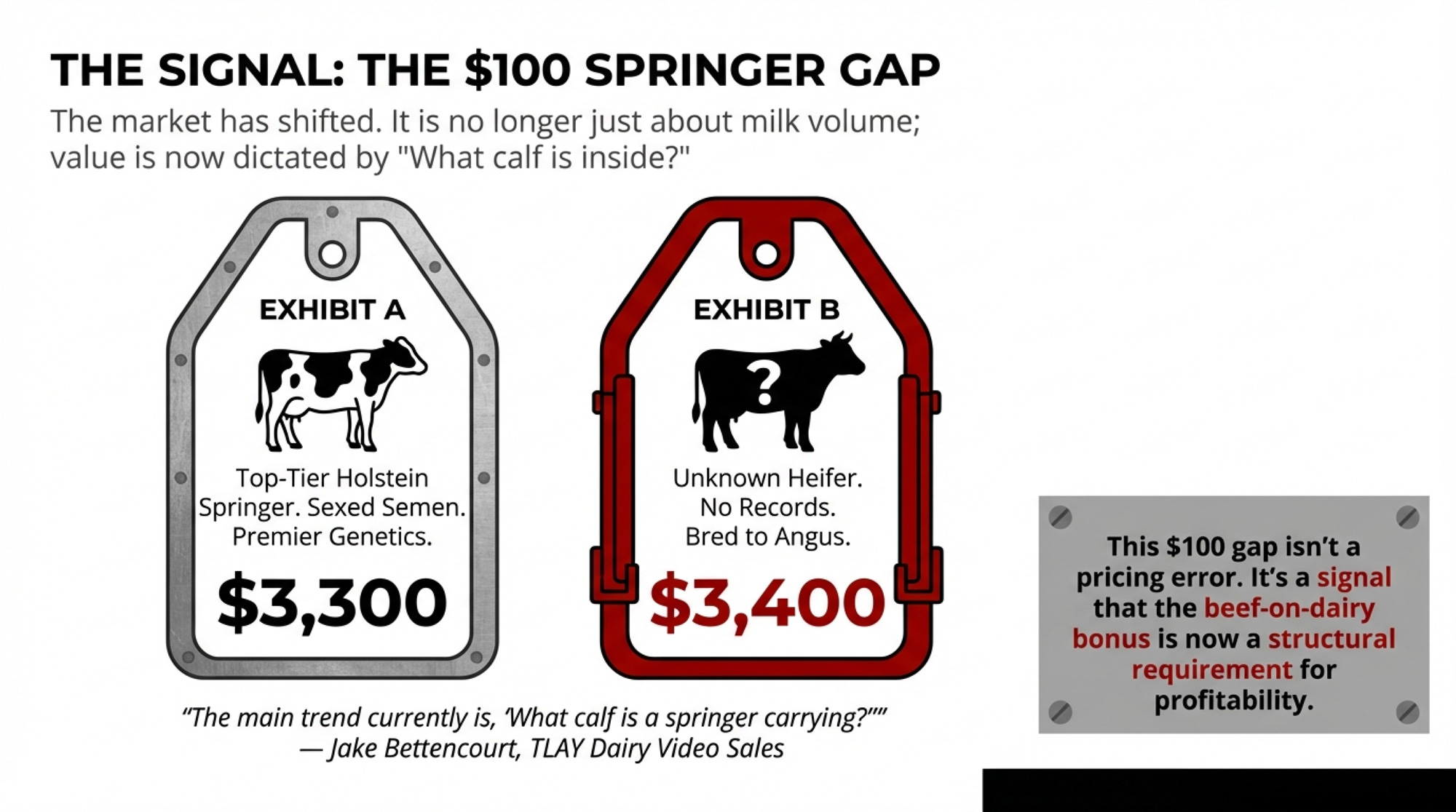
That $100 gap is a small number with a big message. This dairy migration — the relocation of dairy farms at an industrial scale — isn’t just about geography. It’s about which regions built systems where every piece of the profit equation works together, and which ones quietly stacked friction until producers started loading trucks.

88,000 Cows in Five Years — and 25,000 More Right Behind Them

The I-29 and I-90 corridors running through South Dakota, Minnesota, Iowa, and Nebraska have become the primary growth engine for U.S. milk production. The reason isn’t abstract. It’s stainless steel.
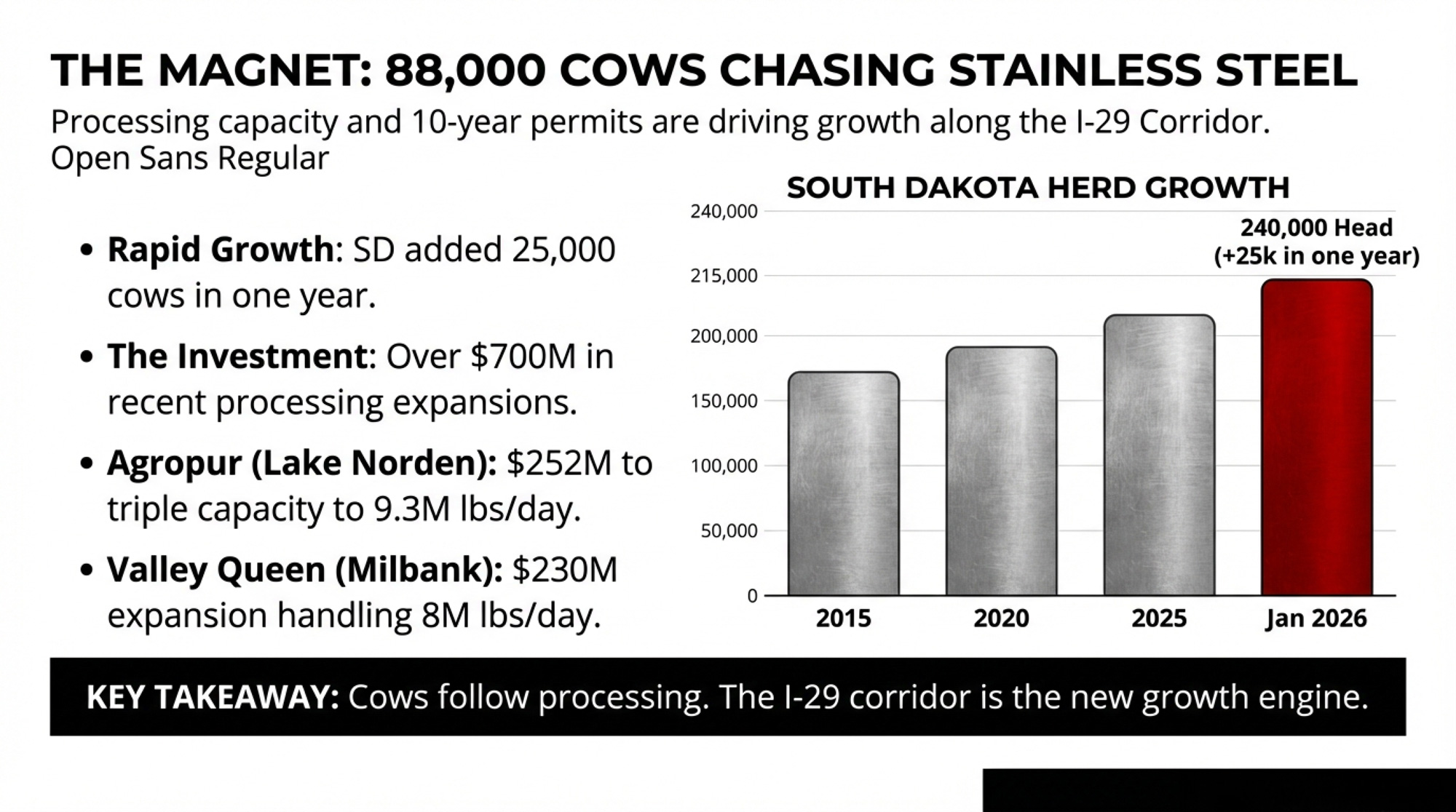
Three processor expansions tell the story. Agropur invested $252 million to nearly triple capacity at its Lake Norden, South Dakota, plant, going from 3.3 million to 9.3 million pounds of milk per day. Valley Queen Cheese in Milbank broke ground on what was originally announced in 2022 as a $195 million expansion, its largest in 93 years. That project came in at $230 million and by late 2025 was handling 8 million pounds of milk daily. Bel Brands launched its Brookings facility, adding still more demand. 

The cows came — fast. South Dakota’s milk cow population reached 215,000 as of January 1, 2025 — more than doubling in a decade, a gain of 117% that leads the nation. Some 88,000 of those cows arrived in just five years, a 69% jump. Then it kept going. USDA NASS confirms the state’s dairy herd reached 240,000 head as of January 1, 2026  — exactly the 25,000 additional cows Valley Queen’s Evan Grong had projected. South Dakota’s December 2025 milk production ran more than 11% above the prior year, the biggest increase among the 24 major dairy states — in a national herd of 9.57 million, South Dakota punched well above its weight. 
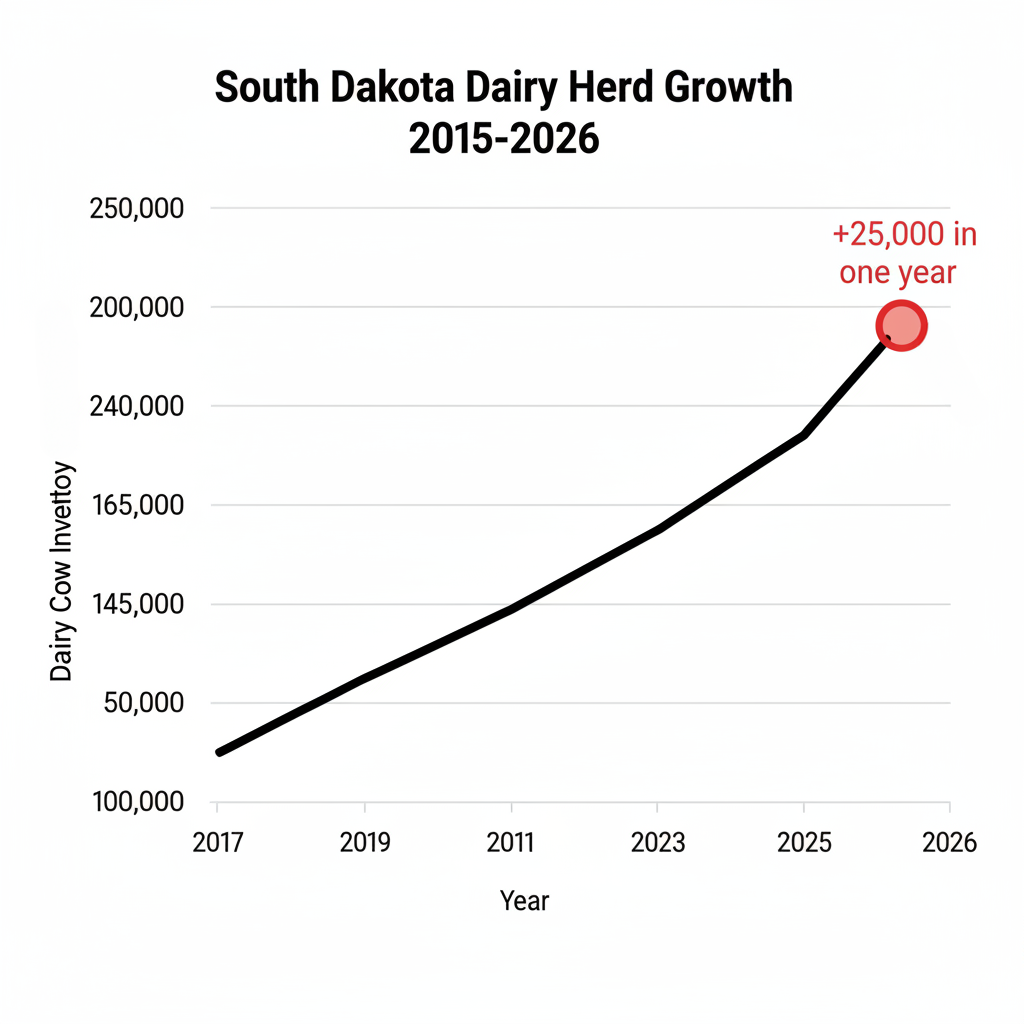
Tom Peterson, executive director of South Dakota Dairy Producers, describes a deliberate effort: “About 20 years ago, South Dakota leaders and stakeholders came together with farmers and milk processors to develop a plan to not only ensure dairy industry survival in the state, but with aspirations of creating a dairy destination”. GOED Commissioner Chris Schilken estimated in early 2024 that the economic impact of 118,000 additional cows was “nearly $4 billion annually”. With 25,000 more since then, that number has only climbed. 

A Genetics Gap Is Emerging

Here’s a dimension of this migration that gets overlooked: the cows moving east aren’t just changing zip codes. They’re changing what gets selected for.

The Upper Midwest model is built around cheese vats. Valley Queen, Agropur, Bel Brands: component-driven processors. That means the genetics flowing into the I-29 corridor increasingly prioritize high-butterfat, high-component cattle that fit Cheese Merit profiles — and component pricing rewards them for it. The April 2025 Net Merit revision tells the same story nationally: CDCB bumped butterfat emphasis to 31.8% (up from 28.6%) while dropping protein from 19.6% to 13.0%, and pushed Feed Saved to 17.8%. Holstein butterfat hit a national average of 4.23% in 2024, per CoBank’s Corey Geiger. Under the revised NM$ weightings, a cow with top-decile butterfat and Feed Saved genetics delivers meaningfully more lifetime profit than a volume-only counterpart — the exact dollar advantage varies by herd and market, but the directional shift is unmistakable.  
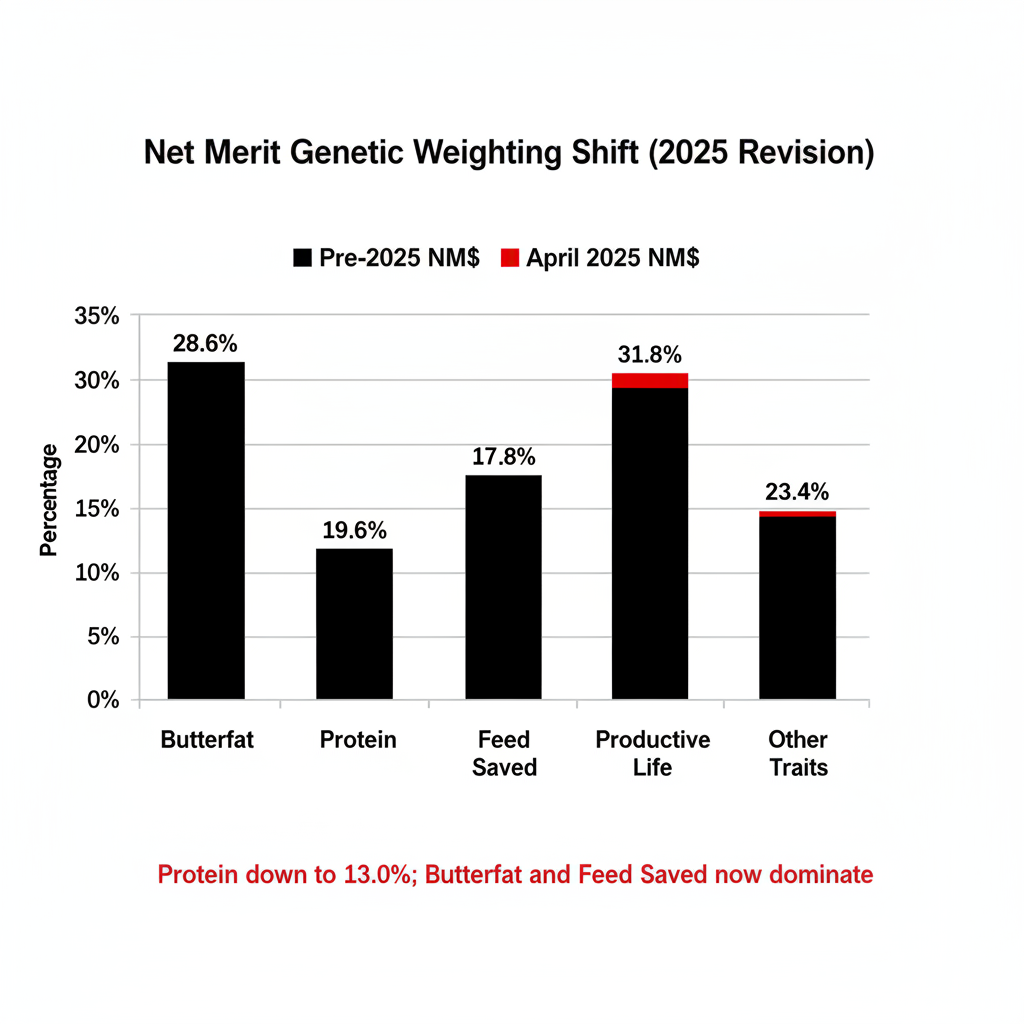
For I‑29 shippers, CM$ often beats NM$ as your main index, because plants like Valley Queen and Agropur pay you on components, not volume.

The Western model may need a different genetic profile entirely. Jared Fernandes at Legacy Ranches in Tulare County made that call: he switched from Holsteins to Jerseys, cutting forage consumption by 30% and reducing water use on a 4,500-cow operation facing tight water supplies. In Merced County, Simon Vander Woude took a different approach: genomic testing since 2012, beef-on-dairy crosses on 60% of calvings, cull rate around 30%, and average lactations pushed to 2.7 — up from 2.2 when he started. “We are creating more milk with fewer cows, more components in the milk with fewer cows,” Vander Woude said. “That’s fewer mouths eating, fewer heifers”. 

Dairy Migration: Two Systems, Two Sets of Friction
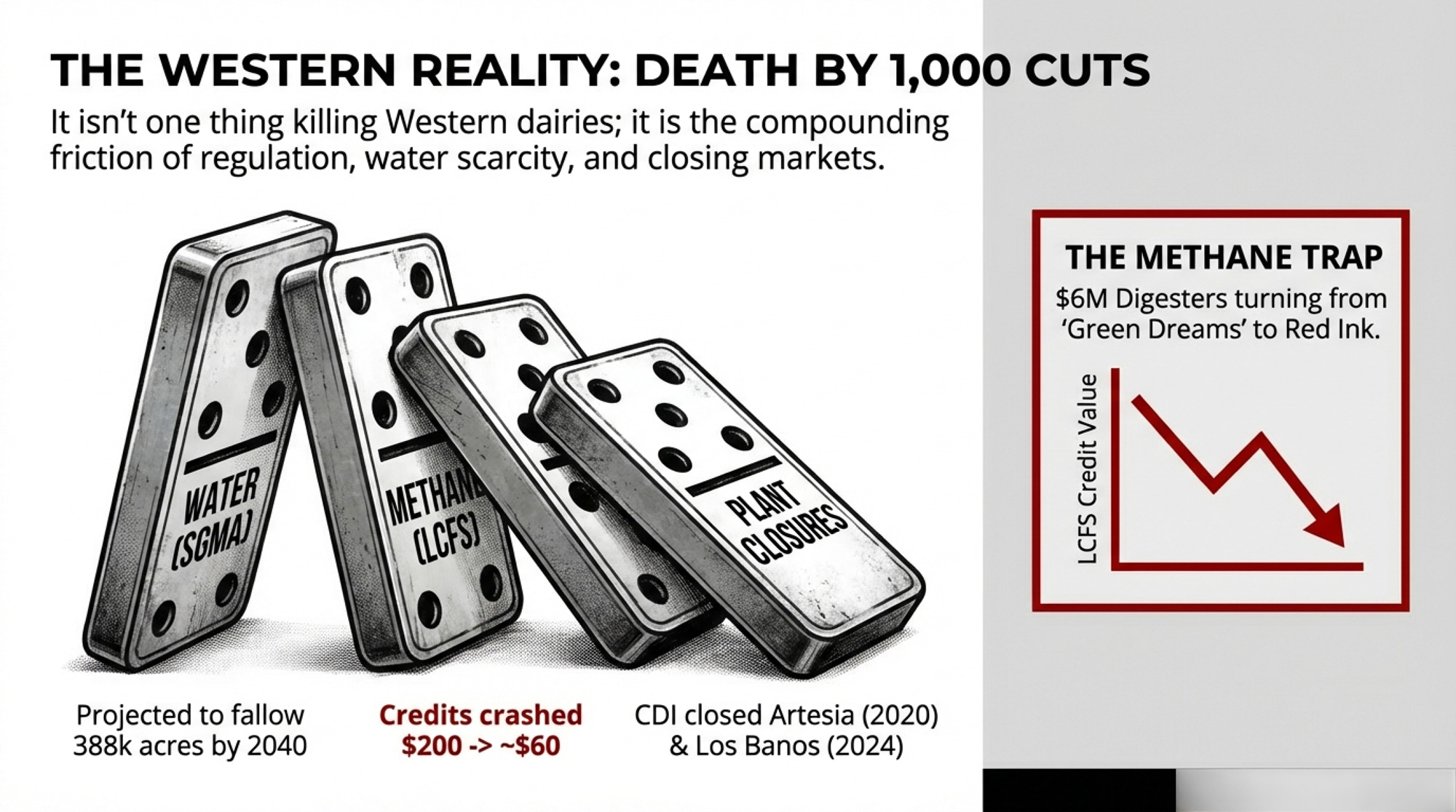
California’s December 2024 milk production fell 6.8% year over year — the state’s steepest monthly drop in roughly 20 years, heavily amplified by HPAI, which hit 747 of approximately 950 dairy farms. California recovered by mid-2025 — production up 2.7% in June versus 2024  —, but the episode exposed structural vulnerabilities that predate the outbreak. Idaho’s Rick Naerebout reported the cost of production “above $18.50 per hundredweight and still around $20 for many.” Oregon’s John Van Dam: “staying above water but not going anywhere”. 

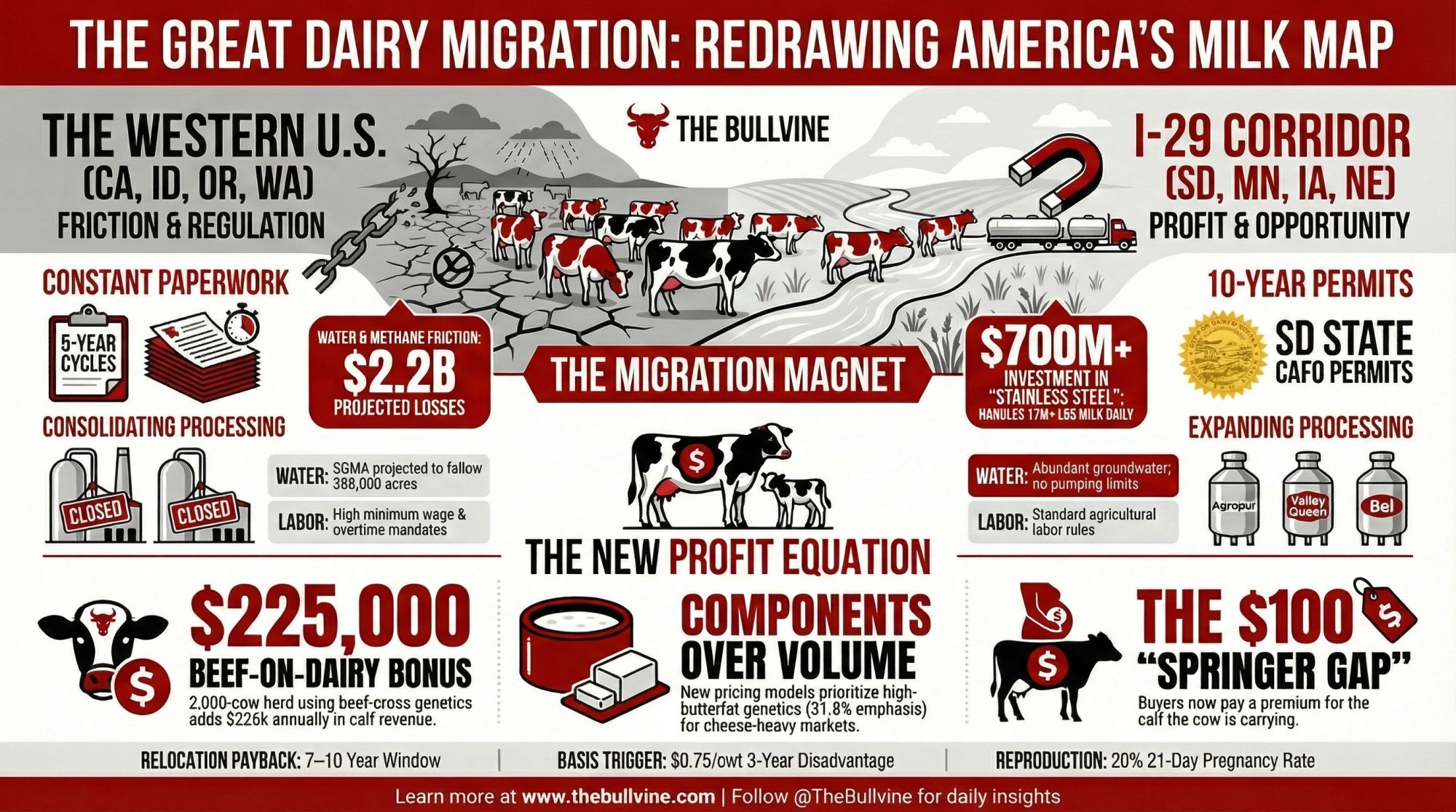
 Upper Midwest (I-29 Corridor)Western U.S. (CA, ID, OR, WA)
CAFO Permits10-year state permits (SD DANR)  5-year federal NPDES cycle; annual state layers
Processing$700M+ invested 2019–2025; coordinated with cow growth  CDI closed Artesia (2020) and Los Banos (Oct. 2024) — two plants in four years  
WaterAbundant groundwater; no pumping restrictionsSGMA projected to fallow 388,000 acres, cut dairy output $2.2B by 2040  
Methane RulesMinimal state mandates$300–$675M/year in projected losses under direct regulation  
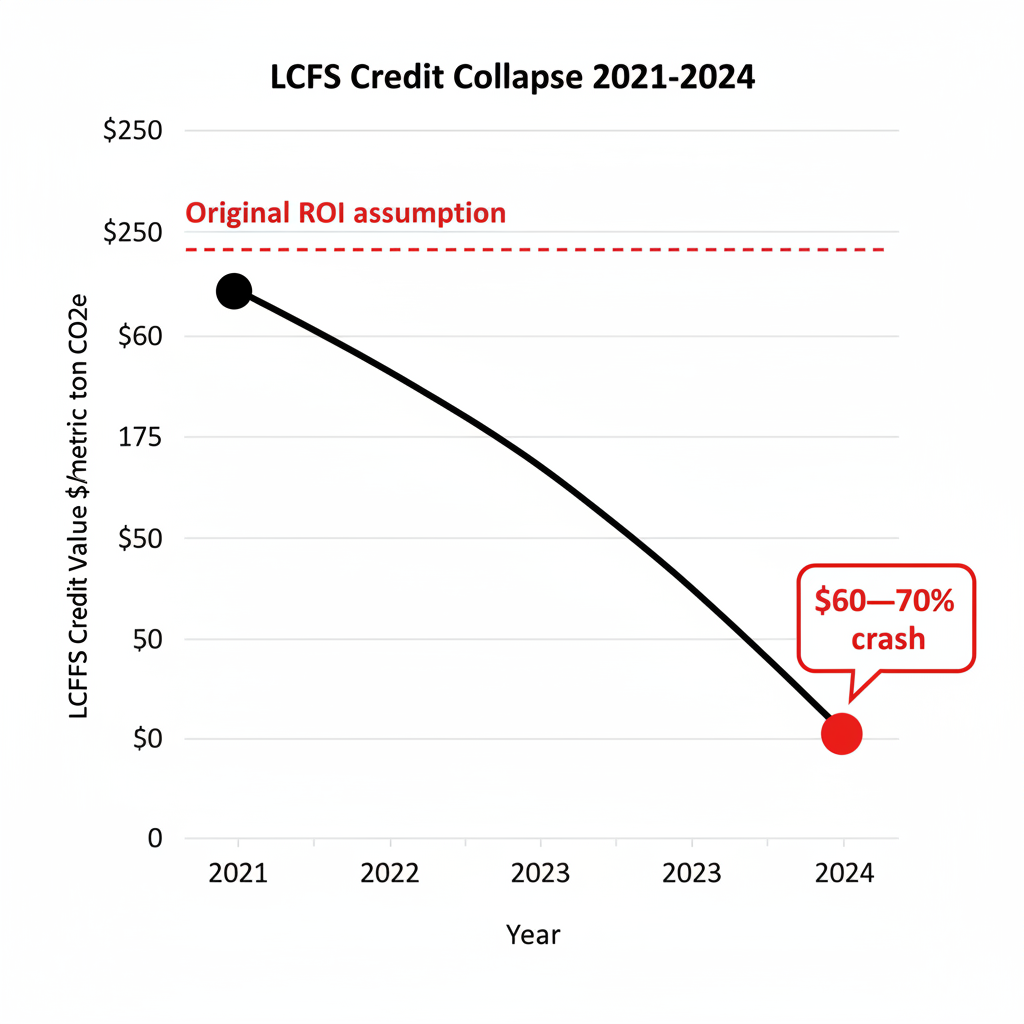
Digester EconomicsN/A (not required)$6M+ per unit; LCFS credits crashed from $200 to ~$60/MT (2021–2024)  
LaborStandard ag labor rulesCA/WA: highest minimum wages + ag overtime mandates
LegislativePro-dairy incentive programs (GOED)  25 anti-dairy bills killed cumulatively through 2023  
GeneticsComponent-driven (CM$); fits cheese processingUnder pressure to shift — Fernandes (Jersey pivot) and Vander Woude (genomic efficiency) lead 

The LCFS column deserves a closer look. Digester construction averages over $6 million per unit. Those investments were supposed to pencil on strong carbon credit revenue. Instead, the green dream turned into a red-ink reality for many Western digesters. UC Berkeley professor Aaron Smith found dairy digester developers need approximately 10 years to achieve ROI on avoided methane credits  — and that’s if credit values hold, which they haven’t. Anja Raudabaugh, CEO of Western United Dairies, noted that producers face “years of delay for approval and additional years of waiting for the actual money to show up”. 
ERA Economics’ February 2023 analysis projects a 130,000-head reduction in California’s herd by 2040 under SGMA. A separate ERA report from September 2024 estimates 20–25% of small dairies could exit under direct methane regulation. These aren’t one-time hits. They compound annually — and they fall hardest on mid-sized commodity operations too large for niche premiums and too small to absorb six- and seven-figure regulatory overhead. 

The Beef-on-Dairy Premium: A Profit Engine That Follows the Truck

The $100 springer gap Bettencourt described is the visible edge of a much larger shift. Kansas State University researchers, analyzing 14,075 feeder steer lots through Superior Livestock (2020–2021), found beef-on-dairy crosses at 550–600 pounds bringing roughly $80–90 per head more than straight Holstein steers. UF dairy economist Albert De Vries found that when 21-day pregnancy rates exceed 20%, a sexed-on-top, beef-on-bottom strategy maximizes calf income while still generating enough replacements. Below that threshold, you may not be making enough heifers to sustain the replacement pipeline. 
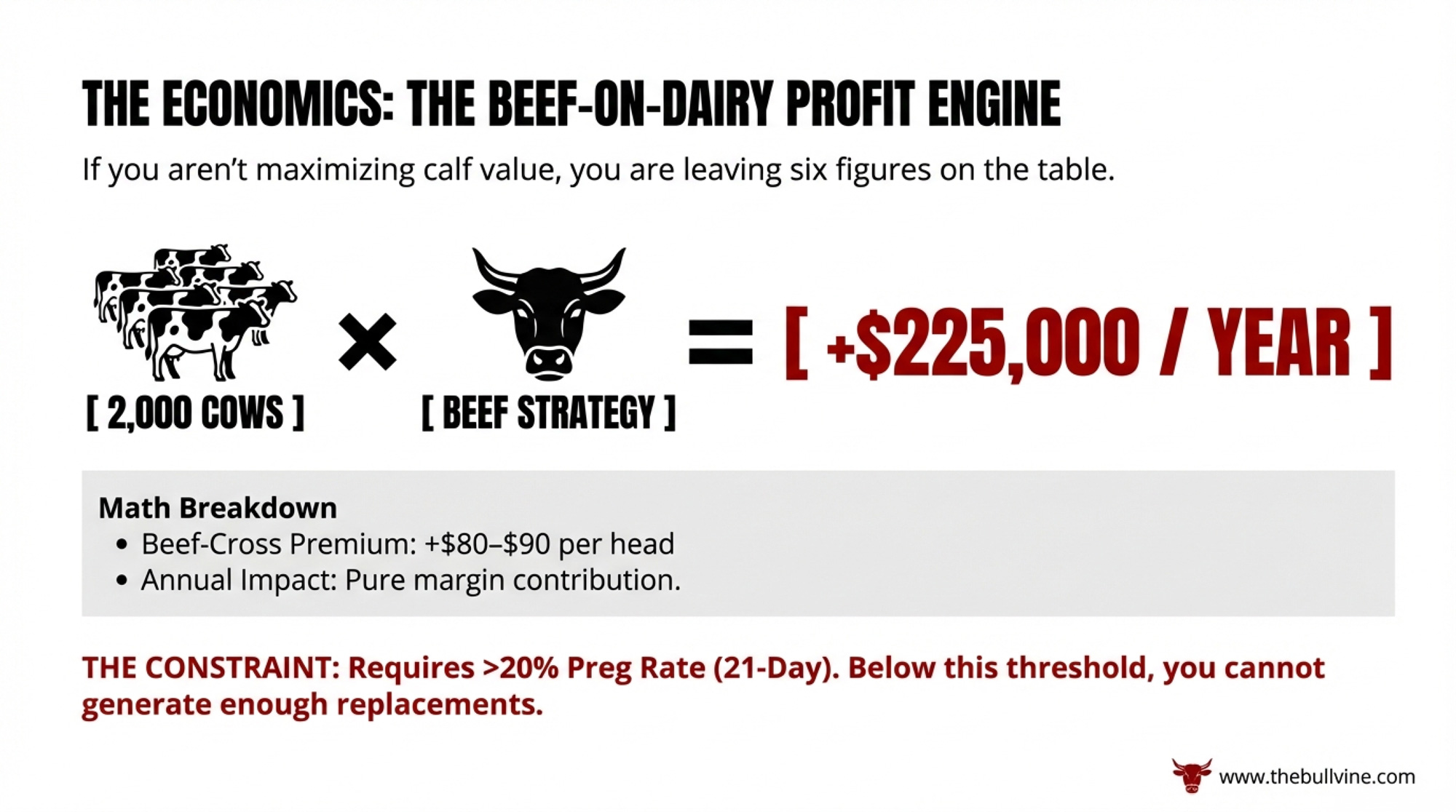
Scale it: a 2,000-cow herd producing roughly 1,500 beef-cross calves annually at a conservative $150/head advantageworks out to $225,000 per year in extra calf revenue. That premium is location-sensitive — regions with established feedlots and packers set up for beef-on-dairy pay more consistently. The I-29 corridor has that infrastructure. And with the U.S. beef cattle inventory at a 75-year low of 86.2 million head as of January 2026, those premiums have structural support. But cattle cycles turn. 

Three Paths Forward — and What Each One Costs
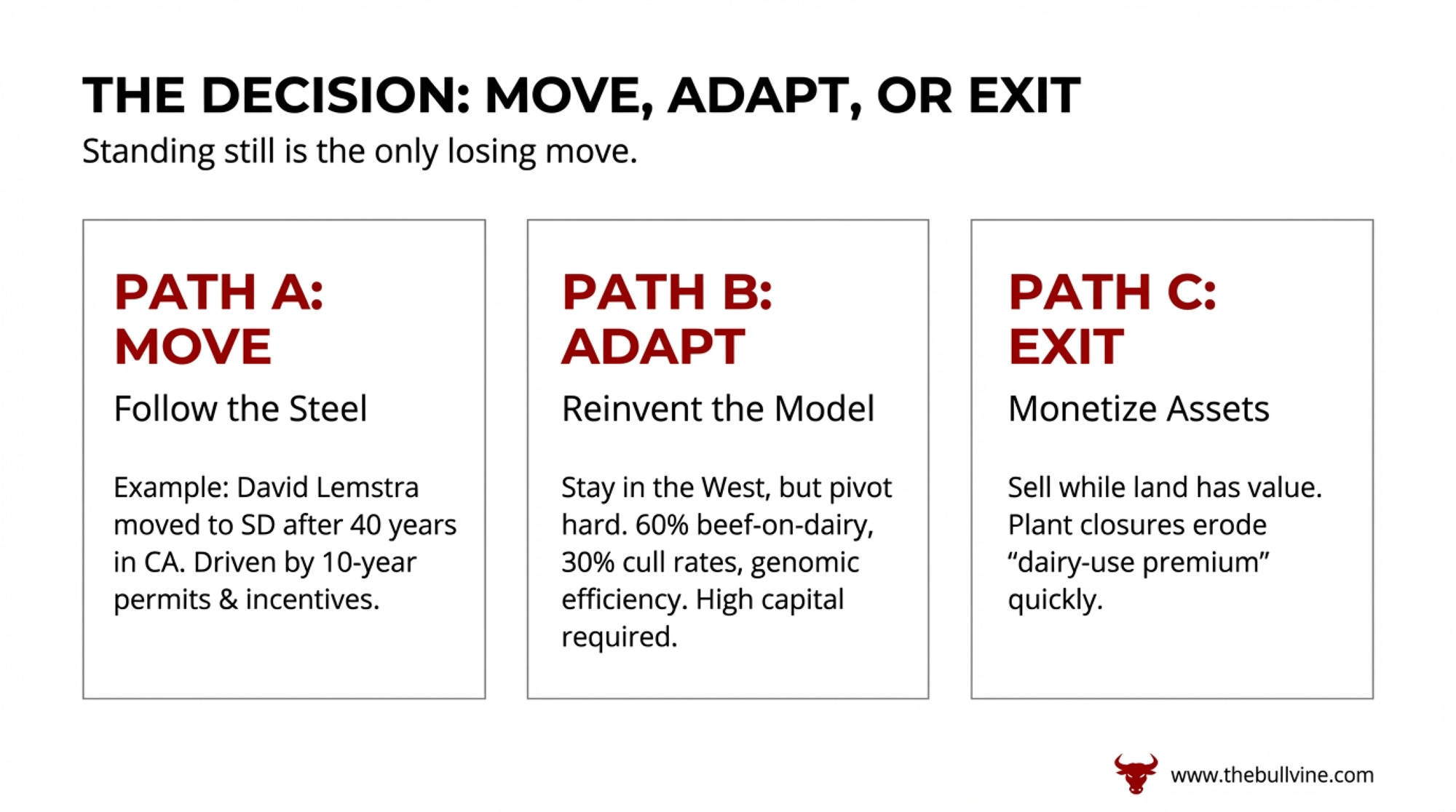
Path A: Move the cows to fit the system. David Lemstra did exactly this. After more than 40 years in central California, he spent nearly a decade researching alternatives before building Dakota Line Dairy in Humboldt, South Dakota. Today, the Lemstras milk 4,000 cows and ship to Agropur’s Lake Norden plant. Feed, permits, and processing” drove the move. He described leaving California as “death by 1,000 cuts”. Compare your 10-year “stay” cost to building in a growth corridor after selling your current assets. If the payback falls within 7–10 years, it pencils out. The risk: capital-intensive, and the best processor relationships won’t wait. 

Path B: Change the model to fit the ground. Fernandes built a digester, went deep on regenerative ag, and made the genetic pivot to Jerseys. “We do a lot of things that you don’t hear about, that I think are sustainable,” he said at the 2025 California Dairy Sustainability Summit. Vander Woude kept Holsteins but used genomics to push average lactations from 2.2 to 2.7 while running 60% beef-on-dairy — more milk and more valuable calves from fewer animals. ERA Economics notes that digester revenue-share agreements typically provide $50–100 per cow per year, which is meaningful if volatile. The risk: heavy capital and regulatory tolerance required; niching down means brand-premium volatility. 

Path C: Monetize the asset base. For operations where neither moving nor reinventing pencils, the honest option may be selling while assets still command value. ERA projects 388,000 acres could be fallowed in the San Joaquin Valley under SGMA. Selling from strength is a different negotiation than selling from distress. 

PathA: Relocate to Growth CorridorB: Reinvent In PlaceC: Monetize & Exit
DescriptionMove cows to I-29 corridor; build on 10-yr permits, processor contractsDigester + genetics pivot (Jersey/genomic efficiency) + regen agSell assets while value remains; avoid distressed sale
Capital Required$7–10M+ (new facility, herd move, infrastructure)$6M+ digester + genetics transition + brand/regen investmentMinimal (brokerage, legal, transition planning)
Payback Window7–10 years (basis advantage + calf premium + water/compliance savings)10+ years (digester ROI alone ~10 yrs; genetics 3–5 yrs to see full shift)Immediate liquidity; capital preservation
Key RisksCapital-intensive; best processor relationships won’t wait; market timingHeavy regulatory tolerance required; LCFS/SGMA volatility; brand-premium niche riskTiming matters—asset values eroding as Western processing consolidates
Best Fit For…2,000+ cow herds with equity, rolling 3-yr basis drag >$0.75/cwt, appetite for scaleEstablished Western herds with strong brand access, regen ag commitment, high reproductive efficiencyMid-size commodity herds: too big for niche, too small for scale, stuck in high-friction state

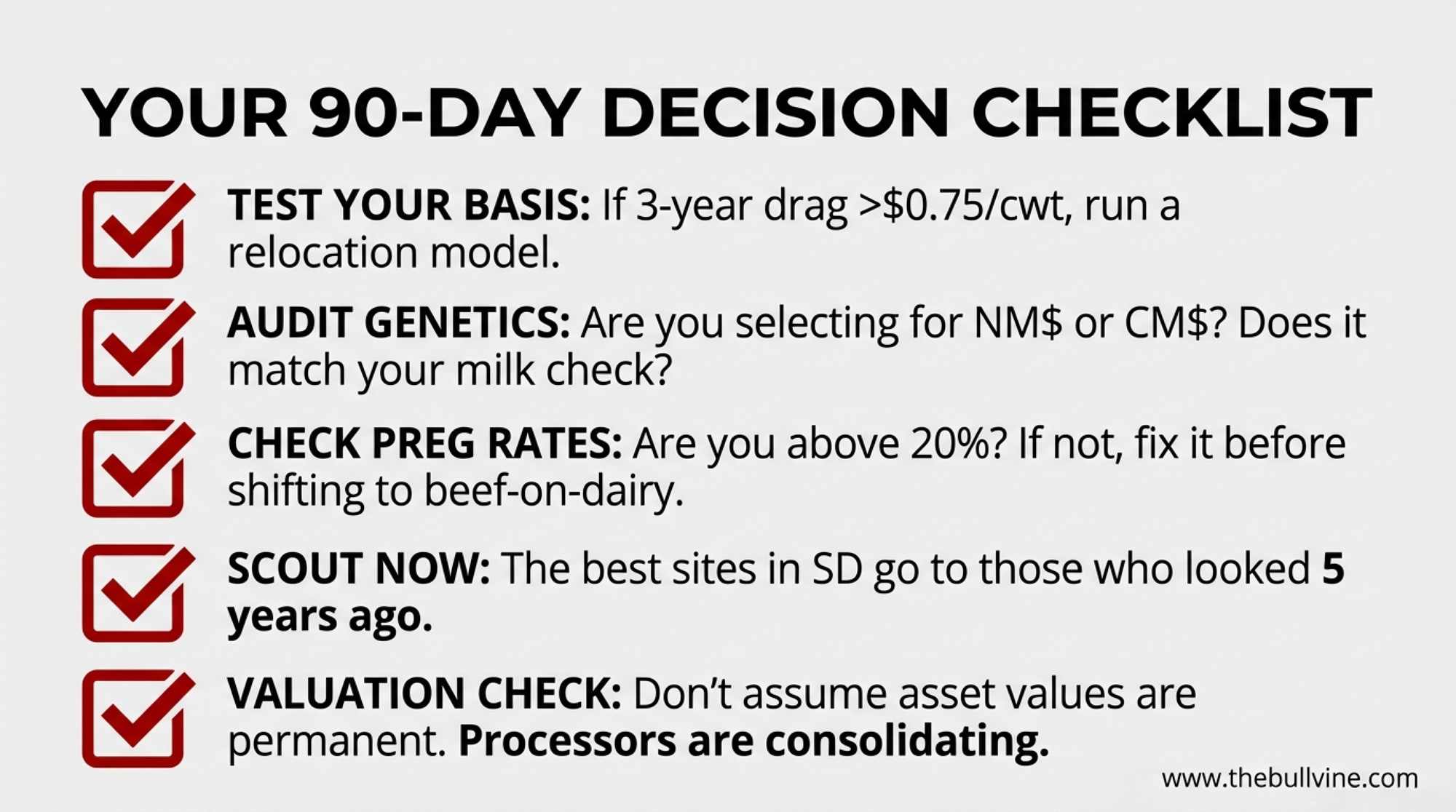
Your 90-Day Decision Checklist

  • Run your 10-year “stay” scenario. Pull your rolling 3-year basis versus the best alternative region. Add actual water and compliance cost trends. If the cumulative drag exceeds $400,000–$500,000 per year, relocation deserves a serious model.
  • Test your basis trigger. A rolling 3-year disadvantage exceeding $0.75/cwt means $225,000 annually on a 2,000-cow herd shipping 300,000 cwt/year. Before water, compliance, or calf value.
  • Audit your genetic alignment. Are you selecting for CM$ or NM$ to match your actual processor contract? The April 2025 NM$ revision puts butterfat at 31.8% — if you’re shipping into a fluid market, that may not be your index. 
  • Check your 21-day pregnancy rate against the De Vries threshold. Below 20%, a sexed-on-top/beef-on-bottom program may not generate enough replacement heifers. 
  • Scout destination regions before you need them. Lemstra spent nearly a decade researching before he moved. The best sites and processor relationships go to producers who are already known. 
  • Don’t assume your current asset values are permanent. CDI closed two California plants in four years — Artesia in 2020  and Los Banos in October 2024. If processors are consolidating around you, your land’s dairy-use premium may already be eroding. 
Key Takeaways

  • South Dakota’s dairy herd hit 240,000 cows as of January 1, 2026, adding 25,000 head in a single year  — exactly matching Grong’s projection, built on 10-year CAFO permits, reinvestment incentives, and nine-figure processor expansions. 
  • The $100 springer premium for beef-cross calves signals that calf revenue belongs in the same strategic column as milk price, basis, and water cost. Beef herd at a 75-year low supports that premium  — but cattle cycles turn. 
  • A genetics gap is emerging between component-driven Midwest herds (butterfat now 31.8% of NM$) and Western herds pivoting toward longevity and efficiency. Fernandes’s Jersey switch and Vander Woude’s genomic program show what that pivot looks like. 
  • Western producers face compounding threats: $2.2 billion in projected SGMA losses by 2040; $300–$675 million per year in methane regulation; LCFS credits crashing from $200 to $60; and CDI closing two plants in four years. 
  • Watch in 2026–2027: SGMA implementation deadlines, Midwest processor capacity utilization, and beef-cycle signals that could compress cross-calf premiums.

The Bottom Line

The middle ground — too big for niche, too small for scale, stuck in a high-friction state with genetics optimized for a pricing structure that’s shifting underneath you — is the most dangerous place to be in 2026. The producers hauling cattle east on I-90 have run the numbers long enough to know it. The ones staying, like Fernandes and Vander Woude, are reinventing their operations from the genetics up. Both are making active choices with their eyes open. The only losing move is standing still and hoping the spreadsheet doesn’t notice.

Complete references and supporting documentation are available upon request by contacting the editorial team at editor@thebullvine.com.

Learn More

Join the Revolution!

Join over 30,000 successful dairy professionals who rely on Bullvine Weekly for their competitive edge. Delivered directly to your inbox each week, our exclusive industry insights help you make smarter decisions while saving precious hours every week. Never miss critical updates on milk production trends, breakthrough technologies, and profit-boosting strategies that top producers are already implementing. Subscribe now to transform your dairy operation’s efficiency and profitability—your future success is just one click away.

NewsSubscribe
First
Last
Consent

California’s Dairy Dilemma: Can the Golden State’s Industry Survive Its Triple Threat?

Can California dairy survive water scarcity, labor laws, and green rules? Innovation vs. exodus in America’s milk capital.

EXECUTIVE SUMMARY: California’s dairy industry, the nation’s largest milk producer, confronts existential threats: severe water scarcity, restrictive labor laws, and stringent environmental regulations. Producers face tough choices—innovate or relocate—as feed costs soar, overtime mandates strain budgets and methane regulations drive compliance costs. While some operations pivot to water-smart practices, methane digesters, and automation, others exit for states like South Dakota with friendlier policies. Despite challenges, California leads in sustainability, cutting emissions by 24.3M metric tons via digesters. The industry’s survival hinges on balancing adaptation, cost management, and policy advocacy in a rapidly shifting landscape.

KEY TAKEAWAYS:

  • Triple Threat: Water scarcity, labor overtime rules, and environmental regulations squeeze profits, accelerating consolidation.
  • Innovation Wins: Despite costs, methane digesters, robotic milking, and water recycling showcase CA’s sustainability leadership.
  • Exodus Trend: Producers like David Lemstra relocate to states with easier permitting, lower costs, and stable water access.
  • Strategic Survival: Success requires automation, diversified markets, and the conversion of compliance (e.g., methane capture) into revenue streams.
California dairy industry, water scarcity dairy farming, dairy labor regulations, sustainable dairy practices, dairy farm relocation

California’s dairy industry is at a critical crossroads in 2025, facing a perfect storm of water scarcity, labor regulations, and environmental restrictions that threaten its position as America’s top milk producer. With 1.71 million cows generating billions in economic activity, producers are forced to innovate or evacuate as the state’s regulatory and resource landscape becomes increasingly hostile to large-scale dairy operations.

The Water Crisis: A Global Challenge with Local Intensity

California’s dairy producers aren’t just worried about water—they’re obsessed with it—and for good reason. The state’s ongoing water crisis has evolved from a periodic concern to an existential threat for many operations.

“As a dairy producer, this is an ever-growing challenge,” says Ryan Junio, owner of Four J Jerseys in Pixley, reflecting the sentiments shared across the industry.

The numbers tell a sobering story. California has overdrafted approximately 2 million acre-feet of water annually for years, creating an unsustainable situation that finally reached crisis levels during the 2014 drought. This prompted the state to implement groundwater regulations, which many producers believe should have happened decades earlier.

Tyler Ribeiro from Rib-Arrow Dairy in Tulare doesn’t mince words about the severity of the situation: “With the lack of water due to the lack of snowpack in the mountains, inability to store surface water, restrictions on ground pumping and now a potential tariff measuring contest, we could be in for a steady increase in feed costs through 2025.”

According to Food & Water Watch, California’s mega-dairies require approximately 152 million gallons of water daily to water and wash cows and buildings—”more than enough to meet the indoor water needs for the entire San Diego metropolitan area.” This figure doesn’t include water needed to move manure into storage systems or produce animal feed, which encompasses the most significant water footprint for milk production.

What makes this particularly challenging is how water scarcity creates a cascading effect throughout dairy operations. Reduced water availability means:

  • Fewer irrigated acres for feed production
  • Higher competition for available feed crops
  • Escalating costs for purchased feed
  • Reduced profit margins even when milk prices are high

“There is a lot of farmland that used to be farmable via groundwater that is not allotted that opportunity because of new regulations,” Ribeiro explains. “These new restrictions have already and will continue to decrease the number of farmable acres, making competition for feed crops increasingly more difficult.”

His assessment of the immediate future is blunt: “2025 will be the game of water and deep pockets. Those with water or the ability to bring in feed will fare well; those that can’t may face some difficulties moving forward.”

Global Water Challenges in Dairy

Water scarcity isn’t unique to California. Australia’s dairy industry faces similar challenges, with drought and extreme weather events limiting water availability for irrigation. Sustainable Table states, “As water scarcity due to climate change becomes more severe, and the water resources we have are needed to supply a growing population, farmers will need to dramatically reduce water consumption and improve water recycling if dairy farming is to be sustainable.”

Water management presents different challenges in Pakistan, which has the world’s third-largest dairy industry. While water availability may be less restricted than in California, the absence of extraordinary chain infrastructure and quality standards creates inefficiencies throughout the value chain, according to a 2019 study published in the Journal of Agriculture and Rural Development in the Tropics and Subtropics.

Labor Laws: The Overtime Squeeze

While water dominates headlines, California’s labor regulations quietly reshape dairy economics. Beginning January 1, 2025, all agricultural workers at small employers (25 or fewer employees) will receive overtime pay at the employee’s regular rate after 8 hours in a workday or 40 hours in a workweek.

This completes the state’s phase-in of agricultural overtime requirements, which began in 2019. This puts dairy producers—who require round-the-clock staffing—in a challenging position.

Melvin Medeiros, a dairy producer from Layton, California, captures the frustration felt throughout the industry: “I do know when legislation gets involved, it turns into a mess. We’re in that mess now and trying to figure out how to invest in this farm to make it more efficient and cut back on labor.”

The impact of these regulations is already evident in employment patterns. USDA Farm Labor Survey data shows that average weekly hours for California farm workers have steadily decreased compared to the national average—from 2.7 hours more than the national average in 2016 to one hour less than the national average in 2023.

For dairy operations, which can’t simply shut down milking parlors on weekends or holidays, these regulations create a stark choice:

  • Pay significantly higher labor costs for necessary overtime
  • Hire additional workers to avoid overtime (increasing management complexity)
  • Invest heavily in automation to reduce labor needs
  • Relocate to states with more favorable labor laws

International Labor Perspectives

Labor challenges vary significantly across global dairy regions. In the European Union, dairy farms face similar regulatory pressures but often operate at more minor scales with more family labor. According to OECD research on global dairy trends, labor regulations in countries like Germany and the Netherlands have contributed to industry consolidation through mechanisms different from those in California.

In developing dairy markets like the Baltic states, labor structures are quite different. The OECD describes a “bipolar” production system—” with a strong competitive sector and part social sector.” These regions face different labor challenges, focusing more on productivity improvements and quality standards than overtime regulations.

Environmental Regulations: Balancing Sustainability and Viability

California’s environmental regulations, particularly those targeting greenhouse gas emissions, create challenges and opportunities for dairy producers. According to a 2024 economic analysis by ERA Economics for the California Cattle Council, these regulations inevitably increase operational costs, creating “a tradeoff between stricter regulations for environmental objectives and increasing costs at the farm.”

The report notes that “the increase in production costs due to regulation decreases the competitiveness of California producers. This results in higher food costs and economic losses, with jobs, income, and farms leaving California for other states with more favorable business conditions.”

However, California’s dairy industry has responded with remarkable innovation. The state now boasts 238 dairy digester projects capturing methane to create renewable energy sources, with 129 currently operational and the remainder under development.

These projects have achieved remarkable results, accounting for 20% of greenhouse gas reductions from all state-funded climate programs while receiving just 1.5% of the awarded funds. These efforts have contributed to a decrease of 24.3 million metric tons of CO2 equivalent emissions.

Karen Ross, Secretary of the California Department of Food and Agriculture, recognizes the challenges and the industry’s response: “I’m very proud of the work we’ve been able to do on climate-smart agriculture. I love that 24.3 million metric tons of CO2 equivalent reductions in greenhouse gasses are because of dairy digesters.”

Environmental Partnerships

Environmental NGOs, leading food and beverage companies, and government agencies have worked alongside dairy farmers to bring sustainability solutions to life. As reported by the California Dairy Research Foundation in May 2024, companies like Starbucks have developed partnerships with California’s largest dairy cooperative, California Dairies, Inc., to implement water conservation tools, electric tractors, and improved manure management technologies on farms.

These collaborative approaches represent a promising model for addressing environmental challenges while maintaining economic viability.

Why This Matters to Your Bottom Line

The combined effect of water scarcity, labor regulations, and environmental requirements creates a competitive disadvantage that’s becoming increasingly difficult to overcome. This has accelerated consolidation within the industry.

According to Food & Water Watch, “California reported roughly half as many family-scale dairies in 2022 compared to just 2017.” This consolidation trend “harms rural communities, with the rise in factory farms linked to a host of social and economic declines, from higher poverty rates to out-migration.”

Tony Louters from T&C Louters Dairy in Merced ranks his concerns bluntly: “Water is our biggest concern right now, along with California environmental and business regulations, continued animal activist pressure, and rising labor costs.”

The processing side of the industry faces similar challenges. “California is a difficult place to do business and especially to build capacity,” Louters notes. “Most plants are built in other dairy states, so they do not have to deal with California’s business regulations.”

This processing bottleneck creates additional market pressures for producers, limiting their options for milk marketing and potentially reducing farm-gate prices.

The Exodus: Finding Greener Pastures

For some producers, the accumulation of challenges has prompted difficult decisions about their future in California. David Lemstra’s story illustrates this trend. After searching for a decade, Lemstra and his family relocated to South Dakota from central California, where they had been established for more than 40 years.

Three pivotal factors drove their decision:

  • Feed availability
  • Easier permitting processes
  • Greater processing capacity

Lemstra describes his family’s coordinated departure from the state as “death by 1,000 cuts,” citing the impact of long-standing political and resource management decisions. California’s overtime labor rule is a considerable obstacle, especially compared to South Dakota’s business-friendly environment.

One benefit Lemstra has discovered in South Dakota is a more favorable labor market. “Some locals say labor is backbreaking, but they don’t know how hard it can potentially get,” he says, appreciating the motivated workforce available in his new home.

Global Industry Restructuring

This migration of dairy operations isn’t unique to the United States. According to OECD research, dairy industries worldwide are undergoing significant restructuring in response to economic and regulatory pressures. In export-oriented countries like France, Ireland, and the Netherlands, dairy companies expand through external investments in other countries. In contrast, developments in countries like Canada, Germany, and the US have mainly focused on greater concentration.

The OECD notes, “The creation of strategic alliances to penetrate product or regional markets is a growing phenomenon,” raising essential questions about competition policy and industry structure.

Water-Smart Strategies for Dairy Survival

Water management has become the cornerstone of operational planning for dairy producers committed to California. The good news is that significant progress has already been made. According to the Dairy Cares initiative, the amount of water used to produce each gallon of California milk has decreased more than 88% over the past 50-plus years, primarily due to:

  • Improved feed crop production
  • Use of byproducts as feed
  • Water use efficiency

Water reuse is now standard practice on California dairy farms, where the same water is used an average of four times:

  1. Clean water is used in the refrigeration process to cool milk
  2. Water recycled from refrigeration is then used to wash and cool cows
  3. After water is used to wash cows, it is captured, stored, and used multiple times to clean barn floors

Additionally, up to 40% of feed ingredients used in California dairies are agricultural byproducts, such as almond hulls, cottonseed, and citrus pulp, which could otherwise be wasted. By upcycling byproducts, dairy farms are reducing the use of water, energy, and fossil fuels needed to grow feed crops.

In 2020, researchers at UC Davis analyzed the economic and environmental sustainability implications of feeding byproducts to California dairy cows. They determined that this practice reduces the water needed to grow feed by as much as 1.3 trillion gallons.

Labor Optimization Approaches

To address labor challenges, successful California dairy operations are implementing several strategies:

  • Strategic Automation: Investing in robotic milking systems, automated feeding technology, and other labor-saving equipment to reduce dependence on manual labor
  • Schedule Optimization: Restructuring work schedules to minimize overtime while maintaining animal care standards
  • Employee Development: Creating clear career paths and training programs to improve retention and productivity
  • Housing Solutions: Some more extensive operations are developing employee housing to address California’s high cost of living and reduce commuting time

Environmental Innovation

California’s dairy industry has become a leader in environmental innovation, particularly in addressing methane emissions. The California Dairy Research Foundation reports, “Over the past few years, California’s dairy methane reduction programs have been among the state’s most cost-effective efforts in reducing climate emissions.”

Key initiatives include:

  • Dairy Digesters: Capturing methane from manure and converting it to renewable natural gas
  • Dairy PLUS Program: Supporting advanced manure management projects that better protect groundwater while also reducing methane emissions
  • Feed Additives: Developing new programs to support the adoption of feed additives and other strategies to reduce enteric methane emissions from cows
  • Electric Equipment: Transitioning to electric tractors and other equipment to reduce fossil fuel use
ChallengeImpact on OperationsAdaptation StrategiesSuccess Indicators
Water ScarcityReduced feed production, higher input costsWater recycling, byproduct feeds, irrigation efficiencyReduced water usage per cwt milk, stable feed costs
Labor RegulationsHigher labor costs, scheduling complexityStrategic automation, optimized scheduling, employee developmentReduced labor hours per cwt milk, improved retention
Environmental RegulationsCompliance costs, operational constraintsMethane digesters, feed additives, electric equipmentNew revenue streams, reduced emissions per cwt milk

The Bottom Line

California’s dairy industry isn’t just facing challenges—it’s experiencing a fundamental transformation that will determine which operations survive and thrive in the coming decade. The combined pressures of water scarcity, labor regulations, and environmental restrictions are forcing a level of adaptation and innovation unprecedented in the industry’s history.

For producers committed to staying in California, success will require:

  1. Strategic water management that anticipates continued scarcity
  2. Labor efficiency improvements through targeted automation
  3. Environmental innovations that turn compliance costs into revenue opportunities
  4. Market diversification to capture premium prices where possible

As Ribeiro puts it: “Dairy producers are fighters. It’s in our blood. It’s how we were raised and woven into the fabric of who we are. If there is a conceivable way to stay in business doing what we love, we will find a way.”

That fighting spirit will be essential as California’s dairy industry navigates this perfect storm of challenges. The producers who emerge on the other side will likely be more efficient, innovative, and resilient—having transformed their operations to succeed despite the state’s challenging business climate.

The question isn’t whether California’s dairy industry will survive—it’s how it will be transformed in the process. For forward-thinking producers, these challenges represent threats and opportunities to build operations that can thrive in the resource-constrained, highly regulated future that awaits all of agriculture.

Read more:

Join the Revolution!

Join over 30,000 successful dairy professionals who rely on Bullvine Daily for their competitive edge. Delivered directly to your inbox each week, our exclusive industry insights help you make smarter decisions while saving precious hours every week. Never miss critical updates on milk production trends, breakthrough technologies, and profit-boosting strategies that top producers are already implementing. Subscribe now to transform your dairy operation’s efficiency and profitability—your future success is just one click away.

NewsSubscribe
First
Last
Consent
Send this to a friend