Archive for Dairy farm cybersecurity

Hackers in the Milk House: Ransomware Is Now a Fresh Cow Problem

The hacker never entered his barn. Never touched a cow. But when ransomware encrypted his robot’s health data, a pregnant cow’s distress went invisible. She died. Cyber risk just hit the transition pen.

Executive Summary: A hacker never touched his cows—but a pregnant one died anyway. When ransomware encrypted a Swiss dairy farmer’s robotic milking system in 2024, the health data that could have flagged her distress went dark. By the time anyone noticed, she and her calf were gone. This is dairy’s new vulnerability: ransomware attacks on agriculture doubled in early 2025, now comprising 53% of cyber threats targeting the food industry. As digital tools increasingly drive fresh cow management, disease detection, and breeding decisions, cyber risk has become a transition pen issue—not just an IT problem. The encouraging news? Protecting your herd doesn’t require an IT department. Here’s a practical six-step framework, the questions to ask your technology partners, and what cooperatives and Congress are doing to help.

You know, a decade ago, the riskiest “system crash” on most dairies was a parlor vacuum pump going down right in the middle of milking. Today—and this has taken a lot of us by surprise—a growing number of those failure points live in software, routers, and cloud accounts.

Here’s what brought this home for me. Back in 2024, a Swiss dairy farmer named Vital Bircher had his robotic milking system encrypted by hackers. They demanded about $10,000 in ransom. The physical robots kept milking—teat cups attaching, vacuums cycling normally—but he suddenly lost access to all the data that actually helps you manage cows. The health alerts, the conductivity readings, the reproduction flags. Without that information, a pregnant cow’s condition deteriorated before anyone caught it. Both she and her calf were lost. CSO Online and several European outlets covered the story, and it’s stuck with me ever since.

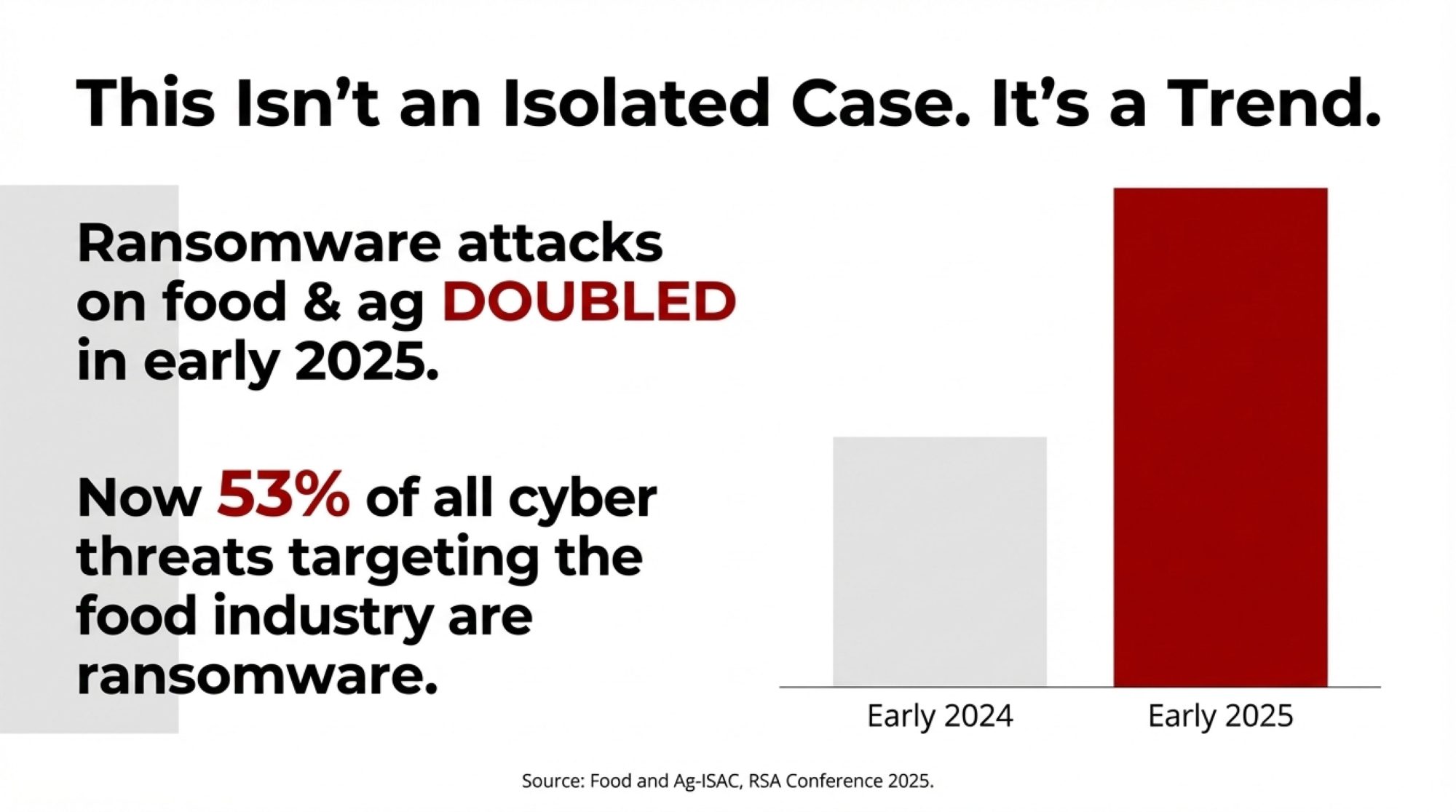
What’s sobering is that this isn’t an isolated incident. Jonathan Braley, director of the Food and Ag-ISAC, reported that ransomware attacks on food and agriculture more than doubled in early 2025 compared to the same period last year—84 incidents in just the first quarter. He presented those findings at the RSA Conference this past spring. Ransomware now accounts for roughly 53% of all cyber actors targeting the food industry.
So here’s what many of us are starting to realize: once your milking, feeding, and herd records move onto networks and into the cloud, dairy farm cybersecurity isn’t just “an IT problem” anymore. It becomes part of herd management, animal welfare, and business continuity.

The Digital Barn Is Already Here

Walk into most progressive operations today—whether that’s a 200-cow freestall in Wisconsin, a large drylot in the Central Valley, a grazing operation in the Pacific Northwest, or a mega-dairy in the Texas Panhandle—and you’ll see it. Robotic milkers, activity collars, sort gates, in-parlor ID, and environmental controllers. At least one computer screen is glowing somewhere in the office. The digital dairy isn’t some future concept. It’s daily life.

A research team published a comprehensive roadmap earlier this year in Frontiers in Big Data—titled “Safeguarding Digital Livestock Farming”—and put dairy right at the center of this transformation. Sensors, automation, and AI are now embedded throughout milking, feeding, and health monitoring on commercial operations worldwide.

The benefits are real, and most of us have seen them firsthand. We’re catching mastitis earlier by monitoring milk conductivity. Activity and rumination data can flag fresh cow problems during that critical transition period—often 24 to 48 hours before you’d see clinical signs with your eyes. There’s solid research on this from Cornell and in journals like Nature Scientific Reports. Labor flexibility has improved with robots handling overnight milkings. Butterfat performance gets better when ration and intake data actually talk to each other.

But here’s the flip side that same Frontiers paper points out: as these systems have come online, the “attack surfaces” have multiplied. Vulnerabilities in barn controllers, herd software, and cloud services can now impact animal care and milk flow as surely as a broken pipeline once did.

The technology and threat curves are rising together. That’s simply the reality we’re operating in now.

When a Cyberattack Actually Reaches the Cows

Let me walk through what happened in Switzerland, because it illustrates how digital problems connect to cow comfort in a very concrete way.

When hackers encrypted Vital Bircher’s robotic milking system, the physical equipment kept running. Teat cups still attached. Vacuums still cycled. But suddenly, he couldn’t see quarter-level milk yield and conductivity, changes in milking duration and flow rate, temperature and milk quality indicators, or health and reproduction flags tied to individual cows.

If you’ve worked with robotic systems—whether Lely, DeLaval, GEA, or others—you know how much you come to rely on that information for daily management decisions. Several controlled studies have shown that milk conductivity, yield deviations, and rumination data can flag subclinical mastitis, ketosis, and other issues a day or two before a cow shows obvious clinical signs. In a fresh cow management context, that head start matters enormously.

What’s worth noting here is that, in Bircher’s case, the cows, the feed, and the barn didn’t change fundamentally. What changed was his ability to see trouble coming. Once that data stream stopped, the margin for error around sick cows and high-value pregnancies narrowed fast.

He didn’t pay the ransom. But his total losses—vet costs, a new computer, the animals—ran around 6,000 Swiss francs. More than the money, though, it shook his confidence in systems he’d built his operation around.

“When you’ve structured your fresh cow protocols around digital data, losing access to that data isn’t just inconvenient—it fundamentally changes how you can care for your animals.”

That’s the part that resonates with a lot of producers. When you’ve built your health monitoring and fresh cow management around digital data, losing access isn’t a minor setback. It changes your entire approach to animal care.

Who’s Actually Paying Attention to Agriculture?

It’s fair to ask: “Am I really on anybody’s radar with 200 cows in a freestall?” The evidence suggests the answer is yes—though the motivations vary quite a bit.

Ransomware operators have definitely noticed agriculture. In 2021, the FBI, CISA, and NSA issued a joint advisory warning that ransomware groups were targeting the food and agriculture sectors. They’d hit two U.S. food and ag organizations with BlackMatter ransomware. Then, in April 2022, the FBI issued another bulletin warning that attackers might time their hits to planting and harvest seasons—when downtime hurts most, and there’s pressure to pay quickly. Brownfield Ag News reported that at least seven grain cooperatives had already suffered ransomware attacks in the fall of 2021.

Since then, we’ve seen plenty of real-world examples. In June 2025, multiple Dairy Farmers of America manufacturing plants got hit with ransomware. The Play ransomware gang later claimed responsibility, and according to reporting in The Record, data from over 4,500 individuals was compromised. DFA worked through recovery—and credit to them for being relatively transparent about what happened—but it showed how a single upstream compromise can ripple through plants, routes, and eventually farm milk checks.

IncidentCategoryCost/Impact
Swiss Farmer (Vital Bircher)Ransom Demanded (unpaid)$10,000
Swiss Farmer (Vital Bircher)Veterinary Costs$2,304
Swiss Farmer (Vital Bircher)New Computer$1,000
Swiss Farmer (Vital Bircher)Lost Animals (cow + calf)$2,696
Swiss Farmer (Vital Bircher)TOTAL OUT-OF-POCKET$6,000
DFA Cooperative AttackPlants DisruptedMultiple facilities
DFA Cooperative AttackIndividuals Compromised4,546 people
DFA Cooperative AttackPayment Processing Delays17 days
DFA Cooperative AttackEstimated Revenue ImpactSystemic – milk checks delayed

Nation-state actors appear to be playing a longer game. This is the part that can feel a bit surreal to discuss at a farm level, but cybersecurity analysts increasingly point out that countries like China, Russia, and North Korea view food and agriculture as strategic infrastructure. A Forbes analysis last fall by Daphne Ewing-Chow noted that the FBI identifies four major threats to agriculture: ransomware attacks, foreign malware, theft of data and intellectual property, and bio-terrorism. FBI Special Agent Gene Kowel was quoted as saying that “foreign entities are actively seeking to destabilize the U.S. agricultural industry.”

For dairy, that could mean interest in genomic data, feeding strategies tied to high components, or disease management approaches. The goal isn’t a quick ransom—it’s gaining competitive advantage by shortcutting years of R&D. From our perspective on the farm, this kind of data theft can be nearly invisible. Whether it’s a significant risk for individual operations or primarily affects larger genetics companies and cooperatives is still being understood.

There’s also an emerging activist angle. Dr. Ali Dehghantanha—he holds the Canada Research Chair in Cybersecurity and Threat Intelligence at the University of Guelph—has been tracking a newer trend. His lab worked on a case involving an Ontario hog operation that was hit with ransomware, but the attackers didn’t want money. They wanted a public confession of animal cruelty. The Western Producer covered the story earlier this year.

As Dr. Dehghantanha put it, “As activists educate themselves on cyberattack techniques, they are becoming a significant, emerging risk in agriculture.” It’s a different motivation than the ransomware gangs, but it’s part of the picture worth being aware of.

Where the Practical Vulnerabilities Are

Most of us don’t have time to become network engineers. So let me walk through the concrete weak spots that keep showing up in farm-focused cybersecurity assessments. These are things you can actually check on your own operation.

Factory-default passwords remain surprisingly common. You know how your router probably came with “admin/admin” as the login? A lot of barn cameras, remote-access modules, and some equipment controllers ship the same way. Those defaults are published in manuals and all over the internet. If nobody ever changes them, automated scanning tools can find and access those devices pretty quickly.

Security assessments consistently identify unchanged default credentials as one of the most common vulnerabilities on farm systems. It’s understandable—we’re focused on the cows, not the router password—but it’s also one of the easiest openings to close.

Everything often runs on one network. On many operations—I’ve seen this pattern from Wisconsin tiestalls to California drylots to Northeast grazing dairies—the setup looks like this: one router from the ISP, a few switches, and everything plugged in together. Robots, office computers, herd software, phones, cameras, tablets. All on the same network.

Security professionals call this “flat networking,” and they consistently flag it as a significant risk. Here’s why it matters: once an attacker gets into any device—say, a poorly protected camera—they can potentially move sideways to more critical systems. Your herd management server. Your robot controls. Your financials.

Firmware updates often get skipped. Just like your phone receives updates, so do routers, controllers, and automation components. Those updates frequently contain security fixes. But on farms, updating firmware often requires a technician visit or carries the risk of breaking something that’s working fine. So a lot of equipment runs older, vulnerable software versions long after fixes are available.

Single passwords often protect critical accounts. Most herd management and financial portals now support multi-factor authentication—that extra code sent to your phone. But as both Hoard’s Dairyman and Dairy Herd Managementhave noted, plenty of producers still rely on just a password. Given how many password databases have been breached over the years, that’s a real exposure worth addressing.

Defense StepCostTime InvestmentImpact LevelProtects Against
1. Change Default Passwords$01 hourHIGHAutomated scans, default exploits
2. Enable Multi-Factor Authentication$02 hoursHIGHStolen password attacks
3. Create Offline Backup System$100-1504 hours setup + monthly backupsCRITICALComplete data loss, ransom pressure
4. Segment Your Networks$500-2,0001 day + IT consultantHIGHLateral movement after breach
5. Train Your Team$0-5002-4 hours annuallyMEDIUM-HIGHPhishing, social engineering
6. Document Incident Response Plan$04 hoursCRITICALChaos during active attack

What’s Actually Working: A Practical Framework

The encouraging news—and there is encouraging news here—is that you don’t need an IT department to improve your farm data security meaningfully. Extension work in Canada, federal guidance from CISA, and sector-specific research all point to a straightforward staged approach that makes a real difference.

Start by taking inventory of your digital barn. This sounds basic, but it matters. Walk the farm and list everything that’s connected to it. Robots, feed systems, herd management computers, environmental controllers, cameras, office machines, and cloud accounts for herd data or milk marketing. For each one, note what it does, who uses it, and whether it touches herd data, financials, or insurance information.

It’s a bit like walking pens for fresh cow checks—you can’t manage what you don’t know is there.

Then close the obvious doors. Several defenses cost little or nothing. Change those default passwords on your router, cameras, and remote-access logins. Use strong, unique passwords—and if a password manager feels like overkill, a written log kept in a locked filing cabinet works fine. It’s far better than using the same password everywhere.

Turn on multi-factor authentication wherever you can. Cloud herd software, email, banking—they almost all support it now. It adds a small step to logging in, but it makes stolen passwords significantly less useful to attackers.

Here’s something simple that security professionals recommend: restart your phones and tablets regularly. It helps get updates applied and clears temporary data where some malware operates. Not a bad habit to pair with morning coffee.

Make sure you can recover offline. When ransomware hits, one of the first things it typically does is look for and encrypt any backups it can reach. That’s why Agriculture and Agri-Food Canada’s cyber security toolkit and programs like CSKA—the Cyber Security Knowledge Alliance—recommend having at least one offline backup. A copy of key data that’s physically disconnected from the network most of the time.

On a 200-cow dairy, a practical routine might look like this: buy an external hard drive—good options run $100 to $150. Once a month, connect it to a trusted office computer and copy critical data, including herd records, breeding and genomic information, ration files, and accounting records. Then disconnect it and store it in a safe, dry place.

If the worst happens, you might lose a few weeks of recent notes. But you won’t lose years of herd history or your entire genetic program.

Consider segmenting your networks. This is where a local IT consultant can really help, but the concept is straightforward. Instead of running everything through one router, you split traffic into separate lanes:

  • Operations network: milking system, feeding controls, environmental controllers
  • Office network: business computers, maybe a dedicated herd management PC
  • Guest network: phones, visitor WiFi, cameras, and less critical devices

Modern small-business routers from companies like Ubiquiti or Cisco can create separate virtual networks, with rules specifying which devices can talk to which. Devices on the guest network can reach the internet, but can’t communicate with your robot controller.

What this accomplishes is similar to what a good pen layout does: it limits how far a problem can spread. If a phone or camera gets compromised, that doesn’t automatically provide a path to your herd management server.

Bring your team into the conversation. Cyber awareness training doesn’t have to mean long courses. Dr. Dehghantanha’s work at Guelph and several farm-focused consulting groups have found that a short, plain-language briefing makes a meaningful difference.

Cover phishing—show examples of suspicious emails that pretend to be from a bank, supplier, or milk buyer asking for login credentials. The key message: don’t click links in unexpected emails. Go directly to the site you already know, or pick up the phone and call. Discuss password practices—no sharing, no sticky notes on the robot room computer. And make sure everyone understands: if something looks weird, say something. Many breaches escalate simply because nobody wanted to raise a concern.

Have a basic plan for when something goes wrong. Just like every farm has a plan for a parlor breakdown or power outage, it’s worth writing down a one-page playbook for suspected cyber incidents. Who gets called first—IT support, equipment dealer, co-op field rep, insurance agent, maybe a law enforcement contact. How to isolate an affected system without shutting down equipment in ways that could harm animals. Where the offline backups are stored and who can authorize a restore.

Think of it like a herd health protocol—you may refine it over time, but having something written down keeps everyone from improvising during a stressful situation.

System CategoryDevice/SystemData at RiskDefault Password Risk
Milking SystemsRobotic milking unitsCow IDs, milking schedules, yield dataHIGH
Milking SystemsParlor identification systemsIndividual cow tracking, timestampsHIGH
Milking SystemsMilk meters & sensorsProduction metrics, quality alertsMEDIUM
Milking SystemsConductivity monitorsMastitis detection, SCC levelsMEDIUM
Herd Health MonitoringActivity/rumination collarsBehavior patterns, health alertsMEDIUM
Herd Health MonitoringHealth monitoring softwareTreatment records, disease historyLOW
Herd Health MonitoringBreeding/reproduction platformsHeat detection, pregnancy status, insemination datesLOW
Herd Health MonitoringGenomic data systemsGenetic profiles, breeding valuesLOW
Barn AutomationAutomated feedersRation formulas, intake patternsHIGH
Barn AutomationEnvironmental controllersTemperature, humidity, barn conditionsHIGH
Barn AutomationSort gates & cow trafficPen assignments, movement logsMEDIUM
Barn AutomationVentilation systemsAir quality, fan controlsHIGH
Business SystemsOffice computersFinancial records, employee dataLOW
Business SystemsCloud herd managementComplete herd history, performance analyticsLOW
Business SystemsFinancial/banking portalsBank accounts, payment informationLOW
Business SystemsMilk marketing platformsMilk prices, shipment schedulesLOW
Network InfrastructureWiFi routersNetwork access, device passwordsCRITICAL
Network InfrastructureSecurity camerasVideo footage, facility surveillanceCRITICAL
Network InfrastructureRemote access modulesVPN credentials, remote loginCRITICAL
Network InfrastructureMobile devices/tabletsEmail, app passwords, two-factor codesMEDIUM

Questions Worth Bringing to Your Vendors and Co-ops

One positive shift I’ve noticed recently is that producers are no longer simply assuming their technology partners have security covered. More farmers are asking direct—but fair—questions of dealers, software providers, and cooperatives.

For equipment dealers and OEMs, questions like these are reasonable to ask:

  • How are passwords and remote access handled on this system? Can factory defaults be changed easily?
  • Does communication between controllers and robots use encryption, or does it travel as plain text on the network?
  • How often do you release security updates, and what’s the process for applying them?
  • If a vulnerability is discovered, how will you notify customers?

For herd management and cloud software providers:

  • Where is my herd data physically stored—what country, what type of data center—and how is it protected?
  • Is multi-factor authentication available for my account?
  • Do you have a documented incident response plan? Will I be notified if my data is accessed inappropriately?

For co-ops, processors, and lenders:

  • Do you offer cybersecurity programs or shared services that member farms can access?
  • Are there minimum security practices you expect from suppliers?
  • Is cyber coverage available as part of broader farm risk insurance, and what does it require?

These aren’t adversarial questions. They’re the same kind of due diligence we already practice around milk quality testing, residue protocols, or animal care standards. Vendors who take security seriously generally welcome the conversation.

How the Broader Industry Is Responding

To be fair, the industry hasn’t been asleep at the wheel here. Several encouraging developments are worth knowing about.

That Frontiers in Big Data roadmap I mentioned earlier was developed by academic, industry, and policy experts specifically to give dairy and poultry clearer guidance on security. Organizations like the Food and Ag-ISAC have grown substantially to help producers and processors share threat information.

What’s particularly interesting is what rural electric cooperatives have accomplished. Through NRECA’s Rural Cooperative Cybersecurity Capabilities program—known as RC3—more than 500 co-ops have built stronger cybersecurity programs by pooling resources. Training, monitoring, and incident response—capabilities no single small utility could afford alone.

Several dairy and crop cooperatives are now studying that model. What might it look like applied to our sector? A regional cooperative could potentially offer shared threat monitoring, collective incident response capabilities, vendor vetting, and centralized training for member farms. Cost might run $50 to $100 per month through the milk check—but the benefit would be access to security resources that no individual 200-cow operation could afford on its own.

On the policy front, Congress introduced the Farm and Food Cybersecurity Act in February 2025, in both the House and the Senate. The legislation aims to give USDA and CISA clearer authority and funding to develop sector-specific guidance. Whether it passes with meaningful resources remains to be seen, but it signals that agriculture has finally gotten the attention of federal cybersecurity agencies.

Bringing It All Together

Looking at everything we’ve covered, the core lessons for most dairy operations come down to a few practical points.

Your digital systems have become as operationally critical as your physical infrastructure. Robotic milkers, activity collars, and herd software are already shaping daily decisions around fresh cow protocols, reproduction timing, and treatment interventions. Protecting those systems is part of protecting the herd.

Most attackers look for easy targets, not sophisticated defenses. The majority of successful attacks in agriculture still exploit basic gaps—default passwords, missing multi-factor authentication, flat networks, and inadequate backups. Addressing those fundamentals won’t make any operation bulletproof, but it creates meaningful separation from operations that haven’t done the work.

A practical dairy farm cybersecurity program can be built through consistent habits rather than massive investments. Know what’s connected on your operation. Improve your password practices and enable MFA where available. Maintain at least one offline backup. Separate barn systems from guest WiFi if feasible. Give your team basic awareness training. Document a simple incident response plan.

None of this requires becoming a full-time IT specialist. It’s the same disciplined approach we already bring to biosecurity protocols or fresh cow management: identify vulnerabilities, apply reasonable controls, review periodically, and work with trusted partners where it makes sense.

What this suggests is that as dairy continues to embrace digital tools for component performance, labor efficiency, and animal care, cyber hygiene will quietly join feed cost management, reproductive programs, and milk quality as one of the background disciplines that distinguish resilient operations from fragile ones.

It’s one more responsibility on an already full plate. But it’s also one of the few areas where a modest investment of time can protect years of breeding progress, operational data, and hard-earned equity.

On today’s digital dairies, that’s work worth prioritizing.

KEY TAKEAWAYS

  • Attacks doubled in 2025: Ransomware incidents in food and agriculture more than doubled this year. 53% of cyber actors targeting the industry now use ransomware
  • Cyber risk hit the transition pen: When hackers encrypted a Swiss farmer’s robot data, health alerts went dark. A pregnant cow’s distress went unseen—she and her calf were lost
  • Attackers exploit basics, not sophistication: Default passwords, flat networks, and missing backups are the doors they walk through. These gaps are fixable
  • Protection costs less than you think: An external drive runs $100-150. Multi-factor authentication is free. Network segmentation pays for itself in risk reduction
  • Three steps to start this week: Change default passwords on routers and cameras. Enable MFA on herd software and banking. Create your first offline backup

Complete references and supporting documentation are available upon request by contacting the editorial team at editor@thebullvine.com.

Learn More:

Join the Revolution!

Join over 30,000 successful dairy professionals who rely on Bullvine Weekly for their competitive edge. Delivered directly to your inbox each week, our exclusive industry insights help you make smarter decisions while saving precious hours every week. Never miss critical updates on milk production trends, breakthrough technologies, and profit-boosting strategies that top producers are already implementing. Subscribe now to transform your dairy operation’s efficiency and profitability—your future success is just one click away.

NewsSubscribe
First
Last
Consent

Is Your Herd Safe? Cybersecurity Essentials for Modern Dairy Farms

Robotic milkers & data-driven herds face invisible threats. Protect your dairy from cyberattacks risking livestock, milk checks, and operations.

Dairy farm cybersecurity, Agriculture cybersecurity, Farm technology security, Protecting farm data, Cyber threats agriculture

Your prize, Holstein, is worth $100,000. Your bulk tank holds three days of milk checks. Your DairyComp records contain a decade of breeding decisions. But while you’re busy protecting your herd from Johne’s, mastitis, and heat stress, an invisible threat lurking could bring your entire operation crashing down faster than a fresh heifer with milk fever. And I guarantee you’re more vulnerable than your weakest teat end during dry-off.

Many dairy producers are dangerously underprepared for cyberattacks, exposing their operations to threats that could devastate their business overnight.

The modern dairy farm isn’t just free stalls and TMR mixers anymore. It’s a complex web of connected technologies – from robotic milkers and automated calf feeders to environmental controllers and DHIA software. This digital transformation has revolutionized efficiency and productivity, but it’s also created a security gap wider than the front of your bunker silo that cybercriminals are increasingly eager to exploit.

Let me be blunt: dairy farms have become prime targets for cyberattacks, and the industry’s response has been inadequate. The FBI now considers agriculture among the top six most targeted industries, with attacks increasing alarmingly. Why? Because we’re vulnerable, time-sensitive, and frankly, most of us haven’t taken this threat seriously enough.

When did you last update the password on your farm’s Wi-Fi network? Still, using your farm name and zip code? You might as well hand over your milk check directly to hackers.

I’ve seen firsthand what happens when these attacks hit. Imagine your DeLaval VMS suddenly shutting down, your Lely Vector feed pusher going haywire, or your entire DairyComp 305 database being held for ransom. This isn’t science fiction – it’s happening to dairy farms across North America right now.

Let’s cut through the tech jargon and get straight to what you need to know to protect your operation. Because in 2025, cybersecurity isn’t just an IT issue – it’s as fundamental to farm management as your vaccination protocol, breeding program, and nutrition plan.

The Digital Dairy Farm: Understanding Your Vulnerabilities

The modern dairy operation has undergone a technological revolution that would have made your grandfather’s jaw drop faster than a cow with hardware disease. Today’s farms are increasingly run on bits and bytes as much as blood, sweat, and tears. But each new connected device creates another potential entry point for cybercriminals – like leaving every gate in your perimeter fence open during calving season.

The Connected Cow: More Vulnerable Than You Think

Let’s take inventory of what’s actually at risk on your farm:

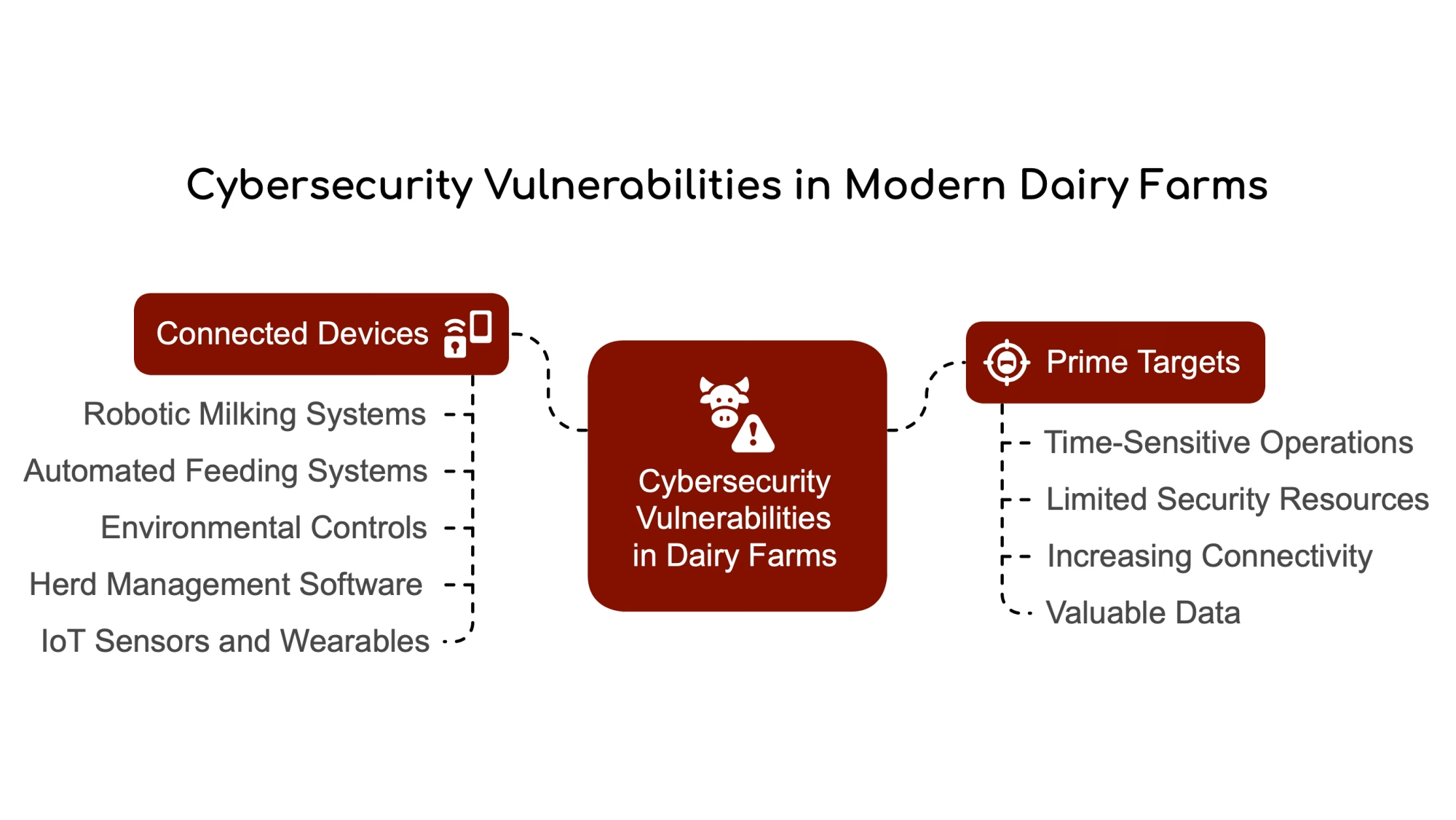
Robotic Milking Systems: These sophisticated machines aren’t just mechanical – they’re driven by software that identifies cows through RFID, controls pulsation rates, manages take-off settings, and collects production data. If compromised, attackers could shut down milking operations entirely or manipulate settings that could harm your animals or compromise milk quality – imagine someone remotely changing your pulsation ratio or reducing your wash cycle temperature below pasteurization standards.

Automated Feeding Systems: From precision TMR mixers to individual concentrate dispensers, these systems rely on software to deliver the proper nutrition to the right animals. A cyberattack could disrupt feeding schedules or alter rations, directly impacting production and animal health – like suddenly increasing the grain-to-forage ratio in your high group without warning.

Environmental Controls: The computerized systems managing tunnel ventilation, evaporative cooling, lighting, and other barn conditions are increasingly connected to the internet for remote monitoring and control. Imagine someone remotely turning off your cooling systems during a summer heat wave, sending your THI soaring above 80, or manipulating air quality monitors to mask dangerous ammonia levels.

Herd Management Software: The digital brain of your operation stores everything from health records and breeding data to production metrics and financial information. This treasure trove of data is exactly what cybercriminals want – to encrypt, steal, or manipulate it for financial gain. Your genetic advancement program, meticulously built over generations, could be held hostage with a single click.

IoT Sensors and Wearables: Activity monitors, rumination sensors, boluses, and other devices constantly collect data from your animals. These often connect to networks with minimal security protections – about as secure as a gate latch with baling twine.

Do you still think this doesn’t apply to your operation? Wake up. You’re already vulnerable if you’ve got a smartphone connected to your farm Wi-Fi.

Why Dairy Farms Are Prime Targets

You might be thinking, “Why would hackers bother with my farm? I’m not a bank or a hospital.” Here’s the harsh reality: cybercriminals target dairy farms precisely because they think we’re easy prey. And often, they’re right – like predators picking off the weakest animal in the herd.

Time-Sensitive Operations: The FBI has explicitly identified agricultural operations as prime targets because of their time sensitivity. Dairy farms operate on strict biological schedules, unlike other businesses that might experience a few days of downtime. Cows must be milked regularly, feeding can’t be delayed, and any significant disruption quickly escalates into an animal welfare crisis – like a blocked quarter that can’t wait until Monday for treatment.

Limited Security Resources: Most dairy farms lack dedicated IT security staff or robust cybersecurity budgets. FBI Special Agent Gene Kowel notes, “A lot of producers don’t have a big budget for cybersecurity, and because of that, both cyber criminals and nation/state adversaries see that as a vulnerability they’re more than happy to exploit.” It’s like leaving your medicine cabinet unlocked when you know thieves are in the area.

Increasing Connectivity: The rapid adoption of precision agriculture technologies has created more attack surfaces without corresponding security measures. Every new connected device potentially opens another door for attackers – from your SCR collars to your Nedap heat detection system.

Valuable Data: Your farm generates enormous amounts of useful data – from proprietary genetic information and breeding strategies to production metrics and financial records. This data has significant value- for ransom and on black markets – as precious to your operation as your carefully curated embryo inventory.

Real Threats, Real Consequences: When Cyberattacks Hit the Barn

This isn’t theoretical – dairy farms and processors are already being hit, and the consequences are more devastating than a BTM positive for Mycoplasma. Let me share some real-world examples that should serve as wake-up calls.

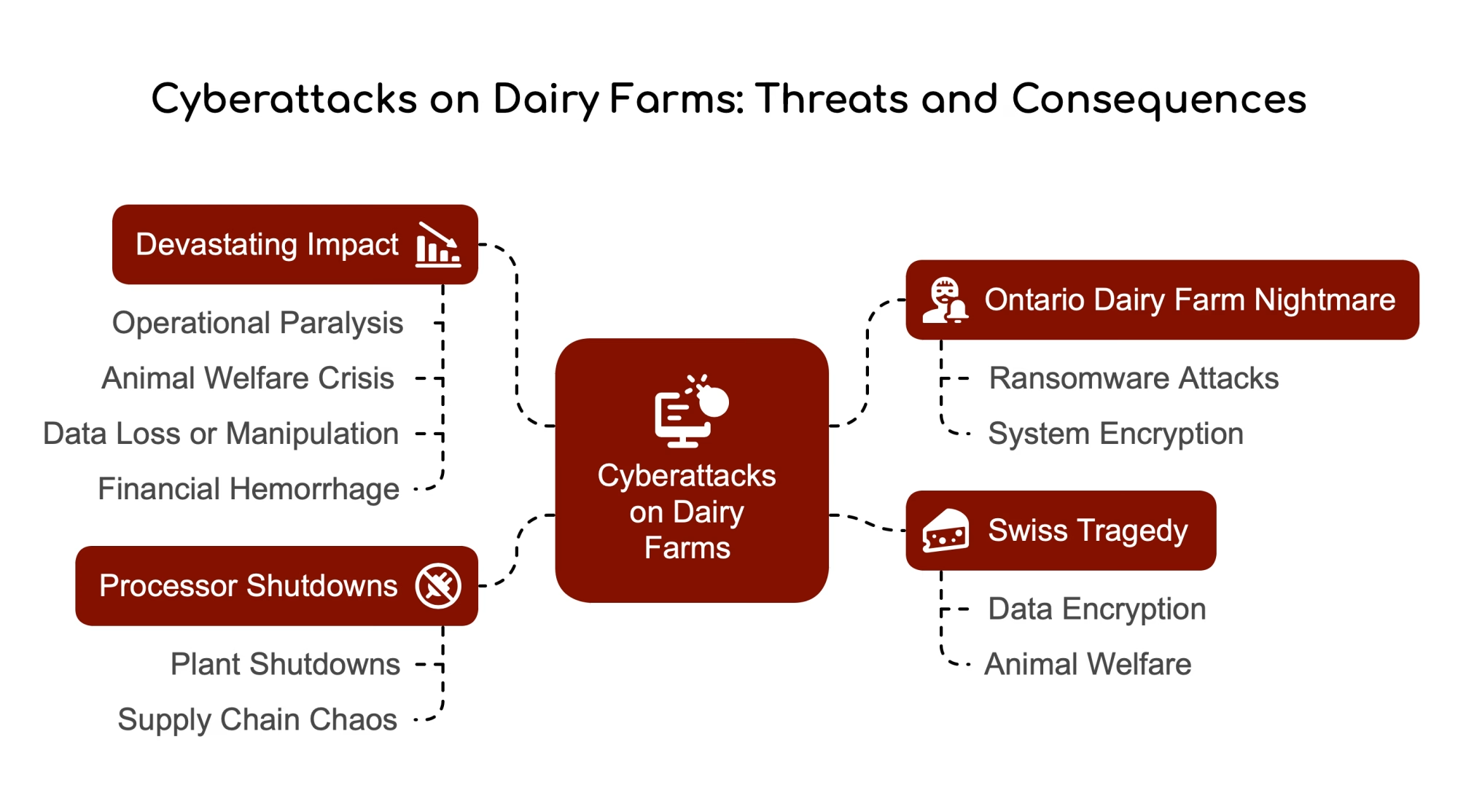
The Ontario Dairy Farm Nightmare

Ali Dehghantanha, Canada Research Chair in Cybersecurity and Threat Intelligence, shared a chilling story about an Ontario dairy producer who experienced multiple ransomware attacks. After paying ransoms twice, the farmer called Dehghantanha when faced with a third attack demanding $25,000. The cybersecurity team discovered the attackers had been in the system for three years, installing multiple backdoors – like a persistent case of Staph aureus that keeps coming back despite treatment.

When the farmer declined Dehghantanha’s offer of a free cybersecurity monitoring program, disaster struck: “Within 20 days, his entire system, including the RFID reader, robots, and backup system, was encrypted, and a US$9.999 million ransom demand was made”.

Let that sink in. Nearly $10 million. For a single dairy farm. That’s enough to build a state-of-the-art 1,000-cow free-stall barn with all the trimmings.

And you think it can’t happen to you? That’s exactly what that Ontario farmer thought, too.

The Swiss Tragedy

Perhaps most disturbing is the case of Swiss dairy farmer Vital Bircher, whose milking robot data was encrypted in a 2023 ransomware attack. Although he refused the $10,000 ransom, the lack of access to critical data reportedly contributed to the death of a cow and her calf.

This is the stark reality – cyberattacks on dairy farms aren’t just financial inconveniences; they can directly threaten animal welfare and lives. It’s like losing access to your treatment records during a disease outbreak.

Processor Shutdowns and Supply Chain Chaos

The ripple effects extend beyond individual farms. Major dairy processors like HP Hood Dairy and Schreiber Foods have suffered attacks that shut down plants and disrupted milk collection. When processors can’t operate, farms have nowhere to ship milk, potentially forcing emergency dumping and significant financial losses – like having your bulk tank truck turned away during spring flush with no alternative outlet.

The HP Hood incident specifically affected the supply of milk cartons to schools in New England, demonstrating how these attacks can quickly cascade through the supply chain faster than a case of Salmonella in a processing plant.

The industry’s dirty little secret? Many processors have already been hit, but keep them quiet to avoid panic. Your milk cooperative or processor could be compromised now, and you wouldn’t even know it.

The Devastating Impact on Your Operation

When a cyberattack hits your farm, the consequences can be immediate and severe:

Operational Paralysis: Critical systems like milking robots, feeders, and environmental controls can be disabled, bringing operations to a halt – like having your entire milking parlor go down during peak production.

Animal Welfare Crisis: Missed milkings cause physical distress for cows, increasing mastitis risk. Early signs of illness or calving difficulties might be missed without access to monitoring systems, like losing your activity monitoring system during breeding season.

Data Loss or Manipulation: Years of irreplaceable records could be lost or subtly altered to influence management decisions – imagine losing your entire breeding history or having someone manipulate your SCC data before a quality audit.

Financial Hemorrhage: Beyond potential ransom payments, the costs include system restoration, lost production, emergency veterinary care, and long-term reputation damage – bleeding money faster than a high-producing cow with LDA.

The Evolving Threat Landscape: Know Your Enemy

Understanding the types of threats targeting dairy farms is essential for effective defense. These aren’t random attacks – they’re as targeted and strategic as your breeding program.

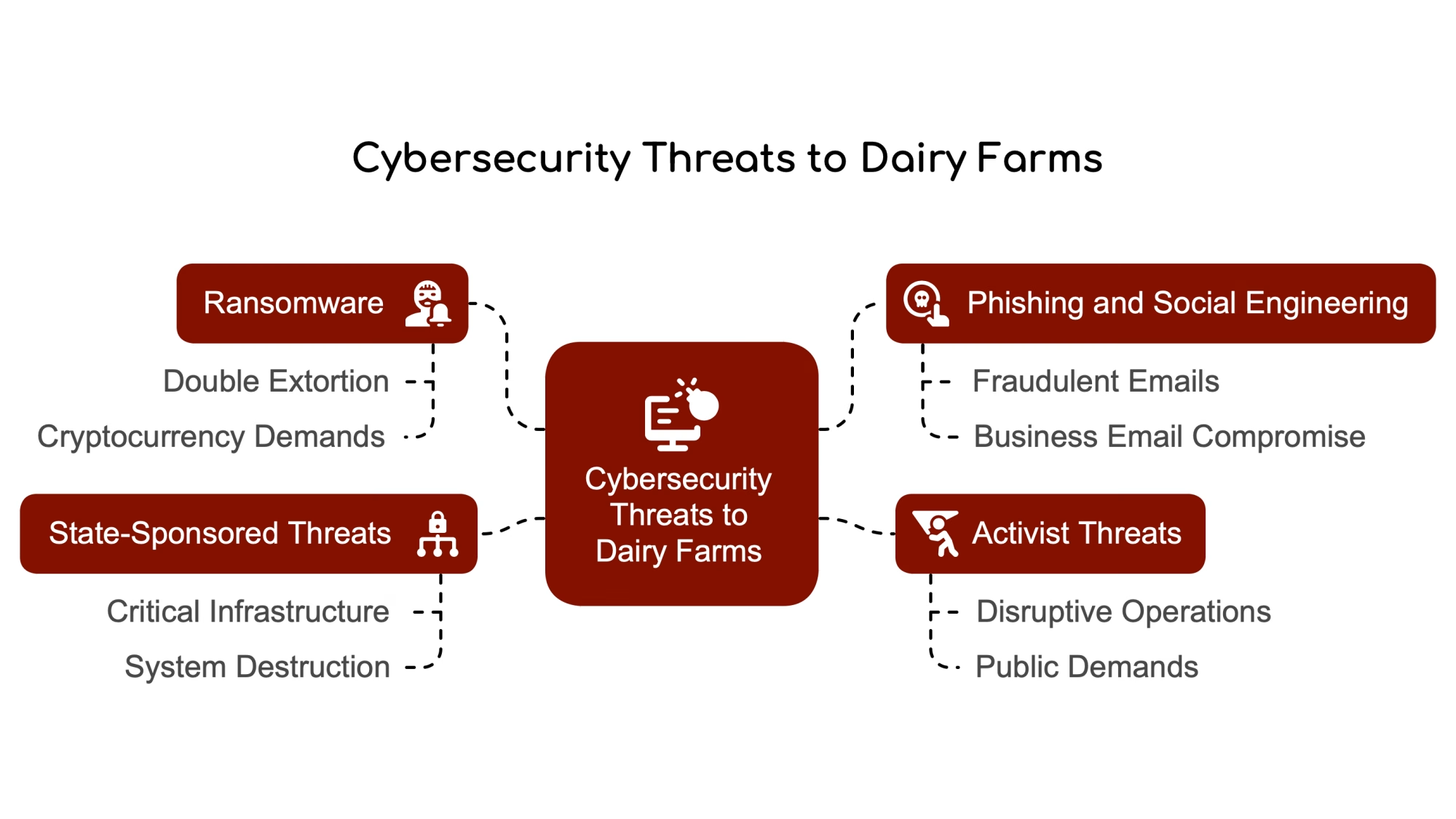
Ransomware: The Dominant Threat

Ransomware has emerged as the most significant cyber threat facing dairy farms. These attacks encrypt your critical data and systems, rendering them inaccessible until you pay a ransom, typically in cryptocurrency.

Modern ransomware attacks often employ “double extortion” – not only encrypting your data but also stealing copies beforehand, threatening to leak sensitive information if you don’t pay up. It’s like someone holding your milk check hostage while threatening to release your financial records to competitors.

The evidence shows a sharp increase in these attacks. One report noted a staggering 118% spike in ransomware attacks on food and agriculture in late 2024 compared to the same period in 2023. Another analysis counted 212 ransomware incidents targeting the sector in 2024, a 27% increase from the previous year – growing faster than your replacement heifer inventory.

Phishing and Social Engineering: Exploiting the Human Element

While ransomware grabs headlines, many attacks begin by exploiting human psychology through deceptive tactics. Phishing remains a common method for attackers to gain initial access, sending fraudulent emails or messages designed to trick recipients into clicking malicious links, downloading infected attachments, or revealing sensitive information like passwords.

Business Email Compromise (BEC) is a particularly damaging form focused on financial fraud, where attackers compromise or spoof email accounts of executives or partners to initiate fraudulent wire transfers or change payment information. It’s like someone impersonating your milk hauler to redirect your milk check to their account.

Let’s be honest – how many of you have clicked on a suspicious link or opened an attachment without thinking twice? That single click could cost you your entire operation.

The Rising Threat from Activists

The threat landscape for dairy farms is evolving beyond traditional criminal motivations. Dehghantanha notes, “Gradually, the animal activists are – as they are educating themselves on cyberattack – becoming a major risk that is changing the [cybersecurity] risk landscape.”

These attackers typically aim to disrupt operations or make public demands of farm owners, potentially exposing farming practices they oppose – like releasing selective footage from your barn cameras.

The industry has been so focused on physical activism that we’ve ignored the digital front entirely. While you’re worrying about protesters at your gate, activists could be infiltrating your network to gather ammunition for their next campaign.

Even more concerning, government agencies have identified state-sponsored threats targeting critical infrastructure sectors, including food and agriculture. Unlike ransomware attacks motivated by financial gain, these attacks aim to destroy systems and negatively impact essential infrastructure – potentially as devastating as a deliberate introduction of FMD.

Threat Analysis of Cyber-Enabled Dairy Systems

SystemKey ThreatsPotential ImpactRisk Level (1-5)
Farm Management SoftwareData tampering, ransomwareOperational paralysis, financial loss5
Robotic MilkingMalware, sensor spoofingMissed milking, mastitis risk4
Automated FeedingRation manipulationNutritional imbalances4
Environmental ControlsHVAC shutdownHeat stress, ammonia exposure3
IoT SensorsFalse data injectionMisdiagnosis of cow health3

Source: Based on NTNU Open threat analysis of dairy systems

Building Your Digital Defense: Essential Cybersecurity Practices

Protecting your dairy operation requires combining technical controls and sound operational practices. While the threat landscape is complex, focusing on fundamental cybersecurity hygiene provides a strong foundation for defense – think of it as your farm’s vaccination protocol against digital threats.

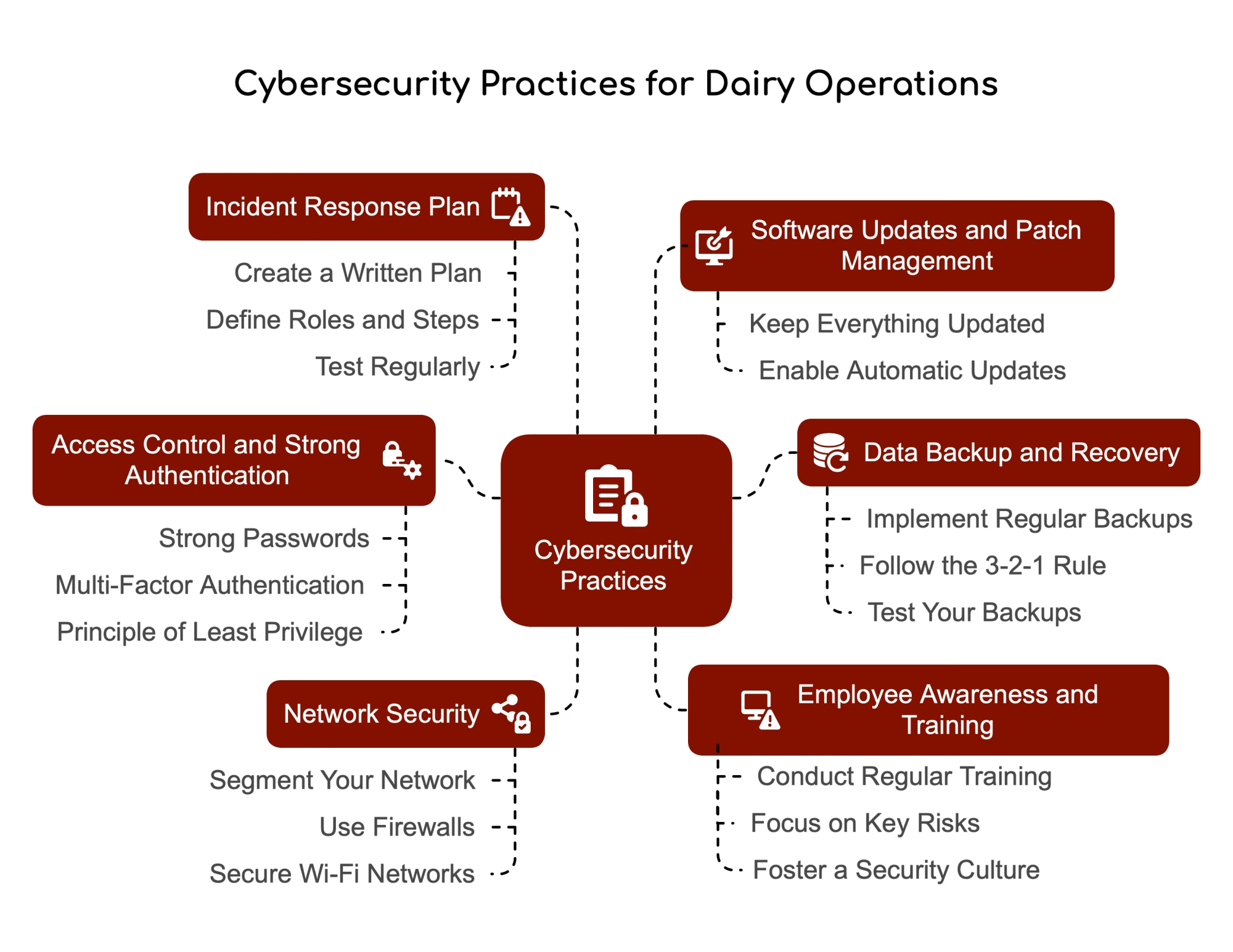
Access Control and Strong Authentication: Your First Line of Defense

Controlling who and what can access your farm systems and data is paramount:

Implement Strong Passwords: Use unique, complex passwords for every account, device, and system. Avoid easily guessable information, dictionary words, or reusing passwords across different services. Consider using password managers to generate and store complex passwords securely – treat your digital passwords with the same care as your AI tank lock combination.

Enable Multi-Factor Authentication (MFA): This requires users to provide two or more verification forms (e.g., a password plus a code from a mobile app) before granting access. Enable it for all critical systems, including email, financial accounts, herd management software, cloud services, and remote access solutions. As CISA notes, implementing MFA “can make you 99% less likely to get hacked” – like adding a second lock to your medicine cabinet.

Apply the Principle of Least Privilege: Users, employees, and even automated systems should only be granted the minimum access necessary to perform their job functions. Regularly review user permissions and remove unnecessary access. Crucially, remove administrative privileges from standard user laptops and workstations to prevent many types of malware from installing or executing effectively – just as you wouldn’t give every employee the keys to your semen tank.

Still, using the same password for everything from your bank account to your feed ordering system? You might as well post your credit card number on Facebook.

Software Updates and Patch Management: Close the Security Holes

Software vulnerabilities are a primary target for attackers:

Keep Everything Updated: Maintain up-to-date operating systems, applications (herd management, accounting software), and firmware on routers, switches, and IoT devices by applying security patches as soon as they become available – as regularly as your preventative hoof bath program.

Enable Automatic Updates: When possible and safe, enable automatic update mechanisms. Prioritize patching vulnerabilities known to be actively exploited by attackers – like immediately addressing a known Staph aureus outbreak in your herd.

Data Backup and Recovery: Your Insurance Policy

Robust backups are essential for recovering from ransomware attacks, hardware failures, or other data loss events:

Implement Regular Backups: Establish a strategy for regular, automated backups of all critical farm data, including operational data, herd records, financial information, emails, and system configurations – as essential as your emergency generator during power outages.

Follow the 3-2-1 Rule: Maintain at least three copies of your data on two different types of storage media, with at least one copy stored offsite or offline (air-gapped). Offline backups – physically disconnected from the network – are crucial because ransomware can often encrypt network-accessible backup drives – like keeping duplicate breeding records in separate locations.

Test Your Backups: Regularly verify that backups are complete, uncorrupted, and can be restored within an acceptable timeframe. A backup strategy is only effective if restoration works – just as you’d test your emergency generator before storm season.

What is the industry’s biggest cybersecurity myth? Your cloud-based herd management software automatically protects your data. You’re one click away from disaster if you don’t have offline backups of your critical farm data.

Network Security: Building Digital Fences

Securing your farm’s network infrastructure helps prevent unauthorized access and limit the spread of threats:

Segment Your Network: Divide your farm network into logical segments. Critically separate the Information Technology (IT) network (used for business administration, email, and general internet access) from the Operational Technology (OT) network (controlling milking robots, feeders, and barn environment). This limits an attacker’s ability to move from a compromised system in one segment to critical systems in another – like maintaining separate pens for different groups of animals.

Use Firewalls: Deploy firewalls at the network perimeter and potentially between internal network segments to control traffic flow, blocking unauthorized connections – the digital equivalent of your farm’s biosecurity protocols.

Secure Wi-Fi Networks: Use strong encryption (WPA2 or WPA3) and complex, unique passwords for all wireless networks. Create separate guest networks for visitors, isolated from the main farm network – just as you’d have separate boot wash stations for visitors.

Employee Awareness and Training: The Human Firewall

People are often the first line of defense but also a potential weak link:

Conduct Regular Training: Provide ongoing cybersecurity awareness training for all farm owners, family members, and employees who use computers, mobile devices, or farm technology – as essential as your milker training program.

Focus on Key Risks: Training should cover how to recognize and report phishing emails and malicious websites, the importance of strong password hygiene, safe internet browsing habits, risks of using public Wi-Fi, and procedures for reporting suspicious activity – like teaching employees to recognize the early signs of mastitis or ketosis.

Foster a Security Culture: Encourage a culture where cybersecurity is viewed as everyone’s responsibility, supported by farm leadership – just as you’d promote a strong safety culture in your parlor.

When was the last time you trained your employees on cybersecurity? You wouldn’t let someone milk your cows without proper training, so why let them access your farm’s critical systems without teaching them the risks?

Developing an Incident Response Plan: Preparing for the Worst

Knowing what to do when an incident occurs is critical to minimizing damage and recovering quickly:

Create a Written Plan: Develop an Incident Response Plan (IRP) before an incident happens. Alarmingly, studies suggest that most farms lack such a plan – like operating without a protocol for dealing with a disease outbreak.

Define Roles and Steps: The IRP should clearly outline who does what during an incident, including steps for identification, containment, eradication, recovery, and communication – as detailed as your calving protocols.

Test Regularly: Practice your response through tabletop exercises or simulations to ensure everyone understands their roles and the plan is effective – like running through your emergency procedures before they’re needed.

Incident Response Steps

StepActionGuidance
IdentificationActivate monitoring alertsUse security monitoring tools
ContainmentDisconnect affected systemsIsolate farm networks
CommunicationNotify insurers, legal, FBIUse a pre-defined contact list
RecoveryRestore from offline backupsTest backups regularly

The Lactanet Success Story: Learning from Industry Leaders

Not all cybersecurity stories end in disaster. Thanks to proactive measures, Lactanet, a major dairy service provider, successfully defended against a cyberattack with minimal disruption.

“We were either lucky or well-prepared to face that situation, so there was minimal disruption in the grand scheme of things,” said Daniel Lefebvre, Lactanet COO and Centre of Expertise director.

Recognizing that cyber threats were ubiquitous, Lactanet employed KPMG two years earlier to run cyber-risk assessments, gradually implementing the recommendations. This included hiring a 24/7 Managed Detection and Response (MDR) team to work with staff cybersecurity experts.

Lactanet’s cybersecurity education and training program includes running fake phishing campaigns that redirect employees to training modules after clicking on a potentially harmful link before granting system access – like running practice drills for your emergency protocols.

This proactive approach paid off when attackers gained access using stolen credentials. The company’s preparedness allowed them to detect and respond to the threat quickly, minimizing impact – much like how early mastitis detection through regular CMT testing can prevent a clinical flare-up.

Why aren’t more dairy organizations following Lactanet’s example? Our industry associations talk endlessly about milk prices and environmental regulations but remain virtually silent on cybersecurity threats that could bankrupt their members overnight.

The Bottom Line: Cybersecurity as a Business Investment

Let’s talk dollars and cents. Implementing robust cybersecurity measures requires investment – in technology, training, and potentially outside expertise. But compared to the potential costs of a successful attack, these preventative measures are a bargain – like spending money on vaccines rather than treating sick animals.

Cost of Cyberattacks vs. Prevention

ScenarioCost EstimateSource
Ontario farm ransomware$9.9M ransom + recoveryFood from Thought, 2024
Swiss farm data lossLivestock deaths + $10K ransomMexico Business News, 2025
Annual MDR service$5K–$15K/yearIndustry average
Employee training$500–$2K/yearEMILI Canada program

The Ontario dairy farm that faced a $10 million ransom demand after refusing basic security monitoring illustrates the stark financial reality. Even if you never pay a ransom, the operational and recovery costs alone can be crippling – like trying to recover from a major disease outbreak without a prevention program in place.

The dairy industry spends millions on genetic improvement, nutrition research, and facility design – yet treats cybersecurity as an afterthought. This misplaced priority will cost us dearly.

Viewed through this lens, cybersecurity isn’t an IT expense – it’s a critical business investment that protects your operation’s continuity, your animals’ welfare, and ultimately, your bottom line – as essential as your preventative health program.

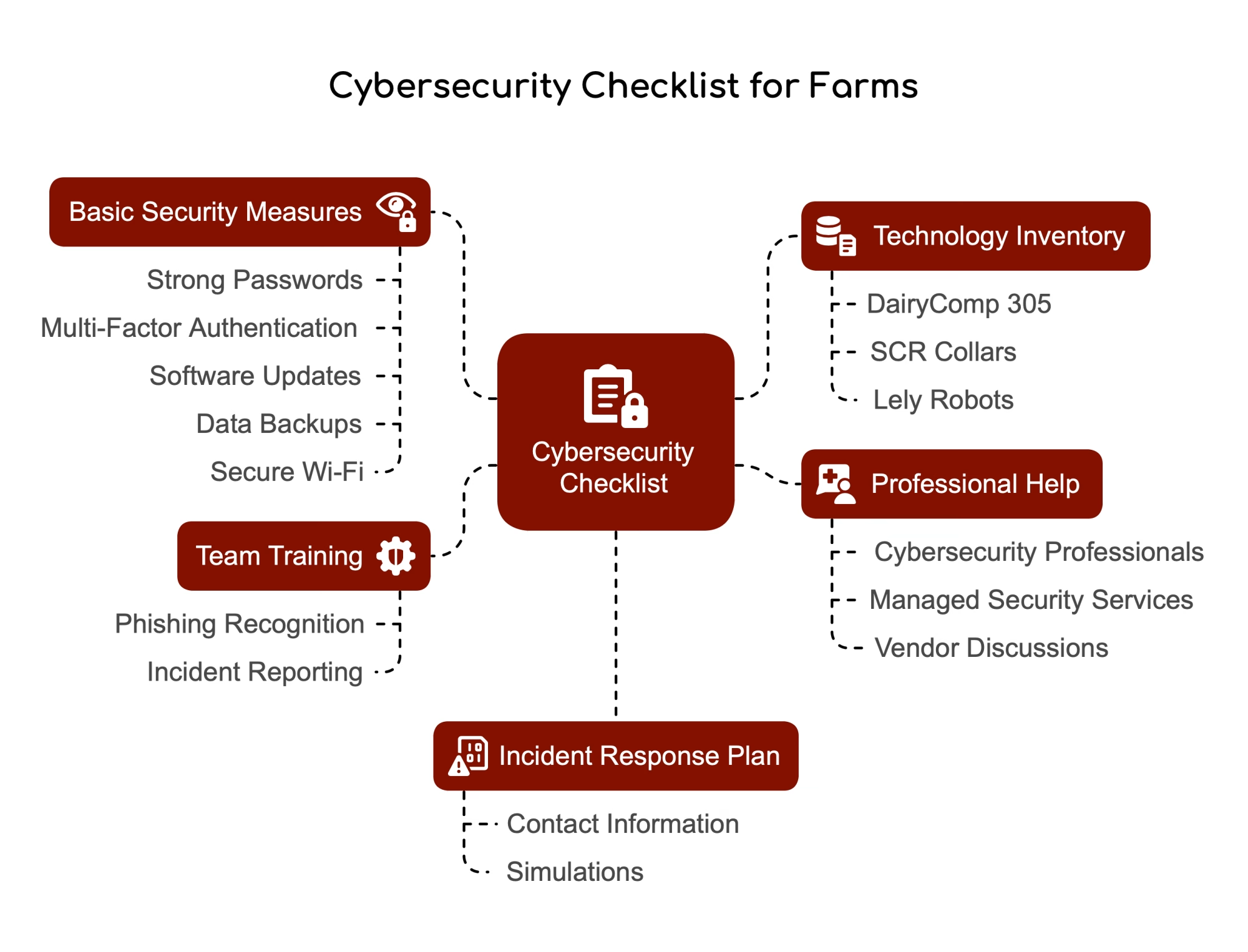
Taking Action: Your Cybersecurity Checklist

Ready to strengthen your farm‘s digital defenses? Here’s a practical checklist to get started:

  1. Conduct a Technology Inventory: Document all connected devices, systems, and software used in your operation – from your DairyComp 305 to your SCR collars to your Lely robots.
  2. Implement Basic Security Measures:
    1. Use strong, unique passwords for all accounts and devices
    1. Enable multi-factor authentication wherever possible
    1. Keep all software and firmware updated
    1. Back up critical data regularly, including offline copies
    1. Secure your Wi-Fi networks with strong encryption and passwords
  3. Train Your Team:
    1. Educate all family members and employees about cybersecurity risks
    1. Teach them to recognize phishing attempts and suspicious activity
    1. Establish clear procedures for reporting potential security incidents
  4. Develop an Incident Response Plan:
    1. Document steps to take if a cyberattack occurs
    1. Include contact information for technical support, law enforcement, and other resources
    1. Practice the plan through simulations or tabletop exercises
  5. Consider Professional Help:
    1. For more extensive operations, consult with cybersecurity professionals for a thorough assessment
    1. Explore managed security services if you lack internal IT expertise
    1. Discuss cybersecurity options with your technology vendors and equipment dealers

Enhanced Cybersecurity Checklist

Priority ActionBest PracticeRecommendation
Network segmentationIsolate farm systemsCritical for protecting milking and feeding systems
Multi-factor auth (MFA)Required for all accountsReduces breach risk by 99%
Air-gapped backups3-2-1 rule (offline copy)Prevents ransomware from encrypting backups
Vulnerability scansUse CISA’s free toolsMonthly checks for connected devices

It’s Time to Wake Up and Act

The digital transformation of dairy farming has delivered remarkable benefits – increased efficiency, improved animal welfare, enhanced productivity, and data-driven decision-making. But these advances come with new responsibilities, including the critical need to secure our increasingly connected operations.

Our industry has been asleep at the wheel when it comes to cybersecurity. While we’ve eagerly adopted every new technology that promises to boost production or cut labor costs, we’ve completely ignored the security implications. This negligence is putting the entire dairy supply chain at risk.

As dairy farms continue to embrace technological innovation, cybersecurity must become integral to farm management practices. The threats are real and growing – from financially motivated ransomware attacks to ideologically driven disruptions by activists and even geopolitically motivated actions by state-sponsored groups.

The good news is that implementing fundamental cybersecurity practices can significantly reduce these risks. Strong access controls with multi-factor authentication, regular software updates, robust backup strategies, proper network security, ongoing employee training, and a well-developed incident response plan provide a solid foundation for protection.

Are you going to wait until you’re locked out of your milking system during a holiday weekend to take this seriously? Or will you take action now!!

Key Takeaways:

  • Tech = Risk: Connected systems (milkers, sensors, software) are prime targets for ransomware and data theft.
  • Animal Welfare at Stake: Cyberattacks can disrupt milking/feeding, risking mastitis, starvation, or death.
  • Start Simple: Use strong passwords, MFA, offline backups, and network segmentation as first-line defenses.
  • Train Your Team: 90% of breaches start with human error—educate staff on phishing and reporting threats.
  • Plan for Crisis: Develop an incident response plan to minimize downtime and financial fallout during attacks.

Executive Summary:

Modern dairy farms’ reliance on connected technologies—automated milking, IoT sensors, herd software—exposes them to devastating cyberattacks like ransomware, phishing, and data breaches. These threats can halt operations, endanger animal welfare, and cost millions, as seen in real cases like Swiss farmer Vital Bircher’s loss of livestock. Essential defenses include multi-factor authentication, offline backups, network segmentation, and employee training. Cybersecurity is no longer optional; it’s as critical as biosecurity for protecting livelihoods. Proactive measures and industry-specific tools are vital to safeguarding farms in the digital age.

Learn more:

Join the Revolution!

Join over 30,000 successful dairy professionals who rely on Bullvine Daily for their competitive edge. Delivered directly to your inbox each week, our exclusive industry insights help you make smarter decisions while saving precious hours every week. Never miss critical updates on milk production trends, breakthrough technologies, and profit-boosting strategies that top producers are already implementing. Subscribe now to transform your dairy operation’s efficiency and profitability—your future success is just one click away.

NewsSubscribe
First
Last
Consent
Send this to a friend