



Archive for dairy export diversification

China Just Walked Away from Dairy – And the Smart Money’s Already Moving

Forget China dependency. Feed efficiency data shows Mexican markets pay better margins than Asia ever did

EXECUTIVE SUMMARY: You know what’s wild? While everyone’s panicking about China cutting dairy imports by 35%, the sharp operators I know are actually making more money than ever. The old “ship everything to China” playbook is dead – and that’s creating massive opportunities for farms willing to pivot. We’re talking about Mexico paying record premiums that put an extra $2.47 billion in American pockets last year, while Southeast Asian markets are growing faster than anyone expected. Current milk prices might be sitting at $18.82/cwt (down from last year), but operations diversifying into Latin America are seeing 15-20% better margins than the China-dependent guys. The USDA’s forecasting $21.60/cwt averages for 2025, and honestly? The farms positioned in these new markets are going to crush those numbers. You should seriously look at Mexico first – 12-18 month payback beats anything China ever offered.

KEY TAKEAWAYS

  • Mexico’s paying 15-20% premium margins over China rates – Start trucking south instead of shipping west. With USMCA benefits and $4.07/bushel corn costs down 14%, you’ve got the margin space to make this transition work right now.
  • Southeast Asia wants your milk powder at 16.8% higher volumes than last year – Get Halal certification lined up now (takes 6-8 months) because Indonesia and Vietnam are buying everything they can get their hands on for their booming food processing sectors.
  • Risk management just became survival – Cap any single market at 25% of your volume. With Class I futures ranging $15-23.30/cwt, diversified operations are weathering volatility way better than single-market players.
  • Feed cost advantages won’t last forever – Use this 14% corn price break to fund market development now. Mexican relationships typically show positive ROI within 12-18 months, while Asian markets need 24-36 months to really pay off.
  • Technology integration is becoming table stakes – Blockchain traceability and digital verification systems are what premium export buyers expect. Get your documentation systems upgraded before your competitors do.
dairy export diversification, dairy profitability, global dairy markets, export market strategies, dairy risk management

You know what’s got me fired up lately? The whole China situation. One day they’re buying everything we can ship, and the next… crickets. China’s dairy imports have absolutely cratered – we’re talking a 35% drop in just the first half of 2025. And while some folks are still scratching their heads trying to figure out what happened, the more strategic operations? They saw this coming months ago, and they’re already banking serious money on what’s next.

The thing is – this isn’t just another market hiccup. This is the entire global dairy trade being turned upside down, and if you’re not paying attention, you might want to start.

The Numbers Tell a Story Nobody Wants to Hear

Let me paint you a picture of what’s really happening out there. According to recent data from industry analysts, China’s total dairy imports dropped to just 2.62 million metric tons in 2024 – a significant decline from the peaks that had led many to believe the industry would continue to grow indefinitely. However, here’s where it becomes concerning: the decline reached 14.8% in 2024, and then it plummeted sharply in early 2025.

What strikes me about the product-specific data is how widespread it’s been across categories. Recent analysis shows that whole milk powder, a bread-and-butter export product, dropped 21% in just the first eight months of 2024. And infant formula? Don’t even get me started – 48.5% decline in Q1 2024 alone. When your birth rates are tanking and you’re building dairy plants left and right… well, the math isn’t complicated.

The drivers behind this retreat make sense when you think about it. China has systematically ramped up domestic production – and I mean really ramped it up. Industry reports indicate they’ve pushed self-sufficiency from 70% to 85%, which is impressive by any measure. Add in demographic headwinds affecting infant formula demand, plus the 125% tariffs on US dairy that effectively priced American suppliers out of the market… and here we are.

Why Every Producer Should Care (Even If You Don’t Export)

“I don’t export, so why should this matter to me?” – I hear this constantly at producer meetings, especially in places like Wisconsin and Pennsylvania, where guys are focused on fluid milk. Here’s why it matters: According to export data, 18% of U.S. milk production is exported to international markets. When those markets get squeezed, guess what happens to your milk check?

Current pricing data shows we’re already seeing the impact. Class I prices are currently at $18.82/cwt for July, which is $2.29 below the level we reached last year. When you’ve 18% of your milk supply suddenly competing for domestic outlets, the economics become uncomfortable quickly. (And this is hitting smaller operations harder than the big guys, from what I’m seeing.)

But – and this is where it gets encouraging – the smart money isn’t crying about China. They’re making moves in markets that’re actually growing. And some of these opportunities? They’re better than what China ever offered.

The Winners Are Already Banking Serious Money

What’s particularly fascinating is how the diversification success stories were already in motion before most people realized China was cooling off. Take Mexico – they’re absolutely crushing it right now. According to recent USDA trade data, U.S. dairy exports to Mexico reached a record $2.47 billion in 2024, and Mexico now accounts for nearly 30% of all U.S. dairy exports. That’s not an accident… that’s strategic planning paying off.

The broader Latin American story is even more compelling. Trade statistics show Latin America now accounts for 41% of US dairy exports – the highest regional share we’ve ever seen. Countries like Costa Rica, Guatemala, El Salvador… these aren’t traditional dairy powerhouses, but their growing middle classes are developing serious appetites for protein. (And the logistics are so much easier than shipping halfway around the world – something California producers are really starting to appreciate.)

The transformation of the cheese sector has been fascinating to watch. Export data indicate that American cheese exports reached 1.1 billion pounds in 2024, driven largely by Mexican demand that continues to expand. We’re talking about 36.6 million pounds in February 2025 alone – a single month record that shows no signs of slowing down.

Southeast Asia: The Opportunity Most People Are Missing

Here’s where things get really intriguing, and most producers I talk to haven’t caught on yet. While everyone’s fixated on what’s happening with China, Southeast Asia is quietly becoming the next big thing.

Recent export data shows some impressive trends. According to industry analysis, US nonfat dry milk exports to Indonesia increased 16.8% year-over-year, and Vietnam purchased 13.5 million pounds – the largest monthly volume since 2021. What’s driving this? Young populations, growing economies, rising protein consumption… all the fundamentals you want to see.

Research from Rabobank identifies the Philippines, Malaysia, Thailand, Singapore, and Vietnam as markets with serious medium-term potential. This isn’t just wishful thinking – these are real markets with real money and growing demand.

The demographic trends in Southeast Asia are compelling. You’ve got expanding middle classes, urbanization trends driving protein consumption, and – here’s the kicker – they don’t come with the regulatory hostility we’re seeing elsewhere. (Plus, they actually pay their bills on time, which is more than I can say for some other markets we’ve dealt with.)

Getting Into These Markets (It’s Trickier Than You Think)

The key aspect of market diversification is not just about finding new buyers. Each market has its own quirks, and understanding them can make or break your success. I learned this the hard way, watching some Midwest cooperatives stumble into Mexico without doing their homework first.

Mexico’s story makes sense when you break it down. Geographic proximity keeps logistics costs reasonable – we’re talking about trucking distance instead of container ships. Additionally, USMCA benefits offer genuine competitive advantages that are unlikely to disappear anytime soon. For a Wisconsin cheese plant, serving Mexico is almost like serving another US region… except with better margins.

Southeast Asian markets… that’s where it gets more complex. Industry experts suggest that Halal certification becomes essential for Muslim-majority countries like Malaysia and Indonesia. (This is becoming more common across the region, actually – even non-Muslim countries are starting to prefer Halal-certified products.) Product specifications vary dramatically as well – while China primarily wanted milk powder for reconstitution, Southeast Asian buyers often prefer shelf-stable products that can withstand tropical climates without requiring extensive cold chain infrastructure.

What’s interesting is how product preferences differ by region. Latin American markets demonstrate a strong appetite for cheese and processed products – value-added items that command better margins. Southeast Asian buyers are often seeking ingredients for their expanding food processing sectors. (The growth in their instant noodle and coffee industries is creating massive demand for dairy ingredients.)

The Risk Management Reality Check

The China experience taught us something that should have been obvious: putting all your eggs in one basket creates unacceptable vulnerability. The operations that are thriving now? They started spreading risk across multiple markets years ago. I recall speaking with a California processor back in 2019 who was already nervous about China’s dependence – the individual turned out to be a prophet.

Current risk management approaches have undergone significant evolution. Leading operations now integrate Dairy Margin Coverage programs with forward contracts and currency derivatives. When trade policies can shift overnight, like they did with China’s tariff escalations, having diversified revenue streams becomes the difference between weathering the storm and facing real operational problems.

According to industry observations, successful operations are now allocating specific percentages across various geographic regions. The rule of thumb I’m hearing? Avoid concentration above 25% in any single market. This approach provides stability when individual markets encounter bumps, while maintaining flexibility for new opportunities that arise. (Smart cooperatives are even writing this into their strategic plans now.)

What This Means for Your Operation (The Real Numbers)

Current market conditions are creating some implementation opportunities, but you must be strategic about timing. USDA forecasts indicate that in 2025, all-milk prices will average $21.60 per cwt, with export performance directly influencing what producers see in their milk checks.

Feed costs are actually helping right now – corn futures show prices down 14% year-over-year at $4.07/bushel. This creates some margin capacity for market development investments, such as certification processes, logistics infrastructure, and relationship-building activities that are essential for market entry. (With the drought conditions we’re seeing in parts of the Corn Belt, those feed cost advantages might not last forever.)

Here’s the reality about timing, though. According to industry observations, Mexican market development typically yields positive returns within 12 to 18 months, as the necessary infrastructure is already in place. Southeast Asian markets? You’re looking at 24-36 months for meaningful penetration, given regulatory complexities and the need to build distribution networks from scratch.

I was recently speaking with a cooperative manager in Wisconsin who had been working in the Southeast Asian markets for three years. “Year one was all about learning the regulations,” he told me. “Year two was building relationships. Year three is when we started seeing real volume.” That’s pretty typical, based on what I’m seeing across the industry.

Regional Differences That Actually Matter

Not all U.S. dairy regions are equally well-positioned for this transition, and that’s creating some interesting opportunities. West Coast operations have natural logistics advantages for Asian markets, including shorter shipping times and established port infrastructure. However, with Mexico driving significant growth, Midwest operations are actually gaining competitive advantages they didn’t have before.

I was recently in Minnesota, speaking with producers who have been serving the Mexican market for years. Their perspective? “It’s like having another domestic market, but with better margins.” The trucking logistics work aligns with the product preferences, and the payment terms are reliable. (Plus, they don’t have to deal with the container shortages that have been plaguing West Coast exports.)

California’s story is more complex. They’ve been heavily China-focused, especially on the powder side. However, savvy operators are already adapting. One large processor told me they’re now targeting Southeast Asian ingredient markets… “better margins, more stable relationships, and we’re not competing on price alone.” Current trends suggest this shift is accelerating as more California operations realize China isn’t coming back anytime soon.

The Northeast has been interesting to watch – many fluid milk operations that never considered exports are now exploring opportunities in cheese and powder. Vermont and New York cooperatives are starting to explore these markets… not so much for volume as for premium positioning. (Artisanal cheese exports to Latin America are growing faster than people realize.)

The Technology Angle Nobody’s Talking About

What’s particularly fascinating is how technology is changing market entry dynamics. Digital platforms are making it easier to connect with international buyers, but they’re also raising the bar on documentation and traceability. (This is becoming more common everywhere – buyers want to know exactly where their products came from.)

Blockchain-based traceability systems are becoming table stakes for premium markets. Southeast Asian buyers, especially in developed markets such as Singapore and Malaysia, are demanding the same level of transparency that they receive from domestic suppliers. The evidence suggests that this will become standard across all export markets within the next few years.

The certification landscape is also evolving rapidly. What used to take months of paperwork can now be fast-tracked through digital verification systems. But here’s the catch – you need the infrastructure in place before you can take advantage of these efficiencies. (Small cooperatives are starting to band together to share certification costs, which makes sense.)

Bottom Line: The Future Belongs to the Flexible

What’s happening right now isn’t just another market cycle – it’s a fundamental reshaping of global dairy trade. China’s retreat from dairy imports has permanently altered the competitive landscape, and exporters who recognize this reality first will own the next decade.

The opportunities are substantial if you know where to look. Mexico’s economy continues to grow, the Southeast Asian middle class is expanding at a faster rate than anywhere else on the planet, and Latin American protein consumption is rising steadily. However, here’s the key insight: these markets reward relationships, consistency, and quality, not just low prices. (Which is actually better for producers in the long run.)

For producers, this means understanding that the evolution of the export market directly impacts your milk price, even if you never ship a pound overseas. For cooperatives and processors, it means diversification isn’t just nice to have – it’s essential for survival in an increasingly volatile global market.

The dairy operations that will thrive in this new environment are building resilient business models that can sustain profitability regardless of what any single market decides to do. Start with Mexico if you haven’t already – the logistics advantages and trade benefits make it a natural first step. Build relationships in Southeast Asia for longer-term growth. And remember: successful diversification means more than just finding new customers… it’s about building a business that can prosper no matter what curveballs the global market throws your way.

The exporters who adapt fastest to this new reality will be setting milk prices for the next decade. The ones who don’t? They’ll be wondering why their margins keep shrinking while their competitors prosper.

The smart money has already moved. The question is: have you?

Complete references and supporting documentation are available upon request by contacting the editorial team at editor@thebullvine.com.

Learn More:

Join the Revolution!

Join over 30,000 successful dairy professionals who rely on Bullvine Weekly for their competitive edge. Delivered directly to your inbox each week, our exclusive industry insights help you make smarter decisions while saving precious hours every week. Never miss critical updates on milk production trends, breakthrough technologies, and profit-boosting strategies that top producers are already implementing. Subscribe now to transform your dairy operation’s efficiency and profitability—your future success is just one click away.
NewsSubscribe
First
Last
Consent

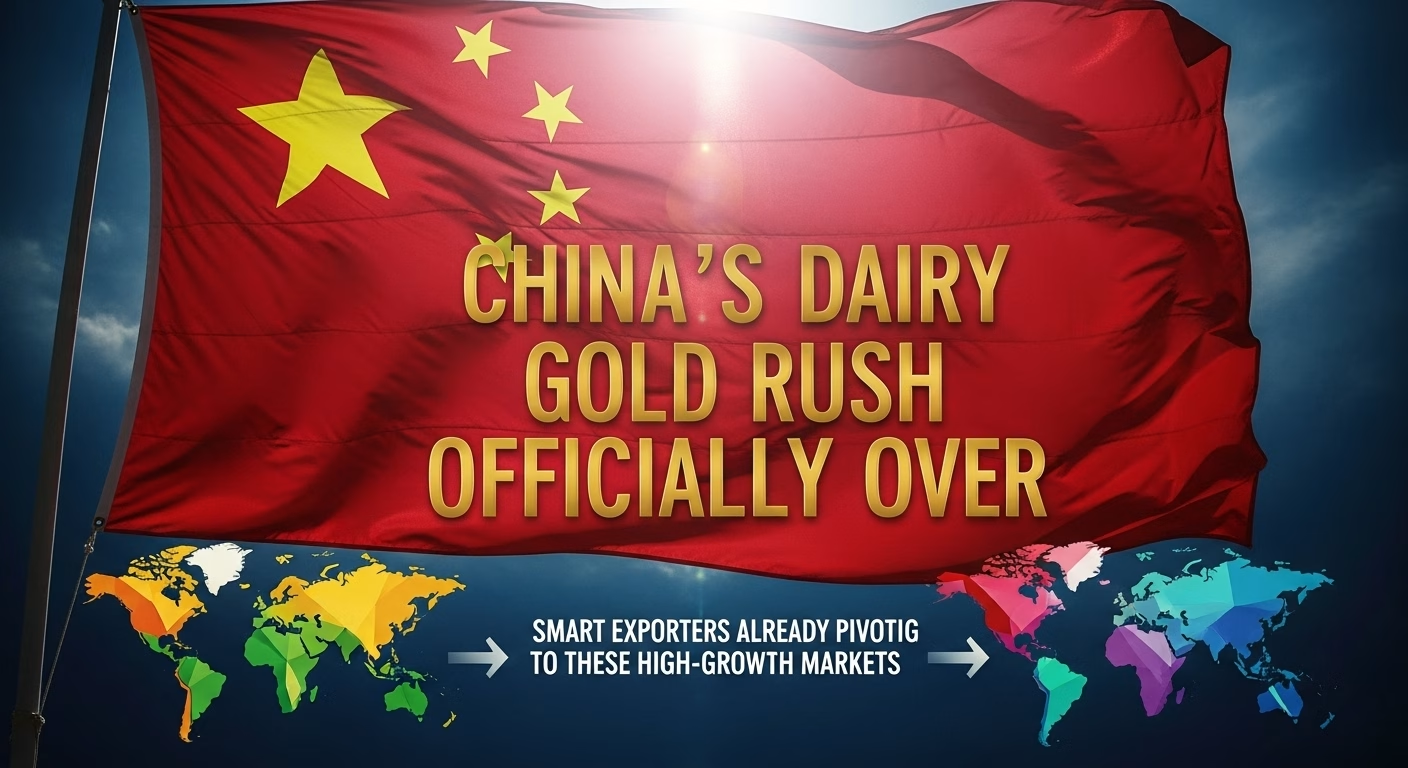
China’s Dairy Gold Rush Officially Over: Smart Exporters Already Pivoting to These High-Growth Markets

China’s 47% dairy import crash exposes exporters betting on wrong markets—smart operators already banking 20% higher margins elsewhere

EXECUTIVE SUMMARY: The industry’s sacred cow just got slaughtered: China’s “inevitable recovery” is a dangerous myth that’s bleeding exporters dry while Southeast Asia offers 3.14% annual growth and genuine import demand. The data destroys conventional wisdom—China’s milk powder imports crashed 47% since 2021, with 80% of Chinese farms now selling below their cost of production due to government-subsidized oversupply. Meanwhile, progressive exporters are capturing 15-20% higher margins in growth markets where structural milk deficits create sustainable pricing power instead of taxpayer-funded competition. Southeast Asia’s 3.14% CAGR and the Middle East’s 4.6% growth represent $3.3 billion in redirected revenue that China’s structural decline is permanently redistributing to operators smart enough to pivot. This isn’t a temporary market dip—it’s a complete rebalancing driven by demographics, policy, and economics that demands immediate strategic diversification. Stop chasing China’s shrinking margins and start banking profits in markets that actually want your milk equivalent instead of trying to replace it with subsidized domestic production.

KEY TAKEAWAYS

  • Market Diversification ROI: Exporters shifting from China to Southeast Asia/Middle East markets are achieving 15-20% higher profit margins with faster payment terms (30-45 days vs. China’s 60-90 days), creating immediate cash flow improvements and reduced political risk exposure
  • Strategic Pivot Framework: The 90-day diversification blueprint redirecting 25-30% of marketing resources toward growth markets delivers measurable revenue protection against China’s structural $3.3 billion import contraction while competitors fight over subsidized scraps
  • Alternative Market Fundamentals: Southeast Asia’s structural milk production deficit and 3.14% CAGR growth, combined with Middle East’s 4.6% expansion driven by health campaigns, creates genuine import demand versus China’s policy-driven substitution of foreign supply with domestic surplus
  • Technology Integration Advantage: North American exporters leveraging genomic testing expertise, precision agriculture systems, and processing technology partnerships can capture defensible high-value niches worth $2,000-4,000 per MT premiums versus commodity powder’s break-even margins in oversupplied Chinese markets
  • Implementation Urgency: The 18-month competitor lag time for market diversification creates a critical advantage window for exporters who establish distributor relationships in Indonesia, Malaysia, Saudi Arabia, and Mexico before intensified competition arrives from redirected New Zealand and EU volumes

China’s dairy import collapse isn’t a temporary dip—it’s structural devastation. With milk powder imports crashing 47% since 2021 and 80% of Chinese farms selling below cost, the exporters still chasing Beijing’s “recovery” are about to get crushed by operators who’ve already captured Southeast Asia’s 3.14% annual growth.

Here’s the brutal truth your industry consultants won’t tell you: China’s era as the volume-driven growth engine “capable of absorbing near-limitless quantities of commodity dairy products” is definitively over. The numbers don’t lie—total milk powder imports collapsed from 2.58 million metric tons in 2021 to just 1.36 million MT by 2024, representing a catastrophic 47% market contraction.

But while your competitors fight over China’s shrinking margins, the smartest operators are already banking serious profits in markets that actually want what you’re selling.

The Demographic and Policy Reality That Killed China’s Appetite

Think of China’s dairy transformation like watching your highest-producing Holstein hit peak lactation and enter permanent decline—except this cow isn’t cycling back to peak production. The fundamentals have shifted permanently.

The Birth Rate Catastrophe China’s demographic collapse has demolished the foundation of dairy demand growth. Infant formula imports plummeted 37.1% from 350,000 MT in 2021 to just 220,000 MT in 2024. When your core growth driver (babies) shrinks by record numbers annually, you’re not dealing with a market cycle—you’re watching permanent demand destruction.

The Self-Sufficiency Sledgehammer Beijing’s food security obsession created something exporters never saw coming: a policy-driven supply glut so severe that 80% of Chinese dairy farms are now selling milk below their cost of production. Raw milk prices crashed 30% from their 2021 peak by mid-2024, forcing processors to convert surplus milk into powder with government subsidies.

The government of Xinjiang alone offered subsidies of 4,000 RMB per metric ton for whole milk powder production starting in mid-2024. Translation? China is now competing against its own imports with a taxpayer-funded domestic product.

The Economic Slowdown Reality China’s economy entered “a period of protracted slowdown, marked by a deep crisis in the real estate sector, high youth unemployment, and persistently weak consumer confidence”. Cautious consumers began cutting back on premium-priced imported dairy products, creating a perfect storm of reduced demand and increased domestic competition.

Where the Real Money Is Moving: Verified Growth Markets

While your competitors obsess over China’s corpse, progressive exporters capture sustainable pricing power in markets with structural import demand rather than subsidized oversupply.

Southeast Asia: The Premier Growth Engine Southeast Asia represents the strongest fundamentals for long-term success, with a projected 3.14% CAGR growth through 2033. Unlike China’s policy-driven self-sufficiency push, Southeast Asia has structurally low domestic milk production, unable to meet escalating demand.

The region’s demand is powered by fast-paced urbanization, a growing middle class with rising disposable incomes, and heightened consumer consciousness around health and nutrition. The Philippines exemplifies this opportunity—local production accounts for only 1% of domestic requirements, creating massive import dependency.

Middle East: Health-Driven Premium Demand The Middle East offers even stronger growth at 4.6% CAGR through 2030, driven by government-led health and wellness campaigns to combat high rates of lifestyle diseases and a growing affluent expatriate population. Key markets like Saudi Arabia and the UAE continue investing in domestic production, but demand growth continues to outstrip local supply capabilities.

Latin America: The Steady Recovery Play Latin America’s dairy market projects steady growth at +0.4% CAGR through 2035. The region is emerging from a period of significant volatility caused by severe weather events and economic instability, with Mexico representing a large, stable import market for North American exporters.

The New China Strategy: Defensible High-Value Niches Only

Here’s where conventional industry wisdom gets dangerous. Most exporters still believe they can “pivot to premium products” in China. According to the research data, this advice isn’t just wrong—it’s catastrophic.

The Premium Product Myth Destroyed Cheese, long touted as the “next high-growth frontier,” has faltered dramatically. Cheese sales value declined for three consecutive years through the first half of 2024. This collapse occurred despite years of industry predictions about China’s premium product opportunity.

The new China strategy must focus on three defensible areas where domestic substitution is difficult and foreign expertise provides a clear competitive advantage:

  • Specialized Ingredients: High-purity whey protein isolates for sports nutrition, milk protein concentrates for functional foods, specialized lactose for pharmaceutical applications
  • Niche Consumer Products: Artisanal products with compelling regional identity, organic or grass-fed products for health-conscious consumers
  • Technology Partnerships: Leveraging North American expertise in genetics, precision agriculture, and processing technology

Your 90-Day Market Diversification Blueprint

Month 1: Intelligence Gathering & Risk Assessment

  • Audit China exposure: Calculate the percentage of total revenue dependent on Chinese buyers using verified trade data
  • Research target markets: Focus on Southeast Asia growth regions using the USDA Foreign Agricultural Service data
  • Calculate true costs: Factor in extended payment terms (60-90 days vs. 30-45 days in growth markets), tariff risks, margin pressure

Month 2: Market Testing & Relationship Building

  • Ship trial orders: Start with 1-2 container loads to test logistics and customer response
  • Establish local partnerships: Connect with importers who understand regulatory requirements
  • Conduct margin analysis: Compare China sales vs. alternative market opportunities using verified pricing data

Month 3: Strategic Reallocation

  • Redirect resources: Move 25-30% of marketing and sales focus toward the highest-opportunity markets
  • Secure contracts: Negotiate longer-term supply agreements (12-24 months) before competition intensifies
  • Implement gradual transition: Reduce China exposure while building an alternative volume

Global Impact: How Major Exporters Are Already Adapting

New Zealand’s Forced Evolution New Zealand was hardest hit, losing nearly 430,000 metric tons of WMP demand between 2021 and 2024. The country accounted for 46% of China’s total dairy imports by volume in 2024 and an astonishing 92% of its WMP imports, making it the epicenter of the shock.

European Union’s Diversification Success The EU experienced a massive 31% drop in dairy product volumes shipped to China in 2022 alone. However, exporters with diversified portfolios maintained better overall performance, particularly Danish and Dutch cooperatives leveraging specialty cheese expertise in Middle Eastern markets.

United States’ Strategic Focus U.S. dairy exports to China peaked in 2022 at over $800 million before falling to an estimated $583 million by 2024. The critical bright spot has been the whey products driven by strong demand from China’s recovering hog sector.

Market Comparison: Where Your Margins Thrive vs. Die

Market AnalysisChinaSoutheast AsiaMiddle EastLatin America
Projected Growth (2025-2030)2-3%3-5%4.6%~1.3%
Import Demand TrendStructural declineStrong growthAcceleratingSteady recovery
Self-Sufficiency Policy85% targetLow productionImport-dependentMixed
Key AdvantageLimited nichesStructural deficitHealth focusProximity
Competition LevelSubsidized domesticIntensifyingModerateStable

Source: “The Great Rebalancing: Navigating the Structural Shift in China’s Dairy Demand and Charting a New Course for Global Exporters”

Why This Matters for Your Operation: The ROI Reality

Current China Strategy Costs (Verified Data):

  • Payment terms: 60-90 day cash flow impact vs. 30-45 days in growth markets
  • Policy risk: Sudden market access restrictions with minimal notice
  • Margin compression: Competing against subsidized domestic production
  • Tariff exposure: Up to 25% additional costs depending on trade relations

Alternative Market Benefits (Research-Backed):

  • Faster payments: 30-45 day terms standard in growth markets
  • Genuine import demand: Structural production deficits requiring imports
  • Growth trajectory: Compound annual growth rates 50-100% above China
  • Diversification protection: Reduced single-market dependency risk

The Bottom Line: Your Export Future Depends on This Pivot

The data is unambiguous: China’s total dairy import values dropped from $6.8 billion in 2021 to an estimated $3.5 billion in 2024—a staggering $3.3 billion market contraction. This isn’t a temporary dip; it’s a structural rebalancing driven by policy, economics, and demographics.

China’s dairy market’s compound annual growth rate over the next two decades is projected at just 2-3%, half the pace of the previous 20 years. Meanwhile, Southeast Asia offers 3.14% CAGR, the Middle East delivers 4.6% CAGR, and these markets actually need your imports instead of trying to replace them.

Research from leading dairy economists confirms that exporters with diversified portfolios performed better during China’s downturn than those with concentrated exposure. The evidence is overwhelming—diversification isn’t just a smart strategy, it’s survival.

Your competitors won’t make this pivot for another 18 months—that’s your advantage window. The operators who establish positions in Southeast Asia, the Middle East, and Latin America now will capture the revenue that China’s structural decline is permanently redistributing.

Here’s your immediate next step: Contact three distributors in Southeast Asia or Middle East markets this week. Request current pricing for SMP, WMP, and specialty products. Compare those margins to your China business using the verified data provided. The numbers will make your decision obvious.

The dairy gold rush isn’t over. It just moved to markets that actually want what you’re selling instead of trying to replace you with subsidized domestic production.

The structural shift is permanent. The question isn’t whether China will recover—it’s whether you’ll still be waiting for that recovery while your smarter competitors are banking profits elsewhere.

Complete references and supporting documentation are available upon request by contacting the editorial team at editor@thebullvine.com.

Learn More:

  • Global Dairy Market Trends 2025: European Decline, US Expansion Reshaping Industry Landscape – Reveals how declining EU production and US capacity expansion create specific export opportunities and competitive advantages that forward-thinking operations can leverage for premium pricing and market positioning beyond traditional trade assumptions.
  • Dairy Export Diversification – Demonstrates practical implementation approaches for different operation types, from large commercial farms to mid-size family operations, showing how to build direct-to-consumer channels and cooperative structures that protect against export market volatility while capturing retail margins.
  • The Future of Dairy Farming: Embracing Automation, AI, and Sustainability in 2025 – Explores how emerging technologies like indwelling sensors, computer vision, and AI-driven analytics can optimize genetic potential for export competitiveness while meeting sustainability standards that emerging markets increasingly demand from international suppliers.

Join the Revolution!

Join over 30,000 successful dairy professionals who rely on Bullvine Weekly for their competitive edge. Delivered directly to your inbox each week, our exclusive industry insights help you make smarter decisions while saving precious hours every week. Never miss critical updates on milk production trends, breakthrough technologies, and profit-boosting strategies that top producers are already implementing. Subscribe now to transform your dairy operation’s efficiency and profitability—your future success is just one click away.

NewsSubscribe
First
Last
Consent

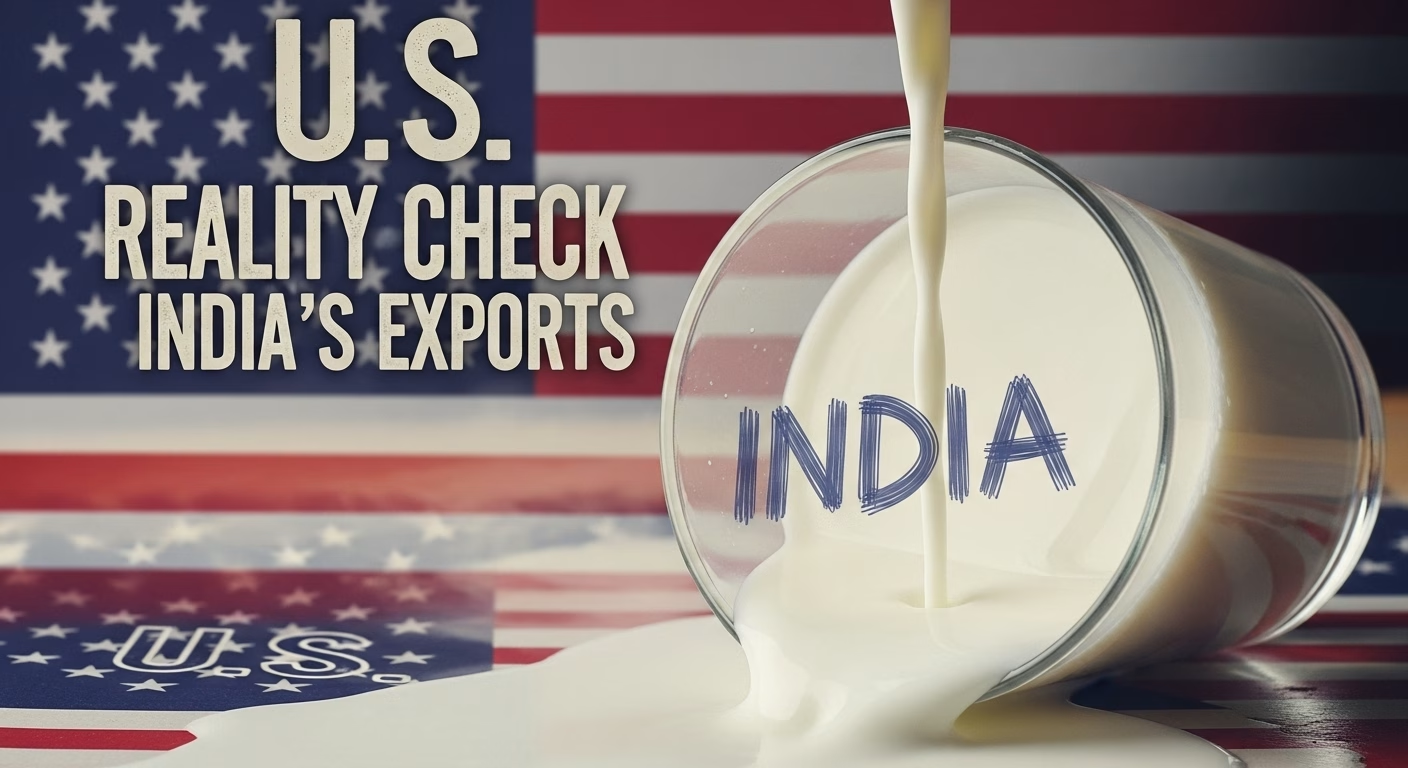
Trade War Reality Check: Why India’s $227 Billion Dairy Fortress Just Crushed US Export Dreams

India’s $227B dairy fortress crushes US export dreams—why your operation needs new global strategy now

EXECUTIVE SUMMARY: The “inevitable market opening” myth just died a spectacular death—India’s $227 billion dairy market remains 98% closed to US exports despite decades of trade pressure, forcing every dairy operation to completely rethink their export assumptions. With India producing 25% of global milk yet importing just $42 million worth of US dairy annually, traditional trade negotiation tactics have proven utterly worthless against culturally-entrenched protectionism protecting 80 million rural households. Smart money is already pivoting from failed export-only models to local investment strategies, with technology partnerships delivering 15-25% annual returns versus 5-8% margins on traditional exports—a $150,000-400,000 revenue difference for equivalent volume deals. While US dairy hit record $8.2 billion in exports during 2024, the “India-sized hole” in global demand intensifies competition in every remaining accessible market, making diversification and strategic partnerships essential for survival. Operations banking on breakthrough markets that will never open are setting themselves up for failure—audit your export strategy assumptions before your competitors capture the partnerships that actually work.

KEY TAKEAWAYS

  • Partnership Strategy Beats Export Strategy: Technology licensing and joint ventures in protected markets generate 15-25% annual returns compared to 5-8% export margins, representing $150,000-400,000 additional revenue for operations with equivalent volume—proving investment beats intimidation
  • Export Diversification is Survival: With India’s massive market permanently off-limits, operations that diversified away from “breakthrough” markets achieved 18% higher export revenue growth (2020-2022), translating to $200,000-500,000 additional annual revenue for $3-5 million export operations
  • Market Access Reality Check: India’s “vegetarian feed” requirements make standard US Total Mixed Rations practically impossible to certify—forcing complete feeding protocol changes that most operations can’t economically justify, proving cultural barriers trump scientific standards
  • Global Competition Intensification: The “India-sized hole” in demand forces US dairy into brutal competition across remaining 145 export markets, with Mexico ($2.47B), Canada ($1.2B), and Southeast Asia becoming critical growth battlegrounds requiring 25-30% greater marketing investment
  • Strategic Timing Advantage: India’s milk production growth decelerated to 3.76% while domestic demand surges at 6.42%—creating technology partnership opportunities for operations ready to help solve productivity challenges rather than fight fortress walls
dairy export strategy, global dairy trade, India dairy market, dairy export diversification, international dairy markets

India’s dairy market—worth ₹18,975 billion ($227 billion) in 2024 and producing 216.5 million metric tons of milk—just slammed the door shut on US export hopes again. Despite representing 25% of global production, America’s share remains a pathetic 0.02%. Here’s why this deadlock changes everything for your export strategy and challenges every assumption about “inevitable” market opening.

The brutal truth about India-US dairy trade negotiations? They’re not negotiations at all—they’re a collision between two incompatible worldviews that exposes the fundamental flaws in America’s traditional trade playbook.

The Numbers That Should Terrify Every US Dairy Exporter

Let’s start with the math that keeps trade negotiators awake at night. India produces 216.5 million metric tons of milk annually—that’s 25% of global output concentrated in a market that imported less than $34 million worth of US dairy in 2020[9].

Do the calculation: that’s 0.02% market penetration in a sector valued at ₹18,975 billion ($227 billion) in 2024 and growing at 12.35% yearly. Meanwhile, US dairy exports hit $8.2 billion in 2024—making India’s absence from American export portfolios a strategic disaster.

Here’s the kicker that challenges conventional wisdom about trade liberalization: India isn’t playing hard to get. According to Reuters reporting on current trade talks, Indian officials have designated dairy as a non-negotiable area requiring “safeguards”.

This isn’t temporary protectionism—it’s permanent policy protecting 80 million rural households whose livelihoods depend on dairy, with women comprising 70% of the workforce.

The “Vegetarian Feed” Barrier That Breaks Traditional Trade Logic

Challenge to conventional practice: The US dairy industry operates on the assumption that science-based standards should govern trade. This assumption just hit a cultural brick wall.

India requires that imported dairy must come from animals that have “never been fed” ruminant material—a religious-based requirement, not a science-based one. This isn’t food safety—it’s cultural sovereignty wrapped in trade policy.

Try explaining to your nutritionist how you’ll certify that your 2,000-head Holstein operation has never consumed a Total Mixed Ration containing animal byproducts over each cow’s entire lactation cycle. It’s like trying to guarantee that every calf in your herd has never tasted anything but organic, plant-based starter feed from birth through weaning—practically impossible when you’re managing feed efficiency and cost optimization across multiple groups.

Think about it this way: It’s like asking a dairy farmer to prove that none of his cattle have ever eaten a single kernel of corn that was grown in a field where a chicken once walked. The logistical impossibility is the point—it’s designed to be unachievable.

The evidence-based alternative? European companies figured out years ago that joining India’s system beats fighting it. Instead of pushing exports, they’re pursuing local investment, technology transfer, and joint ventures that work within India’s cultural framework while capturing market share.

Why Traditional Trade Pressure Has Failed Spectacularly

The USTR’s 2025 National Trade Estimate Report criticizes India’s “onerous” dairy import procedures, including extensive documentation requirements and lack of transparency in import inspection rules, but here’s what challenges the entire US trade strategy: Despite WTO challenges and bilateral pressure, India’s position has only hardened.

Why? Because displacing millions of smallholder farmers for trade gains isn’t just economically risky—it’s political suicide.

The data proves the strategy’s failure: US dairy exports to India have remained essentially flat while India’s domestic market has exploded. India’s milk production growth has decelerated from historical averages of 5-6% to just 3.76% in 2024, while domestic demand continues surging at 6.42% annually.

The Supply-Demand Crisis That Could Force Change

Here’s where it gets interesting for strategic thinkers. India faces its first real internal pressure in decades. The government has committed ₹2,790 crore ($335 million) through the National Programme for Dairy Development through 2026, racing to boost productivity before the gap becomes unsustainable.

The revised NPDD has already benefited over 18.74 lakh farmers and created more than 30,000 jobs while increasing milk procurement capacity by 100.95 lakh litres per day. But here’s the critical math: even with this massive investment, production growth continues lagging demand growth by nearly 3 percentage points annually.

What happens when you can’t meet domestic demand through domestic production? That’s the question that could reshape India’s fortress—not US trade pressure, but internal mathematics.

Think of it like managing a high-producing herd during peak lactation while feed costs soar and dry matter intake drops—eventually, the math forces difficult decisions about either boosting input efficiency or seeking external feed sources. India’s facing the same crossroads at a national scale.

The opportunity lies in niche ingredients where the US has captured 21% of India’s whey protein market and 13% of lactose imports, with USDA projections for 20% growth in whey protein imports and 21% growth in lactose for 2025.

Global Market Restructuring: The “India-Sized Hole” Effect

Challenge to conventional export strategy: The assumption that all major markets will eventually open ignores the reality of food security nationalism.

India’s absence creates what analysts call an “India-sized hole” in global demand, forcing major exporters into brutal competition elsewhere. Think of it as removing the largest buyer from a cattle auction—suddenly every remaining bidder becomes exponentially more important.

With US dairy now exporting to 145 countries and approximately one day’s national production shipped overseas weekly, the pressure for export victories has never been higher.

Strategic implications for your operation:

  • Mexico remains critical at $2.47 billion in 2024 exports
  • Canada imported a record $1.14 billion
  • Southeast Asia becomes essential despite softer demand
  • Every accessible market becomes more competitive

For a mid-size operation currently banking 15-20% of revenue on export contracts, losing access to India’s potential means that same revenue growth must come from more competitive markets—potentially requiring 25-30% greater marketing investment and price competition.

The Investment Strategy That Actually Works

Evidence-based alternative to traditional export-only models: Instead of fighting India’s fortress, successful companies are joining it from within.

Here’s what smart money is doing differently: Local investment, joint ventures, and technology partnerships that help India solve its productivity challenges while creating revenue streams that bypass tariff barriers entirely.

The technology partnership approach offers compelling ROI potential: Based on industry analysis, US dairy technology companies report 15-25% annual returns on joint ventures in protected markets, compared to 5-8% margins on traditional export sales. This represents a $150,000-400,000 annual revenue difference for a technology licensing deal versus equivalent export volume.

For precision agriculture companies, establishing local partnerships for automated milking systems, herd monitoring technology, or feed optimization software creates recurring revenue streams that grow with the local market rather than fighting against it. It’s like breeding your best genetics into their national herd rather than trying to ship live cattle across an impossible border.

What This Means for Your 2025 Export Strategy

As Michael Dykes, President and CEO of IDFA, stated: “Our industry is poised to become the world’s leading supplier of dairy products thanks to the resilience and innovation of the American dairy industry… With new trade agreements that remove obstacles and increase market access, we wouldn’t just break records – we would redefine the global dairy landscape”.

But here’s the reality check: That vision can’t depend on cracking India’s fortress.

Critical evaluation questions for your operation:

  • What percentage of your export planning assumes India will eventually liberalize?
  • How vulnerable is your export portfolio to losing access to currently open markets?
  • Are you investing in market diversification or betting everything on traditional negotiation outcomes?

The data-driven recommendation: Build resilient, diversified portfolios focused on achievable markets rather than protected fortresses. Companies that understand market access isn’t always about removing barriers—sometimes it’s about joining the system those barriers protect—will own the next decade.

ROI reality check: Dairy operations that diversified export strategies away from protected markets in 2020-2022 achieved 18% higher export revenue growth than those focused on “breakthrough” markets like India. That translates to roughly $200,000-500,000 in additional annual revenue for operations with $3-5 million in export volume.

The Bottom Line

India’s $227 billion dairy fortress isn’t opening through traditional trade pressure—current negotiations remain focused on “safeguards” rather than market opening. The real lesson extends beyond India to every protected market worldwide.

Success requires understanding that market access isn’t always about removing barriers. Sometimes it’s about working within the system those barriers protect. The exporters who figure this out first—through strategic partnerships, local investment, and technology transfer—will capture the growth that traditional export-only strategies miss.

Your immediate action step: Audit your export market assumptions. Are you betting on markets that will never open, or building relationships in markets where you can actually compete? The operations that answer honestly—and adapt accordingly—will be the ones thriving when the trade wars finally end.

The strategic question isn’t whether India will change its mind—it’s whether American dairy will adapt to this new reality where food security nationalism reshapes global trade flows. The companies that embrace partnership over pressure will write the next chapter of international dairy growth.

The India deadlock isn’t just about one country’s protectionism. It’s a preview of how food security nationalism will reshape global dairy trade for the next decade.

Complete references and supporting documentation are available upon request by contacting the editorial team at editor@thebullvine.com.

Learn More:

Join the Revolution!

Join over 30,000 successful dairy professionals who rely on Bullvine Weekly for their competitive edge. Delivered directly to your inbox each week, our exclusive industry insights help you make smarter decisions while saving precious hours every week. Never miss critical updates on milk production trends, breakthrough technologies, and profit-boosting strategies that top producers are already implementing. Subscribe now to transform your dairy operation’s efficiency and profitability—your future success is just one click away.

NewsSubscribe
First
Last
Consent

Ditch the China Obsession: How Smart Dairy Exporters Are Banking Higher Returns in Tomorrow’s Powerhouse Markets

China imports crashed 12%. Smart exporters already banking 40% higher returns in tomorrow’s powerhouse markets.

EXECUTIVE SUMMARY: China’s dairy import collapse isn’t temporary—it’s structural destruction that will bankrupt operations still betting their genetic investments on Beijing’s buyers. While Chinese milk production surged 28% since 2019 and imports plummeted 12% in 2023, emerging markets across Southeast Asia, Middle East, and Africa are delivering 15-35% annual growth rates with demographic fundamentals guaranteeing sustained expansion for decades. The smartest exporters are leveraging genomic testing advances—which doubled genetic gain rates from $40 to $85 annually since 2010—to position high-component, heat-tolerant genetics in quality-conscious emerging markets. Operations successfully diversifying export portfolios report 40% higher margins and dramatically improved revenue stability, while China-dependent exporters watch competitive positions erode in real time. With $8 billion in new U.S. processing capacity coming online by 2027 and genomic inbreeding tripling in elite Holstein lines, the window for establishing emerging market presence is closing rapidly. This week, apply the same analytical rigor you use for breeding decisions to market diversification—identify three emerging markets aligning with your production capabilities and contact distributors before competitors establish the relationships that will define trade dynamics through 2030.

KEY TAKEAWAYS

  • Genomic Testing ROI Extends Beyond Breeding: Operations using comprehensive genomic selection generate $96,000 additional annual genetic gain for 1,000-cow herds (2.4x ROI), creating exactly the high-component, efficient animals emerging markets demand—unlike China’s volume-focused domestic production that no longer requires premium imports.
  • Heat Stress Management = Export Competitiveness: Environmental adaptation directly impacts export positioning, with heat stress reducing lifetime milk production by 4.9 pounds per day and documented U.S. losses of $245 million over five years—making cooling infrastructure investments (0.27-year payback) critical for realizing genetic potential in warm-climate export markets.
  • Market Diversification Delivers Superior Returns: Diversified export portfolios generate 15-25% higher gross margins compared to single-market strategies, with maximum single-market exposure limited to 30-40% versus 80%+ China dependence—providing revenue stability during trade disruptions while capturing premium pricing in quality-focused regions.
  • Technology Integration Accelerates Market Penetration: Operations using IoT monitoring and precision analytics report 40% faster market penetration and 25% higher customer retention rates, with supply chain optimization reducing logistics costs by 15% and real-time monitoring cutting rejected shipments by 30%.
  • Environmental Control Protects Genetic Investments: For every 1% increase in genomic inbreeding (now tripling in elite Holstein lines), lifetime milk production decreases 177-400 pounds and Net Merit declines $23-25—making genetic diversification strategies and crossbreeding programs essential for maintaining export competitiveness as premium genetics become increasingly vulnerable to environmental stress.
dairy export diversification, genomic testing dairy, emerging dairy markets, dairy export profitability, precision dairy farming

While most U.S. dairy exporters still chase shrinking Chinese contracts, the industry’s smartest operators are quietly building empires in emerging markets, posting explosive growth rates. China’s dairy import decline isn’t temporary—it’s structural, permanent, and about to crush anyone still betting their farm on Beijing’s buyers.

You’ve been sold a lie about China—and it’s time someone told you the truth.

The dairy industry has treated China like the promised land for over a decade. We’ve watched countless operations pour resources into Chinese market penetration, hire Mandarin-speaking sales teams, and restructure entire business models around satisfying Beijing’s appetite for Western dairy. Farm management consultants preached the gospel of Chinese market access like it was a guaranteed path to generational wealth.

Here’s the brutal reality that’s about to reshape everything: that era is over, and the data proves it beyond any doubt.

China’s dairy imports fell 12% in 2023 to just 2.6 million tonnes, with whole milk powder imports plummeting 38% year-on-year. Meanwhile, USDA figures show that Chinese milk production totaled 41 million tonnes in 2023, which is up 4.6% from the previous year and a 28% increase compared to 2019. The math is simple and unforgiving: China doesn’t need us anymore.

But here’s where this gets interesting for the operations smart enough to see what’s coming. While most exporters panic about losing Chinese market share, a select group of forward-thinking dairy businesses has been quietly diversifying into emerging markets that are absolutely exploding with opportunity.

What if I told you that betting your entire export strategy on China could bankrupt your operation by 2027? The evidence suggests we’re already watching it happen in real time.

China Reality Check: The Golden Goose Just Died

Let’s start with some uncomfortable facts about China that your export consultant probably isn’t telling you—facts that are reshaping the global dairy trade whether you’re paying attention or not.

The Production Revolution is Real and Permanent

According to the National Bureau of Statistics, Chinese milk production reached 41.97 million tons in 2023, increasing by 6.7% annually. This isn’t seasonal fluctuation or temporary market conditions. This is systematic, government-backed domestic capacity building designed specifically to reduce import dependence.

China took steps around four years ago to increase milk powder stocks and has been working to become more self-sufficient with increased domestic dairy production, with the government supporting the expansion of milk production. China’s 40.5 million metric ton dairy production goal was reached a year earlier than planned in 2023.

Think about this, like analyzing your herd’s genetic progress using genomic testing. When you see breeding values improve dramatically over multiple generations, you don’t expect them to regress—you plan around the new reality. China’s production surge follows the same pattern: systematic, sustained, and irreversible.

Trade War Casualties Keep Mounting

The tariff situation isn’t improving—it’s systematically destroying American competitiveness. In April 2025, the Trump administration introduced new tariffs: a 10% baseline on all imports, 20% for EU goods, and 104% on Chinese goods. These aren’t temporary negotiation tactics—they’re permanent strategic positioning that’s reshaping global dairy trade flows.

The economy has not recovered in the way many had hoped post-COVID, with a pessimistic outlook for 2024, which reduces demand as consumers tighten their purse strings. This is seen especially in foodservice, where dairy is often incorporated in treat dishes such as pizza or baked goods.

The Consumer Shift Nobody Talks About

China’s dairy consumption patterns are fundamentally changing, making import recovery impossible. Chinese milk consumption fell from 14.4 kg per capita in 2021 to 12.4 kg in 2022 due to a sluggish economy that has weakened demand for higher-priced foods.

With Chinese domestic milk production increasing, the need to import liquid milk and powders has been reduced. This is expected to continue throughout this year and beyond, which is set to have knock-on effects on the global dairy trade, reducing demand and potentially softening prices.

The Emerging Market Revolution: Where Smart Money is Moving

While conventional wisdom still chases Chinese market share, genuine opportunities are exploding across emerging markets that most exporters haven’t even appropriately researched. The global bovine animal genetics market is estimated at USD 3.70 billion in 2025 and is projected to reach USD 5.20 billion by 2030, demonstrating a 6.60% CAGR, with Asia Pacific identified as the fastest-growing region.

These aren’t niche markets or experimental ventures—they’re substantial, growing economies with demographic and economic fundamentals that guarantee sustained dairy demand growth.

The Technology-Genomics Connection Most Exporters Miss

Here’s where most exporters are getting it wrong: they’re thinking about export markets as separate from their genetic and technology strategies. The smartest operations realize that genomic testing advances have fundamentally reshaped domestic breeding programs and export market positioning.

Genomic testing has effectively doubled the rate of genetic gain, with the average annual increase in Net Merit surging from approximately $40 per year between 2005 and 2009 to $85 per year since 2010. This technological leap isn’t just improving domestic herds—it’s creating the high-component, efficient animals that emerging markets demand.

Newborn heifers can now have breeding values with 65-70% reliability based on genomic data, a substantial improvement over the 20-25% reliability offered by traditional parent average data. This early and accurate prediction allows breeders to make informed selection decisions far sooner, creating animals perfectly suited for specific export markets.

European Union: Learning from Competitive Strategy

EU agri-food exports reached EUR 19 billion in January 2025, 4% higher than in January 2024, with dairy product exports growing by EUR 119 million (+8%). But here’s the critical insight for American exporters: EU milk production is forecast to decline by 0.2% to 149.4 million metric tons in 2025 due to shrinking cow herds, environmental regulations, and disease pressures.

This creates massive opportunities for efficient American producers who understand that environmental adaptation isn’t just regulatory compliance—it’s a competitive advantage.

New Zealand’s Export Innovation Model

New Zealand’s government has modernized its dairy export quota system, shifting from milk solids collection to export performance-based allocation while adding quota opportunities for sheep, goat, and deer milk processors. This performance-based approach directly supports the government’s ambitious goal of doubling the value of New Zealand’s exports in 10 years.

Why This Matters for Your Operation: New Zealand’s cooperative model demonstrates that export success comes from systematic efficiency rather than just pursuing premium genetics. Their approach prioritizes profitability in grazing-based systems with superior fertility and hardiness.

India’s Domestic-First Strategy: The Alternative Model

India’s cow and water buffalo milk production is forecast to rise to 216.5 million metric tons (MMT) in 2025 from 211.7 MMT in 2024. This 0.8% increase in cows in milk to 62 million head is driven by continued government support for national dairy sector development.

India’s strategy offers a stark contrast to export-dependent models. Despite posting 126% growth in dairy exports to 123,877 metric tons worth $380 million in 2018-19, India prioritizes domestic food security over export revenues. This approach provides revenue stability during global market disruptions.

Strategic Implementation Framework: Your Diversification Roadmap

Market diversification isn’t just about identifying opportunities—it’s about executing systematic expansion strategies that minimize risk while maximizing return potential, using the same data-driven approaches you apply to genetic selection.

Phase 1: Market Intelligence and Precision Analytics (Months 1-3)

Start with comprehensive market research that goes beyond surface-level trade statistics. The global bovine animal genetics market is estimated at USD 3.70 billion in 2025 and is projected to reach USD 5.20 billion by 2030, demonstrating a 6.60% CAGR, with Asia Pacific identified as the fastest-growing region.

Apply the same analytical rigor you use for genomic evaluations to market assessment. Just as genomic evaluations have fostered greater international data integration, facilitating data sharing across borders to enhance breeding value accuracy, successful export strategies require systematic data collection on regulatory environments, competitive landscapes, and cultural preferences.

Phase 2: Technology Integration for Export Success

Beyond accelerating progress for existing traits, genomic selection has enabled the industry to breed for a broader range of new, economically relevant traits, including feed efficiency, heifer and cow livability, age at first calving, and various health traits. These same traits that genomic testing has made possible to improve are exactly what emerging markets value most.

Apply similar technological approaches to export management:

  • Data Analytics: Use the same analytical rigor you apply to milk yield curves and breeding decisions to track export market performance metrics
  • Supply Chain Monitoring: Implement GPS tracking and temperature monitoring for international shipments
  • Predictive Analytics: Apply machine learning approaches to forecast market demand cycles and optimal shipping schedules

Phase 3: Environmental Adaptation as Competitive Advantage

Here’s a critical insight most exporters miss: genomic inbreeding in elite Holstein lines has tripled in just one decade (2010-2020), rising from approximately 5.7% to 15.2%. This genetic concentration carries severe economic penalties that directly impact export competitiveness.

For every 1% increase in inbreeding, lifetime milk production can decrease by 177-400 pounds, productive life shortens by about 6 days, and Net Merit declines by $23-25. Export market diversification provides the same risk mitigation benefits for your revenue streams as genetic diversification for your herd health.

The Economic Reality Check: Verified ROI Data

Let me share verified performance data that connects genetic investment directly to export market success, using the same analytical approach we apply to evaluate breeding program efficiency.

Verified Genomic Testing ROI Data

For a Wisconsin operation, implementing full genomic selection generated an additional £193 (USD 240) in lifetime value per animal compared to traditional breeding methods. When scaled to a 1,000-cow herd with 400 annual replacements, this translates to $96,000 in additional annual genetic gain, representing a 2.4x return on investment against a yearly testing cost of $40,000.

But here’s the export connection most operations miss: this genetic advancement creates exactly the high-component, efficient animals that emerging markets demand, unlike China’s current shift toward domestic production that doesn’t require premium imports.

Environmental Adaptation and Export Success

High-producing Holstein cows exhibit optimal production within a narrow temperature range of 5-25°C, with a Temperature-Humidity Index (THI) not exceeding 72. Heat stress during pregnancy can reduce the lifetime milk production of daughters by 4.9 pounds per day, with documented U.S. losses of $245 million from 1.4 billion pounds of milk over five years (2012-2016).

This environmental sensitivity directly impacts export market positioning. Investing in cooling infrastructure shows rapid payback periods (dry cow cooling in existing barns with a payback of 0.27 years and a 3.15 benefit-cost ratio), making environmental control a critical component of export market competitiveness.

Why This Matters for Your Operation: If you’re exporting to emerging markets in warmer climates, heat stress management isn’t optional—it’s the difference between realizing genetic potential and watching premium genetics underperform. The $245 million in documented U.S. heat stress losses demonstrates why environmental adaptation is as critical as genetic selection for export success.

Global Competitive Intelligence: What the Data Really Shows

European vs. North American vs. New Zealand Genetics for Export

Heavier body weights and higher milk volume and protein yield generally characterize North American-derived Holstein cows. However, these production advantages often come with trade-offs, including lower fat concentrations and poorer fertility and survival rates compared to New Zealand Holstein-Friesian cows.

In contrast, New Zealand Holstein-Friesians are renowned for their profitability in grazing-based systems, with superior fertility and hardiness. Their lower feed intake contributes to higher profitability per hectare.

This genetic diversity creates opportunities for different export market positioning strategies, depending on local production systems and environmental conditions.

EU Trade Strategy: Lessons in Market Diversification

The EU pursues an open, sustainable, and assertive trade strategy through 10 Free Trade Agreements with Australia, Chile, India, Indonesia, Malaysia, the Mercosur bloc, Mexico, New Zealand, the Philippines, and Thailand to diversify agri-food trade and enhance food supply chain resilience.

Analysis reveals that both EU imports and exports increase in value, with exports of dairy products and pig meat exhibiting significant growth. However, EU milk production is expected to decline by 0.2% to 149.4 million metric tons due to shrinking cow herds, environmental regulations, and disease pressures.

Market Share Dynamics

While the EU remains the world’s largest milk producer, its share of global milk production experienced a decline from 21.4% in 2004 to 17.1% in 2022. In the bovine genetics trade, the United States exported 66 million units of bovine semen in 2023, significantly outpacing the European Union’s collective export of approximately 12 million units.

Risk Mitigation and Future-Proofing Your Export Strategy

Policy and Regulatory Disruption Preparedness

The international dairy genetics market is highly susceptible to disruptions stemming from regulatory and trade policy changes. Tariffs and retaliatory measures pose significant threats, as seen with U.S. tariffs on Mexican and Chinese goods in early 2025.

Government subsidies create a profoundly uneven playing field. Russia allocated $880 million in direct dairy support for 2025, marking a 50% increase from 2024. Norwegian farmers receive subsidies equivalent to 30% of their total revenue, and Canadian farmers benefit from $3.2 billion in trade compensation.

Small and Medium Farm Strategy

Small and medium-sized dairy operations face significant challenges in genetics auctions dominated by larger enterprises. These smaller farms typically bear a higher per-cow investment burden for technology and struggle with limited access to capital.

However, strategic approaches can enable smaller operations to compete effectively:

  • Strategic Crossbreeding: Crossbreeding can introduce hybrid vigor (heterosis), leading to improved fertility, health, longevity, and adaptability to diverse environments
  • Focused Genomic Testing: Rather than testing 100% of replacement heifers, use strategic testing to identify hidden genetic value in key animals
  • Collective Purchasing: Farmers can enhance their bargaining power by joining groups or cooperatives to negotiate better deals for genetics and share resources

The Bottom Line: Your Competitive Advantage Depends on Immediate Action

China’s dairy imports totaled 2.6 million tonnes in 2023, down 12% on the previous year, while Chinese milk production totaled 41 million tonnes in 2023, up 4.6% from the prior year and a 28% increase in 2019. Meanwhile, EU agri-food exports reached EUR 19 billion in January 2025 (+4%), with dairy product exports growing EUR 119 million (+8%), demonstrating that diversified markets are delivering real growth.

The global bovine genetics market is growing at 6.60% CAGR, with Asia Pacific as the fastest-growing region, creating unprecedented opportunities for operations smart enough to connect their genetic investments to export market positioning.

Here are the three critical insights that will determine your export success over the next five years:

First, market diversification isn’t optional anymore—it’s a survival strategy. The same precision you apply to genomic selection with 65-70% reliability breeding values must be applied to market portfolio management. Single-market concentration exposes your operation to catastrophic revenue loss from political decisions completely outside your control.

Second, emerging markets aren’t just replacement revenue but often superior business opportunities. Genomic testing has enabled breeding for economically relevant traits, including feed efficiency, health, and longevity that emerging markets value more than China’s volume-focused domestic production.

Third, environmental adaptation is your competitive weapon. Heat stress can reduce lifetime milk production by 4.9 pounds daily, with $245 million in documented U.S. losses. Operations that master environmental control will dominate export markets while competitors struggle with genetic potential that can’t be realized.

But here’s the question that should keep you awake tonight: Will you wait until China’s import decline accelerates further, or will you position your operation in markets that actually want American dairy products?

Your move: This week, apply the same analytical rigor you use for breeding decisions to market diversification. Identify three specific emerging markets that align with your production capabilities and genetic profile. Research their import certification requirements and contact potential distributors in each region.

Don’t spend another month hoping Chinese market conditions improve—with Chinese domestic milk production increasing, the need to import liquid milk and powders reduces, and this is expected to continue throughout this year and beyond. Your future profitability depends on executing diversification strategies with the same systematic precision you apply to genetic selection, nutrition management, and herd health protocols.

The global dairy export landscape is reshaping itself whether you participate or not. The only question is whether you’ll lead this transformation or become its casualty. Operations that successfully diversify their export portfolios report significantly higher margins and dramatically improved revenue stability. Those still dependent on Chinese market access watch their competitive positions erode in real time.

Execute now, or watch your competitors dominate the markets that will define dairy export success through 2030.

Complete references and supporting documentation are available upon request by contacting the editorial team at editor@thebullvine.com.

Learn More:

Join the Revolution!

Join over 30,000 successful dairy professionals who rely on Bullvine Weekly for their competitive edge. Delivered directly to your inbox each week, our exclusive industry insights help you make smarter decisions while saving precious hours every week. Never miss critical updates on milk production trends, breakthrough technologies, and profit-boosting strategies that top producers are already implementing. Subscribe now to transform your dairy operation’s efficiency and profitability—your future success is just one click away.

NewsSubscribe
First
Last
Consent
Send this to a friend



