Archive for community resilience

From 6 Crises to 75 Tractors: Reed Hostetler’s Death and the $470K Page That Rewrote Dairy’s Road

OSHA priced six dead dairy workers at $246,609. Wayne County priced one dead dairyman at 75 tractors and weeks of unpaid chores.

Reed Hostetler was 31, co-owner of L&R Dairy in Marshallville, Ohio, and father of three kids under five. On March 5, 2025, he was killed in an accident involving the manure pit at the family farm.

Within days, the same barn where Reed and Abby Hostetler had been married was pressure-washed, scraped, and transformed into a funeral venue — by neighbours who showed up without being asked. An estimated 75 to 100 tractors, trucks, semis, and implements lined the road outside Grace Church in Wooster, organized by local farmers and custom harvesters, according to Farm and Dairy. Weeks later, people were still arriving before dawn to feed calves and clean pens, then leaving before anyone could thank them.
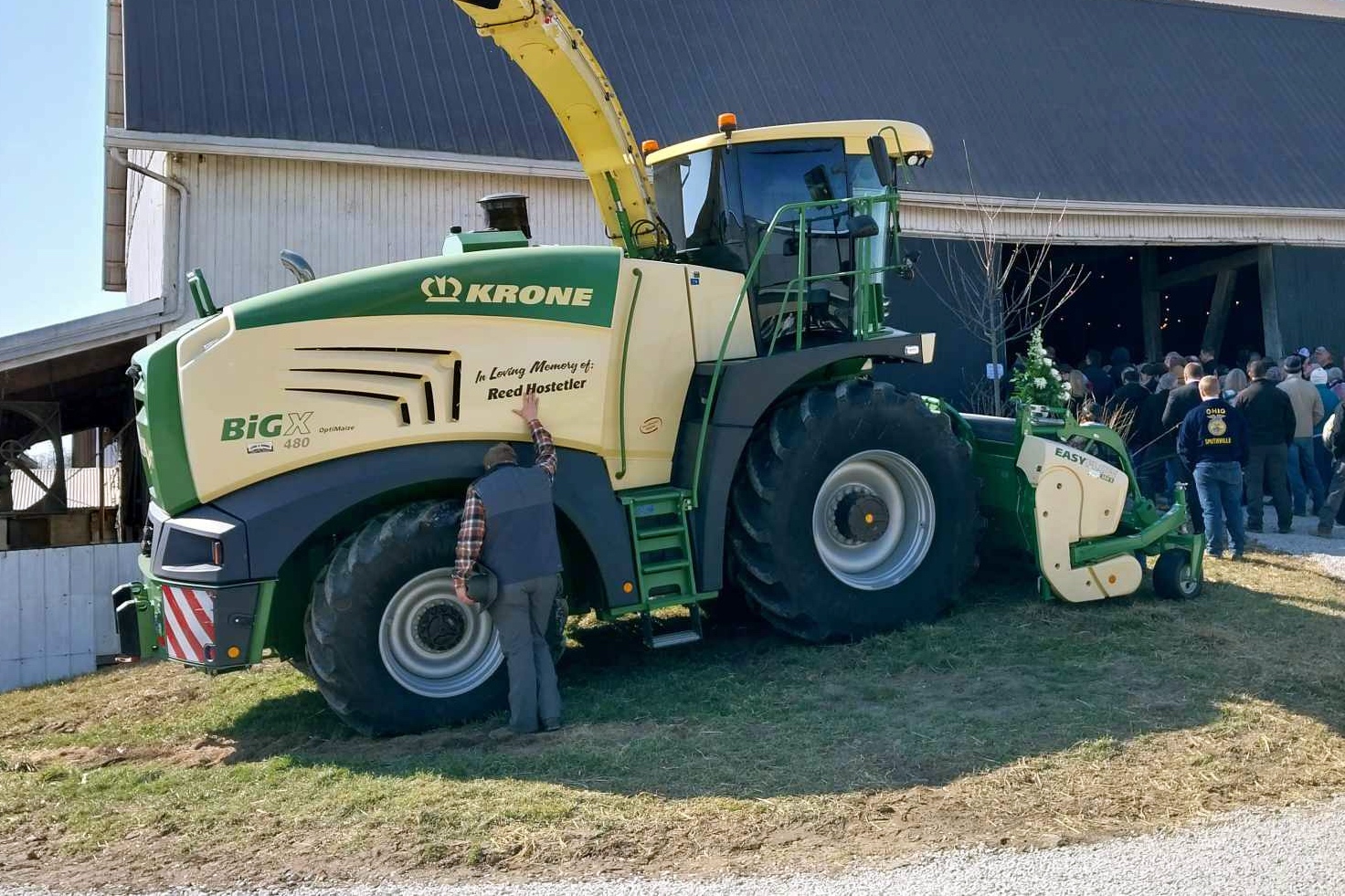
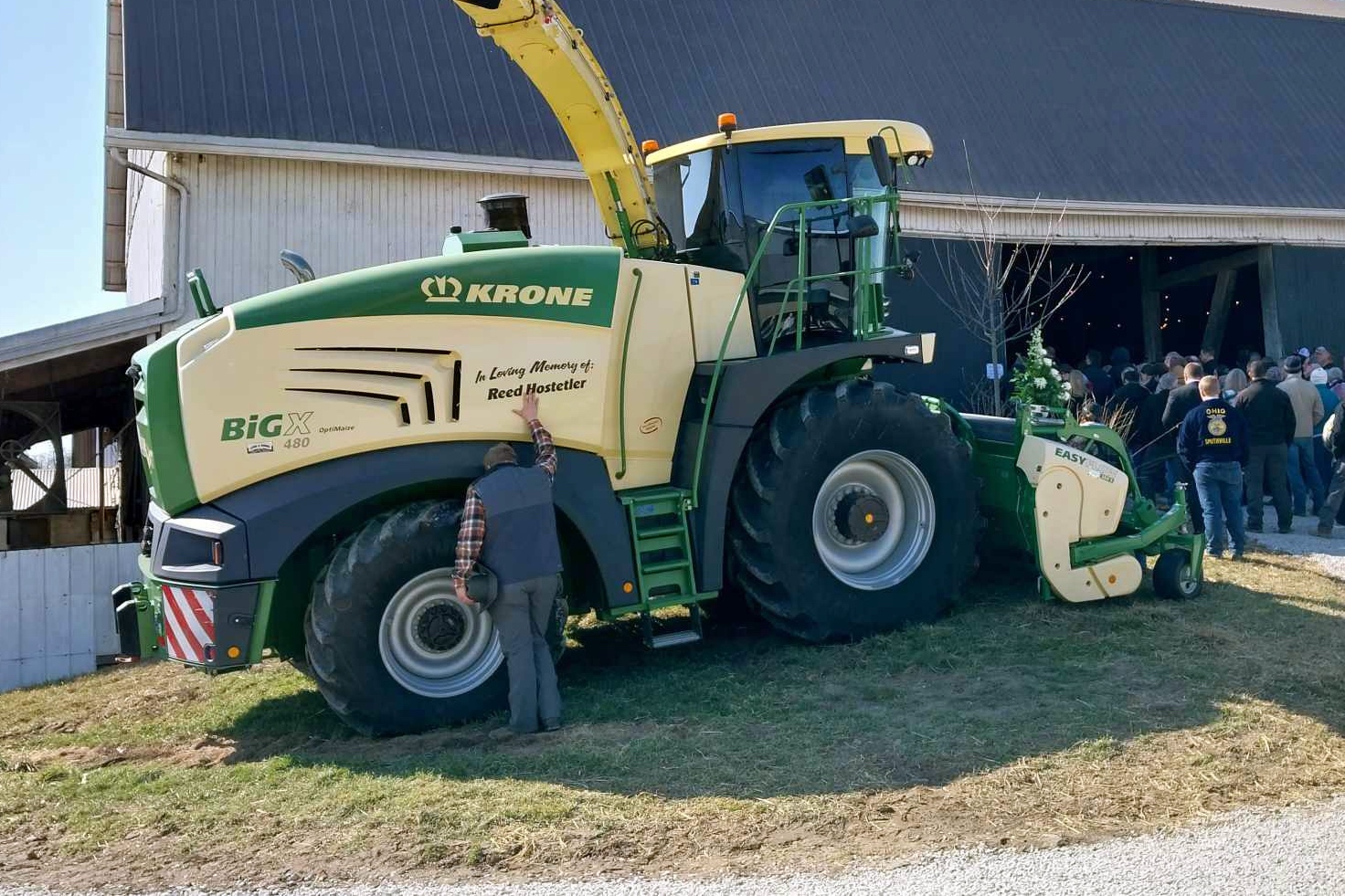
A mourner rests a hand on the Krone forage harvester bearing Reed Hostetler’s name outside the barn-turned-church at his March 12 funeral on the family dairy.

Wayne County didn’t have a crisis-response committee. It had relationships — built over years of co-op meetings, barn clean-outs, and late-night calving calls. That’s what this piece is actually about. Not the crisis. The thing you build before one. (Read more: A 31-Year-Old Dairy Farmer Died in a Manure Pit. What Wayne County Did Next Is a Playbook You Can Steal.)

The Same Pattern, Six Times

We tracked six dairy crises across five years and four structural threats — climate, immigration enforcement, workplace safety, and processing collapse. Different regions, different triggers, same lesson: operations with community infrastructure before the crisis recovered faster than those without.

When the River Turned a Dairy Region Into a Lake

On November 14, 2021, an atmospheric river dumped a month’s worth of rain on British Columbia’s Fraser Valley in 48 hours. The Nooksack River breached into Sumas Prairie — one of Canada’s most productive dairy regions — and the B.C. The Dairy Association reported more than 600 farms affected, with thousands of animals stranded.

Abbotsford Fire Chief Darren Lee told CBC News the flooding moved at a rate he’d never seen in 30 years of emergency services. B.C. Agriculture Minister Lana Popham said she’d been on video calls with farmers who had dead cattle visible behind them.

The community response started before the government’s. Sumas Prairie farm women Jimi Meier and Alison Arends launched a Facebook donation page that collected more than $470,000 in hay, feed, equipment, and cash — tracked through a 2022 Rotary Club accounting. Dairy families from the Fraser Valley, Chilliwack, and Vancouver Island drove in feed while roads were still partially impassable.

Dr. Lisa McCrea Hemphill, a veterinarian who documented the disaster for the Western Canadian Dairy Seminar in 2024, put it bluntly: the 2021 event “was not the first of its kind for Sumas Prairie and it will not be the last.”
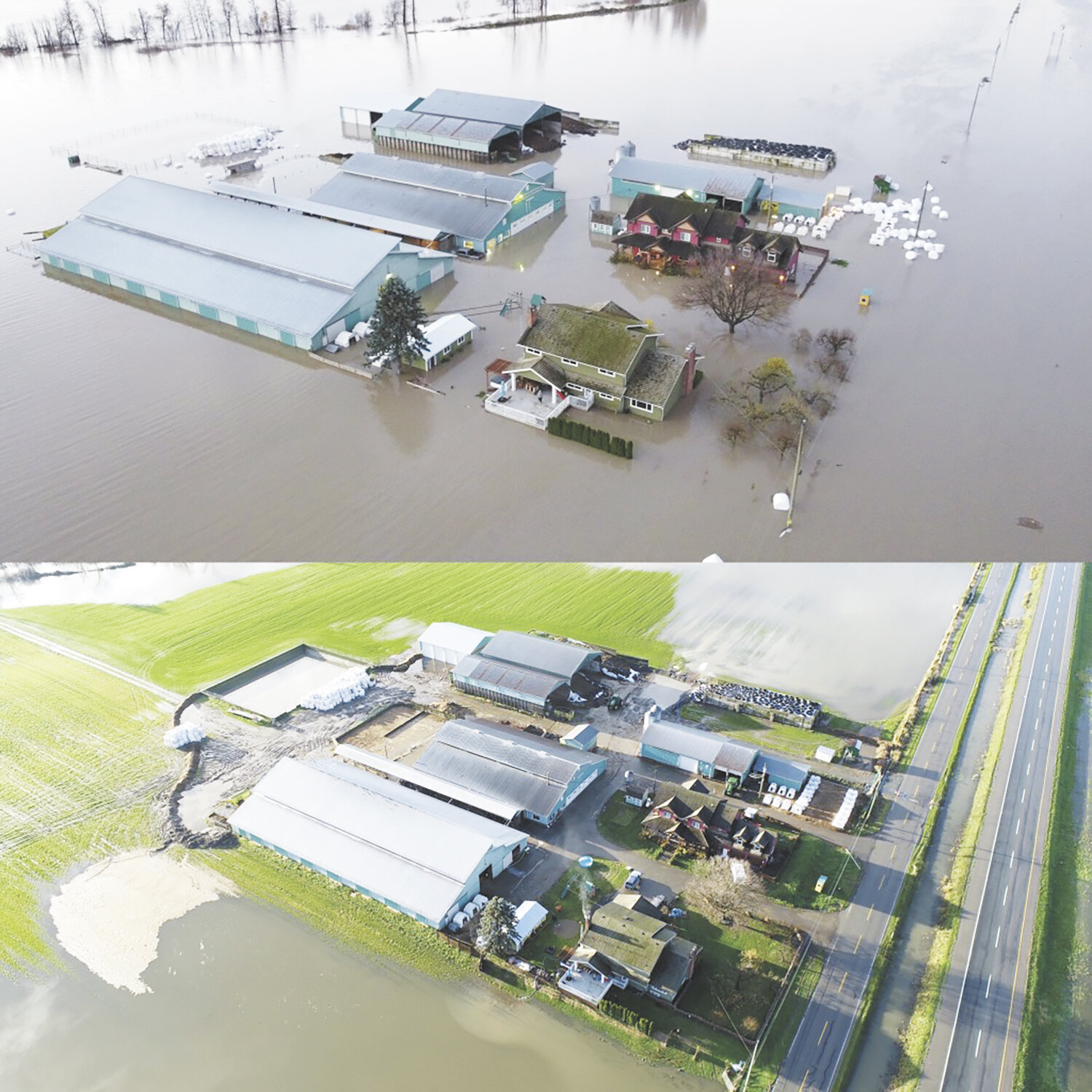
In November 2021, the atmospheric river put 3.5 feet of water in U&D Meier Dairy #1’s parlour and sent 14 loads of milk down the drain (top). By December 2025, pumps, planning, and a neighbour network built from that loss kept stalls dry and cut the damage to a single missed pickup (bottom).

The people who showed up first knew which farm had a flatbed, which neighbour had generator power, and which operation kept extra feed on hand. That informal network — built over years of milk truck routes and co-op meetings — was the actual first responder. For the full story of how Sumas Prairie dairy families turned three floods into a rebuild blueprint, read “Three Floods, One Lifetime”.

What Happens When 35 Workers Disappear in One Morning?

June 4, 2025, at Outlook Dairy in Lovington, New Mexico. ICE officers detained 35 workers in what the Albuquerque Journal described as a targeted enforcement operation. Owner Isaak Bos told the Journal the workers had provided false documentation, and the dairy was cooperating fully with the investigation — the dairy itself was not accused of wrongdoing. But the operational hit was immediate: Bos said milking and feeding “effectively ceased” for a period after the detentions.

Replacing a 35-person crew in Lea County — one of the most remote dairy regions in the country — isn’t a phone call. It’s a months-long rebuild.

What the Outlook Dairy story exposed isn’t about one farm’s hiring practices — Bos made clear the dairy cooperated fully and wasn’t accused of wrongdoing. It’s about an industry-wide labour structure that everyone in dairy knows, and almost nobody talks about publicly. NMPF’s 2015 economic analysis with Texas A&M estimated immigrants account for 51% of all U.S. dairy labour, and dairies employing immigrant workers produce 79% of the nation’s milk supply. Dr. Robert Hagevoort of New Mexico State University, speaking at the Dairy Cattle Reproduction Council in late 2024, said he believes the true percentage is even higher — that study’s a decade old, and dairy’s reliance on immigrant labour has only deepened.

What happened next: family members, office staff, and local teenagers traded summer plans for scraping alleys and attaching milking units. Neighbours from surrounding operations covered shifts. Three days later, at a town hall in Hobbs, Governor Michelle Lujan Grisham heard about the impact firsthand. “It is a real issue, and I’m very worried about it,” she told the Albuquerque Journal.

Nobody had a playbook for “ICE raid response.” They built one in real time. The full account of how Lovington built a response from nothing goes deeper into the labour math and what happened in the months after.

The Three-Day Rule — and the Road That Broke It

Most tragedies in farm country follow a pattern: three days of intensity, three weeks of fading attention, then silence — while the family is still trying to figure out how to milk cows and raise three kids alone.

Wayne County broke that pattern after Reed Hostetler’s death.

Shuttle buses ran from Marshallville Park to the barn funeral. Local companies brought gravel to shore up the lane. A phrase circulated — “Lead Like Reed” — and it served as a decision rule, not a bumper sticker. If something needed doing — calves to feed, kids to watch, hay to chop — people didn’t wait to be asked. They just did it.

Green Elementary’s PTO, led by president Shelly Baumgardner, organized a “Dine to Donate” night at a local restaurant, using a student day-off incentive to bring in more families and raise money for the Hostetlers. Groceries, diapers, and hot meals kept arriving for weeks. As Abby told Farm and Dairy: ‘It has shown me that when our community needs help, help comes. And… the next time our community needs help, I will be there and I will show up.

What made Wayne County different wasn’t that people cared more than anywhere else. It’s that the support network was already there. People had been helping each other with harvest, calving, and equipment breakdowns for years. Reed’s reputation — the kind of guy who’d show up in someone else’s barn without being asked — was the deposit. The community’s response was the withdrawal.

For the piece-by-piece breakdown of what Wayne County built — the shuttle logistics, the gravel, the fundraisers, the chore crews — that’s the playbook worth stealing.

Six Workers Dead in Minutes — and the Fines OSHA Proposed

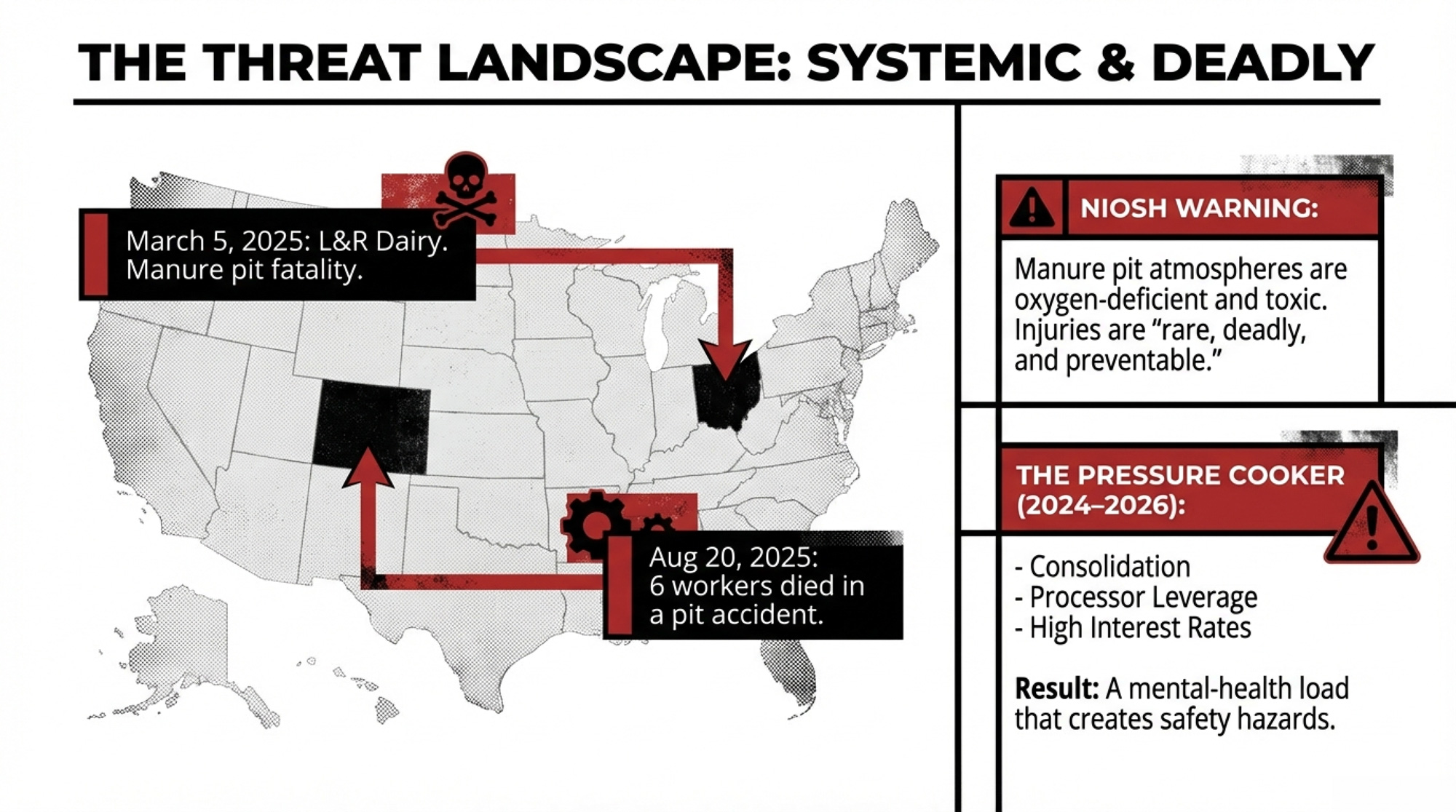
Five months after Reed’s death, the same hazard — manure gas — killed six workers at Prospect Valley Dairy in Keenesburg, Colorado.

On August 20, 2025, according to OSHA’s investigation, a pipe connected to the manure management system disconnected, releasing hydrogen sulfide. One worker went down almost immediately. Then five more went in to save him. All six died. The Weld County coroner confirmed toxic gas exposure as the cause of death.

The victims: Alejandro Espinoza Cruz, 50, of Nunn, and two of his sons — Oscar Espinoza Leos, 17, and Carlos Espinoza Prado, 29. Jorge Sanchez Pena, 36, was related to the family by marriage. Ricardo Gomez Galvan, 40, and Noe Montanez Casanas, 32, rounded out the toll. A father, two sons, and three more men — gone in minutes.

“They were extremely hardworking and humble,” Tomi Rodriguez, an outreach worker for Project Protect Food System Workers, told CPR News. “They were a very united family.”

OSHA cited three businesses in February 2026, classifying the violations as “serious” — not “willful.” Total proposed fines across all three entities came to $246,609 — about $41,000 per life lost. The largest single penalty: $132,406 to Prospect Ranch LLC, the entity operating Prospect Valley Dairy. OSHA calculates fines per violation, not per fatality, but the math is hard to ignore either way.

All citations remain proposed and subject to employer contest. Prospect Ranch LLC has not publicly commented on the citations beyond the formal contest process.

Attorney Sam Cannon of Cannon Law in Fort Collins, representing four of the victims’ families, told KUNC: “We’re no nearer figuring out why this system malfunctioned.” He added: “Family members deserve to understand why this system was operating when it wasn’t safe.”

That impulse — I’m going in after him — is the rawest form of community response. Workers risking their lives for a friend, a father, a coworker. But this story doesn’t have Wayne County’s arc. In Keenesburg, the community showed up with condolences, a benefit dance, and organized services for the families, as the Colorado Sun reported.

Wayne County’s sustained, months-long operational support — the before-dawn chore crews that were still running weeks later — requires a pre-existing infrastructure that not every community has in place when a crisis hits. That gap isn’t about generosity. Every road has generosity. It’s about whether the relationships were already built. For the full OSHA citation breakdown and what the industry hasn’t done, that piece walks through every violation, every dollar, and the confined-space fix that costs less than two cows.

What Does Your Road Look Like When There’s Nobody Left to Call?

Not every crisis arrives with sirens. Some arrive as a letter from your processor.

North Dakota went from 1,810 dairy farms in 1987 to 18 by early 2026 — a 99% decline in less than four decades, per USDA Census data and the Holle family’s own count. That collapse left the state with almost no local processing infrastructure. The Holle family runs Northern Lights Dairy, a 1,000-cow operation about 12 miles south of Mandan — one of just 18 Grade A dairy farms left in the state. After Prairie Farms closed its Bismarck plant in 2023 and DFA ceased operations at Pollock in 2024, the Holles were forced to find a new market for their milk twice in 30 months. They now ship to a Bongards plant in Perham, Minnesota — a five-hour haul, one way.
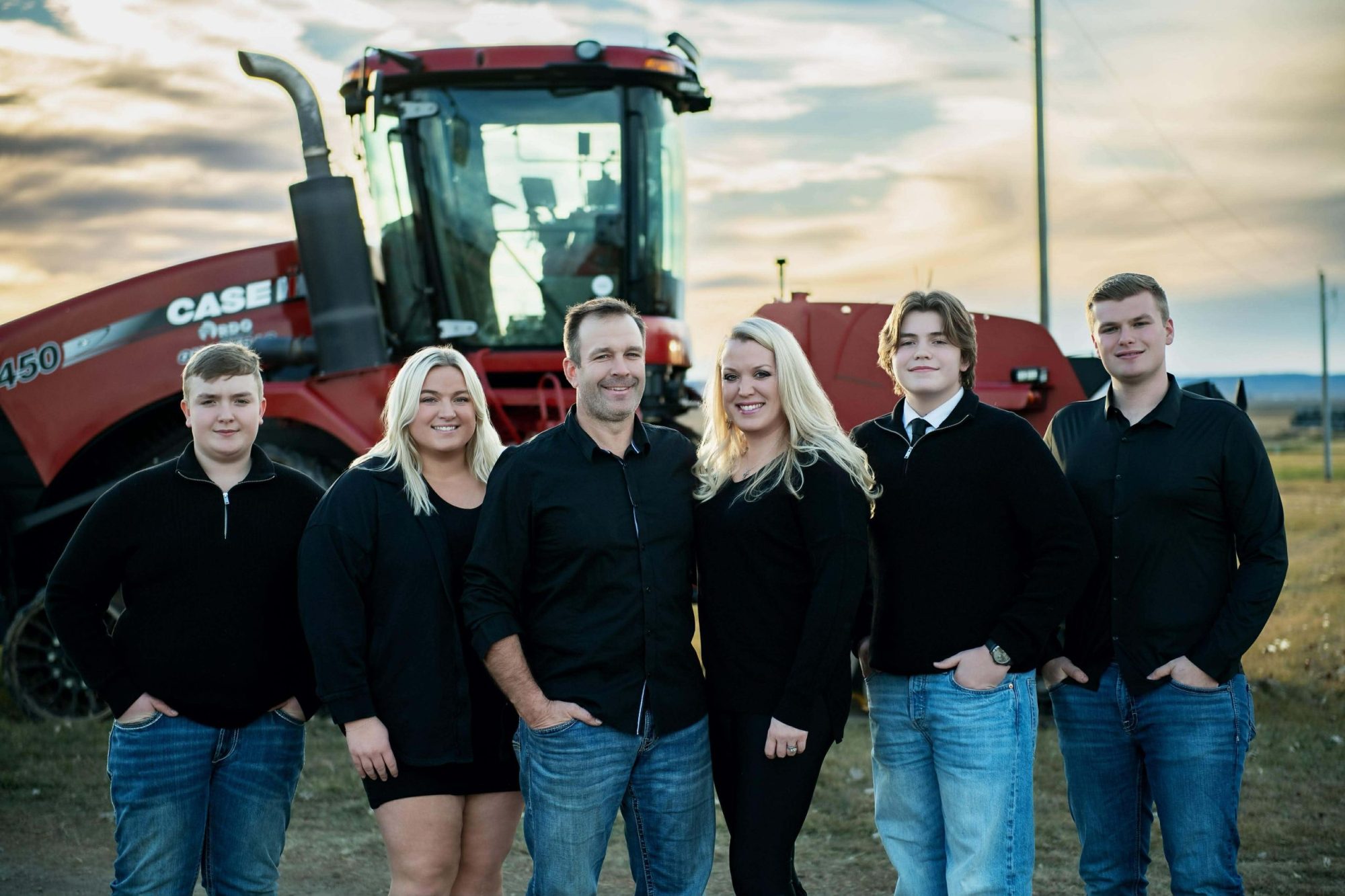
The Holle family — Andrew, Jennifer, and their four children — at their fifth-generation Northern Lights Dairy south of Mandan, North Dakota. They milk 1,000 cows and haul every load five hours to Minnesota. When we asked what comes next, their answer was: “We don’t know what we are going to do.

But the Holles aren’t waiting for an answer to find them. The family is exploring adding on-farm processing — Dawson Holle, their son and a state representative who sits on the House Agriculture Committee, told the North Dakota Monitor the family has plans for a processing plant, though the timeline remains uncertain. And two new large-scale dairies announced for eastern North Dakota along the I-29 corridor are projected to bring $122–$227 million in annual gross revenue to the state, according to a December 2025 NDSU Extension analysis. The 18 farms still standing aren’t just surviving — they’re building the infrastructure that disappeared around them.

(Read more: From 1,810 Dairy Farms to 18: How North Dakota’s Processing Collapse Cornered the Holle Family – and Could Corner You)

Agriculture Commissioner Doug Goehring has publicly noted that “with no other processors nearby, those dairies will likely pay for shipping longer distances that will be deducted from their milk checks.” Every extra mile eats into the milk check — and the further you haul, the harder it gets to pencil out staying in business.

And when a herd sells out in a region this thin, there’s nobody to absorb the loss — no neighbour to take on heifers, no local market for the genetics, no route density to keep the hauler coming.

From 1,810 farms to 18 is what community infrastructure looks like after it’s gone. For the full 1,810-to-18 diagnostic, including the Holle family’s testimony and the processing closures that cornered them, that piece is the warning label.

How Do You Spot the Farm That’s Quietly Going Under?

Not every crisis shows up as a manure pit or a flood. Some show up as yards that don’t look quite like they used to. Ration sheets that haven’t been updated in weeks. A kid who quietly steps back from 4-H. A familiar face missing from the co-op meeting — not once, but three meetings running.

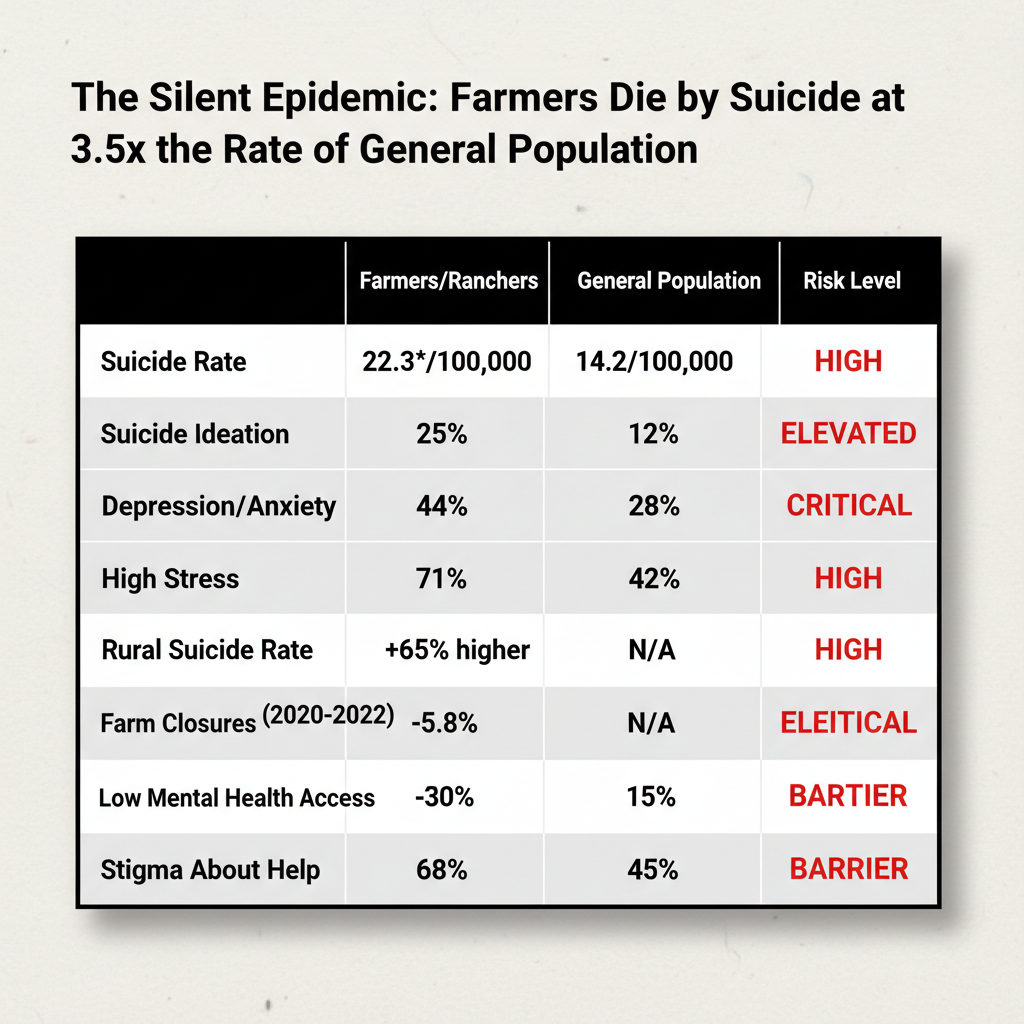
University of Guelph researchers have documented what most producers already sense: farmers carry higher levels of stress, depression, anxiety, and burnout than the general population. Financial pressure and workload consistently top the list. CDC studies published in the agency’s Morbidity and Mortality Weekly Report — including Peterson et al. (2020) analyzing 32 states and Sussell et al. (2023) covering 49 states — have consistently found suicide rates among agricultural workers significantly elevated compared with the general working population. Earlier state-level studies found the disparity to be two-fold or higher when measured against the broader population.

The rescue in this story isn’t dramatic. It’s a vet walking back to the truck after a DA, leaning on the door instead of climbing in, and saying, “You look worn out. How are you really holding up?” It’s a retired dairyman feeding calves three mornings a week without being asked. It’s the neighbour who notices the late barn lights and calls — not texts, calls — to say, “I’ll swing over. Put the coffee on.”

Those interventions buy something that doesn’t show up on any milk statement: time to think clearly. When stress is driving your decisions, you’re more likely to make rushed calls on genetics, culling, expansion, or exit that feel necessary in the moment but leave you with fewer options six months out. The data behind why dairy farmers face a 3.5× higher suicide risk — and what the people closest to them can actually do — goes deeper than any headline.

What Does a Lost Herd Actually Cost Your Road?

Here’s a piece of math most people skip. When a 250-cow herd sells out, you don’t just lose one family’s income. You lose roughly 6.4–6.8 million lbs of annual milk volume on the truck route — that’s 250 cows at 70–75 lbs/day, every day of the year — and your processor starts thinking about rationalizing pickups and consolidating drop points.

That exit takes an estimated $8,000–$15,000/year in genetics purchases with it — semen, embryos, show heifers — money that supported your local AI tech and breed association. Gone, too, are an estimated 50–100 hours of informal labour and equipment sharing per year that nobody tracks but everybody depends on. And you lose one seat at the co-op board, one voice at herd improvement days, one barn where kids learned to fit calves for the ring.

On a 200-cow herd, a single missed milking costs roughly $1,100–$1,400 in lost milk alone — January 2026 Class III hit $14.59/cwt per USDA AMS, the January all-milk price came in at $17.50/cwt per USDA Agricultural Prices (Feb. 27, 2026), and USDA’s February WASDE forecasts $18.95/cwt all-milk for the full year. That’s before the SCC spike and mastitis risk that compounds for days afterward. If your neighbour’s crisis means your backup milker no longer exists, that math applies to your bulk tank too.

Community isn’t charity. It’s risk management you can’t buy from an insurance company.

What You Can Build in 30 Days

You can’t control floods, raids, pit gases, or processor closures. You can control whether anyone on your road faces one alone.

Build a phone tree this week.

Eight to ten names — neighbours, church, co-op, school. Who calls whom in the first 15 minutes after an accident, barn fire, or sudden death? Write it down in the milk house. Tape it next to the bulk tank. This costs nothing and takes one evening. If you can’t fill 8 names without thinking hard, that tells you something.

Check three farms this month.

Not by text. By call or visit. “How are you doing — really?” Be ready for the answer to take longer than you planned. If a yard on your road has been slipping — gates not closed, lane rough, a familiar face missing from meetings — that’s not “busy.” That’s a signal. The earlier you show up, the more steering room exists.

Know your backup processor before you need one.

If your only buyer closes or tightens terms, where does your milk go tomorrow? Contact your co-op or marketer to request a contingency routing plan. The Holle family at Northern Lights Dairy didn’t get a warning. Neither will you.

Put mental health on the agenda — out loud.

At your next discussion group, dairy association meeting, or men’s breakfast, share one real story. Be the person who goes first. In the U.S., Farm Aid’s hotline (1-800-FARM-AID) connects you with staff who understand agriculture. In Canada, the Do More Agriculture Foundation maintains a current directory of crisis lines and counselling by province. If a conversation turns serious and you’re worried about someone’s safety, the 988 Suicide & Crisis Lifeline (U.S.) and Crisis Services Canada (1-833-456-4566) are 24/7.

Give your kids a crisis role

4-H and FFA clubs can own comfort jobs — cards, freezer meals, calf chores. Clear roles mean kids grow up knowing how to show up. And the families that keep their kids connected to 4-H, shows, and herd improvement days through the rough years are quietly protecting the infrastructure that decides who’s still farming in a decade.

Not Every Road Has a Wayne County

This piece would be dishonest if it pretended that every road has that kind of response waiting to be activated.

Some barns are too far apart for quick drop-ins. In some regions, most families work full-time off-farm, and there aren’t extra hands available. Pride keeps good people from speaking up until they’re closer to the edge than anyone’s comfortable with. And sometimes the structural forces — processing deserts, debt loads, a market that doesn’t want your milk at any price — are bigger than anything a neighbour with a skid steer can fix.

Farmer suicide — rates significantly elevated compared with the general working population, per Sussell et al. in CDC’s MMWR (December 2023) — isn’t something you solve with casseroles. It requires professional support, funded infrastructure, and an industry culture that treats “I’m not okay” as maintenance, not weakness.

But here’s what six stories across five years and six provinces and states prove: operations with community infrastructure before the crisis recovered faster — financially and operationally — than those without it. That’s not soft thinking. That’s business continuity.

Key Takeaways

  • If you can’t name 8 people who’d be in your yard within 15 minutes of a crisis, you don’t have a phone tree. Build one this week — it’s the single cheapest piece of risk management on your operation.
  • If you don’t know your second processor option, call your co-op or marketer this month and ask for contingency routing. The Holles didn’t get a warning.
  • If a yard on your road has been slipping for a month, that’s not “busy.” Call — not text — and ask one honest question. Early is always cheaper than late.
  • If missing one milking costs you $1,100–$1,400 and you don’t own standby power, know whose generator you’d borrow and whether it’s wired to connect. Virginia Tech Extension’s standby generator guide walks through the sizing math.

Whose lane are you turning into tonight?

Randy Roecker is training milk haulers to spot the signs that a farmer is in trouble — because haulers are the last person on every road, every other day. That story is worth 10 minutes of your time. And if the deeper economics of processor loss, generator ROI, or what it really costs your road when another herd exits — that’s the kind of analysis we build out in The Bullvine Weekly and our Tier 2 management playbooks. North Dakota’s 1,810-to-18 collapse is the diagnostic tool.

Tonight, the only math that matters is the distance between your lane and the next one over.

Learn More

The Sunday Read Dairy Professionals Don’t Skip.

Every week, thousands of producers, breeders, and industry insiders open Bullvine Weekly for genetics insights, market shifts, and profit strategies they won’t find anywhere else. One email. Five minutes. Smarter decisions all week.
NewsSubscribe
First
Last
Consent

A 31-Year-Old Dairy Farmer Died in a Manure Pit. What Wayne County Did Next Is a Playbook You Can Steal.

One year after Reed Hostetler’s death at L&R Dairy in Ohio, his community is still proving what farm safety and resilience look like when farmers refuse to let one of their own stand alone.

Executive Summary: Reed Hostetler was 31, co-owner of L&R Dairy in Ohio, and father of three when his tractor tipped into the manure pit on March 5, 2025. He didn’t survive. What his community built in the year since—a barn transformed into a funeral venue, tractors lined up in tribute, months of meals, chores, and quiet financial support that never stopped—is a blueprint every dairy should steal. This article connects Reed’s death to the systemic pit risks that killed six at a Colorado dairy five months later, and to the margin and mental-health pressures squeezing farm families through 2024–2026. It delivers a concrete playbook: phone trees, neighbor check-ins, youth crisis roles, safety protocols that don’t vanish when one person does. The core argument is blunt—community is infrastructure, and the operations that have it recover faster when everything falls apart. Nearly one year later, the only question is whether your road is ready.

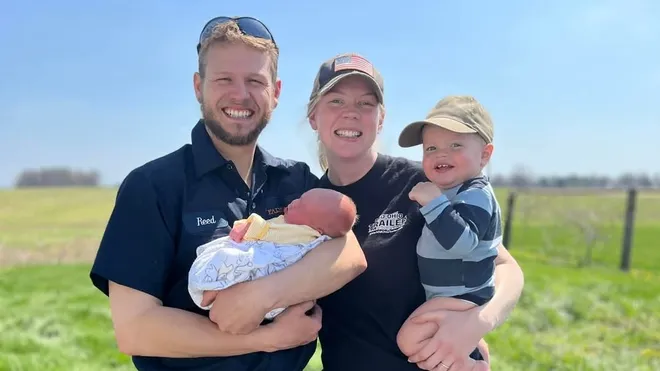
The faces behind the “Lead Like Reed” legacy: For the Hostetler family, community isn’t just a sentiment—it is the vital human infrastructure that ensures no dairy operation has to face its darkest day alone.

On March 5, 2025, a 31-year-old dairy farmer drowned after his tractor tipped into the manure pit at L&R Dairy in Marshallville, Ohio. Reed Hostetler was a husband, a father of three young kids, and co-owner of the family operation. He was also, by every account, the kind of guy who showed up when his neighbors needed help.

Almost a year later, his community is still showing up for his family. And that’s the part of this story you can actually copy.

You’re not getting a safety manual here. You’re getting something harder to build and more important to have: a real-world playbook for community resilience and dairy farm safety, forged in the worst possible way.

From Barn Wedding to Barn Funeral

Years before the accident, Reed and Abby Hostetler were married in the main barn at L&R Dairy. Same beams. Same alley. Same cows shuffling in the background.

In March 2025, that same barn became the gathering place for family and friends to say goodbye.

Hosting a large crowd in a working dairy barn isn’t just sweeping the alley and stacking a few straw bales. It’s parking logistics, liability questions, shuttle coordination, sound systems, seating, and making sure the space looks like a celebration of a life, not a Tuesday afternoon herd check.

The Hostetlers didn’t have to figure any of that out on their own.

Neighbors and friends showed up days ahead to pressure-wash walls, scrape alleys, and transform the barn into a place where a casket and grieving family could stand with some dignity. Local companies and neighbors brought gravel and equipment to shore up the lane before vehicles started rolling in. Shuttle buses ran from Marshallville Park, so the yard and road didn’t lock up.

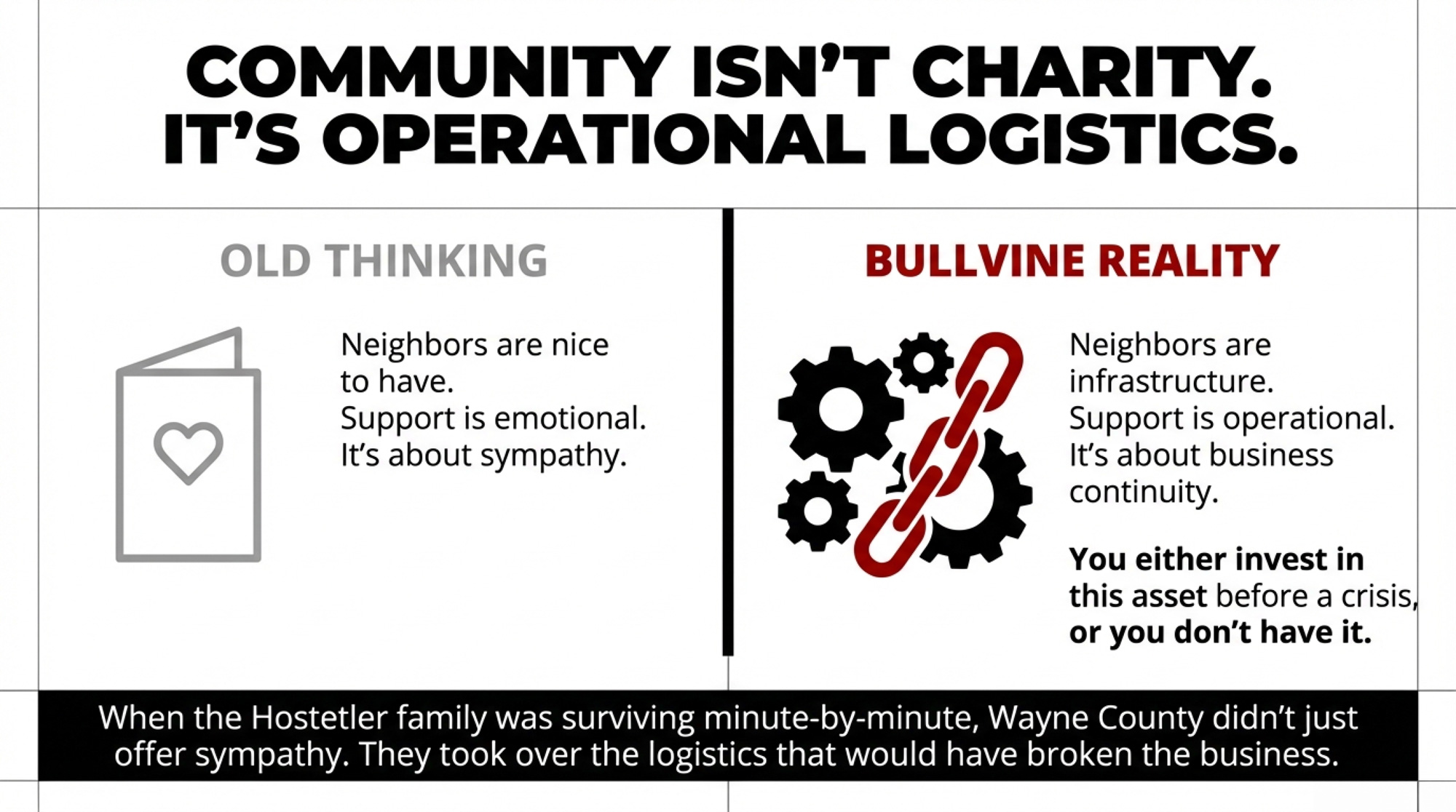
While the family was just trying to survive minute by minute, the community quietly handled the logistics that would have broken them.

Reed and Abby’s three kids—Baer (4), Claire (2), and Axe (1) at the time—were too young to remember most of it. But they’ll hear it for the rest of their lives: the barn was full. People came. We weren’t alone.

That’s not sentimental. That’s an asset. You either have it before a crisis—or you don’t.

The Tractor Line That Said What Words Couldn’t

A mourner puts their hand on a forage harvester parked outside Reed Hostetler’s funeral service, which was held at his family dairy farm March 12. Reed died March 5 after an accident at the farm (Jane Schmucker photo).

There’s a sound you don’t forget: a line of tractors and semis idling in low gear outside a church or a farm. Not parade noise. Heavier. Slower. You feel it in your chest.

At Grace Church in Wooster, where the reception was held, tractors, semis, trucks, and implements lined the parking lot and road as a silent, steel-and-diesel guard of honor.

Local equipment dealers, co-ops, and farmers coordinated the lineup. Once the first few units were committed, the rest followed. Some of the tractors were polished. Others still carried field mud and manure dust. That mix mattered. It wasn’t a show. It was the working dairy community saying, “He was one of ours.”

As one neighbor put it, it was the hardest funeral they’d ever been to—not just because of who they lost, but because of what they watched happen around the family.

Among friends and neighbors, a simple phrase started making the rounds:

“Lead like Reed.” If something needed doing—hay to chop, kids to watch, cows to milk—people asked, “What would Reed do?” and then they just did it. No committee. No sign-up sheet. Just action.

You don’t get that kind of reputation overnight. You build it one favor, one late-night call, one “yeah, I’ll be there” at a time.

When Our Community Needs Help, Help Comes

Most tragedies follow a pattern: three days of intensity, three weeks of fading attention, and then a long, quiet stretch where the family is expected to “get back to normal” while everything inside them is still upside down.

That’s not how this played out.

Weeks and months after the funeral, people kept showing up: groceries, diapers, dinners; neighbors stepping in for chores unannounced; friends checking in not once but over and over.

Abby has said that seeing people show up changed how she thinks about community—and how she plans to show up the next time someone else needs help. That shift, from “How will we survive this?” to “How do we pay this forward?” is the proof that community isn’t just nice. It’s infrastructure.

The support didn’t stop at the farm gate.

Green Elementary’s PTO organized a “Dine to Donate” night at a local Applebee’s, using a “student day off” incentive to bring in more families and raise money for the family. The dollars helped. The message mattered more: “Your school sees what your family is going through. You’re not invisible.”

A crowdfunding campaign drew donations from people who knew the Hostetlers well and from others who only knew them as “the young dairy family in Ohio.” It turned years of quiet relational equity into real, practical support when the family needed it most.

Someone told Abby that because of the way Reed lived, he’s still taking care of his kids even after his death. In strictly financial terms, that’s true. But the bigger truth is this: he’d invested in people, and when it all went sideways, those people cashed that investment in for his family.

Who Reed Was—and Why It Matters Now

Reed wasn’t just “helping out” on the home farm. He was co-owner of L&R Dairy, part of the next generation taking over and pushing the operation forward.

He’d hiked the entire Appalachian Trail. He’d ridden bulls. He’d done mission work in Thailand. Back home, he was the guy who could fix nearly any piece of machinery on the place and still make time to talk with a neighbor in the yard. Neighbors remember him as the kind of person you’d see under a mixer wagon at 11 p.m. and then at someone else’s place the next morning, making sure their chopper started.

Like most dairy producers, Reed knew manure pits are dangerous spaces. He wasn’t inexperienced or careless around equipment. But as this tragedy shows, sometimes the margin between “busy day” and “life-changing day” is just physics and bad timing.

At home, Reed and Abby were in the same season a lot of you are in right now: three little kids, a 24/7 operation, and a calendar that only worked because somebody gave up sleep. Abby picked up nursing shifts at the hospital and was learning more of the farm side to help cover when family needs shifted.

They were raising calves, raising kids, and—often without noticing—raising the bar on what it means to be part of a community.

The wave of support after the accident didn’t appear out of nowhere. It came from years of small decisions: taking a call instead of letting it go to voicemail, showing up with a skid steer when a neighbor’s barn burned, buying a few extra tickets for a school fundraiser, saying yes when something needed doing.

None of those actions looked like “strategy” at the time. Together, they’re the reason people felt personally responsible for being in that barn and that driveway when everything fell apart.

You can’t fake that after the fact. You either build it before you need it, or you don’t have it.

Why One Ohio Manure-Pit Accident Should Change How Your County Shows Up

It’s tempting to file this under “heartbreaking story from another state” and move on. That’d be a mistake.

Manure pits have been recognized as a deadly hazard for decades. In a 1993 bulletin titled “Manure Pits Continue to Claim Lives,” NIOSH warned that the oxygen-deficient, toxic atmosphere in manure pits has “claimed many lives” and that hydrogen sulfide, methane, and other gases can overcome workers within seconds when conditions line up the wrong way. A 2012 clinical review published in the Journal of Agromedicine described manure-pit injuries as “rare, deadly, and preventable,” noting that while these incidents don’t happen often compared to other farm injuries, the fatality rate is extremely high once something goes wrong.

And it’s not just Ohio.

On August 20, 2025, six workers—including a 17-year-old—died in a manure-pit accident at Prospect Valley Dairy in Keenesburg, Colorado. Investigators and local reports indicate that a contractor doing routine work likely triggered a hydrogen sulfide release and was overcome almost immediately. Five other workers went in after him in attempts to rescue him. None of them came back out.

When The Bullvine looked back at 2025’s defining dairy stories, Reed’s death in Ohio and the Colorado tragedy both made the list for the same reason: they exposed how thin the margin really is between an ordinary workday and a permanent hole in a family, a workforce, and a local dairy economy. These aren’t freak one-offs. This is systemic risk we’ve tolerated for too long.

Now layer that on top of 2024–2026 realities—consolidation, processor leverage, stubborn input costs, labor shortages, and interest rates that haven’t dropped the way anyone hoped. You’ve got a mental-health load that doesn’t show up on your milk check but absolutely shows up in your barn and your house.

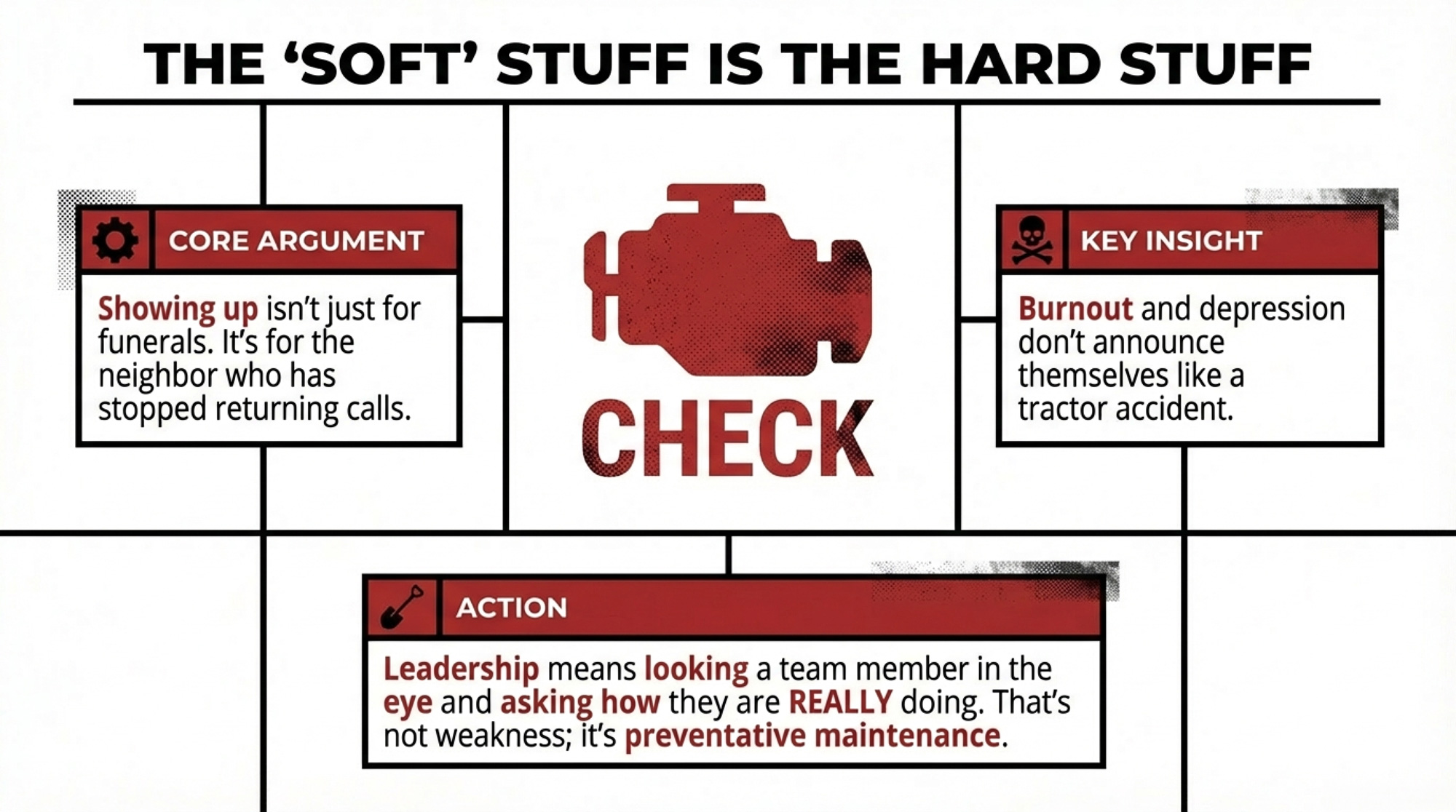
You know people in this business who are running close to the edge—physically, mentally, and financially. “Showing up” can’t just mean after a visible accident. It has to include watching for the quieter stuff: the guy who stops returning calls, the coworker making more mistakes than usual, the family where one bad month of prices seems to hit harder than it should.

Mini-Moments That Show What “Showing Up” Actually Looks Like

Big headlines are built from small, unglamorous decisions. A few details from Wayne County are worth stealing outright.

  • The food. Abby jokes that Wayne County people sure know how to cook. For weeks, the kitchen counters stayed full: hot casseroles, snack trays, grab-and-go items for the kids. The food itself wasn’t the point. The point was the message: “You don’t have to think about supper tonight. We’ve got that piece.”
  • The quiet chores. One neighbor made a habit of showing up early, doing a full round of chores, and leaving before anyone could say thank you. Calves fed, pens cleaned, gates latched. No Facebook post, no photo, no public pat on the back. Just work done when the farm needed fewer decisions, not more.
  • The school connection. Green Elementary’s PTO could’ve checked the “we sent a sympathy card” box and moved on. Instead, they organized the restaurant fundraiser and used a “student day off” incentive to bring in more families. They told the kids, in actions: “Your school sees what your family is going through. You’re not invisible.”
  • The tractors. Those machines parked outside the church didn’t fix anything on paper. What they did was silently tell Reed’s kids: “Your dad mattered to a lot of people.” Ten years from now, those kids will remember that wall of iron as clearly as any words they heard.

None of these actions use the word “community.” They don’t have to. They define it.

What This Means for Your Operation

If you strip away the emotions, what Wayne County proved is simple: community is infrastructure. You either invest in it before you need it, or you find out what it costs not to have it when everything goes wrong.

Farm families that aren’t alone recover faster—financially and operationally—because chores, crops, and kid logistics don’t collapse alongside grief. That’s not soft thinking. That’s business continuity.

Here are the hard questions worth asking this month:

  • If a tractor rolled or a fire started on your place tomorrow, who are the first three people who would be in your yard without being asked?
  • If it happened to a neighbor instead, would anyone automatically assume you were one of those three?
  • If you had to line up 20 tractors and trucks as a sign of respect, who would answer that call—and who wouldn’t notice?
  • Who on your team or in your circle has been quieter, shorter-tempered, or more withdrawn than usual lately—and when was the last time you looked them in the eye and asked how they’re really doing?

If you can’t rattle off names without thinking too hard, you don’t have a phone tree. You have a hope and a prayer.

And if you sign the checks or make the schedule, you’re the one who can change that.

What You Can Actually Do This Month

If you’re wondering where to start, here’s the short list.

  • Build a simple phone tree now. Don’t overcomplicate it. Aim for at least 8–10 key people on your road, in your church, and in your school community. Decide who calls whom in the first 15 minutes if there’s an accident, sudden death, major health crisis, or barn fire. Write it down where people can actually see it—in the milk house, office, or group chat.
  • Pick three farms to check on. Not with a text. With a quick call or visit. Ask, “How are you doing—really?” and be ready for the answer to take longer than you planned.
  • Involve your youth on purpose. 4-H and FFA clubs can own “comfort” jobs in a crisis: cards, posters, freezer meals, calf chores. Give them clear roles so they grow up knowing how to show up instead of watching from the sidelines.
  • Talk about mental health out loud. Put it on the agenda at your discussion group, local dairy association meeting, or men’s breakfast. Share one real story, even if it’s uncomfortable, and be the one who goes first. Make it normal to say, “I’m not okay right now,” before someone breaks. That’s not weakness; it’s maintenance. If you or someone on your team feels overwhelmed, talk to your doctor, a trusted advisor, or a local mental-health provider.
  • Practice before the crisis. Help each other with harvest, planting, big herd moves, or barn clean-outs, so you already know how to work together. You’ll spend a few hours now—or you’ll scramble from zero on your worst day.
  • Tie safety and support together. As you review protocols around pits, lagoons, and confined spaces—gas monitors, ventilation, entry rules—ask yourself: “Who else knows this? Who would enforce it if I’m not here?” If there’s any task on your farm that only one person can do safely, that’s a red flag. Train at least one backup and write down the protocol. Safety that only lives in your head isn’t safety.

None of this replaces hard safety work around manure pits, lagoons, and confined spaces. You still need lock-out/tag-out, proper equipment, training, and clear protocols.

But when safety systems fail, insurance is slow, milk prices are tight, and official help ends—this is what catches people.

Key Takeaways

  • Community doesn’t appear out of thin air in a crisis. It’s built on years of small, quiet favors when nothing is on fire.
  • Kids are watching. Who shows up, who kneels down to their level, who keeps coming back after the casseroles are gone—that’s what they’ll remember long after the details fade.
  • Leadership on a dairy isn’t just about numbers and banners. It’s about who you are when someone down the road is in trouble.
  • “Showing up” includes the quiet stuff. Burnout, withdrawal, depression—these don’t announce themselves the way a tractor accident does. Check on your people before they break.
  • Safety that lives only in your head is a liability. If nobody else on your operation knows your protocols or would enforce them without you, that’s a gap you can fix this week.

Lead Like Reed

Underneath all the grief, this is a story about assets—just not the kind your accountant can depreciate.

On the hard-numbers side, you chase efficiency, butterfat, component premiums, and labor stability because the economics of 2024–2026 don’t leave much slack. If you’re not on top of genetics, feed, and contracts, you get run over. We all know that.

On the human side, there’s another question that matters just as much to long-term survival: when—not if—something goes very wrong, is your farm part of a community that knows how to respond?

That’s not a feel-good side issue. It’s about whether your family, your workforce, and your local dairy ecosystem can take a hit without collapsing.

So here’s the challenge, almost a year after Reed’s accident:

Look at your own road. Who would need you if something happened tomorrow?

Look at your own barn. Who would you call first if it was your tractor in the pit, your fire, your heart attack in the parlor, or your brain finally saying “enough” after too many bad months in a row?

Look at your own kids and grandkids. What stories do you want them telling 10 years from now about how your community handled hard things?

Reed didn’t get a vote on what happened on March 5, 2025. His brothers did everything they could in a window that physics, machinery, and toxic gas had already stacked against them. His wife, kids, and parents didn’t choose any of it.

What they did get—and what they’re still getting a year later—is a community that decided they weren’t going to carry it alone. A community that turned a barn into both a wedding hall and a sanctuary of grief. A community that lined up tractors, cooked meals, ran fundraisers, and kept showing up long after the news cycle moved on.

Support Type Wayne County Response Typical Farm Crisis Response
Immediate Response (0-3 days) 20+ neighbors in yard day 1, full chore coverage Family handles alone, maybe 1-2 calls
Funeral/Memorial Logistics Barn transformation, shuttle buses, tractor line, parking coordination Funeral home handles, family figures out details
Food/Meals Weeks of daily hot meals, grab-and-go for kids, coordinated delivery 3 days of casseroles, then silence
Financial Support Crowdfunding, school fundraiser ($5,000+), sustained donations Maybe a GoFundMe, no follow-up
Chore/Labor Coverage Daily unannounced chore coverage for weeks, crop/haying help 1 week if lucky, then “back to normal”
School/Kids Support PTO-organized fundraiser, student engagement, visible recognition Sympathy card, kids expected to cope alone
Long-Term (3+ months) Ongoing check-ins, continued meals, relationship maintenance “How are you holding up?” texts, no action
Phone Tree/Coordination Pre-existing relationships, clear roles, no central organizer needed Confusion, duplicate efforts, gaps in coverage
Mental Health Follow-Up Community members trained to recognize signs, ongoing support “Let us know if you need anything” (passive)
Business Continuity Farm operations maintained, no production loss, equity preserved Operations suffer, milk quality drops, financial losses compound

You can’t control every accident or every market swing. You can control whether anybody in your circle ever has to face one alone.

So the next time you hear about a farm accident, a diagnosis, or a sudden death—whether it’s in your county or three states away—don’t just shake your head and scroll on.

Ask yourself, honestly: “What would ‘lead like Reed’ look like where I live?”

Then do one concrete thing this month to make sure no farmer on your road has to stand alone when their barn—or their mind—goes dark.

WeekAction ItemOutput/DeliverableTime Required
Week 1Build your phone treeList of 8-10 names: neighbors, church, school contacts who would respond in first 15 minutes if something went wrong2 hours
Week 2Make 3 farm check-insCall or visit 3 farms in your area—ask “How are you doing, really?” and be ready for the answer to take longer than you planned3 hours
Week 3Assign youth crisis rolesMeet with local 4-H/FFA club—define specific “comfort jobs” (cards, posters, freezer meals, calf chores) youth can own during next community crisis1.5 hours
Week 4Put mental health on agendaAdd mental health discussion to your next dairy association meeting, men’s breakfast, or discussion group—share one real story and go first1 hour
BONUS: Practice Before CrisisHelp a neighbor with harvest, planting, big herd move, or barn cleanout so you already know how to work together when everything falls apartCompleted joint work project with neighboring farm4-6 hours

Complete references and supporting documentation are available upon request by contacting the editorial team at editor@thebullvine.com.

Learn More

The Sunday Read Dairy Professionals Don’t Skip.

Every week, thousands of producers, breeders, and industry insiders open Bullvine Weekly for genetics insights, market shifts, and profit strategies they won’t find anywhere else. One email. Five minutes. Smarter decisions all week.
NewsSubscribe
First
Last
Consent

One ICE Raid. 35 Workers Gone. A New Mexico Dairy Learned What Community Really Means.

One ICE raid stopped a dairy cold. 35 workers gone. But it also revealed who neighbours really are.

I’ll never forget the first time someone told this story in a room full of dairy people.

It was one of those meetings where the coffee’s lukewarm, the jokes are familiar, and everyone’s half‑listening while thinking about the next milking. Then someone said, “Did you hear about the dairy in New Mexico that lost 35 workers in one morning?”

The whole room went quiet.

Every person at that table started doing their own math. What would that look like here? On our lane? With our crew?

June 4, 2025, started like any other hot, dry morning outside Lovington, New Mexico. The sky was already bright by the time cows lined up in the parlor at Outlook Dairy. Hoses hissed. Units clanked on and off. Spanish and English mixed over the noise in that familiar way you hear on a lot of larger dairies now.

Honestly, if you’d dropped in early that morning, it would’ve sounded a lot like a Tuesday on plenty of farms across North America.

By the end of the day, nothing about it felt ordinary.

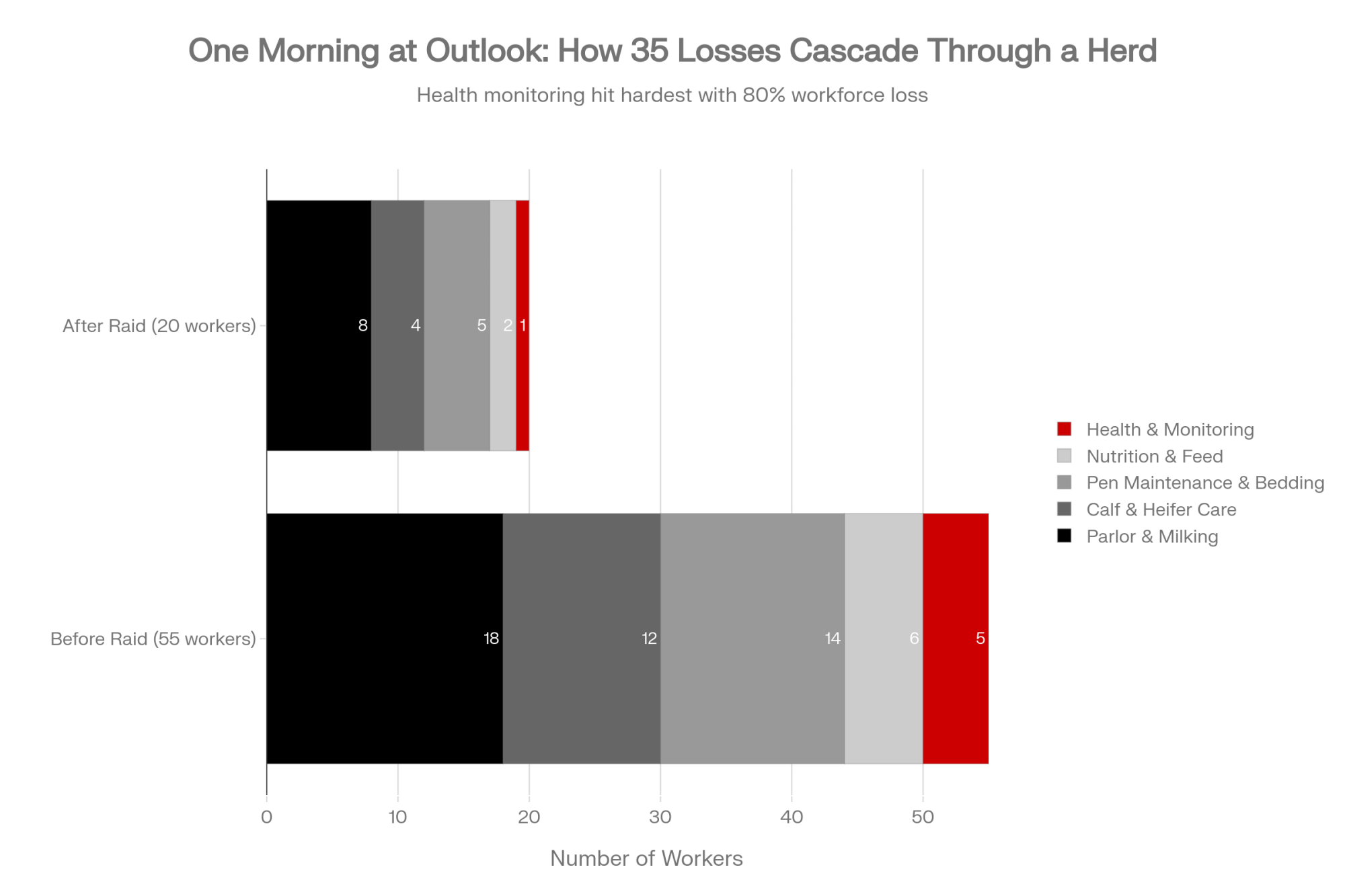
Homeland Security Investigations trucks came down the lane with a search warrant. When they left, 11 workers were in custody. After an employment audit tied to their documents, owner Isaak Bos was told he had to fire 24 more on the spot. In the space of a few hours, Outlook Dairy lost 35 of 55 workers—almost two‑thirds of the people who kept that place running.

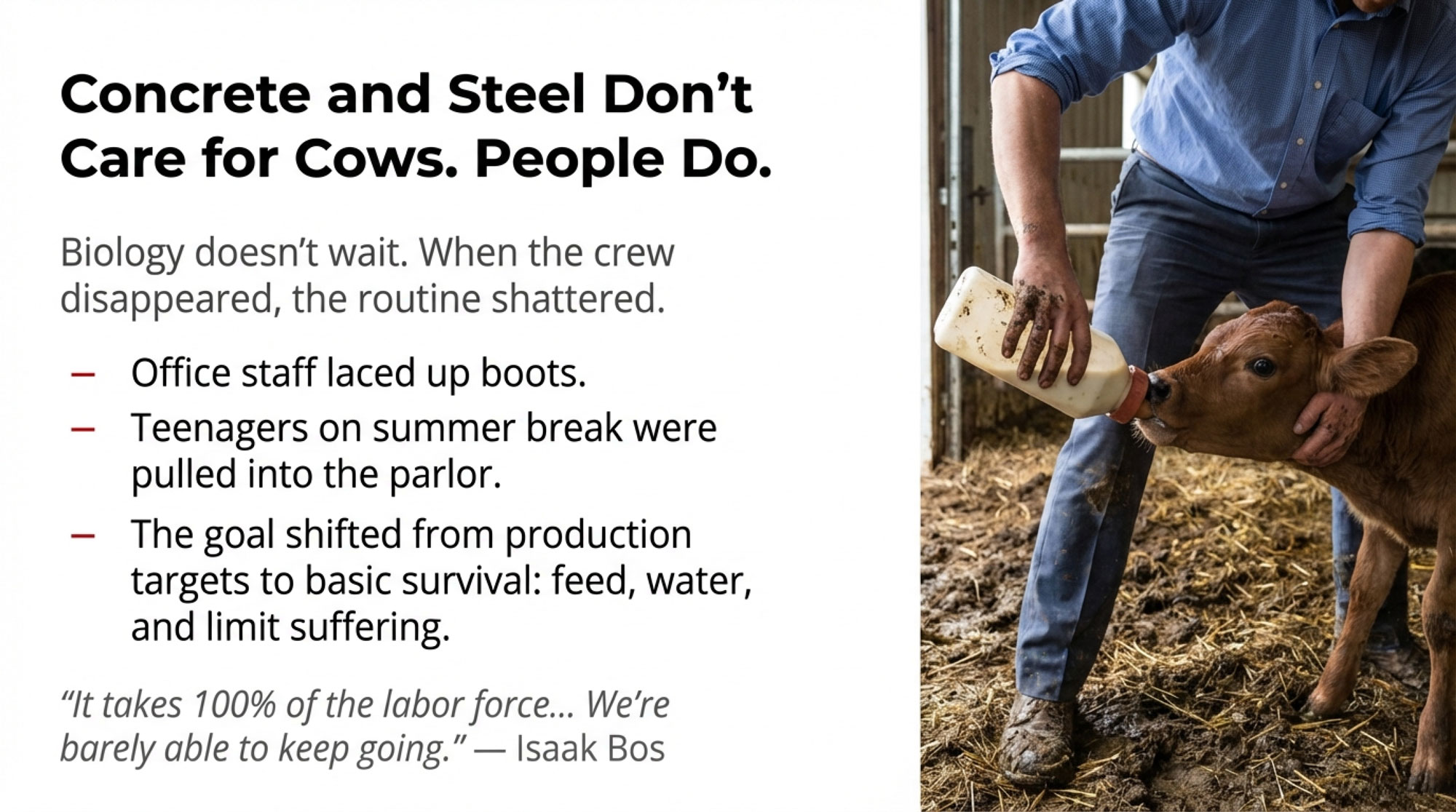
Bos later said milk production had “effectively ceased.” Every remaining person—family, office staff, whoever was available—and even some high school students on summer break were pulled into basic animal care just to keep the cows fed, watered, and milked at all. He put it plainly: “It takes 100% of the labor force, so no day is off right now. It’s detrimental for our cattle. We’re barely able to keep going.”

If you milk cows yourself, you don’t need a graph to understand that. Your stomach does the math for you.

When Everything Stops but the Cows

The thing about a dairy is simple and unforgiving: cows don’t stop just because your labor does.

In Lovington that week, all the routines that make a dairy hum were suddenly missing most of the people who knew them best. The workers who’d been there every day—many of them immigrants who had put down roots in the area—weren’t walking into the parlor, scraping alleys, or checking fresh cows anymore.

Across the U.S., that’s not a side note. It’s the reality of who actually milks the cows. A major industry survey found that foreign‑born workers make up roughly half of all dairy labor, and the farms that rely on them produce nearly 80% of the country’s milk. In barn language: without immigrant labor, most of America’s cows don’t get milked.

That’s true whether you’re pushing cows through a big New Mexico freestall, running a 200‑cow sand‑bedded herd in Wisconsin, or managing a couple of key foreign workers under Canada’s Temporary Foreign Worker Program. It doesn’t take many people to disappear before the whole system starts to wobble.

When an enforcement action hits a dairy, the headlines talk about arrests, charges, and policy. But in the farmhouse, the questions are more basic.

Who’s going to milk tonight?

Who’s going to catch the cow that’s about to crash?

Bos said Outlook went from “operating normally” to crisis mode overnight. People who normally handled phones and paperwork laced up boots and headed to the barn. Teenagers who figured they’d be doing odd jobs suddenly found themselves in the parlor or feeding calves. Production targets weren’t the priority anymore. The new goal was simple: keep the cows alive and limit their suffering until a crew could be rebuilt.

If you’ve ever had flu rip through your family, lost a key employee, or had one bad accident take the legs out from under your schedule, you know a smaller version of that scramble. You stretch days longer than they should be. You pick up one more milking. You cut corners you never wanted to cut because there just aren’t enough hands.

Lovington didn’t invent that feeling. It just pushed it about as far as it can go in a single morning.

The People Behind the Paperwork

From a distance, it’s easy to see “11 arrested, 24 fired” and think in terms of paperwork and status. Up close, those numbers are people.

On that farm, those 35 were workers who had been part of the daily rhythm for years—feeding cows, scraping alleys, watching fresh pens, raising calves. Bos has said all 35 lived locally. Their kids went to the same schools. Their families bought groceries at the same stores. They were neighbours long before a federal truck ever pulled into the yard.

Advocates in the region put it in terms many producers would recognize in their own communities: these aren’t just “workers,” they said. They’re “our neighbors, coworkers and friends,” people who have “contributed to our economy and enriched our culture” in southeastern New Mexico.

After the raid, Bos emphasized that the dairy itself wasn’t charged with wrongdoing. He said the employees had given them false documents and that the operation came without prior warning. Whatever you think about the legal side, you can hear in his words that this wasn’t just about forms to him. It was about people he knew and depended on.

He talked about the “intimidating effect” of the raid and worried that it would scare even more workers away. Any owner who’s spent years building a crew and a culture can feel that in their bones.

Immigrant-rights groups in New Mexico went even further, connecting what happened at Outlook to the broader local economy. They warned that raids like this “threaten the safety and economic well‑being of our communities,” in a region where immigrant workers are “powering industries from dairy farms to oil and gas.” They talked about how every time a worker disappears from a place like Outlook, that absence is felt not just in the barn but in the cash register at the grocery store, in the quiet tables at local restaurants, and in the small shops that count on regular customers from the dairies.

In other dairy regions, people who work closely with farmworkers have been describing the same kind of fear. In Vermont and beyond, organizations that advocate with dairy workers talk about how stepped‑up immigration enforcement has changed everyday life—workers limiting trips to town, skipping church, putting off doctor visits, avoiding school events—because every mile off the farm feels like another chance to end up in a patrol car instead of a pickup.

On paper, that shows up in policy reports and enforcement statistics. On the ground, it looks like people are shrinking their world to the few places that still feel somewhat safe, even as the workload doesn’t let up and the pressure quietly builds.

You don’t have to agree on every policy detail to see how that wears on a crew. And on the people who work alongside them.

What Happens to the Cows When Workers Disappear

Every producer knows this: concrete and steel don’t care for cows. People do.

When most of those people are suddenly gone, the barn feels it long before a reporter ever arrives. In Lovington, reports described remaining family members, non‑farm staff, and local high school students suddenly responsible for nearly everything—feeding, milking, bedding, and keeping an eye on fresh cows—under intense time pressure.

Training someone new in the parlor takes time, even under the best conditions. Getting them comfortable reading cow behavior, spotting a hot quarter, recognizing a twisted stomach before it’s obvious—that takes longer. Doing all of that while you’ve already lost most of your experienced crew and everyone left is exhausted is another thing entirely.

That’s when real risk sneaks in. Not because anyone cares less, but because biology doesn’t wait while people catch up.

Bos said the remaining workers were being “pushed…to the limit.” Most dairy families don’t need that explained. When you’re running on too little sleep, carrying too much worry, and trying to do three jobs at once, little things slip.

A cow that somehow still has a full quarter at the end of milking.

A dull‑eyed calf that should’ve been flagged an hour earlier.

A fresh cow that doesn’t get that second or third look you always meant to give her.

Those aren’t character flaws. They’re the predictable result of stripping away most of the people who knew the herd best and asking the ones who remain to do the impossible.

In Lovington, the raid didn’t just stress a business plan; it shattered it. It stressed a barn full of living animals that had no idea why familiar hands didn’t show up that day. And it stressed the people left behind—owners, spouses, kids, employees—in ways that still don’t fit neatly into any official report but linger in a house and a community long after the headlines move on.

A Town Watching and Worrying

The neighbour’s text came before sunrise for many folks that week: “Did you hear what happened at Outlook?”

At the feed mill, at the co‑op, at the school, people traded pieces of the story they’d heard. Some knew names, some just knew numbers, but everybody understood that losing most of your crew isn’t something you can quietly absorb.

Very quickly, the questions that started in kitchens and pickup trucks found their way into a public meeting in Hobbs. Governor Michelle Lujan Grisham came. So did local officials, church folks, school staff, and people who just needed to look someone in the eye and ask what came next.

In that room, nobody was talking in theories.

People wanted to know what happens to a family when a parent is suddenly detained or fired and there’s no paycheck coming in. They worried about what happens to kids when mom or dad disappears between breakfast and suppertime. They asked what kind of future local agriculture has if dairies can’t keep crews because everyone’s scared of who might show up in the yard.

School staff wondered how to support children who suddenly didn’t know where a parent was—or were afraid to talk about it. Church leaders were hearing from families who now felt too scared to come on Sunday. Small businesses felt the absence of regular customers. In a rural county where agriculture is a backbone, when a dairy loses 35 people in a day, there really isn’t anyone who doesn’t feel some part of the shock.

StakeholderAnnual Spending (lost)Immediate ImpactLong-term Risk
School District~$120k (tuition, meal programs, supplies)8–10 children withdrawn; reduced Title I funding; staff scheduling pressureLoss of enrollment revenue; fewer teachers retained
Churches~$45k (tithes, donations, event participation)Reduced attendance; families too stressed to participate; donation dropReduced community support capacity; programming cuts
Grocery Stores & Food Retail~$280k (weekly family shopping)“Regular customers vanished overnight”Delayed inventory restocking; profit margin erosion
Gas, Auto, Farm Services~$185k (fuel, repairs, feed supplements)~25% of typical weekly transactions disappearSmall businesses operate on thin margins; 1-2 months of losses threaten viability
Rental Housing~$210k (rent income for local landlords)20–25 rental units suddenly at risk of non-paymentRisk of foreclosure or property abandonment in already-fragile rural real estate market
Health Services & Pharmacy~$65k (clinic visits, prescriptions, insurance co-pays)Delayed care; non-payment of bills; language-barrier service lossClinic loses X-ray tech income; pharmacy reduces hours
Lovington Municipal Tax Base~$75k (property, sales tax from dairy wages)Immediate pressure on municipal budgetSchools, roads, emergency services underfunded; quality of life declines
  • TOTAL LOCAL ECONOMIC SHOCK (Direct) | ~$980k/year lost spending power | Cascades through 150+ local businesses | Potential long-term population decline |

Immigrant-rights groups in the area called the raid devastating. They said people were sorrowful, frustrated, and frightened. Those weren’t academic words. They came from organizers who were on the phone with families and workers, trying to make sense of what had happened.

At the same time, the wider dairy industry was circling around the story. Farm media across the country ran pieces on the Lovington raid. The Bullvine called it “a stark preview” of what happens when immigration enforcement collides with the reality of who actually milks America’s cows, noting that removing 64% of a workforce in one morning had effectively brought milk production to a halt. Others described it as an “overnight exodus” and underlined how fragile even large, well‑managed dairies are when labor is shaken that hard.

Put together, the voices from the meeting hall, advocacy groups, media, and the farm itself didn’t produce a neat narrative. They produced something closer to what real life in dairy country looks like.

Complicated. Heavy. And very human.

Not Just One Farm’s Vulnerability

It would be easy to look at Lovington and say, “That’s a New Mexico problem.” But the numbers refuse to keep it that tidy.

Demographic GroupNumber of Workers% of Workforce% of U.S. Milk Production
Foreign-Born Workers180,00051%79%
U.S.-Born Workers170,00049%21%
Total Dairy Workforce350,000100%100%

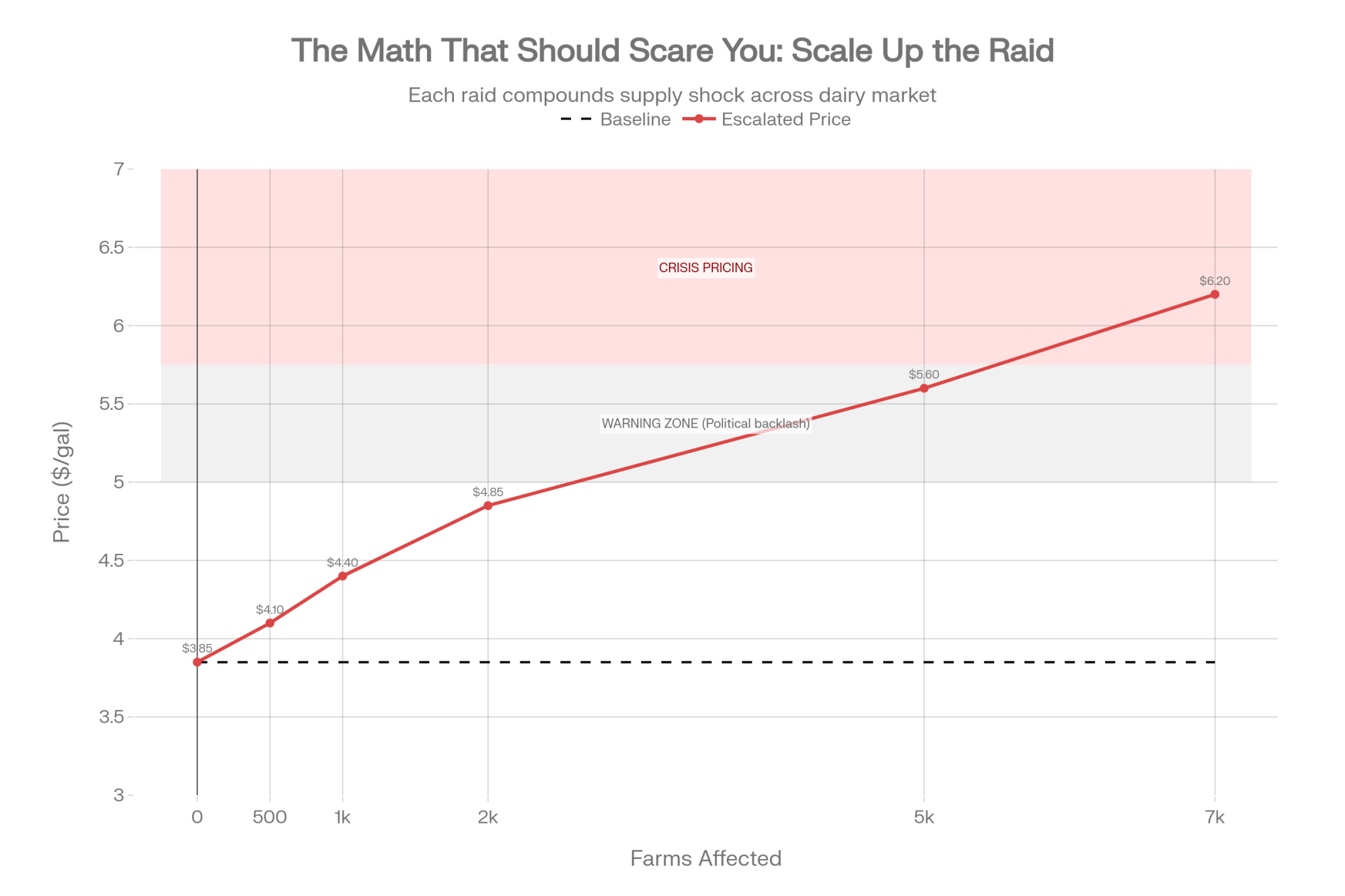
That 2015 national survey on immigrant labor—still the best wide‑angle view we have—estimated that if foreign‑born workers disappeared from U.S. dairies, roughly 7,000 farms would close and milk prices would spike. You don’t have to believe every line of a model to feel the point: the system isn’t built to handle that kind of loss.

In recent years, stepped‑up immigration enforcement hasn’t stayed in one state. Workplace and community raids in different parts of the country, including agriculture and food‑system jobs in states like Oregon and Wisconsin, have fed a constant undercurrent of anxiety in farm country. It’s not just packing plants and warehouses. It’s barns.

In places like Vermont, advocates who work closely with dairy workers have been saying the same thing over and over: fear of being stopped, detained, or deported has pushed many people into deeper isolation. Trips to church, doctor visits, school meetings, even basic shopping—things many of us take for granted—have been cut back or dropped entirely because the risk of being on the road feels too high.

For dairy owners and managers, that climate manifests in different ways. It looks like nights spent looking at the ceiling instead of sleeping, wondering if you’ll have enough hands for the first milking tomorrow. It looks like trying to support workers who are carrying their own fears while you’re also trying to keep the bank at bay and the cows on feed.

It shows up in the lives of farm spouses who balance payroll, kids’ schedules, and the unspoken emotional load of keeping the whole operation from flying apart. It shows up in teenagers who are suddenly taking on more barn work because there isn’t anybody else, watching the adults around them carry stress that’s hard to explain.

Lovington didn’t create that pressure. It just gave everyone a sharper, more public picture of what so many dairy communities have been quietly living with for years.

When Neighbours Became Family

The moment that sticks with a lot of people in stories like this isn’t always the raid itself. It’s what comes after, when the shock wears off, and the sheer amount of work left to do settles on the people who are still standing in the yard.

Standing in the milk house after a day like that, it would be easy to feel alone. The pipeline’s still humming. Cows still need to be fed. The phone won’t stop buzzing. You’re tired enough that the thought of asking for help feels like just one more job.

And then, in a lot of dairy communities, something small but important happens.

A text comes in from down the road: “How bad is it?”

At the feed mill, somebody says, “I heard what happened. Are they okay for help?” A nutritionist or vet decides to swing by sooner than planned. A friend at the co‑op quietly asks if there’s anything the board can do to give a bit of breathing room.

Sometimes it’s as simple as a kid asking their parents if they can go help at the other farm instead of scrolling on their phone that afternoon. On some roads, a teenager showing up to scrape alleys or bed a few pens has been the difference between a barn barely hanging on and a barn where people get to lie down for a couple of hours.

In many dairy communities, when a farm is hit with a fire, a serious illness, a bad accident—or an enforcement action like the one in Lovington—you see familiar patterns:

A neighbour swinging over after their own chores to ask what’s really needed.

A ride into town for someone who doesn’t feel safe driving alone.

A quiet envelope slipped into a hand outside the church because someone heard a family lost their income.

A plate of food left at the back door with the same simple line people have used for generations: “We made too much. Thought you might help us out.”

Most of those acts never see a camera. They don’t end up on Facebook. They don’t make a line in any official report. But for people living through the hardest days of their lives, those moments change how they see their neighbours.

Not as “the guy who runs that place down the road,” but as someone who refused to let them fall alone.

What This Story Asks of the Rest of Us

What moved a lot of people most about Lovington wasn’t just the shock of the raid. It was being forced to look straight at how dependent we’ve all become on workers who carry a lot of risk and not much protection—and at how much we lean on each other, often without saying it out loud.

Sitting at your own kitchen table, you might be thinking, “All right, but what am I supposed to do with this? I’ve got my own headaches.”

That’s fair. Nobody needs one more heavy thing to carry.

Maybe the question isn’t “How do we fix immigration policy?” Maybe it’s smaller and closer to home:

Who do we really depend on here?

Who might depend on us?

On most dairies, there’s at least one person whose cow sense you can’t imagine losing. They might be family. They might be a long‑term employee. They might be the worker who doesn’t speak much in meetings but notices every limp and every change in feed intake. Naming that out loud—and finding ways to show them they matter as a person, not just a set of hands—won’t change federal law. But it might change whether they feel alone when things get hard.

There’s also usually at least one neighbour, advisor, or friend you’d call on your worst day. If you can picture who that is, that relationship is worth investing in now, not someday.

Over supper or during a drive to pick up parts, it might be as simple as saying, “If we ever got hit with something like that New Mexico raid, you’d be one of the first people I’d call. I hope you know that.” And maybe adding, “If anything ever explodes on your place, I hope you’ll call us too.”

Sometimes the bravest thing isn’t staying strong. It’s admitting that if you lost half your crew overnight, you couldn’t do it alone.

Other small things matter more than they look like on a calendar:

Saying yes when the 4‑H leader wants to bring kids through the barn, because those kids might be your next crew—or your next neighbours.

Stopping by a meeting at the co‑op or county when you’re bone‑tired, because being there helps keep agriculture on the agenda.

Checking in on the people who carry the invisible load: the spouse who handles payroll and crisis calls, the teenager who suddenly became the extra hired hand, the worker who hasn’t left the farm in weeks.

And if Lovington has you thinking not just about barns but about the bigger picture, there’s one more step that matters. The same way you’d call a neighbour when the barn is in trouble, you can also let your local representatives know what raids like this look like from your yard. A simple, honest conversation—”Here’s who milks our cows, here’s what happens to our town when those people disappear overnight, and here’s why we need policies that keep both our herds and our communities stable”—isn’t about party lines. It’s about making sure the people writing the rules understand the human and economic reality they’re reaching into.

None of this fixes the whole system. But it does change the way it feels to live in it.

Community & Legacy: What We Build Before the Storm

Lovington is still living with what happened on that June morning. Outlook Dairy has been working to rebuild and get back to something resembling normal. Some legal and immigration cases tied to raids like that can drag on for years. Others end quickly with families separated and people gone before anyone’s ready.

The cameras left a long time ago. The day‑to‑day reality hasn’t.

For dairy people watching from a distance, the story lingers in a different way.

Every time someone mentions losing a chunk of their crew, those numbers in New Mexico—35 out of 55—come back to mind. Every time a producer talks about how much they rely on their immigrant workers, someone remembers Bos’s line: “It’s detrimental for our cattle. We’re barely able to keep going.” Every time a policy discussion treats enforcement like a clean, abstract lever, someone thinks of a parlor that went quiet for all the wrong reasons.

What happened in New Mexico didn’t create the bond between cows, workers, families, and neighbours. It revealed it—and showed how fragile that bond really is when something hits it hard.

The heart of this story isn’t that one farm had a terrible week and made the news. It’s that dairy communities everywhere are quietly being asked the same question Lovington had to face out loud:

When the barn feels empty, and the work looks impossible, will we let each other face it alone?

Most of us can’t choose if or when the next storm hits our lane. It might be enforcement. It might be a barn fire. It might be a health crisis, a brutal price year, or something nobody saw coming.

What we can choose—day in, day out, in a hundred small ways—is what kind of community we’re building long before the sirens ever show up.

The kind where it’s every farm for itself?

Or the kind where, when the worst happens, somebody already has their boots on, their truck running, and their mind made up—not because anyone called a meeting, but because that’s just what neighbours do here.

That decision doesn’t belong to policymakers, reporters, or anyone far away.

It belongs to us.

And if there’s one thing Outlook Dairy’s hardest week made hard to ignore, it’s that the time to make that decision isn’t when the lights are already flashing in the lane.

It’s now.

KEY TAKEAWAYS

  • One raid. One morning. Everything stopped. An ICE action at Outlook Dairy in New Mexico removed 35 of 55 workers—production halted, and everyone left was pulled into survival mode.
  • The math is brutal. Immigrant workers provide 51% of U.S. dairy labor and 79% of the milk. NMPF warns that losing them could close 7,000+ farms and nearly double retail prices.
  • Community didn’t ask permission. Neighbors, local teens, churches, and small businesses showed up with hands, rides, and quiet help—no politics, just presence.
  • This is your question now: If half your crew vanished tomorrow, who shows up before you call? And whose call would you answer?
  • Policy starts at your kitchen table. The people milking your cows have names, kids in local schools, and lives in your community. When you talk to representatives, remember that.

EXECUTIVE SUMMARY

When an ICE raid hit Outlook Dairy in Lovington, New Mexico, on a June morning in 2025, 35 of 55 workers were suddenly gone, milk production “had effectively ceased,” and everyone left—family, office staff, even local teens—was pulled into basic cow care just to keep the herd going. The article treats those 35 as people, not paperwork, tracing how their disappearance shook the barn and the wider town—schools, churches, grocery aisles, and small businesses that depend on dairy paycheques. It ties that one awful morning to the bigger reality that immigrant workers now provide roughly 51% of U.S. dairy labour and 79% of its milk, with NMPF modelling warning that losing them could close over 7,000 farms and nearly double retail milk prices. Against that backdrop, the heart of the story is the quiet, practical ways neighbours and community leaders show up—extra hands in the parlor, rides into town, support at church and school, and hard conversations in a Hobbs town hall—so one farm isn’t left to carry the crisis alone. It ends back at the kitchen table, asking every producer to name who they’d call if half their crew vanished, who might call them, and what to ask local representatives so the people who actually milk the cows—and the communities built around them—aren’t invisible when the next raid comes.

Complete references and supporting documentation are available upon request by contacting the editorial team at editor@thebullvine.com.

Continue the Story

The Sunday Read Dairy Professionals Don’t Skip.

Every week, thousands of producers, breeders, and industry insiders open Bullvine Weekly for genetics insights, market shifts, and profit strategies they won’t find anywhere else. One email. Five minutes. Smarter decisions all week.

NewsSubscribe
First
Last
Consent

Historic $2 Billion USDA Grant to Empower Black and Minority Farmers After Years of Discrimination

Find out how $2 billion in USDA funding changes the game for Black and minority farmers. Will it have an impact on the dairy farming community? Keep reading.

Summary: The USDA is launching a $2 billion project to help Black and minority farmers overcome barriers in obtaining loans and aid programs for over a century. The initiative includes access to advanced equipment, sustainable practices, technical support, and debt relief to reinvest in agricultural operations. Eligible farmers must have a history of financial hardship due to discriminatory actions and provide evidence of previous loan denials or land seizures. The $2 billion investment aims to empower Black and minority farmers by providing access to advanced technology, improved irrigation systems, and sustainable methods to increase production and efficiency. The plan has the potential to spread across the dairy industry, raising awareness of the need for fair assistance and sustainable methods.

  • Historic Investment: The USDA deploys an unprecedented $2 billion to support minority farmers, aiming to correct decades of systemic inequities.
  • Targeted Assistance: The fund is designed to offer financial relief and operational enhancements tailored specifically for Black, Indigenous, and farmers of color.
  • Community Impact: Beyond individual farms, this initiative seeks to bolster broader community resilience and economic stability in historically underserved areas.
  • Dairy Industry Implications: Potential transformative effects on the dairy sector, influencing production, market dynamics, and community engagement.
  • Long-Term Viability: While the $2 billion is a significant sum, questions linger about the sustainability of its impact and the need for further systemic reforms.

Black farmers have been grappling with systemic barriers to obtaining USDA loans and aid programs for over a century. This struggle dates back to the agency’s aggressive promotion of agriculture during the Great Depression. Shockingly, this pattern of exclusion persists even today. A 2022 NPR research revealed that Black farmers faced the highest USDA loan rejection rates, with only 36% of Black applicants receiving approval. The USDA’s new $2 billion project for Black and minority farmers is crucial to rectifying this historical injustice and reshaping the agricultural landscape for those neglected for far too long.

This funding is not just a financial boost; it’s a historic milestone in our commitment to rectifying past injustices and ensuring equity for all farmers,” stated Agriculture Secretary Tom Vilsack.

For many, this initiative is more than an economic lifeline; it’s the long-awaited acknowledgment of their pivotal role in the fabric of America’s agricultural legacy. Here’s what this funding entails: 

  • Access to Resources: Improved access to state-of-the-art equipment, sustainable practices, and expert technical support.
  • Debt Relief: Eased financial burdens, enabling farmers to reinvest in their agricultural operations.
  • Community Development: Backing for local projects to foster growth and innovation within minority communities.

The Untold Struggles: How Discrimination Shaped the Lives of Black Farmers and Their Battle for Justice 

To appreciate contemporary initiatives to help black and minority farmers, we must examine their history with the USDA. These farmers faced significant challenges for years, including discriminatory financing practices and restricted access to government programs. These difficulties go back to post-Reconstruction America when black farmers were often refused land and pushed into discriminatory sharecropping agreements. The USDA has only sometimes been fair, too. Throughout the twentieth century, the organization was regularly accused of rejecting loans and helping black farmers at a higher rate than white farmers. This discriminatory treatment lowered the number of black-owned farms from 14% in 1920 to only 1% in 1997. Local USDA offices made matters worse by ignoring or rejecting minority farmers’ applications, depriving them of the needed resources to thrive.

Lawsuits have brought some of these wrongs to light. The Pigford v. Glickman lawsuit in 1999 revealed the USDA’s long-standing prejudice and resulted in a $1 billion settlement. However, many believed the compensation needed to be more balanced and unevenly divided. Despite such legislative successes, these issues persisted throughout the twenty-first century, jeopardizing minority-owned farms’ financial viability and sustainability.

A Breakdown of the $2 Billion Funding: Where Is the Money Going? 

When analyzing the $2 billion investment for Black and other minority farmers, it is critical to understand where the money is going. The USDA has planned the allotment to guarantee it meets the target.

The first central section focuses on combating racial prejudice, which these communities have experienced for years. This implies that legal aid and advocacy organizations will get assistance in addressing the unjust practices that have harmed farmers’ livelihoods.

There is also funding for community development and infrastructure projects, such as community gardens, which aim to engage people and offer educational materials.

To be eligible, farmers must have a history of financial hardship due to discriminatory actions. They must offer evidence such as previous loan denials or land seizures that have harmed their agriculture operations.

The USDA has simplified the application procedure. The process begins with an introductory form, followed by discussions and verifications with a USDA representative. This makes getting help where it’s most needed simpler and quicker.

Furthermore, farmers who practice sustainable and community-focused farming will be given preference, ensuring that monies are utilized to right past wrongs and create a brighter future for minority farmers.

Empowering Minority Farmers: How $2 Billion is Set to Transform Operations and Community Resilience 

This $2 billion capital injection, which directly benefits Black and minority farmers, is more than a financial lifeline; it is a game changer in operations. Historically, these farmers faced structural impediments that made it difficult to get funding, sophisticated equipment, and improved procedures. This critical support attempts to level the playing field by enabling investments in cutting-edge technology, improved irrigation systems, and sustainable ways to increase production and efficiency.

The investment also promises to increase access to critical resources. Black and minority farmers may benefit from educational programs, technical help, and cooperative extensions that teach them about novel agricultural practices, financial management, and new market prospects. This information could revolutionize farmers’ lives, providing them with a competitive advantage and allowing them to make more informed choices.

Furthermore, economic stability in these agricultural communities is expected to increase. These farmers can maintain and grow their enterprises with more financial support and resources, boosting community resilience. The financing promotes economic development and sustainability by creating local employment and enhancing food supplies. These changes increase the agricultural industry, enabling Black and minority farmers to prosper and contribute to the larger economy.

The Ripple Effect: How $2 Billion for Minority Farmers Could Transform the Dairy Industry 

While the $2 billion investment plan primarily benefits Black and minority farmers, it is critical to understand its possible effect on the dairy business. This program has the potential to spread across the dairy industry, making all dairy producers more aware of the need for fair assistance and sustainable methods. Let us break this down:

On the positive side, having access to better resources and technology is a huge advantage. The USDA’s contributions might result in improved equipment and innovative, sustainable dairy farming practices that will benefit everyone in the long run. Increased production and lower costs may be in the future.

Furthermore, improving the economic condition of minority farmers has the potential to stabilize the agricultural market. This translates to reduced market volatility and a robust support network for dairy producers. Learning from and partnering with minority farmers may help build a more inclusive and creative agricultural community.

On the other hand, there is a competitive aspect to consider. Increased assistance for minority farmers may imply that dairy producers must improve their game to remain competitive. Another area for improvement is policy navigation. Staying current on money allocation and ensuring equitable benefits will be critical. Participating in local and national agricultural organizations may help dairy producers’ opinions be heard.

While this $2 billion investment is a historic step toward fairness, dairy farmers must grasp its implications, speak for their needs, and seek collaborative possibilities to maximize the benefits of these improvements.

$2 Billion Windfall or Short-Lived Relief? The Complexities Behind USDA’s Historic Investment 

Despite the anticipation, the $2 billion financing has specific challenges. First, there is anxiety about how well the USDA will administer the monies. Critics believe that the agency’s history of delays and inefficiency may hold down the provision of financial help. There is also concern about the fairness of the money distribution, with some stakeholders thinking it may favor some groups over others, failing to meet the needs of many minority farmers.

Then there’s the matter of long-term effects. Skeptics question whether the $2 billion will result in long-term benefits or a temporary fix. With continued assistance and institutional reforms inside the USDA, this money may result in the long-term development required. To address these difficulties and maximize the value of this investment, it is critical to ensure openness in how funds are dispersed and to build robust monitoring mechanisms.

The Bottom Line

The USDA’s $2 billion commitment is a substantial step toward addressing long-standing injustices suffered by Black and other minority farmers. This cash goes toward operating expenses, community resilience, and direct financial assistance. By giving these materials, the project hopes to undo years of prejudice. It’s more than simply cash assistance; it’s about creating a more egalitarian and sustainable agriculture industry. This investment provides optimism and development prospects and can improve whole communities. While the journey to 100% ownership is lengthy, this money is a massive step in the right direction.

Learn more: 

Send this to a friend