Archive for carbon footprint reduction

UK Dairy Farmers Just Figured Out How to Make Sustainability Actually Pay – And Everyone’s Taking Notes

When major retailers and processors agree to share the cost burden instead of just making demands, you know something big is happening
dairy sustainability profitability, sustainable dairy farming, carbon footprint reduction, dairy supply chain collaboration, dairy farm efficiency

You know what caught my attention this week? British dairy farmers just did something most of us thought was impossible. They got their entire supply chain—from the corner store to the golden arches—to actually help pay for going green.

I’m not talking about another feel-good press release here. This is real money changing hands, binding commitments on paper, and a completely different way of doing business that’s got folks from Wisconsin to Alberta asking, “How’d they pull that off?”

The UK dairy industry has just launched what it’s calling a “landmark alliance.” But here’s what makes this different: for the first time ever, the big retailers and processors are sitting down at the same table, making formal commitments to share the cost of environmental improvements instead of just handing down demands from corporate headquarters.

The Numbers Tell the Real Story

Let’s cut through the corporate speak and talk about what’s actually happening on British farms right now:

Eighty percent of UK dairy farmers are calculating their carbon footprint. Not planning to do so, not thinking about it, doing it.

Approximately 65% of dairy farmland is enrolled in environmental stewardship programs. That’s two-thirds of the entire sector getting paid for conservation work.

Approximately 40% of on-farm energy comes from renewable sources. Compare that to lower adoption rates in North America, and you start to see why people are paying attention.

These aren’t pie-in-the-sky targets for 2030. They’re happening right now, on working farms, with real farmers managing real cows and real bottom lines.

The alliance bringing this together reads like a who’s who of the dairy world: AHDB, Dairy UK, NFU, Arla Foods UK, Dale Farm, First Milk, Lactalis UK & Ireland, Müller UK & Ireland, Tesco, Sainsbury’s, Morrisons, McDonald’s and Sysco GB all sitting in the same steering group. When was the last time you saw that kind of lineup agreeing on anything?

Bas Padberg from Arla Foods UK, who’s chairing this whole thing, put it pretty simply: “We have to find ways of feeding a growing population and providing nutrient-dense foods that nourish people. Dairy has a key role to play in this, but we know that as an industry, we also need to ensure that we limit our impact on the environment and bring down emissions”. What’s different this time? The retailers aren’t just nodding along—they’re actually writing checks.

Why This Should Matter to Your Bottom Line

Here’s the thing about sustainability requirements: they’re not going away. If anything, they’re getting tougher every year. But until now, who has been expected to absorb all those costs? That’s right—us farmers.

Paul Tompkins from the NFU National Dairy Board said what we’ve all been thinking: “The costs and complexities of compliance are significant, and dairy farmers cannot meet them alone”. Finally, someone in a position to do something about it is actually saying it out loud.

And here’s what really gets me excited: the UK sector isn’t just talking a good game. They’ve already achieved a 24% drop in greenhouse gas emissions since 2015. Their carbon footprint per liter is 1.25 kg CO2e—that’s only 43% of the global average and significantly below benchmarks in other major dairy regions.

These aren’t theoretical numbers dreamed up in some university lab. British dairy farmers are operating at world-leading efficiency levels, and they’re doing it profitably.

How They’re Actually Making It Work

Now, here’s where it gets interesting. The secret isn’t just everyone holding hands and singing about teamwork. It’s the structure they’ve built.

This alliance operates on what they call “shared responsibility,” meaning the costs and benefits of sustainability are distributed across the entire supply chain, not just dumped at the farm gate. Think about it like this: if your local co-op benefits from marketing “sustainable” milk, shouldn’t they help pay for what makes it sustainable?

They’ve a Sustainable Dairy Pathways Report scheduled for 2026 that’ll outline exactly who pays for what. Smart move? A dairy farmer is leading it, so real-world economics don’t get lost in corporate translation.

The targets are ambitious but achievable: Net Zero by 2050, with every farmer calculating their carbon footprint every three years. They aim to achieve 100% renewable electricity on-farm by 2030 and eliminate all serious water pollution incidents by the same date.

The Science Behind What’s Actually Working

Most of us have heard the sales pitches about automated systems and renewable energy. But let’s talk about what’s really happening on farms based on current research:

Carbon footprint reduction through practical measures is where the real progress is happening. Dr. Tianhai Yan from the Agri-Food Bioscience Institute (AFBI) has demonstrated that high-yielding herds can reduce their carbon footprint by 31.5% through practical nutrition and management-based practices, while spring-calving herds can achieve 16.9% reductions. A range of practical mitigation measures can be implemented on dairy farms to help reduce emissions from agriculture. This includes practical nutrition and management-based practices designed to lower emissions of ammonia and methane,” Yan explains.

Renewable energy adoption is where the UK really stands out. The 40% figure for on-farm renewable energy usage reflects substantial investment in technologies such as anaerobic digestion. As Arla’s VP of Production, Fran Bal,l notes, “AD has the potential to play a very valuable role in terms of waste disposal, improving the management of slurry, and providing access to clean biogas””.

Standardized measurement is crucial to this success. The UK’s approach aligns with the International Dairy Federation’s revised Carbon Footprint methodology, developed by 50 experts from 17 countries who reviewed the latest science and best practices. As IDF Director General Caroline Emond puts it, “We can’t reduce what we cannot measure”.

But let’s be honest about the investment. The UK Dairy Carbon Network, led by AFBI, is establishing 56 demonstration farms across four major dairying regions to test real-world solutions. These aren’t just theoretical studies—they’re testing everything from animal management innovations to nutrient management approaches on actual commercial operations.

Let’s Talk Real Money

Sounds too good to be true? Here’s where the rubber meets the road in terms of farm economics that can be appreciated:

The UK’s support through the Sustainable Farming Incentive has been substantial. As of January 2025, there were 32,200 active agreements covering significant portions of England’s agricultural land. The government has committed £5 billion over 2 years to sustainable farming and nature recovery, with over 37,000 agreements in place.

These programs are delivering measurable results. Through SFI, 800,000 hectares of arable land are now farmed without insecticides, while 280,000 hectares of low-input grassland are being managed more sustainably. Additionally, 75,000 km of hedgerows are being actively maintained.

The UK’s success stems from aligning policy support with market incentives. As research shows, “the increasingly pressing challenges and high competition in the dairy industry, particularly in saturated markets, emphasize the importance for farms to undertake a comprehensive economic sustainability analysis”.

However, here’s the catch: these programs rely on meeting specific sustainability targets and navigating complex bureaucratic requirements. Most participating farmers report the paperwork is worth it for the financial support, but it’s not a free ride.

What This Means for North American Farms

For those of us watching from across the pond, this could signal a whole new approach to negotiating with processors and cooperatives. While UK farms are seeing these collaborative results, North American approaches remain more fragmented.

The US dairy industry operates through voluntary initiatives led by organizations like the Innovation Center for US Dairy’s Sustainability Alliance, relying on what they call “braided funding” from public grants and corporate partnerships. Canada’s proAction® program provides more regulatory structure but hasn’t achieved the same level of coordinated industry response we’re seeing in the UK.

Climate and scale matter, too. What works in the UK’s relatively concentrated dairy regions might need adaptation for the vast geographic spread of North American operations. And a 100-cow family operation faces different realities than a 2,000-cow setup with automated systems.

The Technical Foundation That Makes It Work

What really strikes me about this UK approach is how they’ve standardized the technical foundation. The alliance utilizes consistent carbon footprinting tools aligned with the International Dairy Federation methodology, which means farmers can’t be penalized for using the “wrong” calculator. Everyone plays by the same rules.

The UK Dairy Carbon Network is providing the research backbone, with Dr. Steven Morrison from AFBI leading work across 56 farms in four major dairy regions. “Our goal within the project is to drive meaningful change in the dairy sector by applying research findings directly to real-world farming conditions,” Morrison explains.

This isn’t just about measuring emissions—it’s about proving what actually works in commercial farming conditions. The network will assess innovations in animal management, land use, nutrient management, and technology, while supporting farmers in achieving more efficient use of nitrogen and phosphorus.

What You Can Take Away from This

Three things really stand out:

First, collective action works. When the entire industry, including the buyers, commits to sharing responsibility, the economics finally start making sense. Individual farms trying to meet sustainability requirements alone are fighting an uphill battle.

Second, standardized measurement matters. The UK’s emphasis on consistent, credible data using the IDF methodology means everyone is held to the same standards. No more moving goalposts or arbitrary requirements.

Third, timing is everything. The UK moved when market conditions, policy support, and consumer demand aligned. That window exists for North American producers, but it won’t stay open forever.

The Bottom Line

This isn’t about being green for the sake of it. UK dairy has positioned itself as a global leader in low-carbon production by focusing on efficiency and innovation. Now they’re making sure the entire supply chain shares both the costs and the benefits of that leadership.

For North American producers watching this unfold, the lesson is crystal clear: the future belongs to those who can organize collectively and negotiate from a position of strength. The UK dairy industry just showed us exactly how it’s done.

And you know what? It’s about time someone figured out how to make sustainability profitable, rather than just another cost of doing business.

The real question isn’t whether this model will spread—it’s how quickly other regions will adapt it to their own markets. Because one thing’s certain: farmers who wait for perfect conditions usually miss the best opportunities.

Regional Performance Comparison

RegionCarbon Footprint (kg CO2e/L)Progress Since 2015Renewable Energy UseEnvironmental Scheme Participation
UK1.2524% GHG reduction40%65%
Global Average2.9VariableVariableVariable

Sources: UK Dairy Roadmap Climate Ambition, Official Alliance Announcements, AFBI Research, International Dairy Federation

Key Takeaways

  • Collective Bargaining Power Delivers Real ROI: UK farmers negotiating as a unified bloc with retailers achieved 65% participation in environmental schemes with guaranteed cost-sharing, proving that organized producers can shift sustainability expenses from farm balance sheets to supply chain partners who benefit from “sustainable” marketing claims.
  • Standardized Carbon Measurement Cuts Compliance Costs: Using the International Dairy Federation methodology eliminated “wrong calculator” penalties and reduced the administrative burden, while AFBI research shows that practical nutrition and management changes can deliver 31.5% carbon footprint reductions without major capital investments.
  • Policy-Market Alignment Maximizes Feed Efficiency Returns: The UK’s £5 billion Sustainable Farming Incentive, supporting 37,000+ agreements, demonstrates how coordinated government programs and retailer commitments create multiple revenue streams that improve feed conversion ratios while reducing environmental impact.
  • First-Mover Advantage in Low-Carbon Positioning: The UK dairy industry’s 1.25 kg CO2e/L footprint (versus a global average of 2.9 kg) positions producers for premium markets and regulatory compliance, while North American operations risk being left behind as sustainability requirements tighten in 2025-2026.
  • Supply Chain Integration Beats Individual Action: The alliance model proves that shared responsibility frameworks deliver measurable results (40% renewable energy adoption, 24% GHG reduction) that individual farm sustainability efforts can’t match, challenging the conventional wisdom that environmental compliance is a solo farm responsibility.

Executive Summary:

Forget the myth that dairy farmers must shoulder environmental costs solo—the UK just shattered that outdated thinking with a game-changing alliance model. British producers achieved 80% participation in carbon footprinting and 40% adoption of renewable energy by making retailers and processors share the financial burden, rather than just making demands. The results? A 1.25 kg CO2e/L carbon footprint that’s 43% of the global average, 24% GHG reduction since 2015, and measurable profit improvements for participating farms. This shared responsibility approach challenges North America’s fragmented sustainability efforts, where individual operations struggle with compliance costs while processors capture marketing benefits. Research from AFBI demonstrates that high-yielding herds can reduce their carbon footprints by 31.5% through practical nutrition and management changes when properly supported across the supply chain. The UK’s £5 billion government commitment and retailer cost-sharing prove that collective action transforms sustainability from a farm expense into a profitable industry strategy. It’s time to evaluate whether your current sustainability approach is leaving money on the table while your supply chain partners profit from your environmental investments.

Complete references and supporting documentation are available upon request by contacting the editorial team at editor@thebullvine.com.

Learn More:

Join the Revolution!

Join over 30,000 successful dairy professionals who rely on Bullvine Weekly for their competitive edge. Delivered directly to your inbox each week, our exclusive industry insights help you make smarter decisions while saving precious hours every week. Never miss critical updates on milk production trends, breakthrough technologies, and profit-boosting strategies that top producers are already implementing. Subscribe now to transform your dairy operation’s efficiency and profitability—your future success is just one click away.

NewsSubscribe
First
Last
Consent

Understanding the New LPI Formula Implementing April 2025

Explore the April 2025 LPI update to enhance your farm’s sustainability and genetic gains. Ready to thrive?

Summary:

The dairy breeding landscape is poised for a significant shift, with the Lifetime Performance Index (LPI) ‘s modernization in April 2025. This revamped formula intends to align with current industry goals such as sustainability and profitability. Highlighted at recent GEB and industry meetings, the new LPI will feature six sub-indexes focusing on production, longevity, health, reproduction, and environmental impact. It also includes an environmental impact index targeting methane efficiency and body maintenance. These changes are designed to enhance the genetic gains in dairy herds, supporting the sector’s commitment to achieving net-zero greenhouse gas emissions by 2050 and inviting dairy farmers to integrate economic viability with environmental responsibility.

Key Takeaways:

  • The modernized LPI formula will integrate sustainability as a critical component, reflecting industry shifts towards reducing greenhouse gas emissions.
  • Official subindexes, each focusing on specific traits and expectations, will be introduced, including production, longevity, health and welfare, and environmental impact.
  • Breed-specific weights and traits have been recommended, varying among Holsteins, Jerseys, and Ayrshires to optimize genetic gains and align with specific breed goals.
  • Maintaining a 60/40 fat-to-protein yield ratio has been recommended for Holsteins, ensuring consistent genetic progress while adapting to economic and environmental factors.
  • The introduction of the Environmental Impact subindex highlights a global initiative to measure and improve the carbon footprint of dairy operations.
  • Revisions to the LPI formula anticipate changes in sire rankings, with a correlation to the current formula near 97%, slightly affecting the order of top bulls.
  • The sustainability focus aligns with broader industry objectives to reach net-zero greenhouse gas emissions by 2050.
  • The new LPI system provides tools like a personalized LPI, allowing users to adjust trait emphasis and align selection with individual priorities.
Lifetime Performance Index, LPI transformation 2025, dairy farming sustainability, genetic selection dairy, environmental impact index, net-zero emissions dairy, breeding choices dairy farmers, methane efficiency livestock, carbon footprint reduction, dairy industry climate change

In April 2025, the new Lifetime Performance Index (LPI) formula will alter how we evaluate and choose dairy cattle, ushering in an exciting period of innovation and advancement in dairy farming. This revised LPI formula is intended to speed and improve breeding choices while including critical sustainability aspects, resulting in a paradigm change toward environmentally responsible dairy production. But how does this affect the regular dairy farmer and the environment? Let us go into the specifics.

“The introduction of sustainability into the LPI marks a pivotal moment for the industry, echoing global trends towards greener farming practices.”

Are you prepared for a dramatic transition in the dairy industry? In April 2025, the new Lifetime Performance Index (LPI) formula will alter how we evaluate and choose dairy cattle, ushering in an exciting period of innovation and advancement in dairy farming. This revised LPI formula is intended to speed and improve breeding choices while including critical sustainability aspects, resulting in a paradigm change toward environmentally responsible dairy production. But how does this affect the regular dairy farmer and the environment? Let us go into the specifics.

  • Inclusion of Environmental Impact: The new LPI introduces an official subindex for environmental impact, integrating traits that reflect a cow’s carbon footprint.
  • Enhanced Genetic Progress: The modernized formula promises faster genetic gains by incorporating genomic selection and other technological advancements.
  • Focus on Health and Longevity: With subindices dedicated to health and Welfare, the LPI encourages breeding for resilience and longevity, crucial factors in a sustainable dairy future.

Understanding and harnessing these improvements will be critical for dairy farmers and industry experts. The new LPI formula is more than a tool; it represents a bridge to a more sustainable, resilient, and productive future for dairy farmers. Let us embrace change and pave the way to a greener future.

Charting a New Course: Unveiling the Reimagined Lifetime Performance Index

The Lifetime Performance Index (LPI) has long been a dairy industry standard, offering a complete statistic for assessing the genetic value of dairy cattle. Its significance is critical because it helps farmers and breeders make educated choices to improve productivity, profitability, and overall herd genetics. Historically, the LPI combined several features, often classified into three essential components: production, durability, and health attributes. These components were carefully chosen to match the demands of dairy operations, assuring a focus on milk output, lifespan, and health, propelling the industry’s genetic advancement.

However, as the world of dairy farming develops, so do the technologies we utilize. The upgrading of the LPI indicates a trend toward more nuanced and sophisticated approaches, taking into account advances in genetic research and industrial concerns such as sustainability. This transformation is more than just cosmetic; it is based on the reality of modern dairy production, where concerns about environmental impact and animal welfare are increasingly impacting operational decisions.

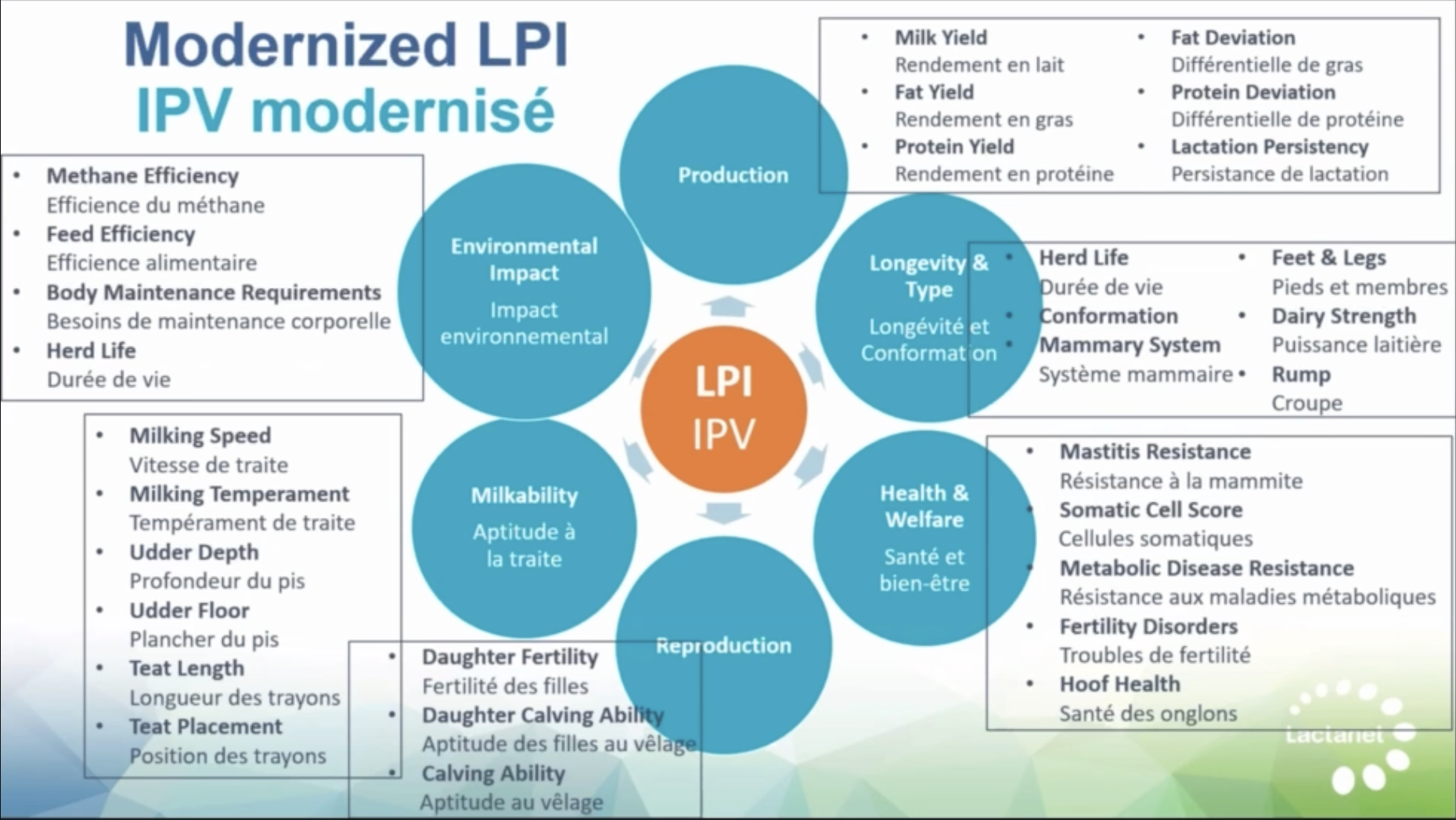
Subindexes are a crucial feature in the new LPI system. They use a more targeted approach, breaking the LPI into particular focal areas, including health and Welfare, reproduction, and environmental impact. Each subindex reflects a set of qualities that, when aggregated, contribute to the overall breeding objectives. This modular approach improves clarity and accuracy in choices. It enables a more adaptable and forward-thinking approach to herd management, connecting genetic selection closely with present and future industry needs.

Embracing Sustainability: The New Era of Dairy Genetics Begins!

Beginning in April 2025, the Lifetime Performance Index (LPI) will undergo a dramatic overhaul, making it more relevant and practical for today’s dairy sector concerns. The main goal of this update is to include sustainability as a critical component of the LPI formula. This project is consistent with worldwide initiatives to lessen the environmental effects of dairy production and targets farmers who are more concerned with sustainable methods.

Moving away from the complicated mathematical formulas of the past, the revised LPI seeks to ease comprehension and implementation. This modification is intended to make the LPI more accessible and intuitive for farmers and industry experts, ensuring that essential advice is not lost in translation.

The addition of official subindexes is another big step forward. These subindexes will now be released individually, focusing on specific performance areas. This segmentation provides a more accurate view of how each component contributes to the total LPI.

Among the new subindexes are: 

  • Production – emphasizing yield and efficiency improvements.
  • Longevity and Type – focusing on the physical traits that affect a cow’s lifespan and productivity.
  • Health and Welfare – prioritizing disease resistance and overall cow well-being.
  • Reproduction – aimed at optimizing fertility and calving success.
  • Milkability – enhancing the ease and efficiency of milk extraction.
  • Environmental Impact (EI) – a new addition targeting reducing carbon footprint and enhancing sustainability.

Each subindex indicates an area where dairy producers may monitor progress and make more informed choices to improve efficiency and sustainability. Together, these LPI improvements give a complete, user-friendly way to evaluate dairy cattle, ushering in a future in which data-driven sustainability is promoted and embedded at the heart of industry measurements.

Optimizing Yields: Balancing Milk, Fat, and Protein 

  • Production: This subindex focuses on yield qualities, namely milk, fat, and protein. The goal is to balance these components while reflecting the dairy market’s pricing mechanisms and solid compositions. Increased concentration of fat and protein yields is required for more significant genetic gain. This subindex has historically held substantial weight in the LPI, with expected development quantified in kilos of milk, fat, and protein over five years.
  • Longevity and Type: This subindex focuses on features such as herd life, conformation, and feet and legs to improve dairy cows’ durability and functionality. Removing the focus on dairy strength corresponds with retaining moderate-sized cows, which supports the environmental impact goals. This ensures that the cows stay healthy and productive throughout their lives, adding to the overall efficiency of dairy operations.
  • Health and Welfare: This subindex’s key features include resistance to mastitis, metabolic illnesses, hoof health, and reproduction issues. It emphasizes animal health by concentrating on common illnesses and disorders to reduce treatment costs and increase heritability. This subindex helps to improve cows’ well-being, which is critical for sustainable dairy production.
  • Reproduction: This subindex focuses on female fertility features such as daughter fertility and calving ability, including calving ease and calf survival. The goal is to strengthen the herd’s reproductive capacity, resulting in increased pregnancy rates and improved calving outcomes. This directly impacts the herd’s production and efficiency, an essential factor in the LPI.
  • Milkability: This subindex focuses on milking speed, temperament, and udder shape. It considers milking efficiency, convenience of use, and cow temperament important for animal welfare and farm management. The subindex hopes to enhance dairy production’s operational elements by addressing these characteristics.
  • Environmental Impact: This new subindex, a pioneering method, incorporates feed efficiency, methane emissions, and body maintenance needs. It demonstrates the industry’s commitment to achieving net-zero greenhouse gas emissions. This subindex covers environmental issues and is expected to play a crucial role in repositioning the LPI for a more sustainable dairy industry.

Pioneering Green Pastures: Driving Dairy’s Sustainable Revolution

The dairy industry’s unshakable commitment to achieving net-zero greenhouse gas emissions by 2050 marks a key milestone in our shared path toward sustainability. As environmental stewards, we realize the importance of this program, which connects with national and global initiatives to reduce climate change consequences. The updated Lifetime Performance Index (LPI) model is created to strengthen this commitment by incorporating sustainability into the heart of dairy genetics.

Genetic selection emerges as a significant tool in this new LPI formula, providing a way to improve features that directly benefit environmental efficiency. By including additional components, such as methane efficiency and feed intake, into the LPI, we provide dairy producers with the genetic insights they need to improve their herds’ carbon impact. These features increase productivity and result in more efficient cows that use less feed to produce the same output, reducing waste and emissions.

This method is based on the concept that genetic enhancements are permanent and cumulative, affecting each subsequent generation more deeply. As dairy herds expand, choosing features that promote environmental sustainability becomes essential to the breeding plan. The LPI acts as a guiding parameter, allowing farmers to make choices that combine economic viability and environmental responsibility, eventually propelling the sector toward its lofty net-zero targets.

Redefining Genetic Progress: Unveiling Key Advances in Dairy Breeding

The newly developed LPI formula, planned to be implemented in April 2025, is projected to accelerate significant genetic gains, with a refined focus on different qualities critical to contemporary dairy production. The anticipated genetic benefits, especially in milk production and health, are predicted to be significant. For Holsteins, the rebalanced focus predicts a yearly genetic gain of 511 kilos in milk output and a 39-kilogram rise in fat and 27 kilograms in protein over the following five years. These increases outperform previous indices, strategically matching current dairy industry needs and genetic potential.

Regarding reproductive performance and health, the LPI framework strongly focuses 70% on daughter fertility and 94% on association, resulting in a two-point increase in RBV and a two-point improvement in calving ability over a half-decade. Such concentrated selection emphasizes the long-term enhancement of reproductive qualities, a significant predictor of herd health.

The environmental impact index (EI), a new component of the LPI, represents a trend toward sustainability. The EI index, built on empirical findings, is designed to precisely target methane efficiency (37% correlation) and body maintenance needs (38% correlation). Consequently, the bovine carbon footprint is reduced overall, furthering the goal of net zero emissions by 2050. However, the original 7% weight in EI resulted in specific unfavorable correlations; modifications to 12% show that strategic realignment may overcome these downsides and ensure a positive trajectory in environmental stewardship.

Across breeds, the new LPI guarantees that the change in weighting, albeit minor, is consistent with current sectors’ needs and breed-specific traits. Whether positioned to enhance production metrics or strengthen resilience via health and environmental indices, this formula encourages a forward-thinking genetic selection approach that embraces the twin mission of productivity and sustainability.

Forging the Future: Transformative Shifts in Dairy Industry Dynamics

Updating the Lifetime Performance Index (LPI) methodology has essential consequences for dairy farmers and industry experts. It will redefine breeding choices, farm management, and competitive dynamics in the business. This new LPI formula elevates dairy production to the forefront of environmental management by including sustainability parameters with standard performance measurements. As we investigate these consequences, we must explore how these factors interact to shape the future of dairy farming.

The redesigned LPI adds dimensions to breeding choices for dairy producers by emphasizing productivity qualities above those related to environmental impact and animal welfare. This comprehensive approach involves changing breeding practices, pushing farmers to consider long-term genetic benefits to sustainability and production efficiency. By providing a better picture of a cow’s entire effect, the revised LPI enables farmers to make educated choices that line with economic and environmental objectives, possibly increasing profitability via greater efficiency and lower environmental footprints.

Similarly, agricultural management approaches will have to adjust. With a greater emphasis on sustainability, producers may need to include techniques that improve feed efficiency and reduce methane emissions, matching their operations with the features currently highlighted in the LPI. This transition supports a more sustainable dairy production model, necessitating investments in new technology and changing herd management practices to realize the advantages of the new breeding priority.

The competitive environment of the dairy business is about to change when the LPI revisions take effect. Companies that provide genetic and farm management solutions must develop and modify their offerings to help farmers navigate this shift, emphasizing services and products that correspond with the new LPI emphasis. This drive for sustainability may increase market rivalry as firms compete to provide the most effective solutions for achieving the upgraded index’s updated breeding and management standards.

The reform of the LPI formula marks a watershed moment for the dairy sector, challenging established assumptions and opening the road for a more sustainable, efficient, and competitive future. As these developments occur, dairy farmers and industry experts will play essential roles in determining the sector’s future, harnessing new insights and technologies to flourish in this changing terrain.

The Bottom Line

Modernizing the Lifetime Performance Index (LPI) is essential for more sustainable and profitable dairy production. This improved recipe will likely boost production while addressing environmental concerns by incorporating new indices and data-driven insights into breeding procedures. The changes in weighting across several genetic traits are intended to improve overall herd performance, offering a complete framework for measuring dairy yield.

The advantages of this contemporary approach are clear. It provides dairy producers a more straightforward approach to optimizing their herds for productivity and environmental sustainability. This strategy is consistent with the more considerable effort for net-zero emissions, thereby establishing the dairy sector as a pioneer in sustainable agriculture.

How will you embrace these developments as the dairy business evolves to keep your farm competitive and sustainable in an ever-changing marketplace? Now is the moment to become involved with these breakthroughs by attending forthcoming industry workshops, researching the abundance of materials accessible via Lactanet, and thinking about how these innovations might be applied to your agricultural methods to ensure future success.

Learn more:

Join the Revolution!

Bullvine Daily is your essential e-zine for staying ahead in the dairy industry. With over 30,000 subscribers, we bring you the week’s top news, helping you manage tasks efficiently. Stay informed about milk production, tech adoption, and more, so you can concentrate on your dairy operations. 

NewsSubscribe
First
Last
Consent
Send this to a friend