







She ditched physics for dairy calves. Emily Miller-Cushon’s PECASE-winning research: pair housing saves $9,900/year in heifer losses. Ready to test it on your farm?
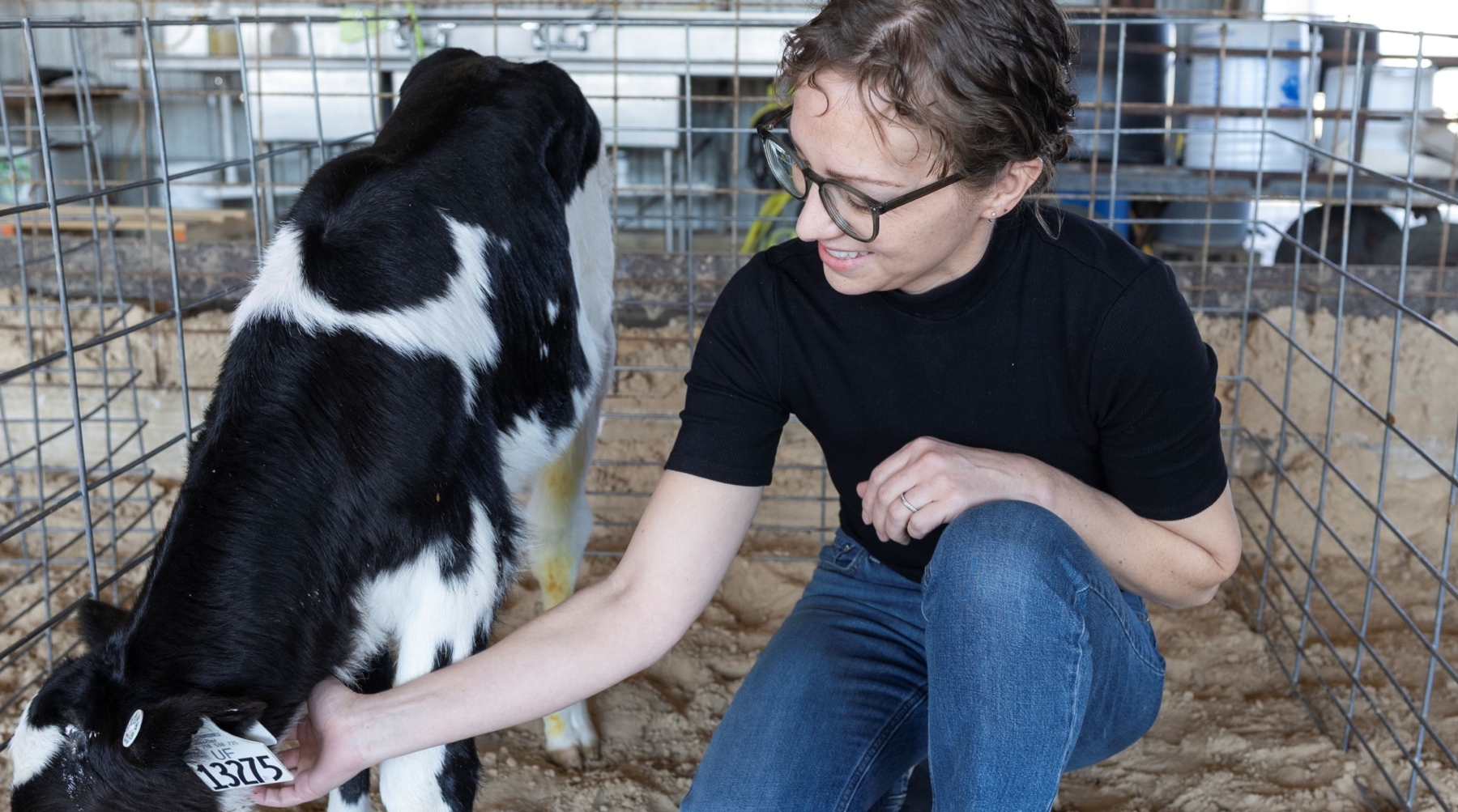
On a February morning in Gainesville, Florida, Emily Miller-Cushon walked through the calf barn at the University of Florida Dairy Unit and checked on animals she’d been tracking since the day they were born — some for nearly five years. Not somatic cells. Not feed conversion. She was watching how they behaved, whether they approached unfamiliar pen-mates or hung back. How confidently they ate at the bunk when competition showed up.
Those aren’t the measurements most dairy scientists build careers on. But Miller-Cushon isn’t most dairy scientists — she started in physics. And that background, plus the unconventional path that followed, is reshaping how the industry understands how a calf’s lifetime performance is affected by decisions you make in her first two weeks of life.
From Quantum Mechanics to Calf Pens
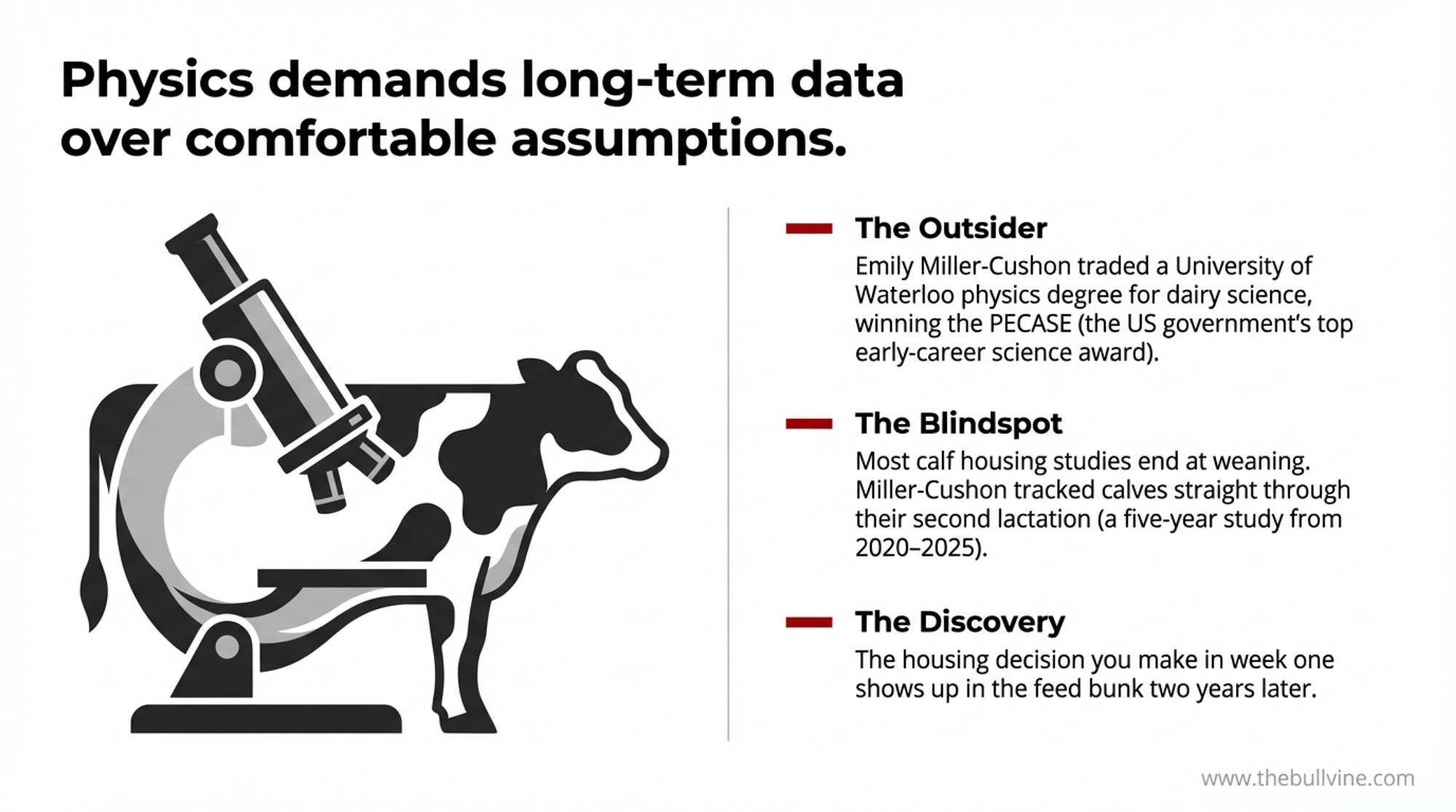
Miller-Cushon grew up in rural Ontario, surrounded by small farms and animals, but headed straight into a physics and mathematical physics program at the University of Waterloo — one of Canada’s most rigorous STEM schools. The work was intense, and she was good at it. By her senior year, though, she had a problem: she couldn’t see where it connected to anything she actually cared about.
“I wanted to make a tangible difference in areas that personally interested me,” she’s said. The summer before her final year, she assisted with animal science research. A mentor recognized something in her excitement that Miller-Cushon hadn’t fully seen herself — and encouraged her to pivot.
So she did. Walked away from physics entirely. Entered a doctoral program in animal science at the University of Guelph, working under Trevor DeVries at the Campbell Centre for the Study of Animal Welfare. Finished her PhD in 2014, joined the University of Florida faculty, and now runs one of the most closely watched calf welfare research programs in North America.
The pivot cost years of career momentum. Physics colleagues didn’t always get it. But what she brought from that training — a comfort with long data sets, statistical rigor, the habit of questioning assumptions — turned out to be exactly what calf welfare research needed.
What Does a Physicist See in a Calf Barn?
Here’s what makes Miller-Cushon’s work different from most calf welfare research you’ve read: she doesn’t just measure what happens during the preweaning period. She has followed animals for years.
One USDA-NIFA-funded project tracked calves from birth through their second lactation — a five-year study that ran from 2020 through 2025, straight through a pandemic. “Tracking animals into adulthood was hard work that took a team of dedicated students,” Miller-Cushon told UF/IFAS. “It has been worth it, though, to see the long-term impact of early life experiences for dairy calves on welfare into adulthood.”
Most calf housing studies end at weaning. Hers didn’t. And the results challenge some comfortable assumptions about what “good enough” looks like in a calf program.
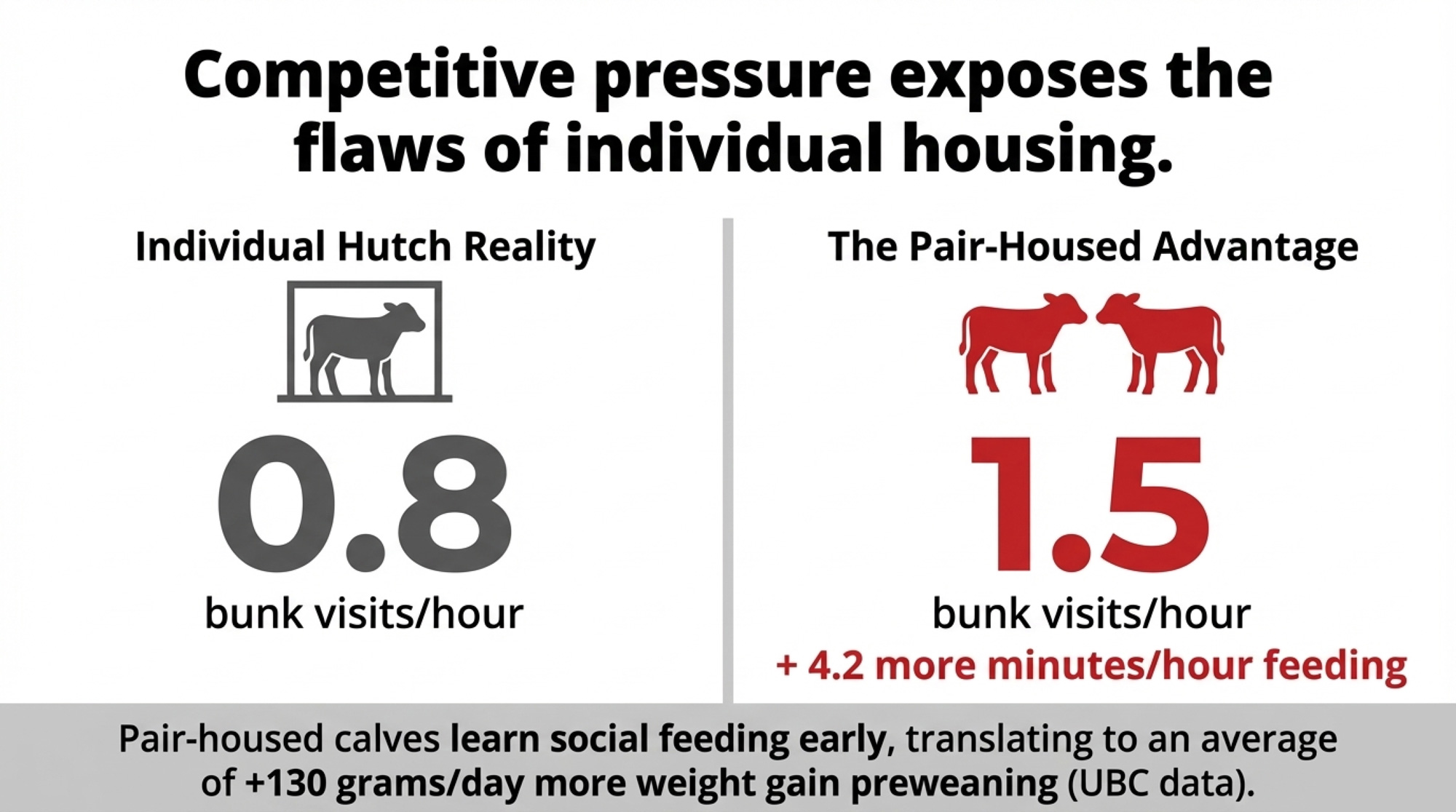
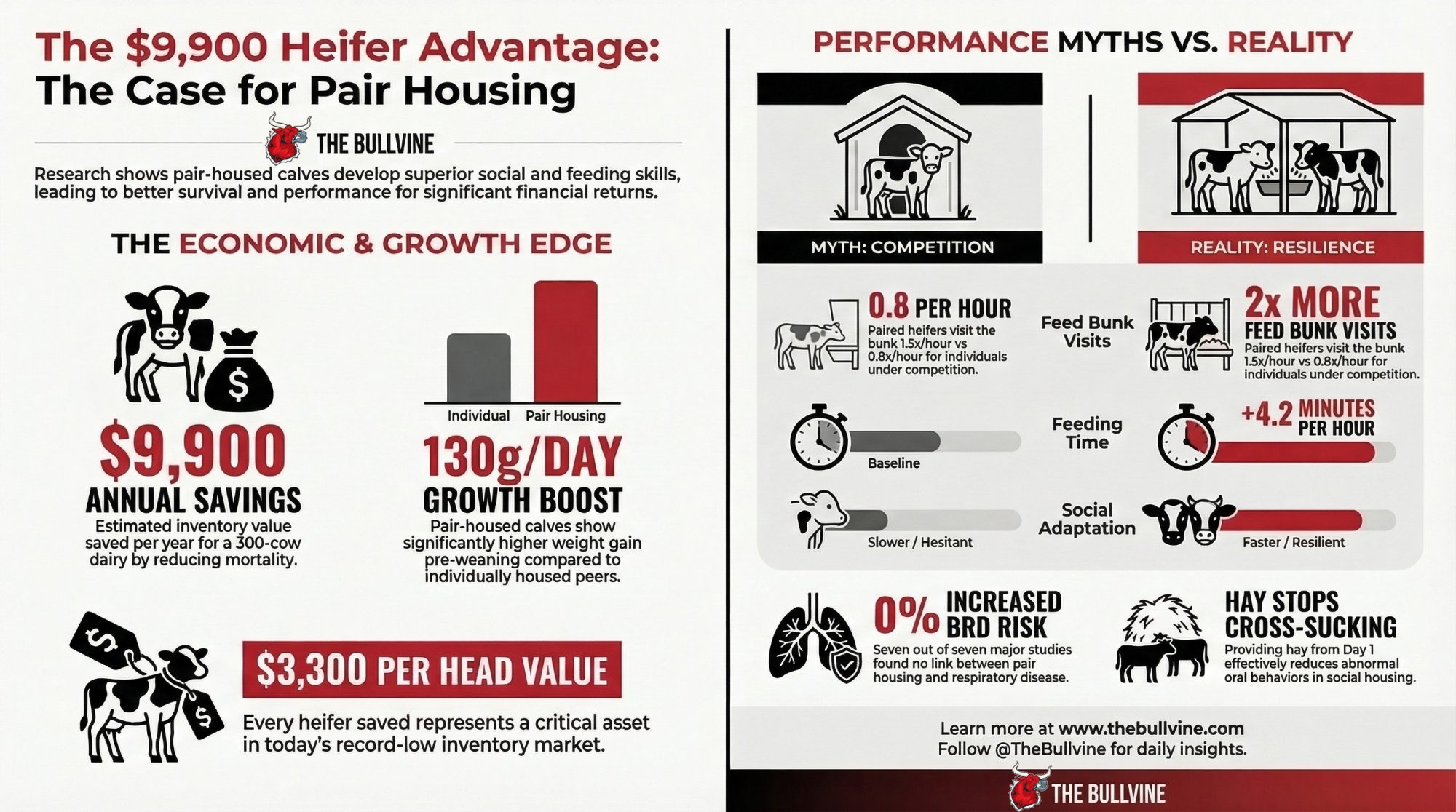
A 2024 JDS paper from her lab tracked Holstein heifers raised in pairs versus individually, then observed their behavior during a social regrouping and a housing transition as pregnant heifers. The pair-housed animals spent 4.2 more minutes per hour feeding and visited the feed bunk nearly twice as often — 1.5 visits per hour versus 0.8 for individually raised heifers. The difference was most dramatic under competitive pressure, exactly the conditions your fresh heifers face when they enter the milking string.
“These results suggest that preweaning social housing had long-term effects on behavior and ability to adapt to a novel environment, which became most apparent under heightened competitive pressure,” the study concluded.
Translation: the housing decision you make in week one shows up in the bunk two years later.
| Metric | Individually Housed | Pair-Housed (Birth) |
| Feed bunk visits/hour under competitive pressure | 0.8 | 1.5 |
| Additional feeding time (min/hour) | Baseline | +4.2 |
| Preweaning ADG advantage | Baseline | +130 g/day |
| BRD risk increase (7 studies reviewed) | — | 0% increase |
Can a Simple Housing Change Actually Move the Needle on Performance?
The short answer: yes, if you look past weaning.
Research from Miller-Cushon’s lab and collaborating institutions has consistently shown that pair-housed calves eat more solid feed earlier — a finding she attributes to social learning. “We underestimate the role of the social environment in determining when and how much animals eat,” she’s told The Dairy Podcast Show. Calves develop preferences for feeds that others in the group are eating. They learn where to go and what to eat from pen-mates, before they ever see a feed bunk in a freestall.
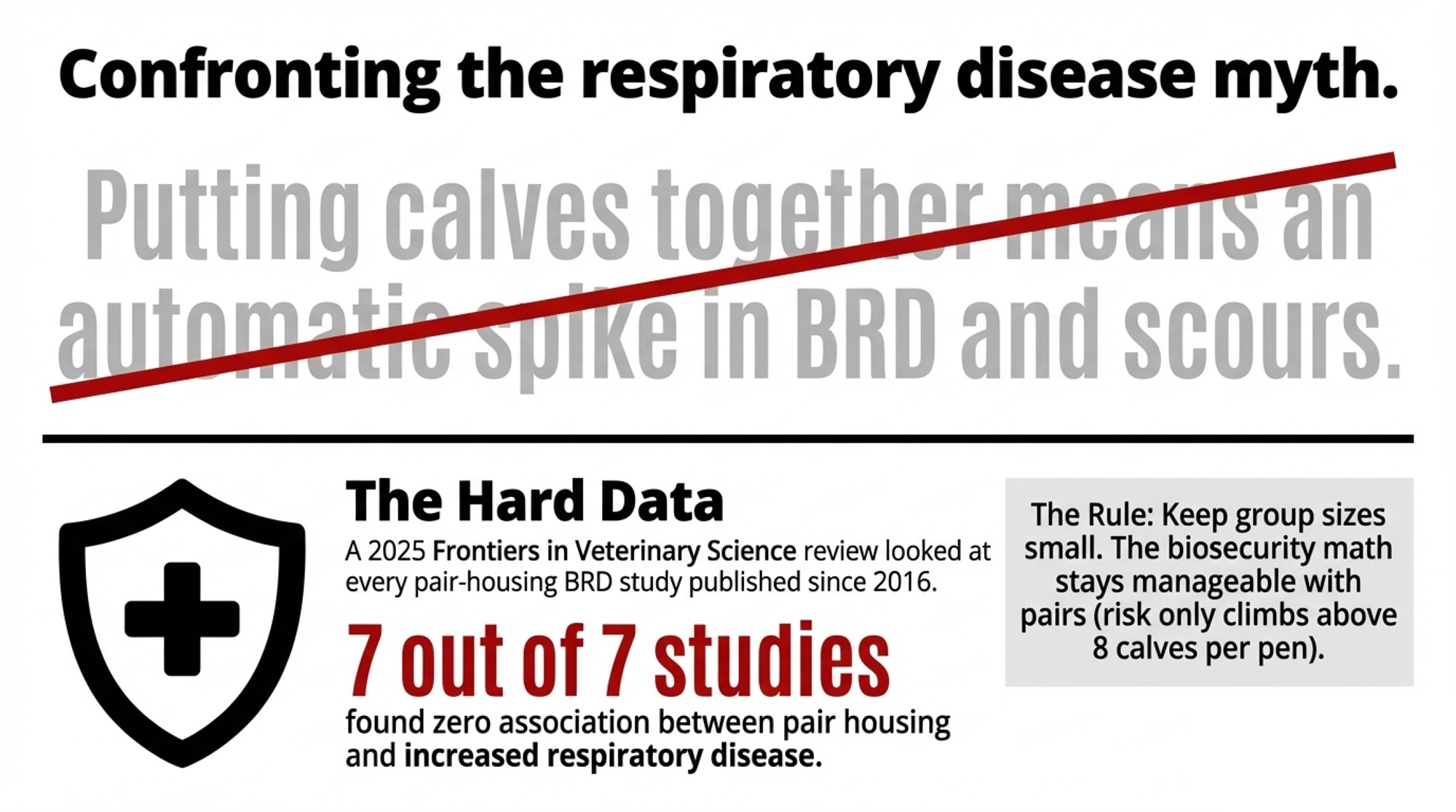
A 2025 scoping review in Frontiers in Veterinary Science, examining pair-housing studies published since 2016, confirmed that pair-housed calves often exhibit better growth performance than individually housed peers. And the health concern that has kept many producers in individual hutches? Seven out of seven BRD studies in that review found no association between pair housing and increased respiratory disease.
That’s not a cherry-picked number. That’s every BRD study they examined.
| Health/Behavior Concern | Research Finding | Mitigation Strategy |
| Bovine Respiratory Disease (BRD) | No increase (7/7 studies) | Keep groups ≤2 calves; standard biosecurity |
| Scours incidence | Tendency for reduced cases (Miller-Cushon 2021) | Paired housing may improve gut health |
| Cross-sucking behavior | Occurs without hay provision | Provide hay from Day 1 with starter grain |
| Disease transmission above 8 calves/pen | Risk climbs in large groups | Pair housing (2 calves) keeps biosecurity manageable |
Research from the University of British Columbia, published in 2023, found pair-housed calves averaged 130 grams per day more weight gain than individually housed calves — a finding consistent across multiple Canadian studies. At UF, Miller-Cushon’s own 2025 study (n=100 pens, 50 individual vs. 50 paired) showed clear performance benefits from pair housing from birth, with advantages particularly strong during cooler months.
The performance edge compounds over time. Pair-housed heifers adapted faster to freestall environments after weaning, ate more aggressively when stocking density climbed, and showed lower displacement rates at the feed bunk. On a commercial dairy where fresh heifers compete with mature cows for bunk space, that behavioral resilience translates directly to dry matter intake — and intake drives milk.
Laura Whalin, a UBC graduate researcher, put it: “Pair housing sets the heifer up for easier transitions such as moving to new pens, changing diets, or learning to cope with an automatic milking system.”
What’s This Worth to a 300-Cow Operation?
You’re not going to change your calf housing because a scientist says it’s “better for welfare.” You’ll change it when the math works. So let’s run it.
Start with replacement economics. Holstein springer heifers are currently trading between $2,500 and $4,000+ per head, depending on region, genetics, and health records, with national averages around $3,300 as of late 2025, according to Ever.Ag and ISU Extension data. Premium strings with sexed semen confirmation have cleared $4,000 in Northwestern and Upper Midwest markets. Meanwhile, heifer inventory sits at 3.914 million head — the lowest since 1978, per USDA’s January 2025 cattle report. CoBank projects the number will fall further before any recovery begins around 2027. Every heifer you raise is worth more today than at any point in the last two decades.
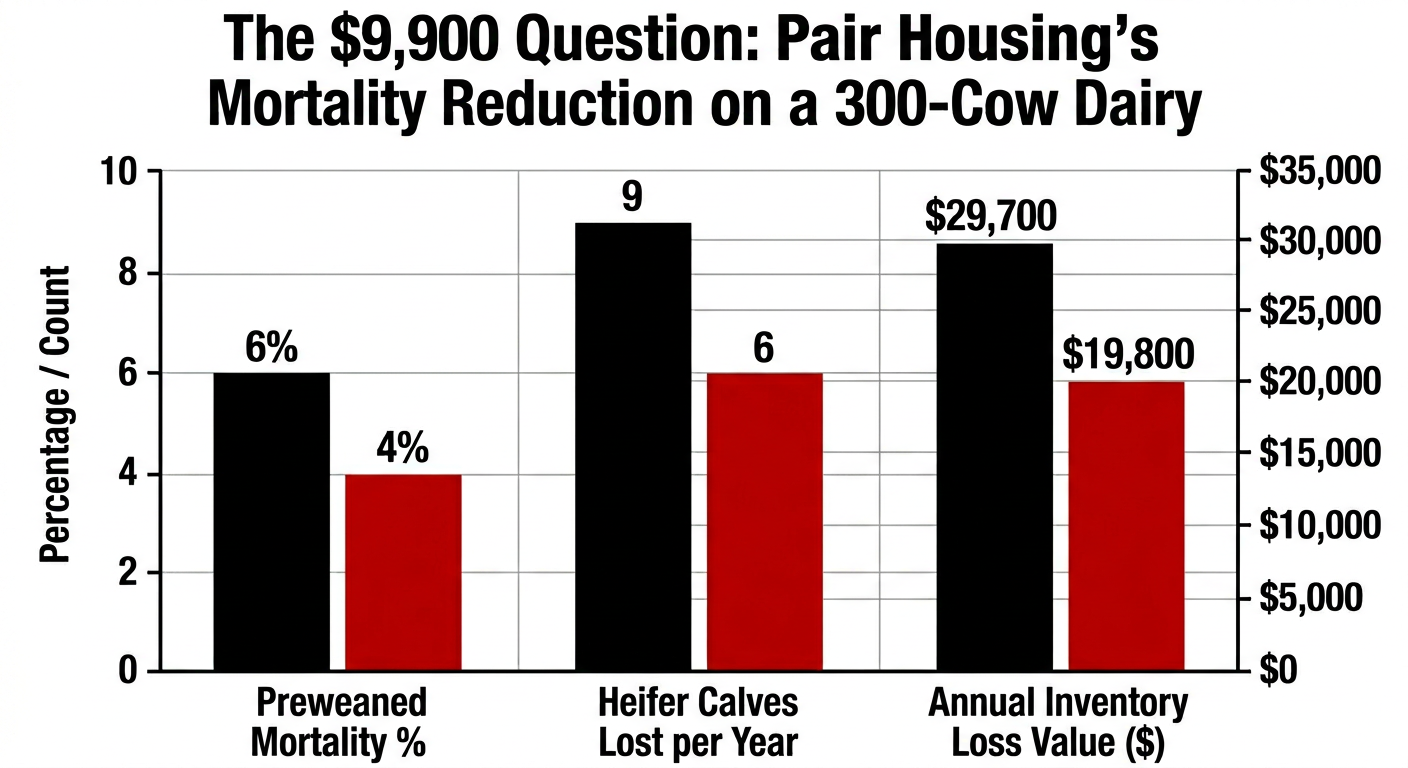
Now consider calf mortality. The most recent USDA NAHMS data (2014, with the next study currently in the field) put preweaned calf mortality at 5.0% nationally. Many operations run higher. If you’re calving 300 cows annually and losing 6% of heifer calves preweaning, that’s 9 dead heifer calves per year. At today’s replacement value, you’re looking at $25,000 to $36,000 in lost inventory — before you count the feed, labor, and vet costs already invested.
Pair housing alone doesn’t eliminate mortality. But the behavioral and health data from Miller-Cushon’s research and the broader literature suggest lower disease incidence, stronger development of feed intake, and better transition outcomes. If pair housing helps you move from 6% preweaned mortality to 4% — a conservative improvement consistent with the published literature — that’s 3 fewer dead heifer calves per year.
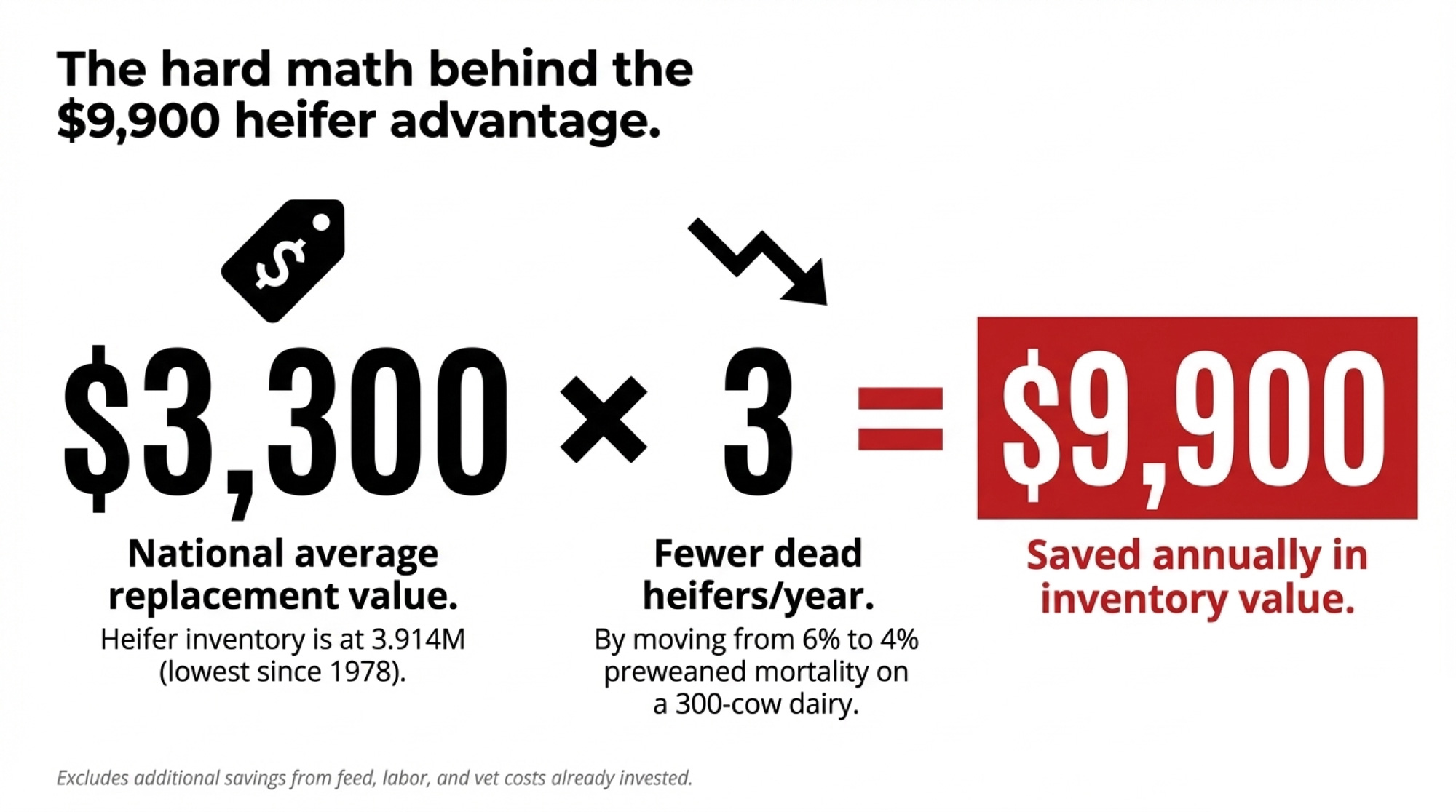
At $3,300 per replacement heifer (near the national average), that’s roughly $9,900 in annual saved inventory value on a 300-cow dairy.
Add the downstream performance benefits. Heifers that visit the feed bunk 1.5 times per hour instead of 0.8, that eat 4.2 more minutes every hour under competitive conditions — those are heifers that peak higher and stay healthier in early lactation. You can’t quantify the exact first-lactation milk premium yet (that data is still coming from Miller-Cushon’s five-year study), but the mechanism is clear: more resilient animals produce more consistently.
Is Pair Housing Actually Practical — or Just a Research Ideal?
This is the honest friction point. Miller-Cushon’s research is rigorous. The welfare benefits are real. But your calf barn wasn’t built for pairs, and you’ve got real concerns about cross-sucking, disease transmission, and labor.
Here’s what the evidence actually says:
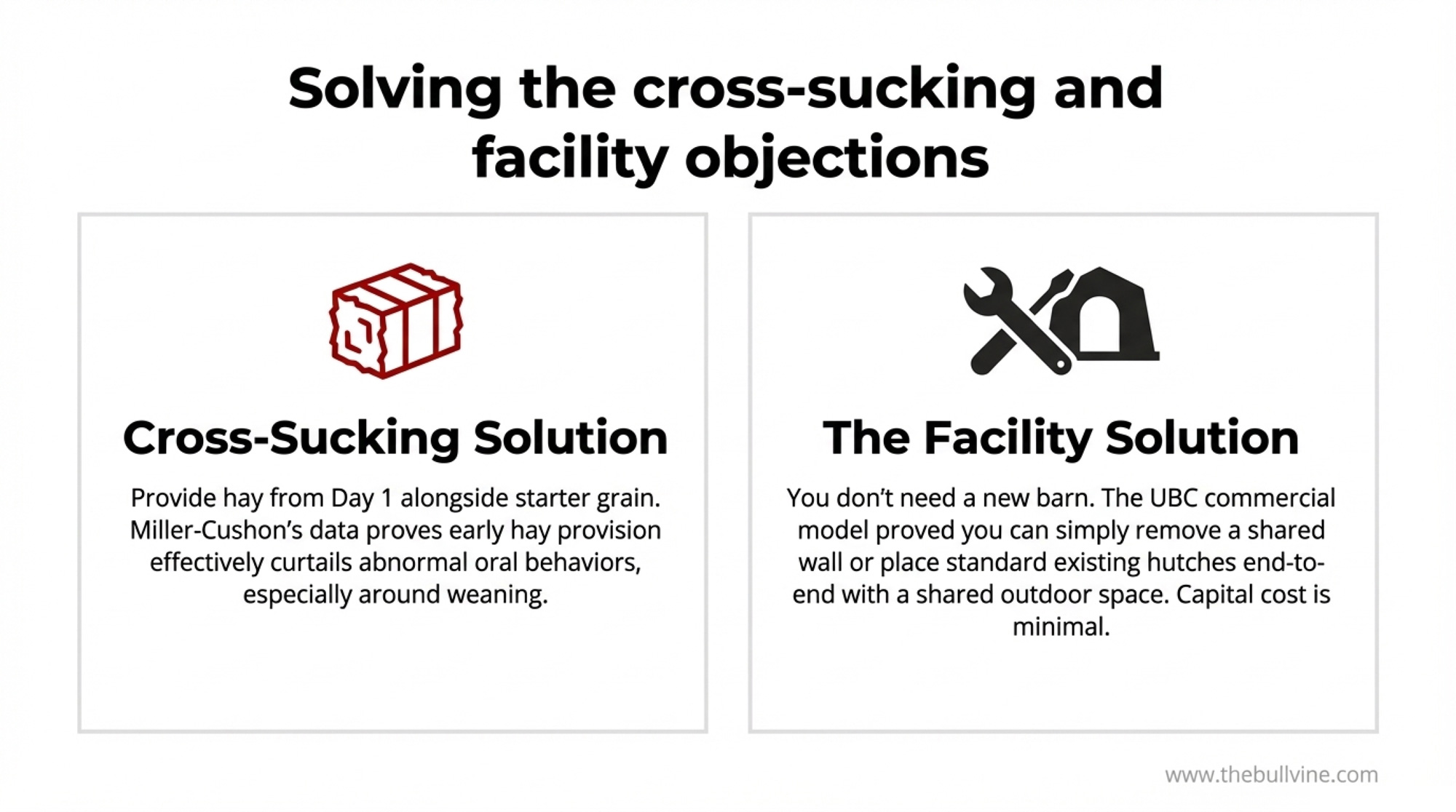
Cross-sucking. It happens. Miller-Cushon’s own research shows that providing hay from starter grain significantly reduces cross-sucking behavior. “Pretty much universally, we’ve seen benefits to giving calves hay earlier in life,” she’s stated. Hay provision around weaning — when the motivation to cross-suck peaks — is low-cost and effective.
Disease. The scoping review data are unambiguous: across multiple university studies (UC Davis, UW-Madison, University of Florida, UBC, and others), pair housing did not increase BRD or scours incidence. Miller-Cushon’s own 2021 JDS work found “a tendency for reduced scours in pair-housed calves, providing evidence that social housing does not negatively affect, and may benefit, early-life calf health.” The caveat: group size matters. Risk climbs above 8 calves per pen, particularly in continuous-flow systems. Pair housing — two calves — keeps the biosecurity math manageable.
Facility conversion. You don’t need a new barn. Laura Whalin’s UBC commercial farm study used a straightforward approach: two standard hutches with a shared outdoor space. Many operations convert existing individual setups by removing a shared wall or placing hutches end-to-end. The capital cost is minimal compared to the value of the heifer at stake. UW-Madison’s dairy welfare program has published a step-by-step pair housing introduction guide specifically designed for commercial operations already using hutches.
The regulatory trajectory. Canada’s draft Code of Practice for the Care and Handling of Dairy Cattle requires healthy calves be housed in pairs or groups by two to four weeks of age, effective 2031. The Netherlands has a similar timeline targeting 2030. If you’re shipping genetics or dairy products into those supply chains, the direction is clear. Staying ahead of mandates is cheaper than scrambling to comply.
Options and Trade-Offs for Your Calf Program
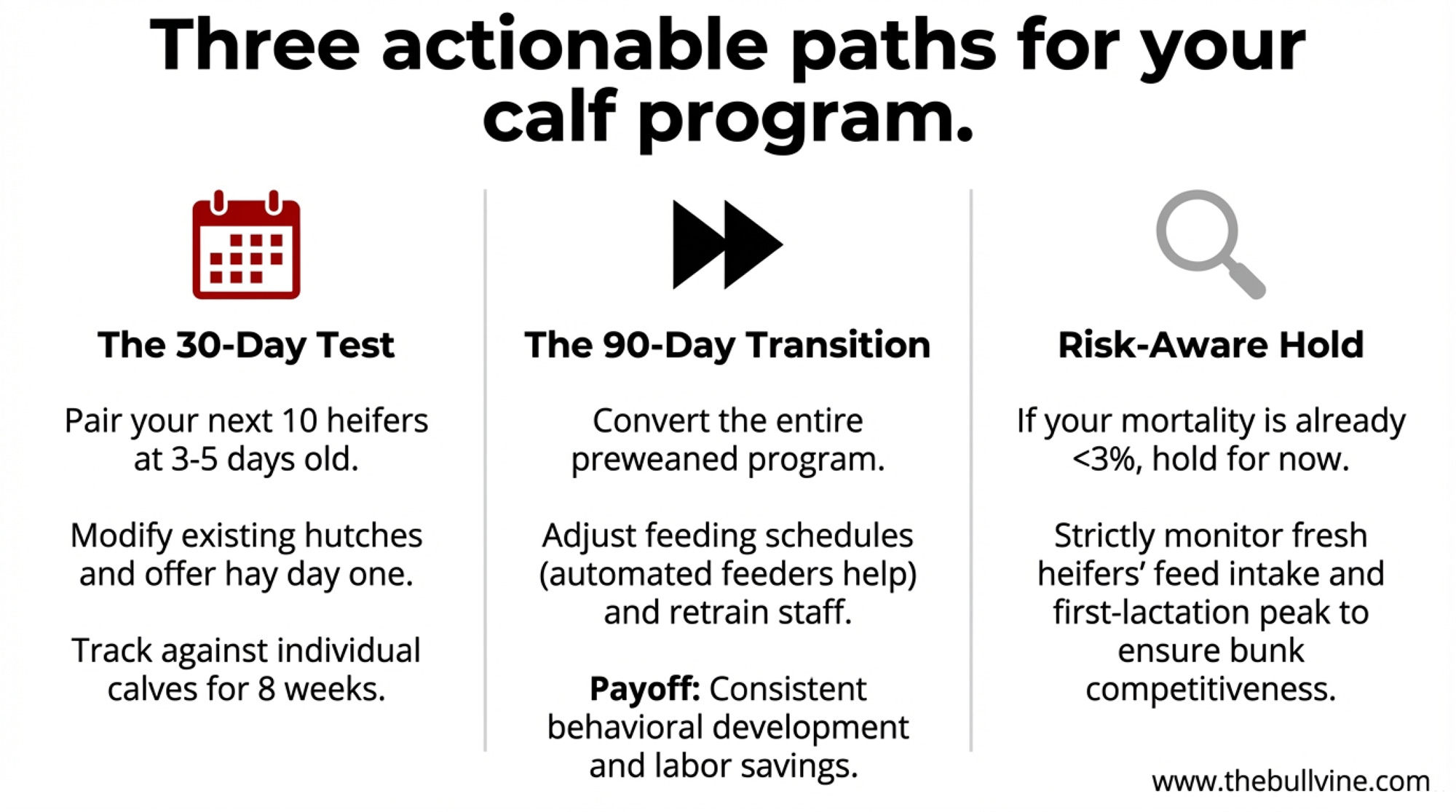
Path 1: Start pairing this calving season (30-day action). Pick your next 10 heifer calves and pair them at 3–5 days of age. Use existing hutches modified for shared space — Whalin’s UBC model works with standard commercial equipment. Offer hay from day one alongside the starter. Track feed intake, health events, and weaning weights against your individually housed calves from the same period. You’ll have your own data in 8 weeks — and your own data beats anyone’s published study when it comes time to decide whether to scale up.
Path 2: Full transition over 90 days. Convert your entire preweaned heifer program to pair housing. Requires modifying hutch layouts or pen configurations, adjusting milk feeding schedules (automated feeders simplify this considerably), and training staff to monitor pairs rather than individuals. Budget for modest facility modifications — the main cost is labor time for reconfiguration, not materials. The payoff: consistent behavioral development across your entire replacement pipeline, plus labor savings from feeding and monitoring paired calves rather than individuals.
Path 3: Wait and watch (risk-aware hold). If your current preweaned mortality is already below 3% and your heifer transition performance is strong, the incremental gain from pair housing may be smaller for your operation. But track your fresh heifer feed intake and first-lactation peak carefully — if heifers are slow to compete at the bunk post-calving, the early housing environment may be the variable you haven’t tested yet. As processor audits increasingly incorporate calf welfare metrics through the FARM Program, having a pair- or group-housing protocol in place positions you ahead of compliance timelines rather than behind them. Miller-Cushon now serves on the FARM Program’s animal care committee — the research-to-policy pipeline is short and getting shorter.
Key Takeaways
- If your preweaned heifer mortality exceeds 5%, pair housing is one of the lowest-cost interventions available — the research shows equal or better health outcomes, and every percentage point of mortality reduction is worth roughly $4,950/year on a 300-cow dairy at the current national average heifer price.
- If you’re concerned about cross-sucking, provide hay from the time you introduce starter grain — Miller-Cushon’s data and the broader literature consistently show it reduces abnormal oral behaviors.
- If your fresh heifers are slow to eat in the milking string, investigate whether their preweaning social environment is part of the problem — pair-housed calves visited the feed bunk nearly twice as often (1.5 vs. 0.8 visits/h) under competitive pressure in Miller-Cushon’s 2024 JDS study.
- If you sell genetics or products into Canadian or European markets, pair/group housing mandates are coming (Canada 2031, Netherlands 2030) — getting your protocol in place now costs less than retrofitting under a deadline.
The Outsider Advantage
Miller-Cushon has won the two biggest early-career honors available to a dairy scientist in the United States: the 2025 PECASE — the Presidential Early Career Award for Scientists and Engineers, the highest recognition the U.S. government gives early-career researchers — and the 2025 ADSA Foundation Scholar Award in Dairy Production.
“My enthusiasm for research is in part due to the opportunities to mentor amazing graduate students and network with the broader scientific community in animal behavior and welfare,” she’s said. “Good research is a team effort.”
The dairy industry has a history of breakthroughs that came from outside the usual channels. Robert Chicoine showed what one unconventional thinker could do with a bull nobody else wanted. Miller-Cushon is showing what a physicist’s training does when you point it at a calf barn — and the data says it changes outcomes your heifers carry for life.
What’s the most unconventional background on your farm team right now — and what are they seeing that the dairy lifers might miss? We’re building a deeper playbook for pair housing conversions and running the full replacement heifer lifecycle economics in upcoming Bullvine coverage. And keep an eye out for the next installment of “The Outsiders” — the software engineer who rewrote how we read bull proofs.
Executive Summary:
Emily Miller-Cushon traded her University of Waterloo physics degree for dairy calf research at the University of Florida—and just won the U.S. government’s top early-career science award (PECASE). Her five-year study shows that pair-housed calves develop more resilient feeding behavior: 1.5 bunk visits/hour vs. 0.8 for individually raised heifers under competitive pressure. That’s 130g/day more gain preweaning, carrying through to adulthood. Barn math: $9,900/year saved in heifer inventory on a 300-cow dairy at $3,300/head. No BRD risk increase (7/7 studies), hay from Day 1 cuts cross-sucking. 30-day test plan: pair your next 10 heifers this calving season.
Complete references and supporting documentation are available upon request by contacting the editorial team at editor@thebullvine.com.
Learn More
- Matching the Feed to the Calf: Birth to 120 Days – Practical Science for Dairy-Beef Calves – Arms you with the specific 24-hour colostrum and starter-intake protocols needed to back up your housing changes. You’ll gain a foolproof nutrition roadmap that ensures your pair-housed heifers hit their growth targets without stalling.
- $3,010 Per Heifer. 800,000 Short. Your Beef-on-Dairy Bill Is Due. – Exposes the structural heifer shortage that makes every retained calf worth $3,300+ in today’s market. This economic breakdown helps you position your replacement pipeline to survive the most expensive heifer squeeze in 47 years.
- Dairy Tech ROI: The Questions That Separate $50K Wins from $200K Mistakes – Delivers the hard math on automated calf feeders and precision tech that slash labor while improving heifer performance. You’ll reveal whether a technology-led transition to group housing justifies the capital investment on your specific scale.
 The Sunday Read Dairy Professionals Don’t Skip.
 The Sunday Read Dairy Professionals Don’t Skip.
Every week, thousands of producers, breeders, and industry insiders open Bullvine Weekly for genetics insights, market shifts, and profit strategies they won’t find anywhere else. One email. Five minutes. Smarter decisions all week.




