







A sick calf costs $1,000+ over its lifetime. What if $35 up front could prevent that?
The thing about this “$35 per calf” ROI figure… I kept hearing it tossed around at industry meetups, and honestly? It made my skeptical farmer radar go off. So, I did what any good dairy person does—I dug into the actual numbers. Not the glossy marketing stuff, but real farm data.
Here is what I found.

Market Realities That Can’t Be Ignored
Let’s start with what we all know hurts: replacement heifers are stupid expensive right now. According to the USDA-AMS National Weekly Replacement Dairy Cattle Report from July 15, 2025, bred heifers are hitting $3,010 per head. That’s not a typo—that’s what it costs to replace a calf you lose.
Meanwhile, milk prices are sitting around $18.93 per cwt as of August 2025 (USDA-NASS Agricultural Prices). Not terrible, but there is no fat in these margins anymore.
Here is what really changes the game, though: since June 2023, the FDA has classified all medically important antimicrobials as prescription-only. The days of metaphylactic treatments as a management crutch? Those are done.
What the Research Actually Says (And Doesn’t)
That foundational Cornell work from Soberon and Van Amburgh (2013) still holds water—1,000 kg more milk in first lactation for every kilogram of extra pre-weaning ADG Solid science, but remember that was controlled university research. Your mileage will definitely vary.

What hits closer to home is Dubrovsky’s 2020 work in the Journal of Dairy Science. They found BRD treatment costs ranging from $42 to $395 per case, depending on the severity of the condition and the method of treatment. That is not a narrow range—that is the difference between “manageable expense” and “profit killer.”
The probiotic research? It is getting more nuanced. Most of the new data on biotics (probiotics/prebiotics) has shown advantages in daily gain and animal health, which is helping to position these additives as part of a good calf management system.
Crunching Numbers (With Honest Caveats)

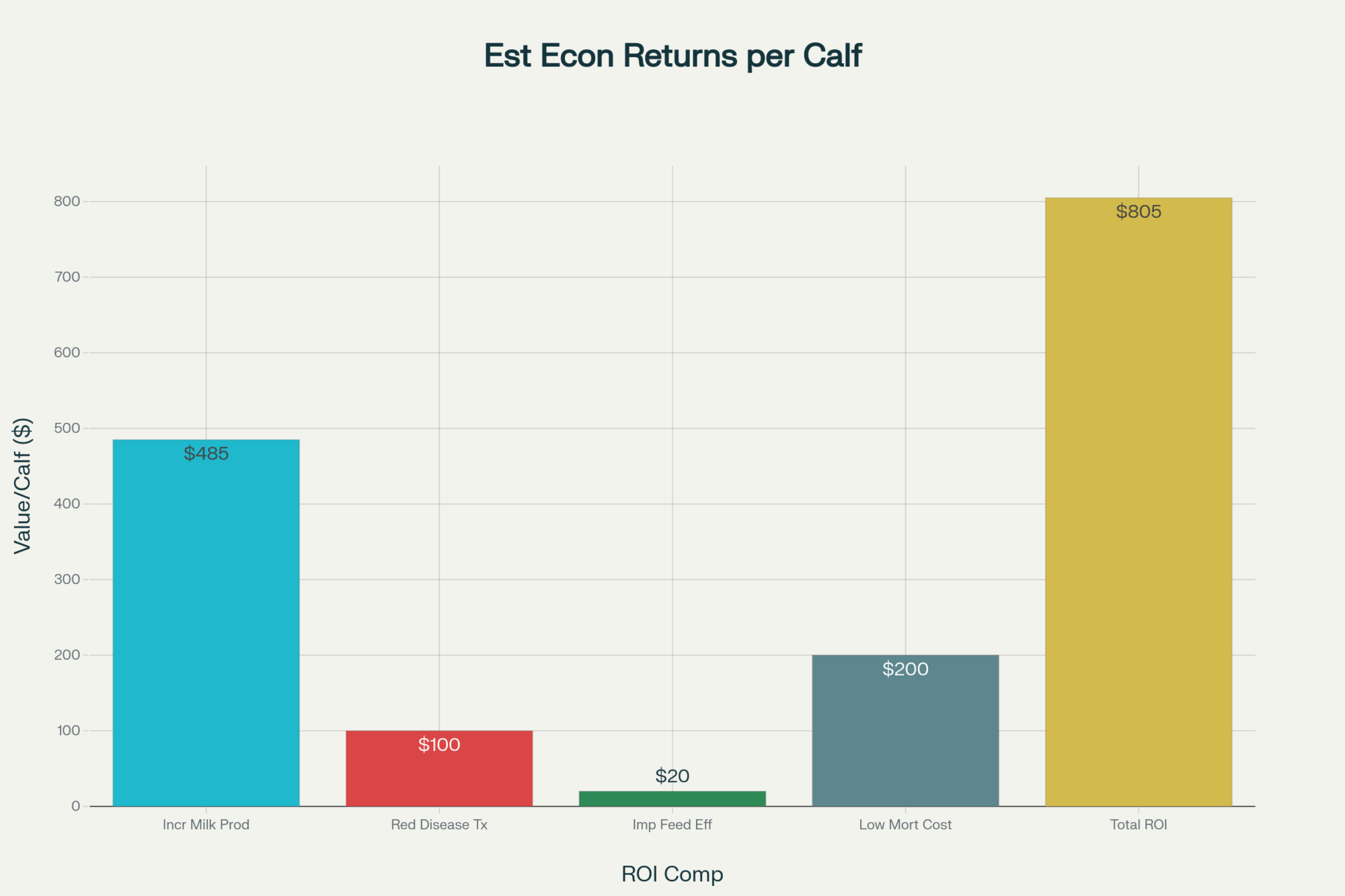
If you are considering a $35 per calf nutrition investment, here is how the math might work:
Potential milk revenue gain: Around $485 (based on that Cornell research and current milk prices)
Disease cost reduction: Highly variable—could be zero on a well-managed farm, or $100+ if BRD’s been killing you.
Feed efficiency improvements: $15-20 over the pre-weaning period.
Total potential return? Looks impressive on paper. But—and this is crucial—I have seen operations where this pencils out beautifully, and others where it makes no difference.
Real Talk from Real Farms
I cannot give you specific farm names (producers value their privacy), but I will say this: the operations seeing consistent results are not just throwing supplements at problems. They are being systematic.
One mid-sized Wisconsin operation with which I am familiar implemented targeted nutrition, upgraded colostrum protocols, improved hutch ventilation, and began regularly tracking growth. Their ADG improved from around 1.4 to 1.8 lbs/day.
But here is their honest take: they cannot tell you exactly how much came from the $35 nutrition program versus the management improvements. And do you know what? They do not care. The entire system got better.
Implementation Is Everything
This is where many farms fall short. Quality matters. Strain specificity matters. Timing matters. I have seen operations spend good money on generic probiotics and wonder why they did not get research-trial results.
A calf nutritionist I respect puts it this way: “Supplements are fine-tuning tools, not foundation fixes. Get the basics right first—colostrum, housing, feeding consistency—then talk about additives.”
Geography and Scale Reality Check
What works in Vermont dairy country does not always translate to Texas. Disease pressure varies. Climate stress varies. Feed costs vary.
In the upper Midwest, respiratory challenges are prevalent, making pathogen-binding strategies a sensible approach to addressing these issues. Down south, heat stress and digestive efficiency become bigger factors. California’s Central Valley has different challenges than Wisconsin’s rolling hills.
Operations with fewer than three hundred cows face different economics than those with 1,000 or more cows. The big guys can justify automated feeding systems and precise protocols. Smaller operations require simpler, yet more robust, approaches.
Your Monday Morning Action List
Based on what works across different farm types:
- Start tracking calf weights weekly—target 1.5-1.8 lbs/day ADG (NAHMS benchmark data shows this separates good from mediocre)
- Document every BRD case and associated costs—you cannot improve what you do not measure.
- Evaluate colostrum quality routinely—Brix refractometer, target ≥22%.
- Improve ventilation and feeding consistency before investing in supplements.
- Know your break-even point—calculate what disease reduction you need to justify program costs.
The Uncomfortable Truths
Some farms should not be spending extra on calf nutrition. If your mortality is high because of poor colostrum management or drafty housing, supplements will not fix that. You are treating symptoms, not causes.
Also, not every calf responds the same way. Genetics matter. Birth weight matters. Health status at birth matters. You won’t obtain uniform results across all animals.
Looking Forward
The trend toward precision nutrition is real, but we are still in early innings. Most farms are not ready for individual animal monitoring and adjustment. What I do see is better data discipline—operations getting smarter about connecting early investments to long-term performance.
Regulatory pressure is not easing up. Consumer preferences are not changing back. The economic incentives for proactive management are only getting stronger.
The Bottom Line
Is there a “$35 advantage” in calf nutrition? On some farms, absolutely. On others, that money generates better returns invested in basic management improvements.
The key is an honest assessment of where your operation stands. If you are already hitting 1.8+ lbs/day ADG with minimal health issues, nutrition supplements are not your highest priority. Fix labor efficiency or breeding instead.
But if you are struggling with respiratory disease or poor growth rates, targeted nutrition investments can pay off—if implemented as part of systematic improvement, not as a magic bullet.
The real value is not in any $35 supplement. It is in the time you take to analyze your own data and figure out what your calves need.
That is what separates the operations thriving in 2025 from those that will struggle to keep up.
This isn’t feel-good farming. It’s a dollars-and-cents strategy backed by solid science Your calves are either an investment or an expense—which camp are you in?
KEY TAKEAWAYS:
- Track those weights religiously—calves gaining 1.8+ lbs daily before weaning set you up for an extra 1,100 lbs milk in first lactation. That’s $500 more revenue per cow.
- Cut your treatment bills in half with strategic colostrum programs and targeted supplements. Less time treating sick calves means more time on profitable work.
- Boost feed efficiency 10% using proven nutritional tools like probiotics and MOS—we’re talking $180+ savings per calf during the most critical growth phase.
- Every calf you save matters more now—with replacement costs hitting $3,010 and labor scarce, preventing death loss isn’t just good animal care, it’s smart economics.
- Adapt to the new reality—FDA restrictions on antibiotics and soaring labor costs mean proactive nutrition programs aren’t nice-to-have anymore. They’re survival tools for 2025 and beyond.
EXECUTIVE SUMMARY:
Here’s what caught my attention in this research: investing $35 per calf in targeted nutrition isn’t just feeding—it’s strategic profit planning. Cornell’s data shows calves hitting 1.8 lbs/day growth before weaning produce roughly 1,100 pounds more milk in first lactation. At today’s prices, that’s nearly $500 extra per cow. But here’s the kicker—with BRD treatment running anywhere from $42 to $395 per case and replacement heifers pushing $3,010, every sick calf you prevent saves serious money. The research breaks down how probiotics, MOS supplements, and better colostrum management can cut treatment costs by 50% while boosting feed efficiency by 10%. With antibiotics getting harder to use and labor costs climbing, this proactive approach isn’t optional anymore. Time to stop playing defense and start programming your calves for profit.
Complete references and supporting documentation are available upon request by contacting the editorial team at editor@thebullvine.com.
Learn More:
- 4 Golden Rules for Optimal Colostrum Feeding – This article provides a tactical deep-dive into colostrum, a topic the main article identifies as a foundational priority. It offers practical, step-by-step protocols for producers to ensure their calves get the essential immunity needed for any nutritional program to succeed.
- Replacement Economics: Why Raising Your Heifers Just Became Profitable Again – Expanding on the market realities, this piece details the strategic financial pressures behind the soaring replacement heifer costs. It reinforces the main article’s economic argument by showing readers the hard numbers and long-term market dynamics driving the need for proactive calf management.
- The $500,000 Precision Dairy Gamble: Why Most Farms Are Being Sold a False Promise – This piece offers a critical, innovative perspective on technology that complements the main article’s forward-looking conclusion. It provides a reality check on high-tech investments, urging producers to focus on data and foundational management before adopting expensive new systems.
 The Sunday Read Dairy Professionals Don’t Skip.
 The Sunday Read Dairy Professionals Don’t Skip.
Every week, thousands of producers, breeders, and industry insiders open Bullvine Weekly for genetics insights, market shifts, and profit strategies they won’t find anywhere else. One email. Five minutes. Smarter decisions all week.




