Milk yield up, lifespan down? The latest Québec data says the average cow’s earning power jumps $240—but she only lasts 3.25 years.
EXECUTIVE SUMMARY: Alright, here’s what blew my mind—and might shake up your calf program too. Turns out, you can’t max out milk per cow and keep cows around forever. Québec researchers compared 1,600+ farms: old-school bucket calves on whole milk lasted 3.41 years, while “modern” pens with powder and auto-feeders only hung in 3.25 years. But hang on—those modern herds banked an extra 340kg of ECM and over $240 more per cow. That’s before you factor in 2025’s feed prices and the global push for feed efficiency and higher genomic merit. Bottom line? If you want more milk money (and you can handle faster turnover), it’s time to scrutinize how you raise those calves. Trust me, even a couple tweaks could fatten your milk check this season.
KEY TAKEAWAYS
Modern early-life systems = higher cash flow. Farms using group calf management and automated milk feeding made $8,008 per cow—up $240 compared to traditional setups. Try switching even part of your calf barn to automated feeders or group pens to see immediate productivity gains.
Less longevity, more liters. “Tech-forward” herds saw cows leave 0.16 years sooner—but pumped out 341kg more ECM per animal. Don’t cling to old culling targets—track your herd replacement rate alongside yield and make data-driven decisions.
Colostrum wins—no matter your system. Herds nailing fast, high-volume colostrum feeding lifted lifetime cow profits, regardless of milk source. Check your colostrum timing and quantity against current USDA and university extension benchmarks—tighten up if you’re lagging.
Calf feeding changes move the needle—fast. Early concentrate feeding and good group hygiene boost feed efficiency and milk value, right off the bat. Revisit your starter grain protocols and group-housing cleaning schedule this month—don’t let market volatility catch you napping.
Don’t follow “what’s always worked”—follow the ROI. Today’s industry winners blend genomic testing, herd-level economics, and hands-on management—don’t get left behind. Set aside an afternoon soon: review your DHI data and challenge just one thing about how calves are raised on your operation.
Here’s the thing about raising dairy calves today: every decision you make in the hutch or group pen sets the pace for future profit. And as new research from Québec shows, those decisions don’t just impact first lactation—they create a fundamental trade-off between a cow’s lifetime production and her longevity in the herd.
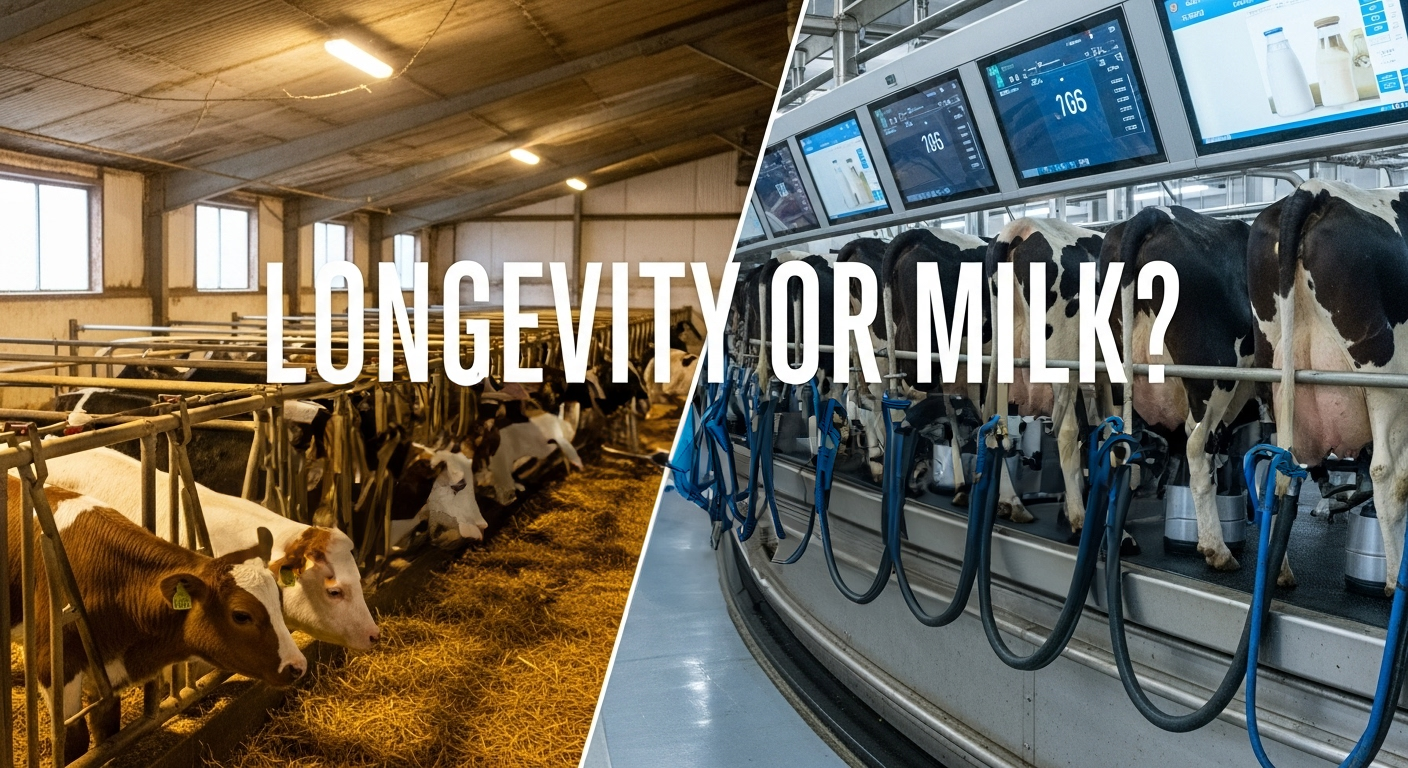
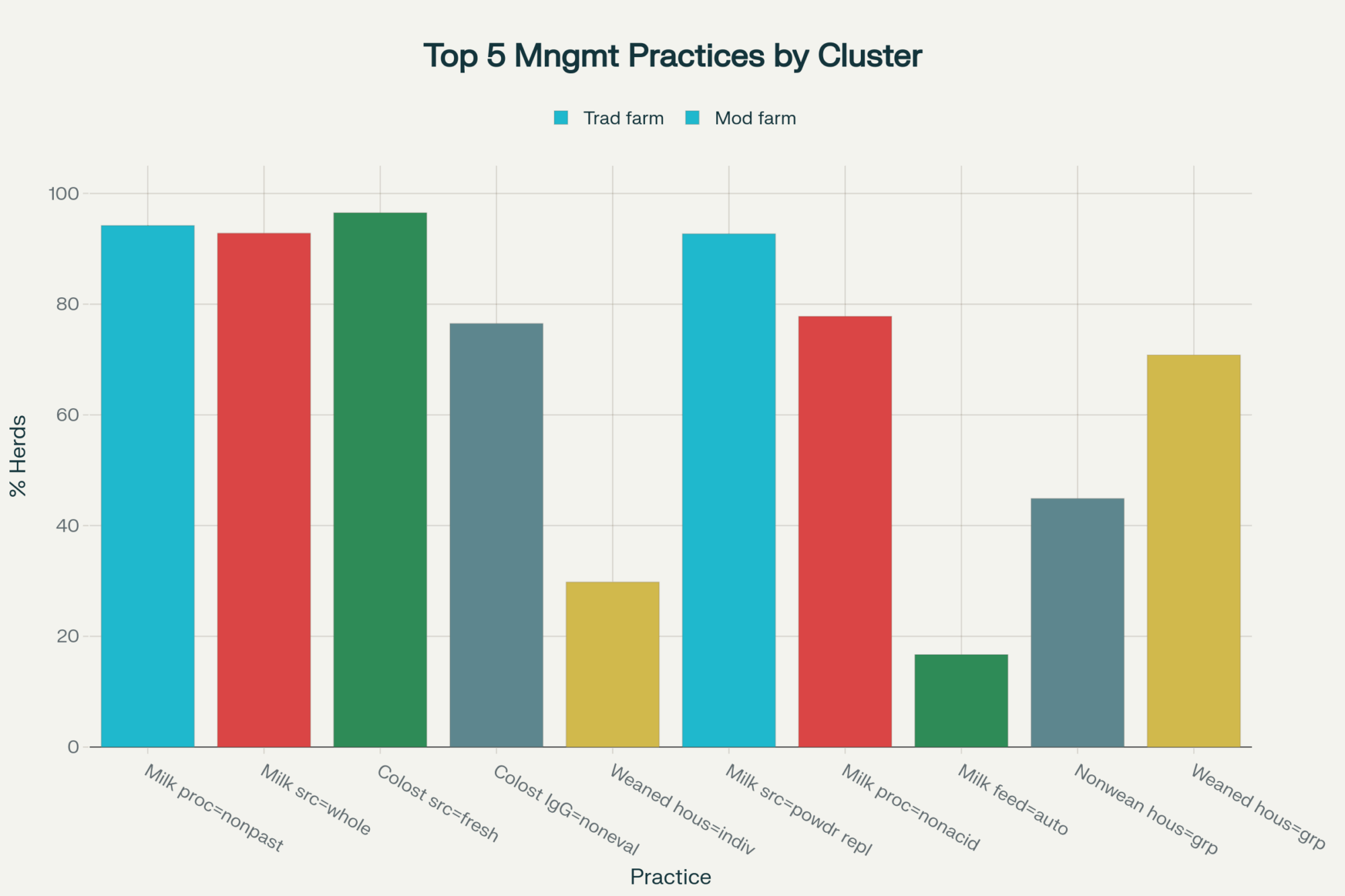
A deep-dive study out of Québec, surveying 1,658 herds, didn’t just ask about best intentions—it dug into what’s actually happening on real farms and then lined up those practices against hardcore numbers: years in production, kilograms in the tank, and dollars in the milk check. In this study, “traditional” meant calves raised individually, getting whole or waste milk by hand. “Modern” was defined as group housing with automated milk replacer feeders and all the labor-saving gadgets that are moving into more and more barns. The chart below illustrates the key management practices that defined these two distinct groups..
Adoption rates of key early-life management practices that define the Traditional (Trad) and Modern (Mod) farm clusters in the Québec study. Source: Dallago et al., JDS 2025.
The Trade-Off By the Numbers
Metric
Traditional (n=600)
Modern (n=1,058)
Productive Lifespan
3.41 ± 0.03 yrs
3.25 ± 0.02 yrs
Lifetime ECM
11,090 ± 64 kg
11,431 ± 48 kg
Lifetime Milk Value (CA$)
7,769 ± 48
8,008 ± 36
% 3+ Lactations
41.5 ± 0.3
41.6 ± 0.2
What strikes me most is that “traditional” setups—buckets, whole milk, solo pens—get you cows that last a bit longer. But those automation-heavy barns, with group housing and powdered replacer, are squeezing extra kilograms (and dollars) from each animal before they head down the lane. That might not seem earth-shattering—until you multiply by every cow that goes through your milking line this year, especially with input costs where they are now.
From Québec to Your Laneway: What This Means on the Farm
Let’s bring the numbers home. On one hand, you’ve got producers sticking with the tried-and-true—more hands-on, more hutches, more routine—and they do see cows round third or even fourth lactations more often. On the other? The neighbor who invested in automation, group pens, and instant milk powder… now he swears by the rapid gains in his heifers, but he’s trading off some longevity. Suddenly, average cull age is dropping by over six months.
This isn’t just a story about Québec, either. Out east, the tradition might stick around longer because labor is reliable. Out west, bigger herds and labor headaches push folks toward tech—and more risk if hygiene slips. The same patterns hold in the Midwest and upstate New York: regional differences matter, but the milk check ultimately tells the story.
What’s particularly noteworthy is that, as feed costs bounce and staff get scarcer, the appeal of automation is only growing. But the dollars and days lived by each cow still don’t move in the same direction.
Under the Hood: What Actually Moves the Needle?
Diving into the details, the “traditional” approach—whole or waste milk, buckets, solo housing—delivers on longevity. More mature cows, more productive lactations. But there’s a catch. According to Dallago and colleagues, the “modern” barn, with technology-driven group management and ample feed, yields higher lifetime milk and profit per animal. That’s what you see when you’re flipping through updated DHI reports.
Here’s something else the data made clear (and most vets or seasoned managers will back up): best-in-class colostrum management—meaning fast, clean, high-volume feedings—amplifies your chances regardless of the other system you’re running. There’s no one-size-fits-all solution, and not all “modern” is gold. Make a mess of hygiene in a big group pen, and you might be worse off than if you stuck with singles.
And let’s not overlook this next part: Disease and reproductive setbacks remain the wild cards. Even the best-managed, highest-yielding cows can crash out faster if transition or fresh-cow care gets sloppy. Barns with sharp protocols and strong staff? They consistently get closer to that sweet spot between yield and years.
Actionable Takeaways
Don’t just chase years or liters—balance your systems and track your outcomes. If you’re considering switching your milk feeding or housing approach, consider whether you have the necessary labor and management structure to maintain consistency. The shift to group housing or auto-feeders is only as effective as your vigilance in maintaining calf health and cleanliness.
Nail your colostrum protocol. Every credible study (and every older producer worth listening to) agrees: it’s about speed, cleanliness, and volume—not gadgets or flavorings.
For group/automated systems: Don’t skimp on daily monitoring and hygiene. Coughing up labor savings only to lose it in vet bills or higher youngstock losses is a rookie mistake—even seasoned teams get surprised by group challenges.
Culling for “maximum longevity” sounds great, but in some markets or barn set-ups, you may need to lean into yield. Either way, know your costs and margins, and revisit them regularly—especially if you’re shifting protocols or market prices fluctuate.
What’s Next for Progressive Producers?
Here’s my honest take: The data shows no perfect playbook. Some years, that extra $240 per cow could cover your feed cost spike, or help float you through a dry spell. Other times, extra months of production mean fewer replacement heifer dollars leaving your account. At the end of the day, you’ve got to keep your head up, work your plan (not just your neighbor’s), and get everyone on your team pulling in the same direction.
So, what have you seen in your own herd? Are you staying the course, or are you eyeing a shake-up in the calf barn? I’ll leave with this: The best operators blend the latest science with a heavy dose of barn-floor wisdom, testing, tweaking, and finding what really fits their herd and crew. And isn’t that what makes this industry so damn compelling right now?
The Ultimate Guide to Colostrum Management: From Birth to Brilliance – This guide provides the tactical steps for perfecting your colostrum program, from testing IgG quality to ensuring optimal intake. It reveals practical methods to build the resilient immune foundation that maximizes the potential of every calf, regardless of your system.
Dairy Profitability: Are you a Price Taker or a Profit Maker? – This article provides a strategic framework for analyzing costs and margins to improve your bottom line. It challenges you to decide whether the short-term milk value or long-term productive life discussed in the main article is the right economic choice.
Precision Technologies for Calves and Heifers: The Unseen Revolution – Looking beyond current automation, this piece explores the next wave of innovation in youngstock management. It demonstrates how new sensors and data analytics can enable early disease detection and optimize growth, showcasing the future of proactive, data-driven calf care.
The Sunday Read Dairy Professionals Don’t Skip.
Every week, thousands of producers, breeders, and industry insiders open Bullvine Weekly for genetics insights, market shifts, and profit strategies they won’t find anywhere else. One email. Five minutes. Smarter decisions all week.
Revolutionize your dairy farm’s calf care with top housing and feeding tips. Discover how pair housing, automated feeders, and colostrum can boost calf health and productivity.
Summary:
This article highlights the significance of calves in dairy farms, focusing on pair housing, automated calf feeders, and behavioral aspects of feeding. Pair housing reduces cross-sucking and promotes healthier rumen development. Automated feeders provide accurate milk volumes, early illness diagnosis, and improved behavioral outcomes. Data analytics can prevent infections and monitor feeding schedules in real-time. Colostrum, a liquid gold in the dairy industry, boosts calf health and productivity.
Key Takeaways:
Pair Housing Benefits: Promotes early grain intake, better growth, and early socialization.
Meal Sizes and Schedules: Proper meal sizes reduce cross-suckling behaviors and ensure calves are satisfied, leading to better health outcomes.
Early Disease Detection: Automated feeders can collect data to predict and prevent disease, offering an 80-85% accuracy rate.
Colostrum Beyond Birth: Supplementing colostrum even after the initial feeding can significantly improve calf immunity and overall health.
Precision Dairy Technology: Integrating technology in calf management offers comprehensive monitoring and tailored care routines.
Cost-Benefit Analysis: Modern technologies provide significant returns in terms of calf health and growth, justifying the investment.
Have you ever wondered what the secret sauce behind a thriving dairy farm is? It’s the calves. Like us, young calves require meticulous care and attention to grow healthy and productive. As a dairy farmer, you understand that how you house and feed your calves now impacts the future success of your herd. In this article, we’ll go over the most recent research and practical tips to help you optimize calf care on your farm, from the benefits of pair housing and the efficiency of automated calf feeders to the behavioral aspects of calf feeding and precision dairy technology for disease prediction, providing actionable strategies to improve calf welfare and productivity.
Transform Your Calf Care: The Game-Changing Benefits of Pair Housing
Pair housing, a novel idea in calf raising, involves housing two calves in the same enclosure. This strategy provides a balanced approach to individual and communal housing systems, allowing the calves to mingle while ensuring they have adequate personal space to avoid stress and disease transmission. Recent studies highlight the critical advantages of pair housing, making it a viable choice for dairy producers.
One notable benefit of pair housing is that it reduces cross-sucking activity, typical in separately housed calves. Research from the University of Wisconsin-Madison revealed that offering a Braden bottle, a specialized feeding tool, to pair-housed calves significantly decreased unwanted behavior. The Braden bottle, designed to mimic the natural suckling process, helps fulfill the calves’ suckling drive, preventing them from seeking out other calves to suck on.
Another significant advantage is the encouragement of early grain consumption and development. Calves reared in pairs begin consuming grain sooner than singly housed calves. This early grain intake is critical because it promotes better rumen development, which leads to higher growth rates. A Holstein-Friesian calves study found that pair-housed calves consumed more food from day five and grew faster than their individually housed counterparts.
From a practical standpoint, implementing pair housing on a dairy farm is not as daunting as it may seem. Farmers can easily combine existing hutches by connecting two fences or turning a portion of a barn into two housing pens. This adaptability enables simple adaption without the requirement for a significant expenditure. Specifically, for those new to pair housing, it is essential to consider the following tips:
Feeding Equipment: Utilize Braden bottles or similar feeding tools to facilitate grain intake and reduce cross-sucking.
Calf Pen Setup: Ensure the pens are spacious enough to comfortably accommodate two calves, promoting social interaction and reducing stress.
Meal Size and Frequency: Set minimum meal sizes at 1.5 liters and maintain consistent feeding schedules to ensure calves remain satisfied and healthy.
Environmental Enrichment: Include brushes, chains, and other distractions in the pen to keep calves engaged and reduce the likelihood of cross-sucking.
The UK experience provides further insights regarding the effectiveness of pair dwelling. Tesco stipulated in 2018 that one-third of milk produced originates from dairies that use pair housing. The collected data revealed no higher risk of illness, dispelling health concerns and emphasizing the superior welfare and development of pair-housed calves.
Pair living tackles behavioral difficulties such as cross-sucking. It promotes healthier and more robust calves by increasing grain intake and development. Dairy farms may effectively deploy pair housing by utilizing existing infrastructure and making practical improvements, resulting in several advantages. Moreover, the integration of precision dairy technology and financial aid can enhance calf care and provide long-term economic benefits, giving dairy farmers a reason to be optimistic about the future.
Unlocking the Secrets of Automated Calf Feeders: Boosting Growth, Health, and Efficiency
Let’s look at the several advantages of automatic calf feeding. These advanced technologies guarantee that calves get constant and exact milk or milk replacer volumes. This precise feeding improves growth rates and general health. The University of Wisconsin-Madison discovered that calves fed using automated systems had a 13% greater average daily growth than those fed manually (Cornell University).
One of the most notable benefits of automated calf feeders is their effectiveness in illness management. By monitoring individual intake and feeding behavior, these feeders may warn farmers of possible health problems before they become problematic. Research published in the Journal of Dairy Science found that employing automatic feeders reduced respiratory illness incidence in calves by 20%. This early detection skill is critical for keeping a healthy herd and may save veterinary expenditures.
Furthermore, automatic feeders lead to improved behavioral outcomes in calves. Calves were given more milk each meal and, in correctly proportioned quantities, had less aberrant habits such as cross-sucking. This is not just theory; it is supported by evidence revealing that cross-sucking incidences decreased by 25% when calves’ meals were raised to 1.5 liters each (Frontiers in Veterinary Science).
Furthermore, these technologies facilitate the weaning process. Gradual, step-down weaning is more straightforward with automated feeders, resulting in a smooth transition and less weaning stress. Calves weaned gradually, had a more developed rumen, and exhibited better post-weaning growth.
Automated calf feeders improve calf-rearing procedures, resulting in healthier and more productive animals. Their ability to deliver constant, monitored, exact feeding, early illness diagnosis, and better behavioral results make them an excellent investment for any dairy farmer seeking to enhance calf health and development.
Mastering Calf Feeding: Why Meal Sizes and Schedules Matter More Than You Think
A significant facet of calf feeding that requires attention is calf behavior, specifically how meal sizes and feeding patterns affect health and behavior. Cross-sucking and other aberrant behaviors must be consistently eliminated to provide a calm and productive environment for newborn calves.
Calf feeding habit is strongly impacted by meal size. Providing too little a meal during feedings may cause calves to feel unsatisfied, leading to undesired behaviors such as cross-sucking, in which a calf begins to suck on pen mates rather than eat. According to research, limiting meal portions to at least 1.5 liters may help to reduce this habit and promote more normal and healthy development patterns (Rushen et al.).
Feeding regimens have a substantial impact on calf behavior. Regular and regular feeding times assist in building a habit, which may lead to reduced anxiety and, as a result, less odd behavior. Automated feeders may help by providing meals at specific times throughout the day, ensuring that no calf goes hungry or upset due to unpredictability.
Implementing healthy feeding habits also includes providing an atmosphere that promotes normal behavior. Pair housing has shown potential because it mimics natural social structures, enabling calves to engage and encourage each other’s eating patterns. This strategy increases grain intake and development while reducing time spent participating in stress-inducing activities (Rushen et al.).
Practical advice for setting up feeding systems includes:
Ensuring minimum meal sizes can satiate hunger and curb cross-sucking tendencies.
They maintain a consistent feeding schedule to help calves establish a reliable routine.
We use automated feeders to deliver precise meal portions at intervals, reducing human error and variation.
We are designing housing systems that encourage natural social interactions and reduce solitary stress behaviors. Pair housing, as previously noted, is highly beneficial.
We regularly monitor and adjust feeding protocols based on observed calf behavior and health outcomes to ensure ongoing effectiveness.
By focusing on these elements, dairy farmers can foster a healthy, efficient, and behaviorally stable calf-rearing environment.
Harnessing Data Analytics: Automated Feeders as Early Disease Detection Systems in Calves
Using automated feeders to anticipate and prevent infections in calves is a cutting-edge technique that uses data analytics. These systems may identify tiny changes in eating patterns that suggest health problems before they become apparent. For example, changes in milk consumption, feeding frequency, and meal size might indicate the development of diseases such as diarrhea or respiratory infections.
Recent research has shown fantastic accuracy in these systems. One study, reported in the Journal of Dairy Science, validated a milk feeding behavior alert, correctly categorizing calves at risk of diarrhea with an 80-85% success rate. This early diagnosis enables prompt action, reducing the severity and spread of illnesses.
Furthermore, researchers discovered that combining these signals with preventive therapies like supplementary colostrum might significantly lower the frequency and severity of respiratory disorders. These results highlight the value of feeder data in illness prediction and improving overall calf health and well-being.
Precision Dairy Technology: The Ultimate Game-Changer for Calf Care
When discussing precision dairy technology, we refer to a complex network of technological instruments to improve dairy farming accuracy, efficiency, and production. This sophisticated technology is more than simply convenient; it is also about using data to make educated choices that may dramatically enhance calf care.
Automated calf feeders are one of the most common uses of precision technology in calf care since they can monitor and alter feeding schedules and volumes in real-time. These methods guarantee that each calf gets adequate nourishment, improving growth rates and general health. This is critical in recognizing early indicators of sickness, such as changes in eating habits, which may suggest health problems before they worsen.
Another use is environmental monitoring systems, which track and manage calf housing conditions. These devices can monitor temperature, humidity, and air quality to ensure that calves are housed in an environment that promotes their health and lowers the risk of respiratory infections. However, the effectiveness of precise technology is strongly dependent on having a specialized individual to handle and understand this data. With someone competent and attentive to monitor the systems, the produced data may be used or disregarded, invalidating any possible advantages. This expert must understand both technology and calves’ requirements and assess data to conduct timely treatments.
Customization Examples:
Environmental Control: Precision technology can be customized for farms in colder regions to include heating systems that activate based on temperature drops, ensuring calf pens remain at a stable and comfortable temperature.
Feed Scheduling: On farms with varying calf feeding behaviors, automated feeders can be programmed to provide smaller, more frequent meals or to adjust the feeding times based on the calves’ activity levels, ensuring they meet their nutritional needs.
Health Monitoring: Precision technology such as wearable health monitors or sensors can be tailored to track specific health metrics like heart rate or body temperature, providing early warnings of potential health issues particular to the herd’s unique challenges.
Precision technology’s scalability allows it to be scaled and changed to match various farm configurations, whether a small family-run dairy or a substantial commercial business. The challenge is incorporating the technology into the farm’s current workflow and ensuring that the data collected is usable and results in concrete gains for calf health and overall farm production.
Going Beyond the First Feeding: The Ongoing Benefits of Colostrum Supplementation
Colostrum is sometimes called liquid gold in the dairy business. Still, its advantages continue long beyond the first feeding shortly after birth. Emerging evidence demonstrates the benefits of colostrum supplementation at birth and throughout a calf’s early life. Proper colostrum management provides optimum calf health during the first few hours after delivery. Consumption of colostrum at this vital phase is essential for the passive transfer of immunity, which protects newborn calves from various diseases. Research constantly highlights the need for timely and appropriate colostrum consumption, stating that calves should be given at least 150 grams of immunoglobulin G (IgG) during the first two hours of life to enhance absorption. This early intake of excellent colostrum is critical because it includes high quantities of antibodies, essential minerals, and growth factors that support the calf’s growing immune system.
Studies have shown that giving colostrum beyond the first day may considerably improve a calf’s immune response, lowering the frequency and severity of diseases, including diarrhea and respiratory infections. Recent studies have shown the sustained effects of colostrum. According to one research study, giving colostrum to calves up to 28 days of age reduced their chances of getting respiratory difficulties by 60%. This suggests that colostrum’s immunoglobulins and other bioactive components may offer persistent immunological support, strengthening calves against infections encountered during their first life-hours.
Another noteworthy study discovered that giving colostrum during the first 14 days of life decreased the intensity and length of diarrheal episodes. Long-term supplementation helps preserve gut health, boosting overall immunity and development. These reported advantages are primarily due to the protective components found in colostrum, such as antibodies and lactoferrin.
So, how can dairy farmers ensure their calves adequately intake this critical resource? To maximize the benefits of colostrum:
Consistent Quality Checks: Ensure that colostrum fed to calves meets a quality threshold, typically above 22%, on a Brix refractometer scale. High-quality colostrum should be the standard for both initial and subsequent feedings.
Sufficient Quantities: Aim to provide 300 grams of immunoglobulin G (IgG) over the first few feedings. If natural colostrum is unavailable in sufficient quantity or quality, consider high-grade colostrum replacers.
Regular Supplementation: Continue feeding colostrum beyond the first few feedings, especially during high-risk periods such as weaning or when the calf shows early signs of illness. Research suggests continued benefits when colostrum is fed intermittently for up to 28 days.
Hygienic Handling: Maintain clean equipment and proper storage protocols to prevent contamination. Poor handling practices can significantly diminish colostrum’s effectiveness if exposed to pathogens.
By incorporating these practices, dairy farmers can leverage the incredible benefits of colostrum beyond its initial nutritional boost, boosting calf health and setting the stage for more resilient and productive adult cattle.
Investing in the Future: The True Cost-Benefit of Modern Calf Housing and Feeding Technologies
When implementing new calf housing and feeding methods, it is critical to assess the economic implications carefully. While the initial expenses might be frightening, the long-term advantages often outweigh the investment, primarily via enhanced calf health and productivity.
First, let’s look at the cost-benefit evaluations for various technologies. Automated calf feeders, for example, cost $10,000 to $20,000. When labor savings and increased growth rates are considered, the return on investment (ROI) becomes apparent. Traditional feeding systems can entail significant work, needing numerous daily feeding occasions. In contrast, automated systems can accurately manage feed dispersal, lowering labor costs and guaranteeing that calves get nutrients more consistently, resulting in higher growth rates and lower mortality.
Pair housing systems are another technical innovation that has significant economic repercussions. While modifying existing calf hutches or building new shared areas is not inexpensive, increased social contact and lower stress levels in calves may lead to better overall health. Research from the Journal of Dairy Science revealed that calves reared in pair housing gained greater weight and were less susceptible to illnesses, resulting in decreased veterinary expenditures and improved long-term output.
Real-world examples demonstrate the advantages even more. After introducing automatic feeders and pair housing, one Iowa farm saw a 15% rise in calf growth rates and a 10% decrease in veterinarian interventions. This resulted in significant cost savings and increased future milk supplies.
Financial aid is also available to help cover the initial cost. Farmers interested in using innovative technology that increases animal welfare and operational efficiency might benefit from programs like the USDA’s Environmental Quality Incentives Program (EQIP), which provides subsidies and cost-sharing alternatives. Furthermore, specific state-level initiatives and dairy cooperatives offer support for technical improvements, helping farmers reduce the financial burden of modernization.
The final line is that although the initial expenditures of new calf housing and feeding technology may be substantial, the long-term economic benefits—from cheaper labor and veterinary expenses to increased productivity and lower mortality rates—make these investments beneficial. Farmers can look into various financial aid programs to reduce early expenditures and position themselves for long-term success.
The Bottom Line
Integrating new calf care strategies is critical in today’s ever-changing dairy production world. Exploring pair housing, automated calf feeders, precise dairy technologies, and continuous colostrum supplementation has dramatically increased calf welfare and production. Now is the moment to use these sophisticated strategies to improve calf care, sustainability, and profitability in your dairy company. Investing in calf welfare means investing in your herd’s future; therefore, consider your next steps in altering your calf care regimen.
Bullvine Daily is your essential e-zine for staying ahead in the dairy industry. With over 30,000 subscribers, we bring you the week’s top news, helping you manage tasks efficiently. Stay informed about milk production, tech adoption, and more, so you can concentrate on your dairy operations.
To provide the best experiences, we use technologies like cookies to store and/or access device information. Consenting to these technologies will allow us to process data such as browsing behavior or unique IDs on this site. Not consenting or withdrawing consent, may adversely affect certain features and functions.
Functional
Always active
The technical storage or access is strictly necessary for the legitimate purpose of enabling the use of a specific service explicitly requested by the subscriber or user, or for the sole purpose of carrying out the transmission of a communication over an electronic communications network.
Preferences
The technical storage or access is necessary for the legitimate purpose of storing preferences that are not requested by the subscriber or user.
Statistics
The technical storage or access that is used exclusively for statistical purposes.The technical storage or access that is used exclusively for anonymous statistical purposes. Without a subpoena, voluntary compliance on the part of your Internet Service Provider, or additional records from a third party, information stored or retrieved for this purpose alone cannot usually be used to identify you.
Marketing
The technical storage or access is required to create user profiles to send advertising, or to track the user on a website or across several websites for similar marketing purposes.
To provide the best experiences, we and our partners use technologies like cookies to store and/or access device information. Consenting to these technologies will allow us and our partners to process personal data such as browsing behavior or unique IDs on this site and show (non-) personalized ads. Not consenting or withdrawing consent, may adversely affect certain features and functions.
Click below to consent to the above or make granular choices. Your choices will be applied to this site only. You can change your settings at any time, including withdrawing your consent, by using the toggles on the Cookie Policy, or by clicking on the manage consent button at the bottom of the screen.
Functional
Always active
The technical storage or access is strictly necessary for the legitimate purpose of enabling the use of a specific service explicitly requested by the subscriber or user, or for the sole purpose of carrying out the transmission of a communication over an electronic communications network.
Preferences
The technical storage or access is necessary for the legitimate purpose of storing preferences that are not requested by the subscriber or user.
Statistics
The technical storage or access that is used exclusively for statistical purposes.The technical storage or access that is used exclusively for anonymous statistical purposes. Without a subpoena, voluntary compliance on the part of your Internet Service Provider, or additional records from a third party, information stored or retrieved for this purpose alone cannot usually be used to identify you.
Marketing
The technical storage or access is required to create user profiles to send advertising, or to track the user on a website or across several websites for similar marketing purposes.








 The Sunday Read Dairy Professionals Don’t Skip.
 The Sunday Read Dairy Professionals Don’t Skip.




