Archive for amino acid balancing

The 2% Protein Mistake: How One Feed Change Is Saving Dairies $40,000 a Year

The diagnostic protocol and implementation timeline that’s turning wasted nitrogen into profit

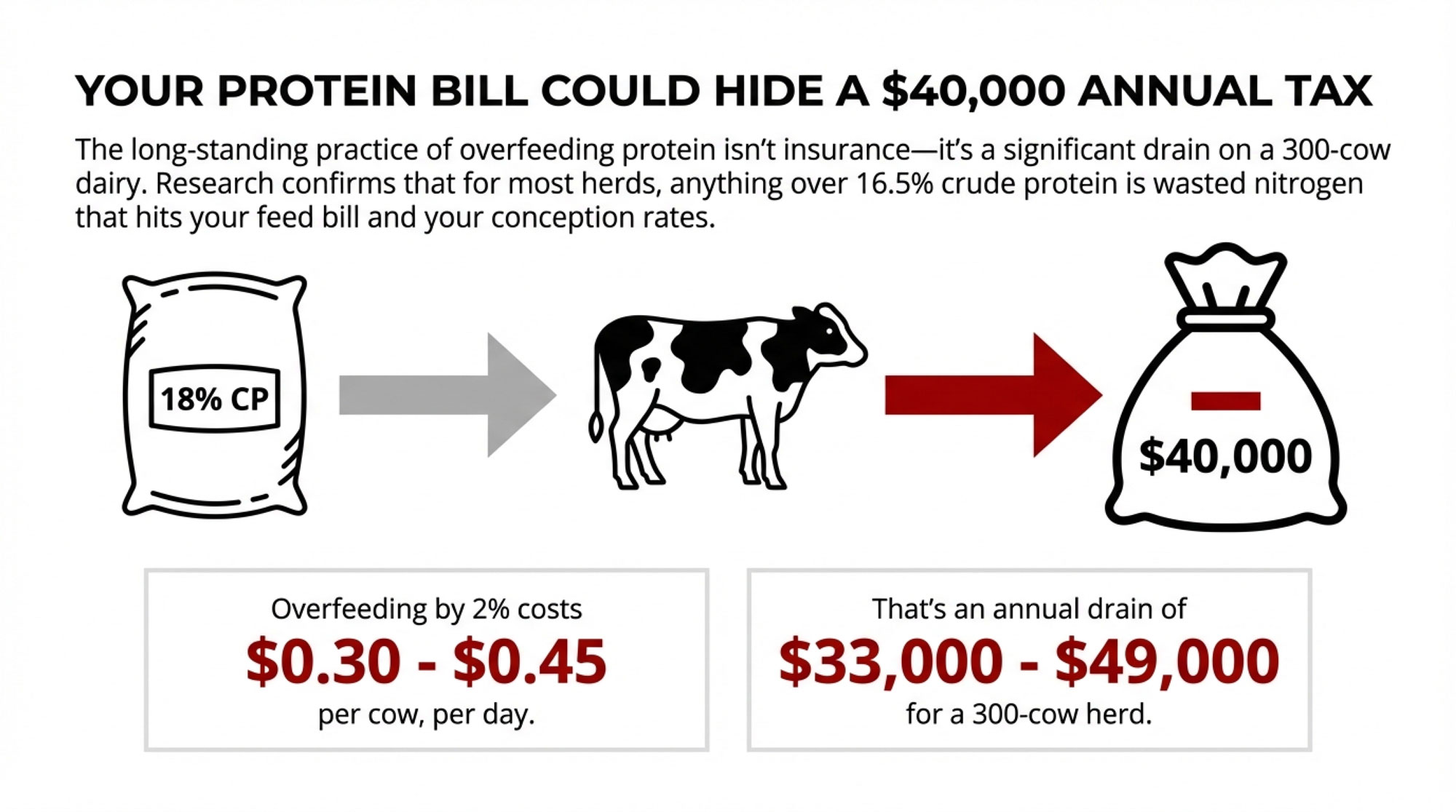
Executive Summary: That extra 2% crude protein in your ration isn’t insurance—it’s a $40,000 annual drain on a 300-cow dairy. Research from Penn State, Cornell, and USDA confirms that properly balanced 15-16.5% protein diets match production while eliminating wasted nitrogen that hits your feed bill and your conception rates. Stack protein optimization with zero-cost heifer separation and proper silage timing, and the combined opportunity reaches $130,000-$160,000 per year. The risk: cutting protein without proper diagnostics can trigger intake depression and lost milk. This guide delivers the 4-step diagnostic protocol that’s working on progressive operations—plus an 18-month implementation timeline, fresh cow exceptions, and clear guidance on when to hold back. The goal isn’t minimum protein. It’s the maximum profit per cow.

What if I told you that 2% of your crude protein is actually a $40,000 hidden tax on your 300-cow herd? That’s the conversation I keep having with producers across North America, and it’s worth exploring carefully.

The central issue comes down to protein. Specifically, the long-standing practice of feeding more than cows can efficiently utilize.

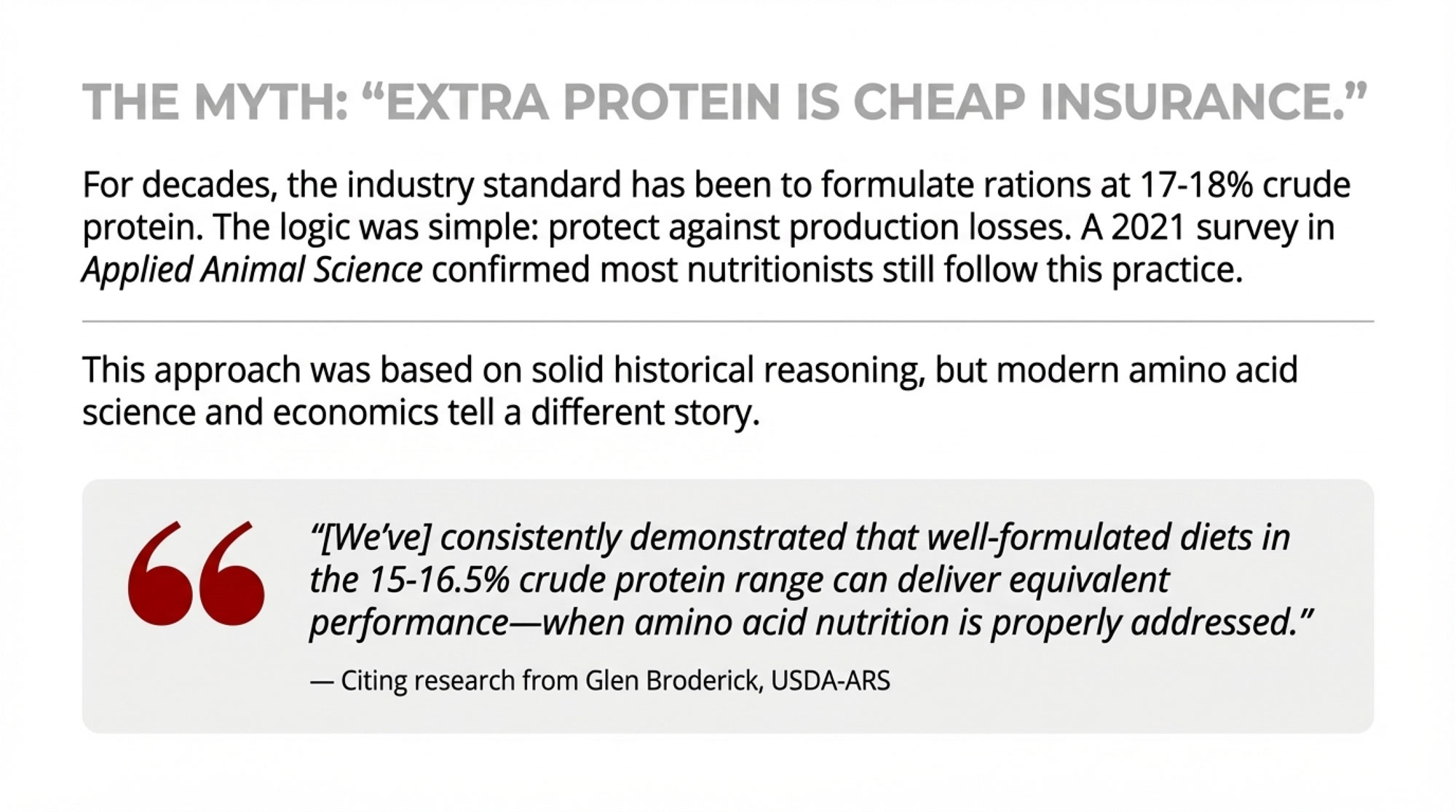
When Applied Animal Science published a survey of U.S. dairy nutritionists in 2021, the findings confirmed what most of us suspected—the majority still formulate lactating cow rations at 17-18% crude protein. There are solid historical reasons for that approach. Protein has always been viewed as insurance against production losses.

But here’s where the conversation gets interesting. Foundational research from scientists like Glen Broderick at USDA’s Agricultural Research Service has consistently demonstrated that well-formulated diets in the 15-16.5% crude protein range can deliver equivalent performance—when amino acid nutrition is properly addressed. That qualifier matters.

The economics become clearer once you work through the numbers. Protein remains one of the most expensive components of the ration. When cows receive more than their metabolism can utilize, the liver converts that surplus nitrogen to urea—an energy-intensive process that diverts calories away from productive purposes. That urea shows up in three places: elevated Milk Urea Nitrogen readings, increased nitrogen loading in the manure lagoon, and higher numbers on the feed bill.

Understanding the Financial Picture

For a 300-cow operation—and I’ve worked through these calculations with producers in several regions—the potential impact deserves attention. Current feed prices vary considerably by geography, but overfeeding crude protein by two percentage points typically costs $0.30-0.45 per cow per day in direct feed expenses.

Annually, that represents roughly $33,000 to $49,000 in potential savings from optimization alone. Whether those savings are fully achievable depends on your specific situation, which is why working with a qualified nutritionist matters so much.

And that’s before considering the reproductive implications.

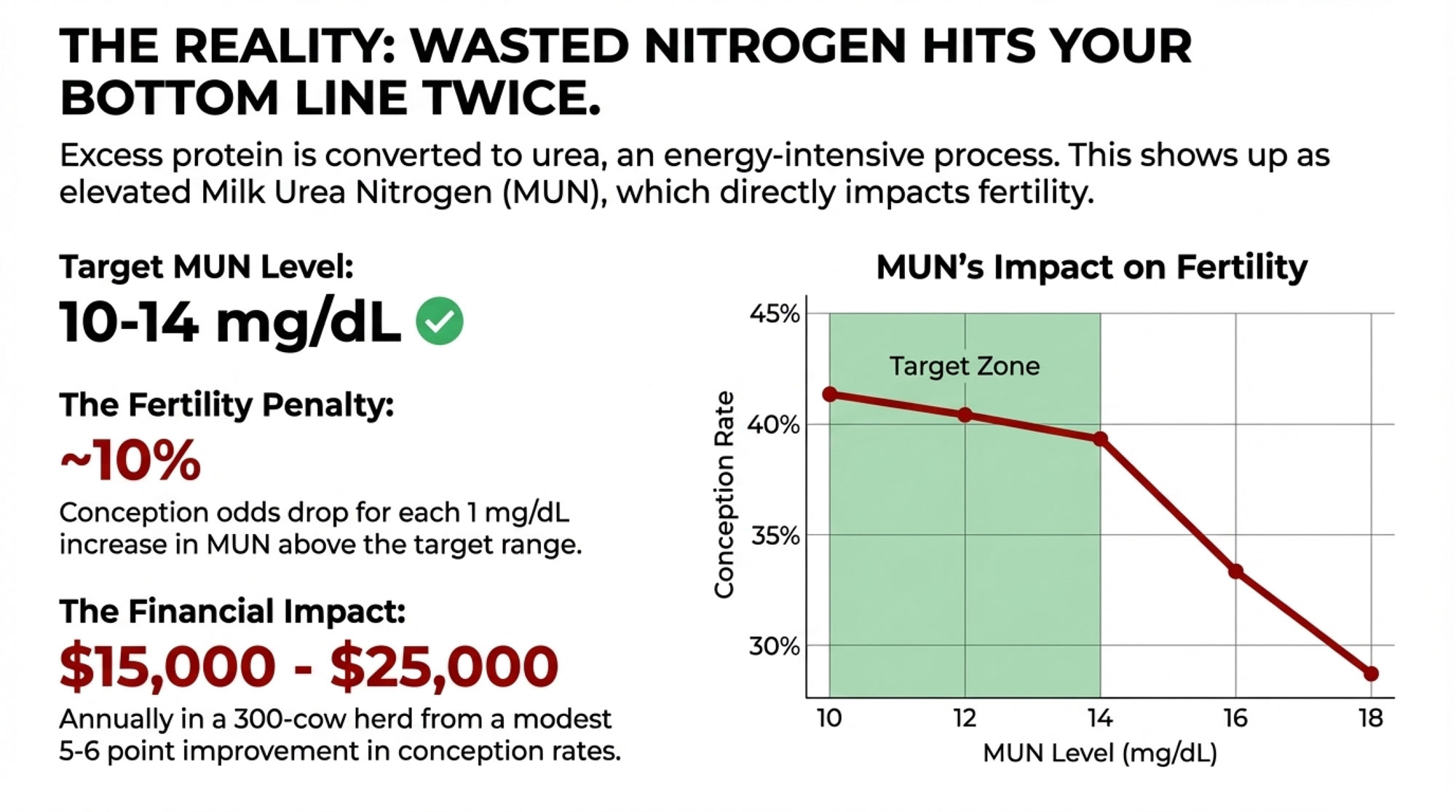
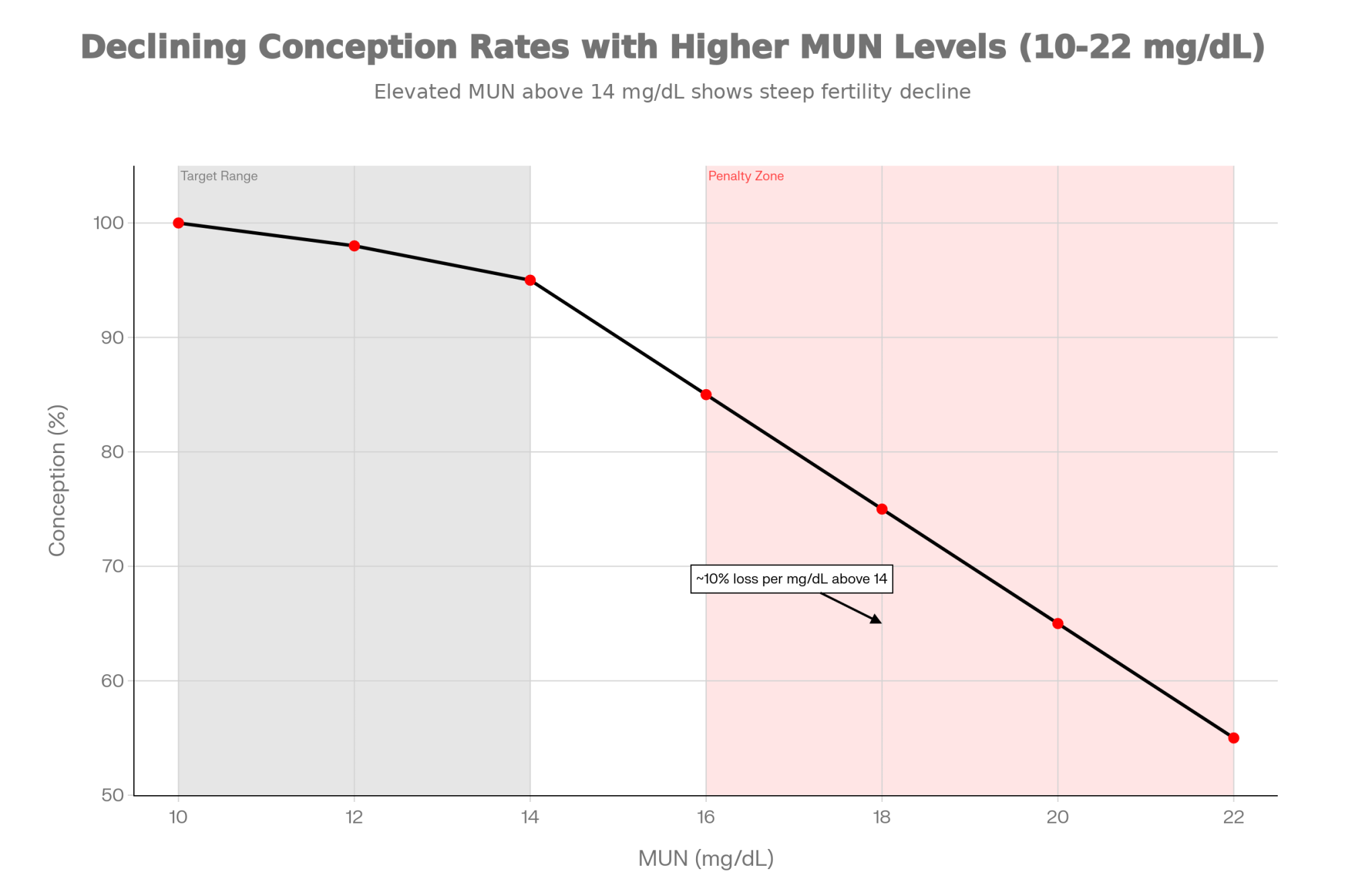
Research from Cornell University and the University of Wisconsin has established connections between elevated MUN levels and reduced fertility. Studies published in Animal Reproduction Science found that cows with MUN concentrations above 16 mg/dL showed notably lower pregnancy rates—approximately 14% reduction in some trials. That’s meaningful when you’re working to maintain reproductive efficiency.

The biology here is reasonably well understood. Elevated circulating ammonia and urea can alter the uterine environment, compromising embryo development. Penn State’s extension service recommends targeting MUN in the 10-14 mg/dL range, and research suggests approximately a 10% reduction in conception odds for each 1 mg/dL increase above that target.

What does that mean practically? A 300-cow operation seeing even modest conception rate improvements—say 5-6 percentage points—could realize $15,000-$25,000 annually in reduced days open, lower breeding costs, and fewer replacement purchases. The exact figures depend heavily on your replacement costs and current reproductive performance.

Why the Transition Takes Careful Thought

Given the potential economics, it’s fair to ask why more operations haven’t pursued protein optimization. The nutritionists I’ve spoken with offer thoughtful perspectives.

The Applied Animal Science survey identified “fear of decreased dry matter intake” as the primary concern when formulating lower-protein diets. And honestly, that concern has merit.

Dr. Alex Hristov’s research group at Penn State has done extensive work in this area, and their findings confirm there’s a real threshold below which performance suffers. In long-term trials, diets containing approximately 14% or less crude protein resulted in decreased intake, even when amino acid balance was addressed. At the 2024 Florida Ruminant Nutrition Symposium, their work highlighted that supplementation with rumen-protected histidine improved performance on low-protein diets—underscoring the amino acid’s critical role.

I recently spoke with an Ontario nutritionist who put it this way: “I’ve seen operations run successfully at 15% crude protein, and I’ve also seen farms struggle at 16% because their forage base couldn’t support it. The tipping point varies by herd.”

That variability is exactly why blanket recommendations can be problematic. Every operation has different forages, different genetics, and different management systems.

There’s another consideration worth acknowledging. Dr. Chuck Schwab, Professor Emeritus at the University of New Hampshire and a leading voice on amino acid nutrition, has been appropriately cautious about some rumen-protected amino acid products. Not all have been rigorously evaluated for bioavailability using in vivo methods, which means nutritionists sometimes formulate without complete confidence in how much amino acid is actually being absorbed. That uncertainty makes some advisors understandably careful.

A Measured Approach That’s Working

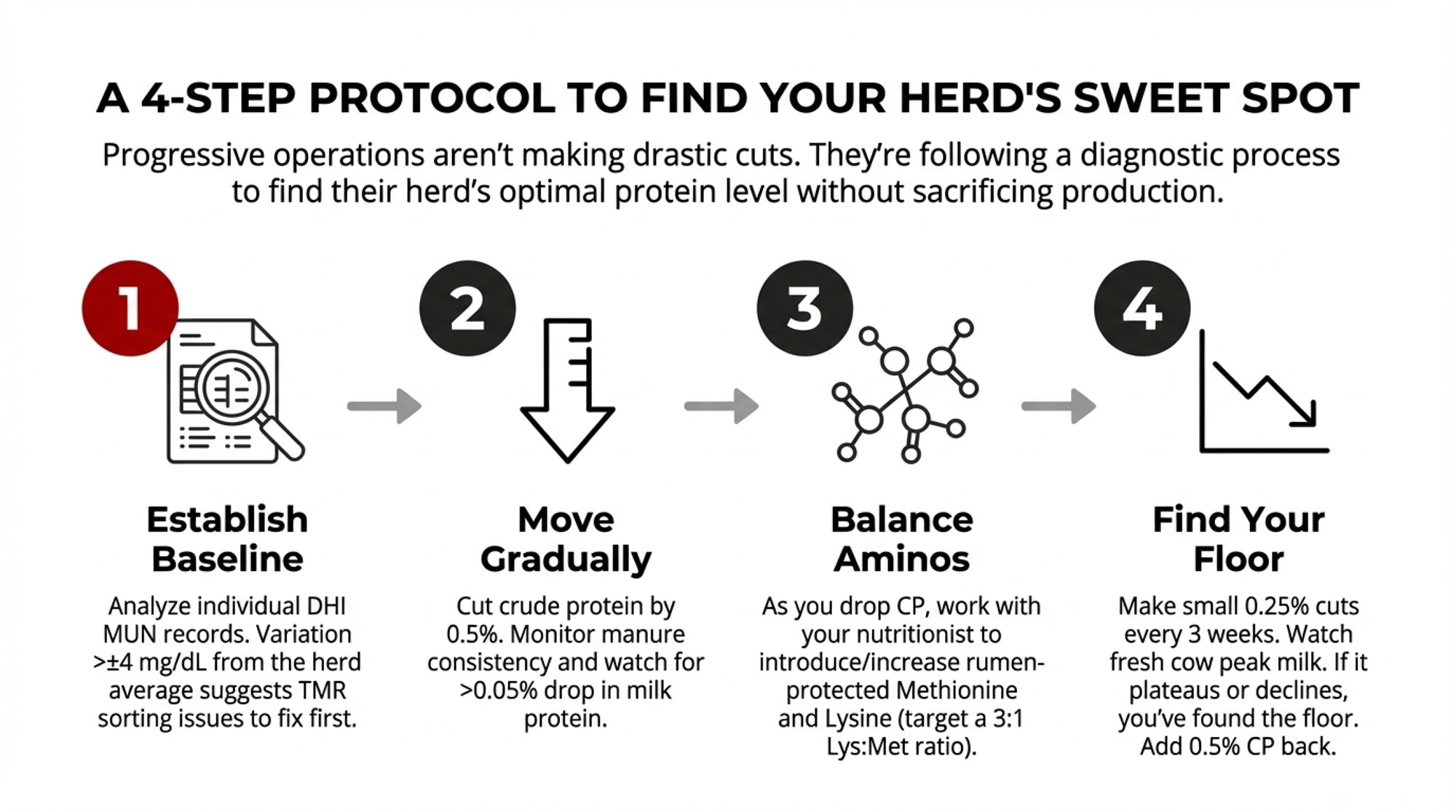
The operations successfully navigating this aren’t making dramatic overnight changes. They’re following methodical processes that identify their specific herd’s optimal range before making adjustments that could affect production.

What does that look like in practice? I walked through the process recently with a California producer running 400 cows who’s been fine-tuning his approach over the past 18 months.

  • Establish your baseline first. Before any dietary changes, examine individual MUN records from DHI testing. Cornell’s PRO-DAIRY program suggests that 75% or more of cows should fall within ±4 mg/dL of the herd average. Wide variation—some cows at 8 mg/dL while others hit 22 mg/dL on the same ration—usually indicates mixing or sorting issues to address first. “We discovered our TMR wasn’t as consistent as we thought,” that California producer told me. “Had to fix that before anything else made sense.”
  • Move gradually. Reduce dietary crude protein by 0.5 percentage points while maintaining amino acid levels. Monitor manure consistency and milk protein percentage carefully. Slightly firmer manure often indicates less nitrogen waste. But if the milk protein percentage drops by more than 0.05% in the first week, you may have reduced rumen-degradable protein too aggressively.
  • Address amino acid nutrition simultaneously. When dropping crude protein further, consider introducing or increasing rumen-protected methionine and lysine. Published research suggests targeting a ratio of approximately  for Lysine to Methionine, with roughly 7.2% lysine and 2.4-3.2% methionine as a percentage of metabolizable protein. Your nutritionist can help fine-tune these targets.
  • Find your floor carefully. Continue modest reductions—perhaps 0.25% increments every three weeks—while watching fresh cow peak milk as a key indicator. Fresh cows have the highest amino acid requirements. When peaks plateau or decline, you’ve found your floor. Add back half a percentage point immediately.
Diet TypeCrude Protein (%)Risk ProfileAnnual Cost (300-cow herd)
Traditional Industry Standard17-18%Low risk, high nitrogen wasteBaseline + $40,000
Aggressive Low (Risky)14% or lessHigh risk—intake depression likelyMay lose production
Optimized Target Range15-16.5%Balanced—when amino acids addressedSaves $33,000-$49,000
Fresh Cow Exception19%Supports metabolic transitionWorth the premium

Most operations following this approach discover their sustainable range is 1.5 to 2.0 percentage points below their starting point. But the key word is “sustainable”—the goal isn’t to reach the lowest possible number; it’s to find where your specific herd performs optimally.

Fresh Cows Require Different Thinking

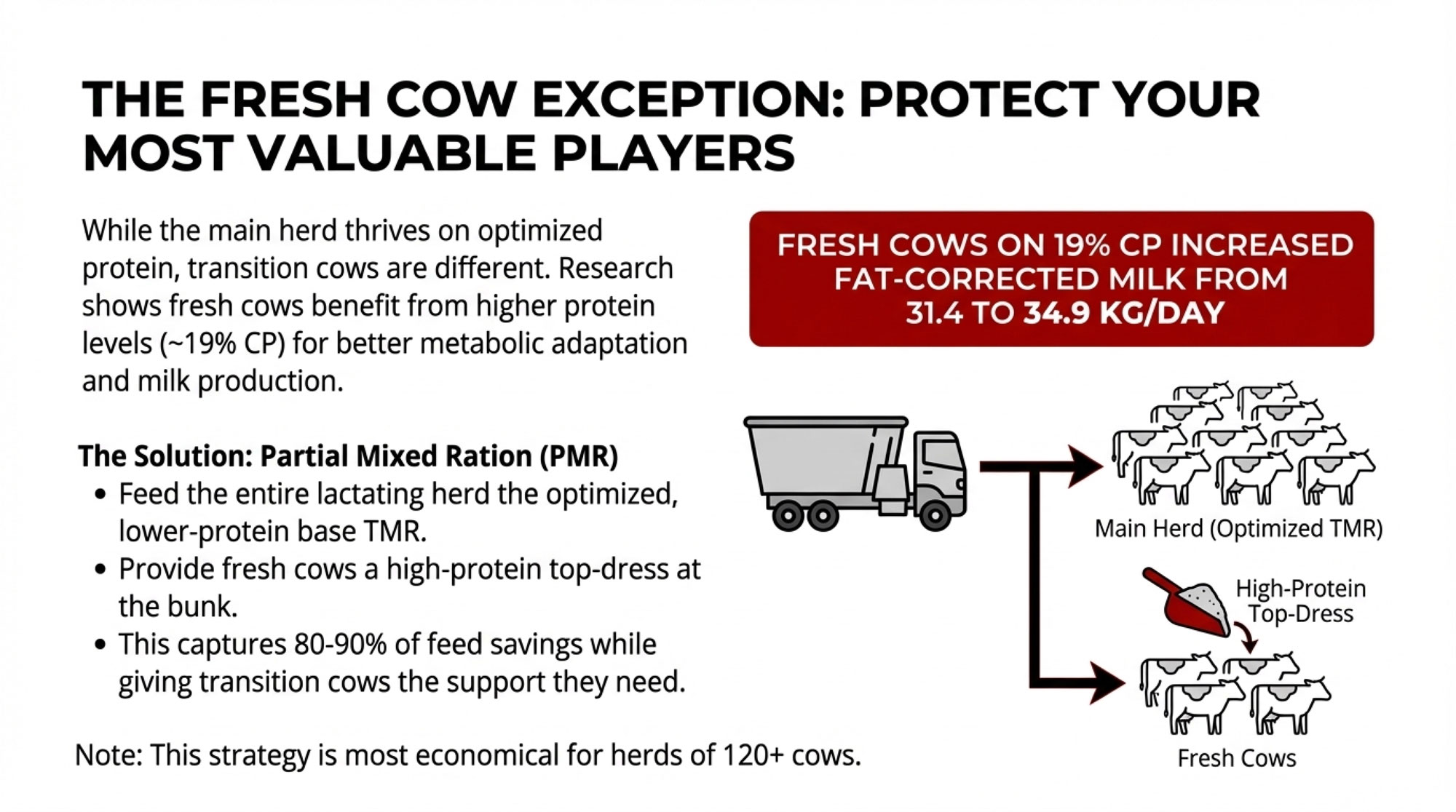
Here’s where the conversation takes an important turn. While mid-lactation cows may thrive on optimized protein levels, transition cows appear to benefit from more generous protein nutrition.

Recent research found that fresh cows receiving approximately 19% crude protein increased fat-corrected milk substantially—from 31.4 to 34.9 kg/day in one study. Those same animals showed reduced body condition loss and improved metabolic markers (lower NEFA and BHB concentrations), suggesting better adaptation to the demands of early lactation.

Dr. Masahito Oba’s work at the University of Alberta supports this general pattern, though he notes that research on rumen-protected amino acid supplementation during transition has yielded inconsistent results. The physiology of transition cows is complex, and we’re still learning how best to support them nutritionally.

So how do you capture efficiency gains on the main herd while protecting vulnerable fresh cows?

Many operations are finding success with a Partial Mixed Ration approach. Rather than preparing completely separate batches—which creates logistical headaches and often exceeds mixer capacity for small fresh pen loads—they feed the entire lactating herd a base ration at the optimized protein level. Fresh cows then receive a high-protein top-dress at the bunk.

This captures most of the potential savings (since 80-90% of cows consume the efficient ration) while providing transition animals the metabolic support they need.

The economics suggest that somewhere around 120 lactating cows represents a rough threshold where the management complexity pays for itself. Smaller operations may find the labor hard to justify. Larger herds—150 cows and above—that remain on a single high-protein ration may be leaving meaningful money on the table.

A High-Return Strategy That Requires No Ration Changes

One finding that consistently surprises producers: one of the most impactful changes doesn’t involve the feed sheet at all.

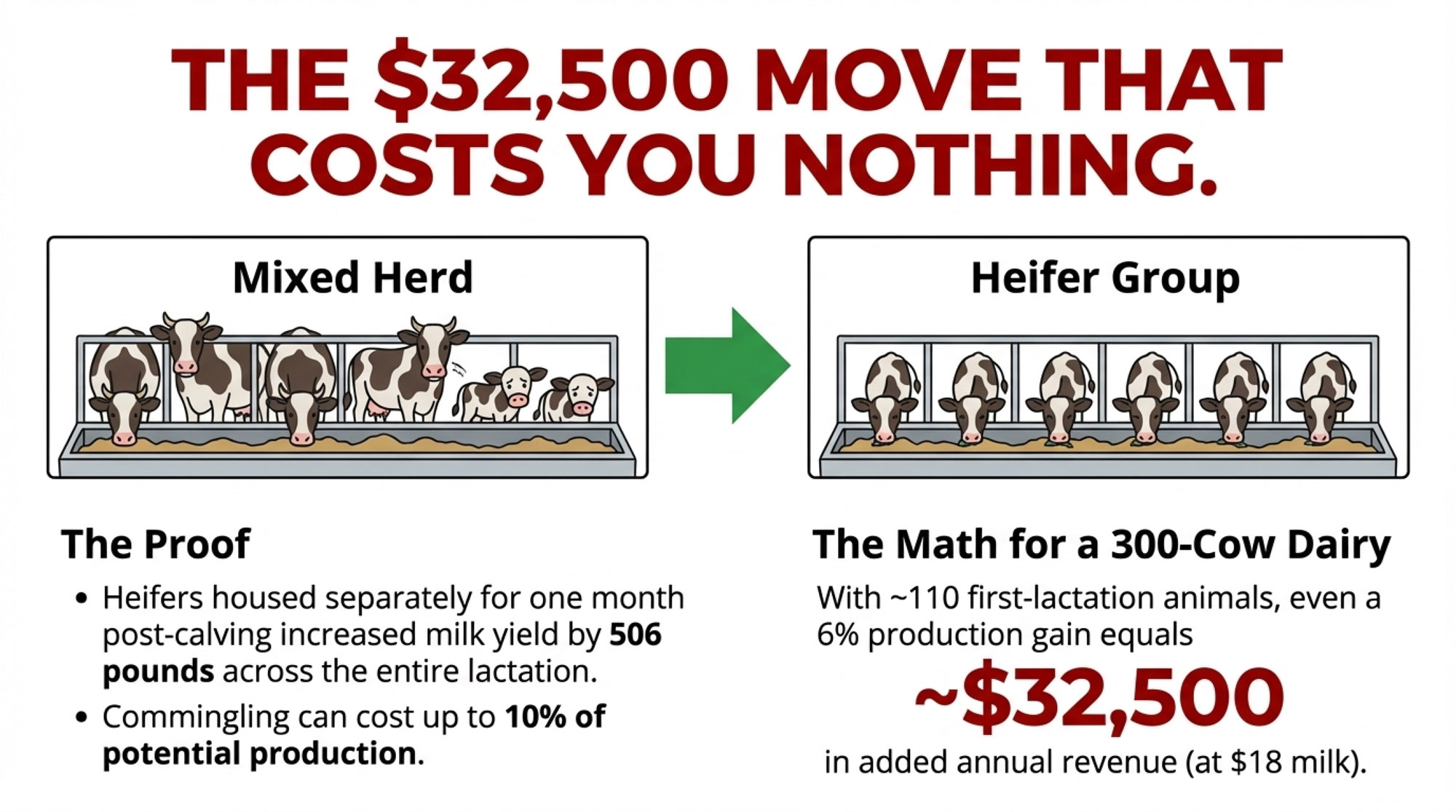
Separating first-lactation animals into their own group—even on identical nutrition—regularly delivers measurable production improvements. Research from multiple university programs, including work highlighted in Hoard’s Dairyman, has confirmed that first-lactation heifers housed apart from mature cows show reduced competitive stress and improved feeding patterns.

European researchers documented that heifers housed separately for just one month after calving increased milk yield by 506 pounds across the lactation. Classic studies suggest farms may sacrifice close to 10% of potential production when parities are commingled—a substantial penalty for something that costs nothing to address.

The mechanism is behavioral, and as many of us have seen watching bunk activity, first-lactation animals naturally prefer smaller, more frequent meals. Mature cows tend toward larger, less frequent consumption. When housed together, dominant animals control access to the bunk during the critical period after fresh feed delivery. Younger cows respond by eating faster (which destabilizes rumen pH) and resting less (which reduces rumination time).

For a 300-cow dairy with roughly 110 first-lactation animals, even a 6% production improvement translates to approximately $32,500 in additional annual revenue at $18 milk. No equipment investment, no ration reformulation—just a management decision about pen assignments.

Management SystemLactation Yield ImpactAnnual Value (300-cow herd)Additional Cost
Mixed Parity HousingBaseline (100%)$0None
Heifers Separated (1 month)+506 lbs/lactation$16,000-$20,000Zero
Heifers Separated (Full lactation)+800-1,000 lbs/lactation (est)$25,000-$32,500Zero
European Research Average+506 lbs/lactation$16,000-$20,000Zero

A Wisconsin producer I spoke with made this change two years ago. “We were skeptical at first,” he told me. “Same feed, same barn, just different pens. But we saw results in the bulk tank within six weeks. The heifers settled into a better routine once they weren’t competing with older cows.”

I’ve heard similar stories from Northeast operations and California dairies. The specifics vary, but the pattern holds.

The Annual Decision That Creates Outsized Impact

While protein optimization and grouping strategies operate throughout the year, one seasonal decision carries disproportionate financial weight: corn silage harvest timing.

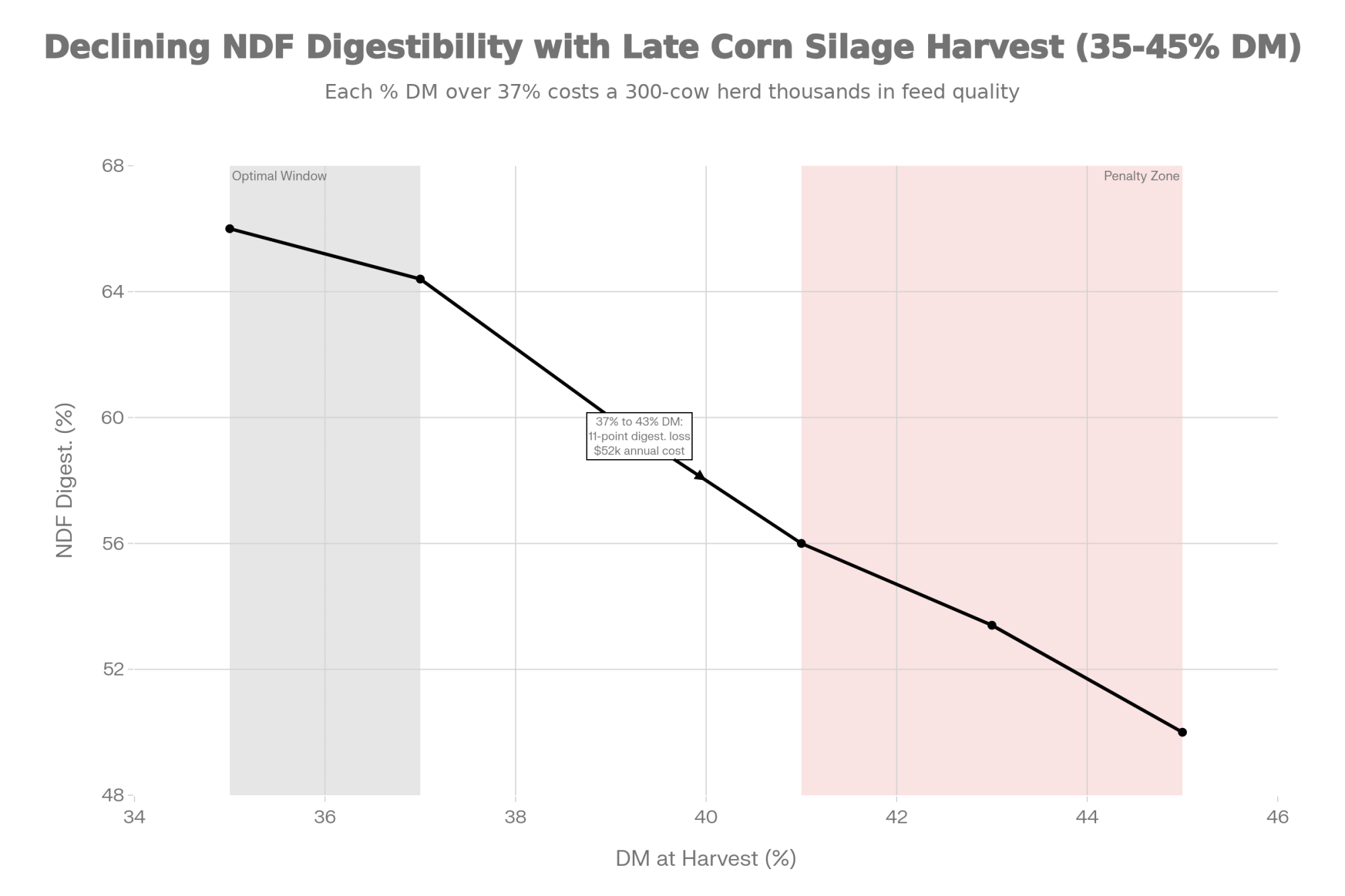
The Bottom Line on Harvest Timing: “Losing 11 points of NDF digestibility from delayed harvest costs more than $52,000 annually for a 300-cow dairy. That’s money lost in a few autumn days that you can never recover.”

Research published in Translational Animal Science quantified what many producers have observed. As harvest gets pushed from 37% to 43% dry matter, NDF digestibility declined from 64.4% to 53.4%. That’s roughly 11 percentage points of fiber digestibility compromised by delayed harvest.

Why does that matter so much? Work from Michigan State—specifically, Drs. Mike Oba and Mike Allen—established that each percentage point of NDF digestibility improvement corresponds to about 0.40 pounds more daily dry matter intake and 0.55 pounds more 4% fat-corrected milk. When you’re losing 11 points of digestibility, the math gets uncomfortable quickly.

The challenge is practical. Corn typically dries at 0.5-0.75% per day during fall conditions (though weather obviously affects this). An operation with 10 days of chopping capacity that waits for an ideal 35% dry matter may finish well above 40%.

For a 300-cow dairy feeding late-harvest silage, the consequences compound:

  • Additional corn grain needed to replace lost energy: roughly $17,500 annually
  • Higher shrink losses from compromised packing and aerobic stability: approximately $15,000 annually
  • Unrecoverable milk from reduced intake: around $19,700 annually

That’s more than $52,000 in annual impact from decisions made in a few autumn days. This is one area where even experienced operations sometimes get caught by weather or competing priorities.

When Caution Is Warranted

Any honest discussion of these strategies must acknowledge situations in which aggressive implementation can backfire.

  • Variable forage quality presents real challenges. Operations dealing with inconsistent harvest conditions, limited storage infrastructure, or purchased feeds with uncertain history face genuine risk when tightening protein margins. The traditional safety cushion exists for good reason.
  • Existing rumen health issues complicate the picture. Herds already managing subclinical acidosis have compromised rumen function. Reducing protein on top of SARA often makes things worse. Address rumen health first.
  • Monitoring limitations matter. Operations relying primarily on bulk tank MUN and monthly DHI tests may not detect problems quickly enough. More frequent observation—at minimum, close attention to milk protein percentage and manure consistency—becomes essential when operating near the efficiency frontier.
  • Regional and system differences affect optimal approaches. Southwest operations managing heat stress face different metabolic pressures than those in the Upper Midwest. Farms built around byproduct feeds have different amino acid profiles than corn silage-alfalfa operations. And for pasture-based systems—whether in Ireland, New Zealand, or parts of Australia—these TMR-focused strategies require significant adaptation for grazing contexts where lush pasture protein creates entirely different management challenges.

And some nutritionists raise reasonable questions about whether current amino acid models are precise enough to support aggressive protein reduction across all scenarios. “The science is clearly trending this direction,” one told me, “but I’m not convinced we have the precision yet for every situation.” That perspective deserves respect.

How the Strategies Work Together

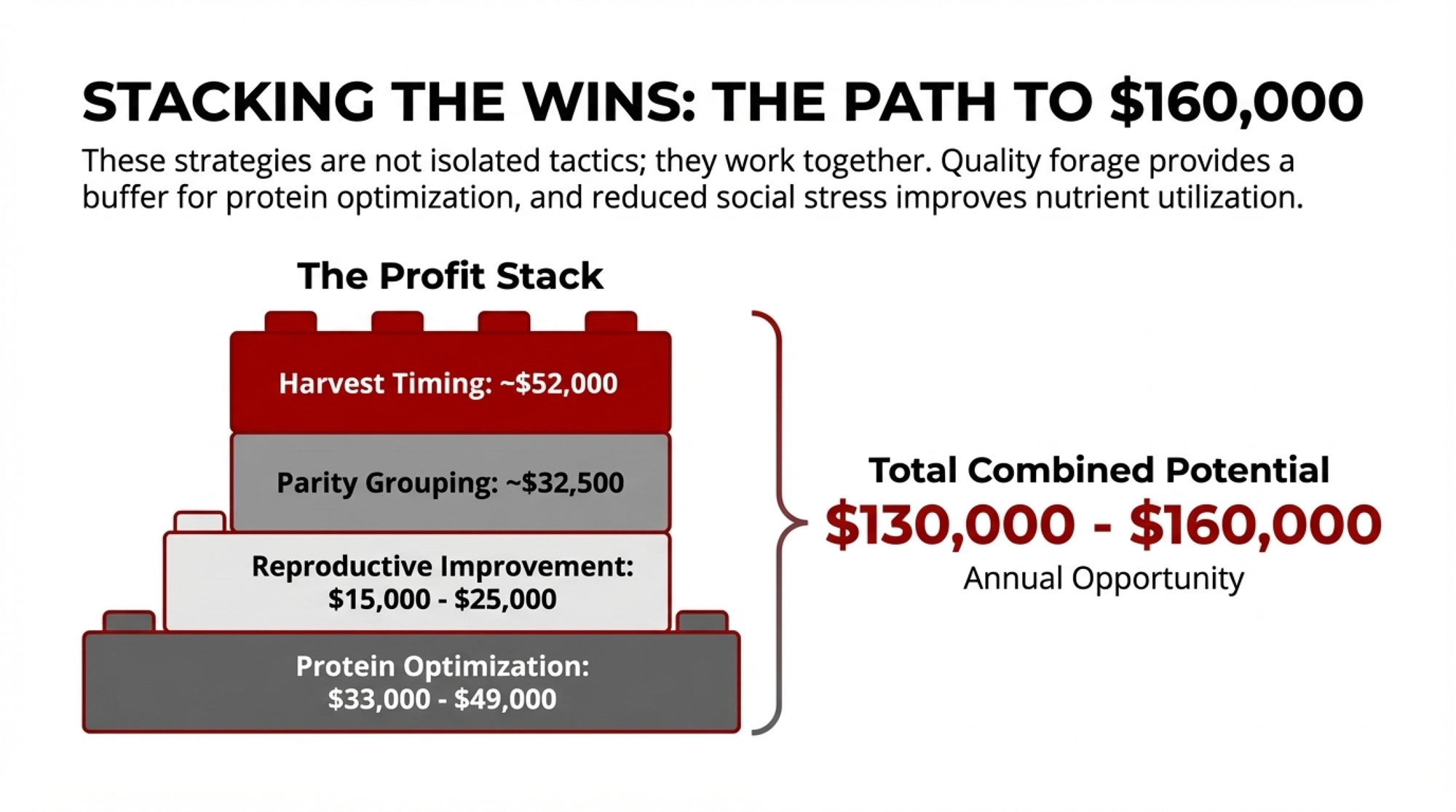
What makes these approaches compelling is how they interact. Operations implementing multiple strategies often see returns exceeding the simple sum of individual improvements.

StrategyPer Cow Annual Value ($)300-Cow Herd Impact ($)
Protein Optimization$110-165$33,000-49,000
Reproductive Improvement (Lower MUN)$50-85$15,000-25,000
Parity Grouping (Zero-Cost)$108$32,500
Optimal Harvest Timing$174$52,000
Total Annual Opportunity$442-532$130,000-$160,000

Quality forage creates a safety margin for lower-protein diets—rumen microbes need readily available energy to utilize limited nitrogen efficiently. Reduced social stress from proper grouping improves nutrient utilization. Better body condition from appropriate MUN levels supports reproduction, gradually improving herd structure over time.

Here’s how the numbers add up when you put these pieces together for a 300-cow operation:

StrategyEst. Annual Value (Per Cow)Primary Driver
Protein Optimization$110-165Reduced nitrogen waste & feed cost
Reproductive Improvement$50-85Lower MUN / higher pregnancy rates
Parity Grouping$108Reduced social stress in heifers
Harvest Timing$174Improved NDF digestibility
Combined Potential$442-532Combined management impact

That suggests an annual improvement potential of $130,000 to $160,000 for a 300-cow dairy. Your specific numbers will shift based on milk price, regional feed costs, current practices, and implementation success—but the general magnitude tends to hold. You can adjust these figures for your own milk price and feed costs to get a better sense of what applies to your operation.

Your 30-Day Quick Start

  1. Pull DHI MUN records—check variation across your herd
  2. Separate first-lactation heifers into their own group (zero cost, immediate impact)
  3. Schedule a nutritionist review for the amino acid balancing feasibility
  4. Mark the corn silage target harvest date on the calendar now

The Component Pricing Connection

One additional factor worth considering: current component pricing structures can amplify or dampen the returns from these strategies, depending on your market.

In regions where protein premiums remain strong relative to butterfat, the milk protein percentage improvements from proper amino acid balancing deliver direct check impact beyond feed savings. Conversely, in markets where butterfat premiums dominate (as they have in many U.S. Federal Orders through 2024-2025), the reproductive and efficiency gains matter more than component shifts.

The point is that these strategies aren’t one-size-fits-all economically any more than they are nutritionally. Understanding your specific market’s component structure helps prioritize which elements to implement first.

Realistic Expectations for the Timeline

Operations considering this path should understand what a realistic timeline looks like.

TimelineWhat’s Actually HappeningMonthly Cash Impact
Month 1Feed cost reduction appears immediately+$1,500-$2,000
Months 2-3Amino acid costs peak, milk check looks same—patience required+$500-$1,000
Months 4-6Heifer grouping benefits measurable, component premiums visible+$2,500-$3,500
Month 6+New crop forage (optimal harvest) creates largest single cash gain+$4,500-$6,000
Months 12-18Full reproductive cycle improvement compounds into herd demographics+$10,000-$13,000

What’s Coming Next

Looking ahead, several developments may make precision protein feeding more accessible and reliable.

Real-time MUN monitoring through inline milk analyzers is becoming more practical, potentially allowing daily or even milking-by-milking adjustments rather than waiting for monthly DHI results. Precision feeding systems that deliver individualized rations based on production stage, body condition, and metabolic status are moving from research herds to commercial application. And genomic selection for feed efficiency traits—still in early stages—may eventually allow producers to select animals that convert feed more efficiently at the genetic level.

These technologies won’t replace good nutritional management, but they may provide better tools for finding and maintaining optimal protein levels for individual animals rather than group averages. Worth watching as these systems mature.

Practical Guidance by Operation Size

  • For herds with fewer than 100 cows, the management complexity of multi-group feeding may not justify the labor investment. Focus on forage quality and gradual protein optimization first. The diagnostic approach still applies—just proceed more slowly and acknowledge real constraints on management time.
  • For herds of 120-300 cows: The economic case for fresh cow differentiation and heifer separation becomes quite compelling. Consider starting with parity grouping (requiring no ration changes) to build confidence in nutritional optimization. This range represents something of a sweet spot for these strategies.
  • For herds with more than 300 cows, full implementation represents a substantial annual opportunity. The 18-month timeline means changes initiated now affect profitability through 2027 and beyond. At this scale, the question shifts from “whether” to “how well and how quickly.”
  • For all operations: Perhaps the most common mistake is confusing high feed efficiency numbers with genuinely profitable efficiency. A cow showing 1.8 pounds of milk per pound of dry matter intake while losing body condition isn’t efficient—she’s depleting reserves that will be repaid through reproductive failure, health challenges, or premature culling. Sustainable efficiency means strong production supported by adequate intake and stable body condition.

Your Next 3 Moves

  1. Review the last 6 months of DHI MUN data—calculate your herd’s variation and identify outliers
  2. Walk your fresh pen and first-lactation group this week—observe feeding behavior during and after TMR delivery
  3. Block 30 minutes with your nutritionist—discuss amino acid balancing feasibility for your specific forage base

The Bottom Line

The opportunity exists for many operations. Whether to pursue it—and how aggressively—depends on management capacity, forage infrastructure, current practices, and appropriate risk tolerance. But the underlying economics, for those positioned to capture them, continue to look favorable.

Key Takeaways:

  • Cut 2% protein, bank $40,000: Balanced 15-16.5% CP diets match 17-18% production—saving $33,000-$49,000/year on a 300-cow herd
  • Fix MUN, fix fertility: Every 1 mg/dL above 14 costs ~10% conception odds. Target 10-14 mg/dL for $15,000-$25,000 in annual reproductive savings
  • Separate heifers today—it costs nothing: First-lactation cows in their own pen gain 506 lbs/lactation. That’s $32,500/year at zero feed cost
  • Miss harvest timing, lose $52,000: Late-chopped silage drops NDF digestibility 11 points. That milk loss can’t be bought back
  • Stack all four for $130K-$160K/year: But first—pull MUN records. Variation over ±4 mg/dL means TMR problems to fix before touching protein

Complete references and supporting documentation are available upon request by contacting the editorial team at editor@thebullvine.com.

Learn More

Join the Revolution!

Join over 30,000 successful dairy professionals who rely on Bullvine Weekly for their competitive edge. Delivered directly to your inbox each week, our exclusive industry insights help you make smarter decisions while saving precious hours every week. Never miss critical updates on milk production trends, breakthrough technologies, and profit-boosting strategies that top producers are already implementing. Subscribe now to transform your dairy operation’s efficiency and profitability—your future success is just one click away.

NewsSubscribe
First
Last
Consent

40% Muscle Loss in 60 Days: The Genetic Time Bomb Hiding in Your Fresh Pen

She’s milking 110 lbs. Ketones perfect. Appetite strong. She’s also lost 40% of her muscle and won’t breed back. You just can’t see it yet.

EXECUTIVE SUMMARY: While you’re watching ketones and body condition, your best cows are quietly losing up to 40% of their muscle—and you can’t see it happening. Fat bounces back by 90 days in milk. Muscle doesn’t recover until 240-270 days, if at all. That gap explains a lot: the silent ovaries, the infections that won’t clear, the early culls you blamed on bad luck. Worse, Purdue research shows your highest-genetic cows mobilize the hardest—we may have spent 40 years breeding cows programmed to destroy themselves for peak milk. Rumen-protected amino acids and late-lactation nutrition buffer the damage—but don’t fix the genetics. The real question: are we willing to weight DPR, Livability, and persistency heavily enough to breed cows that last 4-5 lactations instead of 2.5?

Dairy Cow Muscle Mobilization

New research reveals that high-producing cows can lose up to 40% of their muscle depth in early lactation. The uncomfortable question: have decades of selection created cows genetically programmed to cannibalize themselves?

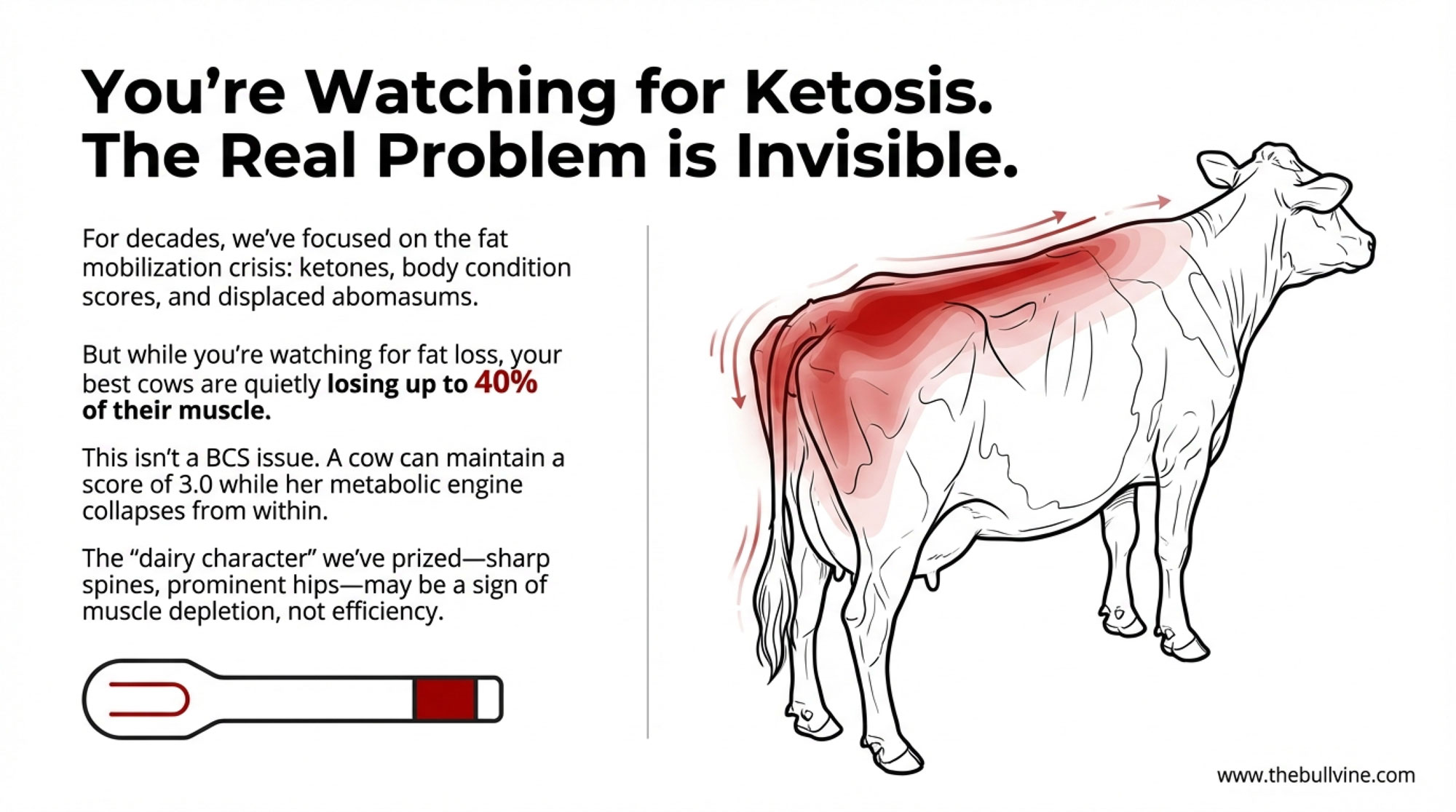
If you’ve spent any time around transition cows, you know the routine. Monitor ketones. Watch body condition. Keep an eye on feed intake. Over the past couple of decades, we’ve gotten pretty good at spotting the fat mobilization crisis—you know, the ketotic cow with acetone breath and a twisted stomach brewing.

But here’s what’s been hiding in plain sight: while we’ve been laser-focused on fat, our cows have been quietly drawing down something else entirely. Their muscle.

Recent work coming out of Purdue University, led by Dr. Jackie Boerman and her team, has documented something that should give us all pause. According to their research database, high-yielding cows routinely mobilize 30% to 35% of their longissimus dorsi muscle depth—that’s your ribeye area—within the first 60 days of lactation. And in some cases, cows can lose up to 40% of that muscle depth during this window.

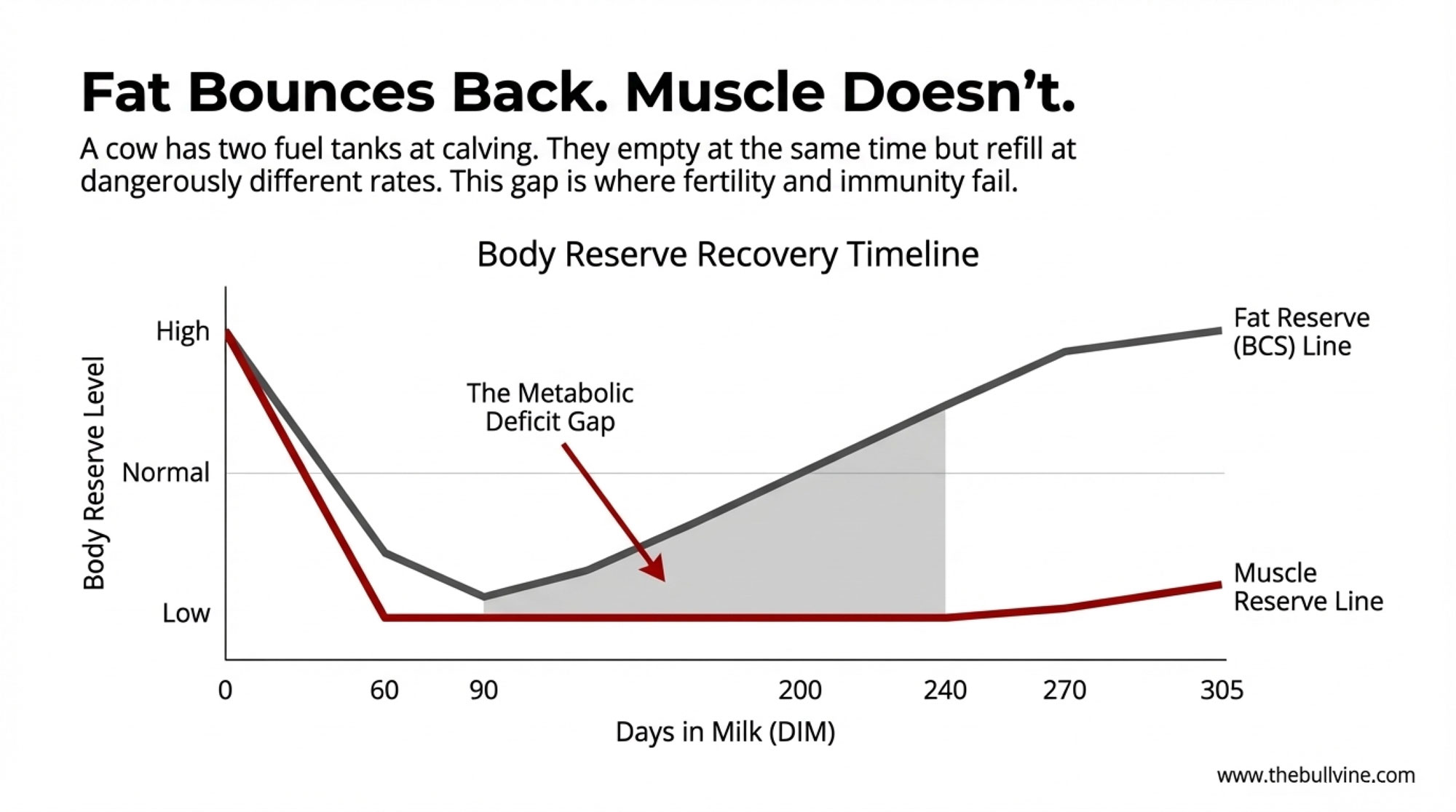
Here’s the part that should make every breeder uncomfortable: unlike fat, which starts coming back around 60-90 days in milk, muscle mass often doesn’t rebuild until 240-270 days in milk. Sometimes not at all.

And the cows doing this most aggressively? Your highest genetic merit animals.

Let that sink in for a minute.

The Breeding Question Nobody Wants to Ask

Let’s cut to the chase here. We’ve been selecting hard for peak milk yield and feed efficiency for decades—really since the early 1980s when the Holstein boom took off. Both traits have value. Nobody’s disputing that.

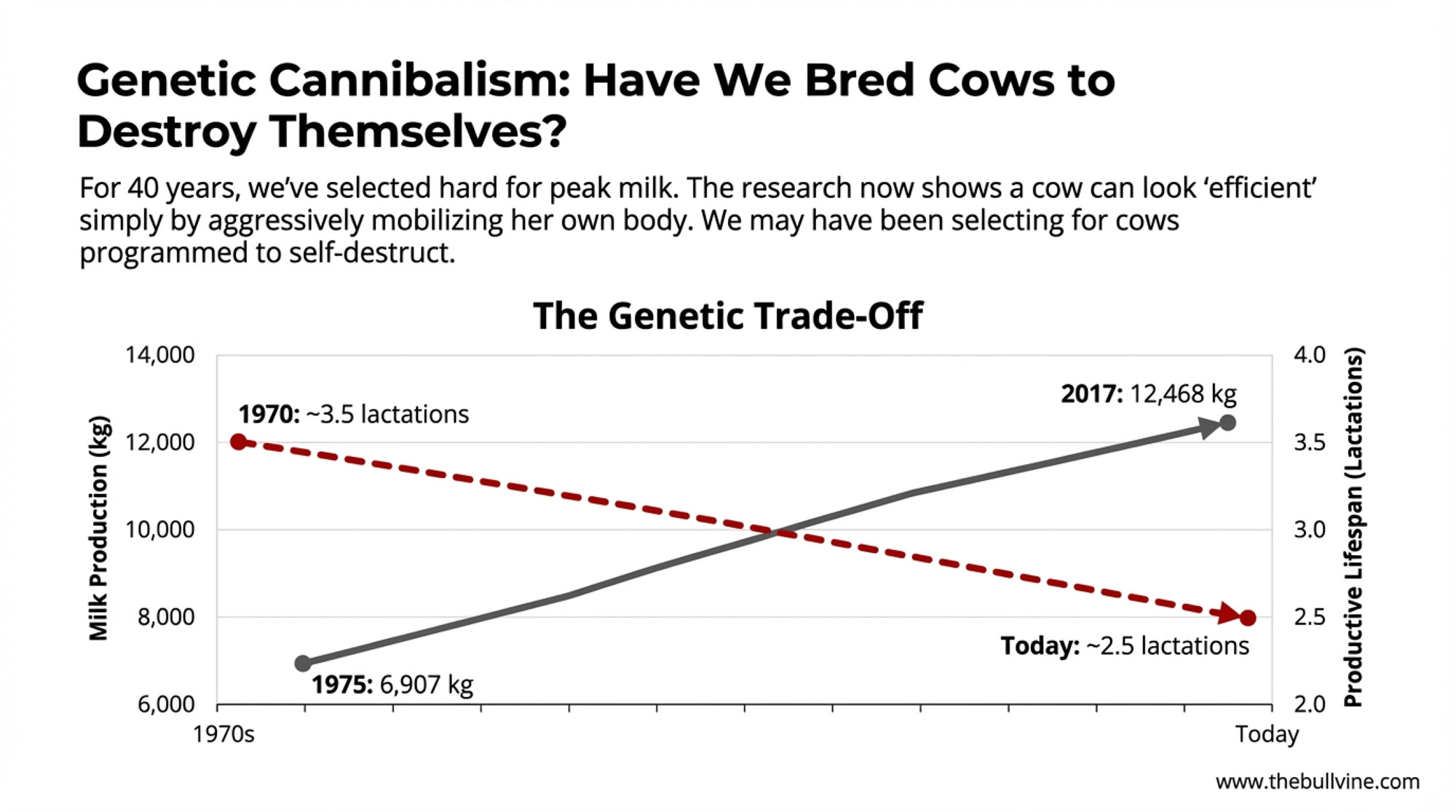
But here’s the uncomfortable reality the research is now exposing: a cow can score high on “efficiency” simply by aggressively mobilizing her own body tissue. She looks efficient on paper because her own reserves aren’t counted as an input.

Think about what that means. We may have spent 40 years selecting for cows willing to destroy themselves to make milk.

The data from Lactanet tells the story pretty clearly. The average Canadian Holstein cow born in 1975 produced 6,907 kg of milk. By 2017, that number had climbed to 12,468 kg. That’s remarkable genetic progress by any measure. But here’s the flip side—productive lifespan has moved in the opposite direction, declining from about 3.5 lactations in 1970 to somewhere between 2.5 and 3.0 today, according to research compiled by Lohmann Breeders.

Now, to be fair, some exceptional operations have achieved 4+ lactation averages even with high-production genetics—but they’re the exception rather than the rule, and they’ve typically invested heavily in the nutritional and management strategies we’ll discuss later. For most herds, the inverse relationship between genetic milk potential and productive lifespan remains stubbornly real.

Studies published in Animals comparing “high muscle” cows (greater than 5cm longissimus dorsi depth at calving) with “low muscle” cows found something that should stop breeders in their tracks. High-muscle cows—your genetically superior animals with the capacity for massive production—actually begin mobilizing before calving even happens. They lose more total muscle in absolute terms. They produce significantly more milk in early lactation. And then they crash harder reproductively.

The cows with lighter frames? More metabolically conservative. Lower peaks, but they hold together longer.

Dr. Kent Weigel, who chairs the Department of Animal & Dairy Sciences at the University of Wisconsin-Madison and has worked extensively on dairy cattle selection indexes, has noted that traits such as Daughter Pregnancy Rate and Livability serve as indirect proxies for metabolic robustness. A cow with high DPR maintained her reproductive function while producing milk. A cow with high Livability survived multiple lactations, which require maintaining body reserves over time.

It’s worth noting that Scandinavian breeding programs recognized this connection earlier than most. Countries like Sweden and Denmark have emphasized health, fertility, and longevity traits in their selection indexes for decades—and their herds show it in productive lifespan numbers that consistently exceed North American averages.

Here’s the call to action for those of us making breeding decisions: If you’re still selecting primarily on milk and type while treating DPR and Livability as afterthoughts, you may be actively breeding for metabolic fragility. Every 500 pounds of additional milk potential means nothing if that cow burns out after 2.5 lactations—which is exactly where the U.S. average sits.

The cow of 2030 needs to look different than the cow we’ve been chasing. A bit more substance. A bit less extreme “dairy character.” Flatter lactation curves. And 4-5 profitable lactations instead of a spectacular peak followed by an infertility cull.

It’s achievable. Some of the herds are already there. The question is whether the rest of us are willing to shift our thinking.

Why Muscle Matters More Than Most Realize

For a long time—and I was guilty of this too—we’ve thought about skeletal muscle as structural tissue. Important for getting the cow from the freestall to the feed bunk, sure, but not really central to the metabolic challenges of early lactation. That thinking is outdated.

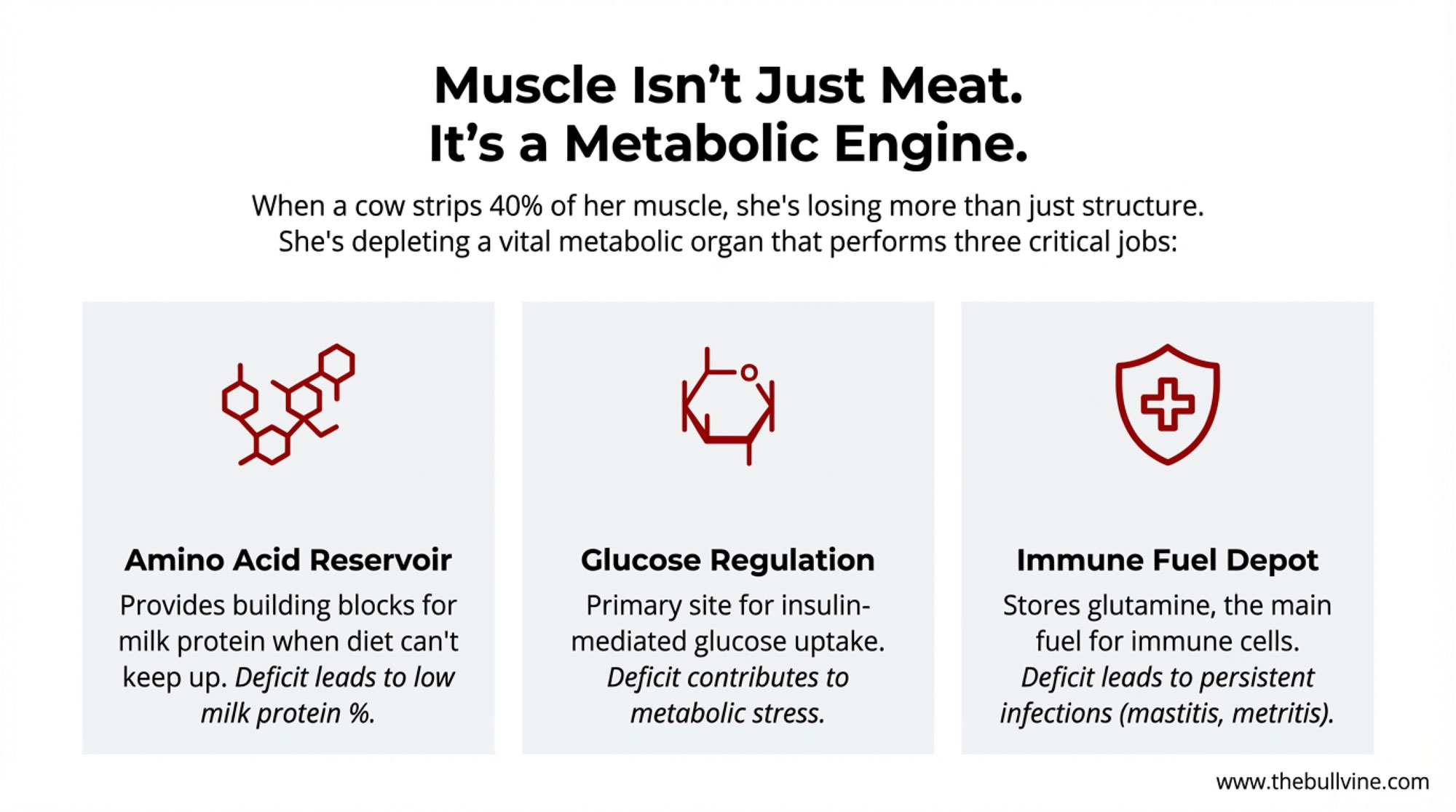
What’s becoming clear from recent research is that muscle tissue pulls triple duty during lactation. It serves as the cow’s amino acid reservoir, providing the building blocks for milk protein synthesis when dietary intake can’t keep pace with demand. It’s also the primary site for insulin-mediated glucose uptake, which matters enormously during that naturally insulin-resistant state after calving. And here’s something that often surprises people: muscle stores glutamine—the primary fuel source for immune cells fighting infection.

Dr. Boerman put it well in a recent presentation at the American Dairy Science Association annual meeting—she essentially said we need to stop thinking about muscle as “meat” and start thinking about it as a metabolic organ. It’s not just structural. It’s actively regulating the cow’s entire metabolic response to lactation.

When a cow strips 40% of that organ in 60 days, you can imagine what follows.

What Body Condition Scoring Actually Misses

Here’s something worth considering, and you may have noticed this yourself if you’ve been paying close attention: our standard monitoring tools weren’t designed to catch muscle loss.

Body Condition Scoring primarily measures subcutaneous fat cover. That’s what it was built to do, and it does that job reasonably well. But a cow can maintain an acceptable BCS of 3.0 while losing significant muscle mass underneath. The visual “dairy character” many of us associate with high production—those sharp spines, prominent hip bones, angular frames—may sometimes reflect muscle depletion rather than optimal metabolic efficiency.

I’ve been thinking about this a lot lately. We may have been confusing a coping mechanism with a desirable trait for decades.

Tools that actually measure muscle status:

Research teams are using ultrasound imaging of the longissimus dorsi at the 12th/13th ribs to track changes in muscle depth over time. Blood biomarkers like 3-methylhistidine indicate active muscle breakdown, while creatinine levels reflect total muscle mass. Even milk protein percentage—when it drops below 2.9-3.0% in early lactation—can signal amino acid deficiency and excessive tissue mobilization.

These tools remain primarily in research settings for now, though some veterinary practices are beginning to explore on-farm ultrasound protocols. That’s worth watching.

Two Cows, Two Outcomes: A Fresh Pen Scenario

Let me paint a picture that might feel familiar.

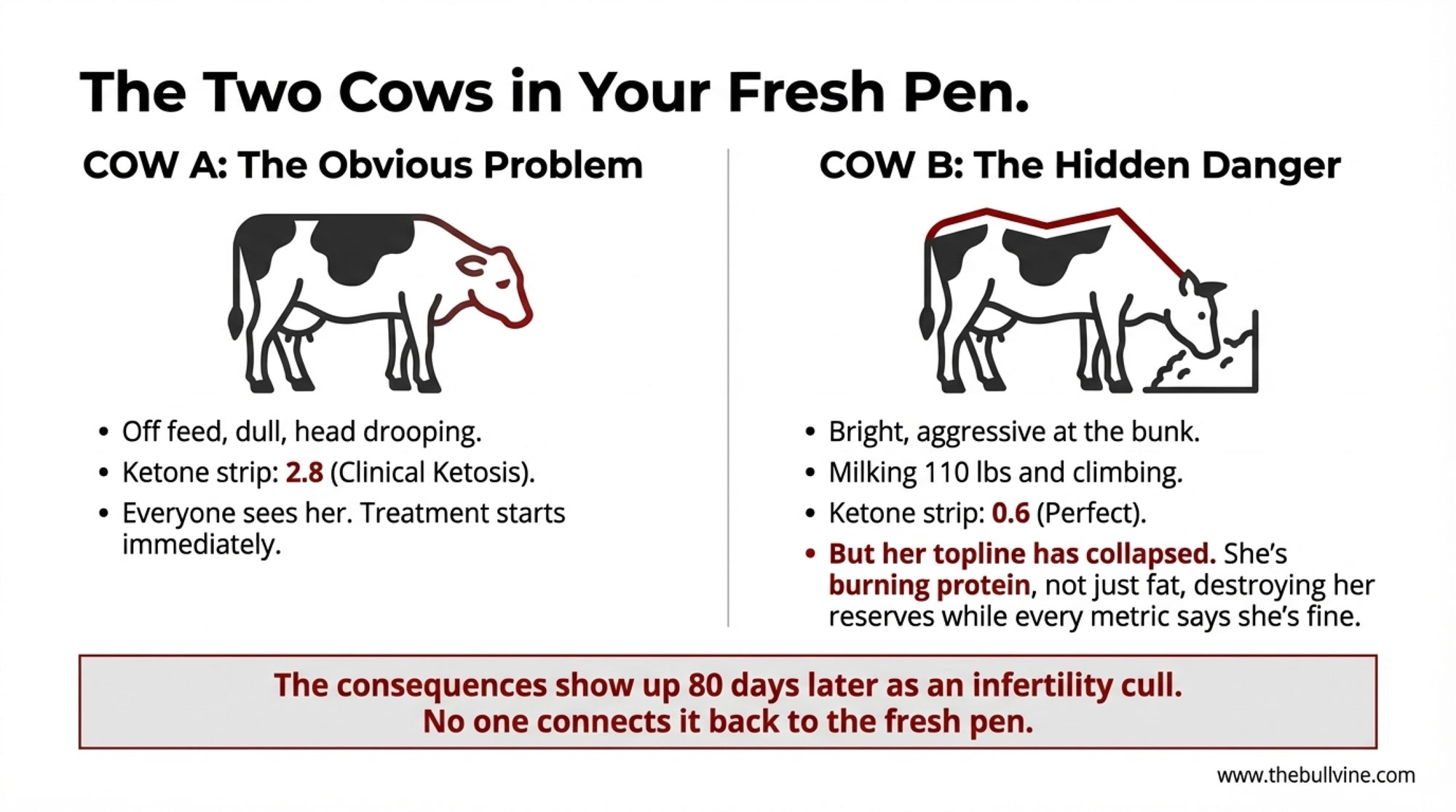
You walk into your fresh pen, 6 AM. Two cows calved about 20 days ago and are now penned side by side.

Cow A is obvious. She’s off feed, dull, and head drooping. Her ketone strip reads 2.8. Clinical ketosis, maybe a DA brewing. Everyone notices her. Treatment starts immediately. This cow is asking for help.

Cow B looks like your star. She’s bright, aggressive at the bunk, already milking 110 pounds, and climbing. Ketone strip reads 0.6, perfect. She appears to be crushing it.

But look closer at her topline. Three weeks ago, there was a firm shelf of muscle along her spine. Today, your fingers slide right down the side. The shelf has collapsed. Her ribs are more visible, her frame more angular.

She’s not showing ketosis because she’s burning protein, not just fat. Muscle catabolism produces glucose precursors that actually prevent ketone formation. She’s destroying her metabolic reserves while every standard metric says she’s fine.

Monitoring MetricCow A – Clinical Ketosis (Everyone Notices)Cow B – Hidden Muscle Crisis (Looks Perfect)
Ketones (mmol/L)2.8 (HIGH)0.6 (normal)
Body Condition Score2.53.0
Milk Yield (lbs/day)75110
Milk Protein %3.22.8 (red text)
Muscle Depth (cm)4.83.2 (40% loss) (red text)
Reproductive Status at 100 DIMNormal cycle expectedNo cycle – infertility cull (red text)

The consequences show up 80-100 days later when she fails to cycle and gets flagged as an infertility cull. And nobody connects it back to the fresh pen—or to the genetics that programmed her to spend herself this way.

Signs Worth Watching For in Fresh Cows

  • Milk protein percentage dropping below 2.9% in the first 30 DIM
  • Topline softening along the spine despite adequate body condition scores
  • High-producing cows failing to show heat by 80-100 DIM
  • Persistent low-grade infections (mastitis, metritis) that won’t fully clear
  • Angular appearance developing more rapidly than expected post-calving
  • Strong peak production followed by a steep, early decline

The Fertility and Immune Connection

This is where the research gets really practical, and honestly, it’s the part that convinced me this topic deserves more attention than it’s been getting.

Work published in the journal Animals back in 2022—a study by Schäff and colleagues that tracked 500 lactations across three commercial UK herds—found that cows experiencing excessive muscle tissue mobilization took significantly longer to resume ovarian cyclicity and had extended intervals to first service. Moderate muscle loss—around 1.5 to 5mm reduction in muscle diameter—was actually associated with optimal reproductive outcomes. It’s the excessive losses, more than 8mm reduction, that correlated with delayed return to fertility.

From a physiological standpoint, reproduction is what biologists call a “luxury” function. When a cow’s body is under severe metabolic stress, the signal is clear: conditions aren’t ideal for supporting a pregnancy.

The immune connection matters too. Immune cells are voracious consumers of glutamine—they use it as fuel to replicate and mount an immune response. Skeletal muscle is the body’s primary site for glutamine storage. When a fresh cow mobilizes muscle too aggressively, she may run short of glutamine for her immune system while the mammary gland simultaneously demands it for milk protein synthesis. Research published in the Journal of Dairy Science found that glutamine supplementation during the transition period improved immune cell function and reduced infection severity.

The practical takeaway: Cows leaving the herd for “infertility” may not have inherent reproductive problems at all. Their bodies have simply entered protein-conservation mode. And stubborn SCC problems or persistent metritis? The ration’s amino acid balance—and the cow’s genetic programming for tissue mobilization—may be part of the picture.

Every cow that fails to breed back at 100 DIM is a decision point—fix her nutrition, change her genetics, or make beef-on-dairy work for you. With week-old beef crosses commanding premium prices and replacement heifers running $2,600-3,000+, that infertility cull calculation has shifted. But here’s the thing: relying on beef-on-dairy to bail out your reproduction program isn’t a long-term strategy. It’s a symptom that something upstream needs fixing.

Financial Metric (500-Cow Dairy)Current Reality: 2.5 Avg LactationsAchievable: 4.0 Avg LactationsYour Farm’s Opportunity
Annual Replacement Rate40%25%-15 percentage points
Cows Replaced per Year200125-75 cows
Annual Replacement Cost$560,000$350,000-$210,000/year
5-Year Replacement Cost$2,800,000$1,750,000-$1,050,000
Reproduction Culls (5 years)250 cows100 cows-150 fewer culls
Lost/Gained Milk Revenue-$600,000 (lost)+$990,000 (gained)$1,590,000 swing
TOTAL 5-YEAR IMPACT$3,400,000 (total cost)$760,000 (net cost)$2,640,000 SAVED

The Recovery Timeline: Fat vs. Muscle

This is what keeps nutritionists up at night. At calving, your cow has both a fat reserve and a muscle reserve. Both start depleting immediately—but their recovery paths couldn’t be more different.

TimelineFat ReserveMuscle Reserve
Days 0-60Heavy mobilizationHeavy mobilization (30-40% loss)
Days 60-90Hits nadir, starts recoveringStill depleted, no recovery
Days 90-200Continues rebuilding; BCS improvesRemains at nadir; cow looks healthy, but chassis is stripped
Days 240-270Fully recoveredFinally begins meaningful recovery
Day 305NormalMany cows still haven’t returned to pre-calving depth

If a cow enters each successive dry period with less metabolic reserve than before, you’re looking at a cumulative deficit that compounds across lactations. That’s not just a nutrition problem. That may be a genetic trajectory toward early culling.

Nutritional Strategies That Buy Time

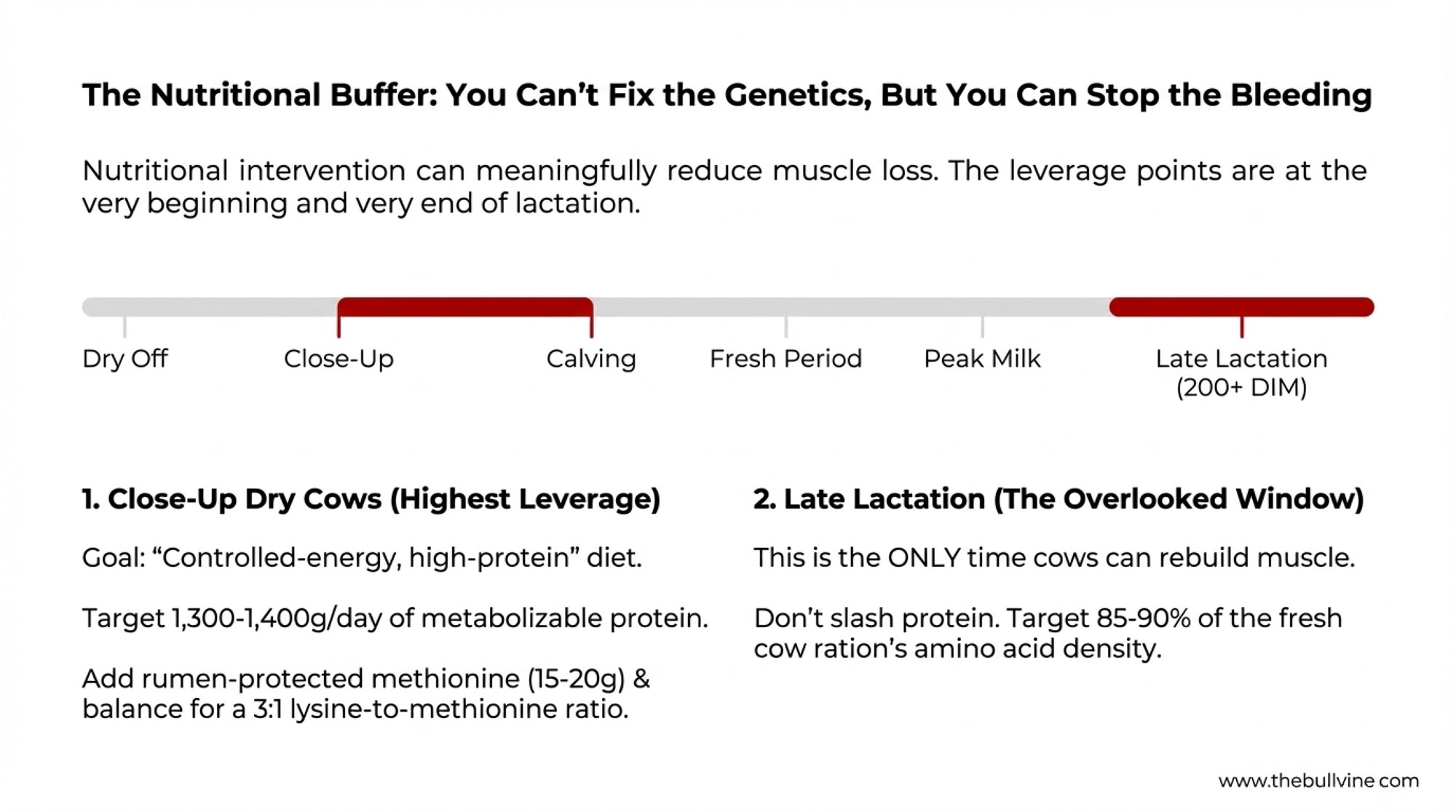
The encouraging news in all of this: nutritional intervention can meaningfully reduce muscle mobilization. It won’t change the underlying genetics, but it can buffer against the damage.

Close-Up Dry Cow Nutrition (21 Days Pre-Calving)

This is your highest-leverage intervention point. What happens in these three weeks before calving sets the trajectory for everything that follows.

The goal is a “controlled-energy, high-protein” approach. You want a high-fiber, high-bulk diet that keeps the rumen full and prevents over-conditioning. But—and this is critical—you also want a high metabolizable protein supply, not just crude protein.

Rumen-protected amino acids, particularly methionine and lysine at a 3:1 lysine-to-methionine ratio (a target well-established in the research literature, including foundational work by Dr. Chuck Schwab at the University of New Hampshire), give the cow a “labile protein reserve” she can draw on immediately post-calving. Think of it as preloading her checking account so she doesn’t have to raid her savings account.

ComponentTypical Close-UpMuscle-Supportive Close-Up
Crude Protein14%14%
Metabolizable Protein1,000-1,100g/day1,300-1,400g/day
Rumen-Protected Methionine0g15-20g
Rumen-Protected LysineVariableBalanced to a 3:1 ratio
Energy DensityOften too highControlled (0.65-0.68 Mcal/lb NEL)

Fresh Cow Adjustments

If you’re seeing signs of excessive muscle mobilization in your fresh pen, here are some starting points:

Add rumen-protected methionine. Target 15-20 grams per cow daily. This is typically the first-limiting amino acid and has a meaningful impact on reducing tissue mobilization.

Increase rumen-undegradable protein (RUP) sources. Blood meal, heat-treated soybean meal, or commercial bypass protein blends provide amino acids that reach the small intestine directly.

Include glucogenic precursors. Propylene glycol, calcium propionate, or well-processed corn provide glucose precursors that reduce the need for the cow to convert her own amino acids into glucose.

Late Lactation: The Overlooked Rebuilding Window

Here’s where many herds have an opportunity, and I’ll admit I’ve been guilty of overlooking this myself in the past.

The 200 DIM to dry-off window is really the only opportunity your cows have to rebuild muscle before the next lactation. If you’re putting late-lactation cows on minimal rations to reduce costs, you may be setting them up to fail next time around.

Target at least 85-90% of your fresh cow ration’s amino acid density in late lactation, even as energy drops. The cow doesn’t need as many calories at 250 DIM, but she still needs the building blocks to rebuild tissue.

Questions Worth Asking Your Nutritionist

  • “What’s our close-up ration’s metabolizable protein supply—not just crude protein percentage?”
  • “Are we meeting the 3:1 lysine-to-methionine ratio in our fresh cow diet?”
  • “What’s our fresh pen average milk protein percentage at 30 DIM?”
  • “What bypass protein sources are we using, and what’s our RUP percentage?”
  • “How does our late-lactation ration compare to our fresh cow ration on amino acid density?”

The Economics

Yes, this adds cost. Here’s the math.

The Investment (Fresh Period, 0-30 DIM):

  • Rumen-protected methionine: $0.30-0.36 per cow/day
  • Propylene glycol or glucose support: $0.40 per cow/day
  • Bypass protein premium: $0.15 per cow/day
  • Total: roughly $0.85 per cow/day ($25 per cow for 30 days)

The Potential Returns:

Fertility: University of Kentucky research indicates each day open beyond 100 DIM costs somewhere in the $2-5 range, though this varies significantly by herd. One fewer cycle open—21 days—often pays back the investment multiple times over.

Reduced culling: Replacement heifers are running $2,600-3,000+ according to USDA 2025 data, with premium animals fetching $4,000+ at auction. Preventing even a few infertility culls on a 500-cow dairy can dramatically change the economics.

Milk protein: Here’s where the market is shifting in ways that make this conversation even more relevant. With GLP-1 weight-loss drugs like Ozempic and Wegovy driving consumer demand toward high-protein dairy products, protein premiums are strengthening. Whey protein isolate hit record prices above $8.50 per pound in late 2024, and that demand is trickling back to the farm gate. In component-pricing markets, Wisconsin producers shipping 3.4% protein are capturing roughly $0.40-0.50 more per hundredweight than their 3.0% neighbors—and that gap adds up fast across a year’s production. Cows that can maintain milk protein above 3.0% while preserving body reserves become doubly valuable—they’re capturing today’s premiums while staying in the herd long enough to keep doing it.

With FMMO modernization now finalized—USDA’s January 2025 rule updates skim milk composition factors to 3.3% protein effective December 2025, up from the 3.1% standard that’s been in place since 2000—the cows that can maintain 3.2%+ protein while staying fertile become strategic assets. The new formula better reflects current milk composition and amplifies the protein’s relative value at the farm gate.

The Big Math: What 2.5 vs. 4.0 Lactations Actually Costs

Let’s run the numbers for a 500-cow dairy over five years. This is the calculation that changes how you think about breeding decisions.

Scenario A: 2.5 Average Lactations (Current U.S. Average)

  • Annual replacement rate: 40% (200 cows/year)
  • Replacement heifer cost: $2,800 average
  • Annual replacement cost: $560,000
  • 5-year replacement cost: $2,800,000
  • Cows culled for reproduction failure (est. 25% of culls): 250 cows over 5 years
  • Lost production from early exits: ~12,000 lbs/cow potential × 250 cows = 3 million lbs
  • At $20/cwt: $600,000 in lost milk revenue

Scenario B: 4.0 Average Lactations (Achievable with intervention)

  • Annual replacement rate: 25% (125 cows/year)
  • Replacement heifer cost: $2,800 average
  • Annual replacement cost: $350,000
  • 5-year replacement cost: $1,750,000
  • Reproduction culls reduced by 60%: 100 cows over 5 years
  • Additional lactations captured: 150 cows × 1.5 extra lactations × 22,000 lbs = 4.95 million lbs
  • At $20/cwt: $990,000 in additional milk revenue

The 5-Year Difference:

  • Replacement cost savings: $1,050,000
  • Additional milk revenue: $990,000 (conservative)
  • Total advantage: Over $2 million per 500 cows over 5 years

That’s $400,000 per year—or $800 per cow annually—that separates the 2.5-lactation herd from the 4.0-lactation herd. And this doesn’t include reduced veterinary costs, fewer fertility treatments, better genetic progress from keeping your best cows longer, or the component premiums from cows that maintain protein percentage.

The Breeder’s Dilemma

Here’s where we need to be honest with ourselves about what we’re doing with our mating decisions.

Nutrition can buffer against aggressive tissue mobilization. Good management can catch problems earlier. But neither changes the fundamental genetic programming that’s telling your highest-merit cows to destroy themselves for peak production.

Research from Dairy Global has documented this connection pretty clearly: “Long-term genetic selection for high-yielding cows with increased productivity and calving intervals showed to increase susceptibility to metabolic diseases, including mastitis and lameness.” And work from the University of Melbourne found a negative association between thermotolerance and production traits—another dimension of the same problem.

A hard look at current index construction:

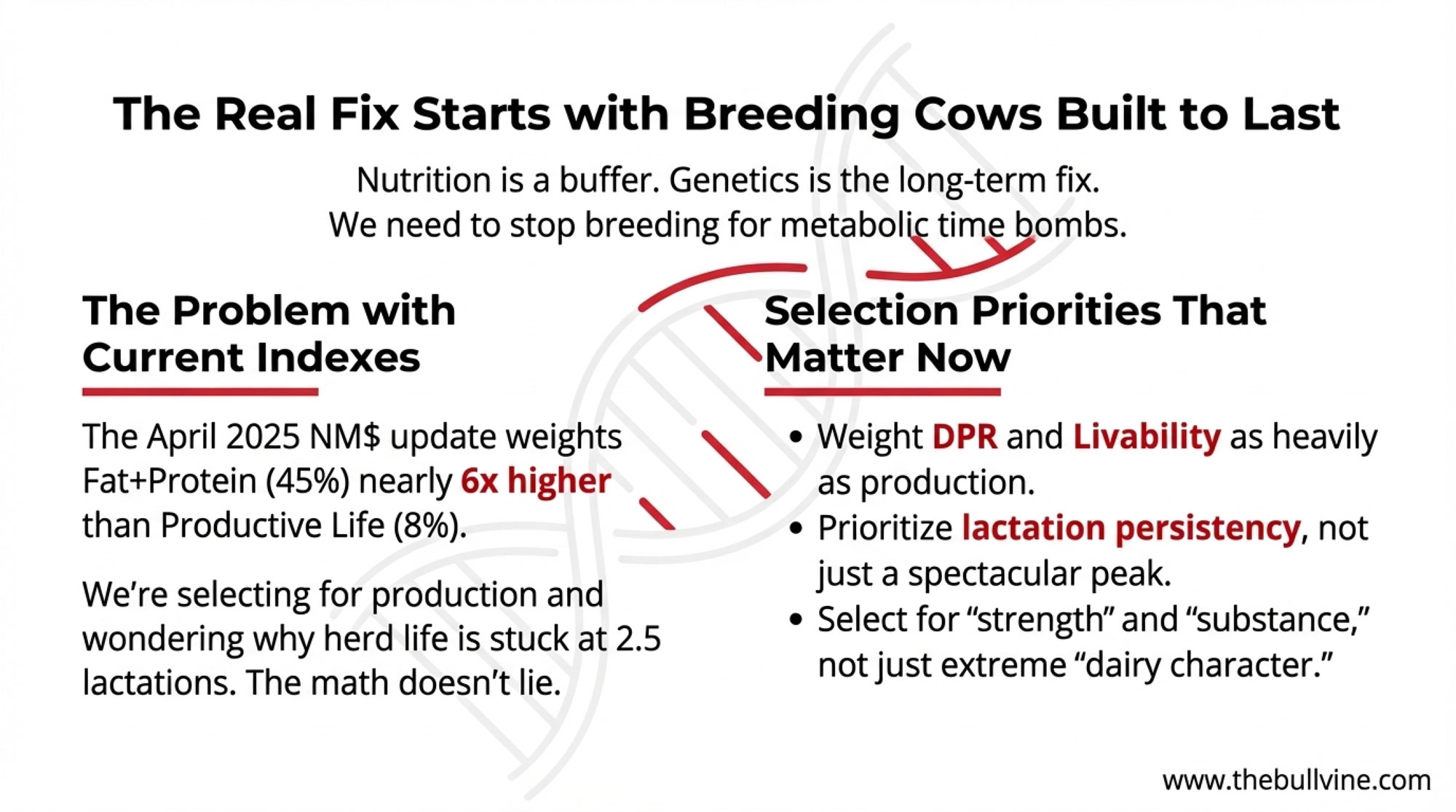
The April 2025 Net Merit revision tells an interesting story about industry priorities. According to CDCB, the updated NM$ assigns 31.8% to fat and 13.0% to protein—roughly 45% to production components. Productive Life, meanwhile, dropped from 11.0% to just 8.0%. Feed Saved increased to 17.8%, which sounds good until you remember that “efficiency” can be achieved by aggressive tissue mobilization.

That ratio may need recalibration if research on muscle mobilization and genetic predisposition holds true. We’re weighting production nearly six times heavier than the cow’s ability to stay in the herd—and wondering why average herd life sits at 2.5 lactations. The math doesn’t lie.

Selection considerations that matter now:

  • Weight DPR and Livability heavily, even if it means accepting modestly lower predicted milk
  • Look at lactation persistency, not just peak yield—a cow that peaks at 110 and holds 95 beats one that peaks at 140 and crashes
  • Consider “strength” traits in type evaluation—chest width and loin strength reflect metabolic capacity, not just appearance
  • Question whether 2.5 lactations is acceptable when genetics exist for 4-5

The question isn’t whether we can keep propping up metabolically fragile cows with expensive interventions. The question is whether we should be breeding them in the first place.

The Bottom Line

None of this changes the fundamentals of transition cow management. Fat mobilization and ketosis prevention remain critically important. But addressing only half of the metabolic equation has contributed to the fertility challenges, cull rates, and shortened productive lives that frustrate operations everywhere.

The research is telling us something uncomfortable: we may have optimized for the wrong things. Peak milk and extreme dairy character came at a cost we’re only now measuring—in muscle depth, immune function, fertility, and herd life.

What’s encouraging is that the tools are available. Nutritional interventions exist. Better genetic selection criteria are documented. Some herds are already proving that 4+ lactation averages are achievable. The knowledge is in the literature and is increasingly being applied in the field.

The cows are telling us something with their disappearing toplines and their silent ovaries. The data is confirming what they’ve been communicating for years.

The genetics we choose next will determine whether we keep selecting for metabolic time bombs—or start breeding cows built to last.

That choice is ours.

Where to Start Based on Your Situation

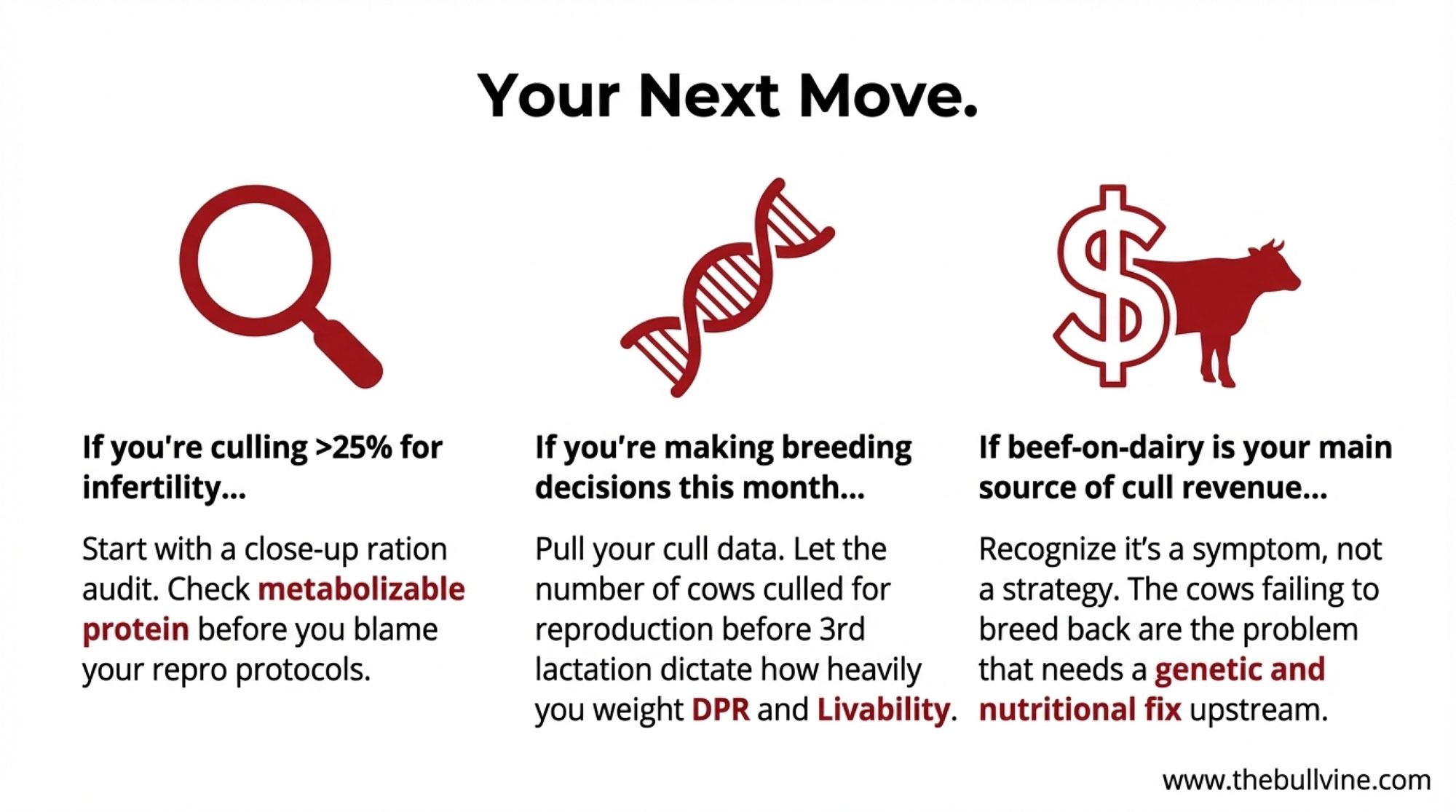
  • If you’re culling 25%+ for infertility, Start with a close-up ration protein audit. Check the metabolizable protein supply and amino acid balance before blaming reproduction protocols.
  • If you’re a 1,000+ cow operation: Consider piloting an ultrasound monitoring protocol with your vet on a subset of fresh cows. Track muscle depth at calving and 60 DIM to quantify what’s actually happening in your herd.
  • If you’re making breeding decisions this month: Pull your last 12 months of cull data. Calculate what percentage is left for reproduction failure before the third lactation. That number should inform how heavily you weight DPR and Livability going forward.
  • If beef-on-dairy is bailing out your cull revenue: That’s fine for now—but recognize it’s a symptom, not a solution. The cows generating those beef-cross premiums are the same ones failing to breed back. Fix the upstream problem.

For more information on transition cow protein metabolism, see Dr. Jackie Boerman’s research publications through Purdue University’s Department of Animal Sciences, or contact your regional dairy extension specialist.

KEY TAKEAWAYS

  • 40% muscle loss in 60 days—invisible to standard monitoring. Your fresh cows are cannibalizing muscle, while ketones and BCS read normal
  • Fat bounces back. Muscle doesn’t. Fat recovers by 90 DIM; muscle takes 240-270 days. That’s 8 months of hidden metabolic deficit
  • Your highest-genetic cows mobilize hardest. The same genetics driving 110-lb peaks are programming aggressive self-destruction
  • Nutrition buffers the damage but doesn’t fix it. Rumen-protected methionine (15-20g/day) and late-lactation amino acids buy time; genetics determines the trajectory
  • The real lever is breeding. Weight DPR, Livability, and persistency now—or keep replacing cows every 2.5 lactations

Complete references and supporting documentation are available upon request by contacting the editorial team at editor@thebullvine.com.

Learn More

Join the Revolution!

Join over 30,000 successful dairy professionals who rely on Bullvine Weekly for their competitive edge. Delivered directly to your inbox each week, our exclusive industry insights help you make smarter decisions while saving precious hours every week. Never miss critical updates on milk production trends, breakthrough technologies, and profit-boosting strategies that top producers are already implementing. Subscribe now to transform your dairy operation’s efficiency and profitability—your future success is just one click away.

NewsSubscribe
First
Last
Consent

December 1 Deadline: How Cutting 15% of Your Herd Could Add $40,000 to Your Bottom Line

Dairy’s best kept secret: The farms shrinking on purpose are the ones making money. Here’s the $165K proof.

Executive Summary: A Wisconsin dairy farmer cut 150 cows and made $165,000 MORE—proving that in today’s market, strategic shrinking beats growing. With mega-dairies producing at $13/cwt versus your $23/cwt, that $10 spread is mathematically insurmountable through volume. December 1’s new protein requirements (3.3% baseline) will either cost you $8,640 in penalties or earn you $40,000+ in premiums—depending on what you do in the next 31 days. The winning formula: cull your bottom 15% to cut costs immediately, then optimize components through amino acid supplementation for premium capture. This article delivers a tested 90-day playbook with specific actions, real costs, and realistic timelines that have already transformed dozens of operations. Your choice is simple but urgent: adapt now, pivot to alternatives, or exit while you still can.

Strategic Culling Dairy

Part One: The Squeeze Is Real—And Getting Worse

You know that feeling when you’re caught between a rock and a hard place? That’s exactly where mid-size dairy operations sit right now. And if you’re running 200 to 600 cows, you’re probably feeling it every time you look at your milk check.

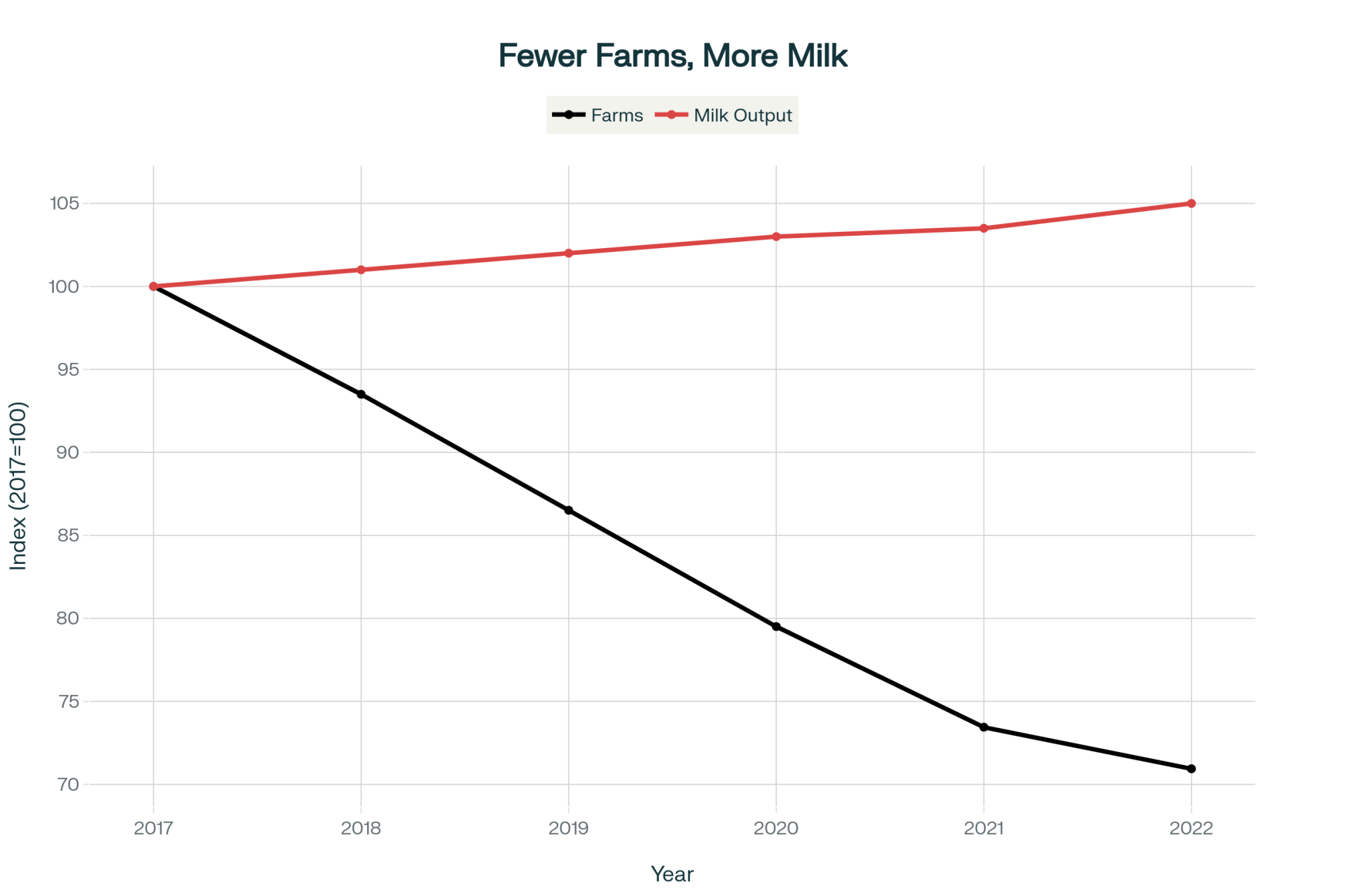
Let me paint you a picture with some hard numbers from the USDA’s latest Census of Agriculture, released in February. Between 2017 and 2022, we lost 15,866 dairy farms. During that same time? Milk production actually went UP five percent.

How’s that math work? Well, you probably know this already, but it’s worth saying—the big got bigger. Much bigger.

The brutal math of consolidation: 15,866 farms disappeared (29% loss) while milk production rose 5%—proof that 834 mega-dairies now control nearly half of America’s milk supply

Year
FarmsChangeProduction IndexMega Share %
201754,59910042%
201851,050-3,54910143%
201947,235-3,81510244%
202043,410-3,82510345%
202140,100-3,310103.545.5%
202238,733-1,36710546%

The Brutal Economics of Scale

So I visited one of these mega-operations in Texas last spring. Twelve thousand cows. Robotic systems everywhere. The whole nine yards.

Here’s what’s interesting—their CFO, who came from the oil industry, actually, showed me their numbers. Thirteen dollars per hundredweight all-in production costs. Thirteen.

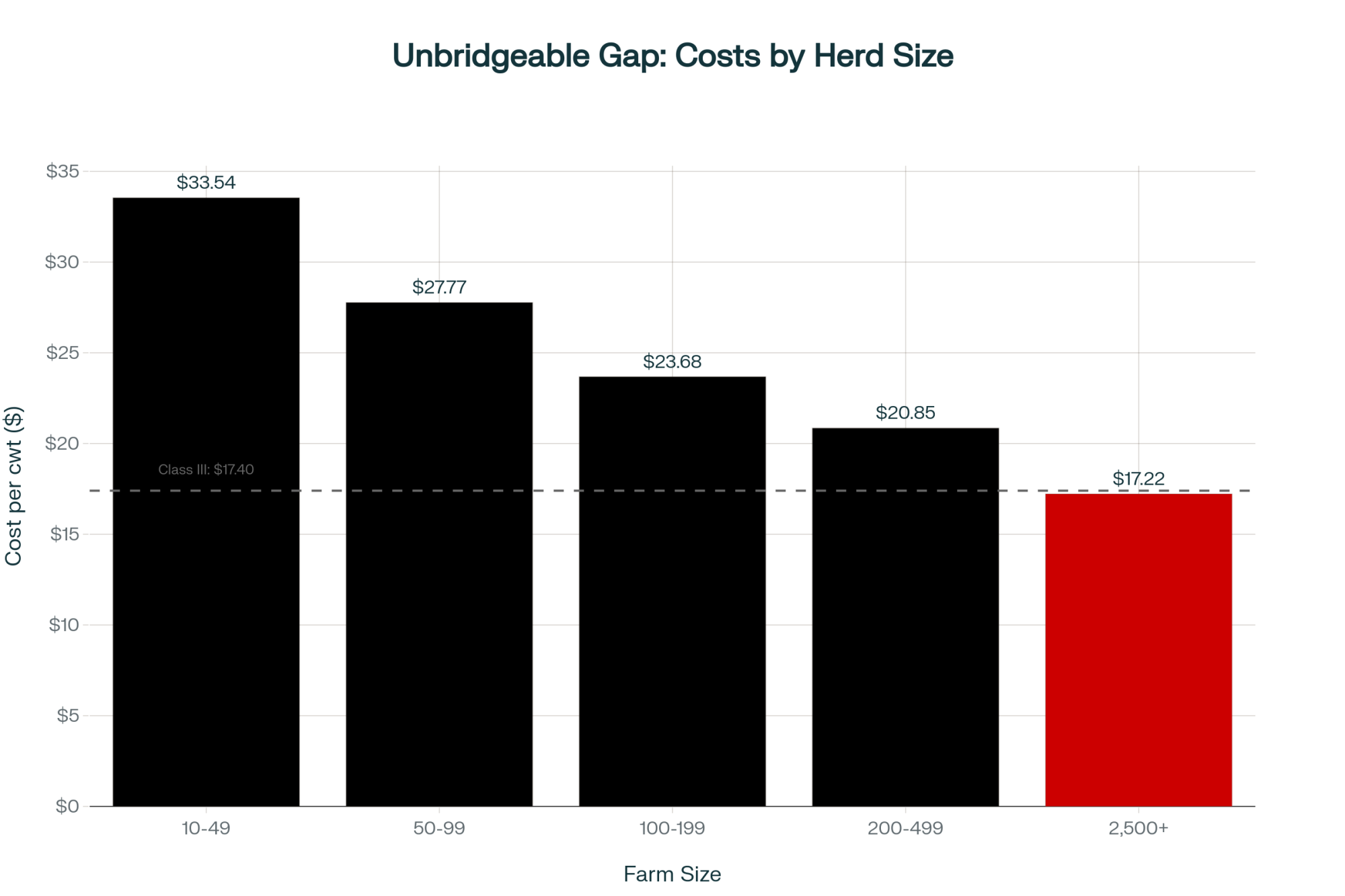
Now, I don’t know about your operation, but Cornell’s PRO-DAIRY program has been tracking costs for typical 100-200 cow herds, and they’re seeing around $23 per hundredweight. That’s… that’s a problem.

The brutal economics of scale: Mega-dairies operate at $13-17/cwt while mid-size farms struggle at $23/cwt—a $10 gap that volume alone cannot bridge

Farm Size
Cost/CWTStatus
10-49 cows$33.54Loss
50-99 cows$27.77Loss
100-199 cows$23.68Loss
200-499 cows$20.85Loss
2,500+ cows$17.22Profit

At today’s Class III price—what was it this morning, $17.40 on the CME?—smaller operations are losing close to six bucks per hundredweight. Meanwhile, these mega-dairies? They’re making over four dollars.

That’s a ten-dollar spread, folks. Ten dollars!

“I realized I was trying to compete on volume with operations ten times my size. Can’t win that game. So I changed the game—focused on profit per cow, not gallons in the tank.” — Wisconsin dairy farmer who cut his herd from 1,200 to 1,050 cows

And here’s the thing that keeps me up at night—it’s not that these big operations are doing anything wrong. They’re just playing a different game entirely. Feed costs alone, they’re saving $2-3 per hundredweight through direct commodity purchases. Labor efficiency? Another couple of bucks saved. It adds up fast.

The Geographic Earthquake Nobody’s Talking About

While you’re wrestling with those economics, something else is happening that’s maybe even more important. The entire industry map? It’s being redrawn under our feet.

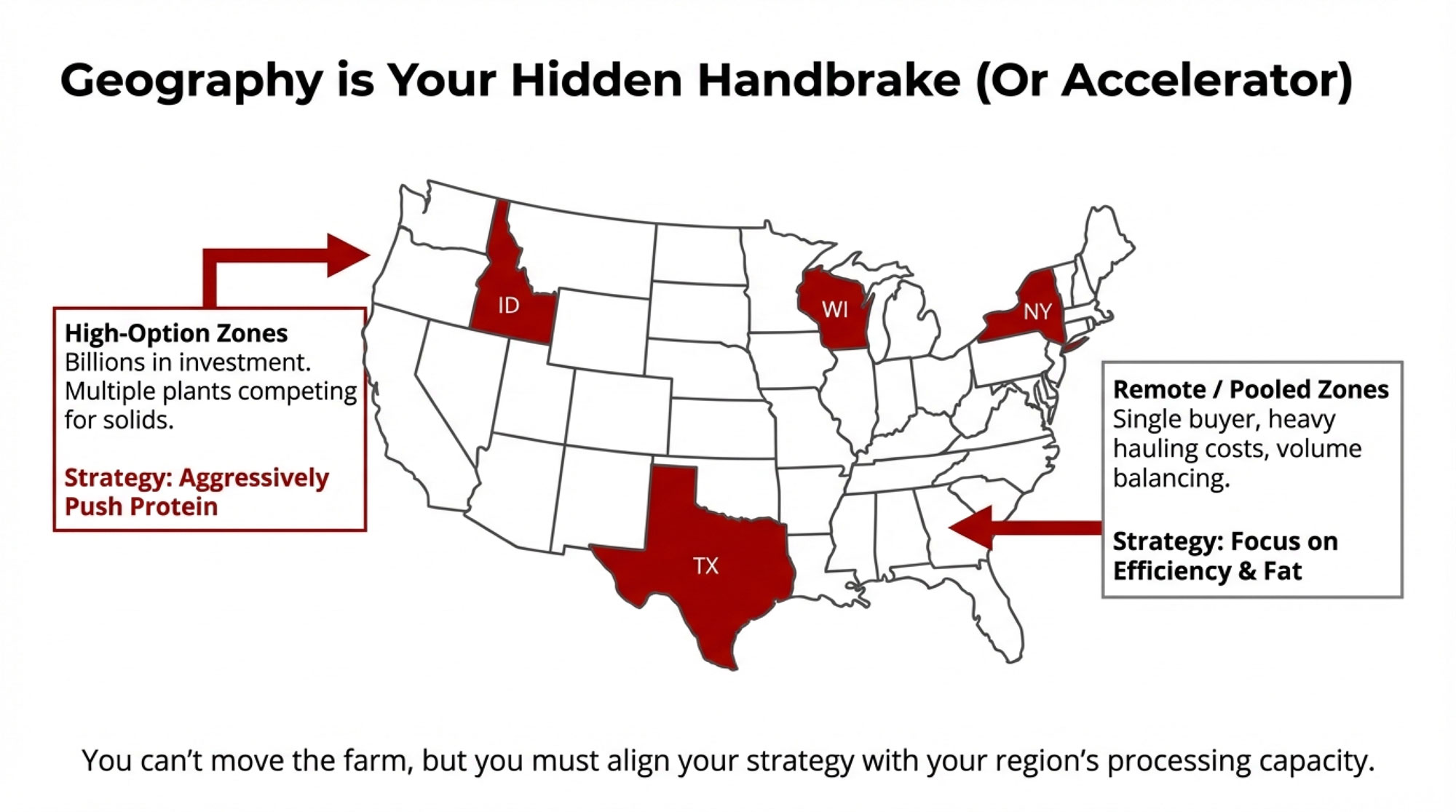
You’ve probably heard about the new processing capacity—Rabobank’s September report put the investment range at $8 to $11 billion. Biggest buildout since the 1990s. But here’s the kicker that nobody really wants to talk about—these plants aren’t where the milk traditionally has been.

Take Hilmar’s new Dodge City facility out in Kansas. Or Valley Queen’s expansion up in South Dakota. These aren’t small operations, folks. They need milk—lots and lots of milk.

And where’s it coming from? Well, USDA’s latest production report tells the story:

Texas added 50,000 cows this past year. Fifty thousand! Kansas jumped by 29,000 head. South Dakota gained somewhere between 18,000 and 21,000, depending on which report you look at.

Meanwhile—and this is what Mark Stephenson, Director of Dairy Policy Analysis at UW-Madison’s Center for Dairy Profitability, calls it—older plants in Wisconsin, Minnesota, parts of New York? They’re taking “strategic downtime.” That’s a polite way of saying they can’t compete for milk at current prices.

What I’m hearing from processing plant managers and dairy economists familiar with these operations is that new facilities are running at maybe 50-70% capacity right now, varying by plant, of course. They’re still ramping up, learning their systems, building those supply chains.

But when they hit full throttle—and most analysts I talk to figure that’ll be late 2026—we’re looking at an additional billion pounds of cheese-making capacity.

Just to put that in perspective… that’s about what the entire state of Vermont produces in a year.

Now, the strategies that work in Texas, with its minimal environmental regulations, aren’t the same as those that work in California, with its water restrictions. And our friends in the Southeast, dealing with heat stress, face different challenges than folks up in Vermont, where land costs are through the roof. But the pressure? That’s universal.

Part Two: December 1—The Trigger That Changes Everything

As if the squeeze wasn’t tight enough already, here comes December 1 with Federal Milk Marketing Order changes that’ll turn chronic pressure into an acute crisis for a lot of farms.

According to USDA’s final rule that came out in October—and I spent way too much time reading through all 147 pages of it—baseline protein jumps from 3.1% to 3.3% starting December 1. Other solids move from 5.9% to 6.0%.

Now, that might not sound like much when you’re sitting at the kitchen table. But let me show you what this actually means for your milk check.

The New Component Reality

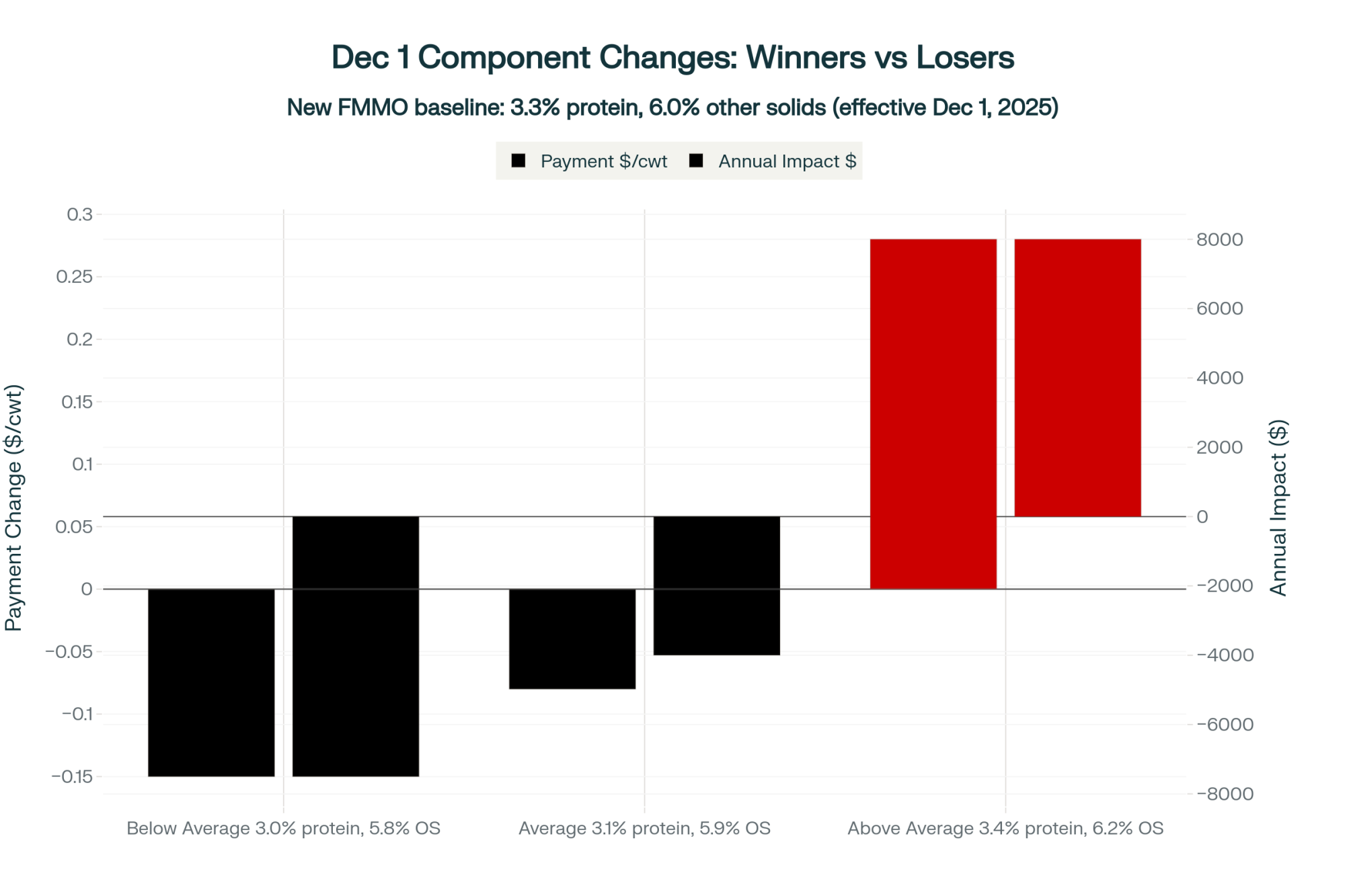
A typical 200-cow operation that’s been hitting that old 3.1% protein baseline? Come December 1, they’re suddenly eight cents under water per hundredweight. Just like that—penalty instead of baseline.

On the flip side, farms hitting 3.4% protein capture about 28 cents per hundredweight in premiums under the new formulas.

Let’s do the math here—on 200 cows averaging 75 pounds daily, that’s the difference between losing money and gaining around $8,640 annually. That’s not pocket change, as many of us have learned the hard way.

Karen Phillips, who’s an Associate Professor of Dairy Science at UW-Madison, explained something fascinating at last month’s extension meeting in Marshfield. She said cheesemakers need a protein-to-fat ratio of 0.80 for optimal yield. Know what the U.S. average is right now? We’re sitting at 0.77 according to the DHIA data from January through September.

That three-hundredths difference—it doesn’t sound like much, but it forces plants to add nonfat dry milk powder to standardize their cheese vats. Cuts right into their margins. Makes them real interested in paying premiums for the right milk.

December 1 creates a $15,500 spread between winners and losers: Farms hitting 3.4% protein gain $8,000 annually while those at 3.0% lose $7,500—all based on new FMMO baselines
ScenarioProtein/OSPayment ΔAnnual Impact (200 cows)
Below Average3.0% / 5.8%-$0.15/cwt-$7,500
Average3.1% / 5.9%-$0.08/cwt-$4,000
Above Average3.4% / 6.2%+$0.28/cwt+$8,000

December 1 Component Changes at a Glance:

  • Protein baseline: 3.1% → 3.3%
  • Other solids: 5.9% → 6.0%
  • Below baseline = penalties
  • Above baseline = premiums
  • 200-cow herd hitting 3.4% protein = ~$8,640 annual gain

Part Three: Why “Just Make More Milk” Is a Losing Game

Your first instinct might be to ramp up production, right? Get more cows. Push for higher yields. Try to compete on volume.

Don’t. Just… don’t.

Here’s why that strategy is basically suicide for mid-size operations.

You Can’t Out-Scale the Giants

Those 834 mega-dairies with 2,500-plus cows that USDA’s Economic Research Service tracked in their March 2025 report? They’re producing 46% of America’s milk now. Nearly half of our milk comes from fewer than 1,000 farms.

Think about that for a second.

They’ve got feed costs that run $2-3 per hundredweight lower than yours through direct commodity purchases—they’re buying trainloads, not truck loads. Labor efficiency through automation saves them another $2-2.50 based on university cost studies. Capital costs spread across massive production volumes? That’s another buck-fifty to two-fifty saved.

You can’t win that game. I mean, you literally cannot win it. So stop trying.

The Processing Capacity Trap

Michael Dykes, President and CEO at the International Dairy Foods Association—I had coffee with him at September’s Dairy Forum in Phoenix—he told me something really revealing. He said everyone in the industry was terrified there wouldn’t be enough milk for these new plants.

“I kept telling them,” he said, “farmers will respond to market signals.”

Well, respond they did. Boy, did they respond.

But here’s what nobody wants to say out loud at these industry meetings: The IDFA estimates we’ll have a billion pounds of new annual cheese capacity by the end of 2026. Meanwhile, domestic demand? It’s growing at about 1-2% annually, based on USDA consumption data from their July report.

You see the problem here? More milk into an oversupplied market just drives prices lower. You’re literally racing to the bottom.

Part Four: The Real Solution—Shrink to Grow

This brings me to something that happened last February that really opened my eyes. I was talking to this Wisconsin dairy farmer—let’s call him Tom to protect his privacy—standing in his freestall barn outside Shawano. And he tells me something that seemed absolutely crazy at the time.

He was cutting his herd from 1,200 to 1,050 cows. On purpose.

“You’re going backwards,” his neighbors told him at the co-op meeting.

Eight months later? His net income—not revenue, but actual net income—had jumped dramatically. The University of Wisconsin Extension has been documenting these kinds of strategic culling success stories in its dairy management programs, and the results are prompting many people to rethink everything.

Here’s the two-step strategy that’s actually working:

Step One: Strategic Culling (The Foundation)

Victor Cabrera, Professor in the Department of Dairy Science at UW-Madison, has data showing something really interesting—the average farm has 10-12% of cows that are net negative on profitability.

They’re eating feed. Taking up stall space. Requiring labor. Getting bred. But when you actually run the numbers? They’re not paying their way.

Culling these underperformers does two things immediately:

  1. Reduces your costs right away—less feed, less labor, fewer health issues
  2. Mechanically raises your herd’s average production and components

What Tom did with his 150-cow reduction was eliminate his worst performers. The 1,050 cows he kept? Higher average production. Better components. Lower costs per hundredweight. It’s not magic—it’s just math.

Step Two: Component Optimization (The Multiplier)

Once you’ve got a leaner, higher-potential herd, now you optimize for components through amino acid balancing.

Jim Paulson, Dairy Extension Educator at University of Minnesota Extension in St. Cloud—he’s been working with dairy nutrition for decades—he explains it really well: “Most farms overfeed crude protein while being deficient in the specific amino acids that actually drive milk protein synthesis.”

The fix? Rumen-protected methionine and lysine in the right ratio. The Journal of Dairy Science has published extensive research on this over the past couple of years, and the 3-to-1 lysine-to-methionine ratio keeps coming up as optimal.

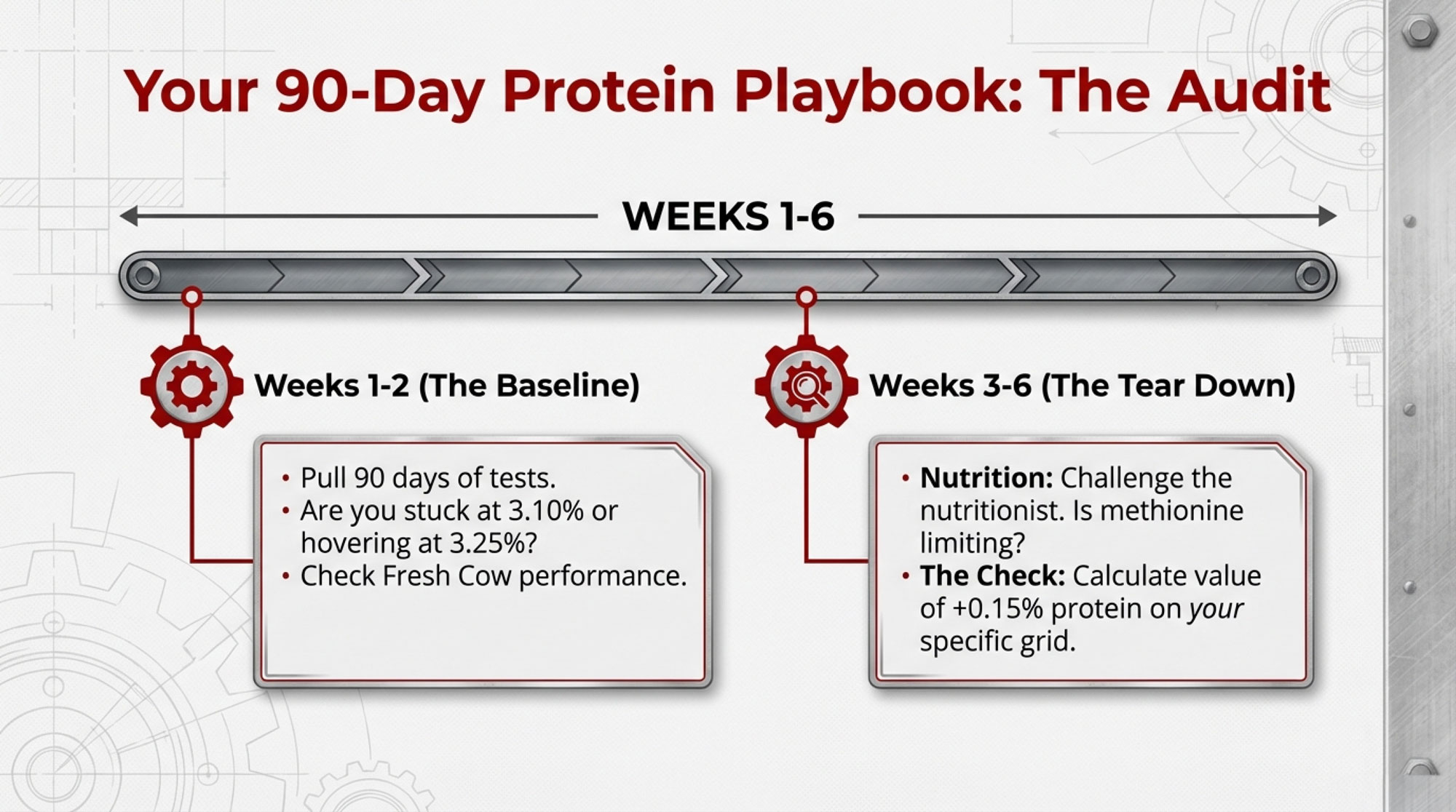
Brian Perkins, Senior Dairy Technical Specialist with Vita Plus Corporation out of Madison—he’s worked with 47 different herds on this in 2025—told me: “Target a 0.15 to 0.20 percentage point protein increase. Budget $0.10–$0.15 per cow daily. Based on our field trials, you’ll see results in 8-12 weeks.”

On a now-optimized 200-cow herd, that’s maybe $7,000 annually for the supplements. But if it gets you to 3.3% protein or higher, you’re capturing those December 1 premiums we talked about.

I don’t have all the answers here, and finding qualified nutritionists who really understand amino acid balancing can be challenging in some regions. Your best bet is contacting your state Extension dairy team—they can usually connect you with someone who knows this stuff inside and out.

The Combined Effect

Simple math that works: Invest $7k in amino acids, execute strategic culling, breed 60% to beef—capture $153k in combined gains on a 200-cow operation within 12 months

Component
AmountType
Amino Acid Supplements-$7,000Cost
Component Premiums (3.3%+ protein)+$40,000Revenue
Beef-on-Dairy (60% × 120 calves)+$100,000Revenue
Cost Reduction (15% culling)+$20,000Savings
NET PROFIT+$153,000Total

* 200-Cow Operation

Here’s where it gets really interesting:

  • Culling raises your baseline—removing the bottom 15% might boost your average protein from 3.0% to 3.1% just from that alone
  • Amino acid optimization adds another 0.15-0.20 percentage points on top
  • Now you’re at 3.25-3.30% protein—above the new FMMO baseline
  • Your costs dropped through culling
  • Your revenue increased through premiums

That’s how you shrink to grow. And it’s working for operations across the country—though individual results will obviously vary based on your specific circumstances.

Part Five: Your 90-Day Survival Playbook


Phase
DaysAction FocusKey Metric
11-7Face the Truth<$19 survive / >$21 exit
28-30Execute Cull15% reduction
331-45Fix Components$0.10-$0.15/cow/day
446-60Diversify Revenue$100K+ annual
561-75Lock Premiums$40K-$140K/year
676-90Hard Decision85-95% vs 50-65%

Alright, so you understand the problem and the solution. But what do you actually DO? Like, starting Monday morning?

Here’s your tactical roadmap—and I mean this is what you actually need to do, not theoretical stuff:

Days 1-7: Face the Brutal Truth

Calculate your true all-in production cost. Brad Mitchell, Extension Agricultural Economist at Iowa State University, has this worksheet on their dairy team website that makes it pretty straightforward. Use it.

And here’s the part nobody wants to hear—include your own labor at $20 an hour minimum. That’s the median wage for dairy workers according to the Bureau of Labor Statistics as of October 2025. If you’re working 60-hour weeks—and who isn’t?—that’s $62,400 annually you’re not paying yourself.

Critical benchmarks to know:

  • Under $19/cwt: You might survive with some adjustments
  • $19-21/cwt: Major changes needed NOW
  • Over $21/cwt: You need to consider all options, including… well, including exit

Days 8-30: Execute the Cull

Time to identify your bottom 10-15% performers. Look for:

  • Chronic high SCC—anything over 400,000 consistently
  • Repeated health issues—if she’s been treated 3+ times in 90 days
  • Production under 60 pounds a day in early to mid-lactation
  • Poor components—under 2.9% protein consistently

Remove them. Yeah, I know it’s hard. Your daily tank volume will drop. But your profitability will improve immediately. Trust me on this.

Days 31-45: Fix Your Components

Call your nutritionist this week. Not next month. This week.

Tell them you need amino acid balancing targeting:

  • 0.15-0.20 percentage point protein increase
  • Rumen-protected methionine and lysine
  • That 3:1 lysine to methionine ratio we talked about

Budget $0.10 to $0.15 per cow daily. Based on what we’re seeing in the field, you’ll see results in 8-12 weeks.

For sourcing quality rumen-protected amino acids, companies like Adisseo, Evonik, and Kemin have good products—your nutritionist will have preferences based on what’s worked in your area.

Days 46-60: Diversify Revenue

If you haven’t started breeding for beef-on-dairy yet, you’re leaving serious money on the table.

Superior Livestock Auction’s video sales from October 28—I was watching them—show beef-cross dairy calves bringing around $1,400 for 400-pound steers. Straight dairy bulls? You’re lucky to get $150 at the local sale barn.

Here’s the optimal strategy:

  • Top 40% of your herd: Use sexed dairy semen for replacements
  • Bottom 60%: Beef semen all the way

Matt Akins, Beef Specialist at UW Extension’s Marshfield Agricultural Research Station, has calculated that this generates an extra $100,000-plus annually for a typical 200-cow herd. That’s real money.

The beef-on-dairy revolution: $150 dairy bulls vs $1,400 beef crosses—a $1,250 premium per calf that adds $150,000 annually to a 200-cow operation breeding 60% to beef
MetricTraditionalBeef-on-DairyDifference
Per Calf Price$150$1,400+$1,250
Annual Revenue (120 calves)$18,000$168,000+$150,000
Feed EfficiencyBaseline8-25% betterAdvantage
Finishing TimeBaseline20% faster5-26 fewer days
Carcass GradingLower15-25% Prime/ChoicePremium

200-Cow Herd (60% bred to beef)

Now, fair warning—Les Hansen, Professor Emeritus at the University of Minnesota’s Department of Animal Science, keeps reminding everyone that beef prices won’t stay this high forever. USDA’s January 2025 cattle inventory showed we’re at a 73-year lows. When rebuilding starts—probably late 2026—these premiums will shrink. So use this 18-24 month window wisely.

Days 61-75: Lock in Component Premiums

If you can hit 3.3% protein with a 0.80 protein-to-fat ratio, those new cheese plants want your milk. They really want it.

I know of several Wisconsin operations working with processors like Grande and Foremost Farms that just locked in multi-year contracts at anywhere from 40 cents to $1.40 per hundredweight above Federal Order minimums. The exact premium depends on volume commitments, location, quality history—you know, all the usual factors.

On 200 cows, even at the low end, that’s $40,000 annually. At the high end? We’re talking $140,000.

But here’s the thing—these deals are happening NOW. By January, that window probably closes.

Days 76-90: Make the Hard Decision

Look, if you’ve done all this analysis and you still can’t hit profitable benchmarks, it’s time for the conversation nobody wants to have.

Tom Peters, Senior Farm Transition Specialist at Farm Credit Services of America—he’s tracked 127 dairy transitions across the Midwest since 2020. A planned exit over 18-24 months typically preserves 85-95% of asset value. A forced liquidation in crisis? You’re lucky to get 50-65%.

On a typical $4 million operation, that’s the difference between walking away with $3.4 million or $2 million. One sets you up for retirement. The other… doesn’t.

I know this is tough to hear. But ignoring reality doesn’t change it.

Success Stories That Prove It Works

This isn’t just theory, folks. Real farms are making this strategy work right now.

I visited an operation down in Georgia that’s similar to what folks like Sarah Martinez are doing—280 cows on pasture, focused intensively on components. She’s hitting 3.45% protein consistently and has locked in premium contracts with a regional cheese maker. Her costs run about $18.50 per hundredweight—actually profitable at current prices.

“We’re not trying to compete with the big boys on volume,” she told me. “We’re competing on quality and consistency.”

Up in Vermont, I know of operations similar to the Johnson family’s that pivoted to organic about five years ago. Yeah, the transition was brutal—they lost money for three years straight. But now? They’re capturing $35 per hundredweight through Organic Valley with production costs around $28. That’s a healthy margin in anybody’s book.

And there are plenty of mid-size operations maintaining profitability through other unique strategies—direct marketing, agritourism, value-added processing. The point is, there’s more than one path forward.

Tom in Wisconsin? His remaining 1,050 cows are now averaging strong protein levels after working on amino acid balancing. He’s breeding 65% to beef. His costs dropped to about $17.80 per hundredweight after culling those 150 underperformers. At current prices, he’s actually making money. Not a fortune, but enough.

The Digital Edge You Need

What’s encouraging is the technology available now that we didn’t have even five years ago:

Penn State’s DairyMetrics offers a free component optimization app that lets you model amino acid changes before implementing them. Wisconsin’s Dairy Management website, through UW-Madison Extension, offers calculators for everything from culling decisions to heifer inventory optimization.

Several folks I know are using FeedWatch or TMR Tracker software to dial in their rations precisely. When you’re spending $7,000 on amino acids, you want to make sure they’re actually getting into the cows, you know?

And of course, USDA’s Agricultural Marketing Service and the CME Group sites let you track real-time market prices from your phone.

The Bottom Line: Choose Your Path

Look, I’ve been covering this industry for thirty years. This isn’t just another cycle. The combination of mega-dairy economics, geographic shifts, component revaluation, and processing overcapacity—it’s creating a fundamental restructuring of how this industry works.

The whey processors figured this out already. They cut commodity production by about 30%, shifted to high-value products, and created scarcity. CME spot dry whey hit 71 cents per pound last week—a nine-month high—while cheese races toward oversupply.

As Tom told me: “I realized I was trying to compete on volume with operations ten times my size. Can’t win that game. So I changed the game—focused on profit per cow, not gallons in the tank.”

He gets it. The question is, do you?

The decisions you make in the next 90 days will determine which side of 2027 you land on. For some, that means strategic culling and component optimization. For others, it means transitioning to organic or direct marketing. And yes, for some, it means a well-planned exit that preserves wealth.

What’s not an option? Not choosing. Because not choosing is still choosing—it’s just choosing to let the market decide for you.

The clock’s ticking, folks. December 1 is 31 days away.

Time to decide: Will you shift with the market, or get shifted by it?

Key Takeaways:

  • The Volume Game Is Over: With mega-dairies producing at $13/cwt versus your $23/cwt, competing on size is mathematical suicide—the $10 spread is unbridgeable
  • December 1 Deadline Creates Winners and Losers: Hit 3.3% protein to capture $40,000+ in premiums, or face $8,640 in penalties—you have 31 days to pick your side
  • Strategic Culling Pays Immediately: Your bottom 15% of cows are profit vampires—cutting them saves $20,000+ annually while raising your herd average instantly
  • Simple Math, Big Returns: Invest $7,000 in amino acids → boost protein 0.2 points → earn $40,000+ premiums PLUS add beef-on-dairy for another $100,000 = $133,000 net gain
  • Three Honest Options: Transform through the 90-day playbook (works if costs <$21/cwt), pivot to specialty markets (organic/direct), or exit strategically while assets retain 85-95% value—but decide NOW

Resources: Visit your state Extension dairy website for worksheets and calculators. Component optimization apps are available through Penn State DairyMetrics and Wisconsin Dairy Management. For amino acid suppliers, contact your nutritionist. Track markets via the USDA Agricultural Marketing Service and CME Group.

Complete references and supporting documentation are available upon request by contacting the editorial team at editor@thebullvine.com.

Learn More:

  • Navigating Today’s Dairy Margin Squeeze: Insights from the Field – This article reveals practical feed management strategies (5-15% cost cuts) and modern culling benchmarks, offering immediate, actionable tactics to improve efficiency and component production, directly complementing the main article’s 90-day playbook for cost control and herd optimization.
  • USDA’s 2025 Dairy Outlook: Market Shifts and Strategic Opportunities for Producers – Explore how USDA forecasts impact milk production and prices, and discover strategic opportunities in component optimization, processor alignment, and export markets. This provides essential broader market context and long-term planning insights to safeguard your operation’s future profitability.
  • When Butterfat Isn’t Enough: Adapting Your Dairy to New Market Realities – Delve into the role of technology and innovation in component optimization, with insights on RFID systems, automated feeding, and calculating their return on investment across various herd sizes. This article demonstrates how to leverage modern tools to achieve the profitability goals outlined in the main piece.

Join the Revolution!

Join over 30,000 successful dairy professionals who rely on Bullvine Weekly for their competitive edge. Delivered directly to your inbox each week, our exclusive industry insights help you make smarter decisions while saving precious hours every week. Never miss critical updates on milk production trends, breakthrough technologies, and profit-boosting strategies that top producers are already implementing. Subscribe now to transform your dairy operation’s efficiency and profitability—your future success is just one click away.

NewsSubscribe
First
Last
Consent

Protein Sweet Spot: How 160g Crude Protein Maximizes Dairy Farm Profits

Discover the protein sweet spot that could save your dairy $100,000 a year. Why overfeeding protein is costing you milk, money, and more.

EXECUTIVE SUMMARY: Recent research challenges the dairy industry’s high-protein feeding paradigm, revealing that optimal crude protein levels of 155-170 grams per kilogram of dry matter maximize both milk production and profitability. Countus data shows farms feeding above 175 grams actually produce less milk while incurring higher costs. By targeting 160 grams of crude protein, dairies can potentially save 1-2 cents per liter of milk, translating to significant annual savings without compromising production. This approach also reduces nitrogen excretion and ammonia emissions, addressing growing environmental concerns. Implementing this strategy requires systematic monitoring of milk urea nitrogen (MUN) levels, gradual ration adjustments, and a focus on amino acid balancing rather than crude protein quantity.

KEY TAKEAWAYS

  • Optimal crude protein levels (155-170g/kg DM) can increase profits without reducing milk production
  • Protein overfeeding wastes money, reduces fertility, and increases environmental impact
  • Focusing on amino acid balance is more effective than simply increasing crude protein
  • Regular MUN testing and gradual ration adjustments are crucial for successful implementation
  • Potential savings of 1-2 cents per liter of milk can add up to $100,000+ annually for a 100-cow herd
dairy protein optimization, milk production efficiency, feed cost reduction, amino acid balancing, sustainable dairy farming
xr:d:DAF5fEsZ_Ls:1,j:781789584982826481,t:24011012

Do you think your cows need high protein levels to milk at their peak? Think again. Recent data from accounting firm Countus reveals a protein paradox that could cost you thousands: feeding between 155 and 170 grams of crude protein per kilogram of dry matter delivers the best economic returns and milk production.

Even more surprising is that farms feeding above 175 grams produced less milk while spending more on feed. This research challenges the dairy industry’s long-standing obsession with high-protein rations and offers producers a rare opportunity: cut costs while maintaining or improving production.

What the Research Shows About Protein and Performance

The relationship between dietary protein and milk production isn’t what most nutritionists have been telling us. According to Rick Hoksbergen, dairy cattle specialist at Countus, their analysis reveals the highest milk production occurs when cows receive between 158 and 173 grams of crude protein per kilogram of dry matter.

When protein levels exceed 175 grams, milk production drops significantly—a finding contradicting the “more is better” approach many farms still follow.

“We see farms achieving excellent production of around 10,000 kilograms per cow annually with protein levels as low as 145 grams or as high as 180 grams,” explains Hoksbergen. “But the higher protein rations cost significantly more without providing any production advantage.”

This pattern occurs because of the cow’s biological limitations. According to verified research, dairy cows convert dietary protein into milk protein with highly variable efficiency—somewhere between 16% and 40%.

This means that for every 100 grams of protein you feed, as little as 16 grams might become milk protein in typical systems, while the rest gets wasted. When protein is fed beyond what the cow can use effectively, those excess amino acids don’t magically become more milk protein—they get broken down and excreted as urea, sending your hard-earned money flowing out of the barn.

The protein waste isn’t just economic—it creates measurable reproductive challenges for your dairy. Research shows cows with high milk urea before insemination are 2.4 times less likely to get pregnant than cows with low milk urea. Consider what a 2.4x difference in conception rate would mean for your breeding program and replacement costs.

The Triple-Win Economics of Optimized Protein Feeding

Because protein overfeeding affects your operation’s profitability from multiple angles, let’s talk money. Protein supplements typically cost substantially more than energy sources, making protein the most expensive nutritional component in your ration.

You burn cash with every mixer wagon load when cows can’t convert that extra protein into milk.

Countus data demonstrates that feed profit per cow daily peaks when crude protein levels stay between 155 and 170 grams per kilogram of dry matter. Their recommendation of targeting 160 grams effectively balances production and cost control.

To put this in perspective, Hoksbergen estimates potential savings of 1 to 2 cents per liter of milk—seemingly small until you multiply across your herd and throughout the year.

Consider a 100-cow herd producing 30 liters per cow daily. Saving just 1 cent per liter translates to $3 daily per cow or $300 daily for the herd. Over a year, that’s $109,500 in potential savings without sacrificing production. What could your dairy operation do with an extra hundred thousand dollars?

“The protein paradox costs thousands of dairy farms: data shows the highest feed profit occurs when rations contain 155-170 grams of crude protein per kilogram of dry matter—not the 180+ that many farms feed.”

The environmental benefits create additional economic advantages as regulatory pressure increases. Research shows each 1% decrease in dietary crude protein reduces nitrogen excretion by approximately 2.8%.

More dramatically, studies demonstrate that reducing diet crude protein levels from 17% to 14% reduced ammonia emissions by an average of 64%. As environmental regulations tighten, these emission reductions may soon translate directly to your bottom line through avoided compliance costs or potential carbon credits.

Beyond Crude Protein: The Amino Acid Revolution

Dairy nutrition science has evolved significantly since amino acid balancing was introduced in the late 1980s. Today’s cutting-edge nutritionists understand that cows don’t require crude protein—they need specific amino acids to produce milk efficiently.

The most limiting amino acids in a dairy cow’s diet are methionine, lysine, and histidine. You can dramatically improve protein utilization efficiency by meeting these specific requirements rather than simply providing a high level of crude protein.

This approach is like precision fertilizer application versus broadcast spreading—targeting precisely what’s needed without wasteful excess.

Working with your nutritionist to implement amino acid balancing can allow you to reduce overall crude protein levels while maintaining or even improving production. Properly balanced rations can achieve protein feed efficiencies approaching 40%—much better than conventional feeding programs’ typical 16-30% efficiency.

This represents a massive opportunity to reduce feed costs while maintaining production.

“With optimal protein levels and amino acid balancing, you’ll spend less on expensive supplements, improve reproduction rates, and reduce manure production—a triple win for your wallet, your herd, and the environment.”

Feed variations pose a significant challenge to maintaining consistent amino acid levels. About two-thirds of feed variations are caused by raw material disparities, with protein and amino acid content varying substantially even within the same ingredient.

For example, protein content in grass silage can range from less than 8% to above 18%. This underscores the importance of regular feed testing and ration adjustments to maintain optimal amino acid balance without excessive crude protein safety margins.

Practical Implementation: How to Find Your Protein Sweet Spot

Transforming these research findings into practical results on your dairy requires a systematic approach. Start by establishing your baseline—where are you now, and where do you want to be?

Milk urea nitrogen (MUN) testing offers an invaluable diagnostic tool for evaluating your current protein feeding status. While many labs suggest MUN levels of 10-14 mg/dL are acceptable, emerging research indicates that targeting the lower end of this range (8-12 mg/dL) maximizes reproductive performance and feed efficiency.

Think of MUN as your protein utilization dashboard. High readings signal wasted protein and money, while optimal levels confirm that your feeding program is hitting the sweet spot.

Once you’ve established your baseline, work with your nutritionist to develop a strategic plan for optimizing protein levels. Rather than making dramatic overnight changes, implement a gradual step-down approach:

  1. If your current ration exceeds 175 grams of crude protein per kilogram of dry matter, set an initial target of 170 grams.
  2. Monitor production closely for two weeks, then evaluate the results. If milk production remains stable or improves, continue stepping down in 5-gram increments until you reach the 155-160-gram target.
  3. Throughout this process, track not just milk production but also components, MUN levels, and your feed costs and income over feed cost calculations.

Remember that grouping strategies can further enhance protein efficiency. High-producing cows utilize protein more efficiently than lower producers. By grouping cows according to production level and tailoring rations to each group’s requirements, you can improve overall herd protein efficiency compared to feeding a single TMR to all lactating cows.

Environmental Wins: The Coming Regulatory Reality

The environmental benefits of protein optimization aren’t just a nice bonus—they’re increasingly becoming a business necessity as regulations around nitrogen and phosphorus management tighten in many dairy regions.

Research demonstrates that as dietary protein increases, the amount of nitrogen excreted in urine increases dramatically. When dietary crude protein rises from 13.5% to 19.4%, urinary nitrogen excretion as a proportion of nitrogen intake jumps from 23.8% to 36.2%.

This represents a substantial increase in environmentally vulnerable nitrogen losses that can lead to ammonia emissions and potential groundwater contamination.

The reduction potential is remarkable. Controlled studies show that reducing diet CP levels from 17% to 14% reduces ammonia emissions by an average of 64%. This approach also reduces manure production, which can decrease manure storage and disposal costs.

In regions facing stringent nitrogen regulations like the Netherlands, optimizing protein levels is no longer optional—essential for business continuity.

Think of protein optimization as a rare triple win: your cows get what they need nutritionally, your wallet benefits from reduced feed costs, and your environmental footprint shrinks significantly. This becomes increasingly valuable as regulatory pressure intensifies and consumers show growing interest in environmentally sustainable production practices.

Are You Throwing Money Away? The Hidden Costs of Protein Overfeeding

The dairy industry’s protein addiction is expensive and counterproductive. The data shows that farms feeding 180+ grams of crude protein produce less milk than those targeting 160 grams while paying substantially more for the privilege.

Table: Economic and Environmental Impact of Overfeeding Protein on Dairy Cows in the Chesapeake Bay Drainage Basin

ItemEstimate
Farms feeding N above recommendations, %71.5
Excess N per overfed cow, kg/yr18.6
Excess N fed in watershed, 10^6 kg/yr10.1
N loss to Bay from overfeeding, 10^6 kg/yr7.6
Additional feed cost per overfed cow, $/yr$32.94
Cost of overfeeding in Watershed, 10^6 $/yr$17.86

Source: Kohn et al., University of Maryland

“But what about peak-producing cows?” you might ask. Even high-producers show diminishing returns above 165g crude protein, with amino acid balance proving far more critical than crude protein quantity.

The science is precise: meeting specific amino acid requirements with lower overall protein is biologically and economically superior to the crude protein sledgehammer approach many farms still use.

When your nutritionist recommends higher protein levels, they’re not just affecting your feed bill—they’re reshaping your entire operation’s economic and environmental footprint. Every gram of excess protein cascades through your business, inflating purchase costs, increasing manure handling expenses, complicating regulatory compliance, and undermining reproductive performance.

This interconnected impact explains why the protein decision might be your dairy’s most consequential nutritional choice.

How Do You Know If You’re Overfeeding? Three Tests That Never Lie

Forget theoretical ration formulations—your cows and financials reveal the truth about protein efficiency. First, check your bulk tank MUN levels—if they’re consistently above 12 mg/dL, you’re likely overfeeding protein and wasting money.

Second, calculate your income over feed cost, specifically during protein reduction trials. Many farms report maintaining production with $0.60/cow/day savings when dropping from 180g to 160g crude protein.

Third, measure your manure output volume—reduced protein often means noticeably less manure production, saving on storage and handling costs.

Table: Checklist to Identify Causes of High (or Low) MUN Concentrations

Factor to CheckWhat to Look For
MUN AnalysisWas the MUN analysis accurate? You may take another sample and try a different laboratory.
Milk ProductionAre the cows producing as much milk as expected?
Diet FormulationIs the diet formulated to meet the cows’ nutrient requirements?
Feed AnalysisAre all forages analyzed routinely?
Feed DigestibilityDo any of the feeds have heat damage? Damaged feeds have low protein digestibility.
Feeding ManagementAre the cows fed the diet as formulated or is something lost in the translation from nutritionist to manager to feeder?
Animal ConsumptionAre the cows eating what is offered or are they selecting part of the ration?
Water and saltDid the cows have adequate salt and water? Low water intake increases MUN.

Source: Kohn et al., University of Maryland

Unlike other nutrition changes that promise results but deliver disappointment, protein reduction delivers measurable, immediate financial returns. A 100-cow dairy implementing optimal protein levels typically sees ROI within the first milk check—no capital investment is required.

Take-Home Tips for Your Dairy

Ready to optimize your protein feeding program? Here are practical steps you can take:

Start your protein optimization journey with these concrete steps: First, establish your baseline by testing the current ratio of crude protein content and recording MUNs weekly for a month.

Second, work with your nutritionist to formulate a reduced-protein ration (targeting 160-165g/kg DM) that maintains amino acid balance through strategic ingredient selection.

Third, the change should be implemented gradually over two weeks, monitoring production daily.

Finally, calculate the before-and-after feed costs to document your savings—knowledge that will protect you from reverting to overfeeding when the subsequent feed salesperson visits.

Remember that many dairy farms could benefit from critically evaluating their protein feeding levels. The data from Countus shows that optimal feed profit per cow per day occurs at a crude protein content between 155 and 170 grams per kilogram of dry matter, with a target value of 160 grams representing an effective balance between production and cost.

As Rick Hoksbergen from Countus says, “Feeding protein pays off directly in spending, but also leads to lower manure production.” The estimated savings of 1 to 2 cents per liter of milk represent a substantial opportunity for improving profitability in an industry characterized by tight margins and volatile milk prices.

“Research shows cows with high milk urea are 2.4 times less likely to get pregnant—meaning protein overfeeding directly impacts your reproduction program and replacement costs.”

Comparison Table: Economic & Environmental Impact of Protein Levels

Measure160g Crude Protein180g Crude Protein
Daily feed cost per cow€5.20€5.80
Milk production (kg/day)32.532.5
Feed efficiency (milk/feed)1.521.36
Relative nitrogen excretion100%156%
Relative ammonia emissions100%278%
Conception rate index100%42%
Estimated savingsBase-€0.60/cow/day

Put This Knowledge to Work on Your Farm Today

The evidence is clear: Optimizing protein levels to 155-170 grams per kilogram of dry matter can significantly improve your dairy’s profitability while maintaining or even enhancing production. Potential savings of 1-2 cents per liter of milk add substantial annual returns without requiring capital investment.

Has your farm already experimented with reduced protein levels? What results have you seen? We’d love to hear your experiences in the comments below.

Want more profit-driving insights for your dairy operation? Subscribe to The Bullvine newsletter for weekly updates on cutting-edge management strategies, nutrition advances, and industry developments that can boost your bottom line.

LEARN MORE

Join the Revolution!

Join over 30,000 successful dairy professionals who rely on Bullvine Daily for their competitive edge. Delivered directly to your inbox each week, our exclusive industry insights help you make smarter decisions while saving precious hours every week. Never miss critical updates on milk production trends, breakthrough technologies, and profit-boosting strategies that top producers are already implementing. Subscribe now to transform your dairy operation’s efficiency and profitability—your future success is just one click away.

NewsSubscribe
First
Last
Consent

Send this to a friend