Archive for News – Page 57

Culver’s Scoops of Thanks Day raises $144,975

Fans of Culver’s frozen custard headed to their nearest restaurant en masse last month to take advantage of a great deal on the creamy treat. This year, the daylong fundraiser Scoops of Thanks was held on Sept. 24, across 761 Culver’s restaurants. Culver’s guests were able to order a scoop of Fresh Frozen Custard for $1, with the proceeds donated to an FFA chapter or other local agricultural organization in each restaurant’s area.

“This year’s donation total exceeded the record of $112,000 held by 2018’s event, making 2020 the most successful Scoops of Thanks Day yet,” said Company Spokesperson Marcie Waters. “Culver’s is especially proud to have raised so much money during a time when it’s challenging for many FFA chapters to host fundraisers of their own.”

Scoops of Thanks Day is part of the Culver’s ‘Thank You Farmers’ program, an initiative that recognizes all farmers for their hard work and dedication in growing and producing the wholesome food that feeds our nation. To date, the program has raised over a million dollars in support of the National FFA Organization and Foundation, local FFA chapters and a variety of local agricultural organizations.

Pa. dairy farmers brace for impact of second COVID-19 wave

Months ago, dairy farmers in southeastern Pennsylvania were forced to dump thousands of gallons of milk because of COVID-19 and the supply chain disruptions the pandemic caused.

Now, the industry is bracing for the impact of a second wave of coronavirus infections and whether they might affect the milk market.

Emily Barge of the Center for Dairy Excellence, which represents the state’s dairy farmers, said the milk supply is stable and back to pre-COVID-19 levels.

“There’s no milk shortage, which is good. And milk production is back on track,” Barge said. “We just, obviously, like everyone else, don’t know what the next month will bring.”

Milk processors and distributors of dairy products remain vigilant as coronavirus cases spike in the state.

“We think that retailers and processors learned a lot from the spring, and are watching carefully to see what will happen with the potential second wave,” Barge explained. “So, that’s not to say there won’t be any dairy product shortages, but if there would be, hopefully it would be days instead of weeks to kind of reach that equilibrium again.”

While some restaurants and schools have reopened with limitations, Barge said sales in those sectors continue to be down.

She said if state health authorities decide to pull back on restaurants or the education sector because of COVID-19, there may be a silver lining.

“Retail dairy sales are actually still increasing because people are eating at home more,” Barge said. “If food service would be shut back down again, hopefully it won’t be as big of a crisis across the industry, just because the retail side’s already higher than it was pre-COVID.”

Source: radio.com

Democrats Claim USDA is Excluding Dairy Farmers from COVID Relief

After USDA changed their pandemic relief program to exclude dairy losses related to meat production, 15 Senators urge the Department to reverse course

WASHINGTON, D.C. – U.S. Senator Tammy Baldwin joined her colleagues led by Senators Debbie Stabenow (D-MI), Ranking Member of the U.S. Senate Committee on Agriculture, Nutrition, and Forestry, and Patrick Leahy (D-VT), to call on the U.S. Department of Agriculture (USDA) to reverse its decision to unfairly exclude dairy farmers from receiving COVID-19 relief to cover losses related to meat production.

While milk is the primary income for dairy farms, they often are diversified operations with significant revenue coming from the meat of cows as they are retired from milking. In the original Coronavirus Food Assistance Program (CFAP), the USDA compensated dairy farmers and other livestock producers for losses related to meat produced from breeding animals. When USDA announced CFAP 2, the second version of the relief program, the Department made a significant change to exclude those losses.

“This change will affect the livestock industry and will be particularly harmful to dairy farmers who often operate at extremely tight margins,” wrote the Senators. “The decision is even more troubling considering that USDA clearly has sufficient resources to cover these losses. Additionally, it is less complicated for both USDA and farmers to cover all livestock and avoid confusion about what animals are covered or excluded.”

“Considering the dairy industry’s traditionally tight margins, USDA’s decision to shift course and arbitrarily exclude dairy farm losses related to meat production is a significant blow,” wrote the Senators. “We urge USDA to reverse this arbitrary decision and make breeding animals eligible for CFAP 2 like they were under the original relief program.”

In addition to Senators Baldwin, Stabenow and Leahy, the letter was signed by Senators Robert Casey (D-PA), Angus King (I-ME), Bernie Sanders (I-VT), Ron Wyden (D-OR), Amy Klobuchar (D-MN), Patty Murray (D-WA), Kristen Gillibrand (D-NY), Tina Smith (D-MN), Chris Murphy (D-CT), Charles Schumer (D-NY), Jeff Merkley (D-OR), and Gary Peters (D-MI).

The full text of the letter is below. A PDF of the letter is available here.

Dear Secretary Perdue,

We are concerned that USDA’s new Coronavirus Food Assistance Program (CFAP 2) will unfairly disadvantage dairy and other livestock producers. Specifically, USDA made a significant change between the first version of CFAP and the new version that has unfairly excluded the value of the meat produced from breeding animals. This change will affect the livestock industry and will be particularly harmful to dairy farmers who often operate at extremely tight margins. The decision is even more troubling considering that USDA clearly has sufficient resources to cover these losses. Additionally, it is less complicated for both USDA and farmers to cover all livestock and avoid confusion about what animals are covered or excluded.

Even before the coronavirus pandemic, dairy farms have struggled with prolonged market uncertainty, unfair trade practices, and the Administration’s chaotic trade policies. Unfortunately many farms, especially smaller operations, have had no choice but to sell their cows and exit the dairy business. While the value of the milk is the primary income stream for dairy farms, they are by nature diversified with significant income coming from the meat of cows as they are retired from milking and any crop production that exceeds the feed needs of their own animals. Considering the dairy industry’s traditionally tight margins, USDA’s decision to shift course and arbitrarily exclude dairy farm losses related to meat production is a significant blow.

We urge USDA to reverse this arbitrary decision and make breeding animals eligible for CFAP 2 like they were under the original relief program. It would not be difficult to estimate an average rate that dairy cows are removed from milking and sent to the meat supply.  Should USDA determine that breeding animals are typically worth less per head than other cattle, a separate per head rate could also be established instead of completely excluding dairy cows and other breeding animals.

With respect to dairy losses due to the pandemic, we continue to encourage USDA to provide assistance to farmers that had to dispose of milk due to the pandemic’s shock to the normal food supply. We also encourage USDA to be flexible and work with the dairy industry, as there may be different scenarios depending on how cooperatives and farmers managed the temporary surplus. A one-size-fits-all approach may unfairly exclude some losses.

While we are particularly concerned with barriers preventing dairy farms from accessing this critical assistance, the exclusion of breeding animals in the other segments will also create unnecessary inequities.  In particular, some farmers have sought out opportunities to specialize and are arbitrarily excluded by the USDA decision.  For example, some farms have focused on developing superior genetics and supplying animals to other farmers that breed them and produce the animals that go directly for meat or wool production. These producers will clearly be experiencing pandemic related losses as the farmers they supply have had to reduce purchases, but the breeding animal decision by USDA completely excludes any assistance for these specialized farms.

Finally, in addition to the unfairness of excluding losses from certain segments of meat production, USDA’s decision to not cover all animals unnecessarily complicates the sign-up process for Farm Service Agency field staff and farmers. Setting a fair payment rate for all animals, including breeding animals, would largely avoid the difficult job of trying to define the ‘intended use’ of each calf, lamb, piglet or kid born and expecting farmers or USDA field staff to validate those determinations.

Thank you for considering our request for USDA to reverse the decision to exclude breeding animals like dairy cows from CFAP 2. Congress recently provided the requested early refill of the Commodity Credit Corporation borrowing authority in the Continuing Resolution enacted on September 30, providing USDA with sufficient resources to correct this unfair decision.

Wisconsin Dairy Farmer Weighs In On The Election, COVID-19 Spike

What’s on voters’ minds in Wisconsin as COVID-19 cases surge in the state? NPR’s Noel King talks to dairy farmer Rick Roden of West Bend, who says he’s more concerned about his farm than the pandemic.

NOEL KING, HOST:

Wisconsin is a key swing state in this election. That’s been true for a long while. But this year, there’s COVID, and cases in Wisconsin are surging. So what are voters thinking? Rick Roden is 36, and he’s been a dairy farmer since – well, if you ask him, since he could walk.

RICK RODEN: When I was 3 years old, I knew every cow in the barn already.

KING: (Laughter).

RODEN: And, honestly, I don’t know what else I would do if I couldn’t farm today.

KING: He works a family farm – 700 cows in Washington County. It’s a deeply Republican region and part of the Milwaukee metropolitan area. He told me that from where he’s standing, the virus doesn’t look that bad.

RODEN: To me, personally, that the cases are rising in Wisconsin really doesn’t affect me much or it doesn’t make a difference to me. I may have had the virus already and I didn’t know it.

KING: He’s actually way more concerned about his farm. The price of milk, like the price of anything a farm produces, is subject to swings, and the past few years have been rough. But projections showed that this year would be a good one for dairy farmers.

RODEN: 2020 was going to be our year, and then the COVID hit. Then you were seeing the dumping of the milk, you know, limits being put in the grocery stores. Our milk price then went from close to $20 to – in April, we got paid $10.50. Our price was cut in half.

KING: Ooh.

RODEN: Then our supplier told us, for May, June and July, we need to cut our production to 80% of our base. Well, how do I tell my cows to – hey, can you give me a little less milk today or – you know, we milk them every day. Then in June, things started opening up a little bit again. Prices have been very favorable for the rest of the year.

KING: That is good news. So who did you vote for four years ago in 2016?

RODEN: I did vote for Donald Trump four years ago.

KING: What was the appeal? Why did you like President Trump?

RODEN: I guess our family has traditionally been Republican. You know, I guess the things we liked about him is he was a businessman. And, you know, dairy farmers, amongst a lot of farmers, it’s no more just milking cows and driving tractors – we’re businessmen, too. And, you know, he’s all about businesses, giving them the taxes that they need to be competitive in the United States. And he’s done that.

KING: I wonder what you thought at the moment that President Trump started the trade war with China and said, China’s taking advantage of us; I’m going to do something about it. Did you think at the time, this could affect my business?

RODEN: You know, we were maybe a little bit nervous at first. But as things have progressed, you know, he’s making those agreements, and he’s building those relationships to continue to export our products in a successful way.

KING: Did you see your bottom line start to take a hit?

RODEN: Not that I recall.

KING: OK. So it sounds like over the past four years, the main problem that you’ve had has been the pandemic. Let me ask you – President Trump supported farmers with billions of dollars in subsidies. Did you get any government subsidies?

RODEN: We have, especially this past year, that – you know, there was some subsidies that were given to dairy farmers.

KING: And were those subsidies for COVID or subsidies because of the ripple effect from the trade war?

RODEN: From the COVID.

KING: Let me ask you about the argument that if President Trump had handled COVID better, if they’d been honest up front and said this virus is dangerous, it’s more dangerous than the flu, that we might have seen things turn out better. Is there any part of you that thinks President Trump has mishandled this in any way?

RODEN: Not really. I think President Trump has handled this pandemic the best that he could with the information that they had at the time. Now, moving forward, when he said he was going to leave it up to the states and go state by state, you know, I guess I respect him for that because it shouldn’t be a one-size-fits-all approach. To me, this corona or this virus isn’t as serious as I think we were led it – to believe.

KING: Do you know anyone who’s died of COVID or who’s gotten very sick?

RODEN: Yes, we’ve known people that have gotten COVID. We’ve known people that have gotten sick from it. But I do not know anybody that’s been hospitalized or has died from it.

KING: Good. I’m glad to hear that. Do you have any kids?

RODEN: I have two girls. One is going to be 4 at the end of the year here, and one is a year and a half.

KING: In the last four years, I think you could argue, fairly, the country has become more divided. There are people who look at the way the president talks. There are people who look at the president sending federal troops into the streets of some U.S. cities and they say, I don’t like what’s going on here. You know, what do you think about this notion that he’s actually not good for the United States?

RODEN: You know, we’re living in a different world today than we were a long time ago. But this world is constantly changing. You know, as far as equal rights to everybody, you know, women and Blacks have a lot of same opportunities that, you know, we may have today that maybe they didn’t have years ago. You know, protests are good, and they’re fine. But when somebody starts rioting, they need to be held accountable, and something need to be done about that.

KING: Who do you think is responsible for it?

RODEN: (Laughter) I don’t know who would be responsible for that, all the stuff happening. If it’s the Black Lives Matter movement is what’s behind all that and – I don’t know.

KING: It sounds like as long as it’s sort of not in your neck of the woods, you are not terribly curious about why this is happening.

RODEN: Well, I’m not going to say it wasn’t in our neck of the woods because down in Kenosha is where a lot of stuff was kind of going on here. Just read an article – a farm in Nebraska who is flying Trump flags that had his combine, tractor and grain cart and two semis start on fire out in the field. For what? That’s uncalled for. Whoever did that to him, they should be in jail. You’re talking almost several hundred thousand dollars’ worth of equipment damaged. I hope they never come to us or come near us with anything. But, boy, yeah, it’s a different world that we live in today right now.

KING: What do you think would happen if Joe Biden won the election?

RODEN: One of my fears if Joe Biden would win the election is he’s talking about making mask mandates and kind of shutting the economy back down again. Now, maybe not to the extent that it was in March, but we need these businesses open. We need these restaurants open that are going to consume our cheese and consume our dairy products. I’m afraid if Biden gets in as president, we might start looking like March and April again before we start heading in the right direction.

KING: That was Rick Roden. He’s a dairy farmer in West Bend, Wis.

(SOUNDBITE OF TONBRUKET’S “LILO (INSTRUMENTAL)”)

Source: npr.org

Wyoming County Dairy Farmer Finds Cash Cow in Soap Business

As far as jokes go, “Wyoming County has more cattle than people” may be a little too on-the-nose.

Probably because it’s true.

Wyoming County’s human population (about 40,000) is decisively outnumbered by its dairy cattle population (about 47,000). All those cows mean a larger workforce for Stephanie Luders, a fourth-generation dairy farmer who’s turned her family’s cattle into a cash cow selling milk-based soaps. 

Luders was inspired to start her business after working at a goat farm in Tennessee.

“We were selling cheeses and handmade soaps at a Farmer’s Market,” she says. “Some person came over and bought 15 bars of soap, at one time, and I was like ‘oh wow! I didn’t realize handmade soaps were such a cool thing!’ ”

When she’s not working for Wyoming County 4H, she makes soap in her kitchen, and ships out bars out of her home.

“I didn’t expect my business to grow as much as it has now,” she says. “I do a lot of small, personal soap sales for people. Either wedding showers or baby showers. I’ve also done wedding favors.” 

Luders says she makes most of her sales at farmer’s markets and crafts fairs.

Source: baynews9.com

Canada begins consultations to improve living conditions for temporary foreign workers

The Canadian government is seeking feedback on mandatory employer-provided accommodation as it begins consultations on improving living conditions for foreign workers.

Since the beginning of the COVID-19 pandemic, the Government of Canada has made significant investments to increase protections for temporary foreign workers, prevent the spread of the virus, and address outbreaks on farms when they do occur. The Government continues to work with partners at home and abroad through the Temporary Foreign Worker (TFW) Programme to ensure employers take the necessary steps to keep workers safe. Despite these efforts, the pandemic has highlighted long-standing challenges, including certain housing and living conditions.

That is why the Minister of Employment, Workforce Development and Disability Inclusion, Carla Qualtrough, and the Minister of Agriculture and Agri-Food, Marie-Claude Bibeau, announced that the Government of Canada has begun consultations with provinces and territories, employers, workers, worker support groups, and other interested parties on a proposal to establish minimum requirements for employer-provided accommodations for the TFW Programme across Canada.

Minister Qualtrough said, “The health and safety of temporary foreign workers is a key priority for the Government of Canada. Any unsafe working or living conditions are completely unacceptable. While we are proud of the worker protections we have in this country, we recognise that there are important issues that need to be addressed within the Temporary Foreign Worker Programme, and we are taking action. Improving accommodations is a major focus of our efforts. We are working tirelessly to ensure that temporary foreign workers’ rights are protected in Canada.”

As a first step, the Government of Canada is seeking input until 22 December 2020 on proposed accommodation requirements in the TFW Programme’s primary agriculture stream. The Government is also seeking feedback on potential approaches to strengthen oversight of worker accommodations, both prior to and after workers’ arrivals. The consultations will inform the development of a lasting approach to improve living conditions for workers. Creating clear and consistent standards will also ensure employers fully understand their obligations and can better adhere to them.

The Government of Canada will also soon be launching a survey of temporary foreign worker employers in the agricultural sector to inform the development of new proposed federal accommodations requirements and how they would be implemented. This survey will help the Government better understand the variety of accommodations arrangements currently being used to support temporary foreign workers in the agricultural sector while they are employed in Canada.

Minister of Agriculture and Agri-Food Bibeau said, “Agricultural workers are essential for the production of safe and reliable food in our country, and we know that they all deserve a safe working and living environment. As the vast majority of our farmers are known to care for the well-being of their workers, these measures will build on Canada’s reputation for prospective workers at home and abroad. These consultations are an important step in helping us address chronic labour shortages and ensuring the sector reaches its full growth potential.”

The Government of Canada will complement existing standards at the provincial level, and will take further federal action in partnership to help improve protections for those who are part of the TFW Programme.

Individuals wishing to obtain more information or provide feedback in this consultation should contact Employment and Social Development Canada by sending an email to NC-TFWP-APT-PTET-EPA-GD@hrsdc-rhdcc.gc.ca by 22 December 2020.

Background to the issue and consultation process

  • The plan to consult with provinces and territories, employers, workers and foreign partner countries on a proposal for mandatory requirements to improve employer-provided accommodations was first announced on 31 July 2020 as part of the Government of Canada’s plan to take additional action to reduce the incidence and impact of COVID-19 outbreaks on farms.
  • Approximately 50,000 to 60,000 foreign agricultural workers come to work in Canada each year, which accounts for more than 60 percent of all foreign workers entering Canada under the TFW Programme.
  • The Seasonal Agricultural Worker Programme (SAWP) is the stream most commonly used by agricultural producers. In 2019, a total of 46,707 positions were approved under the SAWP, of which 12,858 were from the participating Caribbean countries. The rest were from Mexico.
  • Most foreign workers who work on farms are located in Ontario (40 percent), Quebec (32 percent), British Columbia (18 percent) and Nova Scotia (2.6 percent)
  • On 31 July, the Government of Canada announced an investment of $58.6 million to strengthen the TFW Programme and make further investments to safeguard the health and safety of Canadian and temporary foreign workers from COVID-19, including:
    • $7.4 million to increase supports to temporary foreign workers;
    • $16.2 million to strengthen the employer inspections regime; and
    • $35 million to improve health and safety on farms and in employee living quarters.

The TFW Program is managed by Employment and Social Development Canada. Provinces and territories are responsible for most health, employment standards and housing requirements.

Source: thedairysite.com

National Traceability Program launches within Canada

Dairy producers will be getting used to a new way of doing business when it comes to traceability.

On Oct. 5, Lactanet Canada, along with the Dairy Farmers of Canada, announced the launch of DairyTrace, a new program that will take over traceability recording and reporting for the dairy sector nationwide.

Why it matters: Dairy producers are transitioning to a new, national traceability system.

 The program will, “support the dairy industry by protecting the economic livelihood of dairy producers, as well as bring peace of mind to consumers in the event of an emergency,” according to an Oct. 5 release from the Dairy Farmers of Canada. “As dairy farmers embrace the DairyTrace system and report their traceability data, a significant benefit will be state-of-the-art traceback capabilities in the event of an emergency or animal health crisis.”

The program helps fill out the traceability module of proAction, the dairy sector’s multi-pronged effort for self-regulation. The Dairy Farmers of Canada has announced six modules as part of that self-regulatory initiative, ranging from milk quality and food safety, to animal care, biosecurity, traceability and environmental impact.

Within the traceability module, the initiative singled out three pillars: unique identification of each animal, premise identification and record of each animal movement between premises, nationwide.

Prior to the launch of DairyTrace, producers may have voluntarily submitted on-farm traceability data such as births, deaths or moves between herds through the Canadian Cattle Identification Agency’s Canadian Livestock Tracking System (CLTS), Brian Van Doormaal, chief services officer with Lactanet Canada, said.

This June, the Canadian Food Inspection Agency recognized farmer-run Lactanet Canada as national administrator for dairy animal traceability.

According to Van Doormaal, the dairy sector held off requiring mandatory traceability reports to a centralized database, knowing that DairyTrace was coming.

Now, however, producers should be looking to activate their DairyTrace accounts, as the CCIA has backed off administration of white dairy tags and directed producers to submit their data to DairyTrace instead.

Van Doormaal says they are currently reaching out to each dairy farmer to communicate account numbers, information on activation, and to ask permission to move over any previously reported traceability data from the CLTS to the new system.

Once activated, producers will be able to tap into their account from either a web browser or the program’s mobile app, something the Dairy Farmers of Canada hopes will increase usability for producers.

The system has also been designed to mesh with the systems in place at abattoirs, auction marts and assembly yards, the Dairy Farmers of Canada said. According to the Oct. 5 release, “exchange systems have been built to allow information to be funnelled into the DairyTrace database. This will allow affiliates the option of using the new DairyTrace system or CCIA’s Canadian Livestock Tracking System (CLTS).”

“We’ve built this relationship with the CCIA to divide the species, beef versus dairy, but yet have a data exchange system between the two organizations and two databases so that we can facilitate it for all stakeholders,” Van Doormaal said.

The same will eventually be true for dairies using yellow tags on calves bound for the beef sector, although producers who have already stocked up will have some wiggle room before those tags become obsolete.

Van Doormaal says the new single white button ear tag, ordered through Holstein Canada, will eventually replace yellow CCIA tags for all calves born on the farm, regardless of if they are meant for the beef industry.

“We understand that dairy farmers may have already purchased yellow button tags and have inventory in stock, and so we didn’t want to cut that off, for sure,” he said. “But there is a general promotion and encouragement to dairy farmers to gradually move away from the use of those yellow button tags over the course of the next couple of years, and in a couple of years they will no longer be usable.

“We expect that you’re going to make new orders of tags,” he later added. “We would prefer that you would buy the new white button tag, because then you’re supporting the dairy traceability system rather than the beef traceability system, and if you’re a dairy farmer, you should be supporting the dairy traceability system.”

There will be no immediate changes for yellow tag use, the CCIA has said, “however, dairy producers who use a mix of yellow and white dairy tags, must have an active DairyTrace account for submitting their white dairy tag data.”

“If livestock operators submit a mix of white dairy tags with yellow tag data, the white dairy tag information will be redirected to the DairyTrace program automatically,” an Oct. 5 release from CCIA read.

The Dairy Farmers of Canada says it plans to phase out yellow tag use by September 2023.

Van Doormaal could not say how many dairy producers have already activated their DairyTrace account. Producers have been notified in waves following the launch, he said, in an effort to avoid overwhelming customer support services.

Producers can find more information on the new system at Dairy Trace.

Source: Manitoba Cooperators

U.S. Center for Dairy Excellence opens in Singapore

For the first time in its 25-year history, the U.S. Dairy Export Council opened an overseas facility, the U.S. Center for Dairy Excellence (U.S. CDE), Wednesday – unveiling a facility in Singapore with enhanced resources and innovative programming to accelerate market development for U.S. dairy in Southeast Asia.

Funded by U.S. dairy farmers and processors through the National Dairy Checkoff, the U.S. CDE represents a gateway for collaboration between the U.S. dairy community and Southeast Asia’s food and beverage stakeholders, the culinary community, health professionals and other partners. The center’s focus is on inspiring regionally tailored nutrition and innovation solutions with U.S. dairy ingredients and cheeses.

“The U.S. Center for Dairy Excellence creates an education hub and meeting place where relationships can be developed and strengthened, where we can share market intelligence and insights, spark ideation, lead research, and share the remarkable story of U.S. Dairy’s sustainable production,” said Secretary Tom Vilsack, USDEC president and CEO. “It represents a long-term commitment by the U.S. Dairy industry to the region and exports, and recognition of the importance of Southeast Asia as an innovation hub.”

Demand for U.S. Dairy’s growing portfolio of high-quality, sustainably produced dairy products has steadily climbed in Southeast Asia in recent years as customers have come to appreciate the variety and versatility of U.S. cheese and dairy ingredients, such as milk powders, dairy protein, lactose and permeate. In 2019, the region was the second largest destination for U.S. dairy by volume (457,000 MT), after Mexico, with an export value of $928 million. U.S. Dairy exports to the region grew in value by $242 million from 2017 to 2019 and are on track to finish 2020 with record high value. Southeast Asia is well on pace in 2020 to be the top market of U.S. dairy exports by volume, according to USDEC.

USDEC has been active in developing the market for U.S. Dairy in the Southeast Asia since 1998. “Southeast Asia’s dynamic and innovative food sector is a key reason we selected it for the U.S. CDE, along with deep appreciation for our relationships there,” said Vikki Nicholson-West, executive director, USDEC Singapore Ltd.

The center features a state-of-the-art demonstration kitchen, ISO standard-based sensory evaluation lab, meeting and training rooms and the latest video broadcasting capabilities. While pandemic social distancing guidelines will constrain the ability to host guests in person until 2021, virtual programming from the U.S. CDE will commence on Nov. 18 with an online seminar on Healthy Active Aging with U.S. Dairy Proteins featuring nutrition experts from Singapore and Japan.

VIP guests virtual toured the site’s key features showcasing how the U.S. CDE can further support customers and partners in the region. The center also complements USDEC’s partnership formed in 2018 with Singapore Polytechnic’s Food Innovation & Resource Centre to conduct joint research and innovation projects and bring U.S. suppliers closer to the buyers and customers in Southeast Asia.

USDEC Chairman Larry Hancock, a Texas dairy farmer, said, “As an industry we are united on caring for cow and comfort, to environmental stewardship, and to the quality of the great nutritious products we produce. We are united on exports and meeting the needs of local customers and consumers through the new U.S. CDE. This represents a smart, long-term investment of checkoff resources.”

The #1 GTPI calf to be sold so far in Europe in 2020 Tops German Masters Sale

Even the Covid-19 restrictions and format changes did not stop the German Master’s Sale.  While things were certainly was different than usual, but the quality of the sale line up was as you can expect. The highest price at the German Masters Sale (€25,250) was paid for HN-GL-DG Bayla, an Aristocrat-Rockstar-AltaSpring-Supersire out of Oconners Snowman Lexie. She is the #1 GTPI calf to be sold so far in Europe in 2020 in a public auction. She is a descendent of the Lylehaven Lila Z cow family. H-GL Soraya-Red, a Ronald-Apprentice-Delta out of Snowbiz Sympatico Sofia-Red, sold for €22,500. She is a R&W Ronald with GTPI +2726 / RZG 157 (RZE 135) out of Elitestreet Apprentice Spirit Red, this heifer is the full sister of one of the most exciting young R&W sires in the World, Gen NH Spirit Red. One of the greatest daughters of Apple ever sold in a public auction was purchased by Edi Linder from Germany for € 15.000, Jones La Brasserie Apple Red.

Most of the sale lots were present at the Auktionshalle of the RUW in Fließem, where visitors had the opportunity to view the sale animals and including a presentation of the sale heifers in the Auktionsring. The rest of the sale took place through internet on the Eurogenes Online Sale platform. Thousands of online visitors created a huge online crowd with a very lively bid activity right from the start of the sale. A clearance rate of >90% of the lots sold for an average price of € 5.625 on the live lots and 59 embryos sold with prices up to € 1.000 per embryo. Lots sold to buyers from 12 different countries.

Dairy Farmers Stymie India’s Bilateral Trade Deal With U.S., EU

India’s effort to wrap up bilateral trade deals with major economies after pulling out of a China-backed regional pact has hit a major stumbling block — its dairy industry.

Prime Minister Narendra Modi’s administration is hesitant to allow free access of dairy products from several countries, including the U.S., the EU and the U.K., due to strong opposition from politically-influential dairy farmers, according to people familiar with the situation.

There are disagreements over a range of goods, but India feels more strongly about milk products on worries that their imports could destroy the livelihood of millions of farmers as most of whom are small and lack the economy of scale, said the people, who asked not to be identified as the matter isn’t public.

Trade negotiations are also being explored with Australia, while New Zealandhas expressed its interest in a bilateral agreement, they said. The dairy industry is a major component of the proposed India-European Free Trade Association, which includes Iceland, Liechtenstein, Norway and Switzerland, they added.

An email sent to the trade ministry spokesman during the business hours for a comment on the issue remained unanswered.

The latest casualty of domestic opposition is a proposed ‘limited’ India-U.S. trade deal, which is being negotiated since 2018 to resolve pending issues, the people said. The pact, which was almost firmed up, is stuck on the insistence of the U.S. on more dairy concessions and India’s reluctance to do so due to the industry’s aversion, they said.

“We will never allow it,” said R.S. Sodhi, managing director of the Gujarat Cooperative Milk Marketing Federation, the nation’s biggest dairy cooperative that sells its products under the Amul brand. “We will oppose it tooth and nail,” he said by phone.

INDIA-ECONOMY-CHOCOLATE

Inside Gujarat Cooperative Milk Marketing Federation’s Amul Dairy chocolate plant in Gujarat.

Photographer: Sam Panthaky/AFP via Getty Images

In about a decade, India will become a milk-surplus nation, Sodhi said. “Why do we need imports that will destroy the livelihood of 100 million people? It’s not just trade, it’s about their lives,” he said, referring to Indian farmers engaged in the dairy business.

Issues related to the domestic dairy sector were one of the major reasons last year for the Modi government to pull out of the Regional Comprehensive Economic Partnership talks. Powerful groups representing millions of farmers opposed any liberalization in the sector.

Thorny Issue

Tens of millions of people, mostly small and marginal landless farmers, are engaged in milk production in the South Asian nation. With the sector generating livelihood for a substantial rural population, opening up the market has become a thorny issue for the government already struggling with a contracting economy, surging coronavirus infections and unemployment levels that touched multi-decade highs.

The industry is also worried that it will have to follow stringent standards and sanitary and phytosanitary regulations to compete in domestic and global markets.

READ: Modi Looks Inward to Save Indian Economy as Crisis Bites

Any trade deal with countries such as the U.S. and Australia, which have become strategically important following India’s worst border standoff with China in four decades and reorienting supply chains amid the coronavirus pandemic, would impact India adversely, Sodhi said. Any such deal will kill the domestic industry and reduce dairy farmers’ income by half, he added.

Operations At Mother Dairy As World's Top Dairy Consumer To Become Net Importer

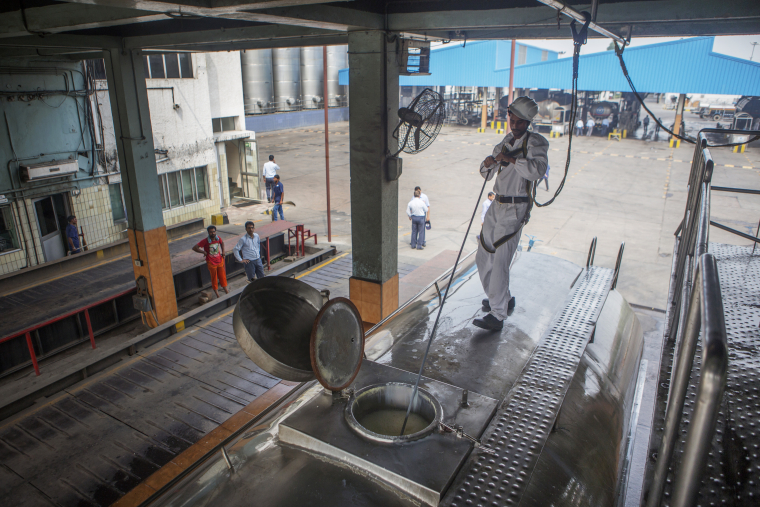
An employee mixes raw milk in a delivery truck prior to sampling and testing at the Mother Dairy milk plant in New Delhi.

Photographer: Prashanth Vishwanathan/Bloomberg

The government’s trade policy is responding to domestic political considerations, which is not surprising but disappointing to potential trade partners, said Richard Rossow, senior adviser at Washington-based Center for Strategic International Studies. This reluctance to open the economy will persist until India’s trade balance improves, he said by email.

India’s largely unorganized dairy sector, with a significant presence of women labor, complicates the decision-making process for the government. The organized sector, comprising dairy cooperatives, private firms and government companies like Mother Dairy, account for just $30 billion of the $110 billion dairy industry in the country, Sodhi said. Farmers in the country earn about 67% of their total animal farming income from dairying.

Trade Deficit

“The issue is not about having domestic sensitivities, but allowing them to sabotage overall ambitions,” said Amitendu Palit, a senior research fellow at the National University of Singapore. India keeps walking out, while others continue engagement. This mindset needs to change, he added.

Operations at a Dairy Farm as Problems for the $83 Billion Industry Mount

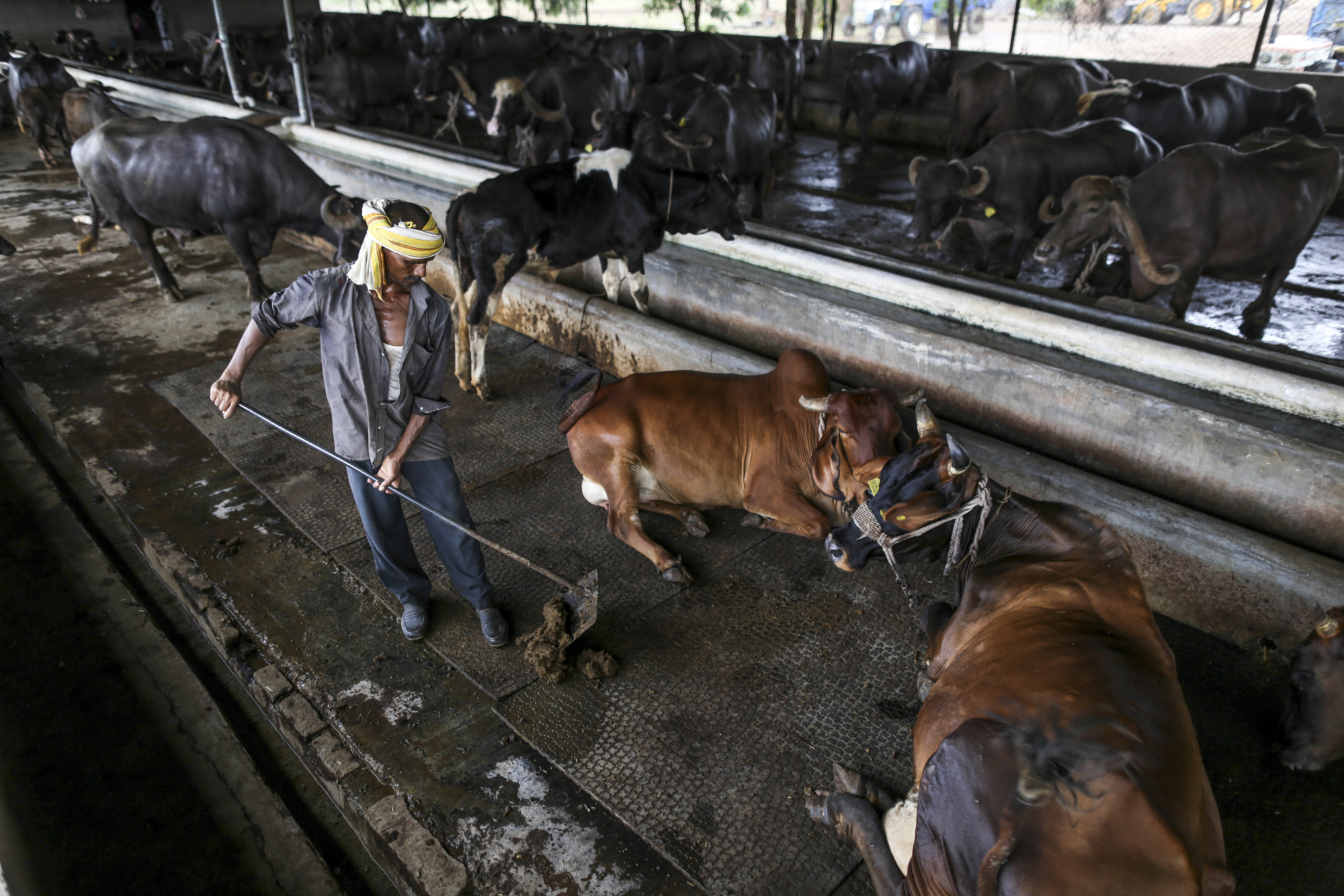
A worker cleans up cow dung at a dairy farm in rural Maharashtra.

Photographer: Dhiraj Singh/Bloomberg

“Foreign companies should bring in their expertise, skills and technology, but they must procure locally,” Sodhi said. “In the U.S., for instance, dairy farmers get subsidies and farms are large, with ample pastures for grazing. How will our farmers with two animals compete?” he said.

India’s apprehensions toward liberalization are also due to worries about the widening of its trade deficit. The Modi government has decided to review all past trade deals, with focus on ensuring mutual benefits and a win-win situation for all sides, trade minister Piyush Goyal said earlier.

But its cautious approach is not showing much success on reigning in the deficit, Rossow said. “Improved trade, even with potential trade deficits, provides economic ballast to a partnership. Trade ties can be narrowly focused to make potential agreements more palatable.”

Source: Bloomberg

Brian Eby of EBYHOLME Passes

We lost a great one this week. Everyone at The Bullfine would like to send our deepest condolences to the family and friends of Brian. 

Brain Eby was a passionate Holstein Breeder (along with his tremendous Brother Don and Wonderful, Predeceased Father Clarence) who farmed In Ayr, On. Breeding & developing one of the most elite Holstein herds in Canada in their prime known as EBYHOLME.

Brian Ross Eby died peacefully, at Hamilton General Hospital, on Friday October 16th, 2020 in his 74th year. Brian was a long-time resident of Ayr.

Beloved husband of Phoebe (Nee McDonald). Loving father of Rob, Andrea Koebel ( Mark); loving step-father of Jackie, Jeff (Natalie). Cherished grandfather of Tanner, Cole, Shelby, Cole, Molly, Cody, Meghan, Mason, Rilee, Presley and Brinkleigh. Dear brother of Don (Julie), Janet Dance (Ken) and Mark (Lynn), brother-in-law of Karen Cornish. Brian will also be missed by his aunts, uncles, cousins, nieces and nephews. Predeceased by his parents Clarence and Doris Eby.

Brian was an award winning dairy farmer. He served as Secretary/Treasurer of the Waterloo Holstein Club for over 30 years, and was a longtime 4H leader. He volunteered for many years with the Ayr Minor Hockey Association.

Friends gathered at the Ayr Chapel, Wm. Kipp Funeral Home, 183 Northumberland St., Ayr on Tuesday October 20th, 2020 and Wednesday October 21st. A family service was held on Thursday, October 22nd, 2020. Interment at the Ayr Cemetery.

Donations to the Waterloo Holstein Club or the Heart and Stroke Foundation would be greatly appreciated.

Source: ObitTree

Covid-19 creates perfect price forecasting storm

When Covid-19 first surfaced in early 2020, global protein markets were still responding to the pork shortages caused by African Swine Fever (ASF).

The crisis has brought even further instability. Brett Stuart, President of Global Agri-Trends, explained Covid-19’s impact on global protein markets at the Canadian Beef Industry Conference. The meeting was held virtually in mid-August.

There has been much confusion around Covid-19 in the last eight months, and that confusion has created great uncertainty, said Stuart. As we edge towards winter that uncertainty continues, creating further instability in global protein markets. This uncertainty has had an enormous impact on price forecasting.

In order to forecast prices, agricultural economists must first estimate global supply and demand, Stuart explained in his talk. Historically, this is done by first analyzing and estimating supply and then selecting a price.

“Our key assumption is that demand is relatively stable; demand doesn’t move much,” said Stuart. “So if we figure out what the supplies are, we’re pretty good at guessing where the price is going to be.”

But price forecasting becomes challenging when demand fluctuates as it has this year.

“We’re in a spot where price forecasting is out the window, it’s absolutely impossible,” said Stuart. “Even if we knew what supply was, we don’t know where demand is going to be.”

Demand is impacted by three main factors. The first factor is the shift from restaurants to retail. As families across the globe moved into lockdown mode, analysts quickly realized that people eat differently when they’re at home.

“They’re way less responsible in a restaurant than in retail,” said Stuart, pointing to demand declines for steak, bacon, cheese and butter.

The second factor surfaced when workers in processing plants started to get sick. “We found that the human labor component is the weak link in the chain,” said Stuart.

The third factor is uncertainty around long-term demand precipitated by consumer fears around economic recessions and possible unemployment.

Taken altogether, it’s understandable why analysts struggle to forecast demand, and therefore, price. Stuart said he doesn’t expect any clarity for at least another year.

Source: thedairysite.com

EU lawmakers to permit “veggie burger” labelling, but take a hard line on dairy labels

The European Parliament says that restaurants and shops in the European Union should be allowed to label products as “veggie burgers” or “vegan sausages” but call for tighter curbs on labelling of plant-based dairy substitutes.

Reuters reports that EU lawmakers voted to reject proposals, backed by farmers, to ban plant-based products from using terms such as steak, sausage or burger.

“I’m going to celebrate with a vegan burger,” Swedish EU lawmaker Jytte Guteland said after the result was announced.

Farmers had argued that the using words like burger or sausage for non-meat products could mislead consumers. European farmers association Copa Cogeca said allowing such terms would open a “Pandora’s box” of confusing wording.

But medical groups, environmentalists and companies that make vegetarian products have said that banning these terms would discourage consumers from shifting to more plant-based diets, undermining the EU’s environmental and health goals.

A majority of EU lawmakers also voted on Friday for stricter rules on labelling of dairy substitutes, backing a ban on terms such as “milk-like” or “cheese-style” for plant-based products that contain no dairy ingredients.

The European Court of Justice already banned terms like “soy milk” and “vegan cheese” three years ago, ruling that words such as milk, butter, cheese and yoghurt cannot be used for non-dairy products.

The labelling rules are part of a bigger EU farming policy package, and are not final. Parliament needs to approve its position on the full package in a vote later on Friday. It must then strike a compromise with EU member states on the final policy.

Elena Walden, policy manager at the non-profit Good Food Institute Europe, called on EU countries to “clear up this mess and reject confusing and unnecessary restrictions on plant-based dairy products.”

Green lawmakers and campaigners, including Swedish activist Greta Thunberg, have called on the EU parliament to throw out the entire farming policy package, which they say does not do enough to curb the sector’s emissions or protect nature from the effects of intensive factory farming.

Read more about this story here.

China’s purchases of US farm goods under the Phase 1 target

US trade representatives claim that China’s purchases of US farm goods is at 71 percent of the target agreed under Phase 1 deal.

Reuters reports that China has substantially increased purchases of US farm goods and implemented 50 of 57 technical commitments aimed at lowering structural barriers to US imports since the two nations signed a trade deal in January.

In a joint statement, the US Trade Representative’s (USTR) office and the US Department of Agriculture (USDA) said China had bought over $23 billion in US agricultural goods to date, or about 71 percent of the target set under the so-called Phase 1 deal.

“Since the Agreement entered into force eight months ago, we have seen remarkable improvements in our agricultural trade relationship with China, which will benefit our farmers and ranchers for years to come,” US Trade Representative Robert Lighthizer said in a statement.

The deal defused a bitter trade war between the world’s two largest economies, but disputes over human rights, the COVID-19 crisis and technology have strained ties between Washington and Beijing, raising doubts about the prospects for deepening the agreement in a second phase.

Agriculture is one of the four areas where China pledged to increase its purchases of US goods and services. Many experts question whether China will meet its overall targets this year given lockdowns imposed earlier this year to contain the virus.

The report showed outstanding sales of US corn to China were at an all-time high of 8.7 million tons, while US soybeans sales for marketing year 2021 to China were at double the levels seen in 2017.

US pork exports to China hit an all-time record in just the first five months of 2020, and US beef and beef products exports to China through August 2020 are already more than triple the total for 2017, it said.

In addition to these products, USDA expects 2020 sales to China to hit record or near-record levels for other US agricultural products including pet food, alfalfa hay, pecans, peanuts, and prepared foods.

Read more about this story here.

New Zealand introduces new rules for live animal exports

New Zealand announces new requirements for the safe transport of livestock after a cattle ship capsized in the East China sea this summer, killing thousands of cows and most of the ship’s crew.

Reuters reports that only two of the 43 members and more than 6,000 cattle on the Gulf Carrier 1, which was heading from New Zealand to China, survived. The disaster prompted authorities to suspend live cattle exports and launch a review.

The suspension expires on 23 October, but a conditional ban is in place until 30 November, during which time New Zealand’s Ministry for Primary Industries (MPI) can livestock exports by sea subject to the new conditions.

The conditions include additional inspection of livestock ships, lowering stock density on vessels to 90 percent of current limits to match new Australian standards, increased requirements for voyage reporting and ensuring at least 20 percent of feed is available for unplanned delays.

MPI said it moved fast to ensure there’s no serious animal welfare issue for the 24,000 cows in pre-export quarantine, which would likely have to be slaughtered without the interim measures.

“We want to ensure they are moved safely. It’s important to note New Zealand does not export animals for slaughter, but as breeding stock,” said MPI Director General Ray Smith.

New Zealand has been looking into a wider policy review of live animal exports since 2019. MPI said it will advise the new government in the coming weeks after the ruling Labour party was returned to power last week.

($1 = 1.4979 New Zealand dollars)

Read more about this story here.

Mexico bans global brands’ dairy products for breaching standards

Mexico’s economy ministry has suspended the sale of over 20 dairy products for breaching standards, including items sold under Mondelez International Inc’s Philadelphia brand and natural yogurt made by France’s Danone.

Of the 19 cheese brands affected, the violations included erroneously claiming to be “100% milk,” using vegetable fat to replace milk, and providing a lower net content in grams than advertised on the packaging, the ministry said late on Tuesday.

Mondelez said on Wednesday the ministry’s order did not affect Philadelphia soft cheese and related to two types of processed cheese marketed under that label.

Mondelez said it was surprised by the order, calling it “totally unfounded,” and damaging to the brand.

It said it had not been promptly notified by the ministry on the start of the administrative procedure and that it would hold a “cordial dialogue” with authorities to clear things up.

Other companies affected by the cheese ban included Grupo Lala, a major Mexican producer of dairy produce.

The economy ministry said the bans on natural yogurt applied to the Danone Bene Gastro and Danone Natural products.

The products were identified due to the addition of sugars and for failing to meet minimum milk content, it said.

Danone said it had earlier this month replaced the labels on the two products singled out by consumer protection officials, and had communicated those modifications to the authorities.

In light of that step, the decision to suspend the products was “untimely,” Danone said in a statement. The company remained open to resolve any outstanding issues, it added.

Source: reuters.com

Minecraft influencers to partner with dairy industry

The dairy checkoff wants to reach Generation Z where they are and believe new partnerships in the gaming space will do just that.

Joanna Hunter with Dairy Management Inc. says nearly 90 percent of Gen Z classify themselves as gamers and a test partnership will enlist the help of four influencers with a combined reach of 120 million followers.

“They’re going to visit farms from across the country, different sizes, different sustainability practices, and then after that farm visit, they’re going to build a dairy farm in Minecraft.”

She says the goal of the gamers is to engage followers in the dairy sustainability story.

One of the virtual farm tours will be on Aric DeJager’s 2,000 cow Colorado dairy.

“They’ll have 40 million people watch them build a dairy on Minecraft and you have all of these young people watching this—it’s going to be insanely impressionable.”

Gen Z includes early teens to early ‘20s and the checkoff says it is also testing partnerships with NFL Madden and retail, and, if successful, will amplify future gaming investment. 

This first $2 million project includes partnering with Mr. Beast – Jimmy Donaldson, Brianna Playz – Brianna Arsement-Barnhart, and her husband Preston Playz – Preston Arsement.

Source: voiceofmuscatine.com

Lactanet Canada Launches Dairy Cattle Traceability Program

Lactanet Canada has announced the launch of DairyTrace, the national dairy cattle traceability program for dairy farmers in Canada.

DairyTrace includes two new traceability tools; a mobile app and on-line database portal, that will streamline and simplify the recording and reporting of animal identification and movement. In addition to these tools, the DairyTrace launch includes the release of a modern national website at www.DairyTrace.ca, that hosts information for dairy producers, other custodians of dairy cattle and consumers.

The DairyTrace program also includes customer service support, improved animal tags, and instructional materials in print, on-line and via video.

Under federal regulations and/or proAction requirements, everyone who owns or has the possession, care or control of dairy cattle must record and report animal identity, movement, location, and custodianship information.

“DairyTrace has been developed to provide dairy farmers with easy-to-use tools for managing their traceability obligations.” says Gert Schrijver, dairy producer and Chairman of Lactanet’s DairyTrace Advisory Committee. “All dairy farmers will also have access to a one-stop-shop for ordering their tags and receiving full customer support from the DairyTrace customer services and National Livestock Identification for Dairy (NLID) program offered through Holstein Canada or from Agri-Traçabilité Québec (ATQ) in the province of Québec where producers have successfully practiced this traceability model for many years using the SimpliTRACE system.”

Also, to accommodate non-producer affiliates outside Québec, such as abattoirs, assembly yards and auction facilities, exchange systems have been built to allow information to be funnelled into the DairyTrace database. This will allow affiliates the option of using the new DairyTrace system or CCIA’s Canadian Livestock Tracking System (CLTS).

Traceability affects over 1.4 million dairy cattle on over 10,000 farms.

Lactanet and Dairy Farmers of Canada have been working collaboratively since 2016 towards the common vision of a national dairy cattle traceability program.

Proposed Rule Would Deter Organic Fraud, Strengthen Label’s Integrity

The National Organic Program (NOP) opens economic opportunities and new markets for American farmers – but in the last several years, millions of dollars of non-organic products have been intentionally mislabeled and sold as organic, eroding consumer confidence in the certified organic program and undermining farmers who adhere to the law. To deter and detect this kind of fraud, a rule proposed by U.S. Department of Agriculture (USDA) Agricultural Marketing Service (AMS) would strengthen oversight of the production, handling, certification, marketing, and sale of organic agricultural products.

A strong supporter of clear, consistent, and accurate food labeling, National Farmers Union (NFU) has previously expressed concern about behaviors that threaten the integrity of the organic seal. In comments submitted today and an accompanying statement, NFU President Rob Larew echoed those concerns and urged USDA to finalize the rule.

“While commodity prices have languished, family farmers have pursued opportunities to differentiate their products and maximize profit margins. One such opportunity is organic certification, which allows farmers to earn a premium for certain management practices. However, the financial advantages of certification depend on consumer trust in the label – something that has been undercut by bad faith actors looking to take advantage of price premiums without doing any of the work to earn them.

“Inaccurate organic labeling misleads and cheats consumers, harms the reputation of the label, and cuts into the profits of farmers who play by the rules. We owe it to both food producers and purchasers to enforce organic standards, without exception. By expanding oversight of the organic supply chain, strengthening import certification, and improving traceability, the proposed rule will help prevent fraudulent activities that weaken the organic label. It is essential that these new regulations do not disadvantage small-scale farmers or businesses, who already face significant obstacles to accessing organic markets. With that in mind, USDA should act swiftly to finalize this rule and ensure the integrity of the organic label.”

###

To download an audio file of Rob Larew’s quotes, click here.

About NFU
National Farmers Union has been working since 1902 to protect and enhance the economic well-being and quality of life for family farmers, ranchers and rural communities through advocating grassroots-driven policy positions adopted by its membership.

Stay Connected
Look for us online at NFU.org and on FacebookTwitter and Instagram. ​

Tumultuous times for Magic Valley dairy

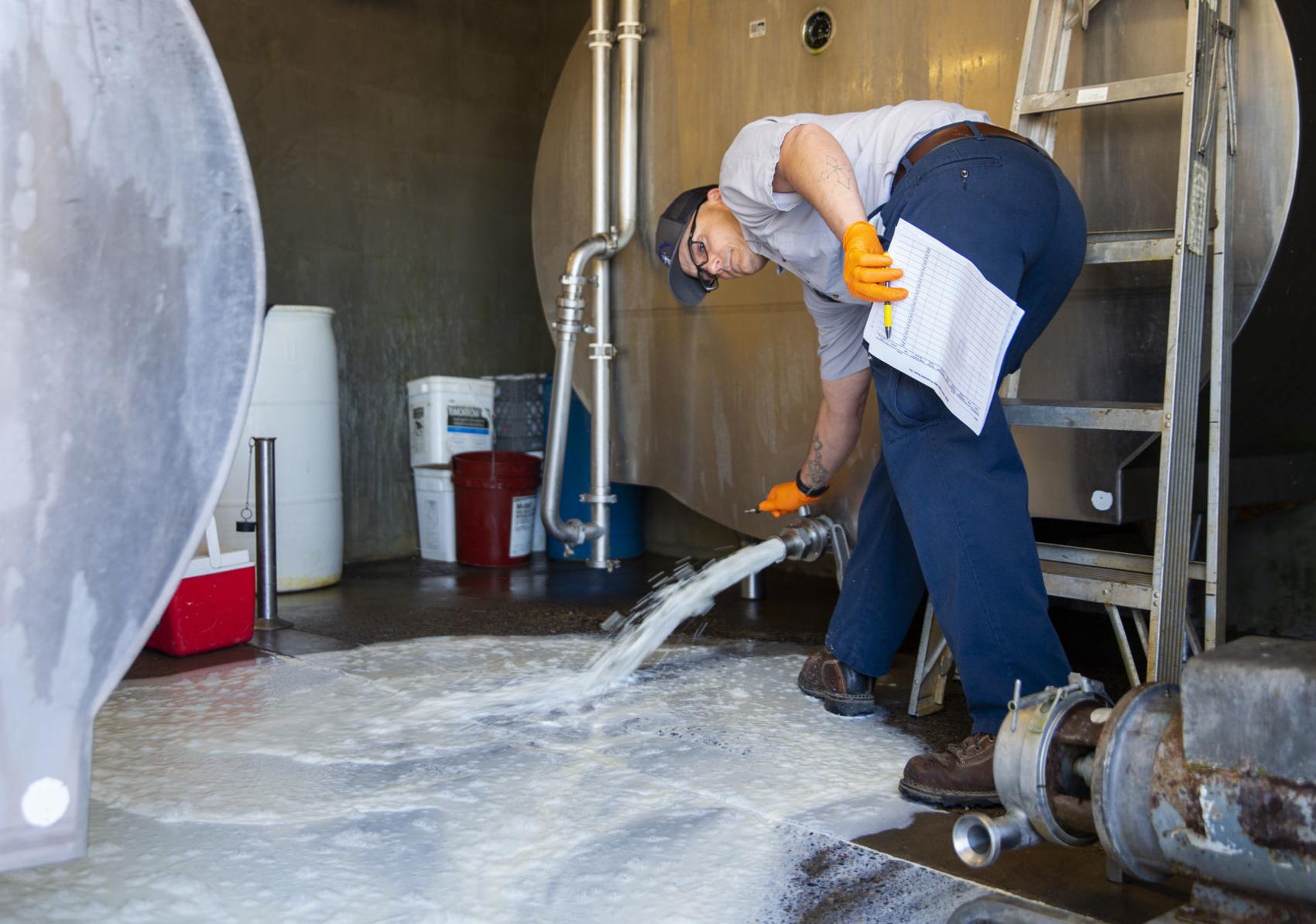
Ricky Jones, operations manager at Magic Valley Quality Milk Transport, opens up the valve of a milk bulk tank Wednesday. PAT SUTPHIN TIMES-NEWS

The Magic Valley dairy industry has gone through brutal lows and record highs during the COVID-19 pandemic.

Back in early April, restaurant closures tanked dairy demand so dramatically that some Magic Valley farmers had to dump their milk. A lot of Idaho milk ends up as cheese, butter and cream, and about 60% of that goes to restaurants. When restaurants stopped buying, much of the Magic Valley dairy industry started hurting.

“For a short period of time there, milk had zero value,” StoneX Director of West Coast Dairy James Carr said.

Even Magic Valley dairymen who had buyers for their milk struggled. The price of milk dropped from around $16 per hundred pounds to $12. Magic Valley farmers break even at around $16.50 per hundredweight.

Some Magic Valley dairymen feared they’d go out of business. A farmer can only lose thousands of dollars every day for so long.

“We were close to going broke,” Buhl dairyman Richard Azevedo said. “If milk wouldn’t have went up in the next month or two, we would have been done. There’s no doubt about it. It just would have been too big a hole.”

But milk did go up in the next month or two, soared to record highs, in large part due to a massive government dairy purchasing program that buoyed demand.

Peaks and valleys

Many dairymen went into 2020 with high expectations. After six years of prices at or below the break-even point, milk finally got into profitable territory toward the end of 2019. A lot of Magic Valley farmers felt some relief after struggling for more than a half-decade straight.

Then the pandemic happened. When COVID-19 destroyed demand for dairy this spring, some experts thought the industry was facing months of misery.

“To have recovery within two months was not expected at all,” Idaho Dairymen’s Association CEO Rick Naerebout said.

CARES Act payments and food purchasing programs likely prevented many Magic Valley farmers from going out of business.


Congress passed the $2.2 trillion CARES Act in late March in an effort to stave off a complete collapse of the U.S. economy. If you received a $1,200 deposit in your bank account or a $600 boost to your unemployment benefits, those payments were part of the CARES Act.

Agriculture was allocated $16 billion in the CARES Act, and that $16 billion can effectively be broken down into two categories: $13 billion in direct payments to ailing farmers and $3 billion in government purchases of meat, dairy and produce to help feed struggling families. (There were also some programs outside of the U.S. Department of Agriculture, such as Dairy West’s Curds + Kindness initiative. Curds + Kindness donated nearly 1 million pounds of finished dairy products made from 7.5 million pounds of milk — milk that dairymen in Idaho and Utah couldn’t have otherwise sold.)

The direct payments were a lifeline for many Magic Valley farmers.

“I’d be done (without them),” Azevedo said. “That helped tremendously.”

Payments went to most types of Magic Valley producers, although there were snags — potato growers and aquaculture farmers didn’t qualify at first, for instance. According to documents given to the Times-News through a Freedom of Information Act request at the end of July, Magic Valley producers had received $34 million in direct CARES Act payments.

The largest payments went to dairies, which typically have expensive overhead costs. Three Magic Valley dairies received $600,000 each, distributed through the USDA. Most of the bigger payments — the 113 in the six-figure range — went to dairies. The maximum individual payment was $250,000, but some operations are split among multiple partners, so they qualified for multiple payments.

On the other extreme, some producers received just $73.60. The average payment for a Magic Valley farmer was $47,000, while the median was around $9,000. There were 733 payments to Magic Valley producers, but many producers received multiple payments.

A $100,000 payment from the government sounds like a lot, Naerebout said. But it’s important to keep in mind how massive Idaho dairies are, he said. Some Magic Valley dairies have more than 10,000 cows. The bigger operations actually fared worse, Naerebout said, since the payments maxed out at $250,000 per partner for up to three partners and didn’t cover the losses of the biggest dairies.

For some farmers, the payments were enough to make them financially whole, Naerebout said. Others lost money overall, despite the payments. He said the pandemic has probably been a net financial positive for Magic Valley dairymen so far, but there’s still a lot of market volatility expected in the future and each dairyman’s situation is different.

“It depends on the farmer,” Carr said, “whether they’re a cheese guy or a non-fat guy.”

Historic intervention

Fast food sales began rebounding during the early summer. Those restaurants typically have cheese-heavy menus, so their success boosted demand somewhat for Idaho dairy. Restaurant sales as a whole still aren’t where they were, though.

The USDA’s food box program is the biggest reason milk prices are so good right now, Carr said. The government bought hundreds of millions of dollars of meat, dairy and produce each month this summer.

Those purchases have completely changed the dairy market and demand.

According to StoneX’s research, government purchases made up about 0.1% of the U.S. dairy market before the pandemic.

StoneX estimates that the government bought 1.1% of U.S. dairy products in May, more than 2% (around $400 million) each month between June and August and a whopping 3% ($500 million) in September.

“When the government’s using 3% of the milk production in the country, it doesn’t seem like a big number,” Carr said. “But that’s a big number.”


That government intervention is why the price of milk jumped to about $25 per hundredweight in mid-July, the highest price ever. Blocks of cheese hit the $3-per-pound figure in mid-July, too, also a record. For comparison, 40-pound blocks of cheddar averaged $1.10 a pound in April and only exceeded the $2 plateau for two months in 2019.

Those high prices have helped Magic Valley farmers make up for the early-April lows. The sky-high prices didn’t last forever though. They’ve been fluctuating wildly during the past few months, from $25 in July back down to $16 in September, now back around $20 in October.

Natural demand for dairy is still down. The reason milk prices are still strong is because government purchases for food boxes are creating demand that wouldn’t have existed otherwise.

The problem for the Magic Valley dairy industry is that government payments aren’t going to go on forever. October is still a strong month for government purchases, but the situation could change soon.

The extreme volatility in the market causes problems. For instance, the Magic Valley has long needed additional processing capacity. A new processor is unlikely to start a $100-million project in the middle of a pandemic.

“It’s probably going to negatively impact the investment in processing expansion, at least in the short run,” Naerebout said. “Companies are going to be a little less willing to jump into big investments right now.”

At least one major dairy project — Gem State Dairy Products’ $130-million milk bottling facility next to Glanbia in Twin Falls — has been put on hold.

And while today’s prices are good, dairymen have also seen new cutbacks in some cases. Processors are penalizing producers who don’t reduce their production. Naerebout said some Magic Valley dairymen have had to cut back their production between 5% and 20%.

Carr said StoneX is projecting $15-dollar milk prices in 2021, back below the break-even point for Idaho farmers. He also emphasized that while the food box program helped the Magic Valley dairy industry enormously, it also has at least one negative impact: It made it seem like demand was good when it really wasn’t. Production should have gone down, he said, but it didn’t because the prices were so good.

“We should have been reducing production because of the demand destruction that COVID has had on this country,” Carr said. “I worry about what happens when the government purchases are done. Where’s the demand going to come from?”

What are the key farming issues in the upcoming US election?

Despite President Trump enjoying wide support among US farmers, some have reservations about the impact his trade policies on crop prices and international movement of US farm products.

In an in-depth analysis from Reuters, journalists outline how international trade, biofuels and the environment are shaping the US farm vote.

Opinion polling shows that farmers across the United States tend to support President Trump. However, the impact of his trade wars and biofuel policies have caused economic uncertainty and hardship on some farms.

The Democrat challenger Joe Biden is capitalising on the biofuel issue and will likely have a more multi-lateral approach to international trade. He has also promised to make farming more environmentally friendly.

Trade

As part of President Trump’s “America first” policy, he challenged the trading status quo between the United States and many of its top commercial partners. These challenges have often impacted farmers’ access to key export markets. The trade war with China, which is a top buyer of US soybeans, pork and dairy has been a sore spot for the president among rural voters.

Economists estimate that the tariffs imposed on Chinese goods since 2018 have resulted in billions of dollars in lost crop sales. To help alleviate the losses, the administration rolled out a nearly $30 billion cash aid scheme for US farmers. The USDA has also rolled out billions in COVID-19 aid.

Read the full analysis here.

Source: Reuters

What exactly is milk? Depends on whom you ask.

Milk is usually white, brown with chocolate syrup, and occasionally pink. In 2020, that’s where the similarities end.

The dizzying array of milks on local supermarket shelves today comes from very different sources. Pennsylvania dairy cows are in the mix, of course, but so are California almond bushes, Upper Midwest soybeans, and Canadian oats processed in a South Jersey plant by a Swedish-based company founded by a food scientist.

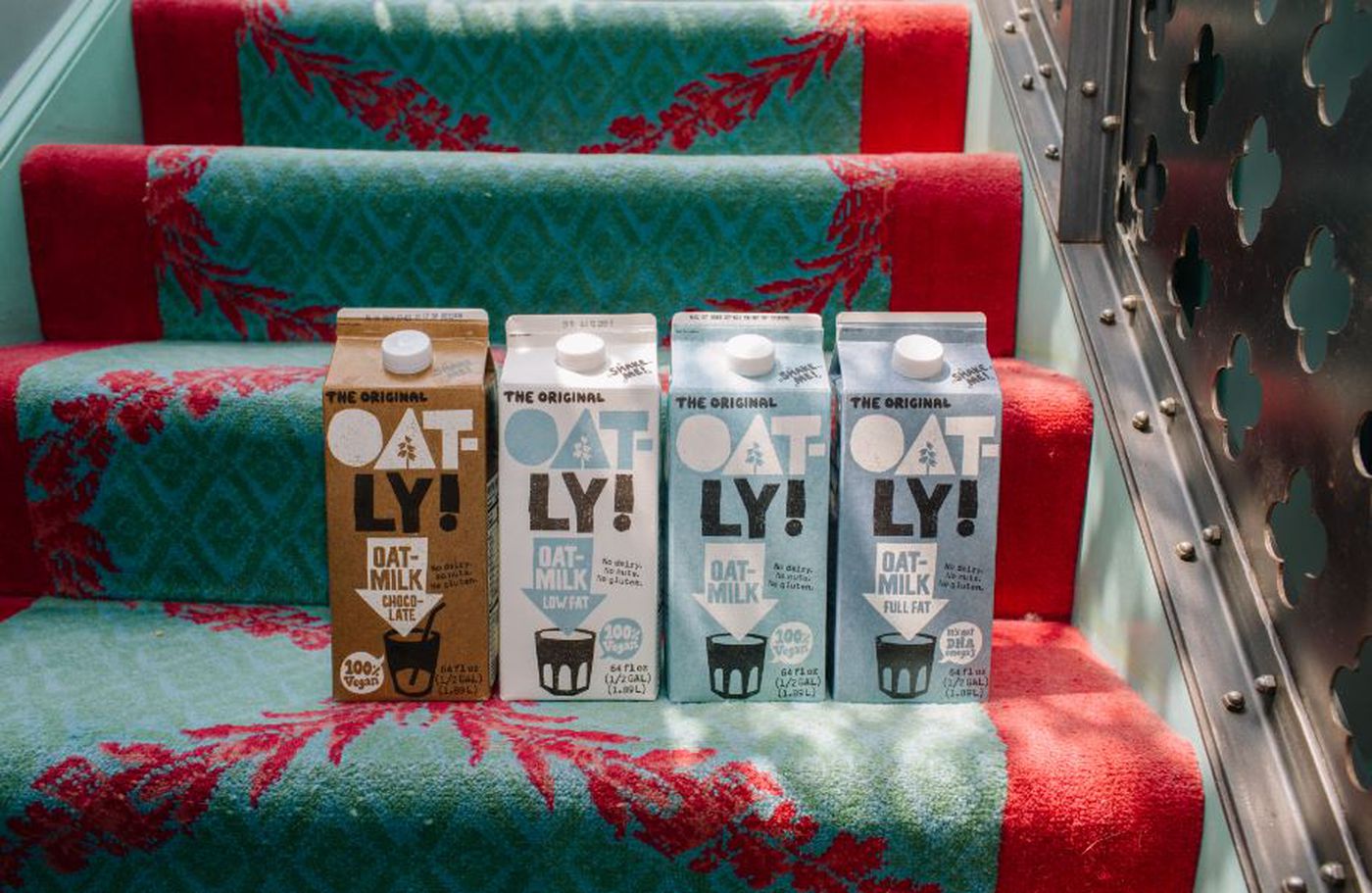
Oatly, a world leader in oat milk production, opened that $15 million plant in Millville, Cumberland County, in 2018 and processes its base product there — oats and water — before adding secret ingredients.

The company is also building a plant in Ogden, Utah, and is in the process of developing U.S.-grown oats.

“Before I started this path to Oatly, I’d never heard of oat milk. I never put those two words together before,” said Mike Messersmith, president of Oatly North America.

Oatly, a Swedish-based oat milk company, opened a plant in Millville, N.J., in 2018

Oatly

Oatly, a Swedish-based oat milk company, opened a plant in Millville, N.J., in 2018

Get the news you need to start your day

Dairy farmers do not think plant-based beverages should be considered milk and have fought, unsuccessfully, to get a hard definition enforced by the U.S. Food and Drug Administration and have those products moved elsewhere in the supermarket.

“There have been a number of federal and state bills where the dairy farmers are saying the legal definition of milk is an excretion of a lactating mammal,” said David Smith, executive director of the Pennsylvania Dairymen’s Association. “For people to be looking for a natural product and go to oat and almond, it just defies logic because they are all built with fortifications and additives. Milk is just natural.”

Oat milk, according to various news reports, is thicker than other plant-based milks and slightly sweeter than dairy, with, of course, a bit of an oat taste. The website Epicurious.com said oat milk is the best alternative to dairy for baking.

The dairy industry was hurting long before the COVID-19 pandemic, with Pennsylvania seeing hundreds of farms close each year or switch to other crops. The state still has 5,730 dairy farms, the second most in the nation, but it has lost more than 1,000 over the last five years. The steepest decline came last year, when 470 dairy farms disappeared.

With schools and restaurants closed during the lockdown, many farmers were left with a glut of supply and were forced to dump milk.

“You work hard to get those cows to produce good quality milk, and then to just spread it on fields,” one dairy farmer told The Inquirer in April.

Milk prices rebounded sharply in the summer, up to $20 per hundred pounds from a low of $11 in the spring.

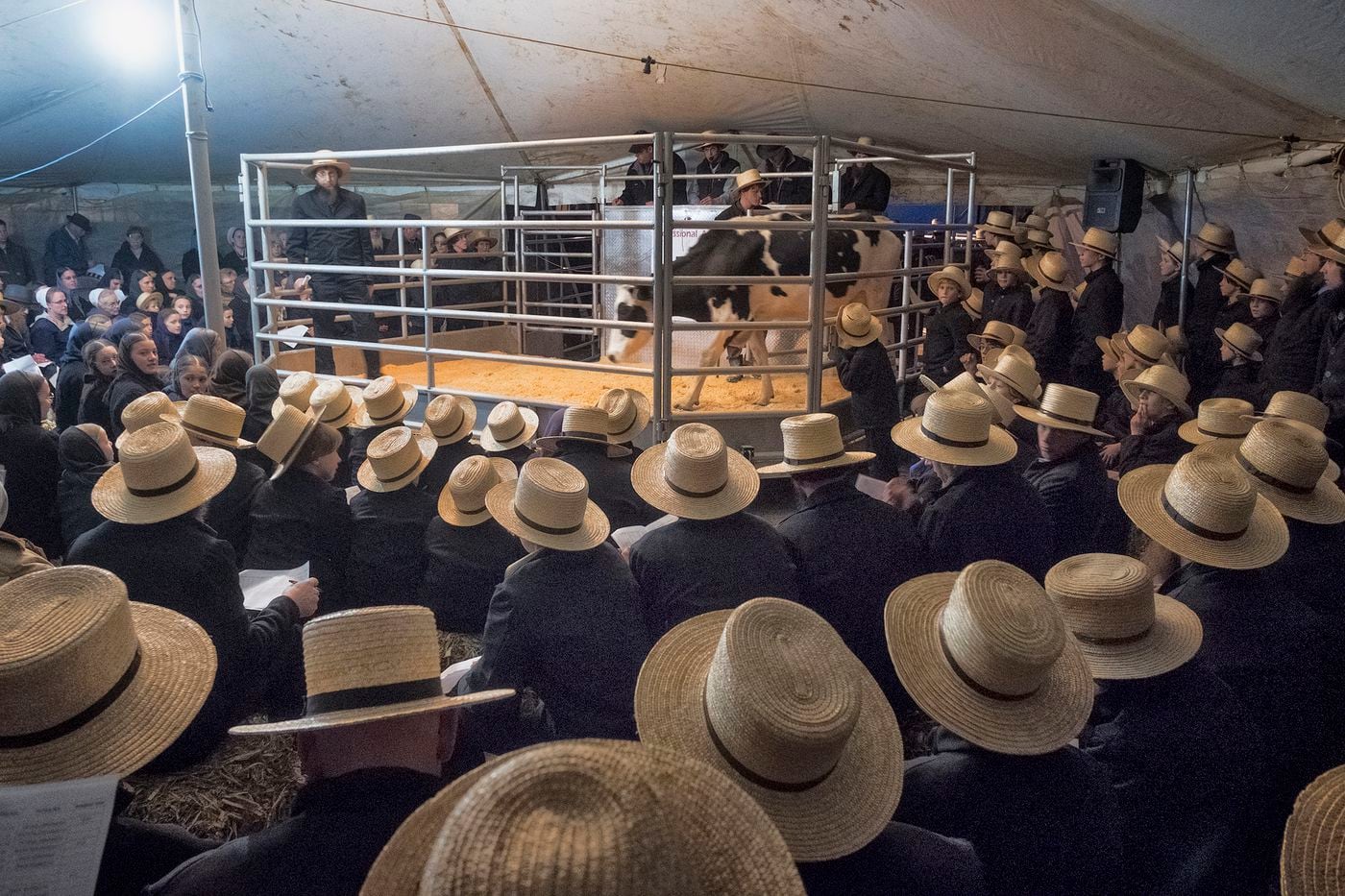
As the dairy industry in Pennsylvania fell on hard times, an Amish dairy farmer sold his herd in 2018, getting out of the business altogether.

Ed Hille / Special to the Inquirer

As the dairy industry in Pennsylvania fell on hard times, an Amish dairy farmer sold his herd in 2018, getting out of the business altogether.

Messersmith said Oatly was founded in the mid-1990s as an alternative for the lactose intolerant and a more climate-friendly product than dairy. The company entered the U.S. market several years ago by focusing on specialty coffee shops, where soy and almond milk were the dominant alternatives to dairy. A six-pack of 32-ounce “barista edition” Oatly milk retails for $32 on its website.

“We really got great traction early on and while it generated business for us, it also gave people a really positive first experience with oat milk through their local coffee shop and their local barista,” Messersmith said.

Hallie Zimmerman, an assistant manager at Old City Coffee on Church Street in Philadelphia, said oat milk is a standard order today.

“I guess we first started seeing it about a year ago,” Zimmerman said. “It used to be predominantly almond milk, and now it’s oat milk.”

On Wegmans’ website, a 64-ounce container is $4.99.

In July 2018, the Food and Drug Administration proposed a rule that would prohibit any manufacturer from labeling a product as milk unless it was “lacteal secretion … obtained by the complete milking of one or more healthy cows.”

“An almond doesn’t lactate,” then-FDA Commissioner Scott Gottlieb said at the time.

The Pennsylvania Farm Bureau also supports enforcement of the strict definition, contending that the current situation creates confusion, “such as believing that ‘almond milk’ is real milk with almond flavoring,” a spokesman said.

The FDA sought feedback from the public on the labeling of plant-based products and received 13,000 comments. A spokesman said the agency was considering its next steps. Meanwhile, dairy still shares shelves with plant-based products.

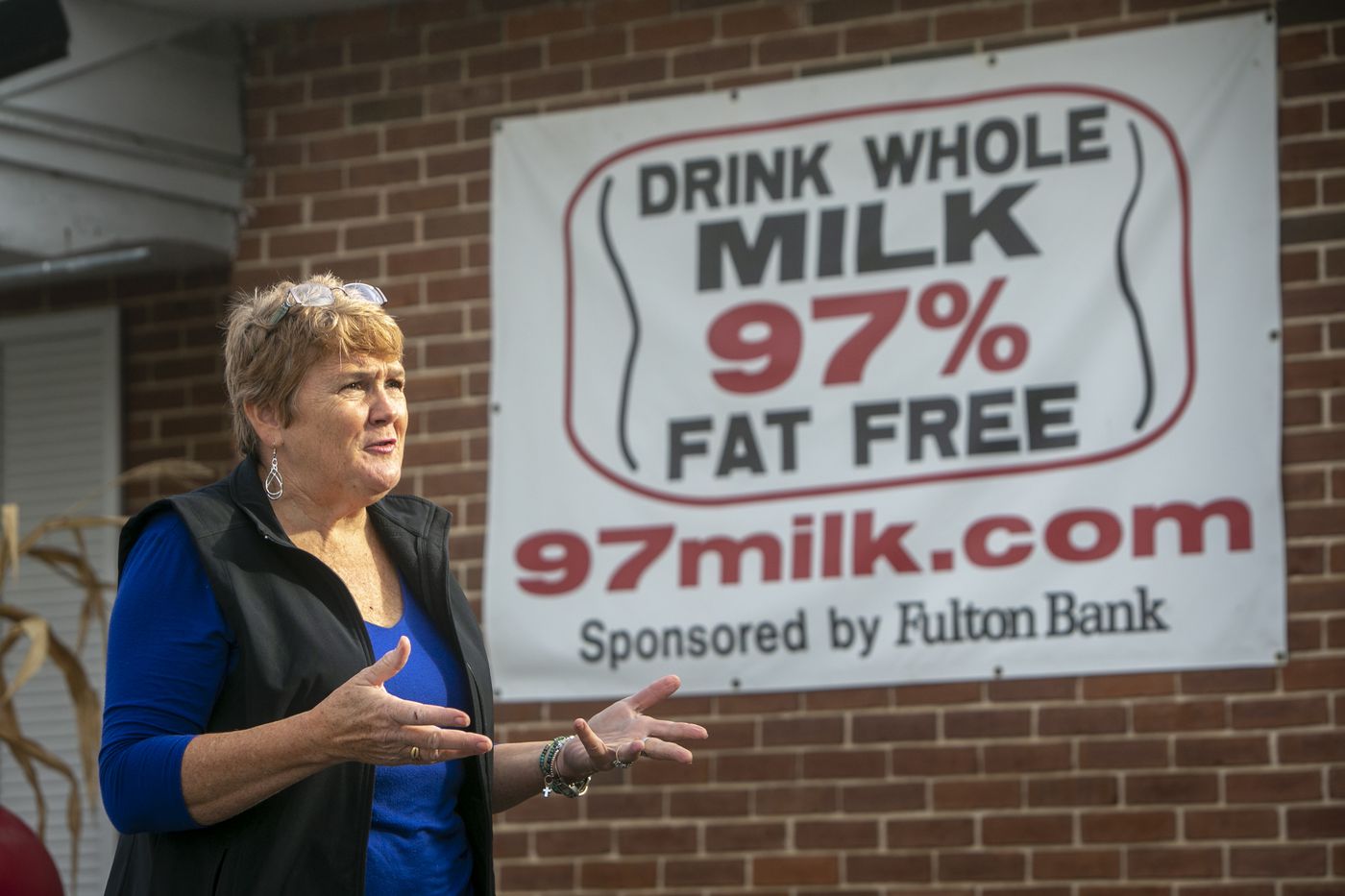
Along with competing against those alternatives, a segment of the dairy industry has also been trying to promote whole milk above milks with lesser fat content, such as skim or 1%. On some rural Pennsylvania roads, “Drink whole milk” or “Drink 97% fat free milk” slogans are affixed to trees or spray-painted on hay bales. The “97 Milk” movement was started by Lebanon County farmer Nelson Troutman in 2019 as a pushback against Michelle Obama’s Healthy, Hunger-Free Kids Act of 2010 that revamped school lunches and cut whole milk from most menus.

Lolly Lesher, a Berks County dairy farmer and board member of 97 Milk LLC, said the former first lady’s program simply resulted in kids drinking much less milk and, in turn, decreasing overall milk sales.

“We’ve lost a whole generation of milk drinkers,” she said.

Dairy farmer Lolly Lesher at her Way-Har Farm Market in Bernville, Berks County. She supports consumption of milk from cows.

ALEJANDRO A. ALVAREZ / Staff Photographer

Dairy farmer Lolly Lesher at her Way-Har Farm Market in Bernville, Berks County. She supports consumption of milk from cows.

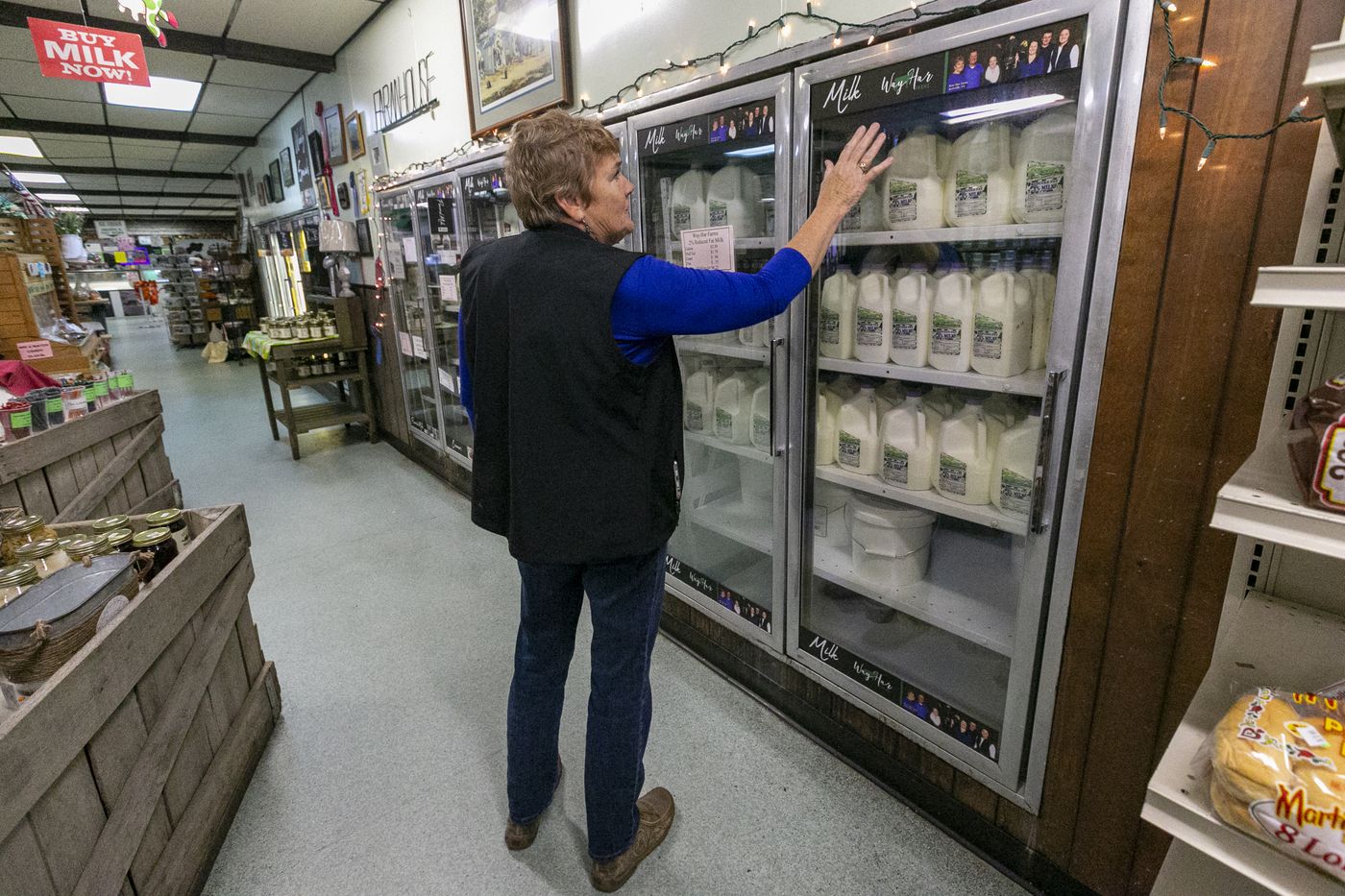
Way-Har Farm Market, Lesher’s storefront in Bernville, does sell reduced-fat milk, along with chocolate and strawberry. She doesn’t sell plant-based alternatives, though, and believes those products don’t belong on the same shelves as dairy.

“It needs to be on the shelf with juices,” she said.

Oat milk and other plant-based alternatives aren’t going anywhere, a welcome boom for vegans, vegetarians, and people with lactose intolerance. Messersmith said supermarkets are simply responding to consumer demand.

“Cow’s milk, ice cream, and dairy-based yogurts are still far and away the largest owners of that shelf space,” he said. “There’s shifting consumer preference for more plant-based options. People are more cognizant of their choices, how it affects the climate, and it’s shifting how the grocery store works.”

Dairy farmer Lolly Lesher in the dairy section at her Way-Har Farm Market in Bernville, Berks County. She doesn’t sell plant-based alternatives such as almond and oat milk, and believes they don’t belong on the same shelves as dairy products.

ALEJANDRO A. ALVAREZ / Staff Photographer

Dairy farmer Lolly Lesher in the dairy section at her Way-Har Farm Market in Bernville, Berks County. She doesn’t sell plant-based alternatives such as almond and oat milk, and believes they don’t belong on the same shelves as dairy products.

Source: inquirer.com

Farm Bill change, COVID-19 cost dairy farmers millions

The 2018 farm bill modified milk pricing rules to facilitate improved risk management for beverage milk processors, cooperatives and dairy farmers.

While the goal of improving risk management was achieved, American Farm Bureau Federation Chief Economist John Newton says the change cost dairy farmers millions of dollars.

“It got rid of what was the higher-of, in the pricing formula, and replaced it with a simple average of the Class III and IV milk prices. And because of COVID-19 price volatility that milk price is a lot lower than what it would have been otherwise, to the effect of around $400 million in lost revenue for dairy farmers.”

He adds it was something that was to provide new risk management tools for the beverage milk industry to allow them to use futures contracts for milk to hedge their beverage milk price risks, but unfortunately because of COVID-19 price volatility, it revealed some of the unintended consequences on farmer income.

Source: NAFB News Service

Duncan Mackenzie Winner Ralph Gushee Passes

Our condolences to the Ralph Gushee family on his recent passing.  Ralph was the Duncan Mackenzie award at WDE in 2006 and has been a fixture in the dairy industry his entire life . A full obituary will be posted when it becomes available. 

European dairy farmers elect new EMB president

Kjartan Poulsen from Denmark was chosen by the members for the post of vice president. Current executive committee members Boris Gondouin, from France, Pat McCormack, from Ireland, and Roberto Cavaliere, from Italy, saw their mandates renewed. The EMB also welcomed Elmar Hannen, from Germany, and Guy Francq, from Belgium, as new members of the executive committee.

Outgoing president, Erwin Schöpges, who wishes to focus on the development of Fair Milk in Belgium and some African countries, was given a warm send-off by his fellow dairy farmers.

They praised him for his political work and involvement in the organization of demonstrations, which have contributed to the growth of the EMB. The assembly also expressed its gratitude to Johannes Pfaller, from Germany, who stepped down from the executive committee after serving for two-and-a-half years, for his commitment to fight for fair trade relations and against the dumping of European surpluses in African markets.

Incoming president van Keimpema told EMB members at the assembly she believed representing the interests of European dairy farmers before the EU Institutions would continue to remain very important.

“I would like to thank you for your vote of confidence,”​ she said.

“Advocating for a crisis-proof agricultural policy will be at the very top of the EMB agenda. The European Green Deal and the Farm to Fork Strategy also need to be considered from a clear producer perspective and the EMB will continue to engage actively with political decision-makers and provide constructive contributions.”

The EMB said that from the intense exchange on the Green Deal and the F2F Strategy at this assembly of EMB dairy farmers, it was clear cost-covering prices and a stable income for farmers must become a real priority for EU policy-makers within their environmental strategies.

“Economic and social sustainability must be given the same degree of importance as environmental sustainability,”​ van Keimpema said.

“This means that we have to create a framework where the costs of climate and environmental requirements are covered by the price and are not simply passed on to be borne by producers.”

Hannen added, “We have to reach a stage where the price covers what society demands. That is the only way to ensure a future for dairy farmers.”

Poulsen said the European Commission’s goal of improving the position of producers must be fleshed out and made a reality with a concrete strategy.

“The EMB expects a clear indication of what steps are going to be taken to achieve this goal, so that it does not simply remain empty words.”

Francq said the Fair Milk project has already demonstrated in many European countries that cost-covering prices and environmental and climate protection can go hand in hand.

“Fair Milk also helps build bridges between producers and consumers,”​ he said.

Gondouin also believes Fair Milk still has growth potential.

“For us at the EMB, it is very important to take this project to other countries as well. But if cost-covering prices are to become commonplace in the dairy sector as a whole, we need – as described – the appropriate political framework.”

Source: dairyreporter.com

Top Dairy Industry News Stories from October 3rd to October 9th 2020

Featured Events:


Top News Stories:

San Jacinto dairy sued over hidden video that allegedly shows abuse of cows

An animal rights organization has sued a San Jacinto dairy, alleging cows are beaten and abused, in violation of industry standards and state law.

“Supervisors and staff use violence as a daily management tool,” the Animal Legal Defense Fund’s lawsuit against the Dick Van Dam Dairy reads in part. Cows are motivated by “kicking them in the face and in their sensitive udders, repeatedly jabbing their faces, legs and udders with splintered wooden canes and metal pipes, twisting their tails, poking fingers in their eyes, and other painful methods.”

On Thursday, Oct. 8, Los Angeles attorney Stephen Larson, the lawyer for Glen Van Dam, who operates the dairy that bears his father’s name, “categorically” rejected the allegations.

“The Van Dam family has been in the dairy business not just for generations, but reaching back to Holland for centuries,” Larson said. “They care deeply about their animals. … Their livelihood, frankly, their family relies on those cows. For generations, they have imposed the highest standards of care for the animals with whom they have worked.”

The dairy supplies Dairy Farmers of America, which in turn produces Alta Dena Dairy and other brands, including Target’s DairyPure and TruMoo.

“While this is not a farmer-owner of Dairy Farmers of America (DFA), we are committed to tirelessly advocating and championing best practices in the areas of animal care and wellness, environmental stewardship, employee training and milk safety and quality across the industry. We do not tolerate animal abuse of any kind,” a Dairy Farmers of America statement released Thursday reads in part. “Effective immediately, the farm in question is not part of our current milk supply, nor used in our products, including DairyPure and TruMoo.”

According to Dairy Farmers of America, a third-party audit is being conducted at Dick Van Dam Dairy to see if it’s in compliance with the National Dairy Farmers Assuring Responsible Management program, which “works with dairy farmers, the producer community and industry partners to show customers and consumers that the dairy industry is taking the very best care of cows and the environment, producing safe, wholesome milk and adhering to the highest standards of workforce development.”

The Sonoma County-based Animal Legal Defense Fund filed the suit in Riverside County Superior Court on Sept. 30, in conjunction with the Riverside-based Talkov Law Corp. The suit was announced Thursday. The ALDF has previously gone after dairies, zoos, pet stores and puppy mills, according to Kelsey Eberly, a senior staff attorney with the organization.

“This lawsuit is seeking for this dairy to be shut down,” she said. “The depth and the breadth of the cruelty shown in this investigation shows no bounds.”

The lawsuit follows an undercover investigation late last year by Animal Outlook activists who allegedly found violations of state animal cruelty laws at the dairy.

Photos and videos released by the Washington, D.C.-based animal rights group show the corpses of newborn calves rotting in the pens where their mothers still lived. Pink, blood-tainted milk is squirted into milk cans — the result, according to the group, of injured and infected cow udders. Workers are seen striking animals with metal poles. Cows, unable to walk, are blasted with hoses, struck and walked on by workers attempting to move them, and lifted by heavy equipment.

Larson expressed skepticism about the video.

“This is not the first instance in which this organization has engaged in, essentially, a set-up,” he said of Animal Outlook. “We want the truth to come out on this. This is entirely inconsistent with the standards (the Van Dam family) has imposed, not just for years, but for generations.”

Animal Outlook explicitly wants the dairy industry shut

and replaced with vegan products.

“It’s time for consumers to ditch dairy,” the organization’s web page about the investigation reads in part, “and for companies … to pivot to vegan products.”

Eberly didn’t go quite that far on Thursday afternoon.

“We are really eager to get going with this lawsuit and hold the dairy responsible for what it just egregious cruelty,” she said. “The conduct revealed in this investigation violates every principle of the dairy industry.”

The ALDF is still serving defendants named in the suit, including three members of the Van Dam family. A hearing in the case is set for March.

In addition to filing the lawsuit, the ADLF is calling out Target, which sells DairyPure milk made from DFA suppliers, and demanding they investigate whether its suppliers comply with industry standards.

“How many Dick Van Dams are in its supply chains?” Eberly said.

Source: pe.com

The secret to frothy latte starts with how milk is handled on the farm

Sometimes, milk for a latte just won’t froth the way it needs to and researchers at the University of Guelph say that inability for milk to maintain bubbles goes back to how the milk is treated right after leaving the cow.

Milk high in free fatty acids won’t froth up nicely for drinks like lattes, researchers at the University of Guelph say. (Kate Bueckert/CBC)

It’s pumpkin spice latte season and the key to a really good latte is a milk that froths up well.

But sometimes, milk doesn’t froth up, and new research from the University of Guelph links the ability to get lots of bubbles in milk back to how it is handled on the farm.

Milk naturally has fat in it, but that can break down, creating free fatty acids.

David Kelton, an epidemiology professor at the University of Guelph and the Dairy Farmers of Ontario research chair in dairy cattle health, says those free fatty acids make it harder for the steam used to froth milk to make bubbles.

“If you think of it as you’ve got a sink with bubbles, you’re doing the dishes, and you pour some bacon fat in there, all of a sudden the bubbles disappear,” he said.

“The same thing is happening. These free fatty acids displace the protein on the bubbles that should be forming the froth for the milk and the milk just won’t froth or the froth breaks down very, very quickly.”

David Kelton is an epidemiology professor at the University of Guelph and the Dairy Farmers of Ontario research chair in dairy cattle health. (Kate Bueckert/CBC)

Answers found on the farm

Masters student Hannah Woodhouse visited 50 farms that were found to have higher free fatty acid levels and she and Kelton found two interesting things. One is related to the tubes used to transport milk and the other had to do with the cooling process.

Once a cow is milked, that milk is moved through a series of food-grade stainless steel pipes to a storage tank where the milk is cooled. The researchers found farms with narrower pipes had higher free fatty acids. Kelton says he consulted with engineers who told him that made sense because of fluid dynamics.

“There’s a lot more turbulence in a narrower pipeline so the fat globules actually bump into each other, bump into the side of the stainless steel pipe, break apart and release those fatty acids,” he said.

He said when it came to cooling milk, farmers normally do it in the bulk tank, but some pre-cooled their milk using specialized equipment.

“The farms that were cooling their milk more rapidly actually had lower free fatty acid levels,” he said, although he added they’re unsure why that’s the case.

Expanding research

Kelton says in Ontario, most milk is similar because it’s a “pooled” product, so milk with higher free fatty acids gets mixed in with milk with lower free fatty acids.

Most people won’t notice a difference between brands, but some people may notice a difference if they buy milk from smaller processors.

He says they plan now to expand the pilot project to 200 farms over the next few months to learn more about how farming practices impact free fatty acids in milk. That includes looking more closely at the way milk is cooled as well as what lactating cows are being fed.

Source: cbc.ca

Dairy Industry Favors RFID Tags

The Iowa State Dairy Association has joined the National Milk Producers Federation in filing comments in favor of USDA’s mandated RFID Tag proposed rule. Iowa State Dairy Association Executive Director Mitch Schulte says the dairy industry believes that the radio frequency identification tags are the best means for animal disease traceability and will help protect their animals.

He says having a uniform identification system is the best way to go in ensuring that safety as well as proper and quick response to any problems.

Schulte says the RFID tag provides certainty to both consumers and export customers that the U.S. dairy industry remains on a safe level.

Schulte says farmers privacy will be protected with usage of the RFID tags.

Source: wnax.com

Environmental groups to dismiss case against Lower Valley dairy owners

Three environmental groups accusing a Lower Valley dairy of contaminating groundwater are now backing off.

The groups, CARE, Friends of Toppenish Creek and the Center for Food Safety filed the lawsuit against Majestic Farm LLC in U.S. District Court in April. Now they want to dismiss their case.

The groups accused the dairy of mismanaging cow manure by using leaky storage lagoons and overapplying manure to fields as fertilizer. They alleged the practices equated to “open dumping” in violation of the dairy’s nutrient management plan and the Solid Waste Disposal Act.

At issue is high levels of nitrates in Lower Valley drinking water. Nitrates naturally occur in soil, but heavy use of fertilizer, including animal waste, and leaky septic tanks can drastically increase nitrate concentrations.

High nitrates can be harmful to the elderly, pregnant women and infants, according to the Centers for Disease Control.

On Wednesday, the groups filed a motion seeking to dismiss the lawsuit in a way that would prevent any further litigation against the dairy’s owners — Nicholas and Janie Struikmans — but not the company.

The motion doesn’t say what prompted the groups to seek the dismissal.

The groups’ attorney, Charlie Tebbutt of Eugene, Ore., wouldn’t say why his clients seek the dismissal.

“This decision does not suggest the facility is not contributing to the groundwater pollution in the Valley. My clients are continuing to pursue their long-standing efforts to protect the drinking water in the Lower Yakima Valley in their cases against larger facilities and intend to hold the dairies accountable for creating this problem and putting the people of the Valley in harm’s way,” Tebbutt said in an email.

The dairy industry is happy about the motion seeking the dismissal, said Gerald Baron, executive director of Save Family Farming, an advocacy group for the dairies.

“We think it could be pretty significant,” he said Thursday. “We are not sure of the reason, but as you know Mr. Tebbutt has filed several lawsuits against dairies.”

Some have resulted in settlements in which the dairies have agreed to significantly change the way they handle animal waste.

The lawsuits united dairy operators across the Valley in hopes of preventing further lawsuits and settlements they say are unfair and costly.

The controversy heightened in 2013, when Tebbutt and CARE successfully sued a handful of dairies in the Sunnyside and Granger areas. A study commissioned by the EPA linked those dairies to high concentrations of nitrates in nearby domestic wells.

That study led to a federal consent decree requiring the dairies to make expensive environmental upgrades and changes to manure management.

Now the dairies are fighting back. They criticize the EPA study, saying it was flawed. They also accuse the groups of using the study to leverage dairies into settlement agreements.

A recent ruling in the Court of Appeals for the Ninth Circuit has allowed the dairy industry to move forward with litigation challenging EPA’s study.

Tebbutt has said those claims are bogus, and that much more data exists showing dairies are having a negative impact on groundwater.

U.S. Justice Thomas Rice is expected to sign the dismissal in the Majestic Farm case on Nov. 6, Tebbutt said.

Source: yakimaherald.com

For dairy farmers, innovation is key to sustainability

Oct. 12 is National Farmer’s Day, a day to acknowledge the hard work that goes in to feeding our nation.

In this region, dairy farmers are working extra hard not only to produce the milk, butter, cheese and other dairy products Wisconsin is known for, but to do so sustainably to keep our air and waterways clean.

The Tribune toured two nearby farms, Ripp’s Dairy Valley in the Town of Dane and Endres Berryridge Farm in the Town of Springfield, to learn about conservation practices farmers employ to keep nutrient rich soils in place, prevent stormwater runoff and manage manure. Both are part of Yahara Pride Farms, a non-profit, farmer-led organization that began in 2011 focused on improving soil and water quality.

Chuck Ripp of Ripp’s Dairy Valley serves on the board of directors for Yahara Pride Farms. His grandfather bought the farm in the late 1940s, and today, Ripp, with his brothers Gary and Troy, own the farm, and brother Craig is employed full-time. Their children also work there and are among the 17 full-time employees.

Jeff Endres of Endres Berryridge Farm is the chair of Yahara Pride Farms. His family, together with brother’s Randy and Steve and their families, have owned the farmstead since the late 1800s, and it is now moving to the fifth generation in the family. The farm has 12 full-time employees and 550 cows, which he said is about the average size of a Wisconsin dairy farm.

Conservation Practices

With 700 cows, Ripp’s Dairy Valley adheres to strict manure management regulations set forth by the Wisconsin Department of Natural Resources. It is one of the three original farms to partner with the nearby Clean Fuel Partners manure digester, where methane from manure is captured and brought to the Dane County CNG station. There, it is processed into compressed natural gas to fuel vehicles.

The farm is at the mouth of Six Mile Creek, so preventing runoff is important, Ripp said. By capturing the methane, the farm emits less CO2 into the atmosphere, as do the vehicles fueled by compressed natural gas.

At Endres Berryridge Farm, Jeff Endres also trucks some of the manure to the digester. He also has also begun a composting facility where manure from the calves and heifers is composted and used as fertilizer.

Both Ripp and Endres plant cover crops such as grasses or barley to keep soil in place and improve soil health. Ripp said he plants the crops on any “brown” areas left after harvesting, and Endres said he rotates the crops to improve soil. On one hilltop at Endres Berryridge Farm, what Endres called a “highly erodible field,” grasses have been planted to prevent the erosion. Ripp noted that when the soil is aerated, water is better able to infiltrate, improving crop growth.

Both also use low-disturbance manure injection to inject liquid manure into the soil to better fertilize the soil and prevent it from running off.

Endres noted that the injections can be applied into the crops after they are planted without wiping them out.

“Time is of the essence in fall,” he said. “We want the cover crops to get as big as we can before it freezes and shuts us down.”

Both farms also employ buffers along with other stormwater management systems to capture runoff, and at Ripp’s Dairy Valley, large lagoons hold manure until it can be piped to the nearby digester.

Some 50 farms within the Yahara Watershed located in Dane, Columbia and Rock counties are part of Yahara Pride Farms, all using innovative practices tailored to their own farms to achieve sustainability.

“It’s a compliment to the farmers in the watershed,” Endres said. “They’re always looking to improve wherever they can on their farms.”

Yahara Pride Farms and their partners are “trying to create enough tools in the toolbox so farmers have the options to achieve their conservation goals,” he added.

Source: hngnews.com

Watertown’s Rosy-Lane Holsteins Wins U.S. Dairy Sustainability Award

Rosy-Lane Holsteins, a Watertown dairy farm, is the winner of a national award for Outstanding Dairy Farm Sustainability. The award will be presented at the annual U.S. Dairy Sustainability Awards on Monday, Oct. 12, which honors dairy farms, businesses and partnerships whose practices improve the well-being of people, animals and the planet. The Watertown farm is owned by Lloyd and Daphne Holterman and their partners Tim Strobel and Jordan Matthews and is one of three national winners in its category.

Wisconsin dairy farmers Lloyd and Daphne Holterman, and their partners Tim Strobel and Jordan Matthews won a national award for Outstanding Dairy Farm Sustainability. Pictured left to right: Jordan Matthews, Tim Strobel, Lloyd Holterman and Daphne Holterman.

 
Wisconsin dairy farmers Lloyd and Daphne Holterman, and their partners Tim Strobel and Jordan Matthews won a national award for Outstanding Dairy Farm Sustainability. Pictured left to right: Jordan Matthews, Tim Strobel, Lloyd Holterman and Daphne Holterman.

“Rosy-Lane Holsteins exemplifies our industry’s commitment to sustainability. They demonstrate that caring for the environment, our cows and our communities is what dairy farmers stand for every day,” said Patrick Geoghegan, executive vice president industry relations for Dairy Farmers of Wisconsin. “These are the stories that are important to today’s consumer and matter to the future of our industry.”

Rosy-Lane’s emphasis on cow health started with incorporating cattle genetic technologies more than 25 years ago to breed cows that live longer and are less susceptible to disease and illness. Another benefit of the genetics program is the farm has not used antibiotics on its milking herd for more than seven years, and a veterinarian is rarely called to treat a sick animal.

“It’s really no different than a family of humans that live a long, healthy life,” said Lloyd Holterman. “Good genetics allow us to have a healthy family of cows that has the ability to ward off illness and disease. The breeding decisions we made have paid off.”

The dairy’s commitment to sustainability is ingrained in the farm’s everyday philosophy with its 20 employees.

“We’re strong on setting protocols about the environment, our cows and our people, and then we make sure everyone is in alignment,” Daphne Holterman said. “As a team, we work to get better every day.”

The farm’s environmental stewardship is evident through several examples. Water is used three times before it is mixed with cow manure and applied to fields to nourish the alfalfa and corn crops that feed the cows. The farm added the infrastructure to store and process corn at the farm, minimizing waste and the need for it to be hauled in from outside the dairy.

“Now more than ever we are recognizing the value and the fragility of supply chains, and both companies and producers are looking for ways to reduce their environmental impact while building resiliency,” said World Wildlife Fund-U.S. Senior Vice President, Fresh Water and Food Melissa Ho, who served as one of this year’s judges. “These award winners show that the dairy community is actively working to put its commitment to environmental stewardship into action with the ultimate goal of achieving a healthy and sustainable future for people and planet.”

Judges evaluated dozens of nominations based on economic, environmental and community impact. The independent judging panel — including industry and conservation experts — also considered learning, innovation, scalability and replicability in every nomination.

About Dairy Farmers of Wisconsin: Funded by Wisconsin dairy farmers, Dairy Farmers of Wisconsin is a non-profit organization that focuses on marketing and promoting Wisconsin’s world-class dairy products. For more information, visit our website at wisconsindairy.org.

Hellenbrand Honored as Friend of Expo

World Dairy Expo is honored to present Michael Hellenbrand of Cross Plains, Wisconsin with a posthumous 2020 Friend of Expo Award. This award is given annually to volunteers of World Dairy Expo who continuously go above and beyond for the organization. Sadly, Hellenbrand passed away this summer, but the positive impact he had on World Dairy Expo will remain for years.

Hellenbrand served on the World Dairy Expo Board of Directors as the current First Vice President and was a past Treasurer and former chairman of numerous committees. His financial background, gained through years of working on Wall Street, were a valuable asset to Expo as Hellenbrand helped to strengthen the organization’s financial position. He also played a large role in the construction of the New Holland Pavilions at the Alliant Energy Center and was a vocal advocate for Showring ethics and youth exhibitors.

“Mike was a true ambassador for World Dairy Expo,” shared Bill Hageman, WDE Board President. “While he especially enjoyed providing opportunities for youth to experience the thrill of showing on the colored shavings, he was also very willing to share his time and his perspective for the greater good of the Expo family. He was the kind of friend who would pick you up if you got knocked down, but at the same time, one who was willing to give it to you straight – good news or difficult news.”

A virtual award presentation can be found at www.worlddairyexpo.com or on Expo’s Facebook page.

Serving as the meeting place of the global dairy industry, World Dairy Expo brings together the latest in dairy innovation and the best cattle in North America. Crowds of more than 62,000 people, from nearly 100 countries, will return to Madison, Wis. for the 54th event, September 28 through October 2, 2021, when the world’s largest dairy-focused trade show, dairy and forage seminars, a world-class dairy cattle show and more will be on display. Download the World Dairy Expo mobile event app, visit worlddairyexpo.com or follow WDE on Facebook, Twitter, Instagram or YouTube for more information. 

Herdsmen milk fortune from camel industry

Camels used to be the main mode of transportation in Alxa League in north China’s Inner Mongolia Autonomous Region, as around one-third of its area is desert. However, the number of camels dropped dramatically due to the development of modern transportation and the low economic benefits of camel breeding.

Statistics showed that the number of camels in Alxa League declined from 251,500 in 1982 to only 55,900 in 2003.

“The gestation period of a two-humped camel in Alxa League is as long as 400 days, and most of them give birth to a single calf. They usually become sexually mature at around five years old,” said Zhang Wenbin, a researcher of the animal husbandry research institute of Alxa League.

“The long breeding cycle and the low yield of camel meat led to the decrease of camel breeders in the 1990s,” Zhang added.

In August 2000, the former ministry of agriculture listed Alxa camels on the national livestock and poultry breed resources protection list and established a national reserve for camels in Alxa.

The situation began to change in November 2012, when the China Animal Agriculture Association officially named Alxa as “The Hometown of Camels in China,” and started to guide local herders to redevelop camel-related industries.

“When the league began to vigorously promote the camel milk industry in Alxa in 2015, only 2,000 female camels could produce milk at that time. After five years’ development, the number has increased to 11,000, with a daily milk output of 10 tonnes per day,” Zhang said.

Altanula has rich experience milking camels, but had only ever used the milk to make yogurt for his family. When the local government introduced a company in Alxa purchasing camel milk, Altanula seized the opportunity and began to sell his milk to the company.

“A kilo of camel milk goes for about 30 yuan (about 4.4 U.S. dollars), and the government will provide a subsidy of 10 yuan per kilo. A camel produces about 2 kg of milk a day. I can earn more than 10,000 yuan from a female camel each year excluding the costs,” the herdsman said.

Yonghong, also a local camel breeder, was registered as a poor resident in 2014. With the help of the local government, he jumped on the bandwagon of the camel milk industry.

“I used to sell camel hair and calves which brought me meager income. But the government helped me build up an 800-square-meter camel pen and taught me to provide better feed and tame female camels. I have more than 100 female camels, and they can generate up to 3,000 yuan per day for me,” Yonghong said.

There are more than 900 households raising camels and over 400 households producing camel milk, as well as 35 professional camel breeding cooperatives in Alxa. The annual output value of camel milk in the league has reached 160 million yuan.

Many camel milk companies said they have seen increased sales of camel milk this year due to the impacts of the COVID-19 epidemic.

“Many people became more health-conscious after the epidemic, while camel milk, boasting nutritional benefits, has now gained popularity in the market,” said Yan Xinlian, a camel milk dealer.

As of June 2020, there are a total of 131,400 camels in Alxa, accounting for one-third of the entire population of the breed across China. At present, Alxa is also developing camel milk derivatives, including cosmetics and camel milk ice cream. More industries covering policy, scientific research and marketing are also under construction.

According to a plan devised by the local government, Alxa will have 180,000 camels in stock by 2025, with an annual output of 640 tonnes of organic camel hair, 111,000 tonnes of camel milk and 4,000 tonnes of camel meat. The output value of the whole industry chain is estimated to reach around 1.8 billion yuan by then. Enditem

Source: xinhuanet.com

Current Marketplace Sires Bull Line Up Includes New Releases

Two new bulls have recently been made available through the Holstein Marketplace Sires program, managed by Holstein Services, Inc. Introduced in January 2019, Holstein Marketplace Sires provides a unique avenue for Holstein breeders to market their genetics. Under the program, bull owners retain ownership of the bulls, and Holstein Marketplace Sires coordinates marketing and sales.

Visit www.holsteinusa.com/marketplacesires to view complete pedigree and genetic information on these new bulls, and the other Marketplace Sires currently available. The site features many generations of photos from their maternal lines, and commentary from the bull owners

New Releases

  • 712HO01010 KINGS-RANSOM C CRUISIN-ET, bred and owned by Kings-Ransom Farm LLC, Schuylerville, N.Y. CRUISIN is sired by OH-River-Syc Crushabull-ET out of Excellent-94 Kings-Ransom Monterey Clash with a second lactation record of over 29,600 pounds of milk, with 1,193 pounds of fat (4.0%) and 928 pounds of protein (3.1%). His next dam is EX-95 2E Kings-Ransom Mogul Cleo-ET who boasts lifetime production of over 153,000 pounds of milk with 4.6% fat and 3.3% protein tests. In total, CRUISIN is backed by 11 generations of high-scoring Excellent dams, going back to “Queen of the Breed” C GLENRIDGE CITATION ROXY, and his 10 closest dams average 93.1 points. His genomic conformation values back up the pedigree, at +2.98 PTA Type, +2.63 Udder Composite and +1.35 Feet & Leg Composite. CRUISIN is also Beta Casein A2/A2.
  • 712HO01009 TRAMILDA STUNNING BLAZER, bred and owned by Troy & Austin Yoder, Montezuma, Ga. BLAZER is a Kingemerling Helx Doctor-ET son, out of a Very Good-87 Delta, then a Very Good-85 Chevrolet. BLAZER has a well-balanced, modern genomic profile, being over +1,400 pounds PTA Milk, with 118 pounds combined Fat and Protein, with positive health and fertility traits and desirable conformation values (+1.67 PTA Type, +1.73 Udder Composite and +1.20 Feet & Leg Composite).

Other bulls currently available through Holstein Marketplace Sires

  • 712HO01006 RASBERRY CRSBL RIP CITY-ET: Crushabull x VG-85 Monterey x EX-91 Epic, then 17 more generations of Excellent dams behind her, tracing back to Audrey Posch EX-93 2E GMD. RIP CITY boasts impressive conformation values at +3.16 PTA Type, +2.55 Udder Composite and +1.48 Feet & Leg Composite, complemented by positive component percentages and Fertility Index values. Owned by Karl & Donna Hale, Cloverdale, Ore.
  • 712HO01005 OUR-FAVORITE CHARISMA-ET: King Doc x VG-88 Hang Time x EX-94 2E Atwood from one of Our-Favorite Holstein’s foundational cow families; 10 generations of Very Good & Excellent dams with an average classification of 91.2 points. +2586 GTPI with very strong conformation at +3.29 PTAT, +1.96 UDC, and +1.92 FLC; also, Beta Casein A2/A2 and Kappa Casein BB. Bred and owned by Our-Favorite Holsteins, Fall Creek, Wis.
  • 712HO01008 OCD KENOBI FOGHAT-ET: Kenobi x VG-87 Burley x EX-90 Delta, FOGHAT is backed by a total of 11 generations of Very Good and Excellent dams, going back through the Markwell Bstar E Raven-ET EX-95 3E GMD DOM cow family. With a 2809 GTPI, he brings a package of high component percentages with a combined 114 pounds of PTA Fat and PTA Protein, along with desirable health traits; +5.2 Productive Life, +1.9 Cow Livability and +2.4 Daughter Pregnancy Rate. Bred and owned by Oakfield Corners Dairy, Oakfield, N.Y.
  •  712HO01007 TERRA-LINDA RYNO-ET: Tahiti x VG-86 Modesty x EX-90 Montross, RYNO hails from the Robthom Georgia Integrity EX-92 2E GMD DOM cow family through a strong maternal line. He is a well-balanced bull, coming in at +2726 GTPI, with strong production numbers of +1,148 PTA Milk and a combined 119 pounds of PTA Fat and PTA Protein, also being Beta Casein A2/A2. RYNO is positive in his fertility traits, is +1.37 PTA Type and +1.39 Udder Composite. Bred and owned by Terra Linda Dairy, Tulare, Calif.

All bulls offered through Holstein Marketplace Sires are free of any undesirable genetic conditions and haplotypes impacting fertility.

Purchasing semen from Holstein Marketplace Sires is simple. Order online or over the phone with your credit card and have semen shipped directly to your doorstep. Buy online by visiting www.holsteinusa.com/marketplacesires, click the red “Buy Now” button, fill in number of units you would like to purchase, and check out using our secure online system. Orders may also be placed by calling customer service 800.952.5200 or contacting a Holstein Association USA regional sales representative.

New President, Directors Elected to National Dairy Shrine

During the 71st annual meeting of the National Dairy Shrine, Dr. Dennis Funk, Sun Prairie, Wis. was elected president of the board of directors. In addition, Matt Iager, DVM, Boonsboro, Md., was elected president-elect.

During the meeting, which was held virtually due to the cancellation of World Dairy Expo, a new slate of board members was also named. This includes: Kate Geppert, Kingdom City, Mo., Jodi Hoynoski, Brattleboro, Vt., Dr. Vikram Mistry, Brookings, S.D., Dr. Sheila McGuirk, Dodgeville, Wis., Carol Regusci, Modesto, Calif., and Brittany Heizer, Snow Camp, N.C. Returning board members include: Bonnie Bargstedt, Valatie, N.Y., Randy Gross Sr., Elkton, S. D., Linda Hanson, Goodridge, Minn., Joel Hastings, Madera, Calif., Stan Henderson, Paso Robles, Calif.., James Huffard, Crockett, Va., Rita Kennedy, Valencia, Pa., Dan Schimek, Eagle Lake, Minn, Royce Thornton, Wooster, Ohio, and Karen Wheatley, Crumpton, Md.

Six board members retired from the board at the annual meeting. Those individuals include: Jim Dickrell, Monticello, Minn., Larry Schirm, Laurelville, Ohio, Fowler Branstetter, Edmonton, Ky., Tim Abbott, Enosburg, Vt., Ken Raney, State College, Pa., and Leah Ziemba, Madison, Wis.

While the meeting was virtual, more than $37,000 in scholarships was awarded to 32 outstanding college students. Adult award winners were also recognized, although formal recognition is planned for the 2021 awards banquet.

A new approach to membership outreach and corporate sponsorships was also discussed during the meeting. A new monthly enewsletter for members will begin in October to further the organization’s mission and increase regular contact with members. In addition, a new corporate sponsorship program will be put in place to encourage greater support of the organization. Anyone who wishes to become a new member, or support the organization in other ways, should contact Mike Opperman, Executive Director, at info@dairyshrine.org.

Shorthorn Society holds Virtual National Show

Grand Champion, Westside Ironman Riley

Due to restrictions caused by the COVID-19 pandemic, the Canadian Milking Shorthorn Society was not able to hold its annual National Milking Shorthorn Show at the Lindsay Exhibition in Lindsay, Ontario in September.  However, there was an interest from breeders and the Board and staff of Lindsay Exhibition to not go an entire year without an opportunity to showcase the best Milking Shorthorn genetics in the country.  As a result, the Society and Lindsay Exhibition partnered to organize a Virtual National Show for 2020, where breeders submitted photos and videos of their animals as if they were headed to the fairgrounds at Lindsay.  Entries were received in late September and were ably judged by Rob Kite, a Dairy Shorthorn breeder from Staffordshire in the United Kingdom.  

A total of 26 entries from 10 exhibitors across three provinces were received.  The number of age classes was consolidated down to six, followed by the naming of Junior and Grand Champions.  

Grand Champion of the Virtual National Show was the first place animal in the First Lactation Cow class, Westside Ironman Riley.  Riley is bred and owned by Westside Farms (the Snyder Family) of New Hamburg, Ontario.  The Snyders have a mixed herd of Holsteins and Milking Shorthorns, and this was their first time participating in a Milking Shorthorn show!  Judge Kite described his Grand Champion as having “an outstanding mammary system, snug with width and height in the rear udder and great udder texture.  I love her cleanness of head and neck, length of body, quality of bone and a good set of feet and legs with depth of heel and strength of pasterns.”

Reserve Grand Champion was awarded to Oceanbrae Ironman Ginger, bred and owned by Oceanbrae Farms of Miscouche, Prince Edward Island.  Ginger was previously Reserve Grand Champion of the National Show in 2015 as a Two Year Old.  This year, she placed first in the Four Lactations and Greater class, calving for the fifth time in December 2019.  She is currently projected to produce close to 10,000 kgs of milk at 5.0% fat and 3.9% protein in fifth lactation.  Judge Kite placed her over the second place Mature Cow and Honourable Mention Grand Champion, Richford Ironman Iceland.  Iceland has previously been Grand Champion of the National Show on two occasions and is bred and owned by the Richardsons of Richford Farms, St. Marys, Ontario.  This made a clean sweep of the Grand Championship class by daughters of Oceanbrae Ironman-P, the #7 LPI sire marketed by Semex Alliance.

Junior Champion, Kolson Bentley Legacy

Junior Champion honours went to Kolson Bentley Legacy, the winner of the Senior Calf and Summer Yearling class.  Legacy is a roan September 2019-born calf bred and owned by Stephen & Janet Edwards of Cobden, Ontario.  Legacy is sired by Semex sire Oceanbrae Royal Bentley.  Judge Kite remarked that she “exhibits excellent overall style, angularity, and openness of rib.  Her quality of bone in both front and rear legs with flat, clean hocks and good width when on the move makes her my Junior Champion.”

For Reserve Junior Champion, Kite selected his first place from a large yearling class, Lynmark STC Fresca, bred and owned by Lynmark Farms of Norwood, Ontario.  Tim Shearer and Irene Vietinghoff of Lynmark Farms are no strangers to success in the show ring with their Milking Shorthorns and Fresca is an impressive roan heifer sired by homebred sire Lynmark St Clare, the #1 Active LPI sire marketed by Semex.  She placed over the Hon. Mention Junior Champion, Oceanbrae Lass Ballerina, the first place Junior/Intermediate Calf bred and owned by Oceanbrae Farms of Prince Edward Island.

The Canadian Milking Shorthorn Society would like to thank the Board and staff of Lindsay Exhibition, particularly Shanice Sproule, for their assistance in coordinating this first attempt at a virtual National Show.  The Society would also like to thank the sponsors, which enabled the Society to offer some prize money to exhibitors, including a special cash prize to the six 4-H members who exhibited heifers in the virtual show.

For full results and photos, please visit the CMSS website or visit our Facebook page.

Press release and photos provided by the Canadian Milking Shorthorn Society

U.S. ag secretary gets ‘real sense of the issues’ at Wisconsin dairy

About three dozen farmers, cheese processors and others got the undivided attention of the country’s top agricultural official today when Edge Dairy Farmer Cooperative hosted a meeting with Sonny Perdue to discuss challenges facing farmers.

The setting was a 250-cow dairy farm in eastern Wisconsin run by Edge President Brody Stapel, his brother, Jory, and his father, Rudy.

“This is real America, and this is real agriculture,” said Perdue, the U.S. agriculture secretary. “We have people come to D.C. and talk about things there, but you get a real sense (of the issues) when neighbors come together at a farm like this… So, I appreciate the Edge co-op for hosting us here today and providing a venue for me to come out and figure out what we can do better. That’s all important.”

The mislabeling of non-dairy foods drew a lot of attention.

Amy Penterman, an Edge member with a dairy farm in northwestern Wisconsin, said that farmers have invested heavily in promoting dairy foods as safe and nutritious, and yet the Food and Drug Administration is failing to enforce current labeling standards that identify milk, cheese and other dairy products as originating from cows.

“It is extremely frustrating to see our investments in our own dairy terms be taken advantage of by imitation plant-based product manufacturers,” Penterman told Perdue. … “This is also unfair to customers who are misled.”

Edge co-commissioned a national survey in 2018 to measure customers’ views on plant-based foods that mimic dairy cheese. The results, released last year, showed that customers are confused about whether those products are indeed dairy foods and whether they carry the same nutritional value.

“Words do matter when it comes to customers’ buying decisions,” Stapel said. “People should be protected from deceptive names and packaging when they’re looking for real dairy products. We are not against customers having options at the grocery store, but they shouldn’t be lied to.”

Perdue fielded questions about many other topics also. Among them:

  • The second round of the federal Coronavirus Food Assistance Program, which provides direct financial help to farmers struggling with low prices, lost markets and other supply chain disruptions tied to the pandemic. Signup for the program runs through Dec. 11.
  • The importance of free trade agreements to U.S. farmers, who are looking for new markets for their products. Perdue pointed to efforts to capture dairy market share in China and capitalize on emerging opportunities in Africa.
  • The challenges dairy farmers face in finding employees, given the lack of a year-round visa option for immigrant workers.

Stapel said it was a privilege to have Perdue visit his farm.

“I think it is crucial as president of Edge and also as a local dairyman that we get our farmer members and bring our voice right to the people who need to hear it,” he said.

Perdue said all farmers “share the same noble goal to feed their fellow countrymen.”

“Today, I got to visit with the great dairy men and women of Wisconsin and hear their concerns and bring them back to Washington to ensure their government is working for them, not against them,” he said.

Source: kneb.com

Jersey Canada Announces Director Election Results for 2020

Jon Kingdon, Charlyn Jerseys, has been elected to fill the remaining two years for the seat currently held by 2020 president, John Vander Wielen – district Ontario 1. Jon’s two year term will begin at the Annual General Meeting to be held in 2021.

By acclamation, incumbent directors were re-elected in the following districts:

District: West 2 – Joanne Edwards
District: Ontario 3 – George Van Kampen
District: Quebec 3 – Danny Morin

Jon Kingdon, Charlyn Jerseys, a été élu pour remplir les deux années restantes du siège actuellement occupé par le président de 2020, John Vander Wielen – district Ontario 1. Le mandat de deux ans de Jon débutera lors de l’assemblée générale annuelle qui se tiendra en 2021.

Par acclamation, les directeurs sortants ont été réélus dans les districts suivants :

District: Ouest 2 – Joanne Edwards
District: Ontario 3 – George Van Kampen
District: Québec 3 – Danny Morin

Top Dairy Industry News Stories from September 26th to October 2nd 2020

Top News Stories:

Send this to a friend