Archive for News – Page 29

Organic Dairy Farms See Slower Productivity in Growth Than Conventional

USDA’s Agricultural Outlook Forum, themed “New Paths to Sustainability and Productivity Growth,” will be held virtually Feb. 24-25, 2022.

Organic dairy farms must follow a variety of USDA regulations to obtain certification and maintain their organic status. For example, they have to use organic grains and feed supplements, and they mostly rely on pasture-based feeding, which makes them more vulnerable to weather shocks such as drought or sudden and intense storms.

These challenges mean productivity on organic dairy farms grows at a slower rate than on operations using conventional processes. Productivity is measured as total factor productivity (TFP), the ratio of the total amount of goods (in this case, milk) produced relative to all the inputs-such as labor, fertilizer, and other costs-used to produce those goods. USDA, Economic Research Service (ERS) researchers studied the difference in TFP growth between organic and conventional farms using data from organic dairy farms between 2005-16 and from conventional dairy farms between 2000-16. TFP grew at an annual rate of 0.66 percent for organic dairy farms compared with 2.51 percent among conventional dairy operations.

Both organic and conventional farms saw productivity growth due to technological progress such as advanced equipment and improved genetics. While weather-related feed factors reduced productivity for organic farms, they contributed to a productivity growth for conventional dairy farms. Technical efficiency increased productivity slightly on organic farms, but reduced productivity on conventional farms, while scale-and-mix efficiency reduced productivity for both types of farms.

Source: wisconsinagconnection.com

Canada’s Best Managed Dairy Herds Revealed

Lactanet is proud to recognize excellence in dairy herd management by publishing the list of Canada’s 25 best managed dairy herds of 2021, according to the Lactanet Herd Performance Index (HPI). The official reveal took place on February 22, 2022 at a virtual event streaming profiles of top dairy herds in both English and French.

To calculate the HPI, Lactanet Canada analyzes data from six key indicators: milk value, udder health, age at first calving, herd efficiency, longevity and calving interval. Each year, Lactanet customers enrolled in milk recording receive their HPI and data from these six indicators.

This information tells a story about the sustainability and health of their dairy operation.

“I truly believe that the Lactanet Herd Performance Index can help us improve, identify solutions, and make the right decisions. Today, we are taking the time to celebrate our best Canadian herds and be proud to be part of this great industry,” says Barbara Paquet, Chair of Lactanet Canada’s Board of Directors.

“We want to acknowledge the incredible effort, commitment and work that goes into developing a high-performing herd and are excited to share and feature each herd over the internet for everyone to see,” explains Neil Petreny, CEO at Lactanet Canada.

A list of Lactanet’s top 25 best managed herds, as well as outstanding herd performance by province and other categories such as milking system and organic production is available here.

Watch for top 1% list of the best managed herds next week.

A video recording of the event can be accessed here:

About Lactanet Canada

Lactanet is the leading dairy herd improvement organization responsible for milk recording, genetic evaluations, knowledge transfer and dairy cattle traceability. As a farmer-run organization serving 8,000+ Canadian dairy producers, Lactanet provides the dairy industry with products and services to help manage their dairy operation for maximum efficiency and profitability.


Western Australian Breeders Host Record-Breaking Guernsey Sale

Gilbert Milos Haiti set a new national breed record, selling for $16,500 at the Gilbert sale.

Well-known Western Australian Guernsey breeders Colin and Elda Gilbert transported 25 heifers and one young bull from their North Dandalup farm to the Rochester, Vic, showgrounds to stage a world record-breaking sale in November.

Gilbert Milos Haiti set a new national breed record, selling for $16,500 at the Gilbert sale.

The large crowd of breed enthusiasts were most complimentary of the outstanding quality and presentation of the offering that was backed up by excellent pedigrees of high production and classification.

The 25 heifers sold to average $9260, a new world record average price for a Guernsey sale.

The sale top of $16,500, a new national breed record for an unjoined heifer, was Gilbert Milos Haiti, an extremely correct 13-month-old daughter of Gilbert Haiti, VG88, with records to 366 kilograms protein and 545 kilograms fat. This superb heifer was bought by MB Daley Pty Ltd, Millaa View Farms, Millaa Millaa, North Qld. The same buyer also selected the classy yearling Gilbert Milos Alexia, bred from a VG Judgment dam with 378kg fat, at $10,000.

Second top lot at $13,000 was Gilbert Milos Pricilla a 16-month-old heifer from a fifth-generation EX and VG Legend dam with 347kg fat. It was bought by M&P Gray, Rollands Plains, NSW.

Third high of $12,000 was paid by Sarah Carver, Tallangatta Valley, Vic, for the joined heifer Gilbert Sigfrieds Mildew backed by the noted Brookleigh ‘M’ family. This buyer selected several top lots throughout the sale.

Next high of $11,000 was reached four times. Dorrigo, NSW, breeders M & J Moore selected the twin seven-month-old heifers Gilbert Milos Maya and Macy, two superb type calves, at $11,000 each.

AB & DL White, Alberton, Vic selected Gilbert Milos Reggie, backed by high production index dams, at $11,000 while Tony Lenehan, Princetown, Vic also paid $11,000 for Gilbert Sigfrieds Helen 3, a daughter of a VG 88 Prada dam with 439kg fat.

Sean Tomkins, Croone, NSW, selected Gilbert Milos Haitsbury, an autumn-calving heifer of exceptional type at $10,000. Also at $10,000 was Gilbert Milos Gloria, a stylish yearling heifer selling to A Crawford, Numbaa, NSW.

The large crowd on site along with more than 170 bidders and viewers online via the Elite Livestock Auctions platform bid strongly throughout the sale.

Selling agents Dairy Livestock Services reported buyers were from Queensland, many parts of NSW and Victoria along with Tasmania, South Australia and the United Arab Emirates.

Sale cattle were presented by Andy Cullen, Darby Norris and a great crew.

Gilbert decision pays dividends
The Gilberts normally milk 50 Guernseys in their four-stall walk-through dairy at North Dandalup. However, recently they noticed that milking time was starting to eat a little too far into their day and on closer inspection realised the milking herd had increased to 60.

It was time to cut back and so after much consideration they decided to sell a few of their best. With little demand for Guernseys in WA, they decided their best plan was to transport them 3500 kilometres across the Nullabor to Victoria.

This trip looked a little daunting for the milking herd and so the decision was made to sell their top 25 heifers and one young bull instead.

This was not the first time Mr Gilbert had made a decision to sell animals, having previously sold his Holstein herd in 2011 so he could focus on his Guernsey herd. At the time many people outside the Guernsey breed thought he had gone a little mad and some even laughed at the idea.

In the years that have followed not only has Mr Gilbert developed one of the premier Guernsey herds in Australia, but he has also supplied milk to processors to create award-winning products and now broken a world record for sale prices.

These achievements don’t come without hard work though and the Gilberts made the decision that if they were going to sell, then there was only one way to do it. They have continually herd recorded and classified their animals allowing them to select only the best of their herd.

They then spent time halter training, washing and clipping them in preparation for professional photographs to complete their catalogue. They were incredibly grateful to the crew of people who helped out with all these stages and to Bradley Cullen for making the trip across to WA to take the photos.

Unfortunately, COVID-19 border restrictions prevented them from making the trip across with the heifers and so they placed their trust in Darby Norris, Andy Cullen and their crew to meet the animals in Rochester and present them at the sale.

While there were many nerves on sale day as the Gilberts settled in to watch the sale online, it seemed that there were even more bids. It was a sale to be remembered and one that left Mr GIlbert a little speechless, as it certainly exceeded all expectations.

The Gilberts would like to thank everyone involved in the sale, especially those who bought the animals and hope they have a long and prosperous future.

The Gilberts’ Golden Opportunity sale opened the doors to many people including two members who were welcomed into the Guernsey Cattle Society of Australia earlier this year. The first ones being David and Tonia Daley from the Atherton Tablelands in Queensland, who bought the top-priced heifer, Gilbert Milos Haiti along with Gilbert Milos Alexia, to keep its company.

The Daley family used to milk Guernseys in the 1960s but when the price structure changed from being paid from butterfat to litres of milk they switched to Holsteins.

In fact, 70 per cent of their red-and-white Holstein herd today goes back to Guernseys. Today they milk Holsteins and Jerseys but they wanted to add Guernseys back into the mix to increase fertility and maintain milk components. Mr Daley is using Guernsey bulls over his red-and-white Holstein heifers and hopes to register the resultant heifer calves as appendix three Guernseys.

The other new member who jumped at the opportunity to attend and purchase from the Gilbert sale was Tony Lenehan and his partner Bec. They currently have five Guernseys, which are housed in Western Victoria on the dairy farm where Mr Lenehan works. They were pleased to buy two in-calf heifers, Gilbert Sigrid 28 and Gilbert Sigfrieds Helen 3.

Mr Lenehan used to milk Holsteins but has always held a fascination for the Guernsey breed. In 2014 he bought Donny Brook Darcy Annette from Craig and Cate Cleggett at Glencoe, SA. He now has a granddaughter from Annette by Golden Gate Prada Kakadu, who is developing well, and is also milking a five-year-old cow by Indian Acres Prada. Mr Lenehan said he believed the Guernsey cow had untapped potential for the Australian dairy farmer in the future.

Provided by Guernsey Cattle Society of Australia

Florida Dairy Farmers and Farmer-Owned T.G. Lee Dairy Transform Landmark Building into Tribute to Agriculture

Paying tribute to Florida’s hard-working dairy farmers and the animals in their care, Florida Dairy Farmers (FDF) have partnered to transform the T.G. Lee dairy, a farmer-owned processing plant of Dairy Farmers of America (DFA)in DeLand, Fla into a larger-than-life tribute to agriculture.

Located on a major highway and visible to tens of thousands of commuters each day, the T.G. Lee plant is a massive building and has been a landmark in the region for decades.

According to Meg Callahan, general manager for T.G. Lee Southeast Region, “For years we talked about doing something creative on this space. The acquisition of the facility by Dairy Farmers of America, coupled with the support of FDF, enabled us to finally transform our entire building into a marketing tool that helps us tell the story of the hard-working farmers that make our dairy products possible.”

At more than 5,500 square feet, the iconic mural is the largest in Central Florida. “It really is attribute to all of Florida’s dairy farmers and a reminder to residents that Florida’s true foundation lies in agriculture,” said Avery LeFils, senior manager of community relations for Florida Dairy Farmers. “We fully believe this will invoke a sense of pride in the community and build consumer appreciation for where our food comes from.

Dairy Farmers of America is a national, farmer-owned dairy marketing cooperative, which supports and serves more than 12,500 family farm-owners across the United States. DFA markets members’ raw milk and manufactures a variety of dairy products, including fluid milk, cheese, butter ice cream and dairy ingredients that connect our Cooperative’s family farms to family tables. Learn more atwww.dfamilk.com

T.G. Lee Dairy has been providing families with fresh, nutritious dairy products since 1925. Read their story at www.tgleedairy.com

Florida Dairy Farmers represents the hard-working dairy farm families in Florida that produce more than 300 million gallons of milk each year. Learn more at www.floridamilk.com

The video, which includes a backstory of the artists visiting a dairy farm for inspiration, also is available at YouTube:

https://www.youtube.com/watch?v=5OvQ1J19VqA

New Zealand farmer prohibited from owning or managing cattle and sheep for 10 years

A farmer who failed to adequately feed cattle, treat worms and tend to ill and injured cattle, has been fined and banned from owning or managing animals for a decade.

Michael William Goodwin (75) is mainly a cattle farmer with up to 200 Hereford cattle, along with a small number of sheep.

He appeared for sentencing at the Dargaville District Court last week after being prosecuted by the Ministry for Primary Industries (MPI) on six charges under the Animal Welfare Act.

Along with being fined $6,500, Goodwin was ordered to reimburse veterinarian costs totalling $2,252.40.

The sentence included prohibition from owning or exercising authority over cattle and sheep for 10 years.i

MPI regional manager animal welfare and NAIT compliance, Brendon Mikkelsen, says this outcome should send a strong message to all people responsible for production animals.

“People in charge of animals are responsible for their animal’s health and wellbeing at all times. Most farmers recognise this and provide enough feed for their animals, drench them to manage parasites, and treat their injuries,” Mikkelsen says.

Goodwin’s offending was discovered between March 2020 and October 2020 after MPI received two complaints.

MPI animal welfare inspectors found evidence of animals in pain and distress at Goodwin’s farm, including two animals showing signs of bottle jaw and one with signs of a mouth infection (known as woody tongue). They also found a Hereford bull with an injured right hind leg, in a severely lame state.

Seven of Goodwin’s cattle and sheep had not been provided proper and sufficient feed, 14 cattle were discovered with parasitic worms, and a Hereford bull was found with a severely infected puncture wound.

Goodwin failed to comply with MPI’s direction to improve the animals’ welfare.

“Despite knowing what he had to do, Goodwin failed to take necessary and reasonable actions which would have improved the welfare of his animals,” says Mikkelsen.

“When MPI becomes aware of neglect or deliberate cruelty to animals – you can be assured, we will investigate and bring the matter before the courts if necessary. Again, we would strongly advise farmers – particularly those who are aging – to create a succession plan.”

MPI strongly encourages any member of the public who is aware of animal ill-treatment or cruelty to report it to the MPI animal welfare complaints freephone 0800 00 83 33.

Source: ruralnewsgroup.co.nz

55th World Ag Expo® Comes to a Close

Serious buyers and curious crowds returned to Tulare for the 55thedition of World Ag Expo®. The world’s largest annual outdoor agricultural exposition came to a close on Thursday, February 10 and boasted 1,272 exhibitors on 2.6 million square feet of exhibit space. The three-day show hosted 98,387 attendees representing 49 states, the District of Columbia, and 34 countries.

Exhibitors reported quality traffic and numerous leads at the highly anticipated return to a live event. Veteran exhibitor Dragon-Line LLC was in Pavilion B, the irrigation and water hall. 

“This is the best World Ag Expo ever for Dragon-Line,” reported Monty Teeter, company CEO. “A great exposition for domestic and international producers to participate and view so many facets of the Ag industry. World Ag Expo efforts helped host not only big companies, but also new innovative small companies that amazed all attendees!”

Farmers and ranchers returned in large numbers for the 2022 show after the event went digital in 2021 due to the COVID 19 pandemic. World Ag Expo® is one of the first large Ag events of the year offering opportunities to network and learn about the newest Ag equipment, services, and technology. More than 100 educational seminars, demonstrations, and workshops were held over three days and covered a variety of topics ranging from irrigation to dairy, livestock to professional development.   

“This was a great way to return to a live event” said Jerry Sinift, CEO of the International Agri-Center®. “Buyers showed up, exhibitors are thrilled, and we were all able to come together to celebrate Ag. We knew we wouldn’t hit the attendee total from 2020, but this was better. Everyone saw highly engaged crowds who were happy to be here.”

Ag tech was the highlight of the event and showed the advances Ag has made in the last two years. Nine of the ten winners of the 2022 Top-10 New Productscontest were a tech-forward item. A number of exhibitors took larger spaces to offer demonstrations, equipment skill contests, and ride and drive opportunities for attendees.

Other popular attractions at the 2022 World Ag Expo® included the Big Idaho Potato, the Fresno State WET Center Innovation Pitch Event, and the WW Livestock Demonstration Pavilion

The 2023 World Ag Expo® will be held February 14-16. Space renewals are now being accepted from 2022 exhibitors. Potential exhibitors can begin requesting space on March 1, 2022 at www.worldagexpo.org

###

In addition to producing World Ag Expo®, the International Agri-Center® is also home to the AgVentures!® Learning Center and Museum, the California Antique Equipment Show™, the IAC Livestock & Equestrian Center, and has a wide range of facility rentals available for any size event. Learn more at www.internationalagricenter.org.

UK: Dairy-crossed beef calves continue to rise

Overall calf registrations were average

According to Agriculture and Horticulture Development Board (AHDB) senior analyst for red meat Rebecca Wright, births to dairy dams hit a 10-year high in 2021. Overall, though, calf registrations were average, according to BCMS data.

Although numbers may have been average, the make-up of the national herd has been changing, in part driven by changes in dairy calf management requirements. Ten years ago, just over half of all registrations were for calves born to suckler cows, this has now fallen closer to 45%, said Wright.

There has also been a notable rise in the number of beef registered calves born to dairy dams, she noted. In 2012, just over a third of calves born to dairy dams were registered as beef animals; by 2021 the share had risen to a half.

The change in breeding patterns means that the make-up of British beef is changing. As policies surrounding dairy calf rearing change, Wright expects a knock-on effect in the type of animals born, as well as an increase in the use of dairy-sexed semen, and an increase in the use of beef semen. This means more beef produced from the same number of breeding animals.

“The combined effects of these changes in farming practices mean that dairy registered animals that once used to make up 13% prime beef, are now closer to 8%,” wrote Wright in her analysis. “Equally, around 25% of beef registered calves were to dairy dams 10 years ago, but by 2019 this had reached 33% and in 2021 was 37%.”

“This again demonstrates the rising influence of dairy crossed beef calves on British beef production,” she concluded. “Total registrations of beef animals meanwhile have remained relatively flat, as registrations to beef dams have fallen.”

Source: thedairysite.com

Edge Dairy Farmer Cooperative Stresses Need for New FDA Leader to Address Mislabeling

Edge Dairy Farmer Cooperative said today the group looks forward to working with newly confirmed U.S. Food and Drug Administration Commissioner Dr. Robert Califf to stop the mislabeling of imitation dairy foods.

The Senate today confirmed Califf to the position, which had been vacant since President Biden took office a year ago.

Dr. Califf is a cardiologist who served as the FDA commissioner in the last year of the Obama administration. During Califf’s nomination hearing in December, Sen. Tammy Baldwin, D-Wis., asked him if he would commit to finalizing guidance on the use of dairy terms for plant-based products while preserving the use of dairy terms for dairy products. Califf responded by committing to making dairy labeling a priority if he was confirmed. “(There) is almost nothing more fundamental about safety than people understanding exactly what they’re ingesting,” he said at the time. 

Edge President Brody Stapel said the cooperative shares that viewpoint.

“Dairy farmers completely agree with Dr. Califf that it is fundamental for people to know what they’re eating. The simple fact that the new commissioner has acknowledged that is a big step in the right direction,” Stapel said. “The FDA has strict standards of identity for dairy products, but the agency continues to refuse to enforce the rules. This should have been cleared up a long time ago.”

Mislabeling remains a top concern for his group’s members, said Stapel, whose co-op represents farmers throughout the Upper Midwest and is the third largest in the country based on milk volume. And, they want dairy customers to be treated fairly.

“There is room for a variety of products, and customers should have choices,” he said. “But the plant-based beverage industry is quick to dismiss the fact that misleading labels confuse customers. That’s unfair.”

A national survey co-commissioned by Edge documented the confusion when focusing on plant-based products packaged to resemble cheese. Some of the findings: 

  • One-quarter of customers mistakenly thought the plant-based products contain milk.
     
  • One-third of customers believed that the products contain protein, and 21 percent thought that it is of a higher quality than dairy even though the imitations have little to no protein. Real dairy cheese has 7 grams of protein.
     
  • One-quarter of customers purchased imitation cheeses because they believed them to be low in calories and fat and without additives. In reality, these plant-based foods contain an equal or comparable amount of fat and calories and substantially more additives than dairy cheeses.

Customer survey: 

Study background and executive summary 

A graphic of key findings 

Video 

Dr. Robert Califf comment during nomination hearing in December 

About Edge:

Edge Dairy Farmer Cooperative provides dairy farmers throughout the Midwest with a powerful voice — the voice of milk — in Congress, with customers and within our communities. Edge, based in Green Bay, Wis., is the third largest dairy cooperative in the country based on milk volume. Member farms are located in Illinois, Indiana, Iowa, Kansas, Minnesota, Nebraska, Ohio, South Dakota and Wisconsin. More information: www.voiceofmilk.com

Reasons for optimism as US agriculture heads into 2022

Agricultural producers are certain to face challenges as they plan for 2022, but there are reasons to be optimistic about the U.S. farm and ranch situation as a whole, said Rob Fox, director of Cobank’s Knowledge Exchange Division.

Fox discussed his outlook at Oklahoma State University Extension’s 2021 Rural Economic Outlook Conference in October, where he addressed the longer-term effects of the COVID-19 pandemic, the shrinking labor force, drought impacts on cattle supplies, packer concentration, poultry profitability, views on policy he has seen in evidence coming out of Washington D.C. and more.

“Commodity prices across the board are doing pretty well, particularly the grains and especially cotton,” Fox said. “Cattle prices could be a bit better, but they’re not terrible. The most obvious challenges are some key risks on the crop inputs side.”

Among the challenges listed by Fox:

  • There are going to be shortages of chemicals and fertilizer because of plant shutdowns and logistical issues.
  • Fertilizer prices are going to be higher into 2022.
  • Supply chain issues will continue to plague producers for the foreseeable future.

“Tractor repair parts, blades for equipment, forage choppers, pesticides and herbicides; you name it, there are going to be delays and shortages,” Fox said. “As a former dairy farmer, I can attest a producer can be in big trouble if a piece of equipment goes out. To combat this, keep more spare parts on hand, if possible, and stick to a well-designed maintenance schedule.”

Trent Milacek, OSU Extension area agricultural economics specialist, agreed with Fox and recommends Oklahoma producers take all possible steps to ensure they have a plan in place for several months or more to lessen the negative effects of potential challenges.

“Get your fertilizer supplies purchased, even if you have to keep them in a shed,” Milacek said. “Take advantage of current good crop prices; forward contract, look at futures prices, lock in what you can. There isn’t a lot an individual producer can do about the specifics of ongoing trade negotiations, but producers need to pay attention and manage as best they can any fallout and related effects.”

Ongoing trade negotiations between the United States and China could be particularly important. The current Phase One deal expires at the end of this year. Most analysts agree American agriculture has fared well overall. Unfortunately, other segments of the U.S. economy have not.

“Producers and agribusiness leaders need to watch what happens with the upcoming negotiations as America attempts to get something better across the board,” Fox said. “There is going to be a lot of pressure from various industries put on negotiators.”

Protein production is expected to do well in 2022. The world is demanding access to more meat — beef, chicken, pork, Fox recently told the agricultural television program SUNUP.

“The United States is the world’s most efficient producer of meat,” he said. “As long as we have a level playing field, there should be strong international markets for American meat, although some types will be more popular than others in specific countries, as always.”

On the home front, most beef cattle will need supplemental feed in addition to hay this winter. The amount and type of supplement depends on the type and amount of hay available. Crop and feedstuffs prices are sharply higher this year, in part because of the export-driven corn market. Current corn prices in the southern Great Plains are 40-50% higher than the same time last year.

“Hay prices in Oklahoma are up 23.5% year over year and up 10.6% in Texas compared to the same time last year,” said Derrell Peel, OSU Extension livestock marketing specialist. “Increased feed costs have been negatively affecting feedlots for several months. The impacts will grow as cow-calf and stocker producers face additional feed and supplement needs this winter. Plan for those needs now.”

OSU Extension recommends producers begin the process by increasing their awareness of cattle nutritional requirements based on production stages. Testing and weighing hay will help determine the nutritional contribution of hay to meet cattle needs, and careful feeding of hay can help reduce waste and make supplies stretch farther.

Fact sheets detailing research-based information and recommendations for managing farm and ranch costs are available online and through OSU Extension county offices.

In terms of overall farm and ranch profit projections, commodity prices will be high, but most industry analysts — including Fox — don’t expect producers and related agribusiness operators to feel the full brunt of the cost increases this year. Rather, the increases will be felt most keenly on income generated from next year’s crops and livestock.

To see a video of the OSU outlook conference, click here

New Brunswick dairy farmer grateful for community support after roof collapse

Roga Dairy Farm, near Port Elgin, N.B., faces a hefty $300,000 bill to repair their barn after extensive snow caused the roof to collapse while some of their cattle were still inside. A fundraiser is helping with the repair costs.

Roga Dairy Farm near Port Elgin is faced with a hefty $300,000 cost to repair their barn after extensive snow caused the roof to collapse while some of their cattle were still inside. (fundrazr.com)

One of the last things a farmer hopes to see is their barn fall apart in front of their eyes, but that’s what happened to Con Rommens recently.

The owner of Roga Dairy Farm in Melrose, N.B., awoke in the middle of the night to find the roof had caved in after a mountainous gathering of snow on Feb 5.

“It was not very nice,” said Rommens, who was emotionally shaken by the sight. “We walked in the barn at 4:30 a.m. and you see 10 feet of snow on top of the roof.

“I went and got my wife out of bed and we went with a flashlight all the way around to see the cattle were all right.”

The damage did not kill any of the cattle in the barn, but an excavator was required to break two walls to rescue the few trapped cows.

Con Rommens is pictured here with his wife, Rose Rommens, at their farm, Roga Dairy Farm, near Port Elgin in Melrose, N.B. (fundrazr.com)

Due to the generosity of a neighbouring farm, Rommens said he was able to have 90 cattle transferred there while repairs begin.

The roof caving in is a heavy blow for the family, who do not have insurance to cover the damage, the area of which accounts for 25 per cent of the farm’s infrastructure.

Rommens says he estimates the damage will cost the family upwards of $300,000, but he’s waiting on carpenters to come back to him with the final figure.

Over three metres of snow had gathered on the roof, which caused it to collapse. (fundrazr.com)

The farm has 66-year history in the community and Rommens’s sister, Melissa Rommens, started a fundraiser to try to cover the costs.

So far over $50,000 has been raised by almost 900 contributors. It’s a gesture that Rommens and the family appreciate deeply.

“We were shocked … We try to be friends with everybody and help them out whenever something happens and they’re paying me back … I didn’t know I was that good of a guy in the neighborhood, but I must be,” said Rommens with a laugh. 

Source: CBC

Lactanet Canada’s Best Managed Dairy Herds Revealed

On Tuesday, February 22nd at 1:00pm EST, Lactanet Canada will be revealing ‘Canada’s Best Managed Dairy Herds,’ through their virtual event! Click here


Meet the 2020 Gold Cup dairy farmer finalists

The Gold Cup is the premier national dairy herds competition, recognising efficiency in commercial milk production.

Gold Cup will be awarded at Dairy-Tech 2022

The 2020 NMR RABDF Gold Cup will be presented at Dairy-Tech 2022 on 7th April 2022.

The 2021 Gold Cup competition will not be awarded. This is not taking the Gold Cup history into unchartered waters. In 1925, five years after its introduction, the award was cancelled due to a foot-and-mouth pandemic. Between 1939 and 1946, World War II brought the award to a halt and then, more recently in 2001 and 2002, the competition did not take place again due to foot-and-mouth disease.

The Gold Cup remains the country’s top prize and the lineup of finalists for the 2020 title certainly maintains the high standards expected of such a coveted prize.

 The competition

Major changes were made to the Gold Cup competition in 2017 to ensure herds across the whole range of management systems could compete in the UK dairy industry’s flagship award.  

These changes were implemented to ensure that more extensive grass and forage based businesses can compete alongside housed and higher input herds, however, it is imperative applicants realise the competition will remain focused on herds, whatever their system, who demonstrate high standards of parameters, such as herd health and fertility.

Whilst the traditional entry route will remain through Milk Recording Organisation’s, focusing on milk production, somatic cell count and genetic merit data from official milk records, the spring calving index, that also appears on the herd’s milk records, will be considered in herds where this is applicable. Additionally, herds can be nominated through regional and national discussion groups and specialised grazing groups. While official milk recording will not be a prerequsite in these nominated herds, judges will expect to see recording protocols in place.

New for the 2020 competition we asked industry stakeholders to nominate up to three herds which meet a set of indicative KPIs (see T&Cs below).

The criteria for entry and judging will continue to be reviewed to ensure it best reflects the UK dairy industry and that the award continually showcases the top herds as examples of good management.  We want to make sure that all dairy businesses connected to the competition will continue to, as they always have, to be an inspiration to other producers.

Criteria connected to the Gold Cup associated awards – Silver Salver, Lilyhill Trophy and Chairman’s Cup has also changed to the below:

  • Silver Salver – presented to the qualifying Holstein herd with the highest value of total solids produced (fat and protein)
  • Lilyhill Trophy –  presented to the qualifying Jersey herd with the highest value of total solids produced (fat and protein)
  • Chairman’s Cup – presented to the qualifying non Holstein or Jersey herd with the highest value of total solids produced (fat and protein)

The Chris May Memorial Salver for the highest average Lifetime Daily Yield will continue as before with no changes.

All forms, documents and Adobe software can be downloaded using the buttons below:

  • 2019 Winner – Firm of Bryce Sloan, Darnlaw Farm, Cumnock Ayrshire
  • 2018 Winner – Metcalfe Farms, Washfold Farm, Leyburn, North Yorks
  • 2017 Winner – Rich & Chris Norman, The Leen, Pembridge, Leominster
  • 2016 Winner – R E Bugler & Partners, Pilsdon Dairy Farm, Bridport, Dorset
  • 2015 Winner – Neil Baker, Rushywood Farm, Haselbury Plucknett
  • 2014 Winner – Michael Eavis, Worthy Farm, Glastonbury
  • 2013 Winner – The Higgins family, Wilderley Hall, Shrewsbury
  • 2012 Winner – M Miller, Shanael Farms Ltd, Evesham
  • 2011 Winner – Tom King, Vortex Holsteins, Dorchester
  • 2010 Winner – Michael & Chris King, Kingspool Holsteins, Iron Acton

 To visit the NMR website please click here.

Gold Cup Open Day

Each competition winner has the privilege of hosting the prestigious Gold Cup Open Day.  This not only provides the farm with an opportunity to showcase their business but offers visitors the chance to look around, network with a large number of local and national trade companies and listen to a variety of engaging and informative talks and demonstrations relevant to both the winning farm and the industry as a whole.

Source: rabdf.co.uk

U.S. Farms and Land in Farms Were Down Slightly in ’21

The number of farms in the United States for 2021 is estimated at 2,012,050, down 6,950 farms from 2020.

The USDA reports that the number of farms increased in all sales classes except $1,000-$9,999, $100,000-$249,999, and $1,000,000 or more. In 2021, 51.0 percent of all farms had less than $10,000 in sales and 81.5 percent of all farms had less than $100,000 in sales. In 2021, 7.4 percent of all farms had sales of $500,000 or more.

Total land in farms, at 895,300,000 acres, decreased 1,300,000 acres from 2020. The biggest change for 2021 is that producers in Sales Class $1,000 – $9,999 operated 640,000 fewer acres than in 2020. In 2021, 30.1 percent of all farmland was operated by farms with less than $100,000 in sales, while 40.9 percent of all farmland was operated by farms with sales of $500,000 or more.

The average farm size for 2021 is 445 acres, up from 444 acres the previous year. Average farm size increased in the $1,000,000 or more sales class and decreased or remained unchanged in all other sales classes.

Source: UAGNET

Jersey Canada AGM Early Registration Deadline Extended

The early registration deadline for the 2022 Jersey Canada AGM in Manitou Beach, Saskatchewan has been extended to Tuesday, February 22. A $20 late fee will be charged for each submission after the 22nd.

Now is the time to register for our first in-person AGM since 2019. Farm tours, mineral springs, a speaker series, and dancing! Don’t miss this opportunity to shake hands once again with your fellow Jersey breeders, talk cows, and celebrate.

More information and the registration form can be found on the Jersey Canada website!

Sersland Receives Marlowe Nelson Wisconsin Distinguished Service Award

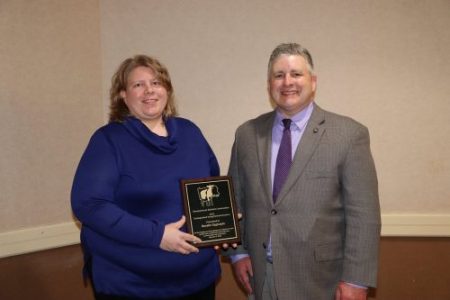
At the 2022 Wisconsin Holstein Convention, IPS Owner and CEO Ron Sersland received the Marlowe Nelson Distinguished Service Award. Ron grew-up on a dairy farm near Decorah, IA and has remained involved in the dairy industry his entire life. He has worked in the A.I. industry for about 35 years and has been the owner and CEO of IPS for the last 25 years.

Currently, Our Help, Inc. is owned by Ron and his wife, Nelly Sersland. Nelly has played a key role over the past 20 years of IPS as a hostess for countless international visitors. IPS has shipped semen to over 40 different international countries. It is very rewarding for Ron to see milking daughters from IPS bulls performing well around the world. Ron and Nelly have a daughter, Bailey.

Since 1986, Ron has been involved in international business and travel and is fluent in Spanish and Portuguese. In 1991, Ron and Sandy Sersland began Our Help, Inc., as a part-time business to help international customers acquire items difficult to find outside of the United States. Unfortunately, Sandy passed away in 1994. Ron grew this business and purchased 50% of International Protein Sires in 1999 from its founders, Marlowe Nelson and Alvin Piper. A year later, Ron became the 100% owner of IPS. This award is particularly meaningful for Ron, as it is named after one of the two founders of IPS, Marlowe Nelson. Genetics and IPS is the main focus of Our Help’s business, which is celebrating its 30th anniversary.

Congratulations to Ron on receiving this prestigious award. Thank you for your contributions to the dairy industry around the world.

Provided by International Protein Sires

Champion Monica New World Record for Fat and Protein

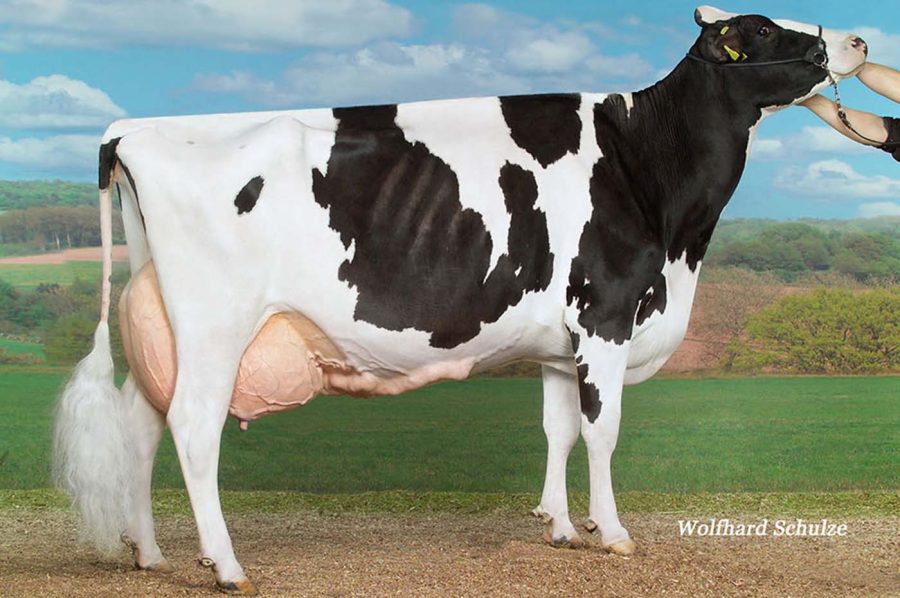
Every farmer who breeds Holstein cows aims to have cows with high lifetime productions in the barn. The Burgstallers from lower Austria have been enthusiastic Holstein breeders for many years and are successful at regional and national cattle shows. Last week, one day before her 18th birthday, Champion Monica EX-93 (pictured) become the new world record holder. Bred from the Matt Mistys, she broke the 20-tonne barrier for fat and protein production. The impressively vigorous and exceptional cow of Klaus Burgstaller from Austria has produced more than 232,386kg/512,323lb 4.98% 3.66% (20,073kg/44,253lb F&P). No Holstein has ever achieved a higher lifetime production for fat and protein. Monica could also threaten the long-standing record for milk production, currently held by Gillette Smurf. For that world record (247,711/546,109lb) she is short just 15,325kg/33,786lb.  

Records are not only achieved in the Burgstaller family’s stable because the overall performance in Lower Austria is also top. Also, the performance of the Holstein herdbook cows with full qualification has increased again. With 9,266 kilograms of milk, Austria is again the leader and has now reached the level of German dairy farms. But even when it comes to the ingredients and thus also to the fat and protein kilograms, Lower Austria is represented in the top field with 682 FEKG. Compared to other breeds in the association area of ​​NÖ Genetik, the average Holstein cow produces around 120 kilograms of fat and protein and 1,800 kilograms of milk more. At a milk price of 35 cents, this corresponds to around EUR 630 more per cow and year. These performances coupled with the good forage efficiency that this breed can show absolutely speaks for the fact that the Holsteins are economically really competitive compared to dual-purpose breeds. The lifetime production of the Holsteins also speaks for it, so this year we have 21 new 100,000 liter cows in Lower Austria. But these masterpieces are only possible with a good conformation and this is currently confirmed by 9 cows that are classified with the predicate EXCELLENT, i.e. with 90 points or more. This means that excellent breeding work is being done on the Holstein breeding farms in Lower Austria, for which one can only congratulate.

‘Forever chemicals’ contaminate milk on Maine dairy farm

A farm in Albion has discovered harmful forever chemicals in some of their products.

Late last week, the owners of Misty Brook Farm found out some of their cow milk was contaminated with PFAS.

Now they’re waiting for test results from the state.

Until then, they can’t sell their milk.

Misty Brook Farm is an organic family farm where owners Brendan and Katia Holmes produce and sell everything from meat and eggs to grains and milk.

“It’s important for farms like us to be here in this state,” Katia Holmes said.


After seeing PFAS contamination cases across the state, they took it upon themselves to test their own farm.

They found high levels of forever chemicals in the milk.

They say it came from hay they bought from an outside farm.

“And that is what we believe contaminated our cows,” Brendan Holmes said.

They pulled all their products from the shelves of 35 local grocery stores.

“At first, it was kind of a bit of disbelief because we really thought we were producing the highest quality product we could,” Katia Holmes said.

“And you feel bad when somebody calls you, leaves a message wondering what to do because they’ve been feeding it to their two-year-old,” Brendan Holmes said.

On Tuesday, the state will do more testing on the farm.

Those results will take four to five weeks, and it will take about a year to get the chemicals out of their cattle.

In the meantime, they plan to buy clean cattle and hay, but the bills keep piling up.

A farm in Albion has discovered harmful forever chemicals in some of their products. (WGME)

“We need assistance now,” Brendan Holmes said. “We need money now.”

They say they could run out of money in a week and half.

“It’s not about the stress of not being able to pay our bills for us, it’s more trying to get the message out there,” Katia Holmes said.

In Augusta, lawmakers are working on a bill that would prohibit contaminating soil with these chemicals.

Representative Bill Pluecker issued a statement about the issue.

When we buy land and start a farm it is with the faith that the land is strong and healthy and that we can build our families and businesses in cooperation with the land. When we find out that the soil and water are contaminated by actions that happened decades before we started our businesses, that our families might have been hurt by the land, it is like getting the rug pulled out from under us.

As a State, we depend upon our clean land and water for our businesses and food. We must take all actions possible to prevent it’s contamination from PFAS and protect our farmers who have been affected.

1911 begins this work, and I am proud to do the hard work of preventing the further contamination of our agricultural lands.

“This is an issue that I know all too well,” Environmental Protection Agency Administrator Michael Regan said.

The problem is even getting the attention of the EPA.

“There is $8 million in the bi-partisan infrastructure law that focuses specifically on contaminants like PFAS,” Regan said.

“We are not the only farm,” Katia Holmes said. “We’re not going to be the only farm. This is a much bigger problem.”

Even before the state sent them a cease-and-desist letter, the farmers pulled their product from the shelves.

Source: WGME

UK dairy farmers frustrated by poor welfare shown in TV report

Dairy farmers have reacted with dismay to a BBC Panorama programme shown on Monday (14 February) – A cow’s life: The true cost of milk – which showed examples of poor welfare practice on an unidentified Welsh dairy farm and linked it to poor margins for primary producers.

Much of the programme was filmed by an undercover representative of animal rights group Animal Equality.

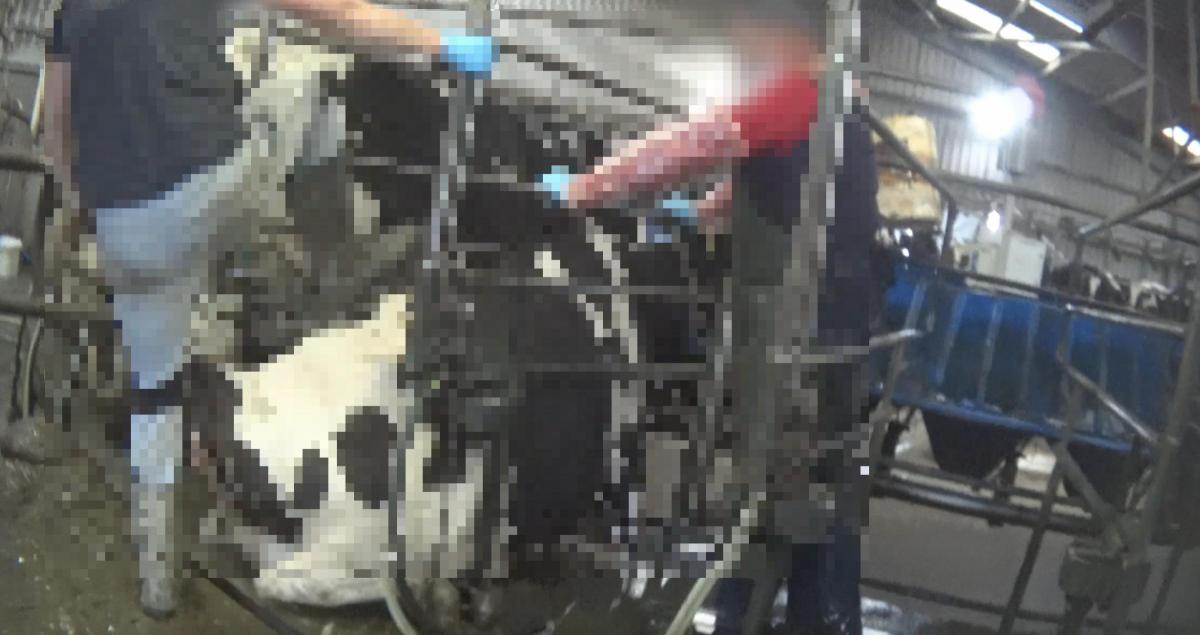
The programme included scenes of calves being tipped out of a tractor bucket, cows being repeatedly kicked and punched, a dying cow left for 24 hours before a slaughterman arrived, and another “downer” cow partially raised on a telehandler and dragged across concrete to a straw bedded area.

Calf separation

More generally, the programme discussed the issue of calf separation – with experts explaining that this was better done sooner rather than later – and lameness resulting from high milk production and long-standing times.

Farm vet Roger Blowey told the programme: “It would be unusual to find any herd without lameness” and suggested lifting cows on a hoist was “common practice”.

There was a degree of “emotive” language used, for example the lines “little of that milk is destined for her own calf” and “the calves are unlikely to see their mothers again”.

The programme also contrasted “standard” dairy production with practices at The Ethical Dairy  in Scotland, where calves are kept with their mothers for five months, the cows are milked once a day, and premiums are made from converting the milk into cheese and ice cream.

It also suggested the poor welfare on show was the result of low prices and tight margins. It noted that the Welsh farm in question – which was Red Tractor assured – sold its milk to Freshways, reportedly one of the lower payers.

Presenter Daniel Foggo calculated that a 2m litre dairy herd selling to one of the top five payers over seven years would have earned £240,000 more.

NFU Cymru deputy president Abi Reader told the programme that even an extra 1p/litre would enable the farmer to invest in better care facilities.

Farmer reaction

Farmers reacting to Panorama have been quick to condemn the poor welfare practices shown, but have been adamant that it is not representative of the vast majority of dairy farmers in the UK.

Taking to social media, herdsman Rob Pooley tweeted: “So disappointed by the #BBC they have shown the vile actions of those workers on dairy farms shown, but yet they won’t show the 99% other dairy farms in UK producing quality milk with the best animal welfare in the world please everyone don’t think that’s the norm #Panorama”

Pembrokeshire dairy farmer Steve Evans also urged: “Don’t tar all farmers with the same brush. I’m as appalled as you are about the abuse on that farm and hopefully there will be prosecutions.”

Cumbrian cheesemaker Martin Gott observed on Twitter: “Yes cruelty happens on some farms, it’s never right. In my experience it’s far from the norm and actually becoming rarer.”

And Sussex dairy farmer Phil Nash, replying to a viewer who described the Panorama programme as “the last straw”, tweeted: “Please don’t think this is every dairy farm Eve, on our farm we respect and care for our cows, this is a tiny minority.”

Animal Equality response

Animal Equality, however, has challenged this. “We have investigated four UK dairy farms over the past six years and found violent treatment of cows and/or illegalities on each one. It is never the case of just one farm or worker being a ‘bad apple’,” it said in a statement.

The group’s lawyers have submitted an official letter of complaint to Carmarthenshire County Council, the local authority where the farm featured on Panorama is based. “We are urging for the farm to be prosecuted and held accountable for its crimes.”

It has also launched a petition calling on government to implement a licensing system for farms, to increase farm inspections and to better protect farmed animals.

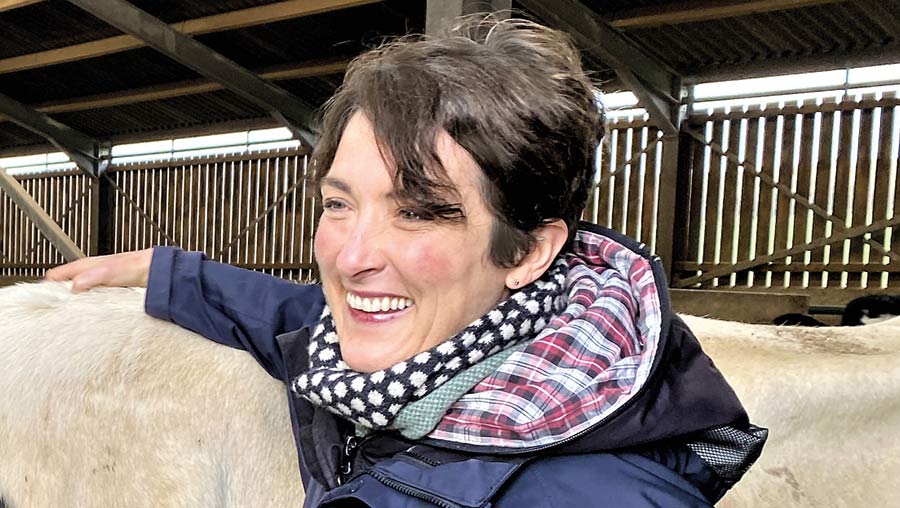
Opinion: Amy Jackson, Oxtale Communication, food and farming PR professional

Amy Jackson

© Amy Jackson

Following tonight’s Panorama, I think it’s time for those of us professionally involved with animals to take a long hard look at these exposés and decide this will not be tolerated in any form. Society will not, cannot and must not accept what we are seeing, and neither should we.

We know Red Tractor and supply chain standards do a good job generally, but they cannot monitor farms 24/7. If we want to build trust in what we are doing, we need to think about how we can increase accountability, increase transparency, and clearly act on what we find.

At a recent conference, a large US dairy business outlined its use of an independent company to install CCTV and monitor it, flagging areas of concern back to the farm so incidents and remediation could be tracked. If this was affordable and doable, would UK farmers consider it?

Cow-calf separation is a very tough one to solve, and it’s a shame Panorama glossed over the huge challenges farmers must overcome to make it work and the higher returns you need. But let’s at least talk about what we are trying to do while research and innovation keeps working on solving it

Bottom line – these and other actions are going to be really important if trust is to be built. Society is changing and people care. Many want to support dairy, so let’s help them.

First, there are unacceptable practices that need to be called out and stopped. Zero tolerance.

Then there’s the shoddy stuff – tired people, poor training, lack of support and sloppiness which need to be spotted quickly and remediated before they become standard practice.

Then there are things we need to change to modernise the industry and make it fit for the 21st century – demonstrating the care and respect animals deserve, that people want to see.

It means supply chains and retailers working collaboratively with farmers so they have the resources and abilities to do their best. It means end customers paying what’s needed to ensure investment can get back on farm. it means all the supply chain taking responsibility and doing better.

But most of all, it starts with the industry saying “no more, not in our name”.

Source: fwi.co.uk

Outside Deri third German two-hundred-tonner

The 17-year-old cow Deri from Grünefeld Holsteins from Backemoor (Eastern Friesland) has achieved a lifetime production of 200,000 kg of milk. She is the third cow in Germany to pass this special milestone. With that, Deri is the only active German cow with such a high lifetime production.

Deri, classified with 87 points, was born in November 2004 and is a daughter of the Canadian bull Comestar Outside. She is not an unknown cow in Germany. In 2018, for example, she was presented at the Excellentschau in Leer, where she was honored as the cow with the highest lifetime production ever to appear at the inspection.

In 2020, Deri finished second in the election of the ‘best economic utility cow’ of the association ‘Arbeitsgemeinschaft Lebens Linien’. At that time, she had already produced 174,000 kg of milk. On this occasion, her owner – who milks 250 cows with robots – described his favorite as a “unobtrusive, trouble-free cow who has rarely seen the vet in her life and almost always got pregnant on the first insemination.”

The third German two-hundred-tonner comes from a cow family that has proven its breeding power with several AI bulls, including Jocko Besne son Jardin, who is also used in the Netherlands. The eldest daughter of Deri – whose father is Boss Iron – has also produced more than 100,000 kg of milk in her lifetime.


Dairy workers rally for more rights after Mills vetoes farmworker unionization bill

Just weeks after Gov. Janet Mills issued a highly controversial veto against a bill that would have allowed farmworkers in Maine to unionize, dairy workers rallied outside Hannaford headquarters in Scarborough to demand more rights.

Workers from the advocacy group Migrant Justice on Saturday were calling on the supermarket conglomerate to join their “Milk With Dignity” program. If the chain becomes a member, farms involved in the production of Hannaford-branded milk will be legally required to follow a set of worker-created standards for improved housing, wages, health and safety conditions. 

Addressing the crowd, Rep. Thom Harnett (D-Gardiner), the sponsor of LD151, which would have allowed farm workers in Maine the opportunity to unionize and collectively bring employment concerns to their bosses without fear of retaliation. 

“Just two weeks ago, the governor of Maine vetoed a bill passed by the House and Senate that gave workers the right to talk to one another, to better their lives, to increase their wages,” Harnett said. “And she said no. And that is wrong. In Maine and Vermont, farm workers are considered essential, but they’re not even considered employees under the law.”

Rep. Thom Harnett addresses the crowd at Hannaford headquarters in Scarborough on Feb. 13, 2022. | Nathan Bernard, Beacon

Mills’ veto was decried by labor advocates at the time as being “fundamentally immoral” and an “absolute disgrace.”

Since the 1930s, farmworkers and most domestic laborers—disproportionately workers of color—have been excluded from federal labor protection laws affording them the right to earn minimum wage, get paid overtime and form unions. As a result, almost a quarter of farm workers in the U.S. still earn less than minimum wage.

Maine dairy workers face similarly bleak working conditions. Migrant Justice previously reported that Maine dairy workers and their families suffer from brutal winters without heat, working for under minimum wage and laboring seven days a week for long hours without a break. In other instances, Maine dairy workers and their families were kicked out of their homes after refusing to work while sick with COVID.

“We’ve been working throughout the pandemic, because we can’t stop. We have to provide for our families and we could lose our jobs,” Emilio, a dairy worker, said at the rally. “But Hannaford hasn’t recognized that hard work throughout the pandemic. That’s why we’re here to speak to their faces. Just like we work everyday on the dairy farms, we are fighting everyday for milk with dignity.”

Milk With Dignity was first conceived in 2009 after young dairy worker José Obeth Santiz Cruz was pulled into a mechanized gutter scraper and strangled to death by his own clothing. Three years ago, Ben & Jerry’s signed on to the group’s pilot program. Working and housing conditions for their more than 250 dairy farm workers have improved as a result. 

“In Maine and Vermont, farm workers aren’t entitled to the minimum wage, they don’t get overtime even though they work 60, 70, 80 hours a week,” Harnett said. “In Maine and Vermont, farmworkers can’t unionize. They can be fired for talking to their bosses about bettering their lives and working situations. It is because of laws like that that farmworkers are treated as less than. Less respected, less valued, less than human, and that is wrong.”

Mills’ veto of LD151 is among the executive actions she’s taken against pro-worker bills. In 2021, the conservative Democratic governor vetoed six labor bills. Those policies include giving harassed workers access to the court system, providing bargaining power to public-sector unions to settle wage disputes, and requiring public construction projects to be made with American materials. In 2019, Mills also threatened to veto several other major pro-worker bills, such as a paid time off law.

“I know the change we need is not happening in state capitals, it is only going to happen when the people get together and make that change,” Harnett said. “That is why today I’m proud to stand in solidarity with my brothers and sisters from Migrant Justice and Milk With Dignity to tell Hannaford to do the right thing.” 

“We are asking Hannaford to recognize and say out loud that farmworkers have human dignity and rights, that they deserve to be treated like human beings. We cannot accept anything less, we will not accept anything less,” Harnett added. “Today we stand together, today we demand change.”

Source: mainebeacon.com

In a La Nina winter, brace for impact

The National Oceanic and Atmospheric Administration released its winter outlook for the next few months, and another La Nina weather pattern of warmer and drier conditions is likely to occur in parts of the US, but don’t be fooled into thinking it’s going to be a mild winter.

State Climatologist Gary McManus advised against letting mild predictions fool people into thinking ice, snow and extreme cold won’t happen. Last year’s La Nina winter began with an ice storm in October and ended with a deep freeze in February.

“The subzero temperatures we saw last year for an extended period of time haven’t been recorded in Oklahoma since 1983,” he said.

McManus said storms are possibly sticking around longer than usual thanks to a weakening of the jet stream combined with stubborn weather patterns downstream.

“A blocking pattern in the Atlantic Ocean causes high pressure systems to stick here in the middle of the country, and the jet stream slows,” McManus said.

So how do livestock owners plan for a mild winter that could include severe ice, snow and cold? Evaluating the impact of last year’s weather is a good first step.

“The ice storm in late October of 2020 came as a surprise and limited stockpiling of warm-season grasses for use later in the winter along with wheat pasture growth in crop fields,” said Paul Beck, an Oklahoma State University Extension specialist in beef nutrition. “The limited amount of available forage was a good lesson in setting aside forage during early fall and having extra hay for when things don’t go according to plan.”

While Beck said cattle had time to regain any losses in body condition suffered from the second winter storm in February, a bigger concern was the short-term lack of water. Stock tank heaters and tools to break ice on ponds were in short supply during the extreme cold snap, and producers lost livestock due to drowning or hypothermia after falling through pond ice. The cold stress also took its toll on herd sires, reducing fertility in bulls that were exposed to subzero temperatures and frostbite.

“Producers who do not conduct breeding soundness exams on their herd sires may not realize the reduced fertility effects until they conduct pregnancy tests this fall or discover open cows next spring,” said David Lalman, OSU Extension beef cattle specialist.

Boosting nutrition requirements and providing shelter from the elements can greatly alleviate the impact of cold stress and decrease livestock loss. Daily access to water while feeding extra hay and supplement in a covered area — such as a man-made windbreak, a line of round bales or a stand of cedar trees — will help maintain a cow’s milk production and stabilize a bull’s fertility.

“The lowest temperature a cow in good body condition with a good winter coat can be exposed to before her nutrition needs increase is 20 degrees,” Beck said. “The lowest temperature for a thin cow with short hair is 40 degrees.”

If severe cold or precipitation is short-lived, producers should remain consistent with their livestock’s balanced nutrition program. When a radical weather change is expected, avoid digestive upset by modestly increasing energy and protein availability to help cattle maintain their body heat and condition.

“For example, in the case of cattle grazing winter pasture, high-quality hay could be put out ahead of the storm,” Lalman said. “If 4 pounds of 20% protein cubes are being fed, perhaps increase the feeding rate to 5 pounds prior to and during the storm.”

Wind chill is often a bigger threat to cattle, especially calves, than temperature. Many of the calves who survived the extreme cold last winter have the scars to prove it with frostbitten ears and noses because they lacked the capability to maintain body temperature at such a young age.

Dr. Rosslyn Biggs, OSU Extension veterinarian and director of continuing education for the OSU Center for Veterinary Medicine, recommended evaluating cattle herds now to make culling decisions that can improve the welfare of not only an individual animal but also the entire herd.

“Animals in poor or thin body condition need to be placed on an increased plane of nutrition to address additional demands as we enter winter,” she said.

Once the first storm arrives, producers should have extra feed on hand, provide as much cover from the elements as possible and watch for changes in animal behavior.

“It’s easy to rush through feeding and chores when the weather is poor, but we should always be focused on monitoring our animals closely and taking the extra moments to evaluate for signs of illness,” Biggs said.

Paul Beck advises how to adjust cattle nutrition programs during a long-term winter weather event in this episode of the agricultural television show SUNUP.

Source: thedairysite.com

Fonterra, NZX And EEX Enter GDT Partnership For Future Growth

Subject to the approval of Boards, clearance from European or any other relevant competition law authorities, and finalisation of transaction documentation, the partnership is expected to be completed mid-2022, with Fonterra, NZX and EEX each holding an equal one-third (33.33%) shareholding in the global dairy auction platform.

Fonterra Chief Executive Miles Hurrell says the move to a broader ownership structure marks the next step in the evolution of GDT – further enhancing the standing of GDT as an independent, neutral, and transparent price discovery platform, giving it a presence in prominent international dairy producing regions, and creating future growth opportunities.

“This is good news for our farmer owners, unit holders, and all dairy industry participants and is expected to lead to greater volumes being traded on GDT. It will bring more participants and transactions, stimulating further growth of risk management contracts available on financial trading platforms.

“We all know that dairy is one of the most volatile traded commodities,” he says. “This partnership is another step in helping to manage this risk for everyone – from the farmer through to the customer at the end of the supply chain. A more liquid dairy trading environment allows for the growth of financial tools which can be used by all participants to better manage price volatility.

“Our focus has been about securing the best partners, and NZX and EEX share our vision for a stronger, more liquid auction platform that benefits all involved. We are also closely aligned on future possibilities for GDT as the world’s most trusted reference point for dairy commodity prices.”

NZX Chief Executive Mark Peterson says the price discovery that GDT provides the international dairy industry is crucial for dealing with volatility and its associated risks.

“We see the expansion of the physical trading environment as both further strengthening existing financial contracts and enabling the creation of new tools and opportunities for dairy processors and end-users to manage price volatility. These offer clear benefits for New Zealand dairy farmers and customers around the world,” he said.

EEX Chief Strategy Officer Dr Tobias Paulun says “becoming a shareholder of Global Dairy Trade is perfectly in line with the EEX strategy of taking asset classes which we already successfully serve to a global dimension. With our experience in operating Europe’s leading trading platform for dairy futures, but also with multiple spot contracts in the energy space, we believe that we can be of value supporting GDT’s growth vision.

“At the same time, we can create value for the global dairy value chain by further improving price discovery and price risk management instruments.”

GDT Director Dr Eric Hansen says “GDT is excited that the addition of NZX and EEX as shareholders alongside Fonterra will enable us to build on our success in establishing a global brand and expertise in price discovery to create more opportunities for our customers.

“The strong alignment of all three shareholding partners to GDT’s purpose of credible price discovery will support initiatives to increase liquidity on GDT, attract new supply from prominent dairy producing regions, and will strengthen GDT’s linkages to financial trading platforms.”

About Fonterra

We’re an Aotearoa, New Zealand dairy co-operative owned by 10,000 farming whānau (families). Through the spirit of co-operation and a can-do attitude, Fonterra’s farmers, along with 20,000 employees around the world, share the goodness of our milk through innovative consumerfoodservice and ingredient brands. Sustainability is at the heart of everything we do, and we’re committed to leaving things in a better way than we found them. Everyday people working hard to be Good Together in the community.

About NZX

For more than 150 years we have been creating opportunities for Kiwis to grow their personal wealth and helping businesses prosper. As New Zealand’s Exchange, we are proud of our record in supporting the growth and global ambitions of local companies. NZX operates New Zealand’s equity, debt, funds, derivatives and energy markets. To support the growth of our markets, we provide trading, clearing, settlement, depository and data services for our customers. We also own Smartshares, New Zealand’s only issuer of listed Exchange Traded Funds (ETFs), and KiwiSaver provider SuperLife. NZX Wealth Technologies is a 100%-owned subsidiary delivering rich online platform functionality to enable New Zealand investment advisors and providers to efficiently manage, trade and administer their client’s assets. Learn more about us at: www.nzx.com

About EEX

The European Energy Exchange (EEX) is the leading energy exchange which builds secure, successful and sustainable commodity markets worldwide – together with its customers. As part of EEX Group, a group of companies serving international commodity markets, it offers contracts on Power, Natural Gas and Emission Allowances as well as Freight and Agricultural Products. EEX also provides registry services as well as auctions for Guarantees of Origin, on behalf of the French State. More information: www.eex.com

About GDT

Global Dairy Trade (GDT) is the world leader in developing and operating dairy trading platforms, and actively supports the development of efficient dairy derivative trading. Our GDT Events auction service is the world’s pre-eminent price discovery platform for globally-traded dairy products, bringing together buyers and sellers of dairy ingredients from 70 countries to trade US$2-3 billion annually. GDT’s credible, market-based reference prices play an important role in allowing buyers and sellers to trade with confidence in global and regional dairy markets.Data generated from the auction process is available through our GDT Insight subscription service to support the global dairy industry and associated financial trading.

Canadian alliance aims to improve dairy competitiveness, sustainability

Dr. Gisèle LaPointe will lead the five-year initiative

A newly funded, $6.1-million project headed by the University of Guelph in Canada aims to ensure environmental sustainability while strengthening Canada’s dairy industry.

Led by Dr. Gisèle LaPointe, a professor in U of G’s Ontario Agricultural College, will lead a five-year initiative in dairy microbiology involving nearly 50 U of G researchers and students as well as five leading partners in Canada’s $20-billion dairy industry.

The Dairy Alliance will receive $3.5 million from the Natural Sciences and Engineering Research Council and a total of $2.6 million in funding and in-kind support from Dairy Farmers of Ontario, Dairy Farmers of Canada, Novalait Inc., Lactalis Canada and Lallemand Inc.

The alliance is intended to bring together experts from the University’s OAC and Ontario Veterinary College to ensure dairy product quality through improved control of microbial ecosystems from production to processing, said LaPointe.

“Farm management practices have impacts on the types of microbes that are transmitted to milk, which in turn influence processing and the shelf life of the products,” she said.

The project’s findings will feed into Canada’s National Dairy Research Strategy, which aims to support continuous improvement in the sustainable production of quality, nutritious dairy products.

Source: thedairysite.com

UK dairy farm under investigation after distressing Panorama scenes

A Carmarthenshire farm is facing investigation after its cows were filmed being punched, kicked and hit with metal shovels.

Following Tuesday’s distressing edition of Panorama, where millions of viewers were shown footage which had been filmed covertly by an international animal protection organisation Animal Equality, a spokesperson at Carmarthenshire County Council’s animal health department confirmed that an investgation is now underway at Madox Farm, near Trelech.

“This showed some of the most alarming animal neglect and abuse that I’ve ever encountered,” commented leading veterinary surgeon Marc Abraham, OBE, following Tuesday’s programme. 

“There are a number of concerning incidents where appropriate medical care was not provided to sick, lame and injured cows, as well as several occasions where cows were struck violently and repeatedly.  There is no doubt in my mind that these cows would have suffered significantly and that their prolonged pain was entirely avoidable.”

Meanwhile, Excutive Director of Animal Equality Abigail Penny is urging the authorities to hold the farm accountable for what she describes as it’s “abusive actions towards animals”.

She said:

“A conviction of cruelty won’t help those cows who were brutally beaten or left to die in agony overnight, but it will send a strong message to this industry that the UK will not tolerate such cruelty.

“We’re fed a fairy-tale about dairy farming, but the reality is far darker. Consumers are being conned.”

The Panorama footage was filmed in late 2021 by an Animal Equality investigator over several months, where workers were seen kicking and punching cows in the face and stomach, and hitting them with sharp, metal shovels. It also shows cows that were unable to stand being lifted by their hips and dragged against the concrete floor.

The farm supplies milk to Freshways, the UK’s largest independent dairy processor and wholesaler and which distributes dairy products to a number of established retailers and businesses, including Costa Coffee, British Airways, Londis, Budgens and P&O Cruises.

Freshways also supplies Morrisons’ wholesale operation, which supplies products to restaurants, cafés and Amazon Fresh.

But according to Animal Equality, the Madox Farm incident isn’t isolated.

Over the past six years Animal Equality UK has investigated four dairy farms and has uncovered what it says is prolonged animal suffering, deliberate abuse and neglect, or illegality taking place on each one. 

Animal Equality UK says up to 50 per cent of dairy cows suffer from painful infections, such as mastitis, due to the unnatural milk yields that place strain upon their udders.

The dairy industry produces 15 billion litres of milk annually, worth £9.2 billion to the economy while the average yield for a dairy cow is 40 per cent higher than it was 30 years ago – around 23 to 24 litres a day.

Cows used for dairy in the UK are typically sent to slaughter at three or four years old for cheap beef as they are considered ‘spent’ by the industry due to their reduced milk production.

Meanwhile the legal firm Advocates for Animals has submitted a complaint on behalf of Animal Equality UK to Carmarthenshire County Council. 

Edie Bowles, solicitor at Advocates for Animals, said: “The treatment of cows at Madox Farm is in clear contravention of the law. Not only are there incidents of direct violence towards cows, there is a culture of neglect and substandard care causing gross suffering, all of which is contrary to the Animal Welfare legislation.”

Lawyers for Madox Farm, where the filming took place, told BBC Panorama that if workers had abused cows, a disciplinary process would begin immediately. They added that the farm owner continues to invest in the health and welfare of his herd.

Source: tivysideadvertiser.co.uk

Wingham dairy farmer Ben search for love in Farmer Wants a Wife films in Taree

Reality drama Farmer Wants a Wife has taken a multimedia approach to finding love this season.

The women keen to capture the heart of NSW Mid-North Coast Wingham dairy farmer, Ben, took to the airwaves at a Taree radio station recently.

The show, now in its 12th season, teamed up with a local station for some radio presentation training with 2BOB’s Rosie Herberte.

Then 2BOB presenter John Cooper will put them to air playing a song and making a passionate pitch to Ben, who will be listening on the tractor at home on the farm.

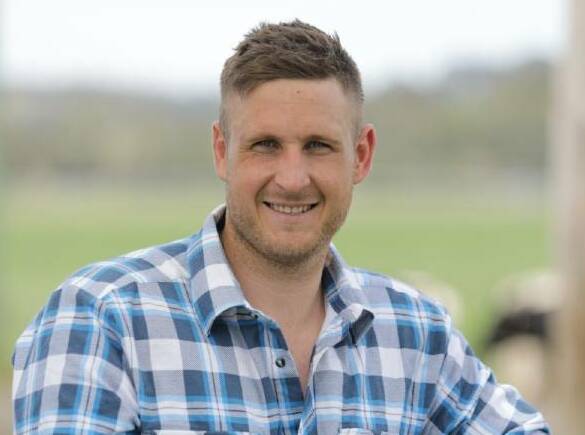
Ben is an eligible 27-year-old with a three-year-old daughter from a previous relationship.

He was born in Bega and went to school in Mount Gambier in South Australia.

He describes himself as a “pretty handy cricketer, loves the outdoors, a day out at the races, and a larrikin who loves a good laugh”.

He is looking for “someone who is caring, loving, honest, sincere, and selfless. A person that is supportive and kind, but not afraid to take charge and speak up”.

Source: Cookwell Gazzette

Tesco and McDonald’s suppliers among food firms ‘at risk of sparking next pandemic’

Two-thirds of the world’s largest meat and dairy firms, including suppliers for Tesco and McDonald’s, aren’t doing enough to prevent the next pandemic, it’s claimed.

Non-profit organisation the Fairr Initiative has scored food industry companies according to their perceived risk of allowing new diseases to emerge.

The report, backed by a World Health Organisation Covid envoy, blames a failure to improve crowded, high-stress conditions in animal agriculture for creating an “ideal breeding ground” for infections.

The companies were rated on conditions for animals, “aggressive encroachment” into wild habitats and labour practices that it claims contributed to the spread of disease among workers.

The research ranked 38 out of 60 animal agriculture firms (63 per cent) as “high risk”, including a Chinese supplier to McDonald’s and Tesco.

None of the seven large meat firms studied, including US giants, planned to extend enhanced sick leave to prevent employees suffering with the coronavirus from attending work, according to the study.

Experts from both the UN and the European Food Safety Authority have previously pinpointed animals or food of animal origin as a starting point for emerging diseases, such as Covid-19.

The UN says factors likely to drive a new pandemic include increased demand for animal protein; a rise in intense and unsustainable farming and the increased use and exploitation of wildlife, as well as the climate crisis.

Last year South African scientists warned that demand for regular supplies of affordable meat would create future pandemics that will make Covid-19 pandemic look like a “dress rehearsal”.

The new report, produced by a multi-trillion-pound investor network FAIRR, marking two years of the pandemic, says the 63 per cent is a slight improvement from 73 per cent in June 2020 but it still showed the vast majority were performing poorly.

Eight of the 10 worst performing companies in the ranking are based in Asia.

When animals are kept in crowded conditions, they are more susceptible to viruses, and the stress lowers their immune systems, allowing pathogens to spread more easily than in the wild.

Regular use of antibiotics creating resistance and lower genetic diversity of animals are other risk factors.

David Nabarro, special envoy on Covid-19 for the World Health Organisation, said: “The emergence of diseases that move between animals and humans has increased markedly in the past decade. 

“Hence the importance of concerted action by governments, sectors, institutions, civil society, indigenous peoples, youth and more, convened by the World Health Organisation, to adapt systems for preventing pandemics and countering the inequity of infectious disease.”

The report recommends regulation to encourage diversification into alternative proteins, among other measures.

Other experts have previously warned the “cocktail” of infections to which chickens are subjected creates a near-perfect breeding ground for a disease outbreak of pandemic potential.

Jeremy Coller, chair and founder of Fairr, said: “The message from the markets is clear: following SARS, swine flu and Ebola, Covid-19 must be a line in the sand.

“Business-as-usual animal agriculture risks incubating the next zoonotic pandemic, posing both an intolerable investment risk and a threat to global public health.

“The sector must improve rapidly, starting with welfare conditions for both animals and workers.”

Alex Burr, of Legal & General Investment Management, said the findings should be a wake-up call for the meat industry.

The Independent asked both Tesco and McDonald’s to comment but the companies had not responded by publication.

Source:  independent.co.uk

3 Tips to Keep in Mind This Calving Season

Calving season is an exciting time for us all as we gear up to welcome our newest calf crop into the world. Help make it the most successful season possible by ensuring adequate colostrum, preventing cold stress, and having a calving kit at the ready.

Tip 1: Ensure Adequate Colostrum  

Calves are born agammaglobulinemic, meaning they have almost no antibodies to protect them against disease. Simply, they’re not born with any immune memory that we develop over our lifetime – they receive those antibodies, an immediate source of immunity, and a very concentrated source of energy from their cow’s colostrum (the first milk produced following birth).

Colostrum delivers some 95% of the antibodies a calf obtains, plus a rich source of minerals, vitamins and energy. It provides protection for newborn calves against infectious agents during the first few months of life.

Colostrum absorbance has a 24-hour window. That short time influences a calf’s lifetime of health and productivity. Because antibodies are very large molecules, the calf’s intestine is only capable of absorbing this protection immediately following birth, with essentially no absorption possible after the first 24 hours. Within the first 12 hours of a calf’s life, ideally within the first four to six hours of life, these calves should receive three to four quarts of colostrum.

Depending on if the calf nurses or not, we might have to tube them and get some colostrum replacers or colostrum supplements into them. Keep in mind, there are colostrum supplements and colostrum replacers, and there is a difference.

Colostrum replacers have roughly double the level of antibodies in them, compared with colostrum supplements. If your calf doesn’t receive any colostrum, then we would recommend giving them a colostrum replacer. Colostrum supplements work well in circumstances where a calf might not have nursed enough, for calves born from heifers, or if you fear the cow’s colostrum quality could be lacking. Colostrum supplements can also offer a very good source of energy, fat and protein to help jumpstart sick calves.

Tip 2: Keep Chilled Calves Warm 

The most severe result from cold stress on calves is death from hypothermia. If at all possible, bring cows indoors to a calving shed or barn to calve in a heavily bedded, clean pen for added warmth and reduced moisture. If calving outdoors, an area mostly free of mud and manure – with a wind break – is ideal. Cold stress and hypothermia can pose great risk to calves, especially if calves experience dystocia, which often results in delayed standing and nursing, both can quickly lower their body temperature.

A cold calf is going to be slow and a little lethargic – they might not want to stand up. If their nose or extremities like their feet or right above their feet feel cold, then most likely they need warming.

Beware the signs of hypothermia, which include:

  • Body temperature below 94° F
  • Shivering
  • Increased pulse and breathing rate
  • Erratic behavior
  • Confusion and uncoordinated gait
  • Cold, pale nostrils and hooves

It’s critical to return the calves to their normal core body temperature of 102°F. There are several ways to do this, such as placing them under a heat lamp, warm blankets, bringing them indoors, or giving them a warm bath (warmed gradually), or putting the calf into a warming box.

I personally find there to be more practical methods than, let’s say, a warm water bath. Let’s face it, often times there’s a lot of moisture, snow and mud. So, after a warm water bath indoors, we have to dry off calves completely before returning them to the cow. The practice can be labor intensive.

There are calf warmers that can dry them off as the unit warms the calf. Another benefit is, when inside the warmer, the calf is actually breathing in warm air, helping to warm them internally, as well. That’s my favorite way to warm a chilled calf.  

As far as when we need to warm them up, I recommend warming if their body temperature falls below 100°F. Producers will also need to consider wind break availability and what current environmental conditions are like. If it’s extreme enough, drying and warming every calf could be necessary.

Tip 3: Have a Stocked Calving Kit  

It’s better to have it and not need it, than to need it and not have it – and that’s especially true as we head into calving season. I recommend having a calving kiton-hand; here are some items I’ve always valued having in mine.

  • Calf resuscitator
  • Calf pulling chains
  • OB handles
  • Stainless steel pail
  • Chlorhexidine disinfectant solution
  • OB sleeves
  • OB lube
  • Iodine or umbilical spray
  • Colostrum replacers and supplements

Continue learning about calving and cattle health solutions at ValleyVet.com, and stay tuned for my next piece on the topic of assisting with calving.

About Valley Vet Supply

Valley Vet Supply was founded in 1985 by veterinarians to provide customers with the very best animal health solutions. Building on over half a century of experience in veterinary medicine, Valley Vet Supply serves equine, pet and livestock owners with thousands of products and medications hand-selected by Valley Vet Supply Technical Service veterinarians and team of industry professionals. With an in-house pharmacy that is licensed in all 50 states, and verified through the National Association of Boards of Pharmacy (NABP), Valley Vet Supply is the dedicated source for all things horse, livestock and pet. For more information, please visit ValleyVet.com.

More than 2,900 entries for the 2022 World Championship Cheese Contest

From March 1-3, the group of 53 international experts will evaluate 2,919 dairy product entries

Less than a month remains until dozens of highly qualified judges from around the world gather in Madison, Wisconsin for the 2022 World Championship Cheese Contest. From March 1-3, the group of 53 international experts will evaluate 2,919 dairy product entries, selecting the best in each class – and the 2022 World Champion.

This year’s judging team includes cheese graders, cheese buyers, dairy science professors, and researchers with more than 700 combined years of experience in the dairy processing industry. They hail from 16 countries and 13 U.S. states. They are:

“The skill, expertise, and knowledge of our Contest judges are part of what make this competition so unique,” said Kirsten Strohmenger of the Wisconsin Cheese Makers Association, host of the biennial event. “Their precise, rigorous evaluation adds meaning and value to the golden Contest seal consumers see on the store shelf, helping to boost sales and drive interest in the winning companies.”

Under the leadership of Chief Judge Jim Mueller, Chief Judges Emeritus Bill Schlinsog and Bob Aschebrock, and Assistant Chief Judges Tim Czmowski, Stan Dietsche, Josef Hubatschek, Mariana Marques de Almeida, and Sandy Toney, the judges will calculate a precise score for each cheese, butter product, yogurt, and dry dairy ingredient entered in the Contest. Products are evaluated on a variety of attributes including flavor, body, texture, salt, color, finish, packaging, and others.

Gold, silver, and bronze medals are awarded to the three highest scoring entries in each of this year’s 141 distinct classes. The World Champion Cheese will be announced live online at WorldChampionCheese.org at 2:00 p.m. (CT) Thursday, March 3.

Dairy Margin Coverage Deadlines and Pandemic Assistance Payment Updates

Today the USDA announced that they have extended the deadline to enroll in Dairy Margin Coverage (DMC) and Supplemental Dairy Margin Coverage (SDMC) for program year 2022. The deadline to apply for 2022 coverage is now March 25, 2022. DMC and SDMC signups opened in December 2021 to help dairy producers manage economic risk brought on by milk price and feed cost disparities. FSA has also updated how feed costs are calculated, which will make the program more reflective of dairy producers’ actual expenses.

How to Sign UpYou must work with your local Farm Service Agency (FSA) service center to sign up for the DMC program by March 25. Click here to find a service center near you.

Background on the DMC Program: DMC offers reasonably priced protection to dairy producers when the difference between the all-milk price and the average feed cost (the margin) falls below a certain dollar amount selected by the producer. Supplemental DMC will provide $580 million to better help small- and mid-sized dairy operations that have increased production over the years but were not able to enroll the additional production. Now, they will be able to retroactively receive payments for that supplemental production.

A Recap of 2021 Payments: Producers who enrolled in DMC for 2021 received margin payments each month, January through November, for a total of $1.2 billion, with an average payment of $60,275 per operation.

Feed Cost Updates: USDA has recently changed the DMC feed cost formula via final rule published on December 13, 2021, to better reflect the actual cost dairy farmers pay for high-quality alfalfa hay. FSA now calculates payments using 100% premium alfalfa hay rather than 50%. In December 2021, following publication of the new feed cost policy, $102 million was paid to producers as a result of the revised high quality alfalfa feed cost formula. The amended feed cost formula will make DMC payments more reflective of actual dairy producer expenses.

Learn More About DMC

Cornell University receives grant to study sustainable milk production

The funding will be used to test a novel strategy to make milk production more efficient, and to communicate animal science to the public

Cornell University has received a four-year, $1 million National Science Foundation (NSF) grant that will be used to help fund a project to test a novel strategy to make milk production more efficient and sustainable. According to a news release in the Cornell Chronicle written by Krishna Ramanujan, a second, related NSF grant of $200,000 will help students and faculty from Cornell and SUNY Cortland to communicate animal science to the public.

For the project’s research component, principal investigator Joseph McFadden ‘03, associate professor of dairy cattle biology in the College of Agriculture and Life Sciences, and colleagues will use $1,021,000 to test whether lipids called ceramides could help improve the efficiency and sustainability of milk production. When cows and sheep use nutrients and produce milk efficiently, they emit less methane, a powerful greenhouse gas.

“Animal foods are nutrient dense foods,” McFadden said. “They’re very important for human health and nutrition.” At the same time, over the last century, researchers have used their understanding of genetics, nutrition and animal management to dramatically reduce the amount of methane that an animal produces per unit of milk, McFadden said.

“It’s important that we let the consumer know that these advancements have existed and they’ve actually helped the dairy industry become more sustainable,” he said. “There’s a perception out there that the dairy industry isn’t doing anything and they’re purposely harming the environment.”

Dale Bauman, professor emeritus of animal science, discovered that recombinant bovine growth hormone, somatotropin, a key contributor to how milk is made, involves a physiological process called insulin resistance. The hormone insulin helps regulate blood sugar, while also affecting fat and protein metabolism. Insulin resistance in early lactation rises in order to deliver the proper nutrients for making milk. McFadden and colleagues discovered early evidence that ceramide may cause insulin resistance and promote milk production in ruminants.

With the grant, the group will test how somatotropin promotes milk production and whether it depends on ceramides. In part two of the study, the group will test a new recombinant protein they hope will increase ceramide levels in the animal.

“If that’s the case, [the sheep or cow] should be more insulin resistant and make more milk,” McFadden said.

The project’s outreach component, led by Amanda Davis, a former member of McFadden’s lab who is now an assistant professor of biological science at SUNY Cortland, is funded by the National Science Foundation Research Experiences for Undergraduates (REU) program, which supports research activities by undergraduates in NSF-funded areas.

More than 60 students and faculty from Cornell and SUNY Cortland will take part in science communication training led by staff and youth program coordinators at the Sciencenter, a hands-on museum in Ithaca. Ultimately, Cornell students and SUNY Cortland NSF REU researchers will apply what they learned about sustainable food animal production to inform the public on these issues. The students will also hold a public outreach event at local summer festivals and the state fair.

McFadden will also teach a course, Communicating Animal Science, which includes using social media and producing episodes for the podcast, Ruminate on This, to inform the public on issues concerning ruminants, such as cows and sheep. When McFadden taught the course last fall, students investigated consumer decisions about plant-based milk alternatives, surveyed members of the public at Trader Joe’s and Wegman’s on their choices, and then interviewed scientists to identify and address misconceptions. The results of their research and interviews will end up on the podcast in the near future.

Source: thedairysite.com

The Impact of COVID on Dairy Products

This post will examine the changes in the use of producer milk brought on by COVID mandates and guidelines.  Five year trends will be addressed on the following products.

  • The impact on fluid milk
  • The impact on cheese
  • The impact on ice cream
  • The impact on yogurt
  • The impact on butter
  • The impact on milk production

To prevent the spread of COVID, mandates and guidelines were issued causing lifestyle changes.  The most impactful change was the “stay at home” program.  The “stay at home” program meant that most everyone was buying food from grocery stores and eating at home.  Restaurant business declined.  This change had a major impact on dairy products and consumption. The data is this post are based on 12-month moving averages from 2017 through 2021.

FLUID MILK – Chart I

In the January 2  and January 30 posts, fluid milk was reviewed.  Fluid milk has been on a steady decline for decades.  However, in March 2020, fluid milk sales jumped to 4,242 million pounds an increase of 330 million pounds compared to the prior year.  Grocery shelves were often empty, and processing plants and truckers were stretched to keep up with the demand.  In Chart I below which graphs the 12-month moving averages, there is a black dotted straight line.  It is not a trend line; it simply illustrates the decline over 2017 through 2019 extended to the end of 2021.  Dairy headlines in 2020 were positive because fluid milk sales were increasing, but that “bubble” has largely disappeared by the end of 2021.  The gains were typically attributed to people eating cereal at home with milk.  It appears that the increase of a breakfast of cereal with milk has largely disappeared.  By the end of 2021, milk sales were down, approaching the level as if “stay at home” never happened.

Chart I is based on sales, not production.  Other charts in this post are based on production.  In the case of fluid milk, production and sales are closely linked, due to the short shelf life of fluid milk.

Chart I – Fluid Milk Sales

CHEESE – Chart II

Cheese followed a different route from fluid milk.  When COVID hit and people were discouraged from eating in restaurants and encouraged to “stay at home,” they bought food from grocery stores, not restaurants. Cheese for grocery stores is packaged very differently from cheese packaged for food service sales.  The type of cheese also varies.  This caused a major and immediate impact on cheese processing and distribution.

Cheese production had very nice increases in 2017 and 2018 growing by about three percent annually.  The slowdown in cheese production started in early 2019 and lasted through 2020.   For these two years, the increase in cheese production was only about a half percent annually.  In 2021, production of cheese has again started growing at the same rate as in 2017 and 2018, increasing by about three percent annually.

Chart II – Cheese Production

ICE CREAM – Chart III

Ice cream production follows the theme that when told to “stay at home,” eating habits change.  Starting in midyear 2020, production of ice cream jumped by eight percent!  This must mean, that when we stay at home, we eat more ice cream!  However, by the end of 2021 most of the gains were gone and the trend is for further reductions.  Ice cream is a major butterfat user so lower ice cream production will require less butterfat, making it available for butter churning.

Chart III – Ice Cream and Sherbet Production

YOGURT – Chart IV

After years of significant growth, yogurt was in a decline by 2017.  As COVID and “stay at home” emerged in March of 2020, sales reversed and instead of a decline, yogurt production grew by 11 percent between March 2020 and the end of 2021.  Unlike ice cream, yogurt production has continued to grow through 2021.  It appears that COVID forced more trial of yogurt and has changed consumer habits, at least temporarily.

Because much of yogurt is reduced fat or no fat, yogurt does contribute to the pool of butterfat for other products like butter and ice cream.  However, the impact is small compared to the amount of butterfat harvested from fluid milk.  (See the January 30 post to this blog for more details on butterfat removed from fluid milk.)

Chart IV – Yogurt Production

BUTTER – Chart V

Butter production is a little confusing.  From 2017 through early 2020, butter production was growing at a little over one percent annually.  When COVID “stay at home” policies were implemented, butter production grew by nine percent in one year.  Since then, production has decreased noticeably.  From March of 2021 to December of 2021, butter production dropped by over three percent.  Is this just a “return to normal?”  Probably

The data suggests that when we stay home, we eat more butter.  Once the impact of COVID declined, the consumption of butter declined.  This is contrary to the what has been in the press and in this prior blog post, stating that butter production had decreased due to a lack of milk and logistic issues.  By comparison, there was a significant increase and no drop in cheese production in 2021.

Chart V – Butter Production

PRODUCER MILK PRODUCTION – ChartVI

From the start of 2017 to March of 2020, milk production was growing at just over one percent annually.  For the next 12 months, starting in March 2020 milk production grew by over 1.5 percent.  In the last half of 2021, milk production has plateaued.  Is this just another return to normal?

Chart VI – Milk Production


WHAT DOES ALL THIS SAY?

COVID and “stay at home” had a significant impact on the dairy industry by every metric explored in this post.  COVID did not end in March of 2021, one year after the start, but dairy statistics indicate that eating habits and dairy consumption headed back to near normal.  The only statistic that seems to have retained the COVID impact is yogurt, and that category is very small compared to overall dairy statistics. 

Source: milkprice.blogspot.com

Maine dairy workers rally for more rights after Mills vetoes farmworker unionization bill

Just weeks after Gov. Janet Mills issued a highly controversial veto against a bill that would have allowed farmworkers in Maine to unionize, dairy workers rallied outside Hannaford headquarters in Scarborough to demand more rights.

Workers from the advocacy group Migrant Justice on Saturday were calling on the supermarket conglomerate to join their “Milk With Dignity” program. If the chain becomes a member, farms involved in the production of Hannaford-branded milk will be legally required to follow a set of worker-created standards for improved housing, wages, health and safety conditions. 

Addressing the crowd, Rep. Thom Harnett (D-Gardiner), the sponsor of LD151, which would have allowed farm workers in Maine the opportunity to unionize and collectively bring employment concerns to their bosses without fear of retaliation. 

“Just two weeks ago, the governor of Maine vetoed a bill passed by the House and Senate that gave workers the right to talk to one another, to better their lives, to increase their wages,” Harnett said. “And she said no. And that is wrong. In Maine and Vermont, farm workers are considered essential, but they’re not even considered employees under the law.”

Rep. Thom Harnett addresses the crowd at Hannaford headquarters in Scarborough on Feb. 13, 2022. | Nathan Bernard, Beacon

Mills’ veto was decried by labor advocates at the time as being “fundamentally immoral” and an “absolute disgrace.”

Since the 1930s, farmworkers and most domestic laborers—disproportionately workers of color—have been excluded from federal labor protection laws affording them the right to earn minimum wage, get paid overtime and form unions. As a result, almost a quarter of farm workers in the U.S. still earn less than minimum wage.

Maine dairy workers face similarly bleak working conditions. Migrant Justice previously reported that Maine dairy workers and their families suffer from brutal winters without heat, working for under minimum wage and laboring seven days a week for long hours without a break. In other instances, Maine dairy workers and their families were kicked out of their homes after refusing to work while sick with COVID.

“We’ve been working throughout the pandemic, because we can’t stop. We have to provide for our families and we could lose our jobs,” Emilio, a dairy worker, said at the rally. “But Hannaford hasn’t recognized that hard work throughout the pandemic. That’s why we’re here to speak to their faces. Just like we work everyday on the dairy farms, we are fighting everyday for milk with dignity.”

Milk With Dignity was first conceived in 2009 after young dairy worker José Obeth Santiz Cruz was pulled into a mechanized gutter scraper and strangled to death by his own clothing. Three years ago, Ben & Jerry’s signed on to the group’s pilot program. Working and housing conditions for their more than 250 dairy farm workers have improved as a result. 

“In Maine and Vermont, farm workers aren’t entitled to the minimum wage, they don’t get overtime even though they work 60, 70, 80 hours a week,” Harnett said. “In Maine and Vermont, farmworkers can’t unionize. They can be fired for talking to their bosses about bettering their lives and working situations. It is because of laws like that that farmworkers are treated as less than. Less respected, less valued, less than human, and that is wrong.”

Mills’ veto of LD151 is among the executive actions she’s taken against pro-worker bills. In 2021, the conservative Democratic governor vetoed six labor bills. Those policies include giving harassed workers access to the court system, providing bargaining power to public-sector unions to settle wage disputes, and requiring public construction projects to be made with American materials. In 2019, Mills also threatened to veto several other major pro-worker bills, such as a paid time off law.

“I know the change we need is not happening in state capitals, it is only going to happen when the people get together and make that change,” Harnett said. “That is why today I’m proud to stand in solidarity with my brothers and sisters from Migrant Justice and Milk With Dignity to tell Hannaford to do the right thing.” 

“We are asking Hannaford to recognize and say out loud that farmworkers have human dignity and rights, that they deserve to be treated like human beings. We cannot accept anything less, we will not accept anything less,” Harnett added. “Today we stand together, today we demand change.”

Source: mainebeacon.com

Fake milks fail to quench thirst for real thing

The big investment in plant-based milk has so far failed to dampen demand for dairy.

An explosion of new products which call themselves milk – particularly nuts and soy – are not making the consumer inroads many of their makers claim.

The dairy industry says only two per cent of Australian households are regularly buying plant-based milk.

But lots more fake milks are in the pipeline, hoping science will provide the breakthrough to replicate actual cow’s milk.

One of them is the Australian startup Eden Brew which is developing animal-free dairy products with the $4 million backing of CSIRO and Australia’s oldest dairy co-operative Norco.

Eden Brew is still fine tuning a process called precision fermentation to mimic cow’s milk.

Others like plant-based meat startup All G Foods has the support of Woolworths to explore new products, which includes a similar precision fermentation process to replicate milk.

Food company Sanitarium claims global sales of non-dairy milk alternatives have more than doubled between 2009 and 2015 to $21 billion, “while dairy milk consumption is on the decline”.

TESTING TIME: "Milk" produced in a research laboratory in Melbourne has the backing of traditional dairy farmers in Australia. Picture: Eden Brew.

TESTING TIME: “Milk” produced in a research laboratory in Melbourne has the backing of traditional dairy farmers in Australia. Picture: Eden Brew.

Sanitarium has a large share of the plant-based milk market in Australia with its So Good range.

Dairy Australia says the Sanitarium claim is “technically correct” but not really.

Australians consumed on average 94.4 litres of liquid milk each in the 2020/21 financial year.

This was down three per cent from the previous year and by eight per cent over the past five years.

But Dairy Australia’s senior industry analyst Sofia Omstedt said consumption of other dairy products has remained stable and, in some cases, has increased.

Cheese consumption has been stable over the past five years at 13.4 kg per person per year, while yoghurt consumption has grown by five per cent to 9.5 kg per person per year.

“It is also important to point out that 98 per cent of Australian households still regularly purchase milk,” Ms Omstedt said.

“So, while consumption is down a bit, Australia still has a very high liquid milk consumption from a global perspective.”

Sanitarium wants Australia's food regulators to change the laws to allow it to tweak the recipe of its plant-based products.

Sanitarium wants Australia’s food regulators to change the laws to allow it to tweak the recipe of its plant-based products.

MORE READING: Trade Minister chasing Indian deal.

Dairy Australia’s human health and policy manager Melissa Cameron also commented on thenutritional differences between cow’s milk and plant-based “milks”:

“Plant-based beverages represent a small share of the drinking “milk” market relative to fresh and long-life cow’s milk. In fact, only 2 per cent of households exclusively buy plant-based beverages,” she said.

“Cow’s milk is an affordable nutrient powerhouse, naturally containing an array of nutrients in a unique matrix that are well absorbed by the body and deliver positive health benefits.

“Plant-based beverages contain a different package of vitamins and minerals which are often added in (through fortification) and in smaller quantities than cow’s milk.”

“The health benefits of dairy foods are well supported by a strong body of scientific evidence, but there is currently limited evidence to demonstrate the health benefits of plant-based beverages.”

Meanwhile, Australian food company Sanitarium has approached the national food regulators wanting to tweak its range of products to add new ingredients to their recipe.

They want the food laws changed so they can add plant sterols to the mix, and then claim the products help reduce cholesterol.

“The inclusion of plant sterols in dairy based products has been permitted for over 15 years in Australia. We are seeking permission to allow plant sterols to be included in plant milks in the same way, providing more choice to consumers seeking to support their heart health,” a Sanitarium spokeswoman said.

Food Standards Australia New Zealand appears likely to approve the use of plant sterols as long as it is made clear on the packaging.

“Sales of plant-based milk alternatives as a category, and each major segment of soy, almond and oat, has been growing steadily over the past decade in Australia and New Zealand driven by an increase in users of these products,” FSANZ says.

“The proposed change will, for the first time provide Australian and New Zealand consumers who are interested in lowering their cholesterol the choice of accessing effective amounts of plant sterols via one serve of plant sterol enriched plant-based milk alternative as part of their diet.”

Dairy farmers around the world have long campaigned for plant-based manufacturers to stop calling their products "milk", mostly without success.

Dairy farmers around the world have long campaigned for plant-based manufacturers to stop calling their products “milk”, mostly without success.

Late last year the Australian dairy industry called on the federal government to stop allowing plant-based products to misuse and leverage dairy terms.

The Australian Dairy Industry Council also called for the government to stop plant-based products misrepresenting dairy nutrition.

“The issue of plant-based products falsely leveraging the dairy industry is a long-standing problem in this country,” ADIC chair Rick Gladigau said.

At one of the public hearings called during the Senate inquiry into fake food labelling, Mr Gladigau said the Australian dairy industry had extremely strict standards of identity to be able to call a product milk, cheese or yoghurt.

“We follow strict standards of identity for all our products that gives us permission to use those dairy terms, and unfortunately the plant-based products don’t have that,” Mr Gladigau said.

The dairy industry has been advocating for fair labelling and marketing since the 1980s.

Source: farmonline.com.au

Medicine’s loss is dairy’s gain

A LOSS to the medical profession has been the local dairy industry’s gain in Western Dairy regional extension officer India Brockman.

Ms Brockman, 27, joined Western Dairy last year, initially as Young Dairy co-ordinator, but quickly stepped up to the extension officer role, taking on organising Western Dairy’s annual portfolio of events, while retaining her Young Dairy responsibilities.

She joined at a time when Western Dairy was undergoing fundamental change.

The old guard in Western Dairy executive officer of more than 20 years, Esther Jones and Ms Brockman’s predecessor as extension officer for seven years, Jess Andony – who both served the dairy industry extremely well – were moving on, leaving a huge vacuum in operational knowledge and experience.

Ms Brockman only had four years of hands-on dairy farm experience and new regional manager Julianne Hill, while widely experienced in grains and cattle, was new to both dairying and Western Dairy.

But they had people such as Western Dairy immediate past chairman Peter Evans, vastly experienced in dairy farming, dairy business and agripolitics, to guide them.

At the same time, the philosophy of the organisation also appeared to be subtly changing.

Possibly due to the strength of character of the people involved, Western Dairy had always run its own agenda and operated as an adjunct to national organisation Dairy Australia.

Since 2015 it had been responsible for the local industry and had taken over pasture trials and other scientific research from the Department of Primary Industries and Regional Development (DPIRD), after a previous State government decided to downsize DPIRD and outsource administration of the dairy industry.

As of last year, Western Dairy appeared to be moving under the Dairy Australia umbrella, as its local arm in WA.

Industry changes were happening around Australia – a code of conduct for supply contracts and plans being drawn up for a better future for the industry and for farmers – so Western Dairy shrewdly recognised there was strength in numbers and moved to get with the strength.

It was into this relative state of flux Ms Brockman plunged last year when she joined Western Dairy, but she has thrived.

“I’ve been in the job five months and I’m enjoying it,” Ms Brockman said.

“Some of it is a challenge – I’m organising Innovation Day and it’s not small.”

Dairy Innovation Day on Thursday, May 12, will take up much of her time before then because the very popular annual day showcasing the industry will feature a new format this year.

Traditionally held on one or sometimes two nearby dairy farms, the event has become so big it is unrealistic to expect farmers to volunteer their properties and open up to almost 400 people.

So this year’s event will be held in the Dardanup Hall, with afternoon visits by bus to the Depiazzi and Twomey dairies to inspect onfarm innovations and improvements, for those who are interested.

“It’s my baby at the moment,” Ms Brockman said of Innovation Day.

“Last year’s Innovation Day at the Haddons’ (Neville and Elaine Haddon, their son Garry and his wife Tiffany, who operate the largest dairy farm in the Busselton region), was so big and such a success that I have big shoes to fill.

“We’ve taken a different approach this year because last year’s was so big there is no point trying to beat it – that shed (the Haddons’ new machinery shed completed a week before Dairy Innovation Day was held in it) was huge.

“It’s more about putting on a topical, interesting program than beating last year’s numbers.”

Ms Brockman describes herself as “well and truly bred for the country, not born to it”.

She grew up in Fremantle, but her paternal grandparents, John and Margaret, have a farm at Ruabon just out of Busselton and she has lived there while working as a milker and calf rearer on local farms and now with her Bunbury-based role with Western Dairy.

“Every school holidays we (Ms Brockman is the middle one of three children) came down here), I’ve always been down here getting thrown on the racehorses for a ride around until they tossed me off,” she said.

Her grandfather, who turns 84 next month, trained racehorses – he only stopped riding 15 years ago – and her aunt Tonia was a successful trainer.

“We’d come down, I’d want a pony ride but the pony in the stables is a little satan (pony Buzz is the same age as Ms Brockman and used to keep racehorses company in the float on the way to race meetings) so dad would pick the nicest in work racehorse for me to ride and usually I came off it 10 minutes later,” she recalled.

The Brockman family was among the first settlers in the South West and her forebears include explorers and politicians.

Brockman Highway is named after early family members.

“We (Brockmans) came here (Busselton) with the Bussells and the Malloys back in 1834,” Ms Brockman said.

“There are lots and lots and lots of Brockmans.

“What is now Provence (housing estate, East Busselton) used to be the old Busselton Brockman property – I’ve got not so fond memories of being thrown off a pony out there before the development started.”

Her maternal grandparents, the Simpsons, have a 1214 hectare wheat and sheep property at Three Springs.

But it was medicine, not farming, that initially attracted Ms Brockman, who graduated from The University of Western Australia in 2014 with a bachelor of science, majoring in anatomy and human biology.

“I was going to be a doctor, I thought,” she said.

But a gap year accident in Queensland resulting in a knee reconstruction changed the course of her life.

“I came back home and got stuck in an office job for a bit, until I couldn’t stand it anymore,” she explained.

“Then I had a friend come down who had wanted to go north (jillarooing) but was told to get some experience with cattle first, so she was working on a dairy farm and loving it.

“I thought ‘I can do that’.

“So I applied for a job at 6.30 in the morning and the farmer rang back about 20 past 10 and at the weekend I was down onfarm for a trial and two weeks later I’d moved in with gran and granddad at Busselton and was milking.

“I stayed there two years.”

That farmer was current Western dairy vice chairman Andrew Jenkins on a lease property at Yelverton.

“I moved into the calf rearing area pretty quickly and did some tractor work when needed, around sillage time,” she said.

“For the last six months I was there, Andrew had moved back to his Denmark farm, so the team ran the (Yelverton) farm, which was brilliant.

“But when Andrew and (wife) Clare moved back to their farm at Denmark, I had to move on because I wasn’t going to the cold down there – it’s a beautiful part of the world, but too cold.

“I had an offer of a job in the Health Department at that time, but when COVID came through it didn’t eventuate, so I took a job milking with Pete Duggan on the dairy farm at Cowaramup.

“The good thing about working at the Duggans was Andrew had sold a lot of his cows there, so the first calf that I raised I got to follow to Duggans and watch her calve down with a heifer calf – that was beautiful, really satisfying to be able to do that.”

Ms Brockman also worked for the Haddons and the Merritt family at Elgin Dairies, before it was suggested she should apply for the Young Dairy co-ordinator job.

Her story of starting out with no agricultural experience and finding a niche in dairy is not unusual.

“It’s more and more common for those who don’t come from an ag background to discover there are many opportunities in ag, particularly for women,” she said.

“It turns their life around like it did mine and they love it like I do.

“Dairy, in particular, is really good for getting a start.

“One thing that dairy farmers like doing, I’ve found, is they like teaching.

“They are so generous with their time.

“If you want to learn, they are more than happy to take you through how they do things.”

Source: farmweekly.com.au

Low-fat Flavored Milk can be Offered in all Schools

On Friday, February 4, the U.S. Department of Agriculture (USDA) announced low-fat flavored milk can be offered in all schools. The final rule released last week provides transitional standards for milk, whole grains and sodium in school meals. These standards focus on gradual improvements that help achieve nutrition security, while being mindful of the ongoing challenges schools face in terms of pandemic recovery, supply chain disruptions, product availability and more.

Food hardship has been exacerbated by the pandemic, which is why ensuring access to high-quality, nutritious foods like milk, yogurt and cheese is so important. Milk is a required and vital part of school meals because it is nutrient dense, affordable, easy to consume and highly palatable, helping children meet their daily nutrient needs. Flavored milk enables schools to meet the taste preferences of students and has the potential to increase milk consumption as well as school meal participation. School meal programs play an important role as a community solution for nutrition adequacy, supporting children’s health and ability to learn.

The new standards will only affect meals offered for the next two school years (2022–2023 and 2023–2024), as USDA intends to update the meal patterns more comprehensively by mid-2023 to align with the current Dietary Guidelines for Americans. The transitional standards, which go into effect this summer, establish the following requirements:

Milk: Flavored low-fat (1%) milk can be offered alongside unflavored fat-free and low-fat milk in schools and childcare programs (Special Milk Program, Child and Adult Care Food Program).

Whole Grains: At least 80% of the grains served in school lunch and breakfast each week must be whole-grain rich.

Sodium: The weekly sodium limit for school lunch and breakfast will remain at the current level in the 2022–2023 school year. For school lunch only, there will be a 10% decrease in the limit in 2023–2024. This change aligns with the U.S. Food and Drug Administration’s recently released guidance that establishes voluntary sodium reduction targets for processed, packaged and prepared foods in the United States.

USDA is required to update school nutrition standards based on recommendations from the latest Dietary Guidelines for Americans and intends to issue a proposed rule in fall 2022 that moves toward updating nutrition standards for the long term. USDA is requesting public input on both the transitional standards and the future broader meal pattern changes, providing a good opportunity to proactively inform bigger changes coming in 2023, including those related to existing standards. Dairy Council of California is closely monitoring these efforts, and we intend to submit public comment as appropriate. We invite you to submit public comment as well. All comments can be submitted to the online public docket now through March 24, 2022.

Source: Tammy Anderson-Wise, CEO Dairy Council of California 

Utah Dairy Supplies Milk For Team USA Speedskaters In Beijing

One part of traveling internationally many people love is getting to try new foods.

For Olympic athletes, though, they’re used to a strict diet, and shouldn’t necessarily change their routines.

Their meals are very important, and with all the restrictions of not being able to go out in Beijing, it’s even tougher to find what you need. For example, milk.

Athletes drink milk all the time for recovery and carbohydrates.

US Speedskating, the team that’s based in Kearns, wasn’t sure they could get the same quality of milk in Beijing, so they reached out to Utah dairy farmers for help.

Every single morning, dairy farmers have work to do.

Cows don’t take a break on the weekends, and neither can Jackson Smith.

“It’s not as bad as people make it out to be,” said Jackson Smith, owner of Smith’s Cream Pitcher Jerseys. “It’s actually a pretty dang good life.”

Smith and his family run Smith’s Cream Pitcher Jerseys in Lewiston. Their dairy operation milks about 1,700 cows, and, along with other Cache County dairy farms, feel like their milk is among the best in the world.

“They all try and do the best job they can so that the consumers get the very best product that they can get in the end,” Smith said.

And if that quality is good enough for them, it’s good enough for US Speedskating.

“It’s this, this perfectly packaged recovery drink, so we’re big on milk,” said Dr. Jen Day, sports dietician for US Speedskating.

Day is in charge of making sure the speedskaters are doing everything right when it comes to nutrition and recovery after training or big races.

“If you think about the stress and strain on their bodies, and all the repair that needs to be happening continuously, nutrition is what really supports that. So, it’s a big deal,” she said.

And milk is such a big deal for the skaters.

The team worked with Dairy West and Gossner Foods in Logan, which gets milk from Utah dairy farmers, to ship 5,000 units of it to Beijing, just before the Olympics. That way, the quality of milk the athletes drink is exactly what they know.

“Chocolate milk is one of my favorite foods,” US Short Track Speedskater Julie Letai said laughing.

For Letai, having the milk she’s used to drinking is one less thing to worry about as she focuses on these Games.

“It gives us the fuel that we need and the consistency,” she said. “Also, with a long shelf life, that will really help us stay consistent during our training.”

That means, if one of our Team USA speedskaters win a medal, there’s a good chance that one of Smith’s cows helped.

“Heck yeah! Yeah!” Smith cheered.

And that leaves a great taste in his mouth.

“At least be drinking some of the milk, some of the, some of the chocolate milk when they get it. Yeah,” Smith said laughing.

Source: kslsports.com

Why does the U.S. government have 1.4 billion pounds of cheese stored in a cave underneath Springfield, Missouri?

Have you heard of “government cheese” before? No, it isn’t money but actually cheese, 1.4 billion pounds of it to be exact, stored in a cave in Missouri.

According to The Washington Post, the U.S. has the largest domestic reserve of cheese of all varieties, including cheddar, Swiss and American

You may wonder why the government has a massive cheese stockpile.

Well, it started in the 1970s, during former President Jimmy Carter’s era and his promise of giving farmers a break. He wanted to raise the price of milk, but the government couldn’t just buy milk and store it, so it started buying as much cheese as people wanted to sell, according to Pacific Standard Magazine.

But now, farmers were producing way too much cheese, leading to the ultimate question: What should the government do with all the cheddar? To tackle this, former President Ronald Reagan started food assistance programs to distribute 30 million pounds of cheese.

“People talk about food assistance programs as if they were created to help poor people out,” said Andrew Novakovic, professor of agricultural economics at Cornell University, per CNBC. “Yes that’s true, but almost all of the major food assistance programs were ideas that came from agriculture because we had too much of something.”

In the 1990s, the government also started making deals with fast-food restaurants to help sell the surplus. The National Dairy Promotion Board, a semi-public marketing branch, was also created, which created campaigns like “Got Milk?” and a range of popular fast-food menu items like Domino’s seven-cheese pizza or Taco Bell’s very cheesy Quesalupa, according to WBUR.

The 1.4 billion pounds of cheese still exists in cold storage holdings but it is no longer completely owned by the government but by private companies.

“Precious little cheese is owned by the government,” Stephenson said, per WUSA 9. “We used to have a program in place where the government would buy some storable dairy products, and a very specific kind and style of cheese was one of those items. But those programs became completely sidelined back in the 1980s.”

The problem of overproduced cheese stayed consistent throughout the years, with lower dairy consumption. The government offered, again, to buy more cheese worth $20 million in 2016, according to Vox.

The Department of Agriculture has not stopped buying just yet. In August of last year, the agency announced the Cheese Purchase Program to buy Mozzarella, process and natural American cheddar cheese for the National School Lunch Program and other federal food nutrition assistance programs.

According to The Guardian, it’s safe to say that American dairy farmers will continue to look for ways to offload their cheese supplies as the demand for it decreases with a rise in veganism and sustainable eating.

Source: deseret.com

Amazon deforestation hits record high in January

High prices for beef, soy and other commodities are boosting demand for cheap land

Brazil recorded the most deforestation ever in the Amazon rainforest for the month of January, according to government data on Friday, as destruction continues to worsen despite the government’s recent pledges to bring it under control, reported Reuters

Deforestation in Brazil’s Amazon totalled 430 square kilometers (166 square miles) last month, 5 times higher than January 2021, according to preliminary satellite data from government space research agency Inpe.

That’s the highest since the current data series began in 2015/2016, equal to an area more than seven times the size of Manhattan.

Environmental researchers said they were not surprised to see destruction still rising, given right-wing President Jair Bolsonaro’s weakening of environmental protections.

With little fear of punishment, speculators are increasingly clearing forest for ranches in illegal land grabs, said Britaldo Soares Filho, an environmental modeling researcher at the Federal University of Minas Gerais. High prices for beef, soy and other commodities are also boosting the demand for cheap land.

“People might be surprised that it didn’t increase even more,” Soares Filho said.

“There is a race to deforest the Amazon.”

Bolsonaro’s office and the Environment Ministry did not immediately respond to request for comment on the deforestation figures or the government’s environmental policies.

The preservation of the Amazon, the world’s largest rainforest, is vital to curbing climate change because of the vast amount of greenhouse gas absorbed in its trees.

Bolsonaro has long argued for more commercial farming and mining in the Amazon to help lift the region out of poverty.

Facing international pressure from the United States and Europe, Brazil last year pledged to end illegal deforestation by 2028 and signed a global pact to stop all forest destruction by 2030.

Soon after those commitments, Inpe released data showing that deforestation in 2021 in the Brazilian Amazon hit the highest point in 15 years. The preliminary data for January shows the destruction is continuing to mount.

Ana Karine Pereira, a political scientist at the University of Brasilia, said while Bolsonaro and his government changed their tone last year, their policies remain the same.

Soares Filho and Pereira said deforestation will only stop rising if Bolsonaro loses the presidential election in October.

“Changing the political profile of the president and federal government leadership is crucial in this moment to see a break in this trend of high levels of deforestation,” Pereira said.

High deforestation is unusual in the current rainy season, when the rainforest is harder for loggers to access. The January data showed that new clearing was still less than half of what is common during the peak months from June to September.

A deforestation monitoring researcher at Inpe told Reuters the surge last month could be partially due to higher levels of cloud cover in November and December than the previous year.

Those clouds might have hidden destruction from satellites in those months that was subsequently revealed in January, said the person, who was not authorized to speak publicly.

Still, cloud cover remained relatively high in January, declining to 43% from 54% in December.

Source: Reuters

Rosalie Zaginaylo of Four-Zag Holsteins is Awarded Distinguished Young Breeder Award

This year’s Distinguished Young Breeder winner is one of the brightest financial minds in our Association and is one who is very humble and hard-working. The winner has served the Association in numerous leadership roles over the past seven years including on the Executive Committee, finance committee, National Convention planning committee, state convention planning committee, and the transition team that helped this Association plan for life after Ken Raney’s retirement. This winner can be described as determined, meticulous, and straightforward.


This year’s winner is Rosalie Zaginaylo of Four-Zag Holsteins in Berwick, PA. Rosie Z. as people refer to her since most people struggle with pronouncing her name.

A good purchase for Rosie was at a Nittany Lion Fall Classic sale when she bought Pennwood Adolph Cobalt in partnership with one of her dairy mentors, Jan Jurbala. Cobalt sold as a bred heifer that year and ended up with a score of EX-90.

While Cobalt provided some success in Rosie’s herd, she notes in her application that Fairwood Chairman Beryl and North-Rush Lou Gaye are the two cows that had the greatest influence in her herd that she owns and operates with her family.

Beryl was purchased by her parents from a neighbor and mentor, William Fairchild in 1987. Beryl was one of three heifers that introduced 100%RHA Holstein cattle to Tri-John Holsteins, her parents’ prefix. From Beryl’s line came Tri-John Macys Parade, the first bred and owned excellent cow on the family farm.

Rosie’s second most influential cow, North-Rush Lou Gaye was purchased on a production sale PHA managed for another of Rosie’s mentors, Marlin and Karen Shultz of Danville. Gaye hailed from the Shultz’s best cow family. She eventually scored EX-90 for Rosie. Rosie described her importance, “Gaye was an important purchase for us because her granddaughter is our 2nd Bred and Owned EX cow, Tri-John Perky Gorgeous, who recently scored EX-91. Gorgeous is one of our oldest cows and we are milking 2 of her daughters and she is pregnant again. She is our ideal cow in the barn, because she has an excellent set of feet and legs, along with the dairy character for a strong cow. Plus, her personality is 2nd to none.”

In 2015, Rosie took over the herd from her parents and collectively they built a new dairy facility centered on cow comfort. This well-ventilated compost pack barn with a set-up parlor has allowed the Zaginaylos to expand from 30 cows to 120 cows over the past six plus years. Those first cows that moved into the new barn from their old tie-stall barn increased in milk production almost overnight. Longevity has become the norm, not the exception.

As Rosie expanded the herd she brought in a significant portion of Marlin & Karen Shultz’s herd. With this deal, she also received more coaching from Marlin, a fun-loving masterful breeder.

Four-Zag Holsteins is a Holstein Complete herd that uses Tri-Star at the Premier level, Tag ID along with EASY ID to register calves and they classify. Currently the herd BAA is 106.6 with 3 EX & 26 VG cows, that’s up from 105BAA from just 5 years ago. In that span she increased the herd average from 20,506 to 21,803.

Rosie is using high GTPI bulls with a minimum of 2600 GTPI. She is focusing on building a strong cow with good health traits, along with positive net merit, solid functional type, Feet and legs and udders are very important to her, especially in our bedded pack facility.
Off the farm she works as a consultant support analyst. She keeps up with the news about what is going on in the Dairy Industry and Agriculture as a whole.

In her application Rosie says, “I try to be a resource for my dairy farmer friends and neighbors that might not understand programs, or other issues that come up in the industry. For example, when the changes were made to the Dairy Margin Coverage Program and recently with the added Supplemental DMC. I researched the program and filled out the applications early on so I could explain the process to others and what items were needed. I also researched the Dairy Revenue Protection program to use for my operation and offer advice to others. I have a strong financial background and have offered advice to other farmers that might have questions about different capital purchase decisions, or budgeting concerns. I also forward contract milk for my own farm with my cooperative, so I have also helped others understand that process.”

Rosie has aggressive goals for her herd like a 110 BAA, 2400 for her heifers average GTPI, and 23,000 RHA. We know that Rosie will accomplish these goals and more because of her determined spirit and her brilliant mind. Congratulations Rosie Z!

Provided by Pennsylvania Holstein Association

Saputo Closing Several Plants, Spending $133M to Upgrade Others

As part of the Optimize and Enhance Operations pillar of the company’s Global Strategic Plan, Saputo Inc. announces Feb. 8 several major capital investments and consolidation initiatives intended to enhance and streamline its manufacturing footprint in its USA Sector and International Sector. These planned activities are consistent with the previously announced Global Strategic Plan designed to create shared value for all stakeholders.

Saputo2 1024x637 61379790f28e4In the USA Sector, as a first phase, the company plans to invest approximately US$133 million towards the modernization and expansion of its cheese manufacturing facilities in Wisconsin and California and to support its growth plan in the retail market segment. These initiatives will begin in the fourth quarter of fiscal 2022 and are expected to take approximately 24 months to implement. Complementing this first phase, Saputo plans to consolidate the cut-and-wrap activities in its West Coast operations, and right-size its footprint by closing its Bardsley Street, Tulare, CA facility in fiscal 2023. The impact on employees is expected to be minimal as opportunities for employment will be available at other Saputo facilities in Tulare.

In the International Sector, the Company will be streamlining operations in two of its manufacturing facilities in Australia. A limited number of employees will be impacted. These employees will be provided with severance and outplacement support, and Saputo is exploring redeployment opportunities for some of the affected employees.

“Staying true to our disciplined approach and commitment to shareholder value creation, we are executing our Global Strategic Plan with intention and precision. Today’s announcement is the first in a series of investments and consolidation activities that will increase efficiency and productivity, improving our ability to meet the evolving needs of our customers and consumers,” said Lino A. Saputo, Chair of the Board, President and Chief Executive Officer. “Our five strategic pillars are expected to fuel strong organic growth and this step in our journey lays the groundwork to improve our product portfolio, modernize our processes, enhance capacities, and enable us to pursue initiatives to deliver against our growth objectives.”

The capital investments and consolidation initiatives outlined above are expected to result in annual savings and benefits gradually, beginning in fiscal 2023, and reaching approximately US$88 million (US$65 million after tax) by the end of fiscal 2025. Costs connected with the capital investments and consolidation initiatives outlined above will be approximately US$36 million after tax, which include a non-cash fixed assets write-down of approximately US$31 million after tax. These costs will be recorded in the fourth quarter of fiscal 2022.

Saputo produces, markets, and distributes a wide array of dairy products of the utmost quality, including cheese, fluid milk, extended shelf-life milk and cream products, cultured products, and dairy ingredients. Saputo is one of the top ten dairy processors in the world, a leading cheese manufacturer and fluid milk and cream processor in Canada, the top dairy processor in Australia, and the second largest in Argentina. In the USA, Saputo ranks among the top three cheese producers and is one of the largest producers of extended shelf-life and cultured dairy products. In the United Kingdom, Saputo is the largest manufacturer of branded cheese and a top manufacturer of dairy spreads. Saputo products are sold in several countries under market-leading brands, as well as private label brands.

Source: foodmanufacturing.com

Send this to a friend