Archive for News – Page 13

Fonterra COO resigns

Whineray joined Fonterra in 2020 and has made a significant contribution to the company, according to CEO Miles Hurrell.

“Fraser has set the Co-op ambitious goals for decarbonisation and the management of water, and his enterprise leadership helped shape our new strategy and 2030 targets.

He will leave our operations business unit in excellent shape, with a long-term outlook and a sharp focus on efficiency.

“Fraser has indicated he intends to embark on a new career path and is looking to become more involved in venture capital as an investor and governor. “I wish him the best of luck in this endeavour,” Hurrell said.

Whineray will stay on until the end of July and will assist in the search for a replacement.

U.S. agriculture’s record figures are misleading.

Despite record-breaking net agricultural earnings, Xochitl Torres-Small told the Rural Action Caucus that the consequences for many farmers have been less bright.

This disparity is driving the agenda of the United States Department of Agriculture during the crafting of the next farm bill. Torres-Small is the Rural Development Undersecretary.

“Congress crafts the agricultural bill, but if they’re doing their job well, they listen to individuals like you,” she said. “They understand that individuals all throughout the nation are affected by the farm bill and how it affects the locations and people who work so hard every single day to provide the rest of our country with the goods we often take for granted.”

She highlighted statistics indicating that half of U.S. farmers would be unable to break even by 2022, and that 80 percent of farmers would have to supplement their income with non-farm labour.

“Clearly, although traditional agriculture works for some, it works for a few and feeds a lot of people. “That doesn’t always work for everyone,” she said. “It’s provided a dilemma for a lot of farmers, whether they have to feel like they have to go large or go out.”

Value-added goods may be the key to distinguishing farmers and ensuring the economic survival of their counties.

Torres Small recalled a chat with an Iowa dairy farmer who was anxious about the future of her family’s farm.

“What she said to me is ‘It doesn’t matter how hard we work — you know dairy is a 365 days-a-year, 24 hours a day industry. “The cows are continually having to be milked, and no matter how many improvements we develop or how hard we work, we’re stuck with the same price that everyone else receives,” Torres Small said.

The possibility arises when that milk is converted into cheese or ice cream, allowing for more diversity.

“That’s what I believe we can do more of throughout the nation if we support farmers’ aspirations for how to add value to their product while also understanding — and you know this better than anybody — that in rural, it’s about the whole community… because you can see how the work you perform on the ground affects the whole community.”

Torres-Small said that the presence of Rural Development around the nation aided in keeping the United States running despite the limits imposed by the epidemic.

“Under COVID, the USDA was depended on to get out critical help because often, when aid comes just via the states, it doesn’t reach everybody, so being able to invest in individuals who live in the areas they serve makes a significant impact for rural Americans,” she said. “USDA and rural development are very unusual in that we have individuals living in the places we serve, which gives us a unique viewpoint.”

Holstein’s Foundation YDLI Class 12 is underway.

In Texas, the Young Dairy Leaders Institute (YDLI) is in full swing. Several highlights from the first day were posted on the Holstein Foundation’s Facebook page:

Highlights from the welcome reception and first full day of Young Dairy Leaders Institute Class 12, live from Fort Worth, Texas!

Tuesday evening started with a welcome reception, where the class had the chance to get reacquainted with each other and engage in some fun teambuilding and friendly competition.

Wednesday was the first full day of training. The morning session was “Leading Out Loud: Advanced Media Training,” led by Joan Horbiak. After learning tips and tricks to navigate challenging media interviews, the class members put their newly learned skills into practice with live interviews on camera. After lunch, we shifted gears and dove into the world of public policy. YDLI alum Bonnie Burr led a session called “Driving Farm Policy in a Changing Climate,” where she walked the class through some real-world scenarios and explained tools and strategies to effectively become involved in policymaking. Following that, another YDLI alum, Mary Knigge, DFA VP of Government Relations, provided a “Dairy Policy Update from Washington DC.” Mary walked through who the key players are in Washington now as it relates to ag policy, and gave an overview on the current status of a wide breadth of current issues. At dinner on Wednesday evening, the group honored retiring YDLI Advisory Committee members Jessica Getty and Tyler Ribiero, and had a special presentation from National Dairy Shrine, which extended lifetime NDS memberships to all YDLI class members. 

Stay tuned for more updates from Fort Worth as YDLI training continues through the end of this week! Applications will be available in the coming months for our next YDLI class – if you are interested in being notified when they are available, please visit the YDLI page on the Holstein Foundation web site and fill out the contact form. #ydli12

 Here is a glimpse of what the activities of these young leaders.

Find dairy farming’s best young vlogger.

Submissions for the competition are now being taken in advance of the Borderway Dairy Expo, which will be held on March 10 and 11 in Carlisle.

The subject is primarily focused on dairying and informing elementary kids about where their milk originates from.

The Harrison & Hetherington (H&H) competition is available to anybody active in farming in any capacity, aged up to 18 years.

Submissions must be submitted in the form of vlogs with a maximum run duration of five minutes.

Glynn Lucas, H&H auctioneer and event organiser, predicted a’spectacular reaction’ from the dairy sector’s up and coming young farmer vloggers.

“This is the fastest growing media for the younger generation, and it’s a fantastic method to exhibit their life in farming and their thoughts and objectives for the future.

“With farming facing such a difficult future, it’s never been more crucial for us to educate the public on the significance of farming as the country’s primary food provider, especially the high-quality milk they purchase in supermarkets.”

“I’m surprised by the volume and quality of films and vlogs that are surfacing on social media, created by individuals in farming and covering every imaginable facet of agricultural life,” said sponsor Alastair Herd, head of Herd’s Media.

“This is opening up a window that allows the public to get a close-up look at genuine farming, and I’m thrilled to be able to inspire the next generation of young vloggers to continue telling people how essential farming is to the country’s future.”

The vlogging competition entry forms and guidelines may be acquired at H&H’s Facebook page.

A Goulburn Valley water body wants to know what governments will do when the Murray-Darling Basin Plan ends.

“We can’t do this anymore”: Ontario dairy farmer begins “milk dumping” petition.

An Ontario dairy farmer started an online petition to ban ‘milk dumping’ one week after a video went viral on social media showing fresh milk being poured down the drain.

“When another farmer dumps 30,000 gallons, it gets everyone’s attention,” John Van Dyk told CTV News on Thursday. “It’s past time to put a stop to this practise. There is no necessity for this practise.”

Jerry Huigen uploaded a video on TikTok from his farm in Dunville, Ontario, which was then shared on Twitter.

“They force us to discard it,” Huigen said in the video.

“As a small child, we grew up on a dairy farm, came from Europe, work, work, work, and here we are, this is what’s happening,” as milk pours out of a drain pipe is seen in the video.

“To watch it happen is heartbreaking,” said Sylvain Charlebois, a Canadian food specialist. “Especially at this time. “Everyone is in pain in the grocery store.”

“There is no politician out there who would support us on the basis of ‘oh yes, it’s OK if you people dump milk.'” “No, it isn’t,” Van Dyk said. “We can’t do it any longer.”

Van Dyk, a second generation dairy farmer, said he felt compelled to act after seeing the video.

“Why don’t we as an industry seize the bull by the horns and make a difference?” Van Dyk explained.

Ann and John Van Dyk, Ontario dairy farmers, have launched a petition to put a stop to on-farm milk dumping in Canada. “Let’s End the Dumping of Over-Quota Milk”. To sign the petition, go here: https://t.co/ro2kDJAYcv
February 7, 2023 — The Food Professor (@FoodProfessor)

“Let’s put a stop to farmgate waste caused by ‘over-quota’ milk,” the petition says. “Supply management is the best approach for preventing dairy farmers from squandering thousands of litres of milk. With a plan and some money. Our industry can have a beneficial influence on the environment while also increasing revenue and developing new markets for our excellent product.”

Otherwise, according to Van Dyk, farmers are forced to make difficult decisions such as selling cows if their herd produces too much milk.

Farmers are not compensated for surplus milk sent beyond their limit, according to Van Dyk.

“Then you have to pay 20 cents per litre to convey that ‘over quota’ milk,” he said.

Van Dyk says that one solution may be to establish a milk “pool” to compensate farmers that do not deliver as much milk as their quota permits.

Alternatively, the milk might be given to food banks or processed in another manner.

According to Charlebois, one possibility is to utilise it for home baby formula manufacture.

“The Chinese really constructed a factory in Kingston, Ontario to process our own milk, dry (it), and create infant formula. It is all sent to China. That’s something we could do!” According to Charlebois.

Murray Sherk, board chair of the Dairy Farmers of Ontario (DFO), stated in a written statement to CTV News, “Navigating peaks and troughs of customer demand is an essential component of our Canadian dairy system and is carried out via appropriate farm management.”

“Every dairy farm in Canada is managed by a licenced producer who selects the best approach to produce good quality milk within his or her assigned quota and in conformity with all milk quality and animal welfare rules,” Sherk said.

According to the DFO, unpasteurized milk is not suitable for human consumption according to public health rules.

However, the DFO does offer the Ontario Milk Program, which saw producers give over 1.3 million litres of milk to Ontario food banks last year alone.

Ayrshire Breeders’ Association Joins Multi-Breed Classification Program With Holstein Association USA

The Ayrshire Breeders’ Association (ABA) and Holstein Association USA (HAUSA) are pleased to announce a new collaboration for the classification of Ayrshire cattle in the United States effective June 1, 2023. Ayrshire will join the Holstein, Guernsey and Milking Shorthorn breeds working together in a multi-breed program where cattle are evaluated by professionally-trained HAUSA classifiers.

ABA Classification Chairman David Hanson stated, “I feel very good about this decision to work with Holstein Association USA. Every detail was evaluated by ABA staff, the Classification Committee and the ABA Board of Directors before a final vote was taken. HAUSA offers many efficiencies of scale for the ABA, from the price per cow to the number of trained employees available to classify our cattle across the country. We must continue to emphasize the value of Ayrshire type data, and this is the next step forward in our pursuit of quality and accuracy.”

The Ayrshire Breeders Association has a long history of working with other dairy breed organizations. “We have appreciated and valued over nine years working with the Brown Swiss Cattle Breeders Association in our current classification program. This is not an end to our relationship with Brown Swiss as we will look forward to new opportunities that will come our way in the future,” stated Becky Payne, ABA Executive Director.  “As we look ahead, we believe HAUSA has demonstrated an appreciation for all dairy cattle breeds; and we look forward to working with them on this program.”

“We welcome the Ayrshire Breeders’ Association to the Holstein Association USA classification program,” said John M. Meyer, HAUSA CEO. “Our classifiers are often presented cows in mixed herd scenarios, and this arrangement is another step forward in service to our members, dairy producers and industry partners.”

This venture with HAUSA will provide great opportunities for Ayrshire breeders who value classification, and we anticipate an increase in the numbers of Ayrshires being scored annually. Staff members from ABA and HAUSA will coordinate and administer the program through the various stages, and the details will be communicated to Ayrshire breeders later this spring via mail, email and social media.

Could the USDA limit flavoured milk being served in American classrooms?

The ideas, which are available for public comment until April 10, 2023, incorporate the latest Dietary Guidelines for Americans. Targeted are some of the most prevalent sources of added sugar and sodium, such as flavoured milk, which, according to the USDA, is the leading source of added sugars in both lunch and breakfast programmes, accounting for nearly half of the added sugars in lunches and approximately 30% of the added sugars in breakfasts*.

Currently, schools are mandated to provide fat-free and/or low-fat (1%) unflavored milk for breakfast and lunch, but schools may also provide fat-free and/or low-fat flavoured milk beverages.

Currently, the USDA proposes two possibilities. One option is to restrict the availability of flavoured milk to students in higher grades, i.e., high school students, while offering elementary and middle school students only fat-free and/or low-fat unflavored milk.

The other option, flavoured milk for everyone, would be to maintain the present standard while limiting the amount of added sugar in flavoured milk.
How does flavoured milk affect sugar and salt consumption during school meals?

According to a study conducted by the Center for Science in the Public Interest (CSPI), which analysed the nutritional content of milks served in US schools, all 29 flavoured milk samples contained between 95 and 250 milligrammes of sodium, or an average of 164 milligrammes, which is 48 percent of the DGA-aligned standard for K-5 breakfast. The sample with the greatest salt content was a flavoured milk product that had 250 mg.

The USDA intends to progressively reduce lunch programme goals for all school grades from 2025 to 2029, and breakfast programme goals from 2025 to 2027. For example, the revised salt limit for students in grades K-5 will be 1,000 mg for lunch beginning on July 1, 2025, and will decrease to 810 mg on July 1, 2029.

While there is no restriction on added sugars in school meals, the CSPI compared the sugar content of flavoured milks to DGA-aligned standards. Seven flavoured milk products supplied more than 100 percent of the DGA-aligned sugar requirement, whilst 13 other items contributed 80 percent or more. Six goods in the higher classes had 8 percent or more of the DGA-aligned sugar limit.

Now, the USDA is proposing to restrict the amount of added sugars in flavoured milks to 10g per 8oz of milk for goods provided at breakfast and lunch; a higher recommended limit is 15g of added sugars per 12oz of milk for products sold outside the meal for middle and high school kids.

The USDA wants added sugar to account for fewer than 10 percent of calories every meal, in addition to any product-specific limitations. The new regulation might be implemented beginning with the 2027/28 school year.
Snap verdict

The USDA’s two milk suggestions are unlikely to excite makers of flavoured dairy products. By not giving a flavoured alternative to younger kids, restricting the availability of flavoured milk to students in higher grades may be seen as an effort to restrict the market. And placing limitations on added sugar together with reduced salt recommendations will undoubtedly necessitate reformulation of some goods. Milk is crucial to the USDA’s efforts to enhance school nutrition, with the agency claiming that fat-free and low-fat milk in particular “contains critical elements that children need to develop and thrive.”

National Milk Producers Federation (NMPF) and International Dairy Foods Association have said that they are ‘seriously studying’ other proposed rules, such as the weekly added sugars and salt limitations, and will submit official comments.

Jim Mulhern, president and CEO of the National Milk Producers Federation, said, “Providing children with access to the nutritious meals they need to develop and concentrate in school is a top concern for dairy producers. Milk is the best source of calcium, potassium, phosphorus, and vitamin D for children aged 2 to 18, and 1% flavoured milk is a nutrient-dense, low-fat beverage that students will consume. We are glad that the USDA is retaining low-fat flavoured milk in schools, giving children with an extra and preferred option for obtaining 13 key elements, including three of the four nutrients of public health significance. However, we wonder why the USDA would recommend school lunch choices that potentially restrict a child’s access to these nutrients and encourage them to increase access to dairy alternatives. Providing children with low-fat flavoured milk will boost their consumption of essential nutrients for growth and development.”

Michael Dykes, D.V.M., president and CEO of IDFA, adding, “The most recent Dietary Guidelines report is clear: children are not obtaining enough important nutrients for growth, development, good immune function, and general health.” “School lunches provide the most crucial chance of the day for children to get the essential nutrients they need.

“Parents and nutrition experts have agreed for years that milk and dairy products must remain essential components of school meals. While we are delighted that this new regulation continues to place dairy at the centre of child nutrition, we are worried about the USDA’s continuous attempts to reduce milk and dairy in school meals, which run contrary to the Dietary Guidelines and the parental mandate of the United States.

Fonterra and Genesis prefer wood over coal for heating and power

Genesis’s interim CEO, Tracey Hickman, said that the companies signed a deal to work together and look into whether biomass could replace coal.

Hickman said that a domestic supply chain for biomass would also be looked into.

She said that the companies had signed an agreement to work together on biomass because they were looking for a different fuel source to help them reduce their carbon footprint.

Hickman said that the agreement came before a test of burning biomass at Genesis’s Huntly Power Station next week.

Genesis burned coal to make electricity, and Fonterra burned coal to make heat for processing milk.

She said that the Huntly plant would continue to back up the electricity grid while Genesis switched to more renewable ways of making electricity.

She said that the biomass used in the trial was brought in from elsewhere and not made locally.

The black charred biomass was made of sawdust from trees.

During torrefaction, she said, the biomass was slowly heated to between 200C and 300C without oxygen.

Hickman said that the process made solid, uniform pallets that had about 30% more energy than raw biomass.

She said that burning rotten biomass made less than 10% of the pollution that coal did.

Hickman said that if the trial went well, the companies wanted to use New Zealand wood waste, like forestry slash, to make biomass.

She said that the companies needed to work with the forestry sector to figure out how a steady supply of raw materials could be made and whether or not a biomass plant could be built.

Genesis’ use of coal changed depending on the weather and how much was needed.

She said that if the market was normal and there wasn’t a dry year or a lack of gas, the company had enough coal to keep the electricity system running until at least 2024.

Hickman said she hoped that by next year, it would be clear if a domestic biomass supply chain was possible.

According to data from the Ministry of Business, Innovation, and Employment for the year 2020, New Zealand could use up to 1.7 million tonnes of wood pellets each year instead of coal.

Fraser Whineray, the chief operating officer of Fonterra, said that reducing carbon emissions was a key part of the co-strategy op’s for sustainability because it had to meet changing consumer expectations.

Genesis had agreed, based on science, to cut its carbon emissions by 1.2 million tonnes a year by 2025, with 2020 as the base year, in order to keep global warming to 1.5C. Hickman said that one of these goals was to cut emissions from power plants by 36%.

Whineray said that Fonterra wanted to reach net zero emissions by 2050, with a short-term goal of reducing manufacturing emissions by 30% by 2030 compared to a base year of 2018. It has also said that it will stop using coal by 2037.

The $11.6 billion fortune of America’s wealthiest self-made woman was first built on a dairy farm where she was raised.

Diane Hendricks did not inherit from celebrities or political figures. Instead, she spent her youth on a dairy farm in Wisconsin, where she learned a work ethic that would later help her build a commercial empire.

For the fifth year in a row, Hendricks, who has a net worth of $11.6 billion, topped Forbes’ list of America’s Richest Self-Made Women. Her riches is mostly based on ABC Supply, a building supplies firm she founded in 1982 with her late husband. She presently serves as the company’s chairperson.

In 2017, Hendricks told Forbes that witnessing her parents manage the farm around the clock instilled in her a work ethic that proved crucial at a young age: she fell pregnant at the age of 17, and had to complete her final year of high school while living at home. She filed for divorce from her high school love at the age of 21, and as a single mother, she scraped by on a succession of odd jobs in offices — rather than focusing on a single vocation and seeking success in it — until finally obtaining a real estate licence.

“Motherhood got in the way quickly, and I grew up quickly,” Hendricks remarked. “It didn’t deter me from pursuing my ambition. In fact, I believe I got even more focused on my goals.”

Hendricks described some of her ambitions as basic, such as relocating to a metropolis and wearing a suit to work every day. Those ambitions were dashed when she met and married roofer Ken Hendricks in the 1970s. The two merged their abilities and co-founded ABC Supply in Beloit, Wisconsin.

The corporation had 100 sites by 1994. According to Forbes, four years later, it earned more than $1 billion in yearly revenue for the first time.

Hendricks has headed ABC Supply on her alone since her husband’s death in 2007. According to its website, the firm currently has over 840 sites and is the country’s 23rd-largest private corporation, according to Forbes. According to ABC Supply’s website, it has bought the assets of 18 other firms in the previous five years, demonstrating its market domination.

Success has not been without controversy. The Milwaukee Journal Sentinel stated in 2016, the first year Hendricks topped the Forbes list, that she “didn’t pay a penny in state income tax from 2012 to 2014.” According to the news site, she also owed no money in state taxes in 2010.

That is not always illegal: ABC Supply tax director Scott Bianchini tells CNBC Make It that throughout those years, the firm altered its tax classification from C-corp to S-corp. Under Wisconsin state law, businesses may seek to be S-corps on a federal level and C-corps on a state level, which means ABC Supply might opt out of state tax-option status if all of its federal taxes were paid off, perhaps including any cheques made out to Hendricks.

Hendricks is still located in Beloit, which has a population of fewer than 37,000 people. Forbes reports that she has spent millions of dollars on local programmes to rehabilitate abandoned houses and attract new enterprises to the state.

Hendricks created a local job centre in 2017 that holds programmes to educate middle and high school students skills like as coding and carpentry. According to Forbes, the program’s goal is to teach kids the “importance of a job.”

“Children say, ‘Wow, is that how a welder works?'” she said. “They may go to vocational school and become welders, which pays $50,000 per year. Those are excellent positions. Excellent work.”

A three-year peak in Wisconsin dairy farm closures

The Reisinger family sold their cows in 2021 after owning and managing a dairy farm in Sauk County for almost 100 years and five generations.

“It seems like something has been taken away from you,” Brian Reisinger said.

Brian Reisinger stated the cows delivered more milk than they ever had before the day they left.

“I believe they understood they were headed down that path,” Reisinger said.

Instead of selling the whole property, the Reisingers shifted their focus from milking cows to producing heifers and planting income crops. This is part of a bigger Dairyland phenomenon.

“In general, the farms that have been departing are on the small side. “The farms that are increasing tend to be the larger farms,” said Chuck Nicholson, an associate professor at the Dairy Innovation Hub at UW Madison.

According to Nicholson, Wisconsin has lost roughly 10,000 dairy farms in the last 20 years. According to figures published this month by the National Agricultural Statistics Service, almost 400 dairy farms in Wisconsin closed their doors last year. This is a three-year peak for dairy farm losses.

“It’s not really a little vs huge problem,” Nicholson said. Smaller farms are rapidly abandoning dairy, being acquired by larger farms, or disappearing entirely.

Meanwhile, bigger farms may spread their fixed expenditures, such as structures and equipment, over a greater number of cows, according to Nicholson. Lowering their expenses and increasing their profits.

Wisconsin’s evolving terrain has been influenced by factors other than economy. In Wisconsin, the typical farmer is 55 years old, and not every farmer’s offspring want to take over. Janet Clark attributes the survival of her little family farm to having a second generation eager to continue on the company.

“A lot of farms don’t have the following generation like my parents did,” said Clark, the second-generation owner of Vision Aires Farms in Fond du Lac.

Regardless of how the state arrived, Reisinger believes that the loss of small farms had an influence on Wisconsin’s culture.

“It’s an important element of who we are as Wisconsinites,” Reisinger said. “So when you lose it, you lose a piece of yourself.”

According to Nicholson, these industry shifts are unlikely to affect grocery store shelves. Milk output has risen as larger farms have grown.

The Dairy-Tech event honoured Harvey’s Holsteins and Hunter’s Jerseys.

Scottish dairy farmers triumphed to win three major NMR RABDF awards to include the coveted Gold Cup, at last week’s Dairy-Tech.

The award which was presented at the Stoneleigh-based event, saw the chairman of the Royal Association of British Dairy Farmers, Di Wastenage, present the Gold Cup to Alistair and Anne Logan of the Holehouse Holstein herd from Ayrshire.

Ms Wastenage, who was one of the award judges, viewed the Logan’s as ‘having it all’ when it comes to a farming system.

“They tick all the boxes for sustainability, the environment, maximising output from the land, and optimising herd health and welfare,” she said. “They’re at the forefront of many technological advances to help drive forward their 280-cow pedigree Holstein herd.”

Now in its fifth generation, the Logan partnership consists of brothers Alex, Tom and Hugh, alongside Tom’s sons Alistair and Stuart, who run 280 mainly red and white pedigree Holstein cows. The cows averaged 10,500kg at 4.10% butterfat and 3.40% protein on twice a day milking for the qualifying year to September 2021 with milk from this all-year-round calving herd sold to Muller.

The use of technology and data to maximise cow health and welfare, and the application of renewable energy are key factors that the Logans consider will help them progress and future-proof their business.

The Scottish Farmer: Winners of the Lilyhall Cup, Robert and Lorraine Hunter of the Clydevalley Jersey herd, pictured with RABDF chair, Di WastenageWinners of the Lilyhall Cup, Robert and Lorraine Hunter of the Clydevalley Jersey herd, pictured with RABDF chair, Di Wastenage

Four other awards were made as part of the Gold Cup presentations, all to herds that qualified for the competition.

The NMR Silver Salver for the Holstein herd with the highest combined weight of fat and protein production went to The Scottish Farmer’s Field Margins’ columist John Harvey, who together with his brother Stuart, and their mother Margaret, manage a herd of 300 pedigree Holstein cows at Drum Farm in Dumfries.

No stranger the limelight, their Killywhan herd has won many awards, including Scottish Dairy Farm of the Year. They have also been finalists in the Gold Cup on several occasions.

Three years ago, in 2020, the Stuarts won the Chris May Memorial Award, and this year, they collect the Silver Salver among Holstein herds, having achieved a combined fat and protein yield of 1017kg per cow and 14,267kg of milk on three-times-a-day milking regime.

The Scottish Farmer: Richard Bell of Nerewater British Friesians won the Chairmans CupRichard Bell of Nerewater British Friesians won the Chairmans Cup

The main breeding focus here is keeping size down, after that they are mainly interested in increasing protein. The Harveys are on a cheese contract and as such get additional bonuses for achieving good levels of protein in the milk.

The cows’ diet supports production of solids with a mineral pack which includes additional methionine to support milk protein production.

The Lilyhill Cup for the Jersey herd with the highest combined weight of fat and protein went to Lanarkshire breeders, Robert, Lorraine and Mark Hunter, of the Clydevalley herd from West Tarbrax.

Their all-Jersey unit consists of 160 milking cows supplying milk to Graham’s Dairy. Controlling the cows’ diet is the secret to their herd’s high fat and protein levels which saw a combined weight of 878.42kg per cow.

Cows are buffer fed at night throughout the year, even though they are outside grazing from early spring through to autumn, with the stability in the overall diet resulting in top milk quality.

The Scottish Farmer: John Harvey along with his brother, Stuart and their mother Margaret, Drum Farm, won the Silver SalverJohn Harvey along with his brother, Stuart and their mother Margaret, Drum Farm, won the Silver Salver

Cows are fed high quality round bale silage. The Hunters harvest grass at the optimum time and aim for dry matters of 35% to 40%. Cows are also fed an 18% protein cake in the parlour and a 16% blend, mixed with the silage, in a tub mixer when housed.

Sexed semen from Canadian and American bulls is used across the herd’s top 60-70% of animals, with the rest AI’d to Aberdeen-Angus sires. Longevity plays a key part when selecting bulls, with breeding decisions very much type-orientated.

Cows are yielding 8063kg of milk at 6.97%BF and 3.93%P. Such is the longevity of the herd, that the Hunters are able to sell 50 cows and heifers per year.

The Chairman’s Cup for breeds, except Holstein and Jersey, with the highest combined weight of fat and protein went to Richard Bell, Nerewater, Wigton.

Mr Bell, a second generation Cumbrian dairy farmer runs his all-year-round calving pedigree Friesian herd of 70 milking cows almost single-handedly on a grass-based system. Cows graze outside from the end of April through to October, with homegrown feed the mainstay of the cows’ diet.

Five to seven hectares of spring and winter barley are grown and harvested as wholegrain and straw. Barley is fed to youngstock and cows, and the straw is used as bedding. Concentrates are fed in the parlour.

Growing cereals not only helps keep feed costs low but also aids the grass rotation, with leys reseeded with high-sugar grass varieties and clovers every eight years.

Selling surplus stock provides an added income for this business, with up to 23 breeding bulls sold a year along with surplus dairy cows, heifers and youngstock.

The herd is currently averaging 8800kg of milk with a 4.40%BF and 3.52%P, which coupled with a combined weight of 738kg milk solids, put the herd in top place.

Essex-based producer, John Torrance, Stapleford Abbotts and former Gold Cup winner, won The Chris May Memorial Award for the highest average lifetime daily yield.

His Curtismill pedigree Holstein herd, comprising 670 cows and 430 followers, achieved an average lifetime daily yield of 22.30kg of milk per cow per day.

The Scottish Farmer: Scott and Stuart Orr, Kaemuire, were finalists for Gold CupScott and Stuart Orr, Kaemuire, were finalists for Gold Cup

This dairy business, run by John Torrance in partnership with father Robert, mother Janet and wife Lucy, was winner of the Gold Cup 2020.

Other finalists for the Gold Cup included Stuart Orr from Kaemuir Farm, Avonbridge, Scotland

This family-run unit, consisting of son Stuart, his parents George and Marion and brother Scott, is run as a tight ship. The 260 cows average 10,258kg at 3.98% butterfat and 3.25% protein on twice a day milking

Their calving interval is 368 days and age at first calving has been reduced by eight months to 22 months in the past 11 years. Health is a high priority and the annual average cases of mastitis is just 8%.

They aim to breed a long-lived and well-balanced cow and began genomically testing all newborn calves and heifers under one at the start of 2022.

The other three Gold Cup finalists were :

Liz Birkett, Rookhaye Farm, Bowerchalke, Salisbury, Wiltshire; Chris and Helen Ford, Peadon Farm, Fiddington, Bridgwater, Somerset and Andrew, Oliver and Wendy Reed, France Farm, Blackborough, Cullompton, Devon.

Norman Hill Obituary

Norman Dorsey Hill, 91, of Westminster, MD, passed away on Saturday, February 4, 2023, at Ridge Overlook in Westminster, MD. He was the beloved husband of Mary Velma Hill (nee LeRoy).  Norman was born December 10, 1931, in Dayton, MD, the son of the late William H. Hill and Elva Hill (nee Iglehart).  He was one of seven children and grew up on the family farm where they raised Ayrshire Cattle.

Norman joined the local 4-H club at the age of ten and began showing cattle in 1942. In 1952, he went on to place 2nd in the National 4-H dairy contest in Waterloo, Iowa. He then went to work with his brothers on the family farm, under the name Wauwatosa Farm. They showed cattle all over the East Coast for over 20 years until 1969, at which time Norman went to work with A. Doty Remsburg of Remsburg Sale Service. He worked there for 20 years in the areas of cattle selection, pedigree work and sales announcement. The highlight of his time with Mr. Remsburg was helping with the National Holstein Sale, which was held in Baltimore, MD. After his many years spent with Remsburg Sale Service, Norman founded NH Cattle Co., where he managed numerous dairy cattle sales, both private and public, for many of the East Coast’s most respected and well-known dairy cattle breeders. Norman’s straight-up honesty and integrity were second to none. He was inducted into the MD Dairy Shrine in 2009.

Surviving in addition to his wife are his daughter Marsha Dorsey and husband Mike and his stepson Edmond Lott. He will be remembered by his grandchildren Tim Dorsey and wife Stephanie, Melissa Morris and husband Mike, Anna Meushaw and husband Cody, James Lott and seven great-grandchildren. He is also survived by numerous nieces and nephews. Norman was preceded in death by his six siblings. There will be a public memorial service for Norman on May 5th at Jennings Chapel United Methodist Church in Woodbine, Maryland.

Everyone at The Bullvine extends our condolences to the friends and family of Norman.

In lieu of flowers donations can be made to Jennings Chapel United Methodist Church; 2601 Jennings Chapel Road, Woodbine, MD 21797 or Calvary Lutheran Church; 16151 Old Frederick Road, Mt. Airy, MD 21771.  Online condolences at www.Burrier-Queen.com.

Over-the-counter to Prescription Change for Antimicrobials Signals Shift for Livestock Producers

Livestock producers will start noticing a change in how they access specific antimicrobial products, as some products will be switching from over-the-counter (OTC) to prescription (Rx) only status as a result of U.S. Food and Drug Administration (FDA) Guidance for Industry (GFI) #263. The guidance calls for animal drug manufacturers to change medically important antimicrobial drugs from OTC to Rx status by June 11, 2023. Now is the time to plan for a smooth transition, and Zoetis is actively working with veterinarians and producers in this time of change to help ensure continued access to the company’s animal health products.

“We have long been committed to working with veterinarians and livestock producers to help them establish veterinarian-client-patient relationships [VCPR] that put the animal’s best interests at the center of the conversation,” said Mike Lormore, DVM, Head of U.S. Cattle & Pork Technical Services at Zoetis. “Now more than ever, it is important to ensure that a VCPR is in place, and revisiting treatment protocols and where products are available will be keys to success.”

Antimicrobial products from Zoetis that will be affected include:

  • Albadry Plus® (penicillin G procaine and novobiocin sodium intramammary infusion) Suspension for cattle
  • Albon® (sulfadimethoxine) Boluses for cattle
  • Lincomix® (brand of lincomycin injection) for swine
  • Liquamycin® LA-200® (oxytetracycline injection) for cattle and swine
  • Terramycin® (oxytetracycline hydrochloride and polymyxin B sulfate ophthalmic ointment) for sheep, cattle, horses
  • Terramycin® (oxytetracycline HCl) Scours Tablets for cattle

The FDA has requested that label changes for these products be in place by June 11, 2023.

“This change matches with our industry goal of helping veterinarians and producers be good stewards of antibiotic products through judicious use,” Dr. Lormore said. “Once the guidance is in effect, it is important that these products are used under the supervision of a licensed veterinarian going forward.”

Antibiotic stewardship and judicious use are keys to successful disease treatment and helping to provide the best possible animal health outcomes. Zoetis supports the livestock industry through a One Health approach for the responsible use of antimicrobials. This approach includes advocating for the health of animals and those who care for them; innovating and investing in research that provides enhanced solutions; and collaborating with leaders in veterinary, human and public health as well as the food industry to preserve animal health and welfare.

“We strongly encourage producers to talk to their veterinarian about these changes to avoid surprises in where and how they can access animal health products,” Dr. Lormore said. “Don’t be caught unaware. Have a plan. Additionally, our commitment to supporting veterinarians and the livestock industry as a whole is unchanged, and we are providing resource materials and educational pieces on products that were previously available over the counter.”

This switch should prompt positive producer-veterinarian conversations that allow for revisiting animal health treatment protocols. Putting a plan in place now will help ensure access to the products needed later in the year.

Questions to keep in mind for those conversations:

  1. What prevention and treatments are recommended for operation-specific disease pressures?
  2. Will the antimicrobials I am currently using be affected by the switch?
  3. How can affected products be accessed after June 11,2023?
  4. Are there disease prevention protocols that could be implemented to help reduce disease risks before they occur and increase my operation’s success?

For more information about this transition, visit with your veterinarian and local Zoetis representative.

IMPORTANT SAFETY INFORMATION

Do not use Albadry Plus 30 days prior to calving. Milk from treated cows must not be used for food during the first 72 hours after calving. Treated animals must not be slaughtered for food for 30 days following udder infusion.

Albon Bolus has a 60 hour milk withhold period, and a pre-slaughter withdrawal time of seven days. Do not use in calves to be processed for veal. Treatment should not be continued beyond five days.

Do not use Lincomix Injectable in animals with a history of hypersensitivity to lincomycin. Withdraw 48 hours prior to slaughter.

Discontinue treatment with Liquamycin LA-200 at least 28 days prior to slaughter. Discard milk for 96 hours after the last treatment. Do not exceed the highest recommended level of drug per pound of body weight per day. Withdraw Liquamycin LA-200 at least 28 days prior to slaughter.

Discontinue treatment with Terramycin Ophthalmic Ointment (oxytetracycline hydrochloride/ polymyxin B sulfate) if severe allergic reactions occur.

Terramycin has a pre-slaughter withdrawal time of 7 days. Do not use in lactating dairy cattle. Do not use in calves to be processed for veal.

“New Zealand is one of the few island countries that could feed itself in the event of a nuclear winter.”

Researchers discovered that New Zealand is one of just a few island countries that might continue to produce enough food to sustain its people through a nuclear winter.

According to a new study led by Professor Nick Wilson of the University of Otago in Wellington and independent researcher Dr Matt Boyd of Adapt Research, five island nations, including New Zealand, may be well positioned to continue producing food despite reduced sunlight and cooler temperatures caused by soot in the atmosphere following a nuclear war in the Northern Hemisphere. Even in a harsh nuclear winter, Australia (an island continent), Iceland, Vanuatu, and the Solomon Islands were projected to have substantial food self-sufficiency.

Their findings have been published in the international journal Risk Analysis. While New Zealand was expected to continue producing adequate food, Professor Wilson said the country’s severe reliance on imported goods, such as refined gasoline, posed a danger to food production and delivery.

The researchers evaluated the worldwide effect of sudden reductions in sunlight induced by nuclear war, major volcanic eruptions, or asteroid impacts on agricultural productivity. They used existing agricultural models under ‘nuclear winter’ circumstances to estimate food calorie supply for 38 island countries, integrating this with other methodologies. They also looked at a variety of resilience elements that may shield nations from the effects of a nuclear winter. Dr. Boyd believes that although some other countries may be able to produce adequate food, other issues such as the collapse of industry and social functioning call their resilience into question. The results, according to Professor Wilson, are consistent with a 1980s research on the effect of nuclear war on New Zealand, albeit the country’s resilience has diminished since then as its reliance on imported fuel and digital infrastructure has risen. “Islands such as New Zealand are frequently heavily reliant on imports of refined liquid petroleum, may lack energy self-sufficiency and are subject to breakdowns and shortages of vital commodities. While New Zealand has the potential to divert a large percentage of its dairy exports to feed the domestic market, it lacks the ability to produce numerous replacement components for agricultural and food processing gear.”

According to Dr. Boyd, the study’s results underline the vulnerable situation that many nations would find themselves in amid a worldwide disaster.

“New Zealand has the ability to sustain an industrial civilization through this type of tragedy, but it is not ‘plug-and-play’. A significant amount of strategic planning is required, over a lengthy period of time, although this preparation would be beneficial in coping with a broad variety of severe risks.”

According to Dr. Boyd, the results demonstrate the need of analysing nuclear winter and other rapid sunlight-reducing scenarios as part of a complete national risk assessment. “We are not aware of any preparation for this type of global calamity, particularly if objectives for rationing have been addressed.

“With the Government about to announce New Zealand’s first National Security Strategy this year, it’s critical that the catastrophic dangers connected with sudden sunshine reduction scenarios don’t fall through the cracks.”

MU wants to sell its dairy farm for $4.8 million and put the money back into farming.

Since the 1950s, MU has owned a dairy farm that is now for sale with a price tag of $4.8 million.

The Midway Dairy Farm is a 320-acre rectangle of land next to MU’s Foremost Dairy Farm. It is off Old Highway 40, about 10 miles northwest of Columbia’s city centre.

Christian Basi, MU’s spokesman, said that the Midway property isn’t used much by MU right now. He said that it is only used for grazing, growing some corn and soybeans, and housing replacement cows.

Basi said that because of the size and value of the Midway land, MU decided to put it up for sale so it could use the money to reinvest in the larger Foremost Dairy Farm, which is used a lot for agriculture and research.

Basi said, “The Foremost Dairy Farm is one of our farms where we learn new techniques and technologies that we can share with farmers all over Missouri and beyond.” “(This research helps farmers) do their jobs better as they continue to grow food for everyone.”

Near the end of December, MU put the Midway Dairy Farm on the market. Mark Robb, the real estate agent from Mid America Land Services that MU is working with, said that several potential buyers have already put in bids. The UM Board of Curators is in charge of talking about the offers, negotiating the prices, and making sure the sale goes through.

Robb said that a lot of people are interested in the land because it is in a very desirable area and has four different sizes of water lines and road frontage. He said it would be easy to make.

Basi said that putting money from Midway into Foremost would mean making several repairs and improvements. Plans include updating its milking parlour, farm software, and replacement cow housing, as well as getting auto-feed technology, a covered calf-rearing facility, and possibly hiring a new dairy research faculty member.

Basi said that these changes to Foremost will give students and researchers the best possible experience for their dairy farming education and projects, which will help them continue to help Missouri agriculture.

Holstein All-Canadian Contest Winners

The results are in! Holstein Canada has announced the 2022 All-Canadian contest winners – see the B&W, R&W and junior results below!

Bar 20 Dairy Named 2023 Innovative Dairy Farmer of the Year by Dairy Herd Management Magazine and International Dairy Foods Association

Bar 20 Dairy of Kerman, Calif., was recognized today as the 2023 Innovative Dairy Farmer of the Year at the International Dairy Foods Association’s (IDFA) Dairy Forum. The award is presented each year by IDFA and Dairy Herd Management magazine. Bar 20 Dairy, owned by third-generation dairy farmer Steve Shehadey along with seven other family members, is a 7,000-cow dairy that also farms 5,000 acres in the San Joaquin Valley.
Founded in 1953, Bar 20 has evolved with a greater focus on greenhouse gas emissions (GHG) reductions and renewable energy generation. The Shehadey family installed a methane digester in 2021, pairing it with Bloom Energy fuel cells on the dairy farm to generate renewable electricity from the methane captured via the digester. Through a partnership with BMW North America, Bar 20 provides combustion-free, dairy-derived electricity to the utility grid to power electric vehicles; BMW then purchases the environmental credits generated by Bar 20 Dairy. The renewable energy generated results in carbon emissions reductions equivalent to providing clean power to more than 17,000 electric vehicles per year. This type of innovative partnership serves as a model to accelerate the adoption of biodigesters at dairy farms across the country.

According to Dairy Herd Management, the Shehadeys say these kinds of projects are investments made for future benefits. For example, the farm’s electricity needs are offset by a 2 megawatt on-site solar array, and 100% LED bulbs are used on the farm. Their solar array and methane digester produce more power than the dairy and farm use, allowing Bar 20 to sell the surplus energy. An electric feed mixer saves on diesel fuel by using renewable electricity to mix the feed, further reducing emissions on the farm. Bar 20 Dairy’s methane digester captures more than 25,000 tons of CO2 emissions annually, equivalent to the carbon sequestered by approximately 30,000 acres of U.S. forests in one year.

The award was accepted by Steve Shehadey. You can read more about Bar 20 Dairy in this feature story from Dairy Herd Management magazine.

“IDFA is grateful to the Shehadey family for their vision and leadership on behalf of U.S. dairy, and we’re proud to know innovative farms like Bar 20 are paving the way for our industry to thrive,” said Michael Dykes, D.V.M., IDFA president and CEO. “Bar 20 Dairy’s on-farm energy investments and GHG reduction efforts are a model for the industry, and their visionary partnerships have paved the way for other farms to advance sustainability in dairy’s supply chain.”

“When I was young, my grandfather told me that we make milk for people’s children,” said Shehadey. “That has always stuck with us on the farm. We can’t offer anything but our best for children and the families who buy our milk. Today, that also means doing what we can to help clean the San Joaquin Valley air and be part of a climate solution.”

Bar 20 Dairy was nominated for the award by The California Milk Advisory Board.

Previous winners of the Innovative Dairy Farmer title are Mason Dixon Farms, Gettysburg, Pa. (1999); Clauss Dairy Farms, Hilmar, Calif. (2000); Baldwin Dairy/Emerald Dairy, Emerald, Wis. (2001); Si-Ellen Farms, Jerome, Idaho (2002); Pagel’s Ponderosa Dairy, Kewaunee, Wis. (2003); C Bar M Dairy, Jerome, Idaho (2004); North Florida Holsteins, Bell, Fla. (2005); KF Dairy, El Centro, Calif. (2006); Joseph Gallo Farms, Atwater, Calif. (2007); KBC Farms, Purdy, Mo., (2008); High Plains Dairy, Friona, Texas (2009); Haubenschild Dairy Farm, Inc., Princeton, Minn. (2010); Brubaker Farms, Mount Joy, Pa. (2011); Sweetwater Valley Farm, Philadelphia, Tenn. (2012); McCarty Family Farms, Rexford, Kan. (2014); Hilmar Jerseys, Hilmar, Calif. (2015); Holsum Dairies, Hilbert, Wis. (2016); Jer-Lindy Farms LLC, Brooten, Minn. (2017); Schrack Farm Resources LP, Loganton, Pa. (2018); Foster Brothers Farms, Middlebury, Vt. (2019); MVP Dairy of Kansas and Ohio (2020); and Homestead Dairy, Plymouth, Ind. (2021); Hildebrand Farms Dairy, Junction City, Kan. (2022).

A call for nominations for the 2024 Innovative Dairy Farmer award will be released this summer.

Netherlands cow found to have BSE

On a farm in the Netherlands, a beef cow was found to have Bovine Spongiform Encephalopathy (BSE). There are currently investigations going on to find out if it is a harmless or infectious variant.

The country’s minister of agriculture, nature, and food quality, Piet Adema, told the news today [Wednesday, February 1]. In a letter to Parliament, he said that the animal’s meat has not entered the food chain and does not threaten food safety.

The disease was found on a farm in the province of South Holland when a dead beef cow was under “active surveillance.” No more information was given about when and why the outbreak was found. Because of what they found, the Netherlands Food and Consumer Product Safety Authority (NVWA) shut down the farm. No animals or manure could be taken away.
Atypical version or typical version?

The body of the infected animal is being studied by Wageningen BioVeterinary Research in order to learn more about the disease’s variant. The so-called “atypical variant” was found for the last time in the Netherlands in 2011. It could happen on its own as a result of getting older. The “classic” type, on the other hand, is caused by eating contaminated feed.

The infected animal’s offspring and animals that ate the same food or grew up with the same animal will be killed anyway. All of these dead bodies will also be looked at.

If the research shows that the variant is “atypical,” then the case will be closed and the country’s BSE status won’t change. If the case turns out to be a classic case, more steps will be taken to make sure the food is safe. Most of the time, BSE doesn’t show up until 2–5 years after contaminated feed.

Since 1997, there have been a total of 88 cases of BSE in cattle in the Netherlands, and two of them were “atypical.” At the time, reusing animal proteins in animal feed was likely a major reason for the spread of classical BSE in cattle. After this, Europe banned the use of animal meal in cattle feed.

In Europe, the disease is rare these days. Cases were recently reported in Germany (2022), the United Kingdom (2022), Spain (2021), Ireland (2020), and Switzerland (2020).

Cattle with BSE have problems with their central nervous system, which is why it is also called “mad cow disease.” Creutzfeldt-Jakob disease, a brain disease that kills people, can be caused by this disease.

Bosnian dairy farm makes electricity from organic waste

A high-tech dairy farm is among the first in Bosnia turning biogas from animal faeces and silage into electricity, as it aims to become self-reliant at a time when high energy prices pose a risk to the subsidy-dependent agricultural sector.

The project at Spreca farm, in the north of the coal-rich Balkan country, is in line with the government’s efforts to gradually switch its energy production to renewable sources.

It is able to produce more electricity in an hour than the average household consumes in a month. Energy production started in September, operating at 50%-60% capacity due to regulatory requirements, but it will be able to produce 600 kilowatts per hour once fully operational.

It comes at a time when prices of fertilisers, food and energy have spiked following Russia’s invasion of Ukraine.

The idea to turn the mixture of cow and chicken faeces, corn silage and other organic waste available at the farm into biogas was born almost a decade ago, farm director Said Karic said.

It is the first such project in Bosnia’s autonomous Bosniak-Croat Federation, according to Karic and project leader Mirsad Tursunovic.

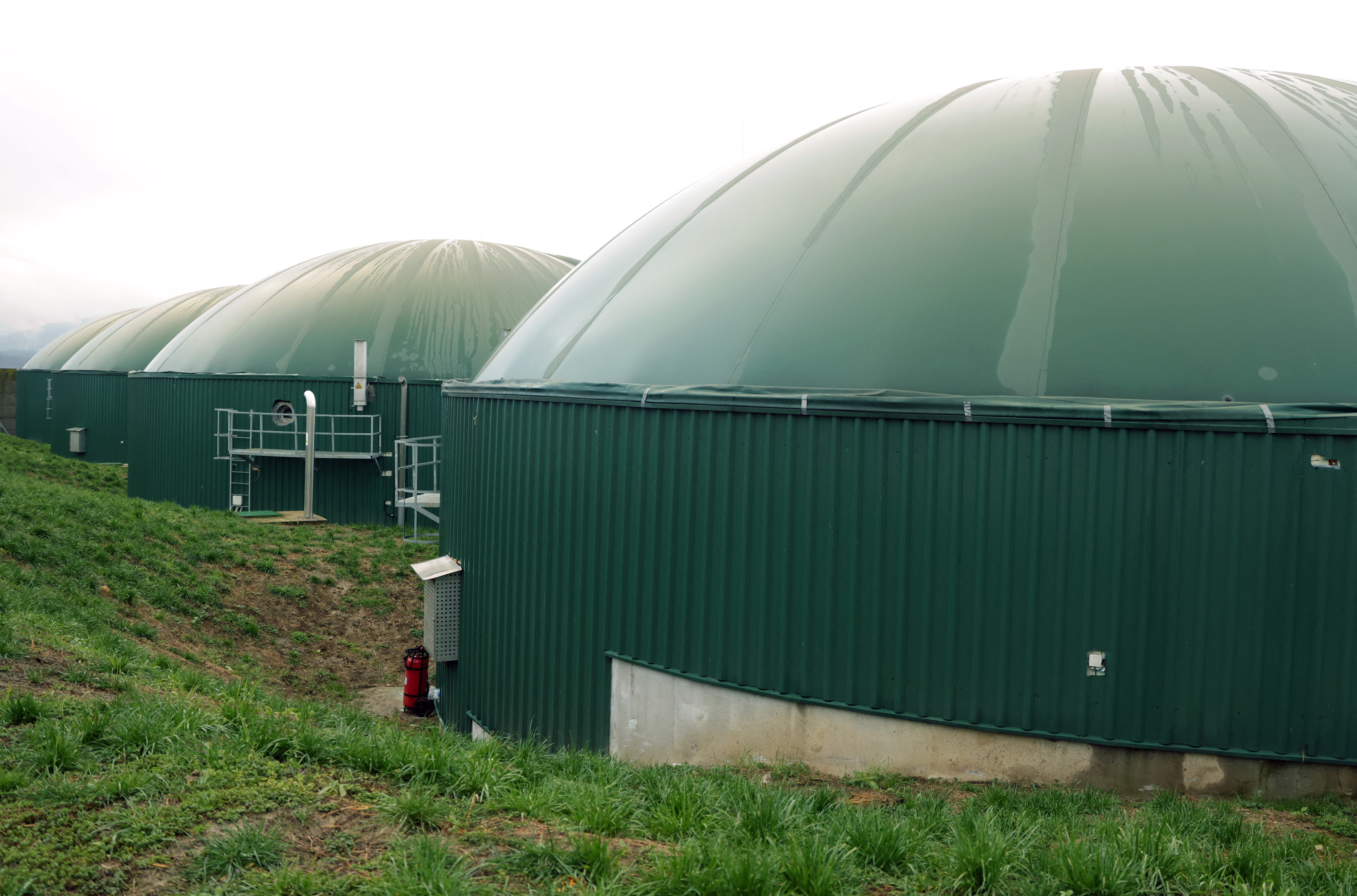
Biogas plant producing electricity from organic waste is seen on Spreca farm in Kalesija

[1/3] Biogas plant producing electricity from organic waste is seen on Spreca farm in Kalesija, Bosnia and Herzegovina, January 19, 2023. REUTERS/Dado Ruvic

“It was envisaged to crown the existing processes at the farm,” Karic said at the farm owned by the Sarajevo Milkos dairy industry, which covers 800 hectares of its own and leased land and has capacity for 2,000 high-yielding cattle.

The scheme at the farm, which already uses automation and high tech machinery, is government-backed and funded by Sarajevo Milkos.

Advertisement · Scroll to continue

“This is a step towards aligning with the European standards … and represents an economic model that can be developed to increase the economics of the business, bearing in mind that primary agriculture production is low profit,” Karic added.

Bosnia, where energy production accounts for about 20% of its GDP, is the Balkans’ sole electricity exporter, with about 60% of it produced from coal-fired plants and the rest mainly from hydropower.

Its two regions, the Bosniak-Croat Federation and the Serb Republic, have pledged to increase the share of energy produced from renewable sources by 2030 but the energy crisis triggered by the war in Ukraine has slowed those plans.

The thermal energy created during the fermentation of the biogas is also used to heat some farm buildings.

“Our long-term plan is the construction of greenhouses that would be also heated by this thermal energy,” Karic said.

Source: Reuters 

Tom and Fran Bennett Win Grand and Reserve in the 2022 On-Farm competition

Tom and Fran Bennett won the Mature Cow class and Grand Champion in the 2022 On-Farm competition with Te-Hau Windbrook Cleo and Reserve Champion Mature Cow with Locknee Cup Gertrude. In the 19th year of the competition, 717 cows from 92 herds competed.

Do cows in the ocean represent the future of farming?

Samuel L. Jackson can fly with his snakes. Peter and Minke van Wingerden have come up with something even crazier: a herd of cows floating on the sea.

Floating Farm, a high-tech micro-dairy, is a sustainable farming experiment by a Dutch husband and wife. It is floating in the port of Rotterdam. The modernist building is home to 40 Maas-Rijn-Ijssel cows, which produce about 200 gallons (757 litres) of milk every day. The waterborne farm not only helps feed the local community, but it also contributes to a global conversation about how the climate crisis is forcing farmers to change how and where they grow food.

Floods, megadroughts, and even rising nighttime temperatures have thrown off the food system and cost the US farm industry alone more than $1 billion. Scientists in Mexico are working on climate-resilient wheat strains, and Jack’s Solar Garden in Longmont, Colorado, is a testbed for the emerging method of agrivoltaic farming. This is a space-efficient system that allows solar arrays and traditional farming to coexist on the same patch of land. This is a multi-tasking innovation that proponents say leads to a higher crop yield. “If you have a strong ecological system under the solar panels,” says Byron Kominek, Jack’s third-generation owner, “you can have a win-win for climate change.”

Joshua Faulkner, a research assistant professor and the programme coordinator for the University of Vermont’s farming and climate change programme, says that extreme weather has made farming completely different from what it was just a few decades ago. “Farmers used to know that certain things, like when to plant and when to harvest, were always the same. In the past 10 to 15 years, these assumptions have been thrown out the window, and farmers are having to rewrite the book.”

The Van Wingerdens, on the other hand, are betting on a method that has nothing to do with land at all. Peter, who used to build houses and has a background in engineering, got the idea for the Floating Farm from a climate disaster on the other side of the world. When he went to New York City after Hurricane Sandy hit the northeast US in 2012, he saw how flooding made it hard to get fresh food to millions of people. He was almost certain that this problem would get worse in the years to come. So, he used his knowledge of aquatic architecture to make nearly 10,000 square feet (929 square metres) of floating farming space. If his experiment worked, it would not be affected by rising sea levels or floods that cause damage.

Rotterdam is already known as one of the places in the world that can deal with climate change the best. The city is 90% below sea level, so everything from office buildings to whole neighbourhoods is built on water. The Van Wingerdens’ floating dairy farm was something new, but it was bound to happen. If bad weather strikes, a waterborne farm doesn’t have to stay in one place. An urban farm that serves people in the city also cuts down on the carbon emissions that come from transporting food. A farm on water also helps to ease what conservationists call the “global land squeeze.” This is the ever-growing tension that happens when there is a limited amount of land and more and more wild land is turned over to agriculture to meet the demand for “food, feed, fuel, and fibre,” says Janet Ranganathan, the managing director for strategy, learning, and results at the World Resources Institute, a global research organisation.

The experimental farm of the Van Wingerdens is built on pontoons that rise and fall with the tides (which, in Rotterdam, fluctuate about eight feet each day). The cows are milked, cleaned, and fed by robots in the rubber-floored barn on the top level of the building (they can also walk down a gangplank to a waterside patch of pasture). On the middle level, butter, yoghurt, and other dairy products are made from milk. On this level, rainwater and seawater that has been taken out of it are cleaned and made safe for the cows to drink. The animals’ waste is turned into fertiliser that is used on local soccer fields. The grass clippings from these fields are then fed back to the animals. At the bottom of the building is a naturally cool area where up to 1,000 wheels of gouda-style cheese can be aged at once. Some of these cheeses are flavoured with curry, while others are flavoured with wild garlic. All of these cheeses are sold in the farm shop. In other words, it’s a self-sustaining system that works in a circle, both in terms of the environment and money.

The Van Wingerdens’ model is ready to be copied, which is what a group of 14 people at the Floating Farm are doing right now. Plans are in the works for a floating vegetable farm to move in next to the current Floating Farm. Permit requests for similar buildings are also out in Dubai, Singapore, and the Dutch cities of Haarlem and Arnhem.

The new projects will use what was learned from the first project in Rotterdam. Peter says, “You have to build a house to learn how to build a house.” Some of his most important lessons have been about how things work in the real world, like how farm materials move through a waterborne structure. He has also learned a lot about how to deal with bureaucracy and set ideas.

The biggest problems he thinks he will face are not financial or physical, but political and bureaucratic. “As a world, we really need to find answers for the next 30 years,” says Peter. “One of the biggest problems we face around the world is rules. Cities need to think outside the box. Cities need departments that shake things up. Cities need places where you can say, “Okay, this is the place to try new things.” Because what Peter and his team are doing isn’t like other ways to be environmentally friendly. “We don’t come up with new ideas,” he says. “We are disruptive.”

USDA Announces Additional Assistance for Dairy Farmers

The U.S. Department of Agriculture (USDA) today announced the details of additional assistance for dairy producers, including a second round of payments through the Pandemic Market Volatility Assistance Program (PMVAP) and a new Organic Dairy Marketing Assistance Program (ODMAP). The update to PMVAP and the new ODMAP will enable USDA to better support small- and medium-sized dairy operations who weathered the pandemic and now face other challenges.

“The Biden-Harris administration continues to fulfill its commitments to fill gaps in pandemic assistance for producers. USDA is announcing a second set of payments of nearly $100 million to close-out the $350 million commitment under PMVAP through partnerships with dairy handlers and cooperatives to deliver the payments,” said USDA Under Secretary for Marketing and Regulatory Programs Jenny Lester Moffitt. “USDA is also announcing new assistance targeted to small to medium size organic dairy farmers to help with anticipated marketing costs as they face a variety of challenges from weather to supply-chain challenges.”

Pandemic Market Volatility Assistance Program

PMVAP assists producers who received a lower value due to market abnormalities caused by the pandemic and ensuing Federal policies. As a result of the production cap increase, USDA’s Agricultural Marketing Service (AMS) will make PMVAP payments to eligible dairy farmers for fluid milk sales between 5 million and 9 million pounds from July through December 2020. This level of production was not eligible for payment under the first round of the PMVAP. Payment rates will be identical to the first round of payments, 80 percent of the revenue difference per month, on fluid milk sales from 5 million to 9 million pounds from July through December 2020. USDA will again distribute monies through agreements with independent handlers and cooperatives, with reimbursement to handlers for allowed administrative costs. USDA will contact handlers with eligible producers to notify them of the opportunity to participate.

As part of the first round, PMVAP paid eligible dairy farmers on up to 5 million pounds of fluid milk sales from July through December 2020. The first round of payments distributed over $250 million in payments to over 25,000 eligible dairy farmers. These dairy farmers received the full allowable reimbursement on fluid milk sales up to 5 million pounds.

More information about the PMVAP production cap increase is available at www.ams.usda.gov/pmvap.

Organic Dairy Marketing Assistance Program

The new ODMAP, to be administered by USDA’s Farm Service Agency (FSA), is intended to help smaller organic dairy farms that have faced a unique set of challenges and higher costs over the past several years that have been compounded by the ongoing pandemic and drought conditions across the country. Many small organic dairy operations are now struggling to stay in business and FSA plans to provide payments to cover a portion of their estimated marketing costs for 2023. Final spending will depend on enrollment and each producers projected production, but ODMAP has been allocated up to $100 million.

The assistance provided by ODMAP will be provided through unused Commodity Credit Corporation funds remaining from earlier pandemic assistance programs. The assistance will help eligible organic dairy producers with up to 75 percent of their future projected marketing costs in 2023, based on national estimates of marketing costs. This assistance will be provided through a streamlined application process based on a national per hundredweight payment. The payments will be capped at the first five million pounds of anticipated production, in alignment with preexisting dairy programs that target assistance to those smaller dairies that are most vulnerable to marketing challenges. This program is still in development.

Details about the Organic Dairy Marketing Assistance Program will be available and updated at www.farmers.gov as more details are released in a Notice of Funds Availability later this year.

USDA touches the lives of all Americans each day in so many positive ways. In the Biden-Harris administration, USDA is transforming America’s food system with a greater focus on more resilient local and regional food production, fairer markets for all producers, ensuring access to safe, healthy, and nutritious food in all communities, building new markets and streams of income for farmers and producers using climate smart food and forestry practices, making historic investments in infrastructure and clean energy capabilities in rural America, and committing to equity across the Department by removing systemic barriers and building a workforce more representative of America. To learn more, visit www.usda.gov.

#

USDA is an equal opportunity provider, employer, and lender.

How a Stowe dairy famer is doing nearly a year after losing over 100 cows in a barn fire

Last February, I heard a barn had burned in Stowe. And that’s not all.

“There was 130 Jersey cows in there, dry or milking, and they’re all gone,” farmer Paul Percy told me on the phone after the fire.

“There actually was a few in there that hadn’t calved yet, that we’d brought up from one of the other barns,” he said. “I think it was about a dozen that were all ready to calve in the next two weeks. But that isn’t going to happen.”

We talked for about 15 minutes, then I thanked him for his time, and we hung up.

Listen to the original story from Vermont Public: Stowe dairy farmer reflects on losing more than 100 cows in fire

That was almost a year ago, long enough for the leaves to come out on the trees, fall, and be covered by snow again. I wondered about Paul Percy from time to time — had his insurance come through? Did he get more cows? Did he rebuild the barn?

His farm is one of about 500 dairy farms left in Vermont, down from thousands just 60 years before. Many of the farms that remain are in precarious positions — when disaster strikes, it can be hard to come back from.

So a few weeks ago, I went to Stowe to pay Paul Percy a visit, and see how things were going.

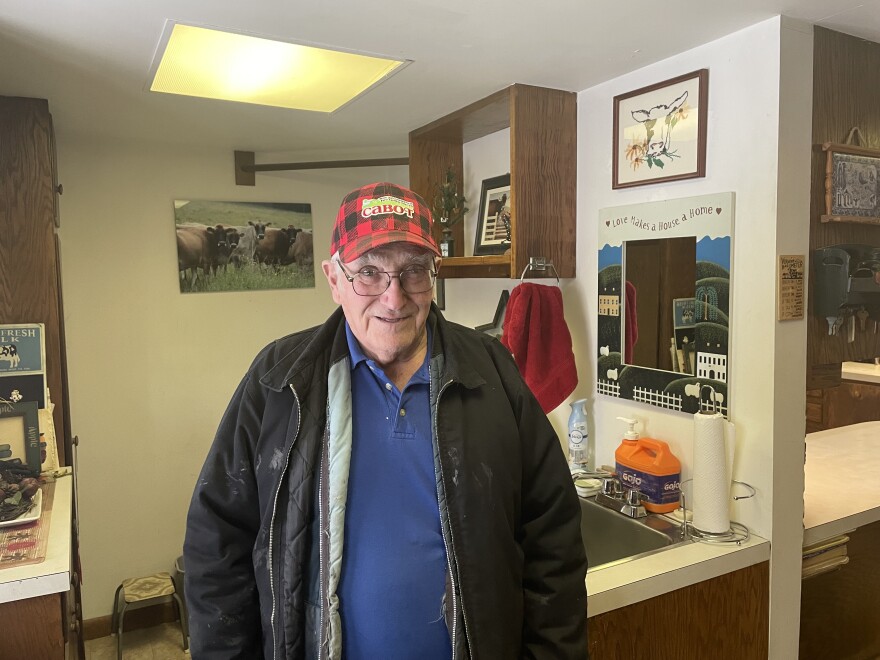
An older man in a red Cabot baseball cap and jacket stands in his mudroom. A printed photo of cows is in the background.

Anna Van Dine

/

Vermont Public

Paul Percy stands in the mudroom of his house in Stowe, where he was born more than 80 years ago.

He greeted me at the door wearing jeans and a blue polo with the Agri-Mark logo. His eyes were bright behind a pair of wire-rimmed glasses.

He’s in his 80s, and has lived in this old farmhouse his entire life. We sat down in the living room, under a window that looks out on where the barn used to be.

“You’d hardly know there was a barn down there. We had that done about three weeks after the fire,” he said.

Percy has other property in town, including a barn where he keeps about 350 cows. He said they’ve concentrated on that, but still, they’ve lost money.

“There’s no question about it, income is down,” he said. “Expenses are down some, too, because I’ve got one less employee and, you know, we’re not spending money taking care of [the cows], the light bill and all that, it’s down. But again, I miss it. But — I don’t talk about this because it bothers me a little bit — they started a GoFundMe. I don’t know whether you ever heard about this or not. But they started one for us. And I didn’t know anyone started it, I didn’t know what was happening, I didn’t know what was going on, I couldn’t believe it. But people donated a lot of money to make it all work.”

“How did that feel?” I asked.

“Well,” Percy said, “in a way it bothered me, because it’s like a — like a kind of charity thing, sort of. Somebody needs help. And, you know, to farm and build what we need to, we probably needed the help. But I had insurance on that barn — ‘course never have enough — but I had insurance, had insurance on the cattle. We can build barns and fix things back up. It’s really — it’s really an interesting town to live in. I had no idea that people in this town wanted farmers here as much as I think they do today.”

More from Vermont Public: In West Enosburg, a lifelong parishioner tries to move on without his church

“Are you saying because of how the character of Stowe has changed over the years, and how it is today, that you were surprised people came together to help you?” I asked.

“Right. You know, there used to be a lot of farms here. And they’re all gone. There’s only me and two others left in Stowe, and there used to be like 125,” Percy said. “But they’ve been disappearing over the years, and they’ve really disappeared lately. But people — they don’t want us to leave. They want farming to be here.”

“Why?” I asked.

“Because of the character, that it makes the town,” he said. “You know, it warn’t the barn that’s the beauty, it’s the cows out in the fields. It’s the meadows. I’m convinced that most of the people appreciate Stowe and make Stowe what it is because a lot of this open land and open meadows and the way the whole thing is designed. And the zoning is set up to keep that that way, to keep it open.”

A photo grid of four brown baby cows with yellow nametags: Joy, Harley,Tulip and Moon

Photos: Percy Farm, Courtesy

/

Graphic: Elodie Reed

These are four of the seven calves the Percy Farm was able to save in the fire.

I asked: “Has having this happen changed how you think about the future of your farm, and maybe Vermont farms in general?”

“Oh I think farming in the state of Vermont is going to thrive,” Percy said. “Because there’s a lot of good land that grows grass, you don’t have to irrigate. And there’s a lot of good, modern farms in the state of Vermont. There’s some big farms in the state of Vermont. Now, I don’t think you’re going to see very many 15-20 cow farms, 40 cow farms. I think it’s got to be a special situation. Although there’s a 40-cow farm here in Stowe, the boys have been there for a long time, and when they retire or stop farming, I don’t think that farm will continue.”

“What do you want the future of your farm to be?” I asked.

“I’ve got a boy, Ryan, that is into farming, but he’s got to decide what he’s going to do with it,” he said. “He’s got two girls, and who knows whether they’ll want to be farmers or not, or whether they’ll find somebody that wants to be a farmer. Only the future will tell that.”

I asked: “When you sit in your kitchen, or in this room here, and you look out the window to where the barn used to be, what do you think about?”

“Well, I thought about all the years it’s been there, and all the times I’ve gone down there, and all the problems and late meals,” he said. “But there’s a beautiful view now that the barn’s gone. There really is. This fall, it was gorgeous with all the colors of the leaves you know, and the green background down there. But it’s sad. It’s sad.”

Percy hopes to build a new barn, not far from where the old one was.

Source: vermontpublic.org

VAS collaborates with Zoetis to bring genomic data to herd management software

VAS is pleased to work with Zoetis to bring genomic data to the PULSE Platform and DairyComp herd management software. This integration makes it easy to view genomic data from the CLARIFIDE® brands and herd data in one place for efficient herd management.

“We’re thrilled to collaborate with Zoetis and bring even more data together to streamline processes for success,” says Scott Noble, VAS vice president of strategy. “The powerful combination of genomic data and herd management software helps inform profit-driven decisions.”

This integration makes recording, submitting and evaluating genetic test data seamless between VAS PULSE Platform and Zoetis SearchPoint®. You’ll be able to:

  • Streamline data entry – animal identification, sample and pedigree data updates – by entering it in one place. Enter it in PULSE Platform, and it automatically updates in SearchPoint.
  • Use DairyComp mobile work lists to locate animals for sampling and scan their sample barcode to store on their record.
  • Use the new genomic sample submission form in PULSE Platform to assign sample types and select the Zoetis test to be performed and submitted electronically.
  • Check individual animal genomic test statuses on the new PULSE “submitted samples” page.
  • View up-to-date genomic values and test results in the PULSE Platform “CowCard genomics” tab.
  • Automatically synchronize updated genomic values in PULSE Platform and DairyComp.

“Data integration and seamless workflows help to unlock the power of CLARIFIDE® Plus across the farm,” said Jason Osterstock, D.V.M., Ph.D., vice president and head of precision animal health at Zoetis. “Our collaboration with VAS makes it easier for dairy producers to capture the value of genetic testing and the accuracy of genomic predictions for health and production outcomes in their herds.”

The Zoetis genomics integration is one of 40 integrations offered by VAS. VAS is proud to collaborate with Zoetis to bring you more connectivity and insights.

“Begin the digital transformation of your dairy by bridging the information gap to boost productivity and build your future herd,” says Noble.

Contact VAS Support to turn on this integration for your dairy or view the instructions in the PULSE Platform.

A study shows that drinking milk made ancient people taller and heavier.

A new study found that drinking milk made ancient people taller and heavier. It also found that drinking milk had a direct effect on the patterns of lactose intolerance in Europe today.

The data for the study, which was released on Tuesday, came from a researcher at Queen’s University Belfast. The study compared skeletons from archaeological sites that date back 25,000 years.

The research, which was led by the University of Western Ontario, found that people were bigger between 2,000 and 7,000 years ago in places where they had more genes that make enzymes that digest milk into adulthood. This is called lactase persistence.

Because of this, lactose intolerance is more common in the north of Europe than in the south.

In the study, which was published in the journal Proceedings of the National Academy of Sciences, a group of 16 scientists compared the height and body mass of 3,507 skeletons from 366 different archaeological sites. This made a large set of data that could be used to compare how people’s bodies change over time and space.
Exploration of the past

Most of the samples in the data set used for the study were from Europe. Researchers said that this was mostly because archaeologists were exploring the continent more often.

Dr. Eóin Parkinson from the school of natural and built environment at Queen’s University Belfast gave data for the study. He said the research showed that in some parts of the world, drinking milk led to more bone growth.

“Everyone remembers being told as a child to drink their milk because it would help them grow. We can almost think of this in terms of how humans evolved, and we can see that trends in dairy consumption from as far back as 7,000 years ago have an effect on how people process dairy products today.

“Drinking milk and eating dairy products are important parts of food culture in many parts of the world, so it’s interesting to learn about the biological processes that make these things happen.”

Dr. Parkinson said that in some parts of northern and central Europe, where the climate wasn’t right for the Asian crops that were brought there, “human societies responded by drinking more milk.”

The study was led by Prof. Jay Stock from the University of Western Ontario. He said that drinking milk has been “culturally important” on different continents, and that drinking milk has left genetic traces. “People in western Africa, the Rift Valley, and the Horn of Africa, as well as some parts of Arabia and Mongolia, have a lot of lactase persistence genes,” he said.

All-American Dairy Show Seeking Fundraising Coordinator

The All-American Dairy Show, a leading event on the East Coast for dairy cattle enthusiasts is seeking a Fundraising Coordinator to join their team.  The event showcases nearly 2,000 head of cattle exhibited with over 1,000 participants. Along with open class competitions and awards presentations, an array of youth events including the Premier National Jr Show, Showmanship, Invitational Youth Judging Contests and the Junior Dairymen’s contest headline the week.

Responsibilities

  • Organize and execute initiatives to solicit and secure funding/resources to help the show continue to thrive by serving current customers and developing new relations
  • Attend at the show to execute donor commitments and assist where needed.
  • Handle all donor recognition
  • Work with sponsors to fulfill trade show commitments
  • Assist with promotion of the show and its events by updating the website and Facebook page with photos, sponsor levels and information
  • Provide post-show thank you correspondence

Position Requirements:

  • Knowledge of the show/industry
  • Outstanding oral and written communication and customer service skills
  • Exceptional administrative and clerical skills
  • Knowledge or willingness to learn Word, WordPress, Excel, and digital marketing. Advertising and design experience is a plus
  • Strong work ethic with a positive attitude and the ability to work well independently and with others

The Fundraising Coordinator will work closely with AADS Staff, Executive Committee and Bookkeeper (who does the invoicing).

This is a part-time position with the ability to work from home and create your own hours. Time each month will vary with an estimated total of 850 hours. Compensation will be both a monthly stipend based on qualifications as well as incentive bonuses.

Please send your resume or questions to Allen Hess at allen_hess@hotmail.com

Deadline to apply is February 24th.

Idaho legislator ’embarrassed,’ apologises for comparing women to dairy cows

Idaho legislator ’embarrassed,’ apologises for comparing women to dairy cows

Nelsen admitted to being “embarrassed” and “offending people.”

“The way I expressed my comments regarding women and reproductive rights yesterday utterly missed the target,” Nelsen stated in an emailed statement. “I really apologise. I own my error and promise to do better in the future.”

During the first meeting of the House Agricultural Affairs Committee of the parliamentary session, Nelsen stated that he is a “lifelong dairy farmer” who has “milked a few cows” and spends “much of my time wandering behind lines of cows.”

“So if you want some suggestions on repro (reproduction) and women’s health, I have some solid opinions,” he joked.

The remark garnered harsh criticism on social media as well as national media coverage.

“Let us be clear: Politicians like Jack Nelsen have no business forcing our reproductive health care decisions. “Period,” declared the Idaho Democratic Party in a tweet.

Nelsen is a Magic Valley music instructor and former county planning and zoning and water resource commissioner. Nelsen ran on local control of water and schools, as well as the preservation of agricultural property, before beating Democrat Karma Metzler Fitzgerald in one of Idaho’s few swing districts in November.

During his candidature, he also stated that the government should not be involved in abortion care, separating himself from fellow Idaho Republicans who established a near-total ban on abortion.

Nelsen apologised, saying that the ladies in his life showed him “strength, perseverance, honesty, hard work, joy, and love.”

“I completely support women’s freedom to chose their own health care,” he stated. “I have always and will continue to work under the premise that the government has no place in a doctor’s office.”

BC Dairy and Alberta Milk lean into weird

Who: BC Dairy and Alberta Milk, with Taxi for strategy and creative, Dear Friend for production (directed by Grayson Whitehurst), Vapor Music for audio, and OMD for media.

What: “Make it With Dairy,” a campaign that reminds Gen Z of how bad some favourite foods would be without dairy.

When & Where: The campaign launched in digital, social and out-of-home on Oct. 31, but a TV buy began this week, running until March 5.

Why: Like other milk marketers, both BC Dairy and Alberta Milk are eager to connect with young consumers who have been drawn to the large number of dairy alternatives that have proliferated in recent years.

“While previous generations already view dairy as a key ingredient for making food and drinks taste delicious, Gen Z’s didn’t have the same associations amongst a sea of options in today’s grocery aisles,” said Jennifer Woron, director of market development at BC Dairy, in a release. “So, we wanted to show this next wave of food lovers—in a humorous way—that without the incomparable taste of dairy, some of our favourite staple dishes are just plain disappointing.”

How: Taxi, as it put it in the release introducing the campaign, “dialed up the weird factor,” with a series of 15-second videos comparing different food options served without milk—a mango lassi, a cookie and cereal—to other equally jarring scenarios, like sliding (squeakily) down a dry water slide, dunking a cookie in a glass of water, and eating a bowl of nuts and bolts (like cereal without milk). All very cringe, as the kids say. (We think. Not sure anymore. Hard to keep up.)

It’s the kind of untraditional, subversive humour that resonates with Gen Z, according to Taxi. “Research showed quirky and weird is a good way to cut through so we leaned into that,” said James Sadler, executive creative director of Taxi Vancouver. The ads are the same in both markets except for the closing logo of each organization.

BC and Alberta together? Last fall, the Western Milk Pool—comprised of BC Milk, BC Dairy, Alberta Milk, SaskMilk and Dairy Farmers of Manitoba—agreed on a new governing model that would see them work more closely together on certain initiatives. “As part of our effort towards greater collaboration, BC Dairy and Alberta milk made the decision last year to work together on marketing initiatives, which is the reason for our new joint campaign,” explained Woron in an email to The Message.

Source: the-message.ca

2022 Milking Shorthorn All-American Nominations

The American Milking Shorthorn Society recently announced the animals nominated in the 2022 All-American and Junior All-American contests! Shoutout to everyone involved in these animals’ success. Congratulations!

All-American Nominations

Spring Calves
Dream Chaser Lotto Serena – Willow Upchurch, Hebron, IL
Hillholm F Wildflower EXP ET – Allen Hess & Ellie Fleming, Hagerstown, MD
KNH-Endres Comanche La-Di-Da – Tyler Endres, Reedsburg, WI
Maunesha Creek Odessa – Mena Schmidt, Lake Mills, WI
Lazy M Deuce Fancylike EXP ET – TJ & Jazmine Wingert and Colton Gregory, Kent, IL
Old-N-Slow Lapdance EXP ET – McKenzie Pedigo, Epworth, IA

Winter Calves
Topp-View Mykola Apple EXP – Jacob Fisher, Warner, NH
All-In Deuce Liza EXP P*TC – Ellie Fleming & Allen Hess, Hagerstown, MD
Lazy M Wild Ginger ET – Joe Gibbs, Epworth, IA
Circle B Rockstar Get Lit – Matthew Borchardt, South Beloit, IL
Lazy M Lars Gametime EXP – Randy & Matthew Winch, Fennimore, WI
Woodsey-Dell Lran Chopper EXP – Alora Sprout, Springville, PA

Fall Calves
Henkeseen Cyr Rebellion EXP ET – Trent & Matt Henkes, Luana, IA
BDF PV Rockstar Margarita ET – Suton Paulson, Rockford, IL
Molehill Lars Mrln Monroe EXP – Mike Gregory, Michelle Upchurch, Brandon & Shianne Ferry, Hebron, IL
Lazy M Bender Back EXP – Lazy M Farm, Stitzer, WI
BDF PV Rockstar Marsha ET – Suton Paulson & Sage Dornan, Rockford, IL
Lands-Brook KNH Chilli Pepper – Peter Vail, Englewood, FL

Summer Yearlings
Idalee Zeus Thunder ET – Tristan Upchurch, Hebron, IL
KNH-Endres Zeus Good As Gold – Mikayla Endres, Reedsburg, WI
Hazelbrush Comanche Ammo – Adhyn Schell & Jamie Gibbs, Lewiston, MN
Corstar RW Lovelli EXP – Redwillow Genetics-Eric Seifert, Long Prairie, MN
Old-Bankston Badgerluna EXP ET – Peter Vail, Englewood, FL
Top Shelf Presto Laney – Tristan & Willow Upchurch, Susan Lee, Hebron, IL

Spring Yearlings
Idalee RU Tipsy EXP ET – Allen Hess, Susan Lee & Ellie Fleming, Hagerstown, MD
Hasheider Camero Roseann – Elizabeth Hasheider, Bryn & Blake Agnew, Sauk City, WI
Mapleton Vly Rockstar Moxie – Mapleton Valley Farms, LLC, Oconomowoc, WI
Maunesha Creek Princess Opa – Ron and Christy Ratliff, Garnett, KS
Cold Springs St Em Jaguar – Peter Vail, Englewood, FL
Halpins Rockstar Dixie – Owen or Colt Halpin of Halpin Farms, Buckingham, IL

Winter Yearlings
Heavenly Zeeks Sunshine – Suton Paulson & Makenna Reed of Oak Grove, Rockford, IL
Jon-Ann Delux Rosea Bean – Kyle Bonavita, Meshoppen, PA
Weissmann Motown Celebrity – Shocking Genetics-Katie Schultz & Jeffrey McKissick, Chambersburg, PA
Krauses Money Saida 878 – Rick Heslinga of Krause Dairy, Como, TX
Heavenly Ice Pop – Sarah Hill, Bristol, VT
Heavenly Lookin Good ET – Brian, Traci and Landon Neely, Utica, PA

Fall Yearlings
Maunesha Creek Coors On Tap – Mena Schmitt, Lake Mills, WI
Brightside Lott Sriracha EXP – Kalan McDaniel, Perkins, OK
Lazy M Petrone Equisitely – Lazy M Farm-Herman and Michael Maier, Stitzer, WI
Cold Springs Lottery Lullaby – Matt Henkes, Luana, IA
Halpins Rockstar Mysterious – Owen or Colt Halpin or C. Makinson of Halpin Farms, Buckingham, IL
Elite HP Showtime Fireflame EXP – Peter Vail, Englewood, FL

Yearling In Milk
Corstar Badger Ladybug – Matthew Borchardt, South Beloit, IL
GMC Rockstar Dairyzone – Brooke Clark of GMC Farm, Cornish Flat, NH
Rough Road Adventure Lily EXP – Mccoy Kinslow & Gracie Logsdon, Smith Grove, KY
Molehill Mykola Myrtle EXP – Mike Gregory, Michelle Upchurch, Greg Clark, Hebron, IL
Garys Christos Saffron – Allen VanGorder, Glenn McNeil, Gram Rozler, Little Falls, NY
Heavenly Hushpuppy – Tyler Endres, Reedsburg, WI

Junior Two-Year Old
Na-Mor-Dale Rockstar Iggy Pop – Na-Mor-Dale Genetics, Morgan & Nate Kliebenstein, Darlington, WI
SF HC Lad Payment EXP ET – Keith & Donnette Fisher, New Enterprise, PA
Big Time Ricochet Macarena – Matt Linehan & Laura Holtzinger, Lena, WI
KNH-Endres MD Devil Anse Cece – Tyler Endres & Mike Gregory, Reedsburg, WI
Mikes-Dar Trans Rebecca – Tristen Upchurch, Hebron, IL

Senior Two-Year Old
Lazy M Jekyll Zella EXP – Britton Allen, Stitzer, WI
Cold Springs Ant Buttercup – Charlie & Will Hackman & Sim & Sam Florine, Brownstown, IN
Elm Roc Lecom Stella 426 – Tanna Luchterhand, Neillsville, WI
Mikes-Dar Zeus Serenity EXP ET – Mike Gregory, Hebron, IL
GMC Robin Desire ET EXP – Brooke Clark of GMC Farm, Cornish Flat, NH
Elite HP Fire Spark – Peter Vail, Englewood, FL

Junior Three-Year Old
GMC Clearly A Lucky Lady ET – Brooke Clark of GMC Farm, Cornish Flat, NH
Brand-New Z Fallin In Love ET – Colton & Ashley Brandel, Lake Mills, WI
Halpins Lapdog Misfit – Owen or Colt Halpin of Halpin Farms, Buckingham, IL
Lazy M Lethal Justice EXP ET – Scott Wolf, Epworth, IA
Lazy M Presto Eska EXP – Mike Gregory, Michelle Upchurch, Holbrich Holsteins, Hebron, IL
Henkeseen Royalty Reason EXP – Trent & Matt Henkes, Luana, IA

Senior Three-Year Old
Heavenly Juice Box – Matt & Abbey Opland, Mindoro, WI
Hard Core Lottery Fireworks – Payton Towe, Scottsville, KY
Hard Core Jstice Ramira EXP ET – Chriselle Fisher, New Enterprise, PA
Cold Springs Lottery Peri – Mike Gregory & Kingsdale Farm, Hebron, IL
GMC Jeff Reese Puffs EXP – Brooke & Lindsey Clark of GMC Farm, Cornish Flat, NH
Lazy M Wildside Genette EXP – Peter Vail, Englewood, FL

Four-Year Old
Heavenly Badgers Lime – Mike Gregory, Hebron, IL
Ourway DL Alisha 15th EXP – Ourway Cattle Co., Brooklyn, WI
Lands-Brook Christianna EXP – Cory & Kristen Salzl, Ariana Everle, Litchfield, MN
DND Pirelli Onsight EXP – Jaxon Burris, Mabel, MN
Heavenly Zora ET – Dillon Freeman, Bremen, IN
Hard Core C-Tie Sundance – Keith & Donnette Fisher, New Enterprise, PA

Five-Year Old
Elm-Dell Demi EXP – Brayley Fortin & Sadie Thume, Ellenburg Center, NY
Circle B Limarita EXP P*TC – Matthew Borchardt, South Beloit, IL
Lazy M Jekyll Arizona – Tyler Endres and T.J. Wingert, Kent, IL
Triple S Lad Laidbacknlazy EXP – Triple S Genetics, Strawn, IL
Molehill Lottery Caliente – Mike Gregory & Tyler Endres, Hebron, IL

Aged Cow
Redwillow Presto Mara EXP – Eric Seifert, Long Prairie, MN
Taylor Farms Rubens Spitfire – Greg, Marcia, and Brooke Clark of GMC Farm, Cornish Flat, NH
Corstar Presto Lulu ET – Cory & Kristen Salzl, Litchfield, MN
Millcreek Lottery Ladyluck – Taylor Graves, Danville, KY
Lazy M PS Ladylump EXP ET – Ritschard, Davis, Young of Heavenly Show Cattle, Monroe, WI
Pine-Valley P Junebug EXP – Cory & Kristen Salzl & Jason, Leah & Jessica James, Litchfield, MN

Lifetime Merit
HC-HP Red Rob Fireball EXP ET – Peter Vail, Englewood, FL
Storytown Dap Ruben Rampage – William Solberg, Oregon, WI
HC-HP Frolic Dixie ET – Keith & Donnette Fisher, New Enterprise, PA
B-D-F Polaris Abbi – Tre Wright, Kadyn Gibson, Dakota Thompson, Eminence, KY
Maple Fudge of 12 Oaks*CV – Ashley Brandel, Lake Mills, WI
Corstar Presto Lulu ET – Cory & Kristen Salzl, Litchfield, MN

Junior Best Three Female
Top Shelf Genetics, Hebron, IL
Heavenly Show Cattle, Monroe, WI

Best Three Females
GMC Farm, Cornish Flat, NH
Ourway Cattle Co., Brooklyn, WI
Hard Core-Keith & Donnette Fisher, New Enterprise, PA
Lazy M Farm-Herman & Michael Maier, Stitzer, WI

 

Dairy giant Danone aims to cut methane emissions by 30% by 2030

Danone (DANO.PA), one of the world’s biggest dairy companies, said on Tuesday that it plans to cut absolute methane emissions from its fresh milk supply chain by 30% by 2030 by working with farmers, other companies and governments on regenerative practices.

Methane emissions have emerged as a top threat to the global climate, with scientists and policymakers calling for aggressive action to curb them.

At the 2021 U.N. climate summit in Glasgow, Scotland, more than 100 countries pledged a 30% cut from 2020 methane emissions levels by 2030. However, few have since carved out clear plans to reach that goal.

Danone, which works directly with 58,000 dairy farmers across 20 countries, expects to remove 1.2 million tonnes of carbon dioxide equivalent of methane emissions by 2030. Between 2018 and 2020, the French company had reduced its methane emissions by about 14%.

Danone said it will launch four new initiatives this year for methane reduction in Africa, Europe and the United States. It is also launching a partnership with U.S. non-governmental organisation Environmental Defense Fund, and working with the United States Department of Agriculture and the European Commission-funded Climate Neutral Farms project.

Simple techniques can have a big impact, said Chris Adamo, vice president of regenerative agriculture policy at Danone.

“In Belgium and Spain, for example, we’re looking at a variety of different manure options. We’ve been finding that, for example, with one technique that is just different management of manure, you’re literally removing the liquids so that the solids dry — the solids then become a better substitute, actually, in many cases for synthetic fertiliser on the crop side as well. But that mere separation itself can have anywhere from a 25-35% reduction in methane from the manure itself,” Adamo told Reuters on a phone call.

Danone declined to comment on how much it would spend on its plans.

“The costs are really, frankly, somewhat unknown, or early days in terms of estimating because these are new technologies that are coming out,” Adamo said.

About 60% of the methane in the atmosphere comes from industrial sources, including oil and gas pipelines and drill sites, as well as feed lots, croplands and landfills.

Dairy production from cattle makes up an estimated 8% of total human-caused methane emissions, as part of agriculture and livestock activities which represent approximately 40% of global methane emissions, Danone said.

Going forward, the company will report on its methane emissions as part of its extra financial disclosure

Source: reuters.com

Adapting to the new raw-milk laws in the United States

Meadow Creek Dairy is different from most American cheesemakers because it uses unpasteurized, or “raw,” milk to make its cheese. Its brown-and-white cows graze on a grassy hillside high in the Appalachians.

In the US dairy market, which is dominated by industrial cheesemakers who only use pasteurised milk, the small family business in the east is unusual.

Helen Feete and Ana Arguello wear blue overalls and caps to work. They stand in front of huge vats of milk that each hold hundreds of gallons.

Feete and her husband started the dairy in the 1990s. She told AFP that when they began, “there were no models for us to follow” because not many small dairy farms were trying to make cheese from raw milk.

On the other side of the Atlantic, methods that are considered traditional in Europe and even a source of regional pride are almost taboo.

The main difference is that pasteurised milk needs to be heated, either to 63 C for 30 minutes or 72 C for 15 seconds.

That kills the microflora in the milk, which has a big effect on how it tastes—and not in a good way, say people who like raw milk.

Liz Thorpe, an American who writes books about cheese, said that unpasteurized milk gives cheese its “complexity and uniqueness of flavour.”

On the other hand, people who don’t like unpasteurized cheeses say that raw milk is more likely to have bacteria and microbes that can cause diseases like salmonella and listeriosis, which can be fatal.

The US Food and Drug Administration (FDA) says that “all milk and milk products in their final package form that are meant for direct human consumption must be pasteurised.”

But since the 1940s, the agency has allowed the sale of raw-milk cheeses as long as they have been aged for at least 60 days at temperatures above 2 C.

Kat Feete, who has worked at Meadow Creek with her parents and brother for most of her life, said, “That’s not so much a problem as it is something we have to build our cheeses around.”

The FDA’s 60-day rule is meant to give all dangerous pathogens in raw milk enough time to die off. However, it prevents the sale of soft cheeses made from raw milk that are ready to eat before 60 days are up.

Kat Feete said, “It can be frustrating that we can’t make certain kinds of cheese.”

“Many people would love to have a raw-milk brie or something small like that.”

Most of the cheeses at Meadow Creek are semihard. Seasonal cheeses are made based on what the cows eat at different times of the year. They age in the cellars of the dairy, where the temperature and humidity are controlled.

Grayson, which is one of the most popular cheeses, is a semihard cheese that is similar to Reblochon from the Alps or Maroilles from the north of France.

“Not right.”

Meadow Creek Dairy and other US companies that make raw-milk cheese face another problem: many Americans are still afraid to buy something they think might be dangerous.

“So many people in the US think it’s illegal to eat cheese made from raw milk, but that’s not true,” said Thorpe.

“There are a lot of false ideas,” Thorpe said.

She said that she works hard to let people know that these cheeses are “perfectly healthy, safe, and good.” She also said that it’s important for a consumer to know where a cheese comes from.

In the beginning of Meadow Creek, “it was a little harder to teach the market about what we were doing because they thought it wasn’t very safe,” Kat Feete said.

But, she said, things are starting to change.

“I think people are starting to realise that making cheese with raw milk is safe and a good way for a small cheesemaker on a farm to make cheese,” Feete said.

U.S. and Chinese markets are tightening, putting pressure on dairy farmers and manufacturers of infant formula.

Danone, Abbott, and Wyeth, the three biggest makers of baby food in the world, all have factories in Ireland. They are all facing a major change in the market, which could have bad effects on jobs and dairy processors.

China is the biggest market for infant formula in the world, and these three exporters put a lot of effort into selling there. However, China has become hard to sell to because of restrictions on Covid-19, a low birth rate, registration requirements, and fierce competition from Chinese manufacturers who have won back consumers’ trust.

Euromonitor says that Chinese brands have quickly gained market share in recent years. Based on retail sales, Feihe will have 20% of the market in 2022, up from 12% in 2019. Yili, the other top Chinese brand, will have 14%.

Compared to this, imported brands like Danone, which is down to 12%, and Nestle, which owns Wyeth and is down to 10%, followed by Abbott at 3%, have lost a lot of market share.

The Covid pandemic and the problems it caused with shipping goods around the world were especially bad for European companies that sold to Asian markets.

This year’s problems are made worse by the fact that the Chinese government will start to use a new national standard for infant formula next month. Many companies, including European manufacturers, are still waiting for approval.
International companies have to deal with a lot of competition from Chinese companies that are regaining the trust of consumers.
International companies have to deal with a lot of competition from Chinese companies that are regaining the trust of consumers. Image by: STR/AFP/Getty

Industry experts think that China’s new standards will cause up to a third of all formula brands to go out of business this year. This is likely to make Chinese consumers trust local brands that meet the new standards even more.

Changes to the Chinese market are still a big question for the more than 1,000 dairy farms on the island of Ireland that supply quality milk to these big companies that make baby food.

Baby formula is mixed, pasteurised, and dried at the Abbott Cootehill plant, the Wyeth Askeaton factory, and the Danone Macroom and Wexford plants. Once they are packaged, they are sent to Europe, Southeast Asia, the Middle East, Latin America, Canada, but not the US.

The US Food and Drug Administration does not allow European companies to sell baby formula in the US because they are not regulated by it (FDA).

In the past year, some of the problems in the Chinese market have been lessened by the FDA’s decision to loosen controls on imports. This was done to make up for manufacturing problems, product quality recalls, and supply chain disruptions caused by Covid in the tightly controlled US market.

The United States is the second biggest market for baby food. But about 90% of the US market is controlled by just four companies. Nearly half of the market is made at Abbott’s US plant. Mead Johnson Nutrition, Nestlé USA, and Perrigo are also in the game.

Only 2% of formula comes from other countries, and it’s hard for new companies to get into the market because of FDA rules.

Because there are so few companies, when one shuts down, it starts a domino effect that has led to major shortages over the past two years. Mothers all over the US have been unable to buy when they need to because of these shortages.

In the past year, the FDA had to give temporary import exemptions to a number of non-US production facilities, such as Abbott in Cootehill and Danone in Macroom, in order to fix a serious shortage that had become a political hot potato.

But all exemptions for foreign suppliers were set to end at the end of December. Even if technical food safety standards are approved, US importers will have to pay tariffs of up to 17.5% on sales to the market.

The push for organic baby food around the world, especially by young parents, is another problem for the industry.

Many companies are trying to make baby foods that don’t come from animals but have the same nutrients as breast milk. This could help them make more money in the future, but it could also speed up the decline of the dairy processing industry in Ireland.

John Whelan is an expert on Irish and global trade.

Trans Ova Now Accepting Scholarship Applications

The Trans Ova Scholarship Program is now open! College students interested in areas including beef, dairy, swine, sheep, goat or veterinary are encouraged to apply.

Click here to start your application. Apply before March 15, 2023.

Friends of Expo Honored at Annual Event

On Wednesday, November 30, World Dairy Expo hosted its annual Friends of Expo celebration, honoring the hundreds of volunteers, paid workers, and partners who make World Dairy Expo possible. Highlighting the evening was the presentation of the 2022 Friends of Expo awards. Receiving recognition this year were Bob and Marge Kaether, Berta Hansen and Adam Alesch.

Bob and Marge Kaether, Waunakee, Wis., have been essential in the success of World Dairy Expo, specifically in the Purple Cow Gift Shop and WDE’s School Tour program. After a two-year hiatus of school tours, no one was more excited to see them return than Bob, who has led numerous fourth-grade students around Expo grounds, sharing his passion for the dairy industry. Marge can be found in the Purple Cow Gift Shop throughout the week, doing everything from sorting hangers and inventory to helping customers find the perfect gifts for their loved ones.

For over 20 years, Berta Hansen, Evansville, Wis., has served as the International Registration Coordinator. During this time, she has personally greeted over 58,000 international guests and manages the on-site interpreter team. Hansen has created a team that is compassionate, dedicated and essential to creating a memorable experience for Expo’s international guests.

The final friend honored was Adam Alesch of Madison, Wis. As an employee at Alliant Energy Center, Alesch touches every part of Expo and ensures its success. From setting the Showring and booths for the Trade Show to creating a home for dairy cattle and their exhibitors in the New Holland Pavilions, his work begins weeks in advance of the event and concludes weeks after the last cow goes home.

Why I worry for dairy-deprived mums and kids

Standing in the queue for my morning cappuccino has recently become a troubling experience for me. It is because of the frequent requests I hear from young women, particularly those who are obviously pregnant. They are asking for an almond, soy or oat milk coffee as an alternative to standard cow’s milk.

Plant-based milks have become more popular with coffee drinkers.
Plant-based milks have become more popular with coffee drinkers.Credit:Fairfax

I am troubled because these women are very likely putting the developing brains of their unborn babies at risk of suffering intellectual impairment and other neurological disorders. Not because the plant-based alternative milks are naturally harmful, but unlike dairy milk, these products do not contain the micronutrient iodine that is essential for optimal maternal thyroid gland function that regulates normal foetal brain development.

As Angus Dalton highlighted in his article I’ll have a half-oat, half-soy decaf in The Sun-Herald last week, a quarter of the customers in the cafés he canvassed had ditched dairy milk in their coffees for plant-based alternatives. This causes me a great deal of concern for future generations of Australian children.

Last week’s story in the Sun Herald.
Last week’s story in the Sun Herald.Credit:Fairfax

The World Health Organisation states iodine deficiency during pregnancy and early infancy – the first 1000 days of life when development of the human brain is so critical – is the commonest global cause of preventable intellectual disability.

Added to this, there is also good evidence implicating iodine deficiency during pregnancy – as a causal or possible contributory factor – in the development of other neurological disorders such as ADHD and autism, which are on the increase in Australia without any plausible explanation. These consequences are not simply theoretical. Recent studies performed in Tasmania, where dietary iodine deficiency has been more prominent than elsewhere in Australia, have confirmed that children born to women with mild iodine deficiency during pregnancy had a 10 per cent reduction in literacy and numeracy performance, compared with children born to mothers who had a sufficient iodine intake.

Related Article

PLant milk explainer

Unfortunately, follow-up of these affected children has shown impaired school-performance has persisted and is irreversible. When you see these results, it is not unreasonable to ask: is iodine deficiency the reason for the continuing decline in the academic standards of Australian schoolchildren compared with their peers in many other countries? As with the increased rates of ADHD and autism, no plausible explanation has been advanced for the comparatively poor performances in these international examinations.

Iodine in the Australian diet comes mainly from dairy milk, iodised salt, and to a lesser extent seafoods. There is good evidence from studies of pregnant women in Sydney that dairy milk has been the main source of iodine for the great majority not taking an iodine supplement.

Iodine deficiency re-emerged in Australia several decades ago because of a decline in the content of iodine in dairy products, coupled with decreased household use of iodised salt and it not being used by the food manufacturing industry.

This problem continues as it is frequently difficult to find any iodised table salt on display in our grocery stores, where the shelves are dominated by un-iodised crude, pink crystalline salts imported from salt mines in Pakistan and labelled as “Himalayan salt” – somehow conveying some mystic qualities on these products. When I get the opportunity, I furtively look for the iodised salt products and bring them to the front of the shelf and push the un-iodised products to the back.

More people are buying plant-based alternatives such as soy, almond or oat milk.
More people are buying plant-based alternatives such as soy, almond or oat milk.Credit:iStock

In response to a national survey of children in 2005-2006 by Westmead Hospital and Sydney University, which established widespread insufficient dietary iodine intake in the Australian population, WHO labelled Australia as an iodine deficient country. State and federal health departments eventually mandated iodine fortification of food in 2009 requiring that all salt used in the making of bread and such products must be iodised salt.

While this initiative has been successful in raising the intake of iodine to satisfactory levels in most of the population, it is insufficient to meet the natural increased requirements of iodine during pregnancy and breastfeeding.

To address this deficit in 2009, our National Health and Medical Research Council (NHMRC) recommended a daily supplement of 150 ug of iodine for women during pregnancy and breastfeeding. Unfortunately, this message has not been well promoted as current research indicates approximately 50 per cent of pregnant women in Australia are still not getting enough iodine.

We know from very good studies conducted in pregnant women before mandatory fortification of bread with iodised salt in 2009, that the principal source of iodine in the diet of pregnant women in Australia was dairy products.

Given the increasing preference for plant-based milks it is likely that this new fad, coupled with the consumer preference for non-iodised salt in the home and by the food industry, will likely contribute to a further decline in iodine intake in vulnerable sections of our population.

It is unquestionable that the outcome will be some degree of impairment of normal brain development in the most critical first 1000 days of life, leading to lower IQs, lifelong disability, and disadvantage in a large section of our population, unless we take action to prevent it. We know what the problem is, how to fix it, and we should do it now.

Creswell Eastman is a Professor of Medicine at Sydney University Medical School, Principal of the Sydney Thyroid Clinic and Consultant Emeritus to the Westmead Hospital.

Source: smh.com.au

Fire at Wisconsin dairy plant leaves storm drains clogged with butter

Bring in the toast.

A fire at a dairy plant in Wisconsin left storm drains and a historic canal clogged with butter.

The fire took place at an Associated Milk Producers facility in Portage on Monday, according to a news release from the Wisconsin Department of Natural Resources.

Approximately 20 gallons of butter flowed into the adjacent Portage canal via a storm sewer, says the department. The butter has since been removed from the canal and the storm sewers were clear as of Thursday.

Environmental impacts are “minimal,” officials said in the news release.

“Most of the butter that left the facility exited via the sanitary sewer and traveled to the wastewater treatment plant,” according to the department. “Wastewater plant personnel have been clearing butter out of the plant since the incident. The treatment plant has operated effectively without disruption, though some temporary exceedances are anticipated.”

The fire started in a room that was used to store butter, according to a Facebook post from the Portage Fire Department, which was first responded to the incident. Butter runoff and heavy smoke made it difficult for personnel to enter the facility. It took several hours and help from other fire departments in the area to contain and extinguish the fire, the department added.

In a statement to CNN, Associated Milk Producers thanked local fire departments and first responders for controlling the fire.

“We appreciate their professionalism and hard work, as well as that of our employees, under difficult circumstances,” wrote the company.

They added that responders blocked the street drains and placed “absobent materials in the canal to minimize milkfats.”

An investigation is ongoing into the origins of the fire, according to the Department of Natural Resources.

P.E.I. farmers still picking up the pieces 3 months after Fiona

Some farmers on P.E.I. are still cleaning up and rebuilding what they lost more than three months after post-tropical storm Fiona left the Island battered and bruised.

Some looking for new ways to mitigate damage from future storms

Farmer Andrew Smith.
Andrew Smith of Smith Farms in Newton, near Kinkora, P.E.I., says while the weather has co-operated with his rebuild, it has been a challenge to find workers to rebuild these barns in New London. (Wayne Thibodeau/CBC)

Some farmers on P.E.I. are still cleaning up and rebuilding what they lost more than three months after post-tropical storm Fiona left the Island battered and bruised.

Andrew Smith remembers the destruction all too well. The roof was torn off his potato storage building in New London, the walls had collapsed and debris was strewn across the property.

“Sick, just sick, this was four or five days before harvest, the thought of ‘What are we going to do, where are we going to put our crop?'”

Other farmers in both P.E.I. and Nova Scotia pitched in, helping him find storage space. 

Now Smith is focused on the cleanup. He has insurance, but he said it won’t cover all the damages. He said he could be out as much as $1 million.


The weather, at least, has been on his side. 

Storage building damaged by Fiona.
The roof blew off this storage building at Smith Farms. (Wayne Thibodeau/CBC)

“Normally it could be –20 and a blizzard every second day, so if that was the case we’d be at a standstill. Right now we’re able to carry on, bit by bit, and hopefully, at least, get all of the old stuff torn down and get some protection on the concrete before it gets too cold and then be ready to build when we’re able.” 

No milk lost

Gordon MacBeath of Marshfield, chair of the Dairy Farmers of Prince Edward Island, said remarkably, there was no milk lost in the days after Fiona. Every day, there’s about 330,000 litres of milk produced on P.E.I., he said, and all of that was picked up and processed without any losses.

But the cleanup has been “massive,” and farmers are looking for ways to minimize the damage from future storms.

“Maybe dairy farms have to get their lines buried from their transformer to the buildings, so take that variable out of it,” he said.

“There will be small changes like that I think we can make that will be a long-term benefit for everyone.” 

Gordon MacBeath, chair Dairy Farmers of P.E.I.
Gordon MacBeath, chair of the Dairy Farmers of P.E.I., says the cleanup has been massive. (Wayne Thibodeau/CBC)

Smith plans to rebuild his wooden structures with steel and cement.

But with the planting season only a few months away, he’s facing a new challenge — finding workers to help. 

“We’re having a very hard time finding locals that will stand the elements and come out and work with their hands. It’s hard work.”

Source: cbc.ca

Locals pitch in to assist a dairy farmer load sandbags when a levee in Pootompa collapses.

As the River Murray rose, a private levee that had just been built broke under the weight of the water.

The levee broke late Wednesday, letting floodwaters into valuable land for dairy cows to graze. The low areas quickly filled up with murky water and the occasional carp.

All of the people who came to help knew someone at the Smart Dairy, which needed extra help protecting one of the farmhouses.

Steve Hein, who is the president of the Mypolonga Progress Association (Mypolonga Community on Facebook), said that the small town has been great during the flood crisis.

“Our rallying cry is that Mypo, Wall Flat, and Toora are strong and tough, and every day of the week shows that this is true. “Every day, people in the community, residents, and shackies live up to that,” he said.

“We were putting sandbags around the houses on the farm, and the people in Mypolonga and the nearby towns have been so helpful throughout the whole process. Yesterday, about 20 people came to help, and then the Mypolonga cricket club came and helped make about 400 sandbags and add to the stockpile.

“The community has been great, with people helping each other and watching out for each other.”

The first group of people who came to help fill sandbags at 1 p.m. were all different ages. (Senior reporter Lauren Thomson, in the middle, also helped fill and move sandbags.)

It was the fourth working bee in the past month.

The flood peak was expected to affect most of the Smarts’ 250-hectare property, so efforts were made to move the milking robots. Since then, attention has turned to a house on the property that was in danger because water kept coming in from the Murray.

David Smart, who owns a dairy farm, spent more than $100,000 to protect it from the growing Murray River. But the three-meter-high levee that had just been built broke, and there is no government grant money to cover the cost of the levee, the loss of milking time, and other costs like extra haylage because there isn’t enough grass.

Floods cost Smart Dairy a lot of money, so they decided to leave the business. The cows and milking systems have been sold.

Cooperation between the beef and dairy industries is essential for their continued development.

I’ve always worked in the dairy business. Pat and Peggy started Sustaire Dairy in Winnsboro, Texas, in 1966. When I was growing up, my parents expected me to help out wherever I could. In 1990, I bought 17 heifers to add to the 100 cows we already had. Today, my son Garrett and my daughter Jordan run Sustaire Dairy as the third generation.

A lot has changed in the dairy business in the nearly 33 years I’ve worked there. There are fewer small family-owned dairies, more large operations, computerised milking technology, and changing consumer tastes, just to name a few. Another big change is that dairy cattle are now a common part of the beef marketing chain of today.

Most people don’t know that the dairy industry and the beef industry have been working together for years, with dairy steers being fed to cattle to make beef. In fact, the amount of dairy beef in the U.S. beef supply has been between 18 and 24 percent since 20021. So that the dairy industry can get the most out of the Beef Checkoff’s ability to promote, research, and educate, dairy producers like me sit on the Cattlemen’s Beef Board (CBB), where we currently hold 12 percent of the seats.

Crossbreeding dairy cows with beef genetics is becoming more and more common as the dairy industry continues to change. Because of this, it is thought that between 2.5 million and 5 million beef-on-dairy cross calves will be born this year, and these numbers are likely to stay the same in 2032. In addition to dairy and beef crossbreds, beef is also made from dairy finished steers, cull cows, and finished heifers.

But some beef producers are worried that crossing beef with dairy could take market share away from “traditional beef.” As a CBB dairy farmer, I can understand that worry. But the U.S. dairy herd stays the same at about 9.3 million heads, and dairy farmers need a lot of replacement heifers every year to keep their businesses running. Because of these things, it’s not likely that the number of beef-on-dairy cattle will grow to the point where they threaten the market dominance of traditional beef.

Even though the trend of crossbreeding doesn’t change the number of calves and feeders in the feedyard very much, it does change the quality of the beef these cattle produce. Dairy farmers get more money for their calves on the market, and people in the U.S. and other countries benefit from having more Choice and Prime-grade beef to buy.

Also, beef-on-dairy crossbreeding can help the whole beef industry and make beef production less harmful to the environment. These results were found by researchers from Cargill and Nestle3:

Calves raised on milk produce high-quality beef without affecting how well milk is made.
Because they have more higher-quality beef carcasses, feedyard owners have more chances to sell beef based on its value.
Beef-on-dairy calves also use their feed more efficiently than purebred dairy calves, which reduces the amount of greenhouse gases (GHG) that are released into the air.

I think that crossbreeding can be good for both dairy farmers and beef farmers. Crossbred cattle can help the beef industry make sure there is a steady supply of high-quality carcasses. And since drought and other things are making the number of beef cattle in the United States go down, we need these beef-on-dairy crosses to help meet the growing demand for beef. Also, the farmers I know who have started their own beef-on-dairy crossbreeding programmes say it helps their cash flow because the animals are easier to sell than the traditional dairy breeds.

People like me who sell cattle and calves have to pay two checkoffs: the Dairy Checkoff and the Beef Checkoff. Our contributions help with promotion, research, education, and information for both dairy and beef, which drives demand for our goods. It is important that dairy farmers have a voice on the CBB because dairy cattle are a big part of the beef industry.

Dairy farmers and beef farmers live close to each other, and we have many of the same goals, problems, and opportunities. By working together on the CBB, beef and dairy producers can continue to find ways to save time and money that will help both industries and give consumers more of the high-quality products they want and need.

32nd Butter Sculpture Unveiled: “Pennsylvania Dairy: Rooted in Progress for Generations to Come”

American Dairy Association North East, in conjunction with the Pennsylvania Department of Agriculture, revealed the highly anticipated butter sculpture, a tableau that showcases the importance of the dairy industry’s traditions and its focus on sustainability.

“Pennsylvania Dairy: Rooted in Progress for Generations to Come” is the theme for the 32st butter sculpture. The sculpture depicts several generations of a dairy farming family, enjoying a moment together amid the background of their family farm, celebrating how they work together to produce wholesome food for their community in a sustainable way.

Dairy farmer Steve Harnish of Central Manor Dairy in Washington Boro, said, “The butter sculpture is a creative way to showcase the important role agriculture plays in our lives. Producing nutritious milk and dairy products, and feeding people, is what I love most about being a dairy farmer.”

“This sculpture could be my own family,” Harnish said. “This is a meaningful way to show how dairy farmers work with their loved ones on land where they have deep roots, but always farming for the future.”

The sculpture was constructed over several weeks by artists Jim Victor and Marie Pelton of Conshohocken, Pennsylvania, using more than 1,000 pounds of butter donated by Land O’ Lakes in Carlisle, Cumberland County.

“Creating art that showcases the hard work of dairy farmers is an immense source of pride for us,” said Jim Victor. “We also enjoy knowing that the sculpture tells an impactful story about the importance of dairy farming,” added Marie Pelton.

The butter sculpture is on display in the Farm Show’s Main Hall. Following the Farm Show, the butter will be moved to the Reinford Farm in Juniata County to be converted into renewable energy in the farm’s methane digester.

Half a million people are expected to visit the butter sculpture at the PA Farm Show during its eight-day run from January 7th through January 14th.

SOURCE American Dairy Association North East

Send this to a friend