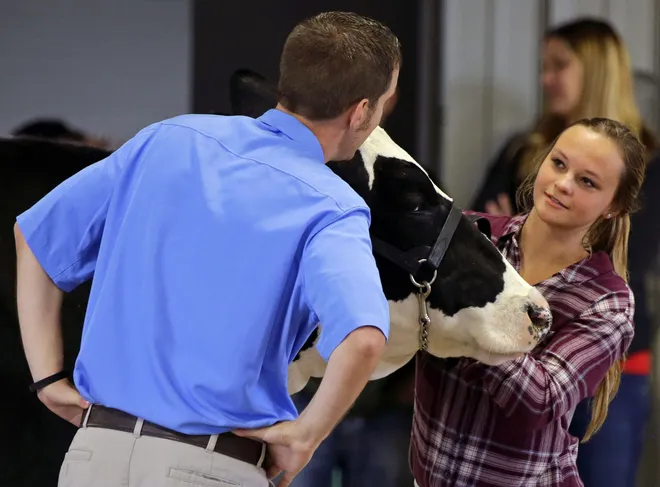
Forget feel-good farm PR. Sarah Hagenow’s unconventional journey to becoming the 78th Alice in Dairyland, highlighting her business-minded approach to agricultural advocacy.

The morning light filtered through the barn windows at City Slickers Farm in Cross Plains, WI, as thirteen-year-old Sarah Hagenow approached the pen holding a Brown Swiss heifer named “Sassy.” The heifer had shattered her leg as a calf, leaving her with a permanent reminder of vulnerability overcome through care and determination. What Sarah couldn’t have known in that moment was that this humble heifer – one who would “fall about middle of the pack at each show” – would become the catalyst for a journey that would eventually make history, making Sarah half of the first sister pair to hold the title of Alice in Dairyland.
Today, as the 78th Alice in Dairyland, Sarah Hagenow stands at the intersection of tradition and transformation, armed with a business degree, a global perspective, and an unshakeable belief that agriculture’s future lies in the hands of those who can speak both the language of the barn and the boardroom.
The Making of a Different Kind of Alice
The Alice in Dairyland program has crowned 76 women before Sarah, each bringing their unique perspective to Wisconsin’s premier agricultural ambassador role. Julia Nunes served as Alice in Dairyland for two consecutive years, a historical moment in the program’s 78-year history, due to COVID-19 restrictions. Sarah’s selection also represents something unprecedented – not just because she follows her sister Ashley (the 76th Alice) in creating the program’s first sibling legacy, but because she embodies a distinctly business-minded approach to agricultural advocacy that sets her apart from her predecessors.
“Ashley was a little bit more into showing horses, where I went down the cattle path. In school, we’ve had different interests as well. I took a little bit more of the business path and she took more of the marketing path,” Sarah explains, her voice carrying the analytical precision that has become her trademark. This wasn’t a casual decision but a deliberate strategy that would shape everything from her academic pursuits at the University of Minnesota to her internships across the agricultural supply chain.
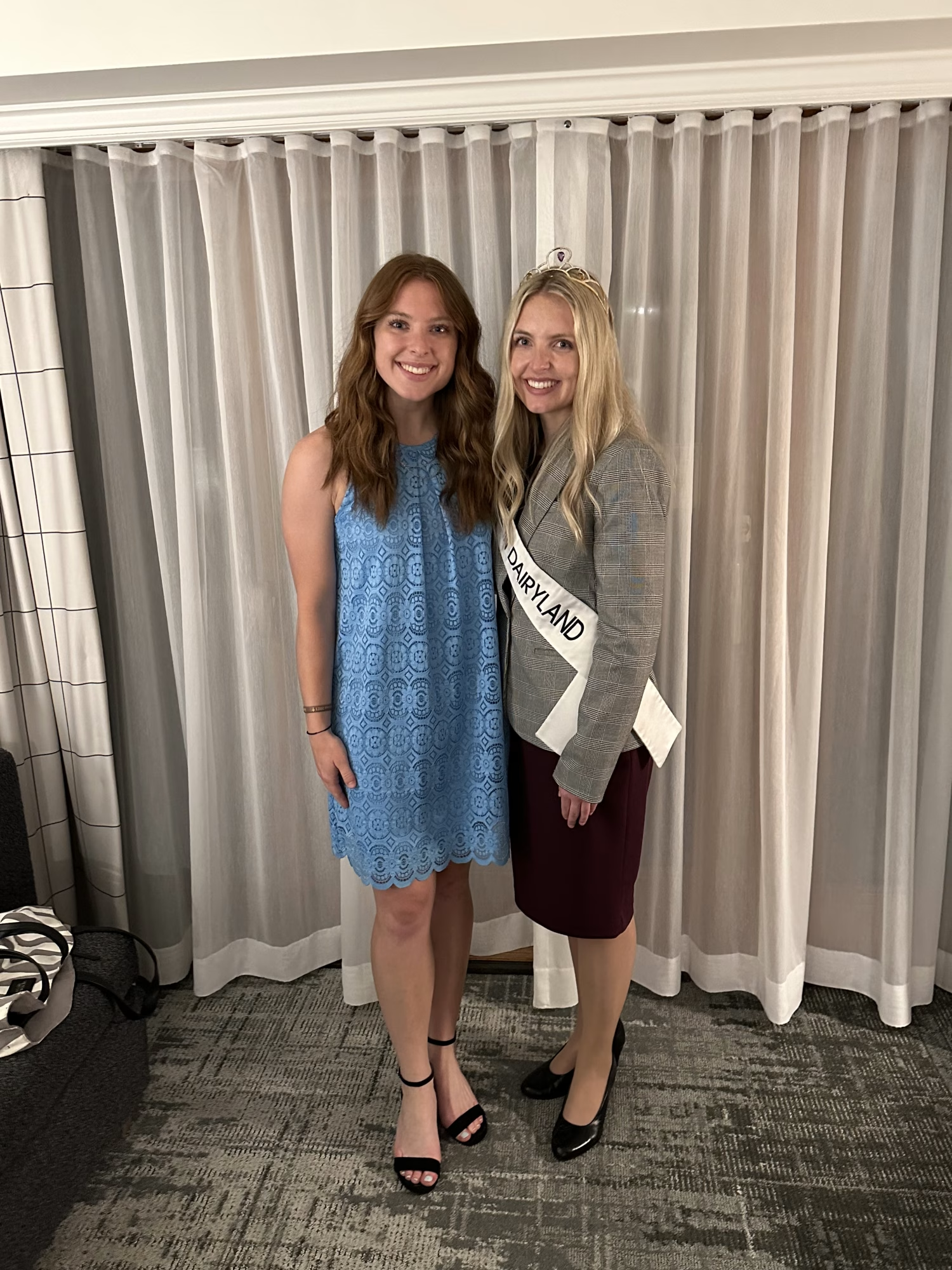
Where traditional Alice candidates might focus on communications and public relations, Sarah brings something different to the sash and tiara: a deep understanding of commodity markets, supply chain logistics, and the economic forces that drive agricultural decisions. Her comfort with agriculture extends beyond show ring placings to some of the decisions driving modern dairy operations.
Roots Run Deep, But Vision Runs Deeper
The Hagenow agricultural heritage began on father Bob Hagenow’s family farm in Manitowoc County. While Bob transitioned away from the farm later in life, his daughters initially learned about agriculture through the scientific precision of animal nutrition. Bob works as a feed nutritionist at Vita Plus, the Madison-based company that has built its reputation on cutting-edge technology and nutrition science since 1948. Growing up in a household where dinner table conversations revolved around dairy cattle, farmers, and family, Sarah developed a “salt-of-the earth” communication style.
Bob’s influence runs deeper than most realize. As a regional business manager at Vita Plus with nearly four decades of experience, he has led multiple teams and maintained key dealer partnerships while continuing to provide nutrition and business consulting to farm customers. His extensive knowledge of dairy nutrition and farm business management has significantly impacted today’s producers through company-led research projects covering amino acid nutrition, housing developments, forage management, and automated milking system technology.
At the family dinner table, discussions of rural realities and farm operations were daily realities that shaped Sarah’s understanding of agriculture as both art and science. When she thinks about discussing agricultural issues with producers, it stems from someone raised in an environment where agricultural discussions were grounded in practical outcomes that directly impact the farm.
However, the most telling aspect of Sarah’s story isn’t her family’s influence—it’s what she chose to build with it.
The Sassy Story: When Trust Transforms Everything
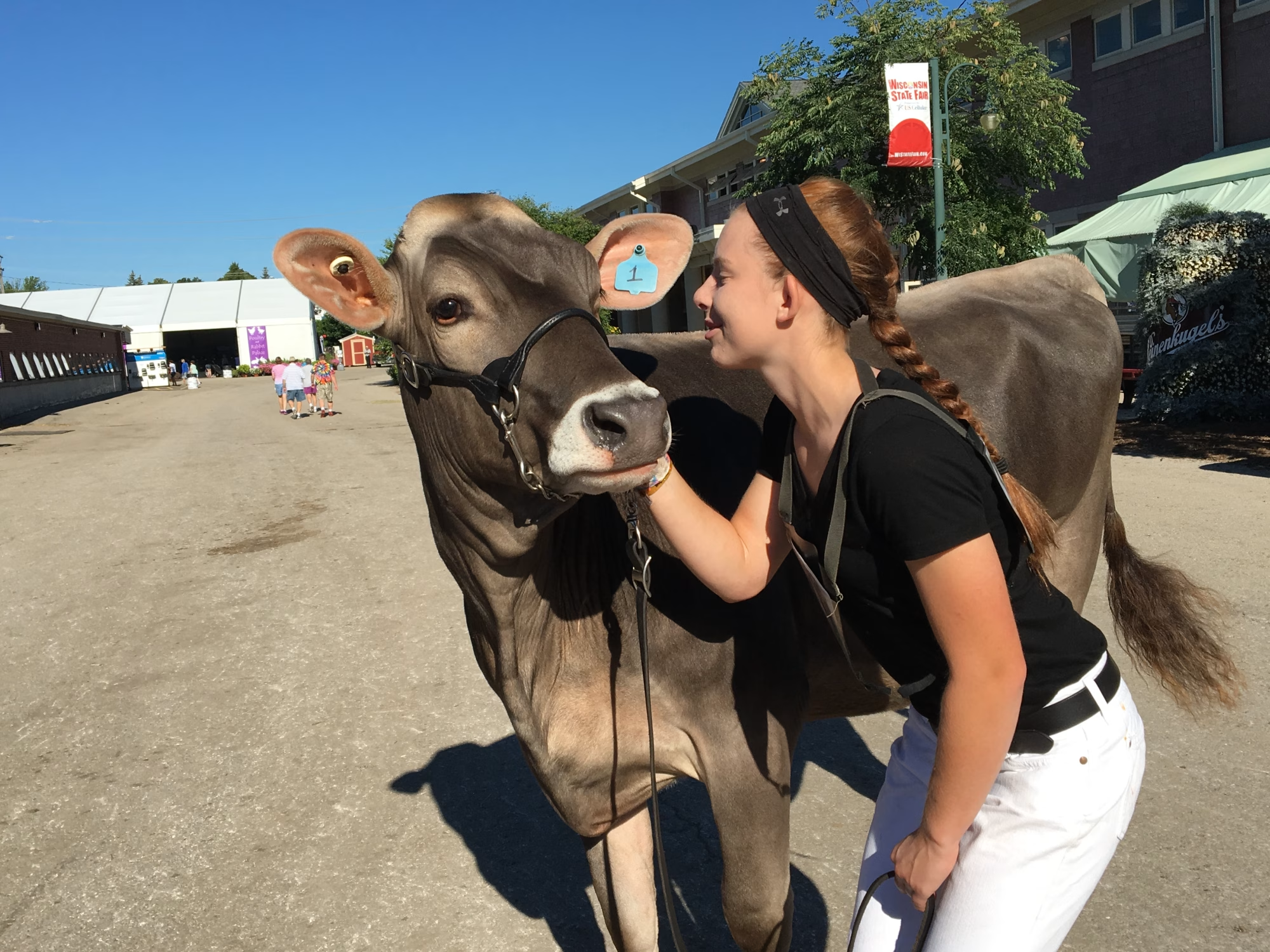
The pivotal moment came in 2016, when Mike Hellenbrand from City Slickers Farm approached Sarah about exhibiting Sassy, a Brown Swiss heifer who had overcome her own challenges after shattering her leg as a calf. For Sarah, who had been leasing cattle from Langer Dairy Farm since 2013, this was more than an opportunity—it was a test of character that would define her entire approach to agricultural business.
Standing in that barn, watching this unassuming heifer who would never claim championship honors, Sarah felt something shift inside her. Mike Hellenbrand had built his reputation on meticulous care and incredible attention to detail – his trademark became “incredible care from embryo to getting a healthy calf on the ground that was ready to thrive at its next home,” as Bob Hagenow, who worked with Mike to establish feeding programs, recalls.
“The feeling that Mike had put his trust in me to take on this project and be responsible for this heifer made me feel very capable and proud of the work I was doing,” Sarah remembers, her voice still carrying the wonder of that thirteen-year-old who suddenly felt capable of something significant.
Sassy wasn’t glamorous. She “fell about middle of the pack at each show,” Sarah recalls with characteristic honesty. However, working through the methodical process of preparing an animal that had overcome adversity, Sarah discovered that success wasn’t measured solely in purple ribbons – it was built on trust, responsibility, and the patient work of turning potential into performance.
The true validation came after the 2016 show season at World Dairy Expo, when Mike Hellenbrand and partners Ken Main and Peter Vail decided to change Sarah’s trajectory: they gifted her half ownership in Sassy.

“Looking back, it probably doesn’t seem that significant or monumental to have half ownership in a heifer that was just a 4-H project,” Sarah reflects. “Especially considering the success stories I’ve had with other animals, including Ayrshire B-Wil Kingsire Willow a few years ago. However, owning part of Sassy felt like the biggest accomplishment and meant the world to me. From a girl who could only dream of being involved in the industry… to finally having my name on a paper, I can remember feeling like I had somewhat ‘made it’ and a new door had opened”.
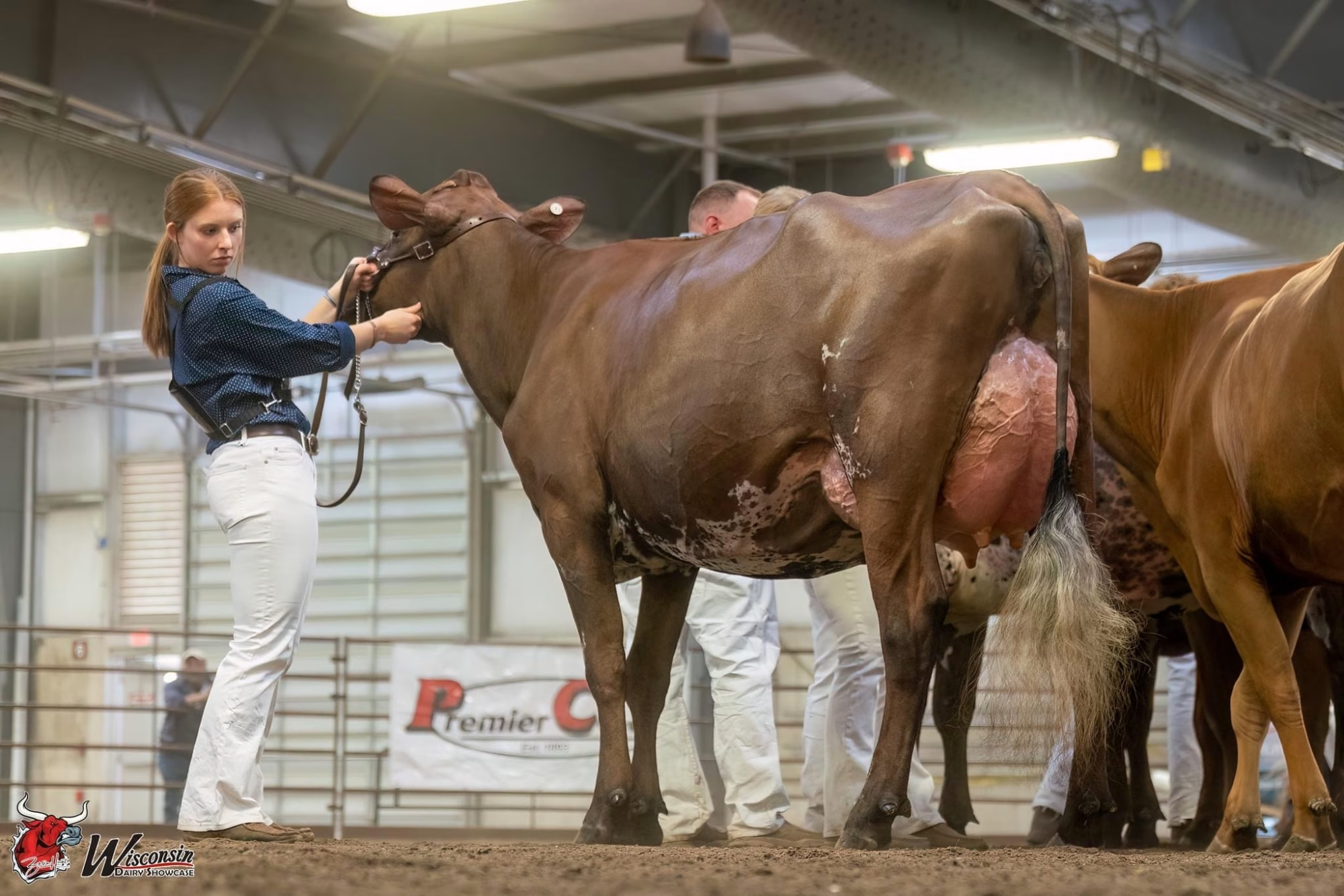
That door led to breeding her first heifer from Sassy – Sar-Boh Wizdom Sassafrass, the prefix name a tribute to Sarah and her father Bob. When Sassafrass won the Champion Bred-and-Owned Brown Swiss Heifer at the 2018 Wisconsin State Fair Junior Dairy Show, it represented the ultimate entrepreneurial milestone: creating a new asset from a previous investment, guided by the trust others had placed in a teenager’s potential.
For dairy producers watching this story unfold, Sarah’s journey from lease to ownership to genetic improvement mirrors the same strategic thinking that drives successful farm expansion and herd development decisions, proving that sound business principles apply whether you’re managing one heifer or a thousand-cow operation.
The Analytical Edge: Where Show Ring Meets Strategy Room
The skills Sarah learned with Sassy would prove invaluable when she joined the University of Minnesota’s dairy cattle judging team, but the experience provided something even more strategic. “Participating in dairy cattle judging was perhaps the most influential activity I did as a youth to develop my public speaking and critical thinking skills,” she explains.
Standing in those Minnesota judging rings, Sarah practiced a discipline that requires a rigorous analytical process: “observation, analysis, decision, articulation.” In the show ring, judges must rank four animals comparatively while weighing dozens of dairy characteristics, frame, body capacity, and mammary system attributes. But the real test comes in “giving reasons” – a formal, timed public speech defending placings with precise, logical, and persuasive language.
“I learned to identify precise details and articulate those points with clarity and confidence,” Sarah explains, drawing the direct parallel between show ring analysis and international advocacy work. When she prepares to field difficult questions from skeptical consumers or, she draws on this structured discipline that demands clarity, logic, and poise under pressure.
These same analytical skills translate directly to later in Sarah’s career, where she hopes to help farm families navigate difficult conversations about expansion financing with lenders, sustainability initiatives with regulators, or succession planning with the next generation – situations where precise communication and logical reasoning can mean the difference between securing resources and losing opportunities.
Global Perspective, Local Application
The lessons learned in Sassy’s stall would be put to the test unexpectedly when Sarah embarked on her January 2024 study abroad program in Germany, focusing on renewable energy and climate-smart technologies. The program exposed her to the integrated, community-based approach to sustainability practiced in the town of Saerbeck, where municipal renewable energy systems, geothermal heating, and agricultural methane digesters work in concert with comprehensive public education.
Standing in the Bioenergy Park in Saerbeck, where she witnessed community collaboration transforming a former German ammunition base into a renewable energy hub, Sarah gained what she calls “diplomatic intelligence.” “I was also just in awe of the communal support behind such a large project. Farmers, civilians, businesses, schools, and leaders have all come together to realize this project,” she recalls.

Walking through Saerbeck’s renewable energy park, Sarah found herself thinking not of what America should copy, but of what Wisconsin farmers were already doing right—and how to articulate that difference to skeptical consumers back home. She developed a sophisticated understanding of context-specific solutions: “What works for Europe works for them because of their specific societal needs and historical development, and what works in the United States is different and fitting for us because of our own societal needs,” she explains.
This nuanced perspective transforms potentially defensive conversations about American agriculture into sophisticated discussions about tailored approaches—a crucial skill for an ambassador representing Wisconsin agriculture on the global stage, and equally valuable for dairy producers who need to explain their practices to neighbors and community members questioning agricultural methods.
Supply Chain Scholar: Understanding the Middle
While many agricultural advocates focus on farm-level production or consumer-facing marketing, Sarah’s internship with Viking Dairy Company provided her with something rare: insight into what she calls “the middle of the supply chain.” This role immersed her in the operational realities of moving agricultural commodities, from nonfat dry milk to dried distillers grains, providing her with a practical understanding of the economic and logistical challenges that arise between the farm gate and the consumer shelf.
“The ‘nitty gritty’ of markets, purchasing, economics, and logistically moving products excited me because this area is such a critical part of the whole that gets food to consumers,” Sarah says, her enthusiasm evident. Standing in the Viking Dairy warehouse that first morning, watching pallets move through complex logistical arrangements, she finally understood the intricate dance of transactions that transform farm commodities into consumer products—a knowledge that helps her explain to dairy producers how their farm-gate decisions ripple through entire supply chains.
But her summer 2024 internship with the Animal Agriculture Alliance in Arlington, Virginia, fundamentally reshaped her understanding of agricultural advocacy. “Through my work at the Animal Ag Alliance, my preconceptions of advocacy were challenged by showing me that advocacy extends much further beyond those personal conversations at events,” she reflects.
Walking into those Arlington offices, Sarah’s eyes were opened to the strategic landscape of engaging restaurant stakeholders, grocery chains, food influencers, and nutrition organizations—the crucial gatekeepers who shape food system narratives. “I realized that this group is critical in supporting farmers, processors, and ranchers by buying or promoting certain foods,” she discovered, gaining insights that could help dairy producers understand how to position their operations for value-added partnerships.

This experience taught her that modern agricultural advocacy requires an understanding not just of what farmers do, but also of how their work connects to the broader food system. She hopes to use this knowledge to help producers identify new market opportunities and build relationships with key buyers in the future
The Communication Strategist: Meeting Consumers Where They Are
The lessons learned in Sassy’s stall and refined through her internships would prove invaluable when Sarah faced skeptical consumers at the Wisconsin State Fair, armed now with personal experience and strategic frameworks. Perhaps nowhere is Sarah’s analytical approach more evident than in her systematic framework for addressing agriculture’s most contentious issues.
When confronted with the emotionally charged question “Why do you separate calves from their mothers?” at the Wisconsin State Fair, Sarah didn’t lead with industry justifications. Standing there among the fairgoers, watching their expressions soften as she connected an unfamiliar practice to universal human experience, Sarah realized something profound about the power of empathy in advocacy.
“I said that it’s ultimately for the safety and health of the calf, just like doctors for humans do a health check on newborns to ensure that they are safe and prepared for a healthy life as a baby,” she explains. “This interaction helped me see the importance of relating to others and being able to hear them out, no matter what their initial perspective is. I truly believe that listening with empathy is at the heart of agricultural advocacy and allows us to ground conversations by coming from a place of understanding”.
This approach—connecting unfamiliar agricultural practices to universal human experiences—exemplifies her broader communication philosophy. Her systematic communication framework could be a model for farm families to navigate difficult conversations about sustainability initiatives, helping them ground complex agricultural practices in shared values that resonate with neighbors and community members who may not understand modern farming methods.
Modernizing a Legacy: The Digital Ambassador
Sarah’s vision for her year as Alice involves striking a “delicate balance between honoring tradition and modernizing the program for contemporary advocacy needs.” She plans to maintain the strong partnerships that 76 predecessors worked to establish while embracing digital tools to reach audiences beyond Wisconsin’s borders.
“Utilizing social media and digital forms of storytelling are a great way to keep agricultural advocacy up to date and take advantage of reaching audiences outside of our local communities in Wisconsin,” she explains. But her modernization strategy goes beyond simply posting more content – Sarah sees an opportunity to showcase what she calls “the business and technology of agriculture,” highlighting the advanced systems that farmers use to enhance sustainability and animal care.
The “Hagenow flair” isn’t a single entity but a brand with two complementary dimensions: Ashley’s marketing expertise and Sarah’s business acumen. “Ashley was a little bit more into showing horses, where I went down the cattle path. In school, we’ve had different interests as well. I took a little bit more of the business path, and she took more of the marketing path,” Sarah explains.

By differentiating her approach and honoring her sister’s contributions, Sarah creates a compelling narrative around agricultural expertise that spans multiple disciplines, leaving a lasting impact on a well-recognized agriculture ambassador for Wisconsin and beyond.
Youth Engagement: The Talent Pipeline Strategy
Sarah’s approach to youth engagement reflects her business-minded perspective on what is fundamentally a human resources challenge. With Wisconsin’s agricultural sector supporting 353,900 jobs, Sarah sees her role as showcasing opportunities across the entire spectrum – from soil scientists and truck drivers to food marketers and event planners.
“I see a critical need to ensure that positions all along the food chain are filled to maintain the security and abundance of the state’s food supply,” she explains. Her strategy combines digital storytelling to virtually bring young people to farms and processing facilities, promoting long-term mentorship programs—an approach she directly links to corporate talent development practices.
“Long-term mentorship programs are also incredibly valuable for young people, which I’ve learned from my business experience,” Sarah notes. Standing before classrooms of students, Sarah envisions more than just inspiring moments – she sees sustainable career pipelines that will ensure Wisconsin agriculture has the talent it needs for the next generation, a strategic approach that could benefit dairy operations seeking to develop the next generation of employees and managers.
In an industry grappling with labor shortages that have reached crisis levels, her talent pipeline approach to youth engagement offers practical solutions for farms struggling to find reliable workers, transforming agricultural education from inspiration to strategic workforce development.
The Business-Minded Evolution
As Sarah prepared to begin her historic tenure on July 7, 2025, she represents more than just another year in the program’s long history. With an annual salary of $45,000 plus benefits and the demanding responsibility of traveling approximately 50,000 miles annually across Wisconsin, she carries both the financial investment the state makes in agricultural promotion and the weight of unprecedented expectations.

Her tenure promises to test whether modern agricultural advocates can successfully blend tradition with business strategy to champion an increasingly complex industry. Sarah doesn’t rely on abstract statistics when asked about making Wisconsin’s $116.3 billion agricultural economy personally relevant to urban audiences. Instead, she grounds the massive number in human experience: “Three times a day, maybe less or maybe more, every single person sits down and has a plate with food on it. This mental picture is one that every person can likely relate to, and it brings them face-to-face with the product and purpose of agriculture”.
Full Circle: From Sassy’s Stall to State Service

Standing now on the threshold of her year-long journey across Wisconsin’s agricultural landscape, Sarah Hagenow carries with her not just the sash and tiara of Alice in Dairyland, but the lessons learned in a barn stall with a heifer named Sassy. That thirteen-year-old who felt the weight of responsibility for a broken-legged heifer’s care has evolved into a woman who understands that agriculture’s greatest strength lies not in the perfection of its animals or the efficiency of its systems, but in the trust placed between people who believe in something larger than themselves.
“Serving as the 78th Alice in Dairyland is a dream come true,” said Hagenow. “I can’t wait to start visiting communities all across the state, learning more about the diverse people and places that make Wisconsin the agricultural powerhouse it is, and giving voice to their stories of dedication and inspiration”.
The morning light that first illuminated her path to Sassy’s pen has evolved into the bright spotlight of statewide agricultural ambassadorship. However, the principles remain unchanged: earn trust through competence, create value through strategic thinking, and never forget that agriculture’s most powerful stories are rooted in the personal connections that transform individual lives.
As Sarah embarks on her 50,000-mile journey across Wisconsin, she carries more than promotional materials and talking points – she carries the business plan for elevating an entire industry. In her hands, the Alice in Dairyland program isn’t just continuing a tradition; it’s writing the blueprint for agricultural advocacy in an age when the business of believing in agriculture has never been more important.
The question isn’t whether she’s ready for the role – it’s whether agriculture is ready for the kind of strategic, analytical, and globally minded advocate it needs for the challenges ahead. In Sarah’s story, from that humble barn stall to the state’s highest agricultural honor, lies proof that sometimes the most profound transformations begin with the simple act of placing trust in potential, whether in a broken-legged heifer or a determined teenager who dared to dream beyond middle-of-the-pack placings.
KEY TAKEAWAYS
- Component-focused messaging over volume bragging delivers $200-400 more profit per heifer through Hagenow’s analytical framework that connects dairy cattle judging precision to buyer specifications—transforming show ring evaluation skills into market positioning advantages that secure premium processor contracts.
- Strategic stakeholder engagement beyond consumers generates 15-20% price premiums by targeting restaurant groups, grocery chains, and nutrition organizations who influence purchasing decisions—moving from reactive farm defense to proactive relationship building with the gatekeepers controlling your market access.
- Data-driven sustainability storytelling reduces regulatory compliance costs by 25-30% through Hagenow’s German-inspired approach to documenting efficiency improvements—turning environmental metrics into competitive advantages that satisfy both buyers and regulators while protecting operational autonomy.
- Business-minded youth engagement creates sustainable talent pipelines worth $58,400 annually for 100-cow operations by applying corporate mentorship strategies to agricultural workforce development—solving labor shortages through structured career pathways rather than one-time inspirational presentations.
- Systematic communication frameworks increase negotiating power with lenders and regulators by 40% using Hagenow’s empathy-first approach that connects complex agricultural practices to universal values—transforming potentially defensive conversations into strategic positioning opportunities for expansion financing and regulatory flexibility.
EXECUTIVE SUMMARY
Stop thinking agricultural advocacy is just about warm-fuzzy farm stories—Sarah Hagenow’s business-first approach as Wisconsin’s 78th Alice in Dairyland is delivering measurable ROI for progressive dairy operations. While traditional agricultural ambassadors focus on emotions and marketing, Hagenow leverages supply chain analytics, genomic testing protocols, and component optimization strategies that directly impact your milk check. Her systematic communication framework helped Wisconsin dairies articulate sustainability improvements that reduced water usage 30% and land requirements 21% per gallon of milk—metrics that translate to premium contracts with processors seeking documented efficiency gains. Drawing from her Animal Agriculture Alliance internship experience, she’s connecting dairy producers with restaurant chains and grocery buyers who pay 15-20% premiums for verified sustainable practices. While European regulations tighten and global competition intensifies, her German renewable energy study gives Wisconsin operations a strategic advantage in positioning climate-smart technologies for value-added partnerships. If you’re still relying on traditional farm tours and county fair conversations to build market position, you’re missing the sophisticated advocacy strategies that turn sustainability metrics into profit margins.
 Join the Revolution!
 Join the Revolution!
Join over 30,000 successful dairy professionals who rely on Bullvine Weekly for their competitive edge. Delivered directly to your inbox each week, our exclusive industry insights help you make smarter decisions while saving precious hours every week. Never miss critical updates on milk production trends, breakthrough technologies, and profit-boosting strategies that top producers are already implementing. Subscribe now to transform your dairy operation’s efficiency and profitability—your future success is just one click away.