Archive for US-Canada dairy trade

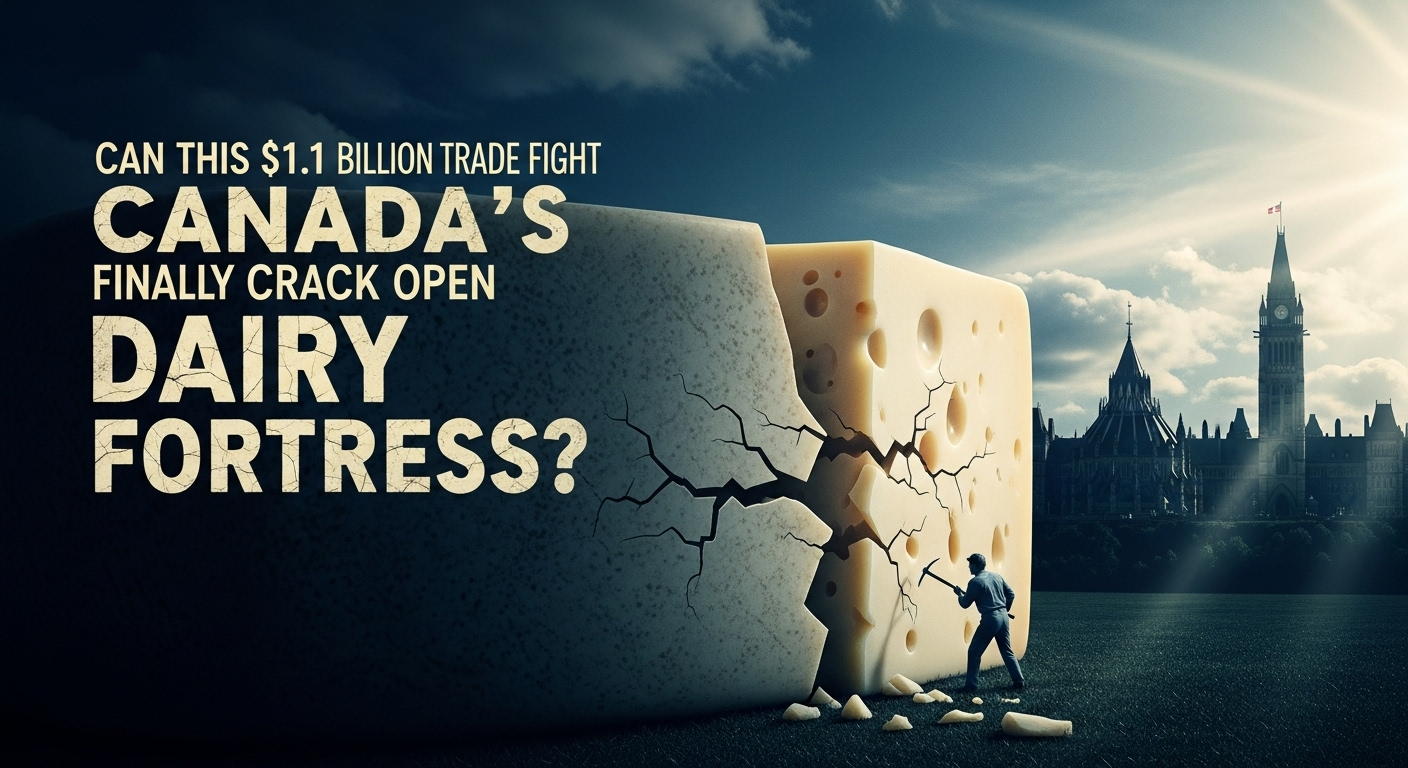
Can This $1.1 Billion Trade Fight Finally Crack Open Canada’s Dairy Fortress?

Only 21% of our Canadian quota gets used—that’s $900M sitting on the table!

EXECUTIVE SUMMARY: Here’s what caught my attention—despite all the trade drama and those brutal 241% tariffs, American dairy still managed to ship $1.1 billion worth of product to Canada in 2024. But here’s the kicker… we’re only using about 21% of our allocated quota space, which means there’s nearly $900 million in untapped opportunity just sitting there. The research shows that with Bill C-202 now locked in and the 2026 USMCA review coming up, this trade fight is going to define the next decade of North American dairy economics. Canadian retail milk prices are hovering around CAD $1.07 per liter while we’re dealing with tighter margins down here. Smart producers who start building export relationships now—especially in the Midwest with those logistics advantages—are going to be first through the gate when those barriers start cracking. This isn’t just politics anymore, it’s real money with real potential.

KEY TAKEAWAYS:

  • Track quota utilization like milk prices – Only 21% filled means massive room for growth if allocation systems get fixed, potentially opening $900M+ in new market access for prepared exporters.
  • Build export co-op relationships now – Partner with processing facilities near the border and establish connections with Canadian buyers before barriers drop, especially if you’re running operations in Wisconsin, Minnesota, or New York.
  • Monitor protein markets for profit signals – Canadian dumping is hammering global protein prices by 8-12%, so watch for market corrections that could boost your ingredient revenue streams.
  • Position for 2026 USMCA review opportunities – Start documenting your export readiness and production capacity now, because when trade negotiations heat up, the prepared operations will capture the biggest opportunities.
  • Focus on specialty and premium products – Canadian retail prices show there’s appetite for premium dairy, so consider organic certification or specialty cheese production that commands higher margins in protected markets.
Look, I’ve been watching this dance between us and Canada for years, and this feels different. The political pressure is real, the economics make sense, and the timing with that USMCA review coming up… it’s all lining up.

The producers who move first on this are going to be the ones laughing all the way to the bank when those trade barriers finally start coming down. What do you think? Are you ready to step up when those market doors crack open?

You know what’s got the whole industry talking? It’s not just another trade spat—we’re looking at a genuine crack in the $1.1 billion Canadian dairy market that’s been locked up tighter than a first-calf heifer. The political winds are shifting, and for the first time in decades, that northern fortress might actually have some weak spots showing.

U.S. Dairy Quota Utilization in Canada (2024)

What’s Really Happening Up There?

The thing about Donald Trump’s renewed focus on Canadian dairy—and I’ve been watching this dance for years—is that it’s hitting different this time. His team’s threatening to match Canada’s brutal 241% tariff on over-quota imports, which sounds like political posturing until you realize we still managed to ship $1.1 billion worth of dairy north in 2024. That’s real money flowing despite the barriers.

But here’s where it gets interesting… Canada just passed Bill C-202 back in June, and this thing is welded shut. They’ve literally made it illegal for future trade negotiators to lower dairy tariffs or increase quotas. Think about that for a minute—they took negotiation off the table entirely.

What strikes me about this whole situation is how it mirrors what we saw with Japan’s beef quotas years back. Same playbook: use legislation to remove any wiggle room for future deals.

The Numbers That’ll Make You Think Twice

Now here’s the part that should grab every producer’s attention—we’re only filling about 21% of our allocated Canadian quota. Not the 42% you hear tossed around, but less than a quarter. That means nearly 80% of our negotiated access is just sitting there unused.

I was talking to a producer from Vermont the other day (you know how those Northeast operations are dealing with labor shortages and feed costs), and he put it this way: “We’re staring at Canadian retail milk prices around CAD $1.07 per liter while we’re trying to make sense of margins that barely pencil out.” That premium is serious money.
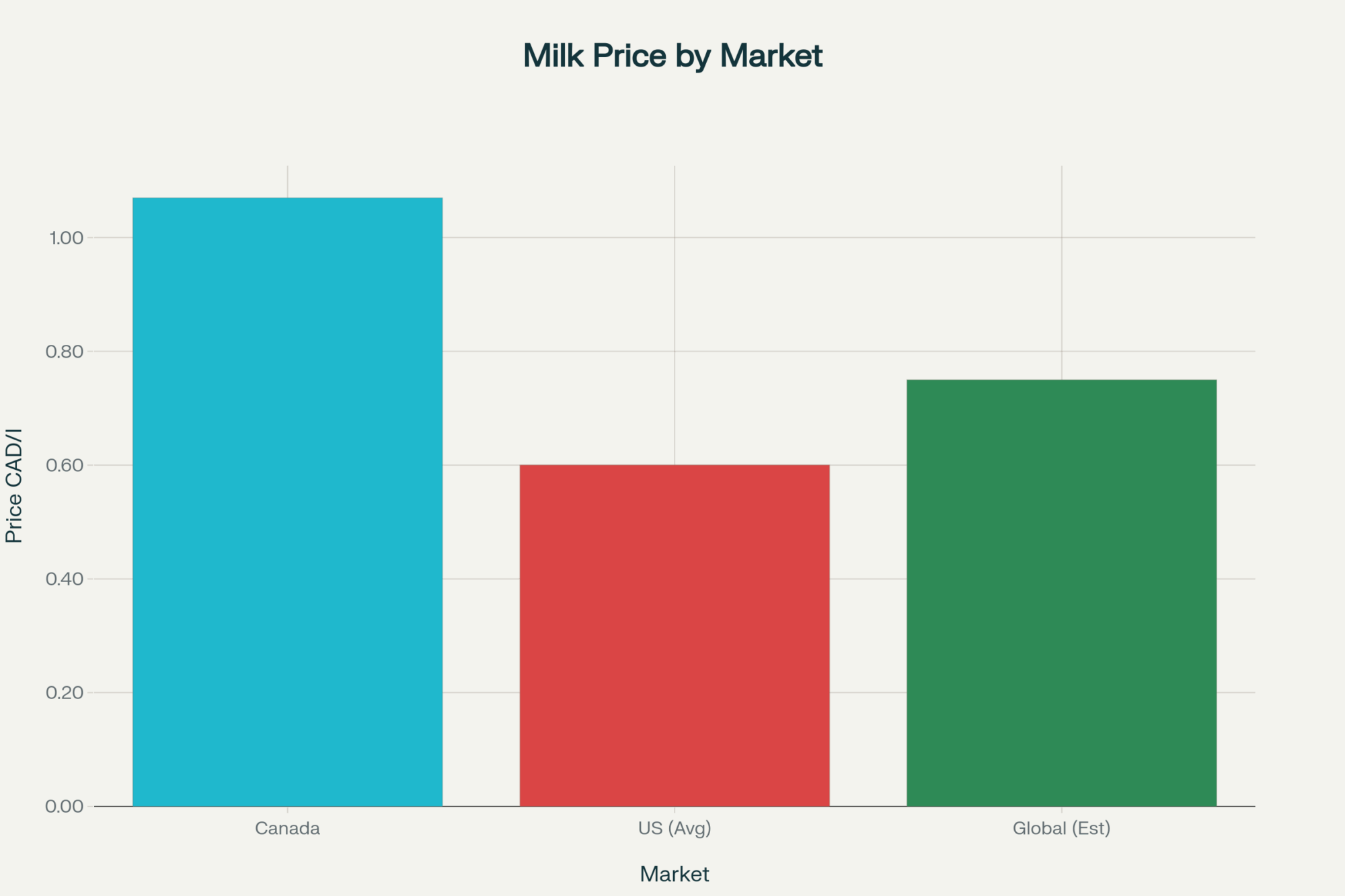
Retail Milk Price Comparison (CAD per liter)

Those tariffs work like a cliff edge, too. Inside quota? You’re golden with zero or low tariffs. Cross that line and boom—241% or higher depending on the product. It’s designed to be a hard stop, and honestly, it works perfectly.

Voices from the Trenches

Shawna Morris from the National Milk Producers Federation doesn’t mince words about this mess. She’s been pointing out for months that Canada’s quota allocation system heavily favors domestic processors who have zero incentive to bring in competing American product.

This isn’t happening in a vacuum either. When the latest round of tariffs kicked in, Canada fired back with retaliatory measures on $30 billion worth of U.S. goods, dairy included. Classic trade war escalation.

The Global Ripple Effect You Might Miss

Here’s something that caught my attention recently, and it’s bigger than just U.S.-Canada trade dynamics. Canada’s been dumping surplus dairy proteins—think skim milk powder—onto global markets at prices that are hammering worldwide protein markets by an estimated 8-12%.

If you’re a producer selling into ingredient markets, that hits your bottom line whether you’re exporting to Canada or not. It’s one of those interconnected things that doesn’t make headlines but shows up in your milk check.

This pattern is becoming more common… protected domestic markets subsidizing export dumping. We’ve seen it with EU dairy, we’ve seen it with New Zealand when they need to clear inventory. The difference here is scale and timing.

Looking at the Bigger Picture

Despite all the trade friction, the numbers tell an interesting story. Since USMCA took effect, U.S. dairy exports to Canada have grown by approximately 34%. That’s not the “quadrupled” figure you sometimes hear, but it’s solid growth in a heavily regulated market.

Those quotas are still managed with an iron fist by Canada’s supply management system—the Canadian Milk Supply Management Committee and Dairy Commission calling every shot. They’ve got this down to a science.

What This Means for Your Operation

Look, if you’re running a dairy operation and thinking about opportunities, here’s what I’d be watching closely:

Keep your ear to the ground on any shifts in U.S.-Canada trade policy, especially as the 2026 USMCA review approaches. That’s when the real horse-trading happens.

Pay attention to quota allocations. If we start seeing more import licenses going to retailers and food service companies instead of processors, that changes the entire game.

Watch protein markets like a hawk. Whether you’re selling domestically or internationally, those Canadian export practices are affecting your ingredient values.

And here’s the thing most producers miss—those 241% tariffs only kick in if you exceed quota limits. Since we’re not even filling a quarter of our allocated quotas, there’s actually room to grow within the existing framework if the allocation system gets straightened out.

Regional Realities Matter

This isn’t uniform across U.S. dairy regions either. Upper Midwest producers with established logistics networks might be better positioned if barriers fall. West Coast operations could find angles in specialty cheese markets. Northeast producers—especially in New York and Vermont—have proximity advantages for premium fluid milk markets.

I’ve been talking to producers from different regions, and the perspectives vary quite a bit. A guy running 800 head in Wisconsin sees this as potentially huge for his cooperative’s powder exports. Meanwhile, a family operation in Pennsylvania is more interested in what it might mean for their organic fluid milk premiums.

Bottom Line

Here’s my take after watching this industry for more years than I care to count: this feels like a rare opportunity for American dairy to crack into a premium market that’s been artificially protected for decades. But it won’t be easy, and it definitely won’t happen overnight.

The Canadian dairy fortress is real, and those political winds up north can shift faster than a July thunderstorm. Success will come to producers who stay informed, build the right relationships, and are ready to move when opportunities open up.

What’s got me optimistic is the combination of sustained political pressure, upcoming trade reviews, and the simple economics of the situation. When you’ve got American producers sitting on unused quota while Canadian consumers pay premium prices for milk, something’s eventually got to give.

The question isn’t whether change is coming to North American dairy trade—it’s whether your operation will be positioned to benefit when it does. This trade battle is going to define the next decade of North American dairy economics.

Your move: Start building relationships with export-focused cooperatives now. Monitor quota utilization reports. Keep tabs on processing capacity in border regions. Because when those barriers start coming down—and they will—the producers who moved first will capture the biggest opportunities.

What do you think? Are you ready to step up when those market barriers start cracking, or are you planning to wait and see how things shake out?

Complete references and supporting documentation are available upon request by contacting the editorial team at editor@thebullvine.com.

Learn More:

Join the Revolution!

Join over 30,000 successful dairy professionals who rely on Bullvine Weekly for their competitive edge. Delivered directly to your inbox each week, our exclusive industry insights help you make smarter decisions while saving precious hours every week. Never miss critical updates on milk production trends, breakthrough technologies, and profit-boosting strategies that top producers are already implementing. Subscribe now to transform your dairy operation’s efficiency and profitability—your future success is just one click away.

NewsSubscribe
First
Last
Consent

DAIRY TRADE DECEPTION: How the US-Canada USMCA Deal Failed American Farmers

Politicians claim “historic wins” on Canadian market access, but US milk trucks still can’t cross the border. Here’s where the real dairy money is.

US-Canada dairy trade, USMCA dairy provisions, dairy export markets, tariff-rate quotas, supply management system

While politicians on both sides of the border are busy patting themselves on the back over dairy ‘victories,’ America’s dairy farmers are left asking: Where’s the milk money? The much-hyped USMCA was supposed to crack open Canada’s dairy fortress, but two years and multiple ‘wins’ later, US producers still can’t get their products onto Canadian shelves.

Here’s what Washington and Ottawa don’t want you to know about this milky mess.

THE $300 MILLION QUESTION: HOW CANADA KEEPS AMERICAN DAIRY OUT

Despite multiple “victories” claimed by U.S. trade officials, the fundamental reality remains unchanged for American dairy exporters looking north—Canada’s market remains impenetrable mainly. The saga began in earnest in January 2022, when United States Trade Representative Katherine Tai announced a “historic win” for American dairy.

“Enforcing our trade agreements and ensuring they benefit American workers and farmers is a top priority for the Biden-Harris Administration. This historic win will help eliminate unjustified trade restrictions on American dairy products and ensure that the U.S. dairy industry and its workers benefit from the USMCA to market and sell U.S. products to Canadian consumers.”

— Katherine Tai, U.S. Trade Representative.

The reality? Think of Canada’s quota system like a two-tier nightclub: There’s a VIP section with no cover charge (the tariff-free quota), but once that fills up, you’re paying a 300% markup at the door (the prohibitive tariffs). The kicker? Canada ensured their buddies (domestic processors) got most of the VIP wristbands, leaving American dairy producers outside in the cold.

The USMCA rules gave Canada 45 days from the final report date to comply with the findings. In response, Canada removed its “allocation holder pools” under all TRQs and included “distributors” as eligible applicants under the industrial cheeses tariff-rate quota.

This cosmetic change didn’t solve the fundamental problem. By 2023, the US launched a second dispute challenging Canada’s market share-based allocation system, which still favored processors over retailers and food service operators. In November 2023, an independent panel rejected US concerns, with two of three panelists determining that Canada’s updated TRQ measures satisfied its USMCA obligations.

CANADA’S SIDE: WHY THEY FIGHT TO PROTECT SUPPLY MANAGEMENT

Canadian dairy farmers defend their supply management system as essential for national food security and stability. According to Dairy Farmers of Canada, the system “helps prevent wild fluctuations in the farm-gate price of milk and enhance Canada’s food sovereignty and stability.” Their primary argument? Rather than relying on foreign countries for dairy needs, Canada can maintain control over its food supply through domestic production.

“Overreliance on dairy imports puts ownership of our food supply in the hands of foreign suppliers and governments. That means we are more vulnerable to global issues beyond our control, like economic boom-and-bust, natural disasters, and government conflicts.”

Dairy Farmers of Canada.

Quebec farmer Markus Schnegg emphasized this point, noting that “nearly all the dairy produced in Canada is sold for domestic consumption,” meaning U.S. tariffs would only affect a small fraction of the market. He’s less worried about tariffs than about the U.S. president targeting Canada’s supply management system ahead of USMCA renegotiations.

Canadian farmers also point to health regulations as a key factor. As one Canadian official noted, “Canada imposes tariffs on U.S. dairy products due to concerns about compliance with health regulations, particularly regarding the use of growth hormones and antibiotics.” All Canadian milk is produced without the artificial growth hormones commonly used in U.S. dairy production.

SHOCKING NUMBERS: THE QUOTA SYSTEM FARMERS NEED TO UNDERSTAND

For dairy farmers reading this while waiting for milk pickup at 5 AM – here’s the bottom line: Don’t hold your breath for Canadian market access to save your bottom line. The politicians claiming victories haven’t delivered actual dollars in your pocket, and the dairy organizations celebrating ‘wins’ are measuring success by legal technicalities, not by more trucks crossing the border.

The mechanism preventing American dairy from reaching Canadian consumers is deliberately complex. Under the USMCA, Canada maintains 14 TRQs on various dairy products, including milk, cream, skim milk powder, butter, cheeses, and more.

The smoking gun? From January through October 2021, the United States exported just $478 million of dairy products to Canada. While this increased to over billion in 2022 (making Canada the second-largest market for US dairy exports), American producers still couldn’t fill any Canadian dairy quotas granted in the USMCA.

Table 1: USMCA Dairy TRQ Fill Rates (2022-2023)

USMCA Dairy CategoryFill Rate (2022-2023)Status
MilkBelow 50%UNDERUTILIZED
CreamBelow 50%UNDERUTILIZED
Skim Milk PowderBelow 50%UNDERUTILIZED
Butter and Cream PowderBelow 50%UNDERUTILIZED
Cheeses of All TypesPart of 9 TRQs below 50%UNDERUTILIZED
Overall Average42%UNDERUTILIZED

The average tariff fill rate was only 42% across all 2022/2023 quotas, with 9 of the 14 TRQs falling below half the negotiated value for the same period. Why such dismal numbers? After Canada’s “compliance” with the first ruling, they implemented new rules that resulted in even higher quantities of quota being allocated directly to Canadian processors.

University of Guelph food economist Michael von Massow points out an essential fact that politicians rarely mention: “Canada imports far more dairy from the U.S. than it exports,” suggesting an escalating dairy tariff war would hurt American farmers more than Canadian ones. Before the trade tensions, U.S. dairy that Canada imported wasn’t tariffed because it was less than the limit agreed upon in the USMCA.

PRICE DISPARITIES: THE FARM-GATE REALITY

While politicians battle over market access, the raw economics of milk production reveals why these two systems clash so fundamentally. According to recent data, Canadian producers will receive approximately $0.99 per liter (farmgate price) in 2025 after a slight 0.0237% decrease, while American dairy farmers face a projected all-milk price of $22.55 per hundredweight—equivalent to roughly $1.94 per liter.

This stark differential—US farmers receiving nearly double what their Canadian counterparts get—illuminates why Canada’s supply management system remains so fiercely protected. Canadian farmers trade higher volume potential for price stability, while US producers bear greater market risk for potentially higher rewards. As University of Guelph food economist Michael von Massow observed, these systemic differences mean “a change in price paid to farmers for their milk does not necessarily translate to a similar retail price change” in either country.

Table 4: US-Canada Farm-Gate Milk Price Comparison (2023-2025)

YearCanadian Price ($/liter)Canadian AdjustmentUS Price ($/cwt)US Price ($/liter equivalent)
2023$1.00+1.5%$20.10 (Jan) to $25.50 (Sept)$1.73-$2.19
2024$1.01+1.0%$22.65 (avg)$1.95
2025$0.99 (projected)-0.0237%$22.55 (projected)$1.94

This fundamental price gap explains why opening Canada’s dairy market remains such a contentious issue—it’s not just about selling more US dairy products; it’s about two entirely different economic systems colliding.

CURRENT MARKET REALITY: WHERE US DAIRY IS WINNING IN 2025

While Canada continues frustrating access attempts, US dairy exports have found significant success elsewhere. According to the US Dairy Export Council, in January 2025, US dairy exports increased by 0.4% in volume compared to the previous year, with export value soaring 20% to a January record of $714 million.

The star performer? Cheese exports jumped 22% to 46,680 metric tons—marking the seventh consecutive monthly record. Unlike the frustrating Canadian situation, US cheese is finding enthusiastic buyers worldwide, with impressive growth in Japan (59%), South Korea (34%), and Southeast Asia (67%).

This global success raises the question: Why continue fighting for minimal Canadian access when other markets are throwing open their doors? Innovative producers are pivoting to these growth markets rather than waiting for political solutions to the Canadian impasse.

POLITICAL THEATER: THE HIGH-STAKES GAME WHERE FARMERS LOSE

While American politicians cry foul and Canadian officials insist they’re playing by the rules, dairy farmers on both sides of the border are mere pawns in a much larger political chess match. The evidence is in the timeline of events and the persistent failure to achieve meaningful market access.

Table 2: USMCA Dairy Dispute Timeline

DateEventOutcomeImpact on US Dairy Access
May 2021US files first USMCA disputeChallenged 85-100% processor reservationNo market impact during dispute
December 2021Panel issues final reportCanada given 45 days to complyNo immediate change
January 2022US announces “historic win”Canada ordered to revise TRQ systemNo measurable export increase
2022Canada revises TRQ measuresRemoved “allocation holder pools”Higher processor allocation
2022US launches second disputeChallenged market share-based systemNo market impact during dispute
November 2023Panel rejects US claims2-1 decision favoring CanadaStatus quo maintained
March 4, 2025Trump imposes new tariffs25% tariffs on Canadian importsCanada announces retaliatory measures
March 6, 2025Trump announces exemptionTemporary pause until April 2Continued uncertainty
March 7, 2025Trump threatens dairy tariffsSuggests possible 250% tariffFurther escalation possible

“The panel’s decision leaves a status quo of Canadian dairy restrictions that is simply unacceptable. American farmers deserve a level playing field, and Canada must uphold both the spirit and the letter of its obligations under USMCA.”

— Jason Smith, House Committee on Ways and Means Chairman

The bipartisan frustration is palpable. House Agriculture Committee Chairman GT Thompson and Ranking Member David Scott called it “critical the U.S. encourage and enforce USMCA,” noting that “this decision allows Canada to continue their questionable protectionist practices.”

“It is unacceptable that the current Canadian dairy restrictions harming U.S. farmers are allowed to continue. Our dairy farmers in Upstate New York and the North Country work hard to provide delicious and nutritious products for our communities. They deserve the market access they were promised under USMCA. This USMCA dispute panel’s decision allows the status quo to continue. This is untenable.” — Congresswoman Elise Stefanik.

The situation has become even more volatile with President Trump’s March 4, 2025, announcement of 25% tariffs on imports from Canada, followed by a temporary exemption until April 2. Canada’s response was swift and forceful. Canadian Finance Minister Dominic LeBlanc announced: “Today, I am announcing that the government of Canada, following a dollar-for-dollar approach, will be imposing, as of 12:01 a.m. tomorrow, March 13, 2025, 25% reciprocal tariffs on an additional $29.8 billion of imports from the United States.”

Prime Minister Justin Trudeau was equally direct, declaring that “Canada will continue to be in a trade war with the United States for the foreseeable future,” adding that “our tariffs will stay in effect until the U.S. eliminates theirs, and not a second earlier.”

Most recently, a bipartisan group of U.S. Senators, including Tammy Baldwin (D-WI), Roger Marshall (R-KS), and Joni Ernst (R-IA), sent a letter to Trump administration officials urging them to address what they called Canada’s evasion of USMCA guidelines. “Historically, Canada has failed to live up to its commitments to provide access to its market; this remains the case even with new provisions in USMCA,” the senators wrote.

WHAT THIS MEANS FOR YOUR FARM: PRACTICAL TAKEAWAYS

If you’re milking cows rather than making policy, here’s what you need to know:

  1. Canadian market access will remain limited regardless of political “wins.” The TRQ system is designed to appear compliant while maintaining barriers.
  2. Focus on markets showing actual growth. Unlike Canada, export markets like Japan, South Korea, and Southeast Asia have demonstrated a substantial appetite for US dairy products, particularly cheese.
  3. Diversification is your best protection. Farms too dependent on any single market (domestic or export) are vulnerable to political whims and trade disputes.
  4. Watch the April 2 tariff deadline. If temporary extensions expire, expect significant market disruption across the North American dairy trade.
  5. Value-added production offers better margins than commodity focus. Specialty cheese producers find eager markets worldwide, while commodity milk faces tighter margins.

THE HARD TRUTH: WHY WAITING FOR POLITICIANS TO FIX THIS IS COSTING US DAIRY FARMERS MONEY

“I am very disappointed by the findings in the USMCA panel report released today on Canada’s dairy TRQ allocation measures. Despite the conclusions of this report, the United States continues to have serious concerns about how Canada is implementing the dairy market access commitments it made in the Agreement.”

— Ambassador Katherine Tai, November 2023

The answer is disappointing for dairy farmers who are wondering when they’ll see actual benefits from these trade disputes. The fundamental barriers remain after multiple “victories,” formal panel rulings, and policy revisions.

Table 3: Rhetoric vs. Reality in US-Canada Dairy Trade

MetricPolitical ClaimVerified Reality
US Dairy Exports to Canada (2022)“Historic market access”$1 billion, but quotas unfilled
USMCA TRQ Fill Rate (2022/23)“Eliminated barriers”42% average utilization
Impact of First USMCA “Win”“Important victory”Canada changed rules to favor processors even more
Result of Second Challenge“Enforcing commitments”Panel ruled 2-1 in Canada’s favor
March 2025 Tariff Situation“Protecting American interests”Created new uncertainty for all export markets

United States Trade Representative Katherine Tai, who announced the “historic win” in 2022, has yet to deliver the promised benefits to American dairy farmers. Meanwhile, Canada’s protective system remains largely intact despite all the political theater.

“The United States won the first USMCA case on Canada’s dairy TRQ allocation system to secure fair market access for U.S. dairy farmers, workers, processors, and exporters… We will continue to voice deep concerns about Canada’s system. We remain focused on securing the market access we believe Canada committed to under the USMCA, and we will continue exploring all avenues available to achieve that goal.”

— Tom Vilsack, U.S. Secretary of Agriculture.

THE BULLVINE BOTTOM LINE: STOP WAITING FOR POLITICAL SOLUTIONS

Stop waiting for politicians to fix this. The harsh reality is that Canada’s dairy market will remain primarily closed regardless of how many press releases claim otherwise. Innovative producers should focus on domestic innovation and emerging markets beyond our northern neighbor.

The actual trade opportunity isn’t in fighting over scraps of Canadian quota – it’s in demanding our trade representatives pursue aggressive new agreements in regions hungry for American dairy excellence. The January 2025 export data makes this case convincingly:

  1. Japan: Cheese exports up 59%, with firm WPC80+ purchases (2,009 metric tons)
  2. South Korea: Cheese exports increased by 34%
  3. Southeast Asia: Cheese shipments jumped 67%
  4. Middle East/North Africa: Significant growth, particularly in Bahrain
  5. Central America & Caribbean: Continued strong demand across product categories

Producers seeking export assistance can access resources through the U.S. Dairy Export Council’s Export Assistance Program, which offers market information, technical support, and regulatory guidance for entering these promising markets. The USDA’s Foreign Agricultural Service also provides export credit guarantees and market development programs specifically designed for dairy exporters targeting Asian markets.

The next time a politician brags about ‘dairy victories,’ ask them a simple question: How many more truckloads of American dairy products are crossing the Canadian border? The silence will be deafening.

Key Takeaways

  • Follow the Numbers, Not the Rhetoric: Despite political claims of “historic wins,” US dairy producers haven’t filled even half of the negotiated Canadian quotas, revealing the gap between trade announcements and on-farm reality.
  • The Canadian Fortress Stands: Canada’s TRQ system is deliberately designed to appear compliant with USMCA while maintaining impenetrable barriers by allocating most quotas to processors with no incentive to import competing products.
  • Growth Markets Are Elsewhere: While politicians fight over Canadian access, US cheese exports are setting monthly records with explosive growth in Japan (59%), South Korea (34%), and Southeast Asia (67%)—markets eager for American dairy.
  • Value-Added Over Commodity Focus: Farms that have pivoted to specialty products for specific export markets are seeing better margins and less vulnerability to political trade disputes.
  • Resources Exist for Market Diversification: The U.S. Dairy Export Council and USDA’s Foreign Agricultural Service offer targeted assistance for producers seeking to enter promising Asian and Middle Eastern markets.

Executive Summary

The much-celebrated USMCA dairy provisions have failed to deliver meaningful Canadian market access for American producers, with average tariff quota fill rates stuck at a dismal 42%. Despite years of “victories” in trade disputes, Canada’s system still effectively blocks US dairy while technically complying with trade rules. Meanwhile, genuine growth opportunities are booming elsewhere—with cheese exports to Japan up 59%, South Korea up 34%, and Southeast Asia up 67%. The recent escalation of tariff threats between the US and Canada only heightens uncertainty for dairy producers caught in political crossfire, making market diversification more crucial than ever for American dairy operations seeking sustainable export growth.

Learn more

Join the Revolution!

Join over 30,000 successful dairy professionals who rely on Bullvine Daily for their competitive edge. Delivered directly to your inbox each week, our exclusive industry insights help you make smarter decisions while saving precious hours every week. Never miss critical updates on milk production trends, breakthrough technologies, and profit-boosting strategies that top producers are already implementing. Subscribe now to transform your dairy operation’s efficiency and profitability—your future success is just one click away.

NewsSubscribe
First
Last
Consent
Send this to a friend