





Raw milk is legal in 32 states — and still 840× more likely to make someone sick than pasteurised milk. The law may say ‘yes.’ Your insurer might already be saying ‘no.’
Executive Summary: Raw milk looks like an easy side hustle, but the Keely Farms case in Florida shows how fast it can turn into a bet‑the‑farm liability. In 2025, a raw-milk outbreak linked to Keely left 21 people sick, including six children, and led to a lawsuit from a mother who says she nearly died and lost her unborn baby. At the same time, only about 3.2% of Americans drink raw milk, yet unpasteurised dairy is linked to an estimated 96% of dairy-related illnesses and an 840× higher risk of illness than pasteurised milk. Insurers have responded by carving raw milk out of standard farm policies, dropping some producers entirely, and pushing specialty coverage that can chew through 20–30% of the typical $31,200 gross margin from a 100‑gallon‑per‑week raw-milk stream. Real-world cases — from Dog Mountain Farm’s $75,000 raw‑milk investment that lost its insurer to pediatric HUS patients with six‑figure hospital bills — show how quickly one claim can erase the upside. This article walks producers through concrete checks on policy exclusions, co‑op contracts, and cost‑of‑production math, then lays out safer ways to tap “wellness” demand through pasteurised value-add, genetics, and efficiency. The core message is simple: before you bottle a drop of raw milk, treat it like a high‑stakes business decision, not a casual side hustle.
You’re being pulled in two directions right now: the desperate need for margin and the terrifying reality of liability.
In August 2025, the Florida Department of Health identified Keely Farms Dairy in New Smyrna Beach as the likely source of raw milk linked to 21 cases of E. coli and Campylobacter — including six children under 10 and seven hospitalisations. Officials said the illnesses stretched back to January, and news coverage describes at least two patients with severe complications. One of those patients was Rachel Maddox of Seminole County, who said she contracted Campylobacter while caring for her toddler after the child drank raw milk she’d purchased from a store in Longwood, Florida. “I became very ill — and I mean the sickest I’ve ever been in my life,” Maddox told News 6 in 2025. “I came really close to dying, and our son did die.” Her 20-week fetus did not survive, and Maddox was diagnosed with sepsis.
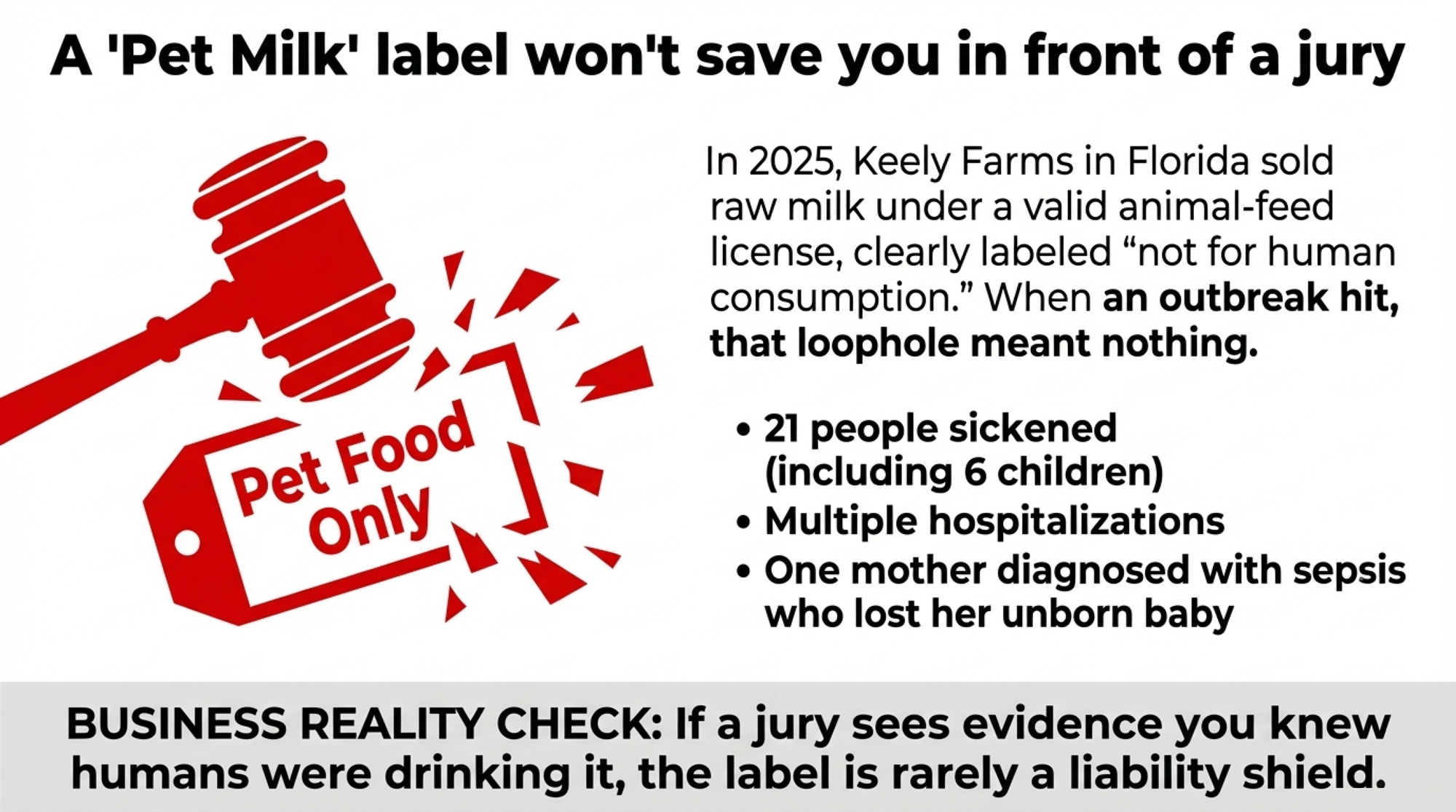
Keely Farms labelled its products “not for human consumption” and sold them under Florida’s pet‑food exemption. According to state records and reporting, the farm held a valid animal‑feed licence with no cited compliance issues at the time. Farm manager Keely Exum said in an emailed statement that the dairy was “blindsided” by the DOH announcement: “The Department of Health has not informed Keely Farms of any investigation or administrative action.” The Farm-to-Consumer Legal Defense Fund, which assisted with the farm’s legal response, reported that the DOH never visited the farm, never collected on-farm samples, and never notified the farmer before issuing its public statement. FTCLDF’s public records requests seeking the underlying data went unanswered. The farm did not respond to phone and email messages from The Associated Press.
That legal label didn’t stop people from drinking the milk. Maddox told News 6 she’d asked about the “for consumption by animals” label at the store and was told “that was a technical requirement to sell ‘farm milk.'” She didn’t question further. State and media reports make clear that many buyers were consuming the product despite the labelling — and the label didn’t prevent Keely Farms from being named in the outbreak investigation.
Business Reality Check #1: In a courtroom, a “Pet Milk” label is often viewed as a “wink-and-nod” agreement; if a jury sees evidence that you knew (or should have known) humans were drinking the product, that label rarely acts as the liability shield producers hope it will be.
Business Reality Check #2: Keely Farms was cleared — negative lab tests, passed inspection, lawsuit dropped. The farm still spent months defending itself against national headlines triggered by a press release with no on-farm investigation. Being right doesn’t make you whole.
In August 2025, national food‑poisoning law firm Ron Simon & Associates, along with Orlando‑based Newsome Law, filed the first lawsuit in Seminole County on behalf of Maddox. Keely Family Farms filed a motion to dismiss, arguing the complaint didn’t identify facts showing contamination or describe any “root-cause investigation of illness,” and that its labelling complied with Florida Department of Agriculture requirements.
The farm’s own independent lab tests — conducted by CentralStar (PCR testing, August 8 and 15, 2025) and the Florida Department of Agriculture (culture, August 12, 2025) — came back negative for both Campylobacter and E. coli across multiple samples. The FDACS routine inspection cleared the farm. Four days after Keely filed its motion to dismiss, Maddox voluntarily dropped the case. No formal notice of violation, shutdown order, or administrative proceeding was ever initiated against the farm.
That outcome should concern raw-milk producers as much as the outbreak itself. Keely Farms was ultimately cleared — negative lab results, passed inspection, case dropped. But by that point, the farm had already endured months of national headlines, a high-profile lawsuit from a major food-poisoning firm, and the kind of reputational damage that no lab result can undo. You don’t have to lose in court for raw milk to become a bet-the-farm event. You just have to get named.
A 2025 National Agricultural Law Center update reports that 32 states allow raw‑milk sales when certain conditions are met, while 18 still ban it outright. Three states — Arkansas, Utah, and North Dakota — enacted laws updating their raw‑milk regulation in 2025 alone. As of early 2026, several more state legislatures have bills moving. You’re feeling that pressure: wellness‑minded customers asking why they can’t buy “real” milk at the farm, homesteaders paying double‑digit prices per gallon, and social feeds full of raw‑milk reels.
The premium looks real. But the “ghost” liabilities sitting behind it — in your insurance policy, your co‑op contract, your lender relationship, and your social licence to operate — can quietly swallow that $31,200 before it ever hits the bottom line.
What’s Actually Changing — and Why It Lands on Your Yard
Raw milk has shifted from fringe wellness fad to active policy and public‑health battleground. A CDC‑linked risk‑modelling study estimated that from 2009 to 2014, unpasteurised milk was consumed by about 3.2% of the U.S. population and unpasteurised cheese by 1.6%, yet an estimated 96% of illnesses from contaminated dairy products were caused by unpasteurised milk and cheese.

Per serving, consumers of unpasteurised dairy were about 840 times more likely to get sick and 45 times more likely to be hospitalised than those consuming pasteurised dairy. If the share of unpasteurised consumption doubled, outbreak‑related illnesses were projected to rise by roughly 96%.
| Dairy type | Share of US population consuming | Share of outbreak illnesses | Illness risk per serving | Hospitalisation risk |
| Pasteurised milk & cheese | ~96.8% / 98.4% | ~4% | Baseline (1×) | Baseline (1×) |
| Unpasteurised milk & cheese | 3.2% / 1.6% | ~96% | ≈840× higher | ≈45× higher |
On the consumer side, raw‑milk advocates talk about “alive” enzymes, gut health, and European “farm‑milk” allergy studies. They show beautiful jars and frothy latte shots. They rarely mention the 840× number.
Agencies are blunt. A 2012 Pennsylvania Campylobacter outbreak sickened 148 people across four states; investigators concluded that consumer avoidance of raw milk was the only way to prevent similar events. A CDC report published in July 2025 documented a Salmonella Typhimurium outbreak linked to commercially distributed raw milk that sickened people across California and four other states between September 2023 and March 2024 — one of the largest raw‑milk outbreaks in recent U.S. history.
And then there’s H5N1. In 2024, USDA confirmed that highly pathogenic avian influenza was circulating in U.S. dairy cattle, and the FDA warned consumers that the virus could be shed into raw milk from infected cows. By December 2024, the USDA ordered mandatory H5N1 testing of raw milk. A January 2026 veterinary case report documented a cat’s death linked to consuming recalled raw milk from a California dairy — the kind of headline that turns a food‑safety debate into a kitchen‑table panic.
That’s the tension you’re sitting in. Your customers see jars and “natural.” Your risk partners see 840×, Salmonella, and H5N1.
How Does the Raw‑Milk Margin Really Look on a 200‑Cow Herd?
Let’s run the barn math everybody’s whispering about but not writing down.
Say you’re milking around 200 cows, shipping roughly 75 pounds per cow per day. That’s about 15,000 pounds — roughly 1,750 gallons — leaving in the tanker every day.
Now carve out a small raw‑milk stream:
- You bottle 100 gallons of raw milk a week.
- Over a year, that’s 100 × 52 = 5,200 gallons.
- If you can reliably get a $6‑per‑gallon premium over what that volume would bring in your normal cheque, you’re looking at $31,200 in extra gross revenue.
You’ve shifted about 5–7% of your annual volume into a higher‑margin channel. Real money on a 200‑cow herd. It’s also the point where you stop being “just” a supplier and start acting like a high‑risk food business in your own right.
Now layer in the risk side — and pay attention to the dates, because this isn’t new.
Back in 2014, Hoard’s Dairyman reported that more insurers were classifying raw milk as too risky to cover. That trend hasn’t softened. According to Food Safety News (October 2014), Farm Bureau–owned Rural Mutual Insurance Co. in Wisconsin sent notices in 2012 to farm policyholders stating that their coverage “does not provide for the sale and/or distribution for offsite consumption of unpasteurized (commonly called raw) milk from cows, sheep, and goats for human consumption.” Not barn‑talk gossip. A specific exclusion in black-and-white.
Published reporting documents a pattern across the industry:
- Flat refusals to cover farms that sell raw milk for off‑farm consumption.
- “Raw milk and raw milk products” exclusion endorsements — like the one documented by the Allegany Group — that carve those claims out of otherwise standard farm policies.
- Broad bacteria or contaminant exclusions can be used to deny any foodborne illness claim.
Re‑insurers are watching too. Tami Griffin, deputy national director for Aon Risk Solutions’ Food Systems, Agribusiness & Beverage Group, told Food Safety News that raw‑milk sales are “definitely on the radar of insurance companies” and that “I have heard some carriers are not willing to provide coverage for those selling it.”
Dog Mountain Farm near Carnation, Washington, learned what that looks like in practice. The farm had invested $75,000 in a USDA‑certified raw goat milk dairy — and then found out its carrier was dropping raw‑milk coverage. Owner Cindy Krepky said the farm would continue its other operations — cider, apple butter, 15 varieties of apples, pears, and quince — while hunting down a carrier willing to insure the raw goat milk business. Seventy‑five thousand dollars in infrastructure, and the insurance market pulled the rug.
Specialty raw‑milk liability policies do exist. Denver broker Kendall Turner says coverage is still possible, but that “the insurance company sometimes has more rules than the state.” Producers and brokers report that meaningful raw‑milk coverage can run into the five‑figure range per year once limits, fees, and surplus‑lines taxes are added.
On that 5,200‑gallon scenario, a realistic specialty premium could chew through 20–30% of your $31,200 gross margin before you’ve bought a single cap or label.
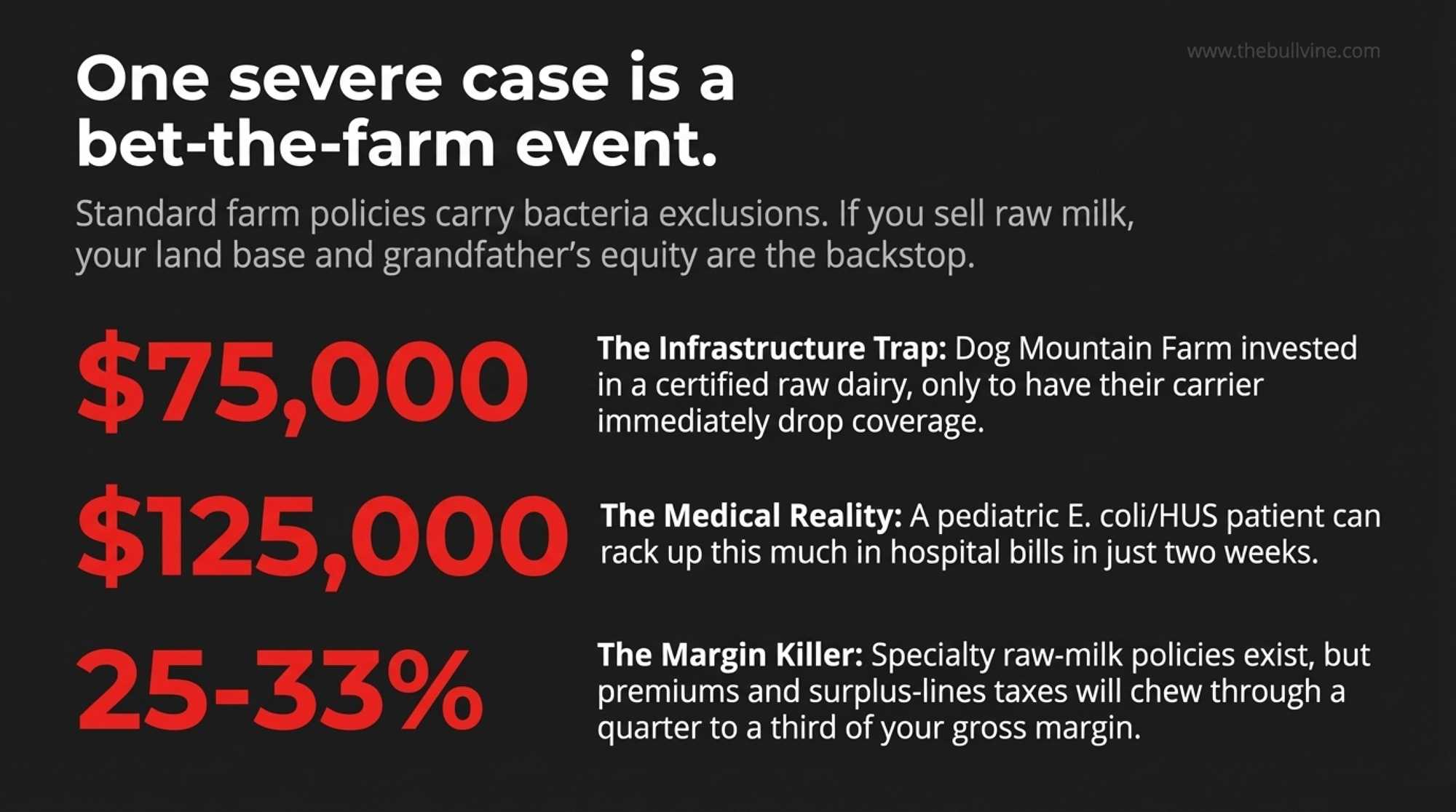
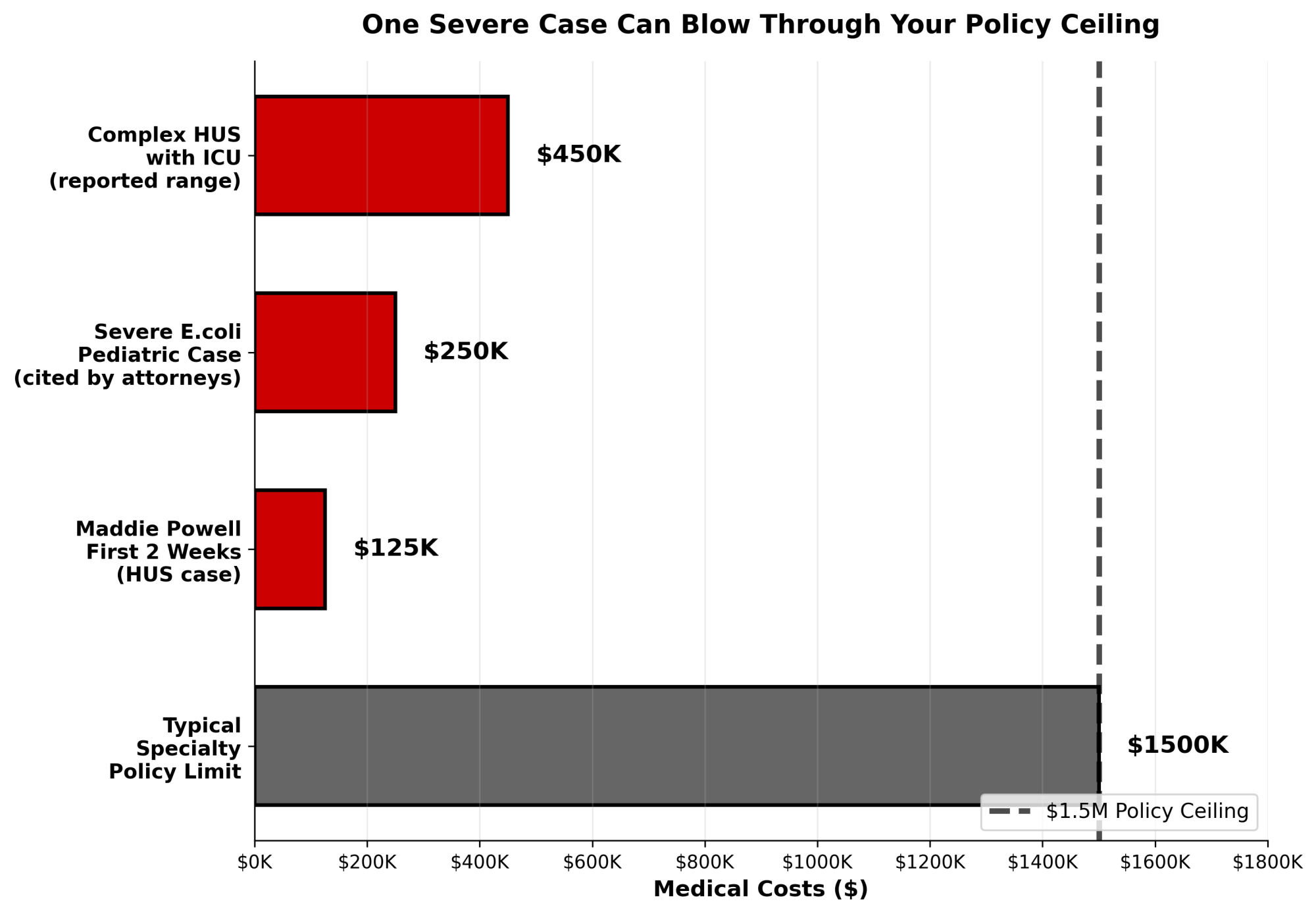
Most specialty policies carry $1–2 million per‑occurrence limits. To understand how fast you can hit that ceiling, consider the case of five‑year‑old Maddie Powell in eastern Tennessee. In 2018, Hoard’s Dairyman reported that Maddie developed hemolytic uremic syndrome (HUS) — a potentially fatal kidney disease — after drinking raw milk linked to an E. coli outbreak. She was on dialysis within 24 hours of admission, endured six blood transfusions, two surgeries, and spent weeks in the hospital, in and out of intensive care. Her mother, Cassie Powell, told Food Safety News that medical bills topped $125,000 in just the first two weeks, with the hospital room alone running $6,000 per day. Food safety attorneys cited in the same reporting pointed to other pediatric E. coli/HUS patients whose bills reached $250,000 and over $450,000 before discharge. A 2014 Food Safety News analysis concluded that treatment of a child or senior with severe E. coli O157:H7 or Listeria complications “not uncommonly” results in direct medical costs exceeding $1 million — deciding to go without coverage “literally a bet-the-farm kind of decision.”

One severe case bumps right against your policy ceiling. And if you’re not carrying specialty coverage — and your farm policy excludes raw milk or bacteria — you’re using your land base, barns, and family equity as the backstop.
On a 200‑cow herd, one raw milk lawsuit isn’t just betting your milk cheque. It’s betting the equity your grandfather spent 40 years building.
| Coverage Scenario | Standard Farm Liability | With Raw Milk Exclusion | Specialty Raw Milk Policy |
|---|---|---|---|
| Slip-and-fall on farm | ✓ Covered | ✓ Covered | ✓ Covered |
| Contaminated bulk tank milk (to processor) | ✓ Covered | ✓ Covered | ✓ Covered |
| Customer sick from raw milk sold off-farm | Likely EXCLUDED | EXCLUDED | ✓ Covered ($1–2M limit) |
| E.coli outbreak traced to your raw milk | Likely EXCLUDED | EXCLUDED | ✓ Covered (if limits sufficient) |
| Annual premium (estimated) | $2,000–$4,000 | $2,000–$4,000 | $6,000–$9,000 |
| Your exposure on $250K claim | $250,000 (self-insured) | $250,000 (self-insured) | $0 (if within limits) |
How Much of a Raw Milk Lawsuit Would Your Insurance Actually Cover?
If you’re anywhere near selling raw milk, this is the first number you need. Not the last.
Pull your current farm‑liability policy and look for three things:
- Any endorsement that mentions “raw” or “unpasteurized” milk or dairy products, including pet food, and “not for human consumption” language.
- Any broad exclusions mentioning “bacteria,” “contaminants,” or “foodborne illness.”
- How your umbrella coverage “follows form” — because if the underlying policy excludes raw‑milk risk, the umbrella usually does too.
Then email your broker one question you can screenshot and save:
“How would this policy respond if someone got sick from raw milk I sold off the farm?”
If the answer is vague, or if you spot clear raw‑milk or bacteria exclusions, assume your current policy won’t stand behind a raw‑milk claim. Ruhl Insurance in Pennsylvania puts it plainly on their blog: “Many farm insurance companies will not write a policy for a farmer who sells raw milk; therefore, if you decide to undertake this business pursuit, you should expect your options of where to obtain coverage for your farm to shrink.”
Get an actual quote for specialty raw‑milk liability. Don’t guess. Put the premium beside your barn‑math gross margin.
If your specialty liability bill eats more than about 25–33% of your projected raw‑milk gross margin, you’re effectively self‑insuring a significant slice of catastrophic risk. The question you’re really answering at that point isn’t “Can I sell raw milk?” It’s “Am I comfortable using my family’s land and barns as collateral for somebody else’s food‑safety risk?”
What Happens to Your Market When the Farm Down the Road Gets Named?
You might decide you’ll never touch raw milk. That doesn’t mean the farm five miles over feels the same way.
In Florida, state officials publicly identified Keely Farms as the likely outbreak source — before conducting an on-farm investigation and despite the farm’s own lab tests later coming back negative. Coverage emphasised that the farm operated under a legal pet‑food licence but that many customers were drinking the milk anyway. For most consumers, the nuances of lab results and dropped lawsuits don’t register. They read: “raw milk from a Florida farm made people sick.” Full stop.
Public‑health responses after outbreaks almost always reach beyond the farm named in the press release:
- State‑level warnings that explicitly call out raw milk as higher risk and advise people not to drink it.
- Tighter scrutiny of raw‑milk permits and sometimes more frequent inspections of other dairies in the same region.
- Calls from medical, consumer, and industry groups to tighten raw‑milk regulations or stall new legalisation efforts.
In Wisconsin, concern over the potential damage of a single outbreak to the state’s dairy reputation was one reason cited when Governor Jim Doyle vetoed a raw‑milk bill. “We have worked successfully over the last seven years to modernize Wisconsin’s dairy industry,” Doyle said in his veto statement. “An outbreak of disease from the consumption of raw milk could harm our reputation for providing healthy dairy products, and damage the entire industry.” That’s social licence to operate in action: the informal permission society gives an industry to do its work. When a high‑profile child hospitalisation makes the evening news, history shows regulators and activists push for tougher rules on all small‑ and mid‑size dairies — not just the one that sold the milk.

Co‑ops build this into their risk calculus. In May 2010, the CROPP Cooperative — the farmer‑owned organisation behind Organic Valley — voted to prohibit its member dairies from selling raw milk as a side business. The initial board vote was 4–3; a subsequent vote went 7–0 to cap any raw‑milk sales at no more than 1% of a member’s volume. CEO George Siemon told Grist at the time: “It’s not a fun issue here. Everyone on the board drinks raw milk.” An estimated 10% of Organic Valley’s member farms — roughly 150 to 200 dairies — were selling raw milk at the time. For those members, the choice was stark: stay in the co‑op or chase raw‑milk premiums, but not both. The board’s concern, as reported by Food Safety News and the Northeast Organic Dairy Producers’ Association, was straightforward: if one Organic Valley member’s raw milk triggered a public outbreak, the fallout could tar the entire brand.
Even if you ship to a different buyer, your neighbour’s decision matters. When raw‑milk headlines hit a region, buyers revisit supplier lists, side businesses, and contract clauses around “uniform marketing,” “conduct that harms the co‑op,” or “damage to brand and markets.” One farm’s raw‑milk gamble can mean more paperwork, more audits, and less patience from your own processor — even if every drop you ship is Grade A into the tanker.
What About Those Allergy and Asthma Studies?
You’ve probably heard the line: “Farm kids who drink raw milk don’t get asthma.” Like most simple stories, the truth is more complicated.

The large European PARSIFAL and GABRIELA studies did find that children growing up on or near farms and consuming farm milk had lower rates of asthma and allergies. One PARSIFAL analysis reported that farm‑milk consumption was associated with about a 26% reduction in asthma, 33% reduction in hay fever, and up to 58% reduction in food allergy compared to kids who didn’t drink farm milk.
Raw‑milk marketers often flatten that to: “Raw farm milk protects kids from allergies.” The researchers did not say that.
The PARSIFAL authors are explicit: their study “does not allow evaluating the effect of pasteurized vs. raw milk consumption” because they had no objective verification of how farm milk was handled at home. Farm kids breathe barns, dust, animal microbes, and everything else in the environment, along with whatever’s in the milk. That’s the “farm effect” — not just “raw milk.”
Follow‑up work points to multiple possible mechanisms: fatty‑acid profiles, whey proteins, milk‑fat‑globule membrane components, dust‑bound particles, even microRNAs — not just live bacteria. Independent reviewers have reached a consistent bottom line: there is a real association between farm‑milk consumption and lower allergy/asthma rates, but that doesn’t mean drinking raw milk is a safe or recommended prevention strategy.
A 2024 Foodfacts review summarising PARSIFAL, GABRIELA, and related work puts it plainly: the evidence “doesn’t prove a protective effect of raw milk consumption,” and the scientists behind the farm‑milk effect explicitly caution that raw farm milk “cannot be recommended” as a preventive measure.
When a customer tells you they want raw milk for their kid’s allergies, the evidence‑based answer is uncomfortable but simple: the “farm effect” is real, and the path forward is to isolate the protective components — not to ignore the 840× risk and pour raw milk for children. That’s a pasteurised product opportunity, not a raw‑milk justification.
Paths That Keep Your Insurer in the Picture
Other paths keep pasteurisation — and your coverage — intact.
Branded pasteurised, your name on the bottle
You’ve got some capital, extra labour, and local customers who want “your” milk with your farm name on it. State dairy‑plant licensing, a HACCP‑style QA system, a small pasteuriser and packaging line, and time to build accounts — that’s the investment. But you can sell cream‑top whole milk, chocolate milk, drinkable yogurt, soft cheeses, ice‑cream mix — all pasteurised, all within frameworks your insurer recognises. The 143‑hour weeks at Clark Farms show what the real math of on‑farm creamery ROI looks like — it’s not glamorous, but the liability picture is completely different.
The catch: you take on inventory risk, marketing, and customer service. If you under‑estimate your time or over‑estimate demand, the margin disappears. But what doesn’t happen is a public‑health investigation with your farm’s name attached.

Breed into the wellness premium instead of bottling around it.
Your processor already pays for components. What if you captured the wellness‑market demand inside a pasteurised, regulated system? Align sire selection, culling, and heifer strategy to hit A2A2, higher components, grass‑fed, organic, or non‑GMO programs — leaning harder on genomic testing and mating programs to shift herd profile. You get paid a premium on every load, not just what you can bottle. Instead of selling raw “A2 milk” directly from the tank, you ship to brands that pay for it, with pasteurisation and QA sitting between you and end consumers.
The trade‑off: organic and grass‑fed limit feed options and stocking rates. Niche programs can lose premium if the market shifts or too many herds pile in. But the regulatory and liability profile is night‑and‑day compared to raw.
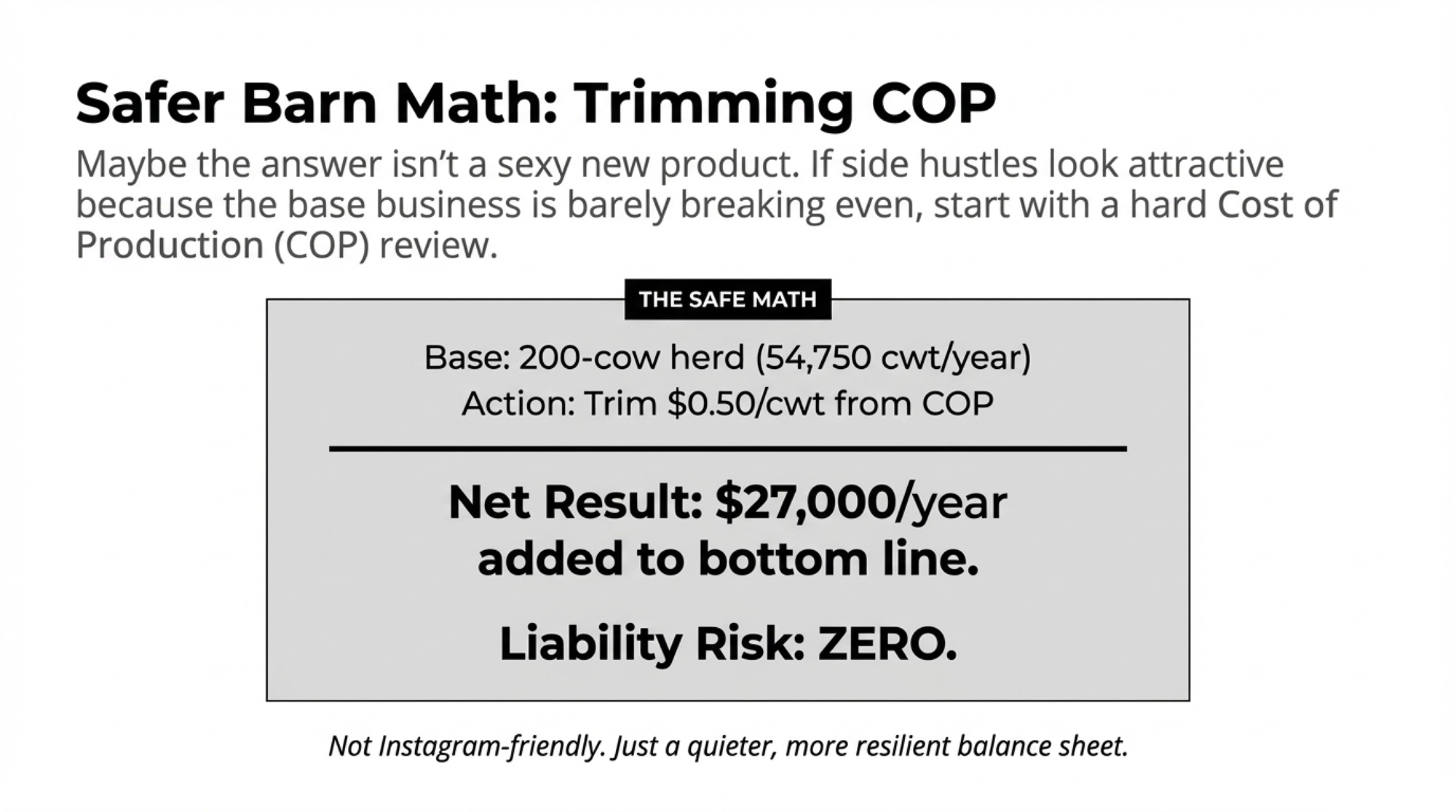
Tighten COP before chasing “sexy” revenue.
Maybe the answer isn’t a new product at all. If side hustles look attractive mainly because the base business is barely breaking even, start with a hard COP review — your nutritionist, accountant, and lender in the same conversation. Feed efficiency, shrink, heifer numbers, replacement strategy, and targeted automation.
| Strategy | Gross Revenue Potential (200-cow herd) | Insurance Impact | Regulatory Burden | Lawsuit Tail Risk | ROI Timeline |
|---|---|---|---|---|---|
| Raw milk direct sales | $31,200/year (100 gal/week @ $6 premium) | Policy exclusion likely; specialty $6K–$9K/year | High (state permits, testing, H5N1 mandates) | 840× illness risk; $250K–$450K exposure per case | 6–12 months (if no claims) |
| Branded pasteurised value-add | $25,000–$40,000/year (cream-top, flavored, soft cheese) | Standard coverage; no exclusions | Moderate (dairy plant license, HACCP, QA) | Normal food-product risk (pasteurisation barrier) | 18–36 months |
| Genetics-driven premiums (A2A2, grass-fed, organic) | $15,000–$35,000/year (component uplift on full volume) | No change to farm policy | Low (breed strategy, herd testing, processor contract) | Zero direct consumer contact | 24–48 months (herd turnover) |
| Cost-of-production tightening | $27,000–$41,000/year ($0.50–$0.75/cwt savings × 54,750 cwt) | Improves debt-to-asset ratio | None (internal process) | None | 12–18 months |
Here’s the barn math: for a 200‑cow herd shipping about 54,750 cwt per year, trimming $0.50/cwt from COP is worth roughly $27,000 per year. At $0.75/cwt, it’s about $41,000. Same neighbourhood as the raw‑milk gross margin — without any of the outbreak-and-lawsuit tail risk. It also lowers your breakeven, which directly strengthens your debt‑to‑asset picture. Not Instagram‑friendly. Just a quieter, more resilient balance sheet. If you want to see how mid‑size dairies are crunching the 2026 margin math, that’s worth reading alongside this.
On‑farm experiences and curated boxes
If you’re in a region with strong local‑food energy and your family is comfortable having people around, there’s a different way to harvest the trust that draws customers to raw milk. Partner with other farms for CSA‑style boxes or local‑food bundles featuring your pasteurised dairy. Lean into education, transparency, and your story. You deepen your social licence by showing urban neighbours where their food comes from, and your insurer doesn’t flinch.
Know yourself before you build the parking lot, though. If your location is remote, your labour is stretched, or the family isn’t keen on hosting, agri‑tourism adds stress rather than margin.

Key Takeaways
- If your raw‑milk liability premium quote comes in above 25–33% of your projected raw‑milk gross margin,you’re effectively self‑insuring a significant chunk of catastrophic risk. That should trigger a hard rethink — not a “maybe it’ll be fine.”
- If your co‑op or processor contract includes “uniform marketing,” “harm to co‑op,” or broad “conduct” language — and you don’t have explicit written approval for raw‑milk side sales — assume they can force a choice between staying in the truck line and filling jars. Organic Valley already drew that line in 2010 for 150–200 of its member farms. Ask in writing before you buy equipment.
- If your current farm‑liability policy has a raw‑milk or bacteria exclusion endorsement, treat that as no coverage for exactly the risk you’re adding. Dog Mountain Farm invested $75,000 before discovering the coverage wasn’t there. Your backstop is your own equity — land, barns, and everything you’ve built.
- If the wellness crowd is what’s pulling you, breed toward A2A2 or other specialty traits and capture that demand through pasteurised, branded programs. The consumer gets what they want. You keep your coverage.
- If you’re using European allergy studies to justify a raw‑milk business decision, re‑read the original research. The scientists behind PARSIFAL and GABRIELA explicitly say raw farm milk cannot be recommended as an allergy‑prevention tool. That’s not an opinion. It’s their conclusion.
The Bottom Line
Raw milk isn’t something your cousin argues about on Facebook anymore. A 2025 legal review counts 32 states that allow raw‑milk sales in some form, three states updated their laws in 2025, and more bills are moving in 2026. The access question is being answered. The liability question isn’t.
Within the next 30 days, pull your insurance policy, your co‑op or processor contract, and your most recent balance sheet out of the drawer. Email your broker, your field rep, and your lender one question each: “How would this policy or contract respond if I started selling raw milk from this farm?” If any of those answers makes your stomach tighten, you’ve already got more clarity than most people bottling straight from the tank.
The full cost‑per‑cwt model comparing raw milk, pasteurised value‑add, and specialty‑contract strategies across different herd sizes is the kind of deeper math that deserves its own piece — and it’s coming. Some gambles you can make on gut feel. This one deserves real numbers.
Complete references and supporting documentation are available upon request by contacting the editorial team at editor@thebullvine.com.
Learn More
- More Milk, Fewer Farms, $250K at Risk: The 2026 Numbers Every Dairy Needs to Run – Arms you with a definitive survival roadmap for mid-size herds facing negative margins. This breakdown delivers a concrete 30-day plan to slash operating costs by 75 cents/cwt and protect your equity before 2026 forces your hand.
- 211,000 More Dairy Cows. Bleeding Margins. The 2026 Math That Won’t Wait. – Exposes the structural “beef-on-dairy” trap and the massive supply shifts redefining the next three years. This analysis reveals how to position your herd’s genetics today to capture processing premiums and avoid the looming structural margin squeeze.
- Why the A2 Boom Bypassed Heritage Breeds – And What’s Actually Working – Reveals the precise genetic roadmap to capturing wellness-market premiums without the catastrophic liability of raw milk. This guide breaks down the A2A2 volume requirements and delivers the math on segregation to secure your farm’s future.
 The Sunday Read Dairy Professionals Don’t Skip.
 The Sunday Read Dairy Professionals Don’t Skip.
Every week, thousands of producers, breeders, and industry insiders open Bullvine Weekly for genetics insights, market shifts, and profit strategies they won’t find anywhere else. One email. Five minutes. Smarter decisions all week.




